

|
Getting your Trinity Audio player ready...
|
Prologue
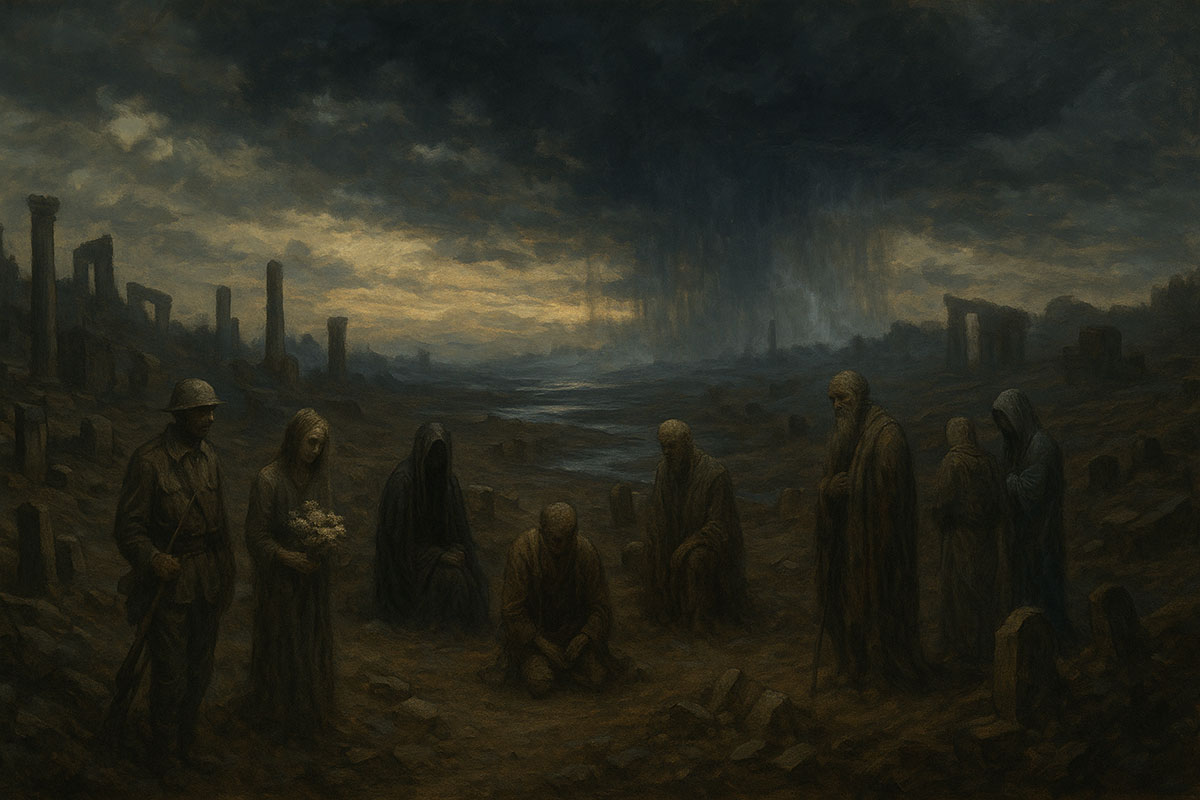
What you will see is not a story, but a ruin.
Fragments, broken voices, scattered images—
such is the world I inherited.
The earth lies barren after war,
the streets echo with hollow steps,
and the river carries refuse instead of song.
Once there was order, once there was faith—
now we live among splinters.
I do not offer comfort.
I only show you what remains:
a burial of the dead in springtime,
a queen drowning in mirrors,
a river turned to ash,
a sailor dissolved in water,
and a wasteland cracked beneath thunder.
And yet—
even in fragments,
there is a whisper.
Even in ruin,
there is the rumor of rain.
Scene 1 — The Burial of the Dead
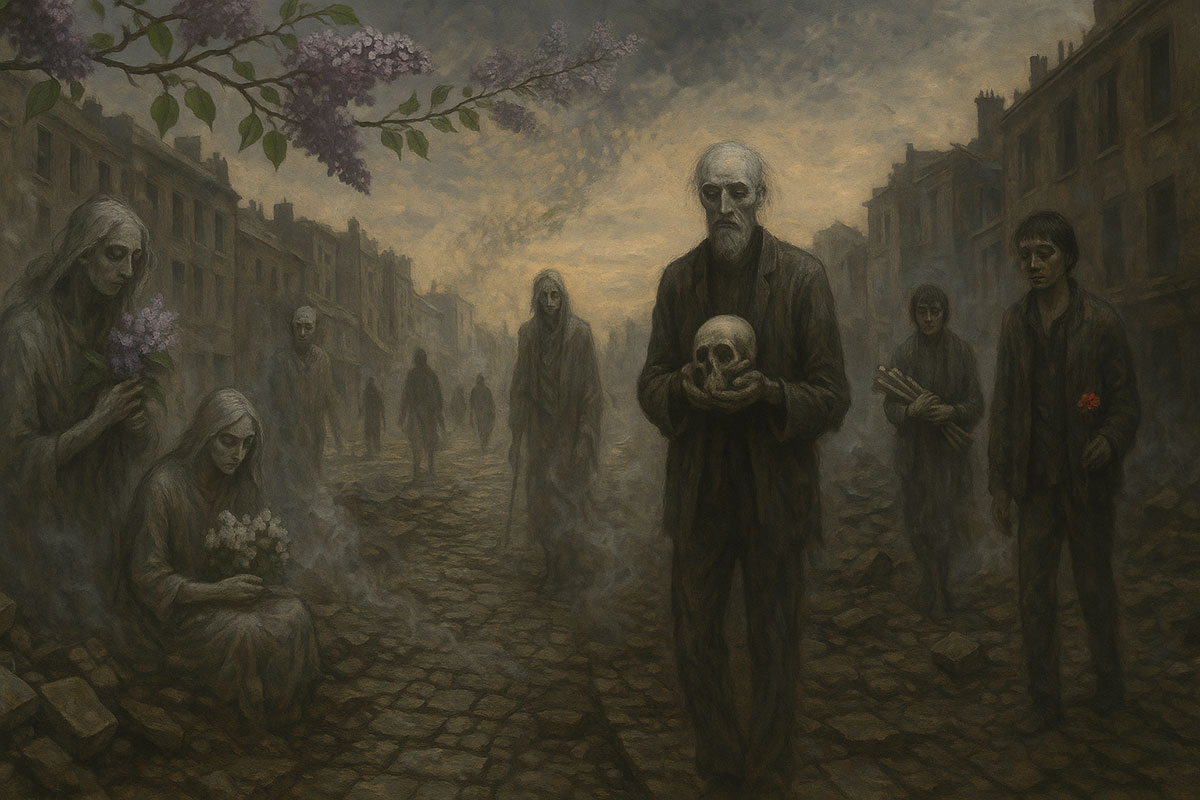
(The stage opens dim. A fractured London street, gray cobblestones cracked from war. Broken lampposts flicker. In the air, the faint smell of lilacs mixes with coal smoke. A lone figure — the Narrator — steps forward. Their voice wavers between poetry, memory, and hallucination. Around them, ghostly figures drift in and out, speaking fragments in many tongues.)
Narrator (softly, to himself):
April is the cruellest month…
mixing memory with desire,
stirring dull roots with spring rain.
(From the shadows, a Woman appears, clutching lilacs. She speaks as if recalling a dream.)
Woman:
I remember the lilacs in the garden—
purple against the dying light.
Winter kept us warm, covering earth in forgetful snow.
Why should April wake us?
Why must spring remind us of what we lost?
(A Man in a soldier’s coat stumbles across the stage. His boots echo. He looks out, as if seeing the trenches again. His voice is ragged.)
Soldier:
I saw men buried under falling sky,
the ground cracked open,
their eyes staring like broken lanterns.
They said it was for country,
but the country lay silent,
only crows saluting the dead.
(A child runs across, dragging a broken toy. The sound of laughter and nursery rhymes echoes, but warped, half-forgotten.)
Child (singing faintly):
Ring-a-ring o’ roses…
a pocket full of… ashes… ashes…
we all fall—
(The song collapses into silence. The Narrator trembles, as though holding too many voices inside.)
Narrator:
A heap of broken images,
where the sun beats,
and the dead tree gives no shelter.
What are we but fragments?
Words torn from newspapers,
faces blurred on the Underground.
Even memory crumbles like stone.
(A Mystic figure steps forward, cloaked. They hold Tarot cards, whispering.)
Mystic:
I read the cards of the age—
The Wheel, The Hanged Man, The Drowned Sailor.
But the card that is not drawn—
the one you long for—
is the card of meaning.
It is missing.
Always missing.
(A murmur rises from the crowd — ghostly figures crossing the stage like commuters. They whisper in German, French, and Latin, fragments of prayers, commands, and laments. The sound builds, chaotic, until it breaks into silence again.)
Narrator (voice trembling):
I want to ask…
do you remember?
The faces in the crowd at King William Street?
The eyes that met yours for one second in the tram?
Did we not pass one another once—
a million times—
and never truly see?
(The Woman drops her lilacs. The petals scatter across the cobblestones. She kneels, touching them, her voice filled with grief.)
Woman:
Lilacs…
symbols of spring,
symbols of graves.
Every flower whispers:
life goes on,
but not for everyone.
(The Soldier removes his cap, holding it against his chest. His voice is low, like a confession.)
Soldier:
The earth gave up its secrets in the trenches.
We buried youth in the mud
and called it honor.
But April brings them back—
faces I cannot forget,
hands that still reach from the soil.
(The Child speaks again, but softer, almost like a ghost.)
Child:
Why must we grow?
Why must we leave?
If spring means remembering,
I want winter forever.
(The Mystic raises their Tarot deck high, and thunder rumbles faintly.)
Mystic:
The gods laugh.
They deal us signs,
but we no longer know the language.
Every man carries fragments of Babel
in his mouth.
No voice completes the other.
All is scattered.
(The Narrator steps forward, breaking the stillness. His face is pale, his eyes searching. He turns to the audience, almost pleading.)
Narrator:
Is this the world we inherit?
A land of fragments,
ghosts in April sunlight,
a chorus of half-remembered songs?
We speak, but do not hear.
We live, but do not love.
We rise, only to bury again.
(He bends down, picks up a single lilac petal, and holds it between his fingers. A faint wind rises, carrying dust and whispers. The crowd of ghostly figures slowly exits, leaving only the Narrator onstage. He whispers the final words, barely audible.)
Narrator:
I will show you fear…
in a handful of dust.
(Blackout. The sound of wind remains, then silence.)
Scene 2 — A Game of Chess
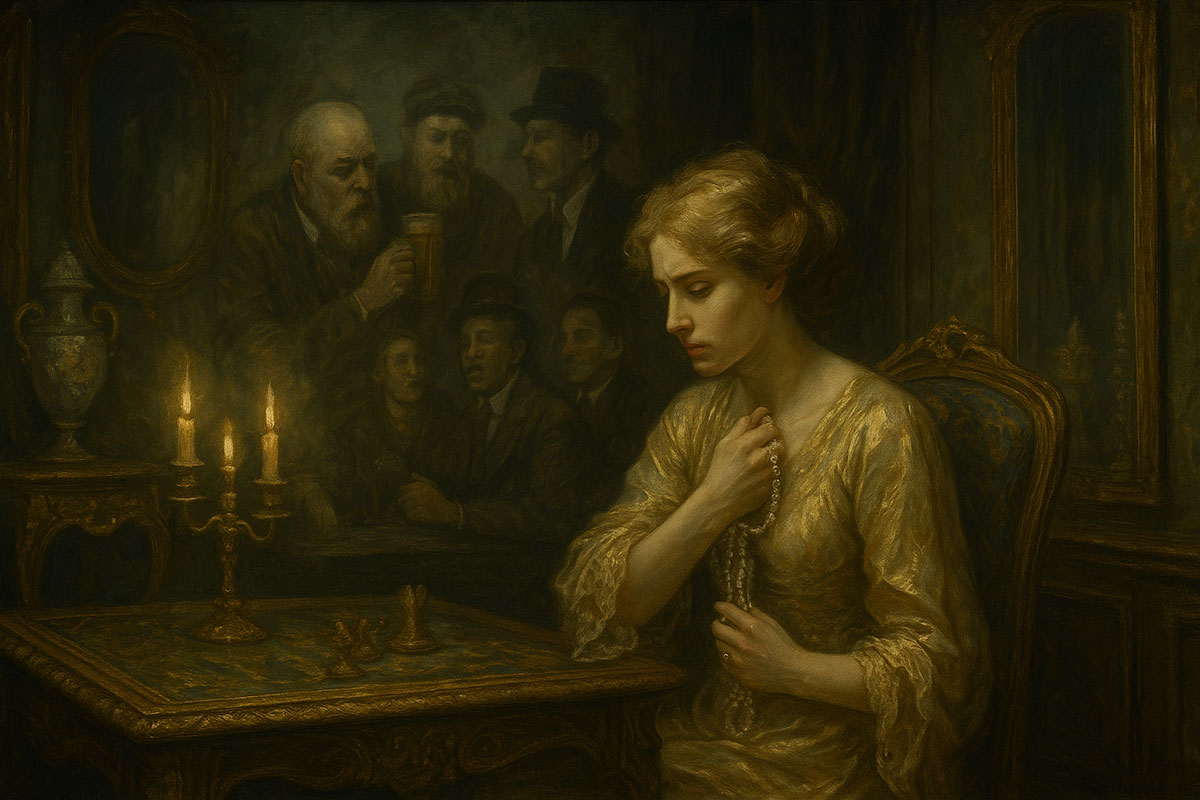
(The stage transforms. A grand but suffocating drawing room glows in golden lamplight. Heavy curtains block the windows. A chandelier hangs low, its light fractured in cracked mirrors. Perfume and incense fill the air, cloying and oppressive. At center stage, a Woman sits before a vanity, her hands covered in jewels. Her reflection is fractured by the mirror’s cracks. A Narrator watches from the shadows, speaking softly.)
Narrator (aside):
The chair she sat in, like a burnished throne…
glowed on the marble,
where a carved dolphin swam among faded sea nymphs.
Perfume filled the air like suffocation,
as if beauty could hide despair.
(The Woman runs her fingers through her jewels, her voice anxious, brittle.)
Woman:
Why do you sit so still?
Why won’t you speak?
Do you see me—this beauty, these treasures?
I am drowning in mirrors,
waiting for a word that never comes.
(She turns abruptly, staring at an empty chair across from her. The silence thickens. From the corner of the room, the sound of a clock ticks louder and louder.)
Woman (sharply):
What are you thinking?
What are you thinking?
What are you thinking?
(The silence answers her. She gasps, clutching her pearls. The Narrator moves closer, describing her nervous gestures.)
Narrator:
Her hair spread out like a restless flame,
her hands clutching ivory combs.
Yet behind her eyes was only panic,
an empty hunger echoing through crystal walls.
(A faint laugh rises from offstage — brittle, mocking. Two voices enter, overlapping: the Pub Women, dressed in shabby coats, leaning against each other as if propping themselves up. They bring with them the smell of stale beer and tobacco. Their voices are sharp, gossipy, cutting through the suffocating perfume.)
First Pub Woman:
Did you hear about Lil?
Her husband’s back from the army,
wants his good time again.
Second Pub Woman (snorting):
Good time? The poor girl’s teeth are gone.
Five kids already, and she looks twice her age.
Doctor says take pills for the swelling,
but pills for what? She’s spent, used up.
First Pub Woman:
I told her, “Get yourself some teeth, girl,
he wants a woman, not a ghost.”
She just sat there, eyes empty as a bottle.
What else can she do?
(Their voices overlap in chatter, trivial but brutal. The Woman at the vanity hears them faintly, as if their gossip seeps through the walls of her golden prison. She slams her hand on the vanity, rattling her jewels.)
Woman (crying out):
Stop! Stop your voices!
Your chatter drills holes into my skull.
I sit in silk, they sit in smoke,
but we are all the same—
trapped, barren, waiting.
*(The Pub Women laugh cruelly, then slowly fade back into the darkness, their voices echoing like broken records: “Hurry up, please, it’s time… hurry up, please, it’s time…”)
(The Woman rises from her chair, pacing. Her perfume seems to choke the room. She holds a goblet of wine but her hand trembles.)
Woman (desperate):
Is this life?
A glittering room,
a thousand mirrors,
and no one to see me?
I am a queen on a ruined chessboard.
Every move is emptiness.
Every word falls dead.
(The Narrator steps closer, his voice low, almost pitying.)
Narrator:
She seeks meaning in jewels,
but they are cold stones.
She seeks love in mirrors,
but the glass is cracked.
The game she plays is endless,
but there is no opponent.
(The Woman collapses into the chair again, burying her face in her jeweled hands. The ticking clock grows louder. Finally, she whispers, her voice frayed.)
Woman (softly):
Hurry up, please, it’s time.
Hurry up, please, it’s time.
(The lights dim. The room seems to shrink, mirrors reflecting fragments of her broken figure. The scent of perfume lingers like poison. Silence swallows the ticking of the clock. The Narrator speaks one final line, almost like a benediction, almost like a curse.)
Narrator:
Between the gossip of the poor
and the silence of the rich,
the world crumbles,
and the game goes on.
(Blackout. The echo of “hurry up, please, it’s time” lingers as if whispered by the walls themselves.)
Scene 3 — The Fire Sermon
Enter your text here...
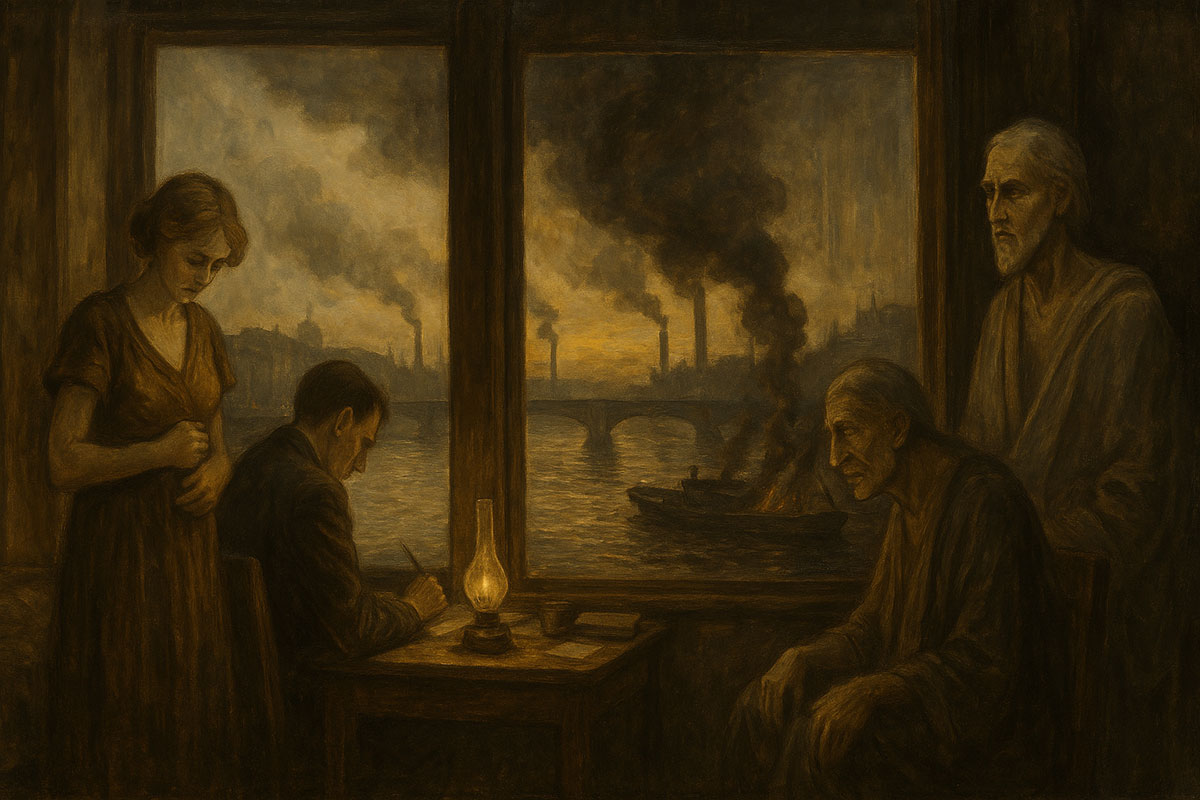
(The stage is set on the banks of the Thames at dusk. The river glimmers faintly, its surface oily with refuse. A gramophone crackles faint jazz from a distance. Tires, broken bottles, and bones litter the muddy shore. The air smells of smoke and river rot. The Narrator, weary, steps forward. His voice carries both lament and prophecy.)
Narrator:
The river sweats oil and tar.
Barges drift past in silence,
their cargo no longer spices or silks,
but rusted machines and broken hopes.
The water no longer sings,
it chokes.
(Figures shuffle along the banks—workers with hunched shoulders, women in factory dresses, children barefoot in mud. Their faces are blank, eyes dulled. A Seer, Tiresias, steps forward, robes tattered, eyes blind yet all-seeing. His voice is heavy with the knowledge of ages.)
Tiresias:
I, Tiresias, have seen it all—
the passionless coupling,
the weary surrender of flesh to flesh.
Desire without flame,
a ritual stripped of fire.
I watch as the human spirit
sells itself for convenience.
(A Typist enters, pale, her dress wrinkled, her movements mechanical. She sets down her bag in a cramped room lit by a weak lamp. A Clerk follows—his gestures clumsy, hurried. There is no romance, no tenderness. Their voices are dull, perfunctory.)
Clerk:
It’s late.
Let’s not waste time.
Typist (flatly):
All right.
(They move together without passion. The gramophone crackles louder with a cheap waltz, covering the silence. The Narrator watches, horrified, but without intervening.)
Narrator:
She turns, indifferent.
He leaves, indifferent.
The act completed like filling out a form.
No kiss. No fire.
Only silence pressing in like smoke.
(The Typist straightens her dress, sighs, and stares at the cracked ceiling. Her voice is barely more than a whisper.)
Typist:
Is this what it means to be alive?
A body touched but never seen,
a life shared but never known?
(She exits slowly, her shoes echoing on the bare floor. Tiresias steps into the center of the stage, raising his hands toward the polluted Thames.)
Tiresias (proclaiming):
Once, the river was sacred.
Priests sang by its banks,
lovers met beneath its bridges,
and the gods blessed its waters.
Now it carries only debris—
the remnants of human longing,
discarded, forgotten.
(From the shadows, a Chorus of Ancient Voices rises — fragments of Greek hymns, church chants, and Eastern mantras. Their overlapping sound creates a haunting dissonance.)
Chorus (fragments):
“Burnt by the fire…”
“…Holy, holy, holy…”
“…shantih, shantih, shantih…”
(The Narrator steps forward, addressing the audience directly, his voice breaking with urgency.)
Narrator:
Do you not see?
Lust without love is a desert.
Bodies lie together,
but hearts lie apart.
The fire of the spirit smolders,
smothered by smoke and indifference.
(The Clerk reappears briefly, adjusting his tie, indifferent. He lights a cigarette, tosses the match into the river. The flame fizzles out in the black water. Tiresias shakes his head slowly.)
Tiresias:
The fire that once cleansed,
the fire that once purified,
has been replaced by this—
a weak spark,
a wasted ember.
(The Chorus fades into silence. The only sound is the river’s sluggish current and the distant gramophone sputtering to its end. The stage dims, leaving Tiresias in faint light. His final words cut like prophecy.)
Tiresias (softly):
I who have seen all,
tell you this:
Without sacred fire,
the world decays.
Without love,
desire is ash.
(The light fades entirely. The audience is left with the faint echo of dripping water and the smell of smoke.)
(The stage is set on the banks of the Thames at dusk. The river glimmers faintly, its surface oily with refuse. A gramophone crackles faint jazz from a distance. Tires, broken bottles, and bones litter the muddy shore. The air smells of smoke and river rot. The Narrator, weary, steps forward. His voice carries both lament and prophecy.)
Narrator:
The river sweats oil and tar.
Barges drift past in silence,
their cargo no longer spices or silks,
but rusted machines and broken hopes.
The water no longer sings,
it chokes.
(Figures shuffle along the banks—workers with hunched shoulders, women in factory dresses, children barefoot in mud. Their faces are blank, eyes dulled. A Seer, Tiresias, steps forward, robes tattered, eyes blind yet all-seeing. His voice is heavy with the knowledge of ages.)
Tiresias:
I, Tiresias, have seen it all—
the passionless coupling,
the weary surrender of flesh to flesh.
Desire without flame,
a ritual stripped of fire.
I watch as the human spirit
sells itself for convenience.
(A Typist enters, pale, her dress wrinkled, her movements mechanical. She sets down her bag in a cramped room lit by a weak lamp. A Clerk follows—his gestures clumsy, hurried. There is no romance, no tenderness. Their voices are dull, perfunctory.)
Clerk:
It’s late.
Let’s not waste time.
Typist (flatly):
All right.
(They move together without passion. The gramophone crackles louder with a cheap waltz, covering the silence. The Narrator watches, horrified, but without intervening.)
Narrator:
She turns, indifferent.
He leaves, indifferent.
The act completed like filling out a form.
No kiss. No fire.
Only silence pressing in like smoke.
(The Typist straightens her dress, sighs, and stares at the cracked ceiling. Her voice is barely more than a whisper.)
Typist:
Is this what it means to be alive?
A body touched but never seen,
a life shared but never known?
(She exits slowly, her shoes echoing on the bare floor. Tiresias steps into the center of the stage, raising his hands toward the polluted Thames.)
Tiresias (proclaiming):
Once, the river was sacred.
Priests sang by its banks,
lovers met beneath its bridges,
and the gods blessed its waters.
Now it carries only debris—
the remnants of human longing,
discarded, forgotten.
(From the shadows, a Chorus of Ancient Voices rises — fragments of Greek hymns, church chants, and Eastern mantras. Their overlapping sound creates a haunting dissonance.)
Chorus (fragments):
“Burnt by the fire…”
“…Holy, holy, holy…”
“…shantih, shantih, shantih…”
(The Narrator steps forward, addressing the audience directly, his voice breaking with urgency.)
Narrator:
Do you not see?
Lust without love is a desert.
Bodies lie together,
but hearts lie apart.
The fire of the spirit smolders,
smothered by smoke and indifference.
(The Clerk reappears briefly, adjusting his tie, indifferent. He lights a cigarette, tosses the match into the river. The flame fizzles out in the black water. Tiresias shakes his head slowly.)
Tiresias:
The fire that once cleansed,
the fire that once purified,
has been replaced by this—
a weak spark,
a wasted ember.
(The Chorus fades into silence. The only sound is the river’s sluggish current and the distant gramophone sputtering to its end. The stage dims, leaving Tiresias in faint light. His final words cut like prophecy.)
Tiresias (softly):
I who have seen all,
tell you this:
Without sacred fire,
the world decays.
Without love,
desire is ash.
(The light fades entirely. The audience is left with the faint echo of dripping water and the smell of smoke.)
Scene 4 — Death by Water
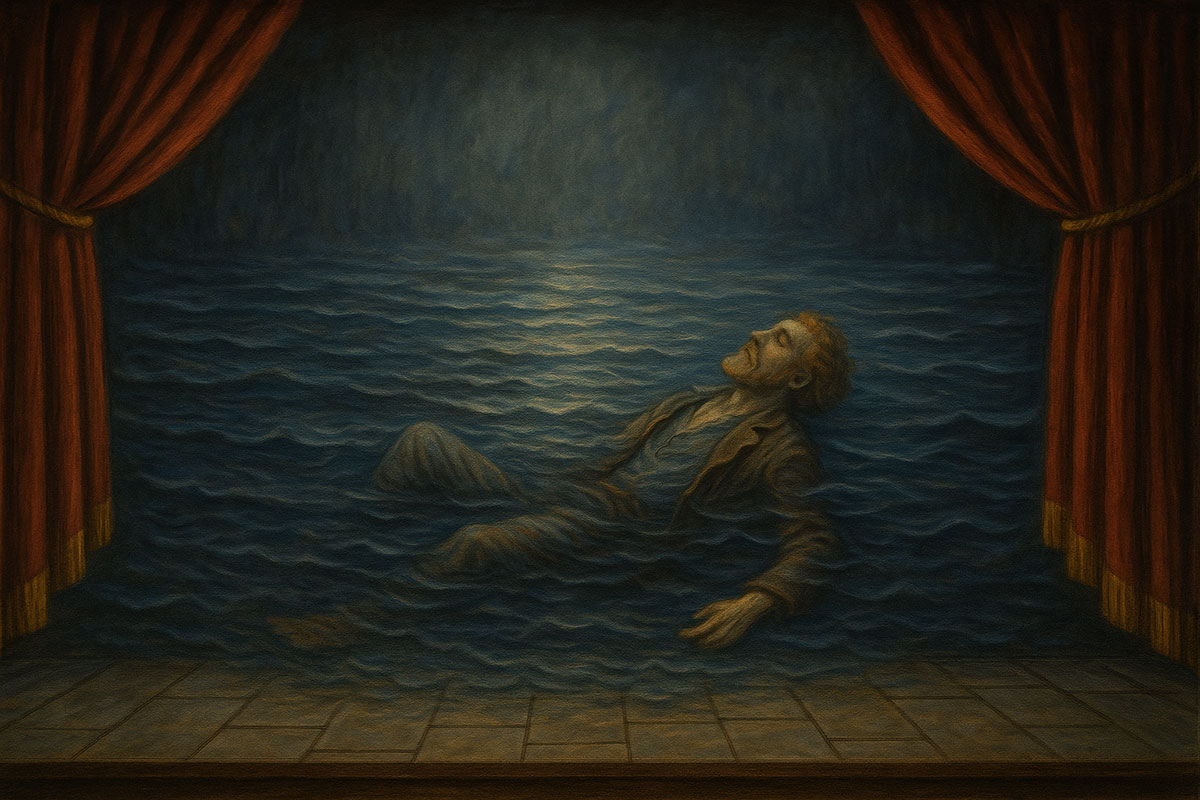
(The stage is bare. Darkness. Slowly, the sound of waves rises. Blue-gray light ripples across the floor like moving water. A faint smell of salt drifts through the air. In the center, a drowned Sailor lies motionless. His clothes are torn, his face pale. The Narrator enters quietly, voice hushed, as though standing in a cathedral of the sea.)
Narrator:
Phlebas the Phoenician, a fortnight dead,
floated through the currents,
his bones picked clean by salt and time.
He forgot the cry of gulls,
the weight of profits,
the turning of the wheel.
Water claimed him—
as it will claim us all.
(The Sailor stirs faintly, not alive, but as though memory flickers through him. His lips move, whispering fragments from a life lost.)
Sailor (whispering):
I traded in ivory, in spices, in copper…
counted coins by firelight…
dreamed of ports filled with laughter…
And yet the sea was always there,
watching me,
waiting.
(His voice dissolves into silence. The Chorus of the Sea rises — voices low and echoing, neither male nor female, like the deep itself speaking.)
Chorus of the Sea:
All men are swallowed.
Kings and beggars,
lovers and thieves—
the tide makes no distinction.
We strip them of pride,
we strip them of fear.
In water, all are equal.
(The Sailor’s body begins to drift slowly as though carried by invisible waves. The Narrator watches, his tone both mournful and reverent.)
Narrator:
Consider this, O you who walk upright on the land:
death waits beneath your feet.
The sailor forgot his debts, his victories, his name.
And in forgetting,
he was at last free.
(The Sailor’s voice returns faintly, but softer, as if memory is dissolving into water.)
Sailor:
I am lighter now…
no ledgers, no hunger, no fear.
Only the sea’s embrace…
only silence…
(The Chorus responds, their voices swelling with the rhythm of the waves.)
Chorus of the Sea:
Death is terror,
death is release.
Water devours,
water renews.
Those who sink learn truth:
you cannot take with you
what you tried to own.
(The sound of the waves grows louder, then subsides into a hushed rhythm, like breathing. The Narrator kneels by the Sailor, speaking almost as if delivering a sermon.)
Narrator:
Gentle or brutal,
the water speaks the same lesson:
Let go.
The wheel of profit, the clamor of voices,
the restless chase of tomorrow—
all dissolve.
What remains is not your treasure,
but your truth.
(A shaft of white light falls across the stage, as if moonlight breaks the surface of the water. The Sailor’s body drifts fully away, leaving emptiness at the center. The Chorus lowers to a whisper.)
Chorus of the Sea (softly):
Phlebas the Phoenician…
remembered youth,
forgot his name.
Death by water is death for all.
But in forgetting,
you may yet be reborn.
(The sound of waves swells once more, then cuts off abruptly, leaving only dripping water echoing in silence. The Narrator rises, his final words carrying both warning and promise.)
Narrator:
Fear death.
Embrace death.
For in its tide,
the world is washed clean.
(The stage darkens completely. Only the sound of a single drop falling into water remains. Then, silence.)
Scene 5 — What the Thunder Said
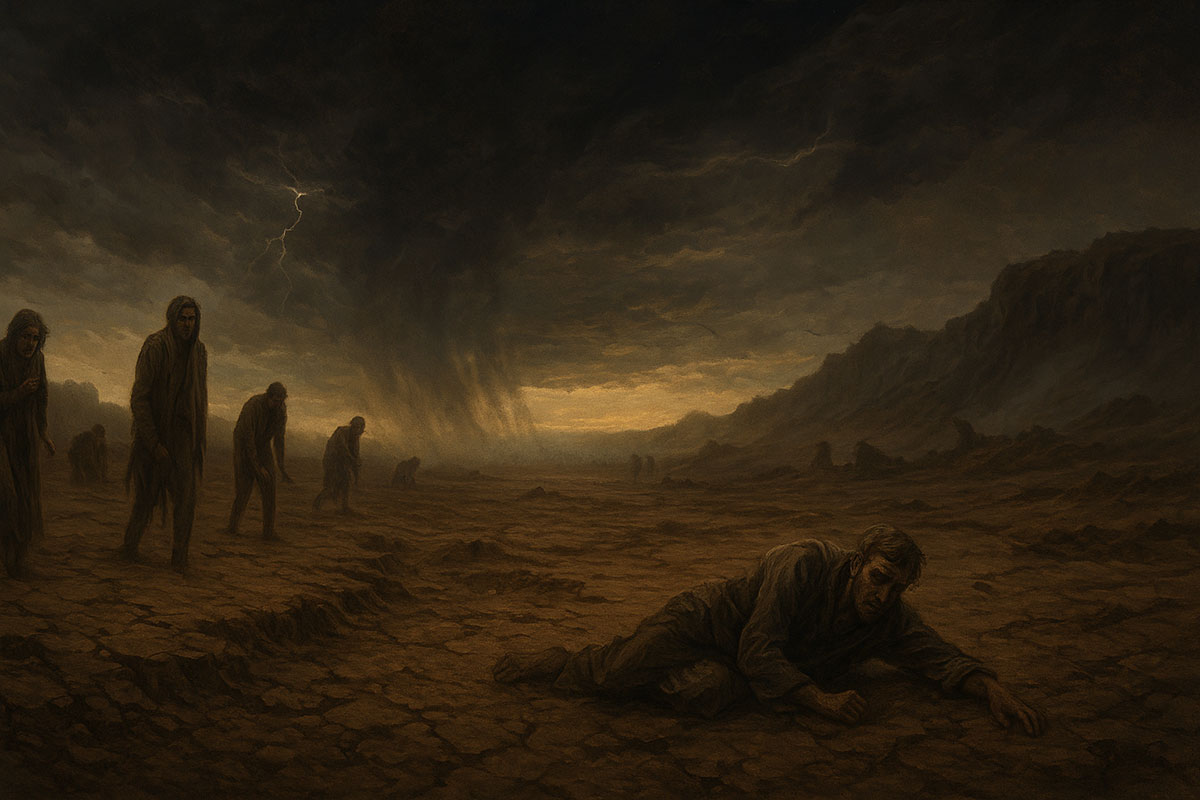
(The stage is barren: cracked earth, stone ruins, skeletal trees. The sky burns orange-red with dusk. Dry wind whistles through broken walls. The ground is parched, dust rising with every step. A Chorus of Wanderers staggers across the stage, gaunt, thirsty, whispering prayers in fragments. Their voices clash in Latin, Sanskrit, and broken English. Thunder rumbles faintly in the distance, but no rain falls.)
Chorus of Wanderers (fragments):
“Jerusalem fell…”
“…the dry bones, the dry bones…”
“…my God, my God, why hast thou forsaken me?”
(The Narrator enters, stumbling, his face pale, lips cracked with thirst. He looks to the horizon, then turns to the audience, voice trembling.)
Narrator:
Here is no water, but only rock.
Rock and no water, and the sandy road—
the road winding endlessly into silence.
If there were water, we should stop and drink.
But there is no water.
(The Chorus groans, collapsing on the ground. A shadowed Figure walks among them, faintly glowing — a Christ-like presence, unrecognized. The Wanderers whisper as he passes.)
Chorus (whispering):
Who is the third who walks always beside you?
When I count, there are only you and I together,
but when I look ahead up the white road
there is always another one walking beside you.
(The Narrator reaches for the figure, but the vision fades like a mirage. A heavy silence falls. The ground trembles with distant thunder. A Mystic steps forward, cloaked, holding ancient scrolls. Their voice is deep, commanding.)
Mystic:
The cities crumble.
Jerusalem, Athens, Alexandria, Vienna, London—
all lie broken in dust.
The towers fall,
the market stalls collapse,
and man’s empire turns to sand.
(The Chorus wails, their voices rising in grief. Suddenly, thunder crashes overhead, louder now. The Mystic raises a hand, as though listening.)
Mystic (intoning):
The thunder speaks.
It says: DA.
(The word reverberates across the stage. The Wanderers lift their heads weakly. The Mystic explains, voice ringing like prophecy.)
Mystic:
DA: Datta — Give.
Give of yourself,
your pride, your greed, your endless hunger.
Give, and be made whole.
(Thunder rumbles again, closer. The Mystic listens.)
Mystic:
DA: Dayadhvam — Sympathize.
Break the prison of your loneliness.
See the suffering of the other as your own.
Sympathize, and be human again.
(The Chorus slowly rises, their voices softer, more hopeful. Thunder rolls once more, echoing deep.)
Mystic:
DA: Damyata — Control.
Not domination, but discipline.
Master desire before it consumes you.
Control, and walk free.
*(The Wanderers repeat after him, their voices growing stronger with each word: “Give. Sympathize. Control.”)
(The Narrator, trembling, lifts his arms toward the sky. His voice breaks between despair and hope.)
Narrator:
I have seen the cities fall.
I have seen love rot into ash,
water turn to poison,
the earth crack with emptiness.
But still—still—
the thunder speaks.
Still it promises rain.
(The sky darkens. A low roll of thunder fills the stage. Suddenly, a faint rain begins to fall—light at first, then steadier. The Chorus stretches out their hands, catching droplets, laughing and weeping together. The Narrator closes his eyes, the water running down his face.)
Narrator (whispering):
These fragments I have shored against my ruins.
This broken world,
this broken self,
yet touched with water,
touched with grace.
(The Mystic raises both hands as the rain falls. The final words echo across the stage like both a blessing and a prayer.)
Mystic:
Shantih… shantih… shantih.
(The lights dim as the Chorus repeats softly, “Shantih… peace… peace that passeth understanding.” The rain continues to fall, steady and cleansing. The curtain lowers in silence.)
Epilogue
You have walked with me through dust and silence,
through rooms of empty laughter,
through rivers that choke,
through death beneath the waves,
through thunder over stone.
What remains?
Only fragments—
but fragments shored against my ruins.
The world is broken,
but still the thunder speaks:
Give. Sympathize. Control.
Still the rain begins to fall,
hesitant, fragile, yet real.
I cannot promise peace entire,
only the beginning of it—
a word, a whisper,
a drop of water on cracked earth.
Shantih… shantih… shantih…
the peace which passes understanding.
Short Bios:
T.S. Eliot — Anglo-American poet (1888–1965), one of the foremost voices of modernism. Author of The Waste Land, Four Quartets, and The Love Song of J. Alfred Prufrock, Eliot captured the spiritual desolation of the 20th century while searching for renewal through faith, myth, and fragmented voices. Awarded the Nobel Prize in Literature in 1948.
The Narrator — A shifting voice of witness and lament, often echoing Eliot’s own perspective. Observes the world as fragments—haunted, disjointed, but still yearning for meaning.
The Woman at the Vanity — Symbol of modern emptiness and suffocation. Surrounded by jewels and mirrors, she represents both decadence and loneliness in a culture of appearances.
The Soldier — Embodiment of the Great War’s trauma. His memories of trenches and fallen comrades haunt the city streets, a reminder of the cost of progress and empire.
The Typist and Clerk — Figures of mechanical lust in The Fire Sermon, their passionless encounter reflects Eliot’s despair at intimacy stripped of love, leaving only routine and emptiness.
Tiresias — The blind seer of Greek myth, present in many voices throughout The Waste Land. He embodies the union of genders, past and present, and serves as the prophetic witness to modern decay.
The Sailor (Phlebas the Phoenician) — A drowned merchant whose death is both a warning and a release. He symbolizes the futility of worldly pursuits, and the equalizing force of mortality.
The Mystic — A composite figure, part Eastern scripture, part prophet, part priest. In the final scene, they interpret the thunder’s voice (Datta, Dayadhvam, Damyata), offering fragile hope amid ruin.
The Chorus of Wanderers — Gaunt, ghostly figures who voice fragments of nursery rhymes, war chants, and prayers. They are everyman and no one, embodying the collective disorientation of modern humanity.
Leave a Reply