

|
Getting your Trinity Audio player ready...
|

Introduction by Richard Connell
When I first wrote The Most Dangerous Game, I meant only to ask what becomes of a hunter when he feels the terror of prey. But stories are not chains that end with a single strike; they are rivers that flow beyond their banks. What happens after victory? What echoes remain when the guns fall silent?
This retelling ventures further into that wilderness. It does not invent new rules so much as reveal the ones already whispered within the original: the temptation to inherit cruelty, the burden of survival, the price of power. Ship-Trap Island is not merely a stage for one duel. It is a mirror, and every man who gazes into it must decide whether he sees a hunter, the hunted… or something worse.
(This performance begins with a familiar tale and unfolds into newly imagined acts, offering an original continuation inspired by its themes.)
Prologue
(A low, steady sound of surf. The stage is dim. A faint green glow seeps through, as though the jungle itself is breathing. The Chorus speaks, calm and eerie, from all directions at once.)
Chorus
There is an island in the sea.
Sailors whisper its name in fear, for ships that pass too near are broken, and men who swim ashore do not return.
Here, the jungle does not forgive.
Here, the sea delivers prey.
Here, the hunter’s heart beats faster, and the hunted learns what terror is.
Men have walked these cliffs. Men have made their rules, their traps, their games. One dies, another takes his place. The island does not care. It remembers. It waits.
Listen now, and you will hear not just one hunt, but many. You will see not just one man’s victory, but the cost of carrying it. You will learn why this is called the most dangerous game.
(The sound of a distant baying hound echoes, then fades into silence. Lights rise on Scene 1.)
Scene 1 — The Hunt (Original Story)
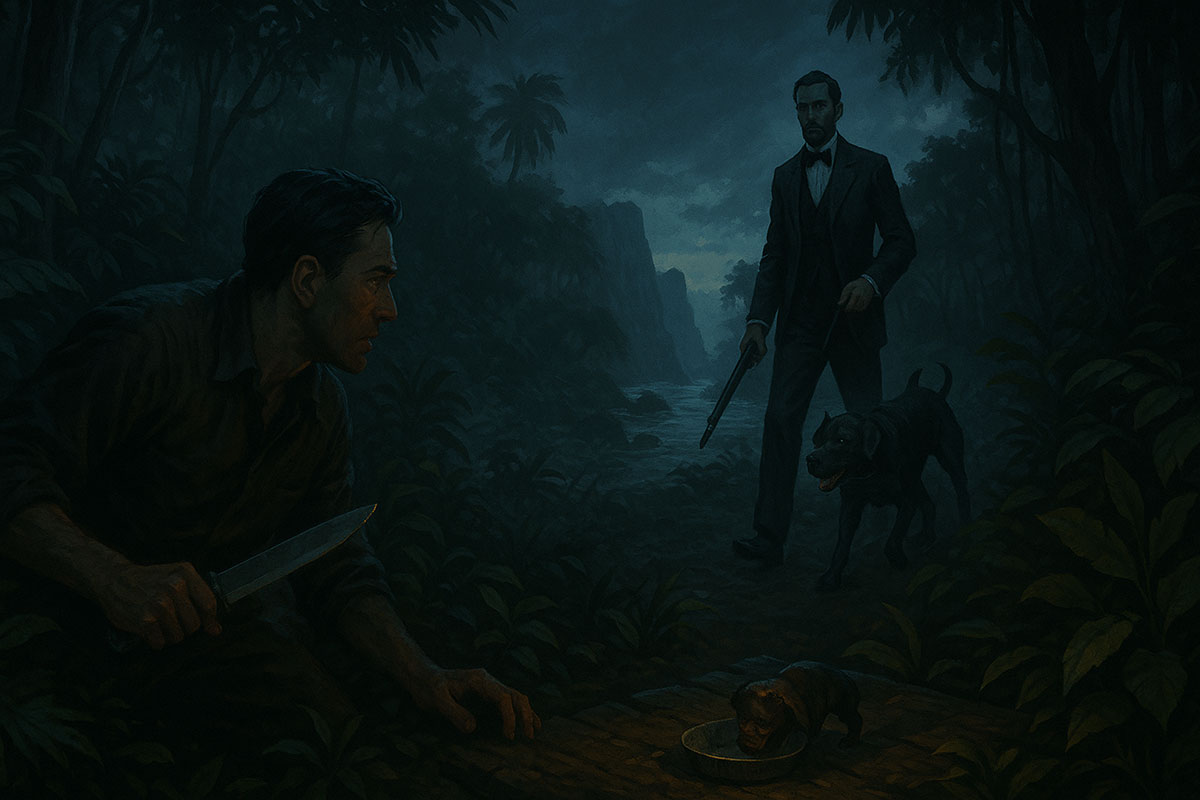
Setting (split stage):
- Stage Left: The Caribbean night. A low rail suggests a yacht; water-light ripples across the floor.
- Center: The jungle on Ship-Trap Island. Palms, creepers, a faint animal path.
- Stage Right: Zaroff’s chateau. Black-and-white marble floor, mounted heads, a great window, a bed curtained in dark silk.
Lights: Moon-blue on the sea; humid green in the jungle; warm, civilized amber in the chateau that never quite feels safe.
Sound: Slow swell of waves; far-off gunshot; jungle insects; the baying of hounds that sometimes stops too suddenly.
Aboard the yacht
Moonlit deck. A faint cigar ember. The sea murmurs.
Whitney
You have good eyes, Rainsford. Can you see Ship-Trap?
Rainsford
(peering)
Only dark—like someone blotted out a piece of night.
Whitney
Sailors say that island makes them uneasy.
Rainsford
(amused)
Superstition. The world’s divided into two classes—the hunters and the hun—
A sudden rope-snap, a lurch. A shot cracks from the darkness. Rainsford reaches, misses, falls. Splash.
Rainsford
(surfacing, gasping)
Whitney!
The yacht slides away like a lit city. Silence, then the relentless hiss of water. He swims toward the blacker black.
Lights cross-fade to the island shore.
The jungle edge
Dawn smear. Rainsford crawls from surf, exhausted, then still: he’s listening.
Rainsford
Shots. Three… someone hunting with gusto.
He stands, finds a smooth cartridge case, a print larger than his own, and a strange, deliberate boot heel.
Rainsford
(grim)
Civilization, after all.
He follows the signs into the green.
The chateau door
Thunder of knocker; door swings. A giant Cossack—Ivan—fills the frame, silent, menacing.
Rainsford
American. Overboard. I need—
From deeper within: a cultivated baritone.
Zaroff
(off)
Ivan, let our guest in.
Lights warm. The hall: trophies, silk, crystal. General Zaroff steps from shadow—tall, silver-haired, eyes like cold wine.
Zaroff
Forgive my servant’s manners. You’ve had a night of it. I am General Zaroff. This is my poor refuge from boredom.
Rainsford
I’m Sanger Rainsford.
Zaroff
(brightening)
The hunter? How excellent. Come—food, clothes, a bed, and after that, talk.
Dinner
Lamps glow. Porcelain gleams. Wine poured. Hounds bark distantly; Zaroff gestures and they hush.
Zaroff
I read your book on snow leopards. You have a gift. But the world grows tame, does it not? Tigers dull. Cape buffalo? A headache. I found myself yawning.
Rainsford
(dry)
Hunting is still hunting.
Zaroff
Unless one improves the sport. I have. I hunt the one animal that can reason.
A beat.
Rainsford
(hard)
You can’t mean—
Zaroff
(pleasantly)
I do. Men. Sailors chiefly. The sea is my best accomplice. I give them a head start, food, a knife. If they last three days, they win. No one has.
Rainsford
That’s not hunting. That’s murder.
Zaroff
Nonsense. I save them from the slow rot of the sea. I offer them art—struggle, choice, the high breath of fear. You of all men should admire it.
Rainsford
I’ll not admire, and I’ll not join.
Zaroff
(sighs, almost kindly)
I fear you misunderstand your position, dear fellow. You will hunt with me… or be hunted by me. Ivan will show you to your room. Rest. Dawn is so flattering to the jungle.
The smile does not reach his eyes.
The rules
Morning haze. Jungle shimmer. Zaroff stands in riding clothes; Ivan holds a small pack and a long-bladed knife.
Zaroff
Supplies. Clothes fit for running. A splendid knife. I shall follow with hounds… and with this. (He pats a light carbine.) You have until midday. After that, we will see who is hunter and who is a theory in a book.
Rainsford
(tight)
If I win?
Zaroff
You’ll have my congratulations—and a boat. If I win, you’ll have furnished me a very interesting afternoon. Off you go.
He bows. Rainsford vanishes into green.
The game
Insects. Heat. Rainsford moves like a cat—doubling back, climbing, dropping, scuffing. He pauses to breathe, then kneels and works quickly with saplings and vine.
Rainsford
Malay mancatcher.
He hides. Time dilates. A twig cracks; the faint scent of expensive tobacco. Zaroff strolls into the clearing as if in a park.
Zaroff
(calling)
An admirable strategy, Rainsford. You reason well.
He steps where the trap will not spring, then deliberately shifts his weight—crack!—the log slams too early, glancing his shoulder. He staggers, laughs softly, blood bright on linen.
Zaroff
Oh, delightful! But I must have my pleasures whole. Rest well. We play again at dusk.
He withdraws. Rainsford’s face tightens. He moves.
Night seep. A pit under palm fronds; sharpened stakes below—a Burmese tiger pit.
Rainsford
(hoarse whisper)
Come on, then.
Hounds bay nearer. Lantern glow. Zaroff’s silhouette pauses on the far side of the pit.
Zaroff
My dear man, I pride myself on reading terrain.
He gestures; a great dog leaps—and vanishes with a yelp that ends too fast. A handler screams; silence.
Zaroff
(a sigh)
You wound me in wardrobe, you wound me in kennel. Tomorrow, then. We mustn’t hurry the rare vintage.
He’s gone. The jungle listens.
Later—deep night. Rainsford lashes a sapling, ties the knife, tensions the vine: a Ugandan trick. Sweat stings his eyes.
Rainsford
One more.
At dawn’s rim the bush whispers. Ivan advances with a leash of hounds; he parts the foliage—snap! The sprung knife lashes out. A dull thud. The hounds erupt, then falter. Rainsford is already running, breath and heart like drums.
The cliff
The island falls away into white surf. Far below, rocks lace the water.
Rainsford
(ragged, cornered)
Hunters and hunted.
The hounds burst through. Zaroff appears, immaculate again, only the bandage at his shoulder betraying the game.
Zaroff
Bravo. Few get this far. Shall I shoot you like a bird or let the dogs—
But Rainsford is already moving—two steps, three—and dives. The sea takes him. Foam leaps, then smooths. Hounds bay frustrated. Zaroff watches, then smiles a schoolboy’s smile.
Zaroff
A splendid end. The sea is a jealous partner. Well done, Rainsford.
He signals the pack. They turn away.
Night at the chateau
Candles. The game room now silent. Zaroff pours a last glass, contemplative, then wanders into his bedroom. He loosens his cravat, draws back the curtain—and stops.
In the shadows beside the bed, wet hair, cold eyes: Rainsford.
Rainsford
I’m still at bay.
Zaroff
(pulse quickening, delighted)
Marvelous! Then the game continues—in here, between us. One wins the bed. The other feeds the hounds.
A pause—no more words. The two men move. The lights jump—shadows flail against the silk like birds in a storm—then a crash, a cry cut short. Silence. The distant hounds, expectant, do not feast.
Lights hold on the bed’s dark outline. Rainsford steps into the lamplight, breathing hard, the knife in his hand a quiet line. He looks at the window, at the trophies, at the sea’s small reflection in the glass. He does not smile. He drops the knife. He sits on the edge of the vast bed, then lies back, as if testing whether sleep is possible for his kind.
Rainsford
(a murmur to no one)
At last—a night without watching.
He reaches to extinguish the lamp. The room darkens to a civilized amber and then to nothing. The jungle hums beyond the walls, patient as ever.
Blackout.
Scene 2 — The Survivor
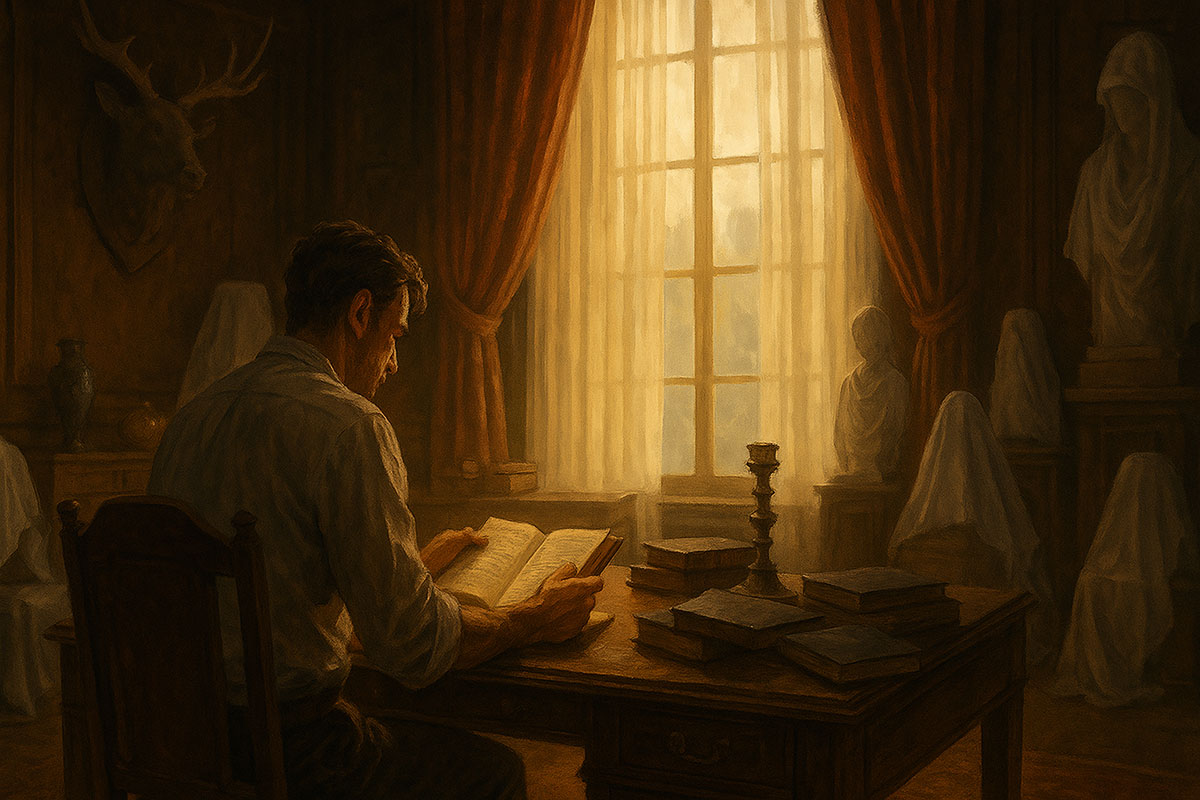
Setting: Zaroff’s chateau at dawn. The vast rooms feel hollow, as though stripped of their master’s presence. The jungle hum presses faintly through shuttered windows.
Lights: Pale morning light filters through curtains, soft but unforgiving. Shadows are long, stretched, as if the house itself remembers.
Sound: A distant surf, cicadas, the faint groan of wood in the mansion. Occasionally the hounds bark in their kennels, then fall silent, waiting.
The bedroom
Stage Right: the silken canopy bed where Zaroff once slept. Rainsford lies awake upon it, staring at the ceiling. The knife from last night lies on the floor beside him. His breathing is steady but his eyes are alert, haunted.
Rainsford
(whispering)
A night without watching… and yet I watched. Every creak, every whisper of the sea. I won, didn’t I? Then why does it feel like the hunt is still running?
He sits up, rubs his face. The sheets seem too fine, too suffocating. He looks at the mounted trophies on the wall—boars, tigers, a cape buffalo with glassy eyes. He looks away quickly, then forces himself to stare back.
Rainsford
Animals. Always animals. And men, hidden elsewhere.
The hall
Stage Center: The grand hall of the chateau. The heads of exotic animals glare from the walls. Rainsford enters, barefoot, his shirt open, weary but restless. He pours water into a crystal glass and drinks. He notices a locked cabinet. He pulls at it, then smashes the glass with the butt of his knife. Papers, journals, and maps spill out.
He kneels, leafing through Zaroff’s journals. His expression tightens.
Rainsford
(reading aloud)
“June 4th — American sailor lasted two days. Promising. Shot him at the swamp.”
“August 12th — The Cossack relishes feeding the hounds.”
“October 1st — New shipment of knives arrived. Pray God for better sport.”
(He drops the journal, disgusted. He finds a box of trinkets—watches, coins, a child’s shoe, a wedding ring. He stares at the ring for a long time before setting it down gently.)
Rainsford
This isn’t a sport. It’s a cemetery with trophies.
The kennel
Stage Left: faint light reveals the barred kennels. The hounds whimper and paw at the doors. They know Zaroff is gone. Rainsford approaches cautiously, the knife in his hand. He looks at them with loathing, then pity.
Rainsford
Monsters. No… not monsters. Made into monsters.
He raises the knife as though to strike, then lowers it. He unlocks the gate. The hounds rush out, circling him, confused but not attacking. They run into the jungle, baying. The silence afterward feels deeper.
The dining room
Lights shift. Rainsford sits at Zaroff’s long dining table. A servant’s bell lies untouched. He pours himself coffee, hands trembling. The silverware gleams too brightly. He pushes the cup away. His reflection in the polished wood startles him.
Rainsford
(to himself)
The world divided into hunters and hunted… I said that. And now I’ve seen what it means when a man believes it fully.
He rises, paces. His voice sharpens.
Rainsford
But what now? Do I leave this place, sail away, pretend the island never breathed? Or do I stay, master of Zaroff’s throne, and keep the rules alive?
(He stops, horrified at his own words. He presses his hands against the table, gripping hard.)
Rainsford
No. That is his voice in me. That is his echo.
The study
Stage Center: Rainsford enters a smaller room lined with books. The journals lie scattered. He gathers them, hesitating. The temptation to burn them is strong.
Rainsford
(muttering)
If I burn it, the game dies here. No one will know. No one will remember.
He strikes a match, holds it above the papers. The flame dances close, but he cannot release it. Slowly, he blows the match out. He sinks into a chair, defeated.
Rainsford
But if no one remembers, then the dead stay buried as shadows. And I am their only witness.
He stares into silence, haunted by the weight of memory.
Final tableau of Scene 2
The lights narrow on Rainsford at the study desk. He sits hunched over Zaroff’s journals, surrounded by relics of the dead. The crucifix of a rosary, a broken shoe, a rusted knife. The house looms around him. The jungle’s hum presses louder, alive, as though watching.
Rainsford
(softly, almost to the audience)
I killed Zaroff, but I did not end him. He lives here, in the walls, in the pages, in the silence between the waves. And now, perhaps, in me.
Blackout.
Scene 3 — The Visitors
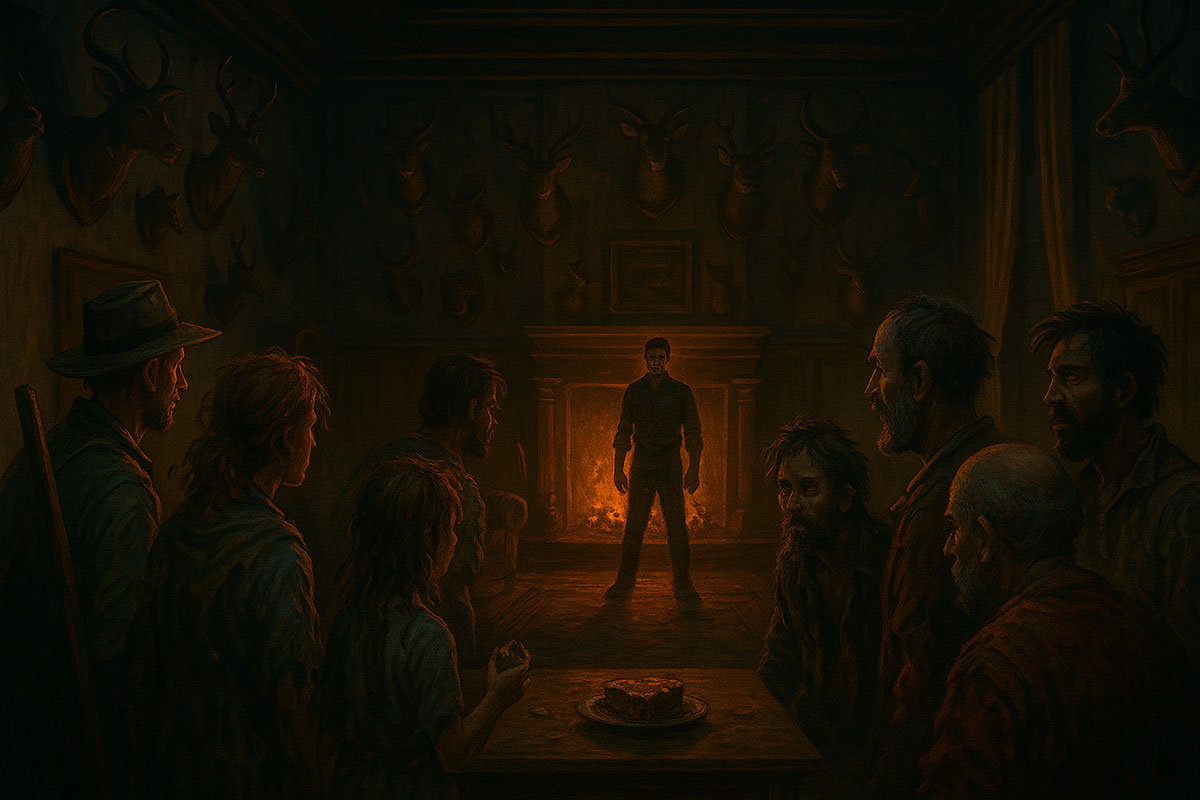
Setting: Zaroff’s chateau, now maintained but slightly more disordered. Dust gathers on surfaces. Some of Zaroff’s trophies remain, though covered with sheets. The jungle outside hums louder, closer, as if reclaiming.
Lights: Afternoon sunlight filtered through torn curtains. Sharp contrasts — bright beams cut across long shadows.
Sound: Ocean waves breaking against rocks. Crows circle overhead. Occasional creak of wood.
The wreck
Stage Left: dim projection of a broken mast, wreckage on rocks. Survivors stagger ashore — a CAPTAIN, two SAILORS, and a YOUNG WOMAN, all ragged and soaked. They whisper of landfall, relief, but look unsettled by the island’s silence.
Captain
Ship-Trap Island. Better drowned than here, they used to say.
Sailor 1
Yet we live. Praise God for it.
Sailor 2
Or curse Him, maybe. Look at this place. It watches.
They stumble toward the chateau. Lights shift to Stage Right.
The chateau door
The survivors approach the door. It creaks open before they knock. Rainsford stands there, gaunt, his clothes neat but worn. His eyes are sharper, older. He speaks with forced calm.
Rainsford
Come in. You’ll need rest, food, dry clothes.
They hesitate. The Young Woman peers past him into the hall, noting the trophies hidden beneath sheets. The Captain finally nods, leading them inside.
The hall
Stage Center: the group enters the trophy hall. Dust motes swirl. Rainsford gestures to chairs, pours water into glasses, his movements precise, too controlled. The survivors drink, exhausted.
Captain
You’re alone here?
Rainsford
Yes. The master of the house is gone. I am… what remains.
Sailor 1
And who was he?
(A pause. Rainsford’s jaw tightens. He chooses his words carefully.)
Rainsford
A hunter. Too fond of the chase.
Young Woman
(softly)
And now you?
The question hangs. Rainsford meets her eyes but does not answer. He turns away, busying himself with bread and fruit. The silence stretches. The survivors glance uneasily at each other.
Zaroff’s journals
Stage Right: Later that night. The survivors rest uneasily in the hall. Sailor 2 wanders, curious. He finds the cabinet of journals, still unburned. He flips one open by lamplight. His eyes widen.
Sailor 2
(reading aloud)
“March 14 — fisherman caught, lasted one day.”
“March 21 — two sailors cornered at the cliff.”
(He looks up, pale. The Captain snatches the journal, scanning it quickly, his expression darkening. The Young Woman stares at Rainsford, who sits silently, staring into the fire.)
Captain
What is this?
Rainsford
(flatly)
The truth of this island. The man who ruled it is dead by my hand. His sport ended with him.
Sailor 1
And how do we know that? Maybe you’re him now. Maybe you play the same game.
Young Woman
(quiet but firm)
His eyes… they’re the eyes of someone who has hunted and been hunted.
(Rainsford finally turns, voice low but sharp.)
Rainsford
I killed Zaroff because I would not be his prey. If you doubt me, leave now. The sea will welcome you.
The silence crackles with tension. The survivors exchange looks — torn between gratitude and fear.
The crack in trust
Days pass in montage: the survivors eat, repair clothes, mend wounds. Rainsford is courteous but distant. He spends hours pacing, reading, staring out windows. Whispers grow among the sailors.
Sailor 1
(to Sailor 2, aside)
Too calm. Too careful. He watches us the way men watch game.
Sailor 2
Aye. Maybe the island needs a master. And maybe he’s it now.
(The Young Woman listens, unsettled. That night, she approaches Rainsford alone, in the study.)
Young Woman
Why haven’t you burned those journals?
Rainsford
Because if I destroy them, the dead vanish with them. And if I keep them, their voices whisper. I don’t know which is worse.
Young Woman
Then maybe it isn’t the island that’s cursed. Maybe it’s you.
(Rainsford stares at her, shaken. He closes the journal sharply and rises. The moment lingers, unresolved.)
Final tableau of Scene 3
The survivors huddle in whispers on one side of the stage; Rainsford stands alone on the other, backlit by jungle green light pressing through the window. His silhouette is tense, hunted and hunter at once.
Captain
(in a low voice to the group)
Mark me — no man lives on Ship-Trap without becoming Zaroff in the end.
The lights fade on the divided stage — survivors fearful, Rainsford isolated, the jungle hum swelling louder, as if waiting for the next hunt to begin.
Blackout.
Scene 4 — The Rebellion
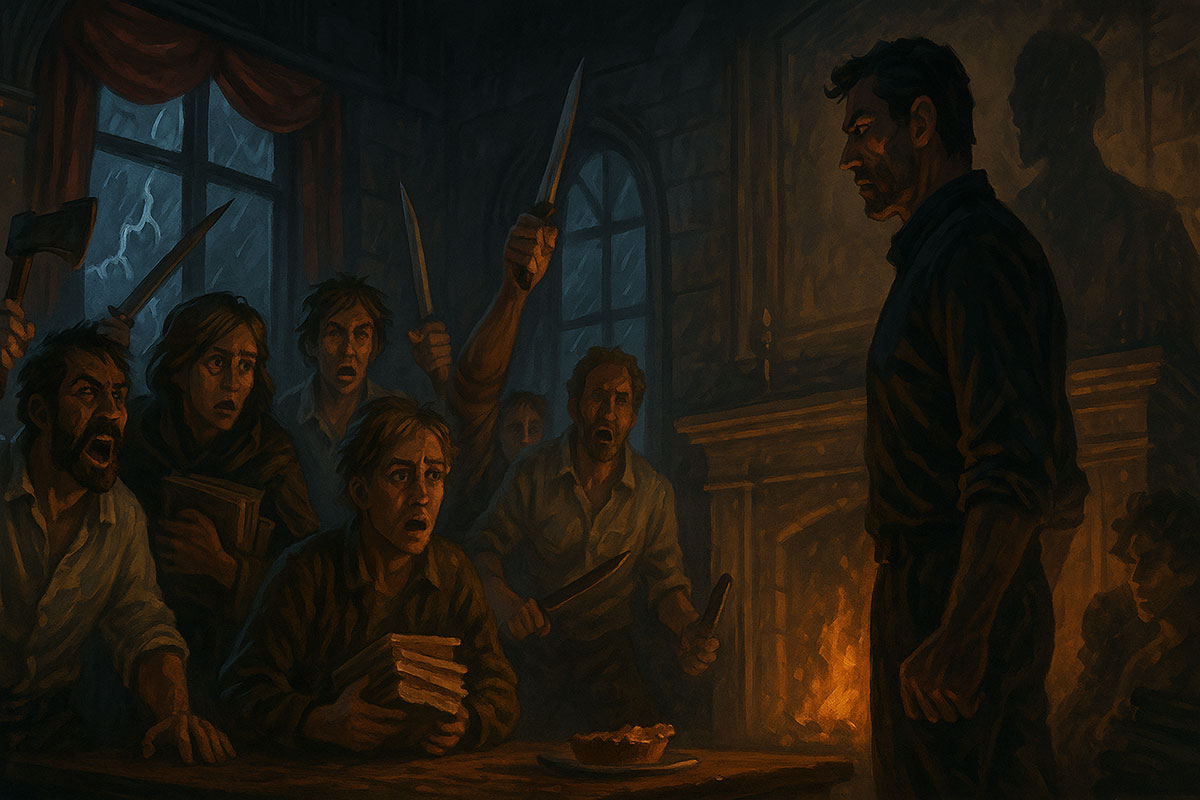
Setting: The chateau, now partly transformed. Some rooms are sealed, others stripped of trophies. Survivors have claimed corners of the mansion, trying to live — cooking, mending nets, tending fires. The jungle looms outside, lush and oppressive.
Lights: Evening torches cast uneven shadows across the hall. The jungle’s green glow seeps through cracks, invasive.
Sound: The sea’s constant thunder, the restless cry of seabirds. Distant thunder hints at a coming storm.
Restless cohabitation
Stage Center: Rainsford walks the hall, journals clutched under his arm. His face is harder now, taut with sleeplessness. The Captain, Sailor 1, Sailor 2, and the Young Woman sit around a crude table, eating in silence. The tension is thick.
Sailor 1
(gesturing at the covered trophies)
We still live among his ghosts. Heads on walls, teeth in jars. This is no home. It’s a trap.
Sailor 2
Aye, and he keeps the keys.
Captain
Enough. We’re alive, aren’t we? Better alive than feeding fish.
(The Young Woman studies Rainsford quietly. He doesn’t eat, doesn’t join them. He flips open one of Zaroff’s journals, scanning, muttering.)
Rainsford
(to himself)
Every entry a crime. Every page a grave.
Sailor 1
(loudly)
Then burn them! End it, once and for all.
(Rainsford snaps the journal shut, his voice cutting like glass.)
Rainsford
I am the only one who knows what he did here. If I burn them, the truth dies with me.
Sailor 2
Maybe that’s mercy.
Secrets uncovered
Stage Right: Later that night. The survivors creep into Zaroff’s old study. They light a lantern, uncovering locked drawers. Sailor 1 pries one open with a knife. Inside: weapons — rifles, cartridges, knives. They gasp. The Captain picks up a rifle, weighing it heavily.
Captain
So this is why he kept us from this room.
Sailor 1
Or why he meant to use it again.
Young Woman
No. You don’t see? He’s afraid of becoming what Zaroff was. That’s why he hides them.
Sailor 2
Or he hides them because the game isn’t over.
(A silence. They look at each other, torn. The jungle’s hum seems louder. The Captain lowers the rifle reluctantly.)
Captain
We’ll confront him. One way or another, this cannot last.
The confrontation
Stage Center: The hall, stormlight flickering through windows. Rainsford enters, journals in hand. The survivors step forward, blocking his path.
Captain
This ends tonight. Either we leave this island together, or we burn this house and every cursed thing in it.
Rainsford
(coldly)
And where will you go? The sea takes more than it spares. The world does not know this island exists.
Sailor 1
Better the sea than your shadow. You pace these halls like a jailer. You watch us like prey.
Young Woman
(firm but pleading)
He’s right about one thing: the sea is death. But staying here under suspicion is worse. Tell us, Rainsford — what are you now?
(Rainsford’s hands shake. He drops the journals onto the table. Pages scatter. His voice cracks with fury and despair.)
Rainsford
I am nothing like him! I killed Zaroff! I ended the hunt!
Sailor 2
(quietly)
Then why do we feel hunted still?
(The storm outside cracks. Lightning flares. The survivors stare at him, unblinking. Rainsford realizes the line between hunter and hunted has blurred completely.)
The clash
Lights shift to chaos: shouts, overturned chairs, the slam of boots. Sailor 1 seizes a knife; Rainsford grapples him, disarming him, but the others circle. The Young Woman pulls the journals from the floor, clutching them protectively.
Young Woman
Stop! Look at yourselves! This is exactly what he wanted — for the island to live on in us.
(They freeze, panting. The storm’s thunder fills the silence. Rainsford stares at them, then at himself — his hands still clenched around the knife. He drops it with a clang, horrified.)
Rainsford
God help me… I don’t know what I’ve become.
Final tableau of Scene 4
The survivors stand divided: the Captain gripping the rifle, the Sailors tense, the Young Woman holding the journals like a fragile hope. Rainsford is alone in the center, trembling, his shadow cast large and monstrous against the wall by lightning.
Young Woman
(softly, almost to herself)
Perhaps Zaroff never died. Perhaps he just changed his name.
Blackout.
Scene 5 — The Final Game
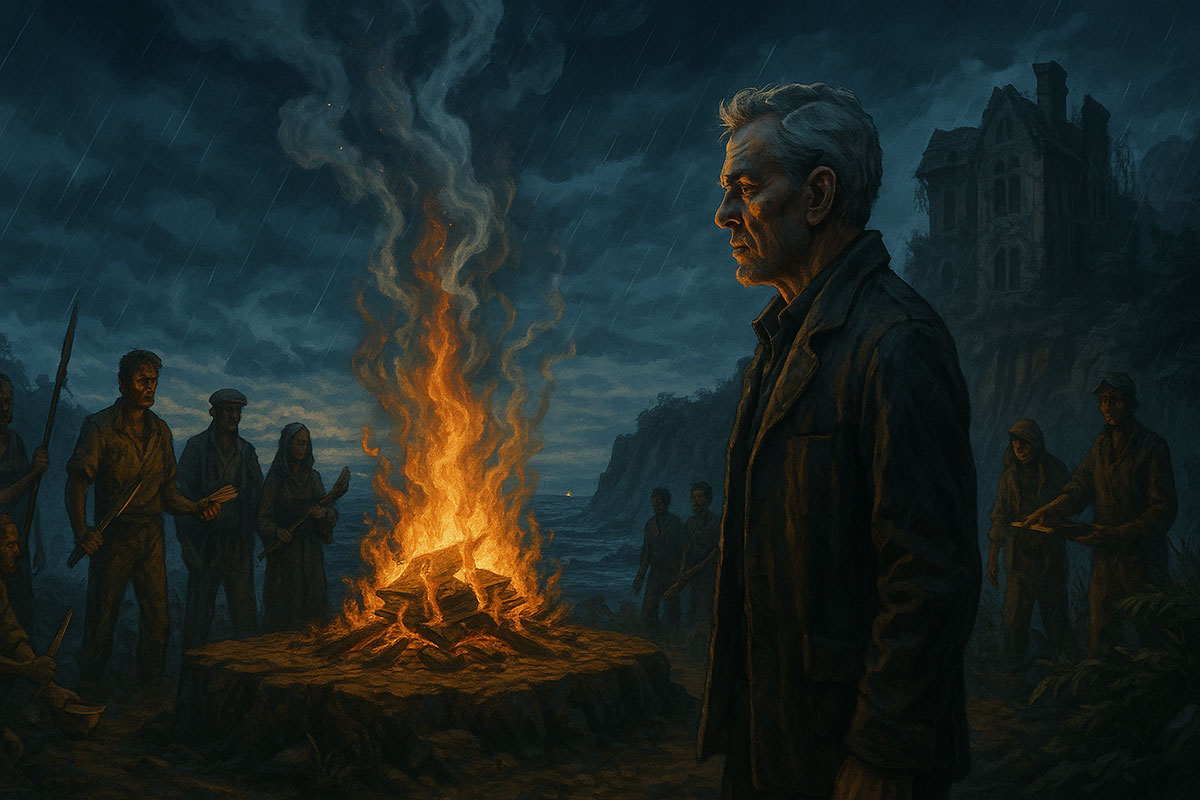
Setting: Ship-Trap Island reclaimed. The jungle has swallowed the chateau; marble floors buckle under roots, antlers jut from vines like drowned masts. The game room is a roofless shell open to sky and storm. Far below, surf combs the black rocks.
Lights: Bleached daylight that comes and goes as clouds race past. Toward the end, a dusk that glows like banked coals as fire takes hold.
Sound: Wind threading broken shutters, far seabirds, the steady thud of waves. When the past intrudes, we hear—very faint—the bay of disciplined hounds that no longer exist.
Ruins
Center stage: a collapsed wall suggests the old trophy hall. Rainsford enters from the green, older now—lean, sun-blasted, his movements careful. A coil of rope at his shoulder, a knife at his belt, a bundle of papers wrapped in oilcloth.
Rainsford
(to the empty room)
You’re quieter, General. Or I am. One of us has learned.
He crosses to a stone ledge that used to be Zaroff’s mantel and unwraps the oilcloth: the journals. He hesitates, breathes the salt air, then rewraps them and looks seaward.
Rainsford
(soft)
What does a witness owe the dead? What does he owe the living?
A crack like a cannon from the cliffs. He freezes, listening. It is not thunder. It is a ship tearing itself open on the teeth of the island.
The wreck (again)
Stage Left: wreckage and spray in flicker-light. Survivors scramble up the rocks: a Captain (weathered), an Engineer (quick eyes, grease-black hands), a Doctor (steady, mid-thirties), and a Boy (fifteen, all bones and fear). They cough salt, look up at the jungle.
Captain
Ship-Trap. God help us.
Engineer
Or no god at all.
Doctor
(to the Boy)
Breathe. In through the nose. You’re on land.
They climb toward the ruin. Rainsford steps out where the stairs used to be. They all stop—four points of wariness.
Rainsford
Food. Water. Dry ground. Come.
Captain
Name yourself.
Rainsford
Rainsford.
The Doctor flinches—recognition passing like a shadow.
Doctor
The hunter?
Rainsford
Once.
No one moves. The wind rattles a line of shells like teeth.
Captain
You alone?
Rainsford
As far as I can tell.
Engineer
(eyeing knife, rope)
As far as we can tell, too soon to trust.
Doctor
(to the Captain, low)
If the stories are true, he ended the man who hunted here.
Engineer
Or he became him. Islands keep their offices filled.
The Boy stares at Rainsford, then at the jungle that seems to breathe.
Boy
Is this the place where men become deer?
The question hangs. Rainsford’s grip tightens on the oilcloth bundle.
The hall of shadows
They enter the roofless hall together, a wary procession. Rainsford distributes canteens and dried fish from a cache. The others take it, but their eyes never leave him.
Captain
We need a signal. Flare? Fire? Sailcloth on the south ridge?
Engineer
We need to know why this place feels watched.
The Doctor runs a thumb along a cracked tile. Her voice is calm, but her gaze measures Rainsford.
Doctor
What happened to the master of this house?
Rainsford
I killed him.
Even the wind pauses.
Engineer
(dry)
Direct.
Rainsford
He hunted men. He set rules. I refused them, and then I replaced them with none. It’s… quieter, but not clean.
Captain
We saw bodies on the rocks. Not fresh. Old ropes. Old bones.
Rainsford
This island is a trap even without a man to bait it.
The Engineer’s eyes have roamed and fixed on the journals. He steps closer; Rainsford puts a hand over the bundle.
Engineer
Those belong to the dead. Or to the living who might learn.
Rainsford
They belong to the truth. I held it because I didn’t know whether to bury it or light it.
Doctor
And which will you choose now?
He looks from the journals to their faces: suspicion, exhaustion, the rawness of people who still have more to lose than he does.
The turn
Night smells on the wind. The Captain confers with the others a pace away. Their whispers are not private.
Engineer
We cannot sleep under his eye.
Captain
We cannot fight the jungle and a man.
Doctor
Or we can ask him to put down the knife and the past.
Engineer
Ask? Here? This island eats the patient first.
The Boy watches Rainsford. He speaks not to his elders, but to the man by the ledge.
Boy
If we run, will you chase us?
It is so simple a question that it empties the room of air. Rainsford answers as if it were a vow.
Rainsford
No.
Engineer
(to the Captain)
Then make sure of him. Before he changes his mind.
Doctor
(sharp)
Enough. We haven’t yet met a tyrant. Don’t build one from fear.
But the island has a rhythm. The surf counts to three; the wind answers; and human hearts, set to alarms by other men’s cruelty, pick up the beat. The Captain turns back to Rainsford, jaw set.
Captain
You will leave your knife here. Your rope. You will walk ahead of us. If you turn, we turn you into the sea. Until we find a height to send a signal or a boat-shaped hope, that is the rule.
The word shocks like a slap: rule. Rainsford hears it as if from another’s mouth—Zaroff’s vocabulary in a different accent.
Rainsford
There it is—the first plank of a scaffold.
Doctor
(quietly)
Help us, then. Break the wood.
He unloops the rope, draws the knife, and lays both on the shattered mantel. He also sets the journals beside them. His hands linger.
Rainsford
A man can live by the opposite of a monster and still be ruled by him.
Engineer
Walk.
The island hunts
They move. A procession through green. Rainsford leads, unarmed. The Engineer tails him with a broken spear. The Captain carries a rusted pistol salvaged from wreckage; it may work, it may not. The Doctor supports the Boy when the path steepens.
Stage pictures:
A fallen tree. Rainsford gently shifts it with leverage, not to crush but to clear. He glances back—habit—and stops himself.
A narrow ravine. Old stakes half-buried in mud—the ghost of a tiger pit. The Doctor sees, understands, says nothing except “Watch your step.”
A cliff path. Wind tears at them. Far below, white water stitches black rock.
They pause at a high ledge. The sea is a slate of moving iron.
Captain
Here. A fire will be seen.
Engineer
If the sky allows.
Doctor
(to Rainsford)
There is driftwood. Help me build.
He kneels, begins to stack. The Engineer stares at him, surprised, then angry—surprised because the unarmed man did not run when the path widened; angry because that makes everything harder to classify.
Engineer
We don’t know what you are.
Rainsford
I’m what happens after winning.
He looks at his empty hands, then at the Doctor.
Rainsford
Do you have matches?
Doctor
No. But your journals will light.
He flinches. She meets his eyes, not unkind.
Doctor
Let the past call the future. Burn what chained it here.
He goes very still. Then he nods once, as if agreeing with a verdict long argued. They have carried a flint from the wreck; sparks bite paper; dry page edges curl. The journals catch, words going to smoke that rises like a column.
The wind takes ash out over the water. The Engineer watches, jaw tight.
Engineer
You destroy evidence.
Rainsford
I free ghosts.
Captain
You light a beacon.
Boy
(soft, awed)
It smells like a library and a storm.
The fire grows. The ledge glows dusk-orange. In the light, faces are truer: the Engineer’s guarded grief, the Captain’s fatigue, the Doctor’s fierce calm, Rainsford’s lined sorrow.
The chase that isn’t
A branch snaps behind them—real, not memory. Two desperate, ragged men from the wreck—stragglers—stumble into the ring of light, knives ready, wild with fear.
Straggler 1
Weapons down!
Straggler 2
We heard the stories. We won’t be game.
The Engineer spins, the Captain raises the useless pistol, the Doctor steps in front of the Boy—and Rainsford, whose body has learned the answer to sudden threat, does not reach for a weapon he no longer has. He lifts both empty hands.
Rainsford
Then don’t play.
The four words hang like a bridge over a chasm. For a long beat, no one breathes. Fire snaps. Surf counts. Wind answers. The knives lower—first an inch, then all the way.
Straggler 1
Who are you?
Rainsford
Once, I was a hunter. Then I was hunted. Then I killed a man who made rules from blood. I have lived here since to see if there is anything else to be.
The Doctor looks at the newcomers.
Doctor
Help us feed the fire. Then help us live till morning.
They nod, chastened and relieved, and begin to gather brush. The circle of people widens by two and, astonishingly, holds.
Coda
Night. The beacon pours smoke and sparks into the dark. Below, a distant light on the water answers—maybe a ship’s mast lamp, maybe not. They watch anyway, because watching is what hope looks like.
At the ledge’s edge, Rainsford stands apart. The Doctor approaches.
Doctor
You look like you’re listening for hounds.
Rainsford
I am. And I hear only the sea.
Doctor
Good. Keep it that way.
He nods. He looks down at the cliff he once leapt from, at the ruined hall, at the fire consuming the last pages of a game. He speaks to himself, but the words belong to the island too.
Rainsford
The most dangerous game isn’t the one between two men. It’s the one a place plays with your soul, until you mistake its rules for nature.
The Boy appears at his elbow, offering a strip of dried fish like a sacrament.
Boy
You didn’t run.
Rainsford
I’ve done enough of both—running and chasing. Tonight we wait.
They stand together in the heat and the wind and the salt. The flame’s roar softens. Somewhere, a gull cries like a laugh.
The fire throws a last bright letter into the air—the ash-outline of a word no one can quite read—and then the page is gone. The stage dims to ember light. Faces are still, breathing. No baying. Only waves.
Blackout.
Epilogue
(The stage is dark again, except for a faint ember glow. The Chorus returns, softer now, but inexorable, as if it speaks through the surf and wind itself.)
Chorus
The game has ended. Or so it seems.
The mansion lies in ruin, the journals turned to ash, the hounds are bones beneath the trees.
But the island remembers. It always remembers.
Every cry, every chase, every trembling step of prey.
The rules written in blood linger in the soil.
And you—who have watched—do you not feel it?
The quickened heart, the thrill, the question whispered in your own mind?
Are you hunter… or hunted?
That is the danger. That is the truth.
The island may be far away, but the game—
The game is everywhere.
(The jungle hum swells, then cuts to silence. Blackout.)
Short Bios:
Richard Connell (1893–1949)
American author and journalist, best known for The Most Dangerous Game (1924), one of the most anthologized short stories of the 20th century. His work often blended suspense with moral dilemmas.
Sanger Rainsford (Fictional Character)
A celebrated big-game hunter who becomes prey on Ship-Trap Island. Intelligent and resourceful, his survival raises troubling questions about morality, power, and the thin line between hunter and hunted.
General Zaroff (Fictional Character)
A cultured Russian aristocrat and former military officer. Brilliant, refined, and monstrous, he hunts men for sport. Though killed by Rainsford, his shadow haunts every corner of the island.
Ivan (Fictional Character)
Zaroff’s deaf-mute servant and enforcer, known for his brute strength and loyalty. He embodies silent menace but also the faceless obedience that allows cruelty to thrive.
The Captain (Fictional Character, Expansion)
A weathered sailor from a wrecked ship who becomes a voice of caution and authority among the survivors. Practical and disciplined, but his mistrust of Rainsford fuels conflict.
The Engineer (Fictional Character, Expansion)
One of the shipwrecked survivors, sharp-eyed and suspicious. Pragmatic to the point of cynicism, he doubts Rainsford’s innocence and represents the corrosive power of fear.
The Doctor (Fictional Character, Expansion)
Another survivor, compassionate and observant. She tries to temper fear with reason, challenging both Rainsford and the others to resist repeating Zaroff’s cruelty.
The Boy (Fictional Character, Expansion)
A teenage survivor whose innocence and questions cut through the posturing of adults. His fear and trust force Rainsford to face what kind of man he has become.
Leave a Reply