

|
Getting your Trinity Audio player ready...
|
Introduction by Nick Sasaki
The meaning of Thanksgiving day has never been just about a feast, a table, or a tradition. For me, it has always been about something deeper — the way gratitude softens the heart, the way remembrance binds us to those who came before, and the way a simple shared meal can bring healing to places we didn’t even know needed healing.
As I began this series, I didn’t want to create another holiday reflection. I wanted to explore what Thanksgiving really represents — not only in American culture, but in the human spirit. I wanted to ask: What does gratitude look like when life has been hard? What happens to our hearts when there’s an empty chair at the table? How do families forgive, how do communities heal, and how do we build a world worthy of those who sacrificed for it?
These five conversations became a journey — across history, spirituality, memory, and humanity itself. Abraham Lincoln, the voice that first made Thanksgiving a national day of gratitude, guided us through each chapter with the wisdom of someone who carried a nation through heartbreak. Around the table gathered some of history’s clearest voices for courage, compassion, hope, and meaning.
Together, they explored gratitude not as a feeling, but as a way of living.
My hope is that these conversations open your heart the same way they opened mine. That they help you see your own table a little differently — whether it’s full, quiet, broken, healing, or somewhere in between.
Thanksgiving is not a moment.
It’s a posture of the soul.
And its meaning grows deeper when shared.
(Note: This is an imaginary conversation, a creative exploration of an idea, and not a real speech or event.)
TOPIC 1 — The Real Meaning of Thanksgiving: Gratitude Beyond Circumstance
Moderator: Abraham Lincoln
Scene Opens
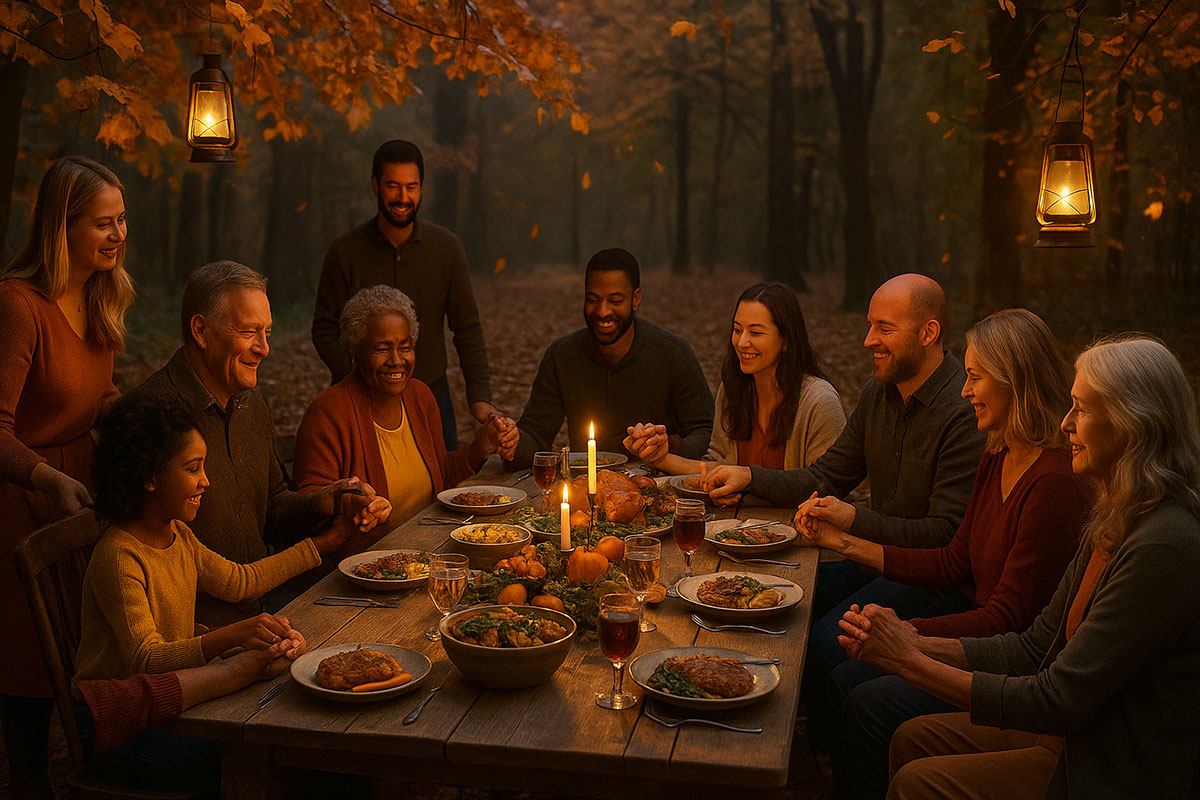
A long wooden table stands beneath a canopy of autumn trees. Burnt-orange leaves drift gently from the branches. Lanterns glow softly. A single empty chair sits near the center — a quiet symbol, not yet spoken of. The air carries the calm of dusk, the warmth of a fire, and the hum of distant memory.
Abraham Lincoln rises slowly, his presence gentle but unmistakably steady.
LINCOLN (opening the gathering)
My dear friends… we meet not merely to feast, but to remember. Thanksgiving was never meant to be a day of abundance alone, but a day to pause in the midst of trial and recognize what remains good, what remains worth cherishing, and what remains sacred.
Tonight, I wish to begin by asking something simple… and yet, perhaps, the hardest question of all:
What does true gratitude mean when life has not been easy?
He sits, folding his long hands calmly, inviting the circle to speak.
MAYA ANGELOU
Ah, Mr. Lincoln… gratitude, to me, is not the denial of pain. It is the decision to rise despite it. A thankful heart isn’t shaped by comfort — it is carved by storms.
I have found that when life presses me hardest, I do not lose gratitude; I discover it.
I learn that I can still laugh. I can still love. I can still dance with the wind.
Gratitude is not about what we have… it is about who we become.
THÍCH NHẤT HẠNH
When we suffer… we often believe gratitude must wait until the suffering ends.
But gratitude is the breath in the middle of the storm — the small, clear moment in which we notice that life is still here, offering itself.
To suffer is not to be cut off from gratitude.
To suffer is to be invited deeper into presence.
Even washing a bowl, even feeling the ground under our feet, can be an act of thanksgiving if we truly see.
THE FALLEN SOLDIER
(A quiet voice, solemn but warm, as though carried on the wind.)
For me… gratitude was never about having an easy life.
It was about knowing that my life meant something.
We did not pray for comfort.
We prayed that our actions would matter — that someone’s son might make it home, that a village would find safety, that a mother would not wake to gunfire.
Gratitude, in the field, was simple:
A warm meal.
A letter from home.
A sunrise we lived to see.
Sometimes… that was enough.
VIKTOR FRANKL
Gratitude appears in the darkest places, but only to the eyes that choose to see.
In the camps, I once watched a man give half his bread to another prisoner weaker than himself. That man had nearly nothing — yet he still believed he had something to give.
True gratitude is not a reaction.
It is a stance toward life.
It is the ability to say:
Even if everything is taken, I will not let the last of my inner freedom be taken.
From that freedom, gratitude blooms.
NICK SASAKI
For me, gratitude came later in life. I used to think it was about success or blessings… but now I see it’s about awareness.
My life hasn’t always been easy. My family hasn’t always understood me. My work has had seasons of doubt.
But I’ve learned that gratitude is the bridge — the thing that reconnects us to what matters.
When I look back, the hardest moments are the ones that shaped my heart the most.
Gratitude is how we give meaning to the chapters we didn’t choose.
Lincoln nods slowly, absorbing every word with quiet reverence.
Second Question — Lincoln Speaks Again
Lincoln rises slightly, his expression heavy with memory.
Why do humans forget to be thankful until something is lost?
He sits. The lanterns flicker, as if the trees themselves lean closer.
THÍCH NHẤT HẠNH
Because we are asleep.
We walk through life forgetting that each breath is a miracle.
Only when a breath becomes difficult do we remember its value.
Mindfulness awakens gratitude before loss demands it.
MAYA ANGELOU
We forget because we live distracted.
We rush through life collecting things and missing moments.
Loss wakes us up like a slap.
But gratitude whispered all along.
We just didn’t listen.
THE FALLEN SOLDIER
We forget because we believe time is guaranteed.
Out there… you learn quickly that time is a fragile thing.
A single moment can be the difference between life and death.
If people understood how brief life is… gratitude would not wait for loss.
VIKTOR FRANKL
In every human heart there is a blindness — a belief that we have “later.”
But “later” is not promised.
Meaning comes from seeing the value of now.
Loss teaches clarity.
But clarity can be learned before loss… if we choose to see.
NICK SASAKI
I think we forget because we measure life by what we expect, not by what we have.
We assume relationships will last.
We assume health will stay.
We assume opportunities will return.
Only when something breaks do we realize we were holding something precious the whole time.
Lincoln’s eyes soften, the weight of history lying deep behind them.
Third Question — Lincoln Speaks Slowly
He leans forward, voice deep and steady:
How can Thanksgiving become a daily way of living rather than a single holiday?
A warm breeze rustles the leaves. The fire pops softly.
MAYA ANGELOU
By choosing to love out loud every day.
Say “thank you” when the world seems dark.
Say “I appreciate you” before regret teaches the lesson for you.
Let gratitude be your language, not your holiday.
THÍCH NHẤT HẠNH
Transform every action into a moment of awareness.
Pour tea with gratitude.
Walk with gratitude.
Breathe with gratitude.
Thanksgiving becomes daily when we live gently, deeply, consciously.
THE FALLEN SOLDIER
Live for those who no longer can.
That alone makes every day an act of thanksgiving.
Honor the life you still have.
Honor the people around you.
Honor the peace you enjoy but did not earn alone.
VIKTOR FRANKL
Make meaning the center of your life.
When you choose purpose, gratitude follows.
Thankfulness is not something you feel — it is something you practice.
Find meaning in your work, your relationships, your suffering… and Thanksgiving will no longer need a calendar.
NICK SASAKI
I think Thanksgiving becomes daily when we stop waiting for something big to feel grateful about.
Small things — quiet mornings, safe families, shared meals — these are the real miracles.
If we can honor those moments, every day feels like Thanksgiving.
Lincoln stands, his silhouette glowing against the lantern light.
LINCOLN (closing)
My friends… gratitude is the thread that binds the living to the lost, the weary to the hopeful, the broken to the whole.
If we remember these truths — not merely today but each day — then Thanksgiving will live not on the table, but in the heart.
The leaves fall. The lanterns flicker. The scene closes gently.
TOPIC 2 — The Table of Remembrance: Honoring Those Who Never Came Home

Moderator: Abraham Lincoln
Scene Opens
A twilight sky fades into soft blue. The long wooden table is now adorned with a single white candle placed where the empty chair sits. No one speaks at first. The hush is purposeful… sacred.
Abraham Lincoln rises with quiet reverence. His face carries the solemn weight of someone who has written too many condolence letters to grieving families.
LINCOLN (opening)
There are chairs at the Thanksgiving table that remain empty not by choice, but by sacrifice.
Tonight… let us speak gently of those who never returned, and of the families who carry both the pride and the sorrow of their absence.
He pauses, steadying his voice.
Tell me, my friends:
What does an empty chair at Thanksgiving truly represent?
He sits. The candle flickers.
 Fallen Soldier Speaks First
(A voice soft as breath, strong as memory.)
The empty chair… is not empty.
It holds a thousand moments — laughter, stories, teasing, hopes.
It holds the life we planned to live.
It holds the dreams we carried in our packs.
It holds the silence of unfinished years.
When a family sets a place for someone who never came home, it means we are still loved. Still remembered. Still part of every meal, every prayer, every heartbeat of the home we left behind.
The empty chair is not absence.
It is presence, remembered.
Gold Star Mother
(She places her hand over her heart before speaking.)
For a mother… the empty chair is both a wound and a blessing.
It is a reminder of the boy I raised, the laughter I knew, the nights I stayed awake waiting to hear his steps at the door.
But it is also the reminder that he lived bravely.
That he chose service.
That he loved enough to give more than anyone should ever be asked to give.
Some people see an empty chair.
I see a life that mattered.
Maya Angelou
The empty chair is a poem without its final line.
It is the echo of a soul that walked with courage.
It asks us not to drown in sorrow, but to rise into gratitude.
For gratitude is the light we shine on the memory of those who gave everything.
The chair is empty.
But the love is full.
Viktor Frankl
An empty chair can crush the heart, unless we fill it with meaning.
A loss without meaning becomes despair.
A loss with meaning becomes a legacy.
When a family keeps that chair at the table, they are not holding onto pain — they are refusing to let the memory vanish.
And that… is an act of profound courage.
Nick Sasaki
When I see an empty chair, I think of all the families who keep going despite the ache.
I think of children growing up with stories instead of embraces.
Thanksgiving is a reminder that gratitude lives side by side with grief.
But the empty chair… reminds us that every blessing we enjoy today was paid for by someone else’s tomorrow.
Lincoln bows his head slightly, the candlelight reflecting in his eyes.
LINCOLN — Second Question
He lifts his gaze with gentle firmness.
Friends… how do we honor someone without letting sorrow eclipse gratitude?
Gold Star Mother
We honor them by living.
Fully.
Bravely.
Kindly.
My son did not die so that we could spend the rest of our lives drowning in grief.
He died believing that his sacrifice would allow others to smile again.
The greatest honor we can give is joy — not forgetting, but remembering with light instead of darkness.
Fallen Soldier
Please do not let sorrow be the only thing you remember of us.
We want to be remembered for the way we lived… not only for the way we died.
Tell our stories.
Live your life in a way that we would be proud of.
Laugh.
Love.
Try things we never got the chance to try.
Your joy honors us more than your tears.
Maya Angelou
Sorrow and gratitude dance together, and that dance is called healing.
We honor the fallen by refusing to let grief harden us.
By loving more fiercely.
By standing up for what is right.
By embracing life with both arms open.
Grief, when held in love, becomes gratitude.
Viktor Frankl
In every loss, there is a choice:
To sink into what was taken,
or to rise into what remains.
We honor the fallen when we turn pain into purpose.
When we take up their unfinished work —
hope, compassion, service, courage.
Meaning is the way through sorrow.
Nick Sasaki
I’ve learned that the greatest way to honor someone is to live the values they embodied.
For soldiers, that’s brotherhood, sacrifice, honor, courage.
When we carry those values forward, their legacy doesn’t fade — it expands.
Lincoln lets out a long breath, as though releasing a century of accumulated grief from the mothers, wives, and children he once wrote letters to.
He speaks softly.
LINCOLN — Third Question
If our fallen could speak to us today… what do they hope we would remember most?
Fallen Soldier
Remember… that we were just regular people.
We were not symbols or statues.
We were sons.
Daughters.
Brothers.
Friends.
We were scared sometimes.
We were brave sometimes.
We laughed.
We dreamed.
We missed home more than anything.
Remember that our lives mattered beyond the battlefield.
Remember our humanity… not just our sacrifice.
And please…
Remember to take care of each other.
That was why we served.
Gold Star Mother
They would want us to remember their kindness.
Their smile.
Their silly jokes.
Their stubbornness.
Their hopes.
Their dreams.
Not the folded flag…
but the life lived before it.
Most of all, I believe they would want us to remember to love one another fiercely.
That’s what every soldier prays for — a world where their children don’t have to fight.
Maya Angelou
They would want us to remember the strength of the human heart.
The courage it takes to stand for something greater than oneself.
They would want us to be gentler with each other…
to see the humanity in every face at the table.
Viktor Frankl
They would want us to remember that freedom is never free.
That dignity must be protected.
That meaning is found in service.
And that the highest calling of a human being is to love.
Nick Sasaki
I think they’d want us to remember something simple…
to be thankful for each other.
To appreciate the moments we still get to have.
To cherish the people at our table,
because not everyone got to come home to theirs.
Lincoln stands, placing a hand gently on the back of the empty chair.
LINCOLN (closing)
Let us honor those who never returned, not only with sorrow,
but with gratitude,
with compassion,
with unity,
and with a fierce commitment to living well the days they never received.
May this empty chair remind us not of what was lost,
but of the love that remains.
The candle flame steadies.
The scene fades.
TOPIC 3 — Family, Forgiveness, and the Quiet Pain of Thanksgiving
Moderator: Abraham Lincoln
Scene Opens
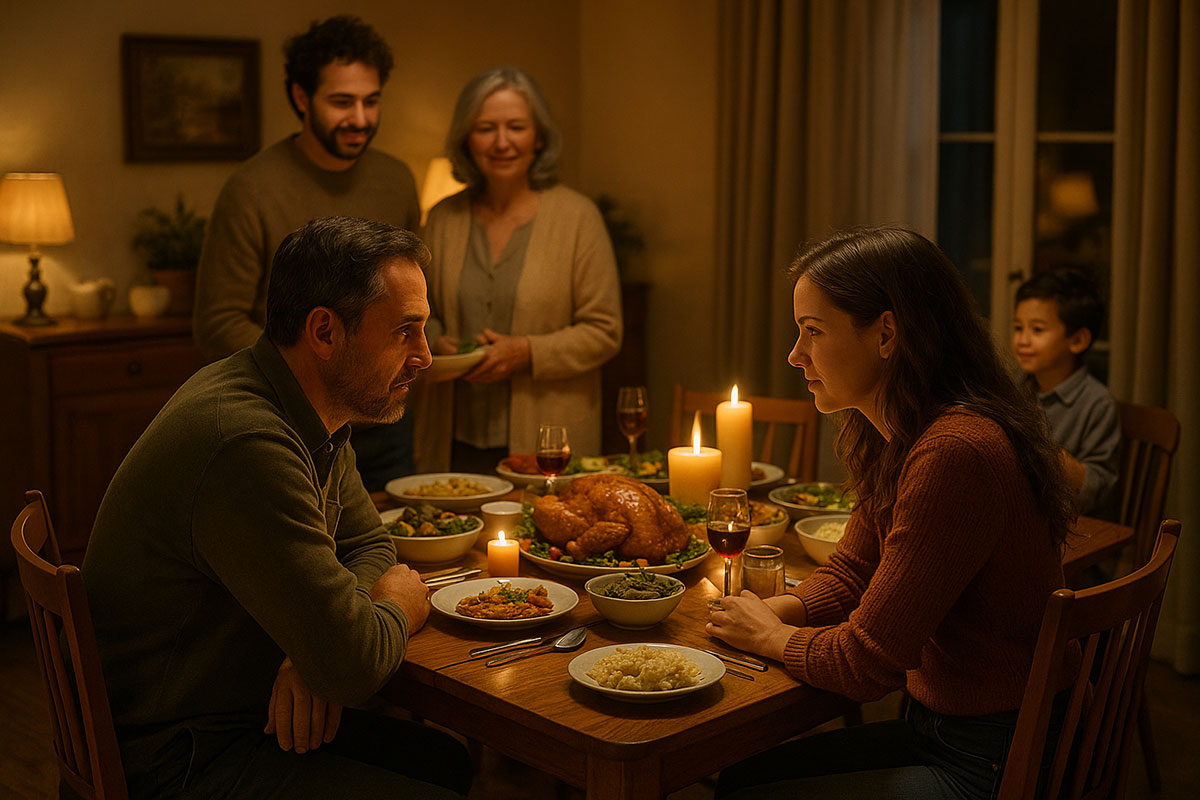
The table now glows with the softer light of early evening. A gentle wind stirs the leaves, and the scent of woodsmoke drifts through the air. The empty chair from Topic 2 remains, but beside it now sits a fresh loaf of bread — a subtle symbol of continued life.
Abraham Lincoln stands slowly, his tall figure both solemn and comforting. His eyes sweep over the group with empathy.
LINCOLN (opening)
My friends… Thanksgiving is often spoken of as a day of warmth and unity, yet beneath many tables lies sorrow, misunderstanding, unspoken tensions… and wounds quietly carried by the heart.
I have known the pain of family divided by war, the ache of misunderstandings that could not be mended in time. And so I ask:
Why is Thanksgiving both the warmest and most painful holiday for so many families?
He rests his hand gently on the back of his chair and sits.
A hush settles.
Brené Brown
Thanksgiving magnifies everything — the joy and the hurt.
It is a holiday built around togetherness, but many people walk into the room with years of unsaid words.
Families love deeply, but they also wound deeply.
Thanksgiving puts everyone in one place, at one table, where the gap between expectation and reality becomes painfully clear.
People long to feel seen, appreciated, understood…
but the table often becomes a stage where old patterns play out.
Warmth and pain — they live side by side.
Thích Nhất Hạnh
When families gather, they bring with them the full history of their hearts.
Old hurts arise because the conditions that created them return:
the same voices, the same patterns, the same roles we once played.
But this suffering can also be a door to healing.
If we breathe, if we listen deeply, if we look with the eyes of compassion…
the pain softens, and understanding becomes possible.
Thanksgiving is painful because we desire love.
And it is healing because love is still possible.
Chief Seattle
In my people’s tradition, gatherings were always sacred.
But sacred things often reveal truth.
When the tribe meets, the heart meets itself.
Thanksgiving hurts because it reminds us of the bonds we wish were stronger.
It warms us because those bonds still exist.
Both the wound and the hope sit beside each other at the table.
WWII Veteran
I’ve spent holidays on the front lines, and I’ve spent them at home.
Let me tell you… Thanksgiving hurts because it reminds you of what you wish you had.
Family isn’t perfect — but it is precious.
And when you’ve seen men die with their family’s names on their lips, you learn to see that even painful family moments are a kind of blessing.
Thanksgiving hits the heart hard because it asks:
Are you grateful for what you still have?
Nick Sasaki
I think Thanksgiving exposes the truth we often bury.
Families don’t stop being complicated just because it’s a holiday.
But the holiday brings everything into the open — the love, the resentment, the longing, the misunderstandings.
It’s the one day of the year when we’re reminded of what we wish our family could be… and that hurt can be real.
But maybe that hurt is also a sign that we care.
Lincoln nods gently, as though seeing generations of American families sitting at their tables, each with their own silent stories.
LINCOLN — Second Question
He rises again, with compassion etched in his face.
Friends…
How do we mend relationships when pride gets in the way?
He sits, folding his long hands thoughtfully.
Thích Nhất Hạnh
Pride is a wall built by fear.
Fear of being wrong.
Fear of being misunderstood.
Fear of being hurt again.
To mend a relationship, one must soften the wall.
A single mindful breath can open the heart.
A gentle word — “I am here, and I wish to understand” — can dissolve years of pride.
Listening is the deepest form of love.
When we truly listen, pride no longer leads; compassion does.
Brené Brown
Pride is armor.
And all armor is built to protect, not to connect.
The healing begins when someone chooses courage over comfort.
When someone decides:
“I will go first.”
“I will apologize first.”
“I will be vulnerable first.”
Waiting for the other person to go first keeps the wound alive.
Going first sets the healing in motion.
Chief Seattle
In my tradition, pride was seen as a cloud that covers the heart.
The only way to clear it is through humility — acknowledging our part in the conflict, even if it is small.
Healing requires truth spoken with kindness.
And sometimes… it requires silence where anger would speak.
When we speak with the heart of the tribe instead of the self, pride falls away.
WWII Veteran
On the battlefield, pride gets men killed.
At home, pride kills relationships.
I’ve learned that saying “I was wrong” or “I’m sorry” does not make you weak.
It makes you brave.
Most fights in families aren’t worth the years they steal.
Someone has to decide that peace matters more than ego.
Nick Sasaki
For me, healing begins with remembering that life is short.
Too short to cling to being right.
When I imagine losing someone, the argument suddenly feels very small.
I’ve learned that saying “let’s talk,” or “I miss you,” or “I don’t want this distance anymore” can melt years of pride in a moment.
The first step is wanting peace more than being right.
Lincoln leans back, his eyes reflecting a bittersweet understanding earned through a lifetime of national division and personal loss.
LINCOLN — Third Question
He speaks softly, his voice rich with empathy.
My dear friends…
How can we turn a family gathering into a place of healing instead of tension?
Brené Brown
By choosing intention over expectation.
Instead of expecting perfection, choose connection.
Instead of expecting everyone to behave a certain way, choose curiosity.
And instead of trying to “fix” family, choose to see them as human — flawed, beautiful, trying their best.
Set the tone with kindness.
People soften where they feel safe.
Thích Nhất Hạnh
Begin with a moment of presence.
Before eating, pause.
Breathe together.
Offer gratitude not just for the food, but for each person at the table — including those who have hurt you, for they have taught you to understand the depths of the heart.
Speak gently.
Listen deeply.
Walk slowly.
Treat each moment as sacred.
Healing grows from mindfulness.
Chief Seattle
Create circles instead of corners.
Circles allow people to face one another, to see each other’s eyes.
In my tribe, we used stories to heal — not accusations.
When a family shares stories, not judgments, the wounds become threads that bind the tribe together instead of splitting it apart.
WWII Veteran
If you want healing, focus on what matters:
being together.
Being alive.
Having the chance to talk, even if the conversations are imperfect.
Make room for laughter.
Make room for stories.
Make room for new memories.
Healing happens when you stop keeping score and start keeping people.
Nick Sasaki
What I’ve learned is this:
When you enter the room with love, the room changes.
When you enter with resentment, everything tightens.
If we choose to arrive with humility, honesty, and a willingness to forgive… Thanksgiving becomes a place of connection.
Healing isn’t something that “happens.”
It’s something we choose to create.
Lincoln stands, placing a hand over his heart.
LINCOLN (closing)
Families are not perfect — nor were they ever meant to be.
But they are ours.
Our roots, our mirrors, our classrooms, our homes.
May we gather with grace.
May we speak with gentleness.
May we forgive with courage.
May we love without hesitation.
And may our tables — this Thanksgiving and always — become places where hearts return home.
The fire crackles softly.
The scene fades into warm, amber dusk.
TOPIC 4 — The Sacred Roots of Gratitude: Spiritual Foundations of Thanksgiving
Moderator: Abraham Lincoln
Scene Opens
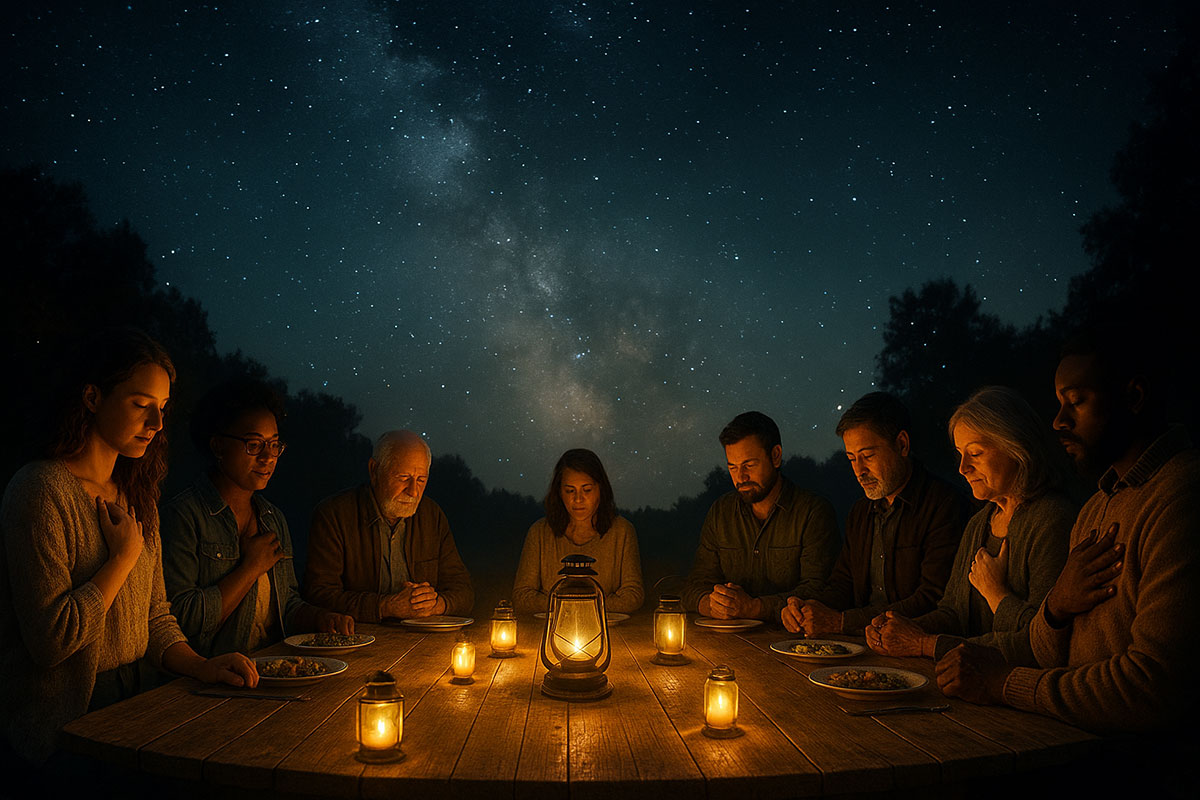
Night has arrived softly. The table glows with lantern light, and above it, the sky is a deep tapestry of stars. A faint breeze carries the smell of pine and earth. This gathering feels different — more reverent, more ancient. The empty chair remains, its candle now joined by a small bowl of water, symbolizing cleansing and spirit.
Abraham Lincoln rises, his silhouette etched by the warm glow.
LINCOLN (opening)
My friends… long before Thanksgiving became a date on a national calendar, gratitude was a spiritual act.
A prayer.
A ceremony.
A way of life.
Tonight, I wish to ask:
What is the spiritual essence of giving thanks across cultures and faiths?
He sits slowly, his eyes bright with quiet curiosity.
The first to speak radiates joy as naturally as sunlight.
Desmond Tutu
Gratitude, my dear ones, is the language of the soul.
It is how we speak to God without words.
When we give thanks, we admit that we are held, carried, loved — that none of us walks through this world alone.
In Africa, we say that a person is a person through other people — ubuntu.
Gratitude is recognizing the divine thread that binds us all.
Thanksgiving, at its deepest level, is not a meal.
It is a moment when heaven and earth touch.
Chief Joseph
Among my people, gratitude is not an act — it is the breath of our existence.
We thank the water, for without it we die.
We thank the earth, for she feeds and carries us.
We thank the wind, for it brings messages from the spirits.
Gratitude is how we honor the circle of life.
The spiritual essence is this:
Nothing belongs to us.
We borrow it for a short time.
And we return it with reverence.
Mother Teresa
Gratitude is love… recognizing love.
In my work with the poorest of the poor, I saw gratitude in places where there was almost nothing.
A crust of bread.
A warm hand.
A single smile.
Gratitude is the heartbeat of humility.
It is the soul bowing in recognition that everything we have — and everything we are — is a gift from God.
Thomas Merton
Gratitude is the doorway to contemplation.
It clears the mind, opens the heart, and allows us to see God not in the extraordinary, but in the profoundly ordinary.
The rustle of leaves.
The stillness of dawn.
The presence of another human being.
To give thanks is to awaken to the truth that we live inside a miracle.
Nick Sasaki
For me, gratitude used to be something I remembered on holidays.
Now I see it as something sacred — a way of staying connected to what matters.
Across every culture and every faith, gratitude seems to say the same thing:
We’re not alone.
We didn’t get here by ourselves.
And there is something larger — love, God, creation — carrying us.
Gratitude feels like touching that larger truth.
Lincoln listens, the reflections of the lantern dancing gently across his face.
LINCOLN — Second Question
He rises, voice warm and steady.
My friends…
Why does gratitude bring us closer to the divine?
He sits, hands crossed gently.
Desmond Tutu
Because gratitude removes the illusion of separation.
When you say “thank you,” whether to God or to another person, you are acknowledging relationship.
Gratitude is communion.
It collapses the distance between the human heart and the divine heart.
It reminds us that we are loved beyond measure.
Chief Joseph
Gratitude brings us closer to the Great Spirit because it teaches us humility.
When we give thanks, we stop demanding and start receiving.
We stop grasping and start honoring.
The Spirit speaks only to the hearts that are quiet enough to listen.
Gratitude creates that quiet.
Mother Teresa
When we give thanks, we recognize God’s presence in everything — in the sick, the poor, the lonely, the hungry.
God hides in the small things.
When we see them, when we thank Him for them, we meet Him face to face.
Thankfulness opens the door for love to enter.
Thomas Merton
Gratitude stills the mind.
And when the mind is still, God is no longer distant.
We are often too busy, too anxious, too full of ourselves to sense the divine presence.
Gratitude empties the self.
And where the self ends, God begins.
Nick Sasaki
I think gratitude brings us closer to the divine because it pulls us out of our own narrow story.
It lifts us above fear, above ego, above scarcity.
It opens our hearts to something larger, something sacred.
When I feel truly grateful, it’s like the world becomes clearer — and I become quieter inside.
Maybe that quiet is where God meets us.
Lincoln nods deeply, his eyes bright with agreement.
LINCOLN — Third Question
He speaks softly, as though entering sacred ground.
My friends…
How can we transform ordinary, everyday moments into sacred acts of thanksgiving?
Mother Teresa
By doing small things with great love.
Every act — washing a dish, serving a meal, offering a smile — can be transformed into prayer if it is done with gratitude.
Holiness is hidden in the simple.
Thomas Merton
To make life sacred, we must slow down enough to notice it.
The miracle is not in grand moments — it is in the quiet, the ordinary, the overlooked.
Wake with gratitude.
Walk with intention.
Speak with kindness.
Rest with trust.
Every breath becomes a hymn.
Chief Joseph
Treat every step as if the earth is your mother.
Treat every sip of water as if it were your last.
Treat every person as if they were sent by the Creator.
A sacred life is not a different life.
It is the same life, lived with awareness.
Desmond Tutu
Laugh more.
Sing more.
Bless more.
Love extravagantly.
Sacredness is not solemnity — it is joy.
When we delight in creation, we join the Creator.
Let every act, every moment, be a celebration of the miracle of being alive.
Nick Sasaki
What I’ve learned is that sacredness isn’t something you find — it’s something you bring.
When I pause and really see the moment — my family, a meal, a conversation — it becomes holy.
It’s like Thanksgiving isn’t a holiday…
It’s a way of paying attention.
Finally, Lincoln stands, hands clasped gently before him.
LINCOLN (closing)
Gratitude is the quiet path that leads the human heart back to the divine.
It sanctifies our days, magnifies our blessings, and softens the sorrows that remind us of love.
May we not wait for feast or ceremony to give thanks.
May we find holiness in the humblest moments.
And may gratitude be not merely spoken…
but lived.
The lanterns shimmer.
The night deepens.
The circle glows with warmth.
TOPIC 5 — A Grateful World: How Thanksgiving Can Heal a Divided Planet
Moderator: Abraham Lincoln
Scene Opens
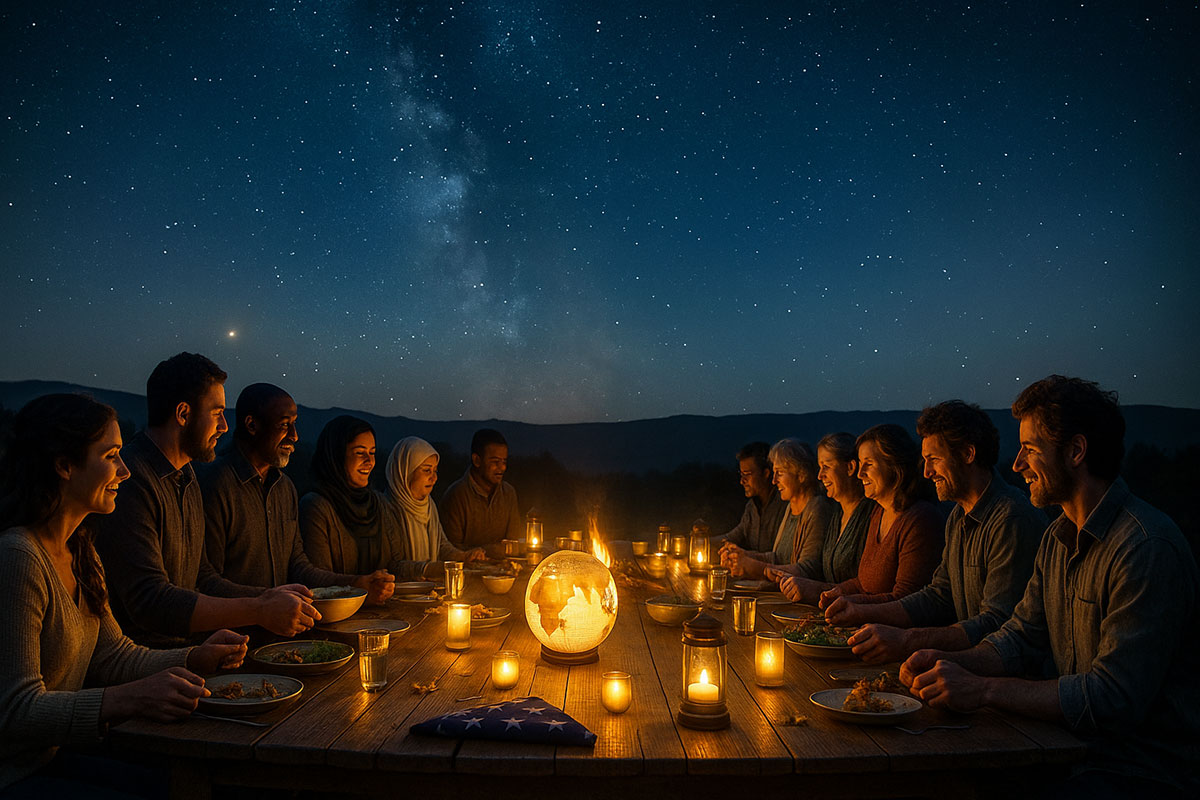
The night is quiet now. Stars shimmer like distant lanterns scattered across the heavens. The long wooden table — once holding autumn fruits, warm bread, and candles — now feels more like an altar than a dining table.
A soft wind stirs the remaining leaves, and the fire at the center burns low and steady, as if listening.
Abraham Lincoln rises one final time, tall and gentle, carrying the solemn grace of someone who has seen a nation fracture yet still believe in its healing.
LINCOLN (opening)
My friends… we have spoken of gratitude, sacrifice, family, and the sacred.
Now we arrive at the final question of our gathering — a question larger than any one table or nation.
The world, as I knew it, was divided. The world you know today is divided still.
And yet… Thanksgiving holds within it a seed, a possibility, a reminder of our shared humanity.
So I ask you:
How can gratitude rebuild trust and unity in a divided world?
He sits, folding his hands with deep earnestness.
The night leans in.
Martin Luther King Jr.
Gratitude opens the door to brotherhood.
When we are thankful, we recognize that we are part of a single garment of destiny, woven together by God’s hand.
Division grows from fear — fear that there is not enough love, not enough opportunity, not enough dignity to go around.
But gratitude reveals abundance.
When a person gives thanks, they cannot dehumanize their neighbor.
When a nation gives thanks, it cannot cling to hatred.
Gratitude is a step toward the Beloved Community — a world where all God’s children share the table.
Maya Angelou
A grateful heart does not build walls — it opens windows.
It lets in fresh air, new understanding, a softer way of seeing each other.
Human beings are so quick to judge, so quick to divide, so slow to understand.
But gratitude slows us down long enough to remember that every person has a story, every person has pain, every person carries something worth honoring.
When gratitude becomes a habit, unity becomes possible.
Viktor Frankl
Division comes when people feel disconnected from meaning.
A person without meaning clings to anger, to identity, to ideology, to anything that gives the illusion of control.
Gratitude reconnects us with meaning.
It aligns us with what matters — relationships, values, the preciousness of life.
When individuals rediscover meaning, societies rediscover unity.
Fallen Soldier
Division thrives when people forget what others have sacrificed for them.
But when a community remembers its fallen — not with politics, but with humanity — something shifts.
Gratitude reminds us that we belong to each other.
That our blessings were bought with blood, sweat, tears, courage.
When we honor sacrifice with gratitude, unity becomes a moral responsibility.
Nick Sasaki
I think gratitude unites the world because it strips everything down to what’s real.
When you’re truly grateful, you’re not thinking about race, politics, money, or ego.
You’re thinking about people.
About life.
About connection.
Gratitude reminds us that we all want the same things — love, safety, meaning, belonging.
When we see that, the distance between us gets smaller.
Lincoln nods, his eyes heavy with remembrance and hope.
LINCOLN — Second Question
He rises again, voice steady but carrying a quiet urgency.
My friends…
What role does sacrifice play in protecting peace today?
He sits, as the fire crackles softly.
Fallen Soldier
Sacrifice is the silent foundation of peace.
People enjoy freedom every day without realizing someone paid for it.
Peace is not the absence of war — it is the presence of responsibility.
Responsibility to remember.
Responsibility to protect.
Responsibility to live in a way that honors those who gave everything.
Sacrifice protects peace because it reminds us what is worth protecting.
Martin Luther King Jr.
Peace does not come cheaply.
It demands courage — the courage to stand up for justice, the courage to turn the other cheek, the courage to love when hatred is easier.
My own life taught me that peace sometimes requires giving everything, even life itself.
And yet, sacrifice born from love becomes a seed of transformation.
When people see that others are willing to sacrifice for peace, they are inspired to build it.
Viktor Frankl
Sacrifice is meaning in action.
It is the willingness to place purpose above comfort.
A society that honors sacrifice is a society that values life.
When people understand the weight of sacrifice, they treat peace with reverence.
Maya Angelou
Every sacrifice — from the smallest kindness to the greatest courage — is a light placed in the darkness.
The world is built by such lights.
Peace survives because ordinary people choose to give a piece of themselves — their patience, their understanding, their forgiveness — every day.
Sacrifice is love wearing its strongest clothing.
Nick Sasaki
I think sacrifice reminds us to stop taking life for granted.
Peace isn’t automatic.
It’s handed down.
Protected.
Chosen.
When we acknowledge the sacrifices made by soldiers, activists, parents, teachers, and countless others, we realize peace is something we must actively continue — not passively inherit.
Lincoln bows his head slightly, honoring every life touched by sacrifice.
LINCOLN — Third Question
He stands once more, voice soft, carrying the final weight of the gathering.
My dear friends…
How can we live in a way that honors those who gave everything for a better future?
Martin Luther King Jr.
By living with moral courage.
By choosing love when hatred beckons.
By building bridges where others build barriers.
By standing for justice, for compassion, for the dignity of every soul.
To honor the fallen, we must create the world they hoped to defend.
Maya Angelou
Honor them by rising.
By forgiving.
By laughing.
By loving.
By choosing joy not as a luxury, but as a rebellion against despair.
Live boldly, kindly, gratefully — that is how we honor the ones who left us too soon.
Viktor Frankl
We honor them by living with meaning.
By asking not “What can I expect from life?”
but “What does life expect from me?”
Meaning makes us worthy of their sacrifice.
Fallen Soldier
Live fully.
Live bravely.
Live kindly.
Live in a way that makes someone’s life easier, safer, more beautiful.
We did not give our lives so that people could live small, afraid, or divided.
We gave them so that you could live with freedom — the freedom to love, to help, to build, to lead.
Honor us by using that freedom well.
Nick Sasaki
For me, honoring them means not wasting time.
Not wasting relationships.
Not wasting the chance to make the world better in whatever way I can.
It means remembering that every day is a gift… one that someone else never got.
To honor them is to live with purpose — and with heart.
Lincoln rises one final time, tall against the night sky.
LINCOLN (final closing)
My friends…
gratitude is the quiet force that can heal nations and mend divisions.
Sacrifice is the price paid so that future generations may gather freely at their tables.
And unity is the promise we must keep.
May we live with humility,
with courage,
with compassion,
and above all…
with gratitude.
For in gratitude lies the path to peace.
The fire glows softly, the stars shimmer brighter, and the night holds the weight of every word spoken.
Final Thoughts by Nick Sasaki
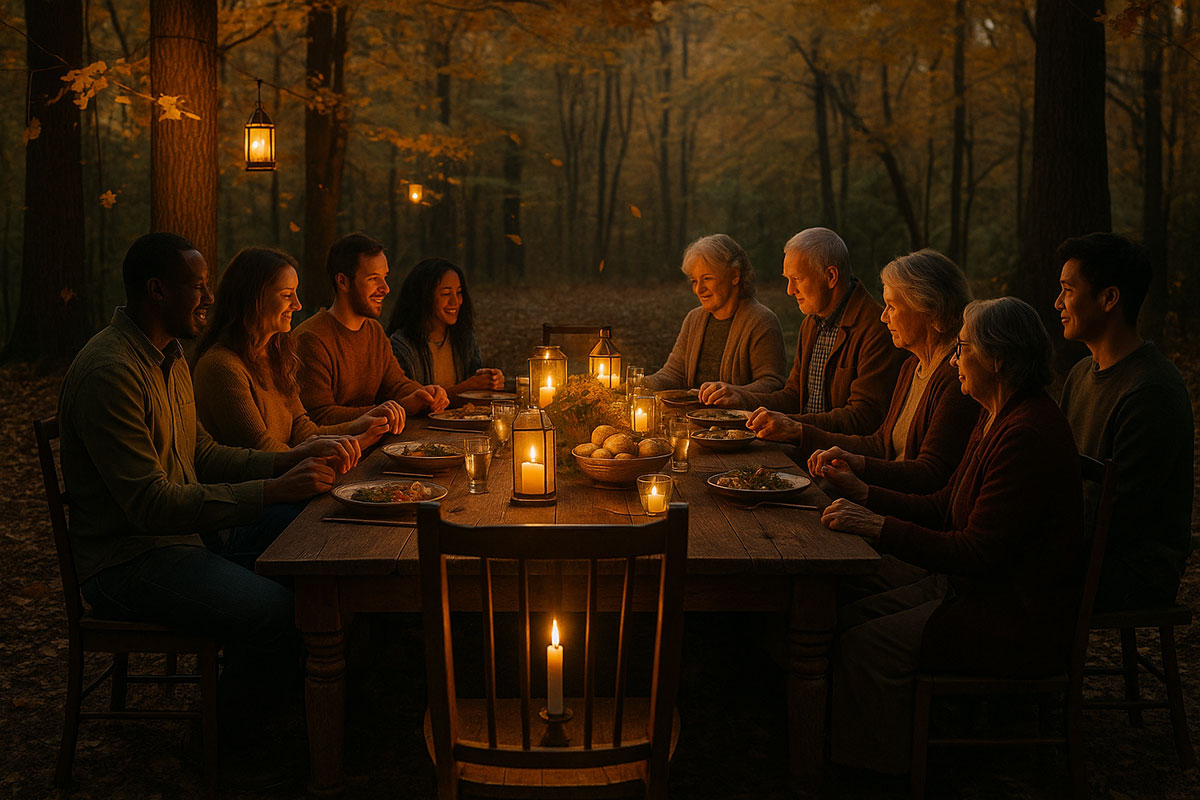
As we reach the end of these five conversations, I’m reminded once again that the meaning of Thanksgiving day is not confined to history, religion, or tradition. It’s woven into the way we live, the way we honor, the way we remember, and the way we choose to treat one another.
What I learned from these voices — from Lincoln to Angelou, from King to Thích Nhất Hạnh, from the fallen soldier to the mothers and veterans who carry their legacies — is that gratitude is not fragile. It is strongest in our hardest moments. It survives disappointment. It grows in the soil of loss. And it lives most powerfully when we choose to keep our hearts open.
Thanksgiving calls us to look at our families with softer eyes.
It asks us to pause long enough to feel the miracle of being alive.
It reminds us that we stand on the sacrifices of people we may never meet.
And it invites us into a world where gratitude becomes a bridge — between past and present, between strangers and neighbors, between nations and hearts.
If there is one message I carry with me from this entire journey, it is this:
Live in a way that honors the people who gave you the chance to live freely.
Live with intention.
Live with compassion.
Live with gratitude that does not wait for a holiday.
Because when gratitude becomes the way we move through the world, Thanksgiving is no longer a day on the calendar —
it becomes the way we build peace, honor sacrifice, and keep each other human.
Thank you for sharing this journey with me.
Short Bios:
Abraham Lincoln
Abraham Lincoln (1809–1865), the 16th President of the United States, led the nation through the Civil War and issued the 1863 proclamation establishing Thanksgiving as a national day of gratitude. Known for his humility, moral clarity, and deep compassion, Lincoln remains a symbol of unity, resilience, and hope.
Maya Angelou
Maya Angelou (1928–2014) was an acclaimed poet, memoirist, and civil rights voice whose work illuminated the human capacity for resilience and grace. Her writings on dignity, belonging, and forgiveness have inspired generations around the world.
Martin Luther King Jr.
Martin Luther King Jr. (1929–1968) was a minister, activist, and central leader of the American civil rights movement. His teachings on justice, love, and nonviolence continue to shape global conversations about compassion and human unity.
Thích Nhất Hạnh
Thích Nhất Hạnh (1926–2022) was a Vietnamese Zen master, peace activist, and founder of the Plum Village tradition. His teachings on mindfulness, compassion, and interbeing helped bring modern spiritual clarity to millions.
Desmond Tutu
Desmond Tutu (1931–2021) was a South African Anglican bishop and Nobel Peace Prize laureate known for his role in ending apartheid and leading the Truth and Reconciliation Commission. He championed forgiveness, joy, and the sacred worth of every human being.
Gold Star Mother (Representative)
The Gold Star Mother in this conversation symbolizes the countless mothers who have lost a child in military service. She embodies courage, remembrance, and the enduring weight of sacrifice carried in silence across families and generations.
Veteran (Representative)
The Veteran represents the men and women who have served in the armed forces, carrying memories of conflict, brotherhood, loss, and gratitude. His presence honors both the visible and invisible costs of freedom.
Fallen Soldier (Symbolic Voice)
The Fallen Soldier is a symbolic presence representing those who gave their lives in service. His perspective reflects duty, love of country, and the hope that their sacrifice leads to peace and unity among those who remain.
Family Therapist (Representative)
The Family Therapist serves as a voice for healing and reconciliation in everyday households. She helps illuminate the unspoken tensions, generational wounds, and quiet hopes that shape family relationships.
Community Elder (Representative)
The Community Elder speaks with the wisdom accumulated through decades of lived experience. His role reflects the importance of memory, tradition, and intergenerational guidance in cultivating gratitude.
Spiritual Teacher (Representative)
The Spiritual Teacher offers universal insights on gratitude, compassion, and the sacredness of everyday life. Their presence bridges personal experience with timeless spiritual truths.
Global Humanitarian (Representative)
The Global Humanitarian works across borders to alleviate suffering and build peace. Her perspective highlights the shared human condition and the global dimension of gratitude.
Nick Sasaki
Nick Sasaki is a writer, storyteller, and creator of ImaginaryTalks.com, dedicated to exploring the deepest questions of life through meaningful conversations across history, culture, and imagination. His work blends spiritual insight, emotional truth, and human connection, inviting readers to reflect, heal, and grow.
Leave a Reply