
|
Getting your Trinity Audio player ready...
|
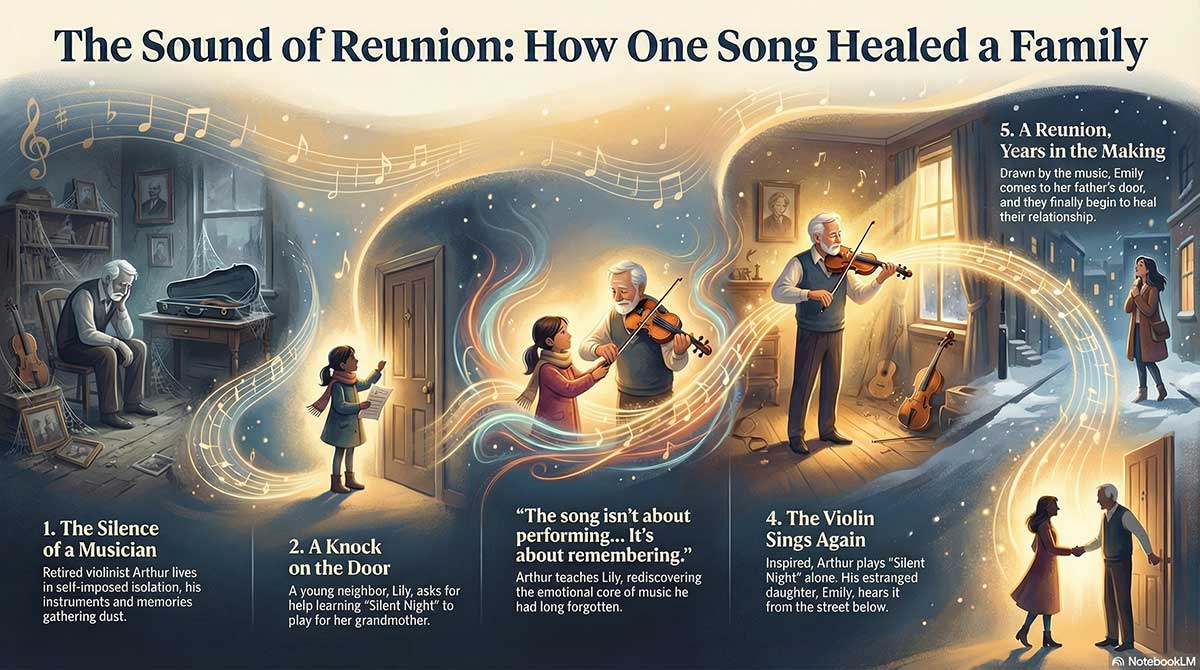
1. The Apartment of Ghosts
The old man’s apartment was full of ghosts.
Not the kind that rattled chains or slammed doors, but softer ones—the kind that lingered in the curtain folds and the dust on the piano keys, in the framed photographs turned face-down on the bookshelf, in the violin case that hadn’t been opened in years.
Arthur Hale sat in his armchair by the window, wrapped in a threadbare cardigan, watching December slip past outside. Snow drifted lazily down onto the city street, settling on car roofs and crooked lampposts. People hurried by with scarves up to their noses, arms full of shopping bags, faces red from the cold.
He could almost hear the sound of Christmas carols muffled through their hats.
He hated Christmas carols.
Not because they were bad songs. Quite the opposite. They were too good at their job. They went straight for the tender spots, pulled at threads he’d spent decades trying to tie off.
On top of the old radio, between a chipped ceramic angel and a crooked candle, lay a single, dusty CD in a cracked case.
“Arthur Hale — Christmas at the Philharmonic.”
He turned his eyes away from it.
He had been famous once, in a modest kind of way—a respected violinist, a long career with the orchestra, a few solo records. People had clapped, had asked for autographs, had written his name in neat serif fonts on concert posters.
That felt like somebody else’s life now.
The radiator hissed. The clock ticked. The world outside glittered with tinsel and shop windows and fresh snow.
Inside Arthur’s apartment, it was very, very quiet.
2. The Girl at the Door
The knock at the door startled him.
He turned his head, listening. No one ever knocked. The building superintendent just barged in when there was a problem with the pipes. Bills came through the mail slot. Phone calls were rare, and when they did come, they were usually mistakenly dialed numbers or charity organizations asking for money he didn’t have.
The knock came again. Small, tentative.
He shuffled to his feet, joints protesting, and walked slowly down the short hallway. He opened the door a crack.
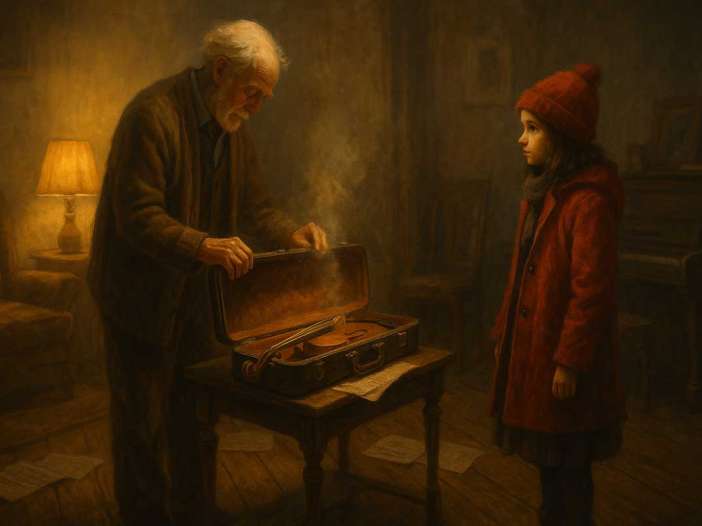
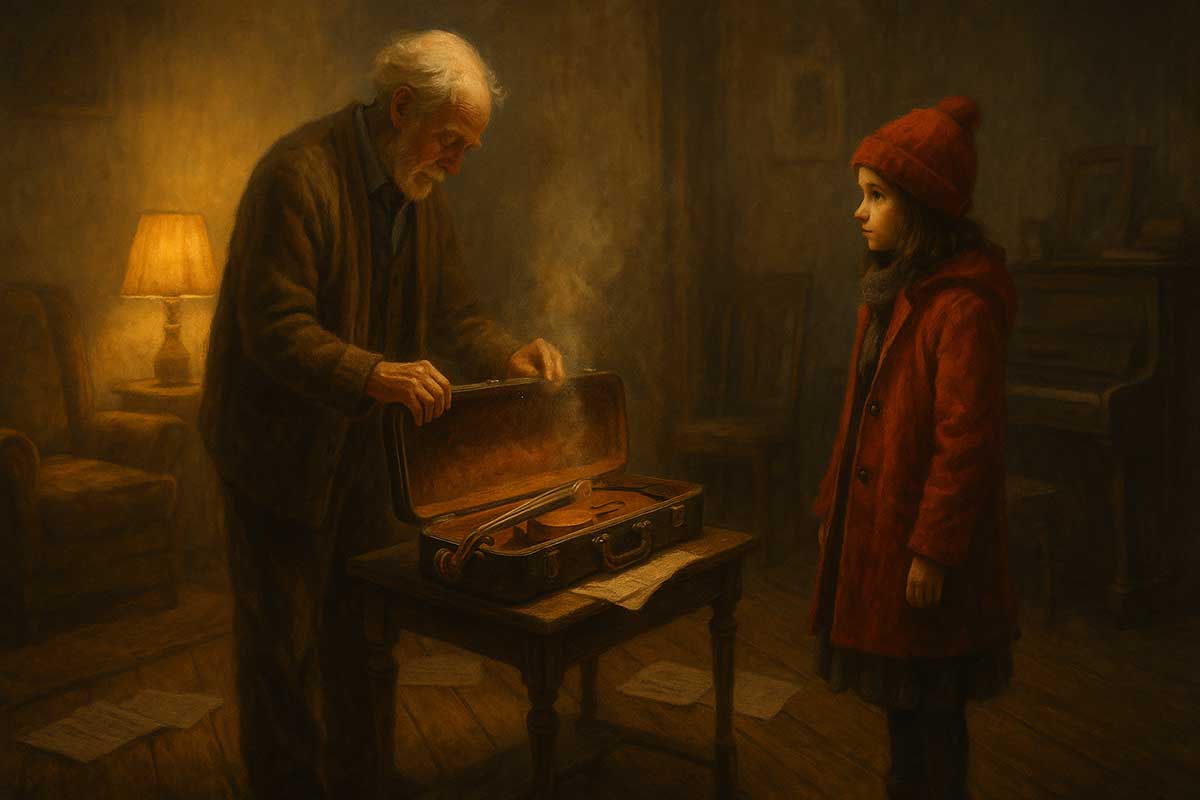
A little girl stood there, bundled in a red coat, hat askew over a tangle of curls, cheeks bright from the cold. She held a foil-covered plate in her mittened hands.
“Hello,” she said, slightly out of breath. “Are you Mr. Hale?”
He blinked. “Who wants to know?”
“I’m Lily,” she said. “I live in 4B. My mom said I should say ‘we’re your upstairs neighbors,’ because that sounds polite, and also, um, because it’s true.” She held out the plate. “We made cookies. Mom says we made too many. But I think she just wanted to share.”
Arthur stared at the plate, then at the girl. “Cookies,” he repeated, as if it were a foreign word.
“Yeah,” she said. “You know, the things that taste like happiness but also cavities.”
Despite himself, the corner of his mouth twitched.
He opened the door a little wider. “You’d better come in. It’s freezing out there.”
She stepped inside, eyes widening as she took in the apartment. “Whoa,” she said. “It’s like… a music museum.”
He followed her gaze to the old upright piano, the shelves of sheet music, the violin case on the sideboard. Everything was covered in a fine layer of dust.
“Does anyone visit your museum?” she asked.
“No,” Arthur said shortly. “The exhibits are retired.”
She nodded in the serious, exaggerated way only children managed. “Mom said you used to be famous.”
Arthur frowned. “Did she now?”
“Well,” Lily said, spinning slowly in place as she looked around, “she said you were in an orchestra for a very long time. And that counts as famous, right? ’Cause your name was in books and stuff.”
“Programmes,” he muttered. “Not books.”
“Still.” She walked over to the sideboard and peered at the violin case. “Is that it?”
“Don’t touch that,” Arthur snapped, sharper than he intended.
She froze.
He sighed, the anger dissolving as quickly as it rose. It wasn’t really anger at her. It was at time. At loss. At the relentless forward march of things.
“Sorry,” he said gruffly. “It’s… delicate.”
She nodded, stepping back respectfully.
“Do you still play?” she asked.
“No,” he said.
“Why not?”
“Because,” he replied, “some things belong to other times.”
She frowned at that, but didn’t argue. Instead, she shifted her weight from foot to foot.
“Can I ask you something?” she said.
“You seem to be doing it already,” he said, but there was no real bite in it.
3. Teaching Silent Night
“In school,” she said, “we’re having a concert. A Christmas one. I have to play a song on the piano, but I’m not very good yet. Mom says I’m better than I think, but I can hear my own hands. They’re clumsy.” She swallowed. “I’m supposed to play Silent Night.”
He flinched. The title landed like a stone in his chest.
“It’s my grandma’s favorite,” Lily went on. “She’s in a nursing home now. Mom says she might not remember us when we visit, but when she hears music, her eyes get brighter. I want to play it for her. But…” She twisted one mitten in the other. “I don’t want to mess it up.”
Arthur felt his throat tighten unexpectedly.
“What do you want from me?” he asked quietly.
“Could you show me how to make it sound… you know…” She flapped her hands helplessly. “Like it means something.”
He looked at her for a long time.
In his mind, for just a moment, he saw another little girl—dark hair, serious eyes, clutching a tiny violin in hands too small for it. His daughter, Emily, age seven, standing on a kitchen chair so she could reach the music stand.
“Play it like you’re telling me a secret,” he had said back then.
“Music isn’t a secret,” she’d argued.
“Ah,” he’d replied. “The best kind always is.”
The memory hurt.
He had not spoken to Emily in years.
He cleared his throat. “I don’t teach anymore,” he said.
“Please,” Lily whispered. “Just once? I won’t bother you again. I promise.”
He almost said no.
But something about the way she clutched that foil-covered plate, standing small and hopeful in his faded living room, made the word stick in his throat.
“Fine,” he said. “Once.”
Her face lit up so suddenly it was like watching the sun breach the horizon.
He gestured to the piano. “Let’s hear what you can do.”
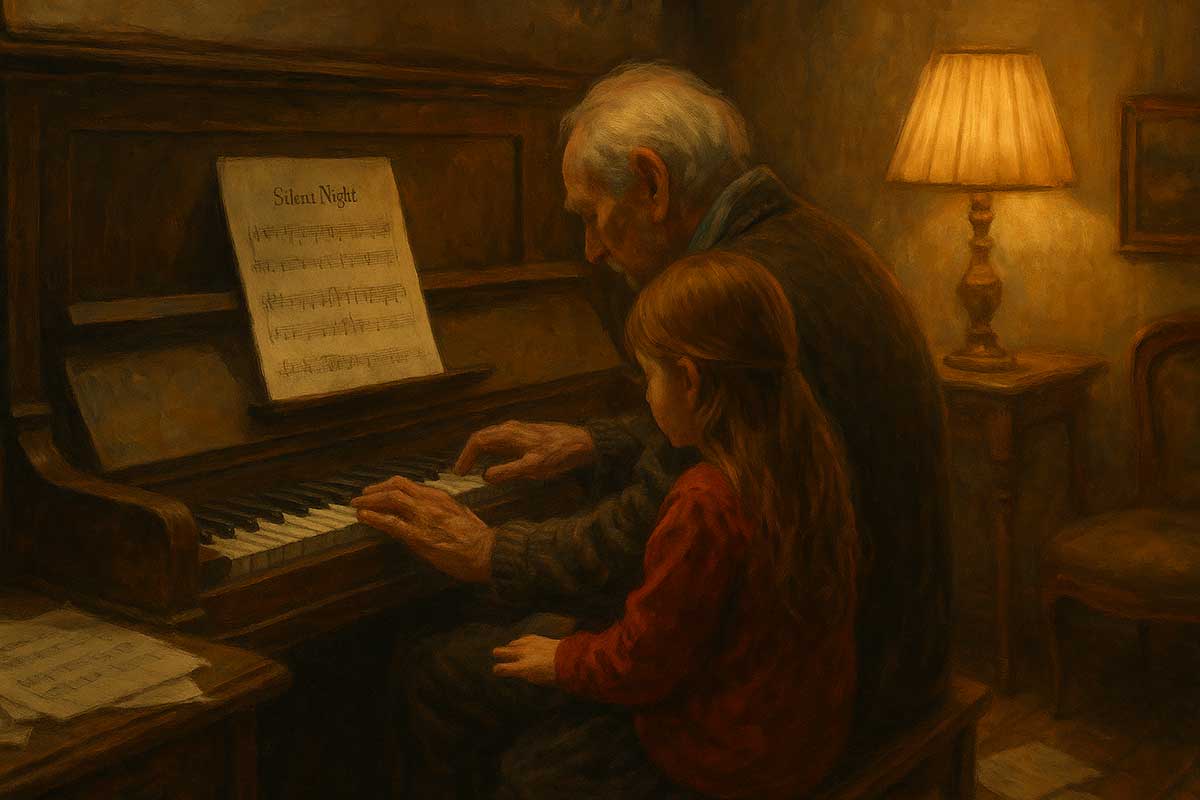
She sat on the worn bench, placing the plate carefully on top of the piano. She removed her mittens, flexed her fingers, and took a deep breath. Then she began to play.
The melody was recognizable, but hesitant—the rhythm uneven, the chords a little thin. She stumbled on the transition to the second phrase, stopped, and groaned.
“See?” she muttered. “It sounds like the song is wearing the wrong shoes.”
Arthur snorted. “That’s quite an image.”
“I don’t know how to make it… float,” she said. “Like the music teacher does.”
He walked over, slower than he used to, and sat beside her on the bench. The wood creaked under the combined weight.
“Move over,” he said.
She scooted a little to the left. He placed his stiff, knotted fingers on the keys. They felt unfamiliar and intimately known all at once.
He played.
Not the whole song. Just the first line. Simple. Clean. Each note given time to breathe.
“So that’s the right shoes,” Lily whispered.
He played it again.
“Do you notice,” he said quietly, “how the melody doesn’t rush? It’s not trying to get somewhere. It’s content to stand in one place and look around.”
She nodded slowly.
“That’s because it’s not about performing,” he said. “It’s about remembering. The song isn’t saying, ‘Listen to me, I’m impressive.’ It’s saying, ‘Shh. Look. Something holy is happening.’”
“Like a baby being born?” she asked.
“Something like that,” he murmured.
He lifted his hands. “Now you.”
She took a breath and played the first line again, this time a little slower, letting each note settle before moving to the next.
He listened.
“Better,” he said.
They worked for an hour.
He showed her how to shape the phrases, where to lean a little harder, where to pull back, where to let silence hang for a heartbeat before continuing. Occasionally, he would demonstrate, and over time, almost without realizing it, he began to hum along.
His voice, unused and rusty, wove around the notes.
“…all is calm, all is bright…”
“Did you ever play this in a concert?” Lily asked.
He hesitated.
“Yes,” he said.
“Did people clap?”
“They did,” he replied. “But that wasn’t the important part.”
“What was?”
He stared at the keys. For a brief, piercing moment, he remembered standing on a darkened stage, the orchestra behind him, the hall filled with people holding their breath as he pulled the bow across the strings.
He remembered seeing, in the second row, his wife wiping a tear from her eye, and beside her, his daughter, Emily, leaning forward, utterly still.
“The important part,” he said slowly, “was that for three minutes, everyone in the room remembered they had a soul.”
Lily nodded solemnly, as if filing that away for later.
When they finished, she bounced off the bench. “Thank you,” she said. “Really. I’m going to practice every day. Grandma won’t know what hit her.”
Arthur managed a small smile. “That’s some odd way of talking about a lullaby.”
She giggled. “You should try the cookies,” she said, picking up the plate and thrusting it into his hands. “They’re chocolate chip. Mom says they’re almost as good as hugs.”
He swallowed around an unexpected ache.
“I’ll… give them a try,” he said.
She beamed, jammed her mittens back on, and headed for the door.
“Merry Christmas, Mr. Hale!” she called as she left.
He closed the door behind her and stood in the hallway for a long moment, listening to the echo of her footsteps on the stairs.
Then he carried the cookies to the armchair and sat down slowly.
He opened the foil.
They were slightly overbaked, edges too dark.
He ate one anyway.
It did taste a bit like a hug.
4. Opening the Violin Case
That night, after washing the plate and setting it to dry, Arthur found himself standing in front of the sideboard, staring at the violin case.
He had avoided it for so long that opening it felt like an act of trespassing.
But his hand moved almost of its own accord, fingertips tracing the worn leather. He flicked open the latches. The soft click sounded indecent in the quiet room.
The case opened with a faint sigh.
There it was.
His violin.
The varnish was duller than he remembered, the strings rough with dust. He picked it up carefully, feeling the familiar weight of it settle against his shoulder. His chin found its old place on the rest as naturally as breathing.
He lifted the bow.
His hand trembled.
He drew the bow across the open strings. The first sound was ugly—scratchy, thin. He winced.
“Of course,” he muttered. “What did you expect, Hale? Time is not a kind teacher.”
He adjusted his grip, rolled his shoulders, closed his eyes.
He tried again.
This time, the note was clearer.
He began to play.
Just scales at first, creaky and uneven. Then a fragment of something half-remembered. His fingers stumbled, corrected themselves, found old pathways in the wood.
And then, without deciding to, he slipped into Silent Night.
The melody emerged, hesitant, then stronger.
His apartment, once so still, filled with sound—fragile at first, then deepening, settling into the corners like light.
Memories came in with the music.
His first Christmas as a father, rocking Emily in the dark, the bow resting on his knee as he hummed the carol into her soft hair.
The time she had played it for a school recital, standing on stage with her half-size violin, scowling in concentration. Afterward, she’d run into his arms. “Did I do it right, Papa?”
“You broke my heart,” he’d told her. “Which is how I know you did it perfectly.”
The fight years later, when she was seventeen.
“You care more about your career than about me,” she’d shouted. “You’re married to your violin.”
“That’s ridiculous,” he’d snapped. “Everything I’ve done, I’ve done for this family.”
“Then why are you never here?” Her voice had cracked. “You miss everything. Every concert. Every birthday. You just send me recordings of you playing as if that’s supposed to make up for it.”
“I’m trying to give you a future,” he’d said.
“I just wanted a father,” she’d replied.
The words had stuck like a shard of glass. Pride had joined hands with hurt. Neither of them had called. Neither of them had apologized. Time had slipped by in thick, guilty layers.
He didn’t even know where she lived now.
The violin trembled under his fingers.
The last note of Silent Night hovered in the air, then faded into silence.
Arthur lowered the instrument with shaking hands.
5. The Reunion
He nearly dropped the violin.
Who would call at this hour?
Heart pounding, he set the instrument back in its case, crossing the room in a few hurried, unsteady steps. He snatched up the receiver.
“Hello?”
There was a pause on the other end.
Then a voice he had not heard in over a decade.
“Dad?”
The room tilted.
“Emily?” he said, barely more than a breath.
“Yeah,” she said, and he could hear the tears in her voice even across the years and the line. “I… I’m sorry to call so late. I didn’t even know if this number still worked, but… I was walking past your building. I—I looked up. I could see your window.”
She laughed weakly.
“And I heard you,” she whispered. “I heard you playing. Silent Night.”
Arthur’s hand tightened on the receiver.
“I thought I was imagining it,” she went on. “I thought, ‘It can’t be him. He hasn’t played in years.’ But it sounded just like when I was a kid. I just… stood there on the sidewalk and cried like an idiot while people walked around me.”
He swallowed around the knot in his throat.
“Emily,” he said. “I… I’ve wanted to call. A thousand times. I just… I didn’t know how to start.”
“I do,” she said.
There was a rustle, as if she were shifting the phone from one ear to the other.
“How about,” she said softly, “start with ‘I’m sorry’ and I’ll say it back, and then we’ll both laugh at how stubborn we’ve been, and then… maybe we can talk.”
He let out a shaky breath that felt like it had been trapped in his chest for years.
“I’m sorry,” he said, the words raw and simple.
She inhaled sharply. “Me too.”
Silence washed over them—this time not heavy, but full, like a pause in the music just before a note that changes everything.
“Are you home?” she asked.
“Yes,” he said. “I… I’m always home these days.”
“Can I come up?” she asked.
He looked around the apartment—the dust, the ghosts, the violin case still open.
“Please,” he said. “Yes.”
He hung up the phone and hurried—faster than his body thought possible—to the door. He opened it, leaving it ajar, then stood in the hallway, hands shaking.
Footsteps on the stairs.
A figure turned the corner—older than the girl in his memories, of course, but unmistakable. Same eyes. Same way of biting her lip when she was unsure.
They stared at each other for a heartbeat.
“Hi,” she said.
“Hi,” he managed.
Then she stepped forward and hugged him hard, nearly knocking him backward.
He held onto her like a man clinging to a piece of wreckage in a storm.
They stood like that for a long time.
Finally, she pulled back, wiping her eyes. “Your neighbor—little girl in 4B—told me I should ring your bell if I ever wanted to ‘unforget someone,’” she said, half laughing. “I ran into her downstairs. She said you ‘helped her fix a song.’ I thought… maybe you’d help me too.”
He chuckled, the sound rusty. “She’s surprisingly persuasive.”
They went inside.
Her eyes scanned the room, landing on the open violin case.
“You played,” she said.
“I did,” he replied. “Not well.”
“It was perfect,” she said. “The way I heard it on the street… it sounded like you were… like you were praying.”
“In a way, I suppose I was,” he murmured.
They sat. They talked. They stumbled through long-overdue apologies, through stories of years missed, through memories of concerts, of birthdays, of the night she’d stormed out and the nights he’d stared at the phone, too proud to dial.
At some point, Lily knocked again—this time with her mother behind her, holding a casserole.
“Sorry to intrude,” her mother said, blinking at the scene. “Lily said you might want company tonight. I didn’t realize you already had some.”
Arthur looked from Lily’s bright eyes to Emily’s tearful smile, and something inside him settled into place.
“Come in,” he said. “The more, the merrier.”
They ate together. They laughed. They cried. He told stories about the orchestra; Emily filled in the missing years. Lily chattered about her school concert.
“Will you come?” she asked. “To hear me play Silent Night?”
“If your mother doesn’t mind,” Arthur said.
Her mother smiled. “We’d be honored.”
Later, as the night grew late and the casserole dish sat empty on the coffee table, they all gathered around the old upright piano.
“Play it,” Emily said softly. “Just once. For all of us.”
Arthur hesitated.
Then he picked up the violin.
Lily sat at the piano, hands poised over the keys, eyes shining with concentration.
He nodded to her.
She began to play, her small fingers finding the melody he had helped her shape. It was not perfect—but it was full of something better than perfection.
When the opening phrase ended, he lifted the bow and joined her, the violin’s voice weaving around the piano’s simple line. Emily began to sing, her voice low and a little rusty, and then Lily’s mother joined in.
“Silent night… holy night…”
In the small, worn apartment, with its faded wallpaper and crooked frames, something sacred unfolded.
Ghosts did not disappear. They shifted.
They stepped back to make room for the living.
Arthur played as if his heart were cracking and mending at the same time.
When they reached the final line, he held the last note longer than written, letting it hover, letting it gather every regret, every apology, every lonely December he’d spent in silence.
Sleep in heavenly peace…
The note trembled, then faded.
No one spoke for a moment.
Then Lily sighed happily. “I think my grandma would have liked that.”
“I hope so,” Arthur said.
Emily reached over and took his hand.
“You know who else liked it?” she said.
“Who?”
“Me,” she whispered.
His eyes filled.
Outside, snow kept falling over the city, covering car roofs and crooked lampposts, resting gently on people hurrying home with their shopping bags and tangled lives.
Inside the apartment, the forgotten musician was not forgotten anymore.
And somewhere—between the notes, between the breaths, between the words they said and the ones they didn’t—an old wound finally began to heal.
All because, on a quiet December night,
one little girl had knocked on a door
with a plate of cookies and a song that needed to mean something.
Short Bios:
Arthur Hale
A retired orchestral violinist in his late seventies, Arthur once performed on grand stages but now lives alone in a small, aging apartment. Haunted by estrangement from his daughter and the loss of his wife, he has abandoned music entirely, believing it belongs to a past he no longer deserves. Beneath his gruff exterior lies a deep longing for connection and redemption.
Lily from 4B
A bright, curious eight-year-old with a fearless heart and a natural talent for forming unexpected friendships. She plays piano in her school’s Christmas performance and wants to make her ailing grandmother proud. Her innocence, determination, and gentle insistence rekindle Arthur’s long-dormant love for music.
Lily’s Mother
Warm, gracious, and perceptive, she works hard to care for her daughter and her own mother in a nursing home. Recognizing loneliness when she sees it, she encourages Lily’s act of kindness toward Arthur and later facilitates the reunion between him and his daughter.
Emily Hale
Arthur’s adult daughter, a woman carrying her own wounds from years of emotional distance with her father. Talented and thoughtful, she once adored him but grew resentful of his obsession with music and his absence from important moments in her life. Hearing him play again awakens both pain and hope, ultimately leading her to seek reconciliation.
Grandmother (Lily’s Grandma)
Mentioned but not directly present, she is the emotional anchor for Lily’s wish to learn “Silent Night.” Her fading memory makes music—especially simple, beautiful melodies—a lifeline that briefly reconnects her to the world and those she loves.
The Neighbors in the Building
A quiet presence within the story, they serve as part of the world Arthur has withdrawn from. Their brief interactions with Lily and her mother highlight the contrast between the warmth of community and Arthur’s self-imposed isolation.
Leave a Reply