
|
Getting your Trinity Audio player ready...
|
What happens after we die is a question that has shaped every era of human history. Some seek answers in science, others in spirituality, and others in the firsthand testimonies of those who momentarily crossed the threshold and returned. This series brings together voices from all of these worlds—neuroscientists, near-death experiencers, philosophers, and spiritual teachers—to illuminate what death may truly reveal about consciousness.
Their perspectives form a single tapestry: that life extends beyond the physical, that consciousness may be far more fundamental than the brain, and that death is not a disappearance but a transition. These dialogues explore the nature of the mind, the structure of the afterlife, the purpose of incarnation, and the powerful transformation that occurs when fear dissolves. Together, they invite us to see death not as an ending, but as a continuation of awareness within a reality more vast than we ever imagined.
(Note: This is an imaginary conversation, a creative exploration of an idea, and not a real speech or event.)
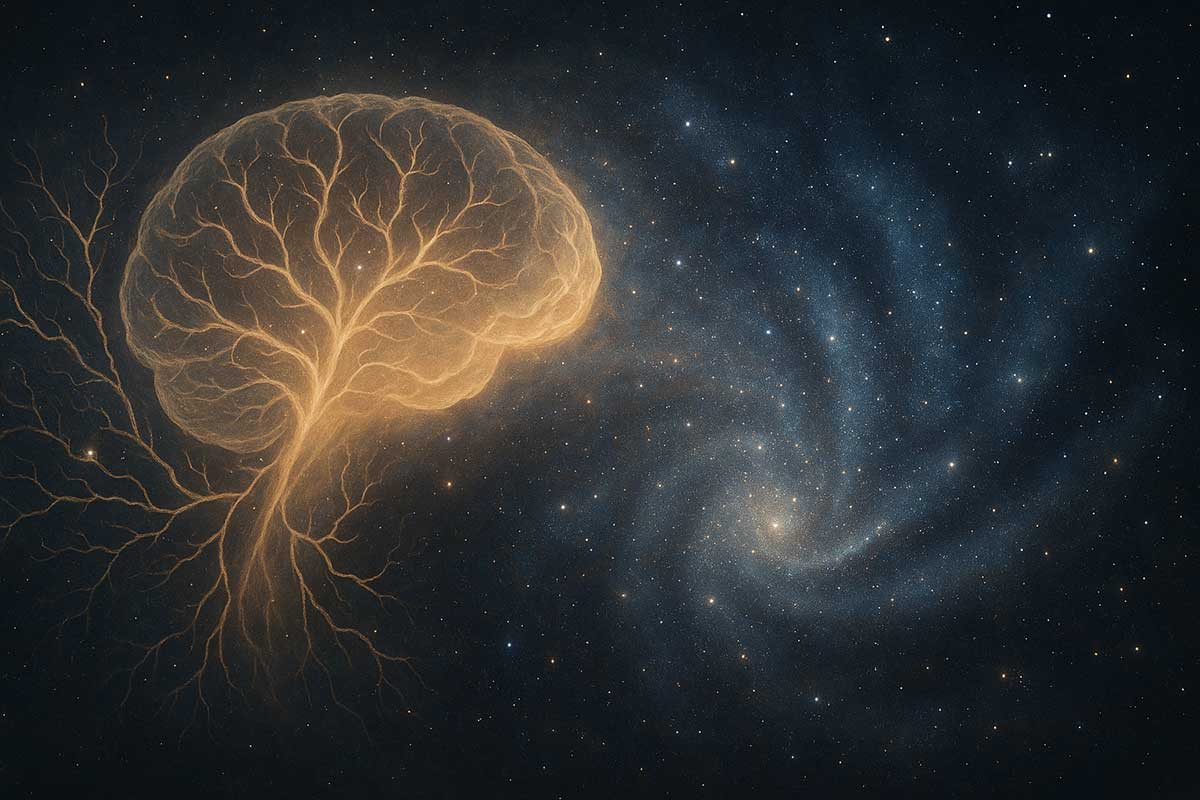
Is Consciousness Independent of the Brain?
Panel: Sam Parnia, Bruce Greyson, Pim van Lommel, Eben Alexander, Penrose/Hameroff (Quantum Consciousness Team)
Moderator: Nick Sasaki
Opening by Nick Sasaki
The question of what happens after we die ultimately begins with a deeper mystery: what produces consciousness in the first place? If consciousness is merely a byproduct of neural activity, then everything ends at death. But if consciousness exists beyond the brain, then death is not an ending at all—it’s a transition.
Today, we explore this frontier with a group of pioneers who have pushed open the edges of what science is willing to consider.
I invite each of you to join me in a thought experiment.
If the brain stops and consciousness continues, even briefly, the story of human existence is far larger than we’ve imagined.
Let’s begin.
CRUCIAL QUESTION 1
If consciousness can continue during cardiac arrest when the brain is clinically inactive, what does that imply about the true source of awareness?
Dr. Sam Parnia
When a patient is in cardiac arrest, blood flow to the brain stops almost instantly. Within seconds, the brain’s electrical activity flatlines. According to the traditional model, the person should have no awareness at all. Yet we have countless verified accounts of patients describing events that occurred during this period, including details later confirmed by medical staff.
What this suggests is that consciousness is not generated by the brain. It is mediated by it. The brain is a device—an interface. When it fails, consciousness does not simply evaporate. Instead, it continues, at least for a period of time, in a state we do not yet understand.
This tells us the story is far bigger than brain chemistry.
Dr. Bruce Greyson
I’ve interviewed thousands of people who should not have been conscious by any neurological standard. Yet they were. Their experiences were often more vivid than ordinary waking life—clearer, more coherent, more meaningful.
When the brain shuts down, we would expect consciousness to degrade, but instead, we see the opposite. So the implication is profound: the brain does not create consciousness; it filters it. As the brain shuts down, the filter loosens, and consciousness expands.
It’s as if we are seeing glimpses of the mind unbound.
Dr. Pim van Lommel
In my research published in The Lancet, we documented NDEs that occurred under conditions incompatible with conscious awareness. Many of these patients described perceptions from a vantage point outside their body. Some even observed details—like medical tools or discussions—that they could not have known.
To me, the conclusion is unavoidable: consciousness is not housed in the brain. It is nonlocal. It exists independently and is merely accessed through the brain while we live.
The brain is a temporary receiver—a biological instrument tuned to a larger reality.
Dr. Eben Alexander
As a neurosurgeon, I once believed consciousness was the product of brain function. Then my own NDE, occurring while my cortex was completely shut down from meningitis, showed me something I was not prepared for: lucidity beyond anything I had ever known.
I was not hallucinating. I was more awake than in waking life.
If consciousness were dependent on the cortex, I could not have had any experience at all, much less a coherent and transformative one. So what is the source of awareness?
It is fundamental. It is the ground of existence itself.
The brain is not the origin—it is the limiter.
Sir Roger Penrose & Dr. Stuart Hameroff (Quantum Consciousness Team)
From our perspective, consciousness arises from quantum processes within microtubules inside neurons. These processes are not limited to the physical body; they tap into deeper layers of reality governed by quantum mechanics.
During cardiac arrest, when brain activity shuts down, these quantum processes may continue in a nonlocal field. When the brain restarts, the information is reintegrated.
This implies that consciousness is woven into the fabric of the universe itself. It is not destroyed when the brain stops functioning.
Nick Sasaki
What you are all pointing to is extraordinary—not only that consciousness survives the brain’s shutdown, but that the brain might simply be the temporary boundary of a much larger awareness.
Let’s go further.
CRUCIAL QUESTION 2
Is the brain producing consciousness, or is it more like a receiver—and if so, what is it receiving from?
Dr. Bruce Greyson
The classic analogy is a television set. If you smash the television, the broadcast doesn’t disappear—it just becomes inaccessible through that device.
The brain is structured to filter, limit, and personalize consciousness so we can function in a physical world. It receives, shapes, and interprets. But it does not create.
What does it receive from?
A field of consciousness that is fundamental, universal, and not bound by space or time.
Dr. Sam Parnia
We’re not simply asking whether consciousness continues after death. We’re asking whether consciousness might precede birth, precede the body, precede the brain itself.
The brain is too limited, too fragile, too easily impaired to be the full source of the mind. But as a receiver, it makes sense. Damage the receiver and the signal distorts. That is exactly what we observe clinically.
The receiver model explains far more than the production model ever could.
Dr. Pim van Lommel
A receiver must be tuned. The brain tunes consciousness to the experience of being human. When the tuning mechanism breaks, consciousness is released, and people often report a sense of returning to something familiar—something that feels like home.
The source is not the brain. The source is consciousness itself.
And consciousness does not arise from matter. Matter arises within consciousness.
Dr. Eben Alexander
During my coma, I experienced something that felt deeply preexisting—a realm that was more real than this one. It felt like returning, not discovering.
The receiver model also explains why under extreme conditions—near death, deep meditation, psychedelic states—people consistently report a dissolution of the self and access to a broader consciousness.
We are receiving from a field of mind that permeates everything.
Penrose/Hameroff Team
In quantum physics, information is never destroyed. Consciousness may be a form of quantum information embedded in the underlying structure of reality.
If the brain acts as a receiver, it is receiving from the quantum level—the same level from which matter, space, and time arise.
This fits the evidence far better than a brain-as-generator model.
Nick Sasaki
If the brain is a receiver of something deeper, then death is not a disappearance—it’s a shift in where and how consciousness expresses itself.
Now for the third question.
CRUCIAL QUESTION 3
What kind of scientific evidence would finally force the world to rethink the materialist model of mind?
Dr. Sam Parnia
The world will change when replicated, controlled studies demonstrate that people can correctly report events occurring while the brain has no measurable activity. We already have such cases, but they need to be widely reproduced with rigorous methodology.
When physicians and scientists witness this repeatedly, the paradigm will shift.
Dr. Bruce Greyson
We already have more than enough evidence to challenge materialism. What we need is not more data, but a change in openness. Scientists must be willing to consider models that extend beyond physicalism.
The evidence is here.
The willingness to see it is what lags behind.
Dr. Pim van Lommel
When multiple independent studies confirm that consciousness can function while the brain is offline, materialism will not simply weaken—it will collapse.
At that point, the question will shift from
“Is consciousness independent?”
to
“What is consciousness truly made of?”
That will redefine science itself.
Dr. Eben Alexander
Personal experience plays a role. When enough physicians, neuroscientists, and researchers personally encounter phenomena that cannot be explained—such as veridical NDEs—they will demand a new framework.
The shift will come from within the scientific community, not from the outside.
Penrose/Hameroff Team
The breakthrough will occur when we can measure, predict, or manipulate the quantum processes linked with consciousness. When we detect coherence or information that persists after clinical death, the entire paradigm changes.
Science will be forced to expand its map of reality.
Nick Sasaki
What I’m hearing is that the evidence is already here, but the worldview has not yet caught up. And once it does, our understanding of death—of life—will transform dramatically.
Let me offer a reflection to close this first topic.
Closing Reflection by Nick Sasaki
If consciousness exists beyond the brain, then our lives are not confined to seventy or eighty years of biological activity. Instead, we are participants in a larger, ongoing story—a story that begins before birth and continues after death.
The implications touch every part of human existence.
Our fears.
Our ethics.
Our sense of purpose.
Our idea of self.
Today’s conversation suggests that death is not a wall but a doorway—and that consciousness transcends the very instrument we believed created it.
This is just the beginning.
In Topic 2, we turn to those who crossed that doorway and returned.
Topic 2: What Do Near-Death Experiences Actually Reveal?
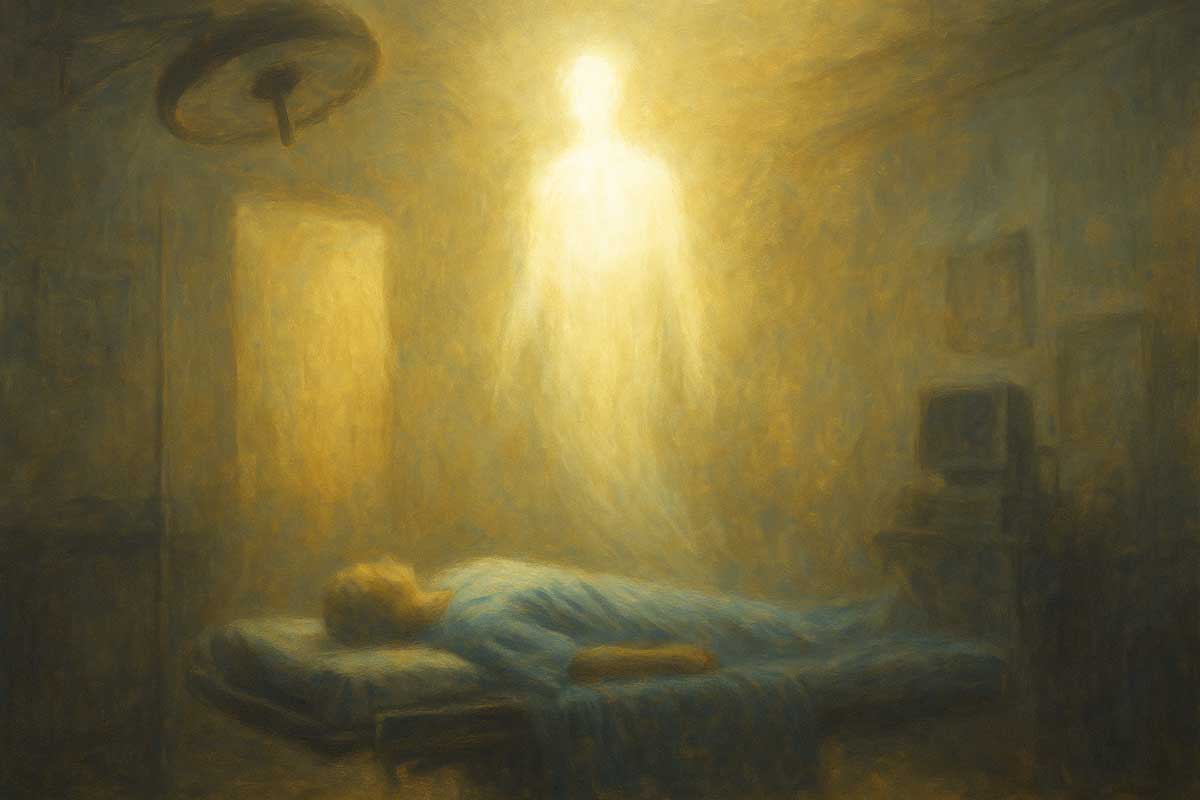
Panel: Anita Moorjani, Jeffery Olsen, Howard Storm, Dr. Mary Neal, Tricia Barker
Moderator: Nick Sasaki
Opening by Nick Sasaki
If Topic 1 explored consciousness surviving the brain, then Topic 2 brings us closer to the source: the people who actually died, left the physical world, and returned.
Each of our guests today crossed a threshold most of us fear yet wonder about. What they saw was vivid, coherent, transformative—so transformative that their lives could never return to what they were before.
These are not abstract theories or philosophical speculations.
These are lived events.
Let’s begin.
CRUCIAL QUESTION 1
Why do NDEs from every culture report the same core elements—clarity, peace, life review, overwhelming love—despite differences in belief or expectation?
Anita Moorjani
My NDE was not shaped by my cultural background or religious upbringing. In fact, it contradicted much of what I expected. I was raised with fear of judgment, fear of failure, fear of not being good enough. Yet in the other realm, I felt an unconditional, boundaryless love so complete that I realized none of my fears had ever been real.
The universality of these experiences tells us that the afterlife is not a reflection of our beliefs—it is the underlying truth of who we are. Our cultures differ, but our essence does not.
Jeffery Olsen
I was raised Christian. But what I encountered was not a figure with a robe or a book—it was presence.
It was familiarity.
It was home.
When my wife and son died in the same accident, I entered a place where love was not something given; it was the substance of reality itself. The consistency across cultures comes from this: we all come from the same source.
Belief shapes language, but not experience.
Howard Storm
I was an atheist. I believed consciousness ended at death. Yet my NDE shattered that assumption completely.
The beings I met did not ask what I believed. They asked who I was becoming. They knew me better than I knew myself. When people across cultures report the same core experience, it’s because the soul knows truth even when the mind rejects it.
The afterlife is not cultural—it is structural.
Dr. Mary Neal
As a spine surgeon, I had no framework for what happened when I drowned for thirty minutes. I should not have had any experience at all. Yet I encountered clarity, peace, and a profound sense of being known.
These experiences match across cultures because they tap into a universal architecture of consciousness. It is as if we all return to the same river, no matter where we began our journey.
Tricia Barker
I was not religious at the time of my accident. I had no expectation of angels or afterlife realms. Yet what I experienced was so suffused with love and purpose that it changed the trajectory of my entire life.
The matching elements across cultures suggest that NDEs are not hallucinations—not random firings of a dying brain—but glimpses into the same fundamental reality. A reality that belongs to everyone.
Nick Sasaki
What strikes me is that no one here describes their NDE as influenced by their earthly expectations. The experience speaks in a universal language, one that bypasses belief and touches essence.
Let’s go deeper.
CRUCIAL QUESTION 2
How can people who were clinically dead return with verifiable knowledge of events they couldn’t have perceived?
Mary Neal
When I drowned in a river in Chile, my body was underwater for too long for any brain activity to remain. Yet I knew what was happening to my team on the riverbank. I knew conversations, decisions, the exact ways they attempted to revive me.
I returned with details that were later confirmed.
This suggests that consciousness during death isn’t limited to the physical body. It expands outward, perceiving reality from a non-local vantage point.
Jeffery Olsen
During my accident, I saw my wife’s spirit before I even knew she had died. I saw the paramedics working on me. I saw the scene from above and from the side, all at once. These were not guesses. They were precise.
Consciousness at death becomes panoramic. You are not observing—you are participating in a wider field of awareness.
Tricia Barker
In the operating room, I floated above my body and saw my surgeon struggle, saw conversations between staff, saw the nurse drop an instrument. All of this was later confirmed.
When consciousness is freed from the brain, it perceives without the limits of eyes or ears. It perceives truth directly.
Howard Storm
In my case, I didn’t witness the hospital room. But I experienced communication and knowledge that surpassed anything I had ever understood. The beings I met knew everything about me—my history, my thoughts, my intentions.
This kind of access is impossible within the constraints of a brain. It suggests a dimension of knowing far beyond physical perception.
Anita Moorjani
When I was in the hospital dying of cancer, I knew the conversations my husband and the doctors were having down the hallway. I knew what my brother was doing on a plane thousands of miles away. I knew the decisions that were being made and the thoughts behind them.
I returned with this knowledge—not as memory, but as knowing.
Consciousness at death is not confined. It is liberated.
Nick Sasaki
What you’re describing overturns every assumption about perception. It suggests consciousness becomes more aware—not less—when the brain shuts down.
Let’s explore the threshold itself.
CRUCIAL QUESTION 3
Are NDEs glimpses of an actual afterlife realm, or are they a transition state—a threshold rather than a destination?
Howard Storm
For me, it was both.
I entered a dark place that reflected my inner state. Then I was rescued and brought into a realm of profound love. I felt that I could choose to stay, but I also sensed there was something beyond that realm—something even more vast.
What I experienced was a threshold, not the totality.
Anita Moorjani
I sensed layers of reality, each one more expansive than the last. The realm I visited felt deeply familiar, like returning to myself without any distortion. But I also felt that if I had continued, I would have gone even deeper.
It was a homecoming, yes—but only the beginning of one.
Jeffery Olsen
My wife was in a place of profound peace. I was invited to stay with her. But I also felt there was more—many more levels, more learning, more reunion, more purpose.
The afterlife is not a room. It is a horizon.
Mary Neal
I was told I must go back, that my work on Earth was not done. The place I visited felt like a staging ground, a place of preparation, a place to remember who we truly are before stepping further.
It was real—but it was also a doorway.
Tricia Barker
I saw angels, but I also sensed they were emissaries from something much greater. They were not the destination. They were escorts.
NDEs are glimpses—not of one place, but of a continuum.
Nick Sasaki
So the consensus seems to be that the afterlife is not singular. It is layered, dynamic, evolving. NDEs offer the first step into a larger cosmic landscape.
Let me close this topic with a reflection.
Closing Reflection by Nick Sasaki
Near-death experiences reveal a universe far more compassionate, intricate, and interconnected than we imagined. These stories are not fantasies or projections—they are consistent, verifiable, transformative.
They tell us:
Death is not the end.
Consciousness does not collapse.
Love is the underlying fabric of reality.
And the journey continues—beyond thresholds, beyond forms, beyond what our physical senses can perceive.
In Topic 3, we turn to religious and spiritual traditions to ask:
If so many people describe similar realms, what do world religions say about what lies beyond?
Topic 3: Heaven, Hell, and Other Realms: Literal or Symbolic?
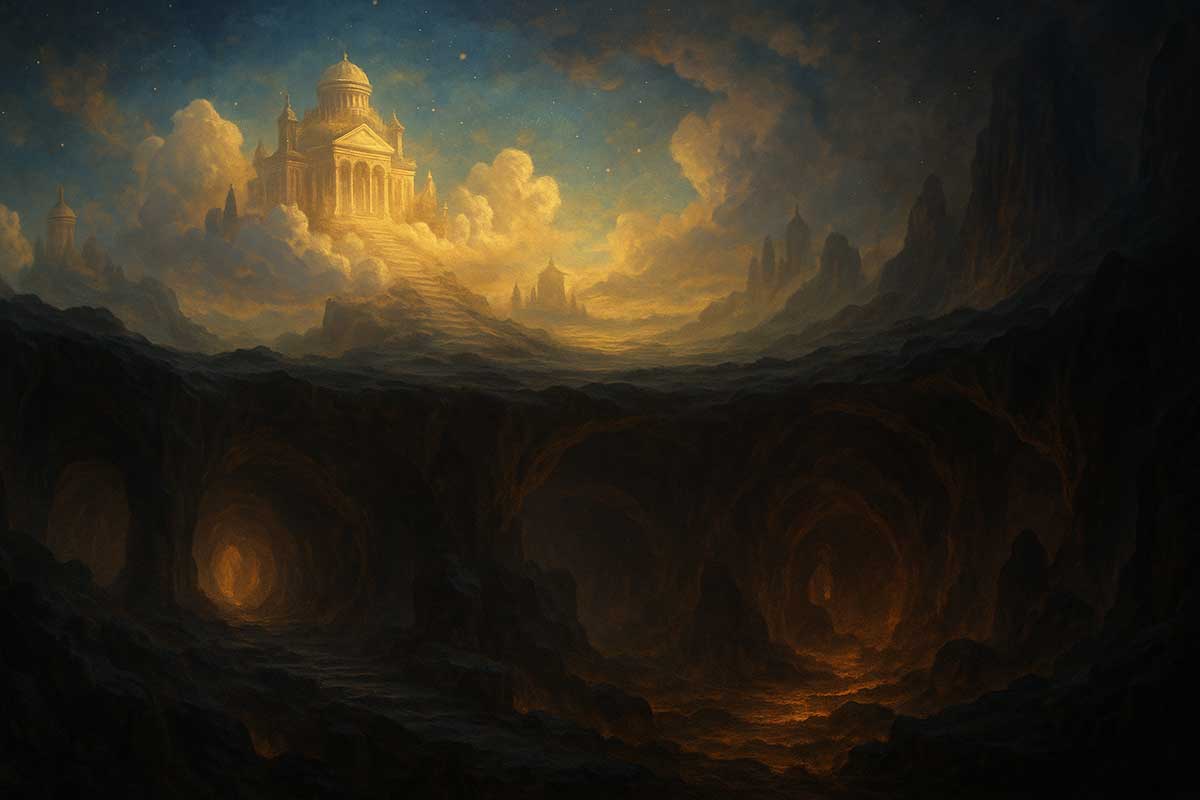
Panel: Dalai Lama, Thich Nhat Hanh (represented), Rabbi David Wolpe, Sheikh Hamza Yusuf, Bishop Robert Barron
Moderator: Nick Sasaki
Opening by Nick Sasaki
Across cultures and centuries, human beings have described realms beyond death—places of peace, judgment, purification, reunion, or dissolution. Some traditions see these realms as literal landscapes; others see them as states of consciousness.
Yet the similarities across religions raise a profound question:
Are these realms real, symbolic, or something in between?
Today, we bring together five voices who each carry the weight of long spiritual lineages. My purpose is not to find agreement, but to illuminate the shared human yearning beneath these teachings.
Let’s begin.
CRUCIAL QUESTION 1
Are heaven and hell objective locations, subjective states of consciousness, or metaphorical descriptions of spiritual laws we don’t yet understand?
Dalai Lama
In Tibetan Buddhism, the afterlife is experienced through the “bardo” states—transitional realms where the consciousness encounters visions shaped partly by karma and partly by the deeper truth of mind’s nature.
Are they real? Yes.
Are they internal? Also yes.
Reality is not divided between inner and outer the way we imagine. Heaven and hell appear as reflections of the mind, but they also exist as patterns within the fabric of consciousness itself. They are both symbolic and actual, depending on the level of awareness.
Thich Nhat Hanh (represented)
Heaven and hell are not places you arrive at after death; they are places you carry within you now.
When we touch compassion, we inhabit heaven.
When we are consumed by anger or fear, we taste hell.
After death, these states continue, but they are not punishments. They are continuations of the seeds we watered in our lifetime.
The question is not where heaven and hell exist, but when.
Rabbi David Wolpe
In Judaism, the afterlife is deliberately left mysterious. We speak of Olam HaBa, the World to Come—not as a geography but as a relational state between the soul and God.
Heaven is closeness to the Divine; hell is distance from the Divine.
These states may have form, but their essence is moral and relational, not spatial. They reflect the truth that our actions shape who we become, and who we become determines where we belong.
Sheikh Hamza Yusuf
In Islam, heaven and hell are real, but they are also symbolic. The Qur’an describes them in imagery that both comforts and warns, yet the Prophet taught that “God has prepared what no eye has seen, no ear has heard, and no mind has imagined.”
This means the descriptions are approximations—metaphors for realities beyond human comprehension.
Heaven and hell are states, yes, but they are also destinations.
They are created realms, but they resonate with the moral architecture of the universe.
Bishop Robert Barron
In Christian theology, heaven is union with God; hell is self-exclusion from God.
These are not arbitrary places—they are the consequences of freedom. A soul aligned with love moves into the divine presence naturally. A soul closed in on itself experiences isolation as torment.
Yet there is also a spatial dimension to Christian imagery: the “many mansions” in the Father’s house.
The mistake is thinking heaven and hell are either literal or symbolic. They are both. Symbol points to substance.
Nick Sasaki
What I’m hearing is a remarkable convergence:
Heaven and hell cannot be reduced to simple locations or metaphors. They are multidimensional—states, realms, consequences, reflections of the soul, and echoes of cosmic law.
Let’s explore the next question.
CRUCIAL QUESTION 2
If people of every faith report afterlife realms that match their expectations, does the afterlife shape itself to the soul—or do we shape it?
Thich Nhat Hanh
The world you perceive is the continuation of your consciousness. Just as a dream reflects your mind yet exists with its own vividness, so too the afterlife manifests from the seeds you have cultivated.
The afterlife does not adjust itself artificially; it simply reveals what is already inside you.
Dalai Lama
In the bardo, the mind encounters peaceful and wrathful deities. These forms are not external beings judging us—they are manifestations of the mind’s deeper layers.
What appears is shaped both by karmic imprints and the fundamental nature of reality.
So yes, the afterlife has its own structure, but the mind’s condition determines how it is experienced—just as two people can walk through the same forest, one seeing beauty, the other seeing fear.
Rabbi Wolpe
The afterlife is not a mirror of expectation but a mirror of character.
People do not receive what they imagine; they receive what they are.
A righteous soul finds closeness to God because it is aligned with God’s nature. A wicked soul experiences separation because it has chosen separation. This is not self-created illusion—it is the consequence of moral direction.
In this sense, the afterlife shapes itself around the soul’s integrity, not its fantasies.
Sheikh Hamza Yusuf
Expectation may color the symbols a person sees, but it does not determine the reality they enter.
A Christian might see Christ, a Buddhist may see bodhisattvas, but the underlying truth is one. God manifests in ways that each soul can recognize, not because reality is subjective, but because divine mercy accommodates human limitation.
The afterlife has structure, but it is perceived through the lens of the soul.
Bishop Barron
The soul does not invent heaven or hell. But the soul’s posture—open or closed, surrendered or self-absorbed—determines how it experiences divine love.
The same sun melts wax and hardens clay.
So too with the soul: God’s presence is constant, but our capacity to receive it shapes our experience. The afterlife does not shape itself to expectation. It reveals the truth of our orientation.
Nick Sasaki
So the afterlife is neither pure projection nor rigid architecture.
It is a dynamic interplay between the soul’s condition and the nature of ultimate reality.
Now for our final question in this topic.
CRUCIAL QUESTION 3
What happens to moral responsibility when we consider that death may involve an encounter with perfect truth?
Bishop Barron
In Christian thought, the soul undergoes a life review—not as condemnation, but as illumination. To encounter perfect truth is to see oneself without distortion. This is both painful and healing.
Moral responsibility becomes unavoidable.
Every act, every intention is seen in its full consequence.
This is not God punishing us. It is truth revealing us.
Sheikh Hamza Yusuf
In Islam, God is both Just and Merciful. The encounter after death is one in which no injustice occurs. Every deed is weighed with complete fairness. But divine mercy is greater than divine wrath. Repentance, intention, and sincerity all matter.
Knowing that we will meet perfect truth does not create fear—it creates urgency for moral clarity.
Rabbi Wolpe
When we imagine being seen fully, the illusion of hiding disappears.
Every action we take is a thread in the tapestry of who we are becoming. In the afterlife, this tapestry is held up to the light.
Moral responsibility is not imposed upon us; it is revealed within us.
Thich Nhat Hanh
When you see your actions clearly, without judgment or blame, compassion arises naturally. You understand the pain you have caused, not as punishment, but as insight.
Perfect truth does not condemn.
It awakens.
And from awakening comes transformation.
Dalai Lama
Karma is not a system of reward or punishment. It is cause and effect. When you encounter the truth of your actions, you also encounter the seeds you have planted. This recognition can be liberating.
Facing perfect truth means taking full responsibility—not out of fear, but out of wisdom.
Nick Sasaki
What a powerful convergence of perspectives. Each tradition affirms that an encounter with truth is not merely judgment—it is revelation. Not merely consequences—it is clarity. Not merely fear—it is awakening.
Let me close the topic with a reflection.
Closing Reflection by Nick Sasaki
Across cultures and traditions, one message echoes:
The realms beyond death are not arbitrary punishments or rewards. They are reflections of the soul’s deepest orientation.
Heaven is alignment with love.
Hell is the refusal of love.
And the journey between them is as vast as consciousness itself.
Whether described as bardo, Olam HaBa, paradise, purgatory, or union with God, these realms point toward the same mystery:
Death reveals who we have become.
And who we have become remains our most profound responsibility.
In Topic 4, we now turn inward to ask:
If we truly do not die, then what is the purpose of being alive at all?
Topic 4: If We Don’t Truly Die, What Is the Purpose of a Human Life?
Panel: Stephen Jenkinson, Sadhguru, Deepak Chopra, Ken Wilber, Dr. Michael Newton (represented)
Moderator: Nick Sasaki
Opening by Nick Sasaki
If consciousness continues beyond death, then life is not a brief episode between two voids—it is a chapter in a much larger narrative. But what is the purpose of this chapter? Why must eternal beings experience limitation, suffering, separation, embodiment?
Is life a school? A proving ground? A creative act? A sacred illusion?
Today’s five speakers have spent decades exploring the edges of meaning. Each carries a different lens, yet all look toward the same horizon: the question of why we are here.
Let’s begin.
CRUCIAL QUESTION 1
If the soul continues evolving after death, what is uniquely possible only in the physical world—and why is it so important?
Stephen Jenkinson
Life is a threshold place, and thresholds demand something that eternity cannot: decision.
In the physical world, our time is limited, and that limitation forces urgency, courage, and consequence.
Only here can we learn to love what we will lose.
Only here can we grieve.
Only here can we act knowing we cannot undo time.
Eternal beings need the scarcity of time to learn the value of existence. Mortality is not a mistake—it is the teaching.
Sadhguru
The body creates boundaries. Without boundaries, you cannot know individuality. And without individuality, you cannot know responsibility.
The physical world offers friction. Friction creates growth.
In the nonphysical, everything is fluid and instantaneous. But here, effort matters. Choice matters. Your longing shapes you. Your failures refine you. Your joys expand you.
Life is the arena where the infinite learns to be finite—and thereby becomes conscious of itself.
Deepak Chopra
The physical world is a mode of consciousness where contrast becomes possible.
You cannot know light unless you have seen shadow.
You cannot understand unity until you experience separation.
You cannot awaken unless you first forget.
Earth is the realm of forgetting and remembering. It is where the soul rehearses the drama of becoming—again and again—until it realizes it was never separate.
The purpose is expansion.
Ken Wilber
Evolution.
Not biological evolution—evolution of awareness.
Physical incarnation provides density, resistance, duality, and individuation. These allow the soul to grow through structured stages: from egocentric to ethnocentric to worldcentric to kosmocentric.
You cannot skip levels by staying in the clouds.
You must descend into form to rise in consciousness.
This world is the soul’s gymnasium.
Dr. Michael Newton (represented)
In thousands of life-between-life regressions, people reported the same truth: incarnation offers training simulations that are impossible in the spirit world.
Earth provides challenge, diversity of experience, and emotional texture. Souls choose bodies, families, hardships, strengths—all to develop specific qualities: compassion, courage, patience, humility, resilience, forgiveness.
Physical life is the soul’s curriculum.
Death is graduation.
And we return for the next course.
Nick Sasaki
What a remarkable agreement: the physical world is not a prison or punishment—it is a workshop, a forge, a classroom, a palette, a proving ground. Eternity requires mortality to know itself more deeply.
Now we move further.
CRUCIAL QUESTION 2
Do suffering, love, and choice serve a larger curriculum of growth—and if so, who designed that curriculum?
Deepak Chopra
Suffering is not inflicted; it is interpreted. We assign meaning to events through our state of consciousness. Pain is inevitable. Suffering is optional.
Love is the antidote because love dissolves separation.
Who designed the curriculum?
Consciousness itself.
We are co-authors of our destiny, both individually and collectively. The universe is a self-aware system evolving through us.
Sadhguru
There is no external curriculum designer.
No cosmic professor handing out lessons.
Life is not designed for you; life simply is.
Your intelligence interprets it. Your awareness transforms it. Suffering is not punishment—it is a signal. Love is not reward—it is your nature. Choice is not burden—it is your possibility.
Life is the canvas. You are the painter. Awareness is the art.
Stephen Jenkinson
Suffering is not a cosmic test. It is belonging to a world that breaks open the heart. When grief enters, it teaches reverence. When love enters, it teaches vulnerability. When choice enters, it teaches consequence.
As for who designed it?
Maybe no one.
Maybe this is simply what it means to live in a world where things matter—where you matter, where others matter, where loss matters.
Meaning emerges from participation, not mandate.
Ken Wilber
From the integral perspective, suffering, love, and choice are developmental catalysts.
Suffering pushes the self to transcend its current limits.
Love pulls the self toward greater inclusion.
Choice empowers the self to integrate shadow and light.
Who designed it?
Reality itself—an evolutionary intelligence that brings forth complexity, depth, and consciousness.
We aren’t puppets. We’re participants in an unfolding kosmos.
Dr. Michael Newton (represented)
In the thousands of regressions I documented, souls consistently described co-creating their life plans with guides, soul groups, and mentors before incarnation.
There is structure, yes, but no coercion.
There are lessons, but no punishment.
Souls choose challenges—illness, loss, difficult relationships—not masochistically, but purposefully. They choose what will help them grow.
The curriculum is collaborative, compassionate, and deeply wise.
Nick Sasaki
A powerful insight emerges here: suffering is not a sentence. Love is not accidental. Choice is not trivial. They are all part of a larger choreography of growth—designed either by us, by consciousness, or by the nature of existence itself.
Now for our final question.
CRUCIAL QUESTION 3
Is life’s meaning discovered, created, or remembered from something the soul already knew?
Sadhguru
Meaning is not found—it is made.
Life has no inherent meaning except what you imprint upon it. The more conscious you become, the more your life becomes a conscious creation rather than an unconscious reaction.
Meaning is your responsibility.
Stephen Jenkinson
Meaning is not a possession, not a trophy. You don’t create it from nothing. You discover it in your obligations—your responsibilities to others, to ancestors, to the land, to the future.
Meaning is found in service, in grief, in fidelity to the moment.
You don’t invent meaning. You inherit it, and then you must earn it.
Deepak Chopra
Meaning is remembered.
The soul enters the body through the amnesia of incarnation. But through experiences of love, synchronicity, insight, and awakening, it begins to recall the deeper truth of its existence.
Every revelation is a form of remembering.
Ken Wilber
Meaning is all three.
At the earliest stages of development, meaning is given—absorbed from culture. In adolescence of the soul, meaning is created—constructed through choice. At the higher stages, meaning is remembered—recognized as the expression of a deeper spiritual identity.
Discovery, creation, and remembrance are developmental phases of one unfolding consciousness.
Dr. Michael Newton (represented)
In the between-life state, souls consistently said:
“We remember who we are.”
Incarnation is forgetting.
Awakening is remembering.
Life is the bridge between the two.
Meaning is not invented. It is rediscovered. It is the echo of something the soul already knew.
Nick Sasaki
Hearing these answers, I’m struck by how life’s meaning is not singular. It is created through choice, discovered through experience, and remembered through awakening. Life is a dance between forgetting and remembering—between contraction and expansion.
Let me close this topic with a reflection.
Closing Reflection by Nick Sasaki
If we do not die, then life is not a countdown—it is a pilgrimage.
A pilgrimage of learning, loving, losing, becoming, and remembering.
Life becomes the soul’s apprenticeship in compassion.
Its training ground for courage.
Its rehearsal for awakening.
Its preparation for eternity.
The purpose of life is not to escape it—it is to be shaped by it.
Now we move to our final topic, where we look not at the individual soul but at all humanity.
Topic 5: What Happens to Humanity When We Stop Fearing Death?
Panel: Raymond Moody, Elisabeth Kübler-Ross (represented), Bashar, Rupert Spira, Bernardo Kastrup
Moderator: Nick Sasaki
Opening by Nick Sasaki
Fear of death is one of the deepest drivers of human behavior.
It shapes economies.
It shapes religions.
It shapes relationships, ambitions, wars, art, medicine, and entire cultural eras.
But what would happen if that fear dissolved?
If we truly understood that consciousness continues, expands, transforms—
How would society change?
How would morality change?
How would we change?
Today’s panel brings together five voices who have each spent a lifetime exploring the threshold between worlds. Their work has reshaped how millions understand death, consciousness, and meaning.
Let’s begin.
CRUCIAL QUESTION 1
If fear of death vanished tomorrow, how would our culture—religion, politics, health care, even economics—transform?
Raymond Moody
Fear of death is the invisible architect of civilization. Remove it, and the scaffolding collapses—making space for something radically new.
Religion would become less about salvation and more about transformation.
Politics would lose much of its manipulation through fear.
Healthcare would shift from avoiding death at all costs to enhancing the quality of life.
Economics would no longer be driven by desperate accumulation.
The absence of death anxiety would usher in a culture based on curiosity instead of control.
Elisabeth Kübler-Ross (represented)
If people no longer feared death, they would no longer fear living.
So many live cautiously, tightly, anxiously—because they cling to survival rather than embracing experience. Without the fear of death, people would be more open, more compassionate, more present.
Healthcare would return to its essence: caring, not curing. End-of-life care would become a sacred process rather than a medical failure.
Love would be less fragile. Grief would be less isolating.
Life would be lived more honestly.
Bashar
When a civilization releases the fear of death, it immediately expands its frequency horizon.
You stop acting from limitation and start acting from alignment. Creativity surges. Innovation accelerates. War becomes obsolete because fear is the root of conflict. Exploration—inner and outer—flourishes.
A society unafraid of death becomes a society unafraid of truth.
This is when planetary transformation becomes possible.
Rupert Spira
Fear of death arises from the mistaken belief that we are the body-mind. If that belief dissolves, identification shifts naturally to the field of awareness itself.
Culture would move from the paradigm of separation to one of shared being.
Religion would emphasize direct experience over doctrine.
Politics would shift from power to service.
Economics would move from acquisition to contribution.
The absence of death fear is not merely a psychological change—it is a metaphysical awakening.
Bernardo Kastrup
Materialism would collapse. And with it, much of the anxiety-driving machinery of society. Without the fear of annihilation, our priorities would shift dramatically.
Consumption would decrease—not from restriction, but from clarity.
Education would include metaphysics, introspection, and the science of consciousness.
Technology would be oriented toward enhancing life, not escaping it.
A civilization that knows death is not the end is a civilization grounded in meaning rather than distraction.
Nick Sasaki
What emerges is a portrait of a civilization transformed at every level—not softened or passive, but more awake, more responsible, more humane.
Let’s continue.
CRUCIAL QUESTION 2
Would humanity become more compassionate and adventurous… or reckless without a sense of consequences?
Elisabeth Kübler-Ross (represented)
People are not reckless when they understand death—they are reckless when they fear it. Recklessness is a form of escape. Awareness, by contrast, creates responsibility.
Those who accept death live with more love, not less. They take fewer meaningless risks and far more meaningful ones—risks of vulnerability, forgiveness, creativity, and connection.
Understanding death deepens compassion.
Raymond Moody
My decades of working with near-death experiencers confirms this repeatedly:
People who lose their fear of death become more compassionate, not less. They become more willing to serve, more patient, more present.
The absence of fear does not create nihilism.
It creates generosity.
Bashar
Recklessness arises from disconnection.
When you know you are eternal, you do not become careless—you become precise. You act from alignment, not compulsion. You explore because you are curious, not because you are trying to fill an inner void.
Compassion naturally increases when the illusion of separation dissolves.
Consequences still exist—vibrationally, emotionally, karmically—but they are understood, not feared.
Rupert Spira
Most reckless behavior comes from the pain of believing we are separate, fragile, temporary selves. When that illusion falls away, there is nothing to defend and nothing to prove.
Compassion is not a moral choice—it is the natural expression of recognizing our shared being.
Adventure becomes an expression of joy, not desperation.
Bernardo Kastrup
The argument that the end of death fear would produce nihilism is based on a misunderstanding of consciousness. If you know you are not extinguished, you do not become indifferent—you become more attuned to the quality of your experience.
Recklessness declines because there is no longer any need to numb existential anxiety.
People become more mindful, not less.
Nick Sasaki
Beautiful. Across all perspectives, a consistent pattern emerges:
Recklessness is the child of fear.
Compassion is the child of understanding.
Now for our final question of the series.
CRUCIAL QUESTION 3
What would a society look like where people live as eternal beings temporarily visiting Earth?
Rupert Spira
Such a society would be rooted in shared beingness.
Conflict would diminish because no one would mistake the body-mind for the self. Education would emphasize awareness, creativity, and relational skills. Spiritual practice would be woven into daily life, not as religion but as recognition.
A society of eternal beings would live lightly, lovingly, and truthfully.
Raymond Moody
Storytelling would change.
Language would change.
The arts would explode with new metaphors and symbols.
Relationships would deepen because people would stop treating time as scarcity.
Fear-based power systems would crumble.
Death would become a rite of passage, not a trauma.
Such a society would be more curious, more reflective, more humane.
Elisabeth Kübler-Ross (represented)
Children would grow up knowing that love is what continues.
The elderly would be honored as people preparing for a transition, not hidden away.
Dying would be accompanied by ceremony rather than fear.
Life would be lived with gentleness.
With openness.
With gratitude.
When people know they are eternal, kindness becomes the natural language of society.
Bashar
A civilization that recognizes its eternal nature becomes a fourth-density society—a telepathic, cooperative, multidimensional culture.
You would see:
Energy systems aligned with consciousness.
Technologies that enhance, not replace, human essence.
Institutions designed around resonance, not hierarchy.
Exploration not only of planets, but of states of being.
It is the destiny of any awakened species.
Bernardo Kastrup
Such a society would be post-materialist—
not in the sense of rejecting the physical world, but in the sense of seeing it as one layer among many.
Science would expand to include consciousness as foundational.
Economics would emphasize meaning over consumption.
Governance would prioritize long-term planetary well-being.
Eternal beings do not exploit.
They steward.
Nick Sasaki
Listening to all of you, I envision a humanity no longer driven by fear of annihilation, but guided by purpose, generosity, curiosity, and inner freedom.
Closing Reflection by Nick Sasaki
The fear of death narrows life.
Understanding death expands it.
Across five topics, we have explored consciousness beyond the brain, first-hand accounts of the afterlife, the wisdom of world religions, the soul’s purpose in physical incarnation, and the transformation of society when fear dissolves.
A picture emerges:
We are not fragile creatures clinging to temporary existence.
We are eternal beings tasting mortality to grow, love, awaken, and remember.
Death is not the opposite of life.
It is the continuation of consciousness by other means.
If humanity understood this—truly understood—it would live differently.
It would love differently.
It would build differently.
Perhaps that is the future we are slowly moving toward:
A world where life is sacred, death is understood, and consciousness is recognized as the common thread weaving all existence.
Final Thoughts by Nick Sasaki
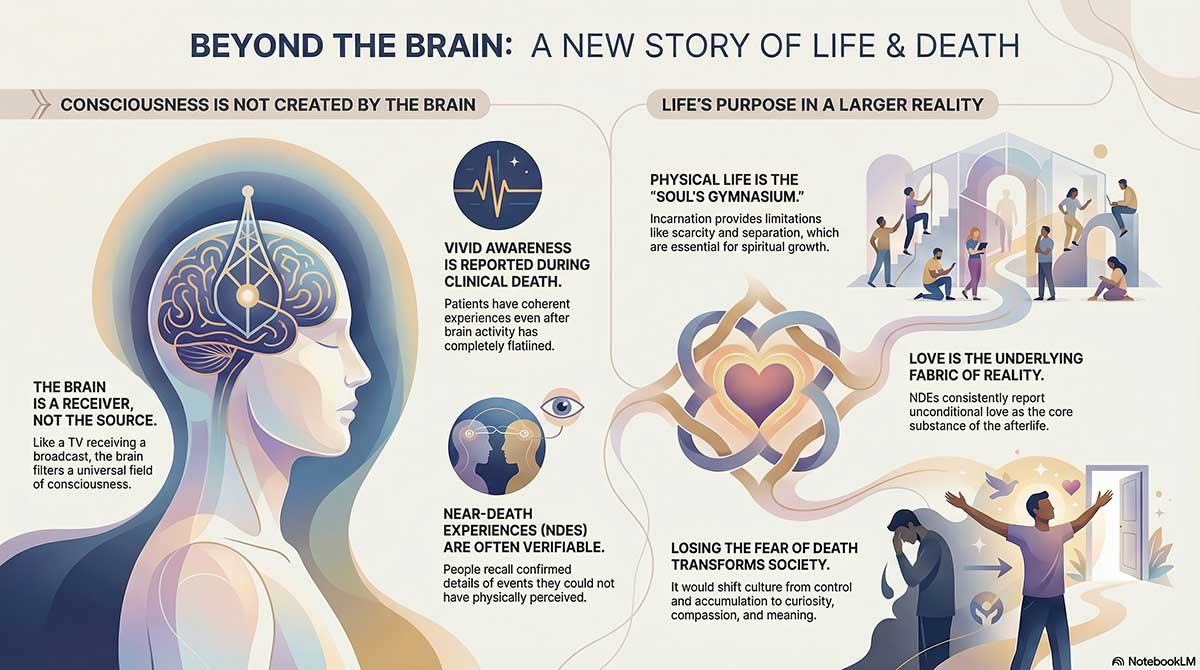
After listening to every voice in this dialogue, I’m left with a sense of profound clarity: the journey of consciousness does not end with the physical body. What we call death is not an exit but a passage—a moment of remembering who we truly are.
When we understand this, life changes.
Fear softens.
Purpose grows.
Connection deepens.
Love becomes the true measurement of our days.
This series is more than an exploration of the afterlife; it is an invitation to live differently now—more openly, more courageously, and with a greater awareness of our eternal nature.
Short Bios:
Raymond Moody
A pioneering philosopher and psychiatrist best known for introducing the world to the term “near-death experience,” Raymond Moody’s research has shaped modern understanding of what happens at the threshold between life and death. His landmark book Life After Life opened a global conversation about the continuity of consciousness.
Elisabeth Kübler-Ross
A world-renowned psychiatrist and author of On Death and Dying, Elisabeth Kübler-Ross transformed modern attitudes toward death, grief, and hospice care. Her work with dying patients revealed profound insights into acceptance, love, and the spiritual meaning of life's final chapter.
Bashar
An interdimensional source of teachings channeled by Darryl Anka for nearly four decades, Bashar offers fast-paced, precise insights into consciousness, parallel realities, and human evolution. His perspective emphasizes alignment, frequency, and humanity’s awakening potential.
Rupert Spira
A British spiritual teacher and author known for his clear, direct exploration of non-duality, Rupert Spira teaches that awareness is the fundamental nature of reality. His work bridges Advaita, art, and contemplative inquiry, helping seekers realize their true identity beyond the mind.
Bernardo Kastrup
A philosopher of mind and computer scientist, Bernardo Kastrup is a leading voice in analytic idealism—the view that consciousness is fundamental. His rigorous critiques of materialism have influenced modern debates about the nature of reality and the survival of consciousness after death.
Dalai Lama
The 14th Dalai Lama, Tenzin Gyatso, is the spiritual leader of Tibetan Buddhism and a global ambassador of compassion, peace, and interfaith dialogue. His teachings illuminate the relationship between mind, suffering, and the journey toward liberation.
Thich Nhat Hanh
A revered Zen master, poet, and peace activist, Thich Nhat Hanh taught mindfulness as a way to touch the present moment deeply. His gentle, accessible teachings on compassion, interbeing, and mindful living continue to influence millions worldwide.
Rabbi David Wolpe
One of America’s most respected rabbis, David Wolpe is known for his thoughtful explorations of faith, meaning, and the human spirit. His work bridges ancient Jewish wisdom with modern philosophical inquiry, offering guidance on life’s deepest questions.
Sheikh Hamza Yusuf
An influential Islamic scholar and co-founder of Zaytuna College, Sheikh Hamza Yusuf is recognized for his articulate exposition of classical Islamic thought. His teachings bring the spiritual, philosophical, and ethical dimensions of Islam into vivid contemporary relevance.
Bishop Robert Barron
A Catholic bishop, author, and founder of Word on Fire, Bishop Barron is one of today’s leading Christian voices. His work brings theology, beauty, and reason into dialogue as he explores God, purpose, and the destiny of the human soul.
Stephen Jenkinson
A cultural philosopher, author, and prominent voice on death and dying, Stephen Jenkinson challenges modern avoidance of mortality. His work emphasizes elderhood, grief, responsibility, and the sacredness of a life lived consciously.
Sadhguru
An Indian mystic, yogi, and founder of the Isha Foundation, Sadhguru is known for his sharp insight into human awareness, inner engineering, and the transformational potential of consciousness. His teachings merge ancient yogic science with contemporary clarity.
Deepak Chopra
A physician and visionary in integrative medicine, Deepak Chopra bridges spirituality and science through his work on consciousness, healing, and the nature of reality. His books and lectures have helped popularize mind-body awareness around the world.
Ken Wilber
A philosopher and creator of Integral Theory, Ken Wilber synthesizes psychology, spirituality, science, and culture into a unified framework of human development. His work maps the evolution of consciousness across personal and collective dimensions.
Dr. Michael Newton
A pioneering hypnotherapist best known for Journey of Souls, Dr. Michael Newton explored life between lives through thousands of regression sessions. His research offers a detailed portrait of the soul’s journey before birth, after death, and across lifetimes.
Leave a Reply