
|
Getting your Trinity Audio player ready...
|
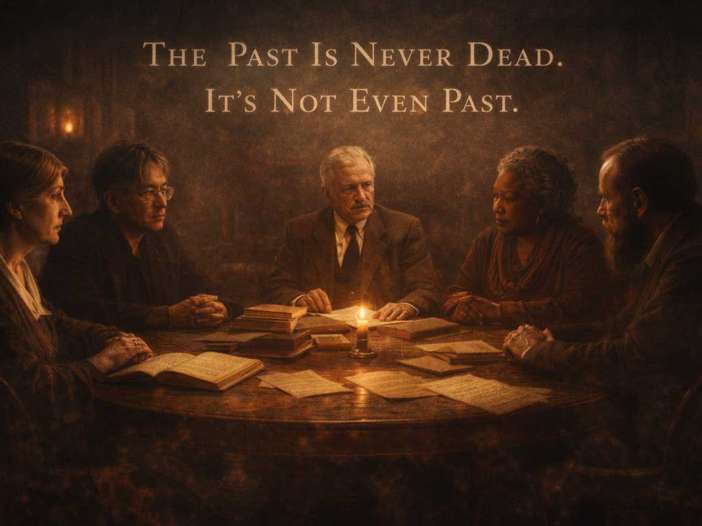
What if William Faulkner gathered the greatest writers in history to interrogate a single sentence?
Introduction by William Faulkner
I have been asked, many times, what I meant when I said that the past is never dead. People assume I was speaking poetically, or nostalgically, or with some fondness for memory. But I was not offering comfort. I was naming a condition.
The past does not lie quietly behind us like a finished road. It inhabits us. It presses forward through bloodlines, through names, through the silences families agree not to disturb. We wake thinking we are free and discover we are acting out something older than ourselves. Not because we are weak—but because we are human.
Time, as we prefer to imagine it, moves forward cleanly. But time, as it is lived, moves in circles, in returns, in repetitions that disguise themselves as novelty. A man believes he has escaped his history, and then one day he speaks a sentence in his father’s voice. A nation declares itself renewed and finds itself repeating the same cruelty under a different banner.
This conversation exists not to admire the past, nor to condemn it from a safe distance, but to understand why it refuses to stay buried. We will speak of memory, of history, of time, of identity, and finally of consequence. Because the past does not demand our reverence—it demands our honesty.
Until it is faced, it remains present. Until it is named, it continues to act.
(Note: This is an imaginary conversation, a creative exploration of an idea, and not a real speech or event.)
Topic 1 — The Past Lives Inside the Present
(The past is never dead. It’s not even past)
Participants:
Marcel Proust, Virginia Woolf, Kazuo Ishiguro, W.G. Sebald, Haruki Murakami
Moderator: William Faulkner
Faulkner — Opening
We speak of the past as though it were a country we once lived in and then left. But I have never known a man to leave it. The past does not stay where we put it. It moves, it breathes, it presses its face against the present and asks to be recognized. So I want to begin simply, and I want you to answer honestly—not as stylists of memory, but as its witnesses.
Faulkner lets the silence settle before speaking again.
When a memory returns without our consent, is it something we remember—or something that has been waiting for us?
Proust
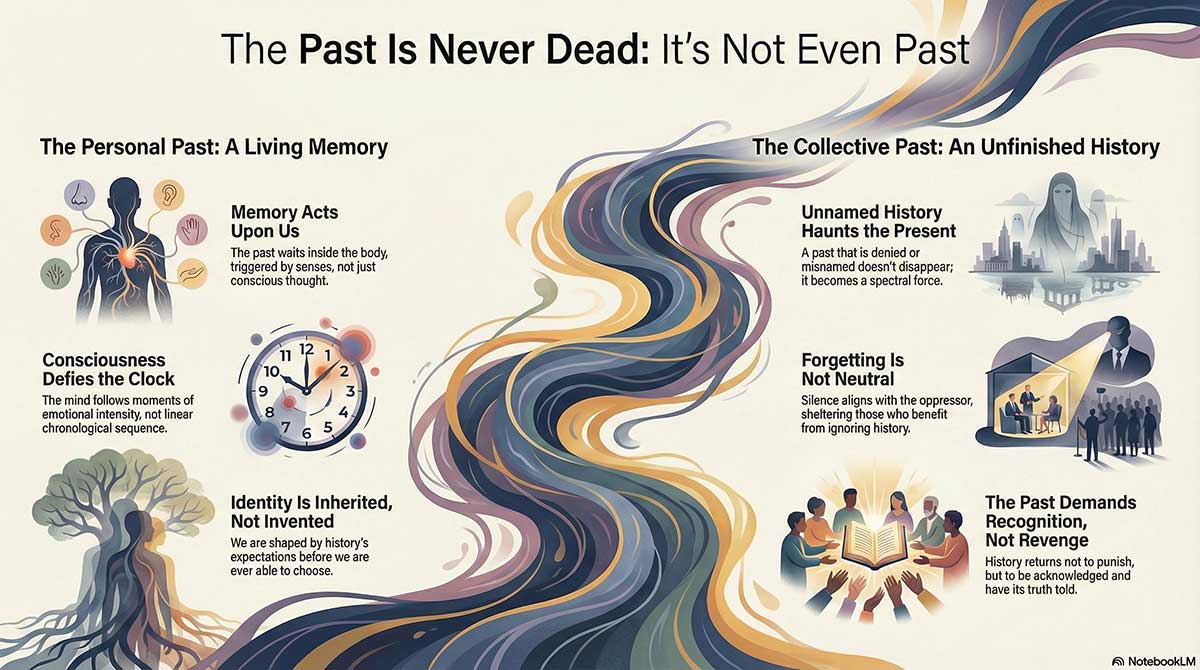
I would say it is not we who remember at all. Memory, in its truest form, acts upon us. When it arrives uninvited—through taste, scent, texture—it proves that the past has been lying in wait inside the body. Conscious recollection is weak and theatrical by comparison. What matters is involuntary memory, because it shows us that the past was never gone. It was merely dormant, conserving itself intact, until the present touched it in precisely the right way.
Sebald
I agree, though I would add that what returns often does so indirectly. The past hides in objects, landscapes, photographs, footnotes. We do not so much remember as stumble into its evidence. When I walk through certain places, I feel that history is observing me rather than the other way around. The past waits patiently, not for emotion, but for proximity.
Ishiguro
I’m less certain the past returns intact. Often what comes back is altered—blurred by the stories we’ve told ourselves in order to live. But even this distortion proves your point, Mr. Faulkner. The past persists, even if we’ve softened its edges. The very effort to reshape memory is itself a sign that it has not released us.
Woolf
What strikes me is how physical this waiting can be. A moment of light on a wall, a phrase overheard, and suddenly one is elsewhere—yet not elsewhere. The past is present as sensation. It is not a separate time, but a different pressure within the same moment. We feel it rather than recall it.
Murakami
Sometimes it feels as if the past is running on a parallel track. You’re living your life, drinking coffee, walking down the street—and then something opens, quietly, and another layer appears. Not dramatic. Just undeniable. The waiting isn’t aggressive. It’s patient. Almost polite.
Faulkner nods, then continues.
If the past can arrive through the body rather than the mind, can we ever truly say we have “left” it behind?
Woolf
No. We leave places, not experiences. The body carries its own archive. Even when the mind insists on progress, the body resists. That resistance is not weakness—it is truth. Time, as lived, is not linear. It accumulates.
Ishiguro
I would say we pretend to leave the past because we must function. But pretense does not equal departure. The body remembers through unease, through hesitation, through choices we cannot quite justify. These are physical echoes, even when we lack narrative clarity.
Proust
Precisely. The mind believes in separation; the body does not. This is why sudden memory feels like revelation. It bypasses explanation. It proves that time has been stored rather than erased. We do not return to the past—the past returns to us, whole.
Murakami
And sometimes it returns without meaning attached. Just presence. A mood. A shadow. You don’t know what it’s connected to, only that it’s real. That’s when you realize you never left anything behind. You just stopped looking at it directly.
Sebald
In my experience, the body remembers what the mind refuses. Trauma, especially, embeds itself spatially. A road, a building, a shoreline—these become repositories. Leaving is irrelevant. The past is not located where it happened. It relocates itself inside us.
Faulkner pauses longer this time, then lowers his voice.
Is the present moment ever free of the past, or is it merely the past speaking in a quieter voice?
Sebald
I have never encountered a present untouched by what preceded it. Even silence has a history. What we call the present is simply the point at which accumulated time becomes visible again.
Proust
The present is a threshold, not a state. It is where layers of time intersect. When we believe we are fully present, it is usually because the past has momentarily aligned itself so perfectly that we mistake harmony for absence.
Woolf
Yes. The present is saturated. It feels immediate only because we are accustomed to the weight. If we could feel it all at once, we would be crushed by it.
Ishiguro
I think the present feels quieter because we have negotiated with the past. We’ve agreed on what not to hear. But silence is not emptiness. It is a compromise.
Murakami
Sometimes the present feels like a hallway. You’re standing there, but doors are open on both sides. You can hear something breathing behind them. That’s the past. Not loud. Just there.
Faulkner — Closing
Then perhaps we have our answer. The past does not pursue us. It does not need to. It resides. It waits. It speaks when spoken to, and even when it is not. What we call the present may simply be the past, having learned patience.
Topic 2 — History Is Experienced, Not Completed
(Why history refuses to stay finished)
Participants:
Toni Morrison, James Baldwin, Chimamanda Ngozi Adichie, Aleksandr Solzhenitsyn, William Faulkner
Moderator: William Faulkner
Faulkner — Opening
We often speak of history as though it were a task already done, a ledger closed, a chapter finished and shelved. But history, as I have known it, does not rest. It waits. It moves through families, through language, through who is permitted to speak and who is expected to endure quietly. So let me begin where the trouble starts.
Faulkner looks around the table.
What kind of past refuses to stay buried—only the violent one, or the one that was never honestly named?
Morrison
The unnamed past is the most persistent. Violence that is acknowledged can be mourned. Violence that is unnamed becomes spectral. It moves freely. In my work, I tried to show that when a people are denied language for their suffering, the past does not disappear—it materializes. It becomes presence. It becomes haunting. Naming is not remembrance; it is survival.
Baldwin
I would say it is not just the unnamed past, but the deliberately misnamed one. When a nation calls theft “progress” and brutality “order,” the past does not rest—it recruits. People live inside lies and call that history being over. But lies have consequences. They arrange the present.
Adichie
Yes, and this misnaming often takes the form of a single story. When history is reduced to something clean and convenient, what is excluded does not vanish. It becomes lived experience. People feel the weight of what is missing every day. History is not finished because it was never told fully.
Solzhenitsyn
I would add that power depends on this burial. Totalitarian systems survive by insisting that the past is settled. But the human conscience does not obey such declarations. What is buried alive begins to breathe underground. That breath becomes resistance—or madness.
Faulkner nods slowly.
Can a society declare its history over while its consequences are still being lived by its people?
Baldwin
No. That declaration is itself an act of violence. You cannot close a book while others are still inside it. When people say history is over, what they usually mean is that they are no longer inconvenienced by it. The cost is paid elsewhere.
Morrison
History cannot be concluded by decree. It concludes only when its injuries are acknowledged and addressed. Until then, what we call “the present” is simply history continuing without its name attached.
Adichie
And those consequences are not abstract. They are visible in bodies, in access, in fear, in aspiration. A society that claims completion while inequality persists is not finished—it is evasive.
Solzhenitsyn
In my country, history was constantly declared resolved. The result was not peace, but repetition. When truth is postponed, it does not expire. It returns, sharpened.
Faulkner leans forward.
If history is still shaping who may speak and who must remain silent, is it history—or is it simply the present wearing an older mask?
Morrison
It is the present refusing responsibility. Silence is never neutral. It is arranged. When voices are excluded, history has not passed—it has been relocated into power structures.
Baldwin
Exactly. History is not behind us if it still decides who is believed. The mask is effective because it allows people to feel innocent while benefiting from its arrangement.
Adichie
This is why storytelling matters. To tell multiple stories is to remove the mask. To insist on one is to preserve it.
Solzhenitsyn
When silence is enforced, history becomes a weapon. It trains people to forget what they know. That forgetting is not peace—it is obedience.
Faulkner — Closing
Then perhaps history does not end when events stop occurring. Perhaps it ends only when truth is allowed to finish speaking. Until then, what we call history remains unfinished business—conducted in the present tense.
Topic 3 — Memory Is Not Linear
(Why time collapses in consciousness)
Participants:
Virginia Woolf, Jorge Luis Borges, Samuel Beckett, Clarice Lispector, William Faulkner
Moderator: William Faulkner
Faulkner — Opening
We pretend time moves forward because it is easier that way. But the mind does not obey the clock, and memory certainly does not. I have written men who live the same moment again and again without moving an inch. So let me ask you what troubles me most.
Faulkner speaks quietly.
Why does the mind leap backward without warning while the clock insists we are moving forward?
Woolf
Because the clock measures sequence, not experience. The mind responds to intensity. A moment rich with feeling exerts more gravity than years of routine. Time is not equal in weight. Memory follows the heavier moments, not the later ones.
Borges
Time appears linear only when we observe it from outside. From within, it behaves like a labyrinth. The mind revisits certain passages because they are structurally central, not because they are earlier. We return to them because all other moments lead there.
Beckett
The clock moves forward. We do not. We remain with what has failed to conclude. Memory loops because the story never finished. The past returns because it was not allowed to end.
Lispector
Memory leaps because the self is not continuous. We become different selves across time, and some selves demand to be recognized again. When memory interrupts us, it is asking, Are you still me?
Faulkner listens, then continues.
If past and present can exist at once in a single thought, what does that say about our faith in chronological time?
Borges
It suggests that chronological time is a useful fiction. We believe in it because it allows us to organize events, not because it reflects reality. In truth, time may be simultaneous—everything occurring at once, with consciousness moving its lantern across the surface.
Woolf
Yes. The present is not a point but a field. Within it, memories bloom and recede like waves. We call this confusion, but it is coherence of a different order.
Lispector
Chronology reassures us that we are progressing. But the soul does not progress—it deepens. Time does not carry us forward. It carries us inward.
Beckett
Chronology promises arrival. Memory knows there is none.
Faulkner waits, then asks the final question.
Do we move through time—or does time circle us, waiting for the moment we are weakest?
Beckett
Time circles. It waits. It wears us down. What returns does so when resistance is gone.
Woolf
I would say time circles gently. It returns not to wound, but to integrate. What revisits us seeks recognition, not punishment.
Borges
Time is both the pursuer and the pursued. We chase it with clocks and calendars, while it quietly arranges encounters with our former selves.
Lispector
Time circles because we circle ourselves. What comes back is what we have not yet understood.
Faulkner — Closing
Then time may not be a road at all, but a condition—one we mistake for motion because stillness frightens us. If memory defies sequence, perhaps it is because the past has never agreed to remain behind us.
Topic 4 — Identity Is Accumulated Time
(Who we are as layered history)
Participants:
James Baldwin, Toni Morrison, Kazuo Ishiguro, Philip Roth, Annie Ernaux
Moderator: William Faulkner
Faulkner — Opening
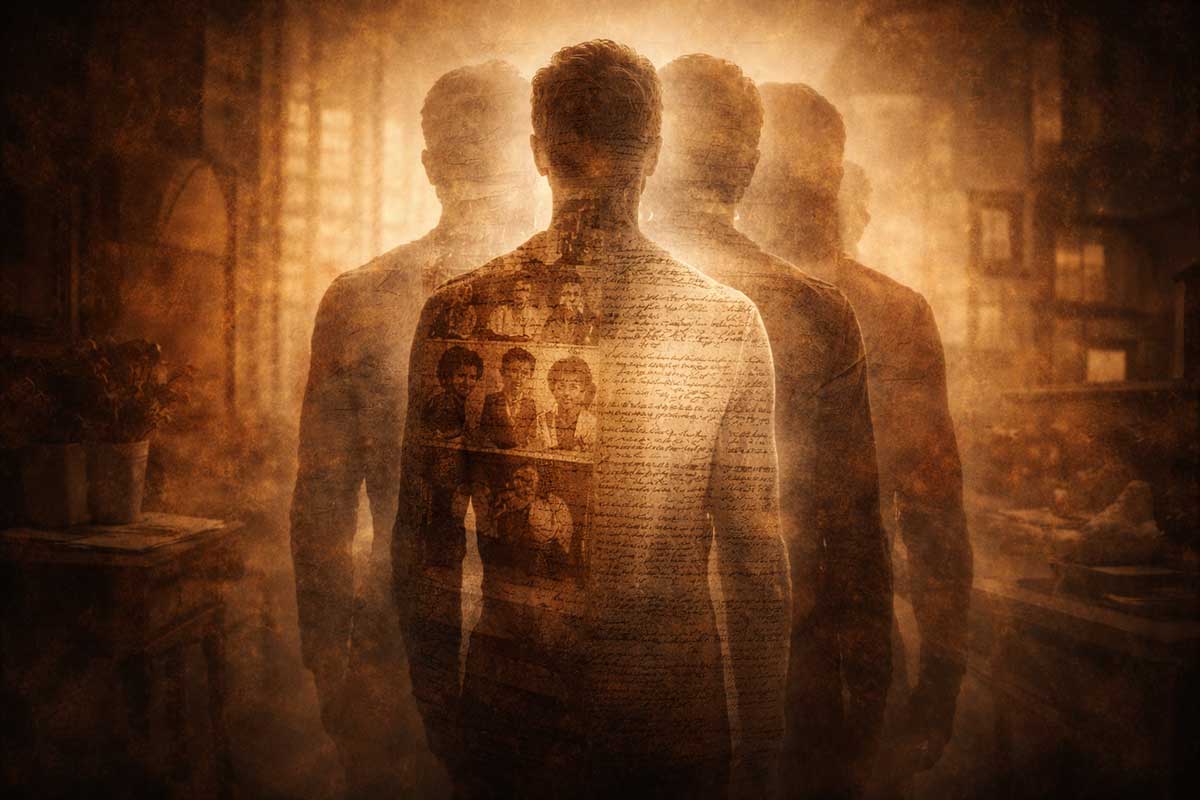
We like to speak of identity as something we make, as though it begins the day we become conscious of ourselves. But I have watched men carry names, debts, and fears they did not choose. Identity, I suspect, is not invented so much as inherited. So let me ask you this.
Faulkner’s voice is steady.
How much of who we call “ourselves” was chosen—and how much was handed down before we ever spoke our first word?
Baldwin
Most of it is handed down. Choice enters late, and even then it is constrained. We inherit not only family, but history’s expectations of us. To believe otherwise is comforting, but it is not true. Freedom begins only after we recognize what has already been decided for us.
Morrison
Inheritance is unavoidable, but it is not destiny. What is handed down includes memory, silence, and absence. Identity forms around these gaps. We are shaped not only by what we are told, but by what we are forbidden to know.
Ishiguro
I think we choose within a narrow corridor. Much of what we call personality is adaptation. We adjust ourselves to survive what we’ve inherited. Later, we mistake those adjustments for essence.
Roth
Identity often begins as resistance. We push against what we are given, yet the shape of that resistance is still determined by the thing we’re resisting. Even rebellion is a form of inheritance.
Ernaux
For me, identity is a social record. Class, gender, language—these precede the individual. We are born into systems already in motion. To write the self honestly is to admit that it was never private.
Faulkner leans forward slightly.
If we inherit wounds we did not cause, do we also inherit responsibility for what they become?
Morrison
Yes. Responsibility is not about guilt; it is about care. What we do with inherited wounds determines whether they continue or transform.
Baldwin
Responsibility is unavoidable. To refuse it is to pass the wound along unchanged. The past doesn’t ask us to be blamed—it asks us to be brave.
Roth
This is where people grow uncomfortable. Responsibility feels unfair. But unfairness has never absolved anyone. History doesn’t consult our preferences.
Ernaux
Responsibility means visibility. To expose the wound rather than aestheticize it. Silence is the most efficient way to ensure repetition.
Ishiguro
I would say responsibility begins with honesty about how deeply the wound shaped us. Without that, any attempt at repair is cosmetic.
Faulkner waits, then asks the final question.
Can a person ever know who they are without first knowing where they come from—and what was done there?
Baldwin
No. Self-knowledge without historical knowledge is fantasy. It produces innocence without understanding.
Morrison
To know oneself is to listen backward as much as forward. The past speaks through us whether we recognize it or not.
Ishiguro
One can function without knowing, but one cannot fully understand oneself. Ignorance creates coherence, not truth.
Roth
People try to outrun their origins. They rarely succeed. The past waits. It always does.
Ernaux
Knowing where you come from does not imprison you. It gives you language. Without language, identity remains vague and fragile.
Faulkner — Closing
Then identity may not be a single voice, but a chorus—some voices chosen, others inherited, all speaking at once. To know oneself, perhaps, is not to silence the past, but to finally hear it clearly.
Topic 5 — The Moral Consequence of Ignoring the Past
(What happens when the past is denied)
Participants:
Fyodor Dostoevsky, W.G. Sebald, George Orwell, Primo Levi, Albert Camus
Moderator: William Faulkner
Faulkner — Opening
We speak often of forgetting as though it were mercy. But I have watched forgetting harden into habit, and habit into doctrine. The past does not vanish when denied. It changes shape. So let me ask you what denial truly costs.
Faulkner’s gaze is steady.
When the past is denied, does it disappear—or does it begin to act without a name?
Dostoevsky
It acts. Always. What is denied becomes obsession, crime, or faith twisted into violence. Guilt unacknowledged does not dissolve; it seeks expression. When people refuse confession, the past returns as compulsion.
Sebald
It also acts quietly. Through architecture, through silence, through landscapes emptied of explanation. Denial does not produce absence. It produces distortion. The world begins to feel wrong, and no one knows why.
Orwell
Denial becomes policy. When the past is erased, power gains freedom to redefine reality. What acts then is not memory, but control. The past survives only as what authority permits it to be.
Levi
And that permission is lethal. Forgetting is not neutral. It aligns itself with the oppressor. When the past is denied, the victims are asked to disappear twice—once in life, and again in memory.
Camus
Denial is an evasion of responsibility. We cannot escape what has been done, only decide whether to face it honestly. To deny the past is to live in bad faith.
Faulkner pauses before continuing.
Is forgetting ever innocent, or does it always choose a side?
Levi
It always chooses. Silence is never empty. It shelters those who benefit from forgetting.
Orwell
Innocence is a narrative. Forgetting is an act, whether conscious or not. When the past is forgotten, someone has arranged for it to be so.
Camus
Even personal forgetting is a choice. We may forget to survive, but we cannot pretend that survival absolves us of moral consequence.
Sebald
Forgetting simplifies the world. It removes complexity, and with it, truth. The cost is paid later, in confusion and repetition.
Dostoevsky
Forgetting is cowardice disguised as peace. It postpones reckoning, but guarantees its severity.
Faulkner asks the final question.
Does the past return to punish us—or to ask, once more, to be acknowledged?
Camus
It returns to demand meaning. Whether we experience that demand as punishment depends on our response.
Levi
It returns to testify. The past does not seek revenge. It seeks recognition.
Sebald
It returns because it was never given a voice. What is unheard must speak again.
Orwell
It returns because power can never fully control memory. Something always escapes.
Dostoevsky
It returns as conscience. And conscience, when ignored, becomes unbearable.
Faulkner — Closing
Then forgetting is not mercy, and denial is not peace. The past returns not because it is cruel, but because it is unfinished. Until it is faced honestly, it will remain—alive, active, and unrelenting.
Final Thoughts by William Faulkner
If there is one thing I have learned, it is this: the past does not haunt us because it is cruel. It haunts us because it is unfinished.
What we refuse to remember does not disappear. It merely finds another way to speak—through habit, through prejudice, through fear passed quietly from one generation to the next. Silence does not end history. It preserves it.
We want the past to be over because reckoning is costly. It requires us to see ourselves clearly, without the comfort of innocence. But forgetting is more expensive still. It condemns us to repetition. It turns memory into fate.
The past is not even past because it is still asking something of us. Not apology alone. Not punishment. But recognition. To look at it squarely and say: This happened. This shaped us. This will not be denied again.
Only then does the past loosen its grip—not because it has been erased, but because it has been acknowledged. And only then does the present have a chance to become something more than history repeating itself under a new name.
That is all I ever meant.
Short Bios:
William Faulkner
An American novelist and Nobel Prize winner whose work explored memory, history, and moral inheritance in the American South. Faulkner’s fractured narratives revealed how the past continues to shape individuals and societies long after events have ended.
Marcel Proust
A French novelist best known for In Search of Lost Time, a monumental exploration of memory and consciousness. Proust illuminated how the past survives within sensation and involuntary memory rather than deliberate recollection.
Virginia Woolf
An English modernist writer whose novels redefined narrative time and inner life. Woolf portrayed memory as fluid and nonlinear, capturing how past and present coexist within a single moment of consciousness.
Toni Morrison
An American novelist and Nobel laureate whose work confronted the enduring legacy of slavery and racial trauma. Morrison depicted history as a living force that returns when it is denied, demanding recognition and moral reckoning.
James Baldwin
An American essayist and novelist who wrote powerfully about race, identity, and history. Baldwin argued that history is not behind us but alive in the present, shaping who is seen, heard, and believed.
Kazuo Ishiguro
A British novelist and Nobel Prize winner whose work examines memory, self-deception, and emotional survival. Ishiguro explored how individuals reshape the past in order to live with it, without ever fully escaping it.
W.G. Sebald
A German writer whose genre-defying works blended fiction, history, and memoir. Sebald focused on collective memory, silence, and the quiet persistence of historical trauma embedded in landscapes and objects.
Haruki Murakami
A Japanese novelist whose surreal narratives explore parallel realities and buried memories. Murakami often depicts the past as a hidden layer of existence that quietly intersects with everyday life.
Jorge Luis Borges
An Argentine writer whose philosophical stories challenged conventional ideas of time and causality. Borges treated time as circular, infinite, and illusory, collapsing distinctions between past, present, and future.
Samuel Beckett
An Irish writer whose stark prose and plays explored repetition, waiting, and existential stagnation. Beckett portrayed time as something that does not advance but erodes, returning characters endlessly to unresolved moments.
Clarice Lispector
A Brazilian writer known for her introspective and philosophical prose. Lispector examined identity and memory as internal states, where time deepens the self rather than moving it forward.
Philip Roth
An American novelist whose work interrogated identity, inheritance, and cultural memory. Roth portrayed the self as inseparable from family history, social expectation, and personal rebellion.
Annie Ernaux
A French writer whose autobiographical works treat personal identity as a social and historical document. Ernaux revealed how class, gender, and collective memory shape the individual self.
Fyodor Dostoevsky
A Russian novelist whose works explored guilt, conscience, and moral responsibility. Dostoevsky showed how suppressed past actions return through psychological and ethical consequences.
George Orwell
An English writer and essayist who examined power, memory, and truth. Orwell warned that controlling the past is a means of controlling the present, making forgetting a political act.
Primo Levi
An Italian writer and Holocaust survivor whose testimony emphasized memory as moral duty. Levi insisted that forgetting historical atrocities enables their repetition.
Albert Camus
A French philosopher and novelist who explored responsibility and moral clarity in an absurd world. Camus argued that facing truth honestly is essential, even when history offers no easy meaning.
Leave a Reply