
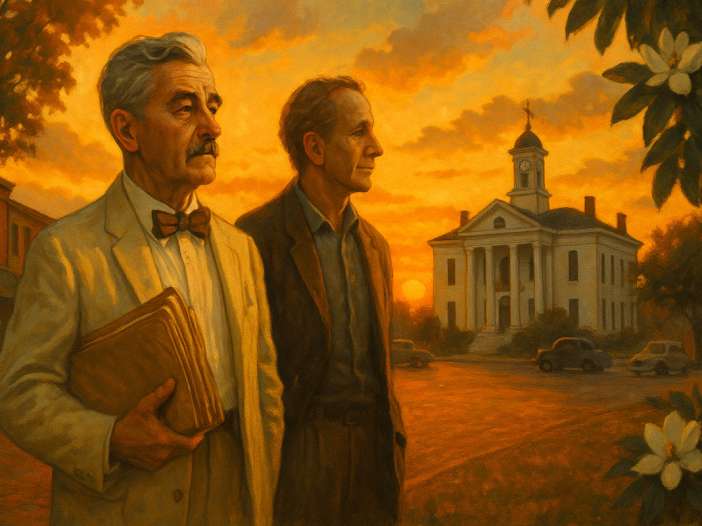
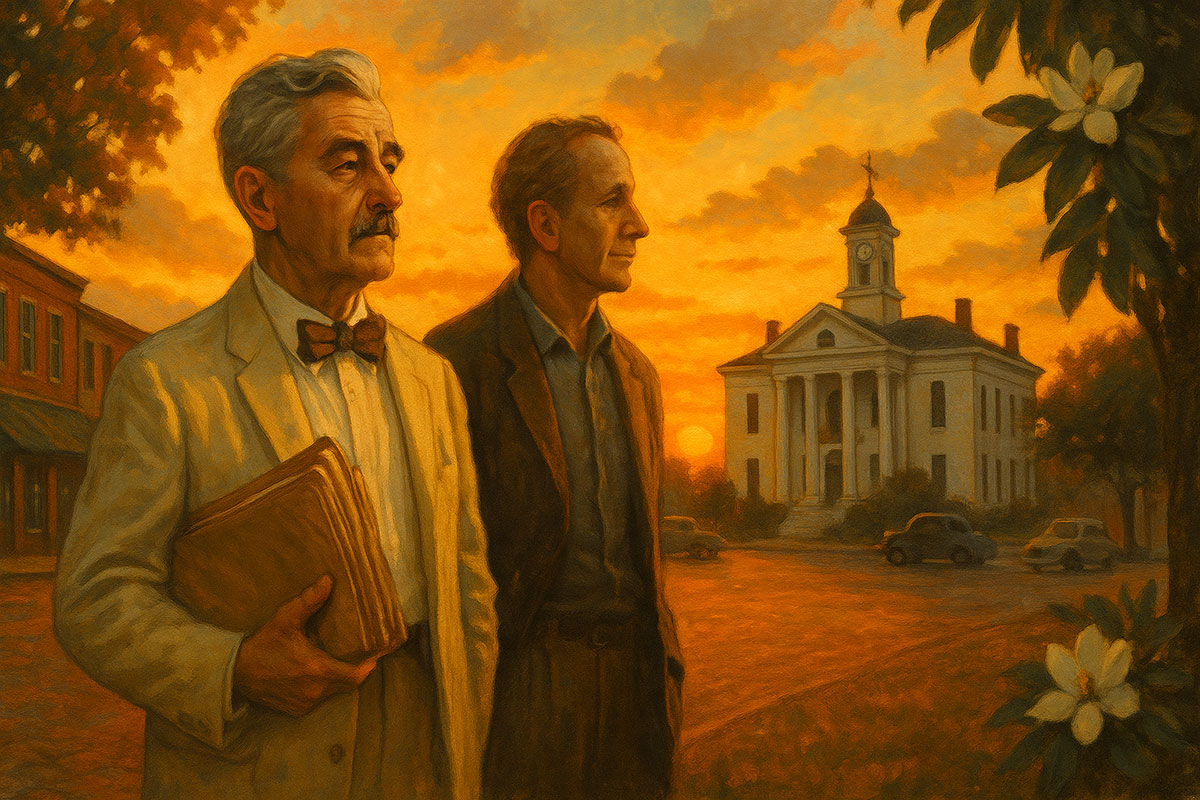
William Faulkner:
There are towns that keep their secrets in the dust, and men who carry their truths in the marrow. Oxford is mine. It has seen me as a boy who would not fit, a man whose words were turned away, a writer pacing long nights in the lamp’s thin glow. It saw me in borrowed dignity beneath chandeliers far from home, and it carried me, at the last, down streets I had walked a thousand times. The seasons here do not hurry; neither does the truth. And so, I will tell you what I have learned, for in the telling, I might learn it again.
(Note: This is an imaginary conversation, a creative exploration of an idea, and not a real speech or event.)
Chapter 1 – The Rejected Poet
The rain in Oxford that day was the kind that blurred the edges of the world—soft enough to dampen the hair, heavy enough to drown the paper in your pocket.
William sat on the front steps of the post office, his overcoat pulled close, the rejection letter still folded in his hand. It had been weeks since he’d sent off his latest sheaf of poems, carefully typed on his old Underwood, each word pressed into the page like a promise.
“You read it yet?” I asked, stepping out from the doorway, the scent of damp cedar clinging to my coat.
He glanced up. The brim of his hat cast a shadow over his eyes, but I could see the tired flicker in them. “Read enough,” he muttered. The corner of the envelope was torn, the paper inside creased as though he’d folded it too quickly, too angrily.
We sat there for a while, watching the drizzle turn the dirt road into a slow, dark ribbon. Horses passed, their hooves sucking at the mud, and from somewhere down the street, a radio played a waltz that didn’t belong to this gray afternoon.
“They don’t understand,” I said finally. “They wouldn’t know a good line if it bit them on the ankle.”
He let out a quiet, bitter laugh. “Maybe there isn’t a good line in it.”
The air smelled of wet earth and the faint tang of ink from the post office. I watched his fingers turn the letter over and over, as if he could rub the rejection out by touch. His boots were muddy. His cuffs were frayed. And yet, even in that moment, I could see it—the way he leaned forward slightly when he was thinking hard, the way his jaw tightened when he refused to be beaten.
“Will,” I said, “this is one letter. One editor. You can’t let it define the rest of the page.”
He shook his head, but there was a flicker of something in his expression, a narrowing of the eyes. “Maybe I’m not meant to write poems,” he said. “Maybe I’m meant to write something else.”
I knew better than to push. Some truths had to bloom in their own season. The rain was easing now, leaving beads of water on the porch rail. He tucked the letter into his coat pocket, as if burying it for later, and stood.
“Let’s walk,” he said.
So we walked, past the courthouse square, past the brick storefronts with their peeling paint, and into the long Mississippi road that smelled of rain and honeysuckle. He didn’t speak much, but every now and then his lips moved as though he were testing out sentences—not for a poem, perhaps, but for something else, something longer, something that might carry the weight of the South itself.
I didn’t know it then, but that was the day William Faulkner began letting go of the poet he thought he should be—and started becoming the novelist the world would remember.
Chapter 2: The War That Wasn’t
The train to Canada rattled like a stubborn thought.
William sat across from me, his khaki uniform still stiff with newness, his cap tilted just enough to suggest he wasn’t entirely convinced by the idea of wearing it. The air smelled faintly of coal smoke and cold iron, the windows rimed with frost that blurred the passing countryside into streaks of white and gray.
He had volunteered for the Royal Air Force, eager for flight, for the sweep of open sky. But as the train clattered northward, I could see in his eyes the quiet knowledge that wars are rarely what they promise.
“Do you think they’ll actually send us up?” he asked, half-smiling, as if to make the question seem lighter than it was.
I shrugged. “They’ll send someone. Whether it’s us…” I let the sentence trail off, watching a farmstead blur past in the frost.
He tapped a cigarette from its tin, lit it, and let the smoke curl between us. The scent mingled with the metallic chill of the compartment. Outside, the trees thinned, giving way to frozen fields that stretched out like pages yet unwritten.
“You know,” he said after a long pause, “I thought I’d come back with stories. Not just the war—everything. The flight, the danger, the men I’d meet. Thought maybe I’d write it all down and make it worth something.”
“And now?”
He exhaled slowly, the smoke drifting toward the ceiling. “Now I’m not sure there’s going to be a war for me at all.”
It was true. By the time we reached Toronto, rumors had already begun trickling through the barracks: the armistice was near. The great fight was ending before it had even begun for us. The uniform felt heavier on him each day, not with use but with uselessness.
We drilled. We polished. We waited for orders that never came. The winter light in Canada was sharp and colorless, and some mornings, I found him staring out the barracks window, his breath fogging the glass, as if he were trying to see the future in the distance.
One evening, over a chipped mug of weak coffee, he said, “Maybe the war I thought I’d fight isn’t out there. Maybe it’s in the stories I haven’t written yet.”
There was no bitterness in his tone now, only a kind of weary acceptance. He seemed to understand that some battles were won not in the air, but on the page.
When the armistice came, there were no parades for men who never saw the front. We returned home quieter than we had left, our uniforms still neat, our boots barely scuffed. But in William’s eyes, I saw something shift—a hunger not for medals or missions, but for the kind of truth only fiction could hold.
And though he didn’t say it aloud, I think that was the day he decided that if the world would not give him the stories he wanted to live, he would write them himself.
Chapter 3: The Yoknapatawpha Vision
It began on a porch that sagged under the weight of years.
The boards creaked beneath our chairs as the late-summer heat pressed in from every side. The air was thick with honeysuckle and dust, the smell of red clay after a brief rain lingering like a memory that refused to fade. Somewhere down the road, a dog barked once, then gave up, the sound swallowed by cicadas.
William sat slouched, a glass of sweet tea in one hand, his gaze fixed not on the yard, but somewhere far beyond it. His hair stuck to his forehead in damp strands, but his mind was elsewhere—walking the streets of a town that didn’t yet exist.
“I keep seeing it,” he said, his voice low and slow, as though speaking too loudly might scare it away. “A whole county. My own county. Every field, every creek, every family that’s ever lived there. It’s all tangled up—past, present, future. Same land, same names, but the years shifting like cards in a deck.”
“Is it real?” I asked.
He smirked slightly. “Real enough that I can walk it in my head. Real enough that the people there argue with me.”
A breeze stirred, warm and heavy, carrying with it the faint metallic tang of a blacksmith’s forge from somewhere unseen. William closed his eyes, and I could almost see what he saw—a courthouse square shaded by pecan trees, a river curling like a lazy snake through fields of cotton, porches where old men in suspenders leaned back in rocking chairs and spoke as if the Civil War had ended just yesterday.
“I’m going to call it Yoknapatawpha,” he murmured, tasting the word like a secret. “It means ‘water runs slow through flat land.’”
The name fit. It rolled slow and deliberate, the way the county itself seemed to move in his mind.
I watched as he reached for his notebook—a battered thing, its leather cover scuffed and soft from years of use. He wrote names, dates, tiny sketches of crossroads. Whole lives appeared in quick, restless strokes. And then he paused, staring at a blank page for a long moment before writing one line with such force the pencil almost snapped:
"This is the truth of the South, whether it happened or not."
It was there, under that sweltering Mississippi sun, that I understood something about William: his war, his grand adventure, would be fought not in the skies but in a place of his own making. A place where history and myth could live side by side without apology.
By the time the light began to fade and the cicadas gave way to the chorus of night insects, Yoknapatawpha County was no longer just an idea. It was a living thing. And William Faulkner was its chronicler, judge, and reluctant god.
Chapter 4: The Prize and the Price
The telegram arrived on an ordinary afternoon, the kind where the Mississippi light slants in just right, making the dust in the air look like drifting gold. William was at the kitchen table, mending a stubborn leak in his pipe with the patience of a man who’d rather fix something himself than trust it to anyone else.
I was halfway through shelling pecans when the knock came—sharp, urgent, the kind that doesn’t belong to a neighbor. A boy from the telegraph office stood there, cap askew, shifting from foot to foot as if the message in his hand burned.
“For Mr. William Faulkner,” he said, and I swear his voice carried the weight of the moment, even if he didn’t know why.
William slit it open without ceremony, his eyes scanning the words. He didn’t smile. Didn’t frown. Just read it again, slower. Then he folded it, placed it on the table beside his pipe, and said in that same flat drawl,
“They’ve gone and given me the Nobel Prize.”
I laughed, thinking he was joking, but his face stayed still. Only his fingers betrayed him—tapping once against the wood, like they needed something to hold on to.
In the days that followed, the house filled with letters, reporters, even strangers who swore they’d been his best friend once. He avoided most of it, retreating to his study where the air smelled of tobacco and ink. “It’s not for me,” he said one evening, as if convincing himself. “It’s for the work. For the endurance of man’s spirit. That’s what I told them, and I meant it.”
But I could see the weight in his shoulders when he thought no one was looking. The prize was a crown, yes, but one made of thorns. It meant that every word he wrote from now on would be measured against the speech he gave in Stockholm, the one about courage, compassion, and the last ding-dong of doom.
When he returned from Sweden, the whole town turned out to welcome him, but William seemed half-absent, like part of him was still in that other place—the one he’d built, with its stubborn rivers and its people who never really left. That night, sitting on the porch with a glass of bourbon, he leaned back and whispered more to himself than to me:
“The truth is, prizes fade. But the stories—if you’ve done them right—will outlive you.”
The crickets sang, the bourbon glowed amber in his hand, and I thought about how a man can win the world’s highest honor and still belong more to a county that doesn’t exist than to the world that gave it.
Chapter 5: The Last Ride Through Town
The morning was unusually still, the kind of stillness that carries its own kind of sound—an absence so complete it becomes a presence. The sun had barely cleared the treetops, its light spilling in long, pale ribbons across the quiet streets of Oxford.
Word had spread before the day was fully awake: William Faulkner was gone.
I sat on the porch, coffee cooling in my hands, listening to the slow tolling of the church bell. It rang not just for him, but for the ending of an era, for the closing of some invisible chapter in the life of the town. People came in twos and threes, their voices low, their steps softer than usual, as if even the gravel knew to hush.
The hearse rolled in from the east road, black paint polished to a mirror. Behind it, a procession of cars moved at the pace of memory—steady, reluctant. I stood as they passed, catching sight of the small spray of magnolias resting on the casket, their white petals unblemished, almost stubborn in their perfection.
He was taking one last ride through the streets he had walked, the streets he had built into stories that would carry Oxford beyond itself. I saw faces at every corner—shopkeepers, farmers, students—some tipping their hats, some bowing their heads, all holding something unspoken.
As the procession curved past the courthouse square, I thought about all the times I’d found him there, sitting on a bench in the shadow of the clock tower, scribbling something in that tiny, cramped handwriting of his. He’d look up just long enough to say, “You can’t write if you’re not watching,” then go right back to it.
The cars turned toward the cemetery, the red clay road crunching under their tires. I didn’t follow. Instead, I stayed where I was, watching until the last taillight disappeared into the trees. It felt right to let him go that way, without chasing him into the quiet place.
When I finally sat down again, the air seemed to move differently—lighter, but also lonelier. I thought about his words the night he won the Nobel Prize: “The work will outlive you.”
And I knew then that somewhere, in the invisible Yoknapatawpha County he carried in his head, he was still walking—past the cotton fields, down the muddy banks of the Tallahatchie, turning into some story that had no end.
Final Thoughts by William Faulkner
A man’s life is not the sum of his triumphs, but the soil in which they root. Mine was tilled in the red clay of Mississippi, watered by long silences and hard laughter, shadowed by rejection, lifted by the stubborn hands of those who believed when I could not. If you find anything worth keeping in my words, it will not be because they are mine, but because they are yours now, planted in your own ground. And if the wind carries them off before they take root, let it be — for there are other fields, and time enough for their growing.
Short Bios:
William Faulkner (1897–1962) was an American novelist, short story writer, and Nobel Prize laureate, renowned for his richly layered depictions of the American South. Best known for works like The Sound and the Fury and As I Lay Dying, his intricate narratives and innovative style reshaped modern literature.
Lifelong Friend (Fictional)
A composite of the steadfast companions who walked beside Faulkner through obscurity and acclaim, this unnamed friend represents loyalty, candor, and quiet strength. Always near yet never overshadowing, they bore witness to the struggles and triumphs that defined Faulkner’s life and art.
Leave a Reply