

|
Getting your Trinity Audio player ready...
|
What if Jonathan Haidt mapped why good people are divided—and gave one practical way to argue without turning each other into enemies?
Introduction by Jonathan Haidt
When I chose the title The Righteous Mind, I was not trying to accuse anyone of hypocrisy or moral arrogance. I was trying to describe a psychological reality that I myself struggled to accept: most people, most of the time, believe they are morally right—and that belief is sincere, emotional, and deeply felt. The tragedy is that this sense of righteousness is not limited to one side of a debate. It is shared almost universally, even by those who appear to us as misguided, dangerous, or incomprehensible.
The phrase “righteous mind” refers to the intuitive machinery that generates moral judgments automatically, effortlessly, and long before conscious reasoning begins. Reason, as I came to understand through years of research, rarely acts as an impartial judge. More often, it behaves like a skilled lawyer—constructing arguments in defense of intuitions that have already reached their verdict. This realization was unsettling to me personally, because I had been trained to believe that moral disagreement could be resolved by better arguments and clearer facts. The evidence suggested otherwise.
What compelled me to write this book—and what excites me about this conversation—is the opportunity to step outside the illusion of moral superiority and examine how morality actually works in human beings. Not how we wish it worked, but how it does. I wanted to place my ideas in dialogue with thinkers who approached morality from different angles: psychology, philosophy, religion, history, and political life. These are people whose work I have long admired, and whose disagreements I take seriously. If moral psychology is to be useful, it must survive honest confrontation with perspectives that challenge its assumptions.
This is not a conversation about who is right and who is wrong. It is a conversation about why disagreement feels so absolute, why moral conflict escalates so easily, and why good people—people who genuinely care about fairness, harm, loyalty, dignity, and meaning—so often end up seeing one another as threats. If we can understand that process more clearly, we may not eliminate division. But we might prevent division from becoming dehumanization.
(Note: This is an imaginary conversation, a creative exploration of an idea, and not a real speech or event.)
Topic 1 — The Intuitive Elephant

Why Reason Follows Intuition (Not the Other Way Around)
Setting: A calm, book-lined room with no podium and no audience. The mood is investigative rather than adversarial—five minds circling one unsettling idea.
Participants:
Jonathan Haidt
Daniel Kahneman
David Hume
Antonio Damasio
William James
Jonathan Haidt:
When I wrote The Righteous Mind, I was trying to explain a puzzle that haunted me: how morally sincere people—good people—could look at the same facts and arrive at utterly incompatible conclusions. My answer unsettled many readers: moral judgment is mostly intuitive. Reason usually comes later, acting like a lawyer defending a verdict already reached.
Let me ask the first question plainly: If intuition comes first, what is reason actually doing?
David Hume:
I’m pleased this question still causes discomfort. Long ago I observed that reason is, and ought only to be, the servant of the passions. By that I never meant reason is useless—only that it does not command. We feel approval or disapproval first; reason then invents explanations. When people believe they reasoned their way to a moral view, they usually mean they reasoned after the feeling appeared.
Daniel Kahneman:
From a psychological standpoint, that matches what we see repeatedly. Fast, automatic processes generate impressions and judgments almost instantly. Slow reasoning often steps in afterward—not to decide, but to justify. This is not a character flaw; it’s a feature of how the mind conserves effort. What surprises people is how confident those intuitions feel. Confidence, unfortunately, is not a reliable signal of correctness.
Antonio Damasio:
Neuroscience supports this hierarchy. Emotional signals—what I call somatic markers—bias decision-making before conscious deliberation begins. Patients with damaged emotional processing can reason logically, yet struggle to make even simple decisions. This suggests that feeling is not an enemy of reason; it is the scaffolding that makes reasoning possible at all.
William James:
And habit plays a decisive role. Our intuitions are not raw instincts alone; they are shaped by repeated experience, culture, and attention. What we attend to becomes salient; what is salient feels obvious. Over time, intuition acquires the weight of inevitability. Reason then behaves like a press secretary—polished, articulate, and rarely candid.
Haidt:
That leads naturally to the second question: If intuition drives judgment, are people actually persuadable? Or are moral debates mostly theater?
Kahneman:
Direct argument rarely changes minds, especially on identity-laden issues. When beliefs are tied to group membership, counterarguments trigger defensive processing. People become more skilled at finding flaws in opposing views than in their own. Persuasion, when it happens, usually occurs indirectly—through trusted messengers, lived experiences, or shifts in social norms.
James:
I would add that belief is often a wager before it is a conclusion. People commit to a moral position because it fits their temperament and their community. Once the wager is placed, reason’s task is to protect it from loss. Debate can change minds, but only when it changes what feels live, forced, or momentous to the individual.
Hume:
Indeed, persuasion is rarely a duel of syllogisms. It is an appeal to sympathy, imagination, and shared sentiment. You do not reason a man out of a conviction unless you first enter the emotional world in which that conviction makes sense. Moral discourse fails when it pretends to be purely rational while quietly being tribal.
Damasio:
Biology reinforces this. Threat—social or existential—narrows cognitive bandwidth. When people feel attacked, the brain prioritizes protection over openness. Persuasion requires safety. Without it, reasoning degrades into rationalization.
Haidt:
Then the third question becomes uncomfortable but unavoidable: If reason mainly serves intuition, what responsibility do we have for our moral beliefs? Are we accountable for intuitions we didn’t choose?
James:
Responsibility lies less in the moment of judgment and more in the cultivation of character. We choose our habits, our reading, our company, and our attentional diet. These choices slowly sculpt intuition itself. Moral responsibility is upstream.
Kahneman:
I agree. While we cannot will ourselves into unbiased judgment, we can design environments that reduce error—exposing ourselves to dissent, slowing decisions, and building procedural safeguards. Responsibility is procedural, not heroic.
Hume:
Moral responsibility also includes modesty. Recognizing the limits of reason should make us gentler with others and more suspicious of our certainty. Fanaticism often begins with the illusion that one’s moral intuitions are self-evident truths.
Damasio:
And compassion follows from understanding mechanism. When you see that moral conviction arises from neural and emotional processes shaped by life history, moral disagreement looks less like malice and more like divergence. That insight does not erase conflict—but it humanizes it.
Haidt (closing):
This conversation reinforces the heart of my claim: moral reasoning is rarely the engine of judgment—it is the press office. If we want better moral dialogue, we must stop pretending people are persuaded by facts alone. We must learn how intuitions form, how they harden, and—occasionally—how they soften.
If good people are divided, it is not because one side has reason and the other lacks it. It is because different intuitions feel morally self-evident. Until we understand that, we will keep shouting arguments at elephants—and wondering why they don’t move.
Topic 2 — Moral Foundations
Why Each Side Speaks a Different Moral Language
Setting: The same quiet room, but the mood has shifted. Less curiosity now, more tension—not hostile, but real. Everyone senses that this is where misunderstanding hardens into moral certainty.
Participants:
Jonathan Haidt
Émile Durkheim
Thomas Aquinas
John Stuart Mill
Martha Nussbaum
Jonathan Haidt:
In The Righteous Mind, I proposed that morality is not built on a single foundation like harm or fairness alone, but on multiple foundations—care, fairness, loyalty, authority, sanctity, and later liberty. Political and religious divisions arise because different groups prioritize different foundations. My opening question is simple but destabilizing: What happens to moral reasoning when people assume their preferred foundation is the whole of morality?
John Stuart Mill:
Then morality becomes dangerously narrow. If harm is treated as the sole moral currency, anything that does not cause obvious injury is dismissed as irrelevant or superstitious. This blinds people to the moral importance of tradition, character, and social cohesion. Liberal morality, when absolutized, forgets that human flourishing is not merely the absence of harm.
Thomas Aquinas:
Indeed. Morality is not reducible to consequences alone. It concerns the proper ordering of the soul and of society. Authority and sanctity are not arbitrary relics; they are structures that orient human desire toward the good. When these foundations are rejected outright, society loses a shared moral grammar—and disagreement becomes incomprehensible rather than merely disputable.
Martha Nussbaum:
At the same time, when authority or sanctity are treated as immune to critique, suffering is often justified in their name. The danger cuts both ways. Moral foundations become oppressive when they are enforced without regard for human capabilities—what people are actually able to be and do. A pluralistic society must take multiple moral claims seriously without allowing any single one to dominate unchecked.
Émile Durkheim:
From a sociological perspective, moral foundations are not optional beliefs; they are the glue that binds groups. Loyalty, authority, and sanctity function to create solidarity. When a society weakens these without replacing them, individuals feel unmoored. What looks like “progress” to one group feels like moral disintegration to another.
Haidt:
That leads to the second question: Why do moral disagreements so quickly turn into judgments about character—“they are evil,” “they are stupid,” “they are dangerous”—rather than disagreements about values?
Durkheim:
Because morality defines the boundaries of the group. When someone violates a sacred norm, they are not merely wrong—they are perceived as a threat to collective identity. Moral outrage is not accidental; it is a social reflex designed to protect cohesion. In modern societies, where shared rituals have weakened, moral conflict becomes more ferocious, not less.
Aquinas:
When people lack a shared conception of the good, disagreement easily becomes demonization. Charity—the willingness to interpret others generously—requires confidence that truth exists beyond one’s own intuition. When truth is replaced by will or preference, the opponent becomes an obstacle rather than a fellow seeker.
Mill:
And when free expression erodes, moral certainty hardens. Suppressing dissent gives people the illusion that their moral view is universally obvious. They stop testing it against opposition and begin to mistake silence for agreement. Character judgments then replace arguments.
Nussbaum:
I would add that fear plays a central role. When people believe their dignity, identity, or way of life is under threat, empathy collapses. Moral language becomes weaponized. The task is not to erase disagreement, but to preserve the conditions under which disagreement does not destroy mutual recognition.
Haidt:
So here is the third and most difficult question: If different moral foundations are genuinely real to different people, what would moral humility actually look like in practice?
Mill:
It would begin with the recognition that one’s own moral emphasis is partial. A society that values liberty must still ask what sustains the character capable of using liberty well. Moral humility means accepting that others may be protecting goods you have neglected.
Aquinas:
Humility requires acknowledging hierarchy among goods without collapsing them into one. Care without order becomes sentimentality; order without care becomes cruelty. Moral wisdom lies in integration, not elimination. Listening across foundations is not concession—it is completion.
Nussbaum:
Practically, humility means designing institutions that allow multiple moral concerns to coexist—protecting vulnerability without shaming tradition, honoring culture without freezing it. It also means teaching emotional literacy: helping citizens recognize when moral disgust or anger is driving their judgments.
Durkheim:
And it means restoring shared rituals and symbols that remind people they belong to something larger than their faction. Without common moral reference points, pluralism becomes fragmentation.
Haidt (closing):
This discussion reinforces something I’ve come to believe deeply: our divisions persist not because one side lacks morality, but because we are speaking different moral languages and mistaking disagreement for depravity. Until we learn to translate rather than condemn, moral conflict will continue to escalate—each side convinced that only it stands on the side of the good.
Understanding moral foundations does not dissolve disagreement. But it does make disagreement less poisonous—and that, in a divided society, is no small achievement.
Topic 3 — Religion as Moral Technology
Why Faith Binds Groups More Than It Explains the World
Setting: The room feels different now—less academic, more ancient. There’s a sense that the conversation has stepped beneath arguments and into something older: ritual, meaning, belonging.
Participants:
Jonathan Haidt
Émile Durkheim
Karen Armstrong
Mircea Eliade
Yuval Noah Harari
Jonathan Haidt:
One of the most misunderstood claims in The Righteous Mind is that religion should be seen less as a set of beliefs about the universe and more as a moral technology—a system that binds people together, disciplines behavior, and creates meaning. My first question is this: If religion functions primarily to bind groups, what have modern secular societies misunderstood about it?
Émile Durkheim:
They have misunderstood its purpose. Religion is not merely an explanation of the cosmos; it is the means by which a society worships itself. Through ritual, symbol, and shared emotion, individuals are lifted into a collective moral order. When modern societies strip religion of this function and treat it only as superstition or private belief, they fail to replace its binding power—and social fragmentation follows.
Karen Armstrong:
Yes, and they also misunderstand religion by reading it literally rather than practically. For most of history, faith traditions were not about asserting propositions but about cultivating compassion, restraint, and transcendence of the ego. Rituals trained people emotionally and ethically. When modern critics attack religion as “false,” they often miss what it was for.
Mircea Eliade:
Religion creates sacred time and sacred space. It allows human beings to step out of ordinary, chaotic time and locate themselves within a meaningful cosmic order. When the sacred disappears, people do not become purely rational—they become disoriented. They seek substitutes: ideology, nationalism, consumer identity. These replacements often lack the stabilizing depth of traditional religious forms.
Yuval Noah Harari:
From a historical perspective, shared myths—religious or otherwise—enable large-scale cooperation among strangers. Whether gods, nations, or human rights, these narratives coordinate behavior. The danger today is not belief itself, but unexamined belief. Secular societies did not eliminate myth; they simply replaced religious myth with political or economic ones—often while pretending they had transcended myth altogether.
Haidt:
That leads to the second question: Why does attacking religion so often strengthen it rather than weaken it—especially among its most devoted adherents?
Durkheim:
Because attacks activate the sacred-profane boundary. When a sacred symbol is mocked or threatened, group solidarity intensifies. What critics experience as “exposing irrationality,” believers experience as an assault on identity. The group closes ranks. Rational critique misunderstands the emotional architecture of the sacred.
Armstrong:
And because many attacks confuse institutional abuse with spiritual function. People defend religion not because they deny its failures, but because it provides meaning, moral orientation, and community that nothing else has adequately replaced. Criticism that lacks empathy confirms the believer’s sense of moral superiority rather than challenging it.
Eliade:
Desecration is never neutral. When the sacred is attacked, it demands response. In traditional societies, sacrilege was understood as existential threat. Modern secular cultures forget this and then express surprise when reactions are intense. You cannot dismantle the sacred with sarcasm.
Harari:
There’s also a power dynamic. When elite institutions ridicule religion, believers interpret it as cultural domination. Resistance becomes not just theological but political. Faith becomes a banner of defiance. This is how religion survives modernity—not by winning arguments, but by anchoring identity.
Haidt:
So here is the third question, and it’s the most important one for divided societies: If religion is a moral technology, what happens when societies lose it without building an equivalent replacement?
Durkheim:
They suffer anomie—a breakdown of norms. Individuals feel disconnected, purposeless, and morally adrift. In such conditions, people become susceptible to extreme movements that promise belonging and moral clarity. The vacuum will not remain empty.
Armstrong:
And compassion often thins. Religious traditions trained people in practices that softened the ego—fasting, confession, service. When those disciplines disappear, moral discourse becomes abstract and punitive. People speak of justice, but forget mercy.
Eliade:
Meaning collapses into immediacy. Without sacred narratives, life becomes flat, time becomes empty, and anxiety increases. Humans are not built to live without transcendence. When the sacred is denied, it returns in distorted forms.
Harari:
We are already seeing replacements: nationalism, identity politics, techno-utopianism. Some of these myths coordinate behavior effectively—but many lack ethical depth. The question is not whether we will have shared myths, but whether they will restrain violence or accelerate it.
Haidt (closing):
This discussion sharpens a realization that unsettles many modern thinkers: religion did not survive because it was irrational—it survived because it worked. It bound people, disciplined desire, and made sacrifice meaningful. When societies dismantle these systems without understanding their function, they don’t become more enlightened—they become more fragile.
The challenge ahead is not choosing between faith and reason, but learning how to preserve moral binding in a pluralistic world without turning difference into war.
Topic 4 — Tribalism, Identity, and the Hive Switch

How Groups Make People Moral—and Dangerous
Setting: The room feels tighter now. Less abstract. Everyone senses that the conversation has crossed from belief into power. What’s being discussed here has started wars, ended democracies, and also built nations and movements of astonishing sacrifice.
Participants:
Jonathan Haidt
Erich Fromm
Hannah Arendt
Jordan Peterson
Frans de Waal
Jonathan Haidt:
One of the most disturbing ideas in The Righteous Mind is what I call the hive switch—the human capacity to lose oneself in a group, to feel morally elevated by belonging, and to justify actions that would feel unthinkable alone. My first question is this: Why does group identity feel so powerful that it can override individual conscience?
Erich Fromm:
Because freedom is frightening. The isolated individual bears responsibility, doubt, and uncertainty. The group offers relief—certainty, belonging, and moral direction. When people fuse with a collective identity, they escape the burden of choice. Obedience becomes virtue. This is not a defect of weak people; it is a temptation built into the human condition.
Frans de Waal:
From an evolutionary perspective, group loyalty predates abstract morality. Primates show empathy within the group and aggression toward outsiders. Humans inherited this pattern but layered it with language and ideology. When the hive switch activates, moral concern narrows. Kindness intensifies inwardly; cruelty becomes permissible outwardly.
Jordan Peterson:
Groups also provide meaning. People will endure suffering if they believe it serves something larger than themselves. That’s why ideologies are so dangerous—they give moral certainty without humility. Once you believe your group embodies “the good,” anyone who resists becomes an obstacle to be removed, not a person to be understood.
Hannah Arendt:
And this is how ordinary people commit extraordinary evils. Not through monstrous intent, but through thoughtlessness. Totalizing movements dissolve personal responsibility into collective purpose. When individuals stop thinking critically and instead adopt the moral language of the group, conscience is outsourced. Evil becomes banal.
Haidt:
That brings us to the second question: Why does moral tribalism escalate so quickly from disagreement to dehumanization?
Arendt:
Because ideology simplifies the world into friends and enemies. Complexity is exhausting; moral clarity is intoxicating. Once a narrative frames the other side as existentially dangerous, restraint collapses. Violence becomes “defensive.” Language deteriorates first—then behavior follows.
Fromm:
Hatred often disguises itself as virtue. People experience moral intoxication when attacking an enemy in the name of righteousness. The more insecure the identity, the more aggressive the defense. Moral tribalism feeds on fear—fear of insignificance, fear of disorder, fear of freedom itself.
de Waal:
Biology reinforces this. Our brains are exquisitely sensitive to in-group signals. Shared symbols, chants, uniforms—these activate trust internally and suspicion externally. Once activated, reasoning becomes asymmetric. Evidence for the group is accepted; evidence against it is rejected.
Peterson:
There’s also the corruption of compassion. People convince themselves they are preventing greater harm by inflicting immediate harm. This is how utopian thinking turns murderous. When suffering is abstracted—justified by future promises—individual lives become expendable.
Haidt:
So here is the third and hardest question: If the hive switch is real and powerful, can modern societies channel it without unleashing catastrophe? Or is tribalism an unavoidable curse?
de Waal:
It can be redirected, but not eliminated. Cooperative rituals—sports, shared civic projects, even national ceremonies—can activate group bonding without requiring an enemy. The danger arises when cohesion depends on opposition rather than cooperation.
Arendt:
Institutions matter. Laws, norms, and pluralistic structures slow moral contagion. When institutions collapse—or are captured by ideology—the hive runs unchecked. The task is not to suppress passion, but to contain it within frameworks that preserve responsibility.
Fromm:
Education must cultivate inner freedom. A person who knows themselves is less desperate for fusion. Without psychological maturity, no political system can save a society. The authoritarian temptation will always return.
Peterson:
And individuals must voluntarily shoulder responsibility. The antidote to ideological possession is meaning grounded in personal accountability. When people build lives of competence and purpose, they are less susceptible to moral hysteria.
Haidt (closing):
This conversation confirms something unsettling: the same forces that make humans capable of moral greatness—loyalty, sacrifice, belonging—also make us capable of moral blindness. The hive switch is not a glitch; it is a feature.
The question facing pluralistic societies is not how to eliminate tribalism, but how to prevent it from turning sacred conviction into sacred violence. Without that restraint, good people will keep doing terrible things—convinced they are on the side of the good.
Topic 5 — Is Moral Dialogue Still Possible?

What It Would Take to Disagree Without Becoming Enemies
Setting: The room feels quieter than before—not calmer, but more deliberate. Everyone senses that this is the point where theory must face practice. What’s at stake now is not explanation, but survival of pluralism itself.
Participants:
Jonathan Haidt
Martin Buber
Václav Havel
George Orwell
Nick Sasaki (moderator)
Nick Sasaki:
We’ve talked about intuition, moral foundations, religion, and tribalism. Each layer explains why good people divide. But explanation alone doesn’t heal anything. So let me begin with the question everyone is quietly asking: Is genuine moral dialogue still possible—or have we crossed a line where persuasion has been replaced by moral warfare?
Jonathan Haidt:
It’s still possible, but only if we stop using dialogue as a covert weapon. Too often, conversations are framed as exchanges while secretly serving as performances for one’s tribe. Real dialogue requires moral humility—the recognition that your opponent may be protecting values you have neglected. Without that assumption, conversation collapses into signaling.
Martin Buber:
Dialogue dies the moment the other becomes an object. In what I called the I–It relationship, the other exists only as a category—enemy, heretic, reactionary, extremist. Moral dialogue requires I–Thou: meeting the other as a full human presence, not a problem to be solved. This is not agreement. It is recognition.
George Orwell:
Language is the early warning system. When words become slogans and labels replace descriptions, dialogue has already decayed. Political language often functions to make lies sound truthful and violence respectable. If people cannot describe reality in plain speech, they cannot argue honestly about it.
Václav Havel:
I would add that dialogue requires courage. In totalizing systems—whether authoritarian or socially coercive—truth-telling carries risk. People retreat into slogans not because they believe them, but because they fear standing alone. Moral dialogue begins when someone accepts personal cost in order to speak honestly.
Nick Sasaki:
That brings us to the second question: What inner conditions must exist for a person to actually hear an opposing moral view without immediately rejecting it?
Buber:
Presence. One must slow down enough to encounter the other as a person rather than as a threat. Listening is not waiting to respond; it is allowing oneself to be affected. This is rare because it requires vulnerability—and vulnerability feels dangerous in polarized times.
Haidt:
Psychologically, safety is essential. People only revise intuitions when they feel respected and included. Moral change is social before it is rational. If your identity is under attack, your mind closes. Dialogue requires environments where disagreement does not threaten belonging.
Havel:
And conscience must be alive. When people surrender their inner compass to ideology or group approval, they lose the capacity for genuine listening. The ability to hear the other depends on the willingness to stand apart from the crowd—even briefly.
Orwell:
Clarity matters too. Many conflicts persist because people argue about abstractions while avoiding concrete meaning. When words are vague, each side hears what it fears. Clear language forces honest disagreement—and honest disagreement is healthier than moral fog.
Nick Sasaki:
So here’s the final question—the hardest one: What practical steps could actually reduce moral hostility without erasing real differences? Not ideals—actions.
Haidt:
First, diversify your moral diet. Intentionally expose yourself to voices that value different moral foundations than you do. Second, stop attributing malice where difference suffices. Most people are not villains—they are guardians of a different moral concern.
Buber:
Create spaces for encounter, not debate. Debate seeks victory; encounter seeks understanding. Small, repeated interactions—shared work, shared silence, shared responsibility—do more for moral healing than public argument ever will.
Orwell:
Defend language. Resist euphemism, refuse slogans, and insist on describing reality plainly—even when it hurts your side. Clear speech is an ethical act. When language rots, dialogue dies.
Havel:
Live in truth. Not loudly—consistently. Refuse to repeat what you do not believe. Refuse to hate on command. Even small acts of integrity weaken systems built on fear and conformity.
Nick Sasaki (closing):
What I hear at this table is not optimism, but responsibility. Moral dialogue isn’t guaranteed. It isn’t safe. And it isn’t scalable in the way outrage is. But it remains possible wherever individuals choose humility over certainty, presence over performance, and truth over tribal applause.
If good people are divided, perhaps the task is not to erase division—but to prevent division from stripping away our shared humanity. Dialogue, at its best, doesn’t end disagreement. It makes disagreement survivable.
Final Thoughts by Jonathan Haidt
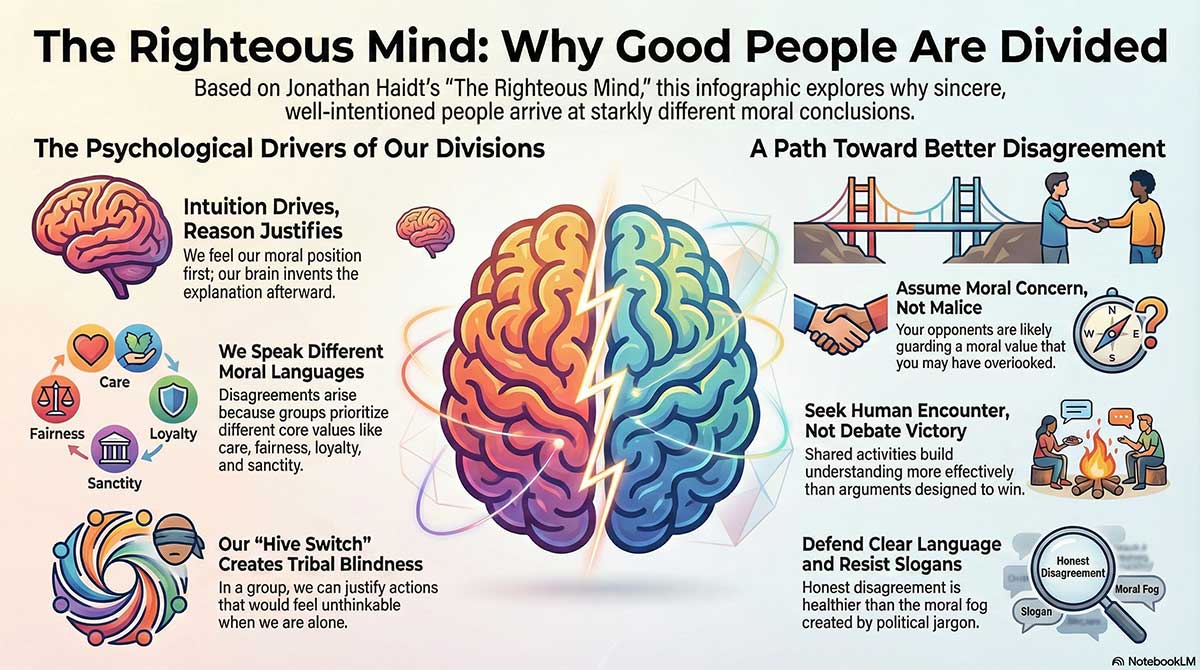
What this discussion has reinforced for me is something both sobering and hopeful: moral conflict is not a sign that society has lost its values—it is a sign that it has many values, held passionately and sincerely. The danger arises not from morality itself, but from the belief that one’s own moral vision is complete, self-evident, and sufficient.
Across these conversations, I was reminded that intuition comes first, that moral foundations are plural, and that reason is far less sovereign than we like to imagine. I was reminded that religion and ritual did not endure because people were foolish, but because they solved real human problems—binding individuals into moral communities, disciplining desire, and making sacrifice meaningful. I was also reminded that tribalism is not a modern pathology, but an ancient human capacity that can elevate us to acts of courage and generosity—or carry us into cruelty with a clean conscience.
Perhaps the most important insight, however, is this: moral certainty is psychologically natural, but socially dangerous. When people are unable to imagine that their opponents are acting from moral concern rather than malice, dialogue collapses. Language hardens. Identities fuse with beliefs. And disagreement becomes a threat to be neutralized rather than a reality to be navigated.
I do not believe that moral dialogue is easy, nor that it can be scaled through slogans or platforms. It requires humility, restraint, and environments where disagreement does not threaten belonging. It requires protecting language from distortion, resisting the lure of moral intoxication, and remembering that every moral community is guarding something it considers sacred.
Good people will continue to disagree—about politics, religion, culture, and the future. The question is not whether division will exist, but whether we allow it to strip away our capacity for recognition, empathy, and restraint. If The Righteous Mind offers any guidance, it is this: understanding how morality works does not make us morally superior—but it may make us morally safer.
And in a divided world, that may be one of the most important virtues we can cultivate.
Short Bios:
Jonathan Haidt — Social psychologist and author of The Righteous Mind, known for Moral Foundations Theory and research on intuition, morality, and political polarization.
Daniel Kahneman — Nobel laureate whose work on cognitive biases and dual-process thinking reshaped how we understand judgment and decision-making.
David Hume — Enlightenment thinker who argued that reason serves emotion, laying early groundwork for modern moral psychology.
Antonio Damasio — Neuroscientist known for showing how emotion is essential to reasoning, decision-making, and moral judgment.
William James — Founding figure in psychology and pragmatism, focused on habit, belief, and lived experience.
Émile Durkheim — Founder of sociology who explored how morality, ritual, and religion bind societies together.
Thomas Aquinas — Medieval thinker who integrated reason, virtue, and theology into a structured moral framework.
John Stuart Mill — Advocate of liberty and the harm principle, emphasizing individual freedom and moral reasoning.
Martha Nussbaum — Contemporary ethicist known for the capabilities approach and emphasis on dignity and compassion.
Karen Armstrong — Scholar of comparative religion focusing on compassion, myth, and the lived function of faith traditions.
Mircea Eliade — Historian of religion who examined the sacred, ritual, and myth as foundations of human meaning.
Yuval Noah Harari — Historian known for analyzing shared myths, collective belief systems, and large-scale human cooperation.
Erich Fromm — Psychoanalyst who explored freedom, conformity, and the psychological roots of authoritarianism.
Hannah Arendt — Philosopher of power and responsibility, famous for analyzing totalitarianism and the “banality of evil.”
Jordan Peterson — Psychologist and cultural commentator focused on meaning, responsibility, and mythic structures.
Frans de Waal — Scientist studying empathy, cooperation, and morality in primates and humans.
Martin Buber — Philosopher of dialogue known for I–Thou, emphasizing genuine human encounter.
Václav Havel — Playwright-turned-statesman who championed truth, conscience, and moral courage under oppression.
George Orwell — Essayist and novelist who warned about language decay, propaganda, and moral clarity.
Nick Sasaki — Founder of ImaginaryTalks, moderating conversations that explore ideas across history, psychology, and culture.
Leave a Reply