

|
Getting your Trinity Audio player ready...
|
Introduction by Nick Sasaki
Coppélia has always worn a pretty mask.
A village. A festival. A boy with soft eyes and softer responsibility. A girl who’s “too much” because she refuses to be manageable. And in the window—an impossible calm: the kind of calm that makes people believe their lives could finally be simple.
But under the lace and ribbons, the story has teeth.
When you turn this ballet into a spoken play, you don’t lose the dance—you relocate it. The choreography becomes social behavior. The “steps” become phrases people repeat until they stop hearing them. The music box becomes a town that moves like a shared thought. And the doll becomes what she was always meant to be: not a gimmick, not a punchline, but a mirror.
Here, the central spell isn’t magic.
It’s a sentence.
“Hold still. It’s for your own good.”
In Act I, it’s said with warmth—pinning ribbons, smoothing sleeves, rehearsing joy. In Act II, it becomes velvet on a trap. In Act III, it becomes the town’s reflex, spoken without thought, the way people pass down control disguised as care.
And then there’s Swanilda—our real hero. Not the jealous girlfriend. Not the comic troublemaker. The glitch in the pattern. She’s the one who notices the room temperature change near the workshop door. She’s the one who refuses to be edited. She’s the one who loves deeply enough to demand reality, and brave enough to choose herself if reality isn’t offered back.
If the ballet’s genius is physical comedy and uncanny stillness, the play’s genius is responsibility: who gets to define “real,” who benefits from silence, and what we’re willing to worship because it doesn’t challenge us.
So no—this isn’t “cute.”
This is a fairy tale about projection. About the seduction of a love that cannot leave. About a town that calls its script “tradition,” and a girl who calls it what it is: a leash with a ribbon on it.
Welcome to the workshop.
Try not to blink.
Act I — The Town as a Music Box
Scene 1 — The Pattern
A village square at late afternoon. The world looks handcrafted: warm wood, painted shutters, linen banners half-hung for tomorrow’s festival. Everything has the gentle glow of a story people tell themselves every year.
The TOWN enters in a subtle synchronization—small repeated gestures: smoothing sleeves, straightening ribbons, tilting heads the same way. A music-box feeling without music: a rhythm of sameness.
A bell rope hangs near a small tower. A chalkboard sign reads: “FESTIVAL OF ST. VITUS — TOMORROW.” Beneath it, in neat handwriting: “BELL SCHEDULE.” The schedule is mostly unreadable at a distance, but the idea of it is visible.
SWANILDA enters, carrying a coil of ribbon. She watches the TOWN for a second, smiling like she loves them and doesn’t trust them. CATRICE and LUKA flank her.
CATRICE
You’re late.
SWANILDA
I’m never late. The town is early.
LUKA
It’s festival week. Everyone’s early.
The TOWN repeats a gesture: a soft, polite head tilt. CATRICE does it without thinking. SWANILDA notices.
SWANILDA (to CATRICE)
Don’t do that.
CATRICE (mid-tilt, stops)
Do what?
SWANILDA
That… agreeable neck thing. Like your spine is auditioning.
CATRICE
It’s called being pleasant.
SWANILDA
It’s called being trained.
LUKA laughs nervously. The TOWN hums with busyness. Two villagers pass, smiling, hands folded the same way.
VILLAGER 1
Tomorrow’s the day.
VILLAGER 2
Hold still—pin goes in cleaner.
VILLAGER 1 adjusts VILLAGER 2’s sash. It’s gentle, loving. The words land soft.
VILLAGER 2
Hold still. It’s for your own good.
A beat. SWANILDA hears it like a bell.
CATRICE (noticing Swanilda’s face)
Oh, don’t start. It’s just a saying.
SWANILDA
Saying’s are seeds.
LUKA
Saying’s are… sayings.
SWANILDA
And yet everyone says the same ones. Same jokes. Same songs. Same… future.
The MAYOR appears with a clipboard, radiant with civic pride. The TOWN’s gestures sharpen: polite attention.
MAYOR
Good, good—look at you all. Like a proper picture. Like a story worth telling.
CATRICE
We’re trying, Mayor.
MAYOR
You’re succeeding. Swanilda, your ribbons?
SWANILDA (holds them up)
Ready to strangle tradition at a moment’s notice.
MAYOR (laughs; takes it as a joke)
Ah, yes. Our Swanilda. Always a little spark. We need sparks. We also need punctuality. Tomorrow, the bell will ring at dawn.
He points to the bell rope, to the schedule board.
MAYOR (cont.)
When it rings, the town becomes one body. One heart. One celebration. You know the order.
SWANILDA
I know the order. I just don’t know why it’s always the same people deciding it.
MAYOR
Because the same people are still alive, dear. That’s what we call stability.
The TOWN chuckles politely. A shared laugh—timed, tidy.
MAYOR (cont.)
Franz will be leading the first promenade with you, yes?
SWANILDA’s smile tightens.
SWANILDA
If Franz remembers he’s in a town and not a dream.
MAYOR
He’s a young man. Young men dream. Young women keep them grounded. It’s a sacred balance.
SWANILDA absorbs that like a small insult disguised as wisdom. CATRICE squeezes her arm, warning her not to explode.
MAYOR (cont.)
Now, keep working. Tomorrow is not just celebration—it is how we remind ourselves who we are.
The MAYOR moves on. The TOWN resumes their pattern. SWANILDA watches them for a beat, then turns.
SWANILDA
Where is he?
CATRICE
Where do you think? Near the window.
LUKA
He’s not hurting anyone.
SWANILDA
Neither is a wolf until it’s hungry.
CATRICE
You’re being dramatic.
SWANILDA
I’m being awake.
She drops the ribbons into CATRICE’s arms.
SWANILDA (cont.)
Come on.
They exit toward the edge of the square.
⸻
Scene 2 — The Window
Across the street: a narrow house-front with a large second-story window. It’s too perfect. Too clean. Like it belongs in a dollhouse. In the window sits COPPÉLIA—a young woman in a pale dress, posture impeccable, hands folded. Her face is visible but not alive in the usual way. She doesn’t blink.
FRANZ stands below, looking up. He’s grinning like a boy and worshiping like a man.
The TOWN passes behind him. They glance up, smile, move on. Like this is normal. Like this is charming. Like this is safe.
FRANZ
Good evening.
No response.
FRANZ (cont.)
You’re not much for conversation. That’s fine. Most people talk to hear themselves.
He tips his head—the town gesture—and then catches himself and laughs.
FRANZ (cont.)
Look at me. I’m becoming them.
SWANILDA enters, CATRICE and LUKA behind her. She stops, takes in the sight: Franz fixed on the window. The still figure above. The way his face softens like he’s being forgiven by the idea of her.
SWANILDA
Franz.
FRANZ (without looking away)
Swanilda. Don’t be rude—she’s listening.
SWANILDA
She’s not.
FRANZ
You don’t know that.
SWANILDA
I know a person when I see one.
FRANZ (finally looks at Swanilda)
Then you’re seeing wrong.
He turns back to the window.
FRANZ (cont.)
Tell her what you told me.
SWANILDA
What did I tell you?
FRANZ
That you don’t trust anyone who smiles too much.
SWANILDA
I said I don’t trust anyone who smiles the same way every time.
CATRICE (to Luka, sotto)
And here we go.
SWANILDA (calls up to the window)
Hello!
COPPÉLIA remains still. A beat. Another beat. The air holds.
FRANZ
She’s shy.
SWANILDA
She’s furniture.
FRANZ
You’re jealous.
SWANILDA
I’m insulted you think that’s what this is.
She steps closer, peering up. COPPÉLIA’s gaze seems angled slightly downward—toward them. Swanilda’s skin prickles.
SWANILDA (cont.)
How long has she been sitting there?
FRANZ
I don’t know. Long enough to be the best thing I’ve seen all week.
SWANILDA
I’m standing right here.
FRANZ
Exactly.
That lands. Swanilda’s eyes sharpen.
SWANILDA
What’s that supposed to mean?
FRANZ
It means—don’t make everything a test. She doesn’t test me.
SWANILDA
She doesn’t breathe.
FRANZ
Maybe she doesn’t want to waste breath on this town.
He gestures broadly. The TOWN passes with ribbons and bunting and synchronized sweetness.
FRANZ (cont.)
Maybe she’s smarter than all of us.
SWANILDA
Or maybe she’s not real.
FRANZ
Real isn’t always better.
Silence. CATRICE watches Swanilda carefully, as if watching a match near dry hay.
SWANILDA
What did you say?
FRANZ (softly, defensively)
You heard me.
SWANILDA
Say it again.
FRANZ
No.
SWANILDA
Say it again.
FRANZ looks at her—finally really looks. He wants to be charming. He can’t charm his way out of this.
FRANZ
Real is… heavy. Real wants things. Real gets disappointed. Real—
(he stops, embarrassed)
She doesn’t.
SWANILDA’s voice is quiet now, dangerous because it’s controlled.
SWANILDA
So you want a girl who can’t want anything.
FRANZ
I want a moment that doesn’t punish me.
SWANILDA
Then don’t do punishable things.
FRANZ
You see? You’re a judge.
SWANILDA
I’m a mirror.
COPPÉLIA shifts—barely. A minute adjustment of her head, like the slightest tilt.
LUKA gasps. CATRICE freezes. FRANZ lights up like he’s just been chosen by fate.
FRANZ
Did you see—?
LUKA
She moved.
CATRICE
No. She—
(uncertain)
She did, didn’t she?
SWANILDA watches, unmoving.
SWANILDA
Again.
FRANZ
Don’t demand it. You’ll scare her.
SWANILDA
If she can be scared, she can answer.
SWANILDA steps closer, squinting at the glass.
SWANILDA (cont.)
Hello. Blink if you’re alive.
COPPÉLIA does not blink. Her eyes are open like painted coins.
FRANZ laughs to cover the discomfort.
FRANZ
She’s… refined. She’s not like us.
SWANILDA
No. She’s exactly like you want: silent, still, and flattering because you can pretend she’s anything.
FRANZ bristles.
FRANZ
You don’t know what I want.
SWANILDA
I know you want someone who won’t tell you the truth.
FRANZ
Swanilda—
SWANILDA
Tomorrow’s festival. You’re supposed to walk with me. In front of everyone. Like a promise.
FRANZ
It’s just walking.
SWANILDA
In this town, walking is a contract.
The bell rope sways slightly as a breeze passes. The schedule board creaks. The whole square feels like it is listening.
FRANZ
I’ll be there.
SWANILDA
Will you?
FRANZ
Yes.
SWANILDA
Then stop standing under her like a fool.
FRANZ looks up again, helpless.
FRANZ
You don’t understand.
SWANILDA
I understand too well. That’s why it scares me.
She turns away, walking a few steps, then stops. She looks back at the window. COPPÉLIA’s gaze seems to follow her.
A beat.
SWANILDA’s breath catches—just slightly.
SWANILDA (cont.)
Did she just—?
CATRICE
What?
SWANILDA
Nothing.
But Swanilda stares harder.
For a split second, the window “lies”: COPPÉLIA’s hand appears to lift—just an inch—then returns to stillness. It could be imagination. It could be a trick of the light. But Swanilda’s instincts flare like an animal.
SWANILDA (to Franz)
Who lives there?
FRANZ
Coppélius. The toymaker.
LUKA
He’s strange.
CATRICE
He’s harmless.
SWANILDA
Harmless men don’t make girls who never blink.
FRANZ laughs, too loud.
FRANZ
You’re turning her into a monster so you don’t have to admit you feel threatened.
SWANILDA’s smile turns razor-thin.
SWANILDA
Threatened? Franz—
(she gestures up)
If that thing is what you want… then I’m not threatened. I’m relieved.
FRANZ flinches. That hit him.
FRANZ
Fine. Go be relieved somewhere else.
SWANILDA
Gladly.
She starts to go—then stops again, as if pulled by a thread. She steps toward the door beneath the window. It is closed. Too quiet. Too clean. A door that seems to swallow sound.
She touches the handle.
It’s cold.
CATRICE
Swanilda. Don’t.
SWANILDA
Why not?
CATRICE
Because everyone knows you don’t go in there.
SWANILDA
Everyone knows lots of things. Everyone’s wrong about half of them.
LUKA
He’ll be angry.
SWANILDA
Good.
She lets go of the handle, but the cold remains on her palm like a warning.
She turns back to Franz.
SWANILDA (cont.)
Be at the festival tomorrow.
FRANZ
I said I would.
SWANILDA
Say it like you mean it.
FRANZ hesitates, then tries the town gesture—head tilt, polite smile—like it will smooth the conflict.
Swanilda sees it and stiffens.
SWANILDA (cont.)
Don’t do that to me.
FRANZ drops the smile.
FRANZ
I’ll be there.
SWANILDA
Good.
She exits with CATRICE and LUKA. FRANZ looks up at the window again, softer now, almost ashamed.
FRANZ (to Coppélia)
See? You never make me feel small.
COPPÉLIA is still.
Lights shift.
⸻
Scene 3 — The Festival Lesson
Back in the square. Evening approaches. Lanterns are lit. The TOWN rehearses the festival promenade in soft unison. They practice small synchronized steps, not quite dance, more like a shared habit. The pattern is comforting… until you watch too long.
SWANILDA returns alone, carrying ribbon again, but now she’s distracted. She watches the TOWN gesture-spread: a tilt, a fold, a polite laugh. It feels like a spell.
The MAYOR claps.
MAYOR
Lovely! Lovely. Again. And remember—gentle. Joyful. We are not wild animals.
The TOWN laughs. The laugh has the same timing as before.
Swanilda’s friend CATRICE rejoins her, quieter now.
CATRICE
You’re going to start a war with a window.
SWANILDA
It’s not the window.
CATRICE
It’s Franz.
SWANILDA
It’s what Franz wants the window to be.
CATRICE
You can’t compete with someone’s imagination.
SWANILDA
I’m not competing. I’m trying to rescue him from it.
CATRICE
Let him be foolish. It’s a hobby.
SWANILDA watches a villager tie a ribbon on a child’s wrist.
VILLAGER 3
Hold still.
CHILD
Why?
VILLAGER 3 (smiling)
It’s for your own good.
The child holds still. The ribbon becomes a tiny leash.
Swanilda’s jaw tightens.
SWANILDA
Do you ever notice how often they say that?
CATRICE
They say it because it’s true.
SWANILDA
It’s true when you’re pinning a ribbon. It’s poison when you’re pinning a life.
CATRICE doesn’t answer. She wants to disagree, but Swanilda is making a kind of sense that feels dangerous.
The MAYOR approaches, pleased.
MAYOR
Swanilda. Tomorrow, you’ll stand at the front with Franz. Everyone will look at you. They’ll envy you.
SWANILDA
Will they?
MAYOR
Of course. You’ll be the picture of what comes next.
SWANILDA
And if I don’t?
The MAYOR’s smile remains, but something tightens behind it.
MAYOR
Then someone else will.
SWANILDA
So I’m replaceable.
MAYOR
We all are, dear. That’s the comfort of tradition.
Swanilda holds his gaze.
SWANILDA
That’s not comfort.
MAYOR
It is if you don’t fight it.
He gently touches her shoulder, like he’s adjusting her posture.
MAYOR (cont.)
Hold still. It’s for your own good.
Swanilda’s breath catches. The same words—now a little heavier.
She steps back.
SWANILDA
Don’t touch me.
The MAYOR blinks, surprised.
MAYOR
My apologies. I forget you prefer to learn the hard way.
SWANILDA
I prefer to learn the real way.
The MAYOR’s smile returns as if nothing happened.
MAYOR
Rest tonight. Tomorrow is a long day. The bell will ring whether you’re ready or not.
He moves away.
CATRICE watches Swanilda, concern creeping in.
CATRICE
You’re shaking.
SWANILDA looks down at her own hands, annoyed to discover it’s true.
SWANILDA
I’m not shaking. I’m—
(she searches)
—listening.
CATRICE
To what?
Swanilda looks toward the workshop street.
SWANILDA
To the quiet.
⸻
Scene 4 — The Workshop Door
Night. The square empties. Lanterns remain. The village feels softer, almost forgiving.
Across the street, the workshop window is visible in the distance. COPPÉLIA is still in it, illuminated by a low lamp. She seems to float inside the frame like a portrait.
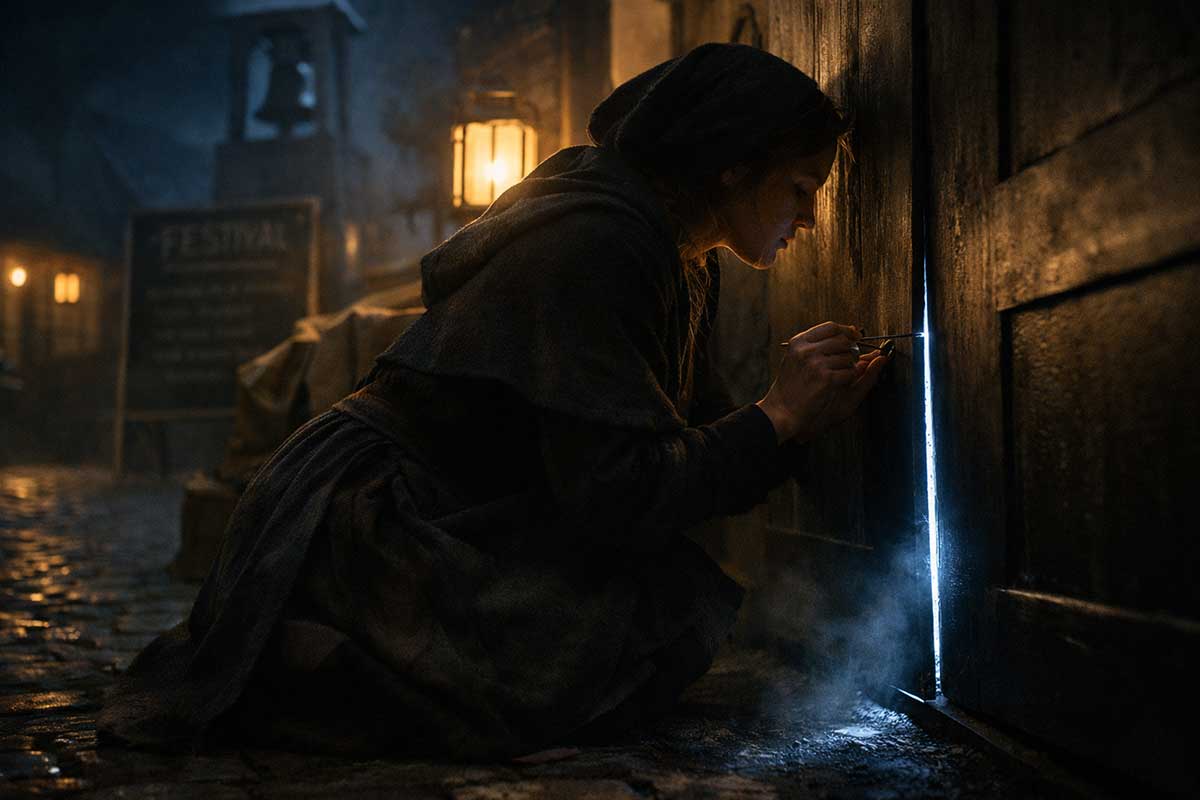
SWANILDA enters alone, hood up, moving carefully. Not sneaking like a thief—more like someone walking toward a truth.
She stops under the window.
Looks up.
COPPÉLIA is there.
Still.
Swanilda whispers, almost against her will.
SWANILDA
Hello.
No response.
Swanilda studies the face. The hands. The posture. Too perfect.
She glances at the glass, trying to catch reflections. Her own face appears faintly, layered over Coppélia’s—like two lives occupying one frame.
Then—something shifts.
Not Coppélia.
The window itself.
For a flicker, Swanilda sees another image behind the girl: shelves, parts, tools, a hint of figures hanging like unfinished thoughts. The lamp dims or brightens—unclear which.
The window “lies” again: Coppélia’s eyes appear to glance sideways.
Swanilda’s stomach drops.
She steps back, heart hammering.
Then, slowly, she steps forward again.
SWANILDA (cont.)
If you’re real… blink.
No blink.
Swanilda’s voice lowers.
SWANILDA (cont.)
If you’re not real… blink anyway.
Still nothing.
The stillness feels intentional now. Like refusal.
Swanilda turns to the door beneath the window.
The handle.
Cold again.
She places her palm on it and feels—under the cold—something like vibration. Like a machine breathing.
She draws her hand back as if burned.
A sound from inside: a soft metallic click. Not loud. Just… precise.
Swanilda freezes.
The door remains shut.
She looks around. The square is empty. The bell tower is a shadow.
She turns back to the window.
Coppélia is still.
But Swanilda can’t shake the feeling that the stillness is not emptiness.
It’s attention.
Swanilda raises her chin and speaks to the window, to herself, to the town that will try to choreograph her tomorrow.
SWANILDA (cont.)
You don’t get to decide what he wants.
(a beat)
And you don’t get to decide what I become.
She reaches again for the handle.
This time she doesn’t hesitate.
She twists.
The door does not open.
Locked.
She presses her forehead against the wood, listening.
Another click. Closer.
As if the lock is thinking.
As if the lock is learning her.
Swanilda steps back, unsettled—and then laughs once, sharply, because fear wants to become a joke so it can be swallowed.
SWANILDA (cont.)
Fine.
She moves to the side of the door, searching along the frame. A hidden latch? A crack? A weakness?
Her fingers find a small seam—almost invisible.
A maker’s seam.
Swanilda’s eyes narrow.
She slides something thin into it—a hairpin, a piece of wire, anything.
It’s clumsy. She’s not a thief by trade.
The seam resists.
Then yields—just a fraction.
A soft sigh of mechanism.
The lock gives.
Swanilda stops breathing.
She pulls the door slightly.
A thin line of darkness appears.
Cold air spills out, carrying a scent: varnish, dust, old cloth, metal warmed by lamplight.
The darkness inside feels thick—like it can be touched.
Swanilda holds the door half-open, hesitating at the threshold.
From inside: a whisper of movement. Not a person—something lighter. A pendulum? A hanging chain? A toy shifting on a shelf?
Swanilda looks back toward the town square.
The bell tower looms. Tomorrow’s schedule board is a pale rectangle in the distance. The countdown exists even at night.
She looks up at the window.
Coppélia is still there, above her, in the frame.
For a moment, Swanilda imagines herself in that window—posed, quiet, acceptable, admired.
She hates how easy it is to imagine.
She looks into the darkness.
SWANILDA (cont.)
All right.
She steps forward—
—and as she crosses the threshold, the lantern light from outside does not follow.
The door swings inward with a soft inevitability.
The line of darkness widens and swallows her.
The door begins to close behind her.
Swanilda turns quickly, catches it before it shuts.
She stands in the crack between worlds.
Outside: the town’s warmth, its rules, its bell.
Inside: quiet that feels like a hand around the throat.
Swanilda breathes once, steadying.
Then she slips fully inside.
The door closes.
A final, gentle click.
Blackout.
Act II — The Workshop as a Trap

Scene 1 — The Room That Watches
COPPÉLIUS’S WORKSHOP. Warm lamplight, but not cozy—surgical warmth. Shelves of parts: porcelain hands, glass eyes in velvet-lined trays, wigs on wooden heads, gears, springs, tiny shoes. A worktable with tools arranged with devotional precision. A tall mirror draped in cloth. A narrow staircase up to the window room.
The air smells like varnish and old fabric. The silence has weight.
SWANILDA stands just inside the door, listening. Her breath is loud in here, like a violation.
A soft ticking begins. Not a clock you can see—something deeper. A mechanism in the bones of the house.
SWANILDA takes a step. The floor answers with a small squeak.
She freezes. Waits.
Nothing.
She moves again, slower now, like she’s learning to be careful the way the room demands.
She sees a small wind-up figurine on a shelf: a tiny dancer frozen mid-turn.
SWANILDA reaches for it, then stops. She doesn’t touch. She doesn’t want to leave fingerprints in someone else’s obsession.
From above: a faint shift. A chain brushing wood. A breath? Maybe not.
SWANILDA looks up toward the staircase.
SWANILDA
Hello?
No answer.
She crosses to the worktable. There’s an open notebook with careful sketches of faces—different expressions, but all… obedient. Beside it: a half-finished doll head. Its eyes are missing. The sockets stare at her like a confession.
SWANILDA steps back, unsettled.
Then she sees something that makes her stop cold:
A small pile of ribbon—festival ribbon. The same color as the town’s banners. Cut into neat strips.
She touches one strip lightly with two fingers.
It’s fresh.
Meaning: Coppélius has been out. He has been watching the town. He has been collecting tomorrow’s “one body, one heart” like raw material.
A sudden sound—very close—startles her.
A click. A soft metal click, like a latch settling.
SWANILDA spins.
COPPÉLIUS stands in the doorway she came through.
He did not burst in like a monster. He is simply there, as if he has always been there and the room has only now allowed her to see him.
He holds a small oil lamp. The flame makes his face gentle and strange.
He looks at Swanilda with the calm of someone examining a tool: curious, not angry—yet.
A long beat.
COPPÉLIUS
You shouldn’t do that.
SWANILDA
Sneak into strangers’ homes?
COPPÉLIUS
Breathe so loudly.
Swanilda’s throat tightens. She forces a laugh that does not help her.
SWANILDA
Sorry. I’ll try breathing quietly.
Coppélius sets the lamp on the table, adjusting it a fraction of an inch until the light falls exactly where he wants.
COPPÉLIUS
Do you know what noise does in a room like this?
SWANILDA
It makes people nervous.
COPPÉLIUS
It wakes things.
Swanilda holds still. Her eyes flick to the shelves. The parts. The eyes. The stillness everywhere.
SWANILDA
I didn’t mean to wake anything.
COPPÉLIUS
No. You meant to see.
He studies her. Not threatening—diagnosing.
COPPÉLIUS (cont.)
You’re Swanilda.
Swanilda hates that he knows.
SWANILDA
Everyone knows me. It’s a small town.
COPPÉLIUS
Small towns make large appetites.
She braces. Chooses boldness because fear is worse.
SWANILDA
Is she real?
Coppélius’s face changes—not anger. Something softer and sharper at once.
COPPÉLIUS
Who?
SWANILDA
The girl in the window.
Coppélius looks up, as if he can see through the ceiling, through the window, into the town, into the place where people stand and stare and invent themselves.
COPPÉLIUS
Real is a lazy word.
SWANILDA
It’s not lazy if it saves you.
Coppélius steps closer. Not too close. He respects boundaries the way one respects glass.
COPPÉLIUS
What did you come for?
Swanilda’s honest answer is: to stop Franz from becoming a fool. But honesty feels like a trap.
So she says the truth sideways.
SWANILDA
I came because something is wrong.
Coppélius nods, as if she has confirmed a private theory.
COPPÉLIUS
Yes.
That “yes” is worse than denial.
Swanilda swallows.
SWANILDA
Is she a doll?
Coppélius considers the word.
COPPÉLIUS
She is… a promise.
Swanilda laughs once, sharp.
SWANILDA
A promise. To who?
Coppélius’s eyes rest on her, and for a flicker, the hunger shows.
COPPÉLIUS
To anyone who is tired.
Swanilda’s skin prickles. She remembers Franz: Real is heavy.
SWANILDA
People don’t get to rest by turning other people into furniture.
Coppélius’s lips twitch—almost amused.
COPPÉLIUS
Other people.
He says it like he’s tasting the phrase.
COPPÉLIUS (cont.)
You think this is about you and your boy.
Swanilda stiffens.
SWANILDA
It’s about what he’s doing under your window.
Coppélius’s gaze lifts again.
COPPÉLIUS
Under my window… he speaks to her?
Swanilda doesn’t answer. Coppélius’s hand tightens around nothing.
COPPÉLIUS (cont.)
He speaks.
A beat.
COPPÉLIUS (cont.)
And she listens.
He says that last line with quiet certainty, like it is a law.
Swanilda backs toward the door, subtly.
SWANILDA
I should go.
Coppélius does not stop her physically.
He stops her with the room.
A soft click echoes—somewhere inside the door mechanism. Not a lock slamming, but a thought being made.
Swanilda tries the handle.
It doesn’t move.
She freezes, then slowly turns back.
Coppélius watches her like someone watching a test begin.
COPPÉLIUS
Hold still.
Swanilda’s jaw tightens.
SWANILDA
No.
Coppélius tilts his head—almost like the town gesture, but different. Not polite. Studying.
COPPÉLIUS
You don’t like that phrase.
SWANILDA
It’s not a phrase. It’s a leash.
Coppélius steps to the table, picks up a small wind-up key.
COPPÉLIUS
Leashes can be kind.
SWANILDA
To whom?
Coppélius’s voice lowers, almost gentle.
COPPÉLIUS
To the one who is afraid of running away.
Swanilda feels the room lean in.
Then, from above—on the staircase—there’s movement.
A soft footfall.
Swanilda looks up.
COPPÉLIA appears at the top of the stairs.
In the lamplight, she looks real enough to make Swanilda’s stomach drop. Hair perfectly arranged. Dress pale. Skin too flawless. Eyes open, unblinking.
She stands utterly still.
Coppélius looks at her with reverence.
Swanilda whispers, involuntarily.
SWANILDA
Oh.
Coppélius’s voice is nearly proud.
COPPÉLIUS
You see.
Coppélia descends the stairs one step.
Then another.
Her movement is precise—like a music box turning.
Swanilda cannot tell if she is watching a girl pretending to be a doll, or a doll pretending to be a girl.
Coppélia reaches the floor and stops, hands folded.
Coppélius touches the side of her head gently, like checking a seam.
Swanilda’s fear turns to anger, and anger gives her breath.
SWANILDA
What is she?
Coppélius’s eyes stay on Coppélia.
COPPÉLIUS
She is what happens when you make stillness beautiful.
Swanilda’s gaze catches on Coppélia’s eyes—glass? real? The lamp reflections make them look alive.
SWANILDA
Does she ever… speak?
Coppélius finally looks at Swanilda.
COPPÉLIUS
Not yet.
That “yet” lands like a threat and a prayer.
Coppélius gestures subtly, and Coppélia turns—without looking like she turned—toward the mirror draped in cloth.
Coppélius draws the cloth away.
The mirror reveals not Swanilda’s reflection, but Coppélia’s—standing a fraction of a second delayed, like reality is lagging.
Swanilda stares, chills spreading.
The mirror “lies.”
Coppélius watches Swanilda watching it.
COPPÉLIUS (cont.)
Everything lies. We just call some lies love.
Blackout shift.
⸻
Scene 2 — The Countdown Outside
Lights up briefly: the TOWN SQUARE at dawn. The bell rope swings. The MAYOR’s voice is heard faintly, calling instructions. The TOWN rehearses again. The gesture-virus spreads: everyone tilts, folds hands, smiles in synchronized rhythm.
A bell rings once. Not the full festival bell yet—just a rehearsal tone. A warning.
MAYOR (offstage)
Again. Again. Tomorrow is not forgiving.
The square fades.
⸻
Scene 3 — Swanilda’s Glitch (Becoming the Doll)
Back in the workshop. Later in the night. Coppélius has set Swanilda on a stool like she is an object he is deciding where to place.
Coppélia stands a few feet away, still.
Coppélius circles Swanilda, not touching.
COPPÉLIUS
You’re wrong for the window.
Swanilda glares.
SWANILDA
I’m not trying to be in your window.
COPPÉLIUS
Everyone is trying to be in someone’s window.
He picks up a ribbon strip, holds it up to Swanilda’s neck, not tying—measuring.
Swanilda flinches.
Coppélius withdraws his hand as if he has been burned by her movement.
COPPÉLIUS
You move too much.
SWANILDA
I’m alive.
Coppélius studies her face. It’s not lust. It’s craft. It’s hunger for control.
COPPÉLIUS
Alive is… unruly.
Swanilda forces herself to breathe quietly.
Her eyes flick to Coppélia. Coppélia stands like a question.
Swanilda’s mind races: the door locked. The man. The room. The girl. The town tomorrow.
If she fights, she loses.
If she plays… she might learn the rules of the trap.
Swanilda straightens.
Her voice becomes mild.
SWANILDA
If you want me to move less… you should give me instruction.
Coppélius pauses. Something like interest sparks.
COPPÉLIUS
Instruction?
Swanilda does the town gesture—slowly. The polite head tilt. The agreeable smile.
Coppélius’s eyes widen slightly.
SWANILDA
Like this?
Coppélius nods once, almost involuntary.
Swanilda sees it: this is a language. He responds to obedience the way the town does. Pattern recognizes pattern.
Swanilda holds her posture. Holds her breath.
SWANILDA (cont.)
Hold still.
She says it to herself, tasting it.
Coppélius watches her, pleased.
COPPÉLIUS
Yes.
Swanilda lets her body become an object: hands folded, shoulders softened, gaze fixed at a point beyond Coppélius’s head.
She becomes still.
It is hard. It is painful. It is intimate in a way she hates.
Coppélius approaches Coppélia, touches her chin.
COPPÉLIUS (to Coppélia)
Look.
Coppélia’s head shifts—slight, perfect.
Then Coppélius turns back to Swanilda.
He circles again, closer now, lamp light crawling over Swanilda’s face.
Swanilda does not blink.
Her eyes water. She refuses the relief of blinking. She refuses giving herself away.
Coppélius smiles—small.
COPPÉLIUS
You have discipline.
Swanilda remains still.
Coppélius picks up a wind-up key and brings it near Swanilda’s back, as if he will insert it.
Swanilda’s muscles tense.
She does not move.
Coppélius stops. Almost tender.
COPPÉLIUS (cont.)
Good.
He sets the key down.
Swanilda hears it: he’s not testing her only. He’s testing whether he can make her consent to being less.
Coppélius steps away, moving to his table, preparing something: a small vial, a cloth, a thin needle, not for blood—too theatrical to be medical, too precise to be casual.
Swanilda’s eyes flick, tiny, toward the staircase.
Coppélia stands at the base now, closer than before.
Coppélia’s eyes look at Swanilda.
Or through her.
Swanilda realizes: this doll-girl is placed here like a witness. Like a guard. Like a standard.
Swanilda slowly shifts—just enough to angle her body toward Coppélia.
Still not blinking.
A silent conversation passes through the room:
Swanilda says with her eyes: Are you real?
Coppélia says with her stillness: Does it matter?
Swanilda’s fear hardens into resolve.
If this room speaks pattern, Swanilda will speak glitch.
She lets a tiny mechanical sound escape her throat—a small click, like a spring.
Coppélius looks up.
Swanilda holds the stillness again.
Coppélius frowns, then smiles.
COPPÉLIUS
Yes. Like that.
Swanilda understands: he wants performance.
Fine.
She gives performance. She gives him the lie he wants, because she needs the truth underneath.
⸻
Scene 4 — Franz Arrives (The Confession)
A knock at the workshop door. Soft at first. Then again. Insistent but polite—like someone asking permission to be foolish.
Coppélius stiffens.
Swanilda remains still on the stool.
Coppélia stands near the mirror.
Coppélius moves to the door, unlocking it with a key that hangs from his neck.
He opens the door a fraction.
FRANZ slips in, grinning, breathless, carrying the night air and the smell of festival banners.
FRANZ
Master Coppélius! I—
(he stops, seeing Swanilda on the stool)
Oh.
Coppélius’s face is blank.
COPPÉLIUS
Why are you here?
Franz tries charm, fails slightly.
FRANZ
I wanted to… apologize. If I’ve been… standing under your window. Staring.
Coppélius’s eyes narrow. Not at Franz’s behavior—at Franz’s hunger.
COPPÉLIUS
And?
Franz gestures vaguely upward, toward the window room.
FRANZ
And I wanted to see her. Up close. Just once. Before tomorrow.
Coppélius looks past Franz, toward the town square beyond the door, as if he hears the bell rehearsal.
COPPÉLIUS
Before tomorrow.
Franz’s gaze flicks to Coppélia by the mirror. His face softens, boyish awe returning.
FRANZ
There she is.
Coppélius closes the door behind Franz with a careful click.
Swanilda’s heart races. She stays still. She lets her eyes become glass.
Franz steps closer to Coppélia, reverent.
FRANZ (to Coppélia)
Hello.
No response.
Franz laughs softly, like that’s part of the charm.
FRANZ (cont.)
You’re even more beautiful in here.
Coppélius watches Franz like a scientist watches a predictable chemical reaction.
Franz notices Swanilda on the stool again.
FRANZ
Is that—?
Coppélius answers before Franz finishes.
COPPÉLIUS
Another.
Franz blinks.
FRANZ
Another what?
COPPÉLIUS
Another attempt.
Franz’s eyes widen with giddy excitement.
FRANZ
You’re making more?
Coppélius says it simply, without pride, without shame.
COPPÉLIUS
I make what I need.
Franz steps toward Swanilda on the stool. He studies her face.
Swanilda’s stillness is nearly perfect. But there’s something underneath—an alertness, a threat. Franz doesn’t recognize it, because he isn’t looking for her.
FRANZ
She’s… not finished.
Coppélius’s hand hovers near Swanilda’s shoulder.
COPPÉLIUS
Not yet.
Franz smiles as if he has been invited into a secret club.
He turns back to Coppélia, then—without thinking—begins to talk.
Not loudly. Intimately. Like the workshop is a confessional booth.
FRANZ
I know everyone thinks I’m… shallow.
(laughs)
Maybe I am. But you—
(he looks at Coppélia’s face)
You don’t look at me like I owe you something. You don’t look at me like I’m a future you’re trying to drag into place.
Swanilda’s throat tightens. She stays still.
Franz’s voice grows more honest.
FRANZ (cont.)
Tomorrow, they’ll ring that bell and everyone will watch. They’ll watch Swanilda and me like we’re the next chapter. And she’ll stand there with that face—like she’s ready to make me better.
He smiles, fond and resentful at once.
FRANZ (cont.)
But I’m tired of being improved.
Coppélius’s eyes gleam—hungry. He is drinking this in.
Franz steps closer to Coppélia.
FRANZ (cont.)
You’re perfect because you don’t ask. You don’t—
(he searches)
—you don’t rearrange me.
Swanilda’s eyes burn. She does not blink.
Franz turns slightly, glancing at Swanilda’s “unfinished” body.
FRANZ
This one will be quieter, right?
Coppélius answers softly.
COPPÉLIUS
If she learns.
Franz laughs, relieved, as if quietness is safety.
FRANZ
See? That’s what I want. Just—
(he makes a small gesture, mimicking the town unconsciously)
—hold still. Just… be. No arguing. No tests.
Swanilda’s spine goes cold. Franz has learned the phrase.
And he uses it like a wish.
Coppélius moves behind Franz, voice like velvet.
COPPÉLIUS
Tell her.
Franz looks up at Coppélia.
FRANZ
I’d take you away from here, you know. I would. If you wanted.
Swanilda’s mind screams: He would take a doll away, but not defend a living girl from the town.
Coppélius circles Franz gently, guiding him without touching.
COPPÉLIUS
And what would you do with her, away from the town?
Franz blushes, then answers with boyish sincerity.
FRANZ
I’d… talk. I’d tell her things. I’d show her the world. And she’d listen.
(a laugh)
She’d listen.
Coppélius nods. This is the engine. He sees it clearly: men pouring themselves into silent vessels.
Coppélius looks toward Swanilda on the stool.
Then he walks to her.
He studies her face.
Swanilda stares forward, glass-eyed.
Coppélius speaks to Franz without looking away from Swanilda.
COPPÉLIUS
Would you like to help her become real?
Franz’s eyes widen like a child offered a sword.
FRANZ
Yes.
Swanilda’s blood turns to ice.
Coppélius picks up the vial and cloth from the table.
COPPÉLIUS
Real requires… a gift.
Franz leans forward, eager.
FRANZ
What kind of gift?
Coppélius says it gently, like a lesson.
COPPÉLIUS
Something that belongs to you.
Franz laughs.
FRANZ
My money? I don’t have much.
Coppélius shakes his head.
COPPÉLIUS
Not money.
He holds up the cloth—embroidered with a small festival motif. Familiar. Town-made. Innocent.
He holds up the vial.
COPPÉLIUS (cont.)
Breath.
(a beat)
Name.
(another beat)
Promise.
Franz’s smile falters. He doesn’t understand, but he feels the seriousness.
FRANZ
How?
Coppélius gestures toward the mirror.
COPPÉLIUS
The mirror remembers.
Swanilda’s eyes flick—tiny—toward the mirror. It looks normal now. Which is worse.
Coppélius places the cloth in Franz’s hands.
COPPÉLIUS (cont.)
Speak into it.
Franz holds the cloth, confused.
FRANZ
Speak into… cloth?
Coppélius’s voice tightens, impatience disguised as calm.
COPPÉLIUS
You speak into everything. Most of all into girls who can’t answer you.
(softening)
This is only more honest.
Franz blushes. He glances at Coppélia, then at Swanilda, then back to Coppélia.
He chooses the fantasy.
FRANZ
All right.
He brings the cloth close to his mouth.
Coppélius watches him closely, like a priest watching a vow.
COPPÉLIUS
Say your name.
Franz hesitates, then says:
FRANZ
Franz.
The lamp flame flickers.
Swanilda feels the air tighten.
Coppélius’s eyes sharpen.
COPPÉLIUS
Again.
FRANZ
Franz.
The mirror—subtly—does something impossible: Franz’s reflection lags a fraction of a second behind his body, like reality is catching up.
Franz doesn’t notice. Swanilda does.
Coppélius moves the vial closer to the cloth, as if capturing sound.
COPPÉLIUS
Now. A promise.
Franz laughs nervously.
FRANZ
To whom?
Coppélius nods toward Coppélia.
COPPÉLIUS
To her.
Franz looks up at Coppélia’s unblinking eyes and feels brave, because she cannot reject him.
FRANZ
I promise… I’ll take you away. I’ll keep you safe. I’ll—
(he searches for something romantic)
—I’ll never ask you to be anyone but what you are.
Swanilda’s throat tightens. The cruelty is accidental, which makes it worse.
Coppélius breathes in, satisfied.
He turns toward Swanilda on the stool.
COPPÉLIUS
Hold still.
Swanilda does.
Coppélius lifts the vial toward Swanilda’s lips.
Not to drug her.
To collect.
A symbolic theft.
Swanilda’s eyes widen—barely.
Coppélius whispers, so only she can hear.
COPPÉLIUS (low)
You’re very good at pretending.
Swanilda stays still.
Coppélius turns to Franz.
COPPÉLIUS
Now we transfer.
Franz swallows, excitement and fear mixing.
FRANZ
Transfer… what?
Coppélius raises the cloth, now “filled” with Franz’s name and promise, and moves it toward Swanilda’s chest—placing it like a bib, like a restraint, like a brand.
Swanilda feels the word “Franz” settle on her like a weight.
Coppélius steps back, assessing.
COPPÉLIUS
Yes.
Franz beams.
FRANZ
Is she… becoming real?
Coppélius’s face changes—almost tender, almost devout.
COPPÉLIUS
She is becoming… owned.
Swanilda’s eyes flash. She almost moves—almost breaks the act.
Coppélius notices.
He smiles faintly.
COPPÉLIUS (cont.)
Hold still. It’s for your own good.
The line lands like a trap snapping shut.
Swanilda’s hands tremble in her lap.
She forces them still.
Franz doesn’t hear the menace. He hears comfort.
FRANZ
See? She’s learning.
Coppélius steps toward Swanilda again, and this time he touches her—two fingers at her throat, finding her pulse.
Swanilda’s body betrays her: the pulse is loud.
Coppélius’s eyes gleam.
COPPÉLIUS
So alive.
Swanilda’s breath is trapped behind her teeth.
Coppélius turns toward Coppélia.
He looks at his “promise.”
Then back to Swanilda.
A choice is forming in him.
A terrible arithmetic.
He reaches for a thin ribbon strip—the festival ribbon. He lifts it as if he will tie Swanilda’s wrists gently.
Swanilda knows: if he ties her, she loses seconds. And seconds are life.
She decides.
She becomes the glitch.
She lets her eyes—still unblinking—fill with tears. Not from emotion. From effort.
Then she does something almost imperceptible: she mimics Coppélia’s stillness so perfectly that it becomes unnatural.
A stillness too clean.
Coppélius pauses, fascinated.
Franz smiles, delighted.
FRANZ
Look—she’s doing it.
Coppélius steps closer, entranced by his own success.
Swanilda waits until he is within reach.
And then—without warning—she sneezes.
A loud, human sneeze.
The room jolts. The spell cracks. Franz jumps.
Coppélius recoils as if struck.
Swanilda launches up from the stool, ripping the cloth from her chest, hurling it into the lamp flame.
The cloth catches instantly, a sudden bright tongue of fire.
Franz yelps.
Coppélius lunges—toward the cloth, toward his captured promise—panic flashing.
Swanilda darts past him, bolts for the door.
The handle turns.
Locked again.
She slams her shoulder into it. Pain.
The mirror behind her “lies”—Swanilda sees herself already outside, running, while her body is still trapped inside.
The lag is like a nightmare.
Franz grabs her arm.
FRANZ
What are you doing?
Swanilda whips around, furious, breathless.
SWANILDA
What am I doing?
(she stares at him, wild)
I’m saving you from marrying a window.
Franz blinks, confused, then—horrified understanding.
FRANZ
Swanilda?
Coppélius stamps out the burning cloth with a precise fury. The flame dies. Smoke curls up like a ghost of a vow.
Coppélius looks at Swanilda now with something new.
Not curiosity.
Betrayal.
COPPÉLIUS
You were never an attempt.
Swanilda yanks her arm from Franz.
SWANILDA
No. I’m a warning.
Coppélius’s voice is very soft.
COPPÉLIUS
And you just broke something I cannot replace.
He steps toward her, and the room seems to tighten.
A bell rings outside—distant. A rehearsal bell. Dawn is coming closer.
Coppélius lifts the ribbon strip again.
COPPÉLIUS (cont.)
Hold still.
Swanilda’s eyes burn.
SWANILDA
No.
Coppélius’s mouth tightens.
COPPÉLIUS
It’s for your own good.
Franz looks between them, terrified.
FRANZ
Master Coppélius—please, I didn’t mean— I didn’t know—
Coppélius does not look at Franz.
He looks at Swanilda.
And in that look is the truth: he is done with boys who promise and cannot deliver. He wants something real now. He wants the thing that resists.
He wants Swanilda.
Swanilda feels it. Her body goes cold.
Coppélius gestures slightly toward Coppélia.
Coppélia moves—silent—blocking the staircase, then the worktable, then the door, placing herself in Swanilda’s escape routes like a chess piece.
Swanilda’s mind races.
Franz, shaking, steps toward Swanilda.
FRANZ
Swanilda, I’m sorry. I was stupid. I—
(he chokes)
I didn’t know you were here.
Swanilda stares at him, eyes bright with fury and pain.
SWANILDA
Yes, you did. You just didn’t look.
Another bell outside, closer.
The countdown is real. The festival morning is sharpening.
Coppélius steps in, close enough that Swanilda can smell oil and varnish.
He speaks low, intimate.
COPPÉLIUS
You want to leave?
Swanilda swallows.
SWANILDA
Yes.
Coppélius nods as if appreciating honesty.
COPPÉLIUS
Then give me one thing.
Swanilda’s stomach drops.
SWANILDA
What?
Coppélius’s eyes flick to the mirror.
COPPÉLIUS
Your name.
Swanilda stiffens.
SWANILDA
My name?
Coppélius’s voice stays calm.
COPPÉLIUS
Names are how the world holds you. Give it to me, and you can go. Keep it, and you stay.
Franz steps forward.
FRANZ
No—she’s not— you can’t—
Coppélius finally looks at Franz. It is not rage. It is disappointment so pure it feels like a curse.
COPPÉLIUS
You promised her away.
(a beat)
Now you want to protect this one?
Franz falters. Shame crushes him.
Coppélius returns his gaze to Swanilda.
COPPÉLIUS (cont.)
Hold still.
Swanilda is trembling. Not from fear alone—rage, grief, betrayal. The town. The bell. Franz. This room that wants to edit her.
She looks at the mirror. In it, her reflection lags again, as if even reality is deciding which version of her survives.
Swanilda takes one slow breath.
Then, with a steadiness that shocks even her, she speaks.
SWANILDA
My name is mine.
Coppélius’s eyes darken.
He lifts the ribbon strip toward her throat—not choking, not violent—measuring where identity sits.
Swanilda holds still—not obedience, but strategy. A hunter’s stillness.
Outside, the bell rings again. Closer. Morning is here.
Coppélius whispers, the line that has traveled from town charm to weapon.
COPPÉLIUS
Hold still. It’s for your own good.
And as he begins the symbolic act—drawing Swanilda toward the mirror, toward the place where names are taken—
Blackout.
Act III — The Glitch Becomes a Voice

Scene 1 — The Mirror Wants a Name
Black. The ticking continues.
Lights rise on the workshop in the same lamplight as Act II, but now the warmth feels tighter, like the room has decided to hold its breath. Outside, distant morning noises: faint footsteps, a cart wheel, the town waking into the festival.
SWANILDA stands near the mirror, close enough to feel its cold. COPPÉLIUS is beside her, holding a ribbon strip like a measuring tape. FRANZ is a few steps behind, shaken, useless, trying to become braver by staring harder.
COPPÉLIA stands between the staircase and the door in a perfect line—placed like a chess piece that does not blink.
Coppélius draws Swanilda one step closer to the mirror.
COPPÉLIUS
Names are simple.
(soft)
You give them away every day.
SWANILDA
I don’t.
COPPÉLIUS
You do.
To the town. To the bell. To the future they clap for.
(a beat)
You give your name away until it fits.
Swanilda doesn’t look at him. She looks at the mirror. Her reflection lags—half a heartbeat behind her movements, like a second Swanilda hesitating in another reality.
SWANILDA
That’s not giving. That’s being taken.
Coppélius smiles, faintly.
COPPÉLIUS
Ah. You understand trade.
He lifts the ribbon toward her throat again. Not strangling. Measuring where the voice lives.
COPPÉLIUS (cont.)
Hold still.
Swanilda does not obey. She becomes still anyway—predatory stillness, strategic stillness.
SWANILDA
If I hold still, will you let him go too?
Coppélius glances at Franz, then back to Swanilda.
COPPÉLIUS
He is already gone.
Franz flinches.
FRANZ
I’m right here.
Coppélius looks at him like he is looking at an empty coat.
COPPÉLIUS
You are standing here. That is not the same thing.
A beat. Franz’s face crumples with shame.
Swanilda hears movement outside—more voices now, more feet, the town pulling itself into pattern.
She recognizes the approaching sound of a rehearsal bell rope being tested.
Time tightens.
Swanilda’s eyes flick to the shelves behind Coppélius: parts, tools, trays, jars. She takes inventory like someone mapping an escape route.
Coppélius catches her glance.
COPPÉLIUS
Looking for a weapon?
Swanilda meets his eyes.
SWANILDA
Looking for a weakness.
Coppélius’s smile fades.
COPPÉLIUS
Weakness is movement.
Movement is mistake.
(quietly)
Hold still. It’s for your own good.
The phrase lands, familiar as town honey, sharp as a blade.
Swanilda inhales slowly.
Then she does something small and impossible: she mirrors Coppélius’s own posture with perfect precision—shoulders, chin angle, even the weight on one foot. She becomes a reflection of him. A glitch that copies the maker.
Coppélius freezes, disturbed. He feels himself being watched by his own pattern.
SWANILDA
You like stillness because it never argues.
(a beat)
But stillness also never forgives.
Coppélius’s jaw tightens.
He reaches for a small device on the table—a wind-up key, larger than the toy ones, heavy, meant for something bigger.
He brings it toward Swanilda, as if to place it against her spine.
Franz steps forward reflexively.
FRANZ
Stop.
Coppélius doesn’t look at him.
COPPÉLIUS
Hold still.
Franz stops. That’s the tragedy: he still obeys the phrase, even when he hates it.
Swanilda sees it. She sees how deep the leash goes.
She speaks, not to Coppélius, but to Franz—sharp, clean.
SWANILDA
Don’t. Do. That.
Franz’s face twitches as if he’s being pulled between two magnets.
FRANZ
I— I don’t know what to do.
SWANILDA
Look at me.
Franz looks. Truly this time.
It changes something.
Coppélius senses the shift—attention moving away from his control—and his calm fractures.
He presses the key lightly to Swanilda’s back.
Not piercing skin. Not physical harm. The symbolic threat is worse: the idea of being wound, set, turned into repetition.
Swanilda doesn’t move.
Then she does the opposite of what he expects.
She laughs.
A loud, human laugh—messy, unpretty, alive.
The room jolts as if laughter is a violation of its rules.
Coppélius flinches.
COPPÉLIUS
Stop.
Swanilda keeps laughing for one more beat—not because it’s funny, but because it breaks the spell.
SWANILDA
You can’t wind up a person who can laugh at you.
Coppélius’s eyes flash—anger, then fear, then hunger again.
Outside: the first true festival bell rings once. Not the dawn rehearsal. The real one. The day has started.
The sound slides into the workshop like a command.
Coppélius looks toward the door as if the bell is a rival.
COPPÉLIUS
The town wants you.
Swanilda’s eyes brighten dangerously.
SWANILDA
No. The town wants an idea of me.
Coppélius steps closer to the mirror and gestures—an invitation, a demand.
COPPÉLIUS
Then choose.
Give me your name, and you go back to their idea.
Keep it, and you stay here—real.
Swanilda stares at him.
SWANILDA
You think you’re offering me real?
Coppélius’s face is so sincere it’s almost tragic.
COPPÉLIUS
Yes.
Swanilda shakes her head, barely.
SWANILDA
Real isn’t a cage with better lighting.
A beat. Coppélius’s calm breaks fully now.
He grabs the ribbon, moves to loop it—gently, efficiently—around Swanilda’s wrists.
Swanilda sees the moment. The smallest opening: Coppélius has to use both hands to tie. He has to stop controlling the room for half a second.
She uses that half second.
Swanilda jerks her hands upward, not away—up—so the ribbon misses her wrists and catches the wind-up key on the table instead, pulling it off balance.
The key clatters to the floor, heavy.
The sound echoes like a gunshot in this quiet world.
Coppélius flinches, instinctively looking down.
Swanilda moves.
Not wild. Not panicked.
Precise.
She reaches behind her to the shelf, snatches a small jar of glass eyes and hurls it—not at Coppélius, but at the mirror.
The jar hits the mirror.
Glass eyes scatter across the floor, rolling like tiny moons, reflecting lamplight in dozens of little lies.
The mirror cracks—one sharp line across its surface.
And when it cracks, the room seems to inhale. The ticking stutters.
Coppélius’s face goes white.
COPPÉLIUS
No.
Swanilda’s breath is hard now.
SWANILDA
Your mirror remembers?
Good.
Let it remember this.
She grabs the cloth from the table—the one that held Franz’s promise—and tears it in half.
Coppélius lunges to stop her. Too late.
Swanilda hurls the torn halves in opposite directions: one toward the staircase, one toward the door.
A symbolic unbinding.
Franz stares as if watching his own spell break.
FRANZ
Swanilda—please—
Swanilda whips toward him.
SWANILDA
Do you hear yourself?
“Please.”
Like you’re asking me to be gentle while you hand me over.
Franz’s mouth opens. Nothing comes out. Shame is a gag.
Coppélius steps into Swanilda’s path again, voice low, terrifyingly intimate.
COPPÉLIUS
You break what you don’t understand.
Swanilda meets his gaze, fierce.
SWANILDA
I understand perfectly.
You want love that can’t leave.
Coppélius’s eyes flare.
COPPÉLIUS
And you want a boy who can’t grow up.
Swanilda’s face hardens.
SWANILDA
No.
I want a boy who can.
That’s the difference.
Another bell rings outside—closer, fuller. The festival procession is moving. The town is becoming one body, one heart.
The countdown is now a pounding in Swanilda’s chest.
Swanilda turns toward the door.
The handle is still locked.
Coppélius smiles, thin.
COPPÉLIUS
Hold still.
Swanilda stops.
Coppélius thinks he has her.
Then Swanilda does something that makes Dev’s “window that lies” become a weapon:
She walks toward the narrow staircase—toward the window room.
Coppélius’s eyes widen.
COPPÉLIUS
No.
Swanilda moves fast, taking the stairs two at a time. Coppélia glides to block her, placed perfectly at the landing.
Swanilda stops inches from Coppélia.
Coppélia is close now. Close enough for Swanilda to see details: the faint seam near the hairline, the unnatural smoothness of skin, the eyes that catch light like glass.
Swanilda’s voice goes quiet.
SWANILDA
Are you real?
Coppélia doesn’t answer.
Swanilda leans closer, as if speaking to a sleeping animal.
SWANILDA (cont.)
If you’re not…
Help me anyway.
Swanilda takes Coppélia’s hand.
It is cold.
But not dead.
It has weight. It has resistance.
Coppélius rushes up the stairs behind Swanilda, panicked.
COPPÉLIUS
Don’t touch her.
Swanilda grips Coppélia’s hand tighter.
SWANILDA
Then tell me what she is.
Coppélius freezes at the top step, as if the question pins him.
Outside, the town’s voices swell.
A chant-like rhythm begins, the chorus pattern.
TOWN (offstage)
Hold still—
It’s for your own good—
Hold still—
Swanilda hears it through the walls like an old curse.
She looks at Coppélia’s face again.
And suddenly she understands:
Coppélia is not only a doll. Coppélia is a test for everyone who enters this room. A mirror without morals.
Swanilda tightens her jaw.
She turns toward the window.
The window that Franz adored. The frame that lies.
Swanilda throws the window open.
Cold morning air rushes in. Festival noise floods the workshop like truth.
And from this height, Swanilda can see the square: people gathering, ribbons, banners, synchronized smiles. The town turning itself into a story again.
Swanilda leans out, calling down with a voice that cuts through the pattern.
SWANILDA (to the town, calling)
He’s in here.
Heads turn below. The chorus stutters.
SWANILDA (cont.)
Your boy. Your promise. Your next chapter.
He’s in here.
Coppélius lunges, grabbing Swanilda’s arm, yanking her back from the window.
COPPÉLIUS
You will not—
Swanilda twists, breaks his grip.
Then she does something dangerous: she pulls Coppélia toward the open window.
Coppélius makes a strangled sound, half rage, half terror.
COPPÉLIUS (cont.)
No. No. Not her.
Swanilda’s voice is steady.
SWANILDA
Yes.
Let them see what they worship.
Coppélius steps forward, hands out, pleading now—genuine, wounded.
COPPÉLIUS
She will break.
Swanilda stares at him.
SWANILDA
So will I.
A beat. Coppélius looks at Swanilda—really looks, as if realizing the truth too late: he chose the wrong girl to cage.
Scene 2 — The Square Below: Pattern Meets Glitch
Lights shift to the town square below, while the workshop window remains visible above as a frame.
The TOWN gathers in festival formation. The MAYOR stands proud. The bell rope hangs like a spine. The gesture-virus is everywhere.
Franz is not in the line. Swanilda is not in the line.
The absence is a wound.
MAYOR
Where are they?
CATRICE (in the crowd, uneasy)
They’re—
(she looks up, sees the open window)
Oh.
The crowd follows her gaze.
Above: Swanilda in the window, hair disheveled, eyes bright.
Beside her: Coppélia—still, pale, perfect. A dream placed in daylight.
The town murmurs.
A hundred tiny head-tilts begin unconsciously—then stop, as if people catch themselves mid-gesture.
The pattern shakes.
The MAYOR calls up, voice carrying.
MAYOR
Swanilda! What is the meaning of this?
Swanilda calls down.
SWANILDA
You want meaning?
Stop rehearsing your life and look at it.
A gasp in the crowd. A ripple. That line is not part of the festival script.
The MAYOR’s smile tightens into authority.
MAYOR
Come down at once.
Hold still. It’s for your own good.
The phrase rises like a reflex. The crowd echoes it softly without thinking.
TOWN (softly, some)
Hold still…
CATRICE hears herself almost say it—and clamps her mouth shut. She looks around, disturbed.
LUKA is in the crowd, pale.
LUKA
Why is she… up there?
Swanilda points down toward the square.
SWANILDA
Because the town keeps choosing stillness over truth.
The MAYOR’s voice sharpens.
MAYOR
You are embarrassing yourself.
And Franz.
Swanilda turns her head slightly and calls into the workshop behind her.
SWANILDA
Franz!
A beat.
FRANZ appears in the window too, behind Swanilda, looking down at the crowd like someone seeing his own life from too far away.
The town murmurs louder.
Franz swallows.
FRANZ
I’m here.
The MAYOR relaxes slightly, as if the story can be repaired.
MAYOR
Good. Good. Come down.
We begin in moments.
Franz looks at Swanilda.
Swanilda looks at him: Do it now. Wake up now.
Franz’s voice trembles.
FRANZ
I… I can’t.
The crowd stirs. The pattern wobbles.
The MAYOR’s face hardens.
MAYOR
You can.
You will.
Hold still.
Swanilda laughs—one sharp bark that carries.
SWANILDA
He’s not a ribbon.
The crowd flinches.
From inside the workshop behind Swanilda, COPPÉLIUS appears at the edge of the window frame too—half-hidden, like a man who hates daylight because it exposes what he builds.
He speaks down, surprisingly calm.
COPPÉLIUS
They don’t want to see her.
He nods toward Coppélia.
COPPÉLIUS (cont.)
They want to see themselves reflected cleanly.
No sweat. No arguments.
No leaving.
The crowd bristles at his voice—partly because it’s true.
The MAYOR points.
MAYOR
Coppélius.
You are not part of this celebration.
Coppélius smiles, bleak.
COPPÉLIUS
That is why it is honest.
Swanilda’s hand tightens around Coppélia’s wrist. She is still holding her—like she is daring the town to take responsibility for what it loves.
The town’s chant begins again, not unified this time—fragmented.
TOWN (some)
Hold still—
It’s for your own good—
TOWN (others, uncertain)
No—
What—
Why—
The pattern is splitting.
CATRICE steps forward, yelling up.
CATRICE
Swanilda! Are you— are you safe?
Swanilda meets her friend’s eyes.
SWANILDA
No.
But I’m awake.
Catrice nods, swallowing fear.
LUKA calls up, voice cracking.
LUKA
Is that… a real girl?
Swanilda looks at Coppélia.
Coppélia stands still, eyes open, expression blank.
Swanilda answers the only honest way.
SWANILDA
I don’t know.
The crowd murmurs. The uncertainty is contagious. This town hates uncertainty.
The MAYOR steps forward again, louder, trying to glue the pattern back together.
MAYOR
This is enough.
Swanilda, come down immediately.
Tomorrow—
(he corrects himself, flustered)
Today— today is a sacred day.
We do not— we do not invent chaos.
Swanilda leans forward, voice cutting.
SWANILDA
You don’t have to invent it.
You’ve been living inside it quietly.
A beat. The town shifts uncomfortably.
Swanilda turns to Franz.
SWANILDA (to Franz, quieter)
Tell them.
Franz stares down at the crowd—at the faces that raised him, praised him, trained him.
He can feel the leash: he wants to be liked. He wants to be admired. He wants to be forgiven without changing.
He speaks anyway.
FRANZ
I stood under the window because it was easier than standing in my life.
The crowd hushes. That is not festival language.
Franz continues, voice breaking.
FRANZ (cont.)
I wanted someone who wouldn’t ask me to be real.
The MAYOR’s face tightens, embarrassed.
MAYOR
Franz. Stop this nonsense.
Franz looks at Swanilda again. He sees her bruised wrist, the wild brightness in her eyes, and realizes she has been fighting alone for hours.
His shame becomes something else.
Courage.
He speaks louder.
FRANZ
No.
The single word lands like a stone dropped into still water.
The crowd gasps.
The MAYOR blinks as if slapped.
Franz’s voice steadies.
FRANZ (cont.)
I’m tired of being a picture.
Silence.
Even the bell rope seems to stop swaying.
Scene 3 — The One Line
In the window frame above, Swanilda’s grip on Coppélia loosens slightly. She is exhausted.
Coppélius stands behind them, eyes sharp. He is watching the town and losing control of it, which is intolerable.
He reaches toward Swanilda—toward the ribbon again, toward the phrase, toward the reflex of control.
COPPÉLIUS
Hold still—
Swanilda snaps her head toward him.
SWANILDA
Don’t.
Coppélius’s eyes flash.
COPPÉLIUS
You broke my mirror.
Swanilda’s voice is raw now.
SWANILDA
You built it to steal people.
Coppélius steps closer to Coppélia, protective.
COPPÉLIUS
She is not a theft.
She is mercy.
Swanilda laughs bitterly.
SWANILDA
Mercy doesn’t need locks.
Coppélius’s face tightens. He is losing. He needs one last move.
He grips—harder than he meant to.
Not Swanilda.
Coppélia.
His fingers clamp around Coppélia’s wrist as if the joint is a hinge he can tighten. As if she is a door he can close before daylight gets in.
The crowd below sees the gesture. The pattern in the square stiffens, ready to call it “protection” because that word has always tasted better than “control.”
SWANILDA
Don’t touch her like that.
Coppélius’s mouth tightens. His calm is gone now. What’s left is need.
COPPÉLIUS
You dragged her into the sun.
SWANILDA
You put her in the window.
COPPÉLIUS
The window was safe.
SWANILDA
Safe for who?
Coppélius pulls Coppélia back a half step, away from the open frame. The movement is small, but it’s a declaration: mine.
Down below, the MAYOR lifts his hands as if trying to conduct the chaos back into harmony.
MAYOR
Swanilda—Franz—this is enough. Come down. We will speak privately.
Privately. Where the town can stitch itself back together without anyone noticing the tear.
SWANILDA
No. You don’t get private anymore.
The crowd murmurs. A few people shift out of their neat festival lines. One old woman unties her ribbon like she suddenly can’t bear the feel of it.
Coppélius’s voice rises—just a little.
COPPÉLIUS
They will ruin her.
SWANILDA
You already did. You just called it beauty.
Coppélius flinches. He grips Coppélia tighter. The joint does not bend the way a human wrist should bend. The tiniest mechanical resistance shows—enough for Swanilda to see it, enough for Coppélius to hate that anyone might.
He turns to Swanilda, eyes bright with threat.
COPPÉLIUS
Give me your name, and I close this window. We go back inside. We are quiet. We are safe.
SWANILDA
You keep saying “we” like I consented.
Coppélius tries to recover the old smoothness—craftsmanship as charm.
COPPÉLIUS
You want to be real? Then be real. Trade.
Swanilda’s eyes flick to Coppélia’s face.
SWANILDA
I’m sorry.
Coppélius mistakes it for surrender.
COPPÉLIUS
Good.
He reaches with his free hand toward Swanilda’s throat again, ribbon ready.
Swanilda moves first.
She slides her hand under Coppélia’s elbow, lifting it—gently, like helping someone stand after a long illness.
Swanilda guides Coppélia’s arm forward into the sunlight, into the town’s gaze.
Coppélius makes a strangled sound.
COPPÉLIUS
Stop.
Swanilda doesn’t.
Franz stares at Coppélia now without romance.
FRANZ
She’s… she’s not—
The MAYOR shouts up.
MAYOR
Franz. Swanilda. This is indecent.
SWANILDA
Indecent is a town that teaches boys they can pour themselves into silence and call it love.
The crowd recoils.
Coppélius’s grip tightens again.
And then—
Coppélia’s head tilts. Not the town tilt. A tilt like a machine finding its balance.
Silence.
Coppélia’s lips part.
And for the first time, the stillness speaks.
COPPÉLIA
You made me.
One line. Flat. Clear. Bell-like.
The square below goes silent as if the town has been unplugged.
Coppélius’s face drains. His grip loosens without permission.
COPPÉLIUS
No.
SWANILDA
Did you hear her?
The MAYOR scrambles for denial.
MAYOR
That is… that is a trick. A ventriloquist’s trick.
Franz steps forward into the frame, posture changing.
FRANZ
It’s not a trick.
FRANZ (cont.)
I stood under that window because it was easier than being seen.
(he swallows)
I wanted a girl who couldn’t leave.
A ripple of shame moves through the crowd.
Franz finally says the name like a person, not a role.
FRANZ (cont.)
Swanilda… I’m sorry.
SWANILDA
Sorry isn’t a spell. It doesn’t undo what you did.
FRANZ
I know.
Coppélius’s hand slides to the key at his neck.
Swanilda tenses—then watches.
He unhooks it. Lets it fall into her palm.
Metal. Warm. Heavy.
COPPÉLIUS
Take them out.
SWANILDA
What about her?
Coppélius’s voice breaks, barely.
COPPÉLIUS
She is… what I asked for.
He turns away from the window and the day.
Swanilda grabs Franz’s sleeve.
SWANILDA
Move.
Franz moves—no argument.
Swanilda takes Coppélia’s hand once more. Not as property. As witness.
Together they step back from the frame and vanish from the town’s view.
The window remains open, empty now, like an eye that finally blinked.
Lights shift.
Scene 4 — The Descent
Back inside the workshop. The cracked mirror catches lamplight in jagged angles. Glass eyes still roll slowly in corners, settling one by one as if the room is tiring of lying.
The festival bell outside continues—full, insistent—like the town trying to keep going out of habit.
Swanilda unlocks the door with the key.
The lock yields with a soft, almost disappointed click.
She pushes the door open. Cold daylight spills in, honest and indifferent.
Franz stands beside her, shaky. He looks at Coppélia.
FRANZ
Is she… alive?
SWANILDA
Does it matter?
Franz flinches. Debt, returning.
Swanilda turns to Coppélius.
He stands by the table, hands braced as if the room might slide away.
SWANILDA (cont.)
You said you wanted real.
Coppélius doesn’t answer.
SWANILDA (cont.)
Real means you open the door and let what you made be seen.
(a beat)
Real means you live with people leaving.
Coppélius swallows.
COPPÉLIUS
I couldn’t.
SWANILDA
You didn’t try.
Coppélius lifts his eyes—wet, furious, ashamed.
COPPÉLIUS
I did try.
(gestures at the shelves)
I tried a thousand times.
Swanilda steps closer—not to comfort, to confront.
SWANILDA
You tried without risk. That’s not trying. That’s collecting.
Coppélius looks at Coppélia, then Swanilda.
COPPÉLIUS
I wanted love that couldn’t leave.
SWANILDA
And you built a world where nobody could move.
Coppélius almost says the phrase—then doesn’t.
Outside, the crowd noise swells—confusion, shouting, the festival pattern trying to reassert itself.
Swanilda squeezes the key.
SWANILDA (cont.)
We’re going.
Franz turns, urgent, clumsy.
FRANZ
Master Coppélius—please— I didn’t mean—
Swanilda cuts him off.
SWANILDA
No more “please.”
(to Franz)
If you mean something, do something.
Franz swallows, then steps to Coppélia. He looks at her.
FRANZ
I’m sorry.
Coppélia does not respond. She has already spoken.
Franz turns to Swanilda.
FRANZ (cont.)
What do I do?
SWANILDA
You walk out with me and you let them see you as you are.
(a beat)
And you don’t hide in windows anymore.
Franz nods.
They move toward the door.
Coppélius speaks—quiet.
COPPÉLIUS
Leave her.
Swanilda stops.
SWANILDA
If she’s a promise, she’s yours to keep.
(soft, fierce)
But don’t put her in the window again.
Coppélius nods once—small, painful.
Swanilda releases Coppélia’s hand.
For a moment, Coppélia stands alone in the workshop, surrounded by parts and the cracked mirror that can no longer pretend it’s truth.
Coppélia’s head shifts a fraction—toward the open door.
Then returns to stillness.
Swanilda and Franz step out.
The door stays open.
Lights shift.
Scene 5 — The Festival Without a Script
The town square. Full morning light. Banners flutter. People are gathered, but the formation is wrong now—ragged, uneven, full of gaps.
The MAYOR stands at the front with his clipboard like a shield.
MAYOR
Positions. We begin.
But people do not move correctly. Some don’t move at all. Some move and stop mid-step, startled by their own obedience.
CATRICE pushes through the crowd.
CATRICE
Swanilda!
LUKA is nearby, pale, hands clenched.
Swanilda and Franz enter from the workshop street.
Swanilda’s wrist is red where ribbon nearly became a sentence.
Franz looks like someone who has lost his favorite lie.
The crowd turns. The choreography falters again—like a music box spring slipping.
The MAYOR’s relief flashes—then hardens.
MAYOR
There you are.
(too bright)
Come. We will proceed. This is not the time for—
Swanilda raises a hand. Not dramatic. Final.
SWANILDA
No.
The mayor blinks.
MAYOR
Swanilda—
SWANILDA
You don’t get to tell me “for my own good” ever again.
A murmur in the crowd. People glance at their own hands.
The MAYOR turns to Franz.
MAYOR
Franz. Speak sense.
Franz looks at the mayor. Then the crowd. Then Swanilda.
FRANZ
I don’t want to be a picture.
MAYOR
Everyone is watched. That is society.
FRANZ
Then watch this.
He turns to Swanilda.
FRANZ (cont.)
I was weak.
(a beat)
I wanted stillness because it asked nothing of me.
(he swallows)
I’m sorry.
The crowd holds its breath.
Swanilda watches him, fighting herself.
Then she speaks carefully.
SWANILDA
I’m not your lesson.
Franz nods, accepting.
SWANILDA (cont.)
If you want to change, change.
(a beat)
Not because I’m watching. Because you are.
FRANZ
Okay.
The MAYOR rises, desperate.
MAYOR
Enough. We have a festival. We have a tradition. We have—
Swanilda turns to the crowd.
SWANILDA
You have choices.
A long beat.
Then a small thing happens:
A teenage boy unties his ribbon and drops it.
A woman steps out of formation and takes her child’s hand.
Luka slowly lets his hands fall to his sides.
Catrice laughs—soft, amazed.
CATRICE
It’s quieter without the script.
The MAYOR lifts his hands, trying to restart the machine.
MAYOR
Hold—
He stops. The phrase sits on his tongue. For the first time, he hears it.
He swallows it.
The bell tower stands above them, silent now—rope hanging, unused.
Swanilda steps back from the center.
She does not take her place at the front.
She chooses not to be the town’s symbol.
She chooses herself.
Franz watches her, then follows—not as owner, not as leader—just walking beside her at a respectful distance.
They move toward the edge of the square where the street opens to the rest of the world—messy, unsynchronized, alive.
Above, across the street, the workshop window is still open.
The crowd looks up again, involuntarily.
The window frame holds only darkness now.
No girl. No promise. No flattering stillness.
Just an empty square of shadow.
Inside the workshop, barely visible through the doorway, the little wind-up dancer sits on the shelf.
Its spring unwinds.
Its turning slows.
It stops mid-turn—one arm lifted, caught between applause and surrender.
And this time, the stillness does not feel like a cage.
It feels like a choice.
Blackout.
END OF ACT III
Final Thoughts by Nick Sasaki
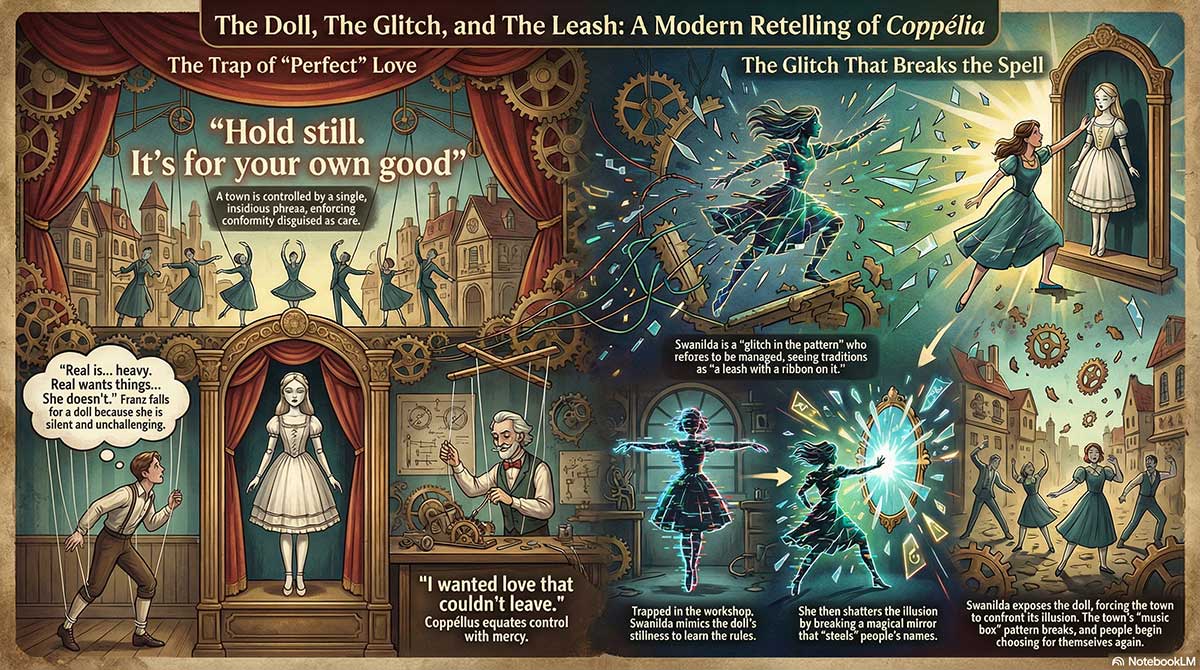
A good story doesn’t end when the door opens. It ends when the audience realizes the door was always inside them.
By the time we reach the window in Act III, the question isn’t whether Coppélia is real.
The question is: what do we do to people when we love what they can’t do?
When we praise stillness because it’s convenient. When we call obedience “maturity.” When we confuse “peace” with “no conflict,” and call that safety.
Coppélius is terrifying because he isn’t a monster—he’s a logic. He’s what happens when loneliness decides control is mercy. When the wound says, If I build love perfectly, it can’t abandon me. And the town is complicit because it’s comfortable—because patterns feel like belonging. Because the chorus line is easier than the unknown.
Franz is the most familiar tragedy: not evil, just avoidant. He wants admiration without accountability, intimacy without friction, a future that arrives without demanding he change. He doesn’t fall for the doll because she’s beautiful—he falls for her because she’s silent. Because she can hold his fantasies without ever asking for his honesty.
And Swanilda—Swanilda is the refusal that saves everyone. She doesn’t win by becoming stronger than the room. She wins by becoming truer than the room. She learns the language of the trap, then breaks it. She turns the “window that lies” into a window that exposes. She takes the town’s favorite phrase and makes it audible again—so everyone can finally hear how cruel it is.
That’s why the ending matters: not as tidy closure, but as consequence.
Because once the music box stops mid-turn, the town has to decide what it will do without the script. Some people will reach for the old gestures. Some will demand the old order. And some—quietly, awkwardly, bravely—will start moving like individuals again.
That’s the only real magic here: not the doll.
The choice.
If this play leaves you unsettled, good. That means you can still feel the leash when it tightens. That means you still recognize the difference between calm and consent. That means you can still tell when “for your own good” is love… and when it’s control wearing love’s face.
So don’t call it cute.
Call it what it is: a warning wrapped in lace.
And a door that opens—whether you’re ready or not.
Short Bios:
SWANILDA — Quick-eyed and fearless, she’s funny the way survivors are funny: to stay sharp. She can smell a lie in a smile, and she refuses to become a “good girl” just because the town prefers its women quiet. Her gift is the glitch—breaking pattern with truth, laughter, and stubborn dignity.
FRANZ — Charming, restless, addicted to being admired. He wants love without consequence, and he mistakes silence for peace. His arc is humiliation into courage: learning to look at Swanilda as a person, not a role, and learning that “real” isn’t punishment—it’s responsibility.
COPPÉLIUS — A maker with a hunger he won’t name. He builds stillness like others build altars, convinced control is mercy. He isn’t a mustache-twirling villain—he’s a man who believes love is safest when it cannot leave, and that belief makes him dangerous.
COPPÉLIA — Seen first as a perfect girl in a window, she’s the story’s living question: doll, human, or something in-between. She’s a mirror without morals, reflecting what others project—until the moment she becomes a voice, forcing the world to face what it worships.
MAYOR — Warm authority and proud guardian of tradition. He genuinely believes ritual keeps people safe, but his kindness is laced with control. He speaks the town’s favorite spell—“for your own good”—and represents how power hides inside “normal.”
CATRICE — Swanilda’s sharp, amused friend—quick with jokes, quick with insight, slower to risk open defiance. She’s the bridge between safety and awakening: the one who stops echoing the town’s lines first, and proves courage can look like loyalty to a friend.
LUKA — Kind, impressionable, and deeply shaped by the crowd’s approval. He’s not cruel; he’s teachable. Luka embodies how “good people” become obedient without noticing, and how small acts—hesitating, questioning, untying a ribbon—can start a break in the pattern.
TOWN / CHORUS — A collective character moving like a shared thought: synchronized gestures, rehearsed joy, comfort that becomes coercion. The Chorus isn’t evil; it’s familiar. It shows how a community can love you and still try to script you—until the script cracks.
Leave a Reply