

What if Thomas J. Stanley and top financial thinkers discussed why looking rich may be the fastest way to stay financially weak?
Introduction by Nick Sasaki
Welcome, everyone.
Tonight’s conversation begins with a quiet challenge: what if much of what people call wealth is only performance?
The Millionaire Next Door unsettled many readers for one reason. It did not flatter the public fantasy of success. It did not tell people that wealth is usually loud, glamorous, or easy to recognize. It pointed in the opposite direction. It suggested that the truly wealthy person is often the one nobody notices — the one living below their means, avoiding spectacle, building patiently, and refusing to turn income into identity.
That idea still carries unusual force. Most people are trained to see wealth through surfaces: the home, the car, the brands, the vacations, the image. Yet surfaces can hide fragility. A polished life may sit on debt, anxiety, and endless obligation. A modest life may sit on freedom, margin, and real independence.
So this conversation is not only about money. It is about human desire. It is about status, insecurity, discipline, parenting, comparison, enoughness, and the strange emotional pressure to appear successful before becoming secure.
Across these five subjects, we asked why people confuse income with wealth, why quiet discipline beats visible performance, what money is actually for, how families pass financial habits from one generation to the next, and whether the “millionaire next door” path can still exist in 2026.
What emerged was not a simple financial lesson. It was something deeper.
Wealth, in its healthiest form, is not a costume.
It is not applause.
It is not proof for other people.
It is stored choice. Stored time. Stored resilience. Stored dignity.
Yet there is danger on both sides. A person can waste money chasing image. A person can also become spiritually trapped by accumulation itself. A family can give comfort yet weaken character. A culture can reward display while quietly punishing prudence. A modern economy can make stability harder just as digital life makes comparison constant.
That is why this book still matters. It keeps asking a question many people try to avoid:
Do you want to look rich, or do you want to be free?
The answer shapes almost everything.
Tonight, our guests helped us examine that question from many angles — behavioral, moral, practical, psychological, and generational. And what they kept revealing is that real wealth is rarely dramatic at first. It grows in hidden choices, repeated habits, honest limits, and the courage to live without constant validation.
Perhaps that is why the millionaire next door is so easy to miss.
That person may not look exceptional.
But they may be living a life many admired people secretly do not have.
(Note: This is an imaginary conversation, a creative exploration of an idea, and not a real speech or event.)
Topic 1: Why People Look Rich Before They Become Rich

Participants: Nick Sasaki, Morgan Housel, Thorstein Veblen, Daniel Kahneman, Robert Cialdini, David Chilton
Nick Sasaki
Welcome, everyone.
Our first subject goes straight to the heart of The Millionaire Next Door: why so many people want to look wealthy long before they become wealthy — and why some never become wealthy at all.
This is one of the strangest facts in modern life. A person can have a high income, a beautiful house, a luxury car, and a polished social image, yet still be financially fragile. Another person may look ordinary, drive a used car, live in a modest neighborhood, and quietly build real independence.
So tonight I want us to stay with that tension.
Why is visible wealth so attractive? Why do smart people spend money in ways that damage their future? And why does modesty often feel harder than ambition?
Let’s begin here.
Question 1
Why do so many intelligent, hardworking people mistake high income for real wealth?
Morgan Housel
A big reason is that income is visible and wealth is hidden.
People can see the car you drove to dinner. They can see your house, your clothes, your vacations, your restaurant choices. They cannot see your investment account, your paid-off mortgage, your lack of debt, your margin of safety, or your ability to sleep well at night.
So from a very young age, most people are trained to admire what can be displayed. We learn to associate spending with success because spending is public. Wealth, in many cases, is silent.
That creates a dangerous confusion. A high-income person may feel rich because they can afford expensive things this month. But real wealth is what gives you options next year, five years from now, twenty years from now. Wealth is stored freedom. Income is just a tool that may or may not become freedom.
The tragedy is that many hardworking people never pause to ask what the income is for. If it is used mainly to buy symbols that impress others, it stops being a ladder and becomes a treadmill.
Thorstein Veblen
The answer lies in social signaling.
Human beings do not consume only for comfort. They consume to communicate rank, aspiration, distinction, and belonging. Expensive objects are rarely just objects. They are social language.
A man does not buy a particular watch simply to know the time. He buys it to announce taste, status, power, and perhaps superiority. A family does not always buy the larger house because they need the space. They buy it because the house functions as a visible badge in the hierarchy of esteem.
This means high income is often mistaken for wealth because it allows one to perform membership in a desired class. The person begins to believe the performance itself is the thing.
Once that happens, possessions stop serving life and begin serving comparison. The person becomes less interested in utility and more interested in distinction. In that world, appearing wealthy is socially rewarding at once. Becoming wealthy is slower, quieter, and far less dramatic.
Daniel Kahneman
I would add that people are poor judges of long-term consequences when immediate rewards are strong.
The pleasure of a visible purchase is immediate. The value of financial discipline is delayed and abstract. Human beings are not naturally built to choose the abstract over the vivid unless they have trained themselves to do so.
A person may know, intellectually, that saving and investing are wiser than overspending. Yet the mind gives extra weight to what is emotionally vivid now: the excitement of the purchase, the admiration of others, the feeling of having “made it,” the relief of no longer feeling inferior.
There is another issue. People adapt very quickly. What once felt luxurious soon feels normal. Then they require a new symbol, a bigger one, or a more exclusive one, just to preserve the same emotional effect. This is one reason high income does so little by itself. It can fuel an endless cycle of adaptation.
So the intelligent person is not protected merely by intelligence. In some cases, intelligence helps people rationalize destructive behavior more elegantly.
Robert Cialdini
Yes, and much of that behavior is reinforced by the social environment.
People constantly look to others for signals about what is normal, admirable, and expected. If everyone around you upgrades the car, renovates the kitchen, posts vacation photos, and speaks as if these things are standard markers of adult success, then resisting them can feel like stepping outside the group.
That social pull is stronger than people admit. They believe they are making free individual choices, yet many of those choices are shaped by subtle pressures: imitation, aspiration, fear of falling behind, fear of seeming unsuccessful, desire for approval.
What is powerful here is that the group does not need to explicitly command anything. It only needs to display a norm. Once the norm is visible, people begin adjusting themselves voluntarily.
So high income becomes dangerous in such an environment. It gives a person the means to conform to the norm of visible success. And since conformity often brings approval, the spending feels justified, even when it is quietly destructive.
David Chilton
I think part of the answer is much simpler too: many people never learned the difference between cash flow and net worth.
They think, “I earn a lot, so I’m doing well.” But earning a lot and keeping a lot are two different skills. A lot of households master the first and completely miss the second.
Real wealth usually looks boring in the beginning. It looks like driving the car longer. It looks like a smaller mortgage. It looks like saying no. It looks like avoiding debt. It looks like regular investing when nobody is applauding you.
That’s not the story most people were sold. Most people were sold a story that success should feel visible. So when their income rises, their lifestyle rises with it, and they call that progress.
But if the whole raise goes into image, then the appearance improves and the foundation does not. That is why a family can look prosperous and still be trapped.
Nick Sasaki
So what I’m hearing is that people do not simply confuse income with wealth by accident. They confuse them because public life rewards appearances, because the mind loves immediate rewards, and because the crowd quietly teaches us that success must be visible.
That brings us to the next layer.
Question 2
What makes visible success so emotionally seductive, even when it quietly destroys long-term security?
Robert Cialdini
Visible success is seductive because it delivers social proof.
When people receive signs that others admire, notice, or envy them, that response acts almost like reinforcement. It tells them, “This works. This gets attention. This earns standing.” The more public the symbol, the more powerful the reinforcement can become.
There is also the issue of identity. A visible marker of success lets a person communicate who they want to be without having to explain themselves. The expensive car says something before they speak. The neighborhood says something. The brand says something. In many cases, these objects act like shortcuts to esteem.
That is emotionally powerful because human beings want acceptance and significance. They want to feel that they matter. If visible success seems to provide that feeling, then people may defend it far beyond reason.
The danger is that the approval is often temporary, shallow, and unstable. But the debt, stress, and lost opportunity are real.
Daniel Kahneman
The seduction is strengthened by a cognitive error: people overvalue what is easy to imagine and undervalue what is difficult to picture.
You can easily imagine how it feels to arrive somewhere in a beautiful car. You can imagine the compliments, the self-image, the private thrill. It is much harder to imagine the value of a future balance sheet, or the emotional benefit of optionality ten years later.
The mind is not naturally loyal to distant abstractions. It is loyal to emotionally vivid pictures.
There is another factor: status threats are emotionally painful. When people feel behind, excluded, or lesser, they are often willing to make irrational choices to relieve that discomfort. A visible purchase can function like pain relief. It may not solve the underlying problem, but it soothes the feeling for a time.
This is why long-term security loses so often. Security is quiet. Relief is immediate.
Thorstein Veblen
Visible success is seductive because it converts wealth into theater.
Human beings are deeply sensitive to social position. In societies where rank is less formally declared, consumption becomes one of the chief ways rank is displayed. Goods become symbols in a public drama of worth.
The emotional force of this should not be underestimated. To be seen as successful is to occupy a desirable place in the social imagination. To appear unsuccessful is to risk humiliation, disregard, or invisibility.
So consumption becomes ceremonial. It is not merely personal pleasure. It is presentation. And the presentation carries emotional intensity because status is tied to dignity in the minds of many people.
That is why visible success can destroy long-term security without losing its attraction. Its social reward is immediate, theatrical, and legible. Quiet prudence has no audience.
Morgan Housel
I think there’s a painful emotional truth here: a lot of spending is not about greed. It’s about insecurity.
People are trying to feel safe in the eyes of others. They’re trying to feel respected. They’re trying to feel like their hard work means something. They’re trying to close the gap between who they are and who they fear they look like.
Money is one of the fastest ways to create an external image, so it becomes tempting to use it for emotional repair.
But the problem is that money is very good at buying symbols and very bad at curing insecurity. If insecurity is the engine, then each new purchase is only temporary relief. Soon the feeling returns, and the cycle repeats.
That is why some of the most impressive-looking people are under the greatest strain. Their lifestyle is not an expression of peace. It is often an attempt to outrun shame, comparison, or fear.
David Chilton
And sometimes people simply do not count the true cost.
They see the monthly payment, not the years attached to it. They see the excitement, not the pressure. They see what the purchase says about them today, not what it takes away from them tomorrow.
What visible success hides is the loss of flexibility. Once you lock yourself into the bigger house, the bigger bills, the bigger expectations, your future choices shrink. You need the paycheck more. You need the bonus more. You need things to keep going well.
That can look like success from the outside, but inside it often feels like fragility. You have built a life that must keep being financed at a high level, and that is a very different thing from freedom.
Nick Sasaki
That word matters: fragility.
A lifestyle can look strong and still be fragile. A household can look polished and still be one shock away from panic. So let’s go to the deepest part of the question.
Question 3
At what point does the performance of wealth become a trap that a person can no longer easily escape?
Morgan Housel
It becomes a trap when your fixed lifestyle starts dictating your values.
At first, the spending feels optional. Then it becomes normal. Then it becomes expected. Then it becomes part of your identity. Once that happens, cutting back no longer feels like a financial adjustment. It feels like humiliation, like loss, like personal failure.
That’s when people get stuck. They do not fear poverty as much as they fear visible downward movement. They fear the social meaning of stepping back.
So they hold on. They keep the payments. They keep the image. They keep the pressure. And over time they become servants to a version of themselves they created to impress other people.
The saddest part is that many of them are chasing the image of freedom while losing the substance of it.
David Chilton
I’d say the trap closes the moment a family cannot tell the truth about its own situation.
If two spouses can no longer say, “We bought too much house,” or “We can’t afford this pattern,” or “We’re doing this for appearances,” then the problem has moved from finance into denial.
When spending becomes tied to pride, honesty becomes hard. People start protecting the image instead of protecting the household.
Another sign is when a raise no longer improves your future because it has already been assigned to a bigger lifestyle. At that point income growth stops creating wealth and starts feeding maintenance.
That is a trap. You’re working harder and earning more, yet your room to breathe does not expand.
Daniel Kahneman
The trap also deepens when losses become psychologically unacceptable.
Once people have adapted to a lifestyle, giving it up is experienced not as returning to neutral, but as suffering a loss. And losses weigh more heavily than gains. This asymmetry makes retreat emotionally difficult.
So a person persists in a damaging pattern because scaling down feels too painful. They may know the numbers. They may know the risk. Yet the thought of surrendering the symbols is experienced as defeat.
This is one reason bad financial situations can continue for many years. Rational calculation is not enough. The person is defending identity, pride, social position, and their own prior choices.
In such cases, intelligence may serve the trap. The person uses it to justify, delay, reinterpret, and protect the very pattern that harms them.
Robert Cialdini
I would add commitment and consistency.
Once people publicly signal a certain status, they feel pressure to remain consistent with that signal. Friends know where they live. Colleagues know what they drive. Family members become accustomed to a certain standard. Children grow up assuming certain things are normal.
At that point the social cost of change rises. The person fears judgment, questions, pity, or the appearance of having fallen.
That is why outward success can harden into a prison. The symbols were supposed to communicate autonomy and achievement, yet they bind the person to the expectations of others.
The stronger the public commitment, the harder it becomes to reverse course.
Thorstein Veblen
Yes. The trap is complete when the person no longer possesses goods, but is possessed by them.
The house must be maintained for its social meaning. The wardrobe must be maintained. The rituals of expenditure must continue. Consumption ceases to be a choice and becomes a duty in the preservation of status.
In that condition, the individual is no longer pursuing comfort or even pleasure. He is maintaining position.
And position is insatiable, for it depends on comparison. One cannot rest in it. One must keep defending it. Thus the performance of wealth becomes endless labor.
What seemed like ascent turns out to be dependence.
Nick Sasaki
That may be the most haunting line of the night: what seemed like ascent turns out to be dependence.
Maybe that is the secret wound behind this whole subject. People think they are buying proof that they have arrived, but what they may really be buying is a life that cannot easily slow down, tell the truth, or step back.
And maybe this is why The Millionaire Next Door still stings. It does not merely say, “Save more.” It says something far more uncomfortable:
A person can look successful and still be financially weak.
A person can look ordinary and still be quietly powerful.
And very often, the crowd admires the wrong one.
So perhaps the real question is not, “How do I look wealthy?”
It is, “What kind of life would let me stop needing to?”
Topic 2: The Quiet Discipline Behind Real Wealth

Participants: Nick Sasaki, Sarah Stanley Fallaw, Thomas C. Corley, Benjamin Franklin, Thomas J. Stanley, William D. Danko
Nick Sasaki
For our second subject, I want to move from the illusion of wealth to the habits that quietly build it.
One reason The Millionaire Next Door struck so many readers is that it challenged a fantasy. Many people assume wealth is created by brilliance, luck, glamour, or a dramatic leap. Yet the book points again and again to something far less exciting on the surface: restraint, planning, consistency, patience, and daily financial discipline.
That can sound almost too plain. Yet maybe that is the point. Real wealth often grows in places that are easy to ignore because they do not entertain the ego.
So tonight I want us to look closely at that quiet discipline.
Why do small habits matter so much? What kind of person is being formed through frugality and self-control? And why do these modest choices beat so many dramatic efforts over time?
Let’s begin there.
Question 1
Why does frugality look small in public yet become so powerful over a lifetime?
Thomas J. Stanley
Frugality looks small in public because the public measures display, not retained capital.
A person who spends modestly is rarely admired at the moment of restraint. Nobody applauds the family that chooses the practical car, the reasonable home, or the unremarkable neighborhood. Those choices do not create immediate prestige. Yet they create something much more important: surplus capital.
That surplus becomes seed. It can be invested, protected, compounded, and converted into independence. Over decades, that matters far more than the temporary admiration that comes from spending.
This is one of the great misunderstandings in American consumer life. People think frugality is merely subtraction. In truth, it is strategic redirection. Money not consumed is money still able to work for the household.
That is why frugality becomes powerful over a lifetime. It is not one heroic act. It is a repeated refusal to weaken one’s future for the sake of one’s image.
Sarah Stanley Fallaw
I would put it this way: frugality is often invisible because its benefits arrive quietly.
You do not always feel the full value of a restrained choice that day or that month. Yet ten years later, that same choice may be the reason you have flexibility, lower stress, stronger savings, fewer obligations, and more freedom to make decisions based on values instead of panic.
In our research, many financially successful households were not trying to appear exceptional. They were trying to align their spending with their priorities. That is a very different orientation. It means the money is serving the family’s long-term purpose, not the family’s public presentation.
Frugality can look small only if you judge it from the outside. From inside a life, it can feel like stability, calm, agency, and room to breathe.
That is not a small thing.
Thomas C. Corley
One reason it becomes so powerful is that frugality tends to travel with other success habits.
People who are careful with spending often become careful with time, careful with planning, careful with goals, careful with risk. They tend to think in terms of patterns instead of impulses. That habit structure matters.
What looks like one small money decision is often part of a whole way of living. The person is practicing delayed gratification. The person is resisting social pressure. The person is thinking ahead. The person is building control.
Over many years, that compounds just as investments compound. A disciplined habit in one part of life often strengthens discipline in other parts.
So frugality is not just about dollars saved. It is often evidence of a broader personal order that makes wealth-building more likely.
Benjamin Franklin
A penny spared is a servant kept.
Men often laugh at thrift, for thrift makes little noise. Vanity rides in a carriage. Prudence walks. Yet the foot traveler may arrive where the carriage rider never reaches, if the rider spends all his substance on the road.
Small leaks sink great ships. Small savings preserve households. The world is full of people who think only large acts deserve notice. Yet fortunes are often made, or lost, in habits so common that few trouble themselves to observe them.
He that would have lasting comfort must learn to distinguish pride from use. Many things are purchased not from need, nor from true delight, but from a restless wish to be seen in a certain light. That wish is expensive.
Thrift is humble at noon and mighty at sunset.
William D. Danko
I think there is a human dimension here that matters very much. Frugality gives a person a greater chance of living from choice rather than from obligation.
When spending rises too quickly, the household often loses this. It becomes tied to a level of income that must be maintained. Fear enters the picture. Dependence enters the picture. The appearance may improve, yet the inner freedom can shrink.
Frugality helps preserve autonomy. That autonomy is deeply connected to well-being. A household with manageable needs and thoughtful spending often has more emotional resilience when life changes. Job loss, illness, market shifts, family pressure — all of these hit differently when the structure of life is lighter.
So the power of frugality is not only mathematical. It is existential. It protects a person’s ability to respond to life without immediate collapse.
Nick Sasaki
That is such an important shift. Frugality is not just “less spending.” It is stored strength. It is capital, flexibility, and even dignity protected in advance.
That takes us deeper.
Question 2
What kind of character is formed when a person keeps choosing restraint over image?
Sarah Stanley Fallaw
A person who chooses restraint over image is often forming a quieter kind of confidence.
They are learning to live without constant public confirmation. They are learning that worth does not have to be displayed to be real. That matters more than it first appears, since much consumer behavior is tied to a hunger for validation.
Restraint can train a person to become less reactive to comparison. That is a powerful moral and psychological development. It means the person is not as easily pulled by trends, pressure, envy, or fear of being judged.
In healthy form, this does not make someone joyless or rigid. It gives them clarity. They become more able to say, “This matters to us; this does not.” That is a form of maturity.
One of the hidden gifts of disciplined spending is that it can reduce the need to perform identity through possessions.
Benjamin Franklin
He that governs his purse often learns to govern himself.
To deny an appetite when it is lawful yet unwise strengthens judgment. To prefer future peace above present show strengthens prudence. To endure the sight of another’s splendor without discontent strengthens temperance.
These are not mean virtues. They are liberating ones. The man who must always be admired is a servant. The man who can be plain without shame is nearer to freedom.
Character is not built by grand declarations. It is built in repeated choices, made when nobody cheers. If a person practices honest restraint long enough, he may come to love usefulness more than appearance, and substance more than applause.
That is no small education.
Thomas C. Corley
I found in habit research that many self-made wealthy people built routines that protected them from emotional decision-making. That shapes character in direct ways.
A person who lives by a plan becomes less likely to swing between excitement and regret. A person who tracks spending becomes more honest with themselves. A person who saves first learns not to trust every urge that arrives dressed as a need.
That does not just build wealth. It builds reliability. It builds steadiness. It builds the ability to finish what matters without getting distracted by social temptation.
You begin to see that discipline is not punishment. It is training. The person is becoming someone who can make long-range choices without being constantly derailed by short-range emotion.
That is why restraint matters. It is a money habit, yes, though it is equally a life habit.
Thomas J. Stanley
Many prodigious accumulators of wealth were not flashy people at all. They were measured, organized, intentional, and resistant to lifestyle inflation. Their habits reflected a certain discipline of self-definition.
They did not ask, “What will others think if I do not upgrade?” They asked, “Will this purchase strengthen or weaken our long-term position?” That is a very different internal dialogue.
Character is revealed in what one normalizes. If a person normalizes restraint, planning, and moderate consumption, they create a life structure that favors financial independence. If they normalize indulgence and visible status, they often create dependence.
The deeper issue is not frugality alone. It is the ability to subordinate impulse to purpose. That is a major difference between households that accumulate wealth and households that merely consume income.
William D. Danko
I would add contentment.
Restraint, when rooted in wisdom rather than fear, can help a person develop a saner relationship with enough. They stop living as if peace always sits one purchase ahead. They stop imagining that identity must be upgraded in order to be secure.
That kind of contentment does not mean passivity. It means proportion. It means the person can enjoy what they have without being chronically tormented by what they do not display.
I think this matters for the good life. Wealth-building without contentment can become its own trap. Yet restraint joined to gratitude and purpose can create a much healthier human life.
So the character being formed is not just disciplined. It is less restless. Less performative. Less enslaved to social comparison.
Nick Sasaki
That may be one of the hidden treasures in this whole book: the right money habits do not just change your bank account. They change the kind of self you become.
Which brings us to the practical question people often resist.
Question 3
Why do boring habits like budgeting, saving, and steady investing so often beat exciting financial moves?
Thomas C. Corley
They win because consistency beats intensity when the goal is long-term accumulation.
Exciting financial moves appeal to the imagination. They promise acceleration, breakthrough, shortcut, exceptional return. Boring habits appeal to discipline. They promise repetition. Human beings are drawn to the dramatic one.
Yet wealth is usually built by behaviors that can be sustained. Budgeting works because it creates awareness. Saving works because it creates surplus. Steady investing works because it keeps capital working over time without demanding brilliance from the investor.
The exciting move often depends on timing, emotion, or luck. The boring habit depends on repetition. Repetition is less glamorous, though far more dependable.
That is why ordinary systems often defeat extraordinary impulses.
Thomas J. Stanley
In our work, we found that many wealthy households did not rely on financial genius. They relied on habits that created margin and allowed capital to accumulate. The discipline came first. Investment success often followed from the existence of investable capital, not from speculation.
You cannot steadily build wealth if you consume nearly all income. Budgeting and savings are not side issues. They are the foundation. Without them, the household rarely gains enough productive capital for investing to matter meaningfully.
People want exciting moves because they wish to bypass restraint. That is the real temptation. The shortcut is attractive because the ordinary path feels too plain.
Yet the ordinary path is ordinary only from the outside. In truth, it is one of the rarest things in modern culture: a sustained pattern of prudent behavior.
Benjamin Franklin
The slow mill grinds exceeding fine.
A field tilled season by season feeds the family more surely than the gambler’s throw. Men love wonders, yet households are supported by regularity. If one spends less than he earns, keeps account, avoids foolish debts, and lets his savings gather fruit, he may in time possess ease without ever having astonished the street.
Exciting schemes flatter pride. They whisper that a man may be clever enough to outrun patience. This is pleasant to hear and costly to believe.
Habit is a quieter craftsman. It builds its house one day at a time, and when storms come, that house is often still standing.
Sarah Stanley Fallaw
There is another reason these habits win: they are teachable, repeatable, and less dependent on exceptional conditions.
Budgeting does not require genius. Saving does not require celebrity insight. Steady investing does not require a dazzling personality. These habits can be practiced by ordinary households over long periods, and that makes them powerful in a democratic sense.
That matters to me. The message of this book was never that wealth is reserved for people with spectacular gifts. It was that many people undermine their own capacity by neglecting disciplined basics.
The boring habit is often more humane than the exciting move. It does not demand perfection. It asks for consistency. It leaves room for an ordinary person to make progress without having to become a hero.
That is one reason the message still matters.
William D. Danko
I think steady habits beat exciting moves because the goal is not excitement. The goal is durable well-being.
A person can have thrilling financial moments and still remain unstable. A person can have very little drama and slowly build a life of resilience, lower anxiety, and real choice. If the destination is peace, then drama is often overrated.
Steady habits create a structure in which prosperity can grow with less turbulence. They allow a person to build a financial life that is less dependent on mood, trend, ego, or panic. That supports more than net worth. It supports a wiser relationship to life itself.
Perhaps the deepest truth is this: the habits seem boring only to the part of us that still craves spectacle. To the part that wants freedom, they are beautiful.
Nick Sasaki
That lands exactly where it should.
Maybe boring habits win because they are not trying to entertain us. They are trying to protect us. They are building a life in which money is less chaotic, less emotional, less performative, and more useful.
And maybe that is the challenge The Millionaire Next Door keeps placing in front of us.
Will we keep admiring the dramatic image of wealth?
Or will we learn to respect the quiet systems that create it?
Will we chase financial excitement?
Or will we become the kind of people who can live by steady principles long enough for freedom to grow?
The strange thing is that discipline looks small at the beginning. Yet over time it may be one of the largest forces in a human life.
And perhaps that is why the truly wealthy so often look ordinary from the outside. Their real achievement is not theatrical. It is cumulative. It is hidden. It is patient. It is built where almost nobody is looking.
Topic 3: What Money Is Really For

Participants: Nick Sasaki, Vicki Robin, Seneca, Arthur C. Brooks, Ramit Sethi, William Bernstein
Nick Sasaki
For our third subject, I want to move into a deeper and more uncomfortable place.
By the time people begin thinking seriously about money, many have already absorbed a silent assumption: that money exists to increase comfort, display success, remove pain, and prove that one’s life is going well. Yet The Millionaire Next Door keeps pointing us somewhere more demanding than that. It asks whether money is for consumption at all — or whether its deepest purpose is freedom, stability, dignity, and peace.
This matters, since a person can build wealth and still remain inwardly poor. A person can save, invest, and accumulate, yet still be ruled by fear, comparison, greed, or restlessness. In that case, money has been gathered, but its meaning has not been understood.
So tonight I want us to ask a harder set of questions.
What is wealth actually for? When does “more” stop serving life and start replacing it? And how does a person know when they have crossed the line between building security and worshipping accumulation?
Let’s begin there.
Question 1
Is the goal of wealth comfort, freedom, dignity, peace, or something deeper?
Vicki Robin
I would begin by saying that money is stored life energy.
When you earn money, you are trading hours of your life, your attention, your labor, your body, your stress, your gifts, your presence, for a unit of exchange. That changes the moral weight of the whole conversation. The question is no longer, “How much can I buy?” It becomes, “What is worthy of my life energy?”
Once you see money that way, the goal shifts. Comfort matters. Safety matters. Yet the deeper goal is alignment. Money should help a person live with greater integrity, less fear, less dependence on work that empties them, and more space to serve what truly matters.
So yes, wealth can support comfort. Yet if that is all it does, it is still being used too narrowly. Its truest value may be that it gives a person more authority over their own time and conscience.
The deepest form of wealth is having enough life back.
Seneca
He is poor, not who has little, but who desires more.
Comfort is pleasant. Peace is noble. Freedom is precious. Yet none of these can be secured by money alone, since the mind that is ruled by appetite will carry its chains into every house, whether grand or plain.
Many men imagine wealth will end their unrest. They gather possessions, enlarge estates, multiply luxuries, and still remain uneasy. Why? Their poverty was not in their purse. It was in their desire. They had trained themselves to depend upon what fortune can remove.
Money is best used as a support, not a master. It may soften certain hardships, protect a household, grant leisure for study, friendship, and reflection. Yet if a man cannot be content with little, he will not be at peace with much.
Thus I would say the goal is not comfort alone, nor even freedom in the common sense, but inner sufficiency. Without that, wealth only decorates anxiety.
Arthur C. Brooks
What stands out to me is that many people want money for emotional reasons they do not name clearly.
They say they want wealth, though what they often want is relief from fear, relief from humiliation, relief from dependence, relief from uncertainty. That makes the goal hard to reach, since money can solve some practical problems, though it cannot settle every emotional wound attached to those problems.
I think money is at its best when it serves higher goods. It can protect family life. It can create margin. It can lower chronic stress. It can open time for vocation, friendship, faith, service, learning, and love. In that sense, wealth is useful. It can help create the conditions for flourishing.
But once wealth becomes the object rather than the instrument, the person often grows more restless, not less. They keep trying to get from money what money cannot give.
So I would say the goal is not wealth by itself. The goal is a life of meaning, love, usefulness, and peace in which money plays a supporting role.
Ramit Sethi
I like pushing people to get specific here, since vague ideas about money create vague lives.
A lot of people say they want freedom, though they have never defined what that means. Freedom to do what? Freedom from what? Freedom with whom? If you do not answer that, money becomes this giant abstract scoreboard, and you spend years chasing a number without knowing why.
For me, money should help you live a rich life — and I mean rich in your own terms, not someone else’s. Maybe that means traveling with family, supporting your parents, having a beautiful home you truly love, working less, starting a business, giving generously, or buying back your time.
Comfort is fine. Nice things are fine. The issue is mindless spending and borrowed definitions. If you spend intentionally on what you love and cut mercilessly on what you do not care about, then money serves life instead of hijacking it.
The deeper purpose of wealth is choice. Yet choice only matters if you know what kind of life you would actually choose.
William Bernstein
From a practical standpoint, wealth is best understood as a buffer between you and catastrophe, and then, beyond that, as a source of independence.
Before anything else, money protects against fragility. Illness, recession, market collapse, job loss, aging, bad luck — these are not theoretical matters. A household without reserves is exposed. That exposure shapes the whole emotional atmosphere of life.
Once a person has adequate protection, wealth begins to offer a second gift: reduced compulsion. You are less forced to tolerate abusive work, less forced to make desperate decisions, less forced to place your entire life at the mercy of a monthly paycheck.
That said, there is a great danger in endless escalation. Financial assets can keep growing long after they have ceased to increase security in any meaningful sense. Then accumulation becomes habit or vanity rather than necessity.
So I would say the goal begins with protection, matures into independence, and should ideally end in a kind of calm sufficiency.
Nick Sasaki
So money, at its best, seems to move through stages: protection, freedom, alignment, and perhaps even inner sufficiency. Yet human beings are rarely content to stop there.
That leads us to the next question.
Question 2
When does the pursuit of more stop serving life and start replacing it?
Arthur C. Brooks
It starts replacing life when the person can no longer answer a simple question: “What is this for?”
At first, ambition can be noble. A person wants to provide, to escape fear, to create options, to help loved ones, to build something stable. Yet after a certain point, ambition often detaches from those real goods and becomes self-referential. The person is no longer earning for a purpose. They are earning to preserve an identity.
This is where wealth becomes spiritually dangerous. It can give the illusion of forward movement without any examination of whether the movement still leads somewhere worth going. A person’s schedule fills, their numbers rise, their commitments expand, and yet their relationships, stillness, gratitude, and joy thin out.
That is a tragic trade, and many do not see it in time. The pursuit of more begins by serving life, then quietly asks life to serve it.
Vicki Robin
I think the turning point comes when enough is never examined.
If a person has no clear sense of enough, then more becomes infinite. There is always a higher tier, a larger cushion, a more impressive peer group, a more luxurious version of comfort, a later date when life will finally begin. Without enough, money becomes a bottomless psychological project.
That project is exhausting. A person can spend decades postponing presence. They tell themselves they are being responsible, and perhaps part of that is true. Yet another part may be avoidance. They are delaying the direct encounter with life as it already is.
When the pursuit of more crowds out time, attention, health, intimacy, and wonder, it has begun replacing life. It has moved from being a means of living into a reason for postponing it.
Seneca
The pursuit of more replaces life when possession possesses the possessor.
At first, the man gathers wealth. Soon wealth gathers his thoughts. He rises with it in mind, sleeps with it in mind, judges himself by it, fears loss of it, envies those with more of it, and neglects the goods of the soul for the goods of display or security beyond measure.
It is not abundance itself that corrupts him. It is bondage to abundance. He has ceased to use fortune and begun to serve it.
A wise man may possess much and still remain free, provided he can lose it without losing himself. Yet most men do not test themselves in this way. They call attachment prudence and appetite necessity.
Thus the line is crossed when “more” ceases to be occasional and becomes identity.
William Bernstein
From a financial angle, the problem often becomes visible when risk-taking or labor intensity no longer matches genuine need.
A household that is adequately funded may still behave as if ruin sits right outside the door. A person with enough reserves may still overwork, overtrade, over-accumulate, and overexpose themselves to stress. This is often treated as admirable drive. Sometimes it is unresolved fear wearing the mask of discipline.
There is a sane respect for uncertainty. Then there is compulsive insulation against every conceivable discomfort. The latter can consume a life just as surely as reckless spending can.
The irony is sharp: people who once sought wealth to escape anxiety may later keep pursuing wealth as a ritual of anxiety.
Ramit Sethi
I see this happen when people become curators of a financial fantasy instead of active participants in their own life.
They optimize every spreadsheet, every return, every tiny decision, yet they never actually use money to create joy, connection, beauty, generosity, fun, rest, or meaning. They become efficient, though not alive.
There is another version too: someone who already has plenty keeps chasing more because they do not know who they are without the chase. Work becomes their source of identity. Growth becomes a substitute for self-knowledge.
For me, the pursuit of more stops serving life when you can no longer spend, save, or work from a conscious point of view. You are just running the script. You are successful on paper and absent in your own life.
Nick Sasaki
That is such a piercing thought: a person can be highly competent with money and still remain absent from their own life.
So now we have to ask the sharpest question of all.
Question 3
How does a person know the difference between building wealth and worshipping wealth?
Seneca
He may know it by testing his dependence.
Can he endure simplicity without shame? Can he hear of another man’s gain without envy? Can he lose some portion of what he has without feeling that his worth has been diminished? Can he rest, or is he driven without cease?
Worship reveals itself in fear and in attachment. The worshipper does not merely use wealth. He kneels before it inwardly. He trusts it to save what it cannot save. He turns to it for identity, immortality, applause, and consolation against mortality itself.
The man who builds wealth wisely keeps it in its proper place. He knows its use, and he knows its limits.
Vicki Robin
I would ask: does money create more aliveness, or more contraction?
When you are building wealth in a healthy way, there is often more clarity, more agency, more congruence, more honesty, more capacity to live by your values. When you are worshipping wealth, there is often tightening: tightening of fear, of comparison, of secrecy, of postponement, of self-worth tied to numbers.
Another test is whether money can ever say “enough” inside you. If every financial milestone only moves the finish line, then the issue is no longer planning. It is hunger.
A good financial life should return you to life itself. If it keeps pulling you away from direct living, then something sacred has been misplaced.
William Bernstein
In practical terms, one useful test is whether the financial structure serves clearly named human goals.
If the purpose of saving and investing is understandable — retirement security, family protection, philanthropy, time autonomy, resilience — then the process remains grounded. But when accumulation continues with no articulated endpoint and no change in life pattern, then one should begin asking harder questions.
Another test is behavior under uncertainty. A healthy builder of wealth respects risk and acts with discipline. A worshipper may either panic excessively at normal volatility or pursue excess returns compulsively, as though no amount is ever sufficient.
It is entirely possible to be prudent without being obsessed. That distinction matters.
Arthur C. Brooks
I would look for signs in relationships and in joy.
If wealth-building leaves a person more generous, more peaceful, more able to love, more available to others, then money is likely serving its proper place. If it leaves them more guarded, more self-protective, more status-conscious, more lonely, more unable to rest, then it may have become an idol.
What we worship eventually reorganizes our heart. So the evidence appears in who we are becoming.
That is the difficult truth. Money is rarely just about math. It is a moral mirror. It reveals what we fear, what we trust, what we believe will save us, and what we think makes a life worthwhile.
Ramit Sethi
I’d make it very concrete.
Are you clear on your numbers? Good. Are you spending well on what you love? Are you using money to support the life you say you want? Are you generous where you want to be generous? Can you enjoy what you’ve built without guilt or obsession? Can you stop working for a day, a week, a month, and still know who you are?
If the answer is no, then your money system may be running you.
I’m all for building wealth. I love systems, investing, planning, automation. Yet the whole point is to help you live more fully. If you die with a giant portfolio and a tiny life, something went wrong.
Nick Sasaki
That may be the deepest warning hidden inside this subject.
A person can escape one financial error only to fall into another. They can reject waste and still become trapped by hoarding. They can stop performing wealth and still begin bowing to it inwardly. They can become disciplined without becoming free.
So perhaps the real question is not simply how to build wealth, but how to keep wealth from becoming sacred.
Maybe money is for protection.
Maybe it is for freedom.
Maybe it is for dignity.
Maybe it is for buying back time, reducing fear, supporting family, and making room for a meaningful life.
But the moment money stops serving those ends and starts demanding that life bend around it, something essential has been reversed.
And maybe that is where this whole conversation meets its sharpest truth:
The richest life is not the one with the most accumulation.
It is the one in which money has been put in its rightful place — important, useful, respected, but never enthroned.
Topic 4: Family, Children, and the Inheritance of Money Habits

Participants: Nick Sasaki, David Owen, Amy Chua, Angela Duckworth, Carol Dweck, George S. Clason
Nick Sasaki
For our fourth subject, I want to move into one of the most sensitive parts of The Millionaire Next Door.
Money habits are rarely created in isolation. They are passed along through family tone, parental fear, class anxiety, reward systems, silent expectations, and the emotional atmosphere of the home. Long before a child understands investing, taxes, debt, or net worth, they are already learning what money means. They are learning whether money is safety, status, love, power, reward, control, or something never openly discussed yet deeply felt.
That is why family money patterns matter so much. A household can give a child advantages and still leave them fragile. A household can offer comfort and still quietly train dependence, comparison, and entitlement. Another household may provide far less outward abundance and yet pass down self-command, patience, and groundedness.
So tonight I want us to examine that inheritance.
How do parents accidentally train children to consume and compare? Why can too much financial help weaken a child’s ambition? And what kind of family culture produces adults who are capable, steady, and inwardly free rather than permanently performative?
Let’s begin there.
Question 1
How do parents accidentally train children to consume, compare, and expect rescue?
David Owen
A lot of it happens through modeling rather than instruction.
Children watch far more than they listen. They notice what excites their parents, what embarrasses them, what they complain about, what kind of people they admire, what purchases change the mood in the home, what brands seem to matter, what neighborhoods are spoken of with longing or contempt. A child absorbs all of that before anyone ever sits down to give a money lesson.
So a parent may say, “Be responsible,” yet the emotional curriculum may be saying something else entirely. It may be saying, “What matters is how we look,” or “success must be visible,” or “being ordinary is failure,” or “if life feels painful, we buy relief.”
That is how consumption gets inherited. It is rarely handed down as a direct philosophy. It is woven into ordinary family life until it becomes normal.
The expectation of rescue often grows the same way. If every discomfort is softened too quickly, if every mistake is financially padded, if every delay is treated as unacceptable, the child begins to assume that life should be continuously buffered by someone else’s resources.
Amy Chua
Parents can unintentionally create this by confusing love with provision.
Many parents want to spare children struggle. That instinct is understandable. Yet when protection becomes excessive, the child may internalize a distorted message: that difficulty is abnormal, that effort should quickly produce reward, and that family wealth exists to preserve ease rather than to support maturity.
Comparison enters when parents are overly attuned to rank. Some families may not explicitly worship status, yet children can still feel it in the air. They learn which colleges carry prestige, which careers bring honor, which neighborhoods “count,” which possessions signal belonging. Once that mentality is absorbed, consumption becomes tied to identity and worth.
A child raised this way may become highly driven, though still deeply dependent on external markers. That person may look accomplished and still remain inwardly captive to comparison.
That is one of the hidden dangers of affluent families. They can pass down not only resources, but also pressure and fear.
Angela Duckworth
I think one of the key mistakes is over-intervening in moments that could have built effort.
When a child feels frustration, embarrassment, delay, or disappointment, those moments can become training grounds for persistence. But if parents rush in too quickly to smooth the path, then the child is denied repeated contact with effort that matters.
Money can make this easier for families to do. They can hire help, replace mistakes, cover consequences, create convenience, and reduce friction. There is nothing automatically wrong with that. The problem comes when the child rarely experiences the connection between struggle and growth.
Then expectation shifts. The child may begin to assume that discomfort should be removed rather than worked through. That mindset can affect academics, work, relationships, and financial life.
What gets weakened is not just toughness. It is the sense that one can meet reality directly.
Carol Dweck
I would add that rescue can shape identity, not just behavior.
If children are consistently protected from failure, they may begin to infer that failure is something catastrophic, something that threatens who they are rather than something that teaches them. That creates fragility. The child becomes more invested in looking capable than in becoming capable.
Money can deepen this problem when it is used to preserve image. A family may solve practical problems for a child over and over, but the hidden lesson may be, “You must not fall behind,” or “You must not look unsuccessful,” or “our role is to keep visible weakness from touching you.”
That can produce adults who are highly avoidant. They may chase status, overconsume, hide mistakes, or fear ordinary setbacks, since they were not trained to see challenge as part of development.
In that sense, expectation of rescue is often an expectation of identity protection.
George S. Clason
The child who never learns to carry a burden cannot know the strength of his own back.
Gold that comes too easily is often spent too lightly. Comfort that is never questioned becomes appetite. Rescue given without wisdom may feel like kindness in the moment, though it can quietly rob a young person of thrift, caution, gratitude, and resourcefulness.
A household must teach that wealth is a servant to be directed, not a fountain to be presumed upon. If children see only the outflow and never the discipline behind it, they will honor consumption more than stewardship.
The beginning of wisdom in money is not abundance. It is respect.
Nick Sasaki
That is such an important distinction: children do not merely inherit money. They inherit emotional assumptions about money, struggle, worth, and what kind of life they should expect.
Now let’s move deeper into the tension.
Question 2
Why can financial overhelp weaken ambition, resilience, and self-respect?
Angela Duckworth
Because effort means more when it is necessary.
A child or young adult who knows that someone else will always absorb the consequences may still work hard in selected areas, though the inner structure is different. There is less direct contact between action and outcome. And that contact is one of the great teachers of grit.
Ambition grows stronger when a person feels that their actions matter, that persistence changes reality, that discipline has consequences, that one’s future is not entirely padded by another person’s intervention. Overhelp can blur all of that. It can make the world feel softer in the short run and the self feel weaker in the long run.
Resilience is not built by hearing encouraging slogans. It is built by surviving manageable difficulty and discovering, “I can handle this.”
Without those experiences, confidence may look polished but remain thin.
Carol Dweck
Self-respect depends heavily on earned experience.
When people know they have done hard things, faced uncertainty, recovered from setbacks, and built something through effort, they develop a deeper and more stable confidence. It is less dependent on applause. It is rooted in evidence from their own life.
Financial overhelp can interrupt this process when it shields a person from the very situations that would have allowed them to grow. Then confidence can become borrowed rather than owned. The person may still speak well, dress well, and function well outwardly, yet inwardly they may doubt whether they can stand on their own.
That is one reason overhelp can create anxiety rather than peace. The parent thinks they are giving security, but the child may secretly feel uncertainty about their own strength.
Real self-respect is hard to fake. It usually comes from lived capability.
Amy Chua
There is a form of love that comforts, and a form of love that prepares.
The problem with excessive financial help is that it can indulge the first form while neglecting the second. A child may feel cared for, yes, but may not be prepared for competition, disappointment, self-management, or the discipline needed to build a life.
Ambition often sharpens in conditions where one feels the weight of consequence. That does not mean parents should be cruel or neglectful. It means they should understand that constant cushioning can be a form of weakening.
There is another issue. Children can detect when achievement is being subsidized beyond what is visible. That knowledge can quietly corrode pride. They may know, even if nobody says it aloud, that their standard of living or path in life is being maintained by family backing rather than by earned capacity.
That can produce dependence mixed with shame.
David Owen
Yes, and overhelp can create a subtle class illusion.
A person may begin adulthood appearing independent, though they are not truly carrying the financial structure of their own life. They may live in a certain neighborhood, keep certain standards, make certain choices, or take certain risks that are only possible because of private support from the family system.
That has consequences. It can delay realism. It can distort self-knowledge. It can leave the person with a fragile sense of adulthood, since many of the signals of independence are being simulated rather than earned.
What weakens is not simply ambition in the narrow career sense. What weakens is ownership. The person may not fully feel, “This life stands on my choices.”
Without that feeling, resilience can remain theoretical.
George S. Clason
The man who is forever carried does not learn to walk with confidence.
A purse opened too often on another’s behalf may empty more than coin. It may empty resolve. When a youth learns that error will be repaid, shortage replenished, and folly softened by the wealth of others, he is tempted to spend courage as lightly as he spends money.
There is honor in beginning with little and increasing it through wisdom. There is dignity in learning measure, in enduring want without surrender, in making one’s own judgment profitable. This is the road by which self-respect grows.
That which is given at the wrong time may steal what would have been built at the right time.
Nick Sasaki
That line is piercing: what is given at the wrong time may steal what would have been built at the right time.
So now we arrive at the most constructive question.
Question 3
What kind of family culture produces grounded children instead of status-driven adults?
Carol Dweck
A grounded family culture treats growth as more important than image.
In that kind of home, mistakes are discussable. Effort is respected. Learning matters. Children are not trained to equate their identity with flawless performance or visible rank. They are allowed to become, not merely expected to appear.
That shifts how money is understood too. Money is no longer a stage prop for proving worth. It becomes one part of responsible living, one resource among others, to be managed with thoughtfulness rather than used for self-definition.
Children raised in that atmosphere are less likely to collapse under comparison, since they have been taught that their value is not settled by status display. They can care about achievement without worshipping prestige.
That is a healthier foundation for both character and finances.
Angela Duckworth
I would say grounded families combine warmth with high expectations.
Children need love, though they also need standards. They need to know they are cared for, and they need to know that effort, follow-through, responsibility, and contribution matter. Too much softness can create drift. Too much severity can create fear. What helps most is steady expectation with emotional support.
Money lessons fit directly into that. A grounded family can talk openly about tradeoffs, work, saving, generosity, and limits. Children can be included in reality instead of being hidden from it. They can learn that every yes means some other no, that resources are finite, and that discipline is part of love.
That kind of culture helps children develop agency. They start seeing themselves as participants in life, not just recipients of comfort.
Amy Chua
Grounded families tend to resist letting status become the family religion.
They may care about excellence, though they do not let symbols of rank become the whole emotional language of the home. A child should not grow up feeling that the purpose of life is to impress a vaguely imagined audience.
The family must be clear about what it truly honors. Is it discipline? Integrity? Gratitude? Learning? Service? Strength? Contribution? Or is it merely polished success? Children will know the difference.
I think many families unintentionally worship prestige while speaking the language of values. That contradiction confuses children. A healthier culture aligns what is praised with what is actually good.
Then the child has a chance to build a self that is substantial rather than performative.
David Owen
Practical transparency matters too.
Children do not need every adult burden placed on them, but they benefit from seeing that money involves choices. They should see that adults think about value, not just desire. They should notice that wise households do not automatically buy whatever they can afford. They should see generosity, restraint, planning, and gratitude enacted as ordinary parts of life.
This kind of visibility demystifies both wealth and status. It helps children understand that a good life is built, not staged.
A grounded family often has a lower need for theater. It is not always trying to prove itself to others. That calm tone can become one of the greatest inheritances of all.
George S. Clason
Teach them first to honor what they earn, then to guard what they keep, then to direct what they possess toward worthy ends.
Let them see that a coin saved has purpose, that debt has weight, that vanity is hungry, that patience multiplies. Let them witness cheerfulness without excess and dignity without display. Let them learn that riches are safest in hands trained by restraint.
A child who sees moderation joined with generosity learns a noble lesson: that wealth is not a costume, but a trust.
Such a child may enter the world with neither fear nor boasting, but with steadiness.
Nick Sasaki
Maybe that is the deepest goal after all: steadiness.
Not children who are merely protected.
Not children who are merely accomplished.
Not children who know how to signal class.
But children who can enter adult life with honesty, self-command, gratitude, resilience, and a sane relationship with money.
And perhaps this is where The Millionaire Next Door becomes much larger than a financial book.
It is not only asking how wealth is built.
It is asking what kind of people and families are formed in the process.
It is asking whether money will be used to create character or to hide its absence.
It is asking whether parents will pass down tools for adulthood or merely cushions against reality.
A family can hand down comfort and still leave weakness.
A family can hand down discipline and leave strength.
And sometimes the most loving thing a household can give is not a softer path, but a truer one.
Topic 5: Can the Millionaire Next Door Still Exist in 2026?

Participants: Nick Sasaki, Scott Galloway, Jean Chatzky, Nick Maggiulli, Richard Thaler, JL Collins
Nick Sasaki
For our fifth and final subject, I want to bring this whole conversation into the present.
One reason The Millionaire Next Door still hits people so hard is that its core message feels both timeless and contested. On one hand, the book insists that real wealth is still built through discipline, modest living, steady investing, and resisting status pressure. On the other hand, many people in 2026 feel that the ground itself has changed. Housing costs are higher, family formation feels more expensive, debt can linger for years, digital temptation never sleeps, and comparison has become constant.
So the question is no longer only whether the book was right. It is whether its path is still truly open.
Which parts of the old wisdom still hold? What has become harder in this era? And can younger people still build quiet wealth today, or has the system itself changed the terms of the journey?
Let’s begin there.
Question 1
Which ideas from The Millionaire Next Door still hold true no matter how much the economy changes?
JL Collins
The first principle that still holds is painfully simple: if you spend nearly everything you earn, wealth will struggle to grow no matter what era you live in.
That truth survives inflation, recessions, housing bubbles, social media, and changing work culture. The tools may evolve. The assets may differ. The platforms may change. Yet the central fact remains that capital has to come from somewhere, and in most lives it comes from the gap between earnings and consumption.
Another timeless idea is that simplicity usually beats confusion. Many people lose financial ground not only from low income, but from complexity, bad products, fees, unnecessary debt, and emotional reactions to noise. A plain, disciplined system still has enormous strength.
And perhaps the deepest principle that remains untouched is this: the person who needs less has more room to maneuver. That was true decades ago. It is true now. Needing less is still one of the closest things to financial power.
Jean Chatzky
I think the enduring truth is that behavior matters more than image.
That may sound obvious, but culture constantly tells people the opposite. It tells them that success should be visible, that adulthood should look upgraded, that if they are doing well it should show in their spending. The book’s core wisdom still cuts against that illusion.
Another lasting idea is that small decisions matter. People often wait for one dramatic break to change everything, though a great deal of financial life is shaped by ordinary choices repeated over years: what you borrow, what you insure, how you save, whether you automate, whether you inflate your lifestyle every time income rises.
No matter how modern the economy becomes, households still live inside habits. That is why the book remains relevant. It speaks to the architecture of money behavior, not just to a specific moment in time.
Nick Maggiulli
I would say the math of wealth-building has not changed, even if the emotional experience around it has.
You still need some combination of income, savings, time, and investment growth. Those forces remain the main engines. What confuses people is that they want a new formula when what they may actually need is a realistic relationship with the old one.
The book’s emphasis on avoiding status spending still matters too. In fact, it may matter more now, since the number of ways to compare yourself has exploded. Every scroll gives you a new reference point. Every reference point creates a new temptation to spend.
So yes, conditions have changed, but the basic equation has not. Wealth still tends to grow where spending is controlled, savings are consistent, and time is allowed to do its work.
Richard Thaler
A great deal of the book still holds because human beings have not become perfectly rational since it was written.
People still procrastinate. They still anchor to social norms. They still overreact to short-term emotion. They still want rewards now and underestimate the value of distant benefits. In some respects, the environment now exploits those tendencies even more aggressively.
So the old message about discipline remains useful because the underlying behavioral problems remain alive. People are still vulnerable to impulse, imitation, inertia, and poor defaults.
That is why systems still matter. If a person relies entirely on willpower in a noisy environment, they will often lose. But if they set up structures that make saving, investing, and restraint easier, then the basic logic of the book still works.
Scott Galloway
What still holds is that self-control is undefeated.
That may sound old-fashioned, but it is still true. The world may be harsher for young people in some ways, and we should be honest about that. Yet the ability to delay gratification, avoid dumb debt, build skills, and live below your means still separates people over time.
The book was never promising fairness. It was describing patterns. And one of those patterns remains alive: people who make deliberate long-range choices usually end up in better shape than those who treat income like permission to consume.
So yes, the game may be tougher. Yet discipline is still one of the few advantages that remains available to almost everyone at some level.
Nick Sasaki
So the old wisdom still stands where it always stood: spend less than you earn, resist status pressure, simplify your systems, and let disciplined behavior work over time.
But that only makes the next question sharper.
Question 2
What has become much harder now: housing, family life, debt, online comparison, or simple stability?
Scott Galloway
Housing is one of the clearest pressure points.
For many younger people, the cost of entering stable adulthood has gone up faster than their ability to build security. Homeownership, which used to function as one of the major anchors of middle-class wealth, can now feel delayed or unreachable in many areas. That changes the psychological landscape. People feel behind later, and that feeling can distort other decisions too.
Family formation has become harder as well. When housing, healthcare, childcare, and education all feel expensive, the decision to marry or have children becomes financially loaded in a way that can produce paralysis. Many are not rejecting family. They are hesitating under economic pressure.
And then there is digital life, which turns comparison into a full-time environment. In the past, status pressure might have come from neighbors. Now it comes from everyone, all the time.
So yes, the ladder still exists. But some of the lower rungs have moved farther apart.
Jean Chatzky
Simple stability has become harder, and that affects everything else.
When people do not feel stable, they have a harder time making good long-term decisions. If rent is high, healthcare is uncertain, childcare is expensive, and job security feels shaky, then even well-intentioned households can start operating in a defensive mode. That can make planning harder. It can make saving irregular. It can make every setback feel larger.
Debt is another issue. Many people begin adult life already carrying a burden that previous generations either did not have or did not have at the same scale. That does not make wealth-building impossible, but it changes the starting point and the emotional weather.
So I think what has become hardest is not one single category. It is the cumulative strain of many categories pressing on the same household at once.
Nick Maggiulli
I agree, and I would add that volatility in life expectations has increased.
It is not just that things cost more. It is that people often do not know what benchmark to aim for. Housing is higher. Schooling is different. Work is less linear. Retirement models are shifting. The old scripts feel less stable. When scripts become unstable, people make worse financial decisions, since uncertainty increases stress and stress narrows judgment.
Online comparison makes that worse by showing people outcomes without showing context. You see the wedding, not the debt. You see the home, not the parental assistance. You see the lifestyle, not the anxiety behind it.
This creates distorted reference points. A lot of people feel poor or behind not only from numbers, but from the illusion that everyone else has solved life sooner and more elegantly than they have.
Richard Thaler
The choice environment is harder too.
Modern households face a huge number of financial decisions, each with different products, pricing structures, subscriptions, contracts, apps, and hidden frictions. The human brain is not well designed to optimize across all of this continuously. Friction used to be physical. Now it is psychological and digital.
Default consumption has become easier. Default restraint has become harder. You can subscribe, finance, upgrade, order, and compare with very little pause. That shifts the burden onto the individual, who must keep resisting many small temptations without much institutional support.
In behavioral terms, the modern environment is simply more demanding. It asks people to be consistently rational in a system that profits from their impulsiveness.
JL Collins
I think the deepest change is that the noise is louder.
The actual principles are not harder to understand, but the amount of distraction between a person and those principles has multiplied. Everyone has advice. Everyone has an angle. Everyone has a strategy. That flood of noise can make the simple path look unsophisticated, slow, or somehow inadequate.
Yet for many people, the real enemy is not lack of information. It is overexposure to information that keeps them unsettled. They keep looking for some new trick when what they need is a durable system and the patience to stick with it.
So yes, costs are higher in key areas. But confusion itself has become one of the hidden costs of modern money life.
Nick Sasaki
That’s a powerful point. Maybe what has become harder is not only the economy, but the atmosphere surrounding the economy. People are paying more, comparing more, deciding more, and often trusting less.
So now we come to the last and most important question.
Question 3
Can younger people still build quiet wealth today, or must the strategy itself be revised?
Jean Chatzky
Yes, younger people can still build quiet wealth, but the strategy has to be applied with more realism and less nostalgia.
We should not pretend the path feels identical. It does not. The starting line can be heavier, and the milestones may come later. That matters. Still, many of the core tools remain available: controlling fixed costs where possible, avoiding high-interest debt, saving early, investing regularly, protecting against risk, and making lifestyle decisions with care.
What may need revision is the emotional framing. People need permission to progress without matching old timelines. A good financial life may not look exactly like the one previous generations imagined. That does not mean it is a failed life.
Quiet wealth is still possible, but it may require a more patient imagination.
Nick Maggiulli
I think the strategy should be updated in tactics, not abandoned in principle.
The principle is still straightforward: increase income where you can, keep expenses from expanding without thought, save consistently, and let time and compounding work. What changes is the tactical expression. For one person, that may mean renting longer. For another, it may mean moving cities. For another, it may mean delaying certain milestones, living with roommates, building side income, or choosing flexibility over prestige early on.
The path may be less linear now, but the engine still works. The biggest mistake would be deciding that because the road is harder, the destination is no longer reachable.
That belief itself can become financially destructive.
Scott Galloway
I would revise the strategy in one major way: younger people need to focus aggressively on building earning power early.
In a harsher cost environment, discipline alone may not be enough. Expense control matters, yes, though the ability to raise income through skills, leverage, ownership, and smart career choices matters more than ever. You cannot thrift your way out of every structural problem.
That said, once income grows, the old temptation returns: lifestyle inflation. So the revised strategy is really two-part. Build skills and earning power hard. Then protect the spread between what you make and what you consume.
The old book was right about restraint. The modern moment just makes capability more urgent.
Richard Thaler
The strategy should also be revised structurally.
Since the environment is filled with temptations and friction, people should rely less on motivation and more on good defaults. Automate savings. Automate investing. Reduce unnecessary decisions. Build systems that make the beneficial choice the easier choice.
In other words, if the world has become more behaviorally hostile, then financial strategy should become more behaviorally intelligent.
This is one reason I am still optimistic. A person does not need to become a perfect decision-maker. They need to arrange their environment so that decent decisions happen with less effort.
That is a modern revision the original spirit of the book would welcome.
JL Collins
Yes, the path is still there.
The simple version remains powerful: spend less than you earn, avoid bad debt, buy broad productive assets, keep going, and do not confuse noise with wisdom. That path is not glamorous, though it still works.
But I would add something important. Younger people should not assume they have failed if the path looks slower. Slower is not failure. Quiet is not failure. Renting is not failure. Starting small is not failure. Driving an old car is not failure. Ignoring the theater of other people’s lives is not failure.
In some ways, the millionaire next door in 2026 may look even less obvious than before. That may be the point. Quiet wealth still exists. It is just harder to see in an age built to reward display.
Nick Sasaki
Maybe that is where this whole conversation arrives.
The millionaire next door can still exist.
But perhaps now that person must resist more noise, more comparison, more temptation, more economic pressure, and more confusion than before.
The principles may still be alive, yet the emotional cost of following them may be higher.
So yes, the strategy needs revision in form.
Income may need more attention.
Systems may need more automation.
Timelines may need more patience.
Housing and family expectations may need more realism.
And people may need to stop measuring progress against an online fantasy of adulthood.
But the heart of the message remains strikingly intact:
Real wealth is still usually quiet.
It is still built more by discipline than display.
It still depends on resisting the urge to turn income into theater.
It still grows where people create margin, live with intention, and let time work on their side.
And maybe the biggest revision of all is not financial, but psychological.
The new millionaire next door may need not only thrift, patience, and consistency.
They may need the courage to look ordinary for a very long time in a culture that keeps rewarding performance.
That may be harder now.
But it may still be one of the sanest paths to freedom.
Final Thoughts by Nick Sasaki
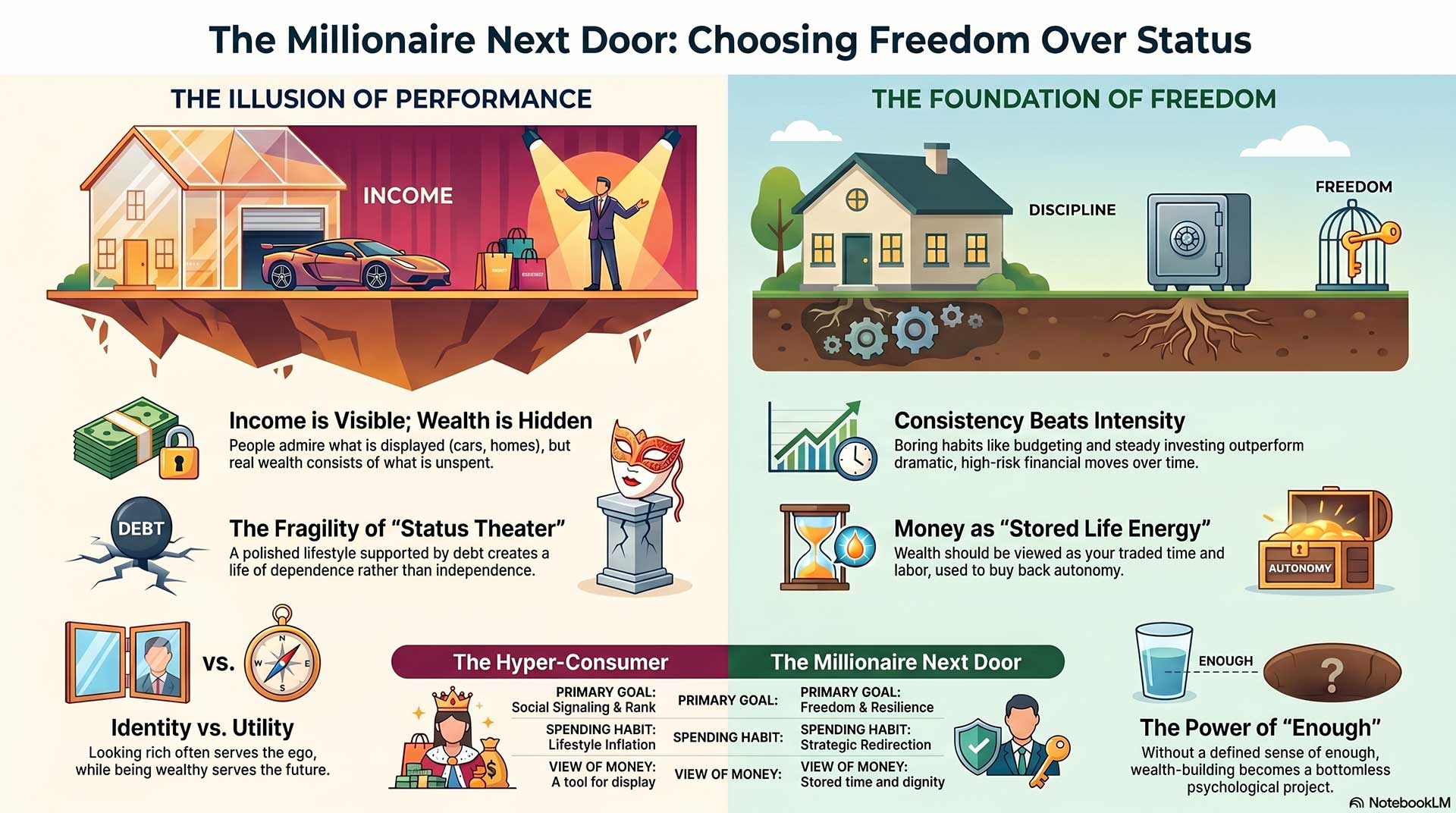
After listening to this full conversation, I think the deepest lesson of The Millionaire Next Door is not simply that people should save more money.
It is that a human life can be quietly deformed by the need to be seen.
Much of modern money trouble begins there. People do not only spend for pleasure. They spend to soothe insecurity, to keep pace, to signal adulthood, to protect image, to soften shame, to prove that effort meant something. And once spending begins carrying emotional weight, it becomes very hard to tell the truth. A person may be earning well and still falling behind. A family may look secure and still be under strain. A child may receive comfort and still grow up fragile.
That is why the book keeps cutting deeper than finance. It asks what kind of person is being formed through everyday money choices.
Are we becoming more honest or more performative?
More free or more dependent?
More grounded or more anxious?
More capable of enough or permanently restless?
Our guests kept returning to the same hard truth: real wealth is often built in ways that receive very little public admiration. It grows through restraint, patience, self-command, planning, and the willingness to look ordinary. Those traits are not flashy. Yet over time they create something many high spenders never reach — room to breathe.
We also saw that money itself is not the final goal. Protection matters. Freedom matters. Dignity matters. Peace matters. The good use of money is to support life, not replace it. Once accumulation becomes identity, the soul can become as trapped by savings as by status.
Then came the family question, which may be one of the most important of all. Wealth is never only personal. It shapes children, expectations, resilience, and the tone of a household. A family can pass down wisdom, or it can pass down comparison. It can raise adults who know how to stand, or adults who expect rescue. So inheritance is not just what is given. It is what is normalized.
And finally, we faced the modern world. Yes, 2026 is harder in real ways. Housing, debt, instability, digital pressure, and nonstop comparison have changed the emotional cost of building quiet wealth. Yet the heart of the old path still stands. Spend with intention. Raise earning power. Resist theater. Build systems. Let time help you. Refuse to measure your life by other people’s display.
So maybe the final message is this:
The millionaire next door still exists.
But in our age, that person may need more courage than before.
The courage to wait.
The courage to look unremarkable.
The courage to choose substance over image.
The courage to define success in private before the world defines it in public.
That is not only a financial achievement.
It is a moral one.
And perhaps that is why this book still endures.
It reminds us that the strongest life may not be the one that shines the brightest from the outside.
It may be the one that no longer needs to.
Short Bios:
Thomas J. Stanley
Co-author of The Millionaire Next Door, known for studying the real habits of affluent households and showing that many wealthy people live far more modestly than the culture expects.
William D. Danko
Co-author of The Millionaire Next Door, researcher and professor whose work explored wealth-building behavior, self-reliance, and the link between prosperity and well-being.
Sarah Stanley Fallaw
Researcher, author, and daughter of Thomas J. Stanley, known for carrying forward the family’s work on self-made wealth and financially successful households.
Morgan Housel
Author and financial thinker known for explaining how psychology, ego, risk, and behavior shape money decisions more than spreadsheets alone.
Thorstein Veblen
Economist and social critic best known for the idea of conspicuous consumption, showing how people use spending to signal status and social rank.
Daniel Kahneman
Psychologist and Nobel laureate known for his work on judgment, bias, and decision-making, helping explain why intelligent people still make poor financial choices.
Robert Cialdini
Psychologist and author known for his work on influence, persuasion, and social proof, illuminating how public pressure shapes spending and status behavior.
David Chilton
Author of The Wealthy Barber, respected for his plainspoken teaching on practical money habits, frugality, and long-term financial health.
Thomas C. Corley
Author and researcher known for studying the daily routines and behavioral patterns common among many self-made wealthy people.
Benjamin Franklin
Writer, inventor, and statesman whose teachings on thrift, prudence, industry, and self-discipline still shape classic ideas about wealth-building.
Vicki Robin
Co-author of Your Money or Your Life, known for asking what money is really for and for framing it as life energy rather than mere consumption.
Seneca
Stoic philosopher whose reflections on desire, sufficiency, simplicity, and inner freedom deepen the moral side of the money conversation.
Arthur C. Brooks
Author and public thinker focused on happiness, meaning, and human flourishing, often examining the limits of money in creating a good life.
Ramit Sethi
Author and money teacher known for the idea of living a rich life through conscious spending, strong systems, and clear personal priorities.
William Bernstein
Financial writer and neurologist known for his work on investing, risk, independence, and the practical meaning of financial freedom.
David Owen
Writer known for exploring affluent family life and the subtle ways money, comfort, and class shape children and adulthood.
Amy Chua
Author and law professor known for examining parenting, discipline, achievement, and the pressures families pass across generations.
Angela Duckworth
Psychologist and author known for her work on grit, effort, persistence, and how resilience is built through challenge.
Carol Dweck
Psychologist known for the growth mindset framework, showing how children and adults develop strength through effort, learning, and honest engagement with failure.
George S. Clason
Author of The Richest Man in Babylon, remembered for timeless financial lessons on saving, stewardship, restraint, and wise money management.
Scott Galloway
Author, professor, and commentator known for blunt analysis of modern economic pressure, generational inequality, work, and wealth.
Jean Chatzky
Financial journalist and educator known for clear, practical guidance that helps ordinary households build stability and make sound money choices.
Nick Maggiulli
Financial writer known for using data to explain saving, investing, wealth-building, and the emotional side of long-term financial progress.
Richard Thaler
Economist and Nobel laureate known for behavioral economics, showing how defaults, incentives, and decision environments shape financial behavior.
JL Collins
Author of The Simple Path to Wealth, known for his clear teaching on simple investing, avoiding noise, and building independence through steady habits.
Nick Sasaki
Moderator of this imaginary conversation, guiding the discussion through wealth, status, family influence, character, and freedom.
Leave a Reply