
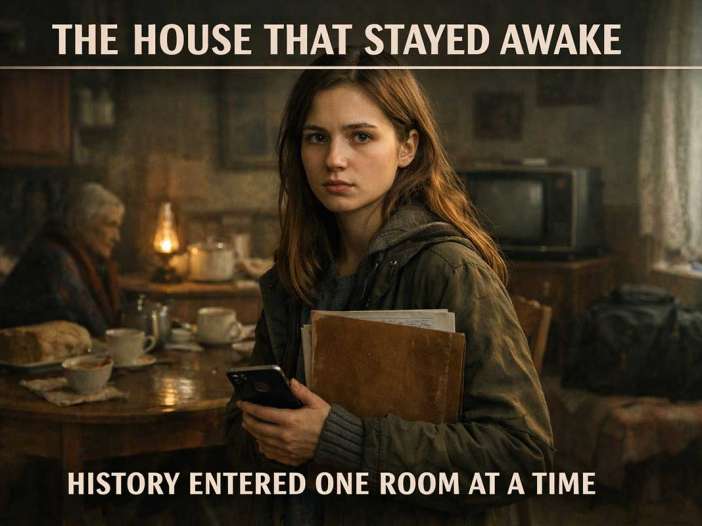
What if the war did not begin in one morning, but entered the house in waves over thirty years?
This story does not begin with an explosion.
It begins with a house that is still trying to believe history can remain outside its walls.
That is the heart of The House That Stayed Awake. It is a war story, but before it becomes a story of invasion, it is a story of generations living in different versions of the same country. A grandmother remembers the Soviet world. A father still carries the dignity of independence. A mother measures politics by what it does to bread, medicine, and children. A son is changed by 2014. A daughter comes of age under 2022. A family friend carries the difficult truth that identity was never as neat as outsiders like to imagine.
What mattered to me in this story was the slow layering of history inside ordinary life.
Ukraine did not wake up for the first time in 2022. The deeper roots were already there: the memory of Soviet rule, the meaning of independence after 1991, the disappointments that followed, the hardening that came with 2014, and then the full invasion that turned warning into fact. I wanted the reader to feel that each of these years lived in a different person at the table.
That is why this story stays close to the house.
When history is written from too far away, it becomes clean too quickly. It becomes dates, borders, alliances, speeches, and strategic language. Those things matter, but families do not live history that way. They live it through television sounds in the morning. Through arguments over breakfast. Through what gets stored in cupboards. Through who stops sleeping well. Through which child becomes serious too early. Through the moment when a political disagreement stops sounding like opinion and starts sounding like danger.
Marta stands near the center of that experience. She belongs to the generation that did not inherit peace in a settled form. She inherits unfinished explanations, adult tension, screens full of urgency, and then direct war. Her brother Taras carries the wound of 2014 more sharply. He is the one in whom politics hardens into vigilance. Their parents stand between principle and survival. Their grandmother knows how power changes its clothes without changing its instincts.
No one in this house is simple. That mattered to me very much.
Mykola is proud, but not naive.
Oksana is practical, but not cold.
Taras is intense, but not empty.
Marta is young, but not shallow.
Halyna is skeptical, but not detached.
Serhii complicates everything because real countries are complicated before war simplifies them by force.
The deepest pain in this story is not only destruction. It is the loss of ordinary emotional grammar. A family that once argued about politics now begins to sort life into batteries, alerts, trains, medicine, roads, and return times. A daughter who once asked abstract questions begins to think in signal strength and evacuation routes. A mother who once managed a home begins managing survival. A father who once spoke of independence as dignity begins to understand it as cost.
That shift is what I wanted to follow.
This is why the title matters.
The House That Stayed Awake is not only about fear. It is about a house that refuses numbness. A house that remains morally alert. A house that does not collapse into propaganda, even when history is trying to crush the difference between private life and public catastrophe.
For me, this story is about what happens when a family can no longer live inside innocence, but still refuses to surrender memory, tenderness, and truth.
Chapter 1 — Before the Break
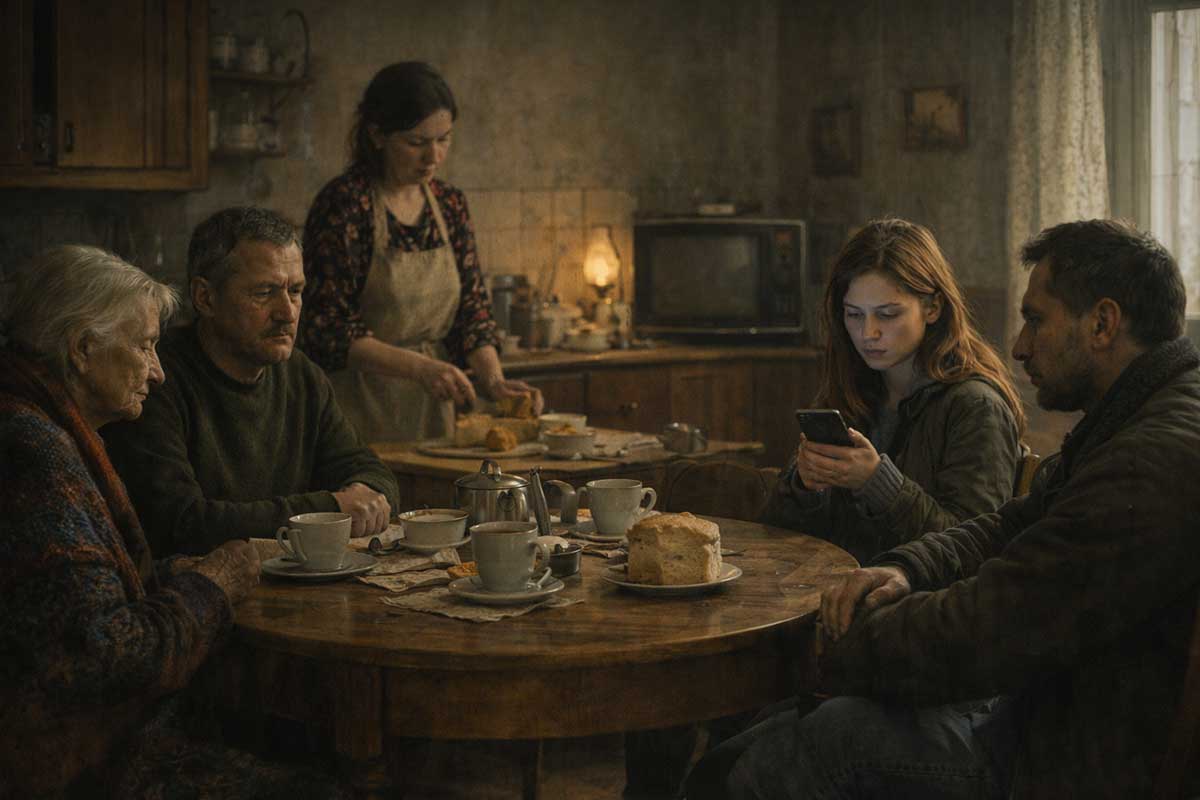
The first sound in the house was not the kettle.
It was Halyna clearing her throat in the dark.
Oksana heard it from the kitchen before dawn had fully taken shape beyond the window. It was the same sound every morning — low, dry, patient, as if the old woman’s body had learned to announce itself before the day properly began. A moment later came the scrape of a chair, then the soft drag of slippers across the floorboards.
Only after that did Oksana lift the kettle.
The water in this house always seemed to take longer in winter, and winter in this city never fully left when it was supposed to. Even in early spring the walls held cold. The window above the sink had gathered a pale film of condensation, and the glass showed only the blur of a still-dark courtyard and the faint orange stain of a streetlamp outside.
She set bread on the table, then cheese, then the small jar of jam Marta liked to claim she no longer ate because she was too old for sweet things in the morning. Every morning the girl said it. Every morning the jam disappeared anyway.
From the other room came the sound of a television being turned on low.
“Mother,” Oksana called, not loudly. “Not so early.”
Halyna’s answer came at once.
“If they are lying, I prefer to hear it before breakfast.”
Oksana almost smiled. Almost.
The television stayed on.
By the time Mykola entered, fastening the cuff of his shirt, the room had begun to gather shape. The table. The kettle. The television voice murmuring from the corner. Halyna in her chair already wrapped in her shawl, eyes narrowed at the screen as if she had spent her life waiting for history to insult her again and wanted to make sure she did not miss it.
“You’re up early,” Oksana said.
“I didn’t sleep well.”
“You never sleep well when it rains.”
“It isn’t raining.”
“It will.”
He kissed the top of her head in passing, the gesture so brief it was almost hidden inside movement. That was how affection lived in this house. In passing. In habit. In the way one person knew when the other had slept badly without asking.
He sat down and poured tea.
On the screen, some commentator was speaking too quickly. A map flashed and vanished. Words like Europe, security, parliament, negotiations. It was always one thing or another now, always one argument that sounded like ten older arguments stitched together.
Mykola glanced at the television and then away.
“If we start the day with that,” he said, “we’ll have indigestion before noon.”
Halyna snorted.
“You say that as if the country waits for your stomach to be ready.”
Before he could answer, a door opened down the hall and Marta came in, wrapped in a blanket, hair still tangled with sleep, carrying her phone like it had spent the night in her hand.
“Is there coffee?”
“There is tea,” Oksana said.
“That is not the same thing.”
“At your age, I knew that already.”
“At my age,” Marta said, dropping into a chair, “you were probably morally stronger than the rest of us.”
“At your age,” Halyna said without looking away from the television, “she was standing in line for shoes.”
Marta gave her grandmother a look. “You always say things like that so no one can win.”
“That is because no one wins,” Halyna replied.
The girl groaned and reached for bread.
Mykola watched her with the expression fathers wore when they wanted to be irritated and fond at the same time. There was still something in Marta that refused the full gravity of the world, and he guarded that lightly, even when he pretended not to notice it.
“Where is Taras?” Oksana asked.
No one answered for a moment.
Then Mykola said, “Up already. He went outside.”
Halyna made a sound in her throat. Not approval. Not disapproval. Something in between.
Taras had begun going outside before breakfast in the last few years, as if he no longer trusted the day to come to him on its own. Sometimes he smoked in the yard though he had promised his mother he had stopped. Sometimes he simply stood there looking toward the road, as though listening for something no one else could hear.
When he came in, the cold came with him.
Not much. Just enough to shift the room.
He closed the door softly and stood for a second with his hand still on the latch. He was not old, but there were certain expressions that had already settled into him too early. Oksana noticed them first in profile: around the mouth, between the brows, in the small pause before he joined the table.
“You’ll make the room colder than it already is,” she said.
“I was only outside a minute.”
“You say that with your face frozen.”
Marta looked up. “You look like you were out there solving geopolitics by yourself.”
Taras ignored her and sat down.
“What did the street say this morning?” Halyna asked.
He poured tea before answering.
“That people are tired.”
“That is what streets always say,” she replied. “I asked what kind of tired.”
This time he looked at her.
“The kind where no one expects good news, only different kinds of bad.”
Marta muttered, “Very cheerful.”
Oksana put a piece of bread on his plate. “Eat before you become philosophical.”
But she watched him a second longer than the others did.
Taras had not always spoken like this. Once, when he was younger, he had laughed more quickly, shrugged things off more easily, argued about corruption as if the country were only disappointing, not wounded. Something had changed in him over the years — not all at once, but in layers. He had become the sort of man who listened to the news as if it were weather coming directly for the house.
On the television, someone was now speaking about Moscow again, and NATO, and sovereignty, and what had or had not been promised to whom. The words came dressed as analysis, but in houses like this they never stayed abstract for long.
Mykola reached for the remote and switched it off.
For a moment no one spoke.
The silence afterward felt larger than the television had.
Halyna looked at him.
“You don’t silence it by silencing it.”
“I know.”
“Then why do it?”
“Because I’d like one meal without Europe, Moscow, and the end of the world in the teapot.”
Marta laughed into her tea. Taras did not.
Oksana said, “That would be nice.”
But she knew, and they all knew, that it was not really possible anymore. Not even now. Not before the war fully entered the house. Not while politics could still be spoken of as politics and not yet as survival. History had already begun to live in the room in smaller forms.
In the language people used.
In which channel stayed on longest.
In whether someone said our country with weariness or with pride.
In whether old habits of speech leaned east or west.
In whether the future still sounded like a place or only like an argument.
It was Halyna who broke the pause.
“When your father was young,” she said to Marta, “everyone talked as if independence would fix the soul of the country in one clean motion.”
Mykola sighed. “Mother.”
“No, let her hear it.”
Marta looked between them, suddenly more awake.
“I know about independence,” she said. “I’m not twelve.”
“Knowing facts is not the same as knowing what people felt,” Halyna said. “That is the problem with young people. You inherit conclusions and think you inherited experience.”
Taras gave a short, dry smile. “You say that as if your generation left us something simple.”
“My generation left you contradiction,” Halyna said. “That is more useful.”
Oksana, who had heard versions of this conversation for years, sat down at last with her own tea.
Mykola rested his elbows lightly on the table and looked at his daughter.
“When 1991 came,” he said, “it was not magic. But it mattered. We were finally not pretending anymore.”
“Pretending what?” Marta asked.
“That someone else could always speak for us.”
Taras was watching his father now.
“And after that?” Marta asked.
Mykola gave a small shrug.
“After that, life remained life. Corruption remained corruption. Men who should have been ashamed remained powerful. Prices rose. Hopes thinned out. But still — it was ours.”
Oksana leaned back slightly.
“Yours,” she said. “And expensive.”
He gave her a tired look. “Yes.”
“Very expensive.”
Taras said, “Everything important is.”
That was the kind of sentence he had begun speaking more often, and every time he did, Oksana felt two things at once: pride and dread.
Marta tore bread into small pieces.
“Did people really think Europe would save everything?” she asked.
This time it was not Halyna who answered first, but Serhii, who walked in without knocking, as he had done for most of his life.
“Only fools think anyone is saved by geography.”
He stamped his shoes lightly at the door and kissed Oksana on the cheek.
“Your lock still sticks.”
“Your manners still do too,” she said.
He smiled and took the empty chair near Halyna.
Serhii was not a blood relative close enough for outsiders to understand quickly, which was one of the reasons everyone simply called him family. He had lived in the east for years, worked there, spoken Russian in some rooms and Ukrainian in others, and made everyone slightly more uncomfortable whenever they wanted the world to stay neat.
“You came early,” Mykola said.
“I was passing.”
“You are never just passing.”
“No,” Serhii admitted, “but it sounds lighter.”
Oksana poured him tea without asking.
Marta, who liked him because he never spoke to her as if she were younger than the century, asked, “Did people really think Europe would save everything?”
Serhii blew across the surface of the tea.
“Some did. Some thought Russia would stop mattering. Some thought we could go on living in the middle forever and call that strategy.”
“And what did you think?” she asked.
“That if people are forced to choose a direction for too long, one day they stop discussing direction and start fighting over what they were already standing on.”
The room quieted a little.
Taras looked at him. “That sounds like one of your ways of avoiding saying anything clearly.”
“No,” Serhii said. “It sounds like a man who watched too many people speak as if identity were a map problem.”
Halyna nodded once, almost imperceptibly.
Mykola rubbed his forehead.
Oksana stood to refill the kettle, less because it needed doing than because movement was sometimes easier than sitting inside these currents.
Marta asked, “So what are we, then?”
No one answered immediately.
It was the kind of question that sounded young and simple until it landed.
Taras looked at her as if the answer were obvious.
Serhii looked at her as if the answer could only be partial.
Mykola looked tired.
Halyna looked old enough to have seen the question asked in too many uniforms.
Finally Mykola said, “We are Ukrainians.”
Taras added, almost at once, “That should not still sound uncertain.”
Serhii said quietly, “For some people it does not. For others it never did. For still others it took longer.”
Oksana set the kettle down more firmly than she meant to.
“This is breakfast,” she said. “Not a referendum.”
That made Marta smile, but only briefly.
Outside, a car passed. Somewhere above them, pipes clicked in the walls. The house held together around the table, around the tea, around the old arguments and the newer ones.
For a few minutes after that, the talk turned to smaller things. Whether there was enough sugar left. Whether Marta would miss the tram if she kept checking her phone instead of eating. Whether Serhii had finally fixed the leak in his own apartment. Whether Halyna would ever stop pretending she could hear the television clearly without her hearing aid.
These ordinary subjects did what ordinary subjects always do: they gave the room back to itself.
Yet history had not left.
It was in Taras’s silence.
In Mykola’s measured pride.
In Halyna’s dry distrust.
In Serhii’s refusal of simple answers.
In Oksana’s practical interruptions.
In Marta’s questions, which belonged to a generation that had inherited not peace, but unfinished explanations.
At the sink, as she rinsed the cups, Oksana looked out the window and saw Taras’s reflection behind her in the glass. For a second she thought of saying what mothers sometimes want to say and never do:
Stay out of history.
Stay in this kitchen.
Stay the age you were before the country became argument.
But history had already crossed the threshold long ago. It just had not yet broken the furniture.
Not yet.
At the table, Halyna said into the almost-calm room, “The trouble with countries is that everyone wants them to become simple right before they become dangerous.”
No one laughed.
Outside, the morning was finally taking shape.
Inside, the house remained awake.
Chapter 2 — 2014 Changes the Meaning of Everything
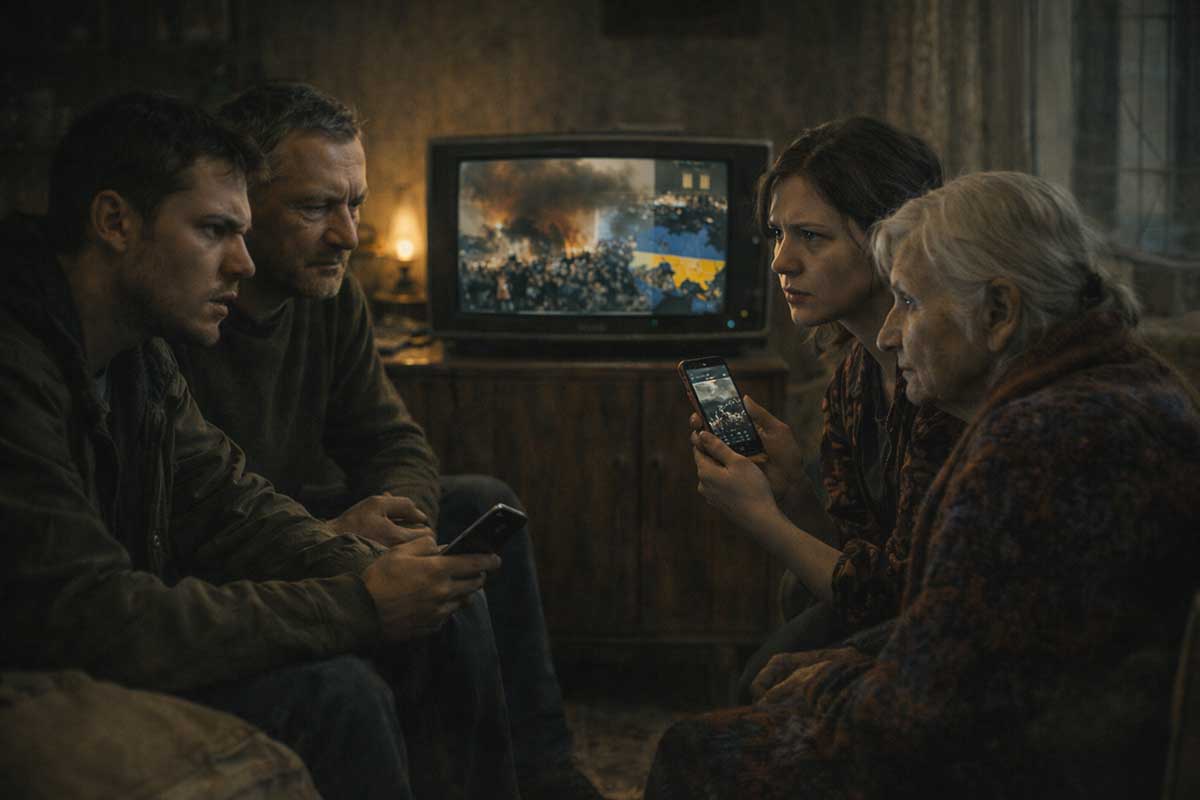
At first, it still sounded like politics.
That was how the television carried it into the house. Parliament. Protests. Europe. Agreements. Corruption. Riot police. One word after another, each serious, each urgent, yet still arranged in the old language of government, as if what was happening could be placed alongside fuel prices and ministerial scandals and the usual theater of disappointed promises.
In the beginning, Oksana tried to keep it in that category.
“Turn it down,” she would say. “You’ll hear it again in an hour anyway.”
Or, “Eat first. The country will still be in trouble after breakfast.”
She said these things half in jest, half in self-defense. She had lived too long with news that entered the house like weather and left nothing behind but irritation. She did not yet understand that this time the weather intended to stay.
The winter light that year seemed meaner than usual. The windows held cold all day. Even at noon, the rooms often looked as though the sun had changed its mind and gone elsewhere.
Taras spent more time standing than sitting.
He stood by the television. By the window. In the doorway with his arms folded. In the courtyard with a cigarette that he claimed not to need. He was no longer restless in the way young men often are. This was different. It was a kind of inward leaning, as if he had begun listening for a sound beyond the room and could not bear to miss it.
On the screen, Kyiv no longer looked like politics.
It looked like smoke.
Crowds. Flames. Helmets. Shields. Men carrying the injured. Women wrapped in winter coats with their mouths open mid-shout. Snow gone dark in places where snow should not go dark. Halyna watched with a face that seemed to grow smaller and harder at the same time.
Marta sat on the floor with her back against the sofa, phone in hand, following updates faster than the television could arrange them. She did not yet know which was worse: when the channels lagged behind the internet, or when they began repeating the same clipped footage until all human movement started to look like staged repetition.
Mykola stood with one hand on the back of a chair, leaning forward slightly.
“Turn it up,” Taras said.
“It’s already loud enough,” Oksana answered from the kitchen.
“Not for the words.”
Halyna gave a dry, almost invisible smile.
“That is always the problem,” she said. “The words arrive last.”
Serhii was there too, though no one had asked him to come. He had started appearing more often once the protests deepened, not in a dramatic way, but with the regularity of a man who knew that history did not ask permission before entering a family.
He stood near the stove warming his hands.
“You can feel it now,” Taras said without turning. “You can feel this isn’t going to go back.”
Serhii did not answer at once.
“That depends,” he said finally, “on what you think it was before.”
Taras let out a short breath that was almost a laugh and not close to one.
“Before? It was rot. It was pretending. It was men selling the country in smaller pieces than anyone could count.”
Mykola said quietly, “Careful.”
“With what?”
“With speaking as if anger is the same thing as clarity.”
Taras turned then.
“And you want me calm?”
“No,” his father said. “I want you exact.”
That shut the room for a second.
Marta looked up from her phone.
“They’re saying more people are coming in from outside Kyiv,” she said. “Not just from the city. From everywhere.”
Oksana set down a plate more sharply than she meant to.
“Then they need to eat,” she said, though no one had suggested otherwise.
The sentence sat in the air strangely, too practical and too true.
That was how Oksana handled fear: she gave it tasks.
Boil water. Slice bread. Count blankets. Check medicine. Ask who is staying the night and who is going back out into the cold.
The closer politics came to the body, the more domestic she became. It was not retreat. It was resistance of another kind.
On the screen, a commentator was still trying to explain the standoff in terms of negotiation, parliamentary arithmetic, diplomatic pressure. Serhii muted it.
“No one in this room needs another man in a suit explaining what smoke looks like,” he said.
Marta’s phone lit again.
“They’re saying the president may leave.”
No one moved.
Halyna said, “Then the story has shifted.”
That was how she put it. Not everything is changing. Not history is turning. Only: the story has shifted.
Mykola lowered himself into a chair at last. He looked suddenly older, though not weaker. Just heavier, as if he could feel thirty years pressing backward and forward at the same time.
“When we became independent,” he said, speaking almost to the table, “I thought the worst thing would be disappointment.”
No one interrupted.
“I thought we would be cheated, badly governed, embarrassed, delayed. I thought we would waste years. I did not think…” He stopped.
“What?” Marta asked.
“I did not think we would still have to prove we were real.”
Taras answered before anyone else could.
“That is exactly what this is.”
His mother looked at him sharply. “Do not say exactly as if you’ve finished understanding it.”
He met her gaze.
“I understand enough.”
“You understand enough to be angry,” she said. “That is not the same thing.”
He looked away first.
Outside, late-afternoon light was already thinning. Somewhere in the building a neighbor shut a door too hard. The sound made Marta flinch without meaning to. She noticed that she had done it and hated that she had.
Later that week, Yanukovych was gone.
The name itself had sat in the house for years like stale smoke — never welcome, never gone. Then suddenly it was no longer there in the same way. It had broken open into absence.
The television said one thing. Phones said another. Friends sent messages full of relief, dread, triumph, profanity, disbelief. The tone changed by the hour. It was not yet possible to tell which emotion would hold.
Taras came home that evening with a different face.
Not happier. Not calmer. Sharper.
“They ran,” he said.
“Who?” Oksana asked, though she already knew.
“The cowards. The thieves. All of them.”
“Not all,” Serhii said from the corner.
Taras turned. “You always do that.”
“Do what?”
“Speak as if every sentence needs a footnote before it can stand.”
Serhii did not seem offended.
“Only because I’ve lived long enough to know what certainty does once it puts on boots.”
Taras’s jaw tightened.
“This is not the time for your balancing act.”
“No,” Serhii said. “This is exactly the time for it.”
Mykola looked from one to the other.
“Enough.”
Taras was not finished. “People are dying in the streets and you still talk as if this is some seminar.”
“And you,” Serhii replied, still calm, “have begun speaking as if history just now entered your bloodstream. For some people it was already there.”
That landed harder than shouting would have.
Marta stopped pretending not to listen.
Halyna spoke into the silence.
“The problem with youth is not that it feels too much. The problem is that it thinks feeling began with it.”
Taras gave a small, bitter smile.
“You all say things like riddles when you don’t want to choose.”
“No,” Halyna said. “We say them because we remember how choosing can be arranged for you.”
No one spoke after that.
Yet something had indeed changed in Taras, and no one in the room truly denied it. Before, he had been cynical. Now he was claimed by something larger than anger. Oksana could see it and hated how proud it made part of her feel.
Then Crimea came.
Not as a line in a history book. Not as a polished phrase. It came the way such things come into families now — clips, maps, uniforms without insignia, confused explanation, confident lies, friends calling late, everyone trying to name something before it had settled into language.
Marta was the first to say, “What do you mean unidentified? Everyone knows.”
Mykola had no answer ready.
Serhii stood by the television with his arms folded, face unreadable.
“Say it properly,” Taras said. “This is Russia.”
Oksana said, “Don’t speak as if naming it makes it smaller.”
“Smaller?” He turned to her. “Mother, this is not a misunderstanding. This is not corruption. This is not one more crooked election. This is someone taking the country apart.”
“Sit down,” she said.
“I’m not hungry.”
“That is not why I said it.”
He stared at her for a second, then pulled out the chair so sharply it scraped the floor.
Halyna watched him with old, unsurprised eyes.
“This,” she said quietly, “is when language begins to harden.”
Marta looked at her grandmother.
“What does that mean?”
“It means people stop arguing about what is true and begin arguing about what may still be said in one piece.”
By then Donbas had begun to enter the house too.
At first through reports. Then through names of places that once sounded merely geographic and now sounded wounded. Then through actual people — sons of neighbors, cousins of acquaintances, men from the city who had “gone east,” then returned changed or not at all.
Serhii started making more phone calls in the hall instead of the main room.
Taras stopped speaking about “politicians” and started speaking about “the country.”
Mykola, who had spent years criticizing the state as if criticism were proof of belonging, now sounded different when he said Ukraine. Less disappointed. More guarded.
Oksana began storing things without announcing it.
Extra flour. Batteries. Medicine. Cash hidden in two places instead of one.
Marta noticed all of it.
“You think something is coming,” she said one evening while helping put away groceries.
“Something is always coming.”
“That’s not an answer.”
Oksana closed the cupboard.
“No,” she said. “It’s the answer mothers give when they do not want fear to become furniture.”
Marta stood still with the jar in her hand.
At dinner that night, Taras said, “This is not a regional issue anymore.”
Serhii replied, “It never was only regional. That was always the lazy way to say it.”
Mykola looked tired. “Stop talking as if either of you owns the whole truth.”
“I know enough,” Taras said again.
“You know the part that cut you open,” Serhii answered. “That is not the whole.”
Taras looked as if he wanted to keep fighting, but Halyna interrupted first.
“When an empire loses grip,” she said, “it does not always let go with its hand open.”
No one asked her to explain.
She had lived long enough to know when a room had finally caught up with a sentence.
That night Marta stood at the window with her phone dark in her hand. The courtyard outside looked ordinary. A man carrying groceries. A child being called upstairs. Laundry forgotten too late. The sort of life that, from a distance, always looked untouched.
She understood suddenly that this was the last part people always got wrong.
History did not arrive only when the tanks crossed some final line.
It arrived when the argument in the house changed shape.
When names of places stopped sounding distant.
When adults began storing things without discussion.
When her brother stopped sounding like a disappointed citizen and started sounding like a man who believed something had already been taken.
From the kitchen came the low sounds of her mother washing dishes.
From the living room came the television again, quieter now.
From the table came Halyna’s voice, saying to no one and everyone, “Now it has begun.”
Not the war entire.
Not yet.
But the time when no one in the house could still pretend that politics lived outside the walls.
That time had ended.
Chapter 3 — The Years of Uneasy Waiting
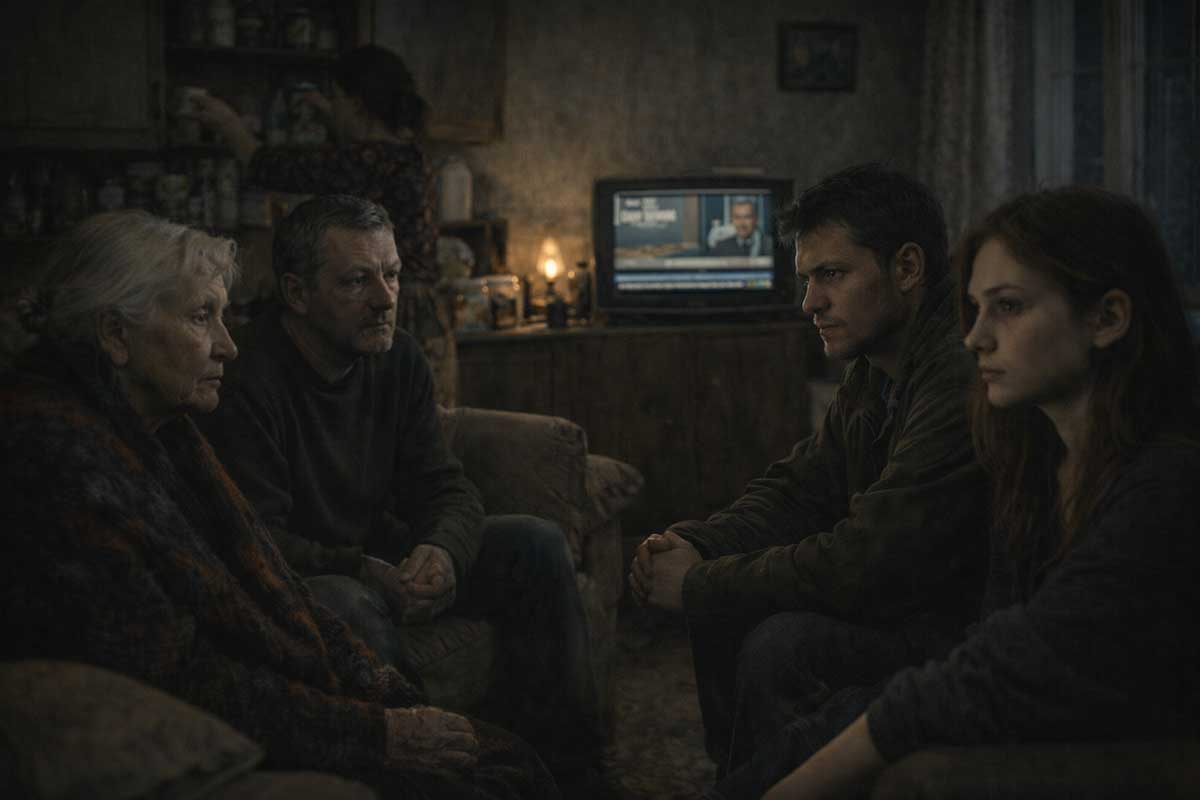
After that, the war became a habit no one admitted to forming.
It did not enter the Kovalenko house every hour. It was not always in the room. That was what made it dangerous. If it had shouted all day, every day, perhaps people would have known how to arrange themselves around it. Instead, it came and went. A name in the news. A map. A funeral in another town. A cousin’s son gone east. A blackout rumor. A conversation cut short in the tram. Then a morning like any other, with tea, bread, and someone complaining that the radiator had gone cold again.
That was how a country learned to live inside half-war.
The first summer after 2014, Mykola still spoke as if the situation might settle into something ugly but containable. Not good. Never good. But containable.
“They cannot go on like this forever,” he said once, repairing a hinge that had not needed repairing until his hands wanted work.
“Who is ‘they’?” Taras asked from the doorway.
Mykola did not answer immediately. He tightened the screw too far, then loosened it half a turn.
“Everyone.”
Taras gave a short laugh with no humor in it.
“That’s not an answer.”
“It is the answer people give when they’re tired.”
Taras came farther into the room.
“They are counting on that.”
“Who?”
“Everyone,” Taras shot back.
For a moment the two men stood inside the same word as if it meant opposite things.
Oksana, kneading dough at the table, did not look up when she spoke.
“If the two of you use one more broken hinge to discuss the fate of Europe, I’ll throw both of you out into the yard.”
That got Chiharu—no, not Chiharu; Marta—laughing for half a second before she caught herself, aware suddenly that the name of another sister from another story did not belong here. In this house there was only Marta, and even her laughter had become careful these last years, as though too much ease might be a form of disrespect toward people living nearer the line.
Taras had stopped rolling his eyes at his mother’s interruptions. He understood now that her practicality was not avoidance. It was the form her vigilance took. When he came home with new words — ceasefire, corridor, line of contact, separatists, volunteers — she answered with batteries, flour, medicine, socks, train timetables, and whether Serhii had called back.
Serhii called less often than before and visited more.
That, by itself, was a sign that things had changed.
He had aged in a way that did not belong to years alone. Something in his shoulders had shifted, not from injury exactly but from listening too long. He spent time in the east, or near it, or moving toward it and back again, depending on what version of events one asked him to describe. He never gave a full report at once. Oksana sometimes thought he spoke in fragments because that was all he trusted.
One evening he came in after dark with road dust on his jacket and sat down without removing it.
“You should at least take that off before you sit,” Oksana said.
“In a minute.”
“You said that last time too.”
Serhii smiled faintly. “Then I’m consistent.”
Halyna watched him from her chair.
“You’ve brought silence with you again,” she said.
He glanced toward her. “Was the house quiet before I came?”
“No. But it was its own quiet.”
He accepted that.
Marta brought him tea. She was old enough now that people had stopped telling her to go to the other room when conversations turned heavy, and young enough that they still forgot she understood more than they intended.
“Did you come from Donbas?” she asked.
No one corrected her for asking directly.
“From near enough,” Serhii said.
“What does that mean?”
“It means the roads change before the maps do.”
Taras leaned forward.
“And?”
Serhii took the tea in both hands and waited until the steam rose between them.
“And men with rifles still stand on both sides of the same lie.”
Taras frowned. “What lie?”
“That this can remain limited.”
Mykola, who had been reading and pretending not to listen, lowered the paper.
“You think it spreads?”
“I think it never stopped being larger than people wanted to say.”
Marta watched her father’s face change at that. Not sharply. Not in panic. Just a small inward tightening, as if an older worry had quietly found confirmation.
The television stayed on more often in those years, though sometimes with the sound muted. People learned to look at maps without wanting to. They learned the names of towns they had never expected to hold in their mouths. They learned that there was a new category of sentence in daily life:
He went east.
They’re near the line.
It was shelling, not an accident.
No, not dead — wounded.
Not this district. Another one.
Not this week. Maybe next week.
These were not dramatic announcements. They were the grammar of uneasy waiting.
Marta absorbed them before she fully understood them.
By seventeen, she could tell from the way adults set down cups whether the news was bad, ordinary bad, or the kind of bad no one yet knew how to describe. She learned to charge her phone before bed even when there was no reason to think the power would go. She learned that when Taras went out late and returned later, the family’s silence would not begin until they heard the gate. She learned that jokes were still possible, but only if they turned away from the wrong things soon enough.
At school, teachers still taught literature and grammar and civics as if the nation existed in orderly chapters. Marta sat by the window and thought how strange it was that maps in textbooks always looked cleaner than maps on the news. A line was a line in a book. In real life, it was funerals, volunteer collections, wounded men speaking too softly in train stations, and classmates whose cousins had stopped answering messages.
One afternoon, walking home with a friend, she passed a church where a funeral was taking place.
No one in her family knew the dead man.
That did not matter.
Outside stood men in dark coats and women whose faces had the exhausted look of people who had spent too long trying not to collapse in public. There were no screams. Only a stiffness in the bodies, as though grief had been forced into ceremonial shape.
Her friend lowered her voice.
“They said he was only twenty-four.”
Marta looked at the flowers, then at the flag, then away.
Only twenty-four.
For the rest of the walk, she felt older than she had in the morning.
At home, Halyna was peeling potatoes.
The old woman looked up once and said, “You’ve seen something.”
It was not a question.
Marta set down her bag.
“A funeral.”
“For whom?”
“I don’t know.”
Halyna nodded and returned to the knife.
“That is how war enters a city,” she said. “First through names you do not know. Later through names you do.”
Marta stood there for a moment.
“You always say things like you’ve already lived them.”
Halyna paused.
“I have lived enough to know the sequence.”
Marta wanted to ask, Does that help? But she did not. She was beginning to understand that experience did not always make suffering easier. Sometimes it only made recognition faster.
Taras changed more slowly than he himself believed.
He liked to think 2014 had cut the country into before and after cleanly. In public, perhaps it had for him. In private, the change was more difficult. He became more impatient, more exacting. He had less tolerance for lazy speech, for the old shrugging cynicism, for people who said that all politicians were the same or that history would settle itself if ordinary people just minded their business.
“They count on that,” he said often. “They count on boredom.”
Once, when Mykola answered, “A country cannot live at emergency pitch forever,” Taras snapped back, “Then maybe we should ask why it keeps being forced to.”
Oksana, stirring soup, said without turning, “If you are going to speak like a pamphlet, at least do it with better manners.”
Taras went silent.
That was another feature of these years: everyone became more exact, then tired of their own exactness, then guilty for their tiredness.
By then, Mykola had started keeping older documents in one drawer and newer ones in another, though no one had asked him why. Oksana stored more than before. Serhii had an overnight bag that was never fully unpacked. Halyna kept saying the same thing whenever television men used the word frozen.
“Frozen things thaw.”
No one liked hearing it.
In winter, the waiting became heavier.
The radiators hissed and clicked. The windows showed only dark by late afternoon. Taras spent more evenings with men who used words like logistics, volunteers, defense, and readiness. He did not always explain where he had been. Mykola did not always ask. Oksana hated both halves of that arrangement.
One night, after Taras came home near midnight, she was still awake in the kitchen.
“You could at least send one message,” she said.
“I was busy.”
“You think fear stops because it lacks information?”
He took off his gloves slowly.
“I’m not a boy.”
“No,” she said. “That is exactly the problem.”
He looked at her.
For one second, all the years inside him seemed to show at once — the son, the man, the almost-soldier, the citizen made sharper by history, the person still vulnerable to his mother’s eyes.
Then he sat down.
“I don’t know how to do this halfway anymore,” he said.
The honesty of it startled them both.
Oksana leaned against the counter.
“There are very few things in life that are done any other way.”
He shook his head. “No. Not this.”
From the doorway, unheard until then, Halyna said, “That is what all dangerous times persuade the young of.”
Neither turned toward her immediately.
The old woman went on.
“They tell you that to be serious, you must become complete. Completely loyal. Completely against. Completely awake. But houses survive on partial things. Half-rest. Half-certainty. Half-healed people. That is the only reason they survive at all.”
Taras rubbed his face with both hands.
“That sounds like surrender.”
“No,” Halyna said. “It sounds like domestic truth.”
Marta listened from the hall and said nothing.
She would remember that sentence later, though not right away. At the time it only made her sad in a way she could not name.
Years passed inside that kind of tension.
Not calm. Not explosion. Not peace. Not full war. Something in between, which is its own deforming force. People married. People buried relatives. People renovated kitchens. People made travel plans and canceled them. People got used to saying the east in a lowered voice. People went to work while checking casualty reports. Children became adults under the pressure of not knowing whether history was about to stay distant or enter the room fully.
That was the true shape of uneasy waiting: not panic, but adjustment.
One evening in late winter, the family sat together after dinner without television, which was rare now. Snow pressed softly against the window. Serhii was there again, coat off, tea untouched. Mykola had his hands folded on the table. Oksana was darning a sock she probably could have replaced but did not. Taras was staring at the grain of the wood. Marta was reading messages without really reading them. Halyna sat wrapped in wool and silence.
No one had planned a serious conversation.
That was often when serious things came.
At last Marta said, without looking up, “Do you think this is just how it will be from now on?”
No one answered first.
The question moved around the room like something cold.
Taras finally said, “No.”
Marta looked at him.
“No,” he repeated. “Not like this.”
“What does that mean?”
“It means this isn’t stable.”
Serhii exhaled through his nose.
“Nothing unstable lasts forever,” he said. “That does not mean what comes next is better.”
Mykola said quietly, “I used to think the country was fragile because it was young. Now I think it is fragile because too many people keep pretending history can be postponed.”
Oksana kept sewing.
“It can be,” she said. “Until it can’t.”
Halyna gave the smallest nod.
There it was again — the whole house speaking in edges.
Marta looked from one face to the next and understood that each of them had been living in a different version of the same waiting. Her father with dignity. Her mother with provisions. Her brother with readiness. Serhii with wary knowledge. Her grandmother with old memory. Herself with questions no one her age should have had to carry.
Outside, snow continued to fall over a city not yet on fire.
Inside, the house remained lit.
But from that winter on, Marta would never again mistake light for safety.
Chapter 4 — 2022 Enters the House
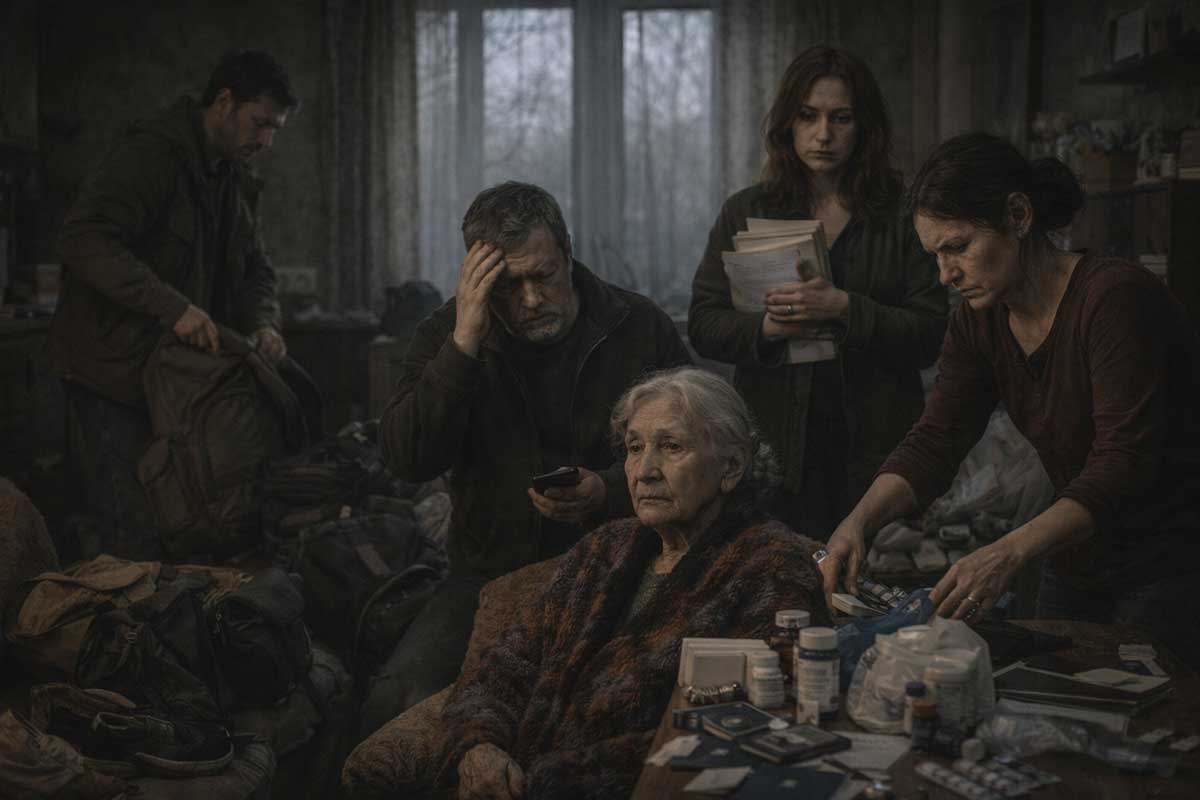
When it finally came, it did not feel like the beginning.
That was the first strange thing.
For years, the family had lived with maps, warnings, half-war, funerals, waiting, arguments, and the dull ache of unfinished danger. So when the news broke before dawn that Russia had launched a full-scale invasion, no one in the house said, How can this be happening?
What they felt instead was something colder.
So this is what all the waiting was for.
Oksana woke first, though later she would not remember whether it was the phone or the silence between sounds that pulled her out of sleep. The room was still dark. Her hand reached instinctively toward the bedside table, found the phone, and saw the screen already alive with messages before she had fully focused her eyes.
Calls.
Texts.
Fragments.
Are you awake?
Turn on the news.
They’ve crossed.
Kyiv too.
Everywhere.
She sat up at once.
Beside her, Mykola moved with the slow confusion of someone pulled too fast from sleep.
“What is it?”
But she already knew that saying it would make it real in a different way.
Still, she said it.
“It’s started.”
He was awake then.
No one in the house ever again used that phrase lightly.
In the next room, a floorboard creaked. Halyna was already up. Oksana heard the old woman’s slippers before she heard her voice. For one wild second Oksana wanted to stop the day from continuing in its usual order. Not because routine was useless, but because routine felt like an insult now.
Then she stood.
By the time she reached the kitchen, Taras was there with his phone in one hand and a half-buttoned shirt hanging open at the throat. He had the face he wore when his body had already moved ahead of thought.
Marta came in wrapped in a blanket, her hair loose, her eyes wide but dry. She looked younger than she had the night before and older than she had the week before.
“What happened?”
Taras answered before anyone else.
“Russia invaded.”
Marta stared at him.
“No,” she said automatically, though not because she thought he was wrong. Only because the sentence was too large to fit all at once.
“Yes.”
“Where?”
He gave a short, almost disbelieving breath.
“Everywhere.”
The word sat there.
Not Donbas.
Not the east.
Not the line.
Not the old map of acceptable danger.
Everywhere.
Mykola turned on the television. This time no one told him to lower it. Channels were already running the same images in slightly different voices: missile strikes, columns, smoke, official statements, hosts speaking too quickly with the false steadiness of people trying to sound more in control than they were.
Halyna stood behind everyone else, one hand on the back of a chair.
“So,” she said, not loudly, “they have stopped pretending.”
No one answered.
It was not the sentence of someone surprised by empire. It was the sentence of someone who had simply hoped it would take longer to show itself whole.
Oksana was the first to move with purpose.
“Taras, water.”
He looked at her, almost irritated.
“What?”
“Fill everything you can.”
He did not move.
“Now.”
That reached him.
The kitchen changed shape within minutes. Not chaotic. Faster than chaos. More exact. Buckets. Bottles. Bread counted. Medication checked. Documents pulled from drawers. Chargers found. Cash. Extra socks. Candles. Tape. A bag for Halyna. A smaller bag for Marta. Another for whatever still felt impossible to leave behind but impossible not to consider.
This was how Oksana met terror: not by calming down, but by assigning it work.
Marta stood in the middle of the room holding passports and birth certificates against her chest.
“What do I put where?”
“Not there. In the folder.”
“Which folder?”
“The blue one.”
“There are two blue ones.”
“The darker blue one.”
Taras was already dressed by then.
Mykola noticed first.
“Where are you going?”
Taras did not answer immediately.
“Out.”
“No.”
The word came too quickly. Too absolutely. Everyone heard the father in it and not the strategist.
Taras lifted his eyes.
“I have to see what’s happening.”
“You can see what’s happening here.”
“No, I can’t.”
Oksana, stuffing medicines into a bag, said without looking up, “Not now.”
He turned to her.
“Mother—”
“Not now.”
She was not telling him no forever. All of them knew that. That was what made it hurt. She was only trying to hold the wall for another hour.
Mykola stepped closer to his son.
“Wait until we know more.”
Taras gave a tight, disbelieving smile.
“We already know enough.”
Serhii arrived before anyone invited him. He came in hard, without his usual half-light entrance, coat still open, breath sharp in the air.
“Roads are already thick,” he said. “People are moving.”
“To leave?” Marta asked.
“To leave, to stay, to look for someone, to prove they aren’t afraid — who knows.”
He saw the bags on the table and nodded once.
“Good.”
“Good?” Marta said.
“No,” he corrected softly. “Not good. Correct.”
On the television, officials were speaking about resistance, emergency, defense, the capital. Another channel showed traffic pouring out of cities in long lines. Another showed smoke somewhere far enough away to still look unreal.
Marta’s phone kept vibrating in her hand.
Friends.
Classmates.
Neighbors.
A girl from school already on a train platform.
Another in a shelter bathroom sending voice messages in a whisper.
A boy she had barely spoken to in months suddenly asking if her family had a car.
The future had collapsed into messaging speed.
For years she had lived with a war that adults said was serious but not immediate. Now immediate had arrived, and it had the strange texture of notifications.
“What do we do?” she asked no one in particular.
No one answered because they were all answering in different ways.
Halyna sat down, finally, in the chair nearest the stove.
“Bring me my shoes,” she said.
Oksana looked up. “You’re not going anywhere yet.”
“I did not say I was. I said bring them.”
Marta took them to her.
The old woman set them beside her feet with the composure of someone who had long ago learned that panic wastes strength.
By midmorning the house no longer felt like the same place. It was physically the same. Same table. Same chipped bowl near the sink. Same curtain that never hung straight. Yet every object had changed meaning.
The hallway was now a route.
The cupboard was now supply.
The window was now risk.
The phone was now lifeline.
The door was now decision.
Even the kettle was different. It boiled because life continued, but its sound no longer belonged to comfort. It belonged to keeping people moving.
Around noon, the first siren reached them.
At first Marta thought it was part of the television.
Then Taras muted the room with one movement, and the sound held.
No one spoke.
It was a strange sound, thinner than she expected, not cinematic, not grand. Worse for that reason. A human city had made a mechanical cry and now everyone inside it had to decide whether to treat it as warning or prophecy.
Oksana was the first to say anything.
“Shoes.”
Marta bent at once to tie hers, hands clumsy.
Mykola moved toward Halyna.
“I can walk,” the old woman said before he touched her.
“I know.”
“Then do not hover.”
Taras picked up two bags, then set one down, then picked it up again. For the first time that day, he looked young to Oksana. Not because he was weak. Because she could see the speed of his mind outrunning his body.
“Basement?” Marta asked.
“Yes,” said Mykola.
“No,” said Taras at the same time. “Too crowded.”
Serhii cut in.
“First alert, basement. Then decide.”
That settled it.
The descent was clumsy, not dramatic. A blanket dragged on one step. Marta almost dropped the document folder. Mykola had one hand under Halyna’s elbow despite her annoyance. Oksana realized halfway down that she had left the bread knife on the counter and hated herself for the irrelevance of the thought.
The basement smelled of dust, damp concrete, and other people’s alarm.
Neighbors were already there. Children trying to stay quiet because the adults were trying too hard to look normal. A woman clutching a cat carrier. A man with no coat and no explanation. A baby beginning to cry with the outraged intensity of someone too young to understand collective fear.
Marta sat on an overturned crate and checked her phone again.
Messages multiplied faster than meaning.
Are you safe?
Do you hear it too?
They hit near—
No signal later maybe
Don’t go outside
My uncle says—
No one knows anything
She looked up and saw Taras pacing the narrow strip near the far wall.
“Sit down,” Oksana said.
“I can’t.”
“Then stand still.”
He actually laughed once at that, though it came out dry and brief.
Across from them, Halyna was sitting straighter than anyone else in the room.
Marta leaned toward her.
“Are you afraid?”
Her grandmother looked at her for a long second.
“Yes,” she said.
Marta had not expected the answer to come so plainly.
“Yes,” Halyna repeated. “Fear is not the shame. Forgetting yourself is the shame.”
Marta looked down at her own hands.
Before 2022, fear had still belonged to a future tense.
It might happen.
It could happen.
It was coming closer.
Now fear had entered the grammar of the present.
After the alert ended, the family came back upstairs into a house that was the same and not the same.
The cups were still on the table.
The blanket still half-folded on the chair.
The television still running.
Yet the old arrangement of things had been broken forever. Even if every wall remained standing, the house no longer lived outside war.
That afternoon, Taras tried again.
“I’m going.”
Mykola did not ask where.
“You think I can sit here?”
“I think if you walk out now, you may not walk back in.”
Taras held his father’s gaze.
“That was already true before today.”
It was the kind of sentence that split a room.
Because it was true.
And because truth can still sound cruel when spoken at the wrong speed.
Oksana sat down heavily for the first time all day.
Serhii looked from father to son and did not interfere. This was not a political argument anymore. It was the oldest argument in war.
The house says: stay alive.
History says: step forward.
Neither side speaks gently.
Marta watched her brother and thought, suddenly and with complete clarity, that this was how families were broken without yet being separated. Not by shells first. By necessity choosing one body before another.
“Will you come back?” she asked.
It was the wrong question. Everyone heard it. But it was the truest one.
Taras looked at her.
For a second, the whole room became that look.
Then he said, “I’ll try.”
Marta hated the answer because it was honest.
Halyna closed her eyes.
Mykola turned away first.
Oksana did not cry. Not then. She only said, “Eat before you go.”
That was her last defense against history: if she could still feed him, then he had not been entirely taken.
By evening, the light outside had turned thin and metallic. The city still stood. The house still stood. The family was still together, though already in a different tense.
On the television, officials spoke of courage.
On phones, people spoke of routes, fuel, roads, checkpoints, cousins, danger, rumors.
In the kitchen, Oksana wrapped food in cloth with hands that did not shake until no one was looking.
Marta stood by the window after dark and stared at her own reflection against the glass. Somewhere outside, the city was holding itself together one decision at a time.
She understood then that war was not only destruction.
It was rearrangement.
Of time.
Of language.
Of rooms.
Of what mothers put into bags.
Of what fathers can no longer forbid.
Of what daughters understand too early.
Of what sons begin to belong to.
From behind her, Halyna’s voice came low and steady.
“Remember this.”
Marta turned.
“What?”
“This is the day the house learned it could be entered from the sky.”
Marta looked back at the window.
No one in the room would ever again live as if ceilings were protection.
And yet the house had not collapsed.
It had only changed its duty.
Before, it held a family.
Now it had to hold a country-sized fear inside family-sized walls.
Chapter 5 — After Innocence
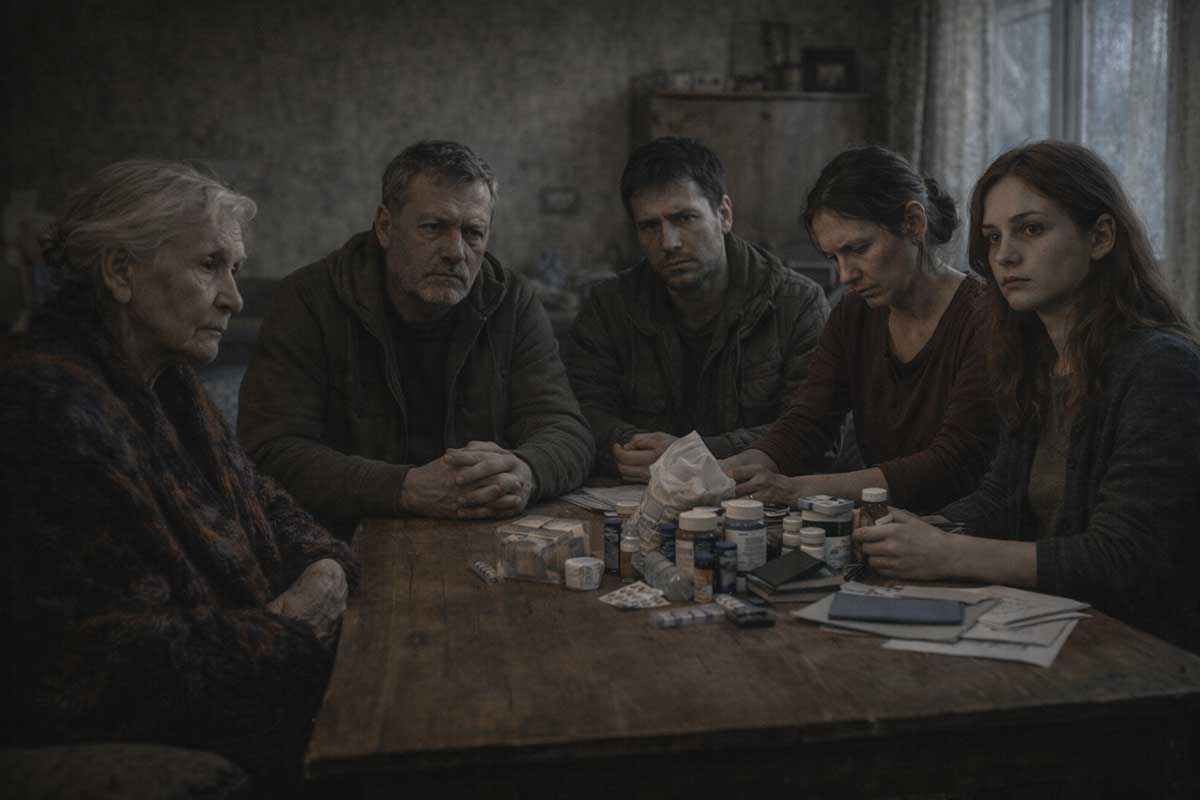
After that, the family stopped speaking about the future as if it were one thing.
Before the invasion, even during the long years of uneasy waiting, the future had still held shape. It might be difficult, delayed, wounded, corrupt, disappointing, even frightening — but it still seemed singular. A road. A plan. A direction.
After 2022, it broke into smaller pieces.
If Taras returned.
If the city held.
If the electricity stayed on.
If the train still ran.
If Halyna’s medicine lasted another month.
If Marta’s friend made it across the border.
If Oksana could still buy flour.
If Mykola’s silence did not harden into something none of them could reach.
The family did not name this shift aloud. They simply began living inside it.
For the first weeks, the house lost all ordinary rhythm. Meals happened when they could. Sleep came in fragments. News and messages bent the shape of every hour. The television stayed on without being watched. The kettle boiled more often than anyone drank tea. The hallway floor filled with shoes that were never properly put away, because no one wanted to be caught unready.
Then, slowly, a new rhythm formed.
It was not peace. It was repetition under threat.
That is one of the things war does best: it teaches people how much fear can be folded into routine.
Oksana learned exactly how many jars could fit behind the lower pantry shelf and which medicines disappeared first from pharmacies. Mykola learned the sound of different alerts and which neighbors would pretend calm until the last possible minute. Marta learned to charge every device whenever current returned, to shower quickly, to sleep with clothes within reach, and to reply to messages in ways that sounded steadier than she felt.
Halyna learned nothing new, at least not visibly.
That was what unsettled Marta most.
The old woman still sat the same way at the table, shawl around her shoulders, back straighter than seemed reasonable for someone her age. She still cleared her throat before dawn. Still listened longer than she spoke. Still answered fear in complete sentences, as if panic were merely another kind of waste.
Once, in the basement during another alert, Marta asked her, “How can you be so calm?”
Halyna looked at her with mild irritation.
“I am not calm.”
“You seem calm.”
“That is because I was not raised to perform every feeling as it arrives.”
Marta almost smiled.
“That sounds unfair.”
“It is unfair.”
“Then what are you?”
Halyna folded her hands in her lap.
“I am old enough to know that terror can become vulgar if you let it speak all day.”
Marta turned that over in her mind for hours afterward. She did not fully agree, but she understood the shape of it. Halyna was not less afraid. She simply refused to hand fear the dignity of constant display.
Taras came and went according to a rhythm no one in the house fully knew.
Sometimes he was gone one night. Sometimes three. Sometimes he returned only long enough to wash, eat, charge his phone, and leave again with the same bag that never seemed either full or empty. He spoke in shorthand now, not because he wanted to sound mysterious, but because language itself had narrowed.
“Roads were bad.”
“Not there.”
“Some got through.”
“They hit near.”
“I’m fine.”
“No, really.”
Oksana hated the phrase I’m fine more than any other words in the language.
She heard in it everything it covered and refused.
Once, when Taras came back just before dawn, she found him in the kitchen drinking cold water straight from a jar.
“You could at least sit,” she said.
He looked at her as if he had forgotten chairs existed.
Then he sat.
The light over the stove was too harsh for that hour. It showed how much older he looked than he had even a year earlier. Not old in years. Old in tension. In the set of the mouth. In the way his eyes seemed always to have one part turned elsewhere.
“You need sleep,” she said.
He gave a tired half-smile.
“Everyone says that as if sleep is a place.”
She sat down opposite him.
For a while neither spoke.
Then she said, “You come back thinner every time.”
“That’s because you say things like that before I eat.”
“I say them because they’re true.”
He drank again, then lowered the glass.
“Mother,” he said quietly, “if I sit here too long, I hear everything.”
She knew what he meant.
Not bombs.
Not vehicles.
Not radios.
The house.
The pipes.
The kettle.
The scrape of your father’s chair.
Marta turning in her sleep behind a wall.
Halyna clearing her throat before dawn.
The sounds of home had become almost too intimate for him, as if war had not destroyed his sense of shelter but sharpened it until shelter itself hurt.
“Then hear it,” she said, though the words felt cruel as soon as they left her mouth.
Taras looked at her, not wounded exactly, but startled.
“Hear it,” she repeated, more softly. “If you still can.”
He did not answer.
But he did not leave the table immediately either.
Mykola changed in a quieter way.
Before 2022, he had still believed in a father’s usefulness as steadiness. Keep the room from becoming hysteria. Measure before speaking. Do not let fear set the tone. Those instincts did not disappear, but they no longer felt sufficient. The war had moved beyond the range of composure. It did not want a calm father. It wanted decisions, supplies, departures, documents, routes, power banks, fuel, burial money, emergency numbers.
And yet he was still a father.
That role had not gone anywhere.
It only became more painful.
One evening, after a strike not close enough to damage the house but close enough to be heard in the walls, he and Serhii stood in the courtyard under a sky that looked wrong for spring.
“They said this wouldn’t happen,” Mykola said.
Serhii did not ask who they were.
“There were too many theys,” he answered.
Mykola let out a tired breath.
“I used to think my job was to help my children grow up in their own country.”
Serhii waited.
“Now it feels like my job is to watch which part of them the country takes first.”
That stayed between them for a while.
Then Serhii said, “Those may be the same job now.”
Mykola turned toward him sharply.
“Don’t give me philosophy tonight.”
“It isn’t philosophy.”
“What is it, then?”
Serhii looked toward the upper windows of the apartment building, where light glowed behind curtains in uneven squares.
“It’s war inside a parent’s vocabulary.”
That made Mykola go silent.
Serhii was often most exact when he sounded the least emotional.
Marta’s world became both smaller and larger.
Smaller because her life was now built around zones: home, basement, shop, station, message thread, battery level, route, signal, return. Larger because war made distant places immediate. Kharkiv, Bakhmut, Lviv, Warsaw, Berlin, villages she had never heard of, bridges she began recognizing before she ever saw them — all of it moved into her phone, her sleep, her friendships, her imagination.
At nineteen, she knew too much about train platforms.
Too much about who had gone west and who had gone east. Too much about which friend had stopped posting cheerful things and which one had become too cheerful online, which usually meant they were frightened all the time. Too much about how quickly people could begin speaking of cities as before and after, as if they were people who had suffered a stroke.
And underneath all of that, something else was happening to her.
She was becoming the one who would remember.
Not as Halyna remembered, through decades and layers. Not as Taras remembered, through anger and urgency. Not as her parents remembered, through disappointment and responsibility.
She would remember in flashes.
The first morning.
The first siren.
The smell of dust in the basement.
Her mother putting passports in the wrong folder and then laughing once because her hands were shaking.
Her father pretending to read maps more calmly than he felt.
Her grandmother asking for her shoes.
Her brother saying, I’ll try.
It would be her generation that carried those pieces into whatever came next.
One afternoon, as summer moved toward autumn, Marta and Halyna sat by the window shelling peas into a metal bowl.
Outside, the street looked almost ordinary. That was another cruelty. War rarely looked proportionate to itself.
“Do you think we’ll ever feel normal again?” Marta asked.
Halyna did not answer immediately. The peas kept falling into the bowl with small dry taps.
“No,” she said at last.
The answer was so plain that Marta almost laughed.
“You could have softened that.”
“I could have lied.”
Marta rolled a pea between her fingers.
“That’s not what I meant.”
“I know.”
Halyna looked out the window.
“Young people always ask the wrong question after disaster.”
Marta turned to her. “Then what’s the right one?”
“Not whether life becomes normal again. It won’t. The question is whether life becomes livable without betraying what happened.”
Marta sat very still.
That sentence seemed too large to understand all at once. Still, she knew at once that it was true.
The family had crossed some line not on the map but in the soul of the house. It was no longer possible to return to the earlier innocence, where history was a distant thing debated over tea. Even if the war ended tomorrow, the walls had heard too much. The floor had carried too many bags packed too quickly. The table had held too many silences.
By winter, the house had changed duty again.
In the first months of invasion, it had become a place of immediate shelter.
Then a place of logistics.
Then a place of return, however temporary.
Now it had become something quieter and heavier.
A witness.
It held the proof that the family had not been broken cleanly apart and not remained whole either. It contained absence and endurance at the same time.
Taras came home less often but more honestly.
That was the strange trade.
He still spoke in fragments, but sometimes those fragments were truer.
One night, after everyone else had gone to bed, he sat with Marta in the kitchen under the small yellow light over the stove.
“You should sleep,” she said.
“You too.”
“I’m younger.”
“That is not a strategy.”
She smiled.
For a while they listened to the refrigerator hum.
Then Taras said, “Do you remember before 2014?”
“Yes.”
“Clearly?”
“No.”
He nodded.
“That may be mercy.”
She looked at him.
“What do you remember clearly?”
He did not answer for so long she thought he would not answer at all.
Then he said, “The feeling that I was still allowed not to choose.”
Marta looked down at her hands.
That was it, perhaps. What had ended was not only peace. It was the luxury of partial belonging, partial attention, partial history.
After innocence, everything demanded naming.
Empire.
Invasion.
Loss.
Defense.
Fear.
Country.
Home.
And yet, inside the house, those words still had to live beside smaller ones.
Tea.
Medicine.
Shoes.
Sleep.
Call me when you arrive.
Have you eaten?
Charge your phone.
Come back if you can.
That was what the family had become: a place where history and tenderness were now forced to share the same table.
In the final weeks of that winter, the snow came again, and the city held.
Not because fear had lessened.
Not because certainty had returned.
Not because life had become fair.
It held because people do not live by innocence forever. Sometimes they live by repetition, by one another, by tasks, by memory, by stubbornness, by the refusal to let terror become the only language in the room.
One evening, as the kettle began to whisper on the stove, Marta looked around the table.
Halyna with her shawl.
Mykola rubbing the bridge of his nose.
Oksana counting tablets into a small jar.
Taras home for one night only, staring at his untouched tea.
Serhii in his usual chair, looking like a man who had long ago made peace with carrying too much.
And herself, watching all of them.
No one said anything important.
No one needed to.
The room itself said it.
They were still here.
Not unchanged.
Not repaired.
Not innocent.
But still here.
And that, in the end, was not a small thing.
Final Thoughts by Nick Sasaki
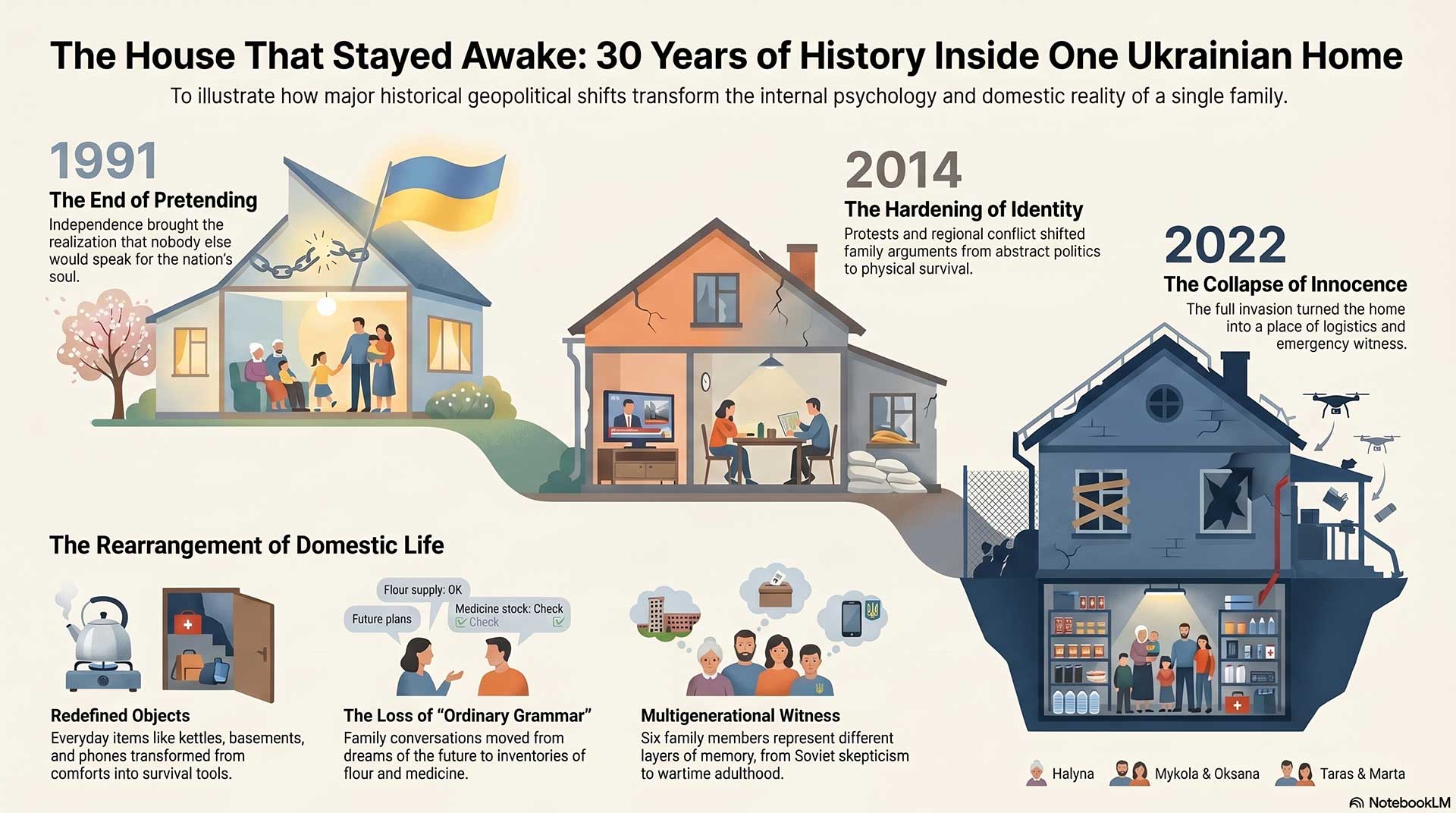
What remains after this story is not a single scene.
It is a changed atmosphere.
That is what I wanted the ending of The House That Stayed Awake to leave behind. Not the feeling that everything has been explained, and not the feeling that everything has been resolved. What remains is the sense that a family has crossed into a different moral climate and will never again live inside the earlier air.
The war changes the meaning of ordinary things. That is one of the most painful truths in the story.
A kettle is no longer just a kettle.
A hallway is no longer just a hallway.
A document folder is no longer just paper.
A basement is no longer just storage space.
A phone is no longer just a phone.
Even light itself changes. A lit room no longer means safety. It means visibility, charge, warmth, temporary shelter, or waiting.
What I found most moving in this story is that each family member meets this transformation differently.
Halyna meets it with old memory and disciplined fear.
Mykola meets it with burdened dignity.
Oksana meets it through tasks, which is her form of courage.
Taras meets it through readiness and inward hardening.
Marta meets it as the generation that must absorb war directly into youth.
Serhii meets it through difficult honesty, resisting the temptation to turn a wounded country into a simple slogan.
That difference matters. It keeps the story human.
No one here is only symbolic. Each person carries history, but each person is still a person first. That was important to protect. I did not want the grandmother to become “Soviet memory” and nothing else, or the son to become “2014 nationalism” and nothing else. I wanted them to remain intimate, flawed, loving, difficult, and recognizable inside the pressure of history.
I think one of the deepest truths in the story is that war does not only destroy. It rearranges. It rearranges time, language, domestic space, family roles, and the inner scale by which people measure danger. Long before a house is physically destroyed, it may already have lost its earlier innocence. That, too, is damage.
And yet the story does not end in emptiness.
It ends in endurance, but not the cheap kind. Not the heroic pose that hides cost. It ends in the more difficult form of endurance: people still sitting at the same table after history has changed the meaning of sitting there.
That is why I think the title remains right all the way to the end.
The house stays awake.
It does not remain untouched.
It does not remain peaceful.
It does not remain innocent.
But it stays awake.
To memory.
To fear.
To love.
To duty.
To what has been taken.
To what must still be named truthfully.
For me, that is where the emotional force of this story lives. Not in victory, and not in despair, but in the difficult refusal to let war become the only language in the room.
Short Bios:
Halyna Kovalenko is the grandmother of the family and the keeper of long memory. She remembers the Soviet years with neither sentimental blindness nor easy simplification. Her skepticism gives the household depth, discipline, and historical scale.
Mykola Kovalenko is the father, shaped by the dignity and disappointment of post-1991 independence. He believes deeply in Ukrainian statehood, though not romantically. His love for the country is steady, sober, and costly.
Oksana Kovalenko is the mother and the domestic center of the house. She understands history through food, medicine, routines, and the fragile work of keeping people alive. Her realism is one of the strongest moral forces in the story.
Taras Kovalenko is the older son, marked most deeply by 2014. He is intense, vigilant, and morally sharpened by what he sees as the end of illusion. He carries the family’s anger, urgency, and readiness.
Marta Kovalenko is the younger daughter and one of the main emotional lenses of the story. She belongs to the generation shaped directly by 2022, where war enters identity, friendship, memory, and adulthood all at once.
Serhii Melnyk is the family’s bridge to the east and to complexity itself. He resists easy narratives and carries the lived truth that language, region, and loyalty were never as simple as wartime categories suggest.
Nick Sasaki is a writer and curator of emotionally serious historical fiction, imagined conversations, and morally layered stories focused on memory, war, family, identity, and the long afterlife of public events inside private lives.
Leave a Reply