
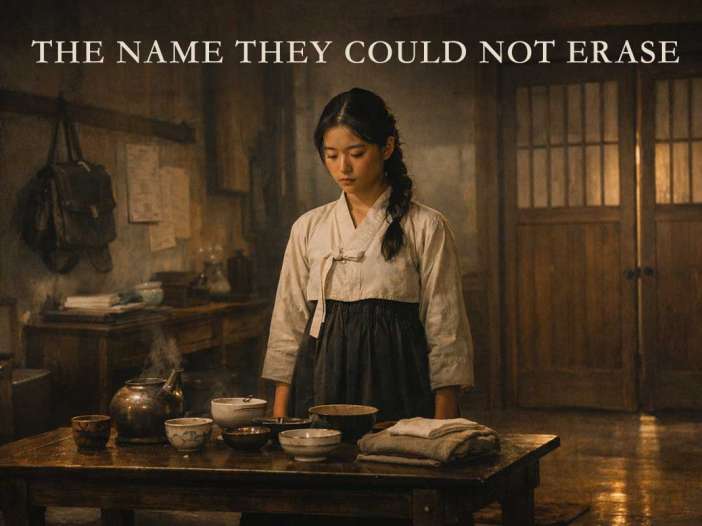
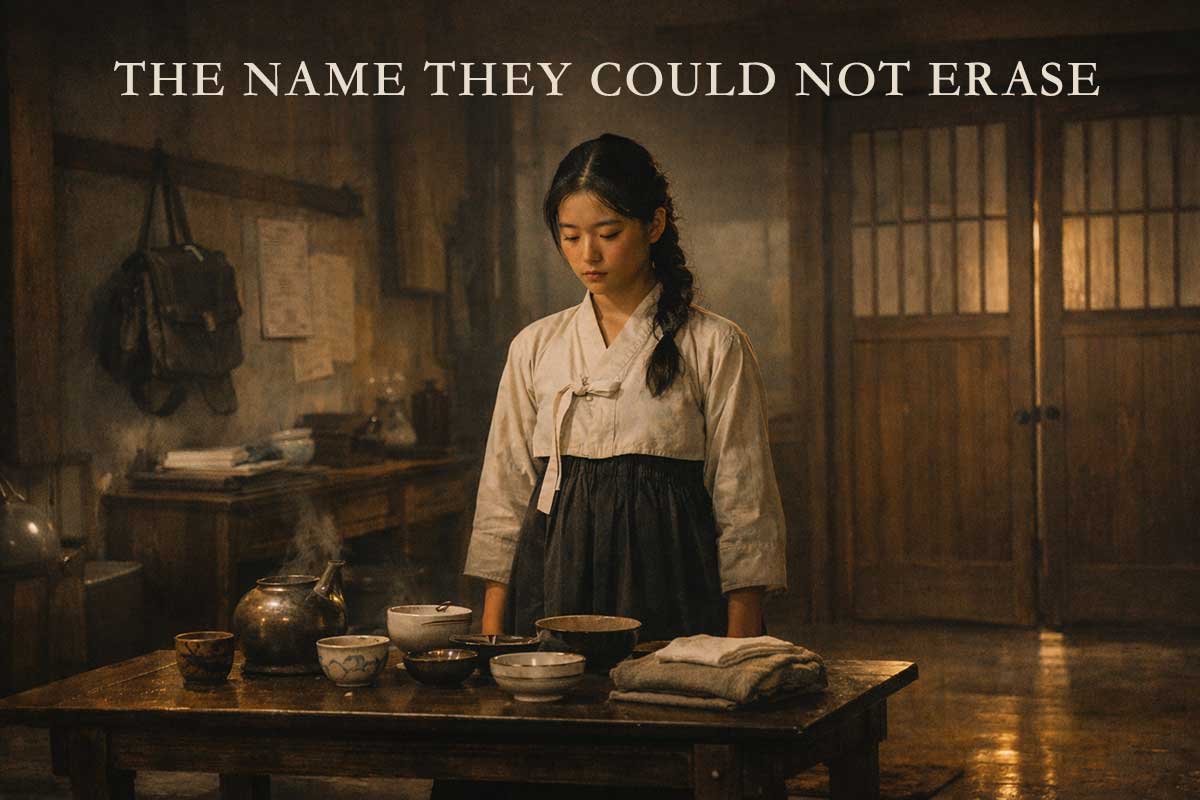
Introduction by Nick Sasaki
Some stories of occupation begin with soldiers, flags, and official decrees.
This one begins with breakfast.
That matters.
The Name They Could Not Erase is built from the slow pressure of daily life, not from a single explosion of history. A mother prepares food. A father watches the outside world with growing caution. A daughter learns to speak one way at school and another way at home. A younger brother brings back the language of discipline before he understands its cost. A grandmother sits in the middle of the house like the last keeper of an older truth.
That is where this story lives.
Not in policy alone.
Not in dates alone.
In the house.
This story is about Korea under Japanese rule, but its deepest movement is inward. It asks what happens to a family when public control enters private life so gradually that people begin changing before they can fully name what is happening. The school changes the children first. Paperwork follows. Rituals follow. The pressure to fit, to obey, to survive, to avoid danger, to protect the future by surrendering part of the self — all of it enters through ordinary days.
That is what makes the story painful.
A violent event can shock a family all at once.
A colonial system can do something quieter and, in some ways, more haunting: it can teach people to divide themselves.
Inside and outside.
Home and school.
Real name and official name.
Private language and public language.
Inner truth and performed safety.
At the center of this story is Seo-young, who feels that split before she can fully explain it. She is intelligent enough to succeed inside the system, and that is part of her sorrow. The better she performs, the more she feels something inside her thinning. That is a very human wound, and one I wanted to keep close to the surface without turning it into speech too quickly.
Her father, Seong-ho, carries another kind of burden. He is not weak. He is not grandly heroic. He is a man trying to protect his family in conditions where every compromise leaves a mark on the soul. Her mother, Jeong-hui, sees practical danger earlier than anyone else and accepts realities the others would rather resist, not from coldness, but from love. Her grandmother understands that names and language are not administrative details. They are lived memory. Her brother, Dong-min, shows how power first enters the home through imitation, reward, and habit.
That was one of the most important things for me in this story: the system does not reach the family only through fear. It reaches them through normalcy. Through praise. Through school routines. Through things that seem manageable until they begin to change the shape of the home itself.
I did not want this to be a story that simply says, “This was terrible,” though it was.
I wanted it to ask a more difficult question:
What does a family become when survival requires adaptation, but adaptation keeps cutting into identity?
That is why the title matters so much.
A name is not just a label here. It is inheritance. Time. Belonging. The sound by which a person has been called into the world by those who love them. To threaten a name is to threaten continuity itself. And yet the story does not become dramatic only at the moment of official pressure. It becomes dramatic in the kitchen, at the table, in the pauses between parents, in the grandmother’s voice, in the daughter writing her name alone.
For me, the deepest sadness in this story is not only that something is taken.
It is that the family must go on living while it is being taken.
And when liberation finally comes, the story does not pretend that freedom repairs time. Names may return. Language may return more openly. But the years remain changed. The habits remain. The inward divisions remain. That too is part of the truth.
This is a story about what occupation does to ordinary life.
It is a story about what a home can still protect.
And it is a story about the parts of identity that survive, not untouched, but unextinguished.
Chapter 1 — When Korean Was Still Spoken at Home
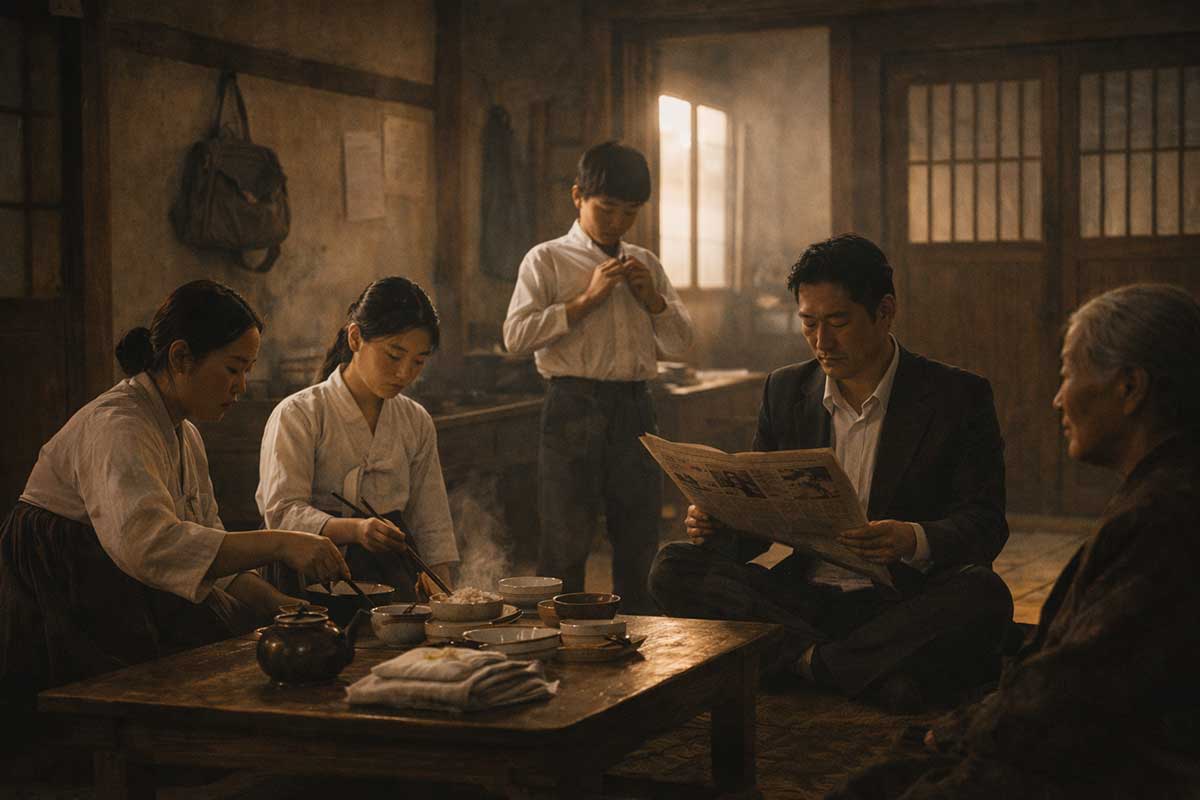
The morning steam still belonged to the house.
Park Jeong-hui lifted the lid of the pot and checked the rice through the pale white cloud rising into the kitchen air. The fire beneath it had settled into the right kind of heat, steady and low. The red glow of the coals, the faint tremble of the pot’s shadow, the smell of breakfast beginning — on most mornings, these things made the day feel manageable.
“Seo-young, hand me that bowl.”
“Yes.”
Yoon Seo-young took the small dish down from the shelf and set it beside her mother without making a sound. At seventeen, she no longer moved like a child inside the house. She already knew what her mother would need before she asked. Jeong-hui was grateful for that, though sometimes it pained her too. Girls who noticed everything also noticed what they should never have had to carry.
“Dong-min, get up.”
From the back room came no answer.
Then, after a rustle of blankets, a sleepy voice: “I’m up.”
“That is not the voice of someone who’s up,” Seo-young said.
A moment later, her younger brother shuffled into view, hair still uncombed, looking half buried in sleep. He was thirteen, still carrying traces of boyhood in his face, though he had already begun to dislike anything that made him seem young.
“I said I’m up.”
“You still look asleep.”
“You’re loud in the morning.”
Seo-young almost smiled. Her mother did too.
Then a low clearing of the throat came from the other room.
Their father, Yoon Seong-ho, was already seated at the table.
A newspaper lay open in front of him. Yet he did not look as though he were reading it so much as staring at it in order not to look elsewhere.
“You’ll be late if you don’t eat,” Jeong-hui said.
He answered with a small sound.
Their grandmother slowly straightened where she sat. In her old age, she seemed to listen to a house before fully entering the day. She heard the doors, the steps, the rhythm of pots and the way the air moved in the rooms.
“The outside sounds uneasy today,” she said.
The room went still.
Jeong-hui had noticed it too. Doors were shutting earlier than usual. Footsteps moved through the street with no looseness to them. Even the morning sounds seemed hurried.
Seo-young felt the silence after her grandmother’s words more sharply than anyone.
Breakfast was set out. Steam rose from the bowls. Each place at the table was familiar: the grandmother’s seat, the father’s place, her brother’s place, her own. It looked like every other morning.
Only it did not feel like every other morning.
“What do you have at school today?” Jeong-hui asked Dong-min.
“Morning recitation. And composition.”
“Another composition?”
“The teacher says it’s important.”
He answered using a stiff expression he had picked up at school, a phrase that sounded too polished, too formal, inside the walls of home.
The grandmother frowned at once.
“You don’t need to speak like that in here.”
Dong-min blinked. “That’s how we say it at school.”
“School is school.”
Her voice was not loud. It did not need to be.
Seong-ho spoke without raising his head. “Outside, do what you must. But don’t wear the same face inside this house.”
He was not angry. He was trying to protect something. That made his words heavier.
After breakfast, Seo-young and Dong-min got ready to leave. At the gate, he nearly used the same school tone again, and she lightly tugged at his sleeve before he finished. He understood and stopped.
“Be careful outside,” their mother said.
She said it every morning, but lately the meaning had changed. It no longer meant simply don’t trip or don’t be late. It meant: do not let the wrong expression live too long on your face.
Once they stepped beyond the gate, Seo-young changed her voice without thinking. Dong-min did the same. The softer language of the house gave way to something safer for the street and the classroom.
He did not seem to feel the change.
She always did.
There was a small pain in it. It was like leaving part of herself behind with every step away from home.
At school, everyone seemed already arranged into a different version of themselves before the day had even properly begun. By the time Seo-young returned that evening, her father had come home wearing the heaviness of whatever he had seen outside.
He sat down and said, “They are speaking again at the offices. About the schools. About the district.”
“What kind of talk?” her mother asked.
“The kind that means the children need to be careful.”
Dong-min straightened. “I’m doing everything right.”
His grandmother heard the same borrowed tone in him again, and her mouth tightened.
Seong-ho looked at his son. “Doing things well is not the same as forgetting who you are.”
Dong-min did not fully understand the difference. Seo-young understood it too well.
That night, after supper, her grandmother said quietly, “If they change the names and the language inside the house, what is left?”
No one answered right away.
Later, alone in the quiet, Seo-young looked around the room — the grandmother’s place, the desk, the bowls, her mother’s folded cloths — and understood for the first time that the language inside their home no longer felt merely natural.
It felt protected.
And anything protected could be lost.
Chapter 2 — When School Began Entering the House
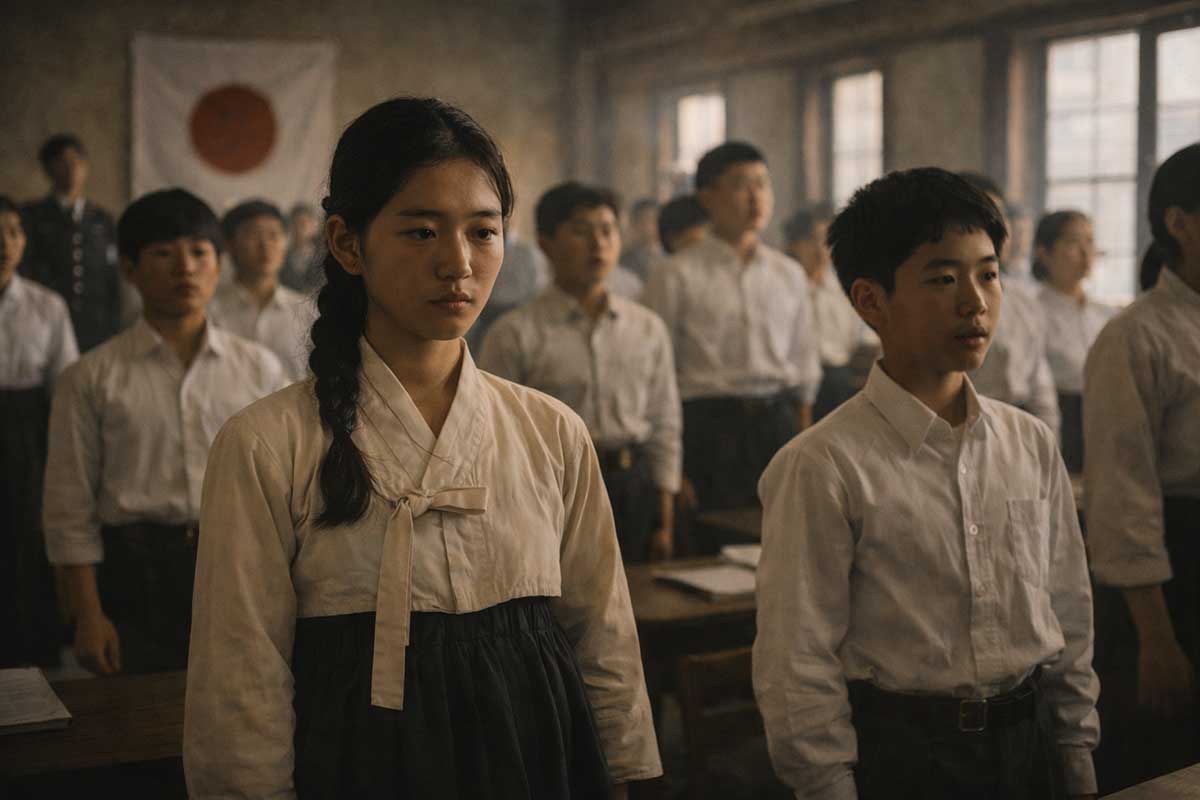
The schoolyard had a cold order to it.
Seo-young stood in line, eyes lowered toward the dirt, while the morning ritual unfolded around her. The rows were exact. The voices came in sequence. One voice first, then all the others after it, merged together until no one sounded like an individual at all.
She spoke when the others spoke. Her tone was correct. Her posture was correct. Her timing was correct. She knew how to do everything expected of her.
That was part of what made it painful.
The better she performed, the more it felt as though some inward distance grew wider.
Beside her, Dong-min recited with far less hesitation. He was still young enough to enjoy praise for getting things right. That innocence made Seo-young ache more than if he had been openly rebellious.
Later, in class, the teacher spoke about language.
“Proper speech must become habit,” he said. “Outside and inside. In school and beyond.”
That phrase lodged inside her.
Outside and inside.
At lunch, a girl near the window whispered, “My mother says we must be careful even at home.”
Another said, “Mine says not to talk about school once we’re back.”
Seo-young listened without joining in.
Either way, the same thing was happening. School was no longer ending at the school gate.
It was entering the rooms of the house.
On the walk home, Dong-min was in good spirits.
“The teacher praised my composition,” he said. “Said I read it well.”
“That’s good,” Seo-young answered.
He heard only the words, not the shadow beneath them.
“If you do things properly, they notice. The teacher isn’t some terrible man.”
Seo-young did not know what to say. For him, praise still felt uncomplicated.
At home, he repeated a school expression again, and again the grandmother stopped him.
“Not in here.”
He frowned this time. “Why does it matter so much?”
“Because it starts small,” she said.
Their mother came in from the kitchen, sensing the tension before a raised voice ever appeared.
“Wash your hands,” she told him.
“But—”
“Go.”
After he left, the grandmother murmured, “A child’s mouth changes quickly.”
Jeong-hui answered, “He doesn’t yet know what weighs what.”
“That is why I’m afraid.”
When Seong-ho returned that evening, the matter deepened.
“There is talk now,” he said, “that habits begin in the home.”
His wife looked at him sharply. “They can’t see inside the house.”
“It isn’t a question of seeing. It’s a question of what becomes natural.”
That frightened Seo-young more than any formal order could have. Habits. Nature. The things that begin as performance and become instinct.
In the kitchen later, Jeong-hui told her daughter softly, “At school, be as school requires.”
The words were not unkind. They were protective.
Still they hurt.
“Must it be like that?” Seo-young asked.
“If it keeps this house safer, yes.”
Her grandmother overheard and answered from the other room, “Say yes to everything long enough, and one day there is nothing left inside to protect.”
Neither woman was wrong. That was the cruelty of it.
That night Seo-young sat with her notebook open and understood something she had not wanted to admit: she was not only afraid of punishment.
She was afraid of becoming good at it.
School had begun to enter the house, not through force alone, but through the voices and gestures the children brought home with them.
And the family was already changing to meet it.
Chapter 3 — What It Means to Change a Name
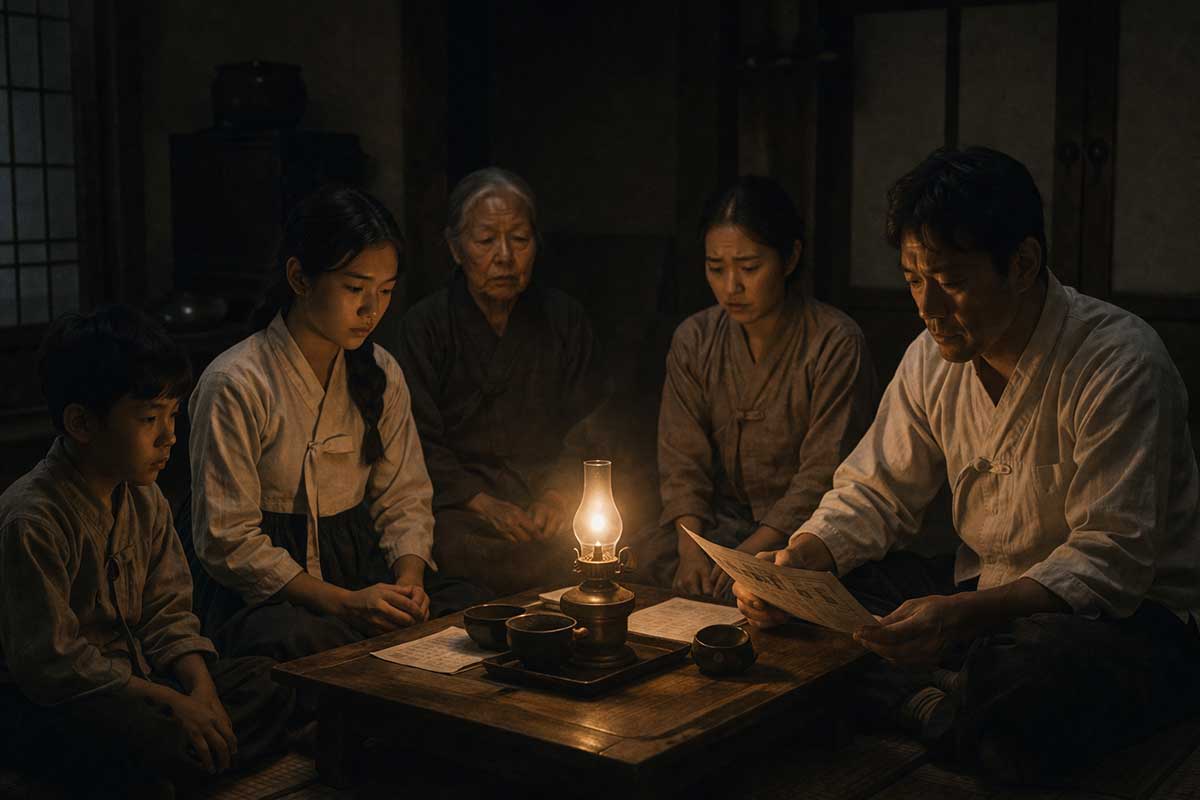
At first it entered the house as rumor.
Someone had heard something at an office. Someone else said the schools were already speaking of it. One family was said to have made a decision. Another was waiting.
By the time Seong-ho brought the matter home in words, it had ceased to be rumor.
“It’s about names,” he said that night.
No one moved.
He stood by the table with a sheet of paper in his hand, lifting it, setting it down, lifting it again.
“The talk now is that more families will begin changing the family name into Japanese form.”
The grandmother spoke first.
“What are you saying?”
Seong-ho lowered his eyes. “That this is where things are headed.”
Jeong-hui asked, “Will it be required?”
He hesitated. “Maybe not in the absolute sense. But what happens to those who refuse will speak for itself.”
That answer was heavier than a direct command would have been.
Seo-young silently repeated her own name to herself.
She had heard it from her mother’s mouth in illness, from her grandmother in the kitchen, from her father in his quiet way, from her brother in teasing and irritation and affection.
What would it mean for that sound to be replaced?
Dong-min, not yet understanding the full force of the moment, said the thing no one else dared.
“But isn’t it only a name?”
The silence that followed felt physical.
His grandmother turned toward him. “Only a name?”
Her voice remained low, which made it worse.
“A name is not a scrap of paper. A person is called by it for years. Parents call it. Grandparents call it. A house fills with it. The dead pass it forward. You think that is little?”
Dong-min lowered his head at once.
He had not meant to wound anyone. That only made it more painful. He had spoken from the place where a child still believes practical adjustment and inner meaning are separate things.
That night, after dinner, the parents spoke quietly near the back room.
“If we refuse, it may affect the children,” Jeong-hui said.
“I know.”
“School records. Future work.”
“I know.”
His voice was tired, not defensive.
He wanted to resist. She wanted the children protected. Neither could dismiss the other.
Later, the grandmother called Seo-young to sit beside her.
“What are they saying at school?”
“Not openly. But people are talking.”
“And you? What do you think?”
Seo-young found no easy answer.
At last she said, “I don’t want it.”
The old woman nodded. “Then do not let yourself forget that.”
“But if it happens anyway?”
“Paper is not the whole of a person,” her grandmother said. “Even if it changes on paper, you do not have to erase it in your own mouth.”
That comforted Seo-young and burdened her at the same time.
The next day, at school, the matter felt more real. It moved in whispers through the corridors and across desks. Some families were ready. Some hesitant. Some already looked defeated.
Seo-young wrote her name in the margin of her notebook and stared at it.
If another sound replaced it in the classroom, would she remain herself?
The question was too large for a girl her age. But she was already old enough to have to carry it.
At home, Dong-min apologized awkwardly.
“I didn’t mean what I said yesterday.”
“I know,” Seo-young answered.
“Is a name really that important?”
She thought for a moment.
“It isn’t only important,” she said slowly. “If it changes, it can make you feel as if you’ve lost where you came from.”
That night their father said only, “We will not decide yet.”
No one answered him.
Because everyone understood that not deciding was already its own form of pain.
Before sleep, Seo-young repeated her own name silently in the dark.
Not as a gesture of defiance.
As a way of making sure it was still there.
Chapter 4 — When War Begins to Steal the Family’s Future
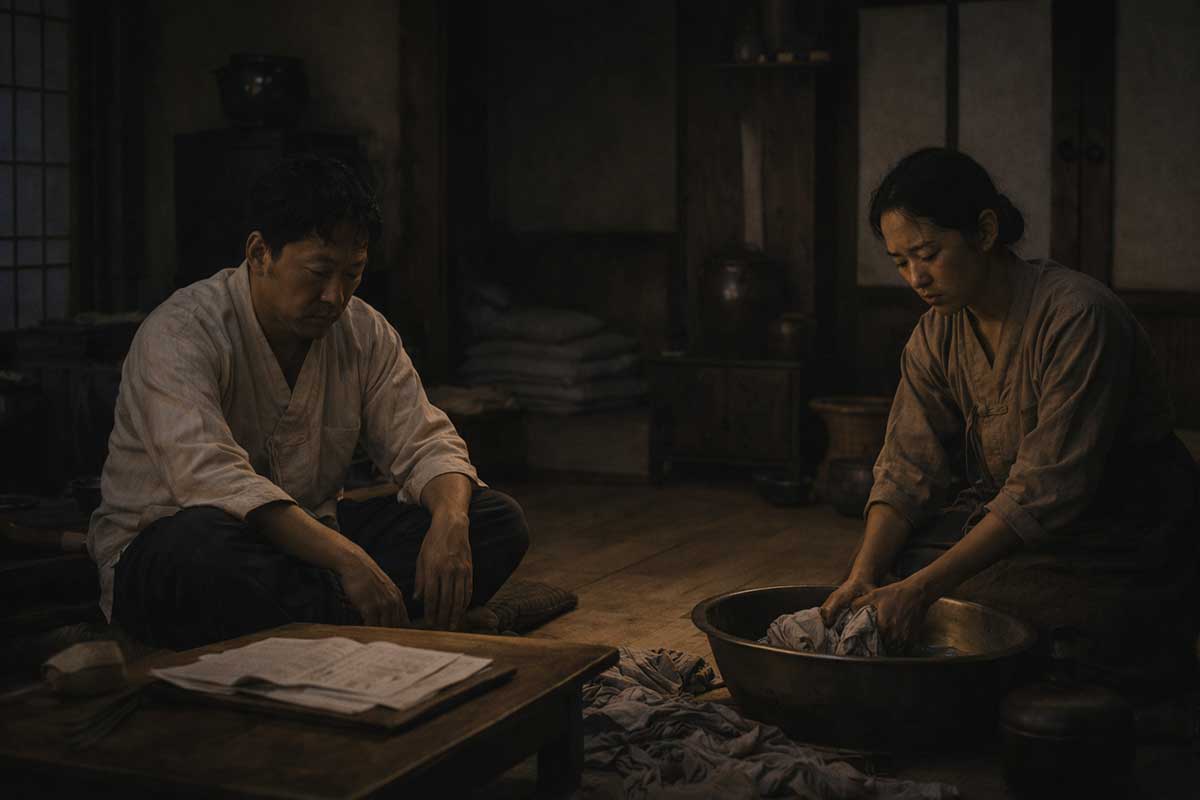
After a while, the future inside the house grew shorter.
Once, they had spoken of next year. Whether Seo-young might continue her studies. What kind of man Dong-min might become. Whether life might grow a little easier for their mother.
Now they spoke in smaller units.
This week.
This month.
Tomorrow.
At school, the atmosphere tightened without becoming louder. Morning discipline lengthened. Expectations about posture, speech, and loyalty grew narrower. The teacher spoke of the future as something granted to those with the proper spirit and correct attitude.
It no longer felt as though learning belonged to the students themselves. It had become linked to something larger, harder, and less human.
Dong-min, for a time, was drawn toward it.
He came home speaking of praise, advancement, effort, recognition. He had begun to imagine that if he did everything correctly, perhaps something good would open ahead of him.
“Father,” he said one evening, “if I do well, maybe I’ll be noticed.”
The family table went still.
“Noticed for what?” Seong-ho asked.
Dong-min hesitated. “For doing what’s expected. For being useful.”
His father repeated the word softly. “Useful.”
The word itself sounded tired.
Jeong-hui stepped in gently. “He doesn’t mean anything wrong.”
“I know,” Seong-ho said. “That is exactly why it hurts.”
Later, Seo-young tried to explain it to her brother.
“It isn’t wrong to want to be praised,” she said. “But sometimes you have to ask what you’re being praised for.”
He frowned. “You think too much.”
Maybe she did. But not thinking seemed more dangerous.
Outside the home, official pressure grew harder to ignore. Records, forms, attendance, names, conduct — all of it now seemed designed not simply to organize lives but to narrow them.
One evening Seong-ho came home with the look he wore when something small and terrible had happened.
“What is it?” Jeong-hui asked.
“Nothing large,” he said.
Which usually meant the opposite.
“School records. More reviews. More corrections.”
Paperwork. Only paperwork.
Yet everyone knew by now that this was how things entered the soul of a family: not always through dramatic events, but through repeated adjustments that asked them to become someone else one line at a time.
That night the grandmother asked him quietly, “What is it you are protecting?”
“The family,” he answered.
“Yes,” she said. “But a family is not only walls and a roof.”
He did not reply.
Jeong-hui’s exhaustion was becoming visible too. She did not collapse. She simply kept moving. Cooking. Sewing. Managing school matters. Softening the room when father and grandmother pulled in different directions. Holding together what she could.
Her strength did not come from fearlessness. It came from having no permission to stop.
One evening Seo-young asked her, “Are you afraid?”
Jeong-hui rinsed her hands and answered simply, “Yes.”
That answer shook her daughter more than denial would have.
“But life keeps coming,” her mother said. “Meals still need to be made. Clothes washed. School still comes in the morning.”
She was right. That made it harder.
Dong-min changed most deeply after hearing a classmate speak about his father.
“He filled out the papers,” the boy had said, “and after that he wouldn’t look me in the face.”
The words stayed with Dong-min.
That night he was quiet.
Later he asked Seo-young, “Do you think Father does things he hates for us?”
She could not soften the truth.
“Yes,” she said.
For the first time, he began to understand that what he had accepted as order or achievement might be tied to his father’s inward humiliation.
The war still seemed far away in its largest form.
Yet it was already taking things from the house:
the future,
the natural shape of speech,
the ease of family closeness,
the confidence that tomorrow still belonged to them.
The house remained standing.
But its future no longer felt fully its own.
Chapter 5 — On the Day of Liberation, Nothing Fully Returns
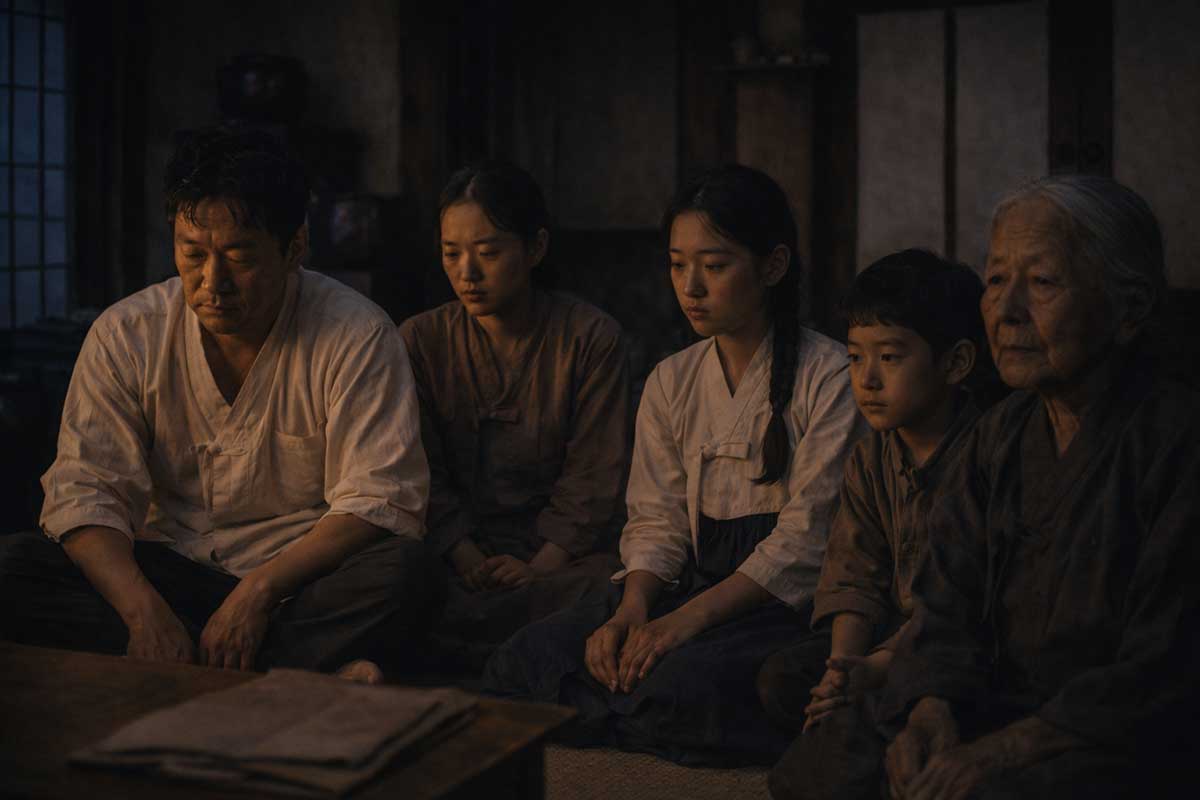
When the news came, no one in the house shouted.
Outside, the street was full of movement. People ran, stopped, stared, spoke in bursts, turned to others for confirmation. Some faces looked as though they might laugh. Others looked as though they might cry. It was impossible to tell relief from shock.
Seo-young stood by the gate and watched the road.
Something had ended.
Her body did not know yet how to receive that fact.
Dong-min came first, breathless.
“They’re saying it’s over.”
He lowered his voice after speaking, as though he still did not trust the air enough to hold those words safely.
In the kitchen, Jeong-hui had stopped mid-motion. Their grandmother sat upright, saying little, though her hands trembled faintly where they rested.
Seong-ho had not yet returned. His absence made everything feel suspended.
When he finally entered, one look at his face told them it was true.
“Is it over?” Jeong-hui asked.
He looked at each of them before answering.
“Yes.”
Nothing more.
And yet the room changed.
Dong-min began, “Then now—” and stopped. He did not know what came after now.
Now could mean too many things.
Jeong-hui let out a long breath. Not a sob. Not a laugh. Just the body releasing what it had held too long.
That evening Seong-ho took out old papers and sat before them in silence. Then, in a voice almost too quiet to hear, he said his own name.
“Seong-ho.”
A moment later, more firmly: “Yoon Seong-ho.”
His mother looked at him and answered, “Yes. That is your name.”
The exchange was small. Yet it felt larger than any public declaration.
Jeong-hui set a cup of hot water beside him and said, “That doesn’t mean everything comes back.”
“No,” he answered. “It doesn’t.”
Dong-min, now quieter than he had once been, said, “I didn’t understand so much.”
His father looked at him for a long time. “Children are not meant to understand everything.”
That only made the sorrow sharper. He had been made to carry too much anyway.
The next morning the house sounded different.
The grandmother noticed it first.
“The sound of the house has changed,” she said.
“What do you mean?” Jeong-hui asked.
“The language.”
It was true.
The same words were being spoken, yet now they struck the ear with a different force. Once they had simply been natural. Now they sounded like something recovered — not fully, not easily, but unmistakably.
Seo-young stood outside in the morning light and understood that liberation did not feel like a clean victory.
It felt more like beginning to count what had been taken.
The years.
The hesitations.
The habits of caution.
The selves they had been forced to perform.
Names might return. Language might return. But lost time did not.
Still, something had remained through all of it.
The old sounds.
The grandmother’s insistence.
The mother’s endurance.
The father’s silence.
The brother’s late awakening.
The daughter’s inward witness.
That evening, when the family sat together once more, Seong-ho called his daughter by her name.
“Seo-young.”
Nothing dramatic hung in the word. That was what made it powerful. It was the sound of the house reclaiming something true.
She looked up at him. He did not lower his eyes.
In that moment she understood:
Not everything returns.
But not everything can be erased.
Final Thoughts by Nick Sasaki
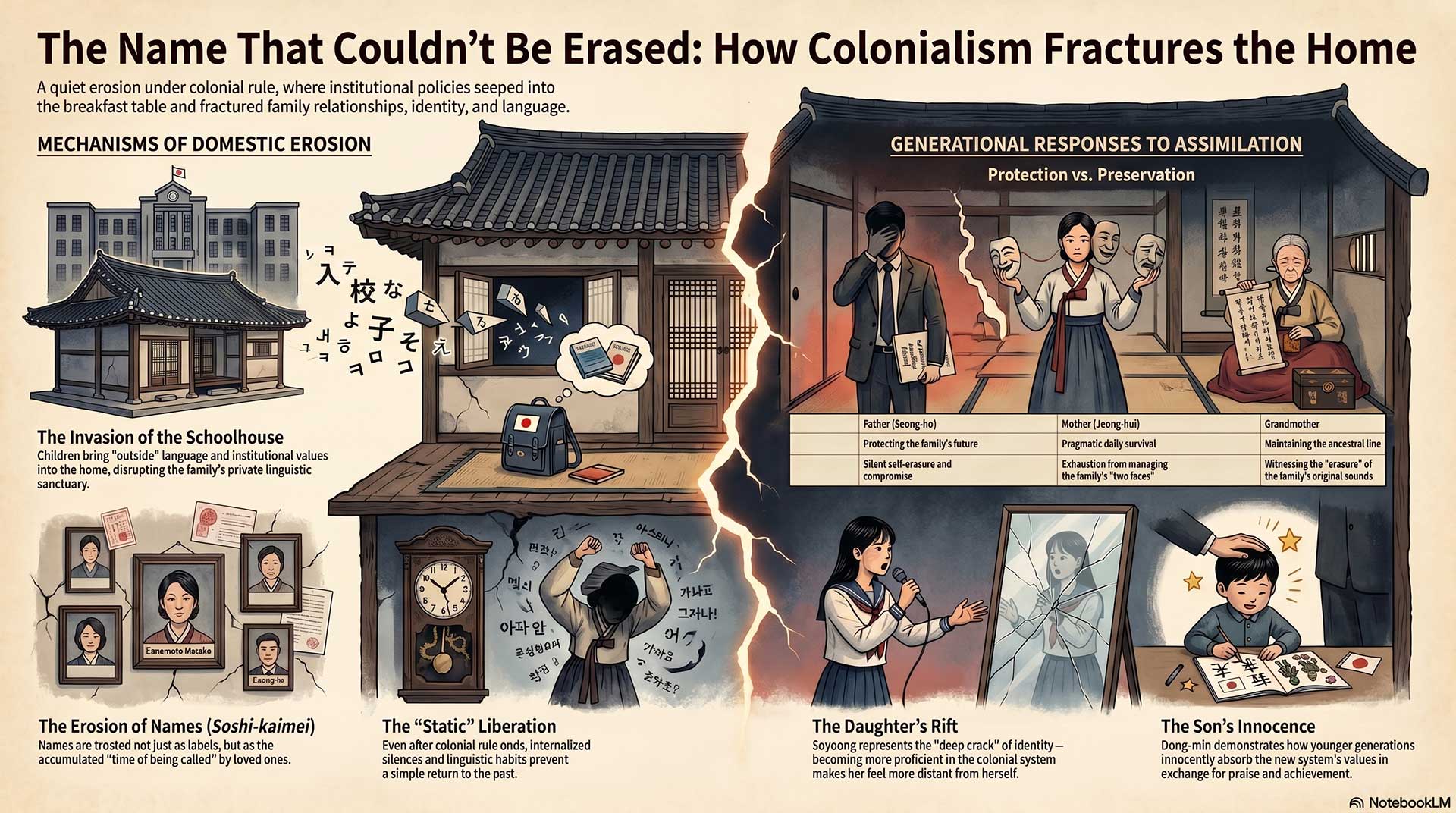
When this story ends, it does not end in triumph.
That feels right to me.
Liberation arrives, yes. The family hears the news. The father speaks his own name again. The old sound returns to the house. That moment matters deeply. Yet the story refuses to pretend that history can simply hand back what it has already taken.
That refusal gives the ending its weight.
Too many stories about occupation or empire move toward one of two extremes. They either become large and distant, turning people into examples of history, or they compress everything into suffering alone, leaving no room for the quieter ways human beings are changed. This story avoids both. It stays close to the house. It lets the historical pressure remain visible, but it keeps asking what it does to speech, to shame, to family roles, to children, to the future itself.
That is where its emotional truth lives.
For me, one of the strongest things in the story is that nobody is simple.
Seong-ho is not merely passive. He is carrying the cost of protecting others through compromise.
Jeong-hui is not merely practical. She is bearing the cruelty of choosing survival over purity again and again.
Seo-young is not merely wounded. She is becoming the witness who understands what is changing before the others can bear to say it aloud.
Dong-min is not merely naive. He is the child through whom the system enters the home, and later the child who must live with that realization.
The grandmother is not merely stubborn. She is the memory of continuity, the person who knows what names and language actually hold.
That complexity matters. It keeps the story human.
I think one of the most painful details in the whole piece is not a major event, but a small one: a borrowed school phrase spoken at home. That is how private life begins to thin. Not always through catastrophe first, but through rhythm, habit, correction, imitation, reward. The story understands that. It understands that the deepest violence of cultural erasure is often quiet.
It changes not only what people say, but how they prepare to speak.
How they listen.
How they decide what can be said in one room but not another.
How children learn to switch faces before they are old enough to know the cost.
That is why the return at the end cannot be total.
A true name may be spoken again.
A language may breathe more freely again.
But the family that hears those sounds is no longer the one that began the story.
Time has done its work.
That is not despair. It is recognition.
And I think recognition is the real gift of this story.
It recognizes that survival is not the same as wholeness.
It recognizes that restoration has limits.
It recognizes that what cannot be erased is not innocence, but something more stubborn: memory, inner truth, and the old sound of belonging that survives under pressure.
So what remains at the end?
Not victory.
Not simple healing.
Not innocence recovered.
What remains is a house where something true has survived long enough to be spoken again.
For me, that is more moving than a cleaner ending would have been.
It leaves behind not satisfaction, but dignity.
And that is why the story lingers.
Short Bios:
Yoon Seo-young
Seo-young is the emotional center of the story, a teenage girl sharp enough to feel the split between public performance and private truth before she can fully explain it. She becomes the inward witness of her family’s slow transformation.
Yoon Seong-ho
Seong-ho is the father, a careful and burdened man trying to protect his family under colonial pressure. His compromises are never clean, and his silence carries much of the story’s moral weight.
Park Jeong-hui
Jeong-hui is the mother and practical center of the house. She understands that survival demands choices the others may resist, and her strength comes from continuing to hold daily life together when nothing feels simple anymore.
Yoon Dong-min
Dong-min is the younger brother, still young enough to absorb the values of school before he understands their cost. His gradual awakening shows how power enters a family through children first.
Grandmother
The grandmother is the keeper of memory, language, and the deeper meaning of names. She understands that what seems small to others may be the very thing that holds a people together.
Kim Hyeon-u
Kim Hyeon-u is the young neighbor who brings outside changes into the family’s awareness. He represents the younger generation’s alertness to danger and the feeling that even those who see clearly may still be unable to stop what is coming.
Nick Sasaki
Nick Sasaki is a writer, curator, and creator of emotionally serious stories and imagined dialogues centered on history, memory, morality, family, and the hidden afterlife of trauma. His work often focuses on what remains inside people after public events have passed.
Leave a Reply