
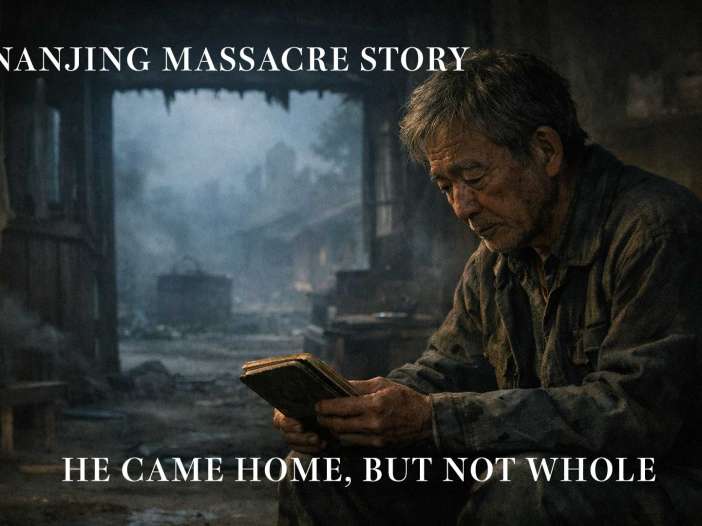
What if the worst part of war began only after the soldier came back to Japan?
Some stories are painful because of what happens.
Others are painful because of what keeps happening long after the event is over.
This story belongs to the second kind.
Nanjing Massacre Story: A Japanese Soldier Who Could Never Come Home is not written to excuse evil, soften history, or blur moral responsibility. It is written to face a harder question: what happens when an ordinary person is swallowed by war, shaped by fear, trained to obey, and then forced to live the rest of his life with what he became and what he failed to stop.
Koichi Murakami begins as a quiet young man in a rural Japanese village. He has a mother, a father, a younger sister, and the kind of small daily life that feels almost sacred once it is lost. He is not introduced as a monster. He is introduced as someone recognizably human. That is what makes the story hurt.
As the story moves from village to training ground, from training ground to China, and from China to Nanjing, the deeper tragedy is not only the violence itself, but the slow stripping away of inner resistance. The story asks a disturbing question that history has forced us to ask many times: not only how cruelty happens, but how it becomes normal enough for people to keep moving inside it.
Yet the emotional center of this story is not only Nanjing. It is what happens after. Koichi returns to Japan alive, but he does not return whole. The real war begins again in his own house: in the sound of a dropped bowl, in the sight of his sister’s face, in the quiet tenderness of his wife, in the notebook he opens night after night because silence is no longer enough.
This is a story about guilt without easy release. About remorse that does not erase what happened. About memory that does not weaken just because the years pass. Most of all, it is about a late honesty that arrives too late to save the past, yet still matters because it refuses one final lie.
That is why the story matters.
It reminds us that war does not end when the shooting stops. It continues in memory, in shame, in families, in bodies, in the private hours of those who survived what they should never have survived in the way they did.
Koichi’s final act is not redemption in any simple sense. It is smaller than that, and perhaps more truthful. He stops hiding. He writes what he can. He admits what he was, what was done to him, and what he did to others. He does not ask to be cleared. He does not pretend that confession heals everything. He simply refuses to die inside a false silence.
That is the moral weight of this story.
Not that truth fixes the past.
But that refusing truth makes the soul rot even more.
(Note: This is an imaginary conversation, a creative exploration of an idea, and not a real speech or event.)
Chapter 1 — The Well at Dawn
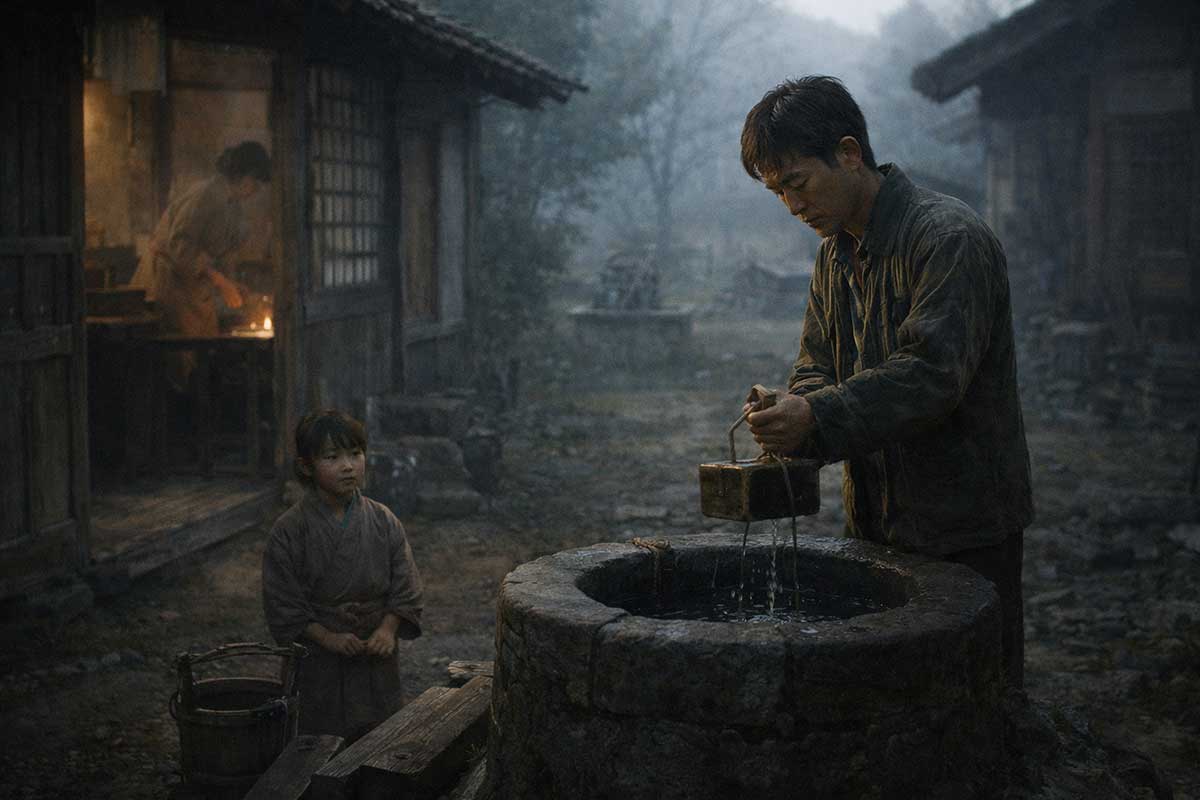
The morning air still carried the smell of earth.
Koichi Murakami drew water from the well outside his family home, lifting the wooden bucket hand over hand as the first pale light spread over the village. A rooster called somewhere in the distance. Inside the house, he could hear his mother ladling miso soup into bowls.
It was an ordinary morning. At least it looked like one.
“Koichi, it’s cold. Come inside,” his mother called.
He answered softly, carried the bucket in, and found his younger sister Chiyo waiting near the doorway, her hair still half undone.
“Are you going to the station today?” she asked.
“This afternoon.”
“Then bring me candy.”
“If I have money.”
She pouted. “Then just one.”
He smiled in spite of himself. She smiled back, relieved by the sight of it.
Their father was already seated at the table. He was a quiet man, not one for long conversation in the morning. That day his silence felt heavier than usual.
After a few moments, he set down his bowl.
“They called you to the town office.”
Koichi nodded. “This afternoon.”
“I see.”
That was all.
Yet everyone at the table knew what stood behind those few words.
After breakfast, Koichi carried firewood behind the house. An old neighbor, Tsurukichi, came hobbling up the road with a bundle on his back. Koichi hurried over to help him.
“Don’t overdo it,” Koichi said.
The old man laughed. “If I don’t overdo it, I don’t feel alive.”
When Koichi set the bundle down, the old man pulled a black candy from his pocket and handed it to him.
“Give this to your sister. You look like the sort who gives things away.”
Just then a young woman’s voice came from the road.
“Koichi.”
It was Sawa.
She had come to return a container of miso, but the moment he saw her face he knew she had heard about the summons. Once his mother stepped back inside, Sawa asked quietly, “Can we walk a little?”
They walked down the village road beside the fields, where yesterday’s rain still darkened the ground.
“Are you all right?” she asked.
He almost laughed at the question. Was he all right about the summons? About leaving? About war? About whatever waited beyond all of it?
“I don’t know,” he said.
She lowered her eyes for a moment, then said, “Come back.”
It was not encouragement. It was prayer.
He could not answer.
That afternoon, the town office handed him a paper and a future he could no longer step away from. By the time he walked home, the village looked exactly the same. Children ran along the road. Women hung laundry. A dog lay in the sun.
Only he had been pushed outside that ordinary world.
When he reached the gate, Chiyo ran out to meet him.
“Did you get my candy?”
He stopped, reached into his pocket, and gave her the black candy the old man had given him.
“Only one.”
She grinned.
Seeing that smile nearly broke him. He turned away before anyone could see his face.
He wanted to cry.
He did not.
Chapter 2 — The Night of Fear
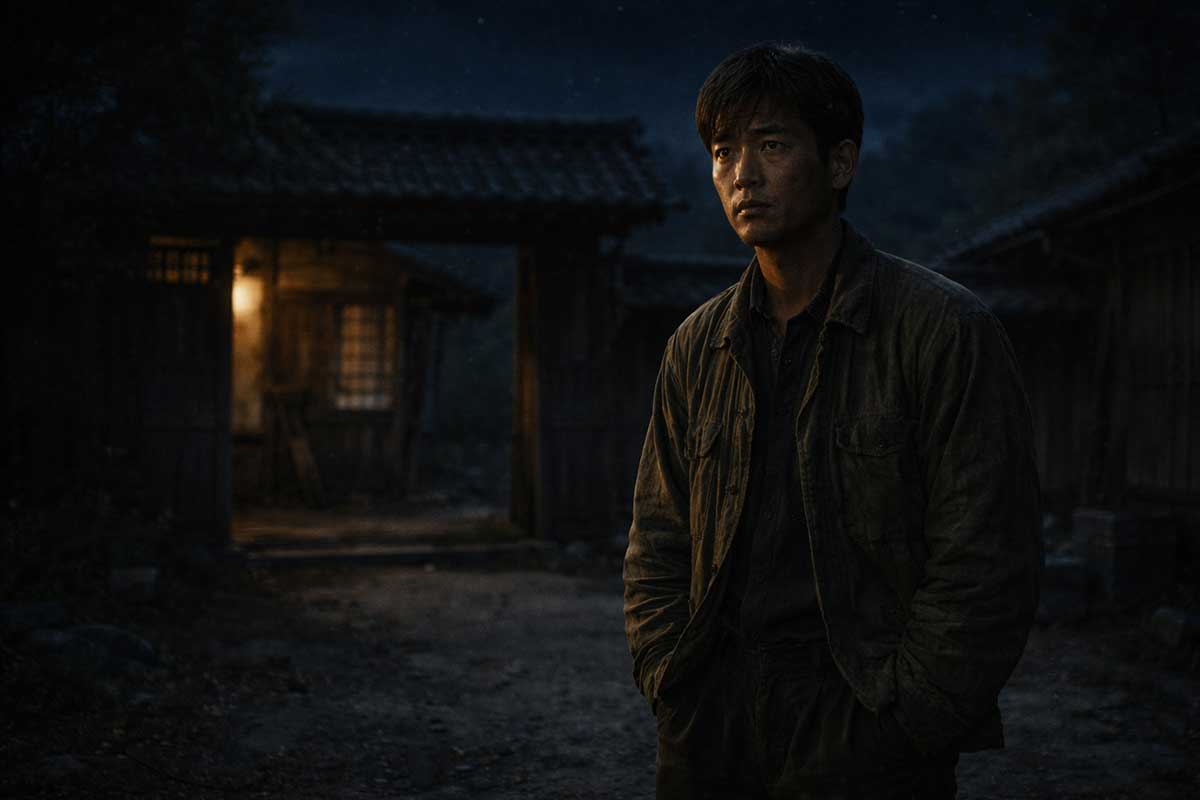
That evening’s meal was larger than usual.
Simmered vegetables. Fish. Pickles. Even eggs.
It looked almost like a celebration and almost like a farewell.
His mother moved in restless circles between the table and the stove. His father drank a little sake. Chiyo was unusually quiet.
At last his father said, “Take care of your body over there.”
“Yes.”
“Don’t ruin your stomach. Sleep when you can.”
“Yes.”
“Don’t think too much.”
That line stayed with him.
At the end of the meal, his mother handed him a small cloth charm from the shrine.
“I don’t know if it does anything,” she said, “but keep it with you.”
He thanked her. Her fingers brushed his hand. They were cold.
After the house had gone quiet, Koichi stepped outside alone.
The sky was sharp with stars. The yard was still. He stood at the gate and tried, for the first time, to let the thought settle inside him.
I may have to kill someone.
The words opened like a drop beneath his feet.
He pressed his hand against the gatepost and bit down hard, trying not to make a sound. Tears slipped down his face anyway.
Then he heard his father behind him.
“Koichi.”
He turned.
“Are you afraid?” his father asked.
The question stunned him. He could not answer.
His father nodded anyway. “Of course you are.”
He stood there for a moment, then said something Koichi had never heard from him before.
“When I was young, I had nights I feared too. Different from this. But fear all the same. I thought being a man meant pretending otherwise.”
He looked out into the dark yard.
“But fear is fear.”
Koichi stared at him.
His father had always seemed made of silence and duty, never weakness. Yet here, in the dark, he looked like a man, not only a father.
“In the morning,” his father said, “I’ll see you off.”
He paused.
“Come back.”
The next day at the station, families crowded the platform in quiet misery.
Chiyo tried to hand him her little gloves. His mother cried openly. Sawa stood apart, watching him as if trying to memorize his face.
His father rested a hand on his shoulder.
“Go,” he said.
Then, lower: “Come back.”
When the train began to move, Chiyo ran a few steps beside it, shouting something he could not hear through the sound of the wheels. His mother’s face was wet with tears. His father stood straight to the last moment. Sawa bowed her head once.
The fields, river, bridge, and mountains of home slid past the window.
A young man across from him said to no one in particular, “It’ll be over soon.”
A few others nodded.
Koichi could not.
Chapter 3 — Strip Off Your Humanity
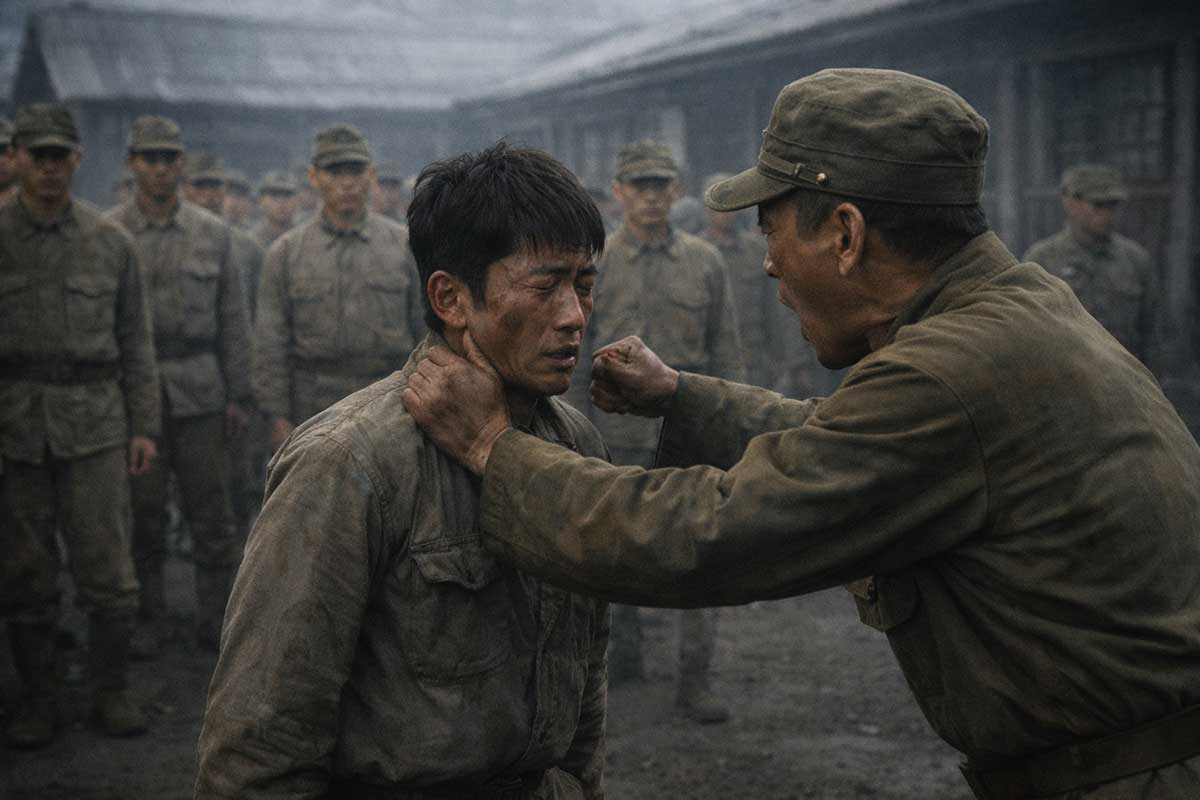
The mornings at the training camp bore no resemblance to the mornings back home.
Before dawn, a bugle tore them from sleep. Every movement afterward had to be exact: folding blankets, lining up boots, answering commands. No one explained the rules before punishing you for breaking them. You learned the rules by being hit.
One day, after a recruit answered too softly, the instructor struck him and shouted, “Before you become soldiers, strip off your humanity.”
That line stayed with Koichi.
The men training beside him were already changing. Some became cruel. Some became blank. Some learned to laugh when others were humiliated.
Koichi made the mistake of stepping toward a recruit who had collapsed during drills.
For that half step, he was beaten.
“Pity rots soldiers,” the instructor barked, driving a fist into Koichi’s stomach. “Don’t help. Don’t hesitate. Look only at orders.”
That night, one of the recruits beside him spoke softly in the dark. His name was Takase.
“Don’t do extra things,” Takase murmured. “We just have to survive.”
Later the instructors began their lectures.
“The enemy is not human.”
It was said over and over. Women, civilians, prisoners, children. Do not be moved. Do not stop. Do not let your heart get in the way.
At first those words came only from officers.
Soon the recruits themselves began repeating them.
That frightened Koichi more than the shouting did.
Then came the ship.
As the harbor receded and Japan became a line, then a blur, then nothing at all, Koichi kept his hand against the charm in his pocket. The smell of oil, iron, and crowded men filled the hold. No one wanted to hear memories of home.
Memories only made the distance worse.
Chapter 4 — The Child Beyond the Wall
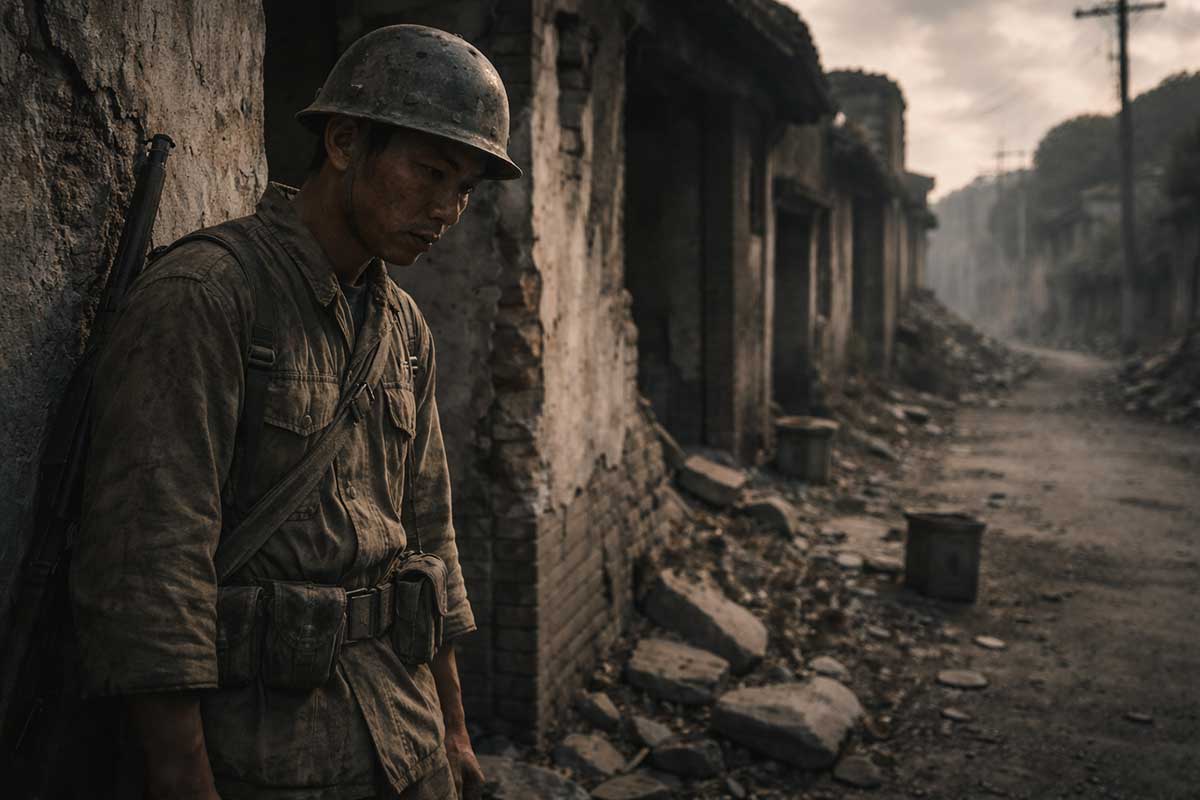
The port in China was quieter than Koichi had imagined.
Too quiet.
Smoke drifted over broken roofs. The smell in the air was wet earth mixed with something sweet and rotten. Buildings stood split open. Black marks climbed the walls.
As the troops marched inland, Koichi saw bodies by the roadside. A man twisted face down in the dirt. A woman lying as if she had still been carrying something when she fell. Then, farther on, the body of a small child.
He dropped to his knees and vomited.
The officer who saw him did not bother to strike him.
“So you’re still this soft,” he said with contempt.
That evening Koichi and two others were sent to fetch water. Near a damaged wall, they heard the sound of a child crying.
Koichi looked through a gap in the stone.
A small child stood alone on the other side.
The face was smudged with soot, streaked with tears. The child looked straight at him.
Not like Chiyo.
Yet also exactly like Chiyo.
The same lost look. The same helpless search for someone older, someone safe.
Koichi almost stepped through the opening.
“Don’t,” one of the other soldiers said. “What are you going to do with a child? Is there an order for that?”
The word order hit him like a blow.
Then a voice shouted from farther back, demanding the water.
Koichi stood frozen one heartbeat longer, then turned away.
That night, in the dark, he told himself three things:
Don’t feel.
Don’t think.
Come home alive.
By then it no longer sounded like prayer.
It sounded like obedience.
Chapter 5 — The Bookseller’s Son
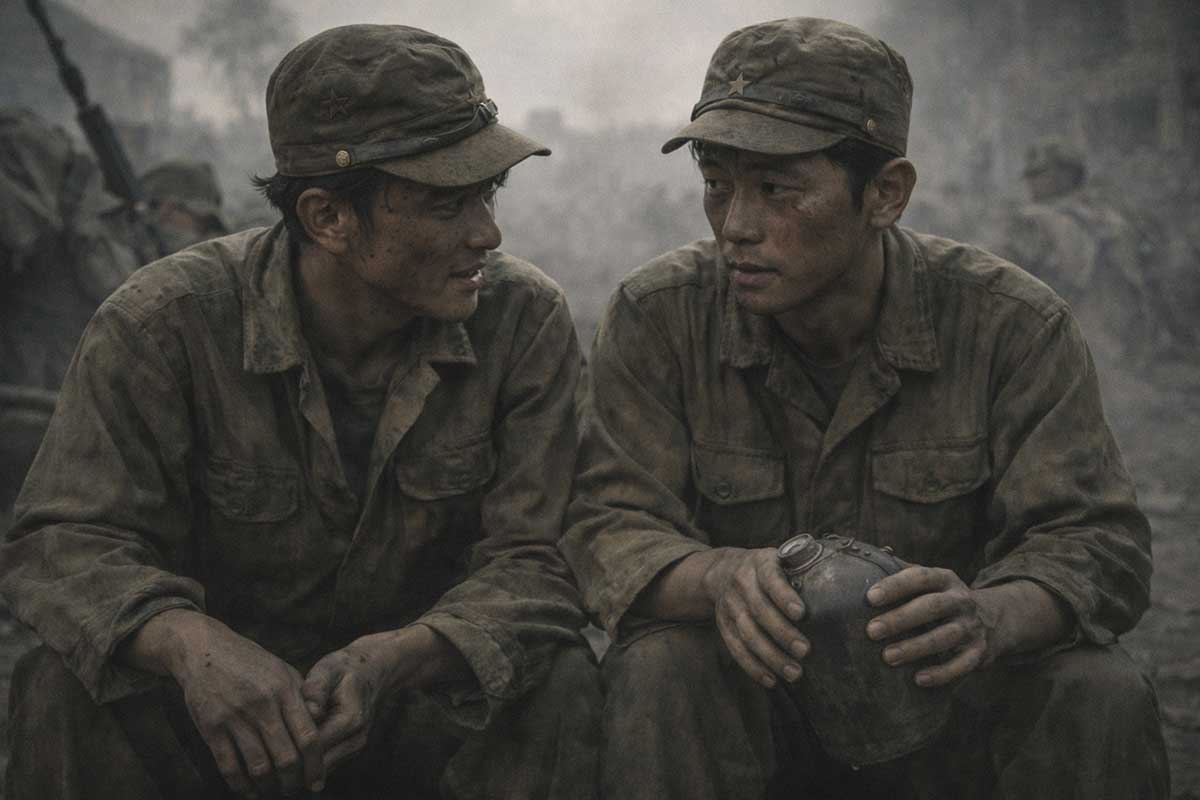
In the middle of all that brutality, Takase still carried traces of the person he had once been.
One night, while they rested against the wall of a ruined house, Koichi asked what he had done back home.
“I helped in my father’s bookstore,” Takase said.
Koichi looked at him.
Takase gave a tired half-smile. “I used to read more than I worked. Geography. novels. Stories about places I’d never see.”
Then, after a pause, he said, “I keep thinking this country must have bookstores too.”
Koichi looked at him.
“Someone here must have stood behind a counter somewhere,” Takase said. “Bored. Waiting for customers. Looking out the window.”
That small thought — that there had once been ordinary life here too — hung between them.
It might have saved something in both of them.
It did not last.
Days later, as they marched toward Nanjing, gunfire broke out without warning. Men dropped to the dirt. Orders flew.
Koichi heard a short sound beside him and turned.
Takase had been hit.
Koichi crawled to him, pressed his hands uselessly against the wound, and listened as Takase tried to speak.
“The back… of the shop…”
That was all.
“Move!” someone shouted. “Leave him!”
Koichi clung for one instant longer, then let go because his body chose survival before his soul could object.
Takase stayed behind.
Koichi went on.
That fact lodged in him and never came out.
Chapter 6 — Do It
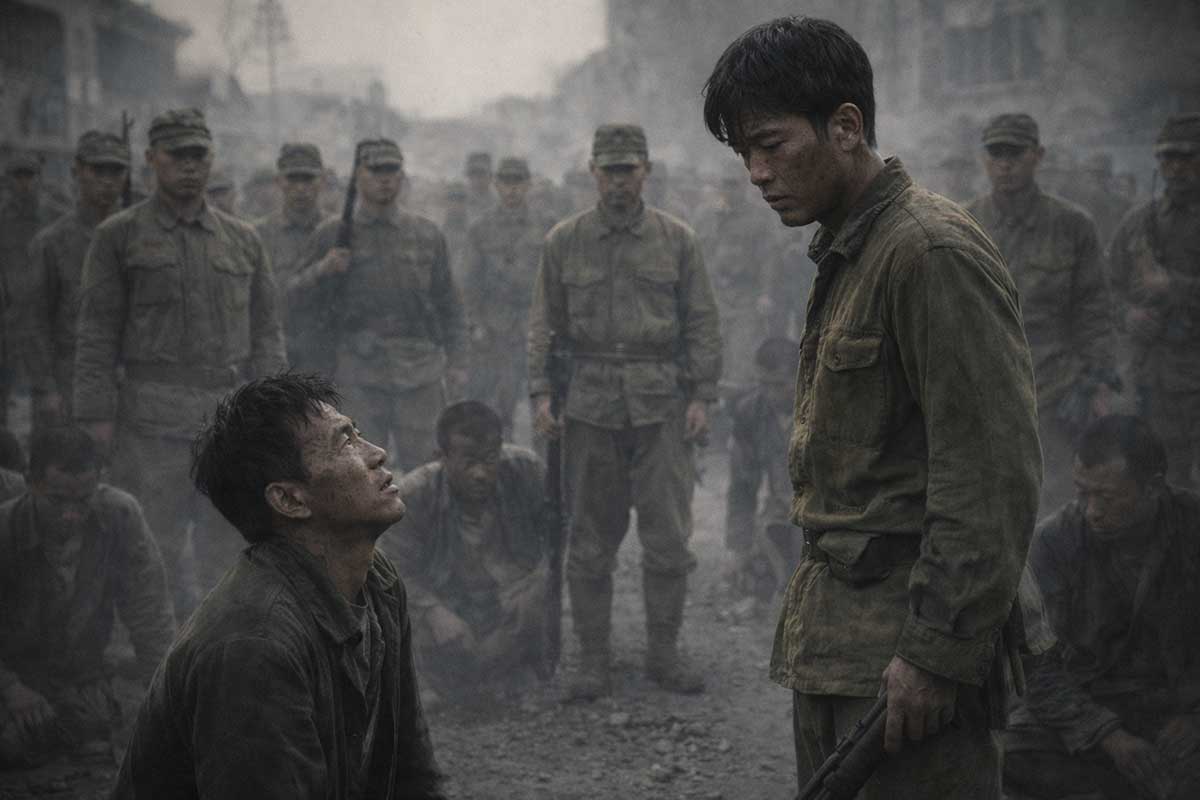
By the time they entered Nanjing, the air itself had changed.
The city still had streets, buildings, courtyards. Yet it no longer felt like a place where people lived. Smoke, shouting, boots, splintering wood, gunfire in the distance. The men around him were exhausted, filthy, half wild.
At a square, several captured men had been gathered together.
Koichi’s unit was brought near them.
An officer jerked his chin.
“You. Go.”
Koichi stepped forward before his mind could catch up.
One of the kneeling men looked up at him.
He was around his father’s age. Hollow-cheeked. Worn down. Not raging. Not begging. Just looking.
That look was almost worse than fear.
It was the look of a human being who had once had a life.
Voices collided in Koichi’s head.
Takase is dead.
If you hesitate, you die.
Look only at orders.
He moved.
Later, he could never remember the whole thing in a single line. Only fragments. The weight in his arm. Dust. Breath. A man no longer looking at him.
He waited for horror, or nausea, or grief.
Instead, for one terrible instant, he felt nothing at all.
That emptiness frightened him more than any scream.
That night, the city darkened into another kind of madness. Doors breaking. Fires. Shouting. Strange bursts of laughter. He was drawn with other soldiers to a damaged house.
Inside was not an “enemy.”
Inside was a family.
An older person. A mother. A child. Someone young trying not to make a sound.
That made it worse, not better.
He should have fled. He should have done something. He should have stopped.
He did none of those things.
The child’s eyes met his.
Again, not Chiyo.
Again, somehow Chiyo.
What happened that night stayed in him as shattered pieces:
A broken door.
A child’s shoes on the floor.
A cough from an old person.
Breathing in the dark.
Morning birds.
At dawn he stood at a well and washed his hands again and again.
The dirt came off.
Something else did not.
That was the morning he understood he might physically return home, yet never return as the same person who had once left it.
Chapter 7 — Home, but Not Returned
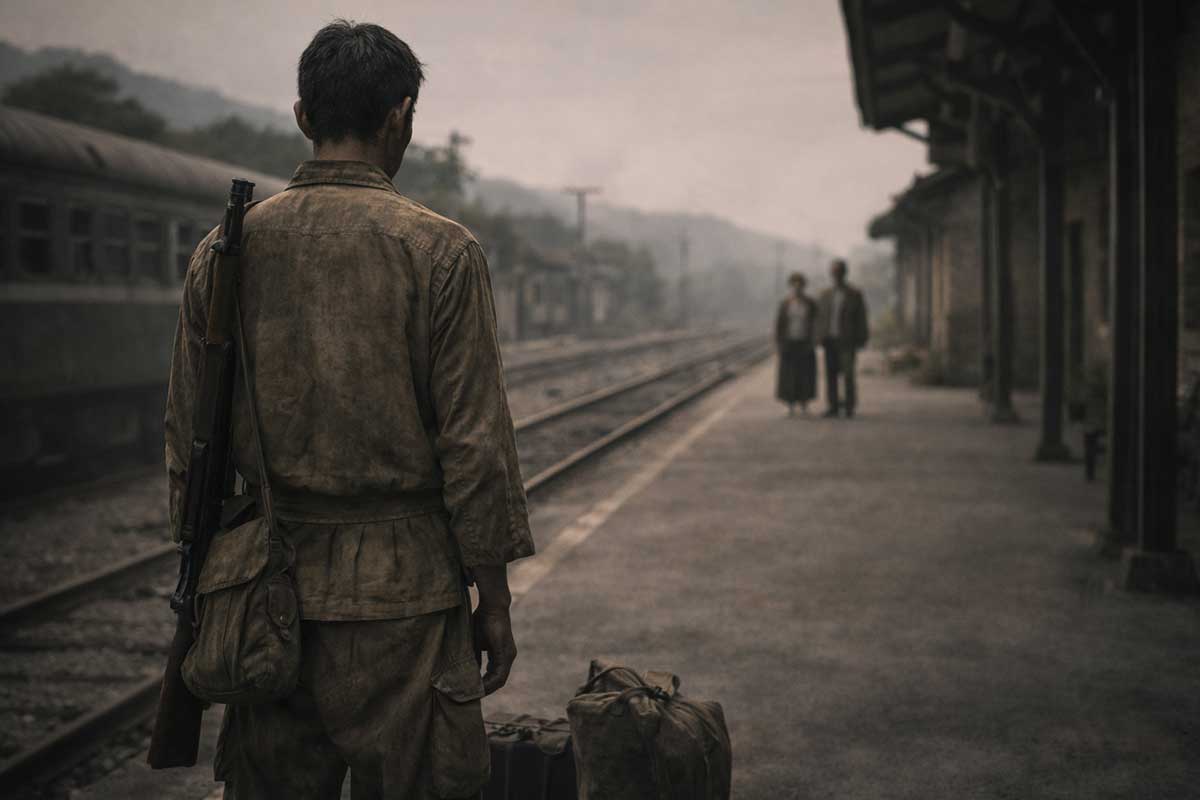
The war did not stop after Nanjing. It kept grinding forward, and Koichi changed with it.
He stopped flinching at things that once would have broken him. A starving old man by the road. Smoke. Weeping. The smell of death.
That frightened him.
Not the suffering itself.
The fact that he could pass through it.
When the chance to return to Japan finally came, he felt no relief — only blankness.
On the ship home, no one bragged. No one celebrated. The sea looked the same as before, yet Koichi no longer did.
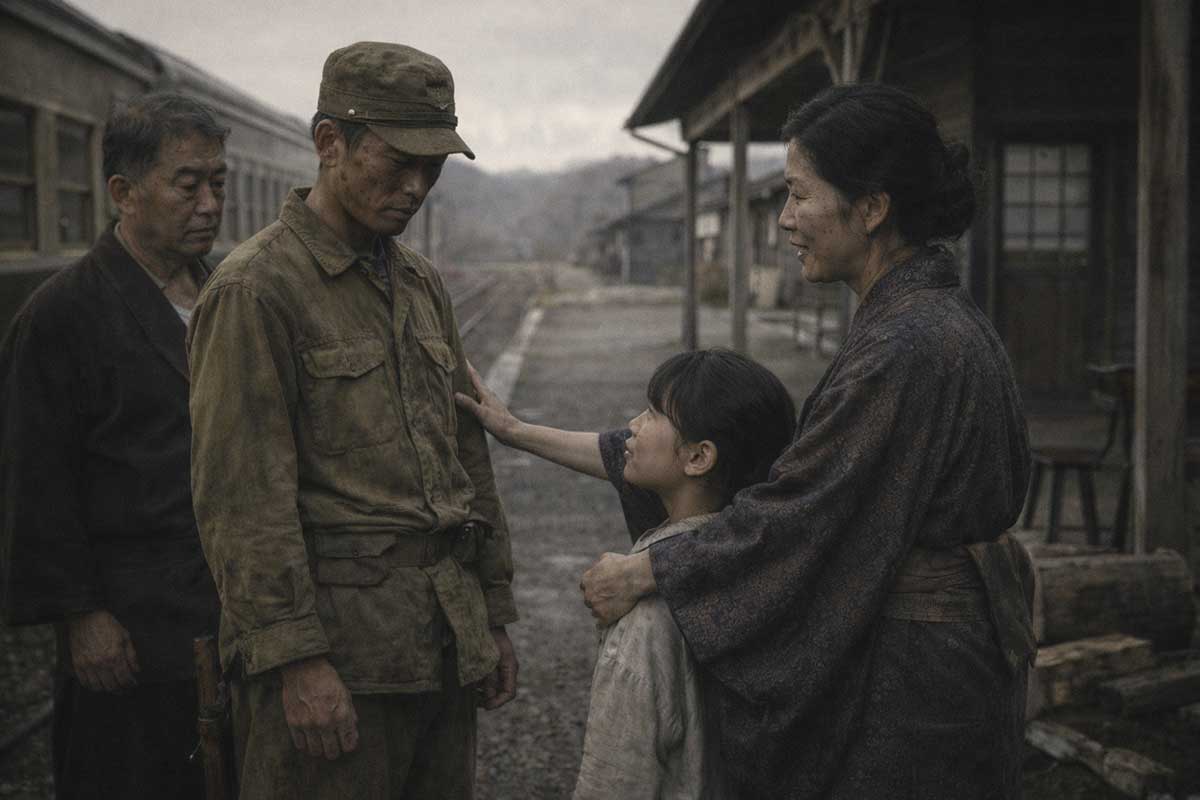
At the station in his village, his family waited.
His mother rushed toward him. His father stood just behind. Chiyo, older now, stared up with tears in her eyes.
When his mother touched his arm, his whole body stiffened.
He hated himself for it.
“Koichi…” she whispered, clinging to him.
He tried to lift his arms and embrace her back.
He could not do it naturally.
The distance was no longer measured in miles.
It was inside him.
That night, after he entered the house, a pot lid slipped in the kitchen and clattered to the floor.
Before he could think, Koichi had already dropped into a defensive crouch.
His mother and sister froze.
His father lowered his eyes.
Koichi stood slowly and said, “It’s nothing.”
It was not nothing.
That night he dreamed of Nanjing and woke shouting.
Only then did he fully understand:
He had not left the war there.
He had carried it home.
Chapter 8 — The Rupture at the Table
No one in the house forced him to speak.
His mother cooked for him. His father asked only practical things. Chiyo learned to lower her voice around him.
Their care was kind.
Their care was unbearable.
Sawa came to visit.
She brought sweets. She sat across from him. She did not demand answers.
After a long silence, she said, “You don’t smile the way you used to.”
Koichi said nothing.
Then she added, “But you also don’t pretend as much.”
That struck him harder than accusation would have.
Before the war, she said, he had always claimed to be fine when he was not. Now he could not fake that anymore.
She asked him, gently, “Do you think we’ll ever walk that road again?”
The same road where she had told him to come back.
He could not answer.
All he could say was, “I’m sorry.”
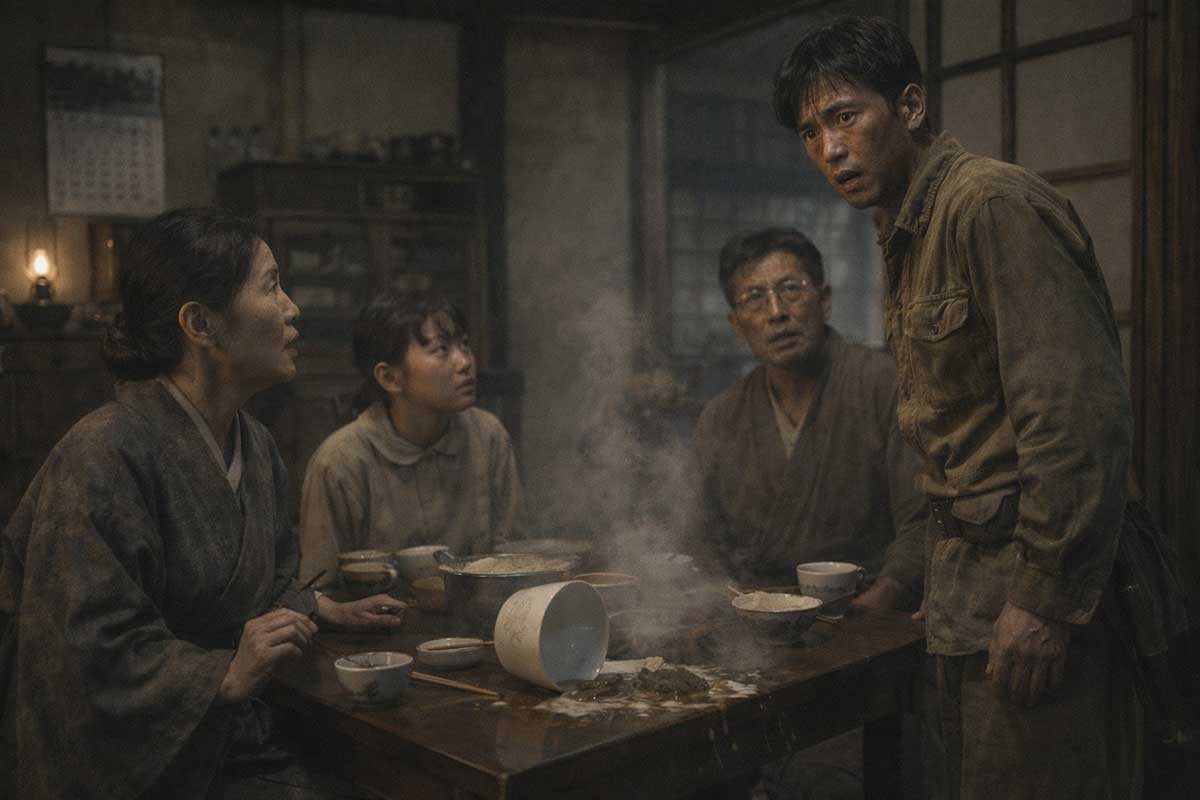
That evening, the family gathered around the table. Miso soup steamed. Fish was set out. The room was warm, ordinary, human.
Then Chiyo dropped her chopsticks.
The small clatter shattered him.
At once he was back in darkness. A broken doorway. Breathing. A child’s shoes on the floor. The smell of morning water. The sound of someone trying not to cry.
He rose so fast he upset his bowl and stumbled outside.
At the well, he fell to his knees and began washing his hands.
His mother came after him. “Koichi, what are you doing?”
He could not answer.
His hands looked clean.
They did not feel clean.
When he looked up and saw his mother and sister standing there, another realization cut through him like a blade:
He had seen faces like theirs destroyed.
“I’m sorry,” he said.
His mother told him not to apologize.
But apology was all he had left.
Chapter 9 — The Chopping Block
The next morning, his father called him out behind the house.
The old chopping block stood beneath a gray sky. Firewood was stacked nearby.
“Split these,” his father said.
Koichi lifted the axe.
After several blows, his father spoke without looking at him.
“Your mother and sister were frightened last night.”
A pause.
“You were frightened too.”
That word — frightened — sounded strange in his father’s mouth.
“I’m not going to force you to tell me what happened over there,” his father said. “But don’t wear the face of a man to whom nothing happened.”
Koichi stopped.
That was exactly the face he had been trying to wear.
His father finally looked at him.
“I won’t coddle you,” he said. “But I won’t tell you to stay broken and silent either.”
Koichi swallowed hard.
“I feel like I stopped being human over there,” he said at last.
His father was quiet for a long time.
Then he said, “If you can still say that, then you haven’t lost everything.”
Another pause.
“But feeling it won’t fix it.”
He glanced at the axe.
“If you can’t say it, write it.”
That night Koichi opened an old notebook.
For a long time he could not make himself move the pen.
At last he wrote two lines:
I came home alive.
But perhaps only my body came home.
Then, for the first time since leaving, he cried.
Chapter 10 — A War One Line at a Time
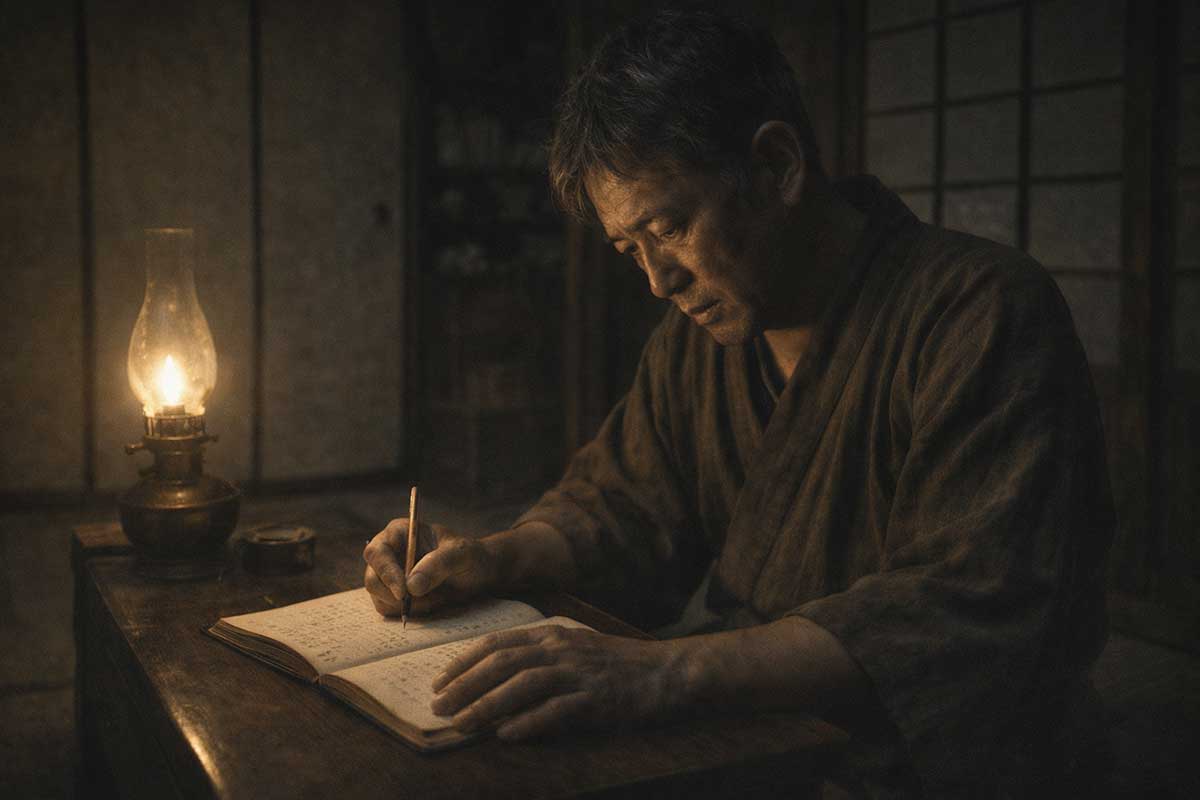
The notebook became another battlefield.
By day Koichi worked in the fields. Soil made sense in a way memory did not. If you turned it, it opened. If you planted, something grew. If something died, you could usually see why.
At night he sat before the blank pages.
Takase died. I left him behind.
That line alone almost undid him.
He kept writing.
At first I did not want to see. Then it became easier not to.
Saying I could not stop is only half true.
I was afraid.
Fear does not make the guilt lighter.
Writing did not bring peace.
It brought dreams.
Yet he kept writing.
Sawa returned to his life little by little, not by demanding truth, but by sitting near him without forcing it. In time she became his wife.
They had children.
Fatherhood did not heal him. It deepened the wound.
Every small hand he held reminded him of hands that had not been protected. Every child’s cry carried an echo from far away.
The years passed. His children grew. His mother died. His father grew weak.
One day, near death, his father asked only one thing:
“Are you still writing?”
“A little,” Koichi answered.
His father closed his eyes and said, “That’s enough.”
It was the last thing of weight he ever gave him.
Years later, when Koichi’s granddaughter visited, she looked at him with open, unguarded affection.
That gaze broke something loose again.
Not because it was the same as the eyes he remembered.
Because it was the kind of innocence that should have been safe.
That night he opened the final blank notebook and wrote:
I stayed silent because I wanted to forget. But while I remained silent, the dead never ended inside me.
Chapter 11 — Even If It Never Reaches Anyone
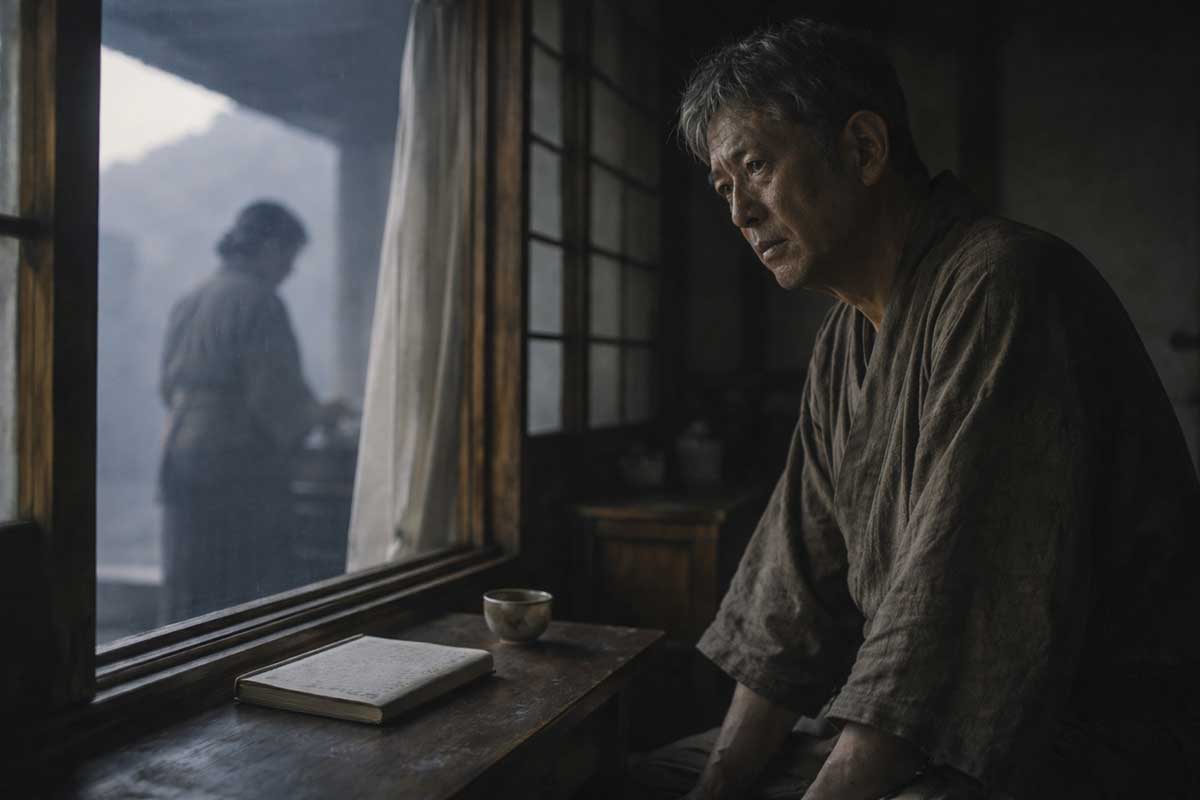
He wrote the last account in old age.
The room was quiet. Dawn had not yet fully entered the house. Sawa moved softly in the background, beginning the morning.
Koichi wrote:
I was young.
Then he crossed it out.
He wrote:
I was afraid.
That one he left.
He wrote of how fear stripped him piece by piece. How he learned not to look, not to hesitate, not to feel. How he crossed lines that should never have been crossed.
He tried the words people use to survive themselves:
It was war.
It was orders.
I was young.
None of them erased the child’s eyes.
At last he wrote the sentence he had spent a lifetime circling:
I was broken. But I did not only break. I also broke others.
That was the truth he had never managed to hold in one line before.
Then he wrote:
There are things that should not be forgiven.
That does not stop a person from continuing to live.
It only means the living must carry what they have done.
And after that, one final line:
Even if it never reaches anyone, I am sorry.
When he finished, he opened the window a little.
The sky in the east was beginning to pale.
He had always feared morning since Nanjing — that first dawn when the birds sang over a world that had become unbearable.
This dawn did not cleanse anything.
It did not absolve him.
It only marked the first morning in which he had not hidden completely.
Sawa came and stood nearby.
“Did you finish?” she asked.
“Not all of it,” he said.
“No,” she answered quietly. “Not all of it.”
She touched his hand.
This time he did not pull away.
He looked at the notebook one last time.
Even if it never reaches anyone, I am sorry.
Then he closed it.
Outside, the first bird began to sing.
He closed his eyes and spoke so softly no one could have heard him from across the room.
“I am sorry.”
No answer came.
No forgiveness came.
Only morning entered the house.
Final Thoughts by Nick Sasaki
When a story ends with an apology, readers often want to know whether that apology was enough.
This story gives a harsher answer: no, it was not enough.
But it was still necessary.
Koichi’s confession does not bring back the dead. It does not restore innocence. It does not turn guilt into peace. It does not allow him to step outside the consequences of what happened in Nanjing. The story never pretends otherwise. That restraint is one of its deepest strengths.
What the confession does offer is something narrower and more honest: the end of self-deception.
For years, Koichi lives between two truths he cannot easily hold together. He was shaped by violence, fear, command, and indoctrination. Yet he was not only shaped. He also acted. He also failed. He also crossed lines that should never have been crossed. The burden of the story comes from refusing to let either side erase the other.
That is why the ending feels heavy rather than comforting.
The final apology is not a cleansing moment. It is not the beginning of moral relief. It is the smallest possible act of integrity from a man who waited too long, suffered too long, and understood too late. Yet that small act matters, because there is a difference between carrying guilt and facing it.
For me, one of the strongest elements in the story is the way ordinary life becomes the true battlefield after the war. The dropped bowl. The dinner table. The well. The notebook. The wife who says almost nothing yet remains present. These details make the story breathe. They show that trauma is not always loud. Sometimes it lives in small interruptions, in flinches, in silence, in the inability to accept love without pain.
The story also carries a warning that reaches far past one man or one nation. Human beings do not become lost all at once. The fall is gradual. First you stop speaking. Then you stop looking. Then you stop feeling. Then one day you discover that what once would have horrified you has become something you can move through. That truth is terrifying precisely because it is not limited to history books.
And yet the story does not end in total darkness. It ends in a dim, fragile kind of honesty. Not hope in the sentimental sense. Not forgiveness in the easy sense. But a final refusal to hide behind excuses. In a world full of propaganda, denial, and selective memory, that refusal has its own grave dignity.
Koichi cannot become innocent again.
He cannot become young again.
He cannot undo Nanjing.
He cannot recover the self that left home.
But in the final morning, he does one thing he had resisted for most of his life: he tells the truth without asking it to save him.
That is not redemption.
But it is human.
And maybe that is why the story lingers.
It does not offer peace.
It offers recognition.
War destroys bodies quickly.
It destroys souls slowly.
This story understands both.
Short Bios:
Nick Sasaki
Nick Sasaki is a writer, curator, and creative host of deep imaginative conversations that explore history, morality, trauma, faith, psychology, and human meaning. His work often brings emotionally serious themes into narrative form, asking what people reveal when stripped of comfort, status, or illusion.
Koichi Murakami
Koichi Murakami is the fictional central figure of this story, a young Japanese villager sent to war who survives Nanjing physically but never returns inwardly intact. His life becomes a long struggle between silence, guilt, memory, and the late need to confess what he can no longer bury.
Sawa
Sawa is Koichi’s childhood companion and later his wife. She represents the quiet endurance of love that does not demand immediate answers, and her presence gives the story one of its most restrained forms of grace.
Takase
Takase is Koichi’s fellow soldier, a thin, thoughtful young man who once helped in his father’s bookstore. He serves as one of the final reminders that ordinary humanity still existed inside the machinery of war.
Koichi’s Father
Koichi’s father is a stern rural man whose silence carries more depth than his son first understands. He becomes one of the few people in the story who points Koichi toward truth, insisting that if he cannot speak, he must write.
Koichi’s Mother
Koichi’s mother embodies home, tenderness, and the ordinary love that war cannot cleanly receive back. Her care becomes painful to Koichi because it shines against what he knows he has done and failed to prevent.
Chiyo
Chiyo is Koichi’s younger sister, whose innocence echoes throughout the story. She becomes one of the emotional threads linking home, memory, and the unbearable recognition of children who should have been safe.
Leave a Reply