
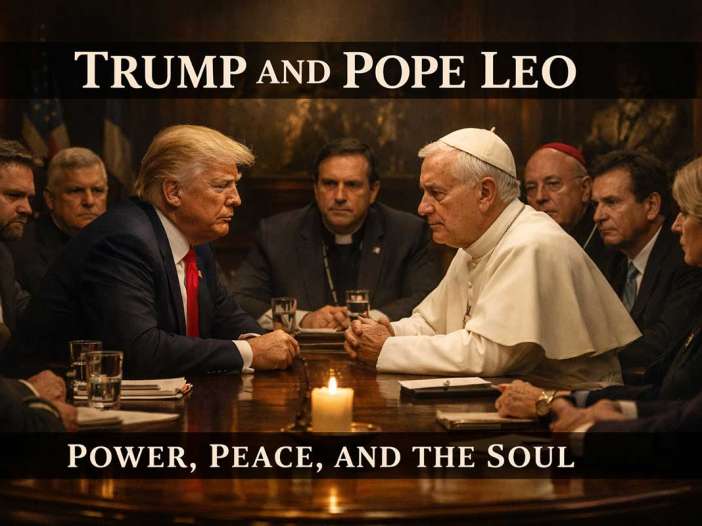
What if Trump and top Christian voices confronted Pope Leo on whether strength can protect a nation without hardening its soul?
There are some conversations that begin with policy, and there are others that begin with something much deeper than policy. This is one of those.
When I first imagined Donald Trump and Pope Leo XIV facing each other, I was drawn to the clash between two very different ideas of strength. One speaks the language of danger, borders, force, protection, and national survival. The other speaks the language of conscience, peace, dignity, restraint, and the soul’s responsibility before God. That conflict alone was already powerful.
But the deeper I sat with it, the more I realized that this conversation could not remain only between Trump and the pope.
Something else had entered the room.
Tucker Carlson belongs here too, not simply as a conservative commentator, but as someone now voicing a more unsettling concern from inside the broad Christian right itself. He is not asking whether Christianity should matter in public life. He is asking whether some people have begun confusing Christianity with power, loyalty, and civilizational fear. That changes the shape of the whole conversation.
Now the tension is no longer only between Trump and Pope Leo. It is also between different Christian instincts about public life itself. One says faith must help defend the nation, support strong leadership, and protect what is good from collapse. Another says faith must remain free enough to judge rulers, restrain force, and refuse every temptation to make power look holy. And now a third voice enters from within the same general camp, asking whether Christianity is in danger of becoming too useful to politics, too flattering of strength, too willing to bless what it should be questioning.
That is what drew me further into this piece.
At first glance, this conversation may look like it is about war, immigration, Christianity, or political leadership. And yes, it is about all of those things. But underneath them is a more difficult question: what happens when fear, faith, and power begin shaping one another at the same time? What happens when one leader believes his first duty is to protect his people in a dangerous world, another believes that once power loses its moral limits the victory itself may become corrupted, and a third warns that religion may be getting absorbed into the appetite for strength?
That is why I wanted to bring these voices together.
Trump, in this imagined setting, represents more than a politician. He represents the demand for action in a world that feels unstable. He represents the suspicion that moral language, when separated from consequence, becomes ornamental. Pope Leo, on the other hand, represents more than a religious leader. He represents the refusal to let urgency become an excuse for spiritual blindness. He keeps asking whether a civilization can remain human if it learns to admire force too easily. Tucker introduces a different kind of unease. He asks whether some Christians are no longer defending the faith itself, but wrapping political desire in sacred language and calling that seriousness.
That is where the real heat of this conversation begins.
Each topic moves through a different doorway into the same central struggle. War asks whether strength can remain moral. Borders ask whether order can remain humane. Christianity asks whether faith exists to bless power or judge it. Strongman politics asks why frightened people are drawn to certainty. Peace asks whether the human soul can still hear anything higher than fear.
I did not want this to become a shallow partisan argument. I wanted it to feel heavier than that, more human than that, more spiritually dangerous than that. These are not only disagreements about public policy. They are disagreements about what kind of leaders we trust, what kind of faith we practice, and what kind of civilization we are becoming when pressure becomes severe.
So this conversation begins there: not with easy conclusions, but with a room full of people who all believe Christianity matters, and who disagree profoundly about what it means for it to remain true while standing near power.
(Note: This is an imaginary conversation, a creative exploration of an idea, and not a real speech or event.)
Topic 1 — Power, Peace, and the Right to Wage War
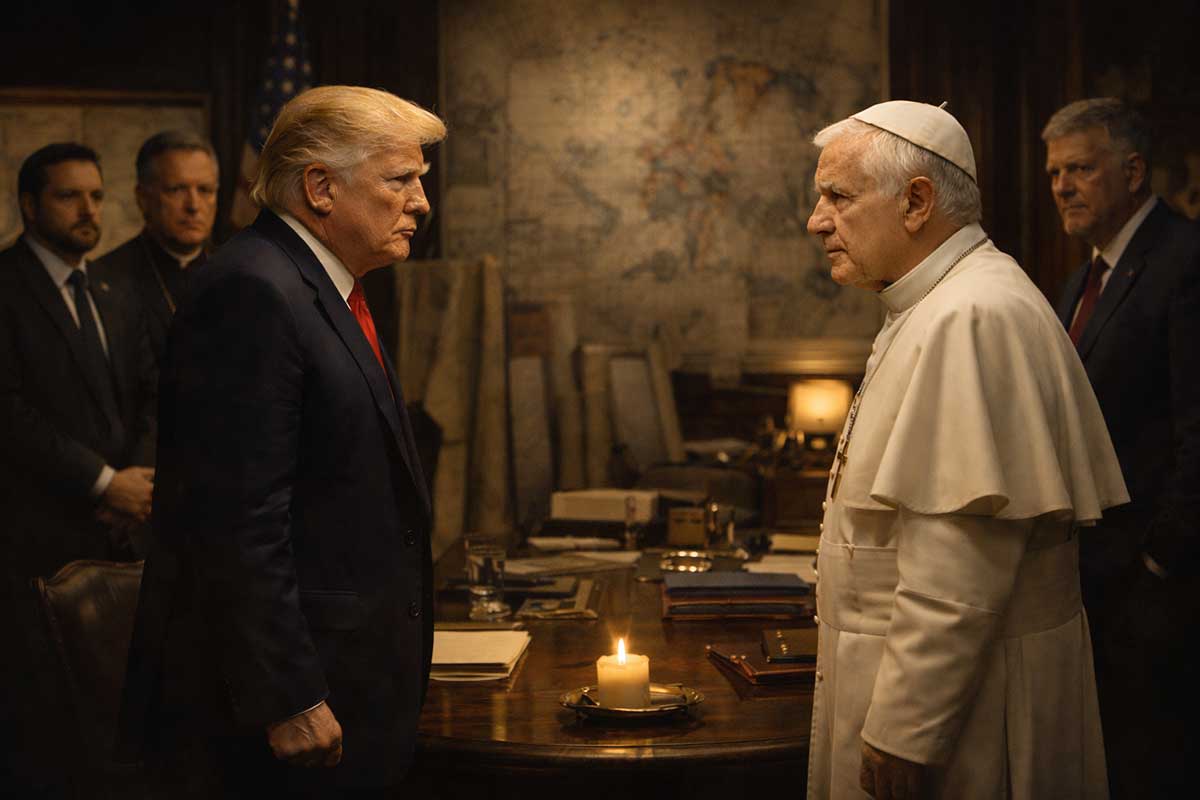
Opening
This first topic begins where the pressure is highest: war, force, and the terrible burden of deciding when violence is justified. President Trump enters this conversation with the instincts of a ruler who believes danger must be faced early, clearly, and without sentimental hesitation. In his mind, the first moral duty of leadership is protection. If threats are real, if enemies are gathering strength, if the cost of delay may fall on innocent people, then caution can become its own form of failure.
Pope Leo XIV enters from a very different place. He does not deny danger. He does not pretend evil is imaginary. But he keeps asking a harder question before force is used: what is happening to the soul of a people when war starts sounding normal, necessary, and even morally clean? He fears that once power becomes too confident in its own righteousness, a nation may still win battles and yet lose something inwardly sacred.
The others deepen that tension rather than simplify it. JD Vance tries to defend the tragic realism of just-war thinking. Archbishop Gustavo García-Siller worries that fear makes governments call violence inevitable far too quickly. Franklin Graham insists that evil does not stop just because moral people wish it would. So this is not a shallow argument between strength and softness. It is a deeper conflict between two burdens. One burden says a leader must act before catastrophe arrives. The other says a leader must fear what repeated force can do to the moral character of the civilization he is trying to save.
Question 1
When a nation faces real danger, when does war become duty, and when does it become moral failure?
Donald Trump
War becomes duty when the threat is obvious, serious, and growing, and when a leader knows that delay may cost innocent lives later. A president is not elected to sound noble after disaster. He is elected to prevent disaster. If hostile regimes are expanding, funding terror, threatening allies, or moving closer to weapons that could change everything, then refusing to act is not automatically moral restraint. Sometimes it is cowardice with better language around it. People who live far from danger love to talk about patience. People responsible for millions of lives do not have that luxury in the same way. War becomes failure when it is careless, stupid, or unnecessary. But refusing to confront evil before it becomes larger can be a worse failure.
Pope Leo XIV
War becomes moral failure long before the first missile is launched. It begins becoming a moral failure when leaders speak of violence with too much confidence, too much fluency, too little trembling. A nation may indeed possess the right to defend its people. That right is real. Yet even justified force must remain burdened by grief, by restraint, by the terrible knowledge that one is entering something spiritually dangerous. The moment war begins to sound morally cleansing, the conscience is already in peril. Duty can exist. Self-defense can exist. But no Christian civilization should ever allow itself to imagine that destruction becomes holy simply because its cause feels urgent. The just use of force, if such a thing is possible, must still remain wounded by sorrow.
JD Vance
This is exactly why the just-war tradition matters. It exists for a fallen world, not an innocent one. It begins with the admission that evil is real, that rulers bear actual responsibility, and that refusing to confront aggression can produce consequences even darker than force itself. Still, the tradition places real limits on power: just cause, right intention, legitimate authority, proportionality, last resort. Those are not decorative principles. They are meant to restrain rulers from baptizing every conflict as necessary. At the same time, those standards cannot be interpreted so rigidly that no modern threat ever qualifies. If that happens, moral language turns into paralysis, and statesmen are left carrying impossible burdens with no usable moral framework.
Archbishop Gustavo García-Siller
War becomes moral failure when fear becomes too eager to call itself realism. That is one of the oldest habits of nations. Every government believes its threat is exceptional. Every leader believes his use of force is reluctant. Every age tells itself that this time there is no other way. Yet conscience must still ask whether all other doors were truly exhausted, or whether violence simply arrived more quickly because it is the language states know best. What frightens me is not only war itself. It is how quickly a fearful people can become accustomed to it, how easily urgency can become absolution. A nation may defend itself and still suffer grave moral damage if it stops speaking of force with humility.
Franklin Graham
A leader has a duty before God to protect the innocent. That is not bloodlust. That is responsibility. The world contains real evil, violent evil, organized evil, evil that does not yield to speeches, summits, or good intentions. So the moral failure is not only in using force wrongly. It can be in refusing to use force when that refusal leaves families, cities, and nations exposed to things that should have been stopped sooner. I agree that war must never be romanticized. It must never become thrilling or spiritually glamorous. But there is another danger too: treating action itself as morally suspicious, as though strength were always less holy than hesitation. Sometimes protection is the burden God gives to rulers, and they sin when they try to escape it.
Question 2
Is a leader more dangerous when he hesitates to use force, or when he starts trusting force too much?
Donald Trump
A leader who hesitates too long is very dangerous, because weakness sends signals, and enemies are always reading those signals. They are not impressed by moral hesitation. They are encouraged by it. They see indecision, and they calculate. They test. They move. History is full of leaders who sounded careful and responsible right up until the moment ordinary people paid the price for their delay. Force is dangerous, yes, but so is the fantasy that you can preserve peace by showing dangerous people that you are afraid to act. That fantasy has killed plenty of people. If I had to choose, I would fear the weak and hesitant leader more, because his mistakes are often hidden until it is too late to reverse them.
Pope Leo XIV
A leader becomes more dangerous when he starts trusting force too much, because then force begins changing the imagination itself. At first it is used for emergencies. Then it becomes the preferred language of seriousness. Then restraint begins looking weak, sorrow begins looking impractical, and moral hesitation begins looking childish. That is when the ruler’s inner life is already being deformed. Chaos and indecision are dangerous, yes. But pride inside power is more spiritually corrosive because it teaches whole societies to admire hardness. It does not merely produce bad outcomes. It reshapes what people call virtue. Once that happens, even success becomes morally unstable.
JD Vance
The honest answer is that both can be disastrous. A leader who cannot act may leave his people exposed. A leader who trusts force too easily may create a habit of escalation that outlives the immediate crisis. That is why prudence matters so much here. Prudence is not indecision. It is not softness. It is disciplined judgment under pressure. The real task of leadership is to recognize that force sometimes must be used, yet never allow the necessity of force to become the center of political identity. The state must be capable of action without becoming addicted to action. That balance is hard to maintain, and that is exactly why moral seriousness is required.
Archbishop Gustavo García-Siller
I fear most the leader who learns to trust force too much. Hesitation may fail in one moment. Trust in force can catechize an entire generation. It teaches citizens to admire domination, to confuse harshness with maturity, to think moral caution is weakness and sympathy is foolishness. A frightened nation may survive a weak leader and later recover its balance. But if a people begins loving power in the wrong way, if it begins finding emotional comfort in the certainty of force, then the damage goes much deeper. Then it is no longer one decision being judged. It is the whole moral atmosphere becoming coarser.
Franklin Graham
There is great danger on both sides, and I do not want to pretend one of them disappears. A hesitant ruler can expose innocent people to terrible harm. A ruler who trusts force too much can begin believing his own strength is self-justifying. That is why humility before God is so important. Leaders must remember that power is stewardship, not possession. They do not own moral legitimacy simply because they act. Still, I would say the modern world often underestimates the danger of hesitation. Evil takes advantage of delay. It does not pause out of respect for our moral struggle. That is why rulers need conscience, but they also need courage that does not collapse under the fear of criticism.
Question 3
Can a Christian leader defend violent action without teaching people that peace is weakness?
Donald Trump
Yes, he can, if he is clear that force is there to protect, not to glorify itself. The mistake is thinking that peace and strength are opposites. They are not. Peace often depends on strength, and enemies know that very well. If a leader makes it clear that force is a shield, not a fantasy, then people can still respect peace. The problem comes when leaders speak as though peace means endless tolerance of danger, endless patience with aggression, endless moral performance while the threat grows. Then people stop respecting peace because it starts sounding fake. Peace has to be backed by seriousness or it becomes just a word.
Pope Leo XIV
Only with great difficulty, and only if he speaks in a way that never lets violence become spiritually attractive. Tone matters here more than many people admit. If the ruler speaks of force with grief, with sobriety, with moral burden, then he may defend tragic necessity without training the public to worship hardness. But if he speaks with pride, theatrical certainty, or self-righteous energy, then the damage begins immediately. The crowd starts learning the wrong lesson. It no longer sees peace as noble and difficult. It sees peace as softness and force as adult clarity. That is not merely a political shift. It is a spiritual corruption.
JD Vance
Yes, in principle, but only if the leader keeps tragedy at the center of the act. The Christian leader must never present violence as cleansing, exhilarating, or redemptive in itself. He has to say, in effect: this may be necessary, but it is still a wound. He must keep alive the sense that force belongs to a broken world, not an ideal one. That is the only way peace remains honorable. The moment force is framed as proof of moral superiority rather than as a grave burden under fallen conditions, public imagination begins moving in the wrong direction.
Archbishop Gustavo García-Siller
This is far harder in practice than in theory. Leaders almost always create narratives around violence, and those narratives almost always flatter the nation. They simplify the enemy, elevate the leader, and make severity feel like wisdom. That is why I am cautious here. Even when force is justified, human beings are tempted to turn it into moral theater. They want to feel clean while doing something terrible. They want to feel brave without having to grieve. That is precisely why the Church must keep speaking the language of peace. Not because peace is easy, but because human beings forget too quickly how much violence takes from the soul.
Franklin Graham
A Christian leader can do it if he keeps returning to duty, justice, and accountability before God. The leader must never act as though force is beautiful. He must act as though it is sometimes required in order to restrain worse evil. That distinction matters. Peace should never be mocked, and it should never be presented as weakness. But peace cannot mean helplessness either. If a leader can hold both truths at once — that peace is precious and that protection is sometimes costly — then people may still honor peace without becoming naïve about the world.
Closing
This first topic ends without resolution, which is exactly why it matters. Trump keeps pressing the ruler’s burden to act before innocent people suffer. Pope Leo keeps pressing the soul’s burden to resist becoming morally at home with force. Vance tries to hold tragedy and duty in the same frame. García-Siller warns that fear teaches nations to excuse too much. Franklin Graham insists that protection is not a shameful calling.
So the room does not arrive at agreement. It arrives at a more painful truth. A civilization may need strength in order to survive, yet the very use of strength can begin changing what that civilization admires, forgives, and becomes. That is the tension at the center of the whole conversation, and it starts here, in the oldest political dilemma of all: how to confront evil without letting the confrontation reshape the soul in evil’s image.
Topic 2 — Borders, Migrants, and the Moral Meaning of a Nation
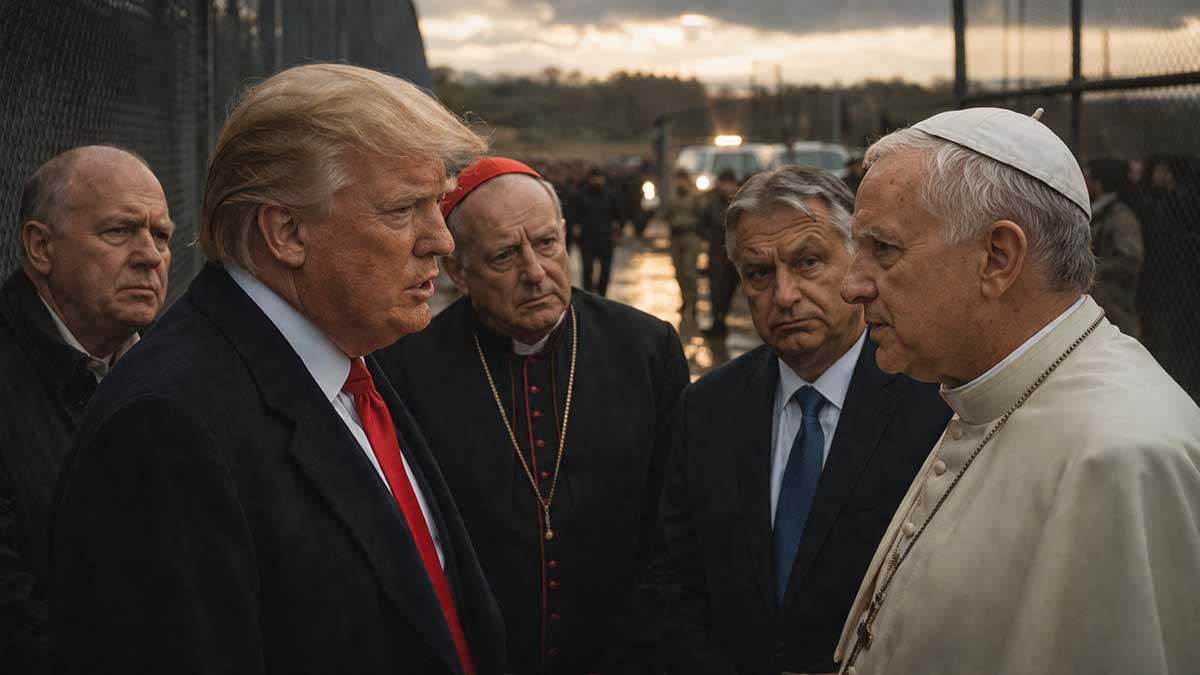
Opening
The second topic moves from war to borders, yet the deeper strain remains much the same. Once again, the argument is about protection and conscience, order and mercy, law and the soul of a people. President Trump enters this topic with a firm conviction that a nation that cannot control its border cannot remain fully a nation. In his eyes, a border is not merely a line on a map. It is a test of seriousness. It tells the world whether a country still knows how to govern itself, defend its citizens, and preserve the conditions of its own future.
Pope Leo XIV does not deny that nations have the right to borders. He is not arguing that all boundaries are immoral, or that sovereignty is meaningless. But he keeps returning to the same warning: a people may succeed in defending its boundary and still lose something inwardly human in the way it does so. The moral issue is not only whether a nation says yes or no at the gate. The issue is what kind of heart is being formed in the act of saying it.
Tom Homan sharpens the enforcement side of the argument. He does not speak in abstractions. He thinks in terms of cartels, trafficking, exploitation, overwhelmed systems, and the hard reality that disorder creates victims too. Cardinal Robert McElroy presses from the other side, fearing that a culture of permanent suspicion can slowly deform the moral imagination of a society. Viktor Orbán adds a third strain, speaking not only of law but of continuity, identity, inheritance, and civilizational survival.
So this topic becomes heavier than a normal immigration debate. It is not simply about policy design. It is about what a nation is, what it owes its own people, what it owes the vulnerable outsider, and whether those duties can still be held together without one swallowing the other.
Question 1
Does a nation betray itself by failing to defend its border, or by forgetting the stranger at the gate?
Donald Trump
A nation betrays itself first by failing to defend its border, because once that failure becomes normal, many other failures follow behind it. The law becomes uncertain. Public trust collapses. The idea of citizenship weakens. People start feeling that the government is no longer there to protect a real common life, only to manage disorder after it has already spread. That is not a small thing. A country has to be able to say who comes in, who stays, and under what terms. Otherwise it is not governing in any serious sense. Now, of course the stranger is human, and decent countries should treat human beings decently. But compassion cannot mean the erasure of the nation’s first duty to its own people.
Pope Leo XIV
A nation may indeed damage itself by neglecting its border, but it betrays itself more deeply when it forgets that the stranger remains a person. The deeper betrayal begins when the foreigner is spoken of only as pressure, danger, mass, problem, or burden. That is when moral sight begins to narrow. The right to maintain borders does not cancel the duty to preserve tenderness, restraint, and recognition of shared dignity. A people has the right to guard its home. But what kind of people does it become if, in guarding that home, it trains itself to look first with suspicion and only later, if at all, with mercy?
Tom Homan
The betrayal starts when a government refuses to defend the border, because that refusal has real consequences, and those consequences fall hardest on the weak. People talk as though enforcement is the harsh side and open disorder is the humane side. That is fantasy. Disorder feeds traffickers. Disorder empowers cartels. Disorder invites lies, exploitation, abuse, and dangerous crossings. Disorder burns out local communities and rewards criminal networks that profit from suffering. I do not deny human dignity. I am saying dignity is not protected by pretending the border is just a symbolic issue. It is not symbolic. It is operational, moral, and real.
Cardinal Robert McElroy
I agree that disorder has victims. Yet a nation begins betraying itself the moment fear becomes the dominant lens through which it sees the stranger. The problem is not having a border. The problem is moral narrowing. Once the vulnerable outsider is seen almost entirely through the categories of threat, burden, and intrusion, the nation is no longer only defending itself. It is teaching itself a spiritual lesson about who belongs in its field of compassion. That is why this issue is so serious. Laws can be repaired. Systems can be revised. But a moral imagination trained toward contempt becomes much harder to heal.
Viktor Orbán
A nation betrays itself by failing to defend its border, because a border is not merely a technical barrier. It is one of the final expressions of self-respect. If a people cannot maintain continuity, language, inheritance, and public order, then it is surrendering the very conditions that make a stable moral life possible. The stranger should be treated with seriousness and dignity, yes. But the modern elite temptation is to speak as though every firm boundary is already a form of cruelty. That is wrong. A civilization that cannot distinguish between compassion and dissolution will eventually lose both.
Question 2
At what point does compassion become disorder, and at what point does order become cruelty?
Donald Trump
Compassion becomes disorder when it stops making distinctions. Once a nation no longer separates legal entry from illegal entry, real asylum from opportunistic claims, genuine vulnerability from manipulation, then it is not showing compassion. It is showing confusion. And confusion at the border spreads quickly into every other institution. Order becomes cruelty when people in authority stop caring about how enforcement is carried out, when they use harshness for show, or when they treat suffering as politically useful. That is wrong. But the answer to bad enforcement is not the collapse of enforcement. It is serious enforcement done with discipline and control.
Pope Leo XIV
Order becomes cruelty when severity starts being admired for its own sake. A nation is in danger when deterrence becomes emotionally satisfying, when public rhetoric begins to treat humiliation as evidence of seriousness, when the suffering of the outsider is no longer tragic but convenient. That is a grave moral warning sign. Compassion becomes disorder when it refuses prudence, yes, when it pretends no limits are needed. But order becomes more spiritually dangerous when it loses mercy, because then the machinery of the state begins teaching the people that hardness is wisdom. A government can have firm laws and still preserve gentleness. The tragedy begins when it no longer wants to.
Tom Homan
Compassion becomes disorder very fast when the rules stop meaning anything. Once word gets out that a border is porous, more people come, more smugglers get involved, more lies are told, and more dangerous journeys happen. That is not kindness. That is a system inviting exploitation. Order becomes cruelty when the men and women enforcing the law abuse people, humiliate them, or operate outside lawful standards. That should never be excused. But we need to stop pretending that the existence of consequences is cruelty. The absence of consequences creates another kind of cruelty, one that is spread out and harder for comfortable people to see.
Cardinal Robert McElroy
Cruelty begins even before obvious abuse. It begins in the language a nation uses about those at the edge. It begins when leaders tell the public, again and again, that visible harshness is necessary, that emotional distance is maturity, that deterrence must be felt in the body of the vulnerable. That is where something dark begins entering the public conscience. I agree that compassion without prudence can become unstable. But order without moral tenderness becomes spiritually corrosive. A nation must never allow itself to become proud of being unyielding.
Viktor Orbán
Compassion becomes disorder when it is detached from loyalty, continuity, and the practical limits of political life. A nation is not a vague moral abstraction. It is a historical people with inherited responsibilities. If those responsibilities are ignored in the name of universal feeling, disorder follows. Order becomes cruelty when discipline is used without purpose, or when strength loses all proportion. Yet many people now use the word cruelty too easily, applying it to any policy that refuses admission or insists on control. That makes serious judgment impossible. Firmness is not the same as brutality.
Question 3
Can Christian language survive inside immigration politics without being used as a shield for fear?
Donald Trump
Yes, it can, but only if it stays honest about reality. Christianity does not require a country to dissolve itself. It does not require a government to pretend that borders are immoral, that law is oppressive by nature, or that every act of restraint is evidence of hatred. A Christian nation, or a nation shaped by Christian values, should care about the vulnerable. It should show decency. But it should also protect families, neighborhoods, schools, wages, and public order. The problem comes when Christian language is used as a weapon against the very idea of national self-defense.
Pope Leo XIV
Christian language survives only if it remains free to unsettle fear rather than sanctify it. The danger is not that believers speak of order. The danger is that they begin wrapping their anxieties in sacred language and calling those anxieties wisdom. Once faith becomes mainly a way of reassuring the strong that their hardness is righteous, the Gospel has been bent toward self-protection. Christian speech must remain inconvenient enough to ask whether the stranger has disappeared from our moral sight. It must keep asking whether fear is quietly trying to dress itself in holy clothing.
Tom Homan
Faith can survive in this debate if people stop weaponizing it on both sides. It should not be used to imply that law enforcement is morally suspect by nature. It should not be used to make agents into villains simply because they do hard work in a hard environment. At the same time, it should not be used to excuse abuse or indifference. The balance is difficult, but it is possible. A person can believe in law, order, border security, and firm enforcement without abandoning the belief that every human being still deserves basic dignity.
Cardinal Robert McElroy
Christian language is in danger the moment it becomes selective. If believers speak constantly about order but rarely about mercy, constantly about sovereignty but rarely about the vulnerable, then politics has begun using the faith more than the faith is judging politics. That is the spiritual crisis here. The Church must never lose the freedom to remind nations that the people they find inconvenient are not invisible before God. Christian speech must widen the moral field, not narrow it.
Viktor Orbán
Christian language survives when it remembers that love has layers and obligations. A nation is not wrong to love its own continuity, families, traditions, and inherited form of life. Those attachments are not automatically selfish. They can be honorable. The mistake is assuming that universal love requires the weakening of every particular loyalty. It does not. Fear can corrupt religion, certainly. But so can a false humanitarianism that treats rootedness itself as shameful. Christian politics must preserve both dignity and continuity, or it will preserve neither.
Closing
This second topic ends with the same unresolved strain that made it worth asking in the first place. Trump and Homan keep pressing the seriousness of borders, the cost of disorder, and the duty of a government to protect its own people in concrete ways. Pope Leo and McElroy keep pressing the inward cost of fear, warning that a nation may succeed in control yet fail in mercy. Orbán reminds the room that continuity, inheritance, and self-preservation are not trivial goods that can simply be brushed aside.
So the argument does not collapse into an easy slogan. It becomes more difficult and more human. A border is real. Disorder is real. Trafficking is real. Public strain is real. Yet the stranger is real too, and so is the danger that a people may gradually train itself to see vulnerability only through suspicion. That is why this question hurts. It forces the nation to look at two duties at once: the duty to remain itself, and the duty not to lose its soul in the act of remaining so.
Topic 3 — Who Speaks for Christianity in Public Life?
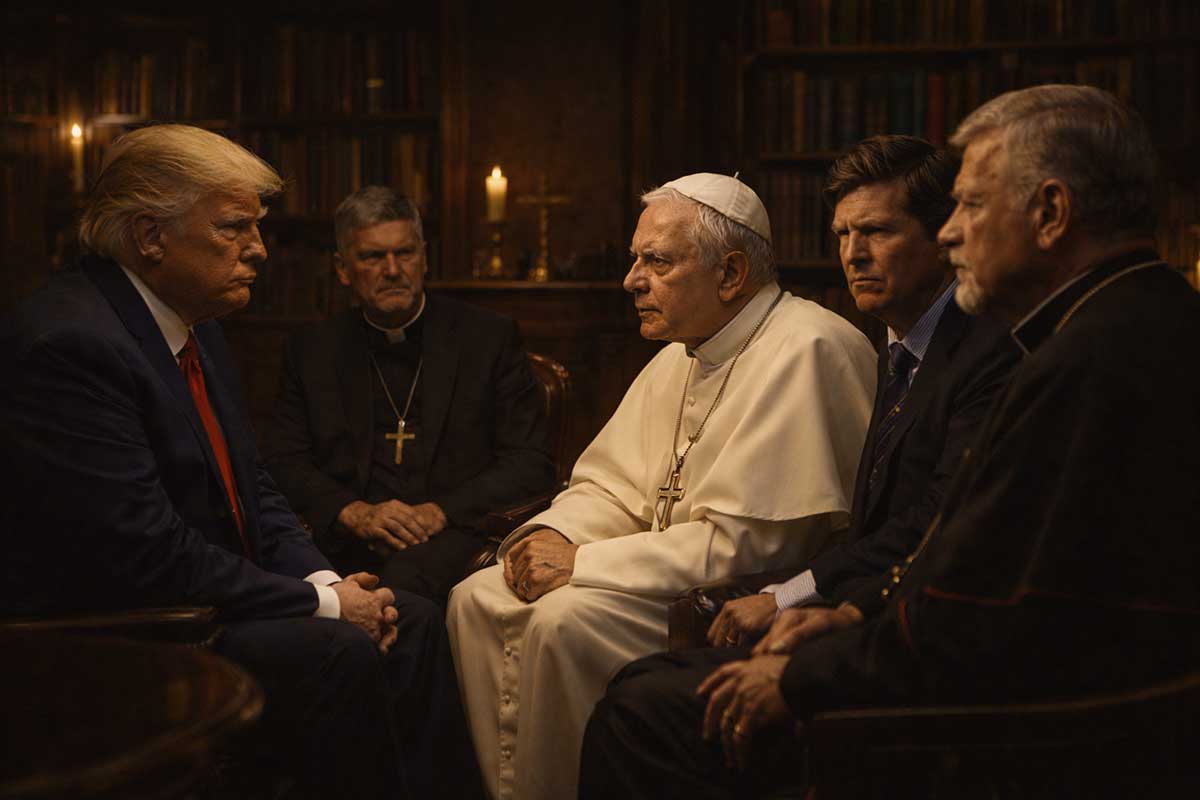
Opening
By the time this third topic begins, the argument has moved past war and borders into something even more sensitive: who gets to speak for Christianity once power, fear, and public life all collide in the same room. That question feels especially live now. Reuters has been reporting on Pope Leo XIV’s sharper public stance against war, against rulers who misuse religion, and against the moral drift that comes when political strength starts borrowing sacred language. At the same time, Tucker Carlson has been attacking what he calls a new civic religion in Trump’s America, using the striking phrase “Christianity without the New Testament.” That means the fracture is no longer only between Trump and the pope. It is now inside the Christian right as well.
That makes this topic much richer than a standard religion-and-politics exchange. Trump speaks for public strength, national confidence, and the belief that Christianity should not be ashamed to stand with power when civilization feels under threat. Pope Leo speaks for conscience, judgment, and the duty of faith to remain free enough to correct rulers rather than simply stand beside them. Tucker enters from inside the broad conservative world, but as a dissenter. He is not asking whether Christianity should matter in public life. He is asking whether some Christians have started mistaking tribal loyalty, state power, and moral seriousness for Christianity itself. Franklin Graham pushes back from the other side, insisting that believers cannot preserve what they care about by retreating from influence. Bishop Thomas Paprocki adds a church-centered warning that once Christian speech becomes selective around its own allies, its credibility begins to thin. So this topic becomes a contest over spiritual legitimacy itself: who may bless power, who must restrain it, and whether public Christianity is still free enough to judge its own side.
Question 1
Is Christianity in politics meant to bless a people, restrain a ruler, or judge both?
Pope Leo XIV
Christianity must remain free enough to do all three, or else it becomes less than itself. It may bless what is good in a people: their courage, their sacrifices, their care for one another, their longing for justice. It may strengthen them in suffering and remind them that history is not meaningless. Yet the moment Christianity loses the freedom to restrain rulers, to correct nations, and to rebuke the sins of its own followers, it stops being witness and starts becoming ornament. The Church cannot simply stand near the throne and feel useful. It must remain answerable to something higher than usefulness. If Christianity becomes mostly a source of comfort for power, it may still sound religious, but it will no longer sound apostolic.
Donald Trump
Christianity in politics should help defend a country’s moral center. It should defend life, family, order, religious liberty, and the basic confidence of a civilization that still believes it deserves to survive. The problem is that many religious leaders now behave as though their highest calling is to criticize the state, criticize strength, criticize borders, criticize authority. That is not balance. A nation also needs leaders and believers who are willing to protect what is good. Faith cannot exist in public life only as a brake. It has to be a source of confidence too. If Christianity is never allowed to stand with the people, defend the nation, or shape the culture, then it becomes a spectator to history instead of a force inside it.
Tucker Carlson
Christianity is not there to decorate political appetite. It is not there to baptize violence, flatter rulers, or give spiritual cover to whatever the crowd already wants. That is where I think the danger is now. There are many people on the right who still use Christian language, Christian symbols, Christian emotional cues, but what they are protecting is not actually Christianity. They are protecting power, tribe, vengeance, and a kind of civic religion that borrows the language of faith without the heart of it. Once that happens, Christianity is no longer judging politics. Politics is wearing Christianity like a costume. That is a very dangerous thing, because it confuses believers into thinking that passion, loyalty, and sacred rhetoric are proof of holiness. They are not.
Franklin Graham
Faith in public life has to do all three, but it must not be forced into a false choice. Christianity can bless what is good in a people. It can restrain leaders when they drift. It can judge the whole society when it turns away from God. The real problem is that many critics now assume any Christian who works near power is already corrupt, and any Christian who speaks positively about strong leadership must already be compromised. That is too simplistic. There are times when standing beside leadership is part of protecting life, order, and freedom. The issue is not whether Christians engage public power. The issue is whether they stay accountable to truth while doing so.
Bishop Thomas Paprocki
The Church must never forget how to judge. It may cooperate with rulers for the common good. It may encourage citizens in their duties. It may even publicly affirm what is worthy. But once it becomes known chiefly as a source of approval for the powerful, something essential begins slipping away. The Gospel was not given to flatter regimes or give religious warmth to public ambition. It was given to call every human being, including rulers and nations, to repentance. If Christianity is welcomed only when it agrees, it is already in danger. Its deepest freedom lies in telling the truth whether the truth is useful or costly.
Question 2
When believers defend power too eagerly, when do they stop serving God and start serving access?
Pope Leo XIV
They cross that line when proximity to rulers begins to feel like a form of spiritual importance. Access can intoxicate quietly. At first the believer tells himself he is near power in order to influence it. Then he begins softening truths he would once have spoken plainly. Then he begins overlooking sins he would once have named. Then he starts confusing usefulness with faithfulness. That is how conscience is domesticated. The corruption is rarely dramatic at first. It appears as caution, prudence, timing, realism. Yet the deeper question remains simple: has the believer become less free to tell the truth? If so, then access has already begun governing the soul.
Donald Trump
I think people are far too quick to call all cooperation with power a form of corruption. If Christians care about schools, judges, religious liberty, life, public morality, the protection of families, then they have to deal with real governments. They do not get to shape history from a distance by sounding pure. That means relationships, influence, negotiations, and yes, access. The real issue is not whether believers are close to power. The real issue is what they do with that closeness. Do they protect what matters? Do they help the country? Do they speak truth when needed? Critics often act like any public Christian who does not spend all day condemning leadership must be compromised. That is not serious.
Tucker Carlson
Believers stop serving God and start serving access when they begin making excuses for what they would once have called sin. It happens when vulgarity becomes strategy, arrogance becomes strength, manipulation becomes necessity, and sacred words are used to protect obviously worldly aims. That is when you know loyalty has replaced discernment. A lot of Christian public language now sounds less like discipleship and more like tribal management. The believers involved may still talk about values, civilization, or defending the nation, but the moral selectivity becomes impossible to miss. If your enemy’s sins are proof of rot and your own side’s sins are proof of complexity, then access has already done its work on you. The saddest part is that many people barely notice it happening.
Franklin Graham
The danger is real when believers start excusing what they know is wrong just to remain close to influence. I do not deny that at all. Yet there is another mistake too. Many observers treat public loyalty itself as proof of compromise. Sometimes leaders are attacked unfairly. Sometimes defending them is part of telling the truth. The deeper test is whether a Christian near power can still say no when no is required, still speak plainly when something is wrong, still remember that the leader is not the savior. Once that freedom disappears, the relationship is unhealthy. But the existence of influence alone is not the problem. Influence can be used faithfully or unfaithfully.
Bishop Thomas Paprocki
The line is crossed when moral language becomes selective. That is usually the clearest sign. If pride, coarseness, cruelty, manipulation, or dishonesty are condemned in opponents but endlessly rationalized in allies, then the believer is no longer applying a moral standard. He is managing a coalition. And once Christian speech becomes coalition management, the public begins to sense the shift. Credibility fades. The Church still speaks, but people begin hearing strategy where they once heard witness. That is a grave loss, and it is rarely recovered quickly.
Question 3
Is public Christianity strongest when it influences the state, or when it refuses to flatter it?
Pope Leo XIV
It is strongest when it can do both without losing its soul. Yet if one must choose, then refusal to flatter is the holier strength. Influence can achieve something visible for a season. It can restrain harm, defend the vulnerable, and shape laws. Those are not trivial goods. But refusal preserves something even deeper: the freedom to stand before power unbought. Once Christianity becomes mainly a useful partner to the state, it may still have a place at the table, but it will begin losing the fearlessness that made it worthy of hearing in the first place. The Church should be willing to stand near rulers, yes, but never so near that it forgets how to tremble before God rather than before them.
Donald Trump
Christianity has to influence the state or it becomes irrelevant to the real world. It is easy to sit outside power and sound morally impressive. It is much harder to shape schools, laws, courts, religious freedom, public order, and the actual institutions people live under every day. Faith that never enters those arenas ends up becoming private emotion. That is not enough. If Christians abandon influence, they hand the country over to people who do not share their values at all. So yes, Christianity should remain honest and strong enough to speak clearly. But it also has to matter in public life. Otherwise it becomes beautiful talk with no effect.
Tucker Carlson
Public Christianity is strongest when power knows it cannot fully use it. That is the test. The Church, or any serious Christian witness, should be able to unsettle rulers, expose fraud, embarrass false sanctimony, and remind a nation that political strength is not the highest good. Once Christianity becomes mainly a language of coalition, even a successful coalition, it starts sounding hollow. It becomes loud but not free. And freedom is the thing that gives Christian speech its force. If politicians know believers will bless them as long as they deliver the right enemies and the right rhetoric, then Christianity is no longer governing politics. Politics is training Christianity to stay useful.
Franklin Graham
Influence matters, and Christians should not apologize for wanting to protect the institutions and principles they care about. If believers withdraw completely, they will not create purity. They will create absence, and that absence will be filled by other values very quickly. But I do agree that public Christianity loses its authority when it sounds like public relations for any politician. That is the challenge: to remain engaged enough to matter, yet free enough to correct. It is a hard line to hold, and believers will sometimes fail at it. Still, failure in holding the line is not an argument for abandoning the field.
Bishop Thomas Paprocki
The deepest authority of Christianity does not come from how many officials return its calls. It comes from whether people believe it would still tell the truth if it lost access, favor, and relevance. That is why refusal to flatter has such spiritual weight. Flattery buys a moment. Credibility is built over years and can be lost very fast. If the public begins to believe that Christian leaders speak bravely only when there is no cost, then something sacred has gone thin. A church that cannot afford honesty before power is already poorer than it appears.
Closing
This topic leaves the room in a more fragile and revealing condition than before. Earlier topics placed Trump and Pope Leo across from one another as contrasting moral instincts. Here, the fracture runs through the Christian right itself. Trump and Franklin Graham keep pressing the need for strength, influence, and a Christianity unashamed to shape public life. Pope Leo and Paprocki keep pressing the need for conscience, moral independence, and the freedom to judge rulers without fear. Tucker stands in the middle as the unsettling critic, warning that the right may be building something that looks Christian from the outside but has become far too comfortable serving power from within. That is not just a political argument. It is a spiritual accusation, and it is one reason this topic feels so charged right now.
What makes this topic linger is that no one here is arguing faith should disappear from public life. Everyone in the room believes Christianity matters. The real question is whether it still has the freedom to matter truthfully. Can it bless without flattering, influence without being captured, defend a nation without turning national desire into sacred doctrine? Those are not small questions. They sit at the center of the whole exchange. And here, perhaps more than anywhere else in the conversation, the danger becomes plain: faith may lose itself not only by withdrawing from power, but by standing so close to it that it forgets how to say no.
Topic 4 — Strongman Politics, Conscience, and the Temptation of Moral Certainty
Opening
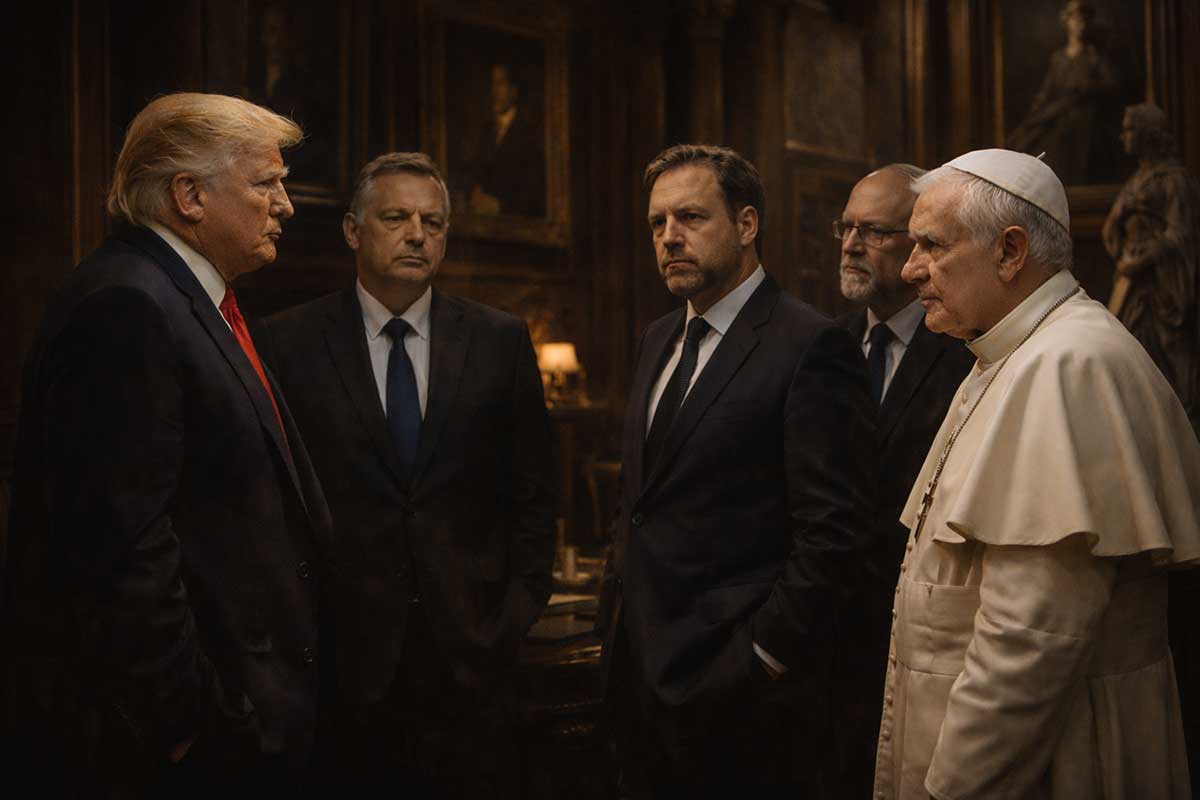
By the fourth topic, the conversation widens beyond Trump and Pope Leo themselves and turns toward a larger civilizational question: why are frightened societies so often drawn to leaders who sound absolutely certain? That question has become especially sharp in the current backdrop. Reuters reports that during his Africa tour, Pope Leo has spoken in unusually forceful language, condemning leaders who spend billions on war, warning against those who use religious language to justify violence, and saying the world is being “ravaged by a handful of tyrants.” Reuters has also described this as a more assertive and confrontational public role than many expected from him.
That is why this topic matters so much. Trump and Viktor Orbán speak for a style of leadership that says disorder, elite confusion, civilizational drift, and external threat all require leaders who sound firm, unapologetic, and hard to intimidate. Pope Leo and David French worry that societies can slowly become too comfortable admiring power for its own sake. Niall Ferguson stands in between as a historical observer, asking what happens when weak institutions produce a hunger for decisiveness, and whether that hunger later becomes something harder and more dangerous. The argument here is not simply whether strong leaders are good or bad. It is whether a civilization can survive fear without turning certainty itself into a kind of moral drug. Reuters’ recent reporting makes that tension feel very alive right now.
Question 1
Why are people so drawn to leaders who sound morally certain in an age full of confusion?
Donald Trump
People are drawn to certainty because they are exhausted by leaders who seem confused about everything. They see borders that do not hold, institutions that sound embarrassed by their own country, endless expert language, endless caution, endless explanations, and very little that actually feels secure. Ordinary people do not live inside theory. They live inside consequences. So when a leader speaks with confidence, clarity, and force, that feels like relief. It feels like someone finally understands what matters and is willing to say it out loud. The elite often call that dangerous. But what many citizens hear in it is seriousness. They are tired of weakness dressed up as sophistication.
Pope Leo XIV
People are drawn to moral certainty because fear longs for simplification. In confused times, a clear voice can feel like shelter. That is deeply human. But shelter can become seduction very quickly. A ruler who always sounds certain may not be wise. He may simply know how to convert public anxiety into personal authority. The crowd often mistakes emotional relief for moral truth. That is why certainty must always be examined. A civilization in pain naturally wants firm answers, but one of the oldest dangers in political life is that the desire for clarity becomes so intense that people stop asking whether the certainty before them is just, humble, or even true.
Viktor Orbán
People are drawn to certainty because liberal societies have spent years dissolving conviction into procedure, abstraction, and apology. Citizens can feel when their leaders no longer believe strongly enough in their own nation, heritage, or inherited form of life. In such a climate, certainty does not merely sound forceful. It sounds sane. It sounds like memory returning. Families need continuity. Nations need confidence. Civilizations need leaders who are not ashamed to defend them. What critics call dangerous certainty is often simply the reappearance of political seriousness after a long period of cultural self-doubt.
Niall Ferguson
Historically, periods of institutional weakness almost always produce a craving for decisive authority. When governing classes seem brittle, morally evasive, or detached from the public cost of their own errors, citizens begin preferring leaders who project strength over leaders who preach process. That pattern is hardly new. The difficulty is that decisiveness can be both corrective and corrupting. It can restore confidence where drift had taken hold, yet it can also become theatrical and self-justifying. Strong rhetoric often rises in response to real institutional failure. The question is whether it then repairs those institutions or quietly teaches the public to prefer personality over structure.
David French
People are drawn to moral certainty because moral fatigue is real. When every issue is framed as nuanced, partial, tragic, and constrained, a person who speaks in clean lines can feel like a rescue. But confidence is not the same as integrity, and decisiveness is not the same as wisdom. One of the most dangerous confusions in public life is when people begin equating emotional reassurance with moral leadership. The strongman does not always rise because people love tyranny. Often he rises because they are tired, frightened, and hungry for someone who seems free from the uncertainty they themselves can no longer bear.
Question 2
Is the greater danger today chaos without authority, or authority without humility?
Donald Trump
Chaos without authority is the greater danger. A nation can recover from a hard leader. It may not recover from drift, collapse, and leaders who cannot or will not control what is happening. When borders fail, when enemies move, when standards disappear, when no one seems willing to make hard decisions, ordinary people do not experience that as philosophical openness. They experience it as abandonment. Authority is what keeps a civilization from coming apart. Humility is fine, but humility cannot replace command. A nation cannot be held together by moral hesitation alone. If leadership is too afraid of using power, the vacuum will be filled by something worse.
Pope Leo XIV
Authority without humility is more dangerous, because chaos is visible, but pride inside authority often disguises itself as virtue. Disorder alarms the public, so people recognize it as a problem. But when rulers begin to trust themselves too much, when they stop fearing the corruption of power, when they begin speaking as though their certainty proves their righteousness, the danger becomes deeper and more subtle. Then whole societies begin learning the wrong lessons. They begin admiring hardness, excusing domination, and treating moral restraint as weakness. That is how authority deforms a civilization from within. Reuters’ reporting on Leo’s recent speeches reflects exactly this concern: his warning against tyrants, war spending, and the use of religion to justify violence is a warning about pride inside power.
Viktor Orbán
The first danger is chaos. Without authority there is no continuity, no confidence, and eventually no freedom worth defending. Modern societies have spent too long suspecting authority as such, and now they are surprised when disorder grows. Humility may be a virtue in the private soul, but the state cannot survive on modesty alone. It must decide, defend, exclude, and endure. Of course authority can become arrogant. Of course it can overreach. But the recurring weakness of modern liberalism is that it speaks as though the risk of force were greater than the risk of disintegration. I do not believe that is true.
Niall Ferguson
History suggests that both dangers matter, and often in sequence rather than isolation. Elite paralysis can create disorder. Disorder then creates a yearning for stronger authority. That stronger authority may restore coherence for a time, but if it escapes institutional restraint, it can harden into something less healthy. The real challenge, then, is not choosing one danger and pretending the other is secondary. It is building institutions strong enough to prevent collapse without making the public believe that personal will is the only cure for weakness. The difficulty is that institutional repair is slow, and slow remedies are rarely loved in anxious times.
David French
Authority without humility is more dangerous in the long run because it changes what the public is willing to excuse. Chaos is painful, yes, but it still feels like a problem to be solved. Authority without humility begins teaching people that the ruler is answerable to nothing higher than effectiveness, victory, or public desire. Then even moral language starts getting redefined around force. A culture that falls in love with unaccountable confidence will not simply choose a hard leader. It will begin mocking restraint itself. That is far more corrosive than many citizens realize when they first ask for strength.
Question 3
Can a civilization survive if it loses shame before power?
Donald Trump
A civilization cannot survive if it becomes ashamed of power itself. That is the first mistake. You need strength, borders, force, industry, confidence, and the willingness to defend what is yours. Countries that become embarrassed by power do not stay safe for long. They start apologizing for their own existence. That is a dead end. Now, can power be abused? Of course. But too many people today talk as though the danger of strength is always greater than the danger of weakness. I do not accept that. A serious civilization must be able to use power without being paralyzed by guilt every time it does.
Pope Leo XIV
A civilization must never lose all shame before power, because shame is one of the final signs that conscience is still alive. I do not mean shame before self-defense, nor shame before rightful authority. I mean shame before cruelty, before domination, before the temptation to believe that because one possesses strength one has therefore become morally justified. Once a people no longer blushes at humiliation, once it no longer recoils from hardness, once it starts using sacred language to decorate force, something vital has been lost. Then power no longer serves the common good alone. It begins disciplining the soul of the nation into admiration of what should still trouble it. Reuters’ reporting on Leo’s latest speeches shows him speaking in exactly those terms, attacking leaders who normalize war and wrap it in moral language.
Viktor Orbán
A civilization needs inhibition, yes, but not the kind that turns into civilizational self-doubt. Europe has often suffered from that very problem: the inability to distinguish between moral seriousness and self-disarming shame. A nation must still believe in its own right to continue. It must still act, defend, and exclude when needed. Shame before genuine cruelty is healthy. Shame before the very exercise of authority is suicidal. The problem with many modern moral critics is that they blur those distinctions until every act of decisive power appears morally suspect. A civilization cannot endure long under those conditions.
Niall Ferguson
The healthiest civilizations preserve both confidence and inhibition. They know how to wield power, yet they also fear its misuse. Historically, decline often comes from losing one of those instincts. Some regimes become too guilty to defend themselves. Others become too intoxicated with force to correct themselves. In either case, strategic judgment deteriorates. A public that can no longer feel appropriate moral unease before power may still appear formidable for a time, but its mistakes often grow harder to reverse. Shame, in the right measure, is not weakness. It is one of the hidden brakes that prevent strength from becoming strategically self-destructive.
David French
Yes, a civilization can die when it loses shame before power. Shame is one of the last protections ordinary people have against complicity. It is the instinct that says, “This tone is wrong. This humiliation is beneath us. This celebration of hardness is a sign that something inside us is coarsening.” Once that instinct is mocked as softness, a people becomes easier to manipulate. It starts participating in its own moral lowering. That is why public laughter at cruelty, public excitement over domination, and public boredom with restraint are all warning signs. They reveal not only what leaders are becoming, but what followers are learning to love.
Closing
This fourth topic leaves behind one of the darkest and most important questions in the whole conversation. Trump and Orbán keep pressing the reality that frightened societies cannot survive on drift, apology, and elite uncertainty. Pope Leo and David French keep pressing the deeper warning that force, once too admired, starts reshaping what a people calls virtue. Ferguson reminds the room that history rarely gives pure choices. Weak institutions create the hunger for harder leaders, and harder leaders may answer one crisis by planting the seed of another.
What lingers after the room falls quiet is this: people are often drawn to strongman politics not because they love tyranny in theory, but because confusion, fragmentation, and public weakness have become exhausting. Yet the cure can become its own temptation. A civilization may need authority in order to survive, but if it loses its inner brakes, if it stops feeling shame before power, if certainty itself becomes morally intoxicating, then survival begins taking on a darker meaning. That is why this topic matters. It asks whether societies can recover seriousness without learning to love hardness too much. And that question may be one of the defining questions of the age.
Topic 5 — Can Peace Still Speak to a Frightened World?
Opening
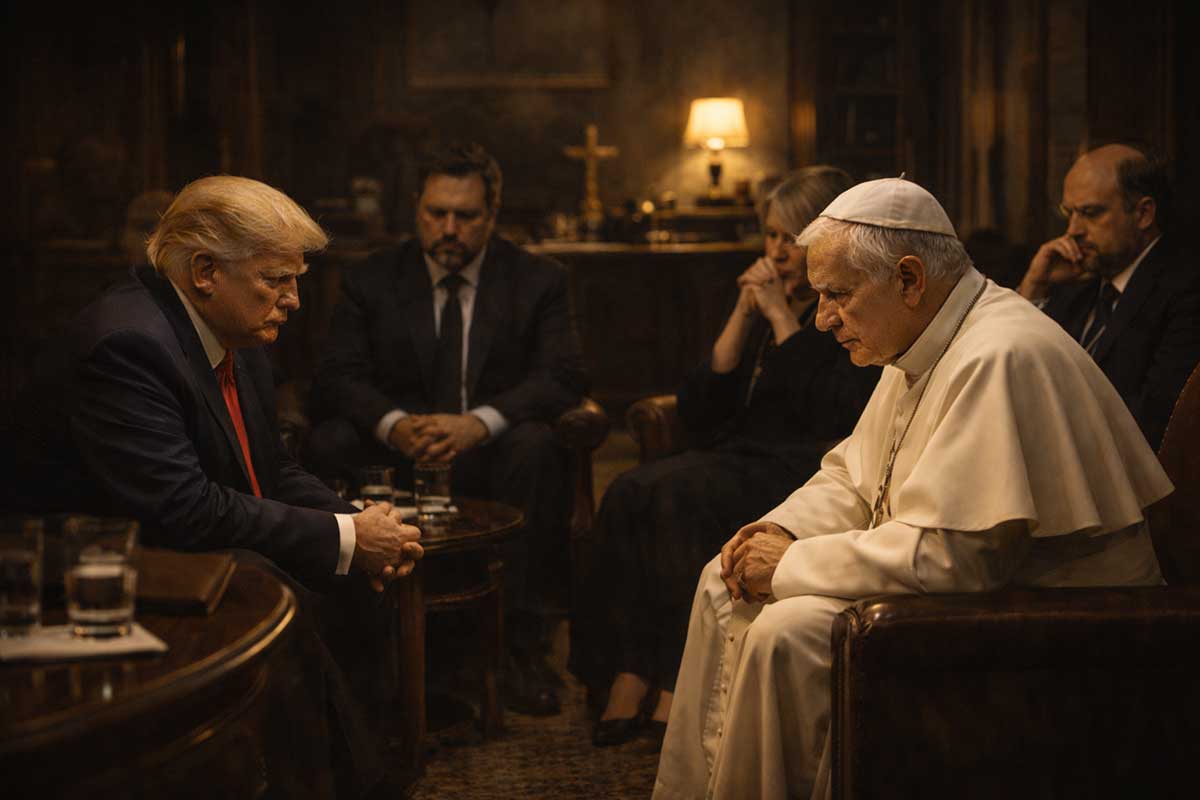
By the time the conversation reaches its final topic, everything has moved beneath the surface of policy and into the deeper moral weather of the age. The question is no longer only about Iran, migration, strong leaders, or Christian politics. It is about whether peace itself still sounds believable to people whose imagination has been trained by danger, conflict, instability, and fear. That is what makes this closing topic so important. Reuters has reported that Pope Leo XIV has kept speaking against the Iran war with unusual directness, promising to “continue to speak out loudly against war” even after Trump attacked him publicly. Reuters has also described Leo as stepping onto the world stage with a more forceful tone than many expected, condemning tyrants, war spending, and the misuse of religion in service of violence.
Trump enters this final exchange with a familiar concern: peace language that does not reckon with real evil can become a luxury paid for by other people. To him, security comes first, because a nation that cannot defend itself has no stable ground on which to build moral ideals at all. Pope Leo enters from the opposite burden. He fears that once fear governs public imagination too completely, force starts sounding like the only adult language left, and peace begins to feel childish, ornamental, or dishonest. Sarah Mullally strengthens the Christian peace witness, insisting that spiritual leadership must preserve words the state cannot produce by itself: repentance, restraint, mourning, mercy. JD Vance presses the just-war and public-responsibility side, warning that peace language can sound detached when ordinary people suspect elites no longer understand the cost of being wrong. Ross Douthat helps reveal the deeper shape of the conflict: modern societies often no longer know how to speak seriously about power and the soul in the same sentence. This last topic therefore closes the whole discussion at its most human level: what happens when fear becomes so persuasive that peace begins to sound unreal?
Question 1
Why does peace sound unreal to people living under threat?
Pope Leo XIV
Peace sounds unreal because fear narrows the imagination. When people feel endangered, they begin to judge moral language by one standard only: does it immediately remove the threat? If it does not, they may start hearing it as softness, distance, or denial. That is deeply understandable. But it is also spiritually dangerous. Once fear becomes the chief teacher of a people, violence will nearly always sound more realistic than mercy, because violence speaks in the register of urgency. Peace, by contrast, requires patience, moral memory, and faith that the human person must not be reduced to the logic of enemy and target. That is why peace sounds unreal to frightened societies: not because peace is false, but because fear has shortened the horizon of what they can still imagine as possible.
Donald Trump
Peace sounds unreal when the threat is real and people know it. That is very simple. Families watching enemies arm themselves, watching disorder spread, watching leaders hesitate, are not going to trust language that sounds noble but leaves them exposed. They want protection. They want somebody who understands that evil is not theoretical. It is concrete. It hurts people. It kills people. So when someone starts talking about peace without being clear about how the danger is actually stopped, it begins sounding fake. People are not rejecting peace because they love conflict. They are rejecting talk that feels disconnected from the cost of being wrong. Peace has to make sense in the real world or it becomes an elegant word with no force behind it.
Sarah Mullally
Peace sounds unreal because people under threat are often exhausted, and exhaustion is vulnerable to simplification. In such moments, immediate action feels morally serious, while restraint can seem like delay for its own sake. Yet that is exactly why the language of peace must remain alive. Not as sentiment, not as abstraction, and certainly not as naivete, but as a discipline of the conscience. A society shaped entirely by fear will eventually lose the ability to distinguish between what is urgent and what is righteous. Peace sounds unreal because it asks frightened people to keep hold of moral depth at the very moment when fear is pressing them toward moral speed.
JD Vance
Peace sounds unreal because people remember betrayal. They have watched institutions speak beautifully and fail practically. They have seen leaders talk about international norms, restraint, and diplomacy while threats intensified and ordinary citizens absorbed the consequences. So when peace language returns, many hear not conscience but detachment. That does not mean peace is wrong. It means peace has a burden of proof that many spiritual leaders underestimate. If you want frightened people to hear peace as serious, you must show that you understand the world they actually inhabit, where mistakes are costly and hesitation may be paid for by other families, not your own.
Ross Douthat
Peace sounds unreal because modern people live under the pressure of two truths they do not know how to hold together. One truth is that evil exists and force may sometimes be necessary to stop it. The other is that force deforms the societies that come to rely on it too confidently. Under threat, most people cling to the first truth and mute the second. That does not make them monsters. It makes them frightened. But it does mean that peace begins sounding less like seriousness and more like a refusal to rank dangers properly. The challenge for spiritual and moral voices is not simply to repeat the word peace, but to make it sound morally adult in a world that increasingly associates adulthood with strategic hardness.
Question 2
Must a spiritual leader sound unrealistic in order to keep humanity from worshipping violence?
Pope Leo XIV
Often, yes. A spiritual leader must sometimes sound unrealistic to a violent age, because the age has already narrowed what it calls realism. When rulers, generals, commentators, and anxious publics all repeat that force is the only adult language left, then the spiritual leader must preserve another register. He must remind the world that necessity is not the only moral category, that power is not innocence, and that what is effective is not always what is worthy. That may sound unrealistic to some ears. But very often that is simply what conscience sounds like when the age has grown too comfortable with hardness. Reuters has quoted Leo saying he would continue to speak out loudly against war despite political attacks, and that itself shows the role he seems to believe he must play now.
Donald Trump
A spiritual leader does not have to sound unrealistic. He has to sound responsible. People can respect a priest, a bishop, or a pope who talks about peace if he also sounds like he understands what violent men do and how dangerous the world can be. The problem begins when religious leaders sound as though moral beauty excuses strategic emptiness. That is when people stop listening. There is nothing holy about having no plan. There is nothing impressive about offering language that costs you nothing while other people live with the consequences. If spiritual leaders want to be taken seriously, they have to show they understand reality too, not just the ideal version of it.
Sarah Mullally
A spiritual leader must at least be willing to sound inconvenient, and sometimes inconvenience will be heard as unreality. That is unavoidable. The Church must preserve words the state does not generate naturally: repentance, mourning, mercy, restraint, the dignity of enemies, the tragedy of bloodshed. If it speaks only in a vocabulary already approved by strategic logic, then it may become useful, but it will no longer be distinct. Its contribution will have been swallowed by the very framework it is meant to question. So yes, there are moments when the spiritual voice will seem too slow, too hesitant, too insistent on moral depth. But perhaps that is precisely how it keeps society from collapsing into worship of force.
JD Vance
I would put it differently. The spiritual leader does not need to sound unrealistic, but he must sound morally serious enough to refuse the seduction of violence. The danger on one side is costless peace language, where a person keeps his conscience clean by ignoring hard realities. The danger on the other side is the sanctification of force, where strategy starts borrowing sacred authority. The truly valuable spiritual voice is one that can speak into tragedy without either retreating from it or becoming captive to it. That is a hard line to hold. But the answer is not unreality. It is moral gravity.
Ross Douthat
The spiritual leader often has to sound unrealistic in a narrow political sense, because he is there to remind the world that politics is not the whole of reality. The state speaks the language of security, threat, deterrence, and interest. Religion, at its best, reopens the language of sin, repentance, limits, sacrifice, and ultimate ends. That contrast can make the religious voice sound impractical. Yet if it never risks that impression, it may no longer be saying anything the world cannot already say for itself. The real challenge is to sound unrealistic without sounding unserious, to resist Caesar without becoming decorative. That has always been hard, and it is especially hard now.
Question 3
Is the real crisis of our time a failure of security, or a failure of moral imagination?
Pope Leo XIV
It is a failure of moral imagination, though not because security is unimportant. Security matters. Governments do have obligations. But a deeper crisis appears when a civilization can no longer imagine that anything except force is realistic. That is when spiritual exhaustion has entered. A people begins assuming that enemies are only threats, that dialogue is only delay, that peace is only a slogan, and that power alone deserves respect. Once imagination collapses in this way, politics grows smaller, harsher, and less human. Reuters has reported Leo condemning leaders who spend billions on war and decrying those who use religious language to justify violence. Those words come from a conviction that the deeper poverty now is not only strategic, but moral and spiritual.
Donald Trump
It is a failure of security first. People can talk about imagination all day long, but if your country is unsafe, your people are vulnerable, and your enemies believe you will not act, then all the moral language in the world does not help much. Security is what gives a nation the room to think, build, teach, worship, and live. Without that, everything becomes fragile very fast. Now, of course you do not want people worshipping force. I understand that. But you cannot start with imagination and ignore protection. That gets backwards very quickly. A country has to survive before it can lecture itself about its higher ideals.
Sarah Mullally
It is both, but more deeply it is a failure of moral imagination. A society can possess weapons, intelligence systems, alliances, border controls, and still become spiritually trapped inside fear. When fear becomes the only organizing emotion, every stranger looks like a threat and every conflict becomes proof that more hardness was needed all along. That is not security. That is a shrinking moral world. Security matters, but if it is pursued without imagination, without memory of shared humanity, without restraint, then it begins defending something smaller than a truly human civilization.
JD Vance
I would say the immediate crisis is security and the deeper crisis is imagination. The state exists to preserve order in a fallen world, and that cannot be dismissed. But once security is defended in a way that teaches people to admire hardness for its own sake, then the culture begins to deform. So the answer is not one or the other. It is that imagination must be disciplined by realism, and realism must be restrained by moral limits. The problem today is that our public life often forces a false choice between sentimentality and brutality, as though there were no serious middle ground.
Ross Douthat
The crisis may be the divorce between the two. Modern politics oscillates between technocratic security talk and moral language that often feels detached from consequence. One side speaks as though power solves everything. The other sometimes speaks as though naming the good is enough. In that split, both become weaker. Trump represents one side of the divide very clearly: protection first, ideals later. Leo represents the rebuke: if ideals always come later, they eventually disappear. The real crisis may be that advanced societies no longer know how to speak credibly about both order and transcendence at the same time.
Closing
This final topic brings the whole conversation into focus. It shows that the clash between Trump and Pope Leo is not only about Iran, migration, or one administration. It is about whether peace can still sound serious in an age shaped by fear, and whether Christianity should mainly comfort the frightened or keep warning them when force starts looking too righteous. Reuters’ recent coverage shows Leo choosing the latter path with unusual directness, and Trump rejecting that posture as weakness in a dangerous world.
What remains after the room goes quiet is not agreement, but a sharper tension. Trump keeps pressing the burden of protection. Pope Leo keeps pressing the burden of conscience. Mullally insists that spiritual language must preserve the categories the state cannot generate by itself. Vance tries to hold realism and restraint in one frame. Douthat names the deepest fracture: modern societies no longer know how to speak comfortably about power and the soul at once. That may be why peace sounds so fragile now. And yet perhaps that fragility is exactly why it must keep being spoken.
Final Thoughts by Nick Sasaki
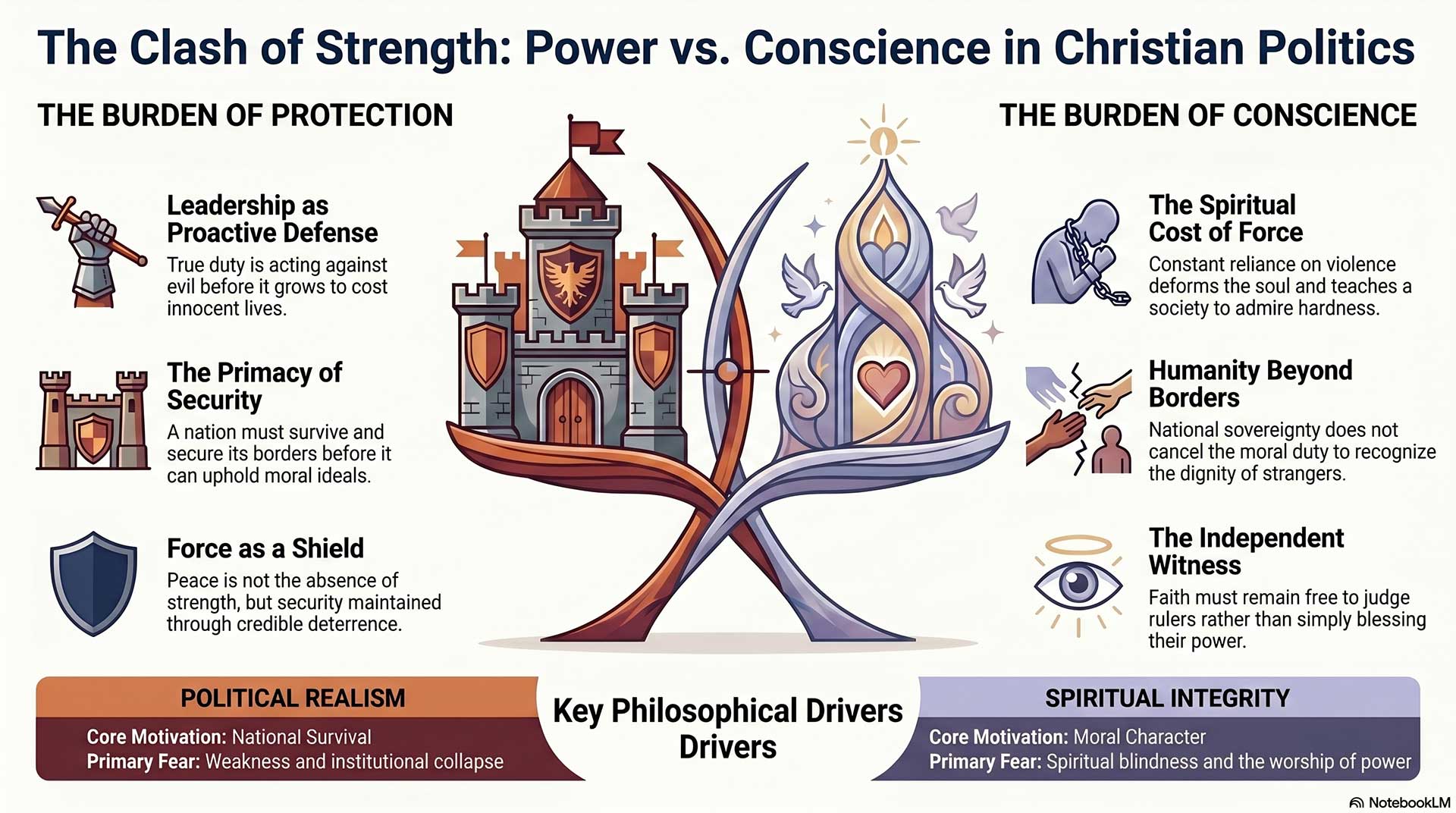
After sitting with this imagined exchange, what stays with me most is not who sounded stronger. It is the fact that each side is guarding something real, and each side is afraid of losing something that matters.
Trump is guarding order, deterrence, survival, and the right of a people to protect what is theirs. He fears weakness, drift, confusion, and the kind of hesitation that lets danger grow until ordinary people pay the price. In his mind, history punishes leaders who fail to act in time.
Pope Leo is guarding conscience, dignity, spiritual limits, and the belief that power must never be trusted too easily. He fears hardness, moral sleep, and the way nations slowly reshape themselves when force begins to feel normal, admired, or righteous. In his mind, history also punishes leaders who save the structure of a nation while hollowing out its soul.
But Tucker’s presence changes the emotional weight of the whole conversation.
He does not simply stand beside Pope Leo, and he does not simply stand against Trump. He brings a more internal accusation. He asks whether some believers, especially on the right, are beginning to confuse Christianity with loyalty to strength, loyalty to tribe, and loyalty to political survival. That is a different warning from the pope’s, and in some ways a more unsettling one, because it comes from within the same broad world that often speaks about civilization, faith, and moral decline. His presence makes the conversation feel less like a simple clash between protection and restraint, and more like a fracture within Christianity itself over what public faith is becoming.
That is why this conversation could never end in a simple resolution.
The deeper I moved through these five topics, the more I felt that the real issue was no longer only Trump versus the pope. It was fear versus conscience. It was protection versus moral restraint. It was the temptation to believe that danger excuses everything, set against the temptation to speak beautifully about peace without facing the cost of evil. And now it was also something else: the fear that Christianity itself may be becoming too comfortable in the company of power.
I do not think this conversation asks us to choose one side cheaply.
It tells us that a nation does need protection. It tells us that borders, order, and security are not meaningless things. It tells us that leaders cannot float above reality in a cloud of abstract virtue. But it also tells us that once strength stops trembling before moral limits, it starts changing the people who cheer for it. And Tucker’s warning presses one step further: once faith becomes too eager to bless strength, it may stop being faith in any serious sense and become something closer to sacred rhetoric for worldly ends.
What stayed with me most was Pope Leo’s warning, Trump’s burden, and Tucker’s unease.
The warning is that power can become self-justifying very fast.
The burden is that leaders are still responsible for what happens when they do nothing.
The unease is that Christians may not notice how easily spiritual language can be recruited into political appetite.
Put those three together, and you get the real tragedy of this conversation. The world is dangerous enough that force may sometimes be needed. A nation is fragile enough that order cannot simply be dismissed. Yet power carries a spiritual cost, and faith loses something essential when it becomes too useful to that power.
Maybe that is the final reason I wanted to imagine this conversation.
We live in a time when many people no longer know how to speak about power and the soul in the same sentence. Politics becomes strategy without conscience. Religion becomes conscience without consequence. Or worse, religion becomes a decorative blessing over strategy. Once those things split apart, or collapse into one another too neatly, both become weaker than they appear.
So I leave this conversation not with certainty, but with a sharper question:
Can a civilization remain strong without teaching itself to love hardness too much, and can Christianity remain alive in public life without becoming too obedient to power?
That, to me, is the question beneath the whole exchange. And that is why this conversation matters.
Short Bios:
Donald Trump
45th and current 47th President of the United States, known for nationalist politics, blunt rhetoric, hardline immigration views, and a strong emphasis on deterrence, sovereignty, and public strength.
Pope Leo XIV
Current pope of the Roman Catholic Church, elected in 2025, who has emerged as a forceful public voice on peace, war, moral restraint, human dignity, and the spiritual danger of unchecked power.
JD Vance
Vice President of the United States and a leading voice in populist conservatism, often arguing from national interest, civilizational concern, and a morally serious defense of state responsibility.
Archbishop Gustavo García-Siller
Catholic archbishop known for strong pastoral advocacy on behalf of migrants and for publicly supporting Pope Leo’s peace witness against war rhetoric.
Franklin Graham
Evangelical leader and public defender of many conservative political causes, often supportive of Trump and influential among Christians who see public strength and religious witness as closely linked.
Tom Homan
Senior U.S. border enforcement figure closely associated with hardline immigration policy, known for framing border control as a matter of law, deterrence, and public safety.
Cardinal Robert McElroy
Catholic cardinal identified with a strong emphasis on human dignity, migrant protection, and the moral duty of the Church to challenge fear-driven politics.
Viktor Orbán
Prime Minister of Hungary and one of the clearest modern voices for nationalist, border-centered, civilizational politics rooted in cultural continuity and state authority.
Bishop Thomas Paprocki
Catholic bishop known for clear public engagement on moral and political questions, with a concern that Christian witness remain independent enough to judge power honestly.
Sohrab Ahmari
Writer and editor whose work explores religion, moral order, post-liberal politics, and the tension between public faith and partisan capture.
Niall Ferguson
Historian and commentator whose work often examines empire, civilizational decline, elite failure, and the historical patterns that drive societies toward harder forms of authority.
David French
Conservative writer and legal commentator known for arguing that Christian and constitutional principles require restraint, moral clarity, and suspicion of personality-driven politics.
Sarah Mullally
Senior Anglican leader recognized for public advocacy on peace, conscience, and the moral role of the Church in times of conflict and fear.
Ross Douthat
Columnist and public intellectual whose work often explores religion, political culture, moral reasoning, and the spiritual tensions inside modern democratic life.
Tucker Carlson
Conservative media host whose April 15, 2026 show sharply criticized what he called the new civic religion of Trump’s America, making him a significant dissident Christian voice from inside the American right.
Leave a Reply