

|
Getting your Trinity Audio player ready...
|
What if a young woman finally chose forgiveness instead of repeating the same pain?
What if a young woman finally chose forgiveness instead of repeating the same pain?
What if a young woman finally chose forgiveness instead of repeating the same pain?
What if a young woman finally chose forgiveness instead of repeating the same pain?
What if a young woman finally chose forgiveness instead of repeating the same pain?
What if a young woman finally chose forgiveness instead of repeating the same pain?
Introduction by Nick Sasaki
This story is about one simple idea that sounds spiritual, but is actually very practical: what you do not forgive, you repeat.
Mina is a young woman who carries a deep grudge against her mother. She moves to Manhattan thinking distance will fix it, but the real conflict is inside her. In Act 1, the pain stays unresolved, and her life ends before the lesson is completed. In Act 2, she is born again into the same emotional setup, same mother, same tension, same invisible contract. This time, she begins to understand the rule: the universe does not only give us what we want, it gives us what we still have not released.
The turning point is not a perfect apology or a dramatic breakthrough. The turning point is when Mina becomes a parent and hears the old pattern try to pass through her into the next generation. That is when she realizes forgiveness is not a sentence you say. Forgiveness is the moment you stop demanding that the past become different. Once she releases that demand from the heart, the loop breaks.
Act 3 shows what happens when the contract is cleared. The same souls may still be present, but they no longer need to play the same roles. Life still has challenges, but the specific struggle that once defined Mina is gone, because there is no longer anything in her that needs it to return.
Act 1: First Life, First Loop
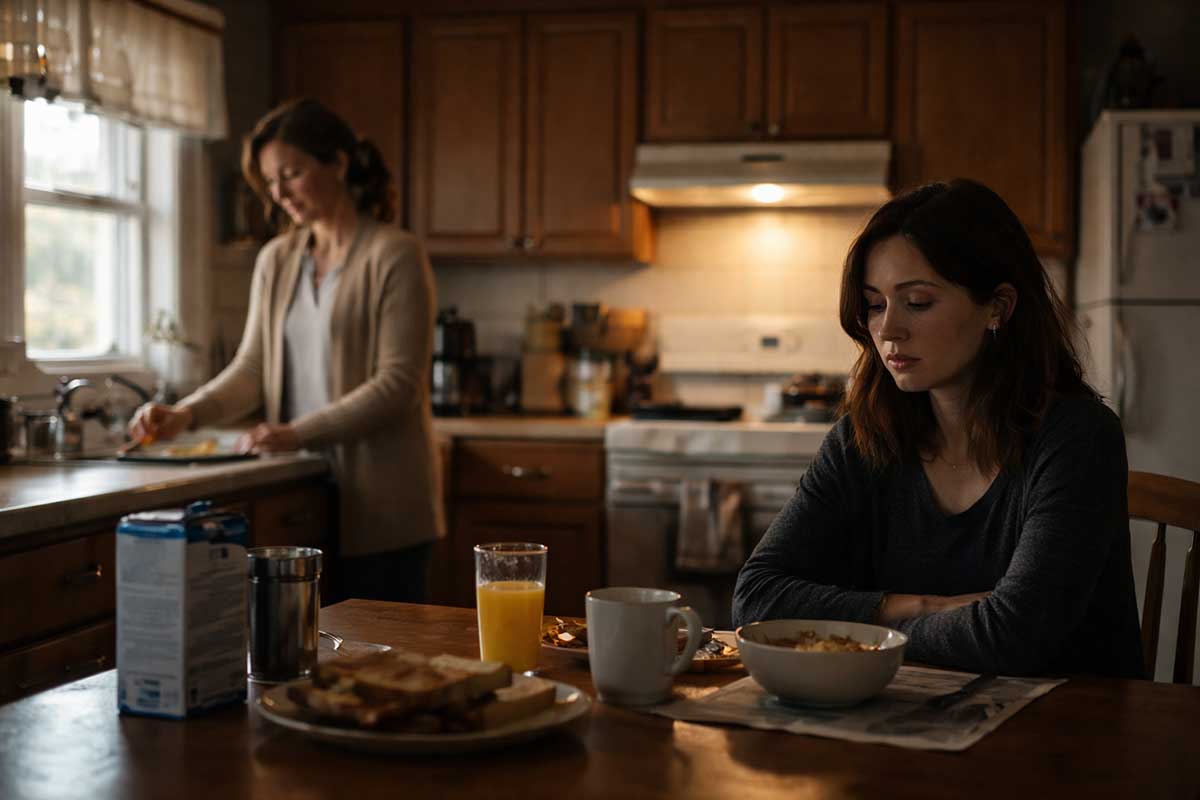
Mina woke before her alarm because the house always made noise before it made sense.
A cabinet door clicked shut downstairs. A faucet ran for exactly ten seconds. Footsteps crossed the kitchen tile in a straight line—efficient, as if someone believed time could be disciplined. The smell of toasted bread drifted up the stairs, warm and ordinary, and yet Mina’s stomach tightened as if the day had already accused her of something.
She lay still for a moment, staring at the ceiling of her childhood bedroom.
The same ceiling she’d stared at when she was twelve, when she was sixteen, when she was eighteen and counting the days until she could leave. The ceiling was painted a pale neutral, the kind of color chosen by someone who didn’t want anyone’s emotions to show.
Downstairs, her mother’s voice carried up the stairwell.
“Mina. You’re going to be late.”
Not angry. Not loud. Just certain—like a fact.
Mina swung her legs out of bed and felt the cold floor bite her feet. She pulled on a hoodie and padded down the hall, passing framed family photos. Smiles. Holidays. Graduation. The kind of images that suggested a warm story to strangers.
In the bathroom mirror, Mina’s face looked calm. That was her talent. Her mother had taught her early that feelings were something you managed privately, like stains.
She descended the stairs.
Her mother stood at the stove, hair pinned back neatly, wearing a cardigan that never wrinkled. She moved with that same controlled grace Mina had watched her whole life. Every motion looked reasonable. Every motion had a message underneath it: This is how you’re supposed to be.
On the table, a plate waited. Eggs. Toast. A glass of orange juice. Everything placed at right angles.
Her mother glanced at Mina’s hoodie.
“You’re wearing that?”
Mina slid into the chair and reached for the toast. “It’s cold,” she said.
Her mother’s eyes narrowed slightly. “You have a nicer sweater.”
Mina smiled—small, practiced. “This is fine.”
Her mother turned back to the stove. “Fine isn’t the point.”
Mina felt the reflex ignite—the urge to argue, to defend, to prove she wasn’t wrong simply for existing. But she swallowed it. She chewed her toast and stared at the wood grain like it might offer a safer conversation.
Her mother set a mug down with a controlled clink.
“You didn’t call Aunt Rina back,” her mother said.
“I was busy,” Mina replied.
Her mother didn’t look at her. “Everyone is busy.”
Mina swallowed. The air in the kitchen thickened the way it always did when her mother started listing invisible debts.
“You need to learn,” her mother continued, “that relationships are maintained. You can’t just disappear and expect people to stay close to you.”
Mina’s jaw tightened. The irony of being told that by someone who could emotionally disappear while standing three feet away was almost funny. Almost.
Mina kept her face neutral. “Okay.”
Her mother turned then, watching Mina the way she watched everything—like she was checking quality.
“You’re too sensitive,” her mother said, as if reading Mina’s thoughts. “That’s your problem. You take everything personally.”
Mina felt the sentence hit the same place it always hit: her ribs, her throat, the part of her that wanted to be tender but had learned to armor instead.
Too sensitive.
Translation: Stop needing. Stop reacting. Stop making me responsible.
Mina looked down at her hands. They were steady, though her throat burned.
Her mother’s voice softened right after the cut. The softness always came like a bandage applied with the same hand that had used the blade.
“I’m saying this because I care,” her mother said. “I want you to have a good life.”
Mina nodded because nodding was safer than telling the truth.
The truth was Mina didn’t know what a good life felt like. She knew what a controlled life felt like. A quiet life. A life built around not disappointing her mother.
Her phone buzzed on the table.
A text from Eli.
Eli: Morning. Thinking of you. Coffee later?
Mina’s thumb hovered over the screen.
Her mother’s eyes flicked to the phone immediately.
“Who is that?” her mother asked.
“A friend,” Mina said.
Her mother’s mouth tightened. “A friend who texts during breakfast.”
Mina tried to keep her tone light. “It’s not a big deal.”
Her mother’s gaze sharpened. “You’ve been distracted lately.”
“I’m not distracted,” Mina said.
Her mother leaned slightly on the counter. “You are. And when you’re distracted, you make mistakes. You miss details. And then you act hurt when someone points it out.”
Mina felt something twist inside her.
Her mother didn’t need to shout. She didn’t need to call Mina names. She simply rearranged reality until Mina felt ashamed for having emotions at all.
Mina pushed her plate away. The toast suddenly tasted like cardboard.
Her mother watched the plate. “You didn’t eat.”
“I’m not hungry,” Mina said.
Her mother sighed, tired like Mina was a puzzle she’d spent her life solving.
“Your father and I are doing our best,” her mother said. “I don’t know why you’re always so… difficult.”
The word landed like a stamp.
Difficult.
Mina swallowed hard. She wanted to say, I’m not difficult, I’m hurt. She wanted to say, You don’t see me. You manage me. She wanted to say a thousand things that would open a door she didn’t trust herself to walk through.
Instead she stood.
“I have to go,” Mina said.
Her mother glanced at the clock. “You’re leaving early.”
“I have things to do.”
Her mother’s voice sharpened. “And you can’t even sit and finish breakfast like a normal person.”
Mina paused at the doorway.
In that pause, the familiar fork appeared.
Option one: turn around and fight. Let the day become war.
Option two: leave quietly. Swallow it. Carry it. Let it harden into something that would follow her for years.
Mina chose option two, like she always did.
She stepped outside into the Ohio morning. The air was clean. The sky was pale. The neighborhood looked calm in the suburban way that made everything seem fine from a distance.
She sat in her car with her hands on the steering wheel, breathing like she’d been running.
Her phone buzzed again.
Eli: You okay?
Mina stared at the message, and something inside her went still.
She didn’t know it yet, but this was the first stone in the road that would lead her to New York—not because New York would save her, but because she was desperate for a place loud enough to drown out her mother’s voice.
She typed back: Yeah. Just family stuff.
And as she hit send, she felt the lie settle into her chest like a seed.
Because “family stuff” wasn’t a passing inconvenience.
It was the beginning of a loop.
Six Months Later
Mina drove with the radio off.
In Ohio, silence had always meant something was wrong. In the car, it meant she could finally hear her own thoughts. They came in fragments, like scraps of paper caught in a draft.
I’m not difficult.
I’m not too sensitive.
I just want to breathe.
At a red light, she watched a woman in a minivan lean over the passenger seat to wipe a child’s face with a napkin. The child squirmed and laughed. The woman laughed too, unbothered. A small, ordinary tenderness.
Mina felt something sharp in her chest and looked away.
She told herself she was leaving because she needed a bigger city, better work, more opportunity. That was true. It just wasn’t the deepest truth.
The deeper truth was that she needed distance—not miles, but atmosphere. A place where nobody knew her as her mother’s daughter.
That night, she packed two suitcases and a box of books. She didn’t pack photos. Photos felt like evidence.
Her mother watched from the hallway, arms folded, face composed.
“You’re really doing this,” her mother said.
Mina kept her eyes on the zipper. “Yes.”
Her mother’s voice stayed calm, which was always more dangerous than anger. “New York is expensive. Competitive. People will eat you alive if you’re not careful.”
Mina nodded because it was safer to nod than to argue.
Her mother stepped closer. “And you can’t call me crying when it’s hard.”
Mina froze with her hand on the suitcase handle.
She wanted to say, I never called you crying. She wanted to say, You were never the person I could cry to. But that sentence would open a door Mina didn’t want open.
“I won’t,” Mina said.
Her mother’s lips pressed together. “Good.”
There were no hugs. No blessing. No warmth that said, I’m proud of you. I’ll miss you.
Only a quiet inspection of Mina’s choice, like her mother was already preparing the critique of how she walked away.
Mina carried the suitcases to the car by herself.
When she backed out of the driveway, she looked once in the rearview mirror and saw her mother standing in the doorway. Not waving. Just standing. Still. Like a judge who didn’t need to move to be felt.
Mina turned onto the street and kept driving.
The first time she saw Manhattan, it looked like a wall of glass and stone rising straight out of the earth. The skyline wasn’t welcoming. It was indifferent.
That indifference felt like mercy.
Her first apartment was small enough that she could touch the kitchen sink and the bed without taking a step. The radiator hissed with the same warning sound as her childhood home, only here it felt less like a threat and more like a reminder that this building was alive.
Work filled her days. She learned New York quickly: walk fast, don’t apologize, don’t make eye contact unless you mean it. She learned which bodegas had the best coffee and which streets became wind tunnels in winter.
After a few months, she moved to a cheaper sublet in Brooklyn—still close enough to Manhattan to keep her life moving, far enough to feel like she’d earned a little space.
But she also learned something else.
You can leave Ohio and still carry Ohio in your ribs.
Her mother called once a week at first. Mina let it go to voicemail. Then her mother started leaving messages that sounded polite enough to be used against Mina later.
“I just want to make sure you’re okay.”
“I’m worried you’re isolating.”
“Call me when you have a moment.”
There was always a subtext: If you don’t call, it proves what’s wrong with you.
Mina would listen to the voicemails and feel that old heat rise, then wash dishes she didn’t need to wash just to keep her hands busy.
Eli came into her life like a kindness she wasn’t prepared for.
They met at a friend’s birthday gathering in Brooklyn. Mina hadn’t wanted to go—crowds made her feel exposed—but she went because she’d promised herself she wouldn’t disappear into her apartment the way she disappeared inside herself.
Eli was easy. That was the first thing she noticed. He didn’t push. He didn’t test. He asked questions and actually listened to the answers like they mattered.
He laughed with his whole body. He made fun of himself lightly without making himself small. He stood next to Mina without trying to fill her silence.
When he asked for her number, Mina almost said no out of habit.
Then she heard her own inner voice, quiet and older than her reflexes.
If you keep refusing warmth, you will only prove the cold was right.
So she gave him her number.
They started with coffee, then dinners, then long walks where Mina talked more than she intended. She told him about her job. About the way she loved the city at night, when the lights made everything look less harsh.
She didn’t tell him about her mother at first.
But some things leak.
One evening, she flinched when her phone buzzed on the table. Eli noticed.
“Everything okay?” he asked.
Mina saw her mother’s name like a brand.
“It’s nothing,” Mina said, too quickly.
Eli didn’t press, but his eyes stayed on her with a quiet steadiness that made Mina feel both safe and nervous.
Later, after Mina finally picked up and endured two minutes of calm criticism disguised as concern, she hung up and realized her hands were shaking.
Eli sat beside her on the couch.
“That’s not nothing,” he said.
Mina stared at her hands.
Eli waited.
And Mina did something she had never done in Ohio.
She told the truth.
“My mom makes me feel like I’m failing just by existing,” Mina said.
Eli didn’t try to fix it. He didn’t say, I’m sure she loves you. He didn’t defend a person he’d never met.
He just nodded.
“That’s heavy,” he said.
Mina’s throat tightened. “I shouldn’t still care.”
“That’s not how it works,” Eli said. “You don’t stop caring just because someone hurt you. Sometimes you care more.”
Mina looked away, furious at herself for feeling seen.
Eli reached for her hand.
Mina let him.
For a few months, life started to feel almost normal.
Then, on a Tuesday in late fall, Mina opened her mailbox and found an envelope with her mother’s handwriting.
The sharp, careful loops. The “M” that looked held down.
Mina carried it upstairs like it was fragile and dangerous. She set it on the kitchen counter and stared at it, breathing like it could bite.
She didn’t open it. She didn’t throw it away.
She just let it sit there, dominating the room.
For three days, it stayed untouched.
Eli noticed it immediately on the second night.
“From her?” he asked gently.
Mina nodded.
“Do you want to open it together?” Eli offered.
Mina shook her head so fast it almost hurt.
Eli studied her. “What are you afraid it will say?”
Mina swallowed.
The truth was she wasn’t afraid of what it would say.
She was afraid of what it would do.
Because her mother’s words always did something. They tightened Mina’s body, shrank Mina’s world, made Mina second-guess her own reality.
“I’m afraid it’ll pull me back,” Mina admitted.
Eli nodded like that made perfect sense. “Then we take it slow. No pressure.”
On the fourth day, Mina opened it.
Her fingers trembled as she unfolded the paper.
Mina,
I’m coming to New York next week. I’d like to see you. Just for a little bit. We need to talk. I don’t want this distance between us.
There were more lines—carefully phrased to sound reasonable. Concerned. Mature.
But Mina could read the hidden meanings like she could read traffic signals.
We need to talk meant you need to listen.
I don’t want this distance meant you’re doing something wrong.
Just for a little bit meant you don’t get to say no.
Mina read it twice. Her chest tightened until she had to grip the counter.
That night, she barely slept.
In the morning, her mother texted.
Mom: I’ll be in NYC Tuesday and Wednesday. I’m staying near Grand Central. Let me know what time you can meet.
Mina stared at the screen until the words blurred.
Something in her wanted to reply with a simple no. A clean boundary. A grown woman’s right.
But another part of her—the older part that had learned survival in Ohio—whispered a different instruction.
If you say no, she will punish you.
Mina hated that she still believed it.
At lunch, she called Eli.
“My mom is coming,” Mina said.
Eli’s voice softened. “Okay. How do you feel?”
Mina laughed once—sharp and humorless. “Like I’m twelve.”
Eli paused. “Do you want to meet her?”
“No,” Mina said, and the word came out like it had been waiting years to be spoken.
“Then you don’t have to,” Eli said.
“I know,” Mina whispered. “But I feel like I have to. If I don’t, I’m… bad.”
Eli’s tone was careful. “Whose voice is that? Yours or hers?”
Mina closed her eyes. “Hers.”
Eli exhaled. “Then let’s make a plan that’s yours.”
The closer Tuesday got, the more Mina’s body lived in alarm. She snapped at coworkers. Forgot small things. Replayed conversations that hadn’t happened yet.
And then Mina did what she always did when she felt cornered.
She tried to cut off the part of her life that felt safest.
On Monday night, Eli came over. One look at Mina’s face and he said, “Hey. Talk to me.”
Mina stood in the tiny kitchen, the letter on the counter like a blade.
“I can’t meet her,” Mina said.
Eli nodded. “Okay. Then don’t.”
Mina’s throat tightened. “But she’s going to come anyway. She’s going to show up. And you don’t understand what it’s like.”
“Help me understand,” Eli said.
That terrified her.
Because if Eli understood, he might stay close.
And if he stayed close, he would see everything Mina had been trained to hide.
So Mina did the leaving first.
“I don’t think this is working,” Mina said abruptly.
Eli went still. “What?”
“I’m not good at this,” Mina said, too loud in the small room. “I’m not good at relationships. I’m not good at… being normal.”
Eli’s eyes searched hers. “Mina, you’re scared.”
“You deserve someone who isn’t carrying all this,” Mina said.
Eli took a slow breath. “Is this what you want?”
Mina opened her mouth.
What she wanted was to be held. What she wanted was to not be alone. What she wanted was a life that wasn’t always a performance.
But wanting had always been dangerous.
“Yes,” Mina lied.
Eli’s face tightened with hurt. He nodded once, as if forcing himself to respect something that didn’t make sense.
“Okay,” he said quietly. “If that’s what you want.”
Mina felt her chest crack.
Eli stepped back. “I love you. But I won’t chase you into your fear.”
And then he left.
The door clicked shut.
Mina stood in the silence and felt the world tilt—not dramatically, just enough to make everything feel unreal.
Her mother was arriving tomorrow.
On Tuesday evening, Mina found herself walking toward Grand Central without fully deciding to. She told herself she was just going to look. Just to prove she could stand in the same neighborhood and not collapse.
The sidewalks were slick from earlier rain. People rushed past with scarves pulled up to their eyes.
Her phone buzzed.
Mom: I’m here.
Mina didn’t reply.
At the corner, the crosswalk signal blinked from the white walking figure to the red hand.
Stop.
Mina stepped forward anyway.
She didn’t see the cyclist cutting through. She didn’t see the delivery van turning too fast. She didn’t hear the shout until it was too late.
The impact was sudden and wrong, like the world had been edited.
A jolt—then weightlessness—then the street spinning up toward her face.
The last thing she saw was the red hand, still glowing.
Stop.
And then everything went quiet.
Act 2: Second Life, Second Chance
The In-Between
There was no pain.
No cold pavement. No sirens. No shouting voices. No Grand Central lights.
Just stillness—wide and quiet, like the space between two thoughts.
Mina stood upright as if she had always been standing. She didn’t remember standing, but she was. She didn’t feel her body the way she used to. No tight chest. No shaking hands. No adrenaline. Just awareness, clean and exposed.
Around her was a soft, endless light. Not blinding. Not holy. More like dawn without a sun—gentle, unclaimed, patient.
Mina looked down at herself.
No blood. No coat. No phone buzzing with her mother’s name. No letter on the counter. None of the objects she’d depended on to prove her life was real.
A wave of panic rose anyway, automatic as breath.
Where am I?
As if the space itself had heard her, a presence stepped into view.
Not dramatic. Not glowing. Not a robed angel or a judge. Just… there. Calm in a way that made Mina’s nervous system want to borrow its steadiness.
The presence felt ordinary, and that was the strangest part—like a person you might trust without knowing why. Like a nurse. Like a quiet teacher. Like someone who didn’t need to win.
“Mina,” the presence said softly.
Mina tried to speak, but her voice didn’t come out as sound. It came out as feeling—anger first, hot and dense.
Anger at her mother’s voice. Anger at her mother’s control. Anger at the way Mina had swallowed so much that swallowing became her personality.
She wanted to list every morning in Ohio. Every quiet insult. Every moment she’d been made to feel defective for having a heart.
The presence didn’t flinch.
It looked at Mina the way Eli had looked at her—no fear, no blame. Just seeing.
“You don’t have to defend your pain here,” the presence said.
Mina’s anger surged anyway. It wanted a verdict. It wanted justice. It wanted the past rewritten until it finally made sense.
The presence waited until Mina’s storm settled into something quieter: grief.
Then it said, gently, as if placing a fact on the table.
“You’re going to meet her again.”
Mina recoiled as if struck.
No.
The presence’s calm didn’t change. “Not as punishment. As process.”
Process.
The word infuriated her. It made her suffering sound like homework.
“She ruined my life,” Mina tried to insist—though again, it wasn’t words so much as a fierce wave of truth.
The presence nodded like her truth was fully acknowledged.
Then it spoke carefully, each sentence laid down like a stepping stone.
“When you refuse to forgive someone, you stay tied to them.”
Mina felt something tighten—an invisible cord she hadn’t known she was holding.
The presence continued. “Not because forgiveness is for them. Because forgiveness is the only way you stop carrying the bond.”
Mina’s mind fought back immediately.
But she should know.
She should admit it.
She should change.
I shouldn’t have to be the one who lets go.
The presence seemed to recognize the shape of her resistance.
“As long as you need your enemy to become different in order for you to be free,” it said, “you will keep meeting that enemy.”
The word enemy made Mina’s throat burn.
“In one life, it is your mother,” the presence said. “In another, it may be someone else who triggers the same wound. But the lesson will wear familiar clothing until you complete it.”
Mina felt cold—not fear exactly, but recognition.
She saw it suddenly, not as a movie, but as a pattern: the same tightening in her chest, the same instinct to run, the same vow to never forgive. Different rooms. Different years. Different faces.
Same chain.
“And if I don’t?” Mina tried to ask.
The presence stepped closer. Its steadiness didn’t push—just offered.
“You will see her again,” it said. “And again. Until you do.”
Mina felt the truth of it like gravity.
Forgiveness wasn’t a moral gold star.
It was an exit.
The presence’s voice softened but did not weaken.
“You will return,” it said. “You will begin again. The morning routines. The same tone. The same hooks. The same urge to run.”
Mina felt herself resisting already, almost laughing at the terror of it.
The presence added, almost kindly, “The loop will feel familiar so you can recognize it.”
Mina wanted to promise. To bargain. To demand a different life, a different mother, a different script.
But the presence offered only one question, simple enough to survive any lifetime.
“When you feel the old hatred rise,” it said, “ask yourself this: do you want to meet your enemy again… or do you want to be free?”
The light around Mina brightened—not like a spotlight, but like sunrise deciding to arrive.
Mina felt herself falling, not downward but inward, as if being folded back into time.
And as she fell, she understood what was coming next.
A repeat.
A second chance.
A choice.
The Second Morning
Mina woke to the sound of running water downstairs.
A cabinet door clicked shut. Footsteps crossed the kitchen tile in a straight line. The smell of something warm—oats, maybe—rose into the hallway.
For a moment she lay completely still, listening.
Her first thought was: I know this.
Her second thought was: I can change this.
She sat up slowly and looked around.
Same bedroom. Same pale walls. But the light felt different, softer—like the world wasn’t bracing for impact.
She walked into the bathroom and looked in the mirror.
Younger. The same age she’d been in the first life. But her face wasn’t braced in the same way. Her shoulders sat lower. Her jaw wasn’t clenched.
She heard her mother’s voice from downstairs.
“Mina, breakfast!”
Almost the same tone.
Almost.
And yet Mina noticed something she had missed before.
Under the command was a question she’d never allowed herself to hear.
Are you coming? Will you meet me here?
Mina exhaled and went downstairs.
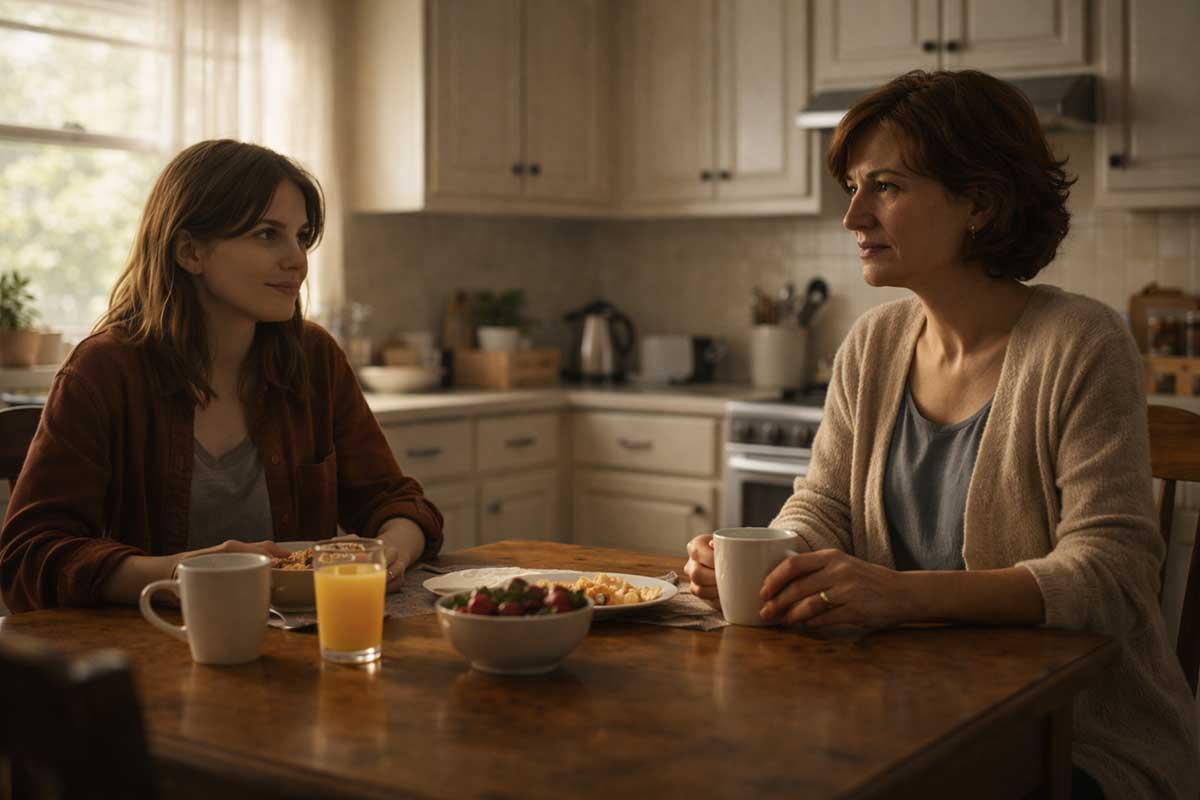
The kitchen looked the same, but the details were slightly different. A different mug on the counter. Oatmeal in a pot instead of eggs. A dish towel with a small pattern.
Her mother stood at the stove, stirring, hair pinned back, cardigan neat.
When her mother turned and saw Mina, her eyes did the familiar scan—clothes, posture, expression.
Mina felt the old anger twitch awake, the old instinct to brace.
Then she remembered the question.
Do you want to meet your enemy again… or do you want to be free?
Mina stepped fully into the room and chose a new tone.
“Good morning,” she said.
Her mother blinked, thrown off by the calm. “Morning. Did you sleep well?”
“I did,” Mina said. And it was true.
Her mother placed a bowl in front of her. Oatmeal with honey, nuts, a few berries. It looked almost generous.
Mina took a bite. It was good.
Her mother watched her. “You seem different today.”
Mina kept her voice steady. “Maybe I am.”
Her mother’s mouth tightened, as if she didn’t trust softness. “Well… you could still dress more put-together in the mornings.”
There it was.
The hook.
In the first life, that comment would have landed like a slap.
This time, Mina felt it arrive—and instead of fighting or swallowing it, she watched it like a weather pattern.
And she became curious.
What is she afraid of?
Mina set her spoon down gently. “Mom… do you ever feel like you have to control things to feel safe?”
Her mother’s face went still. “What kind of question is that?”
“An honest one,” Mina said.
Her mother’s jaw tightened. “I don’t control things. I care about standards. There’s a difference.”
Mina nodded slowly. “Okay. I hear that.”
Her mother looked almost irritated by the lack of argument. She turned back to the stove as if busying herself could restore order.
Mina felt something shift in the air—not victory, not peace. More like a door that had been bolted for years loosening by a fraction.
“I know you care,” Mina said. “I just don’t always feel cared for.”
Her mother’s hand stilled on the dishcloth. She didn’t turn around.
“I’m doing my best,” her mother said quietly.
“I know,” Mina said. “And I’m not attacking you. I’m just telling you how it lands.”
Silence.
Her mother turned then, and for a brief second Mina saw past the mask. Not a villain. A woman who had been performing competence for so long she didn’t know how to put it down.
Mina’s chest loosened.
This was the same kitchen.
But it wasn’t the same breakfast.
Because Mina wasn’t the same person.
Months Later: The Letter Again
When the letter arrived in New York this time, Mina didn’t freeze.
She still felt the familiar tightness—but it didn’t run the whole show.
She opened it that night, read the same phrasing—I’m coming to New York. We need to talk. I don’t want this distance.
And instead of panic, Mina felt clarity.
She texted Eli.
Mina: My mom wants to visit. I’m going to meet her. Can you be nearby?
Eli: Of course. Proud of you.
Mina stared at that last line for a moment.
Proud of you.
Not: What’s wrong with you?
Not: Everyone is busy.
Not: Fine isn’t the point.
Just: proud.
Mina texted her mother.
Mina: I can do coffee. Tuesday at 11. Twenty minutes. Public place. If it turns hostile, I leave.
She hit send before her fear could negotiate.
Her mother replied an hour later.
Mom: Okay.
Just that.
Okay.
It didn’t mean everything was healed.
But it meant something had moved.
Grand Central: The Meeting
Mina arrived early and chose a table near the window.
She ordered tea. She sat with her back straight, hands resting on the table—not in armor, not in surrender. Grounded.
When her mother walked in, Mina noticed everything.
The slight hesitation in her step. The careful way she’d dressed. The tightness around her mouth that said she was nervous too.
Her mother sat down across from her.
“You came,” her mother said.
“I said I would,” Mina replied.
They ordered. Small talk about the city. The train ride. The weather. Safe sentences, laid down like boards across a river.
Then her mother said, voice tight, “You’ve been distant.”
Mina nodded. “I have.”
Her mother blinked, clearly expecting denial.
“I needed space,” Mina continued. “Because when I’m close to you, I don’t feel safe.”
Her mother’s face flushed. “Safe. Mina, don’t be dramatic—”
“That,” Mina said gently, “is exactly what I mean.”
Her mother stopped.
Mina leaned forward slightly. “When I tell you something hurts, you tell me I’m dramatic. When I say I’m overwhelmed, you tell me everyone is. When I need warmth, you tell me to be strong.”
Her mother’s jaw set. “You’re twisting everything.”
“I’m not twisting,” Mina said. “I’m telling you my experience.”
Silence.
Her mother looked away, blinking hard. “I didn’t have warmth either,” she said finally. “I had to be strong.”
Mina felt the old anger rise—fast, familiar, hot.
And then she made the choice.
She didn’t swallow it into a lifelong grudge.
She released it.
“I know,” Mina said softly. “And I’m sorry that happened to you. But I’m not going to repeat it.”
Her mother’s eyes filled. “So what do you want from me?”
Mina took a slow breath.
“I want to forgive you,” she said. “Not because everything was okay. But because I don’t want to carry this anymore.”
Her mother stared at her. “Forgive me for what?”
“For loving me the only way you knew how,” Mina said. “Even when it hurt.”
Her mother’s lips trembled. She looked down at her hands.
“I tried,” she whispered.
“I know,” Mina said. “And I forgive you.”
The words didn’t erase anything.
But they did something else.
They cut the chain.
Mina felt it physically—lightness in her chest, space in her shoulders, breath returning like it had been waiting.
Her mother looked up, eyes red. “I’m sorry,” she said. “I didn’t know how to be different.”
Mina nodded. “Thank you.”
They sat there for a moment—two women who had lived like enemies, lowering their weapons without fanfare.
“I should go,” Mina said, standing. “But I’ll call you next week.”
Her mother nodded, small and uncertain. “Okay.”
Mina reached across the table and touched her mother’s hand—briefly, gently.
Not surrender.
Recognition.
Then Mina walked out into the cold New York air, and for the first time, she felt something she hadn’t known she could feel.
Freedom.
The Baby
Two years later, Mina held her son at 2 a.m. while he cried.
She’d tried everything. Bottle. Diaper. Rocking. Singing. Nothing worked.
And in her exhaustion, a sentence rose to her lips automatically, fully formed:
“Stop it. You’re fine.”
Her mother’s words.
Her mother’s tone.
Mina froze.
The baby kept crying, face red, tiny fists trembling. Mina stared at him and saw herself.
Saw the child who’d been told her feelings were inconvenient.
Saw the loop trying to continue.
“No,” Mina whispered. “Not this time.”
She adjusted her hold, softened her body, and spoke from a different place entirely.
“I’m here,” she murmured. “You don’t have to be fine. You can be upset. I’m not leaving.”
The baby’s cries slowed. His body relaxed into hers.
Mina felt tears slide down her own face—not dramatic tears. The quiet kind. The kind that meant something had finally moved in the body, not just the mind.
She reached for her phone and dialed.
Her mother answered, voice thick with sleep. “Mina? Is everything okay?”
“No,” Mina said honestly. “The baby won’t stop crying, and I’m exhausted… and I just heard myself say something you used to say to me.”
Silence.
Then her mother’s voice, quieter than Mina had ever heard it: “What did you say?”
“I told him he was fine when he wasn’t,” Mina whispered. “And I realized… I’ve been forgiving you in my head, but not in my body. I’ve still been holding you as my enemy.”
Her mother’s breath hitched. “What are you saying?”
“I’m saying I don’t want to pass this on,” Mina said. “I don’t want him to inherit my fear the way I inherited yours.”
A long pause.
Then her mother spoke, small and bare. “I was scared. All the time.”
Mina closed her eyes. “I know.”
“I didn’t know how to be gentle,” her mother said.
“I know,” Mina whispered. “And I forgive you. For real this time. Not because it was okay. But because I don’t need you to become different for me to be free.”
The words landed in Mina’s chest like something unclenching.
Her mother’s voice cracked. “I wanted you to be strong so you wouldn’t suffer like I did.”
Mina looked down at her baby, calm now, breathing softly against her.
“Thank you,” Mina said.
“For what?”
“For trying,” Mina said, “in your way.”
When Mina hung up, she felt it.
The enemy was gone.
Not because her mother had become perfect.
Because Mina had stopped needing her to be.
And because of that, the loop finally had nowhere left to hold.
Act 3: Third Life, After Release
Mina woke before her alarm.
A cabinet door clicked shut downstairs. A faucet ran for exactly ten seconds. Footsteps crossed the kitchen tile in a straight line.
The sounds were the same.
But this time, they didn’t land in her body like a warning.
She lay still for a moment, listening—not bracing. Not scanning for what she might have done wrong. Just listening, the way you listen to rain when you know you’re safe inside.
Her chest was quiet.
Not the forced quiet of suppression. The real quiet of completion.
Mina sat up and looked around her room.
Same pale walls. Same small desk. Same window with the same familiar view of a suburban Ohio street. Even the light looked similar—soft morning, early blue.
And yet everything felt… neutral. As if the air itself wasn’t waiting for judgment.
She walked into the bathroom and looked at herself in the mirror.
Younger again. The age she’d been in the first life, the second life.
But her eyes were different.
Clear. Unafraid. Not asking permission to exist.
From downstairs, her mother’s voice called up.
“Mina, breakfast!”
It wasn’t loud. It wasn’t angry.
It was simply an invitation.
Mina went down the stairs.
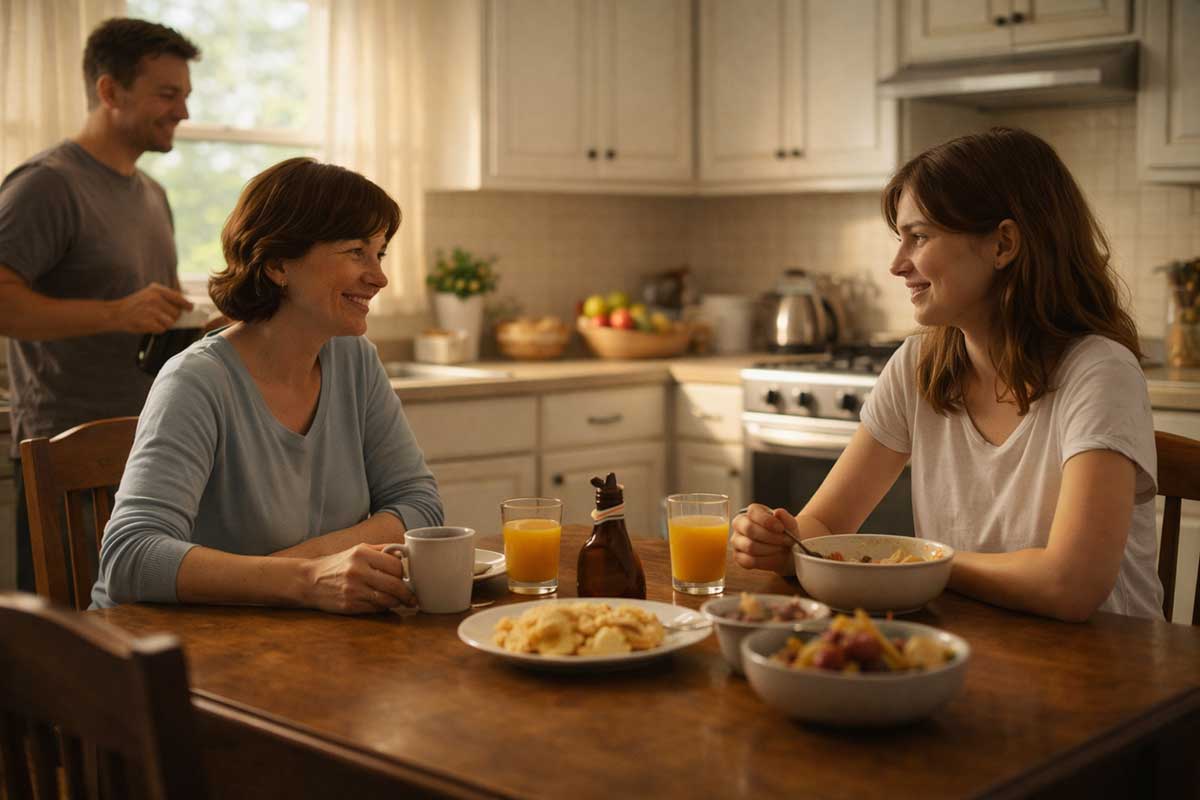
The kitchen was bright, sunlight pouring through the window as if the house had finally stopped holding its breath. On the table were fresh fruit, yogurt, coffee already poured. Nothing was placed with rigid symmetry. Things looked lived-in—human.
Her mother stood by the counter, humming softly as she rinsed a bowl.
When she turned and saw Mina, she smiled.
A real smile. Not performed. Not cautious. Not weaponized.
“Good morning, sweetheart,” her mother said. “How did you sleep?”
The question was simple.
And revolutionary.
“Really well,” Mina said.
And it was true.
They sat and ate together. They talked about ordinary things—something Mina had to do at school, a book her mother was reading, a neighbor’s dog that had escaped again.
Her mother still had opinions. Still liked things a certain way.
But the fear underneath was gone.
The need to control—gone.
And Mina noticed something else, quietly astonishing.
She didn’t feel like she was being graded.
She didn’t feel like she was walking through her own life carrying an invisible report card.
She was just… there.
At one point, Mina laughed. A real laugh. It surprised her, the way it rose naturally without permission.
Her mother laughed too, softer, like she was relieved to remember how.
Mina looked at her mother and realized she could see her clearly now.
Not only as “the enemy.”
As a person.
A woman who had once been a girl. A girl who had learned that love meant pressure, that safety meant control, that warmth was unreliable.
Mina didn’t excuse what had happened.
She simply didn’t need to fight it anymore.
The urge to punish the past was gone.
Because the past no longer held her.
Years Later
Mina moved to New York again.
But this time, it wasn’t escape.
It was choice.
The skyline still looked like a wall of glass and stone rising straight out of the earth. The city was still indifferent.
But Mina didn’t need the city to save her anymore.
She rented a small apartment—not because she was running, but because she liked the feeling of a compact life: everything she needed within reach, nothing unnecessary.
Work was hard. She still felt stress. She still had days when she doubted herself.
But the old familiar struggle—the one that had once defined her—was gone.
Her mother called, and Mina didn’t flinch when the phone buzzed.
Sometimes Mina answered. Sometimes she didn’t. And neither choice made Mina feel like a bad person.
When they talked, it wasn’t perfect. It wasn’t scripted. It was human.
There were awkward moments. Old habits, occasionally.
But there was no chain.
There was no war.
One night, Mina stood by her apartment window watching the city lights blink like distant signals.
She thought about the three lives she’d lived.
In the first, she had carried her pain like proof.
In the second, she had forgiven with words—and then finished the forgiveness with her body.
And now, in this third life, she didn’t feel the need to keep the wound open just to justify her history.
She felt… free.
Not euphoric.
Not spiritually floating.
Just free in the most practical sense:
She could breathe without remembering why she couldn’t before.
She could love without expecting punishment.
She could be herself without preparing a defense.
The New Pattern
When Mina became a parent in this life, her child cried one night at 2 a.m.
The moment was familiar.
The exhaustion. The helplessness. The temptation to speak sharply just to stop the noise.
Mina felt the old reflex flicker—the echo of an inherited sentence trying to rise.
And then it passed through her without taking root.
Because there was nothing for it to attach to anymore.
Mina held her child close and spoke softly, without performance.
“I’m here,” she murmured. “You don’t have to be fine. You can be upset. I’m not leaving.”
The baby calmed the way babies do when they feel safety enter the room.
Mina swayed gently, rocking with the quiet confidence of someone who wasn’t fighting ghosts.
She didn’t think about her mother in that moment.
Not because she was avoiding her.
Because she didn’t have to.
The pattern had ended where it was supposed to end:
Inside Mina.
Later, when the baby slept, Mina stood by the window again, city lights below, her child’s breath steady in the next room.
And she whispered—not like a vow, but like a fact.
“It ends with me.”
Somewhere beyond time, a door that had once been necessary simply closed.
Not with a bang.
With a quiet click.
The sound of something finished.
Final Thoughts by Nick Sasaki

Here is what we can learn from this today.
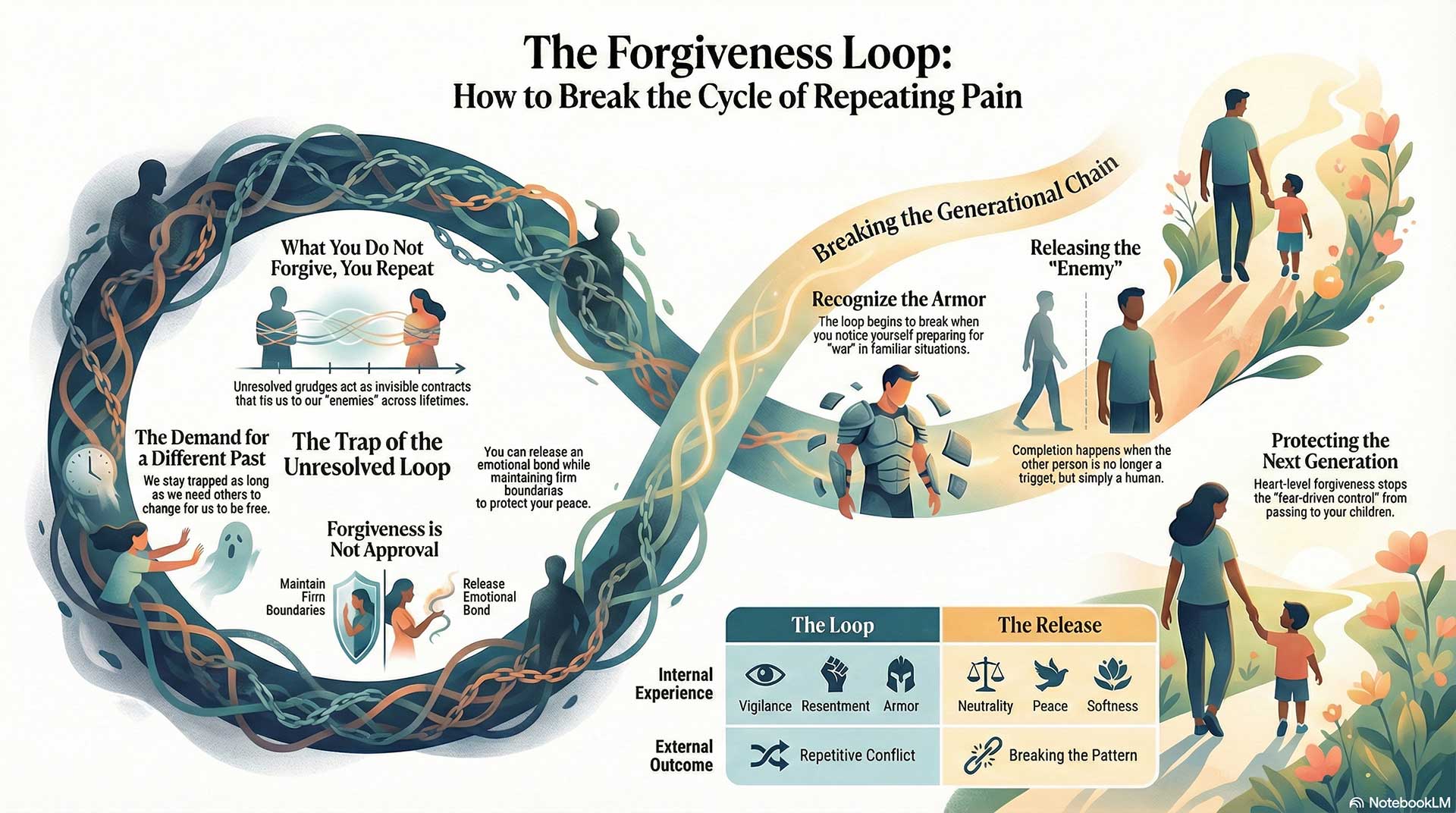
First, forgiveness is not approval. You can forgive someone and still keep boundaries. Forgiveness is not letting someone continue to hurt you. Forgiveness is releasing the emotional grip that keeps you tied to them, even when they are not in the room.
Second, words are not enough. Saying “I forgive you” can be a starting point, but real forgiveness is felt in the body. You know it is real when you stop replaying the argument in your head, stop waiting for their validation, and stop needing them to understand in order for you to be free.
Third, this story shows why becoming a parent can change everything. When we see how easily fear becomes control, we realize we are not only healing the past. We are deciding what we pass on. The moment Mina chooses softness instead of repeating the old reflex, she is not only forgiving her mother. She is protecting her child, and that makes forgiveness real.
Finally, the deepest lesson is this: the “enemy” is often the person we have unfinished emotional business with. If we keep the demand alive, the situation returns in different forms, different years, different faces, until the demand is released. When we forgive from the heart, we do not erase the past. We simply stop carrying it. And when we stop carrying it, we stop recreating it.
Short Bios:
Nick Sasaki: Storyteller and host who frames the meaning of the three-act forgiveness journey and translates the spiritual lesson into everyday life.
Mina: A Manhattan-bound young woman carrying a long-held grudge against her mother, who must learn that forgiveness is not a sentence but the end of emotional demand.
Mina’s Mother: A disciplined, fear-driven parent who loves through control and criticism, forcing Mina to confront the difference between boundaries and lifelong resentment.
Eli: Mina’s steady boyfriend who models calm support and helps her stay grounded during the New York confrontation and the emotional work of real forgiveness.
The Guide: A quiet, non-religious presence in the in-between who explains the story’s rule: what you refuse to forgive becomes a repeating lesson until you choose release from the heart.
Mina’s Baby: The living mirror that reveals how patterns try to pass to the next generation, becoming the catalyst for Mina’s heart-level forgiveness and true freedom.
Leave a Reply