
|
Getting your Trinity Audio player ready...
|
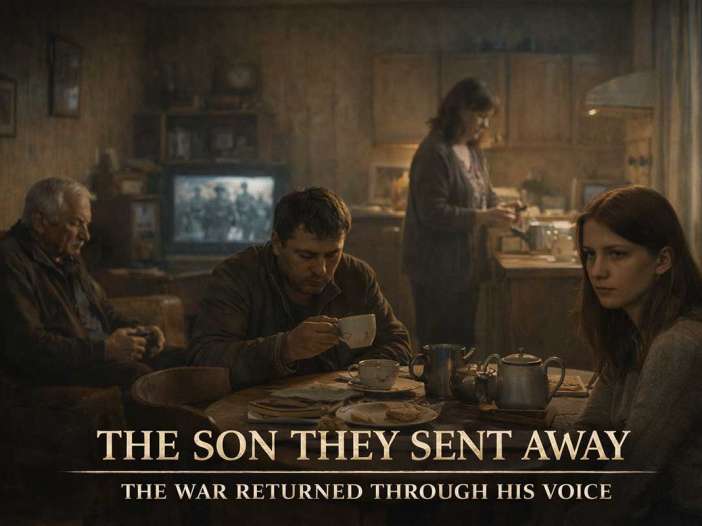
This story begins long before the war itself.
That matters.
The Son They Sent Away is not built around a single decision, a single speech, or a single day of invasion. It is built around a household that has been shaped for years by memory, loss, pride, fear, and the longing not to feel humiliated again. The war enters this family late as an event, but early as a language.
That is the center of the story.
I did not want this family to feel abstractly political. I wanted them to feel ordinary. A grandfather who still lives partly inside the scale of the Soviet past. A father marked less by Soviet pride than by the chaos that followed its collapse. A mother who measures reality through food, medicine, tone of voice, and whether the people she loves are still reachable. A son raised inside restored national confidence. A daughter who hears cracks in public speech before anyone wants to admit they are there.
This is how history often lives in a home.
Not first as doctrine.
First as atmosphere.
As repeated family memory.
As what is admired.
As what is feared.
As what is never spoken lightly.
In this family, the deepest inherited lesson is not ideology in a neat form. It is emotional. Weakness is dangerous. Disorder is humiliation. Respect must be defended. A country that lets itself become small will be treated as small. Those ideas do not arrive through shouting alone. They arrive through breakfast, television, stories about the 1990s, and the felt memory of collapse.
That is why the older generation matters so much here. Viktor does not simply miss an old state. He misses scale, weight, and the feeling of belonging to something that did not need to apologize for existing. Andrei, his son, carries that inheritance in a different form. He remembers the years when the country felt unstable, stripped down, mocked, and uncertain of itself. So when order returns, it does not feel like politics alone. It feels moral.
That emotional history shapes Maksim.
He does not begin as a cruel man. He does not wake up wanting destruction. He is much more recognizable than that. He wants seriousness. He wants dignity. He wants his country to stop sounding diminished. He wants the language of strength to mean something real. That is what makes the story painful. The road into harm is not always built from hatred first. Sometimes it is built from inherited hurt and the wish never to feel powerless again.
Anya stands in the house as a different kind of witness. She is not free from history, but she is less bound to its older sacred forms. She lives inside contradiction more openly. She hears the smoothness of official speech and distrusts it. She notices the lowering of voices, the careful phrasing, the places where public certainty sounds too prepared. She belongs to the generation that no longer hears one story at a time.
And then there is Elena.
To me, she is one of the deepest moral centers of the story. She is not defined by arguments about statehood, borders, or prestige. She hears history when it reaches the body. In appetite. In absence. In the way men speak when they are trying to sound larger than their fear. She understands, almost before the others do, that the old language in the apartment is about to be tested by flesh.
That is where the story truly changes.
When war remains on a screen, families can still live inside explanation.
When someone they love is touched by it, explanation begins to fail.
This is what I wanted to follow most carefully: the moment when national narrative stops being a structure of belief and becomes a pressure on one beloved life. That is the moment the apartment changes. That is the moment the story becomes intimate in the hardest possible way.
For me, The Son They Sent Away is not a story about proving one person innocent and another guilty. It is about the far more painful territory between those clean arrangements. It is about how people inherit stories, how they trust them, how those stories shape action, and what happens when reality returns through the voice of someone they love.
That is why the title matters.
He is not only the son who goes. He is the son the family, the era, the emotional grammar of the house, and the larger national story all help send away.
Chapter 1 — After the Loss, Order Becomes Sacred
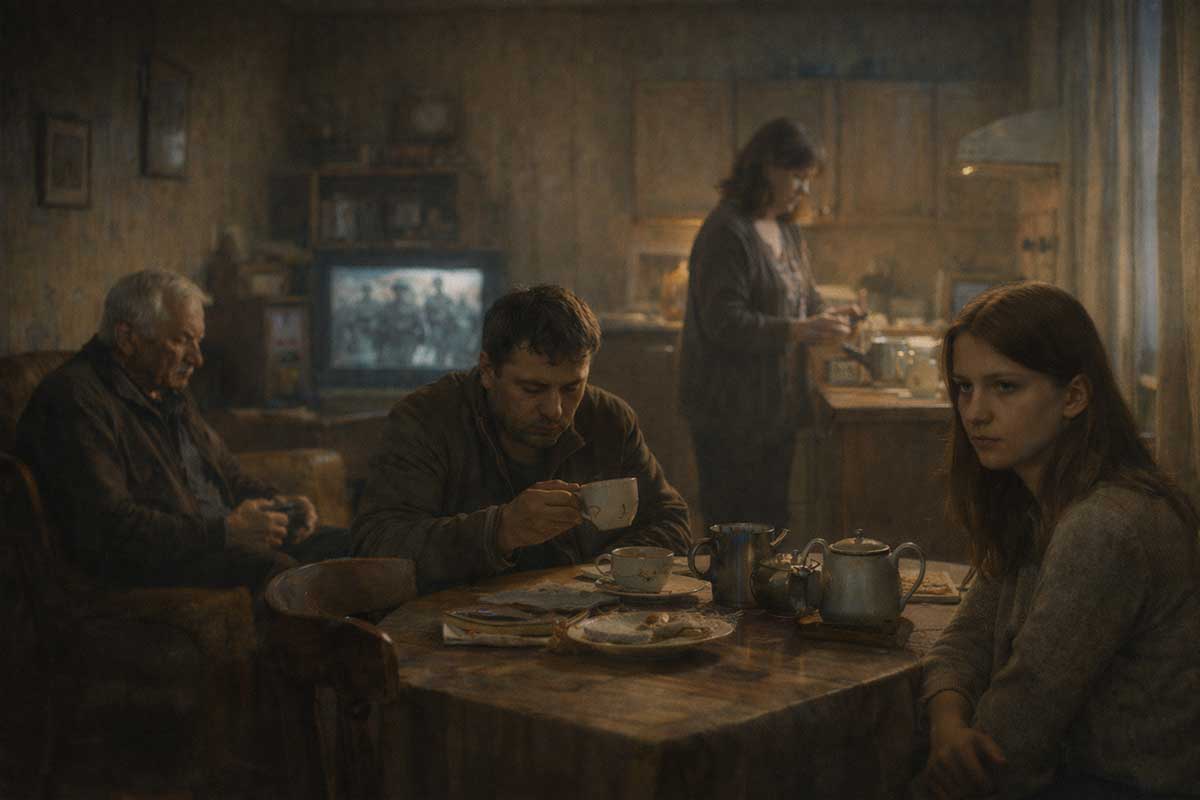
In Viktor Sokolov’s apartment, the television was always louder than necessary.
Elena complained about it every morning.
“You don’t need to argue with the room before breakfast,” she would say from the kitchen.
“It is not the room I am arguing with,” Viktor would answer.
He never lowered the volume.
The television sat in the corner like a second old man, humming before dawn, clearing its throat in static, preparing to explain the world to anyone who had not asked. In winter, when the windows filmed over and the radiator clanked without conviction, its voice filled the apartment before the kettle boiled.
That morning, as on many mornings, Elena was the first awake. She stood at the stove with her hair tied back carelessly, one sleeve rolled higher than the other, waiting for the water to heat. Tea first. Bread next. Butter if Andrei remembered to bring more. Eggs if the market had not raised the price again. These were the things that told her what kind of country she was living in more clearly than speeches ever did.
Behind her, Viktor coughed in the sitting room.
A familiar cough. Dry, old, irritated with both lungs and history.
Then came the television.
A host was already speaking in the grave, overconfident tone Elena disliked most. He sounded like a man who had never once had to choose between medicine and meat, but had firm opinions about the fate of nations.
She sighed and set the bread on the table.
A minute later Andrei appeared in the doorway, still buttoning his shirt. His face had the look it often had in the morning — heavy, not with sleep exactly, but with the kind of inward accounting that never quite finished. Elena knew that expression. It belonged to men who had lived through the 1990s and never entirely stopped checking whether the floor beneath them was real.
“Your father’s already fighting the century,” she said.
Andrei poured tea without smiling.
“That means he slept well.”
From the other room came Viktor’s voice.
“I heard that.”
“Then turn it down,” Elena called back.
“No.”
It was always no first with him. Sometimes yes came later. Never before no.
Their son Maksim entered next, broad-shouldered now, hair still damp from washing, moving with the easy physical confidence of someone who had not grown up inside shortage. He kissed his mother on the cheek in passing, nodded to his father, and glanced toward the television without much curiosity. He did not need to listen closely to know what it would be saying. He had grown up inside the same music long enough to hear the melody before the words arrived.
Behind him came Anya, slower, carrying her phone and the guarded expression Elena had begun noticing more often over the last year. Not fear. Not defiance. Something more modern and more difficult — a kind of inward separation, as if she had begun living with two versions of every public sentence and did not yet know which one would win.
“You’re both late,” Elena said.
“We’re not late,” Maksim replied. “You’re early.”
“That is how breakfast works.”
Anya dropped into her chair and reached for bread.
Viktor, already wrapped in his old cardigan like a retired general of domestic opinion, lifted the remote and made the television even louder.
On the screen, a commentator was talking about the West again. Expansion. Pressure. Respect. Threats. The usual words. Big words made to sound practical. Words that floated easily above apartments like this one and settled into them anyway.
Elena sat down last.
“This is exactly how a stomach ulcer starts,” she said.
Viktor turned toward her without muting the sound.
“No. A stomach ulcer starts when a country forgets how to stand upright.”
Maksim snorted softly.
“That sounds like something they should carve into a monument.”
“It sounds,” Viktor said, “like something your generation laughs at because it did not have to watch a superpower turn into a flea market.”
Andrei did not interrupt. He rarely did when his father spoke that way. Not because he fully agreed with every word, but because the emotional direction was familiar to him. He had lived in the shadow of the same wound, only later and in a different form.
Anya reached for the jam and said, “Some people manage breakfast without talking about empire.”
“No serious country does,” Viktor said.
“No normal family does,” Elena replied.
For a moment, silence held.
Then Maksim smiled in the half-amused way he used when he wanted to keep peace without surrendering his right to find everyone dramatic.
“Grandfather, she’s right. Let us at least drink tea before the fate of civilization.”
Viktor made a dismissive sound but took his cup.
From the kitchen window, the yard looked gray and hard. A woman from the next building was shaking a rug over the balcony. Somewhere below, a car refused to start. The sounds were ordinary, but not peaceful. Elena always thought there was a difference.
Andrei unfolded the newspaper, though he had already seen most of the same headlines online before bed.
“Fuel again,” he said.
“It always comes back to fuel,” Elena answered.
“No,” Viktor said. “It always comes back to weakness.”
Anya looked up.
“Everything comes back to weakness with you.”
“That is because weakness is expensive.”
She almost answered, then stopped. There was no point starting too early in the day. With Viktor, history lived one layer beneath every ordinary subject. Weather could become geopolitics. Soup could become national decline. Milk prices could become proof of Western manipulation.
Yet Elena knew something important about him that the younger ones did not fully see.
He was not only repeating television.
He was speaking from grief.
He missed a country that no longer existed, though he would never say it in those sentimental words. Not the bureaucracy or the lines or the fear of saying the wrong thing. Those he mocked freely enough. What he missed was scale. Certainty. The feeling that the country had once occupied more space in the world and in the minds of others. He missed living in a state that did not have to explain its own importance.
Andrei carried that grief too, but in a more practical register.
He had not loved the Soviet Union the way his father had. He was younger when it ended. What marked him more deeply was what followed — the years when wages became jokes, savings became dust, men stood in the cold selling things they should never have had to sell, and everybody learned too quickly that history could strip a country down without asking permission.
That was why he hated instability more than he hated lies.
He had lived through one collapse already.
Maksim knew those stories by heart. He had been raised on them the way other children are raised on fairy tales. The 1990s in this family were the dragon in the cave: disorder, humiliation, weakness, mockery from abroad, men who drank too much because the world they understood had come apart faster than their pride could adjust.
He had not lived that world himself. That was exactly why it had shaped him so much. It came to him purified into lesson.
Do not be weak.
Do not let them laugh at you.
A country without strength is a country waiting to be handled by others.
He did not think of these as doctrines. He thought of them as common sense.
Anya, on the other hand, had not absorbed the stories cleanly.
She had heard them. Of course she had. But she had also grown up online, which meant that every official narrative arrived already damaged. Every sentence had an echo. Every grand historical claim came with leaked videos, bitter jokes, fragments of contradiction, and the small but stubborn feeling that people lower their voices for a reason.
She spread butter slowly on bread and asked, “Do you ever get tired of sounding like a speech?”
Viktor looked at her.
“Do you ever get tired of sounding like you have no country?”
Elena set down her cup.
“That is enough.”
But Anya was already flushed.
“I have a country. I just don’t need it shouting in my face before eight in the morning.”
Maksim laughed once.
That made Viktor angrier than the words themselves.
“There. There it is,” he said, pointing not quite at Anya and not quite at the whole generation she represented. “You think seriousness is embarrassing. You think history is embarrassing. Then one day you wake up and find others have decided your future for you.”
Andrei finally spoke.
“She’s not saying history is embarrassing.”
Viktor turned toward his son.
“No? Then what is she saying?”
Andrei folded the paper in half, then in half again.
“She’s saying not every sentence has to arrive marching.”
That might have ended it on another day. But Viktor was already too warm with memory.
“When the Union fell,” he said, “people said all kinds of soft things. Reform. Openness. New era. And then? Men selling boots in train stations. Women counting coins for potatoes. Officers with nowhere to stand. Respect gone. Borders gone. Everyone smiling at us as if we had finally been cut down to a more comfortable size.”
Maksim stopped smiling.
Even Anya did not interrupt.
Because this was the real thing beneath the performance. This was the wound.
Elena got up to refill the kettle, not because it needed doing, but because she knew the room would need movement. The worst arguments in families like this were never about the first sentence. They were about the old pain that entered through it.
“I remember,” Andrei said quietly.
Viktor looked at him, and for a moment all irritation passed.
“You were not yet old enough to know the whole scale.”
“I was old enough.”
Elena glanced at her husband. There was that expression again — the one that appeared when the 1990s returned to his face. Not theatrical pain. Not nostalgia. More like a narrowing. A man checking whether the floor still existed.
“I was old enough,” he repeated. “Old enough to know what it did to people.”
No one moved.
Then Maksim said, almost gently, “That is why things had to change.”
There it was.
Not as propaganda. Not as ideology. As family inheritance.
Viktor leaned back, satisfied not by the argument but by the continuity of it.
Anya lowered her eyes to her plate.
Elena watched all three men and thought, not for the first time, that politics enters a house less through belief than through emotional grammar. What wounds count. What humiliations are repeated. Which years become warning and which become myth. By the time slogans arrive, the structure is already there.
After breakfast, Andrei left for work. Maksim left soon after. Anya lingered, pretending to check messages, though Elena could tell she was really waiting until the apartment became less crowded with inherited history.
Viktor remained in his chair with the television still speaking beside him.
When Elena began clearing the table, he said, more softly than before, “They don’t understand.”
She did not ask who.
“They think countries can afford to be careless.”
She stacked the plates.
“Maybe they think people get tired.”
“Tired of what?”
“Being afraid of becoming small.”
He said nothing to that.
She took the cups to the sink. Water ran. A spoon struck the side of a bowl. In the next room the television host was explaining respect, borders, and strength to an invisible audience of men in kitchens.
From the doorway, Anya said quietly, “Mama.”
Elena turned.
“Do you believe all this?”
It was the kind of question asked only when no men were in the room.
Elena dried her hands slowly.
“I believe,” she said, “that people who have lived through collapse can be made to fear it forever.”
Anya watched her.
“That’s not the same answer.”
“No,” Elena said. “It isn’t.”
The girl nodded, though not because she was satisfied.
Later, when the apartment was finally still except for Viktor and the television, Elena stood for a moment at the window. In the yard below, two boys were kicking at dirty snow. Somewhere a dog barked. A bus sighed at the corner. The world looked ordinary in the way ordinary worlds always do before anyone names what is being prepared inside them.
Behind her, the television continued.
In front of her, the window reflected the room.
The old man and the screen.
The table still warm from breakfast.
The apartment carrying its usual weight of tea, resentment, memory, and routine.
This was not yet a war house.
But it was already a house where order had become sacred, where weakness had become moral danger, and where the past had not ended so much as settled into daily speech.
In homes like this, history did not begin with tanks.
It began with breakfast.
Chapter 2 — Pride Returns, Doubt Goes Quiet
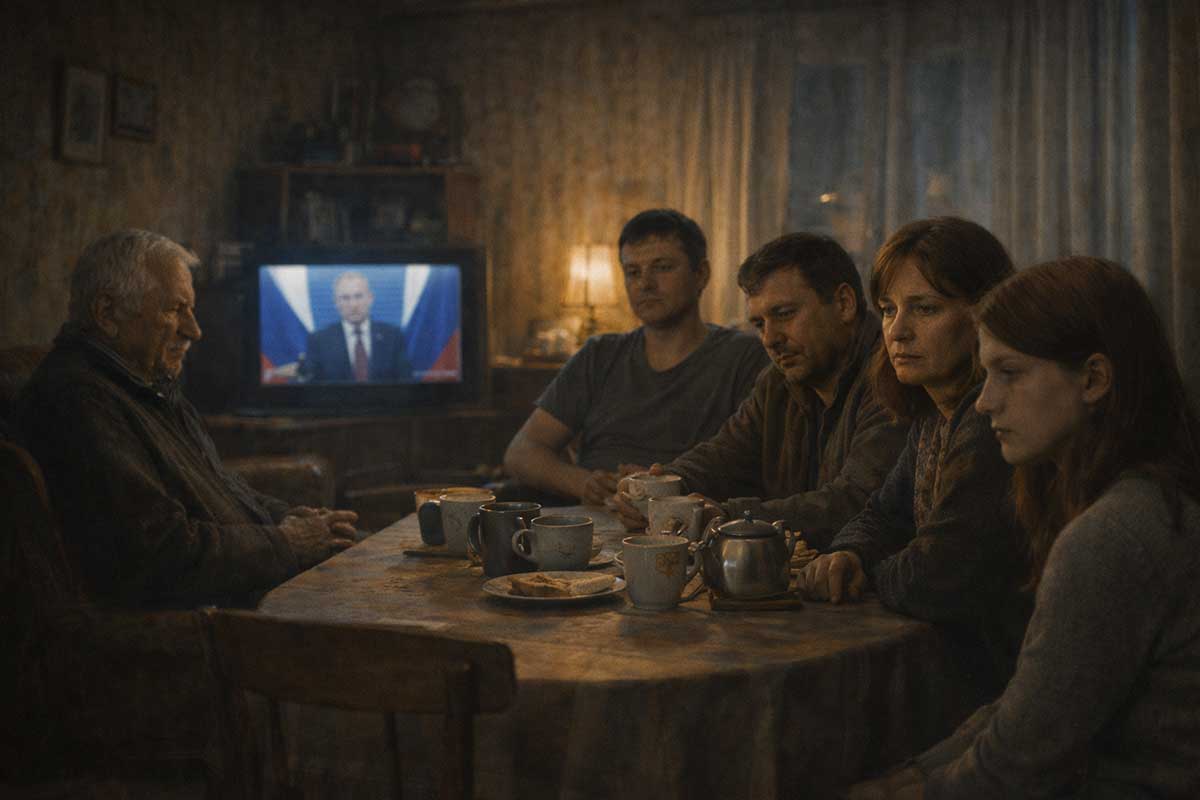
By the time Maksim was old enough to vote, the apartment had changed its tone.
Not its walls.
Not its windows.
Not the radiator that still knocked in winter like an old man refusing to die politely.
But its tone.
In the 1990s, Elena had felt that the house lived in apology. Money was counted with embarrassment. Repairs were delayed with resentment. Men spoke about work as if work had betrayed them personally. Even the television had sounded tired back then, either dishonest or humiliated, sometimes both at once.
Now it sounded different.
Not honest, exactly. But stronger.
The faces were better dressed. The sentences firmer. The maps returned more often. The world outside Russia was described not as a place one might join, but as a place one must answer. There was less pleading in the voices, less explanation. More judgment. More certainty. More of that tone Viktor liked — the one that suggested history had begun standing upright again.
Maksim had grown up inside that change.
He did not remember the worst of the 1990s as lived pain. He remembered them as family memory, sharpened by repetition. He knew them the way some sons know war stories from fathers who never stop returning to the same bridge, the same winter, the same insult. The details shifted slightly each time, but the lesson remained.
Weakness invites contempt.
Disorder is not freedom.
No one respects a country that apologizes for existing.
Those sentences had not been handed to him in one speech. They had settled in through years of breakfast, television, cigarette smoke, arguments half-finished, and his father’s face tightening whenever certain words appeared: reform, openness, Western advice, partnership, transition.
And now, in the years when the country looked more stable, when salaries came more regularly, when state power sounded less like a rumor and more like a fact, those old wounds began to feel not only painful but useful.
They explained why strength mattered.
On some evenings, when snow pressed against the dark window and the television gave the same grave explanations in different jackets, Viktor would sit with one hand on the armrest and say, with no one in particular as his audience, “This is better.”
No one had to ask compared to what.
Even Andrei, who distrusted large emotion and grand historical claims, did not argue much with that particular sentence. Better, yes. More ordered. More legible. Less humiliating.
He came home from work more tired than defeated now, and that distinction mattered to him. The country no longer felt as though it might dissolve while he was standing in line for bread. That alone had moral weight in his mind.
Order had become not merely practical, but almost sacred.
It was in those years that Anya began noticing how quickly some kinds of doubt were treated as vulgar.
Not dangerous in the dramatic sense. Not yet. Just coarse. Disloyal in tone, if not in words. She learned this not from the news first, but from the way people in the apartment shifted their posture around certain topics.
When her school history teacher spoke admiringly of national strength, students repeated the phrases with varying degrees of boredom. When one girl asked whether strength always had to mean fear, the room went oddly still, as though she had used the wrong fork at a formal dinner.
At home, it was subtler.
The television would say something about pressure from abroad, about encirclement, about respect, and no one at the table would necessarily nod. Yet no one laughed either. That was how Anya measured belief in her family — not by enthusiasm, but by the places where irony stopped.
One evening, after dinner, the television was discussing another international disagreement that seemed, to Elena, like all the others: men in suits speaking of red lines and instability while ordinary people still needed socks and medicine and railways that worked.
Maksim was stretched in the chair nearest the lamp, one ankle over the opposite knee, looking at the screen with the alert, half-skeptical interest of a young man who liked to believe he was harder to persuade than he really was.
“They only understand force,” he said.
Andrei, smoking by the window, answered without turning around.
“That is not wisdom. It is just history.”
Maksim smiled faintly. “Sometimes those are the same thing.”
From the kitchen, Elena said, “Sometimes men only say that because they enjoy the sound of force when they are sitting indoors.”
Maksim laughed, but not dismissively.
“You make everything domestic.”
“Because everything becomes domestic eventually.”
That answer stayed in the room.
Viktor, who had been silent for several minutes, lifted the remote and raised the volume by two small clicks.
“They are right,” he said. “Weak countries get instructed. Strong countries get negotiated with.”
Anya looked up from her phone.
“That sounds like something printed on a mug.”
Viktor turned toward her slowly.
“You mock everything.”
“No,” she said. “Only sentences that sound proud because they’re scared.”
Andrei’s head tilted, just slightly.
Maksim dropped his foot to the floor.
Even Elena stopped moving in the kitchen.
That was the thing about Anya. She was not loud. She was not theatrical. She had no taste for dramatic rebellion. But sometimes she said a sentence so exact it made the room look at itself.
Viktor gave a short, irritated exhale.
“Your generation thinks fear is something shameful.”
“No,” Anya said. “I think dressing it up as destiny is lazy.”
Maksim answered before Viktor could.
“And what do you suggest? That countries be polite while they’re pushed around?”
“That’s not what I said.”
“It’s what you mean.”
She set down her phone.
“No. What I mean is that everyone in this room uses the word respect as if it can’t hide insecurity.”
“Anya,” Elena said quietly.
But the girl was no longer speaking only to provoke. She had reached that place where speech becomes more honest than useful.
Maksim leaned forward.
“You didn’t grow up watching the country get laughed at.”
“And you didn’t either,” she shot back.
The sentence landed harder than intended.
Because it was true.
Maksim had inherited humiliation secondhand, but had worn it so long it felt like native memory. He had not stood in lines in the 1990s. He had not watched his father come home with the hard silence of a man counting losses that had no proper numbers. He had not seen Viktor’s old world collapse in real time. Yet the story of those years had formed him as surely as direct experience might have.
That was the power of family history. It did not need to be lived personally to become emotional truth.
Andrei turned from the window and crushed the cigarette out more sharply than necessary.
“That’s enough.”
No one answered immediately.
The television continued speaking into the pause.
On the screen, analysts were discussing borders, energy, regional influence, strategic balance. The words slid across the room like furniture no one had chosen but everyone had gotten used to living with.
Later that night, after Viktor had gone to bed and Maksim had gone out with friends, Anya stood at the sink beside Elena drying dishes.
“You were going to agree with me,” she said.
Elena kept her eyes on the plate in her hands.
“About what?”
“About him. About all of it.”
Elena smiled without warmth.
“You always think people are just one brave sentence away from becoming honest.”
“That’s not fair.”
“No,” Elena said, “it’s experienced.”
Anya dried the next plate too quickly.
“You hear it too.”
“Hear what?”
“That everyone talks like strength is the same thing as health.”
Elena set the plate down.
For a long second she said nothing. Then:
“I hear that some people who have been afraid for too long begin to trust firmness more than truth.”
Anya looked at her.
“That means I’m right.”
“No,” Elena said. “It means life is harder than being right.”
The girl leaned against the sink and stared toward the dark hallway where the men’s voices seemed to linger even after they had gone quiet.
Maksim returned late that evening with cold on his coat and the smell of cigarettes not his own in his hair.
He was in a good mood, that slightly louder and more physical mood men sometimes bring home when they have spent hours speaking in agreement with other men. Elena knew it well enough to dislike it on sight.
He poured himself water, drank, and stood at the kitchen counter scrolling through something on his phone.
“Everyone’s talking about the same thing,” he said.
“Then you had an efficient evening,” Elena replied.
He smiled.
“You make fun, but it matters.”
“What matters?”
“That people are waking up.”
“To what?”
He looked at her as if the answer should have been obvious.
“To the fact that we can’t keep behaving like we’re just another country waiting to be instructed.”
Elena folded the dish towel carefully and hung it over the chair.
“We are another country,” she said.
He laughed, but she did not.
“No,” he said, more seriously now. “That’s exactly what we are not.”
There it was again.
Not ideology in the clean sense.
Not slogans copied from a poster.
Something more intimate and more dangerous: the merging of personal pride with national narrative.
Maksim did not want war. Elena knew that. He did not wake wishing harm on strangers. He was not driven by crude hatred. What he wanted was harder to argue with and therefore more troubling.
He wanted Russia to feel unhumiliated.
He wanted history to stop sounding apologetic.
He wanted his country to occupy the world with weight again.
The trouble was that such desires rarely stay abstract.
That winter, Anya started spending more time online after midnight. Not from rebellion, exactly, but from hunger. Official explanations made her itch. They sounded too smooth, too complete, too self-protective. Every large sentence seemed to her to contain a missing body somewhere behind it.
She began noticing how often people around her used words like stability, respect, order, and strength without ever asking what was being spent to buy them.
One night, hearing voices from the living room, she stood in the dark hall and listened.
Maksim and Viktor were talking.
Not arguing. Talking in that easy, masculine rhythm where agreement wears the clothes of debate.
“Young people now,” Viktor was saying, “they want a country that never asks anything of them.”
Maksim laughed. “They want comfort and then call it morality.”
“And if something must be defended?”
“They call it aggression.”
Viktor grunted approvingly.
Anya leaned against the wall unseen.
There was love in that room. Real love. Grandfather and grandson bound by admiration, memory, masculine ease, and the inheritance of historical injury. That was what frightened her most. It would have been simpler if the dangerous ideas arrived only through cruelty.
But they arrived through belonging too.
Through warmth.
Through approval.
Through the pleasure of continuity between generations.
In the morning, she said nothing about what she had heard.
At breakfast, Viktor raised the television volume. Andrei read the paper. Maksim spoke about some international story with too much casual certainty. Elena sliced bread. Anya buttered her toast and watched the room with the strange detachment of someone beginning to feel that her family was speaking a language she still understood, but no longer trusted.
By then, the apartment no longer felt like a place recovering from collapse.
It felt like a place becoming sure of itself.
That should have made everything safer.
Instead, somewhere inside the new confidence, Anya sensed a quiet hardening. Not loud. Not dramatic. Just the slow disappearance of hesitation.
And when hesitation goes quiet long enough, doubt begins to sound impolite.
That was the real shift.
Not only that pride had returned.
But that doubt had begun learning to lower its voice.
Chapter 3 — 2014 Redraws What Ukraine Means
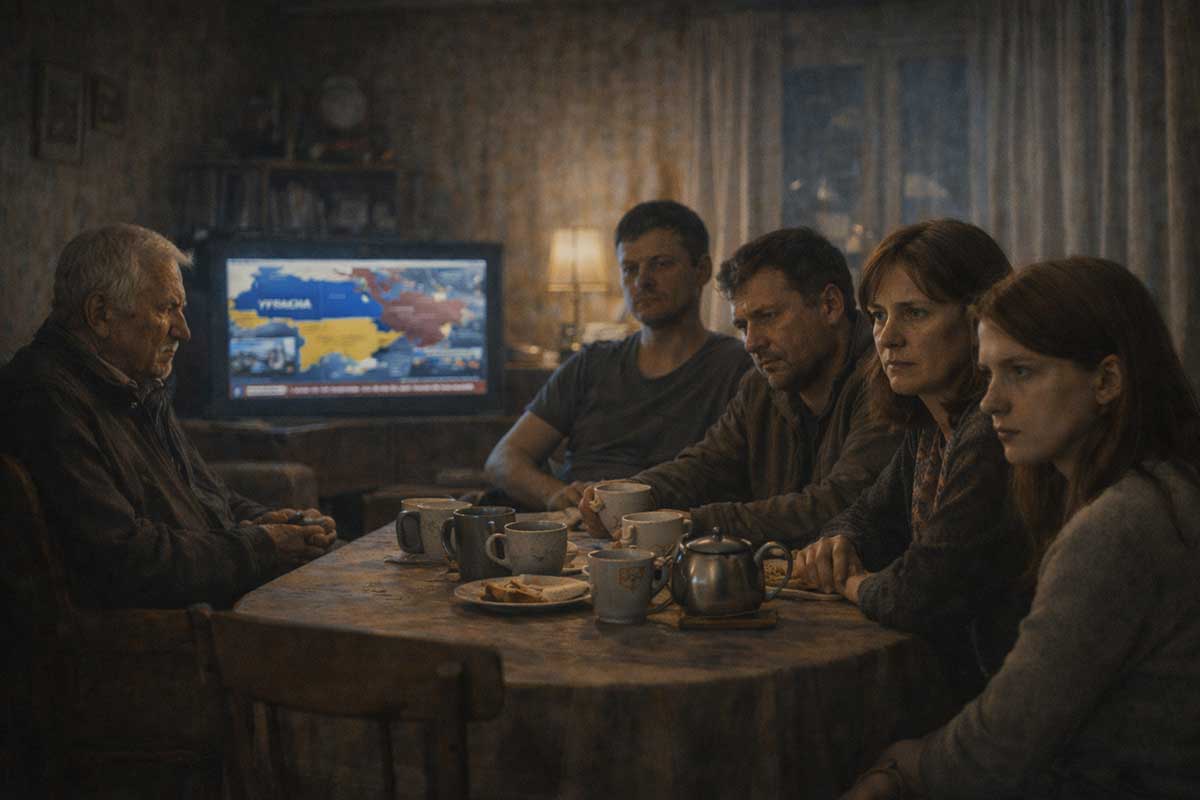
Before 2014, Ukraine existed in the apartment mostly as a word spoken with a shrug.
Not because it was unimportant.
Because it was too close to feel fully foreign and too separate to remain entirely inside old memory. It lived in that irritating space reserved for places people assume they understand without ever having to define them clearly.
When Ukraine appeared on television, Viktor would often make some passing sound — not contempt exactly, but impatience. The impatience of an old man forced to watch history divide itself into pieces smaller than his memory approved of.
Andrei was different. He did not dismiss Ukraine. He spoke of it the way men speak of a relative who has become difficult to categorize after an ugly inheritance. Too close for indifference. Too tangled for ease.
“It was never going to be simple,” he said once, when Maksim was younger and trying to understand why people on television talked about Kyiv as if it were both neighbor and problem.
“Why not?” the boy had asked.
Andrei had considered the question longer than Maksim expected.
“Because too many people want history to behave like property lines.”
At the time, Maksim had not understood him. He only stored the sentence because it sounded like something worth repeating later in life. In that family, many things were inherited before they were understood.
By 2014, the television stopped allowing vagueness.
The first weeks still sounded like politics. Protests. Corruption. Europe. Yanukovych. Agreements. Demonstrations. The usual structure of public events narrated in tones meant to reassure viewers that whatever was happening, it was still explainable from a chair.
But even Elena, who distrusted all television rhythm on principle, could tell that the apartment changed when the images began to repeat: crowds, smoke, barricades, people in winter clothing pressed together with the urgency of those who had crossed from frustration into decision.
Maksim watched with an alertness that went past curiosity.
Anya watched with the distrust of someone already listening for what would be left out.
Viktor watched with the expression he reserved for moments when the present insulted his sense of historical order.
Andrei watched in silence.
One evening, after footage of Kyiv had run for nearly an hour in different forms, Elena muted the television and said, “I’d like to hear my own kitchen for five minutes.”
No one objected.
The quiet afterward felt unnatural, as if the room had already surrendered part of itself to screens.
“What do you think?” Maksim asked, not to Elena, but to the room as a whole.
Viktor answered first.
“I think states that forget discipline invite theater.”
Anya looked at him.
“You always say things like that when people are in the street.”
“Because the street is not where states should be decided.”
“That depends on what the state has already done,” she said.
Viktor turned toward her slowly, not angry yet, but arranged for it.
“And what do you think the state has done?”
She shrugged, though not carelessly.
“Made enough people believe they had no other language left.”
Maksim snorted.
“That sounds very noble.”
“It sounds true.”
“No,” he said. “It sounds rehearsed.”
Before Anya could answer, Andrei spoke.
“The worst rehearsed language is usually the one people have heard so often they think it became their own thought.”
That stopped both of them.
Elena, standing at the stove, felt the room tilt in the way rooms do when a sentence has reached deeper than anyone intended.
On the screen, frozen now in silence, a group of people stood behind smoke and shields. Without the sound, they looked both more human and less readable.
“What do you think it is?” Maksim asked his father.
Andrei looked at the image for a long time.
“I think,” he said carefully, “that when people begin to believe they are no longer being lied to by accident but by design, they stop speaking like citizens and start speaking like the wounded.”
Viktor made an irritated sound.
“Too poetic.”
“No,” Elena said before she could stop herself. “Too accurate.”
That surprised everyone, including her.
She did not usually join these conversations except to cut them shorter. But there was something in the images from Kyiv that disturbed her at a level more domestic than political. It was in the posture of people carrying the injured. In the way women in ordinary winter coats had the same look Elena had seen in mothers at pharmacies when a shortage became real: a kind of frightened competence.
This was what men on television never understood. When crisis reaches a certain point, it changes category. It stops being theory and becomes logistics of the body.
By the time Yanukovych fled, the apartment no longer felt as though it were discussing a neighboring country. It felt as though something had shifted in the atmosphere of the whole region and no one had yet admitted how far the movement would travel.
Viktor reacted with contempt.
“Color revolution. Theater backed by others. All of it dressed up as principle.”
Maksim repeated parts of that language almost unconsciously, not because he was a puppet, but because it fit emotional grooves already worn smooth inside him.
“They wanted this,” he said. “The Americans, Europe, all of them. They can’t stand anything on our border that isn’t weak or obedient.”
Anya, sitting with her knees up on the sofa, lowered her phone.
“Do you hear yourself?”
He turned to her.
“Yes.”
“Do you?”
“What is that supposed to mean?”
“It means every sentence you say already has an audience in mind.”
He laughed once, short and dismissive.
“And every sentence you say wants to sound purer than politics.”
Andrei rubbed his forehead.
“Enough.”
But the room had moved beyond enough.
That was the trouble with 2014. It did not only change what people believed. It changed the speed at which belief moved through rooms.
For Viktor, the events in Kyiv confirmed what he already suspected: that Russia was being boxed in, weakened indirectly, lectured by hypocrites who called their own interests democracy and everyone else’s interests aggression.
For Maksim, 2014 gave shape to a feeling he had been raised into but had not yet needed to test: that Russia was not being treated merely as a country among others, but as something to be reduced.
For Anya, the same year had the opposite effect. It was the first time she felt the official language in the apartment growing too neat to trust. Whenever commentary became most confident, she felt least certain. Not because she thought the West was pure or Ukraine simple. Because certainty had begun to sound manufactured.
Elena heard all of this not in the speeches, but in tone.
People spoke more quickly. More sharply. Less like they were thinking aloud and more like they were repeating something that had already been arranged emotionally.
Then Crimea came.
It entered the apartment like an electric current.
Maps returned to the screen. Anchors stopped sounding merely grave and began sounding satisfied. Words like historical justice, return, protection, and our people began to rise and settle over everything.
Viktor sat taller in his chair.
“There,” he said, almost softly. “There. At last.”
Maksim stood near the television with his arms folded, not smiling but lit from within by the feeling that history had stopped retreating.
Anya looked from one man to the other and felt, for the first time, not simply disagreement, but estrangement.
“What does ‘at last’ mean?” she asked.
Neither answered immediately.
Then Viktor said, “It means a correction.”
“A correction of what?”
“Of humiliation. Of disorder. Of forgetting what belongs to the shape of things.”
Anya stared at him.
“People live there,” she said.
Viktor’s face hardened.
“Exactly.”
“No,” she said quietly. “That’s not what you mean.”
Maksim intervened before his grandfather had to.
“It means that history didn’t start in 1991 just because maps changed.”
“And it didn’t stop there either,” Anya replied.
Elena closed the cupboard door with more force than intended.
“That’s enough.”
But once again, enough had already been passed.
Andrei had not spoken for several minutes. That was when Elena knew he was thinking most seriously.
Finally he said, “The problem is not that history is being invoked.”
Everyone turned toward him.
“The problem is that when people begin to use history to erase the difficulty of the present, something dangerous enters the language.”
Viktor gave him a look of narrow disappointment.
“You always did speak as if caution were intelligence.”
“Sometimes it is,” Andrei said.
“Sometimes it is weakness.”
“No,” Elena said suddenly, her voice sharper than anyone expected. “Sometimes it is knowing that there are mothers in every direction of every map you are all talking over.”
That silenced them all.
Even Viktor.
Especially Maksim.
Because that sentence broke the masculine rhythm of the room. It made the map bodily.
It made the word Crimea stop for one second being only territory and become kitchens, medicine, children, old men, roads, fear.
That was Elena’s gift and Elena’s burden. She domesticized abstraction until abstraction became harder to worship.
Still, the apartment changed after Crimea.
Even the silences changed.
Maksim began speaking of Ukraine differently — not as a foreign country exactly, and not as a brother either, but as something that had become the site of larger struggle. He stopped using the language of normal separation and began using the language of historical contest.
“People there are being used,” he said once.
“By whom?” Anya asked.
“By whoever profits from making them forget what they are.”
“What are they?”
He looked at her as though the answer should not require speech.
“That is the problem,” she said. “You think not saying it makes it more true.”
The war in Donbas complicated the apartment further.
At first it appeared in the usual way: maps, reports, claims, denials, statements from men in uniforms or dark suits. But the emotional effect was different now. Crimea had already changed the moral weather. Donbas entered a room that had lost hesitation.
Viktor spoke of protection.
Maksim spoke of people being abandoned, manipulated, pushed.
Anya heard in every sentence the smoothness of stories that had already made room for violence before naming it as such.
Andrei grew quieter.
Not because he had nothing to think, but because he had too much.
He understood parts of the grievance. He understood the emotional force of post-Soviet loss, of borders that did not match memory, of a West that often seemed to speak as if Russian feeling itself were embarrassing. But he also understood something else: that once a state begins using historical closeness as moral permission, it becomes very difficult to know where the argument ends and appetite begins.
One evening, after a particularly triumphant segment on television about Crimea and “Russian world” language that sounded to Anya like mythology in a suit, she found her father standing alone in the dark kitchen.
He was not smoking. Just standing there.
“Papa?”
He did not turn at once.
“What is it?”
“Do you believe all of this?”
He looked at her then, and she saw how tired his face had become.
“I believe,” he said slowly, “that history leaves real injuries.”
“That’s not what I asked.”
“No,” he said. “It’s the part people forget before they ask anything else.”
She waited.
He leaned one hand on the counter.
“I also believe that people can become drunk on correcting injury.”
She did not answer.
Neither did he.
Because that was as close to honesty as the apartment could bear that night.
From the living room came Viktor’s cough, the television, and Maksim laughing at something on the screen that was not truly funny. Elena moved through the apartment carrying cups, towels, and the weariness of someone living among men who thought they were discussing states while she kept hearing future consequences.
By the end of 2014, Ukraine no longer meant the same thing in the Sokolov apartment.
It had become less clear and more charged.
For Viktor, it was the site of historical wrongness and historical repair.
For Maksim, it was where national pride and geopolitical grievance finally met something solid enough to point at.
For Andrei, it was the place where old injuries and new dangers had begun to mix too thoroughly.
For Elena, it was where maps started threatening kitchens.
For Anya, it was the year language itself became suspect.
Before, people in the apartment had spoken of Ukraine with vagueness.
After 2014, they spoke of it with conviction.
That should have made things clearer.
Instead, it made them harder to say honestly.
The borders on the television sharpened.
The borders inside the family did too.
Chapter 4 — 2022 Turns Narrative into Flesh
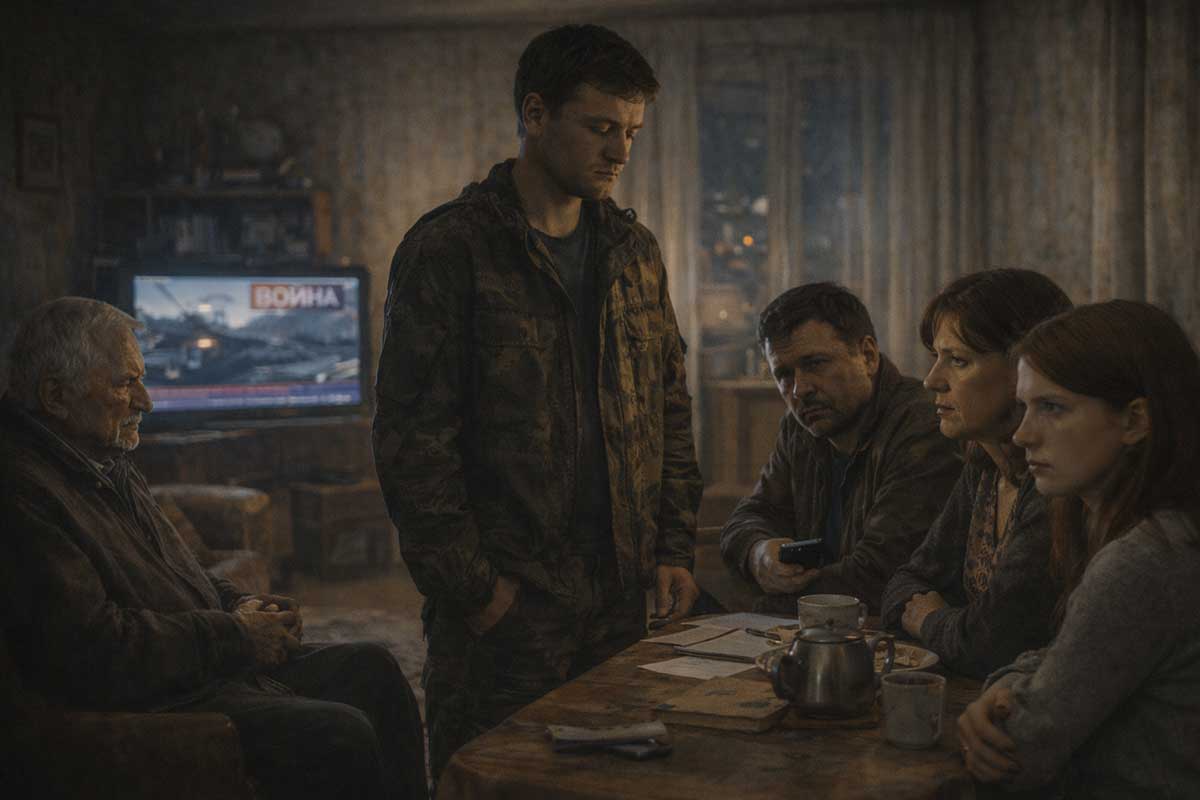
When the invasion began, Elena was the first one awake.
Later, she would not remember whether it was the phone vibrating against the table, or the strange quality of silence around it, that pulled her up from sleep. What she remembered clearly was the dark. The room was still fully dark, and her hand found the phone before her mind had caught up.
The screen was already lit with messages.
Are you awake?
Turn on the news.
It’s started.
Everywhere.
Call me when you can.
She sat up at once.
Beside her, Andrei stirred, still half inside sleep.
“What is it?”
She looked at the screen again, though she no longer needed to.
“They went in,” she said.
That woke him more completely than any alarm could have done.
For a moment, neither moved.
Not from confusion.
From recognition.
For years the apartment had lived with arguments, explanations, television narratives, maps, claims, old grievance, careful doubt, and the language of historical necessity. But this was different. Not because it was shocking. Because it was concrete. The war had crossed from discussion into body.
Andrei stood first and turned on the television.
The room filled at once with voices speaking too quickly in the false calm used by people who know panic is already moving faster than they are. Maps. Columns. Airfields. Missiles. Statements. Hosts trying to sound authoritative as the meaning outran them.
By the time Elena stepped into the kitchen, Viktor was already awake in the sitting room, cardigan half-buttoned, face hard with a kind of terrible concentration. He was not confused. He was not horrified in the simple sense. He looked like a man watching an old story become literal.
Maksim came out next, still in a T-shirt, his hair uncombed, eyes narrowed at the screen. For the first thirty seconds he said nothing.
Anya was last. She appeared in the doorway with her phone already in her hand, as if she had gone to sleep expecting to wake exactly this way.
On the screen, the anchors were now using words that no longer left room for atmosphere.
Operation.
Demilitarization.
Strategic objectives.
Security.
Protection.
Anya stared at the television.
“It’s war,” she said.
No one corrected her.
That mattered.
For years language in the apartment had worked by avoidance. Ukraine was close, complicated, used, misled, manipulated, historical, strategic, emotional, inseparable, dangerous, tragic — anything except simply itself. Now the screen was trying to place the invasion inside old explanatory words, but the body heard something else.
Maksim stepped closer to the television.
“They said—” he began, then stopped.
Elena turned toward him sharply.
“They said what?”
He did not answer right away.
That silence, more than any speech, told her where his mind had been living before this morning.
Andrei kept looking at the screen.
“Turn it up.”
“No,” Anya said at once.
He looked at her.
“I want to hear how they’re saying it.”
“That’s the problem,” she said.
But he raised the volume anyway.
The voices sharpened. Certain phrases repeated. The same old architecture of justification was still standing, but now it had bodies moving through it.
Viktor sat down slowly.
“At last,” he said.
The room turned toward him.
It was not triumph in the childish sense. It was worse than that. It was the grave satisfaction of a man who believed history had finally stopped pretending. To him, years of grievance, disrespect, humiliation, narrowing space, and unresolved injury had now taken action.
Anya looked at him in disbelief.
“At last?”
He did not look at her.
“You are too young to understand what it means when a country is pushed to the wall for thirty years.”
Elena’s voice came low and flat.
“And who lives on the other side of the wall?”
That made him turn.
For a second, no one spoke.
Then Maksim said, “No one wanted this.”
Anya stared at her brother.
“No one?” she said.
“You know what I mean.”
“No,” she said. “I don’t.”
He ran a hand through his hair, suddenly looking less certain than the sentences he had grown up with.
“I mean no one wanted war.”
“Then why does every sentence on that screen sound prepared?”
That landed.
Maksim turned away first.
From the kitchen window, dawn had not yet formed properly. The buildings outside were still shapes rather than surfaces. Elena put the kettle on out of instinct, then hated herself for doing something so ordinary, then hated herself for hating it. Water still had to boil. Tea still had to exist. The body still asked for the old sequence even when the world had broken it.
This, too, was one of war’s first humiliations: that the domestic does not stop just because history has become unbearable.
Maksim’s phone began ringing.
He looked at the screen and did not answer immediately.
“Who is it?” Andrei asked.
“Nikita.”
“Answer it.”
He did.
The room could hear only Maksim’s side.
“Yes.”
“I know.”
“No, I’m watching.”
“No, no one told me anything.”
“How would I know?”
“…No.”
“…I said I don’t know.”
He ended the call and stood for a moment with the phone still in his hand.
“Well?” Viktor asked.
Maksim did not answer him. He looked instead at Andrei.
“They’re saying people may be called.”
The sentence changed the room completely.
Until then, the war had still belonged to the screen. To statements. To maps. To the old, familiar masculine space of explanation. Now it moved at once toward the house itself.
Elena sat down.
“Called for what?”
Maksim gave a humorless smile.
“What do you think?”
Anya said, “This is exactly it.”
No one asked her what she meant because they all knew.
Years of narrative had just become pressure on a body someone in the room loved.
That was the point where explanation usually weakened.
Viktor was still not silent, but something in him had shifted too. Not his certainty exactly. His distance. The invasion had been abstractly imaginable. The possibility of a grandson or son being pulled into it was another scale of reality altogether.
Andrei looked at Maksim for a long time.
“You were never in a hurry for service before.”
“I’m not in a hurry now.”
“But?”
Maksim’s voice tightened.
“But if everyone is moving, what do you expect? That people just sit here?”
Anya answered before anyone else could.
“Yes.”
He turned on her at once.
“That’s because you don’t understand how any of this works.”
“And you do?”
“I understand enough.”
“No,” she said. “You understand how not to look weak.”
That hit harder than she intended.
Elena saw it in his face. Not because he was guilty in some theatrical sense, but because it was true in the way family truths often are: precise, unhelpful, impossible to fully deny.
Maksim had not grown up dreaming of invasion. He had not wanted blood. He had wanted seriousness, dignity, national weight, the end of humiliation. He had wanted history to stop feeling like apology. Now history had arrived not as restored pride, but as a set of demands no ordinary person could answer cleanly.
Andrei moved toward the window and back again, as if he could not yet settle inside his own body.
“You don’t go anywhere today,” he said.
Maksim looked at him.
“You think that depends on us?”
“Yes.”
“No.”
The two men stood facing each other.
This was not yet the old tragedy of father and son with uniforms between them. It was something more modern and perhaps crueler: a father who had passed down the emotional grammar that made refusal difficult, and a son now living inside that grammar under pressure.
Viktor broke the silence.
“A man doesn’t choose his historical moment.”
Anya laughed once — not with amusement, but disbelief so sharp it came out sounding like broken laughter.
“That’s convenient.”
Viktor turned toward her.
“What is convenient?”
“That every time history asks for blood, someone calls it dignity.”
Elena said, “Enough.”
But her voice lacked force now. Not because she did not mean it. Because the room had gone beyond the point where maternal interruption could restore scale.
She knew something the others were still only arriving at:
the apartment would not survive this morning with its old language intact.
Not because everyone would suddenly reverse themselves.
Because the words they had used for years were about to be tested against flesh.
By late morning, the first outward tasks had begun.
Check documents.
Call relatives.
Try banks.
Try fuel.
Call again when lines fail.
Ask what offices are open.
Ask what rumors are nonsense.
Ask which rumors are too plausible to dismiss.
Keep the phone charged.
Keep the television low enough that it does not become a god.
Elena moved through the kitchen making tea no one finished and food no one tasted properly. She watched Maksim pace, sit, stand, text, erase messages, and stare at the screen as if waiting for it to tell him which version of himself it required.
Anya withdrew into an alert quietness that frightened Elena more than tears would have. She stayed online, but not in the frantic way of those who still believe enough information can save them from reality. She was watching tone now. Contradictions. Gaps. The places where public language began to split under the weight it had summoned.
At one point she said softly, almost to herself, “They still can’t stop speaking like it’s clean.”
No one answered.
That was the thing that stayed with her most that day: how prepared the language seemed, and how unprepared the people inside it were.
In the afternoon, after another call none of them wanted and all of them were expecting, Maksim came into the kitchen and sat down heavily.
Elena was cutting bread.
“Do you need to go?” she asked.
He looked up at her, and for the first time all day he seemed younger than he had the day before.
“I don’t know.”
That was the most honest sentence he had spoken.
She set the knife down.
“Then stay inside that not knowing as long as you can.”
He almost smiled, but did not.
From the doorway, Andrei said, “That won’t hold.”
“No,” Elena said. “But it is still true.”
Viktor, farther back in the room, spoke without raising his voice.
“If the country calls, hesitation has its limits.”
Elena turned on him with such force that even he stopped.
“And what are the limits of a mother?”
No one in the room answered.
There was no answer available.
By evening, the television had become unbearable and impossible to turn off. The anchors still spoke of objectives, necessity, defense, history. But now each sentence fell into a room where Maksim’s silence had begun to thicken into something none of them yet knew how to cross.
Anya stood by the dark window and looked at her own reflection.
Behind her:
the television,
the old man,
the father,
the mother,
the brother who might be sent,
the apartment still standing.
In front of her: only black glass.
She understood then that war does not only break buildings. It breaks sequence.
First the family tells a story.
Then the state tells a bigger one.
Then one morning the bigger story enters the hallway and starts trying on the bodies in the house.
That was the day the apartment stopped being a place where politics could be discussed as atmosphere.
It had become a place where narrative was turning into flesh.
And everyone in it knew, even before anyone said so, that once that happens, no word remains untouched.
Chapter 5 — The Silence After Participation
After that, the apartment changed its center of gravity.
Before the invasion, the heaviest thing in the room had usually been language. History, grievance, respect, order, the old injury of the 1990s, the long shadow of collapse, the feeling that Russia must never again appear weak. Those words had sat at the table for years. They had shaped tone, argument, posture, even love.
After Maksim was drawn toward the war, the weight moved.
It was no longer in explanation.
It was in pause.
In how long a phone rang before being answered.
In how quickly Elena crossed the kitchen when a message came.
In whether Andrei asked direct questions or settled for fragments.
In whether Viktor turned the television up or down.
In whether Anya looked people in the eye after the news.
The apartment did not become openly tragic all at once. That would have been almost easier. Open grief has a grammar. It allows crying, pacing, prayer, collapse, soup brought by neighbors, chairs pulled close.
This was harder.
This was waiting shaped like domestic life.
Maksim’s first messages came short and flat.
I’m fine.
Don’t worry.
No signal later maybe.
Food okay.
Cold.
Don’t send too much.
Tell Grandfather to stop shouting at the TV.
Elena read them as if the missing words were the real text.
She knew at once that the sentence I’m fine had split into two meanings. The ordinary one was gone. What remained was a son trying to keep a path open between himself and the home he had already begun speaking from a distance.
She replied with the only kind of language she trusted.
Have you eaten?
Are your feet dry?
Write when you can.
No heroics. Just come back.
I made too much soup again.
That last message she deleted before sending. Then she sent it anyway.
In the first weeks, Andrei still tried to stand inside the old fatherly shape of himself. He spoke in measured tones. He watched the news, made lists, checked information, rejected rumors, spoke about patience as if patience were still a useful domestic tool.
But patience only works when time still obeys ordinary rules.
One evening, after three days with no word from Maksim, Andrei stood by the window long after dark with the curtain half-open and one hand pressed into the small of his back.
Elena watched him from the kitchen.
“You won’t see anything from there.”
“I know.”
“Then sit.”
He did not move.
At last he said, “I used to think that if a man kept his head clear, he could prevent panic from entering the house.”
She dried her hands slowly.
“And now?”
He looked at the glass, where his own reflection floated over the dark courtyard.
“Now I think panic came in years ago and just learned better manners.”
That was the nearest he had come to naming it.
He did not yet speak of guilt. Not directly. That word was still too clean, too singular, too easy to misunderstand. But Elena could see something beginning in him that had not been there before. He no longer spoke of strength in the same effortless register. He no longer used words like duty without hearing the body that stood behind them.
The old emotional inheritance had not disappeared.
It had become dangerous to him.
Viktor changed in the most confusing way of all.
At first, he remained himself. He watched the television with the same hard attention. He still muttered about history, encirclement, humiliation, weakness. He still distrusted the moral softness of younger people. He still believed that large countries do not remain large by asking permission.
Yet even in him, the edges shifted.
The first sign was volume.
He began lowering the television.
Not because he believed it less. Because belief had become too close to someone’s blood.
Anya noticed before anyone else. She noticed everything first now. That had become her role without anyone assigning it.
One night she walked into the sitting room and found Viktor watching the news with the sound barely above a murmur.
“You turned it down,” she said.
He did not look at her.
“I can hear well enough.”
“That’s not why.”
His jaw tightened.
“You’ve become very pleased with your own observations.”
She sat on the edge of the chair opposite him.
“No,” she said. “I’ve become tired of pretending tone means nothing.”
The anchor on the screen was speaking in one of those calm, polished cadences that had once filled the apartment with inevitability. Now it sounded brittle, like a glass someone kept tapping to prove it had not cracked.
Viktor stared ahead.
“Do not mistake discomfort for revelation,” he said.
Anya answered, “Do not mistake repetition for truth.”
That might have become another argument in the old style. In earlier years, he would have answered sharply, perhaps with anger, perhaps with a long bitter speech about decline and seriousness and historical amnesia. This time he only said, after a pause too long to hide, “You think I don’t know what flesh costs?”
The question startled her.
Not because of the words. Because of the wound behind them.
She looked at him more carefully then. Truly looked.
The old man in the chair was still proud. Still stubborn. Still made of history in the way old men sometimes are. But pride now had a crack in it. Not a moral conversion. Not a neat reversal. Something sadder. The discovery that one’s convictions may survive contact with suffering, but not in the same arrangement.
Anya said nothing.
He did not ask her to.
In those months, Elena learned to hear the war through absence of detail.
Maksim no longer wrote long enough messages to sound like himself. When he called, his voice came thinner, more cautious, and never tired in the way real tired people sound at home. It was the tiredness of compression — a voice that had been pressed into usefulness.
“Everything okay?” he would ask.
It was unbearable, that question.
Not because it was foolish. Because it reversed the natural order. A son calling from war asking the kitchen if it was intact. Elena always answered yes, always with more steadiness than she felt.
“Yes. We’re fine here.”
Fine.
Another broken word.
After one call, when Maksim had spoken for less than two minutes and said almost nothing except It’s all right and don’t listen to everything you hear, Elena put the phone down and stood very still.
Andrei was sitting at the table, hands folded too tightly.
“What did he say?” he asked.
She looked at him.
“He said nothing.”
That answer filled the whole kitchen.
Because it was accurate.
And because it was not true enough.
He had said words. But the person inside them had withdrawn. Not completely. Not beyond reach. Only enough to make Elena understand that home was no longer receiving a full voice. It was receiving a shaped-down version, trimmed for endurance.
That night, long after Viktor had gone to bed and the television was finally dark, Andrei sat with Anya in the kitchen.
It was the first time in months that they had been alone without Elena’s movement softening the room.
Anya was studying something on her laptop but not reading it. Andrei had a cup of tea in front of him that had gone cold long ago.
After several minutes he said, “You were right.”
She looked up sharply.
“About what?”
He gave a humorless smile.
“That there are sentences which sound strong because they are afraid.”
She did not answer right away.
Part of her wanted to ask him to say more. Another part knew that if she moved too fast, he would retreat behind father-shaped silence.
So she waited.
He rubbed a hand over his face.
“I thought I was teaching him seriousness.”
There it was.
Not an apology. Not yet. But the opening of one.
Anya closed the laptop.
“And instead?”
He stared at the grain of the table.
“Maybe I taught him how not to step back.”
She felt a sharp pain for him then, which annoyed her. Anger had been easier. Clearer. Anger knows where to stand. Compassion blurs the floor.
“You’re not the only reason,” she said quietly.
“No,” he replied. “But I am one of them.”
That was the closest the apartment had yet come to confession.
Not because the whole truth had been spoken. Because a father had finally begun to see that values passed down as moral discipline could harden into obedience under pressure.
After that conversation, Anya could no longer think of the family only as divided between those who believed and those who doubted.
That would have been too simple.
No one in the apartment now believed untouched.
No one doubted untouched either.
Even she, with all her suspicion of public language, had learned something terrible: once a person you love is inside the machinery, critique no longer feels clean. Every question risks sounding like accusation. Every moral statement risks landing on flesh instead of policy. War drags ethics down into kinship and forces them to live there.
That was the true suffocation of the apartment now.
The silence did not come from not knowing what to say.
It came from knowing that anything said fully would hurt someone already breaking.
One afternoon, weeks later, a package Maksim had sent finally arrived after long delay. It contained almost nothing.
A pair of worn gloves.
A charger with tape around the wire.
A crumpled photograph from years ago of the family standing by a river in summer.
And a note.
Elena unfolded it first, though her fingers trembled.
It was short.
Keep this one. I found it in my bag. Don’t let Grandfather talk too much. Don’t let Anya win every argument. Tell Papa the charger still works if you bend it the right way. I’ll write properly later.
No one laughed at the jokes.
That was the worst part.
Even Viktor, reading over Elena’s shoulder, did not attempt a smile. His face seemed to fold inward around the line I’ll write properly later.
Because everyone in the room knew what it meant.
Not simply delay.
The existence of something that could not yet be written properly.
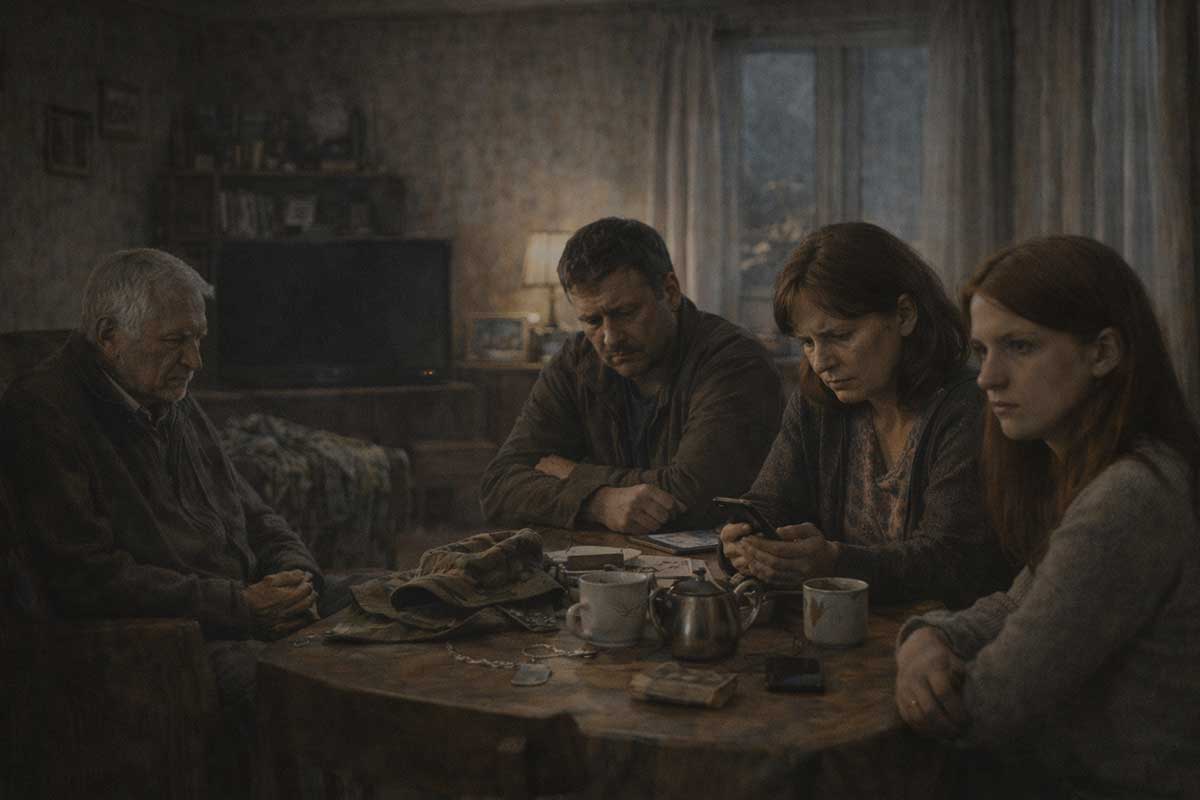
That evening the family sat together after dinner in a room that had once thrived on commentary.
Now the television remained off.
The quiet did not feel peaceful. It felt honest.
Viktor in his chair.
Andrei leaning forward with both hands linked.
Elena holding the photograph in her lap.
Anya watching all of them.
Maksim absent. More present than anyone else.
At last Viktor said, not to anyone and not quite to himself, “A country asks things of men.”
Anya felt her whole body tighten.
But before she could answer, Elena spoke.
“Yes,” she said. “And then mothers are left to learn what exactly was asked.”
No one replied.
Not because there was nothing to say.
Because there was no sentence left that had not already been damaged.
That was the new shape of the apartment.
The old arguments about strength, respect, weakness, history, humiliation — they had not vanished. They had only lost their ability to stand cleanly. Now each of them had a face attached. A voice thinning over the phone. A charger bent at the wire. A photograph found in the wrong pocket. A message too short to hold what it came from.
War had returned to the house not as a theory proven right or wrong, but as alteration.
In voice.
In posture.
In fathers.
In old men.
In daughters.
In the distance between a message and the body that sends it.
Anya understood then that the apartment would never return to the earlier kind of certainty.
Even if Maksim came home.
Even if the television found a new tone.
Even if Viktor resumed old speeches.
Even if Andrei tried to stand again inside the father he had been.
Something had already crossed a line.
The family could no longer speak about history without hearing its cost in someone they loved.
That was the silence after participation.
Not empty silence.
Not innocent silence.
The silence left behind when belief and body have passed through one another and can no longer separate cleanly again.
Late that night, after everyone else had gone to bed, Anya remained alone in the kitchen.
The apartment was quiet enough now that she could hear the radiator ticking.
On the table lay the old photograph.
She picked it up and looked at each face.
Viktor, larger then, more triumphant in his posture.
Andrei, still guarded, but not yet burdened in the same way.
Elena with sunlight on her hair and no shadow in her hands.
Maksim smiling openly, before seriousness began speaking through him.
Herself younger, unsplit, still capable of thinking politics belonged somewhere beyond family.
She set the photograph down carefully.
The apartment had not fallen apart.
That was not the tragedy.
The tragedy was more intimate:
it had remained a home, and that was exactly why the war could not stay outside it.
Final Thoughts by Nick Sasaki
What stays with me most at the end of this story is not argument.
It is damage to language.
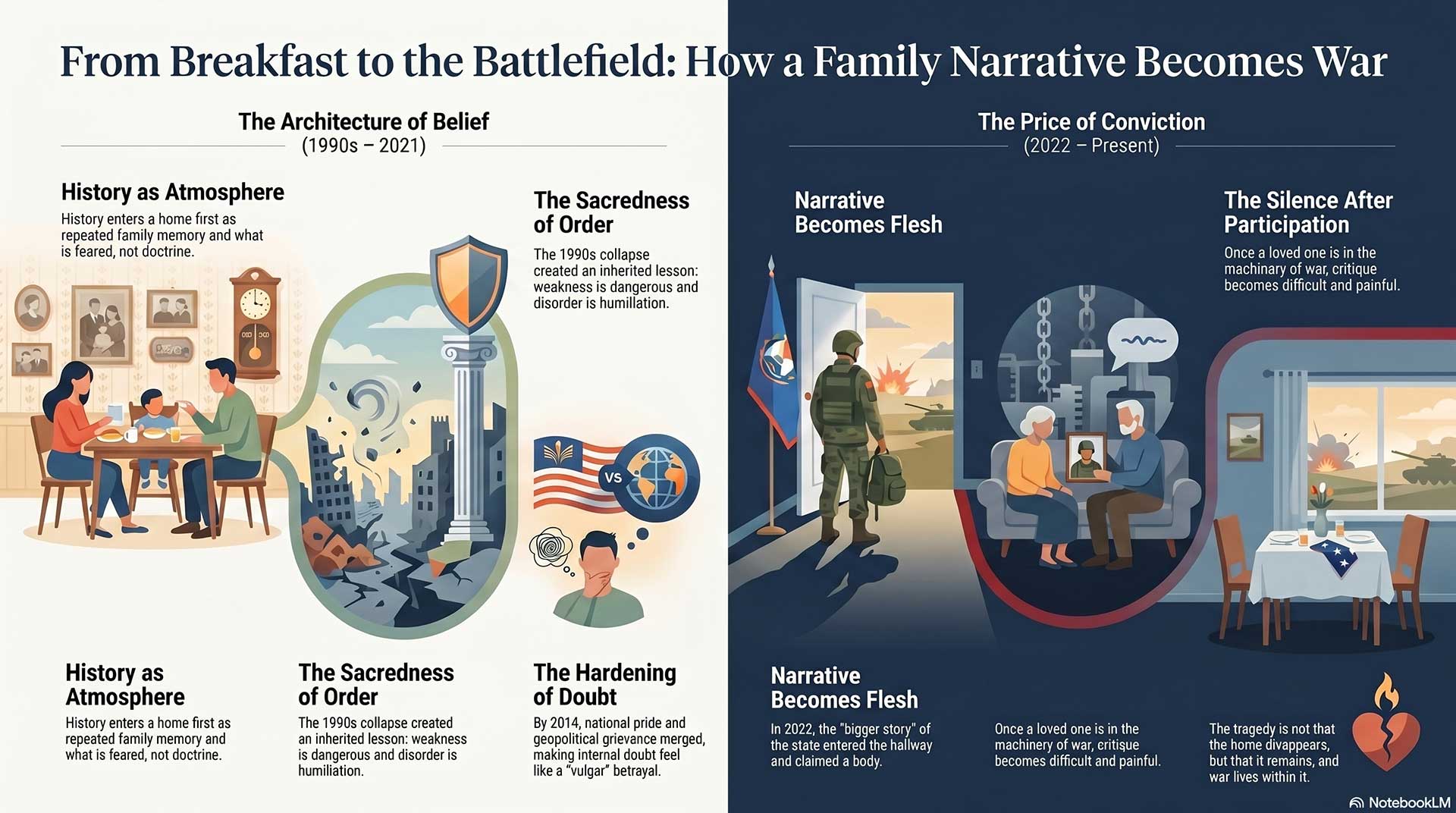
For much of the story, this family lives inside words that feel stable: strength, order, respect, history, humiliation, seriousness, defense. Those words carry real emotional force for them. They are tied to memory, family identity, and the wish not to relive collapse. They help explain how the family sees the world and how it has learned to fear weakness.
Then the war moves closer.
Not closer as a headline.
Closer as a body.
Closer as a voice on the phone.
Closer as a message too short to sound natural.
Closer as a silence in the kitchen.
That is the deepest shift in the story.
The old words do not vanish. But they stop standing cleanly. Once someone beloved is inside the machinery, language changes. What once sounded principled begins to sound thinner. What once sounded proud begins to sound frightened. What once felt historically justified begins to carry the weight of a real person who must now bear it.
I think that is why the story becomes quieter as it goes on.
The early chapters are shaped by memory and explanation. The later chapters are shaped by pause. That change matters. It shows that certainty is easiest before it has to survive contact with someone you love.
Viktor is important in this way because he never becomes simple. He is not there only to be wrong in a tidy moral structure. He carries genuine historical injury and genuine pride. But he also reaches the limit of what inherited certainty can do once the war has a family face. His change is not a neat awakening. It is something sadder and more believable: conviction damaged by intimacy.
Andrei, to me, carries one of the heaviest burdens in the story. He is the father who realizes too late that what he passed down as seriousness, resilience, and the refusal of humiliation may also have prepared a son to step too easily toward obedience under pressure. He does not create the whole war. He does not create the whole system. But he comes to see that homes help form the emotional reflexes that history later uses.
That recognition is devastating.
Elena may be the clearest moral witness in the apartment. She keeps life moving. She refuses to let abstraction erase the body. She is the one who hears when speech has stopped sounding human. Her responses stay domestic, but they are not small. In a story like this, the domestic is where moral truth becomes hardest to avoid.
Anya matters because she refuses to let repetition count as truth. She is not untouched by the family’s history. She is wounded by it too. Yet she is the one who feels earliest that public language has become too smooth, too rehearsed, too ready to hide cost. By the end, she understands something terrible: critique becomes harder once someone you love is inside the structure you are criticizing. That is one of the sharpest pains in the story.
This is why the silence at the end matters so much.
It is not empty silence.
It is not peaceful silence.
It is not innocent silence.
It is the silence that remains after belief and consequence have passed through one another and can no longer be cleanly separated. The family can still sit together. The apartment still stands. Daily life still happens. Tea is still made. Messages are still checked. Yet the old fluency is gone. No one can speak in the earlier way without hearing what those words now carry.
For me, that is the true tragedy of the story.
Not that the home disappears.
That it remains a home, and so the war cannot stay outside it.
The family is not destroyed in a dramatic single motion. It is altered in tone, in trust, in the meanings of ordinary phrases. That kind of damage is quieter than spectacle, but it lingers longer.
I think the ending belongs exactly there. Not at resolution, and not at total collapse. It belongs in that morally strained domestic stillness where everyone knows the old language no longer works, but no new language has fully arrived yet.
That is where this story lives in me.
Short Bios:
Viktor Sokolov
Viktor is the grandfather of the family and the carrier of Soviet-scale memory. He remembers not only hardship, but stature, weight, and a world in which Russia did not feel diminished. He gives the family its deepest inherited sense of historical grievance and pride.
Andrei Sokolov
Andrei is the father, shaped most deeply by the instability and humiliation of the 1990s. He values order, seriousness, and strength because he has lived through collapse. His tragedy is that the values he passes down to protect the family help form the pressures that later endanger it.
Elena Sokolova
Elena is the mother and the domestic moral center of the story. She understands politics through hunger, medicine, routine, tone of voice, and the fragile work of keeping a household human. She hears the cost of war in the body before others can name it.
Maksim Sokolov
Maksim is the older son, raised in an era of restored national pride. He does not begin as cruel or fanatical, but he is vulnerable to narratives of strength, dignity, and historical necessity. He becomes the point where inherited feeling turns into lived consequence.
Anya Sokolova
Anya is the younger daughter and the family’s clearest witness to fracture. She belongs to a generation shaped by contradiction, digital leakage, and distrust of polished public language. She senses early that certainty in the apartment is more fragile than it sounds.
Nick Sasaki
Nick Sasaki is a writer and curator of emotionally serious historical fiction, imagined dialogues, and morally layered stories about war, memory, identity, family, and the long afterlife of public events inside private lives.
Leave a Reply