
|
Getting your Trinity Audio player ready...
|
BUENOS AIRES — The Tango Guitarist of San Telmo
Buenos Aires comes alive at night in a way few cities do.
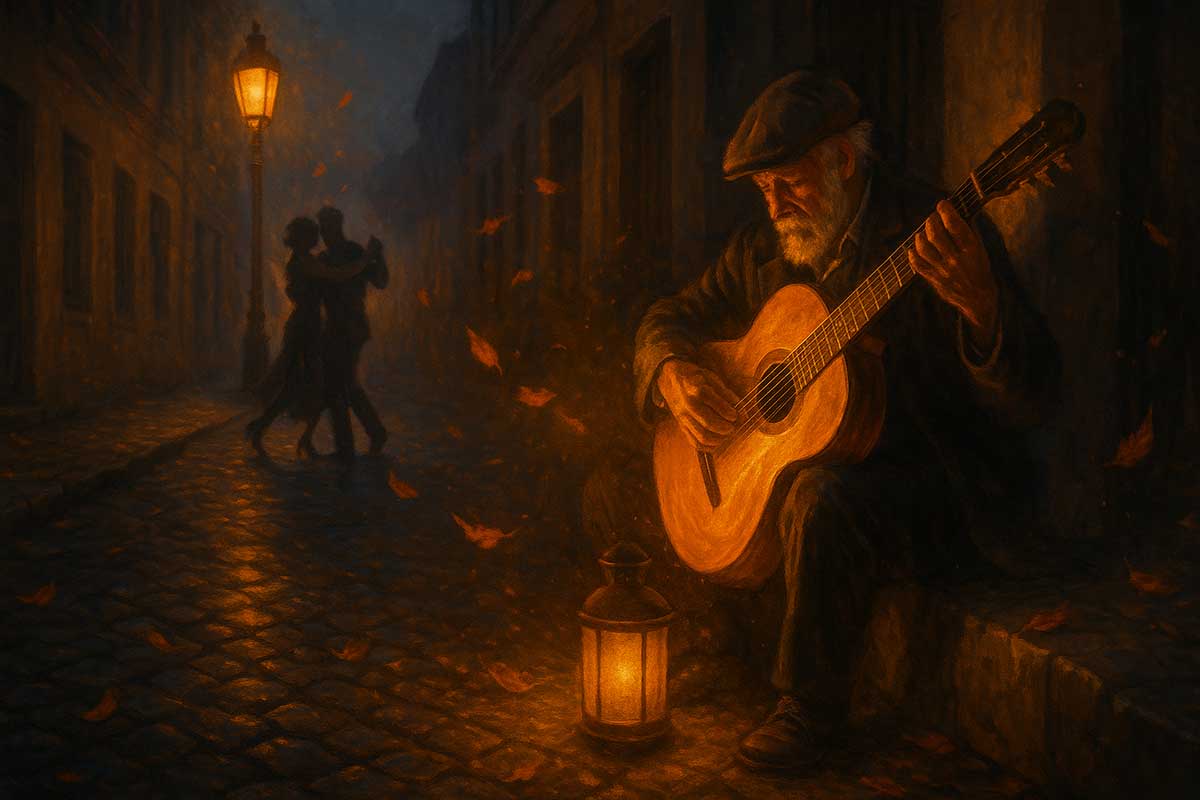
By day it bustles — taxis weaving through avenues, cafés overflowing with conversation, buildings echoing with the sound of old and new generations overlapping each other like instruments in a single song. But at night, especially in the cobblestone quarters of San Telmo, the city softens. Shadows stretch long across the streets. Lanterns glow above doorways. And tango — always tango — rises from somewhere, as if the air itself remembers.
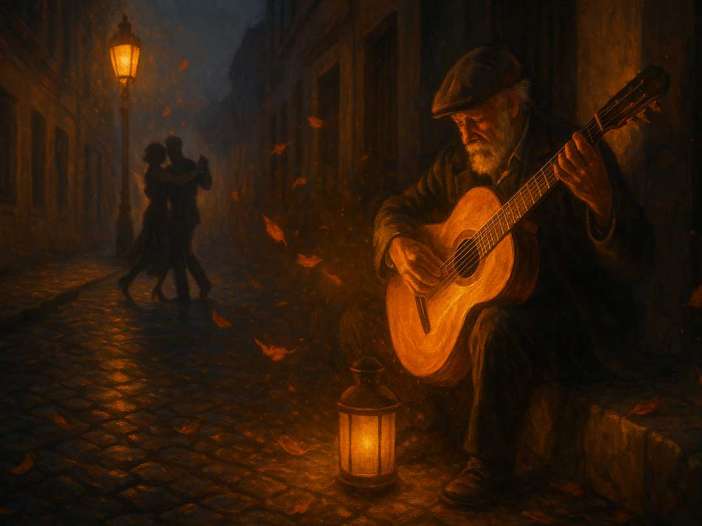
Tonight, on Christmas Eve, the music came from a man seated on a worn wooden stool outside a shuttered antique shop. He held an old classical guitar, its varnish cracked from time, and played a melody so soft and so heartbreakingly longing that even stray dogs paused to listen.
He wore a wrinkled coat, a simple hat pulled low, and something faintly red peeking around his neck — a scarf frayed at the ends. His beard was white, his face weathered, and his eyes held a patience that felt older than the city.
No one knew that he was Santa in Disguise.
They only knew him as El Viejo Guitarrista — the Old Guitarist — a quiet figure who appeared each year around Christmas, always in the same corner of San Telmo, always playing songs that made the night feel deeper than usual.
The locals said his melodies could change a person’s path without saying a word.
Tonight, three people would discover that.
The first was Lucía, a young dancer whose dreams had broken faster than her bones could heal. Once the star of her tango academy, she had been injured in a rehearsal accident two months earlier. Her partner had moved on to another dancer. Her teacher told her to be “realistic.” Her mother encouraged her to find office work “just in case.”
Her ankle had healed, but something inside hadn’t.
As she limped through San Telmo, her heart felt like a window left open in a storm.
The guitarist’s melody reached her like a thread tugging at her ribs.
She slowed.
He played a phrase she knew well — Caminito, a song of longing and lost steps. It was the first tango she ever danced as a child. Hearing it now felt like being seen.
Lucía’s eyes filled instantly. She blinked fast.
The music shifted, softening, turning warmer. She approached.
“You play beautifully,” she whispered.
The old man didn’t stop playing, but his eyes twitched upward kindly.
“It’s an old melody,” he said. “It finds the ones who need it.”
“Then it shouldn’t find me,” she said bitterly. “I can’t dance anymore.”
He shook his head. “You can’t dance the way you used to. That is different.”
Lucía clenched her jaw. “Everyone keeps telling me to let go of dancing. That maybe it wasn’t meant for me.”
“And what do you say?” he asked.
She hesitated. “I say… I don’t know who I am without it.”
“Then,” he replied, “you haven’t lost dancing. You’ve lost permission.”
The words hit like a sudden spotlight.
He placed his guitar gently on his lap. With one hand he tapped out a simple rhythm on its wooden side — soft, steady, familiar.
Lucía felt her foot move.
Just a shift of weight.
Then a pivot.
Her body remembered even as her mind resisted. On the cobblestones of San Telmo, in the glow of lantern light, she danced one slow, trembling step.
Then another.
And another.
She gasped — not from pain, but from recognition.
“You see?” the old man said softly. “The music never left you.”
She laughed through tears, covering her mouth. “I thought I was broken.”
“No,” he said. “You were paused.”
She danced three more steps, her shadow spinning across the stones like ink swirling in water.
When she finally stopped, he resumed playing — a softer melody now, one that felt like encouragement, not nostalgia.
“Tomorrow,” he said, “go back to your studio. Not to reclaim your past, but to begin your new dance.”
She nodded, overwhelmed. “Who are you?”
“Just a man who listens to the city,” he smiled.
Lucía walked away with her face lifted, as if the fog above Buenos Aires had parted just for her.
The second listener arrived an hour later.
Diego, a taxi driver in his fifties, pulled over near the corner to eat his empanada in peace. He had been driving twelve-hour days, trying to cover the rent he used to split with his ex-wife. His son had moved to Spain. His daughter rarely answered his calls. He spent Christmas alone most years, but tonight felt emptier than usual.
He didn’t hear the music at first.
He felt it.
A gentle pressure on the chest, like a hand reminding him he still had a heartbeat.
He turned.
The guitarist nodded to him without stopping the melody.
Diego approached reluctantly. “You play sad songs.”
“They aren’t sad,” the old man replied. “They are honest.”
Diego snorted. “Honesty isn’t very comforting.”
“Then you are listening with the wrong part.”
The guitarist played a warm chord — one that seemed to linger in the air.
“Why are you really out here tonight?” he asked.
Diego shrugged. “No reason.”
The melody shifted into a deep, slow tango bass.
“You miss someone,” the old man said.
Diego’s throat tightened. He looked away. “…My daughter.”
“Does she know?”
“That I miss her?” He laughed bitterly. “She’s twenty. She doesn’t think her father feels anything.”
“And you let her believe that?”
Diego blinked.
A chord struck — clean, direct.
“What if,” the guitarist continued, “instead of waiting for her to return, you send something that reminds her of who you were to her once?”
“A message?” Diego said. “She doesn’t answer.”
“Not a message,” the old man said. “A memory.”
He played a playful tango rhythm — an almost childlike tune.
Diego felt the sound punch straight into his gut.
“When your daughter was little,” the man continued softly, “did you dance with her in your kitchen?”
Diego froze.
“Yes,” he whispered. “I used to pick her up and twirl her. She’d put her feet on mine. We did it all the time.”
The guitarist nodded. “Send her a voice note. Play this melody in the background. Say only: ‘I still dance with you.’ Nothing more.”
Diego’s eyes filled. “Will she answer?”
“That is not the point,” the old man said gently. “The point is that love moves whether or not someone sees it.”
Diego wiped his face and nodded.
When he walked back to his taxi, he looked lighter, as if some invisible burden had slid off his shoulders and vanished into the night air.
The last visitor came close to midnight.
Isabella, a grandmother in her late sixties, leaned heavily on her cane as she strolled slowly under the streetlights. Her husband had died the previous spring. Her children lived far away. Her apartment felt too quiet, too still, too full of echoes.
The guitarist’s tune wrapped around her like a shawl.
She smiled despite herself.
“Ah,” she said, approaching. “That one is for dancing cheek-to-cheek.”
“It is,” the old man agreed. “Do you still dance?”
“I did,” she said wistfully. “But now it’s just me.”
The guitarist stopped playing.
He gently stood, bowed, and held out his hand.
“Would you like to dance?” he asked.
Isabella laughed. “With this old body?”
“With this old body?” he replied, tapping his own chest. “We will balance each other.”
She placed her hand in his.
He hummed the melody softly as they shuffled and swayed in tiny steps — two silhouettes moving slowly on a narrow street in San Telmo, surrounded by lantern light and warm night wind.
She closed her eyes and imagined her husband’s hand in hers, imagined his cologne, imagined the way he used to guide her through every tango as if she weighed nothing at all.
A tear slid down her cheek.
“Thank you,” she whispered.
“No,” he said. “Thank you.”
When she opened her eyes, the guitarist was already sitting again, tuning the strings softly.
She took one last look, pressed her hand over her heart, and walked on into the Buenos Aires night, feeling less alone than she had in months.
After midnight, when the streets grew quieter and the breeze cooled, the old guitarist packed up his instrument. The red scarf fluttered in the warm wind.
“Gracias, Buenos Aires,” Santa murmured. “You always help me give what people cannot ask for.”
The city lights flickered across his glasses. A bandoneón played faintly in the distance, as if echoing his farewell.
He slung the guitar strap over his shoulder, stepping into the shadowed alley.
By the time the next breeze passed, he was gone.
But the melody he played lived on — in three hearts, and in the night air of San Telmo, waiting for the next soul who needed to hear it.
Short Bios:
El Viejo Guitarrista — Santa in Disguise
Known to locals only as El Viejo Guitarrista, he is an elderly street musician who appears every Christmas Eve at the same corner of San Telmo. With a cracked classical guitar, a frayed red scarf, and eyes full of quiet understanding, he plays melodies that seem to find people exactly when their hearts need it most. No one suspects he is Santa—offering gifts not of toys, but of clarity, encouragement, and the kind of healing only a song can grant.
Lucía — The Dancer Searching for Herself
Lucía is a gifted young tango dancer whose rising career collapsed after a sudden injury. Though her ankle healed, her confidence did not. Once celebrated as the brightest star in her academy, she now wanders Buenos Aires afraid she has lost the one thing that defined her. When the guitarist’s melody calls her back to movement, she discovers that her soul still remembers the dance—and that her future may begin exactly where her heartbreak tried to end it.
Diego — The Taxi Driver Carrying an Untold Loneliness
Diego is a hard-working taxi driver in his fifties, weathered by long shifts and a life that slowly drifted away from what he hoped it would be. Estranged from his children and spending Christmas alone, he feels forgotten by the world. A single melody from the old guitarist reminds him of the father he once was—the one who danced in the kitchen with his daughter—and gives him a way to reach out again, not with explanations, but with love.
Isabella — The Widow Learning to Dance Again
Isabella is a warm-spirited grandmother in her late sixties who lost her husband earlier that year. The city she once explored with him now feels too wide and too empty. On Christmas Eve, the guitarist invites her into a simple, gentle dance—one that lets her feel her husband’s presence not in memory alone, but in motion. She leaves with her heart less burdened, reminded that love can remain even when life grows quiet.
Leave a Reply