

|
Getting your Trinity Audio player ready...
|
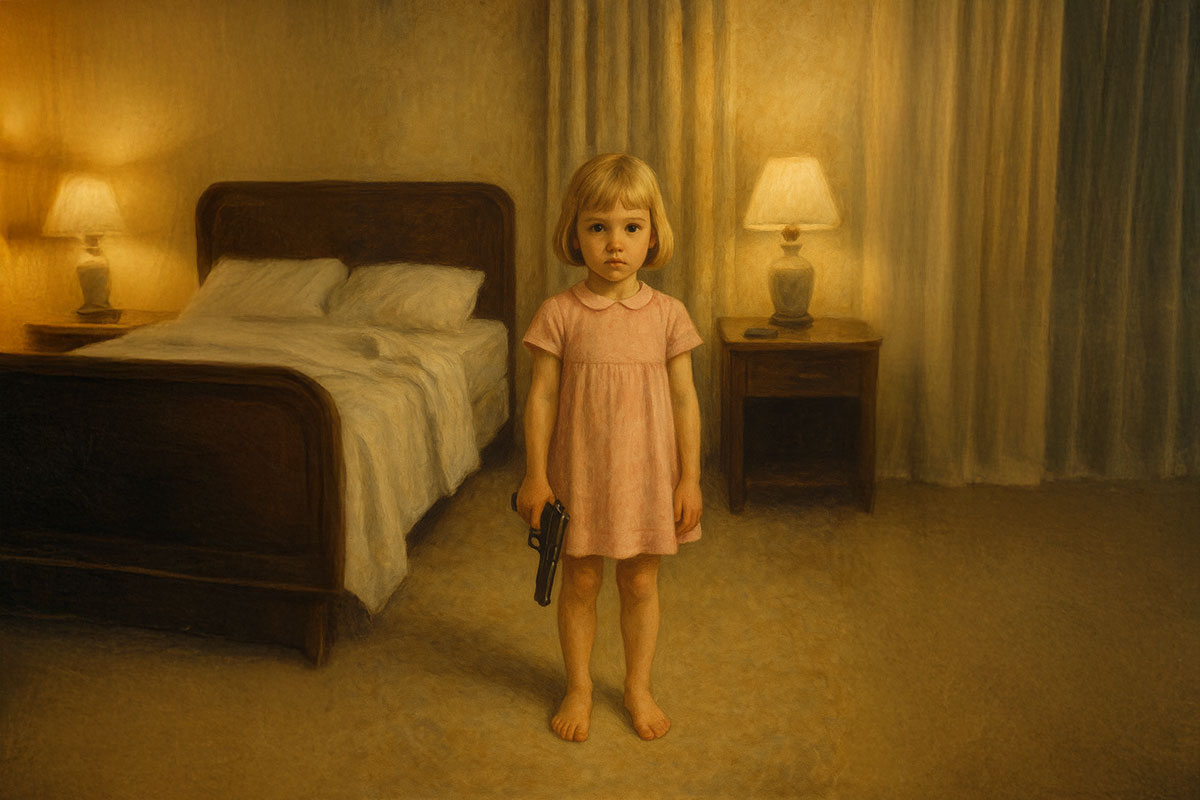
J.D. Salinger:
The girl at the carousel was not in the habit of looking back. She didn’t believe in it. She had a brother once who believed in everything and then didn’t. He used to say the world was a giant practical joke, and that God was maybe the only one laughing.
The smaller girl with her, the blonde one, liked seashells and made declarations about bananafish that no one challenged, possibly because they sounded like bedtime stories and possibly because no one ever really knew what to say to very young children.
And then there was the girl on the bench. She had a face like a held breath and a lap full of silence.
They met by accident, which is to say it was inevitable.
(Note: This is an imaginary conversation, a creative exploration of an idea, and not a real speech or event.)

The Glass Carousel
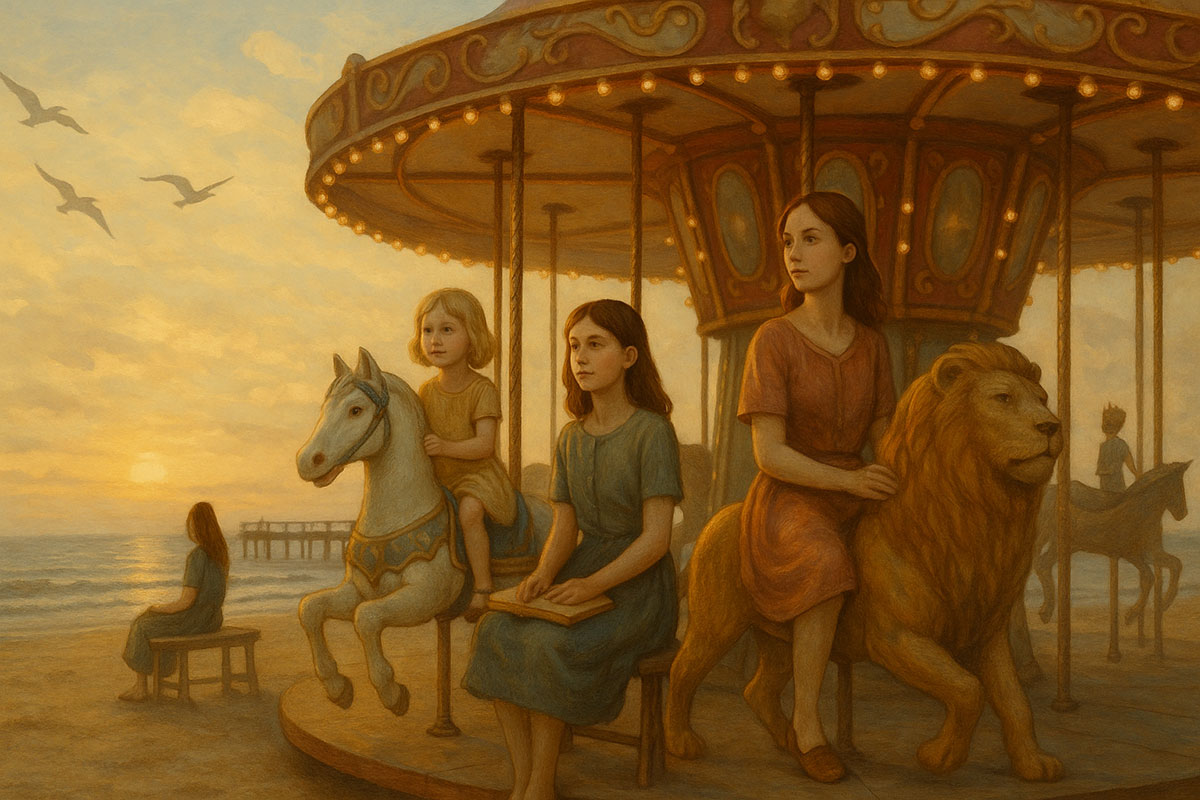
It was late afternoon, and the tide had gone out so far the sand under the pier glinted like scuffed tin. Sybil Carpenter was digging a moat around a shapeless lump of a sandcastle when she saw the older girl walking her way. The girl had a red ribbon tied around her wrist and her skirt looked too big for her, like it belonged to someone she no longer wanted to be.
Sybil didn’t stop digging. She only looked up and squinted.
“Are you lost?”
The girl didn’t smile. “No,” she said, sitting down a few feet away. “Just bored. And I don’t like people much today.”
“I like people,” Sybil said. “Except the ones who say shush a lot.”
The girl pulled at the ribbon, watching her fingers move. “You always say exactly what you think?”
“Yes,” Sybil said matter-of-factly. “Except when I’m swimming.”
The girl let out a soft breath. “I’m Phoebe,” she said. “Phoebe Caulfield.”
“Sybil,” the little girl said. “Are you sad?”
Phoebe turned to her, blinking once. “Why would you say that?”
Sybil shrugged. “Sad people don’t look at things. They stare. You’re staring.”
Phoebe opened her mouth and then closed it again. A wave washed up, just enough to erase the moat.
“My brother used to say weird things like that,” Phoebe said finally. “Then he left.”
“Did he say goodbye?”
“No.”
Sybil poked the wet sand with her toe. “That’s rude.”
Phoebe gave a sideways glance. “You’re not too bad for a tiny person.”
“I’m six and three quarters.”
“That’s practically ancient.”
They sat in silence for a few moments. Seagulls dropped invisible words overhead.
“I had a friend,” Sybil said suddenly. “He was a man but not old. He told me about bananafish.”
Phoebe tilted her head. “Bananafish?”
“They swim into holes and eat so many bananas they can’t come out. Then they die.”
“That’s awful.”
“I thought it was funny.”
Phoebe frowned. “What happened to him?”
Sybil paused, her shovel now a sculpture tool against nothing in particular. “He went away. I think he was too full.”
Phoebe looked out at the water. “My brother said everyone’s full of something. Phoniness, mostly.”
The inn bell rang once, distantly. Both girls turned slightly toward the sound.
“You ever been to a carousel?” Phoebe asked.
“I went last year. It was slow and went in circles.”
“That’s the point,” Phoebe said. “Everything does.”
Up at the inn, Franny Glass sat on the porch, legs tucked under her, a glass of warm lemonade melting beside her notebook. She had watched the two girls from the railing for some time, the way you watch something you’re not sure is real. They had sat too still. Children weren’t supposed to sit still.
Zooey had written again, sent her another long letter folded into eighths. He said things like “don’t get attached to your own sadness” and “breathe into the ache.” She’d read it twice and put it under her pillow like it might leak meaning through her dreams.
She glanced again at the beach. The tide was turning. Everything was always turning.
Phoebe and Sybil walked up the beach, each holding a wet shell. Sybil’s had a hole in the middle, like a wound. Phoebe’s was whole but dull.
“You staying long?” Phoebe asked.
Sybil nodded. “Till next Thursday. Then we go home and pretend everything was special.”
Phoebe looked down. “You’re weird, kid.”
“I know,” Sybil said. “Do you want to go on the carousel tomorrow?”
“I might.”
“You don’t have to smile,” Sybil added. “We can just ride.”
Phoebe stopped walking. “You know what, Sybil? I think I will.”
Back at the porch, Franny watched them approach. She leaned forward and set the lemonade down on the step.
“You two look like you just discovered Atlantis,” she said.
Sybil ran ahead and dropped her shell in Franny’s lap.
“It’s cracked,” Franny said, turning it in her hand.
“Cracks let the light in,” Sybil replied. “I read that in a fortune cookie.”
Franny smiled. “You read fortune cookies?”
Sybil nodded. “They’re more honest than people.”
Phoebe sat down beside Franny, looked out at the ocean, and asked, “Did you ever lose someone who didn’t want to be found?”
Franny blinked. “Yes,” she said, softly. “I think I did.”
Phoebe was quiet, then leaned back and let her head touch the porch rail.
“I thought so,” she whispered.
That night, Franny left her notebook open. She wrote only one line before turning out the light:
"Two ghosts met in daylight today, and neither one was afraid."
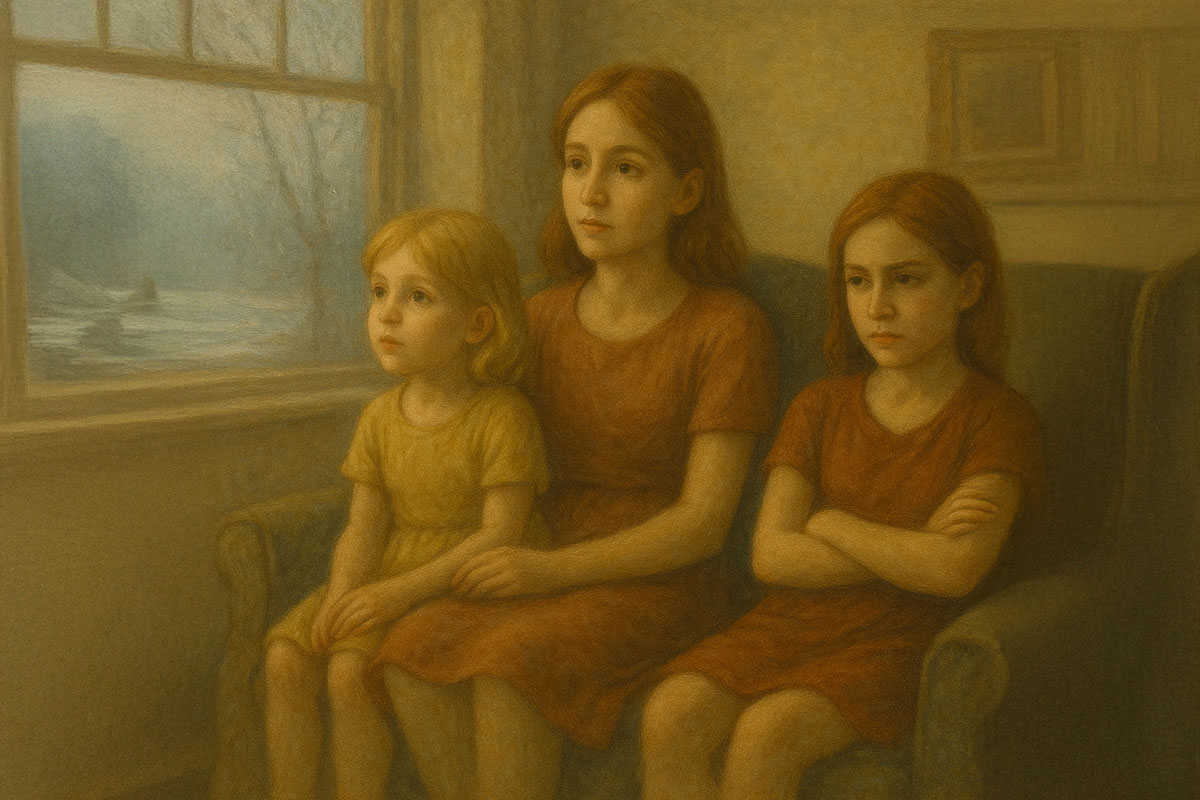
It rained the next morning. Not a sharp kind of rain, but a gray, indecisive drizzle that made everything look softer and slightly more honest. Sybil sat at the window of the inn’s reading room, her cheek against the pane, watching the wet trees nod.
Phoebe was curled up in a faded armchair across the room with a newspaper comic section she wasn’t reading. Her ribbon was gone. She wasn’t sure when she’d taken it off. Something about the rain made it seem like a lie.
Franny entered barefoot, carrying a towel and a book with no dust jacket. She looked like someone who had just passed through a storm and wasn’t entirely dry yet—not from the rain, but from something older and sadder.
“Carousel’s closed,” Franny said, glancing out the window.
Sybil turned her head slightly. “Do they open again?”
“Eventually,” Franny said. “Everything does. Or something like it.”
Phoebe stretched her legs and crossed her ankles the way people did in films. “Did you ever feel like people only want to fix you so they don’t have to look at themselves?”
Franny sat in the empty armchair between them. “Yes,” she said.
“Did it make you angry?”
“No,” Franny said. “Just lonely.”
Phoebe nodded slowly, like she knew that loneliness and had tried to name it but couldn’t quite spell it.
Sybil walked over and climbed into Franny’s lap like it was the most natural thing in the world. She smelled like rain and crayons and something that hadn’t been named yet.
“Do you ever miss someone you never really knew?” Sybil asked.
Franny kissed the top of her head. “All the time.”
Phoebe watched them. She didn’t move, but something inside her softened.
Later that day, after the rain let up but before the sun fully committed to returning, the three of them walked to the pier. The carousel was still closed, but the sea was restless and the gulls had returned to their lecturing.
Sybil held Phoebe’s hand, which surprised them both. Franny walked slightly behind, letting the quiet stretch.
On the beach, a boy with a paper crown was trying to build a boat from driftwood. He looked about twelve and had a gaze like a lighthouse—steady but distant.
“Is he real?” Sybil asked.
“Yes,” Phoebe said. “That doesn’t mean we understand him.”
They stood and watched him work until the boy looked up and said, “You want to help or just look poetic?”
Phoebe cracked a real smile, the kind that shows you your own teeth.
That evening, the inn hosted a supper for the guests. Everything tasted like salt and old memories. Sybil fell asleep in her chair halfway through dessert, her head tipped back like she was waiting for a star to drop into her mouth.
Franny carried her upstairs. Phoebe followed.
As Franny tucked Sybil in, Phoebe stood in the doorway, arms folded but unguarded.
“I used to think Holden was wrong about everything,” she said. “But now I think maybe he was just... early.”
Franny turned and looked at her. “He was watching the world burn with a bucket of hope.”
Phoebe nodded. “Do you think it helped?”
Franny brushed Sybil’s hair from her face. “Maybe not. But it was something. Sometimes holding hope is enough. Even if it leaks.”
Phoebe looked down. “Do you think he’s okay?”
Franny didn’t answer right away. She touched Sybil’s hand and then walked toward the door. She placed one hand gently on Phoebe’s shoulder.
“I think he’s still riding,” she said.
Phoebe furrowed her brow. “Riding?”
Franny smiled faintly. “A carousel. You can’t see everyone from where you are. But they’re out there. Still circling.”
That night, Phoebe sat on the porch alone. The moon had come back, tired but clear.
She held the broken shell Sybil had given her and pressed it to her ear.
No sound. No ocean. Just a long hush that felt like waiting.
She closed her eyes.
In a nearby room, Franny lay awake, her fingers tracing the fold of Zooey’s latest letter under her pillow. She whispered a single line before sleep came:
“Don’t worry. They’re safe inside the music.”
In the morning, the carousel creaked to life again. Not new, not fast, but open.
And that was enough.
Short Bios:
Phoebe Caulfield
Holden’s younger sister from The Catcher in the Rye, Phoebe is now sixteen. Sharp, emotionally intuitive, and allergic to insincerity, she walks the line between lost girl and future writer. She’s still trying to make sense of where her brother disappeared to—and why the world feels less honest without him.
Sybil Carpenter
Originally six years old in A Perfect Day for Bananafish, Sybil remains a soft-spoken, strangely perceptive child. She remembers bananafish and beaches, though not quite the man who told her the story. She sees the world sideways and has a talent for saying things no one expects.
Franny Glass
From Franny and Zooey, Franny is in her early twenties, adrift between spiritual hunger and the disillusionment of intellect. She’s taken a quiet job at the seaside inn, hoping to forget what she once thought mattered. She reads slowly now and prays without moving her lips.
The Boy with the Paper Crown
He isn’t named. He builds boats that can’t float and asks questions like riddles. Some say he’s just a boy. Others suspect he might be someone returning—someone unfinished. He appears when people stop pretending.
Zooey Glass (mentioned)
Franny’s brother. He doesn’t appear until late, if at all, but his words are felt throughout. He writes letters you don’t read all at once and asks questions you’re not supposed to answer.
Leave a Reply