
|
Getting your Trinity Audio player ready...
|
What if Apollo Robbins challenged top cognitive scientists on how attention really works?
Introduction — By Apollo Robbins
When people hear the phrase “Art of Misdirection,” they imagine deception.
They imagine a pickpocket, a magician, a con.
But misdirection is not about hiding something.
It is about understanding how attention works.
For most of my life, I’ve studied attention the way a scientist studies gravity. I’ve stood in front of CEOs, intelligence officers, law enforcement, and everyday audiences. I’ve taken watches off wrists, wallets from pockets, and assumptions from minds. And the most important thing I’ve learned is this:
You don’t see the world as it is.
You see the world as your attention allows.
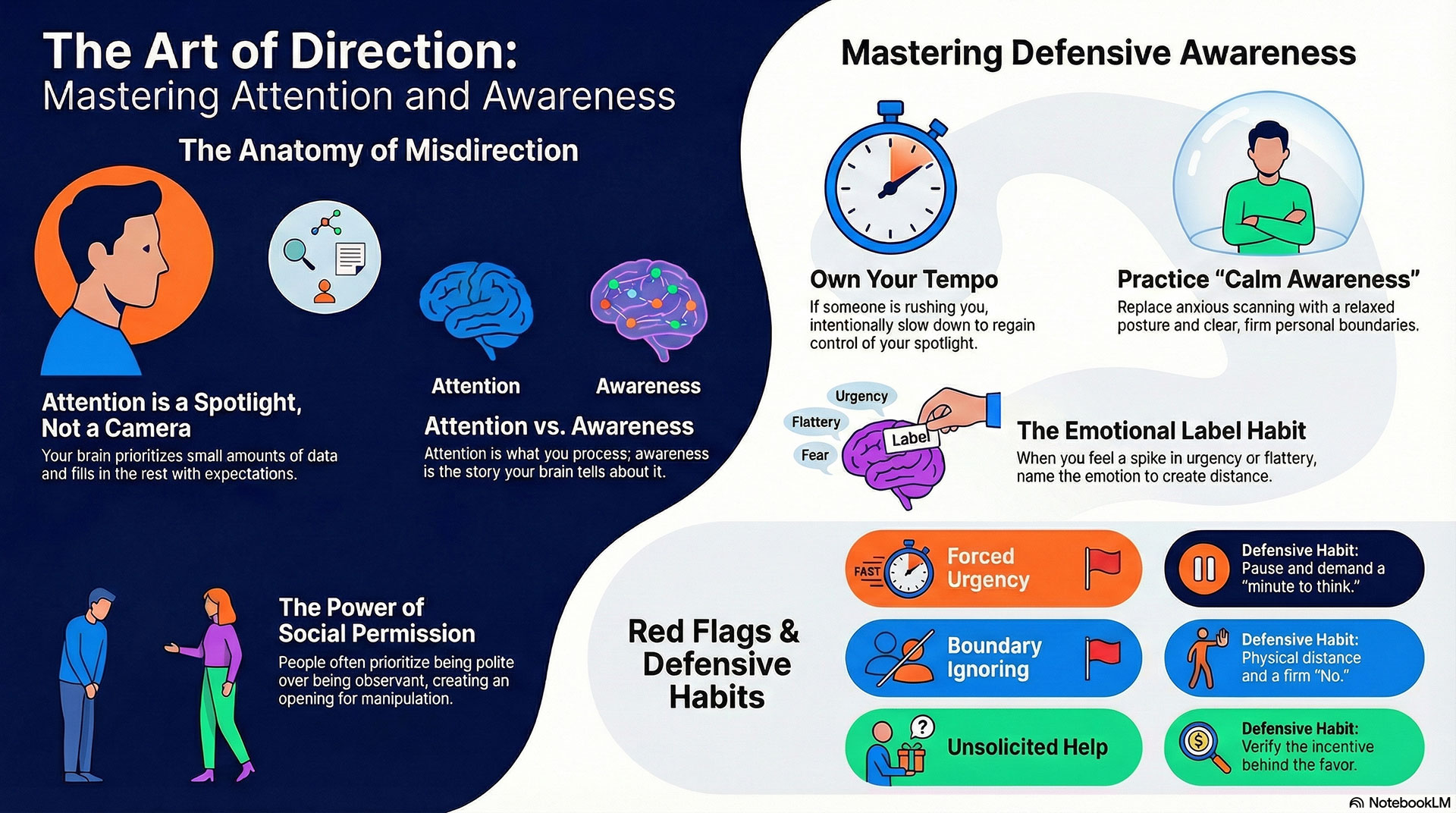
Attention is a spotlight. It has a limited beam. Wherever that beam shines, everything else falls into darkness.
The problem isn’t that people are foolish.
The problem is that attention is finite.
We are wired to trust patterns.
We assume consistency.
We fill in missing information automatically.
We believe what feels coherent.
And that is not weakness. It is efficiency.
But the same cognitive shortcuts that allow us to navigate the world quickly also allow others to influence, redirect, and sometimes manipulate us.
In this conversation, we are not here to turn you into a cynic.
We are here to turn you into someone who understands attention.
If you understand attention, you understand influence.
If you understand influence, you understand vulnerability.
And if you understand vulnerability, you gain choice.
Misdirection is not about tricking people.
It is about revealing the invisible architecture of perception.
Once you see it, you cannot unsee it.
And that is where real awareness begins.
(Note: This is an imaginary conversation, a creative exploration of an idea, and not a real speech or event.)
Topic 1: Attention Is a Spotlight, Not a Camera

Moderator:
Daniel J. Simons (inattentional blindness researcher)
Panel (5):
Apollo Robbins, Christopher F. Chabris, Susana Martinez-Conde, Stephen L. Macknik, Gustav Kuhn
The room feels like a small black-box theater that has been converted into a research lab for one night. A round table sits under soft stage lights. On one side, a simple close-up camera points at the tabletop, but the screen behind it is turned off, almost as if to say: tonight is not about seeing more, it is about noticing what you miss.
Daniel J. Simons sits at the head of the table with the calm, curious energy of someone who has spent years proving one uncomfortable truth: we are all more blind than we think, and we are all certain we are not.
Beside him is Apollo Robbins, relaxed and friendly, the only one in the room who can steal a watch while making you feel like you are being treated kindly. Across from them are Christopher F. Chabris, Susana Martinez-Conde, Stephen L. Macknik, and Gustav Kuhn. Their expressions say the same thing in different dialects: this is not magic, this is the mind.
Daniel J. Simons: Let’s start with the most basic problem. People live as if attention is a camera, recording everything. But in reality, attention is more like a spotlight. Why do people feel like they see everything when attention filters so much?
Apollo Robbins: Because the experience of attention feels complete. When I guide your attention to something, your brain fills in the rest and calls it reality. In performance, I’m not fighting your eyes. I’m partnering with your expectations. You feel like you are watching the whole room, but you are actually watching a tiny story your mind is telling itself about the room. The confidence comes from the smoothness of that story.
Christopher F. Chabris: There’s also a memory issue. People remember the highlights and assume the highlights equal the whole. You don’t remember every detail you missed, because you never encoded it. So later, your mind reconstructs a scene that feels continuous. That reconstruction is convincing. It’s a feature, not a bug. It helps you function. But it makes you vulnerable to misdirection, not only by magicians, but by anyone who can control what you attend to.
Susana Martinez-Conde: From the neuroscience side, the brain is constantly making predictions. You perceive what you expect, and you ignore what your brain decides is irrelevant. Your eyes move in rapid jumps, and in between those jumps, you are not sampling the world the way you think you are. The brain edits, smooths, and stabilizes. This creates a powerful illusion of complete vision. Magic exploits that illusion by pushing something important into the category your brain labels “not relevant right now.”
Stephen L. Macknik: Attention is limited and metabolically expensive. Your brain has to choose. It cannot process everything at full resolution. So it prioritizes what matters for goals, threats, and social cues. That prioritization feels like reality itself, so people confuse “what I attended to” with “what existed.” The feeling of completeness is basically your brain protecting you from overload, and then congratulating itself for the clean result.
Gustav Kuhn: And socially, we learn to trust perception. We build our identities on it. I am competent. I am observant. I am not easily fooled. That identity makes it hard to accept that you can miss obvious things. The emotional resistance is strong. When I show someone a trick, the first response is often not curiosity. It’s disbelief. They feel they must have seen it. That feeling is exactly why misdirection works.
Daniel J. Simons: So the confidence comes from the brain’s editing, memory reconstruction, predictive perception, and even ego. You experience a world that feels complete, so you assume it is.
He glances at Apollo with a small smile, as if acknowledging that this is the stage magician’s favorite weakness.
Daniel J. Simons: Let’s give people some language. What is the cleanest way to explain inattentional blindness and change blindness to normal people, without turning it into a lecture?
Christopher F. Chabris: I’d say: you don’t see with your eyes, you see with your attention. If your attention is busy, the obvious can be invisible. Then I add: your memory isn’t a recording, it’s a story. When the story updates, you feel like you noticed the change, even if you didn’t. That framing helps people stop blaming their eyes and start understanding the mind.
Apollo Robbins: I use a more personal line. I say: if I can get you to care about one thing, I can make you forget another thing exists. People instantly understand that because they’ve lived it. They’ve driven past an exit while thinking about a conversation. They’ve walked into a room and forgotten why. Misdirection is just that, on purpose, with style.
Susana Martinez-Conde: I often use a simple metaphor: your brain is a newspaper editor. It doesn’t print every detail. It prints what seems important. Inattentional blindness is what happens when the editor decides something is not newsworthy. Change blindness is what happens when the editor updates the headline but keeps the same layout, so you don’t notice the change. It’s not stupidity. It’s how the system works.
Stephen L. Macknik: I’d explain it as a bandwidth problem. Your brain has limited bandwidth. You can either have a wide view with little detail, or a narrow view with high detail. When you zoom in, you lose the rest. Inattentional blindness is the cost of zooming. Change blindness is the cost of trusting that the world stays stable while you’re zoomed elsewhere.
Gustav Kuhn: I’d add one line that makes it stick: confidence is not a sign you saw correctly. Confidence is often just a sign your brain filled in the gaps smoothly. That sentence makes people laugh a little, but it also lands. It gives them permission to be humble without feeling broken.
Daniel J. Simons: I like that. Not stupid, not broken. Human. Limited bandwidth, edited perception, and a memory that tells stories.
He pauses as if letting the room exhale, then shifts the conversation from explanation to application.
Daniel J. Simons: Now the part I care about most. What is one everyday situation where misdirection happens without any magician present?
Apollo Robbins: The biggest one is politeness. If I walk into your personal space with confidence and warmth, many people will prioritize being polite over being attentive. They will look at my face, not my hands. They will nod, smile, agree, and miss what they are giving away. In daily life, sales environments use this, social environments use this, even family dynamics use it. Attention follows social rules.
Christopher F. Chabris: Smartphones. Notifications are engineered misdirection. A tiny buzz steals your spotlight and you feel like you chose it. Then your attention shifts, and the world changes without you noticing. It’s not only that you miss what’s happening. It’s that your sense of continuity gets broken. You feel present, but you’re skipping.
Susana Martinez-Conde: Advertising, especially when it’s blended into content. The misdirection is not necessarily the product. It’s the emotional hook and the timing. You’re guided into a feeling first, and then the message arrives when your skeptical brain is relaxed. It’s a gentle pickpocketing of attention. It feels like entertainment, but it’s training your salience system to value certain cues.
Stephen L. Macknik: In meetings and arguments, misdirection happens through framing. Someone controls the question, and suddenly everyone is debating inside that frame. You miss the bigger issue because your attention is captured by the presented choice. This is a cognitive illusion that looks like logic. It feels rational, but it’s often just attention control through language.
Gustav Kuhn: I’ll go interpersonal. Think about someone telling a story with a lot of vivid detail. People equate detail with truth, so attention locks onto the detail and stops checking the structure. The misdirection is not what they say. It’s what they steer you away from asking. The missing question is where the trick lives.
Daniel J. Simons: Politeness, notifications, blended persuasion, framing, and detail as a decoy. That’s a full map of everyday misdirection.
He sits back and looks around the table like he’s looking at a mirror. Not the mirror of vanity, but the mirror of human limitation.
Daniel J. Simons: Here’s the takeaway I want to leave on the table. Attention is not a camera. It’s a spotlight, and the spotlight can be guided. That isn’t a reason to panic. It’s a reason to be humble and to build habits that protect your attention.
Apollo Robbins nods, and his tone is gentle, almost protective.
Apollo Robbins: If you want to be harder to misdirect, the first step is not learning tricks. It’s accepting that you are distractible, like everyone else. The moment you admit that, you stop being easy to manipulate with confidence alone.
Daniel J. Simons: Next we’ll get mechanical. Timing, gaze, touch, expectation. Not to make people suspicious, but to make them awake.
Topic 2: The Mechanics of Misdirection

Moderator:
Apollo Robbins
Panel (5):
Aldert Vrij, Maria Konnikova, Paul Ekman, James Randi, Teller
A smaller stage now, closer, almost intimate. The kind of venue where you can see someone’s hands without binoculars. A single round table sits center stage. Six water glasses. A deck of cards that never gets used, almost as a joke. The lighting is warm but precise, like a spotlight that says: you think you are watching everything, and you are not.
Apollo Robbins moderates with a calm grin, friendly enough to make you relax, sharp enough to make you double-check your pockets.
Around him sit Aldert Vrij, Maria Konnikova, Paul Ekman, James Randi, and Teller.
Apollo Robbins: Topic one was the why. This one is the how. People hear “misdirection” and assume it is one trick. But it’s really a set of mechanics. Timing, gaze, touch, expectation, social cues. If you had to explain the main categories of misdirection in plain language, what are they?
Teller: Misdirection is choreography. Not dance, exactly. More like traffic control. You direct attention where it feels natural to go, and you move the important thing where attention is not. The categories are simple: you point the mind, you time the move, you frame the story, and you borrow social permission. People think the hands do the work. Usually the audience does the work.
James Randi: I’ll put it bluntly. People misdirect themselves. They want to believe they’re too smart to be fooled, so they stop checking. A performer uses expectation, certainty, and confidence. The categories are expectation, distraction, and misinterpretation. And the biggest one is motivation. If you want the trick to be real, it becomes real in your mind. That’s the oldest method on earth.
Maria Konnikova: I like the framing of misdirection as attention plus narrative. The categories I’d use are attentional capture, emotional capture, and story capture. You can grab attention with movement, gaze, touch. You can grab emotion with surprise, humor, flattery, urgency. And you can grab story with a clean explanation that makes the audience stop asking questions. Once someone accepts a story, they defend it, even against their own eyes.
Paul Ekman: From my angle, a major category is social signaling. Humans are trained to look at faces, especially eyes. If you control where someone looks socially, you control their attention. Another is timing. A micro-moment of surprise or laughter creates a blink in awareness. During that blink, anything can happen. Also expectation. If someone expects a harmless action, they will not scrutinize it. The mind relaxes into what it believes is normal.
Aldert Vrij: I’d simplify it into three: attentional direction, cognitive load, and expectation management. Attentional direction is where you want them to look or think. Cognitive load is how you occupy their mental resources so they have less capacity to monitor. Expectation management is what story you give them so that what happens feels consistent and therefore unremarkable. In deception detection we see similar issues. The more effort someone spends on one thing, the more they miss elsewhere.
Apollo Robbins: That’s a great map. Social permission and faces. Timing and blinks. Narrative capture. Cognitive load. Expectation. Let me translate it into how it feels from my side. I rarely “distract” people with something flashy. I guide them to something that makes sense, and their mind does the rest.
He sets his hands on the table, palms down, like he is telling everyone: watch these, if you want, it won’t help.
Apollo Robbins: Here’s the trap I see constantly online and in pop psychology. People obsess over tells. They say, “If someone looks away, they’re lying,” or “If they fidget, they’re hiding something.” Why do “body language tells” get overhyped, and what matters more than tells?
Paul Ekman: Because people want certainty. They want a shortcut. A tell feels like a secret key. But behavior is not specific to deception. Someone can look away because they’re nervous, ashamed, culturally conditioned, or simply thinking. When body language is overhyped, it becomes a way to misjudge honest people and miss skilled deceivers. What matters more is congruence and context. Does the emotional display match the situation? Does the narrative stay consistent? And even then, you do not conclude “lie.” You conclude “check.”
Aldert Vrij: Exactly. The evidence for nonverbal cues as reliable indicators is weak in most real settings. People are different. Situations are different. Stress affects everyone. What matters more is the quality of information and how it is produced. Ask for detail. Ask for elaboration. Ask for a retelling in a different order. Not aggressively, just methodically. Liars can cope, but the task becomes harder. And remember, truth-tellers also make mistakes. So you verify.
Maria Konnikova: The tells obsession is basically a form of magical thinking. People want control over uncertainty. If I know the tell, I can protect myself. But the deeper protection is learning how attention and belief work. The person who can control the frame controls the audience. So what matters more is who is setting the narrative, who is benefiting from urgency, and what claims can be checked. A con artist doesn’t need you to miss a hand movement. They need you to accept a story.
James Randi: I’ve watched countless people get fooled by psychic performers who barely bother with technique. The audience does the heavy lifting. A tell-obsessed person feels sophisticated, but they’re still gullible if they crave a tidy answer. What matters more is skepticism plus method. Can you test the claim? Can you repeat the conditions? Can you rule out trickery? If you can’t, you don’t know. And pretending you know is the misdirection.
Teller: A tell is theatrical. It makes you feel like you’re inside the secret. The trouble is, tells seduce you into watching the wrong thing. In magic, if the audience watches my hands, I’m happy. Because the method is usually not in the hands. It’s in the timing, the structure, the story, the moment you decided you understood. The more important question is not, “Did they blink?” It’s, “What assumption did I just accept?”
Apollo Robbins: That last line is the heartbeat of it. People stare at cues and forget assumptions.
He leans forward slightly, and his voice gets more practical.
Apollo Robbins: Now let’s make this useful. If you had 30 seconds to teach someone one anti-misdirection habit, what would it be?
Aldert Vrij: Slow down and ask for elaboration. That is the habit. When you feel pressure to decide quickly, choose curiosity. “Walk me through it.” “What happened right before that?” “What happened after?” Time is your friend. Deception often relies on speed and shallow processing. Depth defeats it.
Maria Konnikova: Mine is to notice emotional spikes. The moment you feel flattered, rushed, scared, or outraged, that’s the moment you’re easiest to steer. So the habit is: when your emotion jumps, pause and label it. “I feel urgency.” “I feel excited.” That tiny label creates distance. Then you ask, “What is the claim? What is the evidence? What do they want me to do next?”
Paul Ekman: I’d teach people to look for incongruence, but gently. Not a twitch. A mismatch. Words that do not match behavior over time, emotion that does not match context, a story that changes in a self-serving direction. Then verify. The habit is not accusation. The habit is checking.
James Randi: My habit is simple. If someone claims something extraordinary, demand ordinary controls. Not an argument, not a fight, controls. If they resist testing, if they punish skepticism, if they ask you to trust them instead of the method, walk away. In magic, I can tell you a secret. In fraud, they tell you to keep it secret. That’s a difference worth memorizing.
Teller: I’d teach a visual habit. Once in a while, stop tracking the performer and track the stage. Not the person, the environment. Where are the constraints? What could be hidden? What is being introduced? What is being removed? In daily life, that means noticing the setup. A scammer’s power is in the setup. The habit is to look at the frame, not the picture.
Apollo Robbins: These are good because they are calm. None of them require paranoia. They require a pause, a question, a check.
He picks up one of the unused water glasses and sets it down again, a small movement that feels like a demonstration even though nothing happened.
Apollo Robbins: I want to connect this to something people miss. Misdirection is not always about making you look away. It’s often about making you feel safe. It’s politeness. It’s rapport. It’s the social contract.
Maria Konnikova: Yes. The social contract is a lever. We want to be cooperative. We want to be agreeable. That is why cons use friendliness and confidence. The problem is that people think being cautious is being rude. They confuse boundaries with hostility.
Aldert Vrij: And boundaries can be expressed politely. “I need to check.” “I need time.” “I want to understand.” Those are normal sentences. The habit is making them part of your identity so you can say them without shame.
Paul Ekman: Also remember the fairness piece. If you treat every mismatch as deception, you will harm innocent people. So your anti-misdirection habits should aim at verification, not judgment. That keeps you human.
James Randi: I’ll underline that. If you turn skepticism into ego, you become another kind of fool. The point is not to win. The point is to stay honest.
Teller: And to stay curious. Curiosity is the opposite of being controlled. When you’re curious, you’re less predictable.
Apollo Robbins: That’s a strong closing. Here’s what I want people to remember from topic two. Misdirection has mechanics, but those mechanics are built on human kindness and human limitation. Your best defense is not suspicion. It is calm awareness, better questions, and permission to pause.
He smiles, friendly again, like the safe person in the room, which is exactly the point.
Apollo Robbins: Next, we go from misdirection to social engineering up close. The moment where attention becomes permission, and permission becomes access.
Topic 3: Social Engineering Up Close

Moderator:
Robert Cialdini
Panel (5):
Apollo Robbins, Gavin de Becker, Nassim Nicholas Taleb, Shoshana Zuboff, Tim Levine
The setting shifts from theater to something more unsettling because it feels familiar. A hotel lobby lounge. Soft chairs. Warm lighting. A low table. The kind of place where nobody expects danger and everyone expects politeness. A few people pass by, smiling, half-listening, already proving the point.
Robert Cialdini moderates with the gentle authority of someone who can name the invisible levers. Apollo Robbins sits relaxed, hands visible, posture open. Gavin de Becker watches the room like it is part of the conversation. Nassim Nicholas Taleb looks amused and unimpressed by most of human confidence. Shoshana Zuboff carries the weight of systems in her gaze. Tim Levine brings the steady calm of data.
Robert Cialdini: We have talked about attention and mechanics. Now I want to talk about the moment that matters in real life. The moment someone gets permission to move closer, to ask more, to take more. How do rapport, authority, and politeness become a kind of permission to distract and take?
Apollo Robbins: Politeness is the open door. If I can make you feel it would be rude to question me, I can get away with almost anything. I do not need you to look away. I need you to follow social rules. Most people will prioritize being agreeable over being accurate. They will look at my face, not my hands. They will nod to keep the interaction smooth. That smoothness is my cover.
Gavin de Becker: Permission is often manufactured through urgency and charm. People think danger looks like aggression. Often it looks like friendliness that ignores boundaries. When someone closes distance too fast, asks personal questions too quickly, or creates a small obligation, they are testing your compliance. The taking begins long before anything is stolen. It begins when you abandon your own discomfort to protect their feelings.
Tim Levine: There’s a truth-default here too. We assume most interactions are normal and benign. That assumption keeps society functioning. But it means we don’t verify. Authority and rapport help a manipulator ride that default. The person seems legitimate, the interaction feels ordinary, so the listener does not shift into checking mode.
Nassim Nicholas Taleb: People confuse confidence with competence. That is the disease. Authority signals are a costume. A badge, a tone, a familiar script. Most people outsource judgment because they want less friction. That makes them fragile. The trick is not the trick. The trick is that you are willing to suspend skepticism for comfort.
Shoshana Zuboff: And at scale, permission is engineered. The platform environment trains people to accept intrusion as normal. Give us your email. Allow notifications. Accept cookies. Agree to terms you cannot read. This is social engineering built into design. It creates habituation to boundary crossing. Then in physical life, a skilled manipulator uses the same conditioning. They rely on your learned compliance.
Robert Cialdini: That’s the first key. Permission is built with scripts and social norms. It is not a dramatic takeover. It is a gentle glide. Let’s get sharper. What are the biggest real-world red flags for confidence tricks and manipulation?
Gavin de Becker: Forced urgency is the classic. “Right now.” “Don’t tell anyone.” “We need this immediately.” Another is unsolicited help that creates obligation. A manipulator gives you a small favor so you feel you owe them attention. Also boundary ignoring. If you say no and they continue, that is not persistence. That is a test. Finally, isolation. If they try to separate you from friends, from staff, from normal verification channels, they are reducing your reality checks.
Apollo Robbins: I’ll add misdirection cues that feel social. Excessive friendliness that arrives too fast. Overuse of your name. Mirroring that feels slightly too perfect. And the biggest red flag in my world is when someone controls where you stand and where you look. “Come over here.” “Look at this.” “Sign right there.” It is choreography. Honest people may do some of this innocently, but confidence operators do it deliberately and smoothly.
Tim Levine: From a research angle, the red flag is not nervousness. It’s incentive. High stakes plus misaligned incentives is where deception thrives. If someone has a strong reason for you to believe them and little cost for being wrong, be careful. Another red flag is unverifiability. If the claim cannot be checked, or they resist checking, that’s meaningful.
Nassim Nicholas Taleb: Add fragility signals. If the story collapses under small questions, it was never strong. Con artists hate robust questions. They prefer emotional momentum. Another red flag is asymmetry. If they win big and you lose big, walk away. People keep thinking, “What if this is real?” The right question is, “What if this is a trap?” You do not need paranoia. You need antifragile habits.
Shoshana Zuboff: Watch for manipulation that borrows legitimacy. Fake institutional language. Designed credibility. Repetition. The message is often less important than the pathway. How did it reach you? Why are you seeing it? Who is paying for the distribution? At scale, the red flag is a system optimized for engagement, not truth. In individual interactions, it is the same logic. A person optimized to gain, not to relate.
Robert Cialdini: We’re building a map. Urgency, isolation, boundary ignoring, manufactured obligation, choreography, misaligned incentives, unverifiability, asymmetry, borrowed legitimacy. Now the last question is where people struggle. How do we keep trust without becoming paranoid, especially in public spaces and business?
Tim Levine: Keep the truth-default as a baseline, but have triggers that move you into verification. High stakes is one trigger. Unverifiable claims is another. Pressure is another. When a trigger appears, you don’t accuse. You verify. In business, you build verification into systems: two approvals, audits, written confirmations. In public, you build habits: pause, step back, ask clarifying questions.
Apollo Robbins: I like the phrase “calm awareness.” You don’t need to stare at everyone’s hands. You need to stay anchored in your own pace. Most misdirection relies on getting you to match the operator’s tempo. So keep your tempo. If someone is rushing you, slow down. If they are pulling you closer, create space. If they want your attention, decide where it goes. That is not paranoia. That is ownership.
Gavin de Becker: Trust is not a moral obligation. It is a choice based on signals and behavior over time. The healthiest people are not the most suspicious. They are the most willing to honor their internal alarms. That’s the difference. Paranoia imagines danger everywhere. Awareness notices boundary violations and responds early. You keep trust by keeping boundaries and by letting verification be normal, not insulting.
Shoshana Zuboff: We should also talk about reclaiming agency. In digital life, you reduce exposure to engineered manipulation by changing defaults, reducing notifications, and resisting algorithmic escalation. That is the same principle in social life. You control inputs. You choose environments that support verification. Trust becomes sustainable when it is supported by structures that do not punish skepticism.
Nassim Nicholas Taleb: The rule is simple. Be kind, but do not be naive. Do not confuse skepticism with cynicism. Cynicism is lazy. Skepticism is disciplined. You can be warm and still demand symmetry. You can be generous and still demand clear terms. The people who call verification “rude” often benefit from your compliance.
Robert Cialdini: I want to translate that into something people can use tomorrow. Trust is not the absence of checking. Trust is the presence of norms that make checking safe. High trust, high verification.
Apollo Robbins: Exactly. When verification is normal, it stops feeling personal. That’s the real trick. Build a life where “Let me confirm that” is a polite sentence, not an accusation.
Tim Levine: And remember the emotional piece. The more you want something, the easier you are to steer. So a key habit is noticing desire. “I really want this to be true.” That’s the moment to verify.
Gavin de Becker: Desire and fear. Those are the two biggest steering wheels. When they spike, slow down.
Shoshana Zuboff: And don’t blame yourself for being human. Design and social scripts are built to exploit normal cognition. The answer is not shame. The answer is literacy and structure.
Nassim Nicholas Taleb: And a refusal to participate in asymmetry.
Robert Cialdini: That’s a clean close. Permission is built through politeness and authority cues. Red flags are urgency, isolation, boundary ignoring, and misaligned incentives. The antidote is calm awareness plus verification that doesn’t humiliate anyone. Next, we’ll take this into a different arena. Magic as a science lab for the mind, where tricks become experiments and experiments become self-knowledge.
Topic 4: Magic as a Science Lab for the Mind

Moderator:
Susana Martinez-Conde (neuroscience of magic)
Panel (5):
Stephen L. Macknik, Apollo Robbins, Gustav Kuhn, Mac King, James Randi
The setting feels like a hybrid between a neuroscience lab and a small backstage green room. On one side of the room, a clean table with a few everyday objects sits under bright, honest lighting: a coin, a paper cup, a marker, a notebook. On the other side, a simple black curtain hangs like a reminder that concealment is not always deception, sometimes it is just a tool for learning.
Susana Martinez-Conde moderates with the tone of someone who loves wonder but refuses to be sloppy about it. At the table sit Stephen L. Macknik, Apollo Robbins, Gustav Kuhn, Mac King, and James Randi.
Susana Martinez-Conde: We have talked about attention and social engineering. Now I want to talk about why magic belongs in the lab. What can scientists learn from magicians that controlled experiments sometimes miss?
Stephen L. Macknik: Magicians are expert engineers of perception. In the lab, we isolate variables and simplify. That is valuable, but it can miss how perception behaves in the wild where multiple cues compete. Magicians are like field researchers of attention. They have iterated thousands of times on real human brains, under real time pressure, with real social cues. That makes their techniques a rich source of hypotheses.
Apollo Robbins: In performance, I get immediate feedback. If something fails, I feel it in the room. People do not just miss the method, they miss the moment their assumptions locked in. That moment is hard to capture in a lab task because it is emotional and social. A magician learns to shape that moment. So what science can learn is how expectation is built, how timing changes awareness, and how social rapport changes attention.
Gustav Kuhn: Magic also reveals the gap between attention and awareness. People think those are the same. A trick shows they are not. In experiments, we often ask participants to do artificial tasks. Magic gives us naturalistic tasks that people care about. That increases ecological validity. You can test how surprise, curiosity, and confidence shape what people report and what they actually noticed.
Mac King: I’ll say it in plain language. In a lab, you can learn what people do when they try to do a task. In magic, you learn what people do when they think they are just watching. That’s closer to everyday life. People are not walking around doing attention experiments. They are living. That’s when they are easiest to fool and also easiest to teach.
James Randi: Scientists can also learn the adversarial mindset. Nature is not trying to fool you, but fraudsters are. A magician understands how easily a person can be misled while feeling confident. That’s the same problem in pseudoscience and scams. Magic reminds scientists that people can be sincerely wrong. It keeps you humble about perception and testimony.
Susana Martinez-Conde: That humility is important. Magic forces us to confront that subjective certainty is not the same as accuracy.
She pauses, then tightens the lens.
Susana Martinez-Conde: Let’s go deeper. What is the difference between manipulating attention versus manipulating awareness? People mix these up constantly.
Stephen L. Macknik: Attention is what the brain selects for processing. Awareness is what reaches conscious experience and can be reported. You can attend without becoming aware, and you can be aware without knowing what you attended to. Magic often shifts attention away from the method, but the strongest effects happen when awareness is edited. People will swear they saw something that never happened because awareness is a constructed narrative.
Gustav Kuhn: Yes. A classic example is change blindness. People can look directly at something and still not become aware of the change because attention is elsewhere or because the brain assumes stability. In magic, you can sometimes have attention on the hand, but awareness is on the story. The viewer thinks they are watching the hand, but the meaning they extract is controlled by the narrative.
Apollo Robbins: From my side, attention is where I steer your spotlight. Awareness is the story you tell yourself about what that spotlight revealed. I can manipulate attention with gaze and gesture, but awareness is often controlled through expectation. If you believe a hand is empty, you experience it as empty even if the hand is doing something important. That’s why people argue after a trick. They are not arguing about what happened. They are defending the story their awareness delivered.
Mac King: I like a simple version. Attention is where you look. Awareness is what you think you saw. Those are not the same. I can get you to look right at the cup and still not realize what matters. That’s the funny part of magic and also the scary part of real life.
James Randi: And awareness is where self-deception lives. People do not like admitting they missed something obvious, so awareness rewrites. That’s why eyewitness testimony can be so unreliable. People are not lying. They are sincerely defending what awareness gave them.
Susana Martinez-Conde: That distinction is exactly why magic is so valuable. It isolates the moment where perception becomes belief.
She leans forward slightly. The tone stays warm, but the question has teeth.
Susana Martinez-Conde: If magic is a cognitive illusion, what is the most important illusion people live with daily?
Apollo Robbins: The illusion of control. People believe they choose their attention. Most of the time, attention is chosen for them by habit, emotion, social pressure, and design. If you think you are fully in control, you are easy to steer. The antidote is not fear. The antidote is ownership of your pace and your focus.
Stephen L. Macknik: The illusion of completeness. People believe perception is a full, faithful representation of reality. It is not. It’s a compressed, goal-driven model. This illusion is adaptive, but it leads to overconfidence. When you combine overconfidence with high-stakes decisions, you get avoidable errors.
Gustav Kuhn: The illusion that confidence equals accuracy. People do not just believe their perception, they believe their certainty about it. That makes correction hard. In experiments and in life, the biggest barrier to learning is the feeling, “I already saw it.”
Mac King: The illusion that you would notice if something important happened. People think, if it mattered, I would have seen it. But the mind does not work that way. Important things get missed all the time, especially when you are busy, emotional, or polite.
James Randi: The illusion of authority. People believe that if something looks official, it is true. A confident tone, a badge, a chart, a credential. That illusion is the engine of a lot of fraud. The daily practice should be simple: claims need methods, not costumes.
Susana Martinez-Conde: That’s a powerful list. Control, completeness, confidence, noticing, authority. Each one is an illusion with real consequences.
She lets the room settle. It feels less like a performance and more like a lesson you wish you had learned earlier.
Susana Martinez-Conde: If we translate today’s topic into one sentence, it’s this. Magic is not only entertainment. It’s a microscope for the mind.
Apollo Robbins: And once you see your mind’s blind spots with kindness, you can stop being ashamed of them and start designing around them.
Stephen L. Macknik: Exactly. Humility plus method. That combination keeps you both curious and protected.
James Randi: And it keeps you from becoming the kind of skeptic who is just angry. Real skepticism is disciplined, not bitter.
Mac King: Also it keeps you laughing, which helps people learn.
Gustav Kuhn: And it keeps you open to the possibility that what feels obvious might still be wrong.
Susana Martinez-Conde: Next, we bring it home. How to build defensive awareness that is calm, not anxious. How to be harder to misdirect without losing your humanity.
Topic 5: Defensive Awareness Without Losing Your Humanity

Moderator:
Gavin de Becker
Panel (5):
Apollo Robbins, Brené Brown, Robert Waldinger, Tim Levine, Maria Konnikova
A sunlit café in the morning. Not the moody kind from the earlier topics, but a real, ordinary place where people start their day. The kind of environment where misdirection matters because your attention is half awake and your trust is turned on by default. A small table near the window. A phone sits face-down, intentionally, like a quiet symbol of choosing presence.
Gavin de Becker moderates with calm seriousness. Apollo Robbins sits across from him, relaxed but alert. Beside them are Brené Brown, Robert Waldinger, Tim Levine, and Maria Konnikova. No one looks like they are here to scare anyone. They look like they are here to make people steadier.
Gavin de Becker: People hear “defensive awareness” and they picture tension. Scanning. Suspicion. But I want to define something else. What does high awareness look like when it is calm rather than anxious?
Apollo Robbins: Calm awareness looks like owning your tempo. It’s not staring at hands. It’s not treating strangers like enemies. It’s being present enough to notice when someone is trying to rush you, charm you, or move you physically. It’s a relaxed posture with a clear boundary. You can smile and still step back. You can be friendly and still keep your attention.
Tim Levine: Calm awareness also means staying truth-default most of the time. Society works because we trust. Anxiety happens when people try to be in lie detection mode constantly. High awareness is situational. You have triggers that shift you into verification: high stakes, unusual urgency, misaligned incentives, or boundary pushing. When the trigger appears, you verify. When it does not, you live your life.
Maria Konnikova: I’d describe it as metacognition. You notice your own mind. If you feel flattered, rushed, or emotionally spiked, you treat that as information. Calm awareness is the ability to say internally, “My attention is being pulled,” without turning it into drama. The moment you can name the pull, you’re less controlled by it.
Brené Brown: Calm awareness is also about not confusing boundaries with disconnection. Some people think being “nice” means being endlessly accommodating. That’s not kindness, that’s fear of disappointing. Calm awareness is being grounded enough to hold a boundary without apologizing for existing. It’s saying, “No,” without making it cruel.
Robert Waldinger: And it’s relational. Anxious awareness isolates you. Calm awareness connects you to reality and to other people. You’re more likely to check in with someone. You’re more likely to ask, “Does this seem right to you?” Healthy awareness includes reaching for community, not going solo with your fears.
Gavin de Becker: That last point matters. Manipulation thrives in isolation. Calm awareness uses reality checks, not paranoia. Let’s go to the next question. How do we set boundaries and verify reality without humiliating others or ourselves?
Brené Brown: The first move is language that is firm but human. “I need a minute.” “I’m not comfortable with that.” “I want to verify before I decide.” People fear boundaries because they think boundaries are an accusation. But boundaries are actually self-respect. You can hold them without labeling the other person.
Apollo Robbins: In public spaces, there’s a physical version of that. Create space without aggression. Angle your body. Take half a step back. Keep your valuables in a consistent place. If someone asks you to do something that breaks your normal pattern, pause. You don’t need to confront. You just need to not comply automatically.
Tim Levine: In organizations, verification should be procedural. If verification is framed as personal distrust, it creates resentment. But if you say, “This is how we do things here, we double-check,” it becomes normal. High-trust cultures actually rely on good verification systems because they prevent small errors from becoming large betrayals.
Maria Konnikova: Also, avoid the trap of proving you’re not paranoid. Many people get manipulated because they’re trying to appear cool and unbothered. They think caution is embarrassing. So they comply. A mature approach is to allow yourself to be a little socially awkward for the sake of reality. Verification is a small price compared to regret.
Robert Waldinger: And don’t confuse humiliation with accountability. You can be accountable without shaming. In close relationships, it sounds like, “I’m confused, help me understand,” and “This matters to me, so I want clarity.” When people feel safe, they tell the truth sooner. When they feel shamed, they hide.
Gavin de Becker: Exactly. Boundaries are safer when they’re calm, specific, and non-performative. Now for the third question. What is the simplest daily practice that makes you harder to misdirect?
Apollo Robbins: One practice. Keep your hands and attention together. People often separate them. They look at someone’s face while their hands do something automatic. You sign, you reach, you hand over. So the practice is: when you are doing something with your hands, bring your attention to it. Especially when someone is talking fast. It sounds basic, but it defeats a lot of misdirection.
Maria Konnikova: Mine is the emotional label habit. When you feel a spike, name it. “I feel urgency.” “I feel flattered.” “I feel fear.” That label gives you two seconds of distance. Two seconds is enough to stop an impulsive click, a rushed yes, a coerced decision. Misdirection often wins in the first two seconds.
Tim Levine: I’d say build a verification reflex for high stakes. Money, identity, contracts, access. If it’s high stakes, it gets checked. Not because you distrust everyone, but because systems protect trust. A daily practice is simply deciding ahead of time what counts as high stakes and what your checking routine is.
Brené Brown: I’ll make it relational. Practice saying one boundary sentence out loud in low-stakes moments, so it’s available in high-stakes moments. “Let me think about it.” “I’m not ready.” “I need to confirm.” When people freeze, it’s because they haven’t practiced language. A simple daily practice is rehearsing the sentence that protects you.
Robert Waldinger: And I’ll say invest in one honest conversation habit per day. Reach out. Check in. Make your relationships stronger. People with strong relationships are harder to isolate and harder to manipulate. A life with real connection is a protective factor.
Gavin de Becker: That’s a strong close. Calm awareness is pace, boundaries, and reality checks. Verification is not humiliation. And daily practices are small, repeatable moves that make you less steerable.
Apollo’s expression softens, like he’s glad the series didn’t end with fear.
Apollo Robbins: The real goal is not to become suspicious. The goal is to become present. Most misdirection works because we’re half asleep in our own lives. If you wake up gently, you don’t lose your warmth. You gain your agency.
Gavin de Becker: And agency is the antidote. That’s the real defense.
Final Thoughts by Apollo Robbins
After years of studying deception, theft, persuasion, and performance, I’ve reached a conclusion that surprises many people:
The goal is not to “spot every liar.”
The goal is not to “never be fooled.”
The goal is to be aware of how your attention moves.
We live in a world that competes aggressively for your focus. Advertisements, headlines, social media feeds, political messaging, subtle social pressure — all of it pulls on your spotlight.
Most manipulation does not force you.
It guides you.
A slight shift in framing.
A carefully timed question.
A social cue.
A moment of urgency.
And your attention moves.
If you take nothing else from this discussion, remember this:
Slow down your spotlight.
When something feels urgent, pause.
When something feels obvious, examine it.
When someone wants you to look here, ask what’s happening there.
Awareness is not paranoia.
It is intentional perception.
You don’t need to become suspicious of everyone.
You need to become curious about your own cognition.
Because once you understand how easily attention can be guided, you also understand how to guide it yourself.
And that is the real art.
Not misdirection.
But direction.
Of your own mind.
Short Bios:
Apollo Robbins — Sleight-of-hand artist and security consultant known for demonstrating how misdirection guides attention in everyday life, including his TED Talk on the art of misdirection.
Daniel J. Simons — Cognitive psychologist best known for research on inattentional blindness and why people miss obvious events when attention is focused elsewhere.
Christopher F. Chabris — Cognitive scientist and coauthor of work on attention and perception, widely known for research related to the “invisible gorilla” studies.
Susana Martinez-Conde — Neuroscientist who studies visual perception and how the brain constructs what we think we see; a leading voice on the neuroscience of magic and illusion.
Stephen L. Macknik — Neuroscientist whose work explores the mechanisms of perception, attention, and awareness, often using magic techniques to test how the brain is fooled.
Gustav Kuhn — Psychologist researching attention and awareness through the science of magic, including how misdirection and expectation shape perception.
Robert Cialdini — Social psychologist and author of Influence, known for identifying core persuasion principles that can be used ethically or exploited manipulatively.
Gavin de Becker — Security expert and author of The Gift of Fear, focused on practical threat assessment, intuition, and boundary-based personal safety.
Nassim Nicholas Taleb — Essayist and risk thinker known for The Black Swan and Antifragile, emphasizing how humans misread uncertainty and how systems can be designed to resist manipulation.
Shoshana Zuboff — Scholar known for analyzing surveillance capitalism and how digital platforms shape behavior, attention, and belief through incentive-driven systems.
Tim Levine — Communication researcher and creator of Truth-Default Theory, explaining why humans tend to believe others and how deception succeeds in normal life.
Maria Konnikova — Writer and psychologist who explains how confidence, narrative, and cognitive biases shape decision-making and vulnerability to manipulation.
Paul Ekman — Psychologist known for research on facial expressions and emotion, often cited for work related to microexpressions and behavioral cues.
James Randi — Magician and scientific skeptic famous for exposing fraud and demonstrating how easily perception and belief can be manipulated.
Teller — Silent half of Penn & Teller, renowned for precise stagecraft and misdirection, emphasizing how structure and timing guide what audiences notice.
Mac King — Comedian-magician known for using humor and simple props to reveal how attention and expectation shape what people think they saw.
Leave a Reply