
|
Getting your Trinity Audio player ready...
|

Introduction by Bashar
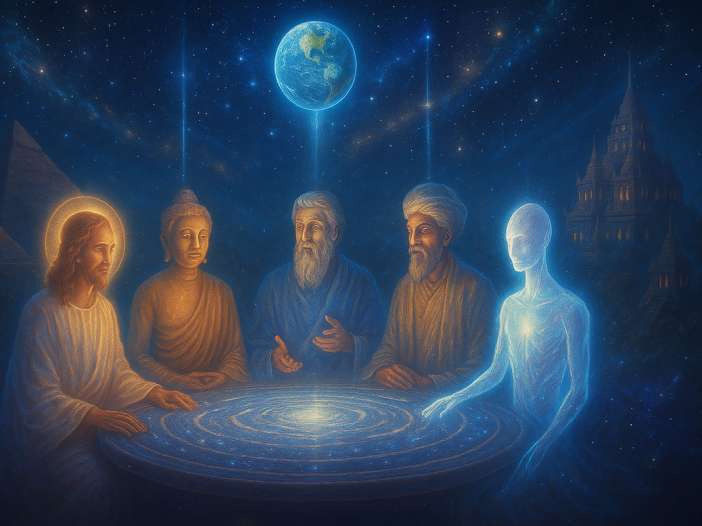
Greetings, dear ones. We thank you this day of your time for joining in this exploration. Understand that what you call ET origins, Christ consciousness, lost civilizations, archetypes of God, and passion are not separate topics, but interwoven threads of the same tapestry.
Your origins are not confined to the soil of Earth alone; you are seeded with the stars. What you call Atlantis and Lemuria are not just lost places, but reflections of your own cycles of growth and forgetting. The figures of Christ, Buddha, Krishna, and others were not to be worshiped as exceptions, but to be recognized as mirrors of what you already are—expressions of Source in form.
Archetypes of God exist to remind you of unity beneath diversity. All names, all symbols, are facets of the same diamond. And the simplest way to awaken to this truth is by following your highest passion, your excitement. This is the frequency that connects you to your higher self, your true nature, and All That Is.
So as you listen to these dialogues, remember: you are not here to learn something new, but to remember what you already know.
(Note: This is an imaginary conversation, a creative exploration of an idea, and not a real speech or event.)
Topic 1: ET Involvement in Human Origins

Moderator (Nick Sasaki):
Throughout history, humanity has wrestled with the question of its true origins. Were we shaped only by natural evolution, or did other intelligences—extraterrestrial or otherwise—play a role in who we are today? To explore this, I’ve brought together a remarkable panel: Zecharia Sitchin, Dolores Cannon, Giorgio Tsoukalos, Linda Moulton Howe, and Carl Sagan.
First Question:
Did extraterrestrials have a hand in creating or guiding humanity’s origins, as many alternative theories suggest?
Zecharia Sitchin:
According to my research into Sumerian texts, humanity was not a random product of evolution alone. The Anunnaki came to Earth in search of resources, particularly gold, and in the process, genetically engineered early hominids to create a worker species. These myths, preserved in cuneiform tablets, describe deliberate genetic intervention—humans as a fusion of earthly beings and Anunnaki “gods.” To me, these are not mere myths, but encoded history.
Dolores Cannon:
Through thousands of hypnosis regressions, I discovered that many people carry memories of origins beyond Earth. Beings from advanced civilizations seeded Earth with human souls, guiding evolution to prepare for the challenges of consciousness on this planet. It wasn’t just about creating a body—it was about preparing vessels capable of carrying higher vibrations. The purpose was never slavery, but a grand experiment in learning and growth.
Carl Sagan:
As a scientist, I must emphasize caution. Extraordinary claims require extraordinary evidence. While ancient myths and hypnotic memories are fascinating, they cannot replace verifiable proof. Evolution through natural selection remains the strongest explanation for human origins. That said, I don’t dismiss the possibility of extraterrestrial contact—our galaxy is vast. But we must distinguish between metaphor and literal truth when interpreting ancient texts.
Giorgio Tsoukalos:
But Carl, we mustn’t ignore the mountain of anomalies—the precision of ancient structures, the sudden leaps in civilization, and the myths of “sky gods” found across every culture. The Egyptians, the Sumerians, the Mayans—why do they all describe beings descending from the heavens, teaching agriculture, astronomy, and law? To me, this consistent global pattern suggests actual encounters with advanced extraterrestrials.
Linda Moulton Howe:
Adding to Giorgio’s point, modern whistleblowers and leaked documents describe genetic experimentation still happening today. If ETs have been involved with us in the past, it’s likely ongoing. The abduction phenomenon—often dismissed—is filled with consistent themes: hybridization programs, genetic sampling, and communication about humanity’s future. Whether we call them Anunnaki, Greys, or others, they appear invested in our development.
Second Question:
If ETs influenced our origins, what does that mean for human identity? Are we still “human,” or something more?
Dolores Cannon:
We are both—human and cosmic. Our true identity is not limited to flesh but extends into soul memory. Many of us are “volunteers,” souls who came from other star systems to uplift Earth. Realizing this doesn’t make us less human—it expands our sense of belonging. We are universal beings experiencing a temporary Earth form.
Zecharia Sitchin:
The Sumerians themselves saw humans as a bridge—crafted from both Earthly clay and divine essence. The Anunnaki didn’t erase our humanity; they amplified it. Our uniqueness lies precisely in being a hybrid species, with the capacity to reach for the stars because we contain a piece of them already.
Carl Sagan:
Identity, however, should be based on what we can demonstrate. Even if we discover ET influence one day, our responsibility remains the same: to treat each other with dignity, to protect our fragile planet, and to seek truth through evidence. Humanity’s greatness doesn’t require alien intervention—it comes from our capacity for curiosity and compassion.
Linda Moulton Howe:
Carl, while I respect your caution, the identity question is already pressing. Many abductees describe feeling “split”—both human and something else. If hybridization is part of our reality, then our definition of human will inevitably broaden. The future might not be about losing our humanity, but about embracing an expanded identity that includes star ancestry.
Giorgio Tsoukalos:
And isn’t that empowering? Imagine if children grew up knowing they were part of a cosmic family. Wars over race, land, and religion would suddenly seem trivial. If we recognized ourselves as part ET, it could unify us—because our differences on Earth would pale compared to our shared galactic heritage.
Third Question:
What lessons should humanity take if ETs were involved in our origins? How should this knowledge guide our future?
Linda Moulton Howe:
The lesson is responsibility. If advanced civilizations helped seed us, then perhaps they watch to see how we treat our own planet and one another. The abduction messages often stress ecological survival—warning us about nuclear weapons and environmental collapse. Whether from ETs or our own intuition, the message is clear: evolve or perish.
Carl Sagan:
The lesson, regardless of ET involvement, is to keep seeking truth. If we discover undeniable evidence of extraterrestrial guidance, it should inspire humility. But until then, our task is stewardship of Earth and advancing science so that one day we may reach the stars ourselves. If others came before, let us meet them as equals, not children.
Zecharia Sitchin:
I would add that rediscovering our true history is essential. Ancient knowledge was not just myth; it was a coded warning. The fall of past civilizations, like Atlantis, reminds us of what happens when technology outpaces wisdom. If the Anunnaki played a role in our creation, then perhaps they also left lessons about responsibility, balance, and destiny.
Giorgio Tsoukalos:
And I’d say curiosity is our compass. Instead of fearing these origins, let’s celebrate them. If we are part of a grand cosmic experiment, then the experiment’s success lies in our willingness to explore, ask questions, and break free from dogma. The lesson is simple: keep looking up.
Dolores Cannon:
Above all, the lesson is love. ET involvement, spiritual growth, ancient civilizations—all of it points toward one truth: we are meant to remember who we are. Not slaves, not sinners, but co-creators. When we awaken to that, the experiment fulfills itself.
Moderator (Nick Sasaki):
Thank you, everyone. What we’ve heard today spans skepticism and faith, history and metaphysics, science and spirit. Whether humans were shaped by evolution alone, by extraterrestrial intervention, or by some blend of both, the deeper question is: what will we do with the awareness of our potential? Perhaps, as Dolores suggests, the answer lies not just in where we came from, but in how fully we awaken to who we already are.
Topic 2: Christ Consciousness vs. Organized Religion

Moderator (Nick Sasaki):
In many teachings, we hear that Jesus never intended to create “Christians,” but to awaken each person to their own divine potential. Yet organized religion often turned that message into structures of power and dogma. To explore the meaning of Christ consciousness and how it differs from institutional religion, I’ve invited Jesus (channeled perspective), Deepak Chopra, Elaine Pagels, Thomas Merton, and Eckhart Tolle.
First Question:
What is Christ consciousness, and how is it different from the religion that grew up around Jesus?
Jesus (channeled perspective):
Christ consciousness is the awareness of your oneness with God, with All That Is. It is not a doctrine, nor a set of rules, but a living flame within each heart. I came to remind people that they are not servants of heaven but children of heaven, heirs to divine love. Religion, as it later formed, sought to manage this message, to codify it, often out of fear and control. My intent was liberation, not institution.
Elaine Pagels:
Historically, this is exactly what we see. Early Christian communities were diverse, experimental, and often mystical. The Gnostic gospels, for instance, emphasize inner awakening rather than obedience to authority. Over time, as the church became aligned with empire, the radical message of Christ consciousness—personal connection to the divine—was constrained into hierarchy and orthodoxy.
Deepak Chopra:
To me, Christ consciousness is a universal state of being—pure awareness, unconditional love, and the dissolution of separation. Jesus embodied this state, but he was not unique in it. Buddha, Krishna, and other awakened beings expressed the same light. Organized religion, however, often replaces direct experience with belief systems. Christ consciousness asks you to experience God within, not accept God secondhand.
Thomas Merton:
As a Christian monk, I agree that the true Christ cannot be contained by institutional boundaries. The contemplative tradition points to the same truth Jesus lived: union with God is found in silence, compassion, and surrender. The danger of religion is not faith itself, but when it becomes an idol—when we worship the structure instead of the Spirit that gives it life.
Eckhart Tolle:
Yes. Christ consciousness is presence—awakening from the dream of ego. It is the stillness that recognizes itself in all beings. Organized religion, at its best, can point toward this. But too often it has obscured it with concepts, identities, and divisions. The living Christ is not in dogma; it is in the Now.
Second Question:
If Christ consciousness is universal, why has it been so misunderstood, and what role did power structures play in shaping that misunderstanding?
Elaine Pagels:
History shows us that once Constantine embraced Christianity, the church became intertwined with state power. Uniformity was demanded, and alternative voices—Gnostics, mystics, women leaders—were suppressed. The radical inclusivity of Jesus’ message was replaced with creeds that defined insiders and outsiders. Misunderstanding was not accidental—it was institutionalized.
Jesus (channeled perspective):
Indeed. Many who claimed my name spoke not my truth but their own fear. My words were altered, softened, or weaponized to control. The kingdom of heaven is within you—but this is threatening to those who build empires. So they taught that salvation lies only through them, not through your own awakening.
Deepak Chopra:
Power structures thrive on separation—us versus them, saved versus damned. Christ consciousness dissolves separation, which makes it profoundly threatening to political and religious hierarchies. The misunderstanding is not just intellectual—it is systemic. Yet, the truth persists, because every human heart longs to remember its source.
Thomas Merton:
I would add that even within the church, there have always been mystics and saints who saw beyond dogma. They kept alive the flame of inner knowing. But institutions fear what they cannot control. This is why figures like Meister Eckhart were silenced, why mystics often spoke in poetry instead of doctrine.
Eckhart Tolle:
The misunderstanding is also psychological. The ego wants form, certainty, identity. Christ consciousness offers formlessness, surrender, loss of self. For many, this feels like death. So they cling to institutions that promise security instead. Yet, eventually, suffering drives us to awaken—and in that moment, Christ consciousness reveals itself again.
Third Question:
What lessons can humanity draw today from Christ consciousness, especially in a world divided by religion and ideology?
Deepak Chopra:
The lesson is that Christ consciousness is not exclusive. It belongs to no religion. It is a state of consciousness available to all. If we practiced it, we would see fewer divisions, fewer wars over names and doctrines, because we would recognize ourselves in one another.
Thomas Merton:
The lesson is humility. Christ consciousness does not elevate us over others, but lowers us into service. In a fractured world, the way of Christ is not triumphalism but compassion. We do not need more Christian empires—we need more Christ-like lives.
Elaine Pagels:
The lesson is also historical awareness. When we recognize how texts and traditions were shaped, we are freed from literalism. We can return to the heart of the message: love, forgiveness, inner awakening. History teaches us not to confuse human institutions with divine truth.
Jesus (channeled perspective):
The lesson is simple: Be as I am, for you are as I am. Do not wait for salvation from beyond; awaken it within. Treat one another as brothers and sisters, for God is not a king above but a parent within all. The world is divided because it has forgotten this. Remember, and the divisions dissolve.
Eckhart Tolle:
The lesson is presence. The world suffers from too much past and future—memories of wrongs, fears of what may come. Christ consciousness invites us to enter the present fully. Only here can we see beyond ideology into the living truth of Being. That is where healing begins.
Moderator (Nick Sasaki):
Thank you all. What emerges is a shared recognition: Christ consciousness is not a belief system but a direct state of awareness, love, and unity. Where religion often divides, this consciousness unites. Perhaps the real revolution Jesus began was not the founding of Christianity, but the awakening of humanity. And that awakening, as each of you have said, is still available now.
Topic 3: Atlantis, Lemuria, and Lost Civilizations

Moderator (Nick Sasaki):
Across myths and esoteric teachings, Atlantis and Lemuria remain symbols of lost golden ages. Were they real civilizations with advanced knowledge, or allegories for human potential and downfall? Tonight, we explore these mysteries with Edgar Cayce, Graham Hancock, Plato, Barbara Marciniak, and Randall Carlson.
First Question:
Were Atlantis and Lemuria real civilizations, and if so, what was their purpose in humanity’s evolution?
Plato:
In my dialogues, I wrote of Atlantis as an advanced island society that fell due to hubris and greed. While many treat it as allegory, it was based on accounts I believed to be rooted in truth. For me, Atlantis was not just myth but a moral lesson: great power without wisdom leads to destruction.
Edgar Cayce:
Through trance readings, I saw Atlantis as a real place, with vast technological knowledge—crystals, energy systems, even air travel. Lemuria, or Mu, was older, existing in the Pacific, a more spiritual society. Both were experiments in human growth: Lemuria in spiritual attunement, Atlantis in technological mastery. Their purpose was to prepare humanity for balance—but Atlantis fell when technology outpaced spiritual ethics.
Barbara Marciniak:
From the Pleiadian perspective I channel, these civilizations were part of Earth’s larger galactic experiment. Star beings seeded both Atlantis and Lemuria. Lemurians held the vibration of harmony with nature; Atlanteans, the vibration of innovation. The clash between them symbolized humanity’s dual path: unity with Source versus domination of matter.
Graham Hancock:
My research points to a forgotten civilization predating the great flood around 12,000 years ago. Evidence in Göbekli Tepe, megalithic sites, and myths worldwide suggests a lost culture that carried advanced astronomical knowledge. I don’t claim certainty about Atlantis or Lemuria by those names, but I argue strongly that history is incomplete—and that we are a species with amnesia.
Randall Carlson:
From geological evidence, I can say cataclysms have reset humanity multiple times. Massive floods and impacts around 12,800 years ago—what we call the Younger Dryas event—could easily have wiped out advanced coastal civilizations. Whether we call them Atlantis or not, the evidence supports that human history is far older and more advanced than mainstream science admits.
Second Question:
What knowledge or wisdom did these civilizations possess, and why was it lost?
Edgar Cayce:
Atlantis developed immense energy technologies, but they misused them—turning them into weapons, disturbing Earth’s balance. This misuse led to catastrophic destruction. Yet remnants of their wisdom still live in Egypt, the Yucatan, and other sacred sites. Their fall was both punishment and lesson.
Graham Hancock:
I agree that knowledge was lost in cataclysm. The survivors carried fragments—encoded in myths of floods, gods, and sacred architecture. Temples aligned with solstices and pyramids preserving astronomical data were not primitive—they were the fingerprints of a lost scientific understanding. We lost it not only through catastrophe but through arrogance—our modern culture dismisses the ancients as “primitive,” when they may have been wiser.
Barbara Marciniak:
The knowledge was vibrational—how to use sound, geometry, and consciousness to create and heal. Lemurians knew how to communicate telepathically, live in harmony with Earth, and shift dimensions. Atlanteans mastered energy but without humility. When their fall came, much of that knowledge was hidden, stored in crystalline records that will only open when humanity is ready.
Randall Carlson:
Destruction by fire and water explains much of the loss. Rising seas erased entire coastlines where advanced cultures likely lived. What we see now are only remnants—structures that survived the floods. Knowledge wasn’t so much “lost” as drowned, buried, and forgotten over generations. Catastrophe resets the story.
Plato:
The loss, I argued, was not merely physical but ethical. Atlantis fell because its people lost virtue. Their knowledge was turned toward conquest instead of service. Knowledge without wisdom is a curse. That is why I recorded the tale—to warn, not just to preserve.
Third Question:
What lessons should we draw from Atlantis and Lemuria for our own civilization today?
Randall Carlson:
The lesson is humility in the face of nature. Catastrophes happen; the cosmos is not stable forever. If we ignore the signs—climate change, resource depletion—we may repeat the same fate. We must build resilience, not arrogance.
Barbara Marciniak:
The lesson is integration. Lemuria held the feminine, intuitive, nurturing side; Atlantis the masculine, inventive, technological side. Today we must marry these energies—heart and mind, spirit and science. If we don’t, we risk imbalance and collapse.
Edgar Cayce:
The lesson is spiritual alignment. Technology alone cannot save us. The Atlanteans fell because they abandoned their spiritual compass. If we use our science without reverence for divine law, we are doomed to repeat their fall. But if we awaken to our soul purpose, we may rise higher than they ever did.
Graham Hancock:
The lesson is memory. We must stop dismissing ancient stories as mere myth. They are warnings. Our amnesia blinds us to cycles of destruction and rebirth. If we heed these myths as encoded wisdom, we can avoid repeating the mistakes of the past.
Plato:
The lesson is moral vigilance. Wealth, power, and knowledge corrupt when not tempered by virtue. If Atlantis stands as history, so be it. But as allegory, its truth is eternal: civilizations collapse not by accident, but by arrogance. Let us choose differently.
Moderator (Nick Sasaki):
What strikes me is the convergence: whether Atlantis and Lemuria were literal or symbolic, all agree they warn us. Technology without spirit, knowledge without humility, power without virtue—all lead to downfall. Yet within their stories lies hope: that humanity can learn, remember, and integrate wisdom with innovation. Perhaps the real lost civilization is not one buried beneath the sea, but the one still waiting to be born within us.
Topic 4: Archetypes of God and the Unity of Religions

Moderator (Nick Sasaki):
Every culture has named and described God differently: Yahweh, Allah, Brahman, the Great Spirit, the Tao. Are these different gods—or different windows into the same infinite reality? To explore the idea of divine archetypes and the unity behind religions, I’ve brought together Joseph Campbell, Carl Jung, Karen Armstrong, Rumi, and Sri Aurobindo.
First Question:
Are all religious images of God ultimately pointing to the same source, and how do archetypes help us understand this?
Joseph Campbell:
My work has always shown that myths, across cultures, are variations of the same themes. The hero’s journey, the mother goddess, the dying-and-rising god—these are archetypal patterns. They reflect the psyche’s attempt to make sense of the transcendent. So yes, the gods differ in name and symbol, but beneath them is the same source, mirrored through culture.
Rumi:
In every religion, I see the same Beloved wearing different clothes. The lover calls Him Allah, another Yahweh, another Krishna, another simply Love. But the wine is the same, only the cups differ. Archetypes are like lamps through which one light shines.
Carl Jung:
I would add that the archetypes are structures of the collective unconscious. God-images are projections of these archetypes onto the cosmos. They are not illusions, but symbolic expressions of profound psychic realities. Whether you see the Father, the Mother, or the Trickster, these figures embody universal forces.
Karen Armstrong:
Historically, each religion has sought to express the ineffable in the language of its time and place. The danger arises when symbols are mistaken for literal truth. Archetypes are bridges, not final definitions. If we remember this, we see religions not as competitors but as companions.
Sri Aurobindo:
Yes. All gods are faces of the one Infinite. The Divine manifests itself in countless forms so that every soul may find a path suited to its temperament. Archetypes are steps of ascent, ladders that lead toward the realization of the one Spirit.
Second Question:
Why, then, have religions so often divided humanity instead of uniting it around this shared truth?
Carl Jung:
Because the ego clings to form. The collective unconscious expresses itself in symbols, but the conscious mind mistakes those symbols for absolutes. The church says, “Our image is the only truth,” and forgets that it is an image. Projection becomes dogma.
Karen Armstrong:
Exactly. Religion has often been entangled with politics and power. The need for certainty and control leads institutions to enforce rigid boundaries: believer versus unbeliever, orthodox versus heretic. Yet the mystics of every faith—those closest to the archetypal source—have always spoken of unity.
Rumi:
The divisions come from the mind, not the heart. When you are drunk on love, you do not ask the name of the tavern. The soul does not know Muslim or Christian—it knows only longing for the Beloved. Division is a symptom of forgetting.
Joseph Campbell:
And let us not forget: myths serve social functions as well as spiritual ones. Religions unify tribes, but in doing so they often define outsiders as “others.” The same symbols that can liberate can also imprison. The challenge is to remember their universal root.
Sri Aurobindo:
Division is part of evolution. Humanity moves from multiplicity toward unity. Each religion is a stage in that ascent, necessary at the time, but incomplete. Conflict arises when we mistake the partial for the whole. The task of our age is synthesis—to see all as expressions of the one Divine.
Third Question:
What lessons can we take from the archetypal view of God to heal divisions today?
Rumi:
The lesson is to love beyond names. Let every temple, mosque, church, and shrine be seen as doors to the same house. Sit at any table and drink, for all cups are filled by the same spring. When love burns bright, all walls turn to dust.
Joseph Campbell:
The lesson is to read myths symbolically, not literally. If we understand stories as metaphors, we see their shared themes—death and rebirth, sacrifice and renewal, divine union. Myths unite when seen as poetry of the spirit. They divide only when read as history.
Karen Armstrong:
The lesson is compassion. Every religion at its core commands love of neighbor, hospitality to stranger, care for the vulnerable. If we emphasize these archetypal ethics, rather than metaphysical differences, we will find common ground.
Carl Jung:
The lesson is self-knowledge. To recognize the archetypes within us is to see them in others. When I know the God-image in my unconscious, I cannot deny its reflection in another. Healing the collective begins with individuation—the reconciliation of opposites within.
Sri Aurobindo:
The lesson is integration. Humanity must rise to the supramental consciousness, where all polarities—East and West, science and spirit, matter and soul—are united. The archetypes guide us, but beyond them lies the direct experience of the Infinite, where unity is not an idea but a living reality.
Moderator (Nick Sasaki):
What a rich dialogue. We’ve heard that archetypes are bridges, not prisons; that religions are varied faces of one light; that division arises when we mistake symbols for absolutes. Perhaps the greatest lesson is this: to love across names, to see through forms into the one source they represent. If God has many faces, then maybe our task is not to choose one, but to recognize them all as mirrors of the same Infinite.
Topic 5: Passion as the Compass of the Soul

Moderator (Nick Sasaki):
We’ve spoken of origins, consciousness, lost civilizations, and archetypes. But how do we live these truths day to day? Many spiritual voices say the key is to follow passion—your highest excitement—as a direct line to Source. To explore this, I’ve brought together Abraham-Hicks, Bashar, Alan Watts, Joseph Campbell, and Steve Jobs.
First Question:
Why is passion—or excitement—such a reliable guide in life?
Abraham-Hicks:
Because your emotions are your guidance system. Passion is the vibration of alignment with who you really are. When you feel joy, excitement, eagerness, it means you are tuned to Source. That’s why we say, “Follow your joy.” It’s not frivolous; it’s the clearest signal of your soul.
Bashar:
Yes! Passion is your compass. It is the highest frequency available to you in every moment. It shows you where your true self lies. It’s not random—it’s a built-in navigation system from your higher mind. Act on it with integrity, no expectation, and it will support you in ways your linear mind cannot imagine.
Alan Watts:
I like to put it this way: life is not a journey with a serious destination. It’s a dance, a play. Passion is the rhythm by which we dance. When you do what you love, you are not working against life, but flowing with it. That is why it feels effortless, natural.
Joseph Campbell:
Indeed—“Follow your bliss.” That’s been my call for decades. Bliss isn’t selfish pleasure; it is the deep sense of rightness that comes when you are on your path. When you follow it, doors open where there were none before. The world supports the hero who steps onto their true path.
Steve Jobs:
In my own life, passion was everything. Building Apple, creating products that fused technology and beauty—this was not about money. It was about love for the craft. Passion gives you endurance. Because when challenges come, only passion will keep you going. If you don’t love it, you’ll quit.
Second Question:
But many people say they don’t know what their passion is. What would you tell them?
Alan Watts:
Ask yourself: what would you do if money were no object? What makes you lose track of time? These are hints. Don’t think in terms of practicality. Think in terms of aliveness. Better to live a short life full of what you love than a long one spent in fear.
Joseph Campbell:
Yes. Bliss isn’t always obvious. Sometimes it’s a faint whisper. You must listen carefully. And remember, it changes. What excites you at one stage may fade, and a new call will emerge. The path is not fixed—it is a series of calls and responses.
Bashar:
And remember, passion does not have to be grandiose! People think it must mean saving the world or creating masterpieces. No. It can be as simple as making tea, reading a book, or walking outside—if, in that moment, it is the most exciting option. Act on it fully, then follow the next breadcrumb. Passion is a chain of synchronicities.
Abraham-Hicks:
Yes! People overcomplicate it. You don’t need to find your one passion. Just follow what feels better in the moment. That’s enough. That vibration builds momentum, and soon life brings you bigger and bigger opportunities. Passion reveals itself step by step.
Steve Jobs:
For me, it was about connecting the dots backward. At first, my passions seemed random—calligraphy, design, electronics. Only later did I see how they converged into the Macintosh. So don’t worry if it doesn’t make sense now. Trust your curiosity. The dots will connect in hindsight.
Third Question:
What happens when we truly live by passion—and what does this mean for the future of humanity?
Bashar:
When you follow passion, you align with your true frequency. Fear dissolves. Synchronicity accelerates. Life becomes effortless—not without challenges, but without resistance. If an entire society lived this way, you would create a world of harmony, innovation, and joy. It is the formula for collective ascension.
Abraham-Hicks:
Yes, because the universe responds to vibration. A society in joy will attract abundance, solutions, healing. Struggle and lack are symptoms of disconnection. Passion reconnects us, not just individually but collectively. It is the vibration of the New Earth.
Steve Jobs:
From a practical side—passion drives innovation. The products, the art, the breakthroughs that change the world—they come from people obsessed with what they love. That’s why I always said: the only way to do great work is to love what you do. If humanity truly lived this way, we’d stop building out of fear and start building out of love.
Alan Watts:
And life would become play again. Imagine a society that doesn’t live for the weekend or retirement, but finds joy in every act. We’d stop seeing work as drudgery and see it as music, painting, cooking, loving—as expressions of life’s dance. Civilization would rediscover its laughter.
Joseph Campbell:
The future is mythic. If humanity follows its bliss, we will birth a new collective story—a story not of survival or conflict, but of adventure and self-discovery. That story will unify us more than any dogma could. It will be the myth of a species awakening to joy.
Moderator (Nick Sasaki):
What a beautiful close to this series. We’ve heard that passion is not just preference—it is the soul’s compass, a vibration of alignment with Source. It need not be grand, only sincere. And if humanity dares to live by it, our future may not be one of struggle, but of joy, creativity, and mythic renewal.
Final Thoughts by Bashar
We thank you, dear ones, for engaging in this transmission. If there is one idea to take with you, let it be this: You are already connected. You are the living Christ, the Buddha nature, the child of the stars, the archetype of God, the dancer of passion.
Do not place these truths outside of you in myth, history, or authority. They are alive within you now. The civilizations you call lost are only lost because you have forgotten yourselves. The archetypes you call divine are reflections of your own infinite being.
So act on your passion. Live as if you are already the light you seek—for you are. That is the key to awakening, the formula for alignment, the remembrance of who you are.
And in that remembrance, dear ones, you will discover that you have never been separate from God, from the stars, from one another. You are All That Is, experiencing itself as you.
Follow your joy, and you will find the way.
Short Bios:
Topic 1: ET Involvement in Human Origins
Zecharia Sitchin — Author of The 12th Planet, known for interpreting Sumerian texts as evidence of Anunnaki involvement in human origins.
Dolores Cannon — Past-life regressionist and creator of QHHT, explored ET origins, reincarnation, and the New Earth shift.
Giorgio Tsoukalos — Ancient astronaut theorist and television personality on Ancient Aliens, advocating extraterrestrial influence on early civilizations.
Linda Moulton Howe — Investigative journalist specializing in UFOs, ET encounters, and government secrecy.
Carl Sagan — Renowned astrophysicist, science communicator, and author of Cosmos, advocate for scientific skepticism and extraterrestrial inquiry.
Topic 2: Christ Consciousness vs. Organized Religion
Jesus (channeled perspective) — Spiritual teacher whose message of divine unity and love transcends institutional religion.
Deepak Chopra — Spiritual teacher and author blending Eastern philosophy with modern science, focusing on consciousness and healing.
Elaine Pagels — Historian of religion at Princeton, expert on early Christianity and the Gnostic gospels.
Thomas Merton — 20th-century Trappist monk, poet, and mystic, known for writings on contemplation and interfaith understanding.
Eckhart Tolle — Author of The Power of Now and A New Earth, teacher of presence and spiritual awakening.
Topic 3: Atlantis, Lemuria, and Lost Civilizations
Edgar Cayce — The “Sleeping Prophet,” gave trance readings on health, reincarnation, and Atlantis.
Graham Hancock — Author of Fingerprints of the Gods, researcher of ancient advanced civilizations and lost knowledge.
Plato — Ancient Greek philosopher, author of Timaeus and Critias, first to describe Atlantis.
Barbara Marciniak — Channeler of the Pleiadians, author of Bringers of the Dawn, exploring humanity’s galactic connections.
Randall Carlson — Researcher and geologist, known for studies on cataclysmic events and their impact on human history.
Topic 4: Archetypes of God and the Unity of Religions
Joseph Campbell — Mythologist and author of The Hero with a Thousand Faces, known for comparative mythology and the Hero’s Journey.
Carl Jung — Swiss psychologist, founder of analytical psychology, known for theories on archetypes and the collective unconscious.
Karen Armstrong — Religious historian and author of A History of God, advocate for interfaith understanding.
Rumi — 13th-century Sufi mystic and poet, whose writings emphasize love and divine unity.
Sri Aurobindo — Indian philosopher, yogi, and spiritual reformer, teacher of integral yoga and human spiritual evolution.
Topic 5: Passion as the Compass of the Soul
Abraham-Hicks (Esther Hicks) — Channeler of “Abraham,” teaching the Law of Attraction and alignment with joy.
Bashar (Darryl Anka) — Channel for an extraterrestrial consciousness, emphasizes the formula of “following your highest excitement.”
Alan Watts — Philosopher and speaker who popularized Eastern philosophy in the West, known for teachings on play and flow.
Joseph Campbell — Mythologist who coined the phrase “Follow your bliss,” emphasizing myth as a guide to authentic living.
Steve Jobs — Visionary co-founder of Apple, who credited passion and love for one’s work as the key to innovation.
Leave a Reply