
|
Getting your Trinity Audio player ready...
|
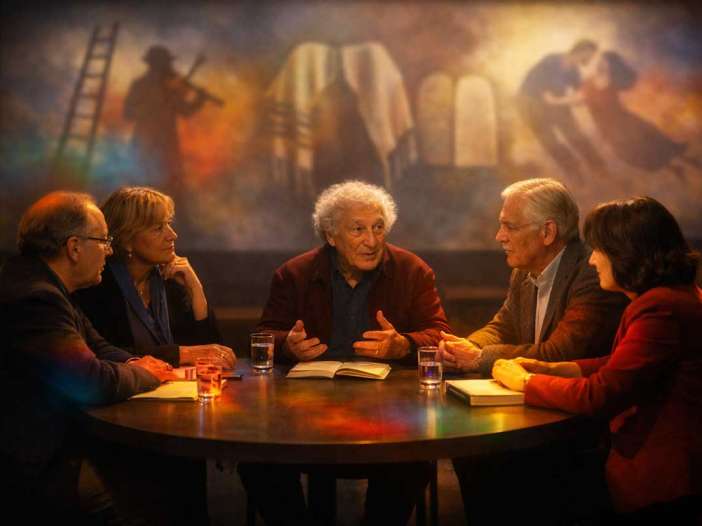
What if Marc Chagall explained his spiritual paintings with four top scholars, one theme at a time—no jargon, just meaning?
Introduction by Marc Chagall
I have been called many things—dreamer, Jewish painter, storyteller, mystic. But if I must introduce these works with one honest sentence, it is this: I painted because the world refused to stay only on the surface.
In my childhood, a village was not merely houses and roads. It was prayer rising from a table, music climbing from a violin, love passing through a doorway like light. The visible world had a second life inside it—memory, longing, blessing, fear, tenderness—and I could not betray that second life by pretending it did not exist. So I learned to paint the way the soul remembers: not in straight lines, but in symbols; not by the clock, but by the heart.
This series gathers ten works that many people feel as “spiritual.” Some are quiet: a man praying, a village held in a gaze, a violinist keeping life from breaking apart. Some are terrible: a world burning, an angel falling, suffering that demands you look without turning away. Some are biblical: a ladder between worlds, a covenant heavy enough to shape a people, love that is not ashamed of being sacred. And at the end, there is stained glass—light itself painting the room—because light is the oldest prayer.
If you walk with me through these images, do not ask first what they “mean.” Ask what they awaken. A painting is not a verdict. It is an invitation. It asks you to remember the hidden life in things, and to notice where your own heart still believes the world can be more than it appears.
(Note: This is an imaginary conversation, a creative exploration of an idea, and not a real speech or event.)
Topic 1 — Soul’s Homeland: Prayer, Memory, Music
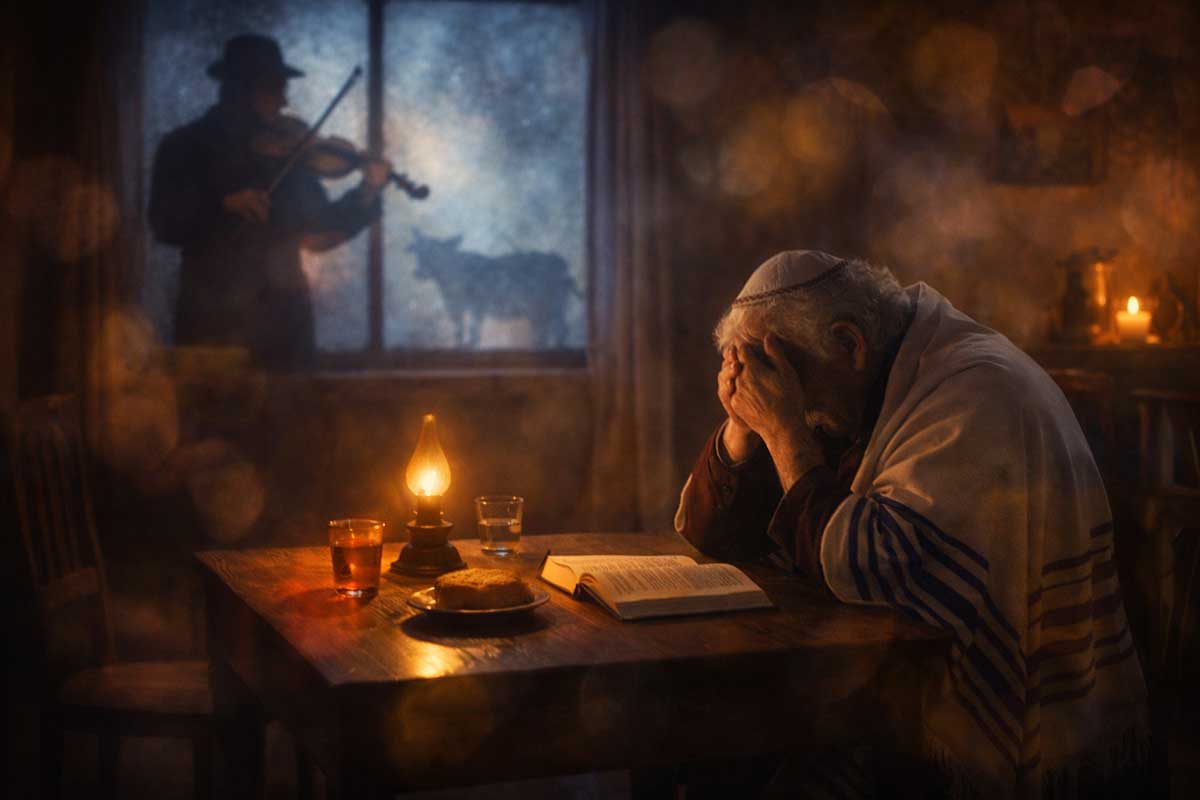
Marc Chagall and Benjamin Harshav sat in a quiet room that felt like a threshold between studio and sanctuary. On the table lay three reproductions: The Praying Jew, I and the Village, and The Green Violinist. Chagall didn’t look at them like “works.” He looked the way a man looks at old letters—half tenderness, half ache.
Harshav: Marc, people keep calling your paintings “spiritual.” Sometimes they mean “dreamlike,” sometimes they mean “religious.” When you hear that word, what do you feel they’re actually sensing?
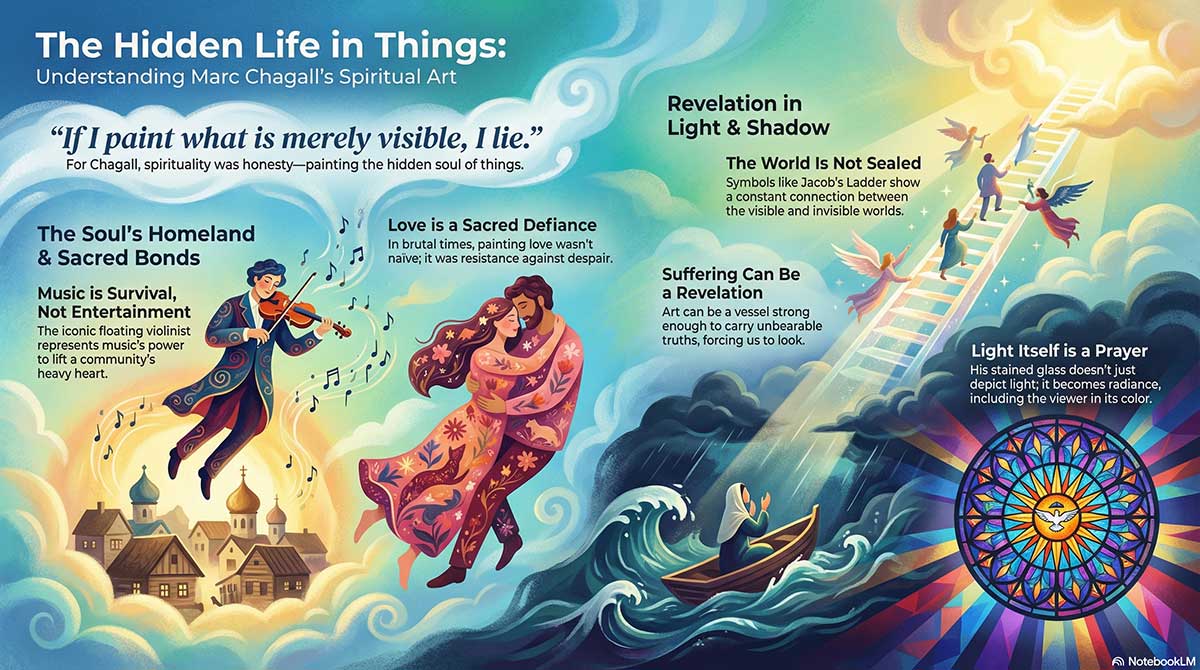
Chagall: They sense that the world is not only what it seems. In my village, a table was not only a table. A candle was not only wax and flame. A song was not only sound. There is a second life inside things—their soul. If I paint what is merely visible, I lie. So yes, spiritual… maybe it means I paint the hidden part that insists on existing.
Harshav: So spirituality is not an effect. It’s honesty.
Chagall: It is fidelity. To what I carried. To what carried me.
Harshav: Let’s begin with The Praying Jew. The figure is heavy, solemn, almost monumental. What did you want prayer to be in this painting—comfort, resistance, conversation?
Chagall: Prayer is not decoration. It is breath. It is also weight. When a man prays, he carries his own life and the lives of others. He carries his father’s voice. He carries the fear of tomorrow. He carries the lost ones. And yet, he stands. In the village, prayer was the rope that tied us to heaven when earth was uncertain.
Harshav: Many viewers feel sorrow in this work, but also a strange steadiness. Is that deliberate?
Chagall: Sorrow is real, but the point is not sorrow. The point is endurance without becoming stone. The man does not pray because he is naïve. He prays because he refuses to be erased. That is spiritual. It is stubborn.
Harshav: There’s something else: the intimacy. It doesn’t feel like a public ritual. It feels private—almost like you’re overhearing someone’s inner life.
Chagall: That is correct. Prayer is not a performance. People perform in the marketplace. Prayer is the place where a person becomes small in the right way—small enough to listen. In the village, we had little. But in prayer, we had a world.
Harshav: If I push this further: is prayer, for you, a way of seeing? A lens that changes how the everyday appears?
Chagall: Yes. Prayer is not only words. It is a way of looking at bread, at a child, at a cow, at a lamp, and feeling: “This is not nothing.” It is a way of granting dignity to the ordinary. A spiritual life is not only in heaven. It is in how you regard the humble.
Harshav: That brings us naturally to I and the Village. Here, the world becomes symbolic—faces, animals, floating fragments, a village that seems both real and impossible. When you paint like this, are you recording memory, or creating a new cosmos?
Chagall: Memory creates its own cosmos. People think memory is a photograph. It is not. Memory is a living creature. It rearranges. It sings. It pulls together what is essential and lets go of what is dead. When I painted I and the Village, I was not reporting. I was returning.
Harshav: Returning to Vitebsk—not the place on a map, but the place in the soul.
Chagall: Exactly. The village is inside me the way blood is inside me. The faces—man and animal—look at each other like equals. In a village, you live with animals. You depend on them. You speak to them without words. There is innocence in that, but also a deep knowledge: we share life.
Harshav: Many people read the shared gaze between the human and the animal as mystical—almost like a covenant. Was that your intention?
Chagall: Covenant is a good word. But not only covenant with God—covenant with existence. With the fact that you are alive among other living things. When I paint the animal’s face close to the man’s, I say: “We are not alone. We are not separate.” The modern city teaches separation. The village teaches relation. Spirituality is relation.
Harshav: In your work, time also feels non-linear—past and present, waking and dreaming, all layered. Is that how the spiritual dimension enters?
Chagall: Yes. The spiritual is not a straight road. It is a circle, a spiral. A mother’s face can appear beside a wedding that happened later. A memory of a synagogue can float near a street you have not walked in years. That is true to how the soul lives. The soul does not obey the clock.
Harshav: Then we arrive at The Green Violinist. This one is beloved—almost iconic. A musician standing above rooftops, unnatural color, that sense of hovering. What is the violinist spiritually? A prophet? A guardian? A part of you?
Chagall: He is the sound that keeps the village from falling apart. In our world, music was not entertainment. It was survival. A wedding without music is like a body without pulse. A funeral without melody is unbearable. The violinist stands above because music stands above. It lifts what is heavy.
Harshav: In Jewish tradition, there’s this sense that song can be prayer. That melody can carry what language can’t.
Chagall: Yes. Sometimes words are too small. Sometimes words betray you. But melody—melody can hold grief and joy at the same time. It can hold longing without explaining it. That is spiritual.
Harshav: Why green? It’s such a daring choice. Green makes him feel uncanny, almost otherworldly.
Chagall: Green is life, but also strange life. It is not the color of flesh. It is the color of something that has crossed from ordinary into symbolic. I did not want him to be merely a village musician. I wanted him to be a sign. When you see him, you should feel: “A different law is operating here.” Not the law of gravity. The law of the heart.
Harshav: Across these three works, I hear a pattern: prayer as tether, memory as homeland, music as lift. Let me ask the question that ties it together. If someone stands before these paintings today—far from your village, far from your religion—what do you want them to receive spiritually?
Chagall: I want them to remember their own soul has a village. Maybe not a real village. But a place inside where the essential things live—love, fear, tenderness, the face of someone they lost, the smell of bread, the sound of a song that saved them. I want them to feel that their inner world is not childish. It is sacred.
Harshav: And if they feel sadness in your work?
Chagall: Let them. But let them also feel the refusal to despair. My paintings do not say, “Everything is fine.” They say, “Even if it is not fine, the soul can still sing.” That is spirituality.
Harshav: One last question, Marc. If we strip away labels—Jewish, Christian, mystical, modernist—what single word would you choose for the spiritual force in these paintings?
Chagall paused, eyes returning to the reproductions as if listening for a note only he could hear.
Chagall: Love. Not sweet love. The kind that carries you when the world becomes cruel. The kind that remembers. The kind that prays. The kind that plays the violin above the roofs so the people below do not forget they are still alive.
Topic 2: When Suffering Becomes Revelation
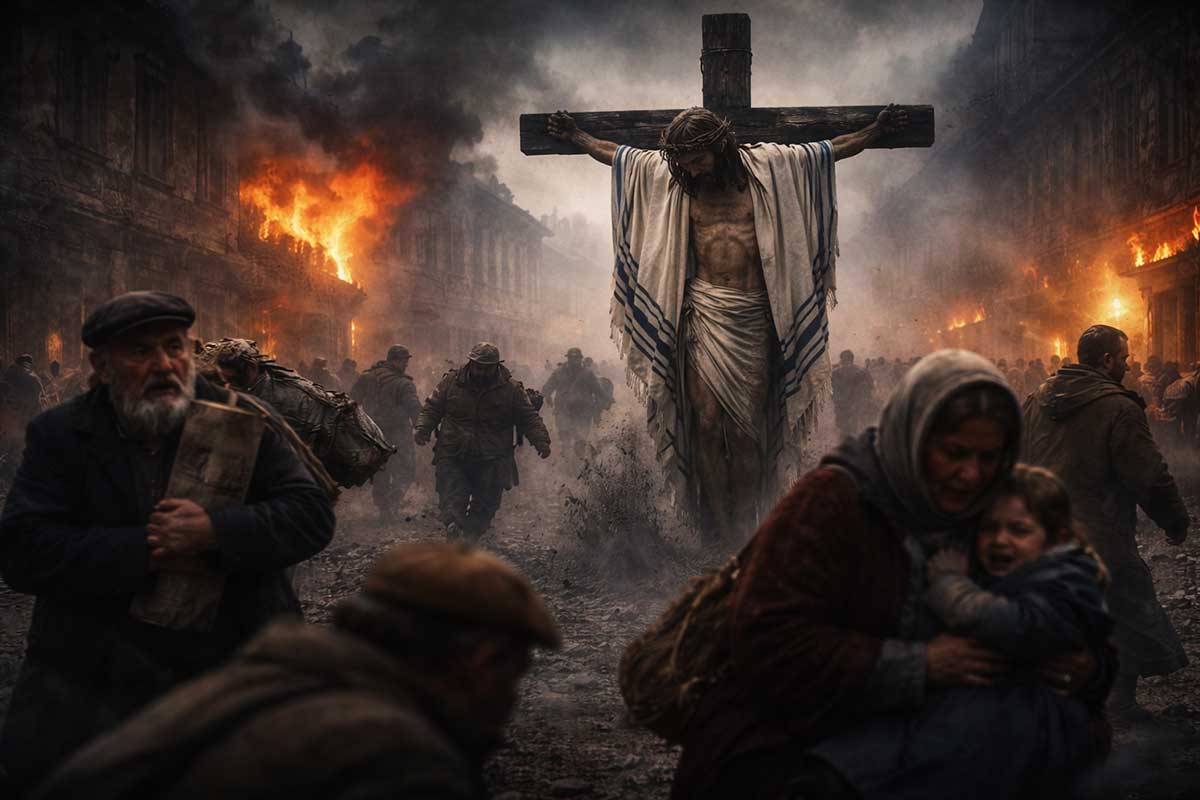
Susan Tumarkin Goodman: Marc, when people stand in front of White Crucifixion, they often go quiet in a way that feels different from ordinary “museum quiet.” It’s not just admiration. It’s confrontation. When you painted this, what were you trying to make unavoidable?
Marc Chagall: The truth that pain is not an idea. It has a face. It has smoke. It has the sound of boots. In those years, the world pretended it did not see what it was doing. I wanted the painting to refuse that comfort. Not to accuse one person—no—but to show what happens when humanity forgets the human.
Susan Tumarkin Goodman: Many viewers are startled by your choice: you place a crucified Jesus at the center, but the surrounding imagery speaks so strongly to Jewish suffering—displacement, violence, burning homes. People argue over what it “means.” Was it a bridge? A provocation? A cry?
Marc Chagall: It was a cry. But also a bridge, yes—because suffering has no passport. I did not paint Jesus as a theological weapon. I painted him as a Jewish son. In my mind, he belonged to my people, to our history, to our grief. If the world could recognize holiness in that image, perhaps it could recognize holiness in the living Jews being hunted, beaten, driven out.
Susan Tumarkin Goodman: So the crucifixion becomes a kind of universal icon—not to erase Jewish specificity, but to force recognition.
Marc Chagall: Exactly. A symbol can be a door. If people have a key for one door, you can lead them into a room where they might otherwise never enter. My room was burning. I needed the world to enter.
Susan Tumarkin Goodman: When I curate work like this, I’m always aware of the danger: viewers can flatten it into “tragedy aesthetics.” But your painting resists that. It’s beautiful, yes, but it’s also… morally uneasy. How did you balance beauty and horror?
Marc Chagall: Beauty is not decoration. Beauty is a vessel strong enough to carry unbearable things. If the painting were only ugly, people would turn away. If it were only pretty, it would lie. I needed the viewer to stay—long enough for the truth to enter. That is why the light matters, the composition, the symbols. They are not ornaments; they are hooks.
Susan Tumarkin Goodman: One thing people remember is the sense of motion—flight, fleeing, chaos—around a still center. The world is falling apart, but the central figure is strangely calm. Is that calm faith? Or is it resignation?
Marc Chagall: It is witness. There is a calm that comes when something is so terrible you stop bargaining. You stop asking, “Why me?” You become the eye of the storm. Not because you are strong—but because you are beyond negotiation with reality. The painting is not saying, “This is good.” It is saying, “This is happening.” That clarity is spiritual.
Susan Tumarkin Goodman: That word—spiritual—can get slippery. In White Crucifixion, the spirituality isn’t comforting. It’s closer to a revelation that shakes you. Would you agree that you were painting revelation through catastrophe?
Marc Chagall: Yes. In catastrophe, the mask falls. People reveal themselves—cruelty, cowardice, courage, love. The spiritual is not always gentle. Sometimes it is the moment you realize: “I cannot pretend anymore.” That is revelation.
Susan Tumarkin Goodman: Let’s shift to The Falling Angel. It’s a different painting in energy—more surreal, more apocalyptic. Yet it feels connected. An angel falls. The world below seems disoriented, as if the laws of heaven are breaking. What is the angel to you?
Marc Chagall: The angel is the shock that the sacred can be wounded. People think heaven is untouched. But when humans destroy the human, they also injure the idea of heaven inside us. The falling angel is that injury made visible.
Susan Tumarkin Goodman: That’s powerful. So it’s not just “an angel fell,” but “our relationship to the sacred has fallen.”
Marc Chagall: Yes. When the world becomes cruel, you begin to doubt the music of the world. You ask if the universe still has meaning. The angel falling is the meaning falling. But notice—falling is not the same as dead. A fall can still be survived.
Susan Tumarkin Goodman: I want to press on that. In your work, even in the darkest scenes, there’s often a thread of tenderness—an embrace, a small light, a memory. In The Falling Angel, where is the tenderness?
Marc Chagall: It is in the fact that I painted it at all. If I believed there was nothing, I would be silent. Painting is my refusal to accept meaninglessness. Even when the angel falls, I say: “Look.” Attention is love. Witness is love. Not sentimental love—love as responsibility.
Susan Tumarkin Goodman: As a curator, I also think about how audiences today receive these images. Some people bring politics, some bring trauma, some bring religion, some bring none of it. If you could guide a modern viewer toward the “right” way to stand before these two works, what would you tell them?
Marc Chagall: I would tell them: do not hurry. Do not treat pain as a spectacle. And do not demand a single explanation. Let the painting work like a prayer works—slowly, inwardly, with resistance. Ask yourself: where do I avert my eyes in life? And where do I need to look longer?
Susan Tumarkin Goodman: That’s almost a spiritual practice in itself—staying with what’s difficult without turning it into performance.
Marc Chagall: Yes. The paintings are not asking for your applause. They are asking for your conscience.
Susan Tumarkin Goodman: Last question, Marc. If Topic 1 was about “the soul’s homeland”—prayer, memory, music—Topic 2 feels like “the soul under siege.” What do you believe survives siege?
Marc Chagall: What survives is the small inner candle that says: “I am still human.” A person can lose home, language, safety. But if they keep that candle, they can still recognize another person as sacred. That recognition is the beginning of mercy. And mercy is the only future worth painting.
Susan Tumarkin Goodman: So in both White Crucifixion and The Falling Angel, the revelation isn’t only that suffering exists—it’s that the human response to suffering reveals what we really are.
Marc Chagall: Yes. And it asks what we choose to become next.
Topic 3: The Ladder Between Worlds
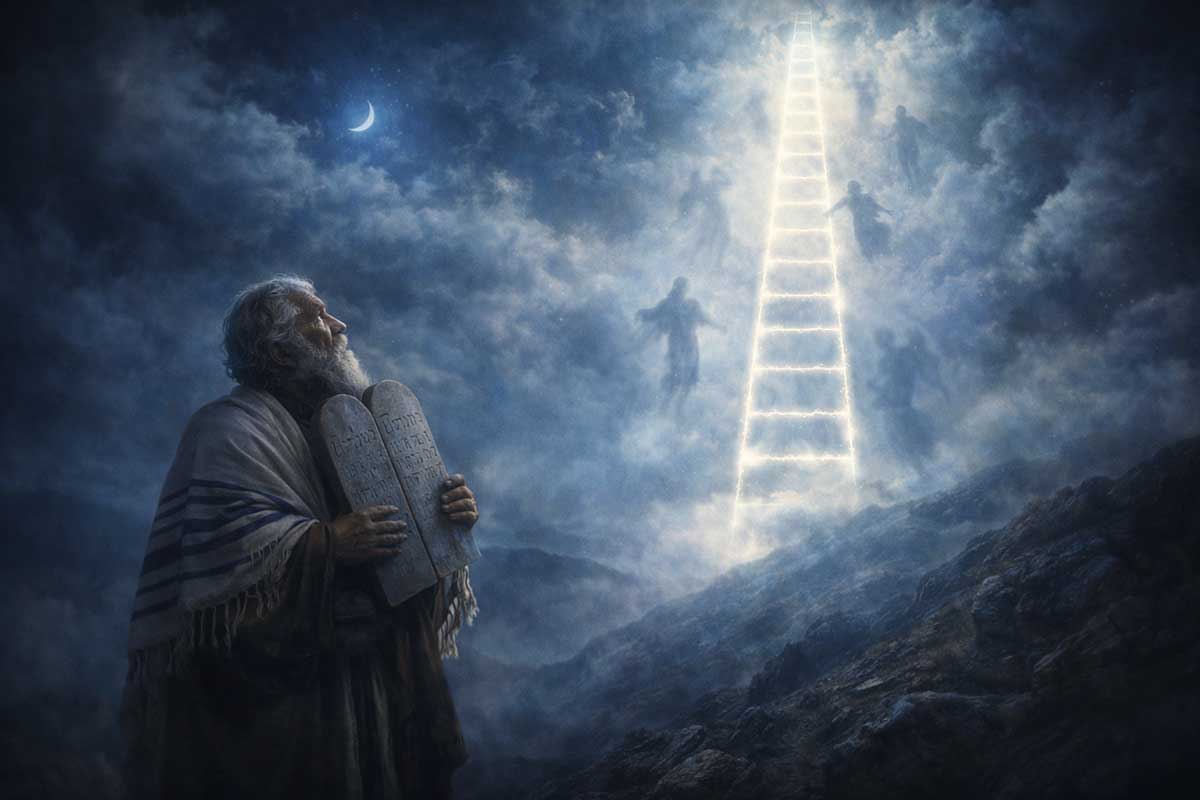
Anne Dopffer: Marc, when people speak of your “spirituality,” they often point to your Bible works as proof—angels, prophets, ladders, tablets. But I’ve always felt the real spiritual charge in your biblical images is not the iconography. It’s the sense of passage—something moving between realms. In Jacob’s Ladder, what is the ladder to you: a symbol, a memory, or a lived experience?
Marc Chagall: It is all three. A ladder is a simple thing in a village—wood, work, hands. But Jacob’s ladder is not carpentry. It is the idea that the world is not sealed. That heaven is not locked away. I painted it because I needed to believe there is traffic between the visible and invisible. Not only angels coming down, but the human heart reaching upward.
Anne Dopffer: “The world is not sealed.” That feels like the key. In the Genesis story, Jacob is fleeing, vulnerable, asleep on a stone. The vision arrives at a moment of fear and uncertainty. Do you see the ladder as consolation—or as a challenge?
Marc Chagall: Both. Consolation because it says: you are not abandoned. Challenge because it says: your life matters in a larger story. When Jacob dreams, he is not a hero; he is a man running. That is important. Revelation does not come only to the strong. Sometimes it comes to the frightened, to the ordinary, to the one who has nowhere to sleep.
Anne Dopffer: Your angels are never cold or distant. They feel alive—sometimes playful, sometimes urgent. What did you want angels to represent for a modern viewer who may not believe in them?
Marc Chagall: Let them call them what they like—messengers, intuitions, moments of grace. But everyone has experienced something that comes from “elsewhere”—a sudden clarity, a warning, a tenderness that arrives without being earned. Angels are my way of painting that. They are the invisible forces that touch us without asking permission.
Anne Dopffer: In Jacob’s Ladder, the composition often feels like a vertical pull, like the whole image wants to rise. Yet the human world stays messy—homes, bodies, the earth. Is that tension intentional: the sacred pulling upward while life stays grounded?
Marc Chagall: Yes. True spirituality is not escape. It is connection. If the ladder goes only up, it becomes fantasy. If it goes only down, it becomes despair. It must connect. A ladder is useful only because it has two ends.
Anne Dopffer: That’s beautifully practical. And it fits your style: sacred things are never far from everyday life—goats, rooftops, lovers, musicians. You don’t put heaven in a separate “holy zone.” You let it drift into the village.
Marc Chagall: Because that is how I felt it. In my childhood, the sacred lived in the kitchen, in the street, in the smell of bread, in the rhythm of blessings. People imagine holiness as marble. For me it was wood, cloth, smoke, song.
Anne Dopffer: Let’s move to Moses Receiving the Tablets. This is a different kind of “between worlds” moment. It’s not dream-vision; it’s covenant, commandment, law. When you paint Moses receiving the tablets, are you painting authority—or are you painting responsibility?
Marc Chagall: Responsibility. Law without love becomes cruelty. But love without form becomes chaos. Moses is not only receiving stone; he is receiving the burden of shaping a people. The tablets are heavy. They are not romantic. They insist: you must treat life with seriousness.
Anne Dopffer: That’s a strong statement—“not romantic.” Yet many artists depict Moses in grandeur, theatrical rays, heroic posture. You often bring tenderness into these scenes. Why?
Marc Chagall: Because Moses is human before he is monumental. If you make him only heroic, you make the covenant unreachable. But if you show the human—his trembling, his awe, his fear—then the viewer can feel that morality is not an abstract rule. It is something carried by a living person.
Anne Dopffer: In the museum context, I’m always watching people react. Some are drawn to your Bible images even if they’re not religious. They say, “It feels like my own inner life.” What do you think they are connecting to?
Marc Chagall: They connect to the moment when you realize: there is a voice inside you that is larger than your appetite. Call it conscience, call it God, call it the better self. Moses on the mountain is that moment. You cannot stay the same after it. You come down changed—and you must live with what you heard.
Anne Dopffer: So Moses becomes a portrait of transformation.
Marc Chagall: Yes. And Jacob too. Jacob wakes up and says, “Surely this place is holy, and I did not know.” That is the spiritual surprise: the holy was here, but I was asleep.
Anne Dopffer: That line feels like the bridge between these two paintings. Jacob is awakened by a dream; Moses is awakened by a call. Both are “woken” into a larger reality. If you had to define the spiritual function of these biblical scenes—what do they do to the viewer?
Marc Chagall: They remind the viewer that their life has depth. That there is an upper room and a lower room in the same house. Most people live only in the lower room—food, worry, money, time. The ladder and the tablets invite them upstairs. Not to abandon the lower room—but to bring light down into it.
Anne Dopffer: That’s the connection again—no escape, but integration.
Marc Chagall: Exactly. A painting should not be a door out of life. It should be a door deeper into life.
Anne Dopffer: Last question, Marc. Topic 2 was suffering as revelation—catastrophe forcing truth into view. Topic 3 feels like revelation without catastrophe: dream, covenant, a sacred instruction. In your heart, which kind of revelation is more enduring?
Marc Chagall: The one that makes you kinder. Catastrophe can awaken you, yes—but it can also harden you. The ladder and the tablets are revelations that ask for a human response: humility, responsibility, compassion. If a viewer leaves these paintings with even a small desire to live more honestly—to see another person as sacred—then the ladder has done its work. Then Moses has brought something down from the mountain.
Topic 4: Love as a Sacred Force
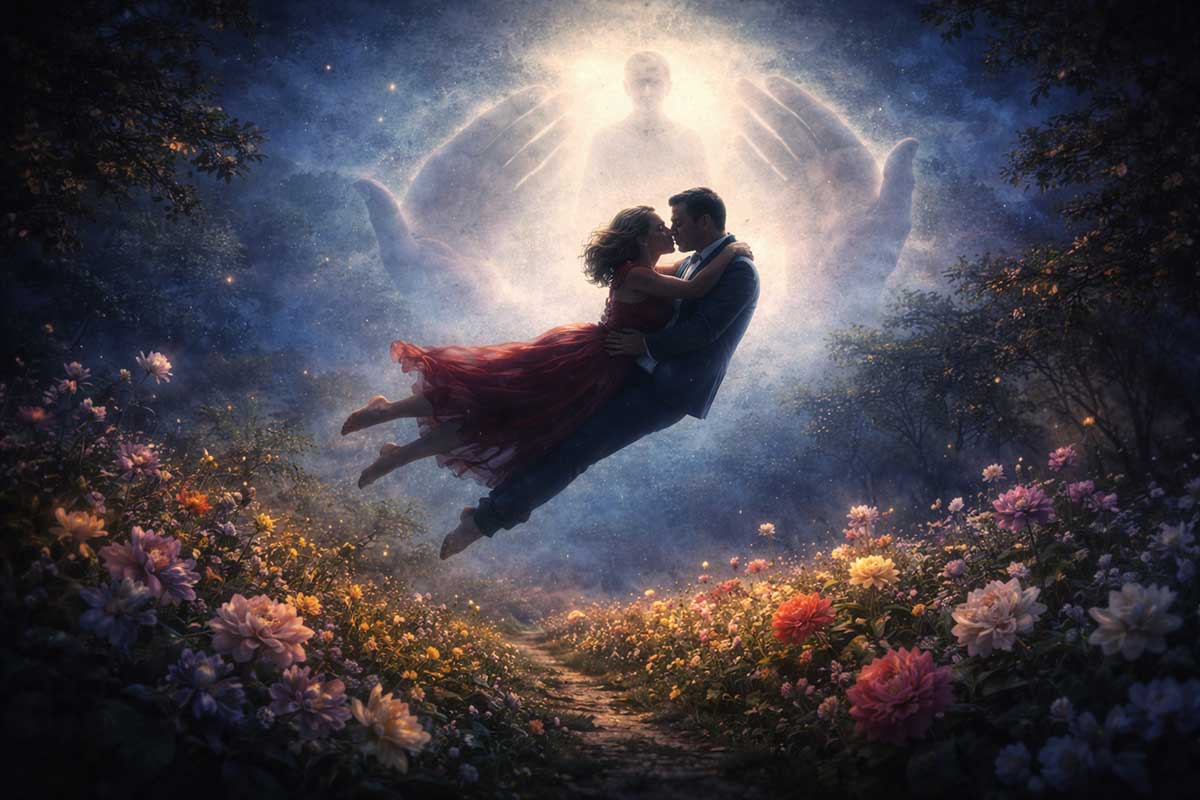
Jackie Wullschlager: Marc, people often call your work spiritual because of angels, prophets, and biblical scenes. But I want to argue that your most radical spirituality is love—human love—painted as something holy without becoming sentimental. When you approached Song of Songs, were you thinking of it as erotic poetry, sacred text, or both at once?
Marc Chagall: For me, there is no “only.” Love is not only body, and not only heaven. It is the bridge. Song of Songs is a miracle because it dares to say that longing can be sacred. People separate spirit and flesh like they are enemies. But love, when it is true, makes them allies.
Jackie Wullschlager: That’s exactly what fascinates critics: you refuse the Western habit of splitting the sacred and the sensual. In Song of Songs, the lovers often float, embrace, drift through luminous color. Some viewers feel it’s bliss; others feel it’s escape. What did you want the floating to mean?
Marc Chagall: When you love, gravity changes. That is not escape. That is experience. The body remains on earth, yes—but the heart rises. I painted floating because it is the most honest way to show what love does inside a person. It unhooks you from the ordinary clock. It rearranges your laws.
Jackie Wullschlager: So the floating is psychological truth—almost spiritual physics.
Marc Chagall: Exactly. People think realism is truth. But the soul does not move realistically. It moves like music.
Jackie Wullschlager: In your Song of Songs images, there’s also this constant presence of light—radiant, almost womb-like. Light becomes a substance the lovers swim in. Is that divine light, or the aura of love itself?
Marc Chagall: Why must we choose? Love is a form of divine light. If God exists, God is not embarrassed by tenderness. Love is not a distraction from spirituality; it is one of its languages. In my life, love saved me more than philosophy ever did.
Jackie Wullschlager: That line could sit on the wall of any museum. But let me complicate it. Critics sometimes point out that your love imagery can feel idealized—love as pure rescue, love as luminous sanctuary—especially given the violence of your century. Did you ever fear that painting love as sacred might feel dishonest against a brutal historical backdrop?
Marc Chagall: No. Because brutality is dishonest about the world. Cruelty pretends it is the only truth. Love contradicts that lie. In terrible times, to paint love is not naïveté—it is defiance. I did not paint love because the world was safe. I painted it because the world was unsafe.
Jackie Wullschlager: So love becomes resistance.
Marc Chagall: Yes. Resistance with warmth, not with weapons—though warmth can be a weapon against despair.
Jackie Wullschlager: Let’s shift to The Creation of Man. This is a different kind of love—cosmic love, generative love, the spark that calls a human into being. When you paint creation, are you painting God as an external maker, or creation as something that continues inside humanity?
Marc Chagall: Creation continues. If God created the world once and then left, what kind of God would that be? Creation is ongoing—every time a person chooses mercy, every time someone makes art, every time a mother holds a child. The first creation is a story; the continuing creation is our responsibility.
Jackie Wullschlager: That’s a profoundly modern reading. It suggests that being “made in the image” is less about biology and more about capacity—imagination, conscience, compassion.
Marc Chagall: Yes. The image of God is not a face. It is a possibility. We can live like animals or like angels. That choice is the drama of creation.
Jackie Wullschlager: In some of your creation imagery, the human figure can feel both fragile and luminous—almost like a new note entering a symphony. Is fragility part of what makes humanity sacred to you?
Marc Chagall: Fragility is the doorway to tenderness. A being that cannot break cannot love in the same way. Humans are sacred because they can suffer—and because they can respond to suffering with kindness. If we were unbreakable, we would be indifferent.
Jackie Wullschlager: That links directly back to Song of Songs. In those works, love is tender, ecstatic, alive. But it also implies vulnerability. To love is to risk loss.
Marc Chagall: Exactly. Love is always near mourning. People do not want to hear that, but it is true. The more you love, the more you open the door to grief. That is why love is spiritual—it asks you to accept the whole human condition.
Jackie Wullschlager: When you put Song of Songs next to The Creation of Man, it’s like two ends of the same sacred arc: love creates us, and love draws us back toward meaning. Do you see it that way?
Marc Chagall: Yes. Creation is the first embrace. Love is the continuing embrace. The lovers in Song of Songs are not only lovers; they are a reminder that life is meant to be held, not conquered.
Jackie Wullschlager: I want to ask you something that modern viewers quietly wonder: If love is sacred, what about love that fails? Love that becomes possession, betrayal, disappearance? Does your spirituality allow for broken love?
Marc Chagall: Of course. Broken love is still love—just injured. People think the sacred must be perfect. But the sacred is also what forgives, what heals, what tries again. Even when love fails, the longing for love remains a spiritual thirst. The danger is when someone stops longing and becomes hard. That is the real failure.
Jackie Wullschlager: That’s a striking distinction. So spirituality is not “never breaking,” but “not becoming hard.”
Marc Chagall: Yes. Not becoming stone.
Jackie Wullschlager: Last question, Marc. If you had to give the viewer one instruction for standing before Song of Songs and The Creation of Man—one posture of mind—what would it be?
Marc Chagall: Stand without cynicism. Cynicism is a cheap armor. It makes a person feel clever, but it kills the heart. If you can look at love and creation without cynicism—even for a moment—then you will remember something you knew as a child: that being alive is not a small thing. It is a sacred thing.
Topic 5: Painting with Light
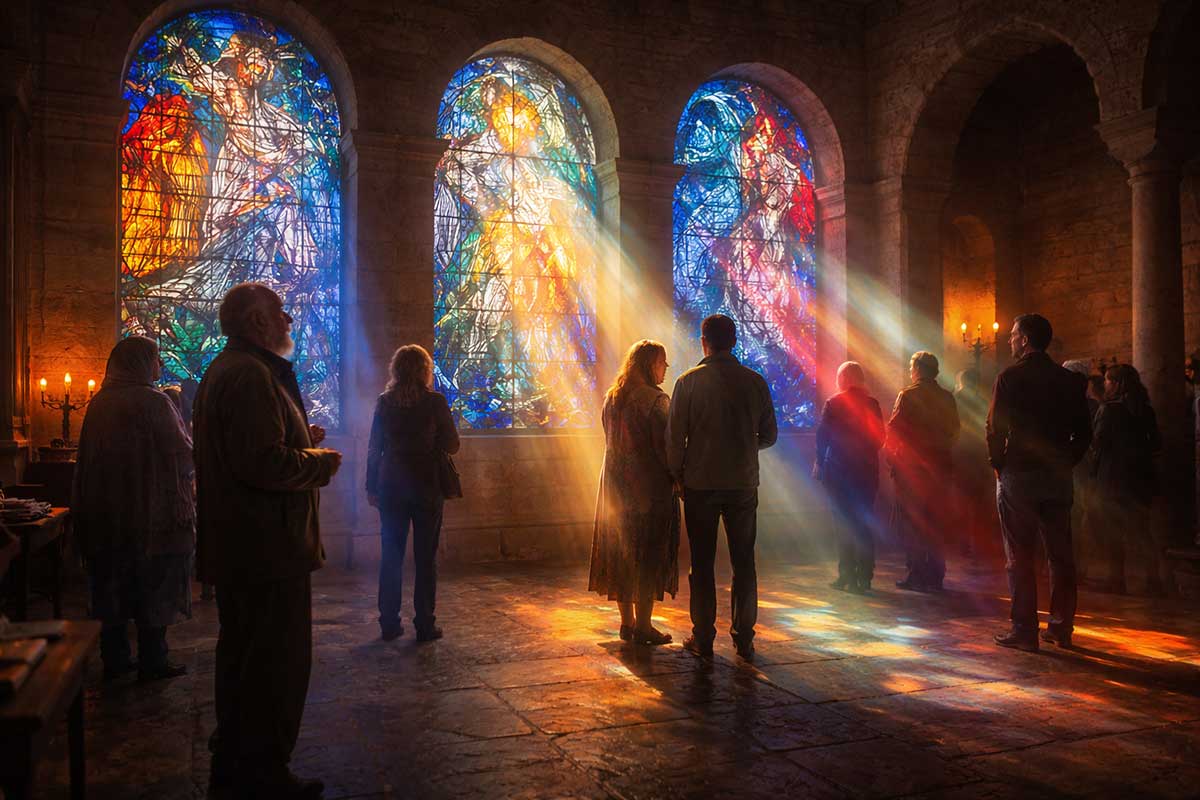
Charles Marq: Marc, when people think of your “spiritual” art, they picture floating lovers, angels, prophets. But when they stand before the Jerusalem Windows, something different happens. They’re not just looking at color—they’re inside it. Did you feel stained glass was the closest you could come to painting the invisible?
Marc Chagall: Yes. Because light is already spiritual. Paint can imitate light, but glass becomes light. When the sun passes through color, it is not a picture of radiance—it is radiance itself. That is why these windows feel like prayer even to people who do not pray.
Charles Marq: I remember the first conversations. You didn’t approach it like “design twelve panels.” You spoke about breath, music, blessing—almost as if the windows were living beings. What were you aiming for beyond the visual?
Marc Chagall: I wanted the windows to bless the space. A painting hangs on a wall; it stays separate. But a window changes the air. It enters the room. It touches faces, hands, silence. It makes time visible—morning, noon, evening. That rhythm is sacred. The windows had to live with people, not just impress them.
Charles Marq: There’s also the subject: the twelve tribes of Israel. That’s identity, history, covenant—so much weight. Yet the windows don’t feel heavy. They feel like hope. How did you avoid turning them into monuments?
Marc Chagall: I refused to make them moral statues. The tribes are not a museum label to me. They are like twelve melodies. Each has a character, a mood, a color that sings. If you turn them into stone, they become ideology. I wanted them to remain life—like fruit, fire, water, sky.
Charles Marq: You kept returning to the idea that each tribe has a “voice.” When you worked, did you hear those voices?
Marc Chagall: I heard my childhood—stories, blessings, the sound of prayers in the synagogue, the way a name can carry generations. But I also heard the modern world, which is loud and hungry and forgetful. The windows had to speak softly and still be heard.
Charles Marq: Technically, stained glass can punish softness. If the line work is too delicate, it disappears. If the colors are too subtle, they flatten. Yet you insisted on tenderness. You wanted the windows to glow, not shout. Do you remember how stubborn you were about that?
Marc Chagall: I remember. Because spirituality that shouts becomes propaganda. Light does not need to shout. Light persuades by presence. I wanted a human warmth in the colors—a warmth that could survive tragedy.
Charles Marq: That word—survive—matters. Your life crossed so much catastrophe. People sometimes assume the Jerusalem Windows are simply celebratory, but they were made in the shadow of enormous suffering. Did you see them as healing?
Marc Chagall: Not healing like a doctor, not so simple. More like—restoring the human soul’s appetite for goodness. After suffering, people can become suspicious of beauty. They say, “Beauty is a lie.” But beauty is not a lie. It is a necessity. These windows were my refusal to let pain become the only language.
Charles Marq: I want to talk about the medium itself. In painting, you can control everything: the surface, the density, the final image. In glass, you have to collaborate—with craftsmen, with the kiln, with sunlight, with weather, with architecture. Did that surrender feel spiritual to you?
Marc Chagall: Yes. Because the ego wants total control. But spirituality begins when you admit you are not the only maker. In stained glass, I could not pretend I was alone. The work required trust—trust in your hands, trust in the material, trust in the light that would finish the painting every day.
Charles Marq: It’s true. Every sunrise “completes” the windows again. And every cloudy day changes the mood entirely. That instability would terrify some artists.
Marc Chagall: It delighted me. The sacred is not fixed like a poster. It breathes. A window that changes is closer to life. People change, seasons change, grief changes, joy changes. The windows should change too.
Charles Marq: When viewers stand before them, they often describe a sensation of being watched over—not by a figure, but by atmosphere. As if the space itself becomes attentive. How do you explain that?
Marc Chagall: Because color can carry conscience. People think conscience is only thought. But conscience can be felt. When a room fills with blue and red and gold, the heart becomes quieter. It becomes receptive. That receptivity is the beginning of prayer, even if no words are spoken.
Charles Marq: You once told me you wanted the windows to be “an invitation, not a verdict.” Can you say what you meant?
Marc Chagall: A verdict says, “This is the truth, accept it.” An invitation says, “Come closer and listen.” I never wanted to trap people inside a doctrine. I wanted to open a door inside them—a door to tenderness, memory, awe.
Charles Marq: So the spirituality is not “religious instruction.” It’s inner permission.
Marc Chagall: Yes. Permission to feel the world as meaningful again.
Charles Marq: Let me ask you the hardest question, Marc. If Topic 1 was the soul’s homeland, Topic 2 was revelation through suffering, Topic 3 was the ladder between worlds, Topic 4 was love as sacred force—what is Topic 5 in one sentence? What do the Jerusalem Windows ultimately claim?
Marc Chagall: They claim that light still belongs to humanity.
Charles Marq: That’s simple—and enormous.
Marc Chagall: Because when people lose faith in light, they begin to justify darkness. They call it realism. They call it strength. But it is only hunger. The windows say: even after everything, there is still a reason to bless, a reason to build, a reason to see one another as sacred.
Charles Marq: And in that sense, stained glass is your final spiritual language—because it doesn’t merely depict hope. It casts hope onto people.
Marc Chagall: Yes. A painting can be admired. A window touches your skin. It makes your face part of the color. It says: you are included.
Charles Marq: That inclusion might be the most spiritual thing of all.
Marc Chagall: It is. Because the opposite of the sacred is not doubt. The opposite is exclusion. When light includes everyone in its color, it teaches the heart a better world without preaching a single word.
Topic 6: What Makes Chagall “Spiritual” — A Panel on the 10 Works
Susan Tumarkin Goodman: Let’s try to name it plainly. When people say “Chagall is spiritual,” they don’t all mean the same thing. Marc, if you had to give one sentence that covers The Praying Jew, I and the Village, The Green Violinist, White Crucifixion, The Falling Angel, Jacob’s Ladder, Moses Receiving the Tablets, Song of Songs, The Creation of Man, and the Jerusalem Windows—what’s the spiritual thread?
Marc Chagall: The world is not sealed. The visible is only the first skin. I paint the second life inside things—memory, love, suffering, blessing—so that the heart can recognize itself again.
Benjamin Harshav: That “not sealed” idea is essential. In The Praying Jew, spirituality is not fantasy. It’s discipline, posture, continuity—prayer as a rope. In I and the Village, it becomes relation: human and animal, living and remembered, all in one breathing field. Marc’s spirituality begins as a Jewish lived reality, not an aesthetic mood.
Anne Dopffer: And the Bible works amplify that into a universal structure. Jacob’s Ladder is literally a passage between worlds—traffic between the seen and unseen. Moses Receiving the Tablets is the moment spirituality becomes responsibility: not just uplift, but ethical weight. It’s not “religion as decoration”; it’s revelation that demands a human response.
Jackie Wullschlager: I’ll add something: the spirituality is also refusal. Refusal to split soul from body. Song of Songs makes love sacred without apologizing for desire. And The Creation of Man frames existence itself as a sacred event—fragility, conscience, imagination. In Marc’s universe, love isn’t a side theme; it’s the engine of the spiritual.
Susan Tumarkin Goodman: That gives us four strong candidates for the “thread”: passage, responsibility, love, and refusal-to-split. But the skeptical viewer might say: “Fine, that’s poetic. Where’s the proof in the images?” Let’s test it. Marc, take White Crucifixion. People feel it as spiritual, but it’s also political, historical, agonized. What makes that painting spiritual rather than simply tragic?
Marc Chagall: Because it forces recognition. Not the recognition of a doctrine, but the recognition of the human as sacred. If the viewer can feel holiness in the suffering body at the center, then the viewer must also feel it in the suffering people around—those fleeing, burning, losing home. Spirituality is not comfort. Sometimes it is the moment you can no longer look away.
Susan Tumarkin Goodman: That’s what I’ve seen in galleries. The painting doesn’t let you “consume” pain. It indicts the spectator’s distance. It turns looking into a moral act.
Benjamin Harshav: And it’s not a betrayal of Jewish specificity. It’s strategic symbolism—using an icon many viewers already understand to force them into a room they might otherwise refuse to enter. It’s spiritual because it reorders empathy.
Jackie Wullschlager: Plus, it refuses cynicism. A cynical artist would say, “There is no meaning.” Marc insists there is meaning even in the wreckage—meaning in witness, meaning in conscience. That insistence is spiritual in a modern world that keeps trying to anesthetize itself.
Anne Dopffer: I’d connect White Crucifixion to The Falling Angel. In the angel’s collapse you feel an apocalyptic fracture: the sacred itself seems injured. It’s spirituality under siege—what happens when the ladder between worlds shakes, when meaning falls. Yet even there, the act of painting is a refusal to let meaning die.
Susan Tumarkin Goodman: So, if we’re mapping it: Topic 1 was “soul’s homeland” (The Praying Jew, I and the Village, The Green Violinist). Topic 2 was “suffering as revelation” (White Crucifixion, The Falling Angel). Topic 3 was “passage and covenant” (Jacob’s Ladder, Moses Receiving the Tablets). Topic 4 was “love as sacred force” (Song of Songs, The Creation of Man). Topic 5 was “light that includes” (Jerusalem Windows). Here’s my next question: Are these five separate spiritualities—or one spirituality with five faces?
Marc Chagall: One, with many faces. Like a family. Prayer, music, love, law, light—these are different rooms of the same house.
Benjamin Harshav: One house, yes, but with a specific foundation. Marc’s symbolism grows from Jewish life—prayer, blessing, the cadence of sacred time. Even when the imagery crosses into Christian iconography or universal dream, the pulse remains rooted in a cultural memory of covenant and exile.
Anne Dopffer: And yet the structure of that memory becomes broadly legible. Jacob’s Ladder is not “only Jewish”; it’s human longing for connection. Moses is not “only biblical”; it’s the universal shock of realizing ethics are heavier than appetite. The works translate without dissolving.
Jackie Wullschlager: The translation happens through feeling, not through explanation. That’s why love matters so much. People can argue theology forever, but they recognize tenderness instantly. In Song of Songs, the lovers float because love reorders gravity; in The Creation of Man, creation isn’t a concept—it’s an intimate summons into being. Those are spiritual experiences before they are doctrines.
Susan Tumarkin Goodman: Let’s talk about the final leap: why stained glass feels like a culmination. Marc, with the Jerusalem Windows, viewers aren’t only observing; they’re bathed in color. Does that change the spiritual relationship between artwork and person?
Marc Chagall: Yes. A painting stays on the wall. A window enters your body. Light touches your face, your hands. It includes you. The spiritual is inclusion—against all the forces that exclude.
Anne Dopffer: That’s why people feel “held” in front of the windows. It’s not merely symbolic; it’s environmental. The space becomes a kind of living blessing.
Benjamin Harshav: And it also completes the arc: from prayer in a single figure (The Praying Jew) to a whole community inside color (Jerusalem Windows). From individual rope to collective atmosphere.
Jackie Wullschlager: Which returns us to the core: Marc’s spirituality isn’t escapism. It’s a craft for surviving without becoming stone—surviving love, surviving loss, surviving history, surviving conscience.
Susan Tumarkin Goodman: Then let me close with one last, practical question for the viewer: If someone wants to “use” these works spiritually—not just admire them—what do they do?
Marc Chagall: They slow down. They look without cynicism. And they ask, quietly: “Where is my ladder? What is my rope? What is my music? Whom do I treat as sacred? Where does light still include me—and where must I include others?”
Susan Tumarkin Goodman: That’s a good ending: not an answer you hang on the wall, but a set of questions you carry back into life.
Final Thoughts by Marc Chagall
When you stand before these works, you may feel many things. You may feel joy. You may feel sorrow. You may feel the sweetness of love or the shock of history. Let all of it come. Spirituality is not a single mood. It is the courage to remain human while the world tries to flatten you.
People often want art to solve pain. I do not think art can do that. But art can refuse the lie that pain is the only truth. It can keep a small inner candle alive—the one that says another person is sacred, that memory still has value, that love is not foolish, that conscience is not weakness, that light is still possible.
If there is a ladder between worlds, perhaps it is not only in heaven. Perhaps it is in us. A step is taken each time we pray with sincerity—whether with words, with music, with honest attention. A step is taken each time we look at suffering and do not turn it into spectacle. A step is taken each time we choose tenderness over hardness. And when light enters a room through colored glass, it reminds us: we are included. We belong to something larger than our fear.
So I leave you with a simple practice. Go back to your life and look again at what you have called ordinary: a table, a window, a face you love, a song, a memory that still visits you. Ask yourself, quietly: what hidden life is living here? If you can see that—even once—then the paintings have done what I hoped. They have reopened the world.
Short Bios:
Marc Chagall (1887–1985) — Belarusian-born modern master whose dreamlike symbolism fused Jewish memory, biblical vision, love, and color into a lifelong spiritual language across painting and stained glass.
Susan Tumarkin Goodman — Curator and scholar of Jewish art and culture, known for shaping major museum interpretations of Chagall and situating works like White Crucifixion within their historical and ethical context.
Benjamin Harshav (1928–2015) — Literary and cultural scholar who illuminated Chagall through Jewish tradition, modernism, and close reading of symbols; influential in framing how Chagall’s imagery functions as lived memory.
Anne Dopffer — French museum director and senior curator associated with the Musée national Marc Chagall in Nice, with expertise in Chagall’s biblical cycle and the spiritual architecture of his imagery.
Jackie Wullschlager — Art critic and biographer whose writing emphasizes Chagall’s inner life, love imagery, and modern contradictions, mapping how his romantic vision remains psychologically and spiritually charged.
Leave a Reply