

|
Getting your Trinity Audio player ready...
|
Prologue
The stage is dark. You hear the sea before you see it. Slow waves. A gull once. A mast leans in shadow, tall and thin. A net lies coiled at its base.
A voice, quiet, direct:
Voice
“He was an old man. He fished alone. He had gone far out and suffered much. He had fought the fish and the sharks and the sea. He lost and he won. He lost the fish, but not the fight. He carried pride, pain, and hope until the end. This is his story. It is the story of all who struggle against the sea, against time, against themselves.”
The sound of waves grows, then fades. The light comes up on the first scene.
(This performance begins with a familiar tale and unfolds into newly imagined acts, offering an original continuation inspired by its themes.)

Scene 1 — The Hunt (Original Story)
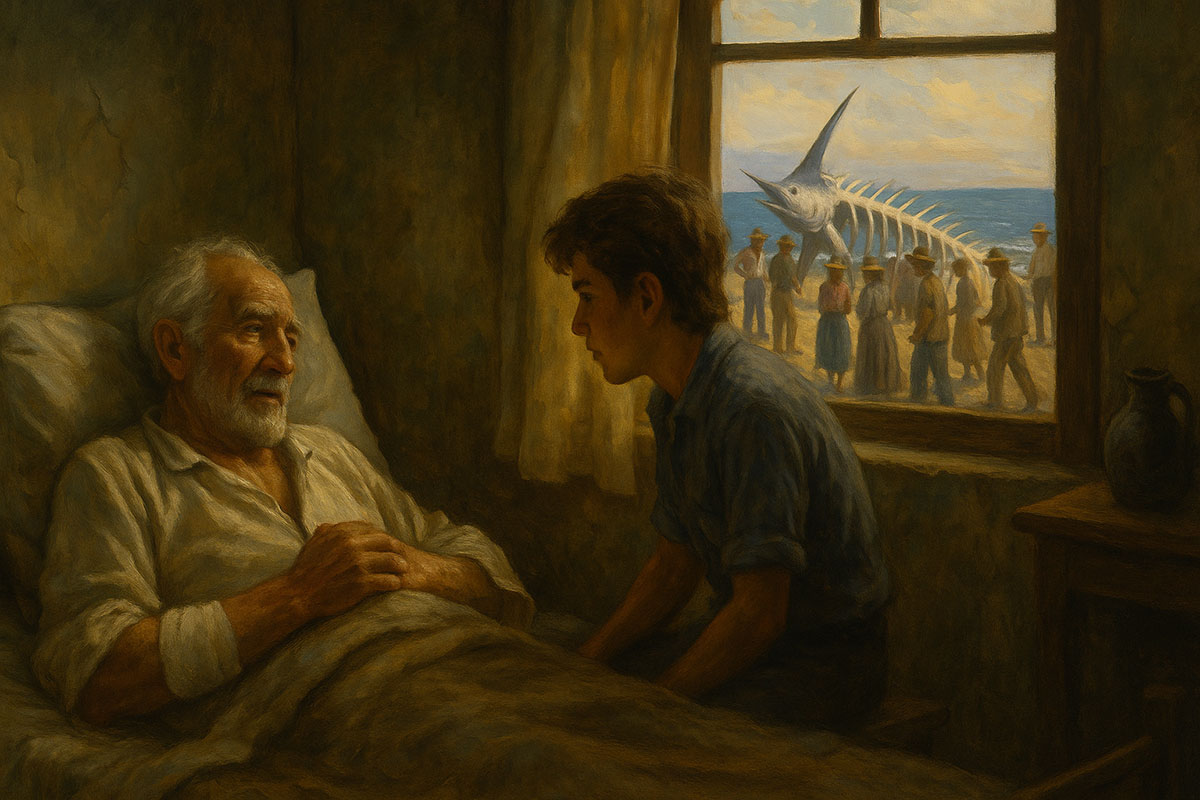
Setting: The Cuban fishing village at dawn. Santiago’s skiff lies pulled up on the sand, the massive skeleton of the marlin still lashed alongside, white bones gleaming like the ribs of a cathedral. The waves lap softly, carrying the scent of salt and blood. Nearby, villagers gather in whispers. On a simple stage-left set, Santiago’s hut: bare, with a cot, mast resting in the corner, and shadows stretching long across the floor.
Lights: Begin with soft morning glow across the beach, slowly shifting to muted gold inside Santiago’s hut. The skeleton remains visible through most of the scene, an unspoken witness.
Sound: Seagulls crying overhead, then falling silent as if awed by the bones. The hush of surf. Occasionally, the creak of the skiff’s timbers.
The Shore
At rise: villagers cluster by the skiff, pointing, arguing in half-whispers. Manolin stands apart, fists clenched. Fisherman One and Fisherman Two circle the marlin’s skeleton, awe mixing with mockery.
Fisherman One
By the saints, never have I seen such a fish. The old man hooked a dream and dragged home a ghost.
Fisherman Two
Aye, a skeleton is no supper. He brought bones, not meat. He fed the sharks, not his belly.
Fisherman One
And yet—what bones! Longer than a man’s boat, taller than a mast.
They laugh uneasily. Villager Woman crosses herself, eyeing the skeleton as though it were sacred and cursed at once.
Villager Woman
Such a fish was not meant for nets, nor harpoons. It was the sea’s own secret. And he took it—and paid.
Manolin steps forward, fire in his voice.
Manolin
He paid with more than you could measure. While you counted your bait and nets, he wrestled with the sea itself.
The villagers quiet, uneasy. Manolin turns from them and strides toward Santiago’s hut.
Inside the Hut
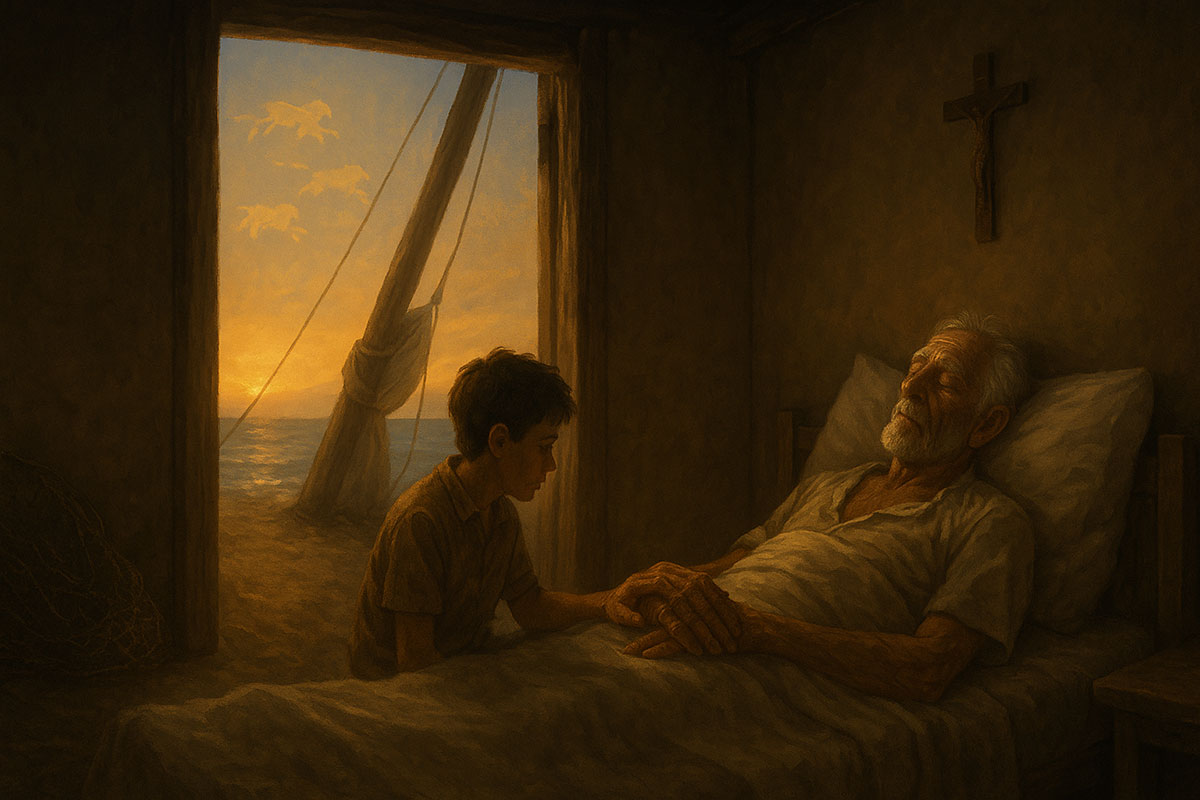
Santiago lies on the cot, motionless, face hollow with exhaustion. The mast leans against the wall beside him like a sentinel. The light is soft, almost holy. Manolin kneels at his side. After a moment, Santiago stirs, opening his eyes slowly.
Santiago
(hoarse, whispering)
Boy… is it morning?
Manolin
It is morning, viejo. The sun is kind today.
Santiago
(weak laugh)
The sun is never kind. But I am glad it shines, for I thought perhaps I had drifted to night forever.
He shifts, wincing. Manolin helps him sip water from a cup. Santiago’s hands tremble, scarred and torn from the line. He looks at them, almost amused.
Santiago
These hands… they are not a fisherman’s hands, but a martyr’s.
Manolin
They are the hands of the strongest man in the village.
Santiago
No. They are the hands of an old man who could not keep what he caught.
Manolin
But you caught it. You alone. None here would have lasted a single hour with that marlin.
Santiago
(eyes closing)
And yet the sharks lasted longer.
Silence. Only the surf outside. Manolin bows his head. After a pause, Santiago speaks again, softer, almost to himself.
Santiago
Do they laugh, the fishermen?
Manolin
Some laugh. Some marvel. All speak your name today.
Santiago
I would rather they forgot it. A fisherman is not his name, boy. He is his catch.
Manolin
Then you are the greatest of them all.
Santiago opens his eyes, looks at him, and faintly smiles. For a moment, he almost believes it. Then he turns his face away.
The Visitors
Two fishermen enter the hut quietly, hats in hand. They stand awkwardly, glancing from Santiago to Manolin.
Fisherman One
Old man… the fish you brought, its bones stretch longer than three men. We thought you should know.
Santiago
(weary smile)
I know. I measured it with my blood.
Fisherman Two
It is a wonder. The tourists will come. They will point, and buy their drinks, and tell each other, “This was caught by the old man of the sea.”
Santiago
(voice sharp)
Tell them nothing. Let the bones speak, if they must.
The fishermen exchange looks, unsettled, then retreat, muttering. Silence returns. Santiago closes his eyes again, his breathing shallow. Manolin adjusts the blanket over him.
Dreams of the Sea
Santiago drifts, half-asleep. His voice floats between waking and dreaming.
Santiago
The sea… she is beautiful, boy. She is cruel, but she is beautiful. I dreamed last night of the lions again. They played on the beaches of Africa, young and golden. Not broken, not hungry.
Manolin
Tell me more, viejo.
Santiago
They ran without fear. They were free. I was with them once, when I was young. I think, perhaps, I shall go to them again.
His voice trails. Manolin grips his hand fiercely, unwilling to let him go.
Manolin’s Vow
Manolin
You will not go yet. You will fish again. I will fish with you. My parents cannot forbid me. I am not a child now.
Santiago
(smiling faintly)
No. You are not a child. You are the fisherman I prayed for, though I am too late to teach you.
Manolin
You taught me everything.
Santiago
No. The sea will teach you. And the marlin. And the sharks. They are better teachers than I.
He closes his eyes, spent. Manolin remains kneeling, defiant, whispering as though to himself.
Manolin
Then I will learn. I will learn it all. But you will see me do it, viejo. You will not go to the lions yet.
Closing Image
Outside, the villagers disperse. The marlin’s skeleton gleams in the morning sun, enormous and silent. Seagulls wheel overhead but do not land. The stage light narrows slowly to Santiago on the cot, Manolin holding his hand. The boy’s face burns with determination, the old man’s with weary peace. For a long breath, the two generations are joined: one at the twilight of his struggle, the other at its dawn.
Blackout.
Scene 2 — The Days After
Setting: Santiago’s hut, several days after his return with the marlin’s skeleton. The hut is sparse — cot, chair, mast leaning against the wall like a cross, fishing gear bundled in the corner. Outside, the faint hum of village life: children shouting, women calling, nets being mended.
Lights: Dim at rise, as if dawn has barely broken. Grow brighter and warmer through the scene, echoing the gradual awakening of the village and of Santiago’s fragile body.
Sound: Roosters crowing, distant waves, occasional laughter from the street — all in contrast to the stillness inside.
Opening Stillness
At rise: Santiago lies propped on his cot, eyes closed, breathing slow. His hands are bandaged, raw beneath the wrappings. Manolin sits beside him on a stool, a basket of food at his feet. He peels fruit slowly, setting slices on a plate, watching Santiago as though guarding him from silence itself.
After a long pause, Santiago stirs, eyes half-opening.
Santiago
How many days, boy?
Manolin
Three, viejo. Since you came back with the fish.
Santiago
Three days. (He smiles faintly.) And yet I feel I have aged three years.
Manolin
You fought more than a fish. You fought the sea itself. Even the sea must rest after such a storm.
Santiago
(hoarse laugh)
The sea never rests. She waits. She gives and takes, as she will.
Silence. Manolin places a slice of fruit near Santiago’s hand. The old man studies it, then takes it, eating slowly, painfully. Each motion costs him effort.
The Boy’s Plea
Manolin
I have been thinking, viejo. You must not go out again. Not yet, not for many weeks.
Santiago
Not go? (smiling sadly) Then I am no fisherman.
Manolin
You are more than a fisherman. You are my teacher, my friend. You need not prove yourself again.
Santiago
I do not fish to prove myself. I fish because it is what I am. A bird does not fly to boast. He flies because his wings command him.
Manolin
Then let me be your wings. I will go, and I will bring you what the sea gives. You will rest.
Santiago
(quiet, shaking his head)
A fisherman who lets another bring him fish is no fisherman.
Manolin
Then let me go with you. Every day. My parents cannot forbid me any longer. I am no child.
Santiago
(looking at him, tender but firm)
Not yet. The sea will test you as she tested me. And I would not see you broken before your time.
The Villagers’ Visit
Footsteps approach outside. Fisherman One and Fisherman Two appear in the doorway, hats in hand, awkward. They speak with forced cheer.
Fisherman One
Good morning, old man. How do you mend?
Santiago
Slowly, like a net full of holes.
Fisherman Two
(smiling)
We thought you should know — the marlin’s skeleton still lies on the beach. The tourists gather to measure it. They call it a wonder.
Santiago
A wonder without flesh is a sermon without bread.
Fisherman One
Still, they speak your name with respect.
Santiago
Respect is for the living. What does the dead fish gain from their words?
An uncomfortable pause. The fishermen shuffle their feet, then nod and retreat. Their voices drift back from outside.
Fisherman Two
A stubborn man. He will die at sea one day.
Fisherman One
Better at sea than in his bed.
Reflection
Inside, Santiago lies silent, eyes closed. Manolin watches him, troubled.
Manolin
Do you hear them? They think you are finished.
Santiago
Perhaps I am. (He opens his eyes.) Do you think I am finished, boy?
Manolin
Never. Not while you can dream of lions.
Santiago smiles faintly, touched, then turns serious.
Santiago
When I was young, the sea was my companion. She laughed with me, she tested me, but I thought her kind. Now I am old, and she has grown stern. She no longer plays; she only weighs.
Manolin
And yet you went farther than any man, and you returned. That is not failure.
Santiago
(quietly)
It is not triumph either.
The Storm Within
Silence. Santiago shifts, staring toward the mast leaning against the wall.
Santiago
Do you see it, boy? That mast?
Manolin
Yes.
Santiago
When I carried it on my shoulders up from the beach, I thought of Christ with his cross. I do not say I am Christ. I say only that I felt the weight of sacrifice.
Manolin
And what was sacrificed?
Santiago
My strength. My pride. Perhaps even my soul.
Manolin
No, viejo. You gave nothing away. You proved that a man can endure more than flesh should allow.
Santiago
Endurance is a poor bedfellow. It keeps you alive, but it does not feed you.
He coughs, the sound harsh in the silence. Manolin supports him, steadying his shoulders until the fit passes.
The Boy’s Vow
Manolin
Then I will feed you. I will fish for you. I will learn, and I will honor you.
Santiago
(soft, almost breaking)
Boy… why do you love me so?
Manolin
Because you are my master. Because you never gave up, not even when you had nothing. Because you taught me that a man is not measured by his luck, but by how he stands when the world turns against him.
Silence. Santiago gazes at him, eyes bright with unshed tears. Slowly, he nods.
Santiago
Then promise me this. If I fall, you will not carry my mast. You will carry your own.
Manolin
I promise. But not yet. Not while you still breathe.
Closing Image
Santiago closes his eyes again, drifting toward sleep. His lips move faintly, almost a prayer.
Santiago
The lions… the golden lions on the beach…
The stage light narrows to Santiago on the cot, Manolin sitting vigil at his side. Outside, laughter of children drifts faintly, a reminder of life continuing. The marlin’s skeleton remains a shadow on the sand, vast and silent.
Blackout.
Scene 3 — The Final Voyage
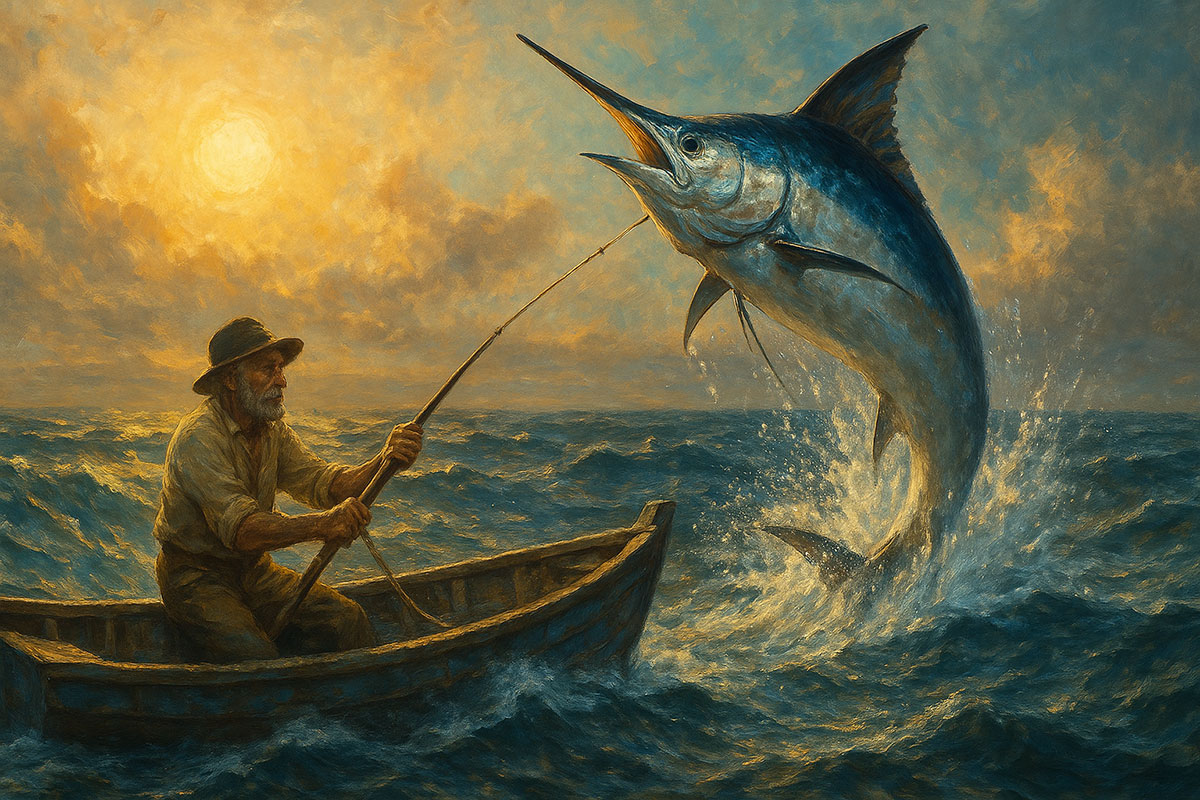
Setting: The village shore before dawn, then the open Gulf Stream. Santiago’s skiff, oars, coils of line, gaff, a short harpoon. Farther out: endless water, a horizon like a blade. A second, smaller skiff lurks in shadow — Manolin’s, following at a distance.
Lights: Indigo pre-dawn at rise. A pale silver seam appears and widens to morning; at sea, the light grows hard and white. Late in the scene, a heat-haze shimmer. As the catch turns, the water flashes metallic and throws brightness upward.
Sound: Oars creak; water lips the hull. Far gulls, then none. A slow, oceanic hush. When the line takes, a deep violin-like hum accompanies the strain.
Before Dawn
At rise: Santiago’s silhouette crosses the beach, the mast on his shoulder like a thin cross. He moves slower than in Scene 1, yet with a private certainty. He sets the mast, lowers the skiff, pauses to listen to the sleeping village.
Santiago
(very softly)
It is time, sea. Let us speak once more, but quietly.
He steps into the skiff, pushes off. The keel grates, then floats free. He rows — small strokes, steady. From behind a hut, another shadow slips: Manolin, bare-footed, a coil of line at his chest. He eases his smaller skiff into the water and follows, keeping to the darker seam between shore and sea.
The Gulf Stream
Light opens like a lid. The coastline smears into a pale bruise and disappears. Santiago rows farther than he has since the marlin, farther than prudence. He sets a stern line, then a second and third, each with a bait small but honest.
Santiago
(to the sea)
No great one today, querida. Only enough to speak well of us both.
He settles, letting the skiff nose along. He fingers the knots with tenderness, the bandages now off his hands; scars shine like starfish. He sips water, eats a dry bit of bread, then waits.
Behind him, far but not far, Manolin keeps watch. He rows only enough to maintain distance. He hides his mast with a tarp, his oars wrapped in cloth to quiet them. He watches the old man’s shoulders rise and fall, learns the cadence of patience.
The First Pull
A tremor runs up Santiago’s port line. He lifts it, feels the suggestion of weight, then the deliberate, testing tug of a fish that knows. The old man lets the line slide over his palm — pressure, release, pressure — his mouth tightening to a smile.
Santiago
Ay. Not a prince; a soldier. Come, soldier. If you are to take, then take like a man.
The line draws away, steady and deep. He sets the hook with a swift, practiced snap. The skiff shudders as the fish turns its full body to the pull. The rodless line hums. The old man braces his bare feet, knees bent, paying out inches, reclaiming inches.
Santiago
Good. Good. You are strong. Not as he was — (a shadow crosses his face) — but strong enough to judge me.
He works the line. The fish does not run to the horizon; it sounds, then circles, then sounds again — a stubborn, smart pattern. The sun climbs; sweat slicks the old man’s chest. His breath becomes a measured engine: draw, hold, yield, draw.
Far astern, Manolin grips his thwart, eyes shining with worry and pride.
Manolin
(whispered to the sea)
Hold him gently. Let him prove himself and come home.
The Battle in Close
Hours. Santiago has the fish under him now, a turner, not a flyer — perhaps a big tuna or a stubborn dolphin, the color unseen beneath the glare. The line seesaws across the gunwale, scoring the wood.
Santiago
(to the fish)
I like you, hermano. You are honest work.
The fish rises once — a silver-green flash and a sickle tail — then dives, the skiff slewing. Santiago gathers, gives, gathers. His hands open and close around the line; the scars whiten, then flush. His jaw sets. He smiles at the pain like an old friend who talks too much.
He speaks to himself to keep the rhythm, as he did with the marlin.
Santiago
Heave when he tires. Rest when he judges you. Do not shame him with haste, nor yourself with pride.
He inches the fish up again. The dorsal breaks; this time it holds. A dark bar, then the gleam of the back. The old man reaches for the gaff, then stops — too soon. He sets it down and returns both hands to the line.
In the distance, Manolin rises, nearly calls out, then bites his tongue. He trusts the silence.
The Turn and the Choice
Midday. Heat presses like a second sea. The fish begins to spiral — a slow, tightening wheel. Santiago gathers the line a full hand at a time now, jaw set, breath short but steady.
Santiago
Now, viejo. Do not betray your age. Be exact.
He leans back, draws the fish within the skiff’s length. The bronze of its head blooms beneath the surface, the eye alive, not wild — alert, accepting. The old man sets the line underfoot, reaches slowly with the gaff.
Santiago
(like a prayer)
Forgive me.
He gaffs true, quick to the head. The fish convulses, striking the gunwale. The skiff lists, takes a pail of sea, rights itself. The old man hauls, grunting, half-lifting, half-rolling the fish into the boat. It is big — not marlin-big — but enough to warm a village’s table. It thrashes, then slows; he speaks softly until stillness takes it.
Santiago
Gracias. You were worthy. We will eat, and tell of each other kindly.
He lashes the fish amidships, covering it with wet cloth from the bailing bucket, then washes the deck of blood with careful hands, as if tending a church floor.
The Return Begins
He sets the oars. Each stroke is small, precise, economic. He is smiling now — not broad, but clean — the smile of a man in right relation with work. He rows an hour, then two. The sun lowers a finger-width. His breath hitches once, twice.
Santiago
(to his body)
Steady, old house. Do not creak so loud they hear you in shore kitchens.
Behind, Manolin allows himself a grin. He whispers a little victory to the sky and rows in a touch closer, still hidden by the sea’s low heaves.
The Uninvited
The first shark arrives without fanfare — a grey triangle, neat as a thought. Then another. They are not the blunt, prehistoric bulldogs of the marlin’s blood-feast, but leaner, quicker, tasting the day for opportunity. The old man sees the fin, nods to it as to an acquaintance.
Santiago
No, amigos. Not today.
He lifts the short harpoon, waits. The first shark veers, tests, then commits: a white scythe at the fish’s flank. Santiago’s strike is exact — down and across — the water blossoms; the shark thrashes, rolls belly-up, drifts. The second flees, then returns with a third.
Santiago
I did not invite you. Go to richer tables.
He works. The harpoon finds one, then he lashes a knife to the tiller as he has done before, cursing his memory for the lesson. He stabs when they come close, he kicks them when they cling. His breath grows ragged. His arms shake. He laughs once, harsh.
Santiago
You teach the same class every year.
They peel away, then return, decorous as gentlemen who intend to stay. Bites appear in the fish’s flesh — not ruinous, not yet, but enough to anger the old man’s pride. He rows harder. His chest rasps.
Far astern, Manolin shifts as if to break cover, but checks himself. He knot-ties a spare gaff to a pole, rehearses in the skiff, white-lipped with worry.
The Debt of Strength
Late afternoon. The sea glass-hard. Santiago’s strokes grow short, the skiff wallowing when he mis-times a wave. A third pair of sharks ghost in, bold. He fends them, takes a cut to his forearm on the knife lashings, ignores the blood. He fends them again, swearing without heat.
Santiago
It is enough. I have paid. I have paid.
They leave. He rows. The outline of the shore now a line more than a rumor. Smoke from cookfires ghosts the sky. He rests the oars, shakes his arms out, then pulls again, a stubborn metronome against age.
The fish’s cloth flutters; beneath it, the flesh shows torn in moons. The old man looks, winces — not at loss, but at the insult to the fish’s nobility.
Santiago
Forgive their hunger. It is their nature. And mine to refuse them.
He rows on.
The Boy Breaks Cover
At last, Manolin can bear it no longer. He angles his skiff across the old man’s wake and closes the distance openly. Santiago turns his head, startled, then too tired to scold. His mouth crooks into a rueful thing.
Santiago
So. The sea has two fools today.
Manolin
Two makes courage, viejo. I am with you.
Santiago
You were with me the whole time.
They do not waste breath on thanks. The boy takes the windward side, his skiff bumping softly against the old man’s as they row in concert, the rhythm found quickly — an old song both know. When the last pair of sharks approach, the boy strikes first, quick and clean, yelling without fear. The sharks shear away. Together, they row again.
The Landfall
Shore thickens into houses, faces on the beach. Voices rise, men pointing, women shading eyes. The fish — diminished, but still a king — rides with them, half-wrapped in wet cloth like a relic. The sun lowers into copper. The oars creak in time with the surf.
Santiago
(very soft)
Enough. Enough.
Manolin
We are almost there.
They beach the skiffs. Villagers run to help. Hands lift, pull, chatter. The old man stands, but the world tilts. For an instant, he steadies on the mast, then his knees fold. The boy is beneath him, catching, easing him down.
Manolin
I have you. I have you.
Santiago
(smiling with his eyes closed)
And I, you.
A murmur circles them — admiration, shame, awe. The skeleton of the marlin’s memory seems to linger in the air above the new catch, as if the sea itself has turned to watch.
The boy looks to the fish — wounded but dignified — then to the old man, whose breath is thin but real. He nods once, as if sealing a pact with time.
Blackout.
Scene 4 — The Night of Storms
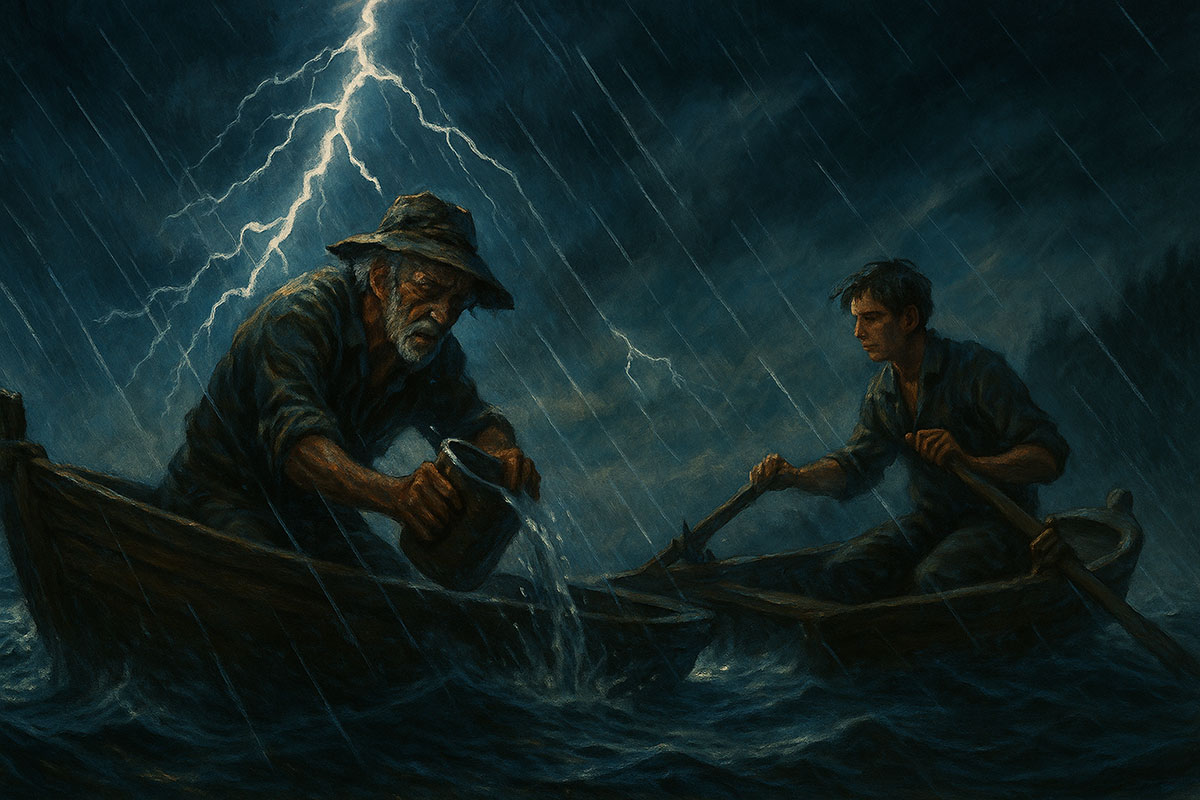
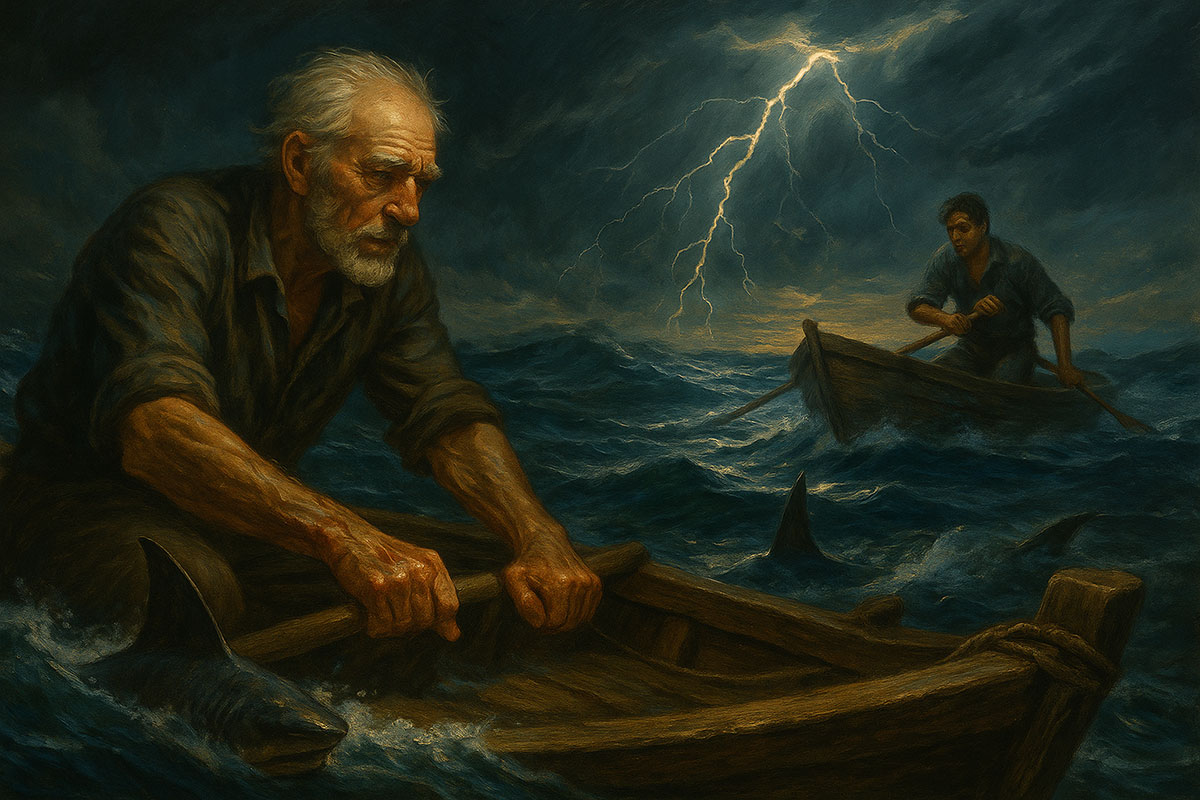
Setting: The Gulf Stream, night. Santiago’s and Manolin’s skiffs are tethered together, small shadows against an endless sea. Storm clouds pile on the horizon. Lightning flickers in the distance, thunder mutters like a warning.
Lights: Deep indigo at rise, shifting with lightning strikes that briefly bleach the stage. Later, a faint silver band at the far horizon suggests the storm’s passing.
Sound: The hush of waves at first, then rain, thunder, and rising wind. Between squalls, the bucket’s splash, oarlocks creaking, men’s breath.
Opening Tension
At rise: Santiago rows slowly, his shoulders sagging. Manolin rows alongside, watching the sky nervously.
Manolin
We should turn in, viejo. The air smells of iron.
Santiago
It smells of work. The sea has not finished with us yet.
Manolin
The sea has taken enough already.
Santiago
She always takes enough. Our task is to endure until she grows tired of asking.
Lightning forks across the horizon. For a moment both skiffs are etched white. Then dark again.
The First Gust
A sudden wind rattles the boats. The tether rope creaks. Manolin leans over to adjust it.
Manolin
If the line parts—
Santiago
Then we both row toward the same star when the clouds break.
Manolin
And if they do not break?
Santiago
Then we row by faith alone.
They share a grim smile. Thunder cracks closer now. The storm is almost upon them.
The Storm Breaks
Rain slams down, drumming the stage. The skiffs pitch, spray flying. Lightning flashes rapid, thunder immediate.
Manolin
(raising his voice)
Viejo, let me take your skiff in tow!
Santiago
No! Each man must ride his own boat. Tie us too close and we both may capsize.
They bend to work. Santiago bails frantically with a bucket, water sloshing out in silver arcs. Manolin fashions a crude sea-anchor from a sack, casting it over to steady his bow. They shout above the noise but never stop moving.
Santiago
Good hands, boy! You have the sea in your blood.
Manolin
I have you in my blood.
Santiago falters a moment, then smiles through the rain, proud and sad all at once.
Lightning and Memory
Lightning bathes the stage in white. For an instant, Santiago sees not storm but memory: golden lions leaping on African beaches. Their movements blur with the storm’s waves, strange and radiant.
Santiago
(half to himself)
The lions… they are not afraid. They run at the surf, laughing.
Manolin
What do you say?
Santiago
That fear is a wave, boy. It passes. But the courage to stand against it remains.
Manolin
Then we will stand.
The Break in the Tether
A loud snap — the tether between skiffs parts. The boats slide apart into the black rain. Manolin’s pale face flashes in lightning, then vanishes into dark.
Manolin
Viejo!
Santiago
I am here! Steady your bow! Ride the swell on your quarter, not your nose. Let the sea lift you, not drown you.
Manolin
And you?
Santiago
The same. We are two reeds in one current.
They work separately now, each boat pitching, each man unseen to the other, connected only by shouts. Thunder answers them like a mocking third voice.
Santiago’s Trial
Alone, Santiago’s skiff takes a broadside wave. Water floods in. He bails desperately, his arms shaking. He braces one oar to keep her from turning turtle. His body trembles with exhaustion. He mutters aloud, half prayer, half defiance.
Santiago
Not yet, sea. Not yet. I have given you blood, strength, pride. You will not take me before the boy learns what I have to give.
He steadies the skiff. Rain sheets down, lessening slightly. He breathes, ragged but alive.
Manolin’s Trial
Elsewhere in the dark, Manolin nearly broaches. His bow plunges, threatening to dig in. He shifts his weight back, shouting with effort. The skiff rights itself. He laughs once, sharp with fear and relief.
Manolin
I am here, viejo!
Santiago
(voice faint but carrying)
Good! Hold steady!
For a flash of lightning they glimpse each other again, two small figures against an ocean that could erase them. Then darkness returns.
Rejoining
The rain slackens to a heavy drizzle. Thunder rumbles farther off. Manolin, searching, calls again.
Manolin
Viejo! To starboard!
Santiago
Here! Throw a line!
The boy casts a rope across the gap. It arcs in silhouette against lightning. Santiago catches it with scarred hands, ties it off firmly. The skiffs draw together again, bumping but steady. Relief floods them both.
Manolin
We are two again.
Santiago
We were never not.
After the Storm
The storm recedes slowly. The sky lightens at the horizon, a bruised silver band. The swell remains, but its rhythm is predictable again. Both men slump, exhausted but alive. They bail silently, side by side.
Finally Santiago speaks, voice low.
Santiago
You have done what no boy should be asked to do. And yet you did it.
Manolin
Because you were with me.
Santiago
(smiles faintly)
Because the sea was with you.
He coughs hard, clutching his chest, but waves Manolin off when he moves to help.
Santiago
Do not fear. It is only the bill the sea sends for my years.
Manolin
She should forgive your debts.
Santiago
She forgives no one. But sometimes… she lets us go home first.
Closing Image
The horizon brightens faintly. The storm is behind them. Santiago leans against the mast, exhausted but calm. Manolin watches him, face fierce with loyalty. The two skiffs ride the heavy but even swell, tethered once more.
Lights narrow to the pair of them in silhouette against the pale horizon, fragile yet unbroken. The sound of the sea softens, fading into the heartbeat of the bucket’s splash, steady and patient.
Blackout.
Scene 5 — The Old Man’s Death
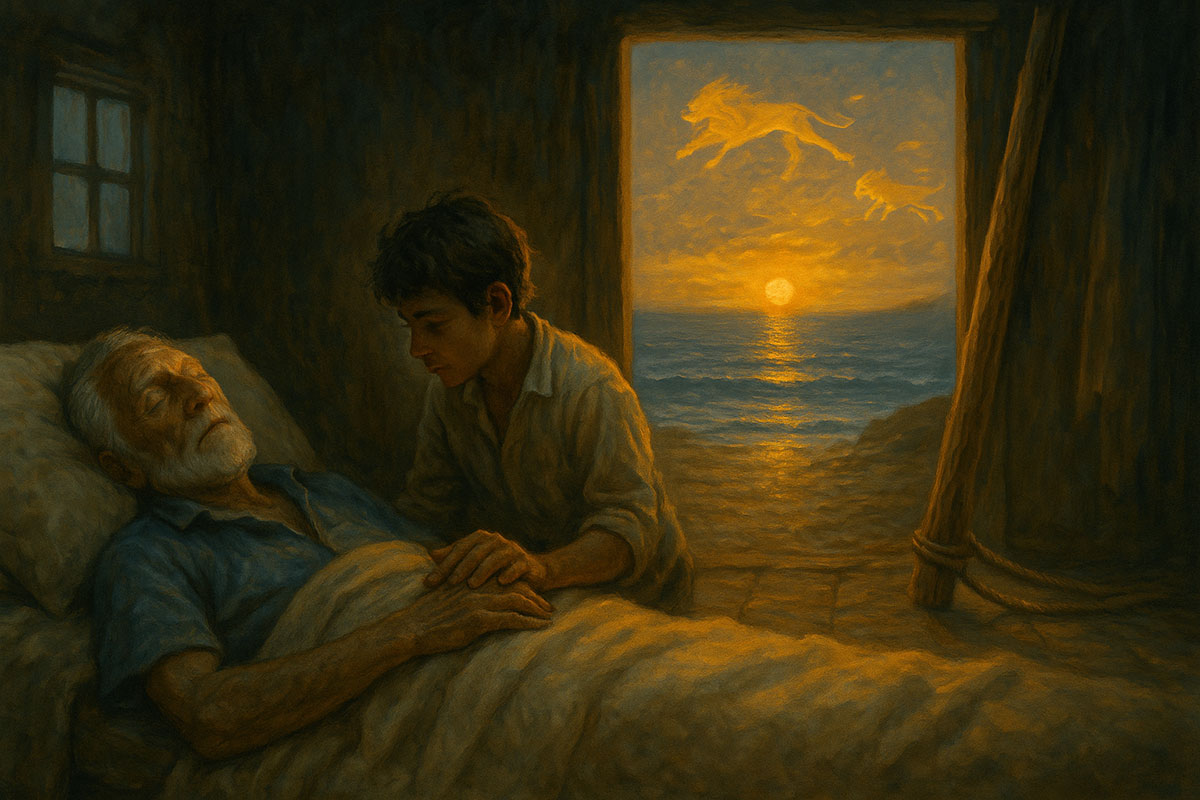
Setting: Santiago’s hut before dawn, the morning after the storm. The door stands ajar to a strip of pale sky. Inside: the cot, the mast leaning in its corner like a tall, thin cross, a chair, a tin cup, coils of line, the faint smell of salt and old wood. Outside, the village wakes slowly — a dog’s bark, a woman’s call, the far clack of oars being shipped.
Lights: A cool pre-dawn blue that warms gradually. A single soft shaft of light from the door and a second from the hut’s small window. As the scene closes, light concentrates on Santiago’s face and the boy’s hands.
Sound: Distant surf, gulls returning after storm. Within the hut: the whisper of cloth, a cup set down, two breaths — one thin, one steady.
The Vigil
At rise: Manolin sits on the stool beside the cot, a blanket around his shoulders, eyes raw from wakefulness. Santiago lies propped on a rolled net, his head tilted toward the open door. His hands are unbandaged now; the scars look like pale rope.
Manolin
It is morning, viejo. A small morning. The storm is gone.
Santiago
I can hear it has gone. The sea breathes easier. (a little smile) So do you.
Manolin
I breathe for two.
Santiago
You always did.
The boy lifts a cup of warm coffee. The old man sips, closes his eyes with a gratitude that is almost pain.
Santiago
That is a good thing. Coffee is better than prayer before the day begins.
Manolin
And after?
Santiago
After, prayer is better than coffee.
They share a quiet look — the kind that has more history than words.
The Village at the Door
Soft footsteps. Fisherman One appears in the doorway, hat in hand. Behind him, Villager Woman with a wrapped parcel; Fisherman Two peers from outside, unsure whether to enter.
Fisherman One
Old man… we brought bread. And a little fish. Not much, but honest.
Santiago
All honest fish are much.
Villager Woman
We prayed when the thunder stood over the roofs. We prayed again when we saw your boats come through it.
Santiago
Then keep your prayers for the next man. Storms have a long memory.
The visitors step in, place the parcel by the stool, and retreat, embarrassed by the intimacy of illness. Fisherman Two lifts a hand, awkward.
Fisherman Two
The bones of your marlin — the tourists still measure them. But we make them be quiet about your name.
Santiago
Let the fish keep his glory. A man does not need it when he is asleep.
They nod, relieved to be dismissed with grace, and go. The hut is quiet again.
The Weight of the Mast
The old man’s eyes drift to the mast.
Santiago
Put your hand on it, boy.
Manolin crosses, rests his palm against the wood.
Santiago
Do you feel it?
Manolin
It is smooth. And heavy with the storm’s water still.
Santiago
It is all the crosses a man must carry, polished by his shoulders. Do not love it. Respect it. Know when to lift it, and when to leave it standing.
Manolin
I will lift mine when it is time. Not yours.
Santiago
Good. (a breath) You will fish today?
Manolin
If you sleep. If you eat. If you do not try to come with me.
Santiago
(still looking at the mast)
I would like to feel the skiff rise once more to an easy swell. No sharks, no storm, no pride — only the small talk a boat makes with water when the sun is new.
Manolin
You will. Tomorrow, perhaps. Not today.
Santiago
Tomorrow is a word for young men. (he smiles) And for fools. I was both once.
The Ledger of the Body
He shifts. A small spasm passes through him. The boy’s hand is at his shoulder at once. The old man waits it out, then settles.
Santiago
It is an honest pain. The kind that tells the bill, not the kind that cheats the debtor.
Manolin
I would pay it for you.
Santiago
You are already paying it. (beat) You rowed in storm with a man who should have turned back at the first black cloud.
Manolin
You taught me not to turn back.
Santiago
To decide, boy. Not merely to refuse. There is a pride that keeps men upright — and there is a pride that pushes them over. Learn the taste between them.
Manolin
I will learn.
Santiago
You have begun.
The Promise
Manolin
I made a vow in the rain — that I would follow you anywhere. Even to the lions.
Santiago
Then break that vow. (gentle) Follow the fish instead. Follow the wind’s patience, the current’s temper. Follow the birds when they do not lie, and forgive them when they do.
Manolin
And you?
Santiago
I will follow sleep. It is the only boat that does not leak when a man is old.
He closes his eyes a moment. The boy watches the breath move under the thin blanket — a small tide.
Manolin
When I bring a fish today, I will bring two portions. One for your mouth, one for your story.
Santiago
Bring the story to your own mouth. That is how a fisherman grows teeth.
They share a faint laugh that trembles and holds.
The Confession
Santiago
Do you resent me for the marlin?
Manolin
No.
Santiago
For the sharks?
Manolin
No.
Santiago
For the storm?
Manolin
No.
Santiago
Then resent me for this — (he lifts his hands) — for leaving you with my absence.
Manolin
I resent only the sea for not letting you rest sooner.
Santiago
She is a good teacher. A hard one, but good. You will not forget her lessons.
Manolin
Nor yours.
The Lions
Light warms slightly. The old man’s face eases.
Santiago
They come when I close my eyes. The lions. They are young again, every time.
Manolin
Tell me.
Santiago
They run along the beach in the morning. The sand is cool; the sun has not yet made the air dance. Their paws leave prints that the tide studies and erases with great tenderness, as if it were ashamed to be the sea. They do not roar much. They play. One stops and looks at me as if to say, “Do not hurry. The day is long enough when you love it.”
Manolin
Stay with them a while. I will be here when you come back.
Santiago
I will come back for one more sip of coffee. And to hear your lie about how big your fish was.
Manolin
It will not be a lie.
Santiago
Then I will forgive you for that, too.
The Blessing
The boy takes the old man’s hand — scar over scar — and bows his head. He does not speak a prayer; he makes one with the steadiness of his grip. The old man watches him as if seeing him from a long way off and also very near.
Santiago
Listen, boy. If I do not wake when you return, do not weep in the street. Hang my net in the shade. Mend the small tear in the bow line. Sell the fish honest, even if they will pay more for the story than the meat. Sleep when the sea says sleep. And when you dream, let it be of lions — not of sharks, and not of me.
Manolin
I will dream of you with them.
Santiago
That is allowed.
He lifts his free hand and lays it clumsily on the boy’s hair — a benediction that is also an apology and a thank-you.
Departure
The old man’s breath grows very quiet, then quiet again. He is not struggling. He is listening. The boy feels the shift and does not panic; he leans closer so the old man does not have to travel so far to hear him.
Manolin
I am here.
Santiago
I know. (a final, small smile) The sea knows, too.
His eyes drift to the door — to the thin ribbon of morning. He inhales gently, as if tasting a wind he recognizes, and exhales. The line of his face rests. His hands, which have always been working, stop without regret.
A long silence. The surf breathes. A gull calls once, then is silent as well.
The Boy’s Work
Manolin does not cry at first. He smooths the blanket. He rises, goes to the mast, stands with his palm on it, then brings it to the doorway and sets it there in the fresh light. He returns, takes the old man’s hands and folds them neatly. He speaks simply, as fishermen do when there is nothing left that needs saying.
Manolin
Sleep, viejo.
He lifts the parcel of bread and fish, sets a small piece on a plate near the cot — not because it will be eaten, but because the gesture is right. He takes the cup, rinses it once with fresh water, sets it mouth-down by the pitcher, as he has seen the old man do.
Only then does he bow his head, his shoulders shaking, soundless.
Closing Image
Outside, the village gathers slowly, respectfully at a distance. No one enters until the boy is ready. The door stands open to the strip of sea. The mast leans in the dawn like a slender monument. Upon the cot, Santiago seems to be listening still — not to pain now, but to the quiet he deserved.
Manolin wipes his face, inhales, and squares himself. He lifts the net — his net now — over his shoulder. He pauses at the door, looks once to the sea, once to the old man, and then steps out into the light.
Lights hold on the empty cot and the mast in the doorway, then fade to the soft color of a lion’s back in morning sun.
Blackout.
Epilogue
The stage is empty. The mast stands in a doorway. The light of morning falls across it. You hear the sea again. Steady. Without pity, without hate.
The voice returns, quieter:
Voice
“He is gone. But the sea remains. The boy will fish. Others will dream of lions on the beach. The fight does not end. The sea asks again each day. And each day a man must answer. That is all.”
The light fades. Only the sound of the sea stays a moment, then silence.
Short Bios:
Leave a Reply