

|
Getting your Trinity Audio player ready...
|

Welcome, my friends, to Loretta LaRoche, How to Humor Your Stress. You know, life today feels like everyone’s in a rush to nowhere, carrying calendars that look like they’ve been filled out by a hyperactive squirrel. We’ve traded porch conversations for push notifications, laughter for likes, and being for doing. Well, I think it’s time we pull the emergency brake, have a good chuckle, and remember that joy is not an Amazon delivery — it’s already sitting at the kitchen table, waiting for us to notice it.
Over the years, I’ve learned that the best antidote to life’s chaos is a hearty laugh and the willingness to see our own absurdity. In this five-part conversation series, I’m joined by some of the funniest, wisest, and most delightfully irreverent people you could hope to meet. Together, we explore how to slow down, bring back neighborhood humor, stop rehearsing disasters, become our own source of fun, and embrace the fine art of laughing at ourselves.
So grab a cup of tea, put your to-do list in the recycling bin, and let’s have some fun — the kind that doesn’t require batteries, Wi-Fi, or a permission slip.
(Note: This is an imaginary conversation, a creative exploration of an idea, and not a real speech or event.)

Topic 1: From Human Doings to Human Beings

Moderator:
Robin Williams – The late, great comedic genius, with a rapid-fire wit and a deep well of compassion, guiding the talk like an improv jazz session on life.
Panelists:
Loretta LaRoche, Eckhart Tolle, Jerry Seinfeld, Arianna Huffington, Shawn Achor
Robin Williams: (leaning forward, twinkle in his eyes) Ladies and gentlemen, welcome to the Olympics of Doing. Gold medalists in “overbooked calendar” and “email triathlon” are here tonight! But seriously—why do we all run around like caffeinated squirrels instead of just… being? Eckhart, you’re our Zen master here—save us.
Eckhart Tolle: (smiling serenely) The truth is, the mind believes that constant activity keeps it safe. But in stillness, we connect to the essence of life. We realize that our value is not in doing, but in being.
Loretta LaRoche: Yes, but tell that to the guy in line at Starbucks who’s on three devices, tapping his foot, and sighing like he’s delivering a baby. People treat to-do lists like holy scripture. Sometimes you just have to rip them up—preferably while dancing.
Shawn Achor: The science is clear: when we pause—literally just a couple of minutes—we reset our nervous system, boost creativity, and make better decisions. It’s like giving your brain a vacation in the middle of Tuesday.
Jerry Seinfeld: (deadpan) People brag about being busy like they just climbed Everest. “I’m so busy!” Where’s your trophy? Do they play your national anthem?
Arianna Huffington: That’s why I advocate for “micro-moments” of stillness. Even ten deep breaths or a mindful cup of tea can remind us that life isn’t a race.
Robin Williams: (grinning) So… no podium ceremony for “Most Emails Sent Before Breakfast”? No gold medal for “Best Kale Procurement Under Pressure”?
(Laughter all around)
Robin Williams: Alright, here’s the scary part—slowing down makes people afraid they’ll fall behind. Like the slow lane is where dreams go to die. How do we get past that fear?
Jerry Seinfeld: First of all, life isn’t a race. No one’s going to say, “Sorry, you came in third in existence. Please return your humanity to the lost and found.”
Loretta LaRoche: Amen! And honestly, half of what we’re sprinting toward is ridiculous. We drive like maniacs to get organic quinoa, as though it’s the last grain on Earth.
Arianna Huffington: Fear comes from comparison. Social media is a 24/7 scoreboard of who’s “winning” at busy. Unplugging, even for a day, can reset our sanity.
Eckhart Tolle: Falling behind exists only in thought. The present moment has no competition. When you’re here fully, the concept of “behind” dissolves.
Shawn Achor: From a performance perspective, rest fuels higher output. It’s not laziness—it’s strategic recovery. Without it, you’re sprinting in circles.
Robin Williams: (mock whisper) Sprinting in circles—also known as a “corporate retreat.”
(Laughter erupts)
Robin Williams: Okay, time for some practical wisdom. One daily habit that keeps you a “human being” instead of a “human doing.” And Loretta, I feel like yours is going to make me spit water out my nose.
Loretta LaRoche: I laugh—on purpose. I find something absurd about my day, magnify it in my head until it becomes a sitcom scene, and then I star in it.
Eckhart Tolle: I take three conscious breaths. That’s all. Inhaling presence, exhaling the need to rush.
Shawn Achor: I write down three specific things I’m grateful for each morning. It trains my brain to look for joy instead of threats.
Arianna Huffington: I have a no-phone policy in my bedroom so the first moments of my day are mine, not my inbox’s.
Jerry Seinfeld: I stare out the window. People think I’m reflecting on life’s mysteries, but really, I’m watching pigeons fight over a bagel.
Robin Williams: (gasps) Pigeons fighting over a bagel—that’s New York’s version of an action movie. “Pigeon Impossible.”
(Laughter and applause)
Robin Williams: You know what I’m hearing? Being isn’t about quitting life and living in a hammock 24/7—although that sounds lovely—it’s about bringing presence into the stuff we already do.
Eckhart Tolle: Exactly. You can wash dishes or answer emails in full awareness. When you’re here, even small acts are infused with life.
Loretta LaRoche: And humor. If you can’t find something funny about the pile of dishes in your sink, you’re missing free therapy.
Jerry Seinfeld: The problem is, people think the present moment is boring. But boredom is just the quiet before noticing something interesting.
Shawn Achor: And if you look for it, you’ll find it. Our brain is a filter—what we seek, we see.
Arianna Huffington: The shift from doing to being doesn’t remove ambition—it refines it. You start choosing what matters instead of reacting to everything.
Robin Williams: (nodding) And maybe, just maybe, we all stop acting like unpaid stunt doubles in our own lives.
Robin Williams: Final round—finish this sentence: “If I slowed down more, I would…”
Loretta LaRoche: …laugh at myself even more often—and probably wear fewer matching socks.
Eckhart Tolle: …taste the fullness of each moment, like the first sip of tea after winter.
Shawn Achor: …connect more deeply with the people I love.
Arianna Huffington: …sleep more, and wake up ready for joy.
Jerry Seinfeld: …finally watch those pigeons long enough to figure out who wins the bagel.
Robin Williams: (smiling softly) …and I’d notice, really notice, that the people in front of me are the greatest part of life. Because in the end, being is just loving without a stopwatch.
Robin Williams: Folks, maybe the secret isn’t in doing less or more—it’s in being more, wherever you are, with whoever you’re with. Now let’s all take a deep breath, slow it down, and, for the love of kale, put down the phone.
(Applause, laughter, and one audience member muttering about pigeons)
Topic 2: The Lost Art of Neighborhood Laughter

Moderator:
Robin Williams – Comedic genius, master improviser, and compassionate observer of human quirks.
Panelists:
Loretta LaRoche, Fred Armisen, Bob Goff, Malcolm Gladwell, Maria Shriver
Robin Williams: (looking around) Remember neighbors? You know, those mysterious people who used to knock on your door with pie, not Amazon packages? Today we’re talking about the vanishing art of spontaneous community laughter. Loretta, you’ve been waving this flag for years—what happened?
Loretta LaRoche: We stopped showing up. Once upon a time, if you were in the yard, people would wander over. You’d laugh, you’d tell stories, maybe argue over whose meatballs were better. Now we have gates, alarms, and social media to make us “connected” while we ignore the people next door.
Fred Armisen: I think part of it is that neighborhoods used to be small, live theaters. People had quirks. There was a guy with the world’s loudest leaf blower, the woman who sang to her cat in the driveway… I loved that.
Bob Goff: And those quirks were invitations. Humor was the glue that kept us together. You didn’t have to agree on politics or religion—you just had to laugh together over a cup of coffee on the porch.
Malcolm Gladwell: Technology’s role here is undeniable. We’ve replaced shared physical spaces with curated online personas. Humor thrives in spontaneity, but social media makes interactions more performative and less organic.
Maria Shriver: And let’s not forget—we’ve become afraid of each other. Fear keeps us inside. But laughter breaks down fear. You can’t laugh together and stay strangers for long.
Robin Williams: So, if laughter builds bridges, how do we lay those first planks again without people thinking, “Oh no, here comes the weird neighbor with the jokes”?
Fred Armisen: Lean into the weirdness! People love authenticity. If you bake cookies, bring them over—even if they’re shaped like amoebas. It starts a conversation.
Loretta LaRoche: Humor needs proximity. You can’t laugh together if you never bump into each other. I tell people—take a walk in your neighborhood and talk to the people you meet. And if they don’t answer, wave until they feel guilty.
Malcolm Gladwell: We also underestimate the role of regularity. In communities with strong ties, people see each other often in predictable ways—at the market, at church, on the sidewalk. Those moments are the soil where humor grows.
Bob Goff: I like to say, “Make room for whimsy.” Put a bench in your yard. Hang Christmas lights in July. Give people an excuse to stop and say, “What’s going on here?”
Maria Shriver: And take the first risk. If you wait for your neighbor to knock, you might be waiting forever. Be the one who says hello. It’s a small act, but it opens the door to laughter.
Robin Williams: Alright—real talk. Some people think neighborhood humor is gone for good. What’s the argument for bringing it back?
Bob Goff: Laughter is the fastest path to trust. When you can laugh together, you’re more likely to help each other in times of need.
Loretta LaRoche: It also keeps us sane. Sharing humor in your community is like free therapy without the co-pay.
Malcolm Gladwell: Humor is social glue. Communities with humor have more resilience—they recover from crises faster because people feel connected.
Fred Armisen: And frankly, it’s fun. You get stories you’ll tell for years. Like the time my neighbor accidentally mowed my lawn. We had a barbecue about it.
Maria Shriver: It’s also generational wisdom. Kids who grow up around laughing adults learn how to connect with warmth and playfulness.
Robin Williams: (grinning) Exactly! If kids don’t see grown-ups laughing together, they’ll think adult life is just bills, kale, and podcasts about murder.
(Laughter)
Robin Williams: Give me one real, tangible thing you’d tell someone to do tomorrow to bring laughter back to their street.
Fred Armisen: Organize a “porch night.” Everyone sits outside at the same time. No agenda—just hanging out.
Loretta LaRoche: Invite neighbors over for dessert, not dinner. Dessert says “fun,” dinner says “stress and cleaning.”
Maria Shriver: Share something silly—leave a note or a cartoon in someone’s mailbox. Small humor goes a long way.
Bob Goff: Start a neighborhood tradition. Could be an annual water balloon fight or a pancake breakfast in the driveway.
Malcolm Gladwell: Learn your neighbors’ names and use them. Humor lands better when it’s personal.
Robin Williams: Before we wrap, finish this sentence: “A neighborhood without laughter is…”
Loretta LaRoche: …like a salad without dressing—dry, boring, and you’re done with it fast.
Fred Armisen: …a silent film with no piano player—awkward and a little creepy.
Bob Goff: …a house without windows—closed off and missing the light.
Malcolm Gladwell: …a network without signal—technically there, but useless.
Maria Shriver: …a heart without a beat—lifeless.
Robin Williams: (softly) …a place where we forget we belong to each other. And that’s the saddest kind of lonely.
Robin Williams: So here’s the mission, folks—don’t just live in your neighborhood, love in it. Knock on a door. Share a laugh. And if they look at you funny, say, “Relax—it’s just me, the weird neighbor with the pie.”
(Applause, a few audience chuckles, and one guy already texting his neighbor about porch night)
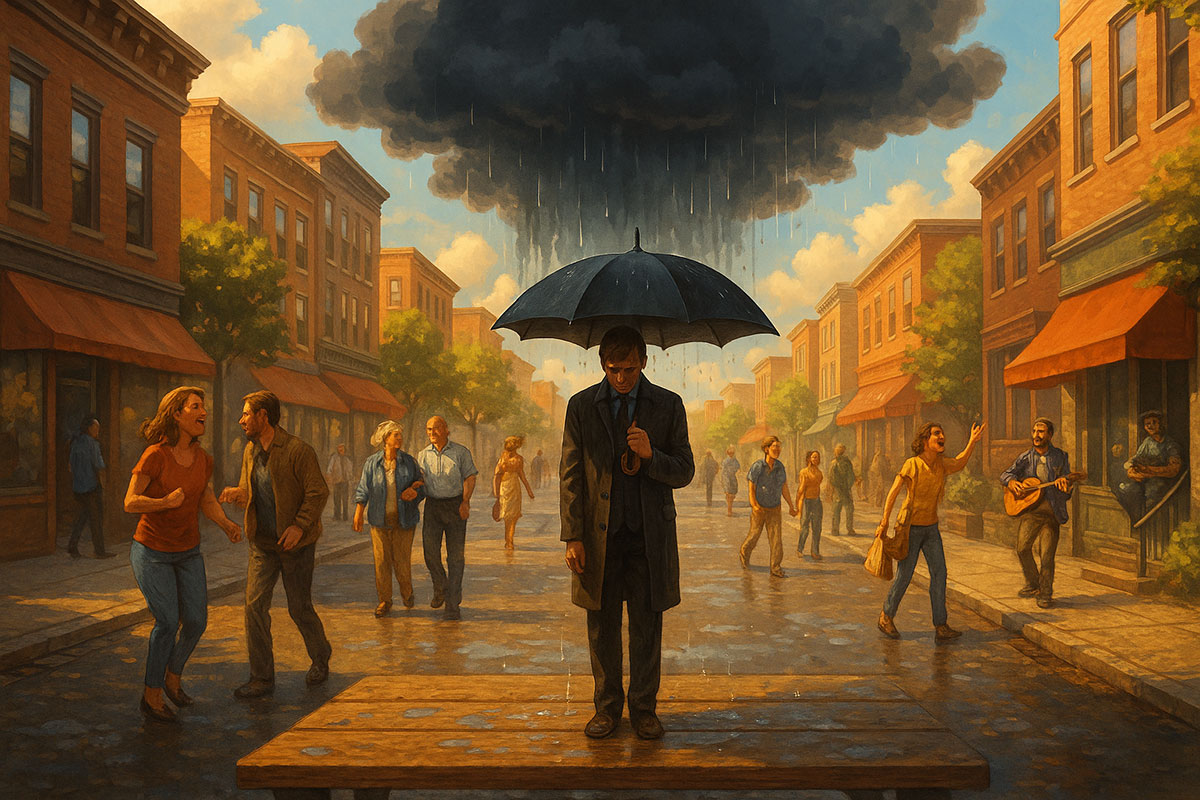
Topic 3: Catastrophizing & Awfulizing — Why We Suffer Twice
Moderator:
Robin Williams – Fast, funny, and fearless, mixing comedic jabs with deep empathy.
Panelists:
Loretta LaRoche, Brené Brown, Ricky Gervais, Albert Ellis (imagined, since Loretta referenced him), Elizabeth Gilbert
Robin Williams: Alright, friends—tonight we’re tackling catastrophizing. That’s when you see a dark cloud and immediately start Googling “ark construction plans.” Loretta, this was your line in the sand in your talk—why do we do this to ourselves?
Loretta LaRoche: Because it makes us feel prepared! Or at least that’s the story we tell ourselves. But what really happens is we live through the bad thing twice—once in our head, and once if it actually happens.
Brené Brown: Fear loves to run ahead of us. Catastrophizing is often a way to avoid vulnerability—we think if we imagine the worst, we won’t be blindsided. But vulnerability isn’t weakness—it’s the courage to stay present.
Ricky Gervais: Yeah, but you’ve got to admit—sometimes we enjoy the drama. “Oh no, the milk’s gone off, society is collapsing!” It’s absurd. That’s why I make fun of it—it’s the only way to stop myself from joining in.
Albert Ellis: (chuckling) Rational Emotive Behavior Therapy teaches that it’s not the event, but our belief about the event, that creates our distress. If you train your brain to question irrational thoughts, catastrophizing loses its grip.
Elizabeth Gilbert: And for creative people, this spiral can be dangerous—it kills inspiration. If you think the worst before you even start, you’ll never write the book, paint the canvas, or take the trip.
Robin Williams: So what’s the deal—are we hardwired to do this, or are we just bad at mental feng shui?
Loretta LaRoche: Some of it’s cultural. I grew up with relatives who could turn a weather forecast into an opera. “Cloudy today? Oh Madonna mia! We’ll never see the sun again!”
Brené Brown: And some of it is survival instinct gone rogue. Our ancestors had to assume the rustle in the bushes might be a tiger. Now it’s the Wi-Fi going down and we’re acting like it’s the apocalypse.
Ricky Gervais: Right, except the tiger was real. The Wi-Fi is just you having to talk to your family for five minutes.
(Laughter)
Albert Ellis: We also reinforce it socially. Complainers find each other. It’s the “misery loves company” club.
Elizabeth Gilbert: But if we can build those groups, we can also rewire them into optimism circles—sharing best-case scenarios instead.
Robin Williams: Okay, let’s imagine this—someone here is a champion catastrophizer. They wake up, the coffee machine’s broken, and suddenly they’re picturing bankruptcy, divorce, and life in a cardboard box. What’s your quick intervention?
Ricky Gervais: I’d tell them, “You’re right—start practicing your cardboard box decorating skills now.” Sometimes you’ve got to mock the fear to shrink it.
Loretta LaRoche: I’d hand them a clown nose. Try having a meltdown with that on—it’s impossible.
Albert Ellis: I’d ask, “Where’s the evidence for that conclusion?” If you can’t prove the chain of disaster, your brain loses the case.
Brené Brown: I’d invite them to sit with the discomfort instead of outrunning it. Sometimes naming the fear out loud takes away its shadow power.
Elizabeth Gilbert: I’d remind them to play. You can’t spiral and play at the same time—your brain won’t let you.
Robin Williams: I love that—fear and play can’t share the same sandbox. So, here’s my next question—what’s the danger of living this way long-term?
Albert Ellis: Chronic catastrophizing leads to chronic anxiety, which takes a toll on both mental and physical health.
Brené Brown: It also isolates us. People tire of constant worst-case talk. It’s exhausting to be around.
Elizabeth Gilbert: And it robs us of joy. You can’t savor a beautiful moment if you’re rehearsing how it might collapse.
Loretta LaRoche: Plus, it’s boring. Nobody wants to be at a dinner party with the Grim Reaper of hypotheticals.
Ricky Gervais: Unless the Grim Reaper is funny. Then I’ll have him over.
(Laughter)
Robin Williams: Let’s lighten it up before we wrap. Finish this sentence: “If I stopped catastrophizing tomorrow, I would…”
Loretta LaRoche: …have more space in my head for laughter—and maybe learn Italian for real instead of just yelling it.
Brené Brown: …love more freely without armor.
Ricky Gervais: …have to find a new hobby. Maybe birdwatching.
Albert Ellis: …spend my energy solving real problems instead of imaginary ones.
Elizabeth Gilbert: …finally buy that ticket for the trip I’ve been dreaming about.
Robin Williams: …and I’d stop imagining the stage collapsing every time I walk out here. But, you know, just in case, I’ve planned my exit line.
Robin Williams: Here’s the takeaway, my friends—if you think the worst and it happens, you suffer twice. If you think the best and the worst happens, you suffer once. And if you think the best and the best happens? Well, then you get to dance in the kitchen like nobody’s watching… until your neighbor films it.
(Applause, laughter, and one guy muttering about cardboard box décor)
Topic 4: You Are the Fun — How to Stop Waiting and Start Laughing

Moderator:
Robin Williams – The human spark plug of joy, flipping between absurd humor and moments of deep connection.
Panelists:
Loretta LaRoche, Jimmy Fallon, Kristen Bell, Deepak Chopra, James Corden
Robin Williams: Alright, folks, here’s the truth—half of you are sitting around waiting for fun like it’s Amazon Prime delivery. “It’ll be here between 2 and 4 p.m.” No! You are the fun. So, Loretta, tell me—why do people wait instead of create?
Loretta LaRoche: Because they think fun is something that happens to them, not something they generate. People say, “I wish something funny would happen,” and I say, “Then do something funny!” Wear a silly hat to the grocery store. Start small.
Jimmy Fallon: Totally. If you’re waiting for someone else to bring the fun, you’re putting your happiness in their hands. And have you seen some people’s hands? Not reliable.
Kristen Bell: I think people are scared of looking foolish. They think being silly means being immature. But some of the happiest moments in my life were when I leaned into total ridiculousness.
Deepak Chopra: Joy is our natural state. We lose it when we externalize the source. If you awaken to the idea that you are the wellspring of your own laughter, you realize the party starts when you show up.
James Corden: And sometimes, you just need to initiate. I’ve started singalongs in places where people didn’t even want to talk—and by the end, they’re belting out “Bohemian Rhapsody.”
Robin Williams: So, what stops people from turning the fun switch to “on”?
Loretta LaRoche: Self-consciousness. They think they’re being judged. And maybe they are—but who cares? Those people aren’t sending you birthday cards anyway.
Jimmy Fallon: There’s also this “cool factor” problem. Everyone’s afraid to be uncool, but the coolest people are the ones having the most fun.
Kristen Bell: Social media plays a role—people think fun has to be Instagrammable. It doesn’t. Sometimes the best moments are messy, private, and impossible to post.
Deepak Chopra: We also mistake distraction for joy. Watching videos endlessly is not the same as creating connection through laughter.
James Corden: Honestly, some people think they need permission to have fun. So—permission granted. Go be a goof.
Robin Williams: Let’s get practical—give me one thing you do to spark fun out of nowhere.
Jimmy Fallon: I make up a fake award and give it to someone on the spot. “Best Laugh of the Day” or “Champion of Carrying Groceries.”
Kristen Bell: I turn ordinary chores into competitions. Folding laundry? Timed race.
Deepak Chopra: I practice mindful play—fully immersing myself in a lighthearted activity, without judgment or outcome.
Loretta LaRoche: I keep a prop box—hats, glasses, wigs. Instant mood shift.
James Corden: I blast music in public and see who dances first. Then I join them.
Robin Williams: (laughing) That’s it. Spontaneous public choreography. It’s like flash mobs, but with lower stakes and higher awkwardness.
Robin Williams: Let’s talk about the benefits—what happens when you are the fun?
Loretta LaRoche: You become magnetic. People want to be around you because you lift the energy of the room.
Jimmy Fallon: You also stop waiting for the weekend to be happy. Every day becomes a chance for a good story.
Kristen Bell: And you show others that joy is accessible. You give them permission to drop their guard.
Deepak Chopra: From a health perspective, joy boosts immune function, reduces stress, and even improves brain chemistry.
James Corden: Plus, you make better memories. Years from now, no one will talk about the emails you sent—they’ll talk about the ridiculous lip-sync battle you started at the staff party.
Robin Williams: Before we wrap, finish this sentence: “If I decided to be the fun today, I would…”
Loretta LaRoche: …wear a feather boa to my next Zoom meeting and never explain it.
Jimmy Fallon: …start a “laugh relay” where you have to make the next person laugh without words.
Kristen Bell: …make pancakes shaped like animals and give them personalities.
Deepak Chopra: …turn a walk into a game of noticing beauty in unexpected places.
James Corden: …sing show tunes in the grocery store produce section.
Robin Williams: …show up here in a full clown suit and act like it’s totally normal. “What? I always moderate in a red nose and giant shoes.”
Robin Williams: Here’s the deal—life’s too short to be the audience all the time. Be the show. Be the weird neighbor, the surprise singer, the one who makes people grin for no reason. The world doesn’t just need more fun—it needs your fun.
(Applause, laughter, and at least one audience member mentally ordering a feather boa)
Topic 5: Laughing at Ourselves — The Humble Cure for Stress
awareness into an art form.
Panelists:
Loretta LaRoche, Tina Fey, Trevor Noah, Dalai Lama, Amy Poehler
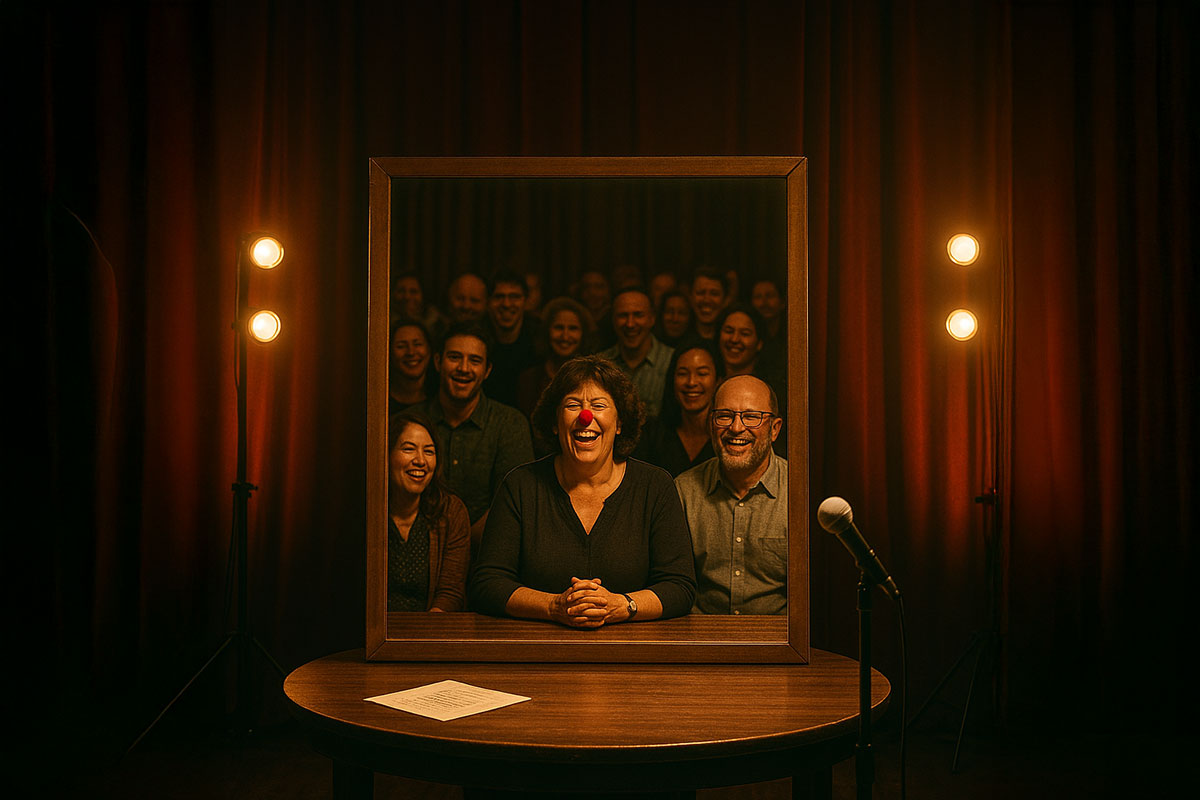
Robin Williams: You know, if we could all laugh at ourselves, therapy bills would drop, blood pressure would fall, and mirrors would become comedy clubs. Loretta, you’ve been championing this for decades—why is laughing at ourselves so powerful?
Loretta LaRoche: Because it kills the ego before it kills us. When we take ourselves too seriously, we become brittle. Humor makes us bend instead of break.
Tina Fey: And it’s the cheapest PR campaign you’ll ever run. If you make fun of yourself first, you take the ammo away from everyone else.
Trevor Noah: I grew up in a world where tension was everywhere—political, racial, cultural. Laughing at myself was the quickest way to disarm people and show I wasn’t a threat.
Dalai Lama: (smiling) When you laugh at yourself, you accept your imperfections. Then, you can be free. If you cannot laugh, you are prisoner of your own image.
Amy Poehler: Plus, it makes you human. Perfect people are boring. I’d rather be the person who trips onstage and turns it into a dance.
Robin Williams: But why do some folks resist? Is it pride, fear, or the secret belief that they’re just too important?
Loretta LaRoche: All of the above. Some people think self-deprecating humor means weakness, when it actually shows confidence.
Tina Fey: And some are just afraid someone will believe the joke. I’ve had people say, “Don’t put yourself down, Tina!” I’m not putting myself down—I’m building a bridge.
Trevor Noah: There’s also cultural conditioning. In some places, admitting flaws feels dangerous. Humor turns that admission into connection.
Dalai Lama: Ego resists humility. Laughter melts ego. This is why leaders who can laugh at themselves inspire trust.
Amy Poehler: And let’s be honest—people are terrified of losing face. But you can’t lose face if you’ve already turned it into a punchline.
Robin Williams: Let’s get hands-on. Say you mess up in public—drop your lunch tray, forget your speech, trip on the sidewalk. How do you turn that into laughter instead of shame?
Tina Fey: Commentate on it like a sports announcer: “And she’s down! But she recovers with grace and… wait, she’s bowing to the crowd!”
Trevor Noah: Pretend it was intentional. If I trip, I’ll say, “That’s step one of my new dance—watch step two.”
Dalai Lama: I smile. I say, “Ah, my body is reminding me to be humble.”
Amy Poehler: Overplay it. If I spill coffee, I’ll grab a straw and start sipping from the puddle.
Loretta LaRoche: I look around, lock eyes with someone, and say, “Did you see that? I’ve been rehearsing for weeks.”
Robin Williams: (grinning) And if all else fails, you pretend you’re auditioning for a slapstick film. “Mr. Chaplin, I’m ready for my close-up!”
Robin Williams: What’s the big payoff when we make this shift?
Dalai Lama: Peace. Without ego’s constant defense, there is calm.
Trevor Noah: You get resilience. You can bounce back faster because you’re not wasting energy on protecting your pride.
Tina Fey: People trust you more. If you can own your flaws, they believe you can own your mistakes.
Amy Poehler: You become fun to be around. Nobody wants to hang out with a perfection robot.
Loretta LaRoche: And you age better—mentally and emotionally. Laughter keeps you light.
Robin Williams: Alright, last game—finish this sentence: “If I laughed at myself more often, I would…”
Loretta LaRoche: …stress less, and maybe finally wear that ridiculous hat in public.
Tina Fey: …stop worrying about how I look in photos and start photobombing strangers.
Trevor Noah: …make friends in every airport line I’ve ever stood in.
Dalai Lama: …bring more joy to others, and to myself.
Amy Poehler: …turn every disaster into a comedy sketch.
Robin Williams: …and I’d stop fearing failure, because at least it would be funny.
Robin Williams: Here’s the truth—laughing at yourself doesn’t make you small. It makes you big enough to hold the whole messy, wonderful picture of who you are. And when we can all do that, the world becomes a little less serious, a little less scary, and a whole lot more human.
(Applause, laughter, and one audience member practicing a mock bow after pretending to trip)
Final Thoughts By Loretta LaRoche
Well, we’ve covered a lot — from slowing down enough to taste life, to knocking on your neighbor’s door just to share a laugh, to shutting down the “what if” catastrophe machine that lives in your head. And if there’s one thing I hope sticks, it’s this: you don’t need perfect circumstances to have a joyful life. You just need the guts to see the humor in it, even when it’s a little messy — especially when it’s a little messy.
Laughter doesn’t erase our problems, but it sure makes them easier to carry. And when we share that laughter — across fences, across generations, across all the little divides we’ve built — we remember that we’re not alone in this circus.
So go ahead: wear the silly hat, talk to the pigeons, laugh when you trip, and for heaven’s sake, don’t wait for fun to show up. Be the fun. If you can do that, you’ll find that stress may still knock on your door — but it won’t stay long, because it won’t be able to compete with the party you’re throwing in your own heart.
Short Bios:
Loretta LaRoche – Humorist, author, and stress management expert known for her signature blend of wit and wisdom, inspiring audiences to find joy and perspective in everyday life.
Eckhart Tolle – Spiritual teacher and bestselling author of The Power of Now, recognized for his insights on mindfulness, presence, and inner peace.
Jerry Seinfeld – Stand-up comedian, actor, and creator of the sitcom Seinfeld, celebrated for his sharp observational humor about the small details of everyday life.
Arianna Huffington – Founder of The Huffington Post and Thrive Global, advocating for well-being, balance, and redefining success beyond work achievements.
Shawn Achor – Positive psychology researcher and author of The Happiness Advantage, specializing in the science of happiness and its impact on performance.
Fred Armisen – Comedian, actor, and musician known for Saturday Night Live and Portlandia, blending character-driven humor with cultural satire.
Bob Goff – Author of Love Does and motivational speaker, encouraging whimsical acts of kindness and intentional living.
Malcolm Gladwell – Journalist and bestselling author of Outliers and The Tipping Point, exploring hidden patterns in human behavior and society.
Maria Shriver – Journalist, author, and advocate for women’s empowerment and Alzheimer’s awareness, blending storytelling with social impact.
Brené Brown – Research professor and bestselling author on vulnerability, courage, and connection, including Daring Greatly and Atlas of the Heart.
Ricky Gervais – Comedian, actor, and creator of The Office, known for his sharp, often provocative humor and social commentary.
Albert Ellis – Psychologist and founder of Rational Emotive Behavior Therapy (REBT), pioneering cognitive approaches to emotional well-being.
Elizabeth Gilbert – Author of Eat Pray Love and Big Magic, offering insights on creativity, curiosity, and overcoming fear.
Jimmy Fallon – Comedian, actor, and host of The Tonight Show, bringing playfulness, music, and audience interaction to late-night television.
Kristen Bell – Actress and philanthropist known for roles in The Good Place and Frozen, celebrated for her down-to-earth humor and advocacy work.
Deepak Chopra – Physician, spiritual teacher, and author of numerous books on mind-body health, meditation, and consciousness.
James Corden – Comedian, actor, and host of The Late Late Show, famous for Carpool Karaoke and infectious energy.
Tina Fey – Comedian, writer, and actress best known for Saturday Night Live and 30 Rock, admired for her intelligent, self-deprecating humor.
Trevor Noah – Comedian and former host of The Daily Show, blending political insight with personal storytelling from his South African upbringing.
Dalai Lama – Spiritual leader of Tibetan Buddhism, Nobel Peace Prize laureate, and global advocate for compassion, humility, and joy.
Amy Poehler – Comedian, actress, and writer known for Parks and Recreation, championing optimism, improvisation, and empowerment.
Leave a Reply