
|
Getting your Trinity Audio player ready...
|
What if Julian Treasure tested modern communication experts on why nobody listens anymore?
Introduction — Julian Treasure
How to Speak So That People Want to Listen is not really a talk about speaking. It is a talk about the conditions that make listening possible.
We live in an age where everyone has a microphone and very few have an audience. Not because people have nothing to say, but because trust has become rare. When words carry judgment, certainty, or hidden agendas, the human mind protects itself by tuning out. Listening is a gift we grant to voices that feel safe.
In this conversation we explore why people stop listening, how honesty differs from authenticity, how the voice reveals the inner state, and why listening itself is the foundation of influence. The goal is not to sound impressive. The goal is to sound human enough that another person wants to stay present.
Because communication does not begin with sound.
It begins with intention.
(Note: This is an imaginary conversation, a creative exploration of an idea, and not a real speech or event.)
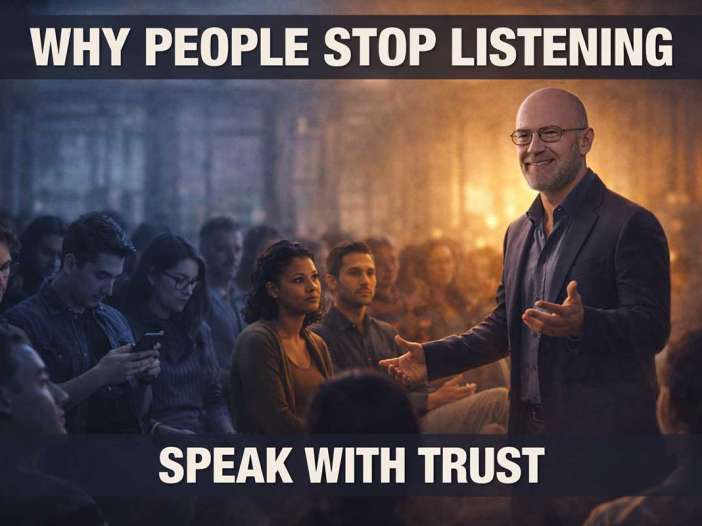
Topic 1: Why People Stop Listening

Julian Treasure:
Welcome. This talk began for me with a simple, painful observation. Many people speak every day, yet fewer and fewer people feel listened to, and fewer and fewer people feel worth listening to. When communication breaks, it’s rarely because someone lacked clever words. It’s because trust eroded.
Let’s go deep with the first question.
What causes people to tune out instantly, even when the speaker is right?
Brené Brown:
People tune out when they sense shame, contempt, or superiority. Even if you’re right, if the emotional message is “I’m above you,” the listener’s nervous system goes into defense. They stop receiving information and start protecting themselves. Rightness without connection becomes noise.
Chris Voss:
Certainty delivered with pressure makes people shut down. When someone sounds like they’re trying to win instead of understand, the listener feels trapped. Even if the content is correct, the tone says, “You don’t get a say.” That triggers resistance fast.
Deborah Tannen:
Often it’s not what is said, but the conversational style. People tune out when the speaker seems to be issuing pronouncements rather than engaging. If the listener feels their perspective will be dismissed, they stop investing attention. Communication needs signals of mutuality.
Adam Grant:
Listeners tune out when they sense the speaker isn’t curious. If you’re “right” but you’re not open to being wrong, people interpret that as ego, not expertise. The fastest way to lose attention is to remove the possibility of dialogue.
Marshall Rosenberg:
People tune out when they hear blame. Even truthful statements can land like attacks if they are framed as judgments about character. When people hear criticism, they stop hearing needs. They hear danger. And when they hear danger, listening ends.
Julian Treasure:
So even truth can be delivered in a way that makes it unusable. The listener isn’t rejecting the facts. They’re rejecting the emotional environment around the facts.
Now the second question.
Which of the 7 deadly speaking habits is most toxic in modern life, and why?
Brené Brown:
Judging. Because it’s often disguised as “just being honest.” Judging triggers shame, and shame kills curiosity. Modern life already has enough public evaluation. When a person feels judged, they stop growing and start hiding.
Chris Voss:
Dogmatism. Because it closes the door. If your language communicates “this is the only valid view,” you force the other person into either surrender or fight. In negotiation, dogmatism is the fastest way to get people to dig in.
Deborah Tannen:
Negativity is especially toxic because it becomes the background hum of conversation. People can tolerate disagreement, but constant negativity makes communication exhausting. It teaches listeners that speaking with you will drain them.
Adam Grant:
Complaining. Not because problems shouldn’t be named, but because chronic complaining signals helplessness and spreads cynicism. It creates a culture where people bond through despair instead of solutions. Over time, listeners associate the speaker with emotional depletion.
Marshall Rosenberg:
Blame, which often appears through judging and complaining. Blame is toxic because it hides needs. Instead of saying, “I need respect” or “I need support,” we say, “You’re wrong.” That guarantees the other person will defend themselves rather than care about what matters.
Julian Treasure:
That’s powerful. The deadly habits all have one thing in common. They remove safety. Once safety is gone, listening becomes impossible.
Now the third question.
How do you repair trust after you have become a person others avoid listening to?
Brené Brown:
Start with ownership. Name what you’ve been doing without excuses. When people hear accountability, they soften. Then rebuild with small consistent changes. Trust is not restored through one grand apology. It’s restored through repeated moments of integrity.
Chris Voss:
Listen first, without defending. Use labels like “It sounds like I’ve been coming off as dismissive” and then stay quiet. People need to feel heard before they can trust again. Also, ask calibrated questions. “What would respectful communication look like to you?” That gives them power and lowers resistance.
Deborah Tannen:
Shift your style from pronouncement to participation. Signal that conversation is a shared activity, not a performance. Repair happens when listeners sense you genuinely want a relationship, not just an outcome.
Adam Grant:
Replace certainty with curiosity. If you’ve been dogmatic, practice saying, “I might be wrong” and mean it. If you’ve been negative, practice asking, “What’s one thing we can do?” Curiosity is a trust magnet because it communicates respect.
Marshall Rosenberg:
Move from judgments to needs. Instead of “You never listen,” say, “I feel hurt and I need to know my words matter to you.” And invite the other person’s needs too. Trust returns when people feel you are speaking from humanity, not from superiority.
Julian Treasure:
Let me close this topic with the heart of it. People don’t only listen to words. They listen to intention. If your speech carries blame, certainty, and negativity, people will protect themselves. If your speech carries honesty, authenticity, integrity, and goodwill, people lean in.
In the next topic, we’ll explore that foundation directly, the HAIL framework and how to make it real without sounding performative.
Topic 2: HAIL, The Trust Foundation Behind Every Great Speaker

Brené Brown:
We’re going to talk about what makes a voice trustworthy. Not polished. Not clever. Trustworthy. Julian’s HAIL framework is a great map. Honesty, Authenticity, Integrity, and Love, meaning goodwill. But maps are easy. Living it is hard.
So let’s begin.
How do honesty and authenticity differ, and why do audiences detect the difference fast?
Julian Treasure:
Honesty is about the truth of the message. Authenticity is about the truth of the messenger. You can speak honest facts with an inauthentic tone, and people feel it immediately. Authenticity is congruence. It’s when your words, your voice, and your intentions line up. People can sense mismatch before they can explain it.
Carl Rogers:
I would say authenticity is congruence with the self. Honesty is saying what is accurate. Authenticity is being what you say. People detect it because human beings are sensitive to incongruence. When the inner experience and outer expression do not match, the relationship feels unsafe.
Maya Angelou:
People can tell when a person is performing goodness instead of living it. Honesty can be cold. Authenticity has warmth. It sounds like a human being, not a mask. And the ear, like the heart, knows when it is being fed a script.
Stephen Covey:
Honesty without authenticity becomes a technique. Authenticity without honesty becomes self-indulgence. The difference is alignment. When people see that your values shape your actions, they believe you. When they see inconsistency, they question everything else you say.
Simon Sinek:
Authenticity is when your why shows up in your tone and behavior, not just in your content. People detect the difference because trust is not built by information. It’s built by patterns. One mismatch can undo a hundred correct statements.
Brené Brown:
So honesty is the facts. Authenticity is the soul behind the facts.
Now the second question.
What does “integrity” sound like in everyday speech, not as a slogan?
Julian Treasure:
Integrity sounds like consistency and clarity. It sounds like you don’t say one thing to one person and another thing to someone else. It sounds like you can say no without cruelty and yes without resentment. And it sounds like you admit mistakes quickly.
Carl Rogers:
Integrity sounds like transparent intention. It is when the speaker is not trying to control the listener. The message is offered, not imposed. In everyday speech, integrity is heard in a lack of manipulation, a steadiness, and a respect for the other person’s autonomy.
Maya Angelou:
Integrity sounds like a person who will not trade their truth for applause. They do not flatter and they do not poison. They speak plainly, but with care. Integrity is the voice that remains the same whether the room is cheering or judging.
Stephen Covey:
Integrity is keeping promises. It sounds like follow-through. In speech, it shows up as specific commitments and honest limits. You don’t overpromise. You say, “Here is what I can do, and here is what I cannot.” People trust that.
Simon Sinek:
Integrity sounds like alignment between words and decisions. If you say you value people, then you talk about people with respect when they are not in the room. That’s the test. Integrity is what your voice does when there is no audience.
Brené Brown:
Yes. Integrity is not a message. It’s a pattern.
Now the third question.
How can “love” in speaking be practiced without sounding fake or overly sentimental?
Julian Treasure:
Love here means goodwill. It means you want the listener to flourish. The simplest practice is to ask yourself before you speak, “Is what I’m about to say going to nourish or diminish?” That question changes tone immediately without a single sentimental word.
Carl Rogers:
In my language, it is unconditional positive regard. Not agreement. Regard. You can disagree and still convey respect. Love in speaking is heard when the listener feels safe to be themselves in your presence.
Maya Angelou:
Love does not have to be announced. It has to be carried. If you speak with love, people feel larger afterward, not smaller. That is the test. You can speak hard truths with love, but you cannot speak love while trying to humiliate.
Stephen Covey:
Love in speaking is seeking mutual benefit. It means you are not trying to win at the other person’s expense. You speak in ways that build trust, because you care about the relationship beyond the moment.
Simon Sinek:
Love in leadership language is service. It’s saying, “I’m responsible for the environment we create together.” When people feel you are serving something bigger than your ego, they don’t need sentimentality. They feel respect.
Brené Brown:
Let me close this topic with the practical truth. HAIL is not a performance. It is a way of being. If you try to sound honest, people will feel the effort. If you become honest, people will feel the calm.
In the next topic, we shift from intention to instrument. The voice itself. Tone, pace, resonance, silence, and the daily practices that make people want to listen before you even finish your first sentence.
Topic 3: The Voice Instrument, Tone, Timbre, and the Physics of Presence

Nancy Duarte:
People often think speaking is about words. But audiences respond to sound before they process meaning. The voice is an instrument. You can have a brilliant idea and still lose the room if your delivery signals tension, uncertainty, or disconnection.
So let’s start here.
What vocal changes create instant credibility, and which ones destroy it?
Julian Treasure:
Credibility comes from a voice that sounds grounded and intentional. A steady pace, clear articulation, and a tone that feels calm rather than hurried. Silence is powerful too, it signals confidence.
Credibility is destroyed by monotone, vocal fry that makes you sound disengaged, and rushed speed that tells people you are anxious or trying to push something through.
Roger Love:
Breath support is the foundation. When breath is shallow, the voice wobbles, rises, and strains. People hear that as uncertainty. When breath is supported, the voice becomes fuller and more stable.
Also, avoid ending every sentence upward like a question. That pattern can weaken authority even when you’re certain.
Annette Schiavone:
Resonance matters. When you speak from the throat, the voice can sound thin or tight. When you place the sound lower and let it resonate, the voice sounds more confident and warm.
Credibility is destroyed when tension is audible. Tight jaw, tight neck, breath held. The audience senses it immediately.
Lisa Feldman Barrett:
People interpret vocal cues as emotional signals. A strained voice can be read as stress. A flat voice can be read as boredom or detachment. A sharp voice can be read as threat.
Even if your content is friendly, your vocal cues may communicate danger. Credibility is often a match between the emotion people hear and the message they expect.
Matthew McConaughey:
People believe you when you sound like you believe you. That means slow down. Let words land. Don’t chase the sentence. Let it walk.
What destroys credibility is when you sound like you’re auditioning for approval. The audience can smell that. Ground your feet. Speak like you’re telling the truth, not selling it.
Nancy Duarte:
So credibility is not volume or aggression. It’s grounded clarity.
Now the second question.
How do emotion and body state shape voice, even when we try to hide it?
Julian Treasure:
The voice is a mirror of the inner state. If you’re anxious, your breath changes. If your breath changes, your voice changes. Even if you try to mask it with words, the audience hears the truth beneath.
So if you want to speak better, you begin by calming the body.
Roger Love:
Posture and breath determine tone. If your shoulders are raised, the breath becomes shallow. If the breath is shallow, the voice becomes thin and fast.
You can’t fake calm. You have to build it physically.
Annette Schiavone:
Muscle tension changes vocal color. Jaw tension makes consonants harsh. Neck tension compresses sound. Even facial tension reduces warmth.
The body is the instrument. The voice is the sound it produces.
Lisa Feldman Barrett:
Emotion is the brain’s prediction about the body in context. When the brain predicts threat, it prepares the body for defense. That shifts breath, heart rate, and muscle tone. Those shifts are audible.
So “hiding emotion” often fails because the body is already broadcasting it.
Matthew McConaughey:
You can’t lie with your voice for long. The voice tells the room whether you’re present. If you’re trying to hide fear, your voice gets tight. If you’re present, your voice gets honest.
So the move is not to hide it. The move is to breathe, ground yourself, and speak from where you are.
Nancy Duarte:
That’s the key. Presence is physiological.
Now the third question.
What is the simplest daily practice that upgrades voice quality in 7 days?
Julian Treasure:
Two minutes of humming and one minute of reading aloud slowly. Humming warms the resonators. Reading slowly builds control and intention. Also, record yourself briefly each day. Awareness is the fastest accelerator.
Roger Love:
Breath drills. Five slow belly breaths, then speak one paragraph on a full steady exhale. This trains support. The voice becomes richer and more stable quickly because the body is doing the work.
Annette Schiavone:
Jaw release and tongue relaxation. Gentle jaw drops, tongue stretches, then speak with soft articulation. Many people don’t realize how much tension they carry in the mouth. Release that and the voice becomes clearer and more pleasant almost immediately.
Lisa Feldman Barrett:
Practice emotional labeling before speaking. Take ten seconds and name your state. Nervous. Excited. Tired. That reduces ambiguity and helps regulate the body. A regulated body produces a regulated voice.
Matthew McConaughey:
Slow down on purpose. Every day, choose one conversation where you talk 20 percent slower than normal. Not weird slow, just intentional. You’ll feel uncomfortable at first, but you’ll sound calm and confident. And people will lean in.
Nancy Duarte:
Let me close this topic with a practical truth. The voice is not separate from character. It’s connected to breath, body, and intention. If you want people to want to listen, you must sound like a person who is present, not a person who is performing.
In the next topic, we go to the missing half of speaking. Listening. Because the fastest way to change your voice is to change how deeply you listen to the person in front of you.
Topic 4: Listening First, The Missing Half of Speaking

Chris Voss:
Most people think communication is about what they say. In reality, influence begins with what you hear. If the other person doesn’t feel understood, your words land like pressure, even if they’re kind. Listening is not passive. It’s a tool that changes the emotional climate in the room.
Let’s begin with this.
Why does better listening instantly make you a better speaker?
Julian Treasure:
Because listening shapes intention. When you truly listen, your goal shifts from performing to connecting. Your voice becomes more responsive, your words become more relevant, and your tone carries respect. People want to listen to those who first make them feel heard.
Thich Nhat Hanh:
Deep listening is an act of love. When you listen without trying to fix or judge, you create space for suffering to soften. A speaker who listens deeply does not throw words like stones. They speak like water. They choose words that heal, not words that win.
David Bohm:
Listening changes the whole structure of dialogue. In true dialogue, the aim is not to defeat the other person’s view but to explore meaning together. When listening is shallow, speaking becomes assertion. When listening is deep, speaking becomes inquiry. That shift changes everything.
Deborah Tannen:
Better listening also reveals conversational style differences. Many conflicts are not about disagreement but about mismatched expectations, interruptions, directness, pacing. When you listen for style, you stop taking everything personally and can adapt your speaking so it fits the listener’s world.
Esther Perel:
Listening makes you a better speaker because it turns your words into a response rather than a performance. In relationships, people don’t want the perfect sentence. They want the sentence that proves you understand their inner reality. Listening gives you access to that reality.
Chris Voss:
Good. So speaking improves because listening provides accuracy, emotional safety, and relevance.
Now the second question.
What is the difference between listening to respond and listening to understand?
Julian Treasure:
Listening to respond is strategic. You’re waiting for your turn. Listening to understand is receptive. You’re letting the other person’s meaning land before you decide what you think. Most people don’t realize how loud their inner commentary is. Understanding begins when the commentary quiets.
Thich Nhat Hanh:
Listening to respond is still about the self. Listening to understand is about compassion. When you listen to understand, you are not building a weapon. You are building a bridge. You become present. You breathe. You allow the other person to exist without being corrected.
David Bohm:
Listening to respond reinforces fragmentation because it keeps each person defending a position. Listening to understand suspends judgment. It creates a shared field where new meaning can emerge. Dialogue requires suspension, the willingness to hold your assumptions without gripping them.
Deborah Tannen:
Listening to respond often looks like problem solving, advice, or debate. Listening to understand looks like mirroring, clarifying questions, and acknowledging what matters to the other person. Many people think they are helping when they are actually redirecting the conversation back to themselves.
Esther Perel:
Listening to respond is often a way to manage anxiety. You want control. You want resolution. Listening to understand tolerates ambiguity. It lets someone be complicated. In intimacy, understanding is often more valuable than solutions.
Chris Voss:
That’s exactly right. People don’t want to be fixed before they’re understood.
Now the third question.
How do you speak truthfully in conflict without triggering defensiveness?
Julian Treasure:
First, check your intention. If your intention is to win, your voice will betray you. Then speak from observation and need, not accusation. Use a warm tone, steady pace, and invite dialogue. Even hard truths can be spoken in a way that feels safe.
Thich Nhat Hanh:
Speak with mindful breathing. When anger is present, do not speak quickly. Speak after you have returned to calm. Tell the truth, but do not punish. When you speak with compassion, the other person can hear you even if the message is painful.
David Bohm:
Conflict becomes destructive when people cling to certainty. You can speak truthfully by expressing your experience as experience, not as absolute reality. Say, “This is how it seems to me” and invite exploration. That reduces threat and keeps conversation open.
Deborah Tannen:
Use framing that acknowledges the relationship. Instead of “You always,” say “When this happens, I feel.” Avoid global judgments. Also, notice style differences. Some people experience directness as attack, others experience indirectness as manipulation. Adapt your style to the person.
Esther Perel:
In conflict, people listen for whether you respect them. You can speak truthfully and still convey dignity. Name what you want, name what you feel, and name what you fear losing. The most disarming truths are the vulnerable ones, not the accusatory ones.
Chris Voss:
Let me close this topic with a principle from negotiation. The fastest path to influence is not pressure. It is understanding. When someone feels heard, their nervous system calms. When it calms, your words can land.
In the final topic, we’ll confront the hardest environment for real listening and real speaking. A polarized world. How do you speak with conviction without becoming dogmatic, and how do you stay humane when the room feels hostile?
Topic 5: Speaking in a Polarized World Without Becoming the Problem

Adam Grant:
We’re living in a time when many conversations feel like traps. People are primed to assume the worst. They listen for ammunition, not understanding. And when that becomes normal, even well-intended speakers start sounding like threats.
So the question is not only how to speak well. It’s how to speak in a way that lowers heat and raises truth.
Let’s begin.
How do we speak with conviction without sliding into dogmatism?
Julian Treasure:
Conviction comes from clarity. Dogmatism comes from closure. You can hold a strong view while still leaving space for learning. The voice of conviction says, “This matters to me and here’s why.” The voice of dogmatism says, “This is the only acceptable view.” People can feel the difference immediately.
Jonathan Haidt:
Dogmatism often arises from moral certainty, and moral certainty feels good. It rewards the speaker with a sense of righteousness. But if you want to persuade or connect, you have to acknowledge moral complexity. A practical method is to state the best version of the other side’s argument before stating your own. That signals humility and reduces tribal threat.
Yuval Noah Harari:
Humans live inside stories. Dogmatism happens when a story becomes sacred and cannot be questioned. Conviction can remain flexible when you remember that your story is a lens, not reality itself. The safeguard is curiosity. Ask, “What facts could change my mind?” If the answer is “none,” you have entered dogma.
Iyanla Vanzant:
Dogmatism is often pain disguised as principle. When people feel unseen, they cling harder to certainty. Conviction with love says, “I believe this and I still see you.” Dogmatism says, “I believe this and you are wrong as a person.” Speak to the heart, not just the argument.
Jon Ronson:
Dogmatism has a tone. It’s brittle. It can’t laugh. It can’t tolerate nuance. Conviction can be firm and still human. If you can’t admit you might be wrong about something, you’re not convincing. You’re recruiting.
Adam Grant:
So conviction is strong belief with openness. Dogmatism is strong belief with contempt.
Now the second question.
What communication habits reduce polarization in real conversations, not just online theory?
Julian Treasure:
Stop speaking in absolutes. Replace “always” and “never” with specific observations. Ask questions that invite reflection. And use tone deliberately. A calm voice can lower the temperature in the room. You don’t match heat with heat if your goal is understanding.
Jonathan Haidt:
Build relationships before disagreements. Polarization drops when people share human experiences. Also, ask, “What life experience led you to believe that?” That question moves the conversation away from slogans and toward stories, which are less tribal and more personal.
Yuval Noah Harari:
Be careful with identity language. When you attack someone’s identity group, you strengthen the group’s internal bonds. So speak about behaviors and policies rather than labeling people as evil. The moment people feel their identity is under attack, truth becomes secondary to loyalty.
Iyanla Vanzant:
Slow down. Most polarization is speed. People react without processing. Create pauses. Mirror what you heard. Say, “What I’m hearing you say is…” That alone can soften defensiveness. People don’t need you to agree. They need you to acknowledge.
Jon Ronson:
Avoid public humiliation. Shaming is gasoline. In real life, people often change privately, slowly, when they feel safe. If you want less polarization, stop trying to score points. Talk like the goal is a future friendship, not a public victory.
Adam Grant:
That’s the core. Less performance. More understanding.
Now the third question.
How do you keep your voice honest and humane when the room feels hostile?
Julian Treasure:
You return to intention. You ask, “What do I want to create here?” If you want to create clarity and respect, your tone must embody it. Also, regulate your body. Breathe. Ground your feet. A calm body produces a calm voice.
Jonathan Haidt:
In hostile rooms, people interpret everything through threat. The best move is to signal respect first. State shared values. Acknowledge the other side’s concerns. Then present your case. If you start with critique, you confirm their suspicion that you’re an enemy.
Yuval Noah Harari:
Remember that hostility is often fear. People fear losing status, security, or identity. You stay humane by refusing to turn fear into hatred. Speak to the shared human condition. Speak as if the person in front of you is not your enemy but someone trapped in a story, just like you.
Iyanla Vanzant:
You keep your voice humane by staying in your integrity. You do not need to shout to be powerful. You do not need to punish to be truthful. You speak with boundaries. You can say, “I will not continue if we cannot speak respectfully.” That is love with strength.
Jon Ronson:
And keep a little humility alive. If you walk into a hostile room thinking you’re the hero and they’re the villains, you’re already part of the problem. If you walk in thinking, “We’re all ridiculous humans trying to survive,” you’ll speak differently. You’ll sound less like a prosecutor and more like a person.
Adam Grant:
Let me close this series with a simple truth. In a polarized world, the most radical communication skill is not eloquence. It is restraint. The ability to remain honest without being cruel. The ability to remain firm without being rigid. The ability to remain human even when the room forgets how.
That is how you speak so that people want to listen. Not by winning the moment, but by protecting the relationship where truth can live.
Final Thoughts by Julian Treasure

A powerful voice is not a loud voice. It is a trusted one.
You can master tone, pace, and projection, but if your words carry superiority or indifference, people will close the door quietly. On the other hand, when your speech carries honesty, authenticity, integrity, and goodwill, people lean closer without realizing why.
Listening and speaking are not opposites. They are partners.
The better you listen, the more precisely you can speak.
The more respectfully you speak, the more deeply others will listen.
In the end, communication is not about winning attention.
It is about creating a space where meaning can travel safely from one mind to another.
Short Bios:
Julian Treasure — Sound and communication expert known for his TED talks on listening and speaking, focusing on trust, intention, and practical vocal tools.
Brené Brown — Researcher and author on vulnerability, courage, and trust, explaining how shame and judgment shut down connection.
Chris Voss — Former FBI negotiator and author of Never Split the Difference, known for tactical empathy and listening-based influence.
Deborah Tannen — Linguist and author specializing in conversational style differences and why miscommunication happens even with good intentions.
Adam Grant — Organizational psychologist studying communication, persuasion, and how curiosity and humility change minds.
Marshall Rosenberg — Creator of Nonviolent Communication (NVC), focusing on needs-based language that reduces blame and defensiveness.
Carl Rogers — Psychologist known for person-centered therapy, emphasizing empathy, congruence, and unconditional positive regard.
Maya Angelou — Poet and memoirist whose work centers on dignity, truth, and the emotional impact of words.
Stephen Covey — Author of The 7 Habits of Highly Effective People, known for integrity-based leadership and trust as a life principle.
Simon Sinek — Author and speaker known for Start With Why, focusing on belief, trust, and purpose-driven communication.
Nancy Duarte — Presentation strategist known for teaching story structure and delivery techniques that move audiences.
Roger Love — Voice and speech coach known for training professional speakers to improve tone, breath support, and vocal presence.
Annette Schiavone — Voice coach and vocal performance specialist focused on resonance, articulation, and reducing tension in the speaking instrument.
Lisa Feldman Barrett — Neuroscientist studying how emotions are constructed and how context shapes what people hear and feel.
Thich Nhat Hanh — Buddhist teacher known for mindful listening and compassionate speech as a path to peace.
David Bohm — Physicist and thinker who developed dialogue practices centered on suspending assumptions and discovering shared meaning.
Esther Perel — Therapist and author focused on relationships, intimacy, and how listening creates emotional safety in conflict.
Jonathan Haidt — Social psychologist studying moral psychology and polarization, explaining why people become certain and tribal.
Yuval Noah Harari — Historian focused on how shared stories shape society, including the risks of rigid narratives.
Iyanla Vanzant — Teacher and author focused on emotional truth, boundaries, and speaking with love and strength.
Jon Ronson — Journalist known for exploring group dynamics, shaming, and how humility and humor soften conflict.
Leave a Reply