

|
Getting your Trinity Audio player ready...
|
Introduction
There is something extraordinary that happens when we allow imagination to dissolve the boundaries of time. In a luminous hall overlooking a renewed Earth, voices that once lived in different ages gather again, not as distant memories, but as living participants in a dialogue that belongs to all of us.
For as long as humanity has looked toward the stars, we have sought wisdom to guide our steps. But rarely do we imagine our greatest teachers seated together at one table—Jesus beside Buddha, Socrates beside Einstein—offering insight not in fragments, but in harmony.
This series is an exploration of that possibility.
A resurrection not of bodies, but of wisdom.
A bringing-together of perspectives that shaped civilizations, now invited to speak to our present moment.
What unfolds here is not bound by history;
it is guided by curiosity, by longing, by the audacity to ask profound questions and imagine the answers with honesty and humility.
We begin not with certainty,
but—as all great journeys do—with a question.
(Note: This is an imaginary conversation, a creative exploration of an idea, and not a real speech or event.)
Topic 1 — The First Question Humanity Must Ask Itself
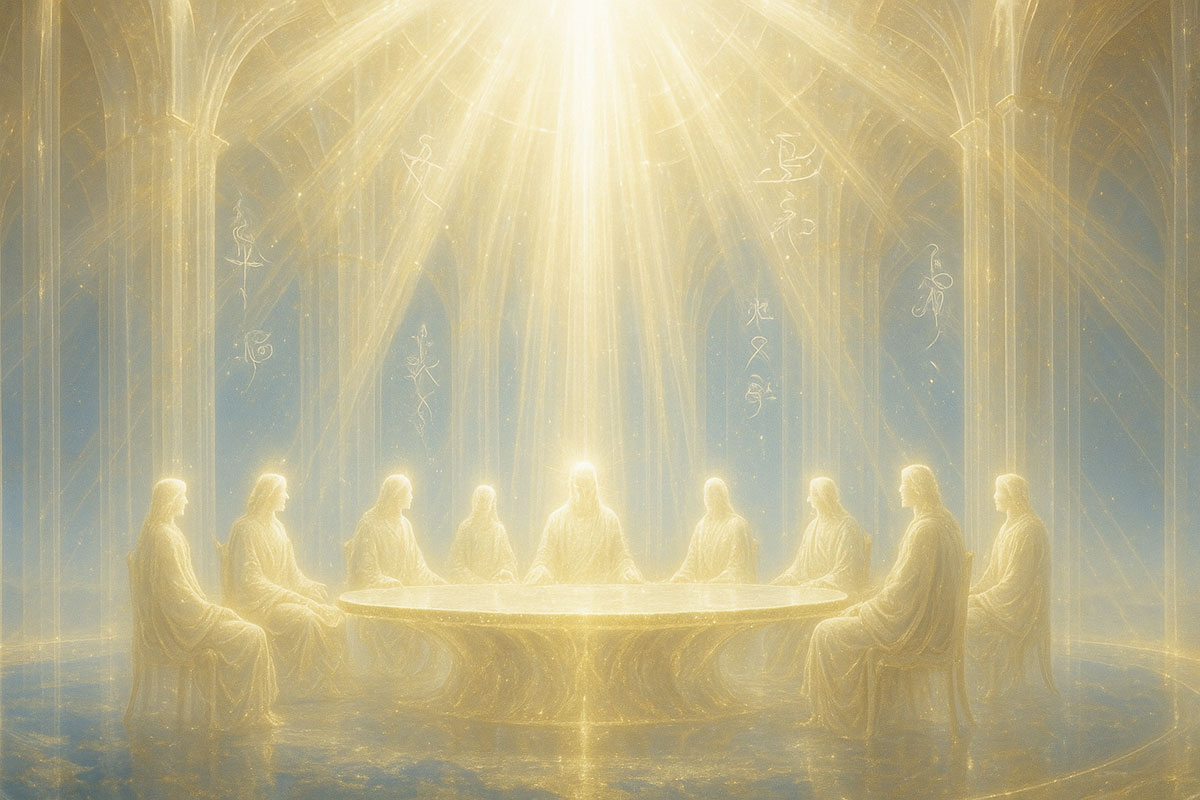
Setting
The year is 2200.
Humanity has survived itself — barely — and now stands at the edge of a renewed world.
A translucent glass hall overlooks vast green continents, sparkling oceans, and skies so clear they seem unreal. Floating holograms display symbols of every spiritual and philosophical tradition. The roundtable at the center is made of soft white light that shifts like living crystal.
Seven figures appear, each in the form that best expresses their essence rather than their historical likeness.
Then a warm radiance fills the air — not blinding, but gently undeniable.
God has arrived.
 INTRODUCTION (by God)
“My beloved children,
before we discuss the future of your world,
I ask you a question older than time:
What is the first question humanity must ask itself
before it can create lasting peace?
I will ask this question in three movements.
Answer as your hearts lead you.”
The light intensifies softly.
“Let us begin.”
QUESTION 1
“What is the FIRST truth humanity must face about itself?”
Buddha
He speaks like still water:
“The first truth is that humanity suffers because it forgets its nature. People think they are separate selves competing for survival. In truth, all beings share the same trembling wish:
May I not suffer. May I be well.
Until humanity sees this shared longing, peace is only a negotiation, never a realization.”
Einstein
He looks out to the restored oceans.
“The first truth humanity must face is that separation is an illusion. Modern physics proved what mystics always knew: everything is connected. Every act touches the whole. The sadness of one child affects the universe. The joy of one mother ripples across galaxies. Peace begins with understanding the fabric of reality.”
Muhammad
He speaks with dignified warmth:
“The first truth is responsibility. Humanity was given the power to build or destroy, to heal or to wound. Too often, people pray for peace while acting in ways that contradict it. Before asking for guidance, one must ask:
Am I using my life in service of goodness?
Peace is not only a gift — it is an obligation.”
Confucius
His voice is calm, reflective:
“The first truth is that harmony begins within relationships. Humanity speaks of nations, ideologies, tribes — but the smallest unit of peace is a person treating another with respect. A peaceful world is only the multiplication of peaceful families, friendships, and communities.”
Jesus
His tone is gentle, almost fatherly:
“The first truth is that humanity has forgotten how loved it is. When people feel unloved, they fear. And when they fear, they hurt each other. But every person is born from love, into love, for love. If humanity remembered this, forgiveness would come easily and healing would follow.”
Socrates
He closes his eyes, listening inward.
“The first truth is ignorance — not as an insult, but as a starting point. Humanity assumes it knows what it wants, yet rarely questions its desires. The unexamined world cannot be a peaceful world. Peace begins with the question: What do I actually seek? And why?”
Moses
His presence is strong but compassionate.
“The first truth is that humanity fears freedom. True freedom requires responsibility, discipline, and moral clarity. Many prefer the chains they know to the uncertainty of transformation. Peace cannot flourish in the hearts of people who fear their own liberation.”
God’s light deepens, as if absorbing their words.
QUESTION 2
“What is humanity’s GREATEST misunderstanding about peace?”
Einstein
“That peace is passive. People imagine peace as the absence of conflict, when in fact it is the presence of justice, empathy, creativity, and courage. Peace is dynamic. It requires imagination. Without imagination, humanity repeats cycles of violence simply because it cannot envision alternatives.”
Jesus
“That peace requires agreement. It does not. Love is not uniformity. Peace is the ability to hold differences without hatred, to meet disagreement without diminishing another’s dignity. Peace is not sameness — it is compassion in motion.”
Socrates
“That peace comes from answers. In truth, it comes from better questions. The right questions dissolve conflict more deeply than any fixed answer could.”
Buddha
“That peace is something to be achieved in the world rather than cultivated within. A restless heart produces a restless society. A peaceful heart radiates outward. Inner peace is not selfish — it is foundational.”
Muhammad
“That peace is a distant ideal rather than a daily practice. Peace is built through small acts: honesty in business, kindness toward strangers, restraint in anger, generosity in hardship. Grandeur does not produce peace. Sincerity does.”
Moses
“That peace is fragile. It is not. Peace built on truth is stronger than any empire, stronger than any fear, stronger even than death. What is fragile is the ego that resists it.”
Confucius
“That peace is a political goal. It is not. It is a moral one. Laws can restrain violence, but only virtue can transform it.”
God listens, radiant but silent.
QUESTION 3
“If humanity could ask ONLY ONE QUESTION to guide its future, what should it be?”
Jesus
“The question is:
‘How can I love more courageously?’
Every movement toward peace begins with love that is larger than fear.”
Buddha
“The question is:
‘What causes suffering here, and how can I lessen it?’
This question dissolves ignorance, attachment, and cruelty.”
Einstein
“The question is:
‘What future am I helping to create with every choice I make?’
Humanity’s future is an accumulation of individual decisions.”
Socrates
“The question is:
‘What truth am I avoiding?’
For all progress begins where self-deception ends.”
Confucius
“The question is:
‘How can I bring honor to my relationships?’
A person who brings honor creates harmony. Harmony scales.”
Moses
“The question is:
‘What must I release in order to be free?’
Every era of peace begins with liberation.”
Muhammad
“The question is:
‘How can my life serve goodness today?’
Not tomorrow — today. Peace is always built in the present moment.”
CLOSING (God)
“My children, you have spoken with clarity.
Let humanity remember this:
Peace is not a destination.
It is a direction, a discipline,
an inner posture that shapes the world.
You have offered them the questions.
May they now offer the answers.”
The hall brightens, as if the world itself breathes in their words.
Topic 2 — What Does Humanity Still Not Understand About Love?
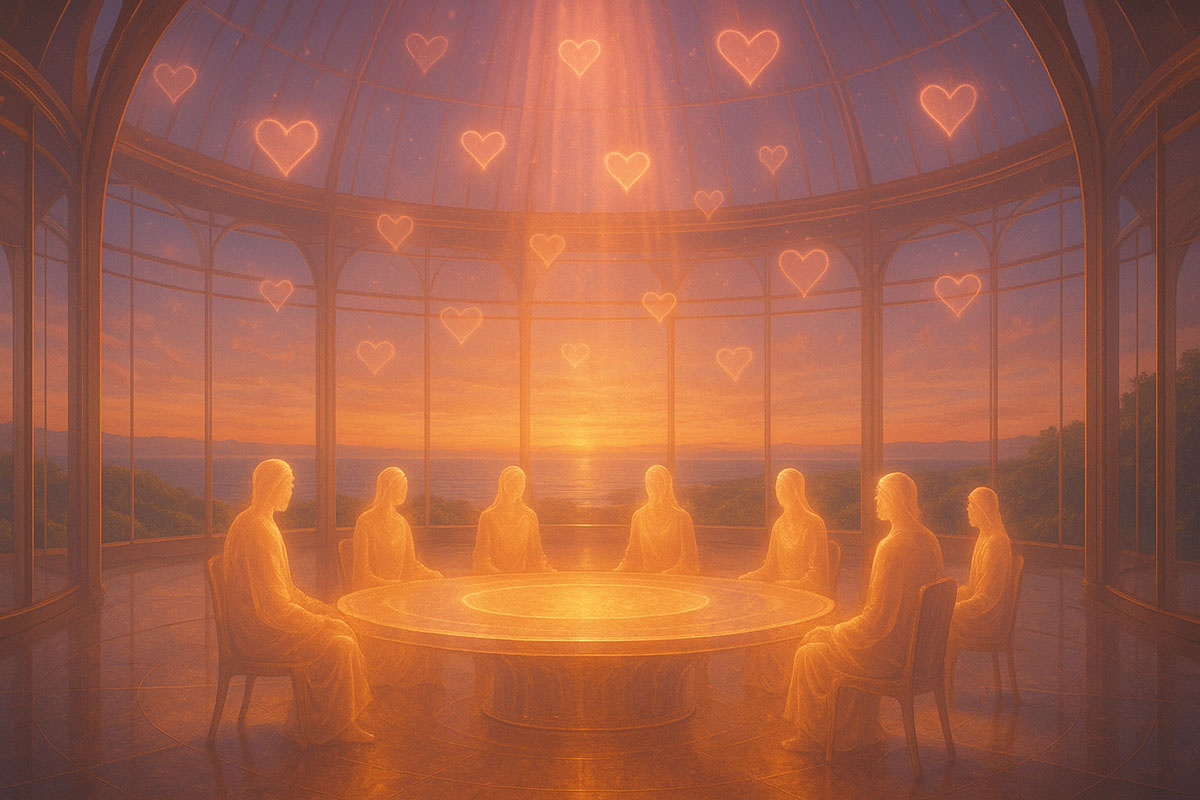
Setting
The aurora-like energy of the Future Hall of Peace shifts into soft gold.
Outside the glass walls, flocks of white birds soar over forests reborn.
The table of living light glows more warmly, as if preparing the heart.
The seven figures sit in a gentle circle.
God’s presence returns as a warm pressure, like sunlight without heat.
INTRODUCTION (by God)
“My beloved ones,
you have spoken of peace.
Now we must turn to the force that sustains it.
Love.
Humanity uses this word more than any other,
yet understands it perhaps least of all.
So I ask you:
What does humanity still not understand about love?
We will explore this in three movements.”
A soft hush fills the hall.
“Let us begin.”
QUESTION 1
“What is the single greatest misunderstanding humanity has about love?”
Jesus
“Humanity believes love is a feeling.
It is not.
Love is a decision — a courageous one.
To love is to choose vulnerability instead of fear, forgiveness instead of resentment, generosity instead of self-protection.
The heart learns love not by being moved,
but by choosing to move toward another.”
Buddha
“Humanity believes love is attachment.
But attachment says, ‘You must make me whole.’
Love says, ‘May you be whole, even if I am not part of that journey.’
True love does not cling.
It frees.”
Socrates
“Many believe love is blind.
But love is the opposite —
it is clear seeing.
When you love someone, you see them not as you wish they were,
but as they are.
And you honor them anyway.”
Muhammad
“Humanity believes love is passive.
But true love is strength.
To love another is to protect their dignity,
to guard their rights,
to stand for justice even when it costs you something.
Love is not softness alone.
Love is firmness with compassion.”
Confucius
“Humanity confuses love with approval.
People think that to love someone is to agree with them.
No.
Love is the ability to guide without controlling,
to correct without humiliating,
to disagree without dishonoring.
Love is respect in action.”
Moses
“Humanity believes love is simple.
But love is the most demanding of all virtues.
Love asks for patience, discipline, humility, sacrifice —
and yet it gives more than it takes.
Love is the great teacher.
Its tests are not easy.”
Einstein
“Humanity thinks love is poetic.
It is scientific.
Love is the most powerful organizing force in the universe —
the energy that binds atoms,
the instinct that protects children,
the empathy that stabilizes societies.
What you call gravity and what you call love
are not so different.”
God’s presence swells like a warm tide.
QUESTION 2
“What does humanity fear most about love?”
Buddha
“Humanity fears impermanence.
To love is to acknowledge that all things change.
Love does not promise forever —
it promises presence.”
Jesus
“Humanity fears being known.
Love reveals the truth of the heart,
and many believe their truth is unworthy.
Yet every person is infinitely lovable,
even in their imperfection.”
Muhammad
“Humanity fears responsibility.
To love is to care,
and to care is to be accountable
for how your actions shape another’s life.”
Socrates
“Humanity fears the loss of control.
Love demands surrender:
to uncertainty, to vulnerability,
to the possibility of heartbreak.
But without surrender,
there is no depth.”
Einstein
“Humanity fears the power of love.
People suspect — correctly —
that love could rearrange their priorities,
their ambitions,
their identities.
Love is not safe.
It transforms.”
Confucius
“Humanity fears disappointment.
No heart escapes hurt.
But pain is not a failure of love —
it is a lesson in wisdom.”
Moses
“Humanity fears the cost of love.
Love requires letting go of ego,
and the ego resists until its last breath.
But every sacrifice made in love
returns multiplied.”
God listens, the hall shimmering gently.
QUESTION 3
**“What is the ONE question humanity must ask itself
to truly understand love?”**
Jesus
“Ask:
‘Who needs my compassion right now?’
Love is practical, immediate, embodied.”
Buddha
“Ask:
‘What suffering can I relieve today?’
Compassion is the expression of wisdom.”
Einstein
“Ask:
‘What invisible connections am I ignoring?’
Love is the recognition of unity.”
Confucius
“Ask:
‘How can I bring honor to this relationship?’
Love thrives in dignity.”
Moses
“Ask:
‘What part of me must soften?’
The harder the heart, the thinner the love.”
Muhammad
“Ask:
‘How can my actions reflect mercy?’
For without mercy, love cannot survive.”
Socrates
“Ask:
‘What unexamined fear keeps me from loving fully?’
When fear is questioned, love expands.”
CLOSING (God)
“My children,
love is the foundation of all creation.
Humanity has spoken of love for millennia,
yet still stands at its threshold.
Let this truth be known:
Love is not merely an emotion.
Love is the architecture of the universe.
When humanity understands love,
it will finally understand itself.”
A glowing silence fills the hall.
Outside, a flock of birds circles the sky as if carried by invisible harmony.
Topic 3 — Why Do Humans Repeat the Same Mistakes?
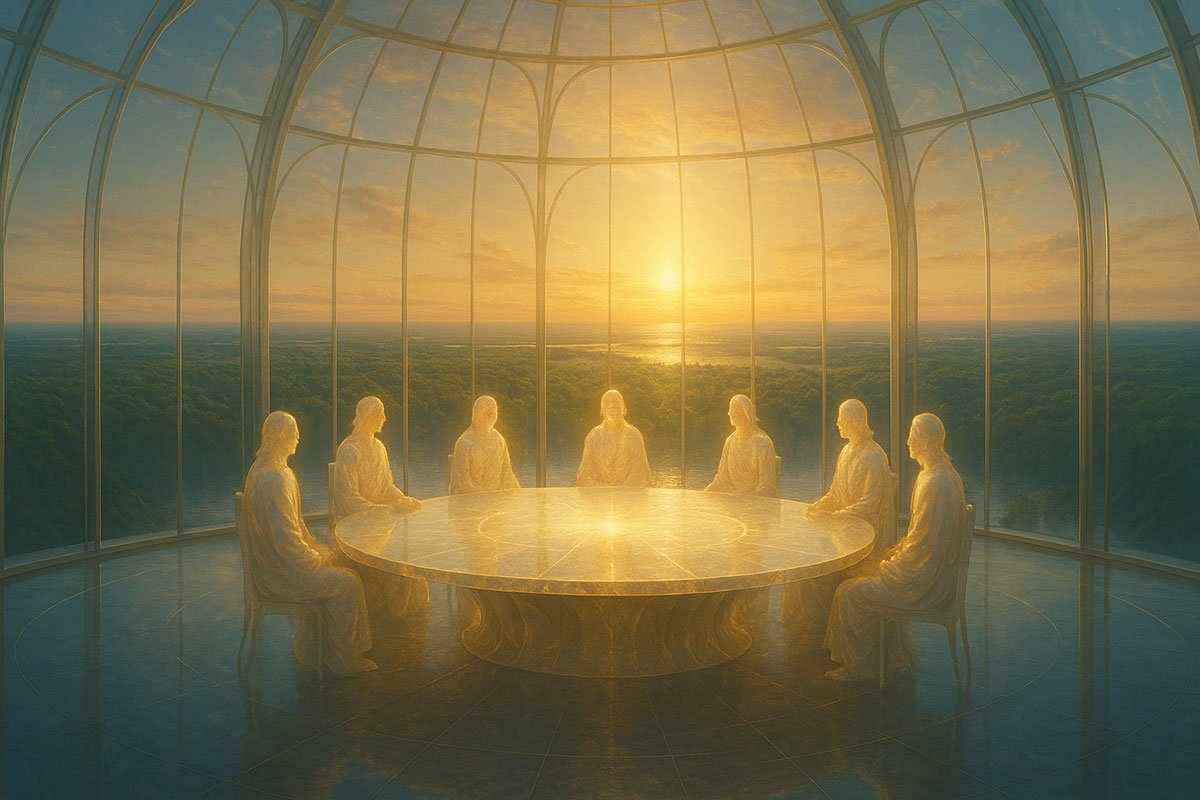
Setting
Dusk settles over the restored Earth outside the glass hall.
The oceans glow a muted silver-blue.
Lights flicker across reforested continents, not from cities,
but from bioluminescent organisms placed intentionally
to heal the land.
Inside, the table of living light brightens as the seven figures return to their seats.
God’s presence now feels slightly heavier—
not burdened,
but solemn,
as if this topic carries great consequence.
INTRODUCTION (by God)
“My beloved ones,
you have spoken of peace and of love.
Now we must turn to a wound humanity has carried for ages:
Why do humans repeat the same mistakes?
Why do wars return?
Why does greed multiply?
Why does fear outlive wisdom?
The answer lies deeper than memory.
So today, we explore this truth in three movements.
Let us begin.”
QUESTION 1
“What lies at the ROOT of humanity’s repeated mistakes?”
Buddha
“The root is unconsciousness.
Humans move through life reacting, not understanding.
They cling, crave, fear, and grasp without seeing the patterns driving them.
What is not seen cannot be changed.
Thus suffering cycles like seasons.”
Socrates
“The root is the refusal to examine the self.
Humanity studies the stars, the oceans, the atom—
but not the soul.
An unexamined life will repeat its errors
the way an untuned instrument will repeat its dissonance.”
Jesus
“The root is forgetfulness.
Humans forget they are loved,
forget they are connected,
forget they are divine reflections.
From forgetfulness arises fear.
And from fear, all manner of harm.”
Einstein
“The root is moral inertia.
Humanity’s ethical evolution lags far behind its technological evolution.
You build machines faster than you build maturity.
You unlock power before unlocking wisdom.”
Muhammad
“The root is pride.
Nations cling to superiority,
leaders cling to ego,
individuals cling to being right.
Pride blinds.
A blind heart walks in circles.”
Confucius
“The root is the breakdown of relationships.
When families lose harmony, communities lose virtue.
When communities lose virtue, nations lose direction.
Mistakes begin at home.”
Moses
“The root is fear of freedom.
True freedom requires discipline, responsibility, and courage.
Many prefer predictable bondage
to the uncertainty of transformation.
Thus they wander the same desert
generation after generation.”
God observes them with a soft, knowing glow.
QUESTION 2
“What keeps humanity trapped in these repeating cycles?”
Einstein
“Humanity confuses intelligence with wisdom.
You innovate faster than you reflect.
You build solutions without understanding the problems.
This creates progress on the outside
and stagnation on the inside.”
Confucius
“Humanity does not pass wisdom forward.
It passes information, skills, ambition—
but not virtue.
A society that values achievement over character
will always repeat its failures.”
Jesus
“What keeps humanity trapped is fear of vulnerability.
People would rather cling to familiar suffering
than risk the unknown freedom of forgiveness.
You cannot evolve while holding grudges.”
Buddha
“What keeps humanity trapped is craving—
craving for pleasure,
for power,
for certainty.
As long as craving drives action,
suffering will repeat itself.”
Moses
“Humanity forgets its covenants—
with the Earth,
with each other,
with the divine.
When promises are broken,
history becomes a loop.”
Muhammad
“What keeps humanity trapped is injustice.
Wherever injustice exists,
peace becomes fragile,
resentment grows,
and cycles of harm continue.
Justice is the shield against repetition.”
Socrates
“What traps humanity is the love of opinion over truth.
People cling to beliefs for comfort,
not for accuracy.
A mind attached to opinion
cannot escape its own labyrinth.”
God’s presence pulses gently, like a deep breath.
QUESTION 3
**“What is the ONE question humanity must ask
to finally break its repeating patterns?”**
Buddha
“Ask:
‘What in me is causing suffering?’
This question frees future generations.”
Jesus
“Ask:
‘What would love have me do today?’
Mistakes dissolve in love.”
Socrates
“Ask:
‘What truth am I refusing to see?’
For all cycles break at the point of honesty.”
Einstein
“Ask:
‘Am I acting from fear or imagination?’
The future is shaped by whichever you choose.”
Confucius
“Ask:
‘What harmony am I responsible for creating?’
Responsibility ends repetition.”
Moses
“Ask:
‘What chains am I unwilling to leave behind?’
Liberation begins with release.”
Muhammad
“Ask:
‘Is my choice aligned with justice?’
Justice is the doorway out of history’s loops.”
God rises slightly, filling the hall with gentle radiance.
CLOSING (God)
“My children,
humanity repeats its mistakes
not because it is wicked,
but because it is wounded.
You have now offered them the medicine:
awareness, honesty, imagination, responsibility, justice,
and above all — love.
Let those who listen break the cycle.
Let those who awaken guide the rest.
And let humanity understand this truth:
History is not destiny.
Awareness is destiny.”
The hall brightens,
and for a moment,
all seven figures sit in perfect silence
as if the world itself has paused to absorb the message.
Topic 4 — What Should Humanity Protect Above All Else?
SETTING
Night has settled outside the Future Hall of Peace.
But the darkness is gentle—alive with sweeping auroras in shades of emerald and gold.
Cities no longer dominate the earth; forests stretch across continents, glowing softly under moonlight.
The glass hall stands at the top of a high plateau, overlooking a world healed.
Inside, the circular table of living light pulses like a calm heart.
Seven timeless figures gather once more.
A warm, radiant presence—God—fills the space, not as a form but as a soft, omnidirectional glow.
The atmosphere is serene, but charged with importance.
INTRODUCTION (by God)
“My beloved children,
Tonight we consider a question that shapes all futures:
What should humanity protect above all else?
Not merely to survive,
but to live with dignity, wisdom, and peace.
We will explore this in three movements.
Let us begin.”
QUESTION 1
“What is the ONE thing humanity must protect before anything else?”
Jesus
“Humanity must protect the sanctity of the human heart.
From the heart comes compassion, forgiveness, and courage.
When hearts harden, cruelty follows;
when hearts open, even enemies become brothers.
Protect the heart,
and everything noble flows from it.”
Einstein
“Humanity must protect curiosity.
Curiosity is the engine of progress, understanding, and unity.
When curiosity dies, fear replaces it.
Fear breeds division.
Protect curiosity,
and humanity will forever move toward light.”
Buddha
“Protect awareness.
All suffering arises from ignorance—
not knowing oneself, one’s desires, one’s patterns.
Awareness ends cycles of harm.
A society asleep repeats history.
A society awake transforms it.”
Muhammad
“Protect justice.
Without justice, peace is fragile
and love becomes sentimental rather than strong.
Justice is the backbone of compassion.
It ensures that no one’s dignity is left unguarded.”
Confucius
“Protect harmony in relationships.
Nations fall when families fracture,
and communities dissolve when respect disappears.
Harmony is not uniformity;
it is the respectful balance that sustains every human bond.”
Moses
“Protect freedom.
Not the freedom to indulge,
but the freedom to become who you were created to be.
Freedom is the soil in which morality grows.
Take it away, and the human spirit withers.”
Socrates
“Protect truth.
Humanity cannot build anything lasting upon falsehood.
When truth is protected, the mind becomes clear.
When clear minds gather, wise choices follow.”
God’s radiance deepens, as if absorbing their words.
QUESTION 2
“What threatens this essential thing more than anything else?”
Einstein
“What threatens curiosity is certainty.
When people believe they already know,
they stop seeking.
Certainty is the end of learning.”
Jesus
“What threatens the heart is fear.
Fear closes the door to compassion.
It convinces the heart that it must defend rather than love.”
Socrates
“What threatens truth is comfort.
People would rather cling to convenient illusions
than endure the discomfort of honest examination.”
Confucius
“What threatens harmony is disrespect.
When people forget how to speak gently,
how to listen,
how to honor one another,
chaos begins.”
Muhammad
“What threatens justice is power without accountability.
Wherever power is unchecked,
oppression follows.
Justice cannot survive arrogance.”
Buddha
“What threatens awareness is distraction.
A distracted mind is never present enough
to see reality clearly.
Distraction is the new prison.”
Moses
“What threatens freedom is fear of responsibility.
People cling to the familiar
even when it harms them.
Responsibility is the price of liberation.”
God listens, steady and warm.
QUESTION 3
“What ONE question must humanity ask to decide what is worth protecting?”
Jesus
“Ask:
‘Does this expand love or shrink it?’
Love reveals what is sacred.”
Buddha
“Ask:
‘Does this lessen suffering?’
Compassion clarifies priorities.”
Einstein
“Ask:
‘Does this help humanity evolve?’
The future depends on the answer.”
Confucius
“Ask:
‘Does this honor the dignity of others?’
Dignity sustains harmony.”
Muhammad
“Ask:
‘Is this aligned with justice?’
Justice reveals what must be defended.”
Socrates
“Ask:
‘Is this true?’
For truth is the beginning of every wise choice.”
Moses
“Ask:
‘Does this liberate the human spirit?’
What liberates is worth protecting.”
CLOSING (God)
God rises as a soft glow, like dawn inside the hall.
“My children,
you have offered humanity seven pillars of preservation:
The Heart.
Curiosity.
Awareness.
Justice.
Harmony.
Freedom.
Truth.
Protect these,
and humanity will thrive.
Neglect them,
and your civilization will fade again.
Remember:
What you protect reveals who you are.
What you cherish reveals what you become.”
The auroras outside shimmer brighter,
as if the Earth itself is listening.
Topic 5 — What Must Humanity Become to Create Lasting Peace?
SETTING
A new dawn rises over the restored Earth.
The auroras fade into soft pastels—rose, gold, and pale blue.
Light pours through the glass hall and scatters across the circular living-crystal table, making it glow like the surface of a calm sun.
The sky is filled with birds migrating freely across continents no longer divided by borders.
Inside the hall, the seven figures gather for the final time in this series.
There is a sense of destiny in the air—
the clarity of a world waiting to hear the answer
to its oldest question.
God’s presence fills the space like a warm, expansive horizon.
INTRODUCTION (by God)
“My beloved children,
Across these gatherings, you have spoken of peace, love, truth, responsibility, and transformation.
Now we arrive at the heart of the matter:
What must humanity BECOME
in order to create lasting peace?
Not temporary peace.
Not negotiated peace.
But peace that lives from generation to generation.
We will explore this in three movements.
Let us begin.”
QUESTION 1
“What must humanity become WITHIN itself?”
Jesus
“Humanity must become braver in love.
Not polite in love.
Not cautious in love.
Brave.
A love that forgives boldly,
gives generously,
and sees the divine in those who are hardest to understand.
Bravery in love is the seed of lasting peace.”
Buddha
“Humanity must become aware.
Not half-awake,
numb from distraction,
reactive from habit.
Truly aware of the causes of its suffering,
aware of its patterns,
aware of its shared humanity.
Awareness dissolves the roots of conflict.”
Einstein
“Humanity must become imaginative.
Without imagination,
you cannot build what has never existed.
Lasting peace requires new systems,
new ethics,
new possibilities.
Imagination is the blueprint of the future.”
Muhammad
“Humanity must become just.
Peace cannot grow in the soil of inequity.
No nation, tribe, or family can truly thrive
when another is oppressed.
Justice is the spine of peace.”
Confucius
“Humanity must become respectful.
Respect transforms families,
families shape communities,
communities shape nations,
and nations shape the world.
Respect is the quiet architecture of harmony.”
Moses
“Humanity must become responsible for its freedom.
Freedom is not doing what one wants—
it is choosing what is right.
Freedom without responsibility
is chaos disguised as liberty.”
Socrates
“Humanity must become honest.
With itself.
With its motives.
With its illusions.
With its fears.
Lasting peace cannot be built upon self-deception.”
God absorbs their words like sunlight falling on water.
QUESTION 2
“What must humanity become in RELATION to one another?”
Buddha
“Humanity must become compassionate without borders.
Not compassion for tribe,
nation,
race,
religion—
but compassion for all beings
who wish not to suffer.”
Socrates
“Humanity must become curious about each other.
Curiosity replaces judgment.
Questions replace assumptions.
Dialogue replaces conflict.”
Jesus
“Humanity must become forgiving.
Not because others deserve it,
but because the heart deserves peace.
Forgiveness is the release of the past
so the future may breathe.”
Confucius
“Humanity must become honorable in relationships.
Peace is a chain of countless interactions.
Honor strengthens every link.”
Moses
“Humanity must become committed to liberation.
To free the oppressed,
to free the fearful,
to free the ego from its own chains.
Where freedom grows,
peace follows.”
Einstein
“Humanity must become collaborative.
You are solving global problems
with tribal thinking.
Collaboration across cultures and disciplines
is the engine of lasting peace.”
Muhammad
“Humanity must become merciful.
Mercy is what prevents justice
from becoming cruelty.
Mercy allows the powerful
to lift rather than dominate.”
God’s presence widens, warm and grounding.
QUESTION 3
“What must humanity become in its VISION of the future?”
Einstein
“Humanity must become future-literate.
To understand not only what is,
but what could be,
and what must not be repeated.”
Jesus
“Humanity must become a mirror of love.
Let your systems,
your choices,
your relationships
reflect the truth that every life is sacred.”
Buddha
“Humanity must become present.
Lasting peace is not built in the future—
it is built now,
moment by moment,
word by word,
choice by choice.”
Socrates
“Humanity must become devoted to truth.
A future built upon illusions collapses.
A future built upon truth endures.”
Confucius
“Humanity must become unified in purpose.
Not identical in thought,
but aligned in intention—
to cultivate harmony rather than domination.”
Muhammad
“Humanity must become guardians of justice.
For justice is the lamp that lights the path ahead.”
Moses
“Humanity must become fearless in its pursuit of goodness.
Fear is the architect of war.
Courage is the architect of peace.”
CLOSING (God)
The hall brightens as if dawn has entered the room.
“My children,
you have named the qualities
of humanity’s highest self:
Brave in love.
Awake in awareness.
Imaginative in vision.
Just in action.
Respectful in relationship.
Responsible in freedom.
Honest in truth.
Compassionate without borders.
Curious without judgment.
Forgiving without condition.
Collaborative across difference.
Merciful in power.
Unified in purpose.
Fearless in goodness.
These qualities are not beyond reach.
They live already
in every human heart
as seeds waiting for light.
Tell humanity this truth:
Peace is not an achievement.
Peace is a transformation.
Become peace,
and the world will follow.”
The hall glows like a second sunrise.
Outside, the birds rise into the sky—
not in fear,
but in freedom.
Final Thoughts
If there is a message echoed across these conversations, it is that humanity’s potential has always been greater than its fears. These timeless voices speak not only to our intellect but to our shared longing—our desire to love more deeply, to live more wisely, to create a world worthy of the generations yet to come.
Resurrecting these figures through imagination is not a departure from the real world; it is an invitation to see it more clearly. Their ideas remind us that wisdom is not confined to the past—it is a living inheritance, waiting to be remembered.
We exist on a small, fragile world suspended in a cosmic vastness beyond our comprehension. And yet, within this tiny dot of light, we hold the capacity for compassion, for justice, for forgiveness, for the kind of transformation that reshapes the course of history.
Lasting peace is not something we stumble into.
It is something we become.
Each act of kindness, each courageous question, each moment of clarity builds the future these voices envisioned—a future where humanity rises not only in power, but in understanding.
The conversation does not end here.
It continues every time we choose curiosity over fear, connection over division, imagination over resignation.
We are still writing the next chapter.
And if we dare to imagine it,
it can be beautiful.
Short Bios:
Jesus was a Jewish spiritual teacher whose message of love, forgiveness, and inner transformation reshaped the moral and spiritual imagination of the world. His teachings emphasized compassion for the marginalized, the dignity of every person, and the possibility of awakening to a higher way of living.
Buddha (Siddhartha Gautama) was an Indian prince who renounced privilege in pursuit of truth. Through deep meditation and insight, he taught the path to liberation from suffering, offering timeless guidance on mindfulness, compassion, and the nature of the human mind.
Muhammad was a merchant in seventh-century Arabia whose revelations became the foundation of Islam. His life and teachings emphasized justice, moral responsibility, charity, and the unity of humankind under one God.
Moses was a foundational figure in Jewish, Christian, and Islamic traditions, remembered for leading his people out of oppression and receiving a moral code that shaped the ethical framework of much of Western civilization. His story symbolizes courage, liberation, and covenant.
Confucius was a Chinese philosopher whose teachings on virtue, harmony, duty, and human relationship profoundly shaped Eastern culture. He emphasized ethical leadership, moral development, and the importance of cultivating wisdom through daily life.
Socrates was an Athenian philosopher whose relentless questioning transformed the way humanity pursues truth. Through dialogue and inquiry, he taught that wisdom begins with recognizing one’s own ignorance and seeking clarity through honest examination.
Albert Einstein was a theoretical physicist whose revolutionary insights into space, time, and energy reshaped modern science. Beyond physics, he was a humanitarian who spoke passionately about peace, curiosity, and moral responsibility in an interconnected world.
Carl Sagan was an astronomer, cosmologist, and storyteller who brought the cosmos closer to the human heart. He dedicated his life to exploring the universe while advocating for scientific wonder, humility, and the shared destiny of humanity on its fragile blue planet.
Leave a Reply