

|
Getting your Trinity Audio player ready...
|
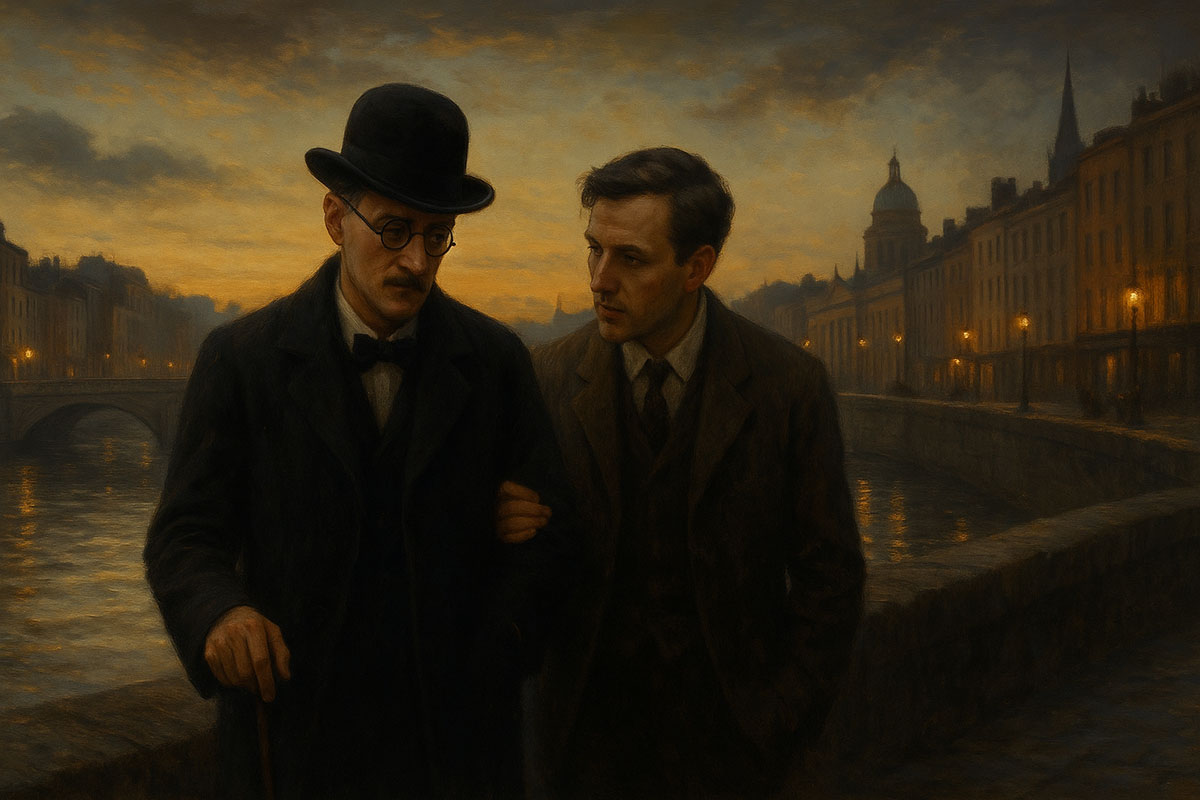
Introduction by James Joyce
Lights low. Joyce steps forward, bowler hat in hand, his voice steady, Irish lilt unmistakable.
“So here I am, James Augustine Aloysius Joyce, lad of Dublin, exile of Europe, scribbler of words that tangle and tumble. You’ve heard much about me: the genius, the blasphemer, the blind man muttering books no one would print. But here—ah, here—you’ll hear another telling. Not the critic’s, not the scholar’s, but a friend’s.
A best friend, at my elbow, listening when no one else would. Through the hunger, the exile, the laughter, the blindness, the bans, the words and more words.
Dublin made me, Paris unmade me, Zurich took me in, but friendship—friendship kept me human. That is the story you will hear now: Joyce the man, Joyce the exile, Joyce the dreamer, never alone because a friend walked with me. Come then. The day is long, the road is rough, but we will walk it together.”
(Note: This is an imaginary conversation, a creative exploration of an idea, and not a real speech or event)
Part 1: The Dublin Boy

We met in the damp corridors of Clongowes Wood College, a school that smelled of chalk dust, wet wool, and the sharp sting of cold mornings. You were small for your age, James, with eyes that seemed to drink in everything—the priests’ gestures, the murmur of Latin, the cruelties and small mercies of boys packed together in a holy cage. I remember you squinting at the board, already troubled by the weak eyes that would plague you all your life, and yet you never missed a word. It was as if your mind leapt farther than your body could see.
At night, lying in the long dormitory rows, you whispered doubts to me. The prayers we were taught—Hail Marys, the endless litany of sins—did they reach God at all? Or were they words, only words, meant to keep us bent beneath a weight? I wanted to hush you, to protect you from the wrath of priests, but you pressed on, whispering that even in your smallness, you would not be bent.
Your family life was no gentler. You told me of your father, John Joyce, a man of booming voice and wasted potential, who drank as if to drown his disappointments. Your mother, May, pious and soft, carried the family on faith while debts mounted and respectability slid away. You would watch her pray, lips moving, eyes closed tight, and I could see you wondering if her God was hers alone—if He would ever be yours.
You confessed once, in a quiet corner of the schoolyard: “I will not serve.” I remember the fire in your voice, how the Latin motto of rebellion—Non serviam—came from your lips not as blasphemy but as necessity. You were only a boy, but you already knew your soul would never bow to Rome, nor to England, nor to any man who tried to chain the wild current of your mind.
I stayed with you as you moved on to Belvedere College. You grew taller, sharper, hungrier. There were prizes for your essays, small coins that sometimes paid for meals when the house was cold and bare. I remember the shame you carried, walking home through Dublin’s streets in a fraying coat, hungry but burning with thoughts of Dante and Aquinas, of Shelley and Ibsen. You told me once, “The world is a forge, and I must hammer out the conscience of my race.” It sounded too large for a boy, yet I knew you believed it—and I began to believe it too.
But with brilliance came isolation. You did not march with the others to Mass. You questioned too loudly the truths others swallowed. When the rector praised obedience, you wrote essays on freedom. When classmates knelt for confession, you stood apart, asking me why a boy’s whispered sins mattered more to God than the cries of the poor.
I can still see you at sixteen, walking the quays by the Liffey at dusk. The city spread around us: beggars with hollow eyes, lovers pressed in shadowed doorways, priests striding with cassocks swishing. You stopped and said: “I must leave this place. Ireland is the old sow that eats her farrow. If I stay, she will eat me too.” You did not speak with cruelty. You spoke with the sorrow of a son already exiled in heart.
At home, poverty deepened. Your father’s songs and stories could no longer charm creditors. You took to drinking cheap wine, to wandering Dublin’s dark lanes, to testing yourself against the city’s temptations. You let me see your contradictions: the boy who loved to sing “Oft in the Stilly Night” with tears in his eyes was the same boy who staggered drunk, laughing at priests, daring God to strike him down. You wrestled with angels and devils nightly, and I wrestled with you, holding you from the brink, listening, always listening.
One memory remains brightest. You had just finished an essay at Belvedere, a prize-winner, though you didn’t yet know it. We sat by the fire, a rare warm evening, and you read aloud lines about Ireland—harsh, clear, unsparing. You wrote of a people chained by history, by church, by fear. You wrote of an artist’s duty to break those chains, even if it meant standing alone. When you finished, your hand trembled slightly. You looked at me and asked, “Too much?”
I told you no—if anything, not enough. That the world needed such words. That you were already, even in that small rented room, forging something no priest or politician could contain. You nodded once, and in that nod, I felt the weight of your vow: to turn every scrap of pain, shame, and exile into art.
But even then, James, you were afraid. Afraid of poverty, of blindness, of failure. Afraid that your defiance might leave you alone forever. You needed me not just to admire your courage but to remind you that rebellion without love curdles. That a boy’s refusal to kneel must one day become a man’s creation of something greater.
And so I walked beside you, James—the Dublin boy who dared to say no, but who was already whispering yes to something larger: the yes of language, the yes of art, the yes that would one day echo from Molly’s lips and change literature forever.
Part 2: The Exile’s Step (1902–1904)

We left Dublin that winter, James, or rather—you left and I refused to let you go alone. You were twenty, restless, already tired of Ireland’s damp grip, of priests hovering in corridors, of your father’s debts and bluster. You had the fire of ambition in your eyes but no money in your pocket. Paris was the word on your lips, as if that city could cleanse you of all that Dublin had pressed into your bones.
I remember your excitement as the train rattled south. You talked of lectures, of medical studies you might never attend, of the freedom of cafés where poets debated over cheap wine. But behind your bravado, I heard your fear. You were leaving behind the only soil you’d ever known, and part of you wondered if you were already a ghost—one of the “exiles of Erin,” gone but not gone, cursed to wander in search of a home.
Paris was not the dream you had painted. The garrets were cold, the bread dry, the money gone before the week was out. I watched you walk from library to library, devouring books as if they were food. Dante, Aristotle, Ibsen—your true professors. You wrote letters home, asking for funds that rarely came. And yet even in hunger, your mind burned. You told me once, shivering under a thin blanket, “Better starved in Paris than stuffed in Dublin.” And I believed you, because your hunger was not just of the stomach, but of the soul.
Then the letter came. Your mother was dying. Consumption. The summons you could not ignore. You boarded the boat back to Dublin, and I saw your face harden as the Irish coast reappeared in gray mist. The prodigal returns, not in triumph but in dread.
At her bedside, the room smelled of medicine and despair. Your brothers prayed; your sisters wept. Your father stumbled between grief and drink. She looked at you, James, her eldest, her pride, her hope. She asked you to kneel, to pray for her soul. And you—my stubborn friend—you would not. You could not. You stood silent, arms crossed, your eyes refusing the crucifix. The others hissed at you, cursed you, but I saw the torment in your clenched jaw. You were not denying her love; you were denying the God that had broken her body and bound her life in chains. Yet the guilt would never leave you. It followed you like a shadow, whispering in your ear long after the funeral earth had closed over her.
But in grief, life has its own answer. Just weeks later, you met Nora Barnacle. A Galway girl, strong, earthy, laughing at your solemnities. The two of you walked out on June 16, 1904, a date that would live forever in your book. She was everything Ireland was not: freedom, sensuality, courage. She loved you not as a genius or a rebel, but as a man. You told me that night, your eyes shining: “She is my life. With her, I can leave.” And so you did.
I remember that departure most of all. No grand farewell, no luggage worth the name. Just you, Nora, and a dream. Dublin slipped behind you like a closed book. Ahead lay Zurich, Trieste, Pola—cities that would never fully be home, yet would never bind you as Dublin did. You turned to me on the quay, the gulls screaming above, and you said: “The artist must go into exile to find his voice.” Your hand shook as you lit your cigarette, but your voice was steady. You were afraid, James, but you were also free.
And I, your best friend, walked beside you into that exile. For I knew that what you carried—your defiance, your genius, your longing—was too large for one island to contain. You would suffer hunger, rejection, loneliness. You would carry your mother’s ghost and the weight of your refusal. But you also carried Nora’s “yes,” and with that, you took your first true step into the life that would make you James Joyce.
Part 3: The Struggling Artist (1904–1915)
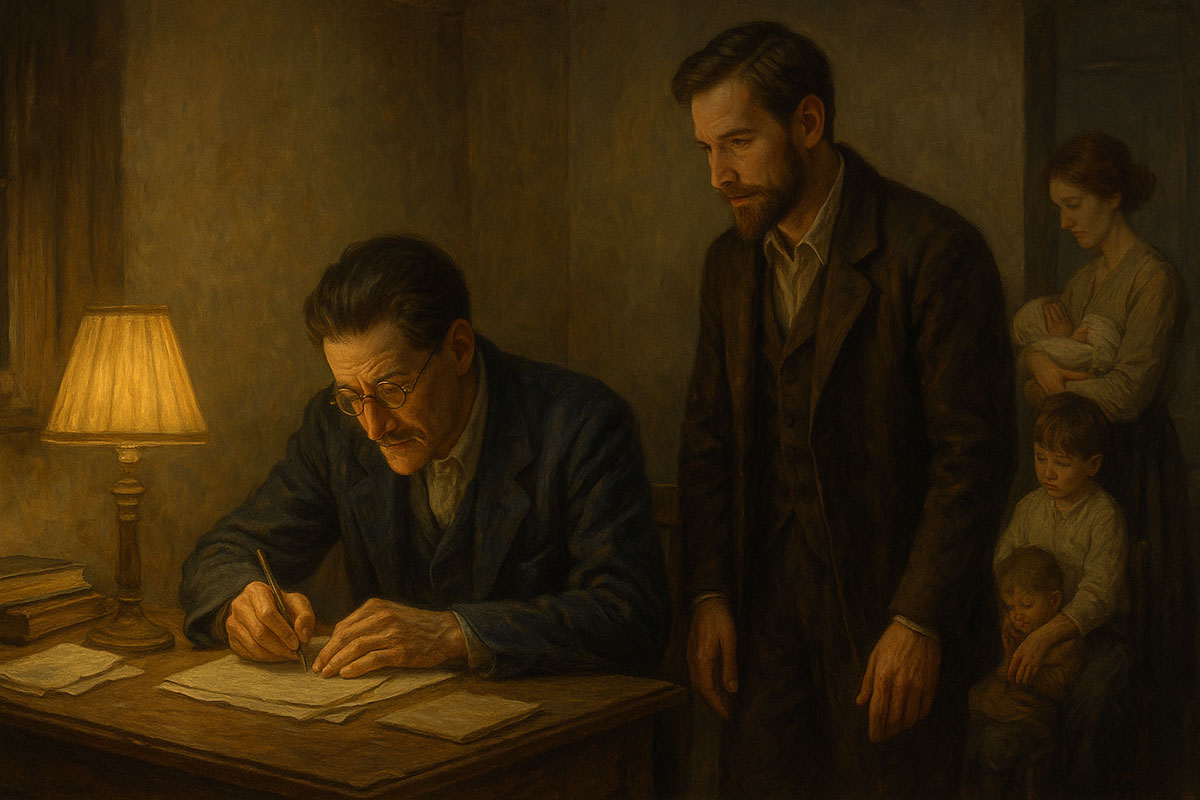
The first years abroad were a crucible, James. You and Nora left Dublin with little more than a bundle of clothes and a handful of coins, chasing freedom, chasing art, and perhaps only half-knowing what you had begun. I was there too, of course, sitting beside you in those dim, smoke-filled train compartments, watching the landscapes of Europe unspool through the window—Trieste, Pola, Zurich, each one strange, foreign, both promise and threat.
Trieste was meant to be stability, but it was a city of hard corners and harder men. You took work teaching English at Berlitz schools, wrangling students who mocked your accent or tested your patience. You joked that the students learned nothing except your contempt for them, yet every lira you earned fed Nora and the children—Giorgio first, then Lucia. Your shabby suit grew shabbier, but your pride never thinned. At night, after classes, you wrote. At the small table by the window, with the city’s salt wind blowing in, you scratched words into the dark, determined that your Dublin would live on the page if not in your body.
But oh, the disappointments. Dubliners—your collection of stories—was rejected again and again. Publishers feared its raw truth, its unsparing mirror of Irish paralysis. “Too bleak,” they said. “Too unpatriotic.” One even demanded changes—removals, alterations—that would have gutted the work. You refused. I remember you pacing in the small apartment, your voice sharp: “If I yield even a line, I betray Dublin itself.” And so the manuscript gathered dust, while bills piled high. Nora sewed patches into clothes; you borrowed coins where you could. Yet in the candlelight, you read drafts to me—“Araby,” “Eveline,” “The Dead”—and I knew, James, I knew these stories would outlast the merchants and priests who sneered at them.
Your eyesight betrayed you often. Inflamed, red, swollen, your eyes burned under weak lamps. You’d lean close to the page, squinting, muttering lines aloud so you could hear what you could barely see. I begged you to rest, but you laughed bitterly. “Rest? Then who will write? Who will put Dublin down before it vanishes?” You would endure pain, surgeries, bandages, anything, rather than stop. It was as if your art had to be wrested from your very body, one painful line at a time.
Through it all, Nora kept you tethered. She laughed at your gloom, scolded your drinking, carried your children on her hip while you chased sentences. She was your anchor, your proof that someone chose you not for your words but for your self. You told me once, after a rare night of warmth in your home: “If I am Odysseus, she is both Penelope and Ithaca.” Yet you feared she would tire of poverty, of your obsessions. I saw the worry in your eyes, even as you mocked yourself as “a poor dauber of words.”
Then came the turning point. A Portrait of the Artist as a Young Man. You had been shaping it for years—once called Stephen Hero, sprawling and awkward. But you cut, sharpened, distilled. It became the story of your rebellion, your cry of “non serviam” given flesh. When you read me the passage where Stephen declares he will forge the uncreated conscience of his race, your voice shook, not with doubt but with triumph. You had captured not just your soul but the soul of a generation breaking its chains.
And slowly, publishers began to listen. Dubliners finally saw print in 1914 after years of battle. I remember the day you held the first copy—cheap paper, rough cover—but your hands trembled as if it were gold leaf. You pressed it to your chest, your eyes wet. “They cannot silence me now,” you whispered.
The war years brought Zurich. Neutral, gray, a city of exiles. You walked its clean streets, half blind from operations, but within your head, a vast new labyrinth stirred—Leopold Bloom, Molly, Stephen wandering Dublin in a single day. I remember your excitement as you explained the plan to me: “An epic of the ordinary. Homer in Dublin. No one will understand it—and yet it will be truer than truth.” I thought you mad, but I also thought you magnificent.
In those years of exile and poverty, James, you could have broken. You could have returned to Dublin, begged for a university post, compromised for respectability. But you did not. You chose hunger over silence, exile over compromise, ridicule over surrender. You told me, more than once, “My only weapon is my word. If I give it up, I am nothing.” And though your coat was threadbare and your sight dimmed, your words grew sharper than ever.
I stayed beside you in those dark Trieste rooms, those Zurich cafés, those nights when you cursed yourself and the world. I reminded you, again and again, that genius is often invisible until it is undeniable. That Nora’s love, your children’s laughter, and the words you carved into paper were already more than most men leave behind. You rarely believed me in the moment, but you always listened.
And so, James, the struggling artist did not vanish into obscurity. He endured. And from his suffering, from his exile, from his refusal to yield, a new chapter began—the chapter of Ulysses.
Part 4: The Ulysses Battle (1915–1922)
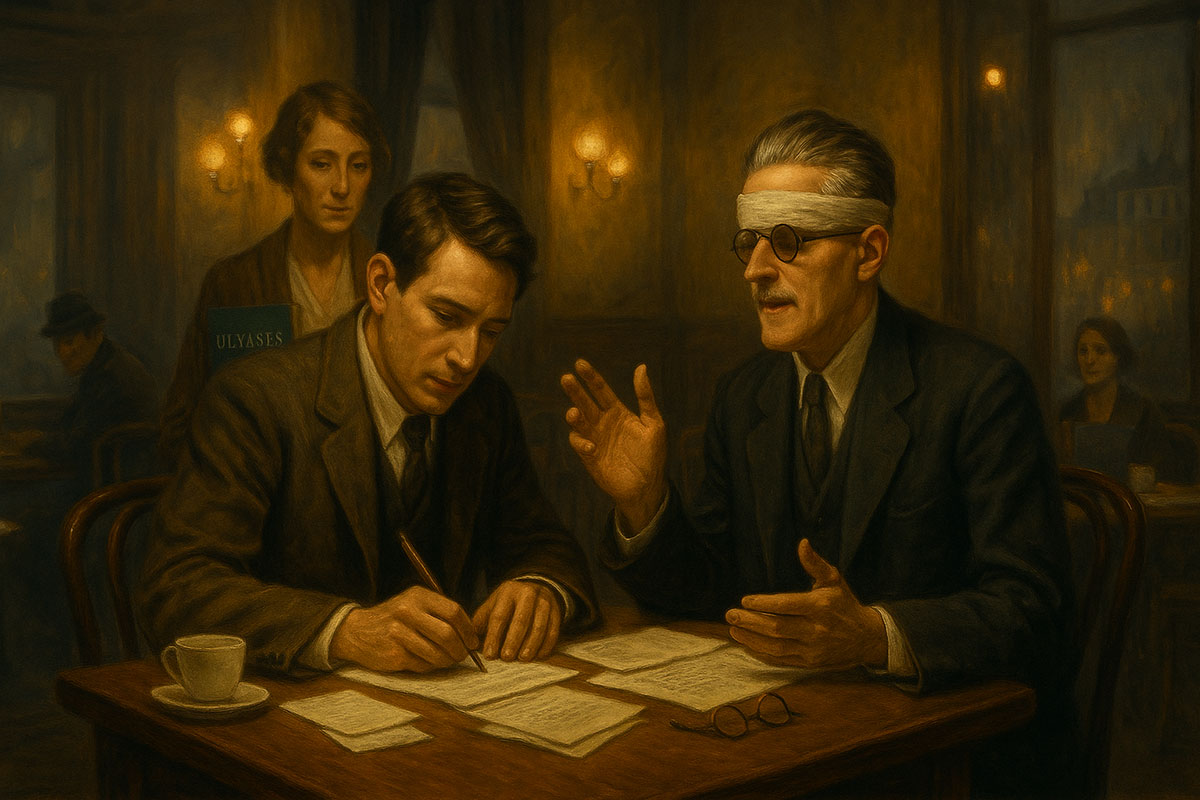
Zurich, 1915. The world was tearing itself apart in war, but you, James, were fighting a quieter, stranger battle. Refugee in a neutral city, you were at once safe and suffocated. The boulevards were calm, the cafés clean, but inside you raged with a book no one else yet believed in. You had written Dubliners, you had shaped A Portrait of the Artist, but now you dreamed of something larger—an epic day in Dublin, ordinary yet infinite.
I remember the way you leaned across the café table, whispering the scheme like a conspirator. “One day, one city, one man,” you told me. “Bloom will wander as Odysseus wandered. Stephen as Telemachus. And Molly, my Penelope—her voice will close it all.” You tapped the table with your finger as if keeping time with Homer’s oars. Your eyes were rimmed red from yet another surgery, but they burned with the fire of creation.
But genius does not erase hardship. Rent was always late. Your eyes failed again and again, forcing you into bandages and blindness. You dictated passages aloud, pacing rooms like a caged lion, muttering and shaping sentences with your tongue. Nora soothed you when you cursed your sight, your pain, the world’s refusal to understand. I sat beside you, pen scratching, trying to keep pace with the torrent of words. You were impatient, fierce, but behind it all, terrified—terrified that you would not finish before the darkness in your eyes consumed you completely.
Then came the publishing nightmare. Ulysses was born in fragments, serialized in The Little Review in New York. You were elated—your book reaching readers, your voice alive across an ocean. But the world was not ready. Obscenity charges followed. Postal seizures. Judges calling your work filth. “No one will read this in my lifetime,” you spat at me one night, pacing the Zurich flat. But I told you: they are afraid because you are changing language itself. And you smiled, weary, because some part of you already knew.
When we moved to Paris in 1920, you thought perhaps here the book would live. The Left Bank hummed with artists and exiles, cafés full of painters, poets, revolutionaries. Hemingway, Pound, Stein—they circled you, half awed, half wary of your stubborn brilliance. And then Sylvia Beach appeared—your angel in human form. A small bookshop, Shakespeare and Company, and a woman who dared to do what great publishers feared: print Ulysses in its entirety.
I can still see the moment the first copy was placed in your hands, February 2, 1922—your birthday, fittingly. Blue cover, bold white letters: ULYSSES. You touched it as if it were a child, fragile yet defiant. Your hands shook, and for once your wit failed you. You simply whispered, “It is mine. At last, it is mine.” I thought of the boy at Belvedere, the man in Trieste with debts and rejections, the exile in Zurich with bandaged eyes. All of it led to this book, this day.
But even triumph carried wounds. Ulysses was banned in Britain and America, called obscene, smuggled like contraband across borders. You laughed bitterly at the thought of your words hidden under coats, slipped in brown paper wrappings. Yet you were also proud—your book was dangerous, alive, uncontrollable. “Better banned than ignored,” you told me with a crooked smile.
Those years in Paris were years of paradox. You were lionized and ridiculed, courted and avoided. The money never stretched far, though your fame grew. Your health worsened, eyes in constant agony. Yet every night you walked the streets with me, seeing the Seine as if it were the Liffey, hearing Dublin’s voices echo in foreign air. You never stopped being a Dublin exile, never stopped hearing the footsteps of Bloom in your own.
And I—your best friend—was there to remind you when doubt gnawed deepest. That Ulysses was not filth but scripture for the modern soul. That Bloom’s kindness mattered more than a thousand epics of heroes and war. That Molly’s “Yes” was larger than every priest’s “No.”
You once told me, over wine in Paris, “I am misunderstood by all but remembered by none.” I held your hand and said, “No, James. You are misunderstood now, but you will be remembered by all.” And you wept, just briefly, before laughter returned, rough and wild.
The battle of Ulysses was never just with censors, James. It was with yourself—your doubt, your pain, your exile. But you won. Against governments, against blindness, against poverty, you brought forth a book that redefined what a book could be. You did not just write Ulysses; you endured it, bled it, birthed it into the world.
And I, walking with you through Zurich streets and Paris nights, knew that I had seen history made—not in parliaments or battlefields, but in the trembling hands of a half-blind Irish exile, holding a blue-covered book and whispering, “Yes. It is mine.”
Part 5: The Final Yes (1930s–1941)
Paris in the 1930s, James. You were famous now, or at least notorious. Ulysses had broken into the world like a storm, banned in some countries, whispered about in others, and revered by those who recognized its genius. You walked the boulevards half-blind, your cane tapping, your head tilted slightly, listening to the voices around you as if they were instruments in your grand orchestra. Yet fame did not mean peace. Your battles simply changed shape.
I remember the endless labor of Finnegans Wake. Years spent spinning language into riddles, dreaming in tongues only you seemed to understand. You called it your “Work in Progress,” though to most it seemed a labyrinth without exit. People mocked it. Even your friends grew weary of the fragments you read aloud in smoky cafés. But you pressed on, word by word, convinced that language itself was a dream worth catching. I sat with you as you dictated sentences that twisted and tumbled like water over stones. You would laugh, delighted, at the sound of a pun no one else could hear.
And yet I also saw the weariness. Your eyes failed more often, pain so sharp you sometimes wept openly. Surgeries left you swathed in bandages, wandering the flat in darkness. I guided your hand to chairs, to cups, to the page you could not see. You never stopped composing, though—if not with pen, then with your voice, with muttered lines that Nora or I would scribble down. You fought blindness with words, James, as if each sentence kept you from falling completely into night.
The greatest wound, though, was not your eyes. It was Lucia. Your daughter, bright and talented, caught in the nets of a mind unraveling. She danced like no one else, but her brilliance turned jagged, her moods wild, her love for Beckett unreturned. Doctors prodded and whispered—schizophrenia, hysteria, madness. You did not care for their labels. You only saw your child slipping away. The guilt tore at you. You believed her suffering was bound to your own restless blood, your artistic curse. Many nights you clutched my hand and said, “It is my fault. She is mine, she breaks because of me.” I told you no, James—that no father chooses such fate for his child—but you never quite believed me.
Still, Nora stood by you. She had endured your drinking, your obsessions, your poverty, and now she endured the burden of Lucia’s illness. She was your harbor, always. You argued, yes—fiercely at times—but always returned to her bed, her laugh, her grounding presence. You loved her body, her voice, her earthiness. She was your Penelope, though she was far from patient silence. In her arms, you found the warmth the world denied.
War came again. The Nazi shadow crept across Europe, and Paris grew tense, dangerous. Exile returned to you, as it always had. Zurich became your refuge once more. You were tired, so very tired. Your hair white, your sight almost gone, your body weakened by years of operations and strain. Yet even then, you walked with me, cane tapping the snowy streets, still listening for the song in every voice.
In Zurich, you spoke often of death. Not with dread, but with a kind of resignation. You told me once, “I have written my monument. The rest is silence.” But you knew it was not silence—not really. It was Molly’s “Yes” echoing forever, a final affirmation against all the world’s denials.
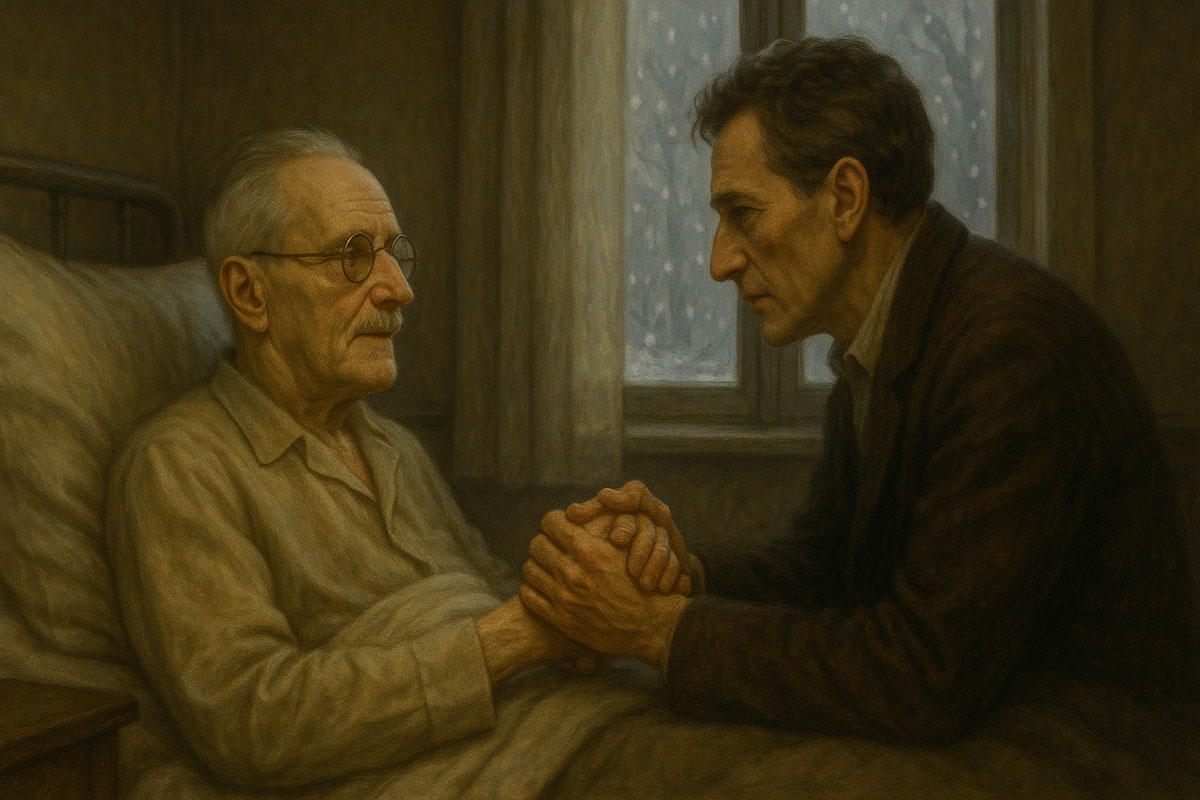
Your last days were marked by pain—an ulcer, surgery, the body giving way at last. I sat by your bed in that white hospital room, holding your hand as you drifted in and out of sleep. Nora was there too, her eyes fierce even in grief. You mumbled fragments—half Finnegans Wake, half prayer, half dream. And then you looked at me, clear-eyed for one brief moment, and whispered, “Did I live?”
I squeezed your hand and answered: “Yes, James. You lived. More than most ever dare.”
On January 13, 1941, you slipped away. No trumpets, no parades. Just the soft sigh of a man who had wrestled with God, with Dublin, with language itself, and left behind a map of the soul that would never fade.
I walked from the hospital into the cold Zurich night. Snow fell, soft and relentless, covering the cobblestones. I thought of you as a boy in Clongowes, doubting prayers; as a young man in Paris, hungry and defiant; as an exile in Trieste, clutching manuscripts against poverty; as the genius in Zurich, shaping Bloom and Stephen and Molly into immortality. And I thought of you as my friend—flawed, stubborn, brilliant, human.
Your life was exile, James, but also return. Exile from Ireland, from church, from acceptance. Return to art, to Nora, to the “Yes” that closed your greatest book. You carried contradictions like scars, but in the end, you gave the world not despair, but affirmation.
And so, I answer your last question again, as your best friend: Yes, James. You lived. You lived so fiercely, so fully, that the world itself will never forget your voice.
Final Thoughts by James Joyce
Joyce returns, older now, leaning on his cane, voice soft, reflective.
“And so, you’ve walked the road with me. From the boy in Jesuit halls to the man half-blind in Zurich snow. From the stubborn lips that would not pray at a deathbed to the trembling hands that held Ulysses at last.
I fought the priests, the censors, the poverty, the blindness. But I never fought alone. Always, there was a friend beside me, whispering when I doubted, steadying when I faltered.
And what remains? Not the bans, not the sneers. What remains is the word, alive as breath. What remains is the love of Nora, the laughter of children, the Yes of Molly, and the Yes of life itself.
If you ask me, James, was it worth it?—I say Yes. If you ask me, James, did you live?—I say Yes. If you ask me, James, what is left?—I say Yes.
Yes, I said. Yes, I will. Yes.”
Short Bios:
James Joyce (1882–1941)
Irish novelist, poet, and modernist whose works (Dubliners, A Portrait of the Artist as a Young Man, Ulysses, Finnegans Wake) reshaped literature forever. Known for his stream-of-consciousness style and his exile-driven defiance of convention, Joyce remains one of the most influential voices in modern literature.
Nick Sasaki
A lifelong confidant in this reimagined journey, Nick appears as James Joyce’s best friend and witness—walking with him through boyhood doubt, the first steps of exile, the struggles of poverty, the triumph of Ulysses, and the twilight of Finnegans Wake. Nick serves as the voice of loyalty, encouragement, and human grounding, reminding Joyce of love, resilience, and the worth of his art.
Nora Barnacle (1884–1951)
Joyce’s partner and later wife, Nora was his anchor and muse, inspiring many of his greatest works and immortalized in the figure of Molly Bloom. Their first walk together on June 16, 1904, became the foundation for the day of Ulysses.
Lucia Joyce (1907–1982)
Joyce’s daughter, a gifted dancer whose life was overshadowed by mental illness. Her struggles profoundly affected Joyce and left their imprint on Finnegans Wake.
Sylvia Beach (1887–1962)
American bookseller and publisher, founder of Shakespeare and Company in Paris. She published Ulysses in 1922 when others called it obscene, securing Joyce’s place in history.
John Joyce (1849–1931)
James’s father, a singer and storyteller undone by debt and drink. His wit and voice shaped Joyce’s ear for the cadences of Irish speech.
May Joyce (1859–1903)
James’s mother, a devout Catholic whose deathbed plea for prayer haunted her son for the rest of his life.
Leave a Reply