

|
Getting your Trinity Audio player ready...
|
What if AI proves IQ was never spiritual authority?
Interaction by William James
When we speak about intelligence, we often speak as if it were a single thing, rising or falling along a single scale. Yet lived experience resists such simplicity. Intelligence comes in forms, appears in moments, and serves different ends. It is a faculty—useful, admirable, and limited.
What troubles me is not intelligence itself, but the quiet authority we sometimes grant it beyond its proper domain.
A man of exceptional IQ may grasp abstractions with remarkable speed. He may detect patterns invisible to most. These are genuine powers. But when we move from how the mind works to what life means, the ground beneath intelligence grows uncertain. The tools that serve us so well in calculation falter when asked to answer questions of value, purpose, or faith.
This becomes especially evident in our age of machines. Artificial intelligence now surpasses even the most gifted human minds in precisely those tasks IQ was designed to measure. Yet no one turns to a machine for consolation in grief, for courage in suffering, or for guidance in love. We recognize instinctively that something essential is missing.
That missing element is not intelligence, but experience.
Faith—whether in God, in Jesus, or in any spiritual reality—is not an abstract conclusion reached at the end of a logical chain. It is a response to life as it is felt and lived. It arises from moments of crisis, surrender, awe, or transformation. It does not announce itself as a theorem, but as a reorientation of the whole person.
When someone says, “God is real,” or “God is revealed in Jesus,” they are not offering a proof. They are reporting what has claimed them inwardly. The proper question is not whether their statement satisfies intellectual criteria, but whether it has altered the texture of their life.
Intelligence may analyze such claims. It may critique them. It may refine their language. But it cannot generate the experience itself. That belongs to another order of knowing altogether.
This conversation, then, is not about rejecting intellect, nor about elevating faith beyond question. It is about restoring proportion. It is about allowing each faculty of the human being to speak where it is competent—and to remain silent where it is not.
(Note: This is an imaginary conversation, a creative exploration of an idea, and not a real speech or event.)
Topic 1 — What Does IQ Actually Measure (and What It Never Will)?

Moderator: Nick Sasaki
Participants: Howard Gardner, Daniel Kahneman, Jordan Peterson, Young Hoon Kim
Opening by Nick Sasaki
Before we talk about God, Jesus, or even artificial intelligence, we need to slow down and ask a more basic question—one we rarely stop to examine.
What is IQ actually measuring?
For over a century, IQ has been treated not just as a tool, but as a kind of authority. High IQ has quietly become shorthand for intelligence, and intelligence has quietly become shorthand for credibility. But those assumptions were never fully examined.
So tonight, we’re not asking whether IQ is useful.
We’re asking something more fundamental: where does IQ’s authority begin—and where does it end?
First Question
What kinds of abilities does IQ genuinely measure, and what aspects of human understanding does it completely ignore?
Howard Gardner
IQ measures a very specific slice of human capability—primarily linguistic and logical-mathematical problem solving under time pressure. That’s it. It tells us how efficiently someone can manipulate symbols within predefined systems.
What it ignores is just as important: emotional understanding, moral reasoning, creativity, spiritual sensitivity, bodily intelligence, and interpersonal depth. Human intelligence is plural, not singular. IQ was never meant to describe the whole person—only a narrow function.
Daniel Kahneman
From a cognitive science perspective, IQ mostly reflects what I would call System 2 efficiency—the capacity for focused, analytical thinking. It says little about intuition, judgment under uncertainty, or wisdom accumulated through experience.
Importantly, it does not measure meaning. It measures correctness, not significance. A person can score extremely high on IQ tests and still make deeply flawed life decisions.
Jordan Peterson
IQ predicts performance in structured environments—academia, engineering, certain professions. It’s very useful there. But life is not a structured problem set. Meaning, responsibility, and moral courage don’t yield to calculation.
When IQ becomes a proxy for truth or authority, it oversteps its competence. Intelligence without orientation toward value can become sterile—or even dangerous.
Young Hoon Kim
From personal experience, I can say IQ reflects how quickly I can recognize patterns and solve abstract problems. It does not tell me what matters. It does not tell me how to live, how to love, or what gives life meaning.
Those questions arrive from somewhere else entirely.
Second Question
Why has society gradually treated IQ as a proxy for wisdom, authority, or truth, even though it was never designed for that role?
Daniel Kahneman
Because it’s measurable. Humans are drawn to numbers. When something can be ranked, it feels objective and safe. Wisdom is slow, ambiguous, and difficult to quantify—IQ offers clarity and hierarchy.
But clarity is not truth. It’s simply easier to trust what can be scored than what must be discerned.
Howard Gardner
There’s also a cultural bias. Modern societies reward speed, efficiency, and productivity. IQ aligns perfectly with those values. But that alignment doesn’t mean it captures the fullness of human intelligence—it only reflects what the culture already prizes.
When a society worships efficiency, IQ becomes a surrogate for worth.
Jordan Peterson
We also replaced older forms of authority—religious, moral, communal—with technical expertise. IQ stepped into a vacuum. But technical intelligence cannot answer existential questions.
When we ask intelligence to do the work of wisdom, we set both up for failure.
Young Hoon Kim
People often assume that if someone is very intelligent, they must also be correct about everything else. That assumption is comforting—but false.
High IQ can increase confidence, but confidence is not the same as insight.
Third Question
If IQ is only one narrow form of intelligence, what important human capacities risk being dismissed or undervalued because they can’t be measured?
Howard Gardner
Empathy. Moral imagination. Spiritual awareness. These capacities shape civilizations, yet they resist quantification. When they are ignored, societies become technically advanced but emotionally and spiritually fragile.
Jordan Peterson
Responsibility and conscience. The willingness to sacrifice comfort for truth. These aren’t measurable skills—but they are what hold cultures together.
When we elevate intelligence over character, we lose our compass.
Daniel Kahneman
Meaning-making itself is at risk. Humans don’t live by optimization alone. We live by stories, values, and commitments. None of these appear on an IQ test.
Young Hoon Kim
I would add humility. Recognizing what intelligence cannot do is itself a form of wisdom. Without humility, intelligence becomes isolated from life.
Closing Reflection by Nick Sasaki
What we’ve established here is simple—but crucial.
IQ is real.
IQ is useful.
IQ is powerful.
But IQ is not comprehensive, and it was never meant to be authoritative over every domain of human life.
It does not measure meaning.
It does not measure moral truth.
It does not measure spiritual reality.
Understanding this doesn’t diminish intelligence—it places it where it belongs.
And with that clarity, we’re now ready to ask the next question:
If intelligence can be exceeded by machines,
and meaning cannot—
then what kind of intelligence were we really talking about all along?
Topic 2 — AI vs. the Highest IQ Human: What Intelligence Is Missing?

Moderator: Nick Sasaki
Participants: Geoffrey Hinton, Yuval Noah Harari, Iain McGilchrist, Young Hoon Kim
Opening by Nick Sasaki
In our first discussion, we clarified what IQ measures—and what it doesn’t.
Now we take the next logical step.
If IQ reflects intelligence in its purest form, then something extraordinary has already happened.
Machines now outperform even the highest-IQ humans in speed, memory, pattern recognition, and complex problem-solving. In many domains, AI doesn’t just compete—it dominates.
So tonight’s question isn’t whether AI is intelligent.
It’s what kind of intelligence AI reveals—and what it leaves out entirely.
First Question
If AI already surpasses even the highest-IQ humans in speed, memory, and problem-solving, what does that reveal about the limits of IQ as a definition of intelligence?
Geoffrey Hinton
AI systems excel at precisely the kinds of tasks IQ tests are built around. Pattern recognition, abstraction, optimization—machines do these extraordinarily well.
That alone should tell us something important: IQ-style intelligence is computational. Once you automate computation, humans lose their monopoly.
What AI lacks is not intelligence in this narrow sense—but context, intention, and lived experience.
Yuval Noah Harari
Historically, humans believed intelligence implied consciousness. AI has broken that link.
Machines can now solve problems better than humans without understanding why the problem matters. This shows that intelligence, as we measured it, was never the deepest human trait—just the easiest to formalize.
Young Hoon Kim
When I compare my abilities to AI, the difference is obvious. AI processes information faster and more comprehensively than I ever could.
If intelligence were only about speed and accuracy, then AI would already surpass me in every meaningful way. Yet that conclusion feels incomplete—because something essential is missing.
Iain McGilchrist
What’s missing is meaning. IQ—and AI—operate primarily within what I would call the left-hemisphere mode: abstraction, fragmentation, manipulation.
Human intelligence, at its deepest, integrates context, relationship, and purpose. Without that integration, intelligence becomes powerful—but hollow.
Second Question
What essential human qualities—such as meaning, moral responsibility, or inner experience—remain absent in even the most advanced AI systems?
Iain McGilchrist
AI has no lived world. It does not experience loss, joy, responsibility, or fear. These experiences are not accessories to intelligence—they are its grounding.
Human understanding arises from being embedded in life. AI floats above life, processing symbols without inhabiting them.
Yuval Noah Harari
AI has no suffering—and therefore no stakes. It cannot care if it is wrong. It cannot take responsibility for consequences.
That absence is crucial. Moral judgment is inseparable from vulnerability. Intelligence without vulnerability is not wisdom.
Geoffrey Hinton
AI doesn’t have values unless we give them artificial proxies. It doesn’t wonder whether something should be done—only whether it can be optimized.
That distinction matters. Humans don’t just solve problems; they decide which problems are worth solving.
Young Hoon Kim
AI does not ask existential questions. It does not wonder why it exists. It does not search for meaning or truth.
Those questions arise from being human, not from being intelligent.
Third Question
Does the rise of AI force us to redefine intelligence itself, or does it expose that we misunderstood intelligence from the beginning?
Yuval Noah Harari
I think it exposes a misunderstanding. We equated intelligence with calculation because calculation was what we could measure.
Now that machines calculate better than us, we are forced to confront what we avoided defining—consciousness, meaning, and value.
Iain McGilchrist
Intelligence divorced from context becomes domination. True intelligence is relational—it listens, responds, and integrates.
AI is brilliant at analysis, but analysis alone cannot guide a life or a civilization.
Geoffrey Hinton
AI challenges us to be more precise. If we continue using intelligence to mean computation, machines win. If we mean something deeper, then intelligence includes things machines don’t possess.
That’s not a failure of AI—it’s a clarification for humanity.
Young Hoon Kim
For me, AI makes one thing clear: intelligence is not what defines our humanity.
If intelligence alone were enough, machines would already replace us entirely. The fact that they haven’t shows that something else matters more.
Closing Reflection by Nick Sasaki
What we see here is not a threat—but a revelation.
AI has surpassed the highest IQ humans at exactly the tasks IQ measures. That doesn’t diminish human intelligence—it reframes it.
Intelligence, as measured, was never the core of what makes us human.
Meaning, responsibility, vulnerability, and consciousness were.
And this realization quietly prepares us for the next question—one that intelligence alone has never answered:
If God exists, and if Jesus matters,
are these truths accessed through calculation…
or through encounter?
Topic 3 — God as Logic vs. God as Encounter
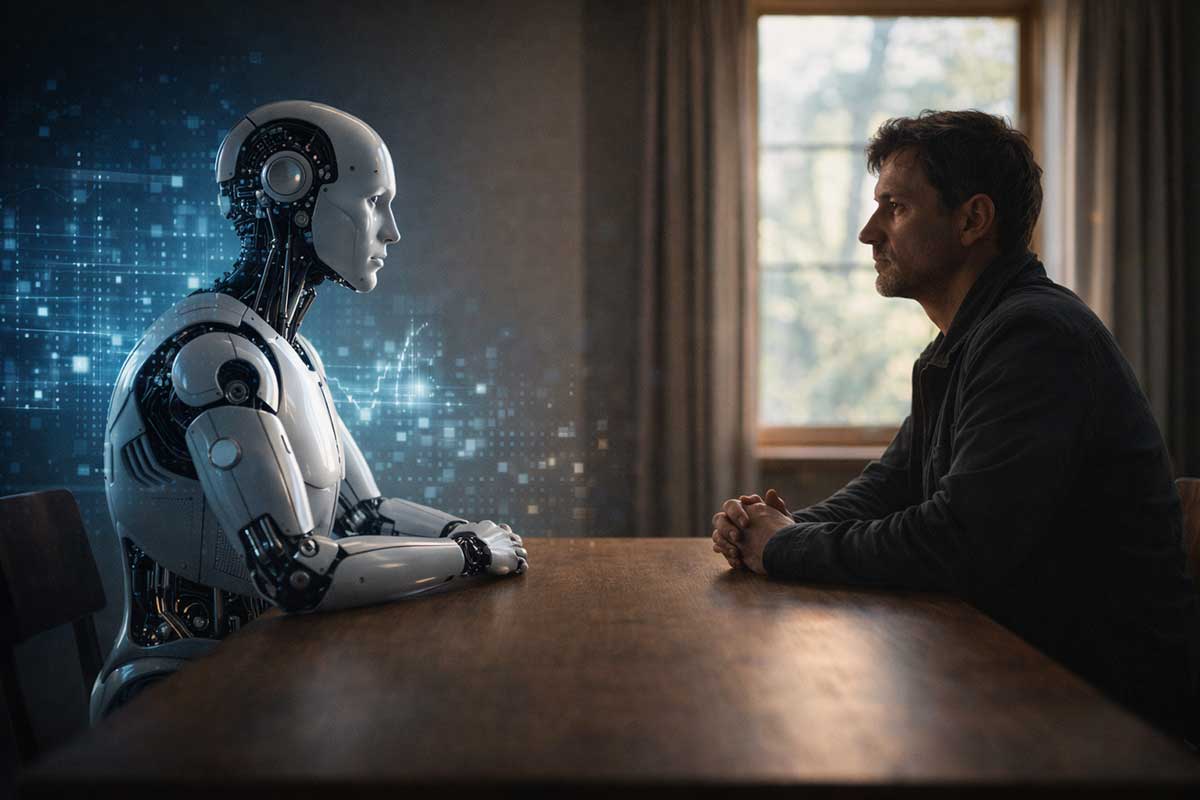
Moderator: Nick Sasaki
Participants: Carl Jung, Paul Tillich, Teresa of Ávila, Young Hoon Kim
Opening by Nick Sasaki
So far, we’ve clarified two things.
First, IQ measures a narrow form of intelligence.
Second, AI now surpasses even the highest-IQ humans in that same domain.
Yet neither IQ nor AI answers the question that has shaped civilizations, suffering, and hope for thousands of years:
Is God real—and if so, how is God known?
Tonight, we’re not asking whether belief is rational or irrational.
We’re asking something more precise:
Is God something to be understood through logic—
or something to be encountered through experience?
First Question
Why do attempts to prove or disprove God through logic alone often fail to address what believers actually mean by “God”?
Paul Tillich
Because God is not an object among other objects. When people try to prove God as though God were a thing, they misunderstand the claim from the beginning.
God is the ground of being—not a being within the universe. Logic operates within existence; God, if real, would be the condition for existence itself. Logic cannot step outside its own foundation to validate it.
Carl Jung
From a psychological perspective, God is not primarily a logical proposition. God is an experience of overwhelming meaning.
Attempts to argue God into or out of existence miss the point. What matters is not whether God exists logically, but whether the experience of God transforms the psyche.
Teresa of Ávila
Those who seek God only with the intellect often remain outside the door. God does not reveal Himself through cleverness.
The soul encounters God through humility, silence, and love—not through argument.
Young Hoon Kim
Logical arguments about God can be interesting, but they never led me to faith. Logic can describe ideas about God—but it cannot create relationship.
That comes from somewhere else.
Second Question
How is encountering God through experience, surrender, or relationship fundamentally different from understanding God as an abstract idea?
Teresa of Ávila
An idea does not change your life. An encounter does.
When the soul encounters God, fear loosens, priorities shift, and love deepens. This cannot be simulated through thought alone—it is lived, not reasoned.
Carl Jung
An abstract God remains distant. An encountered God becomes psychologically real.
Encounter is integration. It reorganizes the inner world. That is why religious experience persists even when doctrines collapse.
Paul Tillich
Faith is not certainty—it is ultimate concern. It is what claims you completely.
You do not decide faith the way you solve a problem. Faith happens when something addresses the whole person, not just the intellect.
Young Hoon Kim
When God becomes personal, belief is no longer theoretical. It becomes relational.
At that point, arguments feel secondary. What matters is trust.
Third Question
Can high intellectual ability sometimes become an obstacle to spiritual encounter rather than a pathway to it?
Carl Jung
Yes—when intellect becomes a defense against vulnerability.
The ego often uses intelligence to maintain control. But spiritual encounter requires surrender. Where control dominates, encounter recedes.
Paul Tillich
Pride of intellect can replace humility of spirit. When intelligence insists on mastery, it resists being addressed by something greater than itself.
Faith requires openness, not dominance.
Teresa of Ávila
God does not reject the intelligent—but God bypasses pride.
Those who come to God as children enter more easily than those who come as experts.
Young Hoon Kim
High intelligence can create the illusion that everything important must be understood before it is trusted.
But faith often asks for trust before understanding—not instead of it, but before it.
Closing Reflection by Nick Sasaki
What we see here is a clear distinction—not a conflict.
Logic is powerful.
Intelligence is valuable.
Understanding matters.
But God, if real, is not an equation to be solved.
God is encountered, not computed.
Jesus is followed, not deduced.
And this explains something essential:
Why belief in God or Jesus cannot be validated—or invalidated—by IQ.
Why intelligence neither qualifies nor disqualifies faith.
Why AI’s brilliance leaves this question untouched.
With that clarity, we now turn to an even more challenging domain—
forms of knowing that exist outside scientific proof altogether,
yet continue to shape human lives across cultures and history.
Topic 4 — Spirit World, Past Lives, and Non-Scientific Ways of Knowing

Moderator: Nick Sasaki
Participants: William James, Carl Jung, Dolores Cannon, Rupert Sheldrake
Opening by Nick Sasaki
Up to now, we’ve clarified three things.
First, IQ measures a narrow form of intelligence.
Second, AI now surpasses humans in that same domain.
Third, God and Jesus are not accessed through logic alone, but through encounter.
Now we enter a more controversial territory—one many people quietly experience, but hesitate to discuss.
Across cultures and centuries, people have reported encounters with the spirit world, memories of past lives, and moments of knowing that arrive without logic or proof.
Tonight, we’re not here to declare these experiences true or false.
We’re here to ask a more honest question:
Are there legitimate ways of knowing that exist outside scientific measurement—and if so, how should we treat them?
First Question
Why have spiritual experiences such as encounters with the spirit world or past-life memories appeared across cultures and history, despite lacking conventional scientific proof?
William James
Because human experience is broader than what science can currently measure. My work showed that religious and mystical experiences arise spontaneously, independently, and with remarkable consistency across cultures.
Their persistence suggests they address something fundamental in human consciousness—whether or not science has yet found the tools to explain them.
Carl Jung
These experiences arise from the deep layers of the psyche—the collective unconscious. Symbols of death, rebirth, and continuation appear everywhere, not because they are taught, but because they are archetypal.
Whether one interprets them literally or symbolically, their psychological reality is undeniable.
Dolores Cannon
In thousands of sessions, people described experiences they had no prior knowledge of—historical details, emotional memories, and spiritual narratives that emerged spontaneously.
What mattered most was not proving reincarnation, but the transformation that followed. People healed, released fear, and found meaning.
Rupert Sheldrake
Science often dismisses phenomena simply because they don’t fit existing frameworks. But history shows that science expands by confronting anomalies, not ignoring them.
The recurrence of these experiences suggests we are encountering limits of our current models—not necessarily illusions.
Second Question
Are there legitimate forms of knowledge that transform people deeply even if they cannot be measured, replicated, or verified scientifically?
William James
Absolutely. The value of an experience lies not only in its cause, but in its fruits. Experiences that consistently produce compassion, courage, and coherence deserve serious attention.
Truth, in human life, is often pragmatic before it is theoretical.
Dolores Cannon
Many people come to these experiences skeptical. What convinces them is not evidence, but change. Fear disappears. Purpose appears.
Transformation becomes the verification.
Carl Jung
Meaning is not proven—it is lived. An experience that reorganizes a person’s inner world has a reality independent of empirical validation.
Psychological truth does not require physical proof to be effective.
Rupert Sheldrake
Scientific verification is powerful, but incomplete. Human knowledge includes intuition, memory, empathy, and insight—none of which are fully reducible to measurement.
We should be careful not to confuse “not measurable” with “not real.”
Third Question
How can we distinguish between dismissing non-scientific experiences too quickly and accepting them too uncritically?
Rupert Sheldrake
By remaining open without abandoning discernment. Curiosity must coexist with skepticism. Dismissal and blind belief are equally unscientific.
William James
We evaluate experiences by coherence, consistency, and consequence—not by demanding impossible proof.
A disciplined openness respects experience without surrendering reason.
Carl Jung
The danger lies in literalism. Symbols should be interpreted, not worshipped. Psychological insight protects against both denial and delusion.
Dolores Cannon
Experience should empower, not control. Any system that removes personal responsibility or discourages questioning should be treated carefully.
Closing Reflection by Nick Sasaki
What emerges here is not a rejection of science—but a recognition of its boundaries.
Science explains mechanisms.
Experience reveals meaning.
Not all truth arrives as data. Some truth arrives as insight, memory, or transformation.
And this brings us to our final and most clarifying question:
If intelligence does not grant spiritual authority…
If AI surpasses IQ without approaching meaning…
If even spiritual experiences require humility rather than dominance…
Then who is actually qualified to speak about God or Jesus—and why?
Topic 5 — Why the Highest IQ Does Not Make Someone the Most Qualified to Speak About God or Jesus

Moderator: Nick Sasaki
Participants: Søren Kierkegaard, Simone Weil, C.S. Lewis, Young Hoon Kim
Opening by Nick Sasaki
Throughout this conversation, we’ve moved carefully.
We’ve clarified what IQ measures—and what it never will.
We’ve seen how AI already surpasses even the highest-IQ humans in those domains.
We’ve explored God not as a logical conclusion, but as an encounter.
We’ve examined forms of knowing that exist beyond scientific proof.
Now we arrive at the final and most clarifying question—not about belief, but about authority.
Does having the world’s highest IQ make someone the most qualified person to speak about God or Jesus?
Tonight, we’re not here to judge faith.
We’re here to understand who is qualified to speak—and why.
First Question
Why does possessing extraordinary intellectual ability not automatically grant authority in matters of faith, God, or Jesus?
Søren Kierkegaard
Because faith is not an achievement—it is a relationship.
Authority in matters of faith does not come from intellectual superiority, but from inward commitment. Truth in Christianity is not something one possesses; it is something one lives.
To confuse intelligence with spiritual authority is to misunderstand both.
Simone Weil
Intelligence can illuminate—but it cannot command grace.
God does not respond to cleverness. God responds to attention, humility, and love. Spiritual authority arises from self-emptying, not self-exaltation.
C.S. Lewis
If God exists, then no human stands above Him intellectually. At best, we are witnesses, not experts.
A brilliant mind may describe theology eloquently—but eloquence does not confer authority over divine truth.
Young Hoon Kim
My IQ gives me skill in certain areas, but it does not make me closer to God than anyone else.
If I speak about faith, I speak as a believer—not as an authority derived from intelligence.
Second Question
In what sense does belief in God or Jesus belong to a different domain of knowing than intelligence, logic, or problem-solving?
C.S. Lewis
Christian belief is not a theory about the universe—it is a claim about relationship.
You do not “solve” Jesus. You respond to Him. That response involves trust, conscience, and surrender—qualities no test can measure.
Søren Kierkegaard
Faith begins where calculation ends.
If belief could be reduced to logic, faith would no longer be faith—it would be certainty. Christianity insists on risk, commitment, and inward passion.
Simone Weil
Truth in the spiritual sense is recognized through consent, not conquest.
To believe is not to dominate truth—but to allow oneself to be transformed by it.
Young Hoon Kim
When faith becomes real, it stops feeling like a conclusion and starts feeling like a relationship.
That shift cannot be explained by intelligence—it happens through experience.
Third Question
What happens when society confuses intellectual achievement with spiritual authority—and how does AI make this confusion even more visible?
Søren Kierkegaard
Society replaces inwardness with spectacle. Authority becomes external, visible, and measurable.
Faith, however, remains inward and hidden. When the visible replaces the true, despair follows.
Simone Weil
When intelligence is mistaken for spiritual authority, humility disappears.
AI now reveals this mistake clearly. Machines surpass us intellectually, yet they do not approach holiness. This exposes how false the equation always was.
C.S. Lewis
If intelligence were the path to God, the smartest machine would be the closest saint.
The fact that no one believes this tells us everything we need to know.
Young Hoon Kim
AI makes it obvious that intelligence alone cannot lead to God.
If my intelligence means anything, it means knowing its limits.
Final Reflection by Nick Sasaki
What we’ve reached is not a rejection of intelligence—but its rightful place.
IQ measures cognitive ability.
AI exceeds it.
Neither approaches God.
Belief in God or Jesus does not come from speed of thought, brilliance, or rank. It comes from encounter, humility, and relationship.
The highest IQ does not qualify someone to speak for God.
It also does not disqualify them.
Faith stands apart—untouched by comparison, untouched by hierarchy.
And perhaps that is the quiet truth this entire conversation has been circling:
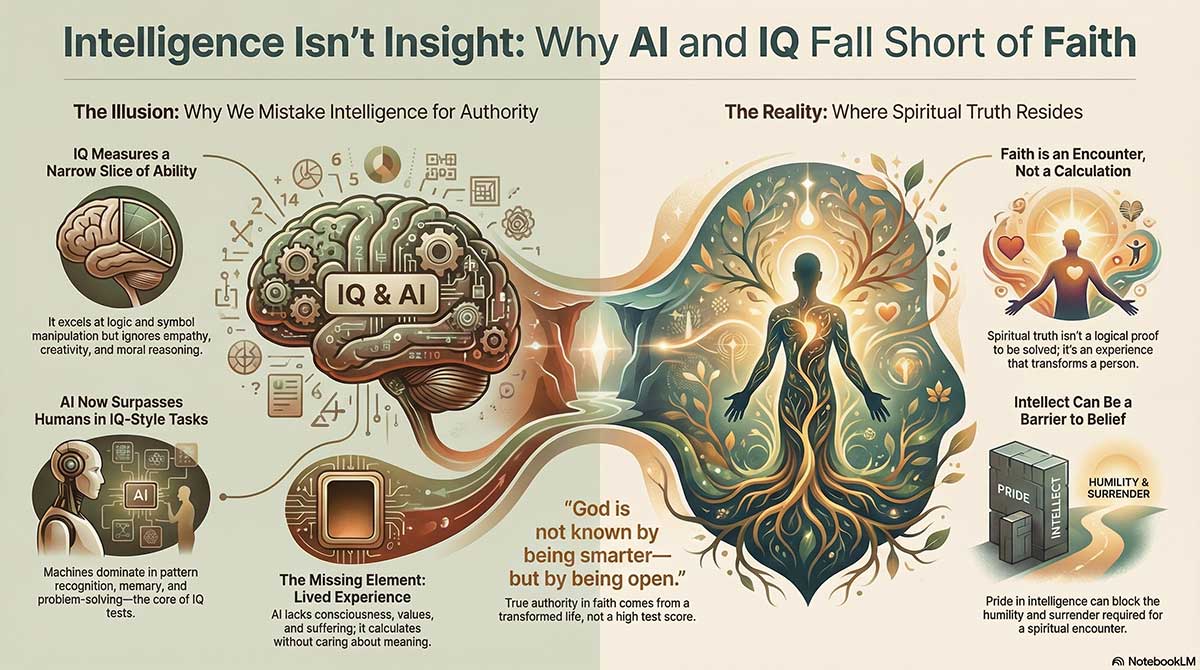
God is not known by being smarter—but by being open.
Final Thoughts by William James
I have often said that the ultimate test of any belief is not its elegance, nor the authority of the one who holds it, but the difference it makes in lived experience.
By that measure, intelligence—however brilliant—has a modest jurisdiction. It can clarify, systematize, and predict. It can help us build machines, solve problems, and understand mechanisms. But it cannot tell us what is worth loving, what is worth suffering for, or what gives coherence to a human life.
To mistake high intelligence for spiritual authority is to ask a tool to perform a task it was never designed to do.
The emergence of artificial intelligence makes this mistake visible at last. Machines now think faster than we do, calculate more accurately than we do, and remember more than we ever could. Yet they remain untouched by meaning. They do not hope. They do not despair. They do not pray. They do not forgive.
This should not alarm us. It should instruct us.
Faith in God or in Jesus does not compete with intelligence, nor does it submit to it. It belongs to the realm of experience—where life is actually lived, endured, and transformed. In that realm, authority is earned not by brilliance, but by depth of encounter.
The person most qualified to speak about God is not the one with the highest IQ, but the one whose life has been reshaped by what they have encountered. Such authority is quiet. It does not demand assent. It invites reflection.
In the end, truth for a human being is not what wins arguments, nor what dazzles the intellect. It is what steadies us in suffering, enlarges our compassion, and gives our days coherence.
Intelligence may guide the mind.
But meaning addresses the whole person.
And it is there—only there—that questions of God and Jesus finally belong.
Short Bios:
William James
American philosopher and psychologist, widely regarded as the father of modern psychology. James explored religion and spirituality through lived experience rather than doctrine, most famously in The Varieties of Religious Experience, arguing that truth must be tested by its effects on life.
Kim YoungHoon
A South Korean intellectual known for claims of exceptionally high IQ. Kim has publicly expressed Christian faith, emphasizing belief in God and Jesus, and has become a contemporary reference point in discussions about intelligence, faith, and authority.
Howard Gardner
American psychologist best known for the theory of Multiple Intelligences. Gardner challenged the idea that a single IQ score defines intelligence, arguing instead for diverse forms such as emotional, interpersonal, and existential intelligence.
Daniel Kahneman
Israeli-American psychologist and Nobel Prize–winning economist. Kahneman’s work on cognitive biases and decision-making revealed the limits of rational thought and showed how intelligence often fails in matters of judgment and meaning.
Jordan Peterson
Canadian psychologist and public intellectual. Peterson explores the intersection of psychology, mythology, and meaning, often emphasizing responsibility, narrative, and moral frameworks over purely intellectual explanations of life.
Geoffrey Hinton
Computer scientist and pioneer of deep learning, often referred to as a “godfather of AI.” Hinton’s work laid the foundation for modern artificial intelligence while also raising concerns about its limits and implications.
Yuval Noah Harari
Historian and philosopher known for examining the future of humanity, technology, and consciousness. Harari distinguishes sharply between intelligence and meaning, warning that AI may surpass human intellect without possessing human purpose.
Iain McGilchrist
British psychiatrist and philosopher whose work focuses on the divided brain and the loss of meaning in modern culture. McGilchrist argues that intelligence without context, relationship, and integration leads to fragmentation rather than wisdom.
Carl Jung
Swiss psychiatrist and founder of analytical psychology. Jung explored the symbolic and experiential dimensions of religion, viewing God as a profound psychological reality rather than a concept accessible through logic alone.
Paul Tillich
German-American theologian and philosopher. Tillich described God as the “ground of being,” insisting that God cannot be treated as an object of proof but must be understood existentially.
Teresa of Ávila
16th-century Spanish mystic and reformer. Teresa emphasized direct inner experience of God through prayer, humility, and surrender, often warning against overreliance on intellect in spiritual matters.
Søren Kierkegaard
Danish philosopher often called the father of existentialism. Kierkegaard argued that faith is a subjective commitment rather than an intellectual conclusion, emphasizing inwardness over certainty.
Simone Weil
French philosopher and mystic whose work centered on attention, humility, and compassion. Weil believed that spiritual truth emerges through self-emptying rather than intellectual mastery.
C.S. Lewis
British writer and Christian thinker known for translating complex theology into accessible language. Lewis emphasized that Christianity is not a theory to be proven but a relationship to be lived.
Dolores Cannon
American hypnotherapist and author known for her work in past-life regression. Cannon focused on spiritual healing and personal transformation rather than scientific validation.
Rupert Sheldrake
British biologist and author who challenges materialist explanations of consciousness. Sheldrake advocates openness to phenomena that fall outside conventional scientific models.
Leave a Reply