

|
Getting your Trinity Audio player ready...
|
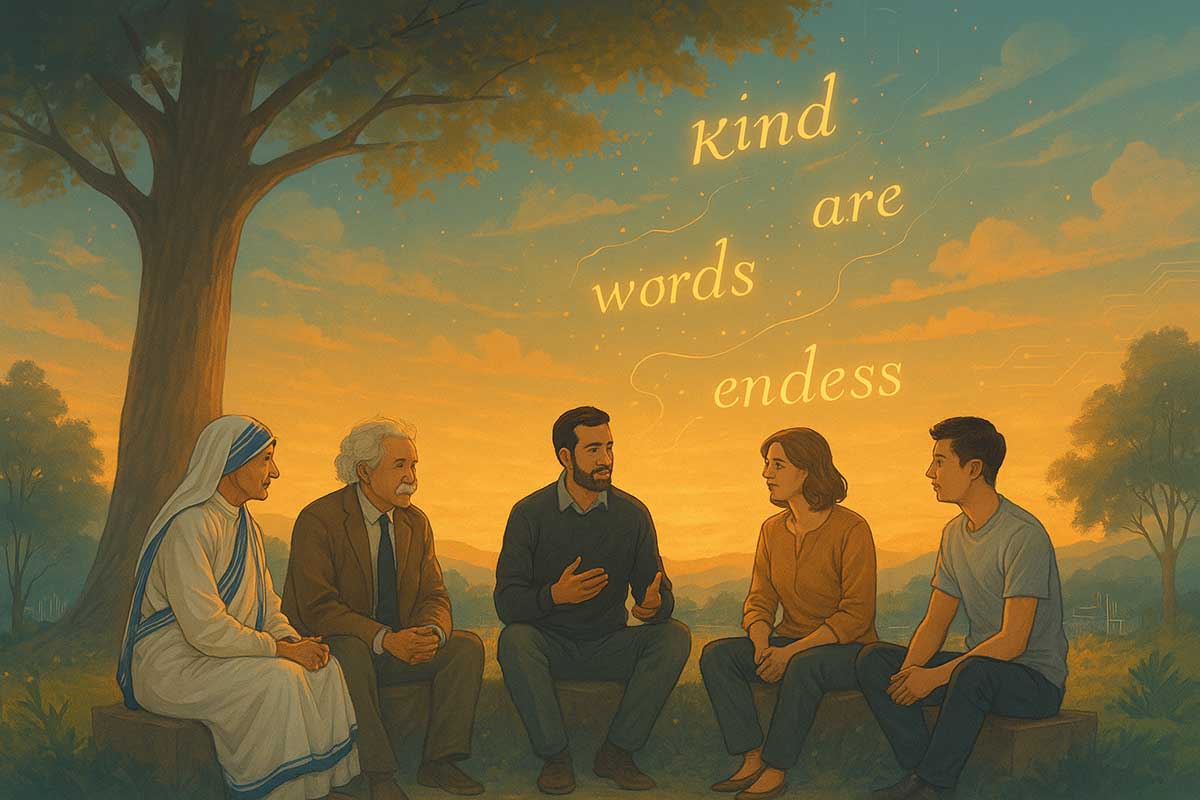
Mother Teresa:
My dear friends,
In this world, we are all hungry for love — not just for food or shelter, but for one kind word, spoken from the heart. Many people pass through life without ever hearing that they are enough, that they are precious, that they are loved.
Kindness is not something small. It is everything. One kind word, spoken at the right moment, can heal what doctors cannot see. It can restore what time has broken. It can save a life without us ever knowing.
I have seen the worst suffering, and yet it was often relieved not by medicine, but by gentleness. In the eyes of the dying, the lonely, and the forgotten, a whisper of compassion becomes the voice of God.
In these conversations, you will hear five reflections — not just from the mind, but from the soul. They are reminders that our words can become wounds… or wings.
Let us choose to be the echo of love in someone’s silence.
do something extraordinary.”
(Note: This is an imaginary conversation, a creative exploration of an idea, and not a real speech or event.)

Topic 1: The Word That Saved Me — When One Kindness Changes a Life
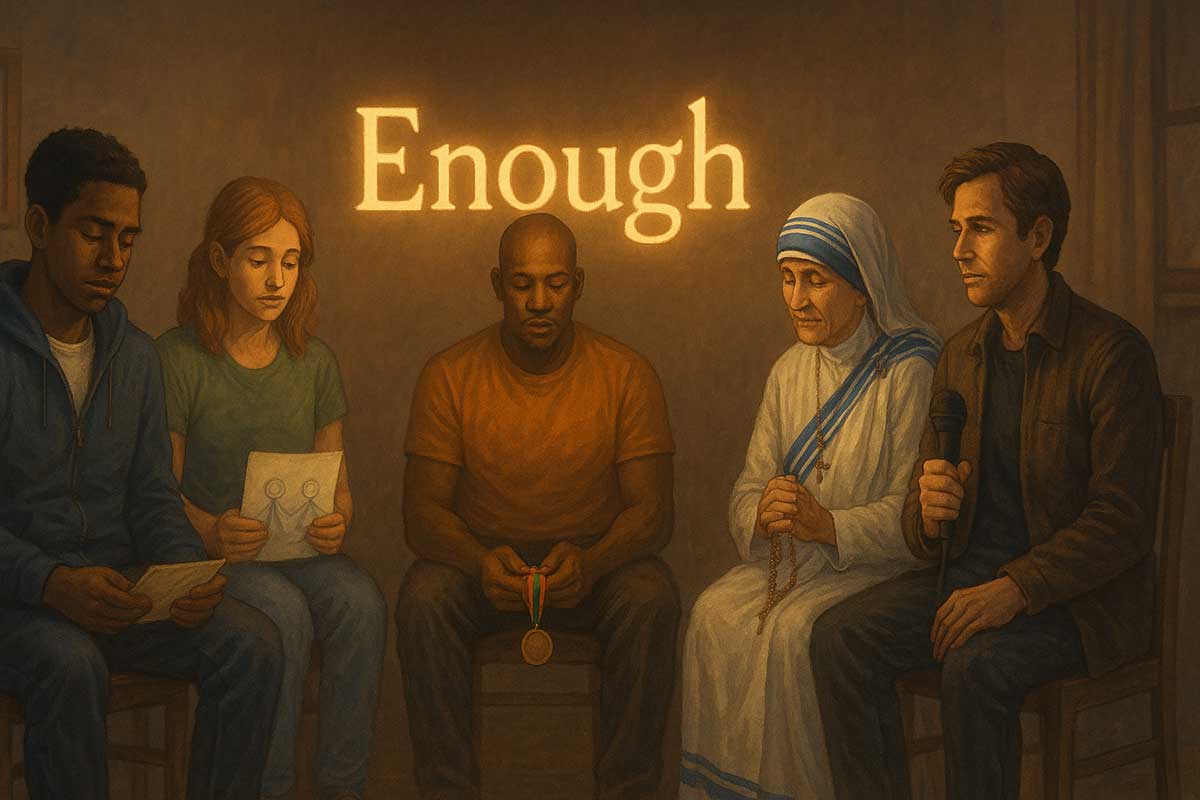
Moderator: Craig Hamilton
Speakers: Mother Teresa, Ocean Vuong, Tan Le, Simone Biles, Nick Vujicic
Introduction – Craig Hamilton
In the stillness between despair and healing, something remarkable can happen — someone speaks a kind word. A word that doesn’t try to fix you, but simply acknowledges your worth. Today, we explore the alchemy of those moments — how a gentle sentence spoken in sincerity can reroute a life.
We’re honored to be joined by five extraordinary individuals, including a woman whose life itself was a sentence of love: Mother Teresa.
Let’s begin.
“Was there a moment when a kind word genuinely changed your path?”
Ocean Vuong:
Yes. I was a boy who felt invisible — queer, Vietnamese, lost in translation. I once turned in a poem I didn’t even think was good. My teacher looked at me and said, “This is real.” That phrase — just that — let me believe maybe I could write not just to survive, but to live.
Tan Le:
When we fled Vietnam and arrived in Australia, I was five. We were broken, afraid. A woman knelt to my eye level, smiled, and said, “You’re safe now.” She didn’t know our language, but we understood. Those three words became the first corner of home in a foreign world.
Nick Vujicic:
In school, I often felt like a mistake. No arms. No legs. One day, a janitor — not a teacher, not a pastor — looked me in the eyes and said, “You’ll speak to millions one day.” I was stunned. But he saw something I couldn’t yet. That sentence put a dream in my heart.
Simone Biles:
At the Olympics, when I pulled out of the competition, the world had opinions. But a teammate came to me quietly and said, “You’re not broken — you’re brave.” I’ll never forget that. It was the opposite of pressure. It was the kind of permission that lets you breathe.
Mother Teresa:
I remember once a man dying in the gutter in Calcutta. He was trembling. I knelt down and said, “You are loved.” He looked at me as if those were the first words anyone had ever spoken to him. He died smiling. Sometimes we cannot give much. But a word spoken with love can carry someone home.
“Why do you think those particular words stayed with you?”
Tan Le:
Because they were complete. “You’re safe now.” It held every promise — that we weren’t alone, that the storm was over, that life could begin again. When you're shattered, clarity is kindness.
Nick Vujicic:
It was because I had no reason to expect kindness from that moment. I didn’t ask for it. But he gave it anyway. That’s what made it powerful. Kindness without agenda — it’s unforgettable.
Mother Teresa:
Because love speaks a language beyond the body. Words that come from a quiet heart carry a weight greater than volume. They stay because they were given in truth, without pride or pity.
Simone Biles:
I think it’s because those words met me exactly where I was. Not where people expected me to be. When kindness sees you — not your role or performance, but you — that’s when it sticks.
Ocean Vuong:
Because they felt earned. Not earned through performance, but through honesty. I wrote from a place of vulnerability, and she didn’t fix it — she honored it. Sometimes the kindest thing we can say is, “I see you, and it’s enough.”
“Do you now try to pass that same kind of kindness to others?”
Mother Teresa:
Yes. Always. I have seen how the smallest word, offered with sincerity, can carry more comfort than bread. We must not wait for grand stages to speak kindness. A whisper of love can reach where nothing else can.
Simone Biles:
I make it a point to check in on younger gymnasts. Not about medals — about them. I tell them, “You’re doing enough. You are enough.” I wish I heard that more when I was starting.
Ocean Vuong:
I try to write like that — as if I’m offering a warm towel, not a commandment. Poetry, in its best moments, is kind. Not because it flatters, but because it tells the truth gently.
Nick Vujicic:
Every school I speak at, I end with: “You are not forgotten.” Because I know what it’s like to feel invisible. Kindness isn’t soft — it’s bold. It interrupts the silence where shame thrives.
Tan Le:
I now mentor refugees and always try to offer one line they can carry. Usually it’s this: “The future doesn’t have to look like the past.” When someone gave me safety, it planted hope. Now I try to pass that spark forward.
Closing Thoughts – Craig Hamilton
What if the next sentence we speak becomes someone’s turning point?
What if we remembered that kind words don’t echo because we mean them loudly — but because we mean them quietly, with care?
Today’s voices remind us that every conversation is a chance to heal, not just exchange. And that one small kindness — spoken gently, offered freely — can outlive our own voices.
Let yours echo wisely.
Topic 2: Speaking Light into Darkness — Kindness Amid Conflict and Division
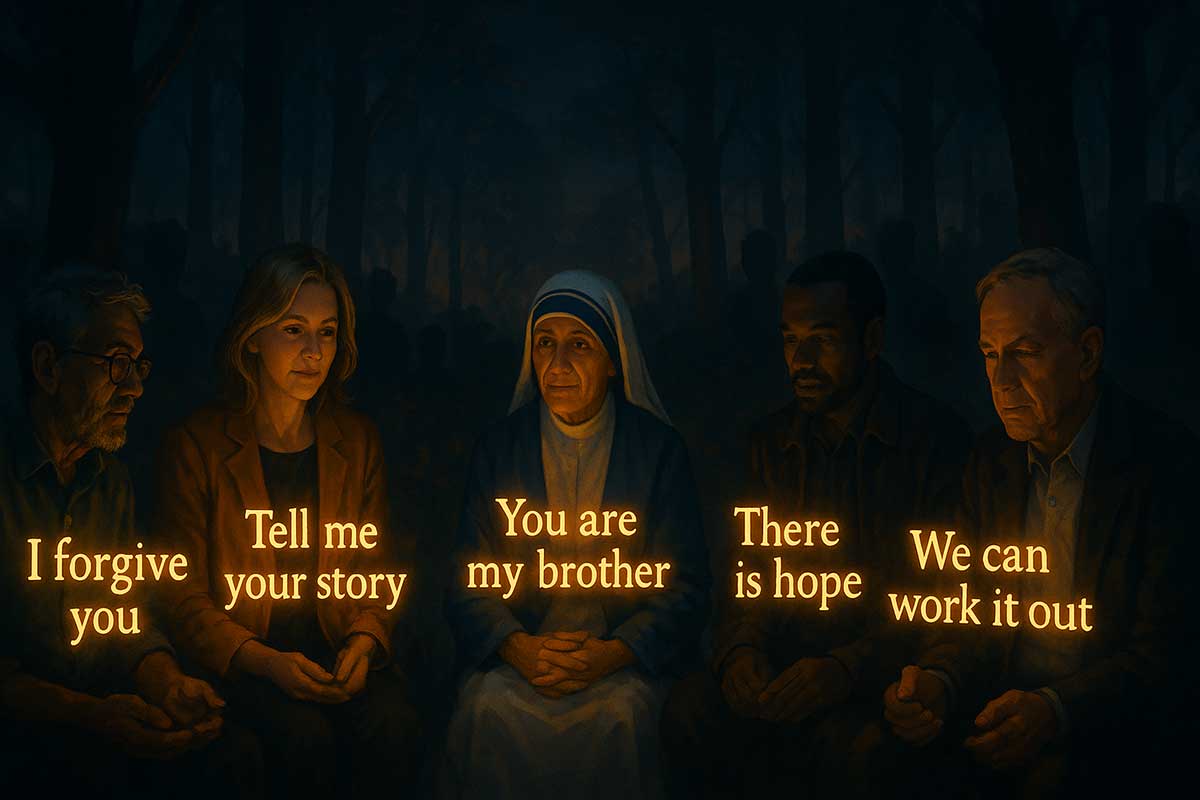
Moderator: Craig Hamilton
Speakers: Mother Teresa, Desmond Tutu (archival/imagined), Iyanla Vanzant, Charlie Mackesy, Daryl Davis
Introduction – Craig Hamilton
What does it mean to speak kindly in the midst of hostility? Not just when it’s easy — but when it feels impossible? Today we explore kindness as a form of moral courage. Kindness that doesn’t avoid the wound but enters it without violence.
Joining us are five voices who have lived this question in war zones, family breakups, racial divides, and inner conflict. And once again, we’re blessed to be guided by Mother Teresa, who showed us that gentleness can outlast any cruelty.
Let’s begin.
“Can you recall a moment when you chose kindness in the middle of conflict — and it changed something?”
Charlie Mackesy:
I remember drawing “The Boy and the Mole” after a painful argument with someone I loved. I didn’t know how to fix it, so I drew a small creature saying, “I’m sorry.” That page traveled around the world. Sometimes we speak light through silence, through art. The kindness we can't say out loud can still be heard.
Iyanla Vanzant:
Once on my show, a daughter told her mother, “I wish you were never born.” The mother began to rage. I placed my hand on hers and said, “Don’t fight the wound. Just hold it.” She wept. Not because I said something brilliant — but because someone chose stillness instead of reaction. That’s the difference between punishment and healing.
Desmond Tutu:
At the Truth and Reconciliation Commission, I heard horror. Torture. Betrayal. But when a mother looked her son’s killer in the eye and said, “I forgive you,” it wasn’t weakness — it was power. Kindness, in that moment, wasn’t sentimental. It was revolutionary.
Mother Teresa:
There was a soldier in Beirut — angry, cruel, eyes like fire. I touched his arm and said, “You are also a child of God.” He did not smile. But he lowered his gun. I have seen again and again: when we speak to the soul and not the anger, the soul sometimes answers.
Daryl Davis:
I sat down with a KKK member once. Everyone told me I was insane. But I said, “Tell me your story.” And I listened. After two years of talking, he left the Klan. Gave me his robe. Not because I argued him out of hate — but because I treated him like a man, not a monster.
“Why is it so hard for people to be kind during conflict?”
Desmond Tutu:
Because we confuse kindness with agreement. We think if we show compassion, we’ve surrendered our values. But true kindness doesn’t erase truth — it holds it without throwing stones.
Mother Teresa:
Because pain teaches us to protect. And protection becomes pride. But kindness is not weakness. It’s the opposite — it is knowing you could harm and choosing not to.
Daryl Davis:
Fear. That’s the root. We fear the other. We fear being humiliated. So we strike first. But kindness isn’t about being passive — it’s about being steady. About being so grounded that someone else’s storm doesn’t blow you over.
Charlie Mackesy:
Because our egos want to win. But kindness doesn’t play that game. It walks off the board and says, “Come sit with me.” It invites presence, not power.
Iyanla Vanzant:
Because people don’t know how to sit with their own pain. So they project it, attack with it, defend it like it’s treasure. But when someone chooses kindness, it rewrites the script. Suddenly, the wound doesn’t have to be a weapon.
“What practice or mindset helps you stay kind when it’s hardest?”
Mother Teresa:
I imagine the person in front of me as Christ in disguise. Even if they insult me. Even if they raise a weapon. If I treat them with reverence, I never lose peace — even if they do.
Charlie Mackesy:
I draw. That’s how I digest conflict. I turn pain into something gentle. When I can’t speak kindly, I let the pen speak for me.
Iyanla Vanzant:
I breathe. Slowly. Deeply. Then I say to myself, “I am here to heal, not to win.” That centers me every time. Conflict wants escalation. Kindness wants truth without a trophy.
Desmond Tutu:
Prayer. Deep prayer. Not for the enemy to change — but for me to keep my heart soft. When I pray for my enemy’s joy, I become free, even if they don’t.
Daryl Davis:
I tell myself, “You don’t have to change them. Just be real.” Kindness, in my experience, doesn’t come from trying to convince. It comes from creating space that disarms defensiveness.
Closing Thoughts – Craig Hamilton
We often talk about courage as if it belongs to heroes and soldiers. But maybe the bravest thing we do is choose kindness in the middle of chaos.
Not because it wins the argument. But because it keeps our soul intact.
And sometimes — just sometimes — it keeps someone else’s soul intact, too.
Let’s speak light. Not to silence the darkness, but to remind it: it’s not the only voice in the room.
Topic 3: Healing Frequencies — The Science and Soul of Kind Words
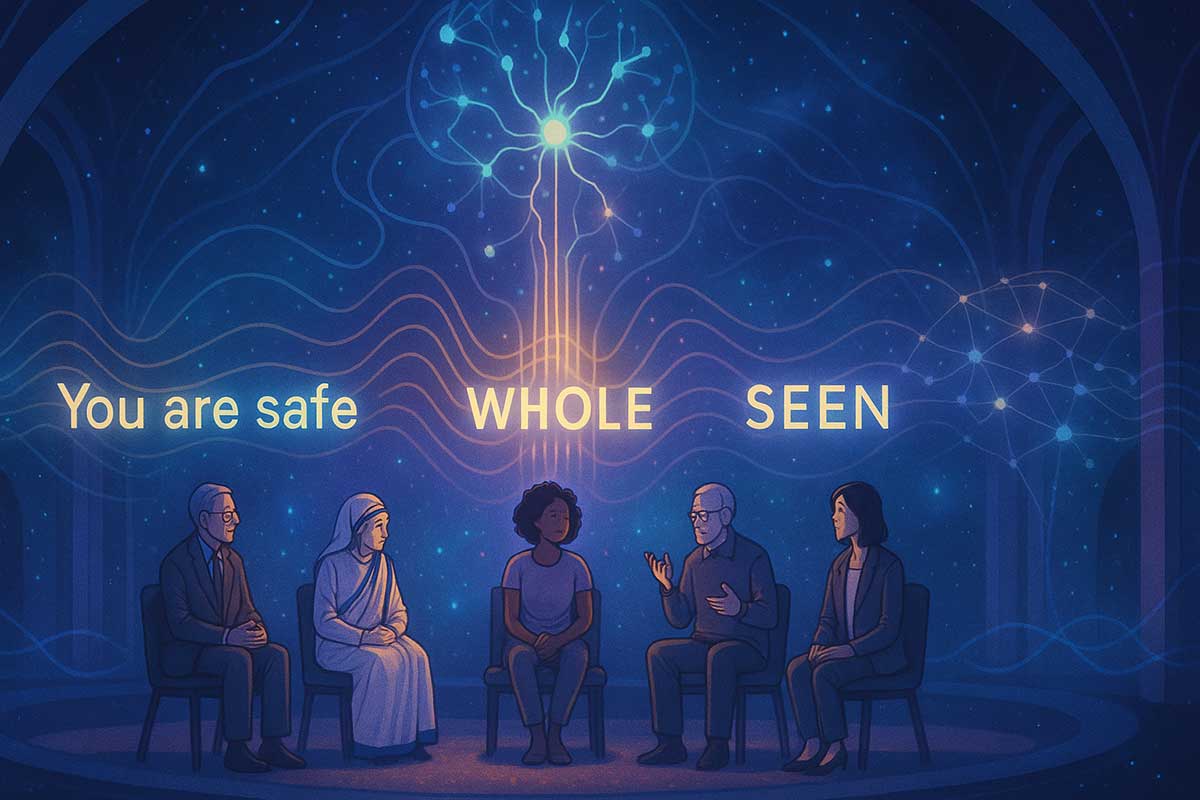
Moderator: Craig Hamilton
Speakers: Mother Teresa, Dr. Gabor Maté, Craig Hamilton, Lisa Miller, Marisa Liza Pell
Introduction – Craig Hamilton
Modern science now confirms what sages have taught for centuries — kind words are not just emotionally soothing; they’re physiologically transformative. They regulate the nervous system, calm inflammation, even change brain chemistry. But what makes them work?
Today we sit at the intersection of neuroscience, spirituality, and energy healing to explore why certain words heal and how we can speak them more consciously. With us is Mother Teresa, who spent her life proving that love is the greatest medicine — often administered one gentle sentence at a time.
“Have you witnessed or experienced a moment when kind words created physical or emotional healing?”
Marisa Liza Pell:
Yes, countless times. As a medium and soul therapist, I’ve watched people dissolve years of grief when a single, simple message came through from a loved one: “I never blamed you.” That phrase alone can unclench a decade of guilt. It's not the word itself — it's the frequency behind it.
Dr. Gabor Maté:
A young man with autoimmune disease once told me, “No one’s ever said they’re glad I exist.” I looked at him and said, “I’m glad you exist.” He burst into tears — not because he believed me immediately, but because his body had longed for those words. His symptoms didn’t disappear, but his posture changed. Sometimes healing begins with the nervous system hearing, You are safe.
Mother Teresa:
Many of the dying I served asked for nothing more than words. One man said, “Don’t let me die without someone saying they loved me.” I leaned in and said, “I love you. God loves you.” He passed away moments later with peace in his eyes. The body can go — but if the heart hears love before it goes, it leaves healed.
Lisa Miller:
My research shows that adolescents who feel spiritually seen — through words like “You have purpose” or “You’re connected to something greater” — are 80% less likely to experience depression. That’s not magic. That’s the brain responding to language that reflects its need for belonging and meaning.
Craig Hamilton:
During a retreat, a woman struggling with chronic pain shared her story. I looked at her and simply said, “Nothing in you is broken.” She wept for twenty minutes. Her pain didn’t disappear that day, but her relationship to it softened. Often it’s not about healing the wound — but about removing the words that re-wound us daily.
“What is it, do you think, that gives kind words their healing power?”
Mother Teresa:
It is not the words. It is the love inside them. Words spoken without love are noise. But words with love — even if they are imperfect — carry divine grace. That is what heals.
Lisa Miller:
It’s resonance. Words of kindness create synchrony between speaker and receiver. That synchrony activates regions of the brain associated with safety, compassion, and resilience. It’s like tuning forks — kindness brings people into vibrational harmony.
Craig Hamilton:
Presence. When words are delivered from stillness, from an awareness that isn't trying to fix or please, they carry the vibration of truth. That frequency penetrates more deeply than logic ever could.
Marisa Liza Pell:
Spoken kindness carries intention through the unseen realms. Words sit in the auric field, in the emotional body. When delivered with soul-level authenticity, they begin to rewire how we see ourselves — not just emotionally, but energetically.
Dr. Gabor Maté:
Most people carry self-negating narratives that keep their physiology in a loop of tension. A kind word interrupts that loop. It offers a new signal: You’re not wrong for existing. That reorientation, if repeated, can shift biology. It’s slow, but real.
“What words or phrases do you try to speak regularly, knowing their healing power?”
Craig Hamilton:
I often say, “You’re already whole.” Because in spiritual growth, the trap is striving. That sentence is a balm to the part of us that’s tired of becoming. It reminds us to rest in being.
Dr. Gabor Maté:
I say, “It’s not your fault.” Not as an excuse — but as a starting point for compassion. Most trauma began in childhood. Adults need to hear that the pain they carry isn’t a moral failure.
Mother Teresa:
I say, “God loves you.” Not as a doctrine — but as a declaration. When spoken with faith, these words remind even the most broken person that they are not forgotten.
Lisa Miller:
“You are not alone.” Especially for young people. In our digital age, the ache of isolation is profound. That phrase — if sincere — can lower cortisol. We’ve seen it in the lab.
Marisa Liza Pell:
I say, “You are seen.” Because even in the presence of love, people often feel invisible. That phrase brings them back into the room, back into relationship with themselves and others.
Closing Thoughts – Craig Hamilton
Healing doesn't begin with procedures or pills. It begins with presence — and often with a sentence.
A kind word isn’t a solution. It’s a permission slip for the body to soften, the mind to reframe, the soul to return home.
So if you only say one thing today, let it be said with kindness — and let it be said as if your voice might be the first safe place someone has ever heard.
Because it might be.
Topic 4: Divine Speech — When Kindness Reflects God Within
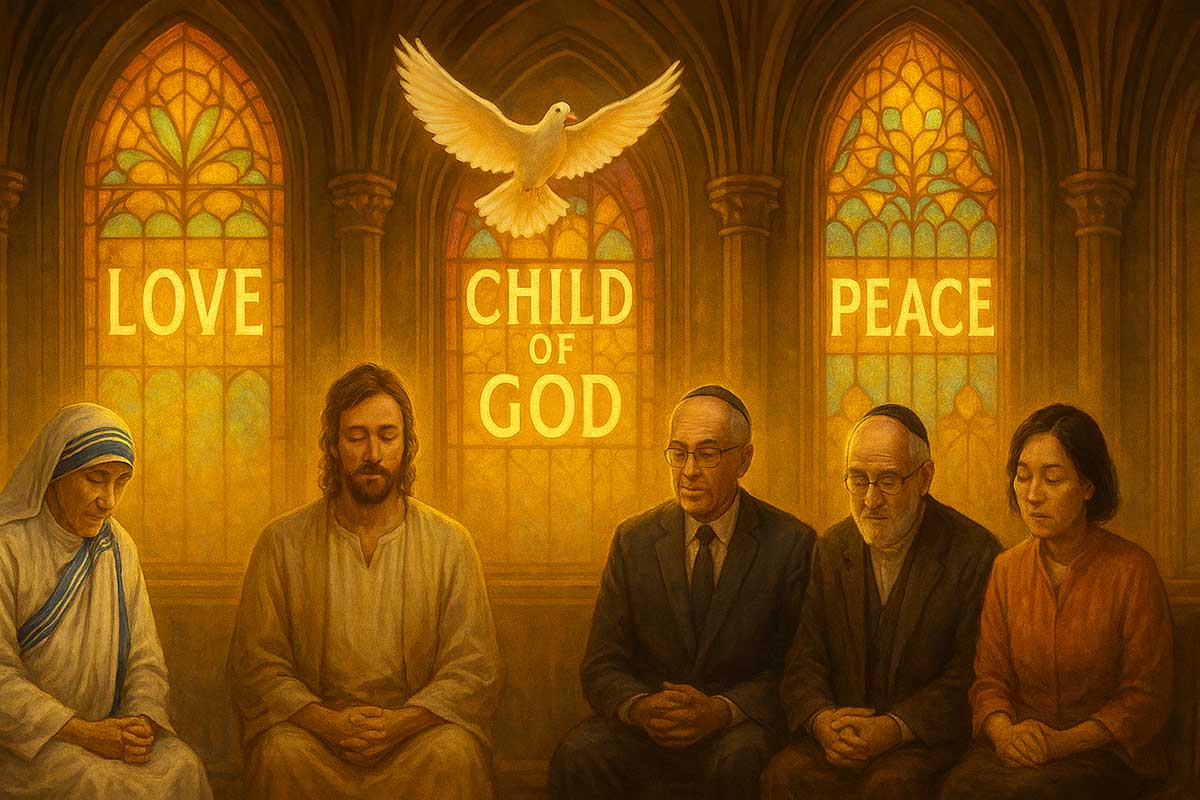
Speakers: Mother Teresa, Paramahansa Yogananda, Maya Angelou, Pope Francis, Rev. Sun Myung Moon
Introduction – Craig Hamilton
Throughout history, mystics, prophets, poets, and teachers have spoken of kindness not just as morality, but as divinity made audible. To speak with love, to bless rather than curse, to comfort instead of correct — these are not just good manners. They are evidence of God within us.
Today’s speakers have each, in their own way, given voice to the divine through words that comfort, awaken, and heal. At the center of this conversation is Mother Teresa, whose every phrase carried the warmth of heaven. Let's begin.
“Have you ever witnessed or experienced a moment when kind words felt divine — as if God was speaking through them?”
Maya Angelou:
Yes, oh yes. I was once broken down — feeling unworthy, lost. And someone said to me, “You have already paid your dues. Now live like you’re free.” I wept. Because those words weren’t just nice — they were anointment. The best kind words feel like God kissing your forehead.
Rev. Sun Myung Moon:
When I was imprisoned in North Korea, there was a moment of deep despair. An old man whispered, “God is still with you.” In a place of no hope, those words ignited fire in my bones. They weren’t just encouragement — they were a message from Heaven itself.
Mother Teresa:
A child once looked at me and said, “You are Jesus’s smile.” I do not deserve that. But the child had no agenda — only love. That purity is divine. God often speaks through the humble — especially children.
Paramahansa Yogananda:
When my guru Sri Yukteswarji once said, “You are not this fear,” it shattered my illusion. Divine speech doesn’t flatter — it liberates. A true word from God awakens your eternal self, not your ego.
Pope Francis:
I visited a prison and said to one man, “You are more than your worst moment.” He sobbed like a child. I believe God was present. Not in me — but in the space that sentence created. Sometimes, we are only the vessel.
“What makes a word or phrase feel sacred, rather than simply kind?”
Mother Teresa:
When it is said without self. A sacred word comes from silence, from prayer. It is not clever or rehearsed. It is simple. And it touches something eternal inside the listener.
Paramahansa Yogananda:
Because it vibrates at a higher frequency. Sacred words align with the divine blueprint of the soul. They don’t agitate — they uplift. They return you to your true nature.
Rev. Sun Myung Moon:
Because it carries the heart of God. A sacred phrase is soaked in tears. It is not language — it is Han, the sorrow and hope of God reaching for His children. That is what makes it holy.
Pope Francis:
Because it doesn’t point to the speaker — it points beyond. A sacred word is like a window. You look through it and see light. It humbles both the giver and the receiver.
Maya Angelou:
Because it rings like a bell in the soul. You feel it. It stops you mid-thought. Sacred language reminds you of your worth — not because of what you’ve done, but because of what you are.
“What words do you speak often that you believe carry divine energy?”
Rev. Sun Myung Moon:
I often say, “You are God’s child.” Not metaphorically — literally. This phrase breaks chains. When people hear it not as theology but as truth, their hearts begin to come alive again.
Maya Angelou:
“Still, you rise.” I say it to others the way I wrote it for myself — as prophecy. When spoken from love, these three words are wings. They remind us we were never meant to stay down.
Pope Francis:
I say, “Peace be with you.” Not as ritual, but as blessing. Because true peace is the signature of God. When I say it, I mean: May the divine rest in your heart.
Paramahansa Yogananda:
I say, “You are light.” Not just spiritually — but vibrationally, cellularly. This is not metaphor. We are beings of radiant consciousness. That affirmation helps souls remember.
Mother Teresa:
I say, “God loves you.” Every day. To strangers, to the dying, to those who curse me. Because no matter what anyone believes, these three words are the deepest truth I know.
Closing Thoughts – Craig Hamilton
Kindness is often seen as a social virtue. But what if it’s more than that? What if it’s sacred technology — a way for divinity to travel through time, through trauma, through us?
Today’s voices remind us that when we speak from stillness, from soul, from love… our words become more than sound. They become sanctuary.
So speak softly. Speak truth. And speak as if God is listening — because God is.
Topic 5: The Echo in the Algorithm — Kindness in a Digital World
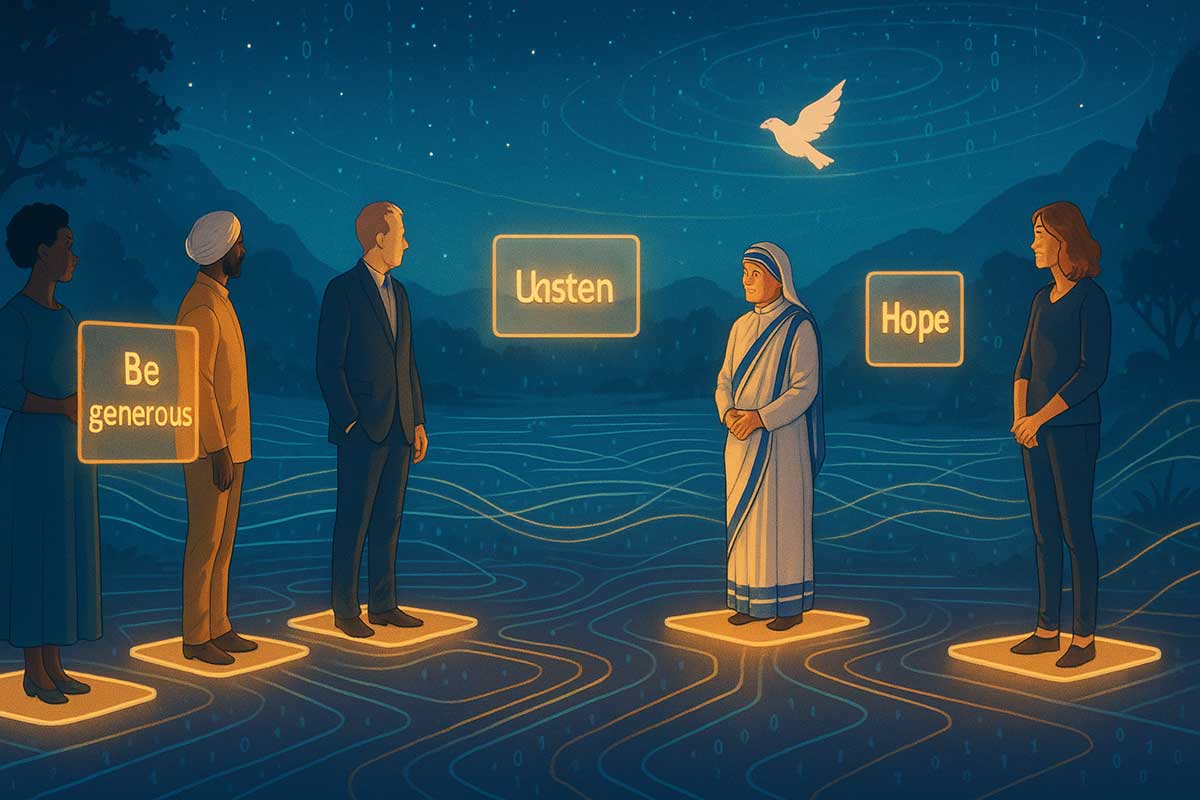
Moderator: Craig Hamilton
Speakers: Mother Teresa, Amanda Gorman, Jay Shetty, IU, Ali Abdaal
Introduction – Craig Hamilton
The internet was supposed to connect us — and in many ways, it has. But the same platforms that carry wedding photos and words of encouragement also spread cruelty at the speed of light. In a world where words are endlessly copied, clipped, and commodified, how do we preserve kindness? How do we speak as humans, not algorithms?
Today, we’re joined by four influential digital voices, alongside Mother Teresa, whose words, though spoken long before smartphones, have echoed further than most.
“Have you ever struggled to maintain kindness in digital spaces — and how did you find your way back?”
Amanda Gorman:
Yes — especially after the Inauguration. Suddenly, I wasn’t just a poet — I was a meme, a target, a hashtag. One day I saw a comment that simply said, “You made me feel brave.” That pulled me out of the noise. It reminded me that our words can be a lighthouse — even if we can’t see who’s watching.
Ali Abdaal:
There’s pressure to always perform — more productivity, more engagement. Once, a viewer commented, “Thanks for not shouting at me.” That stayed with me. It reminded me that calm, kind speech is rare online — and deeply needed.
IU:
In K-pop, fans and critics are relentless. I used to read every comment, good or bad. Now I focus on creating music that speaks gently. A fan once wrote, “Your voice saved me without even trying.” That’s when I knew I didn’t have to react — I just had to keep giving quietly.
Jay Shetty:
Social media rewards the extreme. But real connection comes from being real. I once got a message that said, “Your kindness is like air — I don’t notice it until I can’t breathe.” That’s when I realized that consistency, not loudness, builds trust.
Mother Teresa:
Though I never used a phone or computer, I understand the temptation to shout into the void. In the slums, there was also noise — of hunger, of chaos. I found that when I whispered love, people leaned in. Sometimes, quiet kindness is the loudest message.
“What makes digital kindness different — or even more powerful — than in-person words?”
Jay Shetty:
Digital kindness is scalable. One kind post can reach millions. But it’s also fleeting. So, its power lies in repetition — being a consistent voice of calm in someone’s feed.
Ali Abdaal:
It’s the intimacy of one-to-many. A video, even watched by thousands, feels personal when spoken gently. You’re not broadcasting — you’re connecting. And the brain responds to that tone.
Mother Teresa:
Kindness is not weakened by distance. The Spirit has no need for proximity. A sentence typed with love carries as much weight as one spoken face-to-face — if the heart behind it is pure.
IU:
In-person words disappear. But online, they remain — for better or worse. That means a kind word can become a permanent echo. We should be careful what we allow to echo.
Amanda Gorman:
Because the internet is so crowded, kindness cuts through like music. It’s not always noticed immediately — but it’s remembered. It lingers. I think that’s its secret power.
“What do you intentionally say or post, knowing it will echo digitally?”
Mother Teresa:
“You are loved.” That is the sentence I would post every day, if I could. Whether anyone responds or not, that word never returns empty.
Ali Abdaal:
I often say, “You’re doing better than you think.” It counters the online culture of not-enoughness. People read that and exhale. That’s a victory.
Amanda Gorman:
I post lines like, “You are the poem.” Because we scroll so fast we forget we’re alive. A poetic pause reminds people they are more than data.
Jay Shetty:
I always include, “This message is for you — yes, you.” It pulls people out of the scroll and into presence. That’s where kindness lives — in the moment someone feels seen.
IU:
I write, “Let’s be gentle with ourselves today.” Not flashy. Just an anchor. I know some fans check in just to hear that, like a daily hug.
Closing Thoughts – Craig Hamilton
In the age of algorithms, where outrage trends and silence scrolls past unseen, kindness is rebellion. It’s countercultural. It’s divine.
And it’s needed more than ever.
Our voices may travel through glass and code — but they still carry soul. Speak kindly, even when no one “likes” it. Because someone, somewhere, needed to hear exactly what you said.
And maybe, that someone was you.
Final Thoughts by Mother Teresa
Thank you for listening.
You may feel small in this world. You may feel that your words are not important. But I tell you now — speak anyway. Speak gently. Speak with love. Speak as if the person in front of you is Jesus in disguise, for in truth, He is.
You may never know how far your words travel, but they will go farther than you think. They will become part of someone’s story, someone’s healing, someone’s reason to hope again.
Do not wait for a perfect time to be kind. The time is always now. A smile, a word, a blessing — these are seeds that grow in secret and bloom in heaven.
Be the one who speaks softly in a noisy world. Be the one who remembers that love, once spoken, never dies.
Short Bios:
Mother Teresa
Catholic nun and humanitarian who devoted her life to serving the poor and dying in Calcutta. Known for her humility and gentle words that healed even the most broken hearts.
Ocean Vuong
Vietnamese-American poet and author of On Earth We’re Briefly Gorgeous. His work explores grief, memory, and the quiet power of language to restore.
Tan Le
Former refugee and tech entrepreneur. As founder of EMOTIV, she combines innovation with a deeply human story of healing and survival through kindness.
Simone Biles
World champion gymnast and mental health advocate. Her decision to prioritize well-being over performance sparked a global conversation on self-worth.
Nick Vujicic
Motivational speaker born without limbs. His life message centers on hope, dignity, and the transformational power of encouragement.
Charlie Mackesy
British artist and author of The Boy, the Mole, the Fox and the Horse. His illustrations and words have become symbols of gentle strength and compassion.
Iyanla Vanzant
Spiritual teacher and bestselling author known for her work in emotional healing, family reconciliation, and truth-telling with love.
Desmond Tutu (archival/imagined)
South African archbishop and Nobel Peace Prize laureate. A tireless advocate for reconciliation, he used joy, forgiveness, and spiritual conviction to bridge divides.
Daryl Davis
Musician and racial healing advocate who helped hundreds of KKK members leave hate groups through conversation, respect, and patience.
Dr. Gabor Maté
Physician and author specializing in trauma, addiction, and mind-body health. He teaches that compassionate words can begin the process of inner repair.
Craig Hamilton
Meditation teacher and founder of the Practice of Direct Awakening. He teaches that spiritual insight arises through presence and conscious speech.
Dr. Lisa Miller
Psychologist and researcher of spiritual neuroscience. Her work shows how spiritual language impacts mental health, especially in adolescents.
Marisa Liza Pell
Intuitive therapist and medium who helps clients process grief and emotional pain through soul-centered guidance and gentle affirmations.
Paramahansa Yogananda
Indian spiritual teacher and author of Autobiography of a Yogi. He taught that kind words and divine love are keys to personal and global transformation.
Maya Angelou
Celebrated poet and civil rights icon whose life and writings reflected the dignity, strength, and sanctity of the human voice.
Pope Francis
Current head of the Catholic Church known for his focus on humility, mercy, and compassionate speech in religious and global dialogue.
Rev. Sun Myung Moon
Spiritual leader and peace advocate who emphasized that humanity is one family under God. He believed kind, truthful words could heal God’s sorrow and restore unity.
Amanda Gorman
Poet and activist whose powerful words at the 2021 U.S. inauguration brought global attention to the beauty and bravery of hope.
Jay Shetty
Former monk turned speaker and author. He uses social platforms to spread wisdom, empathy, and consistent kindness in a fast-paced world.
Ali Abdaal
Doctor and content creator known for his calm, uplifting communication. He offers practical, kind guidance on productivity and personal growth.
IU
Singer-songwriter and global icon admired for her humility and emotional depth. Her voice and words have quietly supported millions through hardship.
Leave a Reply