

|
Getting your Trinity Audio player ready...
|
What if Marci Shimoff, Dr. Sue Morter, and Lisa Nichols compared notes on why miracles stall?
Introduction by Marci Shimoff
For a long time, I believed miracles were rare—beautiful exceptions that happened to other people when conditions were just right. Yet the more I studied happiness, the brain, and the inner lives of people who seemed to live with ease, the clearer something became: miracles aren’t created through force or perfection. They emerge when we stop blocking them.
Manifest a Life of Miracles is an exploration of that truth. Through these imaginary conversations, we look honestly at the places where we hold on too tightly, doubt our worth, wait for certainty, stay in unsupportive environments, or resist the natural flow of life. None of this is a personal failure—it’s human conditioning.
The Miracle Zone isn’t a destination you earn. It’s a state you allow. And these conversations are an invitation to gently notice what’s been in the way, so life can meet you with the grace it’s always been offering.
(Note: This is an imaginary conversation, a creative exploration of an idea, and not a real speech or event.)
Topic 1 — Why Do We Cling to What Is Already Hurting Us?

Setting
A quiet, sunlit room with floor cushions arranged in a loose circle. No stage, no hierarchy. The atmosphere is gentle, spacious, unhurried—like a place where nothing has to be defended.
Moderator: Tara Brach
Participants:
Dr. Sue Morter, Michael A. Singer, Marie Kondo, Pema Chödrön, Byron Katie
Question One (Asked by Tara, naturally)
Tara Brach
So many people come to spiritual or personal growth work asking for change—more freedom, more love, more ease. Yet at the same time, they’re gripping tightly to situations, identities, or habits that cause them pain. I’d like to begin here: when something is clearly hurting us, why is letting go still so difficult?
Dr. Sue Morter
From the body’s perspective, clinging is about survival. Even pain can feel safer than the unknown. The nervous system doesn’t ask, “Is this joyful?” It asks, “Is this familiar?” So we hold tension, relationships, jobs, even symptoms, because they give the body a predictable signal. Letting go feels like falling without a net—until the body learns that safety can exist without contraction.
Michael A. Singer
What we’re really clinging to isn’t the situation—it’s the story we’re telling ourselves about it. The mind says, “This may be painful, but it’s mine.” The moment you identify with something, you defend it. True freedom begins when you notice that the one who is aware of the pain is not the pain itself. Then holding on simply becomes unnecessary.
Marie Kondo
I see this very clearly with physical objects. People keep items that remind them of sadness, guilt, or obligation. When I ask why, they often say, “Because I should,” or “Because I might need it someday.” These objects quietly anchor the past in the present. Letting go feels scary because it feels like erasing a part of ourselves—but it is actually an act of honoring who we are becoming.
Pema Chödrön
We cling because uncertainty frightens us more than suffering. The familiar pain gives us an identity: the one who endures, the one who survives. When that dissolves, we don’t know who we’ll be. Letting go is less about removal and more about staying present with the rawness of not knowing. That’s where fear softens.
Byron Katie
We cling because we believe our thoughts. If you believe, “I need this to be okay,” you’ll hold onto it with everything you have—even if it hurts. When you question the thought, the attachment loosens naturally. Reality doesn’t need to be pushed away. It simply becomes lighter when the mind stops arguing with it.
Question Two (Tara continues, gently)
Tara Brach
Many people say, “I want to let go, but I don’t know how.” What actually shifts someone from wanting release to being able to release?
Michael A. Singer
Willingness. Not force. You don’t let go by pushing something away—you let go by relaxing your resistance to what’s already happening. The moment you stop tightening around discomfort, it passes through you. Letting go is a decision to stop protecting yourself from life.
Dr. Sue Morter
The shift happens when the body feels included. You can’t think your way out of holding. You have to feel your way through it. When someone brings awareness to where they’re gripping—jaw, chest, gut—and breathes there with compassion, the body realizes it doesn’t need to armor itself anymore. Release becomes a biological event, not a mental one.
Byron Katie
It shifts when you realize that what you’re holding onto isn’t actually protecting you. Ask yourself: “Who would I be without this belief, this object, this relationship?” The answer is often freedom. Letting go happens when you see that peace is already available without the story.
Marie Kondo
I’ve found that gratitude is the bridge. When you thank something for what it gave you—even pain—you complete the relationship. Incompletion is what keeps us holding on. Gratitude allows closure, and closure allows space.
Pema Chödrön
Letting go becomes possible when we stop demanding certainty as a condition for peace. We don’t wait until fear disappears. We include fear. We soften around it. Then release happens organically, like unclenching a fist you didn’t realize was tight.
Question Three (Tara, after a pause)
Tara Brach
If someone listening today is living in a pattern that’s hurting them, what is one gentle first step toward creating space for something new?
Marie Kondo
Start with something small and tangible. One drawer. One shelf. Choose what reflects who you are now. Physical space teaches the nervous system that letting go doesn’t equal loss—it equals clarity.
Dr. Sue Morter
Place a hand on your body and ask, “Where am I holding?” Then breathe there without trying to fix anything. Presence itself begins the release. The body knows how to unwind when it feels safe.
Michael A. Singer
Notice the next time you feel discomfort and choose not to close around it. Just once. That moment of openness is enough to start a new relationship with life.
Byron Katie
Question the thought that says you can’t let go. Is it true? Who would you be without that belief? The answer will show you the door you’ve been standing in front of all along.
Pema Chödrön
Be willing to stay. Stay with the feeling. Stay with the uncertainty. You don’t have to leap into the future. You only have to stop running from the present.
Closing
Tara Brach
What I hear across all of you is something deeply kind: letting go is not an act of violence against ourselves. It’s an act of trust. Trust in the body, in awareness, in reality, in life itself. And perhaps miracles begin not when we grasp harder—but when we finally loosen our grip.
The room falls quiet—not empty, but spacious.
Topic 2 — Am I Blocking the Life I Say I Want?

Setting
A warm, intimate room with soft lighting. Chairs arranged in a circle, close enough that no one feels hidden. The mood is tender but steady—like a place where honesty is safer than performance.
Moderator: Brené Brown
Participants:
Marci Shimoff, Gabor Maté, Louise Hay, Joe Dispenza, Teal Swan
First Question
Brené Brown
When people talk about not having the life they want—whether that’s love, abundance, health, or joy—it’s tempting to look outward for explanations. But today I want to gently turn us inward. Many of us are unknowingly blocking what we say we want. Let me start here: how does unworthiness actually show up in everyday life?
Marci Shimoff
Unworthiness often hides behind achievement. I see people who look confident and successful, yet inside they feel they have to earn the right to receive. They confuse self-esteem with self-love. Self-esteem says, “I’m worthy because I succeeded.” Self-love says, “I’m worthy because I exist.” When self-love is missing, miracles feel unsafe—even threatening—because deep down, we don’t feel entitled to ease.
Gabor Maté
Unworthiness is not a personality flaw; it’s an adaptation. Many children grow up learning that love is conditional—on behavior, performance, or emotional suppression. That lesson lives in the nervous system. Later in life, when something good approaches, the body reacts with anxiety, because goodness once meant danger or loss. Blocking becomes a form of protection.
Louise Hay
I’ve always believed that every problem is rooted in the belief, “I’m not good enough.” When we don’t feel worthy, we don’t allow ourselves to heal, to receive love, or to prosper. The universe mirrors our inner dialogue. If you constantly criticize yourself, life seems to criticize you back. But when you begin to affirm your worth, life responds differently.
Joe Dispenza
From a neurological standpoint, unworthiness is a memorized emotional state. The body becomes addicted to familiar feelings—struggle, longing, self-doubt. When something new arrives, the body says, “This isn’t who we are.” So the person unconsciously sabotages the opportunity to return to what feels familiar. The block isn’t conscious—it’s chemical.
Teal Swan
I’d add that many people believe wanting something makes them bad or selfish. So they split: one part desires, another part punishes the desire. That inner conflict creates paralysis. Until those parts are integrated and validated, the person keeps canceling themselves out.
Second Question
Brené Brown
That resonates deeply. So let’s go further. If these blocks are largely unconscious, how does someone begin to recognize that they’re the one standing in the way?
Gabor Maté
Pay attention to patterns. When the same disappointment repeats itself, it’s not bad luck—it’s conditioning. Ask not, “What’s wrong with me?” but “What happened to me?” Compassion dissolves shame, and shame is the glue that holds unworthiness in place.
Marci Shimoff
One sign is chronic striving without satisfaction. If you reach goals and still feel empty, it’s not because the goals are wrong—it’s because you’re trying to fill an inner hole with external results. Awareness begins when you ask, “What am I hoping this will finally prove about me?”
Joe Dispenza
Another sign is emotional inconsistency. You say you want abundance, but you feel anxious when opportunities appear. That mismatch tells you the subconscious program hasn’t caught up with the conscious intention. Meditation and embodiment practices allow you to rehearse worthiness before life demands it.
Louise Hay
Listen to your self-talk. If you wouldn’t say it to a child, don’t say it to yourself. Awareness begins with gentleness. The moment you catch yourself saying, “I don’t deserve this,” you’ve found the doorway to healing.
Teal Swan
Resistance is also a clue. If you feel triggered by people who have what you want, it often points to a belief that you’re not allowed to have it too. Instead of judging that reaction, get curious about it. That curiosity is integration beginning.
Third Question
Brené Brown
Let’s bring this home. For someone listening who suspects they may be blocking their own joy or abundance, what is one compassionate step toward removing that block?
Louise Hay
Begin with affirmations—not as wishful thinking, but as re-education. Simple statements like, “I am willing to believe I am worthy,” soften resistance. You don’t have to force belief. Willingness is enough.
Marci Shimoff
Practice self-love independently of outcomes. Choose moments each day to appreciate yourself without conditions. The nervous system learns safety through repetition.
Joe Dispenza
Create emotional rehearsal. Sit quietly and feel what it would be like to receive—without earning, fixing, or proving. Teach your body that worthiness is a familiar state.
Teal Swan
Dialogue with the part of you that blocks. Ask it what it’s protecting you from. You’ll often find fear beneath the sabotage. When that fear is met with compassion, it no longer needs to control.
Gabor Maté
Above all, remove judgment. Healing does not happen in an atmosphere of self-criticism. It happens in relationship—with yourself. When safety is restored internally, the blocks loosen naturally.
Closing
Brené Brown
What I’m hearing is this: we don’t block the life we want because we’re broken—we block it because we learned how to survive. And survival strategies don’t disappear through force; they soften through compassion.
Maybe the question isn’t, “Why can’t I receive?”
Maybe it’s, “What would it take for me to feel safe receiving?”
The room settles into a quiet recognition—less heavy, more honest.
Topic 3 — Why Do We Wait for Certainty Before Acting?

Setting
A bright, minimal room with large windows. Morning light spills across a wooden table. There’s an energy of movement here—unfinished notebooks, coffee cups still warm. Nothing feels staged; everything feels in progress.
Moderator: Naval Ravikant
Participants:
Lisa Nichols, Steven Pressfield, Mel Robbins, Seth Godin, James Clear
First Question
Naval Ravikant
Most people say they’re waiting for clarity before they act. But in practice, clarity often arrives only after movement begins. I’d like to start simply: why does the mind insist on certainty before action—even when experience keeps proving that certainty comes later?
Lisa Nichols
Because certainty feels like safety. When I was a broke single mom, certainty would have meant permission. But life doesn’t hand you permission slips. If I had waited to feel ready, my life would never have moved. Action wasn’t confidence—it was courage. And courage showed up after I moved, not before.
Steven Pressfield
What we call “waiting for certainty” is usually Resistance in a tuxedo. Resistance is brilliant—it disguises itself as prudence, planning, or intelligence. But its goal is always the same: keep you from crossing the threshold. The artist, the entrepreneur, the human being with a calling never feels certain. They act anyway.
Mel Robbins
The brain is wired to protect you, not to make you fulfilled. Certainty lowers perceived risk, so the brain demands it. But you don’t need confidence—you need a moment of action before the fear talks you out of it. That’s why interruption works. Move first. Feel later.
Seth Godin
Certainty is a cultural myth. We’ve been taught that professionals know the outcome before they begin. But innovation has never worked that way. People who ship do so with partial information. The only certainty you need is that waiting guarantees nothing will change.
James Clear
From a behavioral standpoint, certainty is a form of procrastination. The brain prefers predictable rewards, so it delays action until the environment feels stable. Small actions reduce uncertainty not by thinking, but by generating feedback. Movement creates data.
Second Question
Naval Ravikant
That reframes a lot. So let’s go deeper. If action creates clarity, why does fear still feel so convincing in the moment?
Steven Pressfield
Because fear is not the enemy—it’s the compass. Fear shows up at the boundary of meaningful work. Resistance doesn’t attack trivial things; it attacks what matters. The mistake is believing fear means stop, when it actually means proceed.
Lisa Nichols
Fear feels convincing because it speaks in familiar language. It sounds like logic, responsibility, and realism. But when I listened closely, fear wasn’t asking me to stop—it was asking me to shrink. When I chose movement, fear didn’t vanish. It just lost authority.
Mel Robbins
Fear feels real because it’s physical. It’s a sensation, not a truth. The problem is we treat sensations like instructions. When you act quickly—before the mind spins a story—you bypass the fear loop. The body follows behavior, not the other way around.
James Clear
Fear is amplified when the task feels too large. The brain doesn’t fear effort; it fears ambiguity. Shrinking the action to something ridiculously small lowers the emotional cost. You don’t need certainty about the destination—just the next step.
Seth Godin
Fear convinces us because we’ve been rewarded for compliance, not initiative. School teaches us to wait for instructions. Culture teaches us to avoid embarrassment. But meaningful work requires embracing the possibility of being wrong in public.
Third Question
Naval Ravikant
Let’s make this practical. If someone listening feels stuck—overthinking, waiting, hesitating—what is one principle or action that can help them move without needing certainty?
James Clear
Design the environment so action is easier than hesitation. Don’t rely on motivation. Reduce friction. The smallest habit done consistently beats the perfect plan that never starts.
Mel Robbins
Count down and move. Literally. The moment you feel the impulse to act, interrupt the hesitation. Action is a skill—and skills improve with use, not analysis.
Steven Pressfield
Treat action as a daily practice, not a decision. Professionals don’t wait to feel inspired—they show up. Make movement non-negotiable, even when the output feels imperfect.
Seth Godin
Ship something small. Share it. Let reality respond. The market, the audience, life itself will teach you faster than your mind ever could.
Lisa Nichols
Trust your get-up muscle. You don’t need to know if you’ll succeed. You need to know that if you fall, you’ll rise. That trust changes everything.
Closing
Naval Ravikant
What I’m hearing is this: certainty is a reward, not a prerequisite. It arrives after engagement, after feedback, after lived experience. Waiting for clarity is often a subtle refusal to participate.
Perhaps the real question isn’t “Am I ready?”
But “Am I willing to begin without guarantees?”
The room feels lighter now—not resolved, but moving.
Topic 4 — Are the People Around Me Helping or Hindering My Future?

Setting
A quiet, candlelit room with tall windows at dusk. Outside, city lights flicker on. Inside, the chairs form a close circle—intimate but grounded. The feeling is relational rather than instructional, as if what’s about to be said matters personally to everyone present.
Moderator: Esther Perel
Participants:
Dr. Sue Morter, Marci Shimoff, Lynne McTaggart, Henry Cloud, Jim Rohn
First Question
Esther Perel
We like to think of change as an individual act—willpower, mindset, discipline. But human beings are relational creatures. Our moods, beliefs, even our sense of possibility are shaped in relationship. So I’d like to begin with this: how do the people around us quietly shape the future we’re able—or unable—to step into?
Dr. Sue Morter
From an energetic perspective, we are always in conversation with our environment. Every person has a field, and those fields interact constantly. When you spend time with people who live in fear, contraction, or resentment, your body adapts to that frequency without asking permission. Over time, vitality drains—not because you’re weak, but because coherence is being disrupted.
Marci Shimoff
Emotion is contagious. We’ve all felt it—walk into a room and suddenly feel lighter or heavier without knowing why. When you surround yourself with people who complain, doubt, or minimize joy, it becomes harder to sustain happiness. Not because happiness disappears, but because it feels socially unsafe to express it.
Jim Rohn
I’ve said for years: you become like the people you spend the most time with. That’s not judgment—it’s math. Attitudes, standards, expectations are absorbed through proximity. If your circle doesn’t believe growth is possible, eventually you’ll stop believing it too, even if you started out strong.
Lynne McTaggart
Research on intention shows that thoughts don’t stay inside our heads—they have measurable effects. Groups generate fields. When you’re surrounded by people who doubt your success or unconsciously compete with it, that doubt becomes part of the shared field. Conversely, when people genuinely hold positive intention for you, outcomes shift in measurable ways.
Henry Cloud
Psychologically, relationships create permissions. If the people closest to you punish growth—through guilt, withdrawal, or criticism—you learn to limit yourself to preserve connection. Many people aren’t failing because they lack discipline; they’re constrained by relational contracts they never consciously agreed to.
Second Question
Esther Perel
That brings us to a delicate place. Many people sense that certain relationships are holding them back, yet feel guilty or afraid to name it. Why is it so hard to acknowledge when someone close to us may not want us to grow?
Henry Cloud
Because boundaries threaten attachment. We’re wired to preserve connection, even at the cost of our own development. People fear that setting limits means abandonment or cruelty. But boundaries are not punishments—they’re clarifications of responsibility.
Marci Shimoff
There’s also a cultural myth that love means unconditional agreement. But someone can love you and still be limited by their own fears. When their fear meets your growth, friction happens. The challenge is learning not to interpret that friction as proof that you’re wrong.
Jim Rohn
Sometimes people don’t want you to succeed because your success confronts their excuses. That doesn’t make them villains—it makes them human. But it does mean you have to decide whether you’ll live according to their comfort or your potential.
Lynne McTaggart
Unconscious resistance is especially powerful. People may verbally support you while energetically doubting you. The body senses this inconsistency and responds with hesitation or fatigue. Awareness is the first step—without blame, but with honesty.
Dr. Sue Morter
When someone is deeply invested in your staying the same, it’s often because your expansion destabilizes their sense of identity. The body picks this up immediately. You may feel tension, contraction, or exhaustion around certain people—not because they’re “bad,” but because your systems are no longer resonant.
Third Question
Esther Perel
So how does one honor relationships without sacrificing growth? What does it actually look like to choose a supportive environment without burning bridges or living in isolation?
Jim Rohn
You don’t have to fire your friends. But you do have to promote your standards. Seek environments where growth is normal. Spend more time with people who are curious, disciplined, and forward-moving. Influence works both ways.
Henry Cloud
Start with internal boundaries. You don’t need to announce your growth or seek permission. Decide what feedback you’ll absorb and what you’ll let pass through. Boundaries are often quiet.
Lynne McTaggart
Create intentional spaces—mastermind groups, intention circles, even small gatherings—where mutual support is explicit. When people agree to hold one another’s aspirations, the collective field becomes stabilizing rather than draining.
Marci Shimoff
Notice who celebrates your joy without comparison. Those are your people. You don’t need many—just a few who can witness your happiness without shrinking themselves.
Dr. Sue Morter
And listen to your body. It knows before your mind does. Expansion feels open, energized, coherent. Contraction feels heavy, tight, or dull. Use that information kindly, not critically.
Closing
Esther Perel
What I hear is not a call to abandon relationship, but to become more conscious within it. Growth doesn’t require cutting people off—it requires cutting through unconscious agreements that no longer serve either party.
Perhaps the question isn’t “Who should I leave behind?”
But “Where am I allowed to become more of myself?”
The room holds a quiet clarity—less dramatic than expected, but far more honest.
Topic 5 — If Miracles Are Natural, Why Do They Feel So Rare?

Setting
An open room at dawn. Light pours in through wide windows. No decorations, no symbols—just space. The kind of space where nothing needs to happen for something to be felt. The atmosphere is calm, grounded, and quietly expectant.
Moderator: Deepak Chopra
Participants:
Lisa Nichols, Eckhart Tolle, Joseph Campbell, Wayne Dyer, Ram Dass
First Question
Deepak Chopra
Across cultures and traditions, miracles are described not as violations of nature, but as expressions of a deeper order. Yet in everyday life, people often experience miracles as rare interruptions rather than natural occurrences. Let’s begin here: if miracles are natural, why do so many people feel cut off from them?
Lisa Nichols
Because pain convinces us that struggle is normal and ease is suspicious. When you’ve lived through adversity, you learn to brace yourself. I didn’t trust good things when they showed up—I waited for the other shoe to drop. Miracles require receptivity, and receptivity feels vulnerable when you’ve learned to survive by effort.
Eckhart Tolle
Miracles feel rare because presence is rare. Most people live either in memory or anticipation, not in the Now. But the Now is where life unfolds. When attention returns to this moment without resistance, synchronicity appears—not as spectacle, but as quiet alignment.
Joseph Campbell
We’ve been taught to manage life rather than participate in it. The heroic journey begins when control loosens. Miracles occur when one follows the call instead of the plan. But the ego prefers maps, not mysteries.
Wayne Dyer
We’ve mistaken force for effectiveness. Many people believe that if something comes easily, it must not be real or deserved. That belief blocks the very flow they’re asking for. Miracles aren’t rare—they’re simply incompatible with chronic resistance.
Ram Dass
We miss miracles because we’re busy judging the moment instead of inhabiting it. We ask, “Is this enough? Is this right?” rather than saying, “Here I am.” When the heart opens to what is, life responds with grace.
Second Question
Deepak Chopra
That suggests miracles are less about effort and more about orientation. So what internal conditions make someone more available to what we call miraculous experiences?
Eckhart Tolle
Acceptance. Not resignation, but non-resistance. When you stop arguing with reality, the energy you were using to resist becomes available for creation. That shift feels miraculous because it restores harmony.
Lisa Nichols
Trust. Not blind optimism, but trust in your ability to rise again. When I stopped demanding guarantees and trusted my get-up muscle, life met me differently. I wasn’t fearless—I was willing.
Wayne Dyer
Alignment with intention rather than ego. When you act from “What would love do?” instead of “What will protect me?”, the universe responds in kind. Miracles follow alignment, not ambition.
Joseph Campbell
Courage to enter the unknown. The miraculous often appears disguised as confusion or loss. Those who follow the thread instead of retreating discover that life was guiding them all along.
Ram Dass
Devotion to truth as it is, not as you wish it to be. When you stop negotiating with the present moment, you discover it was never withholding from you. You were simply elsewhere.
Third Question
Deepak Chopra
For someone listening who longs for more flow, more grace, more “miracles” in daily life—what is one simple shift that opens that doorway?
Wayne Dyer
Release the need to control outcomes. Set intentions, then detach. Trust that life knows routes you can’t see.
Lisa Nichols
Choose openness over armor. Let good things land without questioning them. Practice receiving—without apology.
Eckhart Tolle
Return attention to the present moment, again and again. Miracles are not events—they are recognitions.
Joseph Campbell
Say yes to the next step, even when it lacks explanation. The path reveals itself through participation.
Ram Dass
Be here now. Not later, not when things improve. Grace doesn’t wait for perfection—it arrives in presence.
Closing
Deepak Chopra
What I hear is a shared truth: miracles are not interruptions of reality—they are expressions of it, revealed when resistance softens and participation deepens.
Perhaps miracles feel rare not because they are absent…
…but because they require us to be fully here.
The room settles into stillness—not empty, but alive.
Final Thoughts by Marci Shimoff
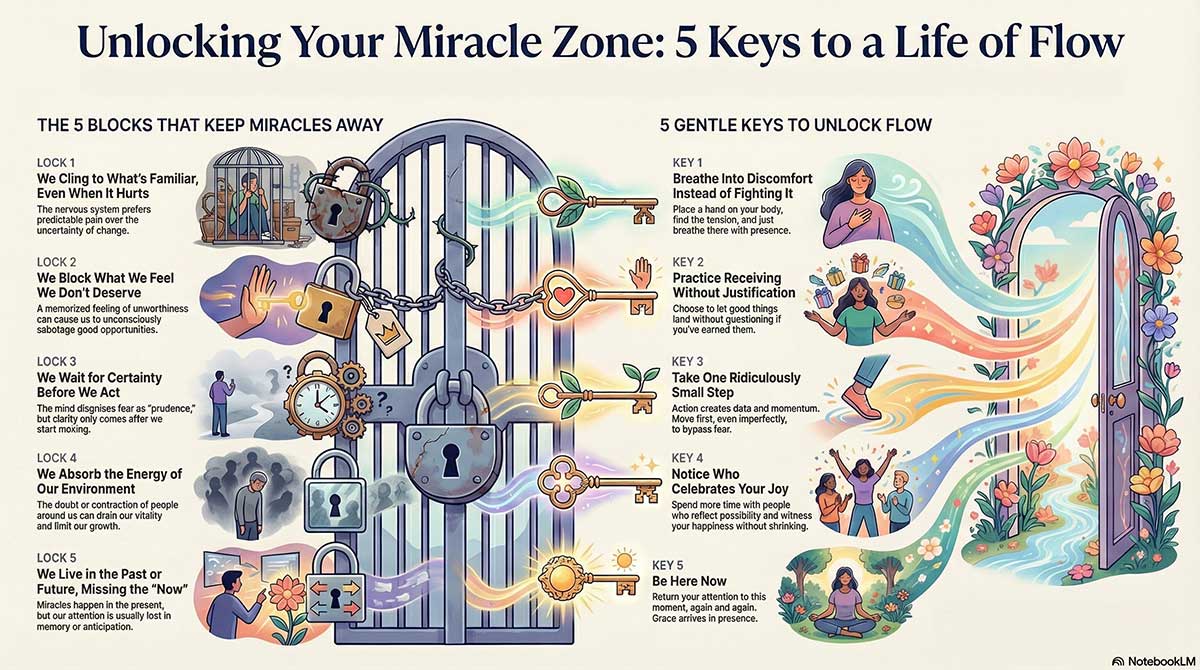
If there’s one thing I hope you take from these conversations, it’s this: you don’t need to become someone else to live a miraculous life. You simply need to release what no longer serves you and remember your inherent worth.
Miracles don’t arrive because we struggle harder or fix ourselves more thoroughly. They arrive when we soften—when we trust, when we take a step before certainty, when we surround ourselves with people who reflect possibility, and when we allow life to support us.
The Miracle Zone is not outside you. It’s what opens when fear loosens its grip and love takes the lead. And the moment you choose alignment over resistance, you’re already there.
Short Bios:
Marci Shimoff
A bestselling author and happiness expert, Marci Shimoff blends neuroscience, psychology, and spiritual wisdom to help people move from striving into joy and ease. She is best known for Happy for No Reason.
Dr. Sue Morter
A chiropractor and energy medicine teacher, Dr. Sue Morter focuses on embodied consciousness and alignment as gateways to vitality and flow. She is the author of The Energy Codes.
Lisa Nichols
A motivational speaker and author, Lisa Nichols is known for translating adversity into courage and action through lived resilience. Her most famous book is Abundance Now.
Michael A. Singer
A spiritual teacher and author, Michael A. Singer explores surrender, non-attachment, and inner freedom. He is best known for The Untethered Soul.
Marie Kondo
An organizing consultant and author, Marie Kondo teaches that decluttering the physical world creates emotional clarity and renewal. She is known worldwide for The Life-Changing Magic of Tidying Up.
Pema Chödrön
A Buddhist nun and author, Pema Chödrön offers compassionate guidance on working with fear, uncertainty, and impermanence. Her most famous book is When Things Fall Apart.
Byron Katie
A spiritual teacher and creator of The Work, Byron Katie helps people question stressful thoughts to uncover peace and clarity. She is best known for Loving What Is.
Gabor Maté
A physician and trauma expert, Gabor Maté explores how early emotional experiences shape health, behavior, and self-worth. His most widely known book is The Myth of Normal.
Louise Hay
A pioneer in mind-body healing, Louise Hay emphasized self-love and affirmations as foundations for healing. She is best known for You Can Heal Your Life.
Joe Dispenza
A researcher and teacher, Joe Dispenza studies how meditation and intention can rewire the brain and body. His most famous book is Breaking the Habit of Being Yourself.
Teal Swan
A spiritual teacher and author, Teal Swan focuses on shadow work and emotional integration. She is known for The Completion Process.
Steven Pressfield
An author and thinker, Steven Pressfield examines resistance and discipline in creative and meaningful work. He is best known for The War of Art.
Mel Robbins
A speaker and author, Mel Robbins teaches practical tools to interrupt fear and take action. Her most famous book is The 5 Second Rule.
Seth Godin
An entrepreneur and writer, Seth Godin explores creativity, leadership, and meaningful work. He is best known for Purple Cow.
James Clear
An author and behavior expert, James Clear studies habit formation and incremental change. His bestselling book is Atomic Habits.
Lynne McTaggart
A journalist and researcher, Lynne McTaggart investigates the science of intention and collective consciousness. She is best known for The Intention Experiment.
Henry Cloud
A psychologist and author, Henry Cloud specializes in boundaries and healthy relationships. His most famous book is Boundaries.
Jim Rohn
A business philosopher and speaker, Jim Rohn emphasized personal responsibility and the influence of environment. He is widely known for The Five Major Pieces to the Life Puzzle.
Eckhart Tolle
A spiritual teacher and author, Eckhart Tolle teaches presence as the gateway to peace and awareness. He is best known for The Power of Now.
Joseph Campbell
A mythologist and scholar, Joseph Campbell explored universal myth and the hero’s journey. His most famous work is The Hero with a Thousand Faces.
Wayne Dyer
A spiritual teacher and author, Wayne Dyer focused on intention, alignment, and living from love rather than fear. He is best known for The Power of Intention.
Ram Dass
A spiritual teacher and former psychologist, Ram Dass blended Eastern spirituality with Western psychology. His most famous book is Be Here Now.
Tara Brach
A psychologist and meditation teacher, Tara Brach integrates mindfulness and compassion for emotional healing. She is best known for Radical Acceptance.
Brené Brown
A researcher and author, Brené Brown studies vulnerability, courage, and shame. Her most famous book is Daring Greatly.
Naval Ravikant
An entrepreneur and thinker, Naval Ravikant explores leverage, clarity, and long-term thinking. He is best known through The Almanack of Naval Ravikant.
Esther Perel
A psychotherapist and author, Esther Perel examines desire, intimacy, and modern relationships. She is best known for Mating in Captivity.
Deepak Chopra
A physician and author, Deepak Chopra bridges science and spirituality through consciousness studies. His most famous book is The Seven Spiritual Laws of Success.
Leave a Reply