
|
Getting your Trinity Audio player ready...
|
Introduction
My name is Eli Thompson, and I’m in the Firefly Writers class at Meadowbrook Elementary. Before today, I didn’t really think much about stories. I liked them, sure—reading them, hearing them—but I never thought I could make any.
Not real ones. Not good ones.
Mrs. Alvarez said we were getting a special guest.
She wiggled her eyebrows like it was a secret treasure.
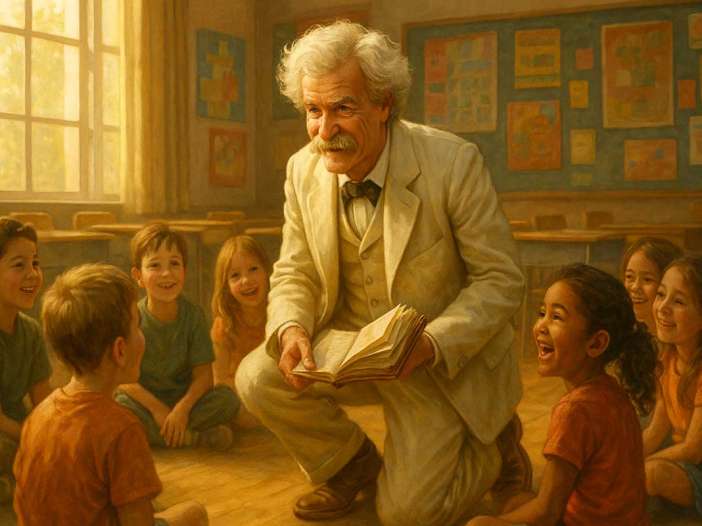
But when the door opened and a man with wild white hair, a suit the color of warm cream, and a smile like he’d just invented mischief stepped inside…
the air in the room changed.
He looked around like he’d been waiting his whole life to meet us, not the other way around.
I didn’t know much about him, except that he wrote stories about kids running wild on rivers.
I didn’t know he was funny, or brave, or that he could make words dance like they were trying to escape his notebook.
All I knew was this:
I had no idea that storytelling could be something I might actually do.
Not until he walked in.
(Note: This is an imaginary conversation, a creative exploration of an idea, and not a real speech or event.)
1. The Mischief of Imagination
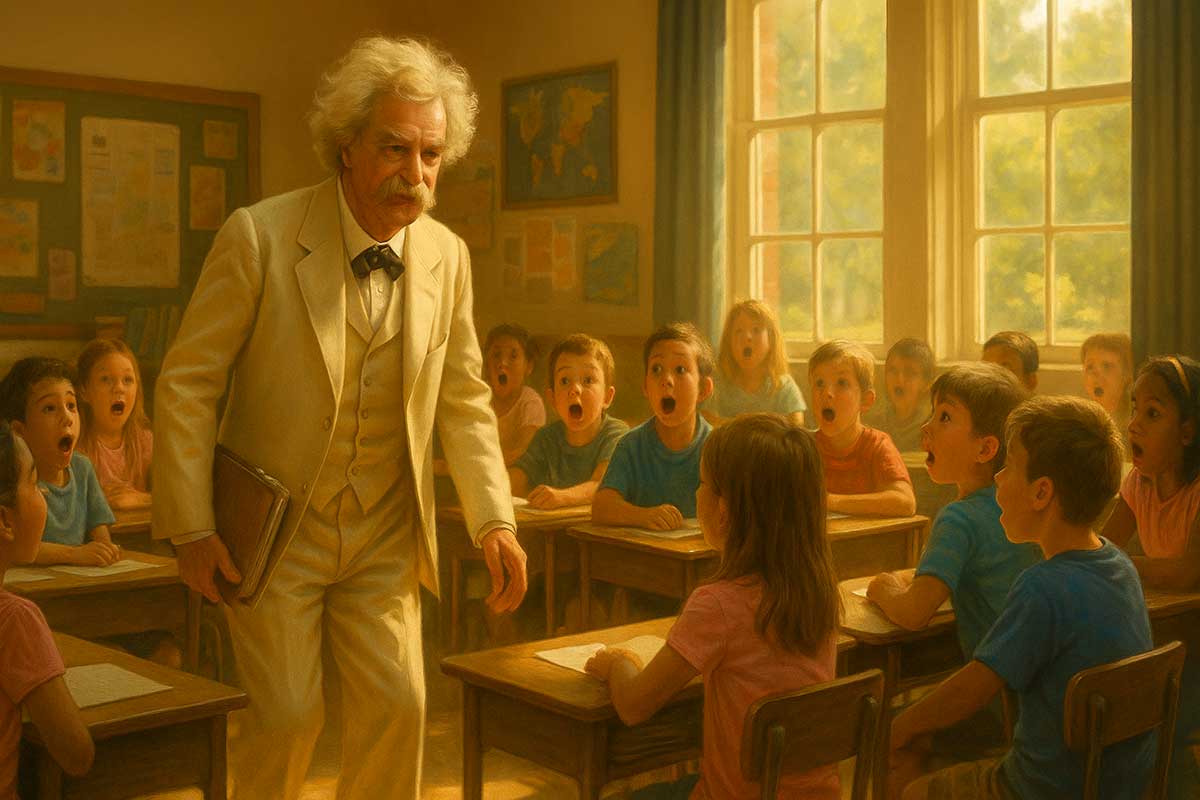
Sunlight pours across the desks. Twain lifts a chalk piece like it’s dynamite ready to go off.
Twain:
“Every story begins with mischief.
A rule broken, a frog in a pocket, a question so bold it scares the grown-ups.”
He draws a crooked river on the board.
Twain:
“My boy Huck began with one simple idea —
what if a kid ran away from a world that didn’t understand him?
Boom. A river adventure.”
Jax raises his hand.
“Can we write about breaking rules?”
Twain chuckles.
“Only the rules that deserve breaking.”
The kids cheer softly, already leaning forward.
Tall Tales: The Bigger, the Better
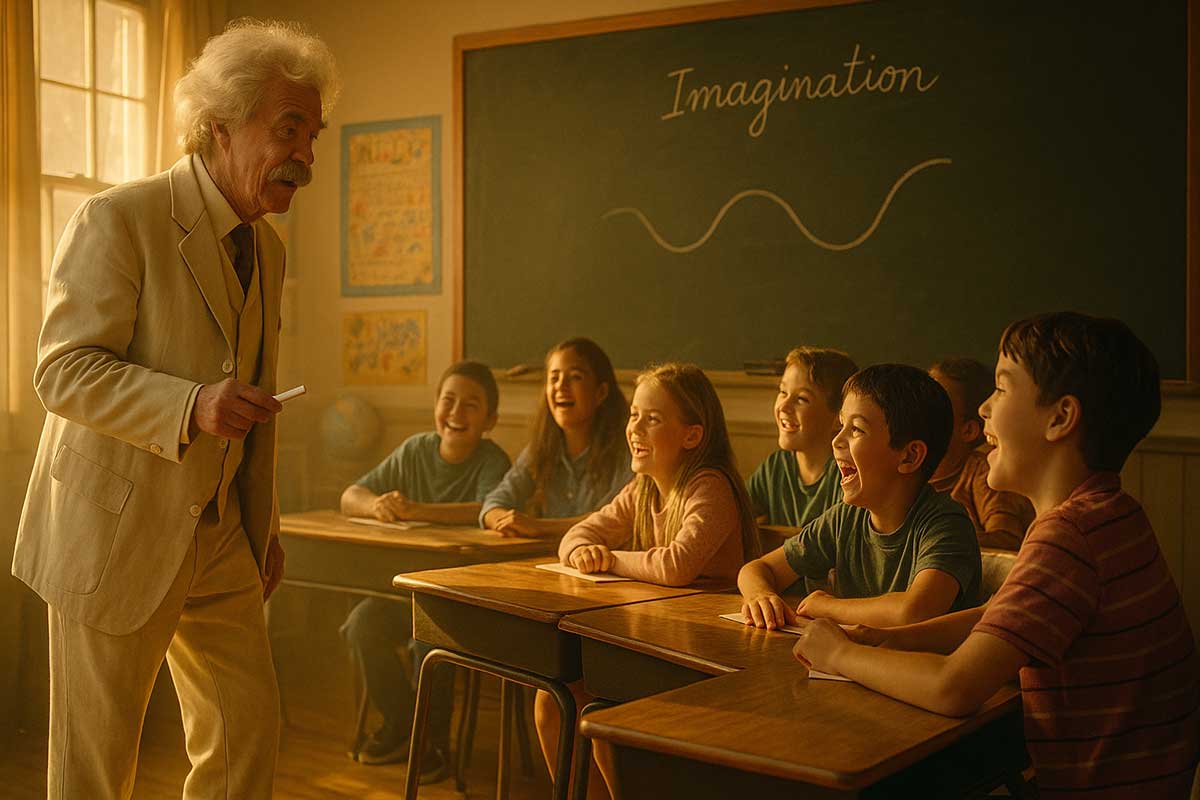
Twain hops onto the edge of Mrs. Alvarez’s desk, legs dangling like a mischievous uncle at a picnic.
Twain:
“Now then — a tall tale is simply a true story that’s grown too big for its britches.”
He opens his notebook.
A page flutters out like a butterfly.
Twain:
“If your fish was this big”—
he spreads his arms wide—
“then let it be bigger. The joy is in the stretch.”
Harper giggles, holding her hands dramatically apart.
Twain points at her.
“You, madam, may very well be the future queen of tall tales.”
The class laughs, the energy warm and buzzing.
3. Characters with Heart
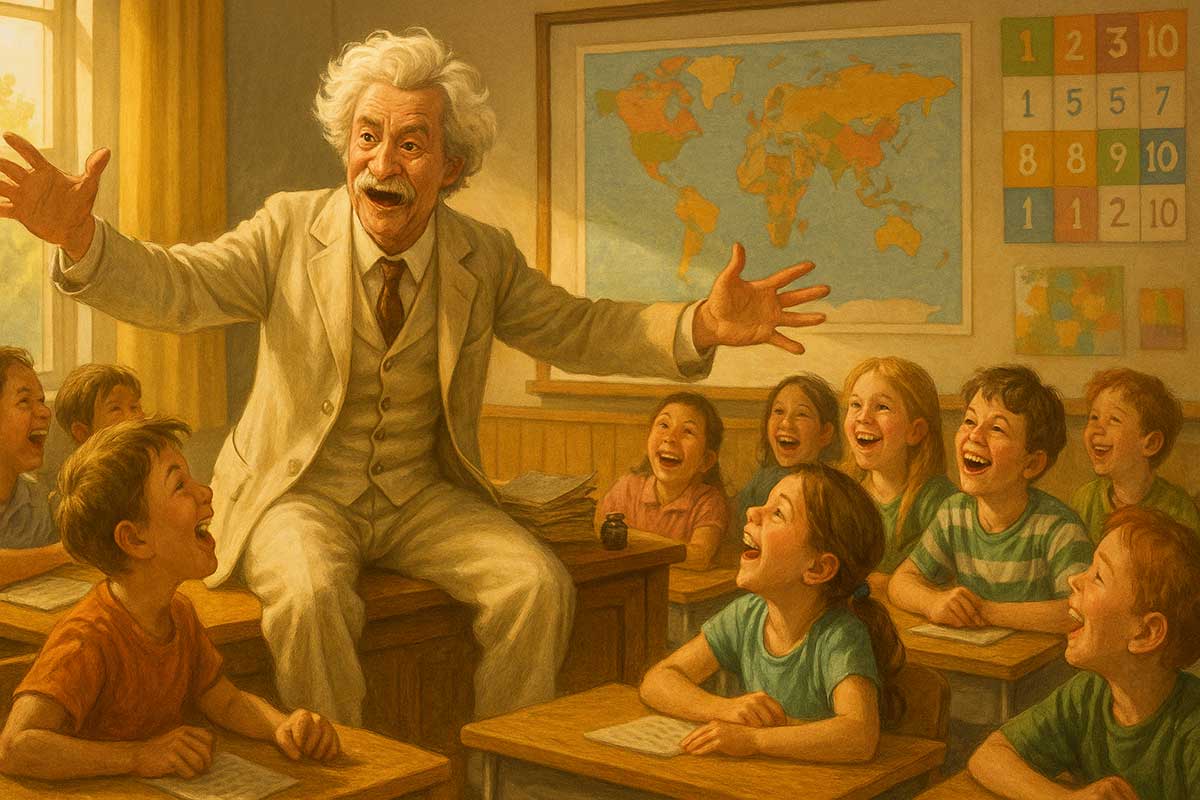
Twain walks slowly between desks, looking at each child as if reading their faces like paragraphs.
Twain:
“A story is only as good as the people in it.
Don’t make perfect characters — make real ones.”
He taps his own chest.
“Huck lied sometimes. Tom Sawyer fibbed often.
I’ve lied more than I care to count —
and that’s why I understand them.”
Maya raises a hand.
“So… characters can mess up?”
Twain bends down to her height.
“My dear, that is their greatest talent.”
She smiles, relieved.
Around the room, pencils hover, ready.
4. Trouble Makes a Beginning
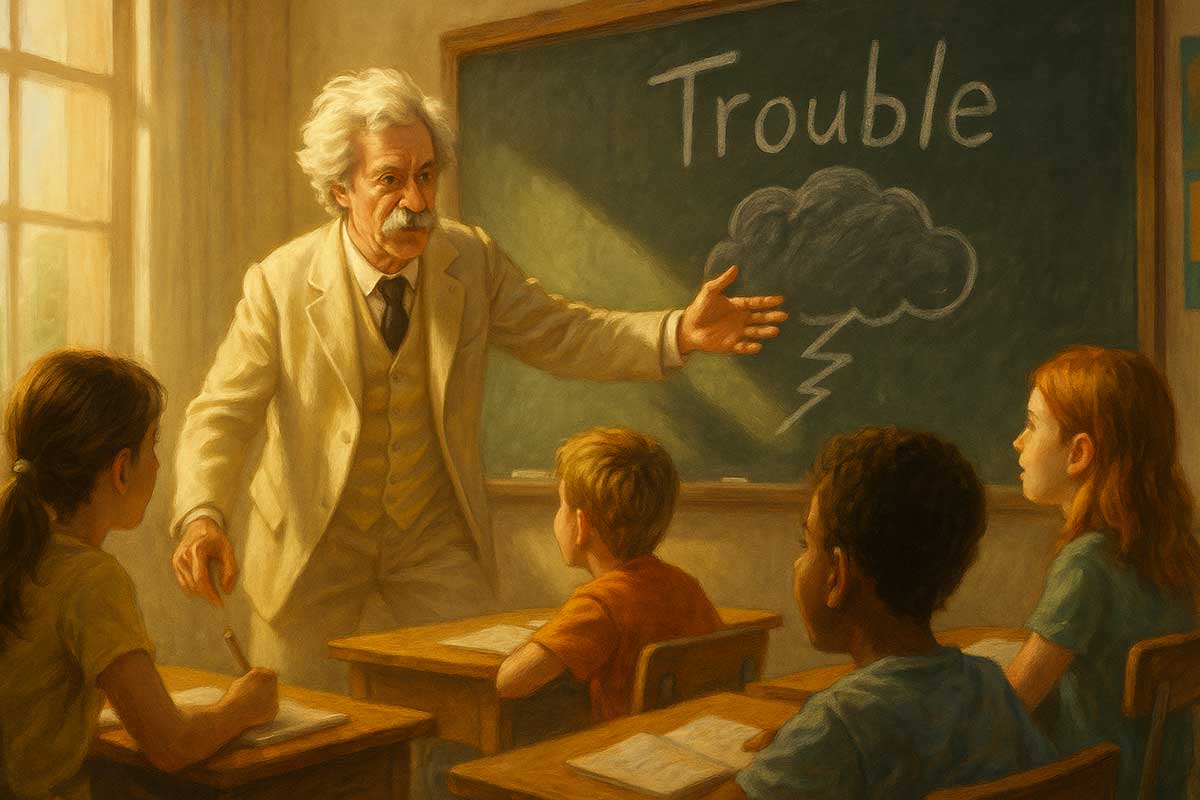
Twain draws a big storm cloud on the board.
Twain:
“Stories start when trouble knocks.
Not when everything is nice and tidy.”
He taps the cloud with the chalk.
“Ask yourself:
What’s the worst thing that could happen to my character today?
Now write it down.
Then write how they wriggle out.”
Noah scribbles furiously.
“My character’s canoe sunk!”
“Excellent!” Twain roars.
“Now make him a terrible swimmer!”
The kids howl with laughter.
Trouble never looked so fun.
5. Humor That Tells the Truth
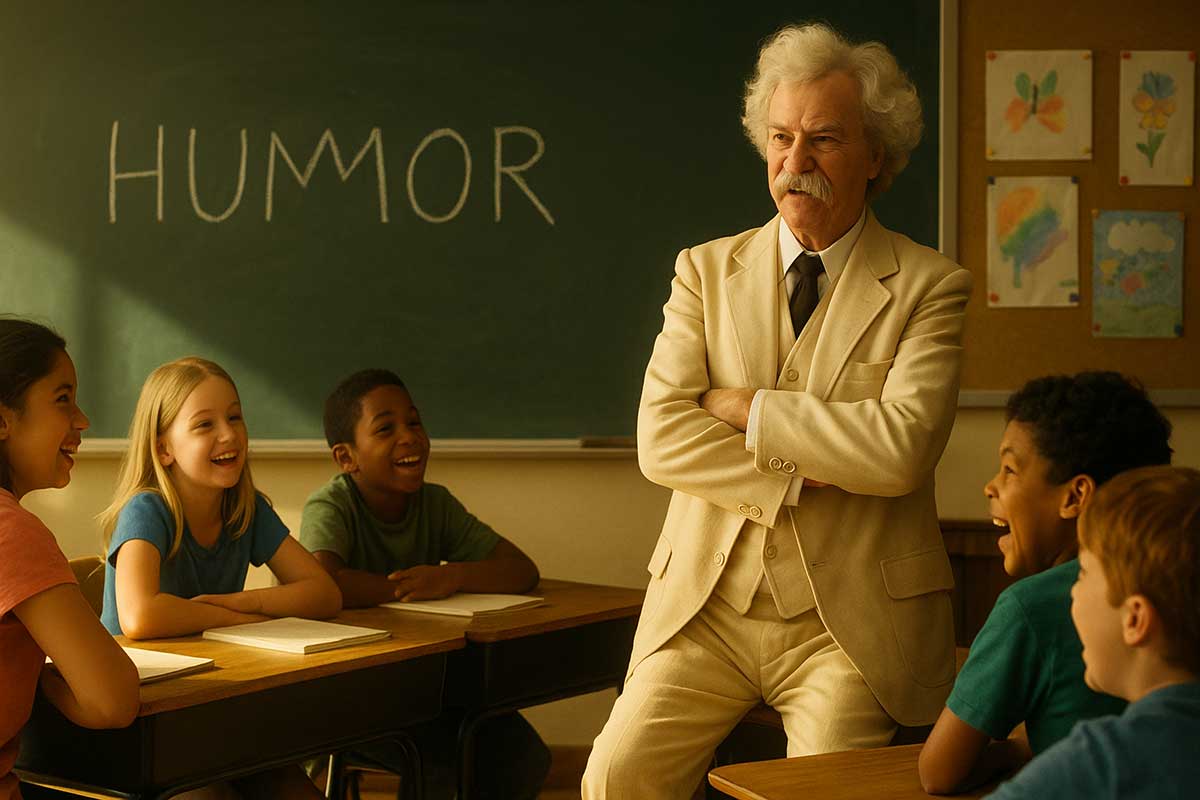
Twain folds his arms, pacing with mock seriousness.
Twain:
“Humor isn’t about jokes.
It’s about truth wearing a funny hat.”
He places Mrs. Alvarez’s reading glasses on top of his head.
The class dissolves into giggles.
Twain:
“If you want someone to remember the truth, make them laugh first.”
Lina whispers to Emma,
“Like medicine with sugar.”
Twain hears and taps his nose.
“Precisely. You’ll be dangerous writers one day.”
6. The Story Only You Can Tell
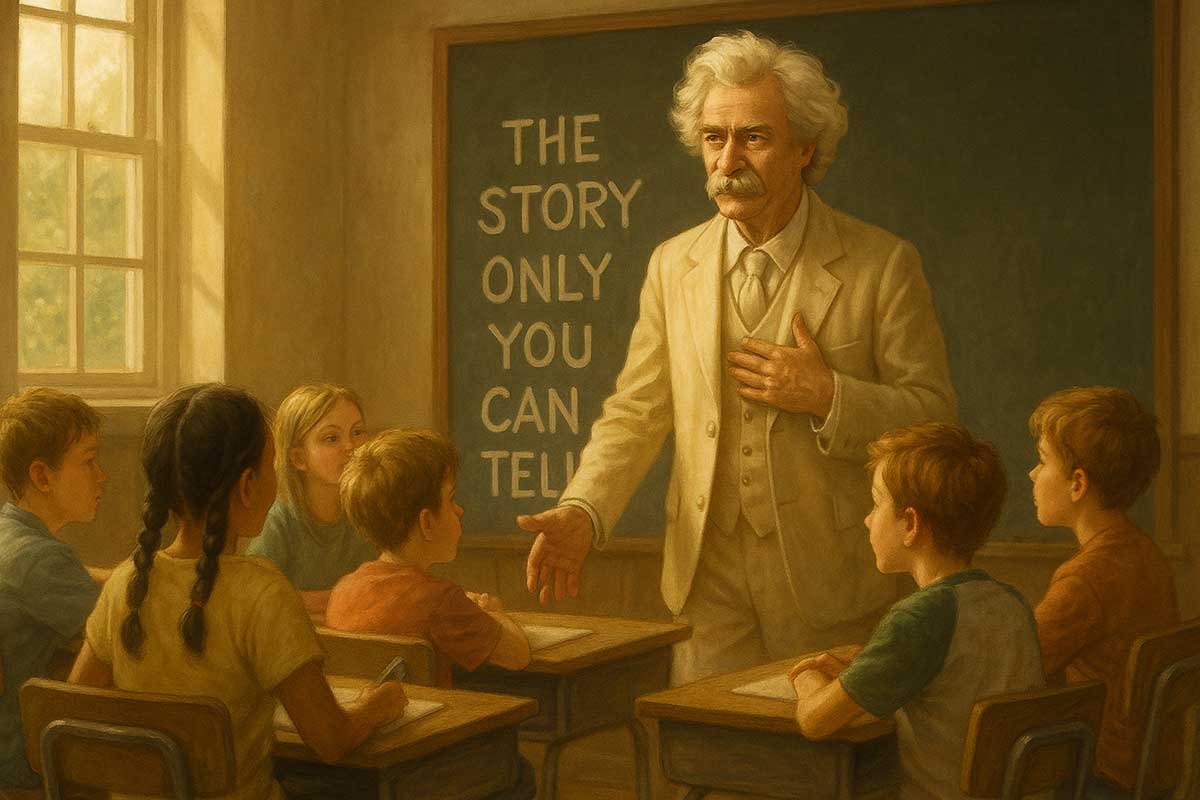
The classroom grows quieter.
Twain lowers his voice.
Twain:
“There is one story — only one —
that no one else on Earth can write.”
He points gently at each child.
“Yours.”
Caleb leans forward.
“Even if our life isn’t interesting?”
Twain smiles softly, compassionately.
“Son, life is interesting because you are in it.”
A hush settles over the Firefly Writers.
Even the dust motes seem to listen.
FINAL GIFT — A Raft That Floats
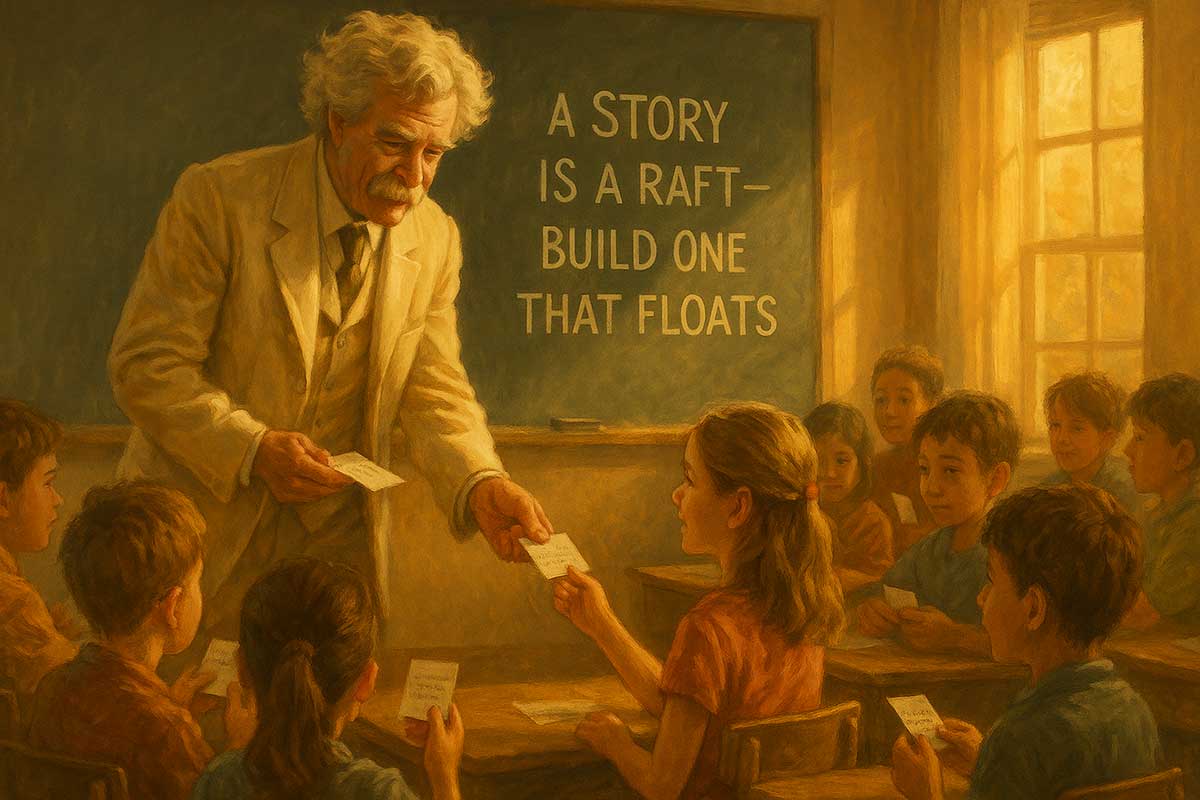
Twain stands at the front again, drawing pages from his overflowing notebook.
He tears off ten small slips — one for each student.
Twain:
“I leave you with the same gift I gave Huck and Tom —
a simple truth disguised as a tiny scrap of paper.”
He hands them out one by one.
Each slip reads:
“A story is a raft.
Build one that floats.”
The children hold the slips carefully, like treasure.
Twain places his hat over his heart.
Twain:
“My young friends…
may your imaginations run wild and your stories run farther.
If anyone tells you your ideas are too big —
tell them Mark Twain came to Ohio…
and said they’re not big enough.”
With a warm bow and a wink,
he steps back through the door,
leaving laughter and possibility glowing in the room.
Final Thoughts
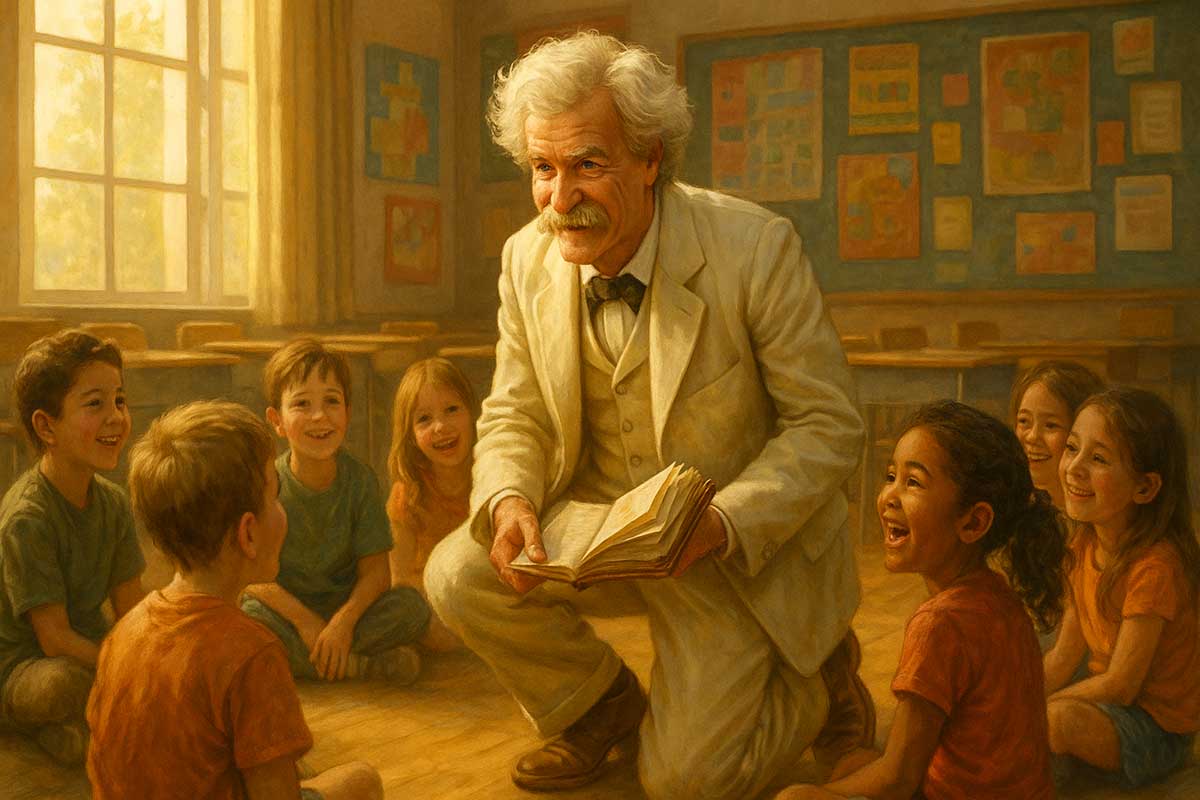
When the door closed behind Mark Twain, our classroom felt different—like it had gotten bigger somehow, like there was suddenly more space for ideas that hadn’t existed an hour ago.
I looked down at the tiny slip of paper he gave me:
“A story is a raft.
Build one that floats.”
I didn’t understand all of it at first.
But then I realized something:
Stories don’t have to be perfect.
They don’t have to be huge or fancy.
They just have to be mine.
I can start with trouble.
I can stretch the truth until it makes us laugh.
I can make characters who fall, mess up, and try again—just like me.
I can even use humor to tell the truth, the way he said.
Before he came, I didn’t think I could write anything worth reading.
But now I think maybe I can build a little raft too.
Maybe small at first. Maybe wobbly.
But something that floats, even just a little.
And I think that’s enough to begin.
Short Bio:
Mark Twain (1835–1910) was an American writer, humorist, and storyteller best known for The Adventures of Tom Sawyer and Adventures of Huckleberry Finn. Born Samuel Langhorne Clemens in Missouri, he worked as a printer’s apprentice, riverboat pilot, gold prospector, and journalist before becoming one of America’s most beloved authors. Twain’s writing blended wit, honesty, and a deep understanding of human nature. His stories often centered on childhood, imagination, and the moral choices that shape a person’s life. He believed that humor could reveal truth better than lectures, and he used simple, vivid language to speak to readers of all ages. Twain’s work continues to inspire young writers to observe closely, question boldly, and trust the power of their own stories.
Leave a Reply