• Skip to main content
  • Skip to primary sidebar
  • Skip to footer
ImaginaryTalks.com
  • Spirituality and Esoterica
    • Afterlife Reflections
    • Ancient Civilizations
    • Angels
    • Astrology
    • Bible
    • Buddhism
    • Christianity
    • DP
    • Esoteric
    • Extraterrestrial
    • Fairies
    • God
    • Karma
    • Meditation
    • Metaphysics
    • Past Life Regression
    • Spirituality
    • The Law of Attraction
  • Personal Growth
    • Best Friend
    • Empathy
    • Forgiveness
    • Gratitude
    • Happiness
    • Healing
    • Health
    • Joy
    • Kindness
    • Love
    • Manifestation
    • Mindfulness
    • Self-Help
    • Sleep
  • Business and Global Issues
    • Business
    • Crypto
    • Digital Marketing
    • Economics
    • Financial
    • Investment
    • Wealth
    • Copywriting
    • Climate Change
    • Security
    • Technology
    • War
    • World Peace
  • Culture, Science, and A.I.
    • A.I.
    • Anime
    • Art
    • History & Philosophy
    • Humor
    • Imagination
    • Innovation
    • Literature
    • Lifestyle and Culture
    • Music
    • Science
    • Sports
    • Travel
You are here: Home / Humor / Mark Twain Teaches Children the Joy of Storytelling

Mark Twain Teaches Children the Joy of Storytelling

November 13, 2025 by Nick Sasaki Leave a Comment

Introduction 

My name is Eli Thompson, and I’m in the Firefly Writers class at Meadowbrook Elementary. Before today, I didn’t really think much about stories. I liked them, sure—reading them, hearing them—but I never thought I could make any.
Not real ones. Not good ones.

Mrs. Alvarez said we were getting a special guest.
She wiggled her eyebrows like it was a secret treasure.

But when the door opened and a man with wild white hair, a suit the color of warm cream, and a smile like he’d just invented mischief stepped inside…
the air in the room changed.

He looked around like he’d been waiting his whole life to meet us, not the other way around.

I didn’t know much about him, except that he wrote stories about kids running wild on rivers.
I didn’t know he was funny, or brave, or that he could make words dance like they were trying to escape his notebook.

All I knew was this:
I had no idea that storytelling could be something I might actually do.

Not until he walked in.

(Note: This is an imaginary conversation, a creative exploration of an idea, and not a real speech or event.)


Table of Contents
Introduction 
1. The Mischief of Imagination
Tall Tales: The Bigger, the Better
3. Characters with Heart
4. Trouble Makes a Beginning
5. Humor That Tells the Truth
6. The Story Only You Can Tell
FINAL GIFT — A Raft That Floats
Final Thoughts 

1. The Mischief of Imagination

Sunlight pours across the desks. Twain lifts a chalk piece like it’s dynamite ready to go off.

Twain:
“Every story begins with mischief.
A rule broken, a frog in a pocket, a question so bold it scares the grown-ups.”

He draws a crooked river on the board.

Twain:
“My boy Huck began with one simple idea —
what if a kid ran away from a world that didn’t understand him?
Boom. A river adventure.”

Jax raises his hand.
“Can we write about breaking rules?”

Twain chuckles.

“Only the rules that deserve breaking.”

The kids cheer softly, already leaning forward.

Tall Tales: The Bigger, the Better
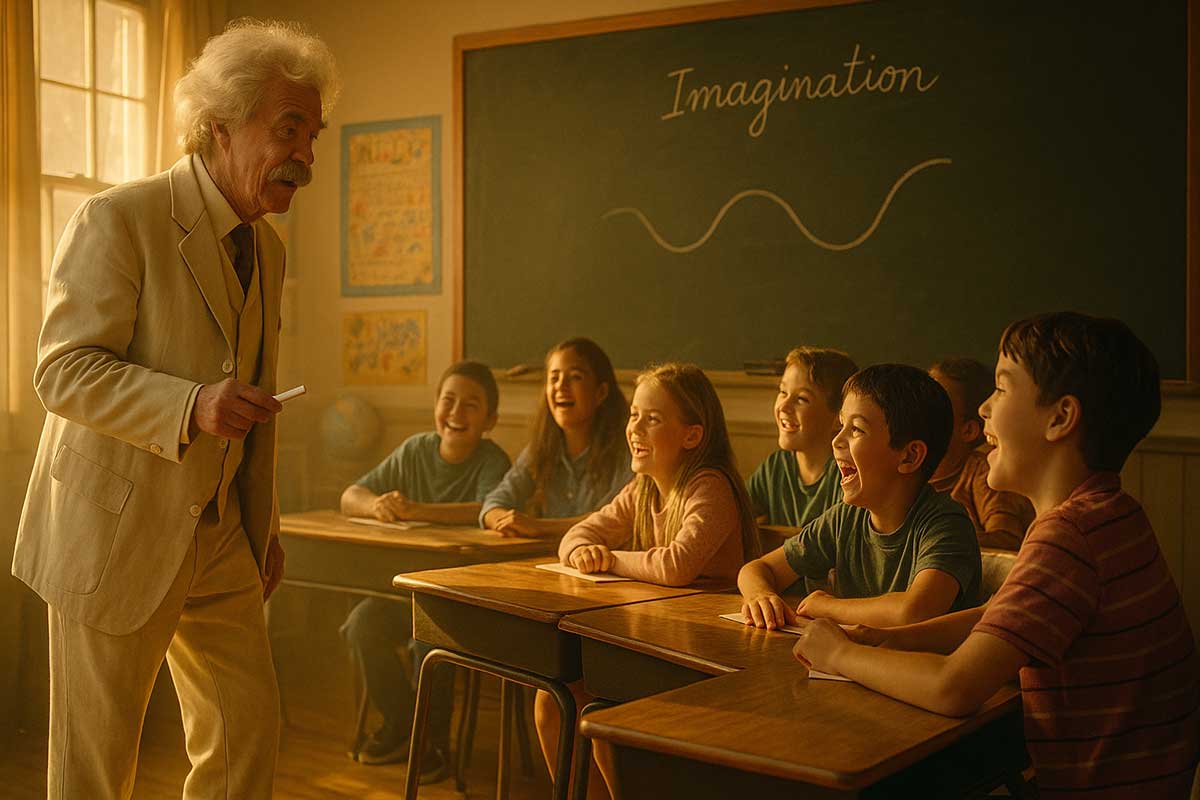
Twain hops onto the edge of Mrs. Alvarez’s desk, legs dangling like a mischievous uncle at a picnic.

Twain:
“Now then — a tall tale is simply a true story that’s grown too big for its britches.”

He opens his notebook.
A page flutters out like a butterfly.

Twain:
“If your fish was this big”—
he spreads his arms wide—
“then let it be bigger. The joy is in the stretch.”

Harper giggles, holding her hands dramatically apart.

Twain points at her.
“You, madam, may very well be the future queen of tall tales.”

The class laughs, the energy warm and buzzing.

3. Characters with Heart
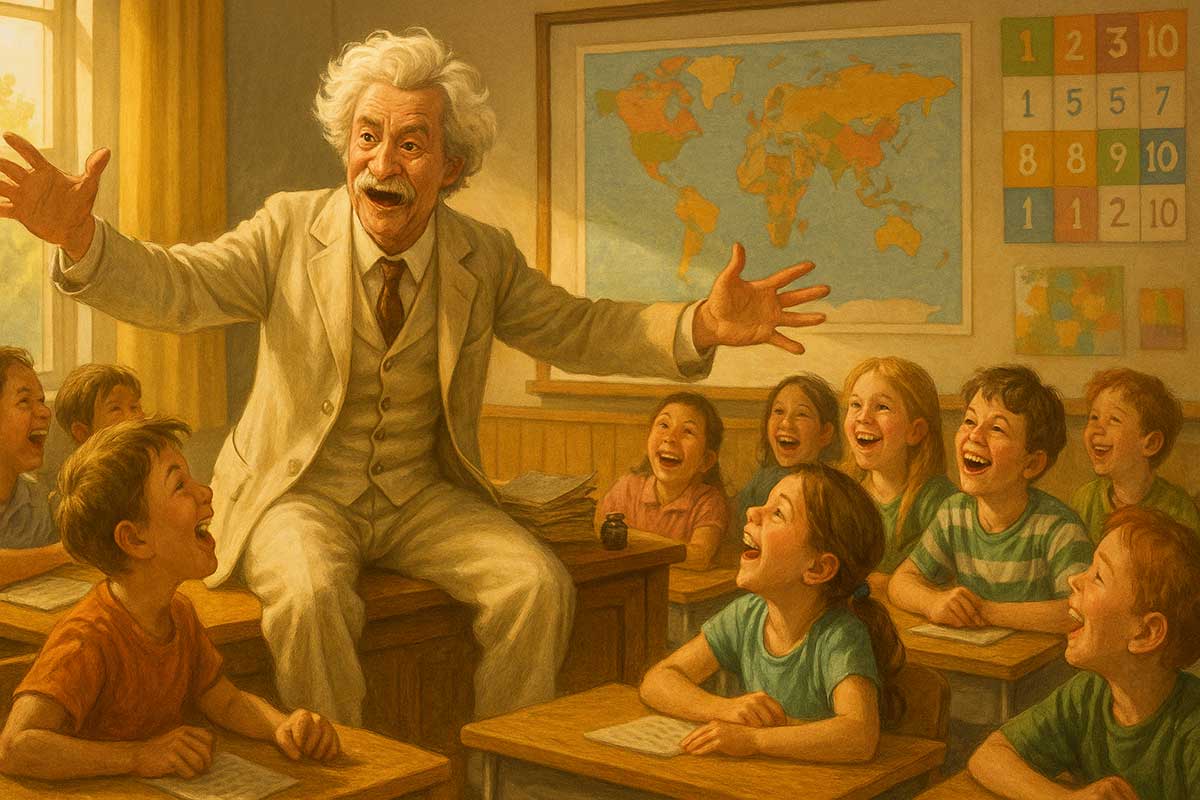
Twain walks slowly between desks, looking at each child as if reading their faces like paragraphs.

Twain:
“A story is only as good as the people in it.
Don’t make perfect characters — make real ones.”

He taps his own chest.

“Huck lied sometimes. Tom Sawyer fibbed often.
I’ve lied more than I care to count —
and that’s why I understand them.”

Maya raises a hand.
“So… characters can mess up?”

Twain bends down to her height.

“My dear, that is their greatest talent.”

She smiles, relieved.
Around the room, pencils hover, ready.

4. Trouble Makes a Beginning
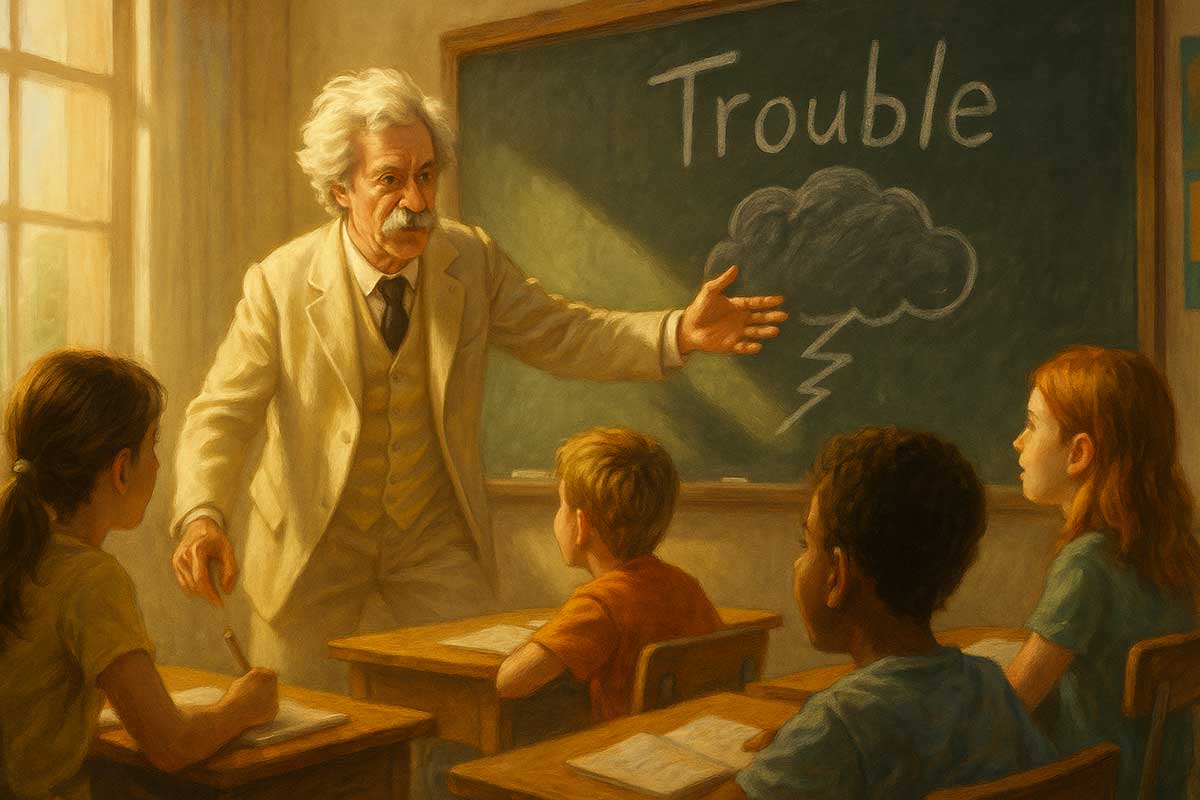
Twain draws a big storm cloud on the board.

Twain:
“Stories start when trouble knocks.
Not when everything is nice and tidy.”

He taps the cloud with the chalk.

“Ask yourself:
What’s the worst thing that could happen to my character today?
Now write it down.
Then write how they wriggle out.”

Noah scribbles furiously.
“My character’s canoe sunk!”

“Excellent!” Twain roars.
“Now make him a terrible swimmer!”

The kids howl with laughter.
Trouble never looked so fun.

5. Humor That Tells the Truth
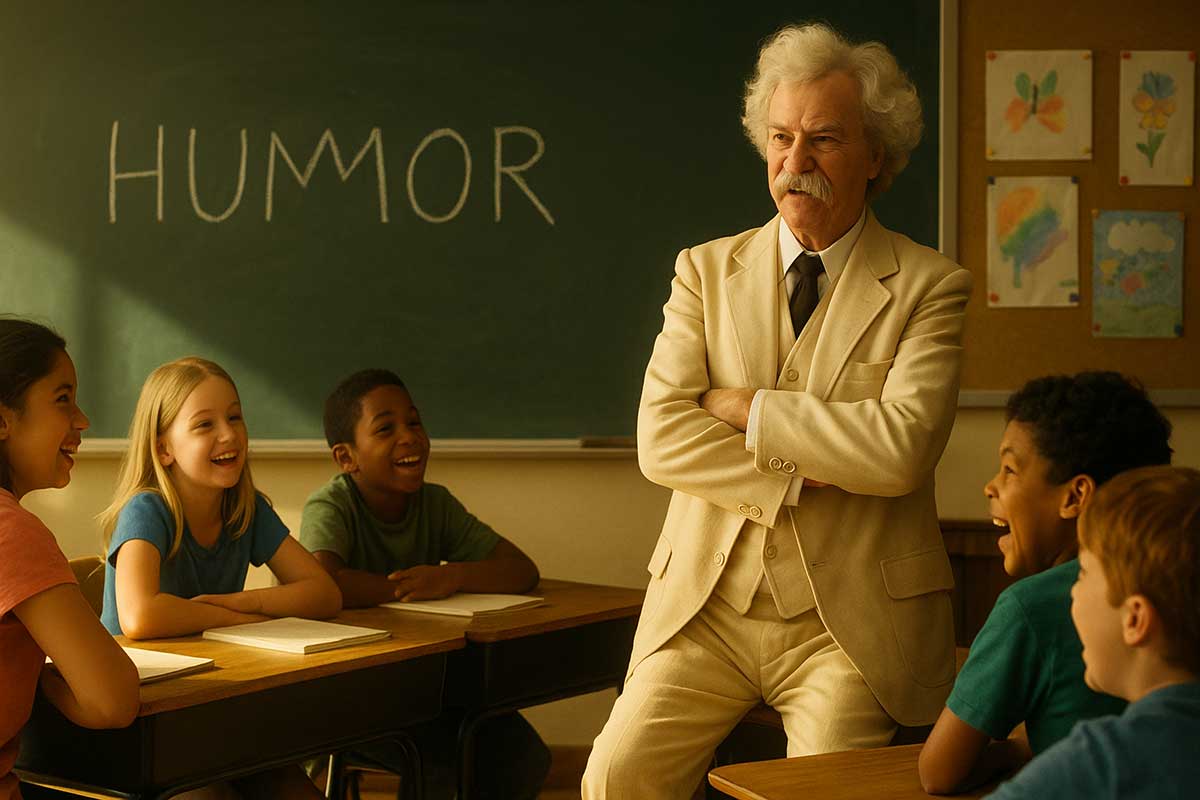
Twain folds his arms, pacing with mock seriousness.

Twain:
“Humor isn’t about jokes.
It’s about truth wearing a funny hat.”

He places Mrs. Alvarez’s reading glasses on top of his head.
The class dissolves into giggles.

Twain:
“If you want someone to remember the truth, make them laugh first.”

Lina whispers to Emma,
“Like medicine with sugar.”

Twain hears and taps his nose.

“Precisely. You’ll be dangerous writers one day.”

6. The Story Only You Can Tell
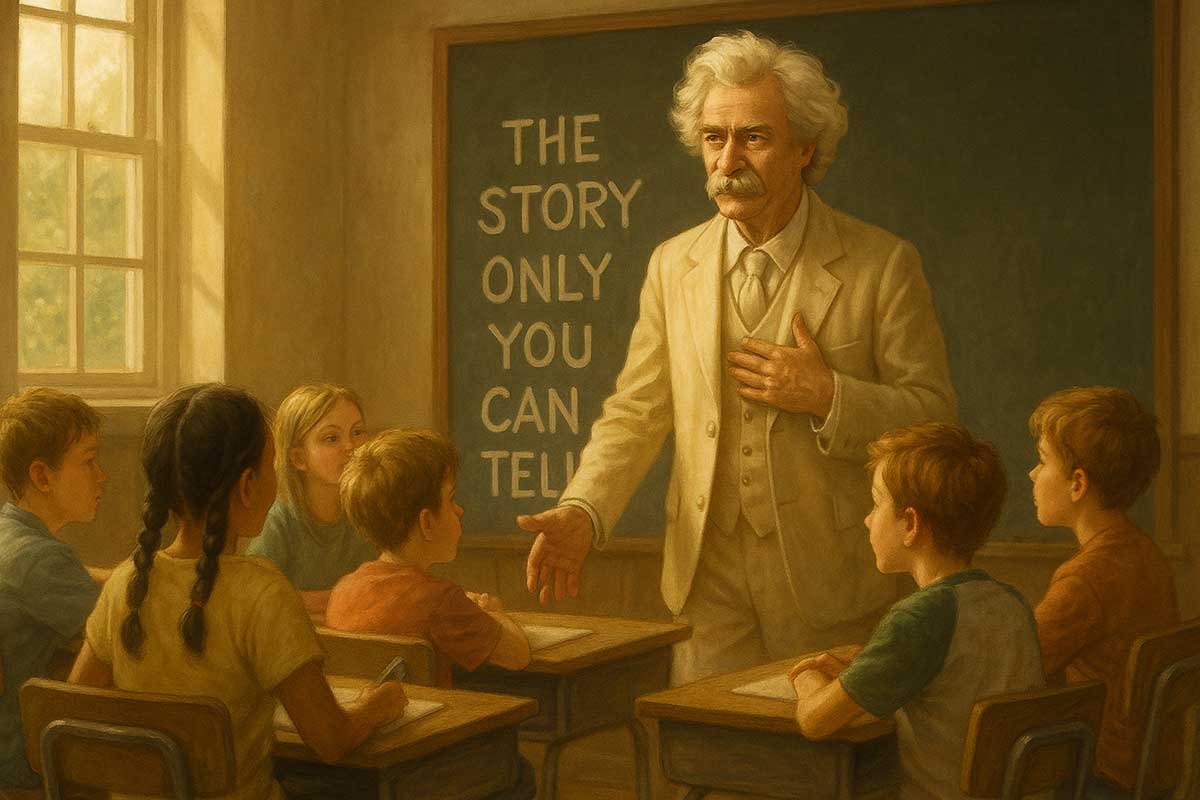
The classroom grows quieter.
Twain lowers his voice.

Twain:
“There is one story — only one —
that no one else on Earth can write.”

He points gently at each child.

“Yours.”

Caleb leans forward.
“Even if our life isn’t interesting?”

Twain smiles softly, compassionately.

“Son, life is interesting because you are in it.”

A hush settles over the Firefly Writers.
Even the dust motes seem to listen.

FINAL GIFT — A Raft That Floats
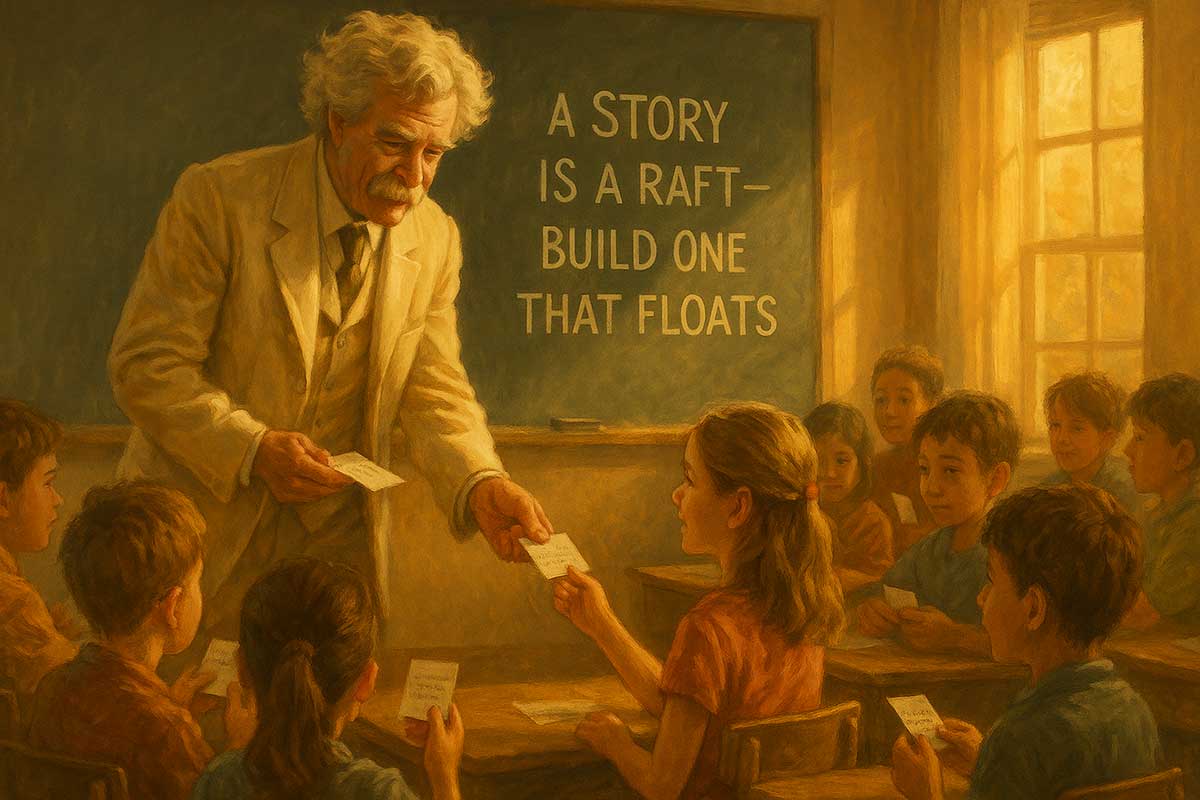
Twain stands at the front again, drawing pages from his overflowing notebook.
He tears off ten small slips — one for each student.

Twain:
“I leave you with the same gift I gave Huck and Tom —
a simple truth disguised as a tiny scrap of paper.”

He hands them out one by one.

Each slip reads:

“A story is a raft.
Build one that floats.”

The children hold the slips carefully, like treasure.

Twain places his hat over his heart.

Twain:
“My young friends…
may your imaginations run wild and your stories run farther.
If anyone tells you your ideas are too big —
tell them Mark Twain came to Ohio…
and said they’re not big enough.”

With a warm bow and a wink,
he steps back through the door,
leaving laughter and possibility glowing in the room.

Final Thoughts 
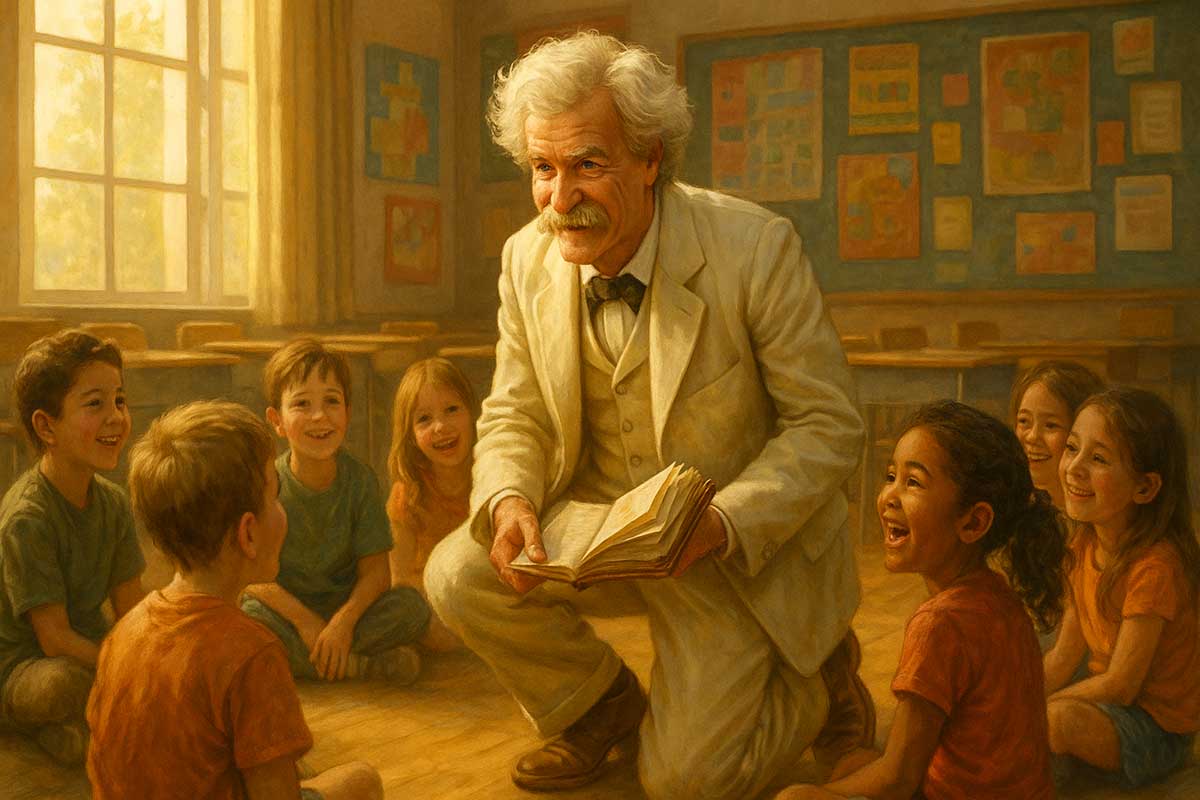
When the door closed behind Mark Twain, our classroom felt different—like it had gotten bigger somehow, like there was suddenly more space for ideas that hadn’t existed an hour ago.

I looked down at the tiny slip of paper he gave me:

“A story is a raft.
Build one that floats.”

I didn’t understand all of it at first.
But then I realized something:

Stories don’t have to be perfect.
They don’t have to be huge or fancy.
They just have to be mine.

I can start with trouble.
I can stretch the truth until it makes us laugh.
I can make characters who fall, mess up, and try again—just like me.
I can even use humor to tell the truth, the way he said.

Before he came, I didn’t think I could write anything worth reading.
But now I think maybe I can build a little raft too.
Maybe small at first. Maybe wobbly.
But something that floats, even just a little.

And I think that’s enough to begin.

Short Bio:

Mark Twain (1835–1910) was an American writer, humorist, and storyteller best known for The Adventures of Tom Sawyer and Adventures of Huckleberry Finn. Born Samuel Langhorne Clemens in Missouri, he worked as a printer’s apprentice, riverboat pilot, gold prospector, and journalist before becoming one of America’s most beloved authors. Twain’s writing blended wit, honesty, and a deep understanding of human nature. His stories often centered on childhood, imagination, and the moral choices that shape a person’s life. He believed that humor could reveal truth better than lectures, and he used simple, vivid language to speak to readers of all ages. Twain’s work continues to inspire young writers to observe closely, question boldly, and trust the power of their own stories.

Related Posts:

  • Karma Exchanger: A Novel of Pain, Rebirth, and Mercy
  • The Nickel Boys: 5 Modern Stories About Truth,…
  • The Empty Chair: A Modern Brothers Karamazov Story
  • The House With the Black Stone: A Korean Family Saga
  • The Midnight Library Explained Through Its Characters
  • Grimm Fairy Tale Universe: The Complete Grimmverse Book One

Filed Under: Humor, Literature Tagged With: American authors for kids, author visit ideas, character writing for kids, children’s imagination activities, classroom storytelling activity, creative writing for children, ED format storytelling, fiction for 3rd graders, how to spark creativity, how to write fiction for kids, humorous writing for kids, kids learn to write stories, kids storytelling lesson, literary lessons for students, Mark Twain classroom visit, Mark Twain for kids, Mark Twain writing tips, storytelling techniques for kids, tall tales lesson, writing tips elementary

Reader Interactions

Leave a Reply Cancel reply

Your email address will not be published. Required fields are marked *

Primary Sidebar

RECENT POSTS

  • The Good Earth: 5 Modern Stories About Love and Sacrifice
  • the good earth scholarsThe Good Earth: What Scholars Reveal About Wang Lung and O-lan
  • the good earthThe Good Earth: Did Wealth Destroy What Wang Lung Loved?
  • SoftBank World 2026: Masayoshi Son’s AI 2040 Vision Explained
  • The Great Gatsby in 7 Minutes: Why Gatsby’s Dream Failed
  • a new earthIs Humanity Entering a New Earth? Spiritual Awakening Explained
  • great gatsby modern storiesThe Great Gatsby: 5 Modern Stories About Dreams We Chase
  • the great gatsby analysisThe Great Gatsby Experts Explain Gatsby’s Dream and Tragedy
  • the Great Gatsby explainedThe Great Gatsby: Did Gatsby Love Daisy or His Dream?
  • After Of Mice and Men: What Happened to George After Lennie?
  • Of Mice and Men in 7 Minutes: When Love Is Not Enough
  • of mice and men modern day storiesOf Mice and Men: 5 Modern Stories About Love, Care and Responsibility
  • of mice and men analysisOf Mice and Men: Was George Right to Kill Lennie?
  • of mice and men 5Of Mice and Men: Was George’s Final Choice an Act of Love?
  • grapes of wrath modern storiesThe Grapes of Wrath Today: 5 Modern Stories About “I” and “We”
  • grapes of wrath questionsThe Grapes of Wrath Explained: 5 Questions Readers Still Ask
  • the grapes of wrath john steinbeckThe Grapes of Wrath: When Does “Me” Become “We”?
  • Stand With Jesus: What If People Tried to Stop the Crucifixion?
  • East of Eden Today: 5 Stories About Breaking Family Cycles
  • john steinbeck east of edenEast of Eden: Does Timshel Still Make Sense Today?
  • East of Eden: Are We Born Bad or Free to Choose?
  • Convenience Store Woman: 5 American Stories About Marriage and Freedom
  • convenience-store-women-analysis-Convenience Store Woman: Is the New Normal Really Normal?
  • convenience store womenConvenience Store Woman: Who Decides What Is Normal?
  • sayaka murata imaginary friendsSayaka Murata Imaginary Friends: The Mystery Behind Her Inner World
  • Social Health Stories: 5 Ways We Lost Our Sense of Belonging
  • Social Health: Why Modern Life Is Making Us Lonely
  • nickel-boys-modern-stories-The Nickel Boys: 5 Modern Stories About Truth, Trauma and Hope
  • coloson whitehead the nickel boys discussionThe Nickel Boys: What Kind of Hope Survives Injustice?
  • the nickel boys colson whiteheadThe Nickel Boys: Elwood and Turner on Justice, Survival and Truth
  • AI Resource Consumption: Can AI Give More Than It Takes?
  • madeline-miller-circe-modern-stories-5 Modern Stories Inspired by Circe by Madeline Miller
  • Circle-Madeline-Miller-analysis-Circe Explained: Myth, Meaning, and Madeline Miller
  • Madeline Miller Circle CharactersMadeline Miller Circe: What If No One Ever Chose You?
  • 5 Modern Stories Inspired by Keigo Higashino’s Silent Parade
  • could japanese culture succeed where religion has failedCould Japanese Culture Succeed Where Religion Has Failed?
  • keigo-Higashino-when-love-becomes-too-much-5 Modern Stories Inspired by The Devotion of Suspect X
  • The Devotion of Suspect X Explained by Psychologists: Is Ishigami’s Love Really Love?
  • the devotion of suspect xThe Devotion of Suspect X Explained: Was Ishigami’s Sacrifice Really Love?
  • 5 Modern Midnight Library Stories About Regret, AI, and Choice
  • Matt Haig The Midnight LibraryThe Midnight Library Explained by Scholars and Matt Haig
  • The-Midnight-Library-explainedThe Midnight Library Explained Through Its Characters
  • 5 Modern Siddhartha Stories About Wisdom, Love, AI, and Choice
  • Siddhartha explained by leading scholarsSiddhartha Explained by Leading Hermann Hesse Scholars
  • Siddhartha explainedSiddhartha Explained Through Its Characters: Love, Loss, and Enlightenment
  • before-the-names-are-carved-Before the Names Are Carved: Five Connected Stories
  • The Scholars and the Unworn ShoesHan Kang Human Acts Explained by Leading Scholars
  • Han Kang Human Acts: An Imaginary Conversation with the Dead
  • The Years We Thought We Had: A Story of Love and Waiting in Japan
  • snow-country-analysis-Snow Country Analysis: Kawabata Scholars Explain It
  • snow-country-was-their-love-realSnow Country Explained Through Its Characters
  • the-man-who-never-took-the-day-off-The Man Who Never Took the Day Off: A Modern Ishiguro Story
  • The Remains of the Day Explained by Leading Ishiguro Scholars
  • the-remains-of-the-day-imaginary-talks-The Remains of the Day Explained Through Its Characters
  • the-pastor-who-couldnt-be-forgiven-The Pastor Who Couldn’t Be Forgiven: A Modern Story of Grace
  • disgrace-j-m-coetzee-Disgrace Explained Through Its Characters
  • disgrace-explained-leading-jm-coetzee-scholarsDisgrace Explained by Leading J. M. Coetzee Scholars
  • Forty-One Could Live. Nine Had to Die.
  • The Gospel According to Jesus Christ explainedThe Gospel According to Jesus Christ Explained Through Its Characters
  • SARAMAGO’S GOSPEL EXPLAINEDThe Gospel According to Jesus Christ Explained by Top Scholars
  • the last safe floorThe Last Safe Floor: A Modern Lord of the Flies Story for 2026
  • william golding explained by top scholarsWilliam Golding Explained by Top Scholars: Evil, Faith, and Redemption
  • lord-of-flies-character-conversation-Lord of the Flies Explained Through Its Characters: Is the Beast Inside Us?
  • never complain never explainNever Complain Never Explain: Henry Ford & Disraeli
  • The Empty Chair: A Modern Brothers Karamazov Story
  • the brothers karamazov explained top dostoevsky scholarsThe Brothers Karamazov Explained by Top Dostoevsky Scholars
  • Brothers Karamazov explainedThe Brothers Karamazov Explained Through Its Characters
  • before yesBefore Yes: A Modern American Story Inspired by Albert Camus
  • The Stranger Explained by Top Albert Camus Scholars
  • the stranger explainedAlbert Camus’s The Stranger Explained Through Its Characters
  • What is Worth Saving?The Last Store on Main Street: Inspired by The Sound and the Fury
  • The Sound and the Fury Scholar discussionThe Sound and the Fury Explained by Top William Faulkner Scholars
  • The Sound and the Fury Family SpokenThe Sound and the Fury Explained by Its Characters
  • The Building That Stopped Seeing | Modern Camus Story
  • The Plague Explained by Top Albert Camus Scholars
  • albert camus the plague explainedThe Plague explained by its characters
  • the last good sentenceThe Last Good Sentence: A Story About Fame and Loneliness
  • hemingway scholars debateThe Old Man and the Sea Explained by Top Scholars
  • The Old Man and the Sea Explained by Its Characters
  • the new meaning of survivalThe New Meaning of Survival: Top Scholars on Human Flourishing
  • true meanig of survivalThe True Meaning of Survival: Living, Not Just Existing
  • the last affordable roadThe Last Affordable Road: A Modern Grapes of Wrath Story
  • the-grapes-of-wrath-explained-by-top-scholars-The Grapes of Wrath Explained: Top Steinbeck Scholars
  • the grapes of wrath conversationThe Grapes of Wrath Explained Through Its Characters
  • the white silenceThe White Silence: A Japanese Novel of Loneliness
  • jose-saramago-blindness-explained-Blindness Explained by Top Scholars | José Saramago’s Greatest Warning
  • José-Saramago-Blindness-Explained-Blindness Explained Through Its Characters and José Saramago
  • Can the Bhagavad Gita Still Guide Humanity in 2026?
  • The Crown of AshesThe Crown of Ashes: A Modern Shakespearean Tragedy
  • the-fourth-bowl-If Toni Morrison Wrote a Japanese Family Novel: The Fourth Bowl
  • Beloved Ending Explained: 25 Questions Answered by Morrison Scholars
  • Toni-Morrison-Beloved-Explained-Beloved Explained Through Its Characters and Toni Morrison
  • house with the black stoneThe House With the Black Stone: A Korean Family Saga
  • Be Kind to Your Mother Before It’s Too LateBe Kind to Your Mother Before It’s Too Late
  • Gabriel-García-Márquez-one-hundred-years-of-solitude-explained-One Hundred Years of Solitude Explained by Top Scholars
  • one-hundred-years-of-solitude-explained-One Hundred Years of Solitude Explained
  • are-any-lives-truly-ordinary-Hateship Friendship Courtship Loveship Marriage explained
  • The Overstory explainedThe Overstory Explained: Themes, Ending, and Meaning
  • Demon Copperhead Explained: Barbara Kingsolver’s Pulitzer-Winning Novel
  • can you judge trump by his enemiesCan You Judge Donald Trump by His Enemies?

Footer

Recent Posts

  • The Good Earth: 5 Modern Stories About Love and Sacrifice September 4, 2026
  • The Good Earth: What Scholars Reveal About Wang Lung and O-lan September 3, 2026
  • The Good Earth: Did Wealth Destroy What Wang Lung Loved? September 3, 2026
  • SoftBank World 2026: Masayoshi Son’s AI 2040 Vision Explained September 3, 2026
  • The Great Gatsby in 7 Minutes: Why Gatsby’s Dream Failed September 2, 2026
  • Is Humanity Entering a New Earth? Spiritual Awakening Explained September 2, 2026

Pages

  • About Us
  • Contact Us
  • Disclaimer
  • Earnings Disclaimer
  • Privacy Policy
  • Terms and Conditions

Categories

Copyright © 2026 Imaginarytalks.com