

|
Getting your Trinity Audio player ready...
|
Introduction
Primal Intelligence by Angus Fletcher examines how human beings think, decide, adapt, and continue forward when logic, data, and certainty are no longer enough.
We live in a paradoxical moment. More is possible today than at any point in human history—technologically, economically, creatively. And yet, when you speak to people, the prevailing mood is often pessimism. Many feel trapped inside narrow futures, dependent on instructions, and unsure how to act without permission or proof.
This is not because humans have become less intelligent.
It is because we have been trained to rely on the wrong kinds of intelligence.
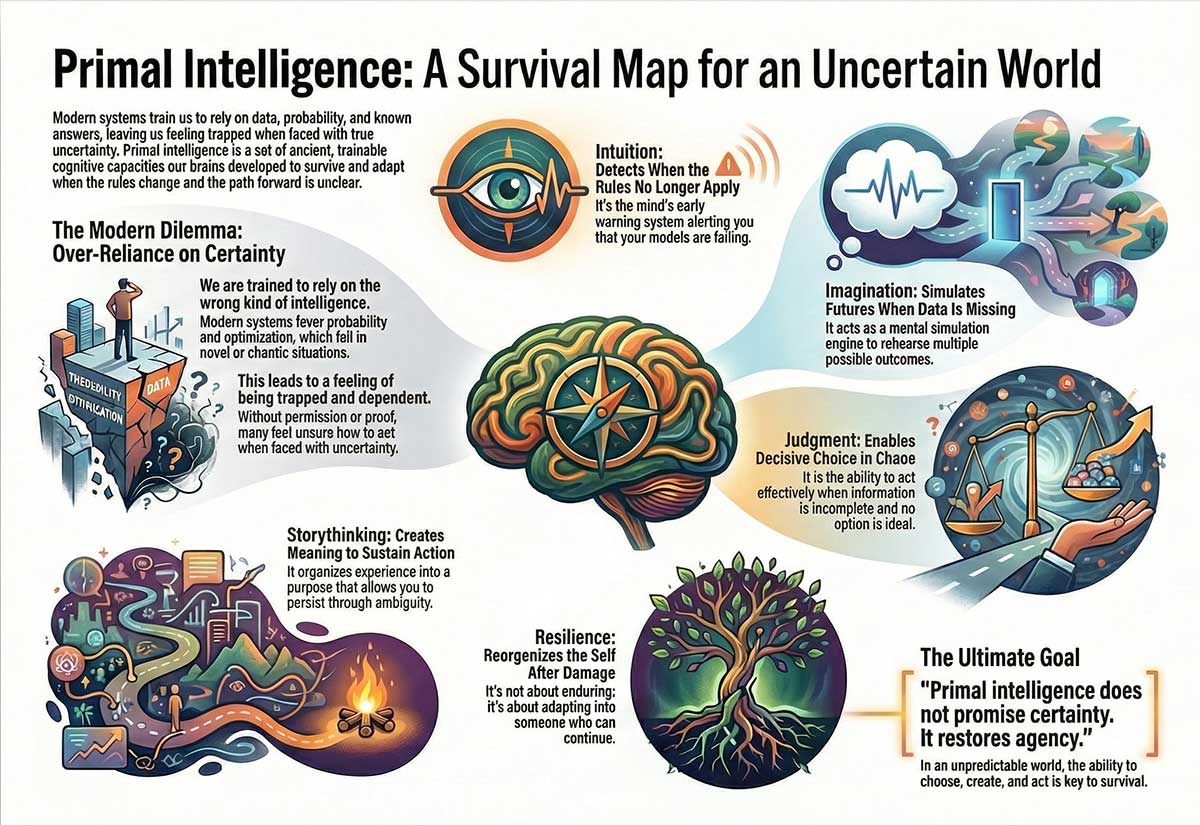
Modern systems favor probability, optimization, and known answers. But human evolution did not occur in predictable environments. It occurred in conditions of uncertainty, novelty, and incomplete information. To survive, the human brain developed ancient cognitive capacities that operate before data, beyond rules, and outside formulas.
These capacities are what I call primal intelligence.
Primal intelligence is not mystical or irrational. It is mechanical, trainable, and deeply human. It includes intuition—the ability to detect when rules no longer apply; imagination—the ability to simulate futures that have never existed; judgment—the capacity to choose under pressure; resilience—the power to reorganize after damage; and storythinking—the ability to create meaning that sustains action over time.
This series explores each of these intelligences not in abstraction, but through lived experience. By placing them in dialogue with individuals who faced uncertainty at the highest levels—artists, scientists, leaders, and innovators—we can see how primal intelligence functions when the map disappears.
This is not a rejection of reason or technology.
It is a reminder of what carries us until reason can catch up.
Topic 1 — Intuition: Detecting When Rules No Longer Work

Angus Fletcher:
Before data, before formal logic, before scientific method, humans still had to survive.
Primal intelligence evolved for moments when patterns broke—when the rules that once worked no longer explained what was happening, and waiting for certainty could be fatal. Intuition is not a vague feeling or a mystical gift. It is the mind’s earliest warning system, alerting us that our models of the world are failing.
This conversation is about that moment—when intuition steps in because evidence arrives too late.
Angus Fletcher:
When the world stopped fitting the rules you were taught, what was the first sign that those rules were no longer enough?
Vincent van Gogh:
For me, it was a sense of falseness. I could follow the techniques I had learned, and yet nothing felt alive. The colors behaved, the forms made sense, but the world I saw was absent. That absence was the signal. Intuition began where imitation collapsed.
Marie Curie:
In science, the signal is often subtle. Results that should repeat do not. Measurements drift. At first, you suspect error. But when the anomaly persists, intuition tells you the mistake is not in the experiment—it is in the explanation.
Albert Einstein:
I felt it as discomfort. A quiet but persistent sense that accepted laws could not fully describe reality. When equations produce contradictions, intuition draws attention to the crack before reason knows how to repair it.
Nikola Tesla:
I experienced it as imbalance. Systems that appeared efficient on paper felt unstable in practice. Intuition warned me that harmony was missing, even when logic insisted everything was correct.
William James:
For me, it was experiential. When theory failed to account for lived reality—emotion, belief, choice—that failure announced itself through intuition. It was the recognition that human life could not be reduced without distortion.
Angus Fletcher:
Once that signal appeared, how did you learn to trust it without confusing it with fear, obsession, or ego?
Marie Curie:
Fear demands urgency. Intuition does not. I learned to trust signals that allowed patience—signals that invited careful attention rather than immediate action. Anything that rushed me was suspect.
Vincent van Gogh:
Fear wanted me to disappear into what was acceptable. Intuition asked me to remain present with what felt necessary. I trusted intuition because it did not promise safety—it demanded honesty.
Albert Einstein:
Ego seeks confirmation. Intuition tolerates uncertainty. When a thought allowed me to remain unsure without collapsing into anxiety, I knew it was worth pursuing.
Nikola Tesla:
Obsession isolates. Intuition connects. When an idea resonated across physics, mechanics, and nature itself, I trusted it. When it narrowed my vision, I abandoned it.
William James:
I trusted intuition when it expanded experience rather than constricted it. Fear simplifies the world. Intuition respects its complexity.
Angus Fletcher:
At what point did waiting for proof become more dangerous than acting without it?
Albert Einstein:
When delay hardened false assumptions. Waiting is not neutral. It often reinforces the very models that no longer work.
Marie Curie:
In my work, some truths only revealed themselves after commitment. Evidence followed action, not the other way around. Waiting would have meant never seeing at all.
Vincent van Gogh:
For me, waiting meant erasure. There was no proof coming—only silence. Acting without proof was not reckless. It was survival.
Nikola Tesla:
Innovation exists in narrow windows. If you wait for permission, the moment closes. Action creates the conditions under which proof can appear.
William James:
Human life does not pause for certainty. Choice itself is unavoidable. Acting without proof is often the only honest response to an unfinished world.
Angus Fletcher:
This conversation reveals intuition for what it truly is: not emotion, not impulse, and not guesswork.
Intuition is adaptive intelligence. It activates when existing rules fail, when evidence arrives too late, and when reality outpaces explanation. It does not replace reason—but it keeps us moving until reason can catch up.
Primal intelligence begins here, at the edge of the known, where humans must act without guarantees. Without intuition, progress stalls. With it, we risk error—but we remain alive to change.
That is why intuition evolved, and why it still matters now.
Topic 2 — Imagination: Simulating Futures When Data Is Missing

Angus Fletcher:
When evidence is scarce, modern thinking often tells us to wait.
But human survival never allowed that luxury. Long before data, humans imagined outcomes—danger, opportunity, consequence—inside the mind. Imagination evolved not as fantasy, but as a simulation engine, allowing us to rehearse futures before they arrived.
This intelligence does not predict the future.
It prepares us for multiple possible ones.
That is the function I want to explore here.
Angus Fletcher:
When information was incomplete or unreliable, how did you begin envisioning possibilities others could not yet see?
Steve Jobs:
I didn’t start with feasibility. I started with clarity. I asked what experience felt inevitable, even if the technology wasn’t ready. Imagination wasn’t guessing the future—it was recognizing what humans would eventually demand.
William Shakespeare:
I imagined by listening. Not to facts, but to people—their fears, longings, contradictions. From those patterns, futures emerged naturally. Human nature changes slowly. When you understand it, tomorrow becomes visible.
Ludwig van Beethoven:
In my case, imagination became necessity. When hearing faded, the music continued inwardly. I did not imagine sound as it was, but as it could be. The future of the composition existed long before it could be heard.
Albert Einstein:
I used imagination to test reality. Thought experiments allowed me to walk through futures without instruments. Imagination let me see consequences before equations confirmed them.
Benjamin Franklin:
I imagined through consequence. I asked, “If we do this, what follows?”—not just immediately, but socially, politically, humanly. Imagination was practical rehearsal, not abstraction.
Angus Fletcher:
Imagination can illuminate—but it can also mislead. How did you distinguish imagination that revealed reality from imagination that merely escaped it?
Benjamin Franklin:
By usefulness. If an imagined outcome clarified action, it was worth keeping. If it distracted from responsibility, it was indulgence.
Steve Jobs:
Escapist imagination avoids constraints. Productive imagination confronts them. If an idea ignored physics, cost, or human behavior entirely, it stayed fantasy. If it wrestled with reality, it became vision.
William Shakespeare:
Escapism flatters the audience. Truth unsettles them. When imagination disturbed rather than comforted, I knew it was closer to reality.
Ludwig van Beethoven:
Imagination that escapes reality loses tension. Music requires resistance. Without struggle, it dissolves into noise.
Albert Einstein:
True imagination must eventually return home. If it cannot be translated into testable form, it remains incomplete. But without imagination, nothing returns at all.
Angus Fletcher:
Why do you think humans can mentally build futures before they exist—and why does this matter when data is missing?
Albert Einstein:
Because the mind evolved to anticipate. Survival required preparation for events not yet observable. Imagination is anticipation refined.
Benjamin Franklin:
It matters because societies act before certainty. Revolutions, inventions, alliances—none wait for complete data. Imagination allows collective movement despite uncertainty.
Steve Jobs:
Without imagined futures, people accept broken presents. Imagination creates dissatisfaction with what exists—and that dissatisfaction drives change.
William Shakespeare:
Stories are imagined futures tested in advance. They allow us to feel consequences before paying their cost.
Ludwig van Beethoven:
Imagination preserves continuity. When the present collapses, imagination carries identity forward until reality can catch up.
Angus Fletcher:
Imagination is often mistaken for fantasy because both begin without evidence.
But fantasy avoids reality.
Imagination prepares for it.
This intelligence evolved to let humans rehearse danger, opportunity, and transformation before those moments arrived. When data is missing, imagination does not replace reason—it keeps us oriented until reason becomes possible.
Without imagination, humans freeze in uncertainty.
With it, they move forward without guarantees.
That is not escapism.
That is survival.
Topic 3 — Judgment & Commonsense: Choosing in Chaos

Angus Fletcher:
When systems collapse, intelligence is no longer about optimization.
In real life, humans rarely face clean choices. Information is incomplete, time is limited, and every option carries risk. Under these conditions, survival does not depend on perfect reasoning, but on judgment—the ability to act effectively when no option is ideal.
Commonsense is not simple thinking.
It is situational intelligence, evolved to guide action when rules conflict and clarity is unavailable.
That is the intelligence we are examining here.
Angus Fletcher:
When every available option carried serious risk, what ultimately guided your decision?
George Washington:
I learned to listen to the moment itself. Strategy mattered, but context mattered more. What the terrain allowed, what the troops could endure, what delay would cost—these realities guided decisions more than ideals ever could.
Abraham Lincoln:
For me, the question was not what was right in principle, but what was possible in practice without losing the nation. Judgment often meant choosing a path that satisfied no one completely, including myself.
Benjamin Franklin:
I favored consequences over intentions. When ideals clashed, I asked which outcome preserved flexibility for the future. A decision that left room to adjust was usually wiser than one that aimed for purity.
William Osler:
In medicine, certainty is rare. I learned to decide based on the patient in front of me, not the textbook. Judgment grows from proximity to reality, not distance from it.
Wayne Gretzky:
I trusted timing. You don’t choose the perfect play—you choose the moment. Commonsense told me when hesitation would cost more than error.
Angus Fletcher:
How did you balance hesitation with decisiveness when delay itself could become dangerous?
Abraham Lincoln:
Hesitation is not weakness if it clarifies values. But once clarity arrived, delay became dishonesty. I hesitated until I understood the moral weight—then I acted fully.
George Washington:
I hesitated when lives were at stake and moved quickly when momentum mattered. Commonsense lies in knowing which situation you are in.
William Osler:
In treatment, delay can kill. I learned that action, even imperfect, often serves better than endless observation. Judgment means accepting responsibility for uncertainty.
Benjamin Franklin:
I distinguished between reversible and irreversible decisions. If a choice could be undone, I moved quickly. If not, I slowed down.
Wayne Gretzky:
On the ice, thinking too long meant losing the puck. Commonsense was knowing when thought had done enough.
Angus Fletcher:
Is good judgment about finding the right answer—or about choosing the mistake you can survive?
Benjamin Franklin:
It is almost always the latter. Perfection is imaginary. Survival belongs to those who manage error wisely.
George Washington:
Leadership is not about avoiding mistakes. It is about ensuring mistakes do not destroy the whole. Judgment protects continuity.
Abraham Lincoln:
I accepted that history would judge me harshly no matter what. Commonsense required choosing the path that preserved the possibility of a future judgment at all.
William Osler:
Medicine taught me humility. Every decision risks harm. Judgment lies in minimizing damage while preserving life.
Wayne Gretzky:
You miss the shots you don’t take—but you also lose games by taking the wrong ones. Judgment is knowing which loss you can recover from.
Angus Fletcher:
Judgment is the intelligence that takes over when optimization fails.
It does not seek certainty.
It seeks workability.
Commonsense evolved to guide humans through irreducible complexity—situations where values collide, time compresses, and information remains incomplete. It accepts that error is inevitable and focuses instead on preserving momentum, flexibility, and life itself.
In chaos, the smartest move is rarely the cleanest one.
But without judgment, no move is possible at all.
That is why commonsense remains one of humanity’s most essential—and most misunderstood—forms of intelligence.
Topic 4 — Resilience: Reorganizing After Damage

Angus Fletcher:
Resilience is often misunderstood as endurance—the ability to withstand pressure without breaking.
But human evolution suggests something more complex. In nature, survival rarely comes from resisting damage. It comes from reorganizing after it. When systems fail, identities fracture, and old strategies collapse, intelligence expresses itself as adaptation, not toughness.
Resilience is not about returning to who you were.
It is about becoming someone who can continue.
That is the intelligence we’re exploring here.
Angus Fletcher:
What kind of suffering changed you in a way that growth, comfort, or success never could?
Maya Angelou:
Suffering stripped away my illusions. It taught me what could be taken—and what could not. My voice was not strengthened by pain, but clarified by it. Afterward, I spoke from necessity, not performance.
Vincent van Gogh:
Failure isolated me. It removed the audience I imagined I needed. What remained was the work itself. Suffering did not make me stronger—it made me more honest.
Nikola Tesla:
Loss refined my focus. Recognition disappeared, resources vanished, but the ideas remained. Suffering narrowed my life until only what mattered survived.
Abraham Lincoln:
Grief rearranged my sense of time. After loss, urgency changed. What once felt unbearable became tolerable, and what once seemed important fell away.
William James:
Suffering shattered abstraction. It forced philosophy to answer to lived experience. Ideas that could not survive pain lost their authority.
Angus Fletcher:
Did adversity strengthen you—or did it force you to become someone else entirely?
Vincent van Gogh:
It made me someone else. The person who wanted approval did not survive. The person who painted because he must did.
Maya Angelou:
It transformed me, but it did not erase me. I became more myself—not by choice, but by necessity.
Nikola Tesla:
I was reshaped by neglect. Without external validation, I became internally governed. That was not strength—it was reorientation.
Abraham Lincoln:
Leadership under grief is different leadership. I did not grow stronger; I grew quieter. Decisions became heavier, but clearer.
William James:
Resilience is identity under revision. The self that emerges is not improved—it is adjusted to reality.
Angus Fletcher:
Can resilience be taught, or does it only emerge when identity itself breaks?
William James:
It cannot be taught directly. It emerges when old selves fail. What can be taught is the permission to change without shame.
Maya Angelou:
You can teach language for pain. Without words, suffering stays chaotic. With words, it becomes navigable.
Abraham Lincoln:
You can teach humility. Resilience requires it. Without humility, breaking becomes bitterness.
Vincent van Gogh:
Resilience arrives when there is no audience left to disappoint. Only then can something new grow.
Nikola Tesla:
It emerges when survival demands reorganization. Comfort does not teach resilience—necessity does.
Angus Fletcher
Resilience is not endurance.
It is reconfiguration.
When damage makes old identities unworkable, resilience allows the self to reorganize around what remains viable. It discards what can no longer function and preserves what must continue.
This intelligence evolved not to protect the past—but to preserve the future.
Humans survive not because they are unbreakable, but because they are adaptable.
That is resilience in its primal form.
Topic 5 — Storythinking: Creating Meaning That Sustains Action

Angus Fletcher:
When uncertainty lasts longer than strength, intelligence must do something different.
Humans do not survive only by reacting well or adapting quickly. We survive by continuing to act when the outcome is unknown. For that, we need more than reason, judgment, or resilience—we need meaning.
Storythinking is not decoration or entertainment.
It is the intelligence that organizes experience into purpose, allowing humans to persist through ambiguity, suffering, and long horizons with no guarantees.
This is the final intelligence I want to examine.
Angus Fletcher:
Why do humans rely on stories even when they know stories can distort facts?
William Shakespeare:
Because facts alone do not tell us how to live. Stories reveal consequence. They show us not only what happens, but what it means to be the kind of person who makes certain choices.
Maya Angelou:
Stories hold truth that facts cannot carry safely. They allow pain to speak without destroying the listener. Without story, truth becomes unbearable.
William James:
Humans act on meanings, not data. Story creates a usable world—one that allows choice, hope, and responsibility to exist at the same time.
Albert Einstein:
Stories provide coherence. The universe may be lawful, but human life is fragmentary. Storythinking stitches fragments into continuity.
Abraham Lincoln:
A nation without story becomes a crowd. Facts may inform people, but only story binds them long enough to endure sacrifice.
Angus Fletcher:
Can people act without meaning, or does action eventually collapse without narrative?
William James:
Action without meaning becomes mechanical. It cannot sustain itself. Eventually, exhaustion replaces motivation.
Maya Angelou:
Without narrative, suffering turns silent. And silent suffering destroys people from the inside. Story allows pain to move instead of stagnate.
Albert Einstein:
Meaning is orientation. Without it, effort loses direction. Even curiosity fades when it no longer points anywhere.
William Shakespeare:
Men can fight without meaning for a while. They cannot live that way. Tragedy begins when action outpaces understanding.
Abraham Lincoln:
War taught me this. Armies can march without meaning briefly. Nations cannot. Meaning is what keeps people choosing the future.
Angus Fletcher:
When the future becomes unimaginable—when hope feels abstract—what kind of story allows humans to continue anyway?
Maya Angelou:
A story that affirms dignity before outcome. People need to know they matter even if victory never arrives.
William James:
A story that allows uncertainty without paralysis. One that says, “Action is still worthwhile, even if the ending is unknown.”
William Shakespeare:
A story that tells the truth without promising comfort. False hope collapses. Honest struggle endures.
Albert Einstein:
A story that preserves curiosity. When wonder survives, despair cannot fully win.
Abraham Lincoln:
A story that frames sacrifice as contribution, not loss. People endure hardship when they believe they are part of something larger than themselves.
Angus Fletcher:
Storythinking is not illusion.
It is the intelligence that sustains action across time—when evidence is incomplete, outcomes are uncertain, and effort must continue anyway.
Facts explain the world.
Judgment navigates it.
Resilience repairs us within it.
But story gives us a reason to remain engaged when none of those are enough.
Primal intelligence culminates here—not in certainty, strength, or control—but in meaning that allows humans to keep choosing life, responsibility, and hope in an unfinished world.
That is why stories endure.
And that is why intelligence, at its deepest level, is inseparable from meaning.
Topic 6 — Self-Story & Antifragility
Angus Fletcher:
When people ask me what the most important story is, they often expect me to talk about Shakespeare, or national myths, or the stories that shape civilizations. But the truth is simpler and more uncomfortable.
The most powerful story is the one you are quietly telling yourself about who you are.
In my work with U.S. Army Special Operations, schools, and companies, I kept seeing the same pattern. People didn’t fail because they lacked intelligence. They failed because their internal story had collapsed—either their past no longer made sense, or their future had narrowed to a single fragile path.
Tonight, I want to explore how self-story creates antifragility—the ability to grow stronger through stress, failure, and uncertainty. Not optimism. Not grit. But something deeper: a story that integrates what has happened and still allows many futures to unfold.
The Conversation
Brené Brown:
What strikes me immediately is how much shame interferes with that integration you’re describing. When people experience failure or rejection, the story often becomes, “This happened because I am broken.” That kind of story fractures the past. It turns experience into evidence against the self instead of material for growth.
Antifragility requires a different emotional move. It’s not pretending pain didn’t matter. It’s allowing the pain to exist without letting it define your worth. When people can say, “This hurt, and it shaped me—but it doesn’t end me,” they regain agency.
Without that emotional permission, no branching future feels safe.
Viktor Frankl:
What you call antifragility, I would describe as the human capacity to choose meaning under any conditions. Suffering itself does not ennoble us. What transforms suffering is the interpretation we give it.
In the camps, those who survived psychologically were not the strongest or the smartest. They were the ones who could still locate themselves inside a larger story—one that pointed beyond the present moment. They could say, “This is not the whole of me.”
That is an integrated past. Not a pleasant one, but a coherent one. And coherence is what allows the future to branch.
U.S. Army Special Operations (Collective Voice):
From our perspective, the issue isn’t fear or stress. Everyone experiences those. The problem is loss of initiative. When someone’s internal story collapses, they stop acting unless they’re told what to do.
Operators who thrive under pressure don’t see failure as identity. They see it as data. They don’t ask, “What does this say about me?” They ask, “What does this allow me to do next?”
That difference isn’t toughness. It’s narrative structure.
Malcolm Gladwell:
What I find fascinating is how often people misunderstand their own past. They treat it as a list of disconnected episodes rather than a developing pattern. When you interview people who later do extraordinary things, their lives rarely look linear—but in retrospect, they feel inevitable.
That inevitability is narrative, not factual. It’s created after the fact. And once someone learns how to construct that story, they become far more comfortable taking risks because they trust they’ll be able to make sense of what happens.
The confidence doesn’t come from predicting success. It comes from believing your story won’t fall apart if you fail.
Daniel Pink:
This ties directly to motivation. When people lose the sense that their past matters or that their future has options, they default to external validation. They wait for instructions. They seek permission.
But autonomy doesn’t begin with freedom from authority—it begins with self-authorship. If you can’t explain to yourself why your experiences matter and where you could go next, no amount of incentives will make you act.
Purpose isn’t a destination. It’s the momentum created by a story that keeps unfolding.
Angus Fletcher:
What all of you are describing aligns with what we observed repeatedly. People who are antifragile carry a specific internal shape. Their past is integrated—it makes sense, even when it includes pain. Their future is plural—it contains many possible paths, not just one fragile plan.
School, work, and modern systems often reverse this. They fracture the past and narrow the future. That’s when people become dependent, anxious, and pessimistic—not because the world is worse, but because their story has lost its flexibility.
If there is one idea I hope stays with you, it’s this:
Antifragility is not about enduring hardship. It’s about interpreting it correctly.
When your past forms a coherent story, it gives you momentum. When your future contains many possible paths, it gives you courage. And when those two coexist, failure stops being a verdict and becomes a transition.
You don’t need a better plan.
You need a better story—one that lets you grow.
Final Thoughts by Angus Fletcher
Across these six conversations, a single pattern emerges.
Human beings do not fail because they lack intelligence. They falter when their internal story collapses—when their past no longer makes sense, and their future narrows to a single fragile path.
Modern culture often accelerates this collapse. Repeated narratives, rigid formulas, frictionless technology, and overreliance on external validation quietly teach people to distrust their own initiative. When uncertainty appears, they wait. When failure occurs, they interpret it as identity.
Primal intelligence offers an alternative.
Intuition teaches us to notice exceptions rather than obey patterns.
Imagination allows us to think in possibility, not probability.
Judgment helps us match the newness of our plans to the newness of our world.
Resilience enables us to reorganize after loss rather than return to who we were.
Storythinking—and especially self-story—binds the past into coherence while keeping the future open.
Antifragility is not toughness.
It is not optimism.
It is not blind persistence.
It is the capacity to grow because stress, failure, and uncertainty are interpreted as part of an unfolding narrative rather than as verdicts against the self.
In an age increasingly shaped by machines that excel at prediction, the most important human skill is not calculation—it is authorship. The ability to say, “This happened. It matters. And it does not end me.”
Primal intelligence does not promise certainty.
It restores agency.
And in a world that cannot be fully predicted, agency is what allows human beings not just to survive—but to continue choosing, creating, and becoming.
Short Bios:
Angus Fletcher
Literary scholar and author of Primal Intelligence, Fletcher studies how ancient cognitive systems—intuition, imagination, judgment, resilience, and story—shape human survival under uncertainty.
Vincent van Gogh
Post-Impressionist painter whose work transformed personal suffering and perceptual intensity into a radically new visual language that reshaped modern art.
Marie Curie
Physicist and chemist whose pioneering research on radioactivity made her the first person to win two Nobel Prizes in different scientific fields.
Albert Einstein
Theoretical physicist who revolutionized modern science with relativity, reshaping humanity’s understanding of space, time, and reality itself.
Nikola Tesla
Inventor and engineer whose visionary work on electricity and energy systems laid the foundation for modern power distribution and wireless technology.
William James
Philosopher and psychologist regarded as the father of American psychology, known for exploring human experience, belief, and pragmatic truth.
Steve Jobs
Co-founder of Apple Inc., whose fusion of technology, design, and human intuition reshaped personal computing and digital culture.
William Shakespeare
Playwright and poet whose works explore power, identity, love, and moral conflict, shaping the foundations of modern storytelling and human psychology.
Ludwig van Beethoven
Composer who bridged classical and romantic music, expanding emotional expression and artistic independence even as he lost his hearing.
Benjamin Franklin
Statesman, inventor, and thinker whose practical intelligence shaped early American society through science, diplomacy, and civic innovation.
George Washington
Military leader and first President of the United States, known for exercising judgment, restraint, and moral authority during national crisis.
Abraham Lincoln
Sixteenth U.S. President whose leadership during the Civil War preserved the Union and redefined freedom through moral clarity under pressure.
William Osler
Physician and medical educator who transformed modern medicine by emphasizing clinical observation, humility, and patient-centered care.
Wayne Gretzky
Hockey legend whose intuitive understanding of timing, space, and opportunity redefined excellence in professional sports.
Maya Angelou
Poet, author, and civil rights voice whose work transformed personal trauma into enduring expressions of dignity, resilience, and human meaning.
Leave a Reply