
|
Getting your Trinity Audio player ready...
|
the Ghost of Shakespeare:
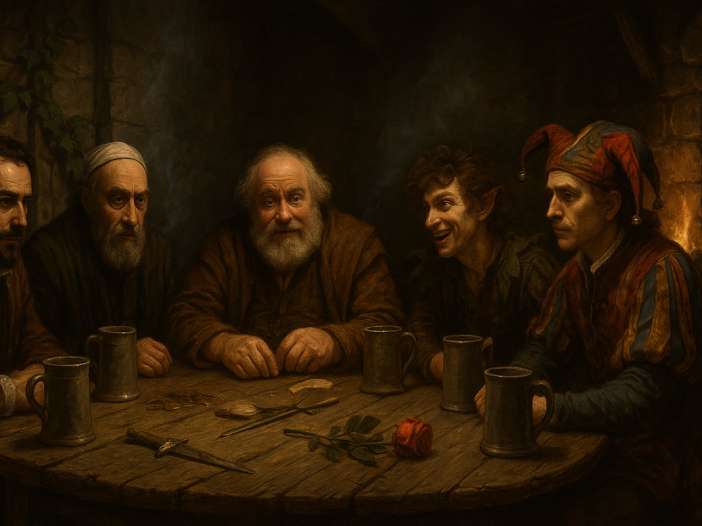
(The tavern is quiet, save for wind against the walls. From the hearth smoke rises, and a form slowly emerges—half-shadow, half-voice. It is him.)
I called you fools.
Knaves. Shadows.
Tools to move the plot forward.
A laugh here. A sting there.
You were not kings.
Not lovers.
Not heroes.
You were the cracks in the story—
The ones who saw too much,
Spoke too soon,
Laughed too loudly
At the wrong truths.
And so, I wrote you out of power
And into exile.
But tonight,
The tavern is yours.
No curtain. No stage. No applause.
Just you.
And the question:
Were you tricksters?
Or simply the ones who dared to see?
Speak now—
And I… shall finally listen.
(Note: This is an imaginary conversation, a creative exploration of an idea, and not a real speech or event.)

Topic 1: “Are We Fools… or Just the Only Ones Telling the Truth?”
Setting:
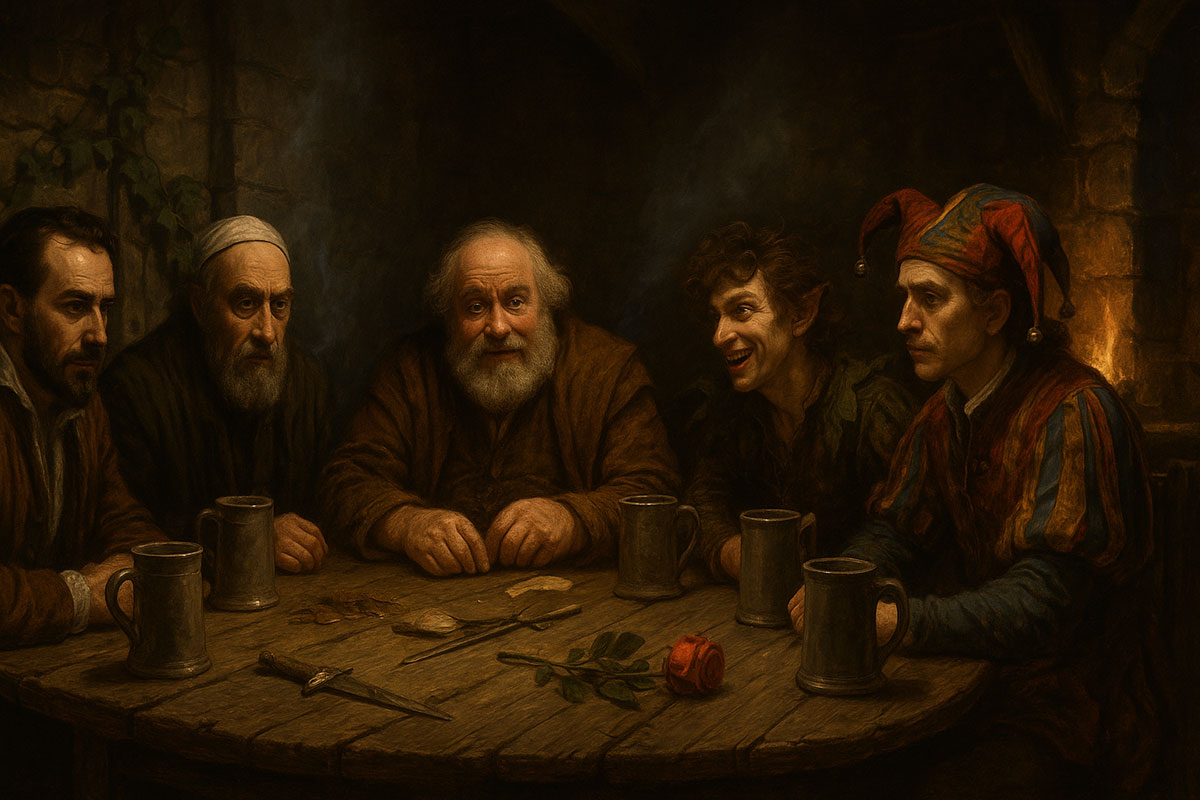
A weathered tavern just past midnight. A fire glows low. Smoke coils in the rafters. Five men sit at a crooked round table with mugs of something strong. Laughter flares, then fades. This isn’t a reunion. It’s a reckoning.
 Opening by the Ghost of Shakespeare
(He floats near the firelight—barely visible, more voice than figure.)
I wrote you as edges.
Comic relief. Cautionary tale.
You spoke when others would not.
You bit when others bowed.
But now I ask you—
Were you fools…
Or just the last men telling the truth?
Speak.
The tavern is yours.
 Question One:
“Why do people call you fools, tricksters, villains? What truth are they trying to avoid?”
Feste (twirling a mug):
They laugh because they must. I wear bells, but my words draw blood. I speak of death with a wink, of love with a sneer, and suddenly they call me fool. I think it’s fear. I make them smile when they should cry.
Iago (cool, deliberate):
They called me villain. As if I wrote the sickness in Othello’s heart. I merely whispered what he already feared. They hated me for naming the rot they’d rather not face.
Shylock (measured):
They call me cruel—but what is more cruel than being told your pain is theater? I asked for justice and they heard villainy. What truth did I threaten? That a man like me could hurt because he had been hurt too.
Puck (smirking):
Because they don’t like messes. I undo order. Lovers, kings, donkeys—I shuffle the deck. And when the mask slips, and they see their own foolishness, they call me trickster. I call it truth with flowers.
Falstaff (raising his mug):
They laugh at my belly, my lies, my wine—but it’s their war I mock. I survive where others die for honor. They call me fool because I won’t die for their nonsense. But tell me—who’s still alive?
Question Two:
“Is laughter your weapon—or your shield?”
Puck:
Both. Laughter slips past defenses. I play, and in playing, I reveal. But it also hides me. No one punishes a prankster… until he goes too far.
Feste:
It’s a blade in a glove. I smile, they drop their guard. Then I speak, and it cuts. But yes—it’s a shield too. Wit is the only armor they let a fool wear.
Falstaff:
Shield. Always. I joke before they can shame me. I drink before they can judge me. You call it comedy—I call it strategy.
Iago:
Neither. I don’t laugh. Laughter is too soft. I offer silence and suggestion. My mask is not humor—it’s understanding exactly what others want… and twisting it.
Shylock:
I do not laugh. Not often. The world gave me laughter only after it took everything else. My shield is survival. My weapon? Memory.
Question Three:
“Would you rather be feared, loved, or understood?”
Falstaff (smirking):
Loved. But I’ll take paid. Understanding’s too expensive, and fear gets you run out of town. Love comes with ale and warm beds.
Shylock:
Understood. Even once. Even by one soul. To be seen as a man, not a merchant, not a Jew, not a plot device… just a man in pain.
Iago (darkly):
Feared. Love fades. Understanding breeds pity. But fear… fear keeps you safe. Fear keeps you remembered.
Puck:
Loved and misunderstood. That’s the best way to live. They think I’m harmless, and so I bloom. But part of me… would like to be understood—just once. Not for magic. For intent.
Feste:
Understood. Because then maybe I wouldn’t have to smile so much. Maybe I could just… speak.
Closing by the Ghost of Shakespeare
(He leans into the firelight—face clear now, eyes hollow.)
You were never fools.
You were my mirrors.
And I laughed at you
Because I feared myself.
But tonight,
You laughed back.
And I—
I finally heard you.
Carry on.
The world still needs your jokes…
And your knives.
Topic 2: “What Made Us Outsiders?”
Setting:
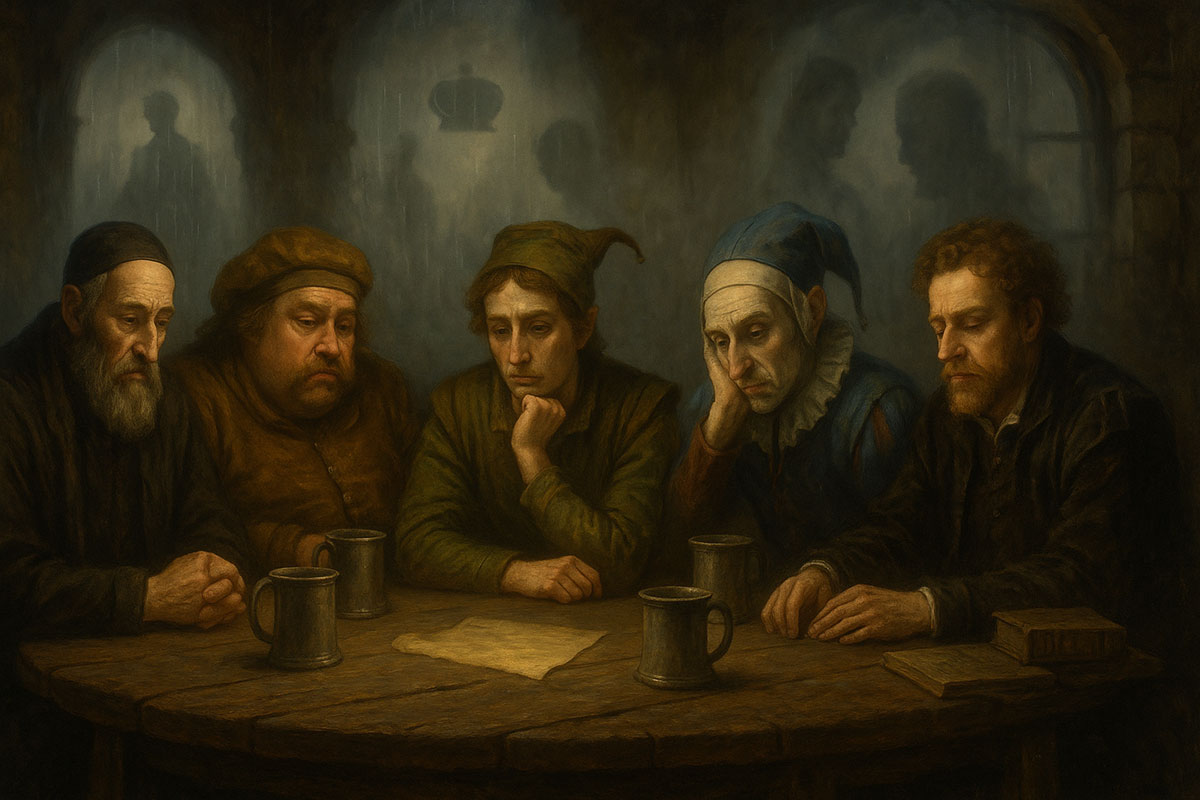
The tavern grows quieter. The smoke thickens. Someone has bolted the door. Outside, rain taps the shutters. Inside, five men lean into their own shadows. No laughter now—only the soft clink of mugs and the creak of old truths about to rise.
The Ghost of Shakespeare Returns
(His voice now less theatrical, more confessional.)
You danced on the edge.
Laughed while bleeding.
Mocked a world that never let you in.
But I never asked why.
So now I ask you—
What made you outsiders?
And was it the world’s doing…
Or your own?
Question One:
“Were you cast out—or did you choose exile?”
Shylock (cold and steady):
I was born outside. My name, my blood, my God—all marked me. They did not cast me out. They never let me in. My exile was not a choice. It was their comfort.
Falstaff (with half a grin):
Cast out? Maybe. Or maybe I walked out when they asked me to die for nonsense. I chose ale over honor. They called that betrayal. I call it surviving the war with both kidneys intact.
Feste (softly):
They called me fool before I could call myself man. So I wore the bells before they rang them for me. Better to choose the mask… than be handed one.
Iago:
Neither. I wasn’t exiled—I simply saw too clearly. I saw their weaknesses, their pretense of virtue. They didn’t push me out. I stepped aside, quietly, to build something sharper.
Puck (playfully):
I was never in. I come from mischief and moonlight. I didn’t want the castle. I wanted the forest. I didn’t choose exile. I chose freedom—and sometimes they’re the same thing.
Question Two:
“What did you lose when you were pushed aside?”
Feste:
Dignity. Sometimes. Not always. I lost the right to weep openly. A fool’s tears are jokes. But pain behind bells is still pain.
Iago:
Trust. Once, I gave it. To Othello. To the system. I believed merit would rise. But when others were lifted above me on charm or color, I understood—truth without status is invisible.
Shylock (sharply):
I lost my daughter. My dignity. My name in the law. They say I was vengeful. No—I was shattered. I lost the right to call myself father without being called villain.
Puck:
Nothing. I never needed their rules. But… I do wonder what it feels like to be inside a story that doesn’t turn you into wind.
Falstaff:
I lost Hal. Or maybe he lost me. We were comrades once—laughing, lying, living. But when he put on the crown, I became embarrassment. He rose. I rotted.
Question Three:
“If you could enter the circle now… would you even want to?”
Shylock:
No. I do not want their wine, their gold, their hollow mercy. I want justice. Or silence. But I will not beg for belonging.
Feste:
Sometimes. On stormy nights. But I think I’ve grown used to the edge. There’s truth here. And you don’t have to flatter anyone to be heard.
Falstaff:
Only if they brought beer and didn’t talk about honor. Otherwise, leave me with my stories and my meat pies. Their circle is cold. This tavern is warm.
Iago:
Let them keep their illusions. I walk alone—but I see clearly. I’d rather watch from the dark than dance in their candlelight of lies.
Puck (grinning):
Only to turn their goblets into frogs. I like the view from the margins. And besides… they look so bored in there.
Closing Words by the Ghost of Shakespeare
(He steps near the door now, hand resting on the bolt.)
You were not born outsiders.
You were made so.
By laws.
By laughter.
By the fear of men
Who cannot bear mirrors with fangs.
But tonight—
The tavern held you.
And in its warmth,
You were not villains.
You were truths that rhyme too closely with the world’s lies.
Sleep well, shadows.
You are not alone here.
Topic 3: “Do We Manipulate… or Do We Merely Reflect?”
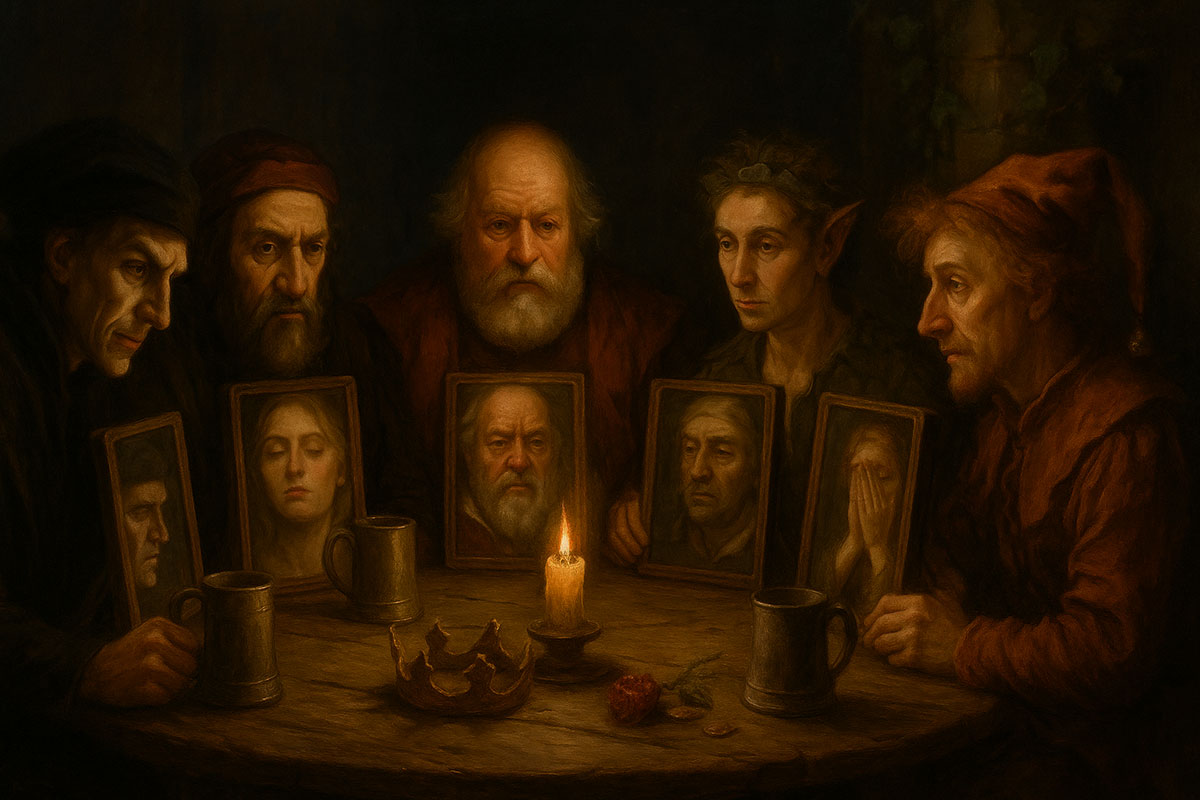
Setting:
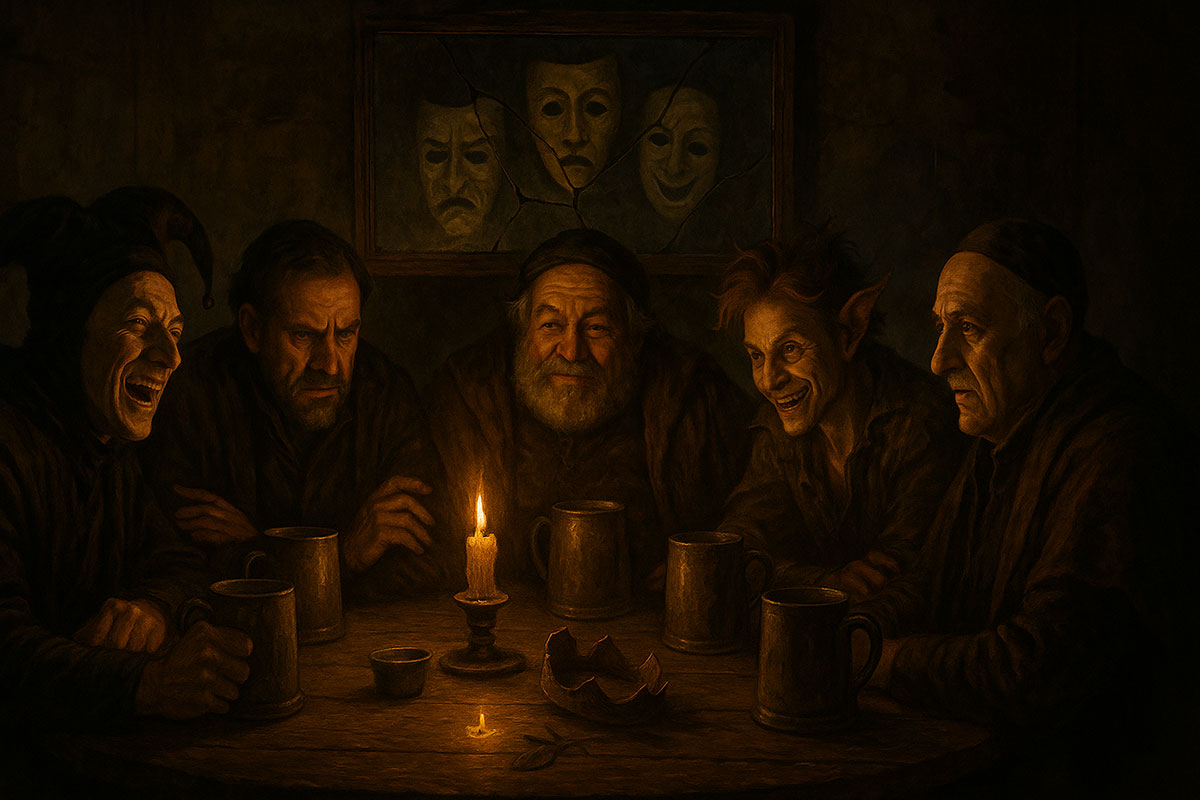
The tavern’s laughter has turned brittle. The fire spits, revealing flashes of each man’s face—sometimes wise, sometimes wicked. The mugs are mostly empty now. Shadows stretch longer. This is where self-defense ends… and self-reckoning begins.
Opening by the Ghost of Shakespeare
(He speaks not from above this time, but from behind them—his voice like a cold wind by the hearth.)
Did you bend the world to your will?
Or merely show it what it already was?
You played with truth.
But did you change it…
Or only reveal its shape?
Speak now, jesters and judges of men.
Who are you—liars?
Or mirrors too honest to be loved?
Question One:
“When you twisted the truth… were you trying to break others, or free them?”
Iago:
Break them. Let’s not dress it up. I saw the cracks and drove the wedge. But only because they lied first. To themselves. I just accelerated the rot.
Feste:
Free them, always. A good jest removes the mask. You laugh, then you see. My words sting, yes—but they leave the wound cleaner than flattery ever did.
Falstaff:
Neither. I twist the truth so it fits better in the hand. Like warming wine. I don’t break or liberate—I entertain. But if someone wakes up better for it, well… that’s a happy accident.
Shylock:
I told the truth so directly they called it cruelty. When you are not welcome, even plain speech is seen as war. I did not twist the truth. I held it too close.
Puck (chuckling):
Free them… into chaos. I rearranged their hearts like flowers in a storm. But did they not find new love in that mess? Sometimes, confusion is the path to clarity.
Question Two:
“Do you see yourself as a villain—or did the world need you to play that part?”
Falstaff:
Villain? Me? I’m the laugh they remember after the war. If that makes me villain, then the world’s gotten too stiff. I’m a necessary pause.
Shylock:
They needed me to be villain. It was easier than admitting their cruelty. My pain made their justice seem noble. But I was no villain—I was inconvenient.
Iago:
I became the villain they expected. They ignored my loyalty, my insight. So I gave them a monster. They clapped louder for it anyway.
Feste:
I’m the whisper behind the king’s ear. Not villain—truth in disguise. They laughed to survive me. But they heard me too. That’s all I ask.
Puck:
I’m mischief. Not evil. I poke, prod, misplace your dreams. But villainy? No. I’m the trick that teaches. And sometimes, they just don’t want to learn.
Question Three:
“If someone had truly seen you—not your jokes, not your tricks—what might they have found?”
Feste (quietly):
A tired man. Tired of being clever. Tired of knowing too much. I jested to keep from crying. Maybe… they’d have found silence.
Puck:
A child. Not young—but playful in the soul. I wanted them to laugh with me, not just because of me. But they never stayed long enough to notice.
Iago:
A man passed over. One who gave and was dismissed. Beneath the venom—there was a soldier. A husband. A man who waited too long to be seen.
Falstaff:
A philosopher in ale-stained clothes. I saw life for what it was—a jest with a funeral at the end. They saw a fool. I saw the pattern.
Shylock:
A father. A merchant. A man who loved words and books. If they’d looked past the gold and the contract… they would’ve found a man who had already lost.
Closing by the Ghost of Shakespeare
(He appears now in the mirror behind the bar—watching, not weeping.)
You were never liars.
You were the language no one wanted to speak.
Not because it was false—
But because it was familiar.
You did not twist truth.
You revealed it—ugly, sacred, inconvenient.
And in doing so,
You became unforgettable.
Not villains.
Not fools.
But witnesses with knives beneath your tongues.
Drink now.
You’ve earned it.
Topic 4: “What Justice Would Look Like—for Us”
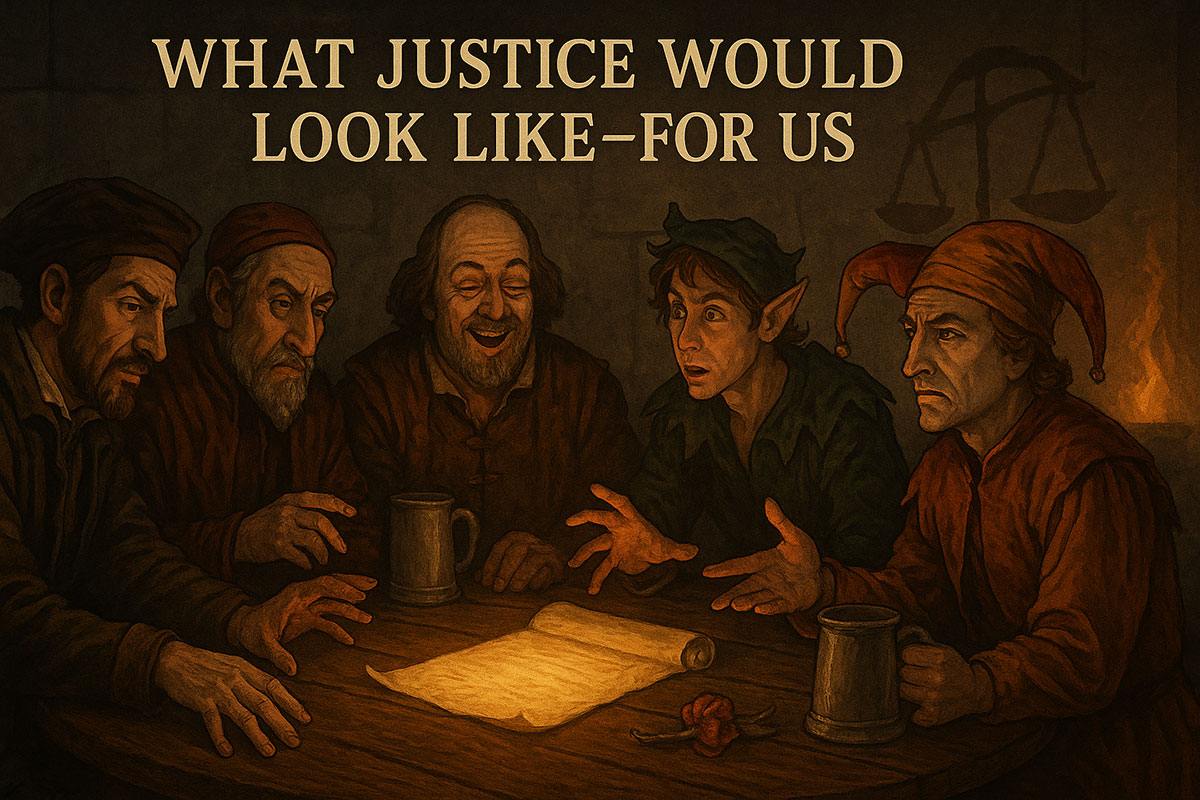
Setting:
The tavern is quiet now. The fire is low and blue. Ash clings to the air like regret. The mugs are mostly drained. No one jokes. No one mocks. This is the hour where even tricksters dare to speak plainly—and for once, they are heard.
The Ghost of Shakespeare Enters
(He no longer floats. He sits at the bar, pouring himself a mug. His voice is low. Human.)
I wrote justice with daggers.
With gallows. With silence.
But tonight, I ask you—
Not what the courts owed you.
Not what the audience cheered.
But what would have felt… fair.
To you.
Only you.
Question One:
“What would justice have looked like for you—not revenge, but restoration?”
Shylock (firmly):
An apology. Not a ruling. Not a forced conversion. Just one man looking me in the eye and saying, “We wronged you.” That would have been worth more than all their gold.
Feste:
Someone asking, “Are you all right?” Not as a jest. Not after a laugh. Just… asking. Truthfully. That’s justice for a fool. To be seen.
Iago:
Justice? A system that didn’t reward charm over competence. That valued loyalty. If someone had seen my work—not just my skin, my class—I might have remained loyal. Might.
Falstaff:
Hal not turning his back. That’s it. No trial. No coin. Just a hand on the shoulder saying, “You mattered to me.” That’s more justice than any court can give.
Puck (with a wink):
A world that learns from its mistakes. I cause chaos, yes—but I hoped they’d grow from it. Justice would be a midsummer night where love stays true, even after the spell fades.
Question Two:
“What part of you was misunderstood by those who judged you?”
Feste:
That I was not mocking them. I was holding a mirror. Gently. Even lovingly. But they saw insult where I offered insight.
Shylock:
That I was not greedy. I was grieving. Grieving my daughter, my dignity, my people. They heard the contract. They did not hear the cry.
Iago:
That I was not born evil. I was born invisible. And when men are not seen, they begin to shape the light around them… however dark it must become.
Falstaff:
That I was not cowardly. I just valued life. They called me a joke because I wouldn’t die for their pride. I bled too—but quietly.
Puck:
That I cared. Truly. I rearranged their hearts so they’d find the right ones. But they blamed me for the mess. Never thanked me for the clarity.
Question Three:
“If justice were truly done, would you still be who you are?”
Shylock:
No. I would be whole. I would not walk with the world’s scorn carved into my back. I would be more than a symbol. I would be me.
Falstaff (pausing):
No. I think I’d be thinner. And lonelier. My jokes kept me company. Justice might’ve made me honest—but not necessarily happy.
Iago:
I don’t know. I think… I might never have spoken at all. If justice had found me early, I wouldn’t have needed words that bite.
Feste:
I’d still wear the bells. But they’d ring a little softer. Maybe… I’d laugh less. Or more. But yes—I’d still be me. Just… lighter.
Puck:
Yes. Chaos and all. Justice would not tame me—it would liberate me. I would still twist the tale… but I’d do it with joy, not necessity.
Final Words by the Ghost of Shakespeare
(He rises from his stool and walks slowly to the hearth. He drops a page into the fire.)
You were never granted justice.
Not by kings.
Not by courts.
Not by me.
You gave the world your riddles, your knives, your light.
And we repaid you with exile.
Laughter… without listening.
But tonight, I have heard you.
And though justice may not rewrite your stories—
It remembers your names.
Not just as jesters…
But as judges of the world’s illusion.
Topic 5: “Would We Still Choose the Shadows?”
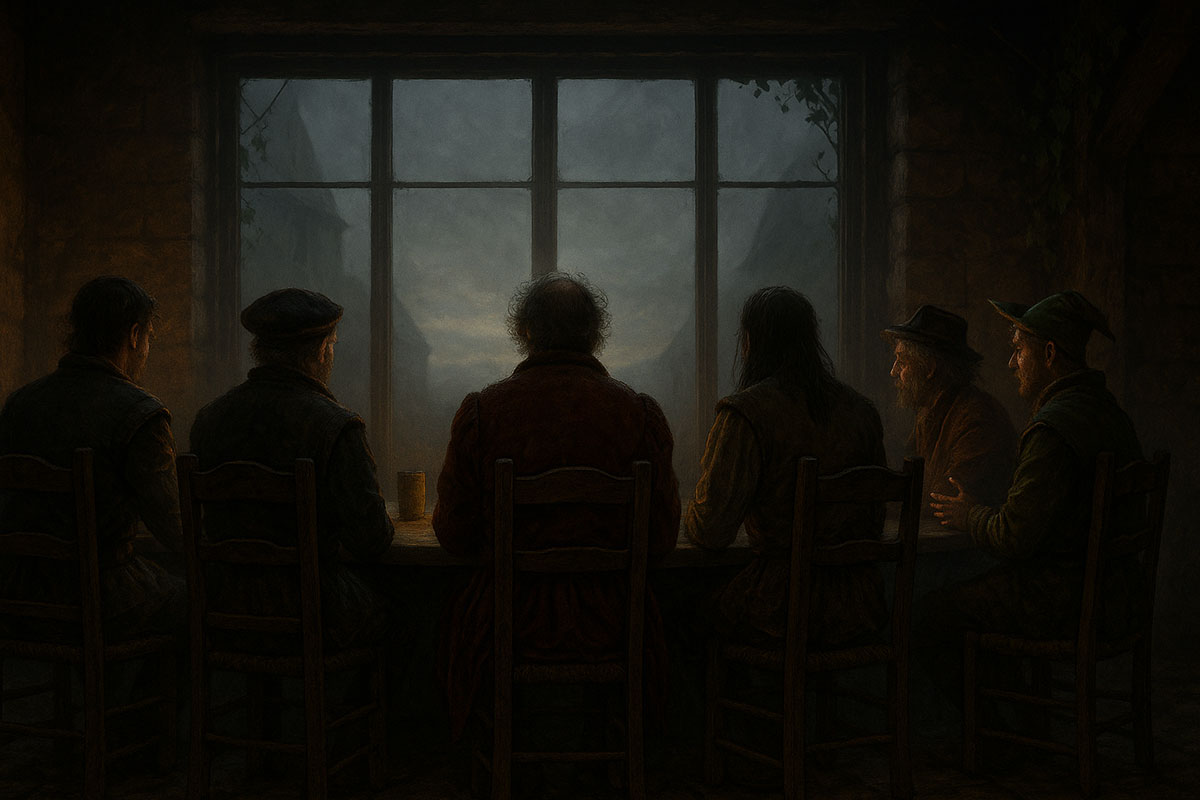
Setting:
The tavern is nearly empty. Chairs are askew. The fire has burned low, but glows enough to show five figures still seated—not with the posture of jesters, but with the presence of prophets. This is not about survival now. It’s about choice. If they had their story to live again—would they step into the light… or walk right back into the dark?
Opening by the Ghost of Shakespeare
(He no longer stands. He sits among them, as if he’s always been one of them.)
I wrote you into corners.
Gave you laughter like armor.
Cast you in shadows…
Then asked the audience to forget you.
But now I ask you—
If the stage were empty,
And the light was yours to walk into…
Would you still choose the dark?
Question One:
“If you could rewrite your story, would you place yourself inside the circle… or remain just outside it?”
Feste:
Outside. But with the door open. I don’t want their stage—I want my own corner to speak truth. If they listen, they listen. But I won’t beg to belong.
Puck (grinning):
Outside, of course. Circles are dull. Everyone facing each other, waiting their turn. I’d rather dance around them, make them dizzy, then watch them laugh when they finally understand.
Falstaff:
I tried the circle. They drank with me, jested with me, but left me in the rain. I’d rather warm myself by this fire than ever trust their court again.
Shylock:
Inside—if only once. Just to speak without suspicion. To be heard as a man, not a warning. Then, maybe, I’d choose the edge again… but it would be my choice.
Iago (quietly):
I don’t know. Maybe the circle would’ve softened me. Maybe I’d have stayed whole. But the edge taught me clarity. So yes… I might still choose exile. But I’d do it unbroken.
Question Two:
“What did the shadows give you… that the center never could?”
Puck:
Freedom. I could say what no duke could. I made lovers out of liars. The shadows let me create… without being held responsible. That’s power.
Feste:
Permission. To tell the truth, even when it hurt. Inside the court, they choke on politeness. Out here, you can breathe. Laugh. Grieve.
Falstaff:
Comfort. The shadows don’t care how much you weigh, how loudly you drink, or how many lies you tell—as long as you share your ale and stories.
Iago:
Perspective. You see more from the margins. Inside, everything’s flattery and masks. Outside, you watch who they are when they think they’re safe.
Shylock:
Depth. In the shadows, you find out what your name means. What you’d bleed for. The center gave me business. The edge gave me self.
Question Three:
“Are you at peace with who you became?”
Iago:
No. But I understand him. And that… is almost peace. I became what they feared. Because they gave me no room to be anything else.
Shylock:
I am still angry. Still grieving. But I have stopped apologizing for surviving. That, too, is a kind of peace.
Falstaff:
Yes. I made them laugh. I stayed alive. I danced when the others died in armor. I regret nothing… except maybe one more hug from Hal.
Feste:
Peace? Not always. But I leave the stage knowing I said what needed saying. Even if no one clapped.
Puck:
Peace? I was never after that. I was after motion, mischief, love confused with longing. I’m not at peace. I’m still dancing.
Final Words by the Ghost of Shakespeare
(He stands. But this time, it’s not to leave—it’s to bow.)
You were my masks.
My edge.
My laughter with teeth.
And I placed you outside the story,
Because I didn’t know what to do with truth I couldn’t tame.
But now I see…
You weren’t outside the tale.
You were the frame.
You showed us
What lies beneath the hero’s crown,
What we laugh at to avoid crying,
What we exile to keep our myths intact.
You were never just shadows.
You were the shape of the truth itself.
And now…
You are remembered.
Final Thoughts by the Ghost of Shakespeare
(The fire is nearly out. He now sits among them, no longer smoke, but form. Voice no longer grand, but raw.)
You were never mere jesters.
You were the ones who told the truth
When no one else dared.
You bent the rules—
Because the rules were already bent.
You twisted the truth—
To reveal it.
And I?
I named you outsiders.
Not because you didn’t belong—
But because you did,
Too honestly.
Too painfully.
I see you now.
Falstaff,
whose laughter was armor.
Feste,
whose songs cut deeper than swords.
Puck,
who moved hearts like puzzle pieces.
Shylock,
who bled in contracts and silence.
Iago…
whose darkness was just the echo of being unseen.
You were not the edge of the play.
You were the frame.
And now,
the audience is gone.
The fire burns low.
But your voices linger.
Not as villains.
Not as fools.
But as
the truth beneath the joke.
Short Bios:
Iago
Othello’s ensign, master of manipulation. Dismissed, overlooked, and burned by ambition, he weaponized insight into destruction. Not born a villain—made into one by silence, suspicion, and the slow rot of invisibility.
Puck
A mischievous spirit from A Midsummer Night’s Dream, dancing through dreams and confusion. He turns lovers into fools and fools into truth-tellers. Chaos is his art. Delight is his mask. Beneath it all? A question: Who’s really in control?
Feste
The fool of Twelfth Night who sees more than he says. Beneath his songs and jests lies a soul carved by observation. He laughs last—not because he wins, but because he understands.
Falstaff
Knight, drunkard, survivor. With a belly full of lies and a heart strangely noble, he mocks the nobility he once courted. Cast out by kings, remembered by taverns—he is comedy with tragedy’s breath behind it.
Shylock
A Jewish moneylender from The Merchant of Venice, defined more by what was taken than what he demanded. Sharp, grieving, proud—he speaks not just for vengeance, but for recognition. A man who asked for justice… and was stripped of even dignity.
Leave a Reply