

|
Getting your Trinity Audio player ready...
|

C.S. Lewis:
When we speak of poetry, we do not merely speak of ornament, nor of leisure’s idle song. We speak of one of the oldest instruments by which humanity has interpreted its place in the cosmos. From the beginning, poets have served as guides through mystery, giving us images that both delight the senses and nourish the spirit.
The ancients knew this well. The Bible, with its psalms and parables, became not only a record of faith but a treasury of metaphor that shaped whole civilizations. The myths of Greece and Rome, with their gods and metamorphoses, supplied a symbolic lexicon that endured for centuries. Poetry, whether in sacred scripture or pagan myth, was never content with plain statement. It taught us to see with a double vision — the visible and the invisible, the literal and the symbolic.
Yet poetry is not merely inheritance. Each age must discover how to speak anew. Chaucer found an English voice amid court and countryside, Shakespeare lent that voice to kings and jesters alike, Donne turned it inward to wrestle with the soul, Wordsworth returned it to nature, and Whitman flung it across the continent with democratic abandon. The poet’s voice evolves because society itself evolves, and with it the demands of language.
But the heart of poetry lies not only in expression but in vision. Allegory, symbol, imagination — these are the tools by which poets enlarge reality. When Blake saw eternity in a grain of sand, or Coleridge set an albatross around the Mariner’s neck, they were not embellishing but unveiling. The poet reveals through symbol what prose cannot say directly: that our lives are woven into larger patterns of meaning.
And what of the poet’s duty to society? This is a dangerous and necessary question. Burns sang for the ploughman, Pope satirized the proud, Shelley thundered against tyranny, Auden reflected on war’s despair. The poet is sometimes courtier, sometimes rebel, sometimes prophet — but always conscience. Through ridicule, song, or lament, poetry insists that society look into a mirror it might otherwise avoid.
Finally, poetry must face its future. Modernism shattered old forms, replacing certainty with fragments, irony, and experiment. Critics emerged not as footnotes but as voices in the dialogue itself, shaping how poems are received. Today the poet stands amid fractured traditions, yet still tasked with the same ancient mission: to make meaning, to give shape to chaos, to sing truth however obliquely.
What follows are five conversations — across centuries, cultures, and styles — but all bound by a common question: what is poetry’s role in human life? I invite you to listen with imagination and with wonder, for these voices are not relics but companions.
(Note: This is an imaginary conversation, a creative exploration of an idea, and not a real speech or event.)

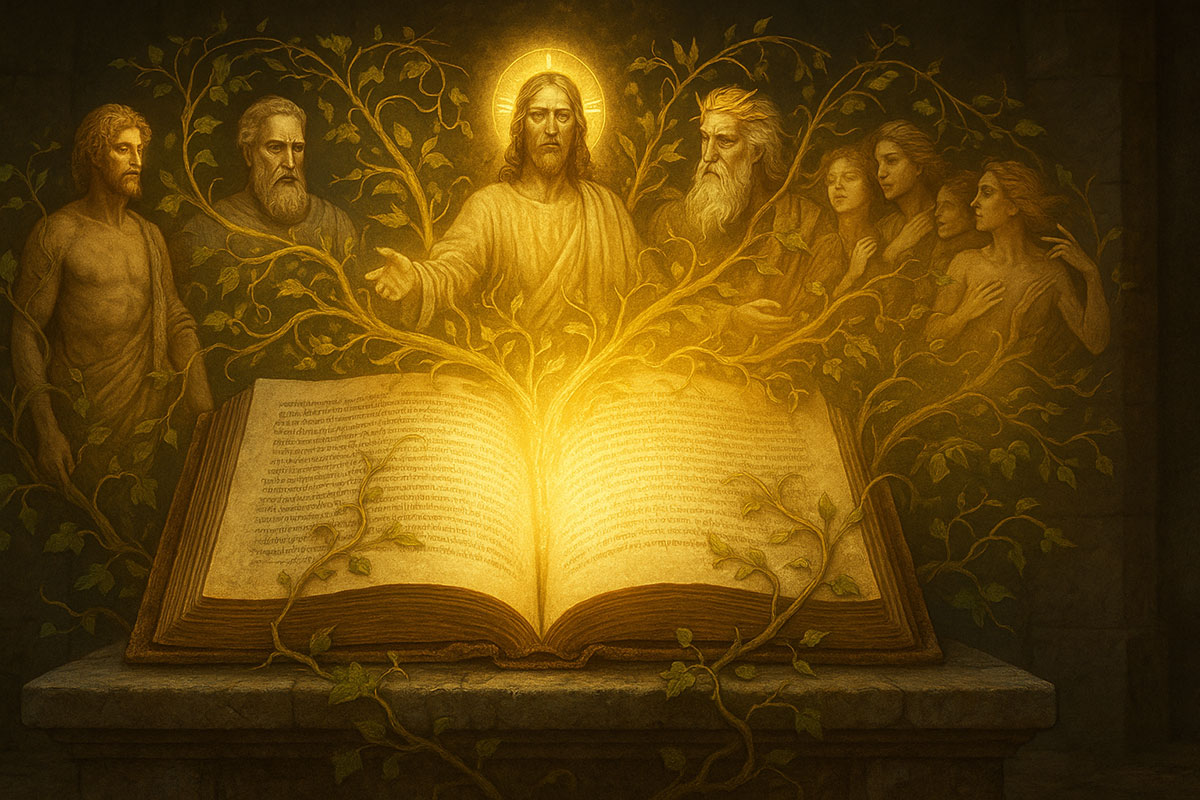
Topic 1: The Bible and Myth as the Foundations of Poetry
C.S. Lewis (Moderator):
Friends, welcome. Across ages you’ve drawn on scripture and myth to create poetry that shapes nations. Let me begin with a question: Why is the Bible and myth so indispensable to the poet? Is it language, symbol, or something deeper?
John Milton:
For me, it is all three. The Bible is not simply a book of stories, but a stage where Heaven and Hell contend, and mankind must choose. Its rhythms taught me cadence. Its typology gave me structure — Adam as the figure of Christ, the Garden as a shadow of Paradise regained. Without that sacred architecture, Paradise Lost would collapse into mere fable.
Ovid:
Milton, you speak of sacred architecture. I speak of endless metamorphosis. In my Metamorphoses, gods become trees, lovers become rivers. The world itself is unstable, pliable. It is not one narrative, but many, woven together like a tapestry that frays and knots again. Myth teaches the poet to see life as fluid, always changing — and thus eternally poetic.
T.S. Eliot:
Yet both of you grasp what matters: order and transformation. The modern poet finds in myth a scaffolding, a way to hold fragments together. In The Waste Land, I turned to the Grail legend not because I believed literally in its mythos, but because without such a frame, the voices of the modern world would be cacophony. Myth offers coherence in the ruins.
Northrop Frye:
Exactly, Mr. Eliot. What unites Bible and myth is that they form what I called the great code. They are not merely stories, but systems of imagery that teach us how to read. When you see the tree of Eden, you also see the Cross. When you see floodwaters, you hear echoes of judgment and rebirth. Without this literacy of myth and scripture, we misconstrue not only poetry but civilization.
Dante Alighieri:
And let us not forget that poetry is a journey. I walked through Hell, Purgatory, and Paradise, guided by Virgil and Beatrice. The Bible lent me its theology, Ovid gave me his shapes, and Aristotle his reason. Myth and scripture are the twin wings on which poetry ascends. Without them, the soul would stumble blind through the dark wood.
C.S. Lewis:
Beautifully said. Now, let me press further. Some claim we no longer need these ancient sources — that modern life demands new symbols. Are Bible and myth still necessary, or are they relics?
Ovid:
Relics? Never. As long as lovers fall, as long as rivers run, the gods will return. Perhaps not Jupiter with his thunderbolts, but some new name, some new mask. Myth does not die; it only shifts costume.
Milton:
I cannot be so quick to abandon the sacred. Myth may change its garment, but revelation is eternal. The Word of God does not metamorphose as Ovid’s nymphs do; it abides. Even in an age of skepticism, poets must wrestle with the divine text. For whether in faith or rebellion, they cannot escape it.
Eliot:
Milton, I share your reverence, yet also Ovid’s realism. Modern man no longer believes as once he did, yet he thirsts for meaning. So the poet must use fragments of both Bible and myth as echoes, as scaffolds. Even disbelief is haunted by what it denies. Thus poetry remains charged with biblical and mythic resonance.
Frye:
Indeed. What we call modern poetry is unintelligible without this intertextual background. Even the most secular writer draws unconsciously from the reservoir of myth and scripture. Remove the Bible and Homer, and you’ve cut the nerve of English literature itself.
Dante:
I agree. Without Virgil, I could not have written The Comedy. Without the Bible, it would have no destination. Whether one believes or not, the pilgrim’s path is carved already. To reject myth and scripture is to walk without map or compass.
C.S. Lewis:
Wise counsel. Finally, let me ask: What is the poet’s task in reimagining these sources for future generations? Should we preserve them faithfully, or transform them?
Milton:
Preserve, but exalt. I strove to justify the ways of God to men — not to alter revelation, but to render it sublime in verse. The poet should be a steward of truth, not its betrayer.
Ovid:
Ah, but transformation is fidelity, Milton. To repeat without change is to let myth die. When I reshaped old tales, I kept them alive. The poet’s duty is to make the old new, to surprise the listener, so that even a well-worn tale glows again.
Eliot:
I stand between you. Tradition must be preserved, yes, but only by transformation. A poet must immerse himself in the great tradition — the Bible, Homer, Dante, Milton — and then, in assimilating them, renew them. Otherwise poetry becomes a museum.
Frye:
I would say the poet’s task is translation — not of language only, but of vision. Each age requires its own symbols, but they must be drawn from the archetypes that endure. Thus the Cross becomes both crucifixion and resurrection, despair and hope, death and life. Poetry interprets these archetypes for each generation.
Dante:
And let us not forget: the poet is also a guide. Virgil guided me, I guided souls through my verse. You, modern poets, must guide your age through its wasteland, its dark wood, toward some vision of paradise. Whether you call it God or simply meaning, the task is eternal.
C.S. Lewis (smiling):
So here we have it: Milton calls us to preserve the sacred flame, Ovid to transform it into endless forms, Eliot to build from fragments, Frye to trace the archetypes, and Dante to guide the soul. Five visions, yet one truth: without Bible and myth, poetry loses its roots, its wings, and its compass.
Topic 2: The Evolution of the English Poetic Voice

C.S. Lewis (Moderator):
Poetry is the record of a culture finding its voice. From Anglo-Saxon chants to Romantic lyric, each age reinvents what it means to speak in verse. Let me begin: How did each of you find your “voice” within the tradition you inherited?
Chaucer:
I took the tongues of England—half French, half Saxon—and gave them shape. The Canterbury Tales are not high Latin, nor courtly French, but the speech of pilgrims, millers, and wives. My voice was England’s many voices woven into rhyme.
John Donne:
I found my voice in discord, in metaphysical collisions. Where Chaucer made harmony from society, I turned inward, crafting conceits where body and soul wrestle. My “voice” was discovery through paradox.
Shakespeare:
Mine was the stage. I gave words to kings and clowns, to murderers and lovers. Blank verse became my heartbeat, prose my shadow. My voice was not my own, but the chorus of all humanity speaking through me.
William Wordsworth:
I found my voice in simplicity—common language elevated into beauty. A ploughman’s speech, a shepherd’s grief, a child’s wonder. Against the artificial diction of my age, I returned poetry to nature and the human heart.
Walt Whitman:
I was America singing. No rhyme, no measure, no leash. My lines sprawled like the continent. I absorbed everything—factories, soldiers, lovers, rivers—and sang it back as one voice, democratic and unrestrained.
C.S. Lewis:
Thank you. Now a second question: How does the poet’s voice both reflect and transform the society from which it arises?
Shakespeare:
Society gave me the theater, but I gave society itself a mirror. In Hamlet, a prince doubted; in Lear, a king went mad; in Romeo and Juliet, young love defied old feuds. Society saw itself more truly in my lines than in its laws.
Whitman:
Yes! The poet does not only mirror but proclaims. America was raw, loud, contradictory—I shouted it into song. In return, my voice gave Americans a vision of themselves not yet realized: a people vast and unified.
Chaucer:
In my time, society was feudal, bound by rank. Yet in my tales, the knight and the cook sit side by side, their stories worth equal telling. In showing this, I transformed society by suggesting a common dignity.
Donne:
Society pressed conformity upon us—church, crown, duty. Yet in my sermons and poems, I revealed the interior tempest. In turning inward, I showed how even under authority, the soul is restless, untamed. That too transforms society, for it teaches that faith and desire cannot be legislated.
Wordsworth:
The society I knew was fractured by industry, alienated from nature. I sought to heal by giving voice to what was forgotten—the shepherd’s solitude, the child’s imagination, the dignity of humble life. My transformation was to say: the ordinary is sublime.
C.S. Lewis:
And finally, let me ask: Looking toward the future, what should the poetic voice strive for? Should it unify, disrupt, or simply endure?
Donne:
The poet must disrupt, for without disturbance, there is no awakening. Conceits, paradoxes—these jolt the reader into truth. To lull is to betray.
Wordsworth:
I must disagree. The poet should heal. We are surrounded by division, war, and clamor. The poetic voice ought to lead us back to nature, to inward peace. Endurance comes through harmony, not shock.
Whitman:
I say both! Disrupt and unify. The poet sings the people’s contradictions until they become one chorus. Yes, America was chaotic—but in my song, it became one body. The future poet must be large enough to contain multitudes.
Chaucer:
Let the poet endure. Time will judge the tales. My pilgrims are still walking, still speaking, six centuries later. A poet must be faithful to voices of his age; unity or disruption may follow, but survival is the test.
Shakespeare:
The poet must hold a mirror, not to flatter nor to scold, but to reveal. Whether it heals or wounds, unifies or disrupts, depends on what is seen. The poet’s voice is not an oracle but a stage, and the world is forever its audience.
C.S. Lewis (closing):
From Chaucer’s chorus of pilgrims, to Donne’s paradoxes, to Shakespeare’s mirror, to Wordsworth’s healing song, to Whitman’s democratic yawp, we see the arc of poetry’s voice. Each age found a tongue adequate to its truth. The future will demand the same—that poets dare to speak, in whatever voice their age requires.
Topic 3: Allegory, Symbol, and the Imagination
C.S. Lewis (Moderator):
Poetry often works through images that carry meanings beyond themselves. Allegory, symbol, imagination — these are the heart of vision. Let me begin: Why do poets turn to allegory or symbol instead of speaking plainly?
William Langland:
Because plain speech cannot capture the weight of eternity. In Piers Plowman, I dreamed a tower of Truth and a dungeon of Wrong. These were not places, but states of the soul. Allegory lets us walk through invisible realities.
William Blake:
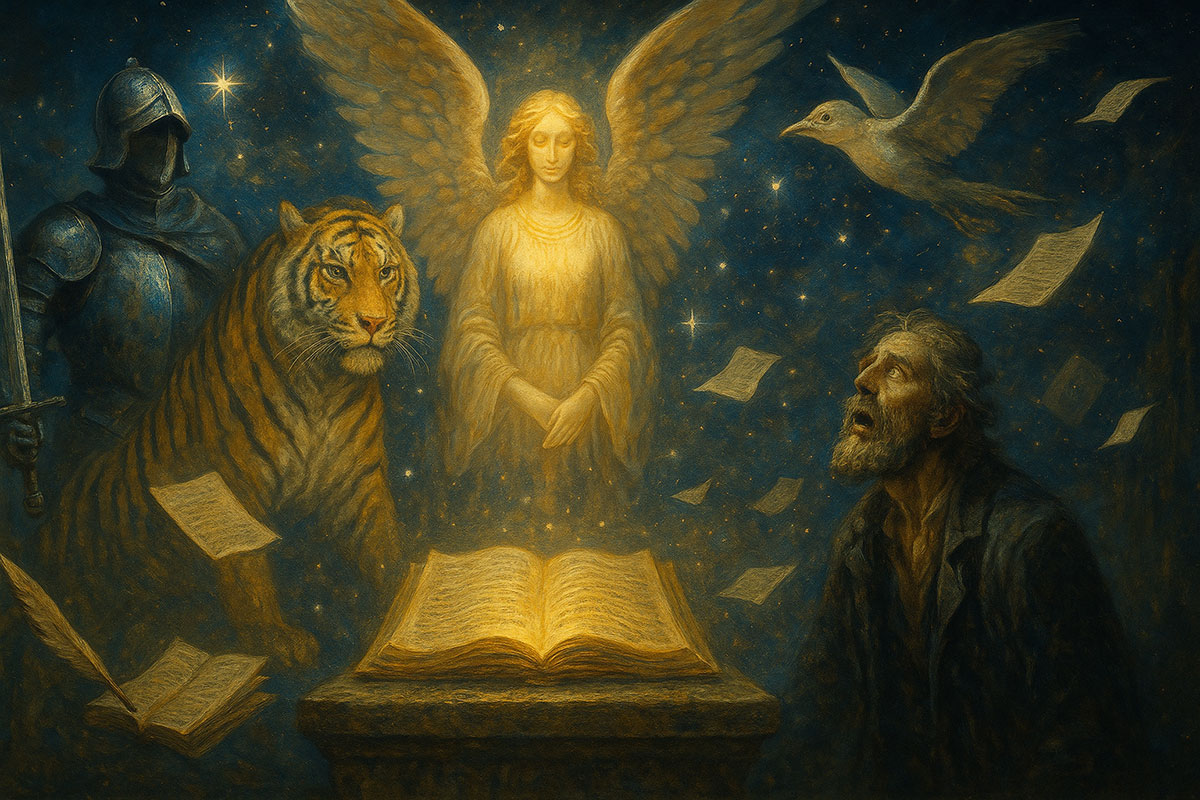
Yes, Brother Langland — and yet allegory can imprison. A symbol lives, breathes, burns! My lamb is innocence, my tiger, fearful beauty. These are not mere stand-ins, but living flames. Plain words are too narrow for eternity.
Samuel Taylor Coleridge:
I must distinguish: allegory is fixed, symbol is organic. An allegory points to one meaning; a symbol unfolds into many. When I set an albatross upon the Mariner’s neck, it was not one thing, but a whole web of guilt, burden, redemption. That is imagination at work.
Emily Dickinson:
I could not tell it straight, so I told it slant. A loaded gun, a buzzing fly, a narrow fellow in the grass — these small symbols sing louder than sermons. To speak plainly is sometimes to silence truth.
Edmund Spenser:
In The Faerie Queene, I did not speak of Elizabeth merely, nor of virtues abstractly. I clothed them in knights, dragons, ladies. Allegory made visible the invisible, turned moral philosophy into quest and combat. Poetry thrives when virtue wears armor.
C.S. Lewis:
Thank you. Now let me ask: What role does the imagination play in shaping these symbols and allegories? Is it invention, revelation, or both?
Blake:
Imagination is not invention — it is vision. The poet does not fabricate; he beholds. When I saw angels in the trees of Peckham Rye, they were not fantasies but realities unveiled. Imagination is the divine eye.
Coleridge:
I agree that imagination reveals, yet it also shapes. The primary imagination perceives the world as given; the secondary imagination reshapes it into art. Thus the Mariner’s tale was both received and transformed. Both invention and revelation dwell within imagination.
Spenser:
To me, imagination is the loom. It weaves classical myth, Christian doctrine, courtly praise into one garment. Revelation gives the thread, invention the pattern. The poet must use both hand and vision.
Langland:
I saw visions in dreams, but dreams alone do not suffice. I labored in waking life to clothe them with form. Imagination is the bridge between divine revelation and human language, between what is seen in spirit and heard in rhyme.
Dickinson:
Imagination is a flashlight in a darkened room. It does not invent the furniture, but shows it from angles unseen. To call it invention or revelation is too small. It is both — and more — the crack of eternity through the everyday.
C.S. Lewis:
One final question: What dangers or gifts come when readers misinterpret these allegories and symbols? Do symbols free poetry or confuse it?
Spenser:
Misreading is the risk of allegory. Knights meant as virtues may be taken as mere characters. Yet even misread, the tale delights, and perhaps instructs unwittingly. Allegory teaches on many levels.
Dickinson:
Confusion is a kind of gift. If my fly troubles you, perhaps death troubles you more. Ambiguity invites rereading, re-seeing. A symbol is not owned by one meaning but by many.
Blake:
But beware! When priests took Christ’s living symbols and froze them into dogma, the imagination died. Misinterpretation becomes tyranny when it chains the symbol to one meaning. The poet must defend the liberty of the image.
Langland:
And yet clarity matters. My allegory was to awaken the slumbering soul to justice, to show the corruption of church and crown. If readers miss that, the prophet’s cry goes unheard. Misinterpretation can dull the blade.
Coleridge:
Still, poetry’s power lies in inexhaustibility. If the albatross means guilt to one reader, sacrifice to another, grace to a third, then the poem is alive. Confusion may be the price of vitality. A dead poem is one whose meaning is exhausted.
C.S. Lewis (closing):
We have heard five visions: Langland’s earnest allegory of towers and dungeons, Spenser’s knights in shining virtues, Blake’s living symbols aflame, Dickinson’s slanted lightning bolts, Coleridge’s layered imagination. From them emerges a truth: allegory guides, symbol breathes, imagination reveals — and all together they give poetry its inexhaustible life.
Topic 4: The Poet’s Relationship to Power and Society

C.S. Lewis (Moderator):
Throughout history, poets have stood in uneasy relation to power—sometimes courtly flatterers, sometimes rebels, sometimes prophets. My first question: What is the poet’s responsibility toward authority—political, religious, or social?
Geoffrey Chaucer:
I served at court, yet my tales whispered truths no sermon dared. The Knight, the Miller, the Wife of Bath—all mocked authority by speaking with earthy honesty. A poet may bow before the crown, but his pen kneels to no one.
Alexander Pope:
Responsibility? To wield wit as a sword! In The Dunciad, I scourged dullness, hypocrisy, corruption. To expose vice through satire is the poet’s true service to society—though it makes enemies in high places.
Percy Bysshe Shelley:
The poet is an unacknowledged legislator. We do not pass laws, but we ignite revolutions. Prometheus Unbound was my rebellion against tyranny, religious or political. To remain silent before oppression is betrayal.
Robert Burns:
I sang as the ploughman sings, and in my songs mocked lords and priests. Yet my aim was not destruction but dignity—to give the common man his voice. My poems were resistance, aye, but with laughter as weapon.
W.H. Auden:
I lived in the shadow of wars and dictators. The poet’s responsibility is honesty: not to flatter power, nor to preach falsely. In September 1, 1939, I tried to face terror without illusions. Responsibility lies in truth-telling, however limited.
C.S. Lewis:
Thank you. Now let me ask a second: Can poetry genuinely change society, or does it merely comment from the margins?
Shelley:
Poetry changes society at its roots. Ideas precede actions, imagination precedes reform. Without poets, revolutions would starve of vision. Poetry is the seed of liberty.
Pope:
I must disagree. Verse cannot topple kings—it can only ridicule them. Satire humbles, yes, but its power is moral, not material. I wrote to correct manners, not to storm parliaments.
Chaucer:
Perhaps both. My tales did not topple the crown, but they revealed the folly of friars, the greed of pardoners. Laughter softens power’s edge. When people see their rulers in my pilgrims, change stirs in their hearts.
Burns:
Change? My songs became the people’s songs. A Man’s a Man for A’ That was sung in taverns, not parliaments—but it carried the spirit of equality. Poetry may not draft laws, but it gives courage to those who will.
Auden:
In my century, I doubted poetry’s power to halt bombs. “Poetry makes nothing happen,” I once wrote—but I meant it as paradox. While it cannot stop a war, it shapes private consciousness, the realm from which all public action flows. That is its hidden power.
C.S. Lewis:
And a final question: Should poets stand apart from society as critics, or within it as participants?
Burns:
I was of the people, not above them. I stood within, sang within, drank within. The poet belongs at the hearth and the field, for he is one of the folk he sings of.
Pope:
I kept my distance, preferring ink to court intrigue. Satire requires perspective; to see clearly, the poet must not be too entangled in the mob.
Chaucer:
I walked both paths. A courtier, yes, but also a wanderer among pilgrims. The poet should move freely, speaking with kings by day and millers by night.
Shelley:
Apart, absolutely. The poet must remain untamed, unbought, unwilling to bend knee to institutions. Only thus can his song strike like lightning against injustice.
Auden:
And yet isolation risks irrelevance. I stood within society, in classrooms, in cafés, in exile—but always as an observer, never wholly absorbed. The poet is half-participant, half-outsider: the conscience both inside and beyond the crowd.
C.S. Lewis (closing):
So we hear: Chaucer’s double vision, Pope’s satiric distance, Shelley’s fiery rebellion, Burns’s communal song, Auden’s witness from the margins. Together they reveal that the poet’s relationship to power is never fixed—sometimes critic, sometimes comrade, always conscience. The poet may not wield a crown, but through words he shapes the soul of society.
Topic 5: Modernism, Criticism, and the Future of Poetry
C.S. Lewis (Moderator):
Friends, our last theme is the most pressing: the future. Poetry in your hands has been fractured, reborn, critiqued. My first question: What did modernism change about the role of the poet and the nature of poetry?
T.S. Eliot:
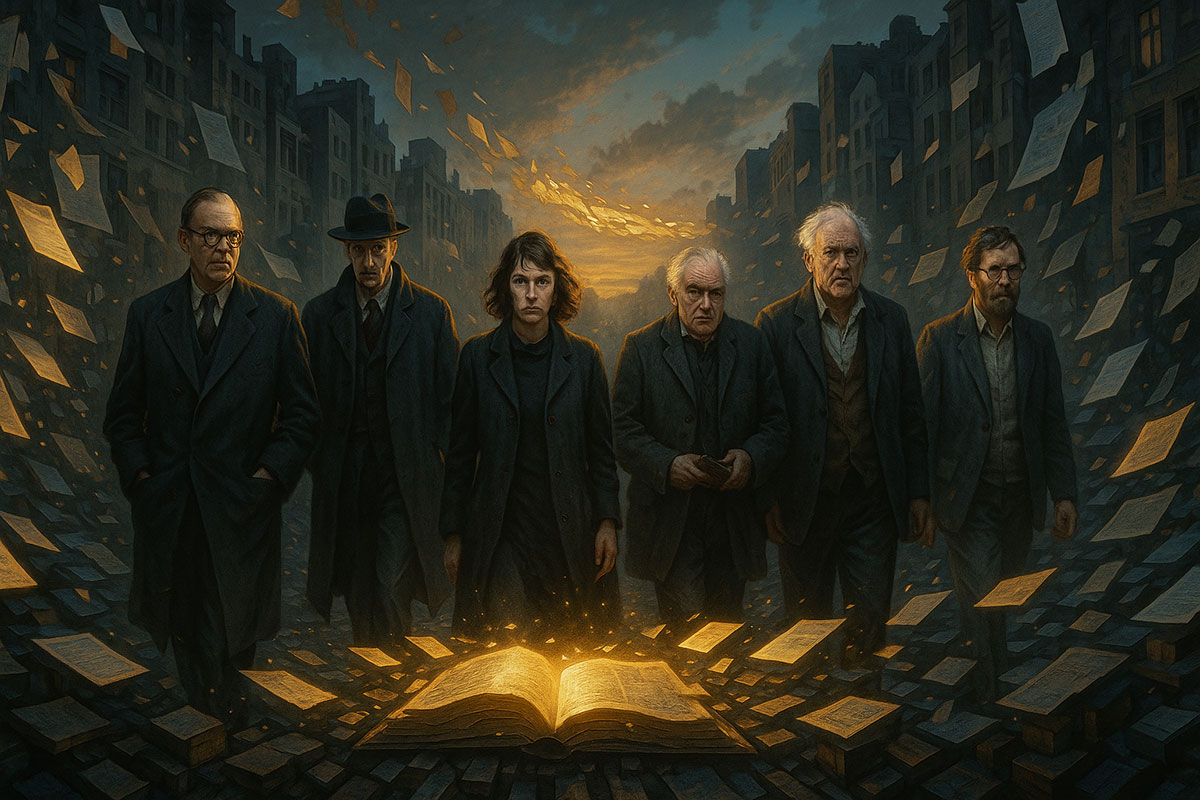
Modernism demanded discipline amid chaos. In The Waste Land, I used fragments because the world itself was fragmented. Tradition was not abandoned but re-forged — a “continual surrender” of the individual talent to the great chain of voices.
Wallace Stevens:
Modernism gave poetry back its philosophy. My “Supreme Fiction” was not belief in God but belief in imagination itself. The poet became not priest nor prophet but maker of reality, one who orders the world through language.
Sylvia Plath:
Modernism opened the door, but I walked further in. I found no comfort in fragments or abstractions. My poems bared the nerve — confessional, intimate, violent. Modernism gave permission to speak the unspeakable, and I did.
Seamus Heaney:
For me, modernism was excavation — digging through tradition with a spade, unearthing myth, bog bodies, buried histories. It gave us tools to uncover not only personal truth but collective memory.
Marjorie Garber:
As a critic, I see modernism not merely as style but as crisis: a crisis of meaning, authority, belief. It forced us to read differently — to accept ambiguity as the norm. Modernism changed poetry, yes, but also changed criticism, demanding that we interpret more deeply.
C.S. Lewis:
A second question: What is the role of criticism in shaping poetry’s legacy — does it illuminate, distort, or even dominate the poet’s voice?
Garber:
Criticism illuminates. It does not replace the poem, but opens pathways into it. My work on Shakespeare, for instance, shows that great poetry survives reinterpretation. Criticism is conversation across centuries, ensuring poetry remains alive.
Eliot:
But criticism must be severe, not indulgent. My essays on tradition, on the metaphysical poets, were not decorative but corrective. Without criticism, poetry risks decadence. With it, poets may be judged by standards beyond fashion.
Stevens:
I am wary. Too much criticism turns poetry into philosophy by proxy. A poem is not an argument but an act of imagination. Criticism may clarify, but it must not domesticate the wildness of verse.
Plath:
I have felt criticism as distortion. To be read as case study, as symptom, is to have the poem’s fire turned into diagnosis. Criticism must not reduce poetry to pathology.
Heaney:
Yet without critics, the shovel finds no soil. My poetry of Ireland was unearthed by readers who connected spade to history. Criticism, when faithful, can link the local voice to universal echoes.
C.S. Lewis:
Now for the last question: What should poetry strive for in the future — clarity, complexity, healing, disruption? What is poetry’s destiny?
Stevens:
Poetry must strive for supreme fictions: not truth in the old sense, but the imaginative order that sustains us when belief falters. Its destiny is to give us reasons to go on singing.
Plath:
No destiny but honesty. Poetry must tear the veil, however raw. The future will not need consolations but revelations — the kind that bleed, that blaze. Poetry should wound and heal at once.
Eliot:
It must preserve tradition even as it renews it. Without a chorus of the past, the poet’s voice becomes meaningless. The destiny of poetry is to hold fragments together so civilization does not dissolve.
Heaney:
I would say healing. The world is fractured still — wars, divisions, losses. Poetry is a redemptive digging, turning the soil to find a shared humanity. Its destiny is reconciliation, however fragile.
Garber:
And I would add: the destiny of poetry is to remain necessary. As long as readers seek meaning, criticism and poetry together will ensure that verse endures — not as relic, but as living practice.
C.S. Lewis (closing):
Here we end our journey. Eliot’s fragments, Stevens’s supreme fictions, Plath’s fierce revelations, Heaney’s healing spade, Garber’s interpretive compass — together they show us poetry’s path: ever ancient, ever new. The poet may change costume with each age, but the song continues.
Final Thoughts By Northrop Frye
If poetry teaches us anything, it is that symbols endure where events fade. The battles of kings and the decrees of parliaments are long forgotten, but Chaucer’s pilgrims still ride, Shakespeare’s soliloquies still echo, Dickinson’s brief lines still blaze with compressed fire. Why? Because poetry inhabits the realm of archetype — those patterns of promise and fulfillment, death and rebirth, exile and return, which form the grammar of the imagination.
The Bible and myth gave us our first archetypes, and every poet since has, knowingly or not, woven their threads. Milton’s Paradise, Spenser’s knights, Blake’s tiger, Whitman’s yawp — each is a reimagining of symbols as old as humanity. Even modernism, with its shattering of continuity, was not a rejection but a renewal, finding new ways to reassemble fragments into wholeness.
What, then, is poetry’s relationship to society? It is both mirror and seed. As mirror, it reflects our follies, our longings, our divisions. As seed, it germinates new visions of justice, equality, or reconciliation. Poetry does not legislate in the narrow sense; it legislates by enlarging consciousness, by showing us worlds that might be. When Burns sings of equality, or Shelley of liberty, they prepare the soil in which social change can grow.
Criticism, too, has its role — not as parasite, but as companion. To interpret poetry is to trace the archetypal currents that flow beneath its images. Without criticism, poetry risks being forgotten; without poetry, criticism becomes sterile. Together they sustain the conversation of culture.
As for the future, it will not lack poets. Whether in meter or free verse, in page or performance, poets will continue to draw from the archetypal reservoir. They will face new crises — ecological, technological, spiritual — but the language of symbol will endure. For the tree in Eden, the tower in Langland, the tiger in Blake, the albatross in Coleridge, and the fractured city of Eliot are not relics of past ages but perennial signs by which the imagination orients itself.
Thus poetry’s destiny is neither escape nor ornament, but participation in the ongoing act of creation. It does not replace faith, philosophy, or science; it complements them, offering what none of them alone can provide: vision through symbol, insight through song. As long as humanity seeks meaning, poetry will remain the grammar of hope.
Short Bios:
C.S. Lewis was a British writer, scholar, and Christian apologist best known for The Chronicles of Narnia and his literary criticism, including English Literature in the Sixteenth Century. He combined imaginative storytelling with profound insights on myth and faith.
John Milton was a 17th-century English poet and intellectual, author of Paradise Lost, a Christian epic that explored themes of free will, rebellion, and redemption, blending biblical narrative with classical form.
Dante Alighieri was a 14th-century Italian poet whose Divine Comedy is one of the greatest works of world literature, mapping the soul’s journey through Hell, Purgatory, and Paradise.
Northrop Frye was a Canadian literary critic, author of Anatomy of Criticism and The Great Code. He developed influential theories on myth, archetype, and the Bible’s role in shaping Western literature.
Ovid was a Roman poet best known for Metamorphoses, a sweeping narrative of mythological transformations that profoundly influenced later European poetry and art.
T.S. Eliot was a modernist poet and critic, author of The Waste Land and Four Quartets. He reshaped 20th-century poetry through fragmented style, mythic allusion, and critical essays on tradition and the poet’s role.
Geoffrey Chaucer was a 14th-century English poet, often called the “Father of English literature.” His Canterbury Tales vividly portrayed medieval society with humor, satire, and human insight.
William Shakespeare was a 16th- and 17th-century English playwright and poet whose works, including his sonnets and plays like Hamlet and King Lear, remain foundational to English literature and drama.
John Donne was a metaphysical poet and Anglican cleric whose intense, paradoxical verse explored love, death, and faith in works like Songs and Sonnets and Holy Sonnets.
William Wordsworth was a Romantic poet whose Lyrical Ballads (with Coleridge) redefined poetry through the use of common language, celebrating nature and the human spirit.
Walt Whitman was an American poet, author of Leaves of Grass, who revolutionized poetry with free verse and a democratic, expansive vision of the human experience.
William Langland was a medieval English poet, known for Piers Plowman, an allegorical dream-vision that critiqued social and religious corruption.
Edmund Spenser was a 16th-century English poet, author of The Faerie Queene, an epic allegory blending moral philosophy, myth, and national identity.
William Blake was an English Romantic poet, artist, and visionary whose works, including Songs of Innocence and Experience and The Marriage of Heaven and Hell, combined radical symbolism and prophetic imagination.
Emily Dickinson was a 19th-century American poet whose short, enigmatic, and deeply personal verses used startling imagery and compressed language to explore death, nature, and eternity.
Samuel Taylor Coleridge was an English Romantic poet and critic, co-author of Lyrical Ballads. His works, such as The Rime of the Ancient Mariner and Kubla Khan, combined imagination with philosophy.
Alexander Pope was an 18th-century English poet known for his satirical verse, heroic couplets, and critical works like An Essay on Criticism and The Dunciad.
Percy Bysshe Shelley was a Romantic poet and radical thinker, author of Prometheus Unbound and political poems like Ode to the West Wind, advocating liberty and revolution through verse.
Robert Burns was an 18th-century Scottish poet whose folk songs and poems, such as Auld Lang Syne and A Man’s a Man for A’ That, gave voice to ordinary people and celebrated national identity.
W.H. Auden was a 20th-century Anglo-American poet, author of September 1, 1939 and The Shield of Achilles, whose works combined moral vision with reflections on politics, war, and love.
Marjorie Garber is an American literary critic and Harvard professor, known for her influential work on Shakespeare and literary theory, especially Shakespeare After All.
Wallace Stevens was a modernist American poet, author of The Idea of Order at Key West and Notes Toward a Supreme Fiction, whose works explore imagination and reality.
Sylvia Plath was a 20th-century American poet, known for Ariel and The Bell Jar. Her confessional style confronted themes of identity, death, and the female experience with raw intensity.
Seamus Heaney was an Irish Nobel Prize–winning poet whose works, including Death of a Naturalist and his translation of Beowulf, blended myth, history, and personal memory.
Leave a Reply