
|
Getting your Trinity Audio player ready...
|
How to become a broadcast writer in Korea often begins with a single spark — maybe from watching global sensations like Squid Game, Oscar-winner Parasite, the heart-melting Crash Landing on You, the brilliant Extraordinary Attorney Woo, or even Netflix sensations like K-pop Demon Hunters. Or maybe the spark begins the same way it did for writer Kim Jiyun — through the doors of the Korean Broadcasting Writers Association.
Kim Jiyun, before writing Smiley Laundromat, sat in the same classrooms, studied the same cue sheets, and learned from the same veteran instructors who shape so much of Korean TV storytelling today. Her path shows that anyone with discipline and heart can grow from a student of the academy into a working writer.
If you’ve ever wondered, “Could I write something like that?” or “What would happen if I trained the way Korean broadcast writers do?” — this five-day immersion offers an inside look at the very system that nurtures voices like hers.
It’s more than a course.
It’s a backstage pass to the creative machinery behind Korea’s most emotional dramas, its funniest variety shows, its most thoughtful documentaries, its healing radio programs, and even its hard-hitting news investigations.
This week-long journey reveals not only how Korean writers are taught — but how you might begin your own path into this world of powerful storytelling.
(Note: This is an imaginary conversation, a creative exploration of an idea, and not a real speech or event.)
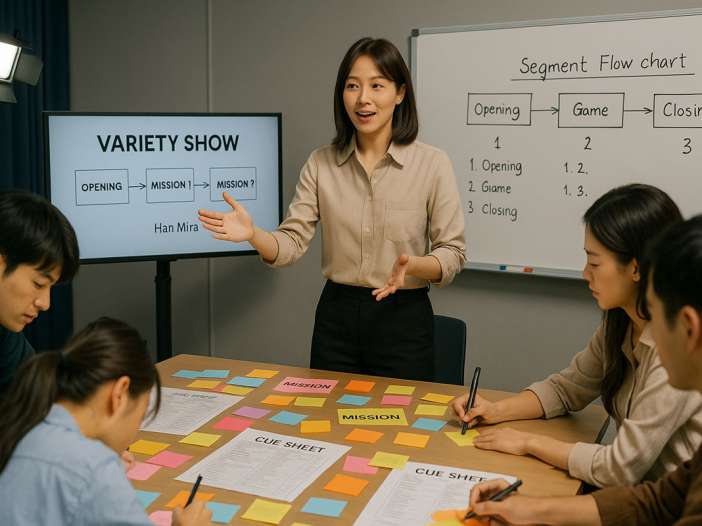
DAY 1 — Variety/Entertainment Writing (예능작가반)

Your first day at the Korean Broadcasting Writers Association
Morning — Orientation
The classroom isn’t glamorous.
Concrete walls, old wooden desks, fluorescent lights humming above.
This is a place for work, not fantasy.
Five students sit around the rectangular tables arranged in a U-shape.
You take a seat beside:
Minji, 24 — bright-eyed, former bookstore clerk
Taesung, 28 — ex-military, quiet but observant
Hana, 32 — former office worker looking for a life change
Jaeho, 21 — the youngest, a YouTuber who thinks everything can be “content”
Everyone looks nervous, but trying not to show it.
At 9:02 AM sharp, the door swings open.
Enter Teacher Han Mira (Early 40s, Head Writer)
She is exactly what you’d imagine a veteran variety-show writer to be:
quick voice
sharp eyes
hair tied loosely but purposefully
energy like she’s been awake for 30 hours (because she probably has)
She carries a stack of cue sheets and a coffee that looks medically necessary.
Han Mira:
“Good morning. I’m Han Mira. Head writer for three variety shows right now, including Weekend Mission Heroes.
Before we begin:
If any of you think variety writing is about being funny… leave now.”
No one moves.
Han Mira:
“Good.
Variety writing is about structure, rhythm, and emotional engineering. Comedy comes last.”
She places cue sheets in a stack.
Han Mira:
“Let’s start.”
Part 1 — What Variety Writers Actually Do
She clicks a remote. A screen lights up:
VARIETY WRITING IS:
– Human timing
– Story architecture
– Emotional flow
– Anticipation
– Release
– Truth
– Surprise
Han Mira:
“Your job is to create a shape for human behavior. Most moments on screen won’t happen unless we set the stage for them.”
You:
“How much is planned?
Like… percentage-wise?”
She chuckles.
Han Mira:
“Eighty percent planning.
Twenty percent chaos.
Your writing has to survive both.”
Minji nods seriously.
Jaeho whispers, “I thought it was the opposite…”
She hears him.
Han Mira:
“It’s only ‘natural’ if we wrote it well enough to look natural.”
Part 2 — The First Assignment (In-Class)
She hands everyone a cue sheet labeled:
EPISODE 37 — Human Arcade
3: Mission 1: The Whisper Challenge
4: Surprise Entry
5: Emotional Beat
Han Mira:
“For your first task…
You will write a 40-second opening narration for this segment.”
She sets a timer.
Han Mira:
“You have 10 minutes.
Narration must:
Create anticipation
Establish stakes
Introduce the emotional angle
Start. Now.”
Everyone bends over their paper.
Your Writing (In-Class Exercise)
You write:
“Today’s mission begins with silence—but only on the surface.
Beneath the whispers lie secrets, strategies, and a rivalry that’s been growing all season.
Who will hear the truth… and who will be completely lost in translation?”
You finish just before the timer beeps.
Teacher Review (Harsh but Honest)
She takes each paper one by one.
You see her eyebrows move—always a bad sign.
On Minji’s narration:
“Too soft. I feel no tension.”
On Taesung’s:
“Too dramatic. This isn’t a war documentary.”
On Hana’s:
“Better. Emotion was clear. Good instinct.”
On Jaeho’s:
“Stop trying to write like a YouTuber.”
Finally, she reads yours.
Han Mira (reading slowly):
“‘Beneath the whispers lie secrets’…
Not bad.
‘Rivalry that’s been growing all season’—good callback.
‘Who will hear the truth… who will be lost’ —
Mm.
You understand variety structure better than most beginners.”
She hands your paper back.
Han Mira:
“Rewrite it tonight. Make it tighter.
But this is a good start.”
Part 3 — Lecture: The Six Emotional Beats
She draws a chart on the board:
Anticipation
Curiosity
Tension
Surprise
Laughter/Relief
Warmth/Closure
Han Mira:
“Every good segment moves through at least four of these.”
Hana:
“Do writers decide when cast members cry or laugh?”
Han Mira:
“No.
We create the conditions where they might.
Never force emotion.
Guide it.”
Part 4 — Group Project
She divides you into two teams.
Team A: You, Minji, Jaeho
Team B: Hana, Taesung
Assignment:
Create a 90-second segment flow for a mission titled:
“The Mystery Box of Truth”
Requirements:
Must include all 6 emotional beats
Must have one comedic payoff
Must allow room for cast improvisation
Must be clearly written in bullets
Must feel like it belongs on a national network
Your Team’s Brainstorm
Minji suggests placing a heartfelt item in the box.
Jaeho insists it needs a big prank.
You try to balance both.
Your final structure:
Host introduces box
Each cast member must guess the box’s truth
Emotional item revealed (baby photo of cast member)
Unexpected twist (second false bottom in the box)
Comedic payoff (live animal puppet jumps out)
Closing warmth (“Truth isn’t what we expect; it’s what surprises us”)
Presentation
Your group presents.
Han Mira:
“Good flow.
But you forgot one thing.”
She writes:
Cast reactions—planned windows.
Han Mira:
“You must create spaces for reactions. Without that, editing becomes painful.”
She marks a B+ on your sheet.
Not perfect, but promising.
Lunch Break (Student Interaction)
You sit with the others at a small kimbap shop.
Minji:
“I thought she would kill us.”
You:
“She kind of did… but in a good way.”
Taesung:
“I respect her standards.”
Hana:
“She’s intimidating, but fair.”
Jaeho:
“I’m doomed.”
You all laugh together.
The ice breaks.
This is the beginning of a team.
Afternoon — Advanced Variety Structure
Back in class, the lights dim.
She plays clips from her show.
Han Mira:
“Now you’ll learn emotional logic sequencing.”
She pauses on a freeze frame.
Han Mira:
“Why is the camera here?
Why does the editor cut here?
Why does the host pause before speaking?”
She points at you.
Han Mira:
“Nick. Your answer.”
You:
“Because the pause builds anticipation…
and it lets the audience lean in.”
She nods.
Han Mira:
“Exactly.
Writing isn’t just writing.
You write for camera, editing, performance, and audience psychology.”
Final In-Class Assignment of the Day
She hands out blank segment skeleton sheets.
Han Mira:
“You will write a complete segment:
‘The Impossible Choice’
One host, three cast members, one twist.”
Rules:
Max 10 bullet points
Must include two reversals
Must end with emotional closure
Must be shootable in 45 minutes
You write:
Host presents two sealed envelopes (“Choice A” and “Choice B”)
Cast guesses contents
Envelope reveals are fake-out (first reversal)
Real choice introduced: choose one cast member’s old embarrassing footage to air
Cast negotiates (emotional tension)
Unexpected twist: they must choose someone not present
Uproar + laughter (second reversal)
Host reveals the footage is harmless
Emotional closure: “Friendship means choosing carefully.”
End with group hug moment
When you finish, Mira looks at it.
She writes:
Grade: A-
Good tension. Smart reversals.
Keep practicing emotional closure lines.
You quietly feel proud.
Homework for Day 1
As the clock inches toward 5 PM, she hands out the homework sheet.
Han Mira:
“For tomorrow morning, complete:
1) Rewrite your narration (tight, 30 seconds)
2) Create a full cue sheet for a 3-minute segment
3) Write five alternative comedic payoff options
I will grade them at 9 AM.
Be prepared to read aloud.”
Everyone groans.
Han Mira (smirking):
“You want to be broadcast writers?
This is light work.”
She looks at the five of you.
Han Mira:
“Bring your best.
I will know if you didn’t.”
End of Day 1
You step outside into the cool Seoul evening.
Your notebook is full.
Your brain is exhausted.
Your heart feels strangely alive.
This is only Day 1.
DAY 2 — Documentary Writing (다큐멘터리 작가반)
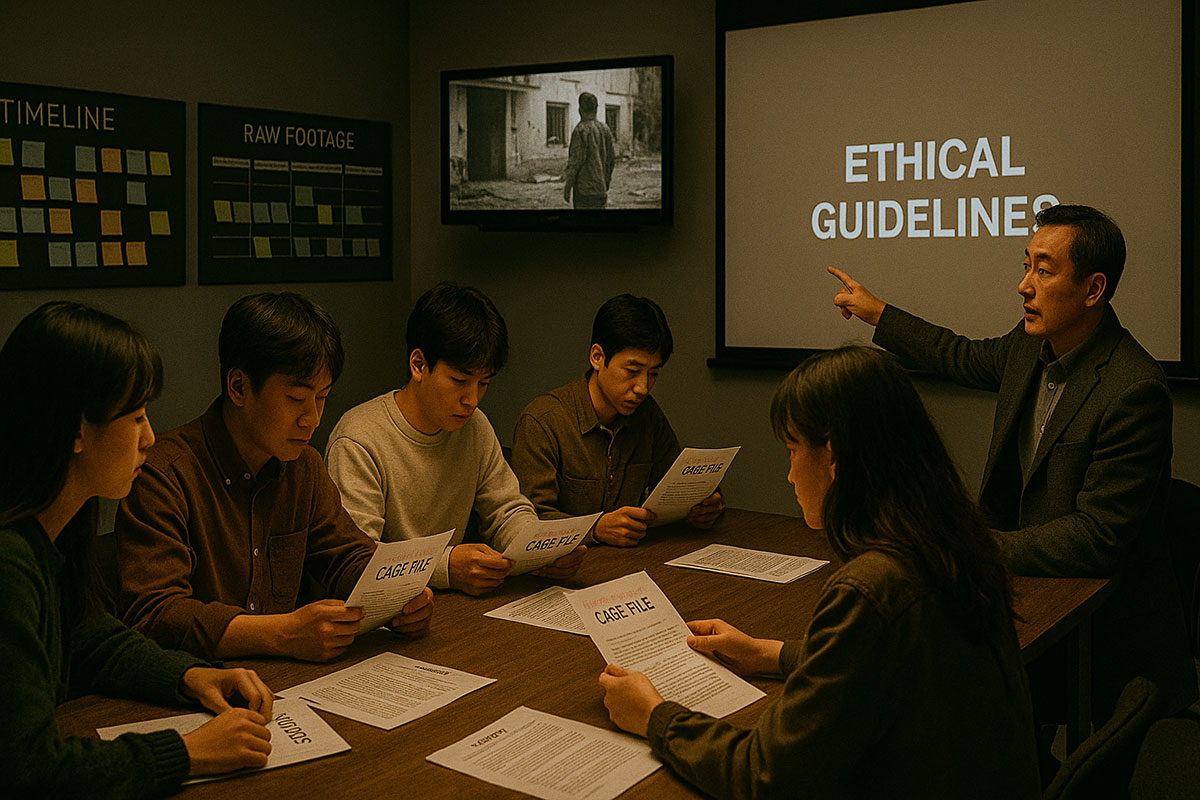
A realistic, rigorous training day at the Korean Broadcasting Writers Association
Tone: documentary-style, moderate scene detail, 5–6 students, strong-personality teachers, structured curriculum, homework and scoring.
MORNING — HOMEWORK REVIEW WITH A NEW TEACHER
When you walk into Classroom 3 the next morning, the air feels heavier than yesterday.
The blinds are half-closed.
The projector hums quietly.
A stack of thick binders sits on the desk.
Your classmates already look tense.
Minji is tapping her pen anxiously.
Hana flips through her notebook, whispering her narration under her breath.
Taesung sits straight, military posture unbreakable.
Jaeho looks like he didn’t sleep.
At 9:00 AM sharp, a tall, lean man enters.
His steps are silent, controlled.
His expression neutral, almost unreadable.
This is Writer Jung Do-seon, a 25-year veteran documentary writer who worked on KBS’s In-Depth 60 Minutes and EBS’s Window of the World.
He sets down his binder.
Jung Do-seon:
“Good morning. I read your homework from yesterday night.”
Everyone freezes.
Jung Do-seon:
“Variety writing requires imagination.
Documentary writing requires truth.”
He opens the binder.
HOMEWORK SCORING (COLD, PRECISE)
He calls names in random order.
“Minji.”
She steps forward and hands him her revised narration.
He reads it silently.
His expression doesn’t change.
Jung:
“Too dramatic. Documentaries aren’t movie trailers.
C+.”
Minji bows politely, though her face falls.
“Taesung.”
He reads.
Jung:
“Overly analytical. No emotional entrance point.
B-.”
“Hana.”
He reads.
Jung:
“Good restraint. Clear focus. You understand tone.
A.”
She sighs with relief.
“Jaeho.”
He reads.
Jung:
“You are still writing like a vlogger.
Your sentences chase attention instead of meaning.
Rewrite again tonight.
D+.”
Jaeho stares at his desk, crushed.
Then:
“Nick.”
You hand over your sheet.
He reads slowly, line by line.
For a long moment, he doesn’t speak.
Jung:
“Much better. You control emotional distance well.
Not too warm, not too cold.
You left space for the viewer to feel, instead of telling them what to feel.
A-.”
He hands it back.
You exhale quietly.
LECTURE 1 — WHAT MAKES A DOCUMENTARY WRITER
The lights dim.
He writes three words on the whiteboard:
OBSERVE — INTERPRET — TRANSLATE
Jung:
“Documentary writing isn’t information.
It’s meaning.
Meaning that must remain faithful to reality.”
He clicks to slide 1.
Slide:
THE FOUR ETHICAL LAWS
Don’t exaggerate.
Don’t manipulate emotion.
Don’t invent facts.
Don’t erase context.
Jung:
“A writer can destroy a person’s life with one sentence.
Or reveal truth with another.
Hold that responsibility.”
There is no humor, no softness in his voice.
Just weight.
LECTURE 2 — NARRATION PHILOSOPHY
He plays a clip: a fisherman returning with an empty net at dawn.
No sound.
Just the image.
Jung:
“Documentary narration should feel like the voice of the sea, not the voice of a judge.”
He points at Minji.
Jung:
“What do you see?”
Minji:
“He looks… tired.”
Jung:
“Wrong.
That is assumption, not observation.
Try again.”
She hesitates.
Minji:
“He… pulls the net slowly.”
Jung:
“Correct. Fact-based.”
Then he points at you.
Jung:
“Nick. What is the meaning?”
You watch the man on the screen.
You:
“He’s doing the same movement he’s done every day for years… but today, it looks heavier.”
Jung’s eyes lift slightly.
Jung:
“That is interpretation.
Good.”
IN-CLASS WRITING ASSIGNMENT — 15 MINUTES
TASK:
Write two sentences:
One purely observational
One interpretive
One narrational line combining both
Your submission:
Observation:
“The fisherman pulls up the net with both hands, water spilling from the holes.”
Interpretation:
“He knows even before seeing it that the sea has offered nothing today.”
Narration:
“Before the net breaks the surface, he already knows today will be empty.”
Jung reads it.
Jung:
“Precise. Controlled.
A good documentary line.”
GROUP ASSIGNMENT — FIELD FOOTAGE ANALYSIS
He divides the class into two groups again.
Team A: You, Hana, Jaeho
Team B: Minji, Taesung
Your team receives raw field footage from a fictional program about elder care.
A frail grandmother trying to carry groceries.
A neighbor helping her.
An interview cut of her speaking quietly about loneliness.
Your Team’s Task:
Write a 60-second narration block that:
Respects dignity
Provides context
Reveals emotional truth subtly
Has no manipulation
No “sad violin tone”
You discuss quietly:
Hana:
“We should avoid words like ‘lonely grandmother’ — that feels disrespectful.”
Jaeho:
“Should we mention aging society statistics?”
You:
“Maybe… but carefully. Too much data can feel cold.”
After 25 minutes, your final narration:
“In this neighborhood, mornings move slowly.
Mrs. Choi carries her groceries one small step at a time,
not because they are heavy,
but because there is no need to hurry.A neighbor sees her and walks over.
He says he has extra time today,
though both know he rearranged his day the moment he saw her turn the corner.She smiles — the kind that appears when kindness interrupts a quiet routine.”
PRESENTATION & FEEDBACK
Team B goes first.
Their narration is too emotional.
Jung:
“You are telling the viewer what to feel.
Rewrite.”
Your team steps up.
Jung listens to your narration twice.
Jung:
“Good restraint.
But this sentence— ‘because there is no need to hurry’ —
Remove it.
Too interpretive.”
He circles it.
Jung:
“Rewrite tonight.
But overall… B+.”
Not perfect.
But solid.
AFTERNOON — THE STRUCTURAL LESSON
Jung opens his binder to a page labeled:
THE FOUR PILLARS OF DOCUMENTARY WRITING
Reality
Sequence
Human Context
Truthful Emotion
Jung:
“Documentary writing is 70% structure, 30% narration.
If your structure is wrong, narration won’t save you.”
He hands out a realistic outline template used in Korean broadcasting:
Opening image
Intro line
First beat (fact)
Second beat (context)
Human story
Tension rise
Reveal
Quiet truth
Outro
Jung:
“Now, each of you will create a full 9-point structure
for this topic:
‘The Last Bakery on the Block.’”
INDIVIDUAL ASSIGNMENT — 30 MINUTES
You write:
Elder baker kneading dough before sunrise
Narration: “The street wakes slowly today.”
Fact: rising rent forcing closures
Context: family-owned shop for 42 years
Human story: daughter wants him to retire
Tension: will he close?
Reveal: he’s training the next-door teenager to take over
Quiet truth: “Some things survive not because of profit, but because someone cares enough to continue.”
Outro: doorbell rings as first customer enters
He reviews it.
Jung:
“Point 8 is good.
Point 3 needs more specificity.
Rewrite for tomorrow.”
Grade: A-
HOMEWORK FOR DAY 2
He passes out the homework sheet.
Tonight you must complete:
Rewrite your group narration (60 seconds)
— remove all interpretive sentences
— add one “quiet truth” sentenceCreate a new 9-step documentary structure
Topic: “A City That Forgets to Sleep.”
Must includeone human subject
two factual anchors
one emotional reveal
one ethical line
Write three alternate narration tones:
Neutral
Warm
Distant
Jung:
“I will score each one tomorrow.
Please do not disappoint me.”
He bows slightly.
Class dismissed.
END OF DAY 2
You walk out with the others.
No one talks for the first minute.
Then:
Hana:
“I’m scared… but in a good way.”
Taesung:
“He’s strict because he respects the craft.”
Minji:
“I want to do better tomorrow…”
Jaeho:
“I’m rewriting everything.”
You nod.
This training is hard.
Demanding.
Unforgiving.
But you feel yourself learning — not only how to write,
but how to respect truth,
how to see people,
and how to listen to silence.
This is documentary writing.
DAY 3 — Drama Writing (드라마작가반)
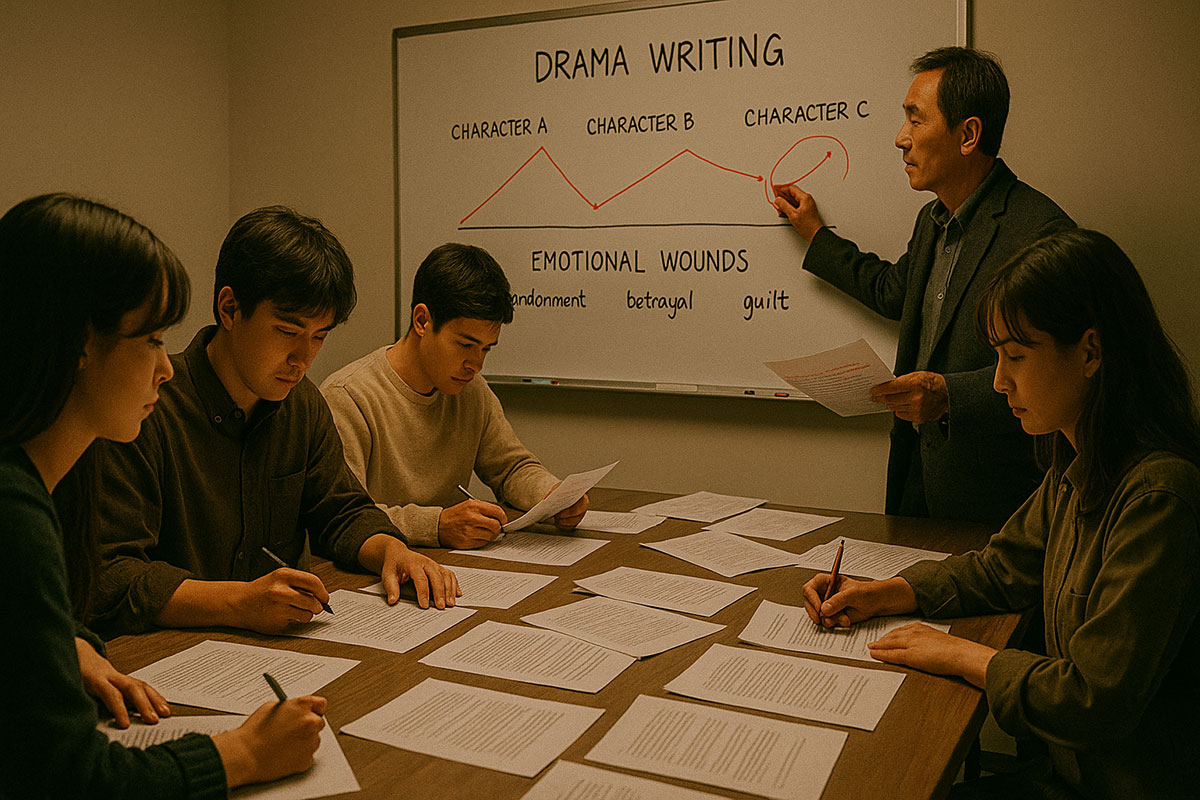
A realistic, structured training day at the Korean Broadcasting Writers Association with strong-personality teachers, classmates, real assignments, in-class writing, and homework grading tomorrow.
MORNING — A NEW CLASSROOM, A NEW ENERGY
Compared to the variety and documentary rooms, Classroom 5 feels strangely intimate.
Soft overhead lights.
Whiteboards filled with colored markers.
A bulletin board with post-it notes labeled:
CHARACTER WOUNDS
ARC POINTS
3-ACT MAP
TURNING SCENES
Your classmates slowly drift in, still sleepy from the heavy homework of Day 2.
Minji clutches coffee like a lifeline.
Taesung sits perfectly straight, already reviewing yesterday’s feedback.
Hana rereads her documentary structure notes.
Jaeho looks like he edited his narration all night and failed.
At 9:05 AM, the door opens.
A woman enters wearing loose slacks, a cardigan, and glasses she pushes up with one finger every time she speaks.
This is Writer Seo Yewon, drama writer for JTBC, known for assisting on several mid-tier but respected weekend dramas.
She looks gentle — until she starts talking.
INTRODUCTION — THE MYTH OF DRAMA WRITING
Seo Yewon:
“Good morning.
Drama writing is not romantic.
It is emotional surgery.”
She writes on the board:
EVERY SCENE = WANT + OBSTACLE + PAIN
Seo Yewon:
“If your characters feel flat, it’s because you haven’t wounded them properly.”
She looks around the room.
Seo Yewon:
“The audience will never cry unless the writer bleeds first.”
You feel the truth of that sentence hit the room like a quiet shockwave.
HOMEWORK COLLECTION FROM DAY 2
Even though this is Drama Day, she has agreed to grade last night’s documentary homework for Jung.
She collects your assignments in a neat pile.
Seo Yewon (dry tone):
“Writer Jung asked me to pass along a message:
‘I will be evaluating your ethical clarity more than your style.’”
Everyone groans internally.
She smirks.
Seo Yewon:
“I see he’s already traumatized you. Good. Drama writing requires that.”
LECTURE 1 — THE HUMAN WOUND
She writes again on the board:
WOUND → PATTERN → CONFLICT → TRANSFORMATION
Seo Yewon:
“All drama characters carry a wound — a lifelong fear, regret, mistake, or loss.
Your job is to expose it slowly.”
She points at Minji.
Seo Yewon:
“Name a wound for a 30-year-old female character.”
Minji:
“She… feels unworthy because her father left.”
Seo Yewon:
“Good. Now what pattern does that create?”
Minji:
“She avoids relationships.”
Seo Yewon:
“What conflict does that create?”
Minji:
“She pushes away someone who actually cares.”
Seo Yewon:
“And her transformation?”
Minji hesitates.
You quietly:
“She lets herself accept love.”
Seo Yewon (looking at you):
“Correct.
This is basic drama architecture.”
She draws a simple chart showing:
Ep 1: Wound shown subtly
Ep 3: Pattern becomes clear
Ep 6: Conflict breaks open
Ep 12: Transformation begins
Ep 16: Resolution
IN-CLASS ASSIGNMENT — 25 MINUTES
Task:
Create a Character Wound Map for a fictional protagonist.
Must include:
Wound
Pattern
Fear
Lie they believe
Desire
Transformation line
You work quietly.
Your submission:
Character:
Kang Jiwon, 37, former ballerina turned elementary school teacher.
Wound:
Career-ending injury at 22.
Pattern:
She avoids ambition; lives safely.
Fear:
That trying again will only bring failure.
Lie:
“That one failure defines my worth.”
Desire:
To help one gifted student reach the stage she couldn’t.
Transformation:
“Your dream doesn’t die just because your path changes.”
You hand it in.
Seo reads silently.
Seo Yewon:
“This is clean.
Emotionally grounded.
Very shootable.”
Grade: A
You feel encouraged.
LECTURE 2 — SCENE CRAFT: CONFLICT IS EVERYTHING
She pulls down a projector screen.
A scene from a JTBC drama plays: two characters arguing at a bus stop.
No shouting, but quiet intensity.
She pauses after 12 seconds.
Seo Yewon:
“Why is this scene working?”
No one answers.
Seo Yewon:
“Because they want different things.
That’s it.
That’s drama.”
She draws three columns:
Wants:
Character A wants honesty
Character B wants to hide truth
Obstacles:
Shame, fear, misunderstanding
Pain:
Past betrayal
She circles “pain.”
Seo Yewon:
“This is where the writer lives.”
SMALL GROUP EXERCISE — 30 MINUTES
Teams again:
Team A: You, Jaeho, Hana
Team B: Minji, Taesung
Task:
Write a 1-page scene using:
two characters
one wound
one revealed truth
one emotional shift
one conflict beat
Your group chooses a simple scene:
Setting:
Two siblings cleaning out their late mother’s apartment.
Conflict:
Older brother wants to sell everything.
Younger sister wants to keep it all.
You and Hana write the emotional lines.
Jaeho insists on adding humor, which surprisingly works.
Your final scene includes:
A broken clock the sister refuses to throw away
The brother revealing he can’t afford the rent
A quiet moment where they find their mother’s letter
A shift from anger to grief
A final line: “She saved everything… because she knew we wouldn’t.”
During presentation:
Seo Yewon:
“Strong.
Clear emotional movement.
But tighten the middle.
Pain shouldn’t drag — it should cut.”
Grade: A-
AFTERNOON — ADVANCED DRAMA STRUCTURE
She writes on the board:
THE 3-ACT DRAMA GRID
Act 1: Setup (want, wound)
Act 2: Confrontation (obstacle, crisis)
Act 3: Resolution (truth, transformation)
Seo Yewon:
“You will write your own mini-drama.
Right now.”
Everyone straightens.
Task:
Write a 3-act outline for a 20-minute short drama episode.
Requirements:
Protagonist with wound
One antagonist (emotional or human)
One reversal
One symbolic object
One transformation line
You begin.
Your Outline:
Title: “The Last Lesson”
Act 1:
Teacher Jiwon discovers her star student plans to quit dance.
Symbolic object: old ballet shoes.
Act 2:
Jiwon pushes the student hard; conflict escalates.
Reversal: Student reveals she’s quitting because her mother is sick, not because she lacks passion.
Act 3:
Jiwon realizes she’s projecting her own wound.
Helps student prepare for a performance.
Transformation line:
“Your dream is yours — not mine, not anyone’s.”
She reads it.
Seo Yewon:
“This is drama.
This is heart.
Don’t lose this instinct.”
Grade: A
FINAL PRACTICE — DIALOGUE WRITING
Task:
Write 10 lines of dialogue where:
One character hides truth
The other tries to uncover it
Subtext dominates
You write a quiet but tense exchange between a mother and son.
She reads it carefully.
Seo Yewon:
“Good subtext.
You underwrite instead of overwriting — rare for beginners.”
HOMEWORK FOR DAY 3
She hands out a detailed assignment sheet.
Tonight, complete:
Full 3-act treatment (2–3 pages)
Expand today’s outline into a full story treatment.Character Wound Map for 3 characters
protagonist
antagonist or emotional mirror
supporting character
Write 2 scenes (1 page each):
Confrontation scene
Quiet transformation scene
Dialogue polish:
Rewrite today’s dialogue adding one shift of power.
Seo Yewon:
“I will give harsh grades.
Drama must be honest.”
She bows lightly.
Class dismissed.
END OF DAY 3
Outside the building, the class gathers again.
Minji:
“My brain is melting…”
Hana:
“But in the best way.”
Taesung:
“We’re learning how to feel again.”
Jaeho:
“I’m rewriting everything from scratch.”
You smile.
Drama writing isn’t just technique.
It’s a deeper kind of courage — to face human wounds and translate them.
You feel yourself changing.
This is only Day 3.
DAY 4 — Radio Writing (라디오 작가반)
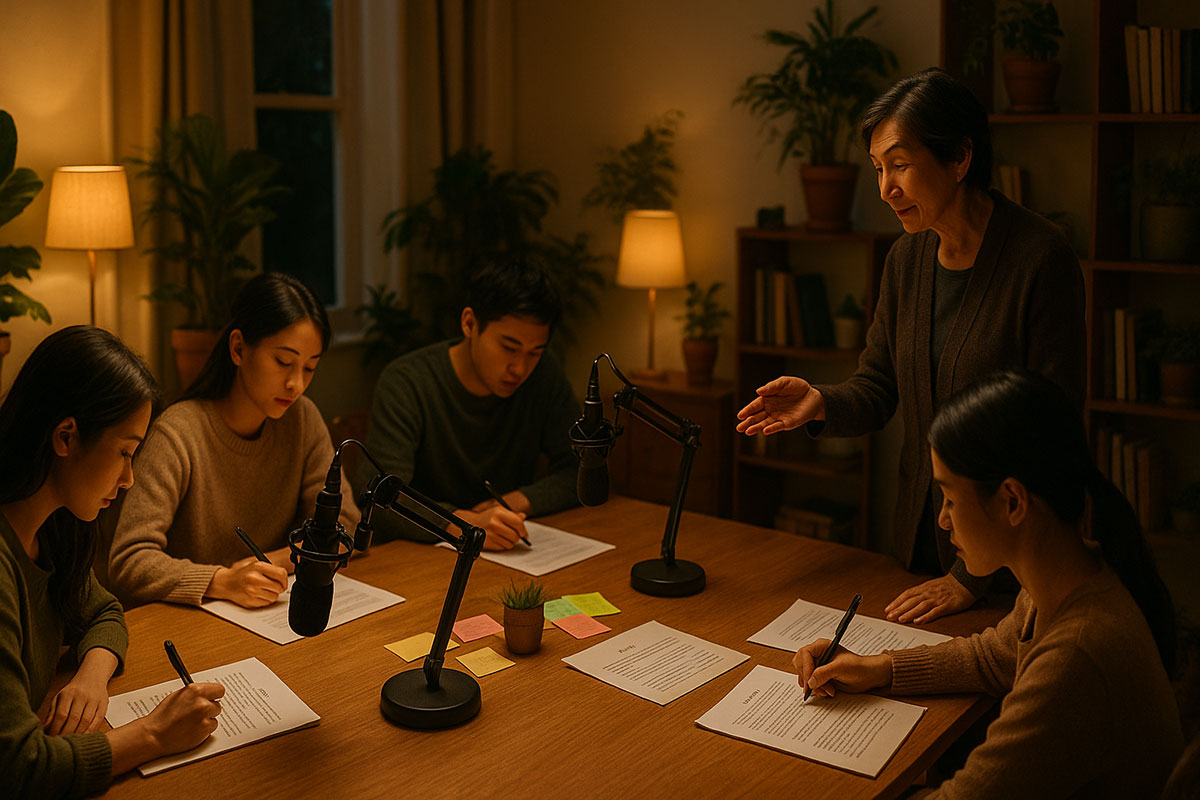
A realistic, emotionally grounded training day at the Korean Broadcasting Writers Association. Moderate scene detail, structured curriculum, strong-personality teacher, classmates, in-class assignments, and homework that will be graded tomorrow.
MORNING — QUIET ROOM, SOFT LIGHTS, SOFT HEARTS
Classroom 2 is nothing like the drama room yesterday.
The lights are dim and warm.
Soft instrumental music plays from hidden speakers — piano, strings, calm.
There are plants in the corners.
A small recording booth in the back.
On each desk: a printed radio script with handwritten notes from a real broadcaster.
The room smells faintly of herbal tea.
Everyone is exhausted from writing drama treatments all night, but when they enter this room, something shifts.
People exhale.
Minji relaxes her shoulders for the first time all week.
Hana closes her eyes, soaking in the music.
Taesung sits a little less rigid.
Jaeho whispers, “This place feels like therapy.”
At 9:10 AM, the door slides open.
A woman in her forties walks in — soft sweater, warm eyes, a smile that seems to say I already understand you.
This is Writer Park Hyejin, veteran SBS radio writer for late-night healing programs.
She bows gently.
INTRODUCTION — THE HEART OF RADIO
Park Hyejin (soft, steady voice):
“Good morning, everyone.
Yesterday you worked with wounds.
Today… we work with hearts.”
She sits on the desk rather than behind it.
Park Hyejin:
“Radio writing is not visual writing.
It is soul writing.
People listen in their loneliness, their cars, their midnight kitchens…
They come to radio hoping someone will say the words they can’t.”
She walks slowly, looking at each of you.
Park Hyejin:
“If you write well here, you may save a stranger’s night.”
Her tone is gentle, but the responsibility feels enormous.
HOMEWORK RETURN FROM DAY 3
Though she is not your drama teacher, she holds a stack of papers.
Park Hyejin:
“Writer Seo asked me to deliver your drama homework.
She said:
‘Tell them I was not gentle.’”
Everyone laughs nervously.
She calls names, handing back grades:
Minji → B
Taesung → B+
Hana → A
Jaeho → C (“Your humor didn’t match the scene tone,” she quotes)
Nick → A-
You breathe out.
Park Hyejin (to you):
“She said you have a good hand for emotional timing.”
Then she places the homework aside.
Park Hyejin:
“Now, forget drama.
Let us begin the work of the heart.”
LECTURE 1 — THE STRUCTURE OF A RADIO HOUR
She plays a 30-second clip: a late-night host speaking softly to a listener who wrote about insomnia.
Park Hyejin:
“The host’s voice matters.
But the writer creates the words that voice carries.”
She draws a simple structure:
OPENING — tone setting
LISTENER STORY — reading letters
REFLECTION — empathy, insight
MUSIC CUE — emotional rest
SECOND LETTER — deeper
CLOSING MESSAGE — comfort
Then she adds:
Everything must feel like a warm hand on a cold night.
Minji wipes her eyes as if something inside her stirred.
LECTURE 2 — WRITING FOR A HOST
She calls you up to the front.
Park Hyejin:
“Nick, read this line as a host.”
You read:
“Sometimes, all we need is for someone to say…
‘It’s okay to rest today.’”
She nods.
Park Hyejin:
“Your tone is steady.
But for radio… soften your breath between phrases.”
She demonstrates:
“Sometimes…
all we need…
is for someone to say…
‘It’s okay to rest today.’”
She looks at the class.
Park Hyejin:
“The writer must hear the host’s breathing.
That’s how we write lines that heal.”
IN-CLASS WRITING ASSIGNMENT — OPENING MONOLOGUE (15 minutes)
Task:
Write a 120-word opening monologue for a late-night radio show titled:
“Midnight Comfort Station.”
It must include:
gentle tone
a relatable thought
one reflective line
one emotional anchor
You begin writing.
Your submission:
“Good evening, everyone.
If you’re awake at this hour, maybe it’s because the world felt a little too loud today.
Here, in this small corner of the night, you don’t have to pretend to be strong.
Let the darkness be soft, and let this moment be yours.
Sometimes all healing begins with a single quiet breath…
and the permission to just be.”
She reads silently.
Park Hyejin:
“This is beautiful.
Centered, warm, and not overly poetic.
A.”
You smile, humbled.
LECTURE 3 — LISTENER LETTERS: TOUCH WITH CARE
She distributes real anonymous letters from former SBS listeners (edited for training use).
Each letter contains:
heartbreak
family stress
work burnout
loneliness
self-doubt
Park Hyejin:
“Many letters are written in tears.
Our job is to hold those tears gently.”
She circles three parts of a sample letter:
Pain
Hidden fear
Unspoken request
Park Hyejin:
“Every letter has an unspoken request.
Find it.
Write toward it.”
GROUP ASSIGNMENT — RESPONDING TO A LISTENER LETTER
Teams:
Team A: You, Minji, Taesung
Team B: Hana, Jaeho
Your letter is from a 29-year-old office worker:
“I feel invisible at work.
No one listens when I speak.
My ideas are ignored until someone else says them.
I’m starting to think maybe I’m not smart enough.”
Task:
Write a 150-word host response including:
empathy
one truth
one piece of gentle advice
one line of emotional permission
You discuss with your team.
Your team’s response:
“Thank you for trusting us with this.
Being unheard is one of the heaviest feelings we carry.
But please remember—your value is not measured by the volume of the room, but by the truth of your voice.
Your ideas deserved to be heard the first time, not borrowed by others.Try this tomorrow: speak once, clearly, and let silence follow.
Sometimes the room needs a moment to catch up to your courage.And tonight… let me tell you this:
You are not invisible.
You are simply waiting to be seen by the right eyes.”
When presented:
Park Hyejin:
“This is strong, gentle, and clear.
You did not shame the listener for feeling this way.
You guided without lecturing.
A-.”
AFTERNOON — THE EMOTIONAL HEARTBEAT OF RADIO
She dims the lights further.
You hear a soft melody of piano notes.
Park Hyejin:
“In radio, silence is a character.
Use it.”
She plays a real-off-air moment where the host pauses for 3 seconds before responding to a caller crying.
Then:
Park Hyejin:
“That pause saved the caller from shame.
Learn to write pauses.”
She writes on the board:
Radio Script Notation
(breath)
(pause)
(softer)
(smile)
(warm)
Task:
Mark a script with emotional cues.
You mark your monologue, adding:
(soft breath)
(gentle warmth)
(small pause)
(smile in voice)
She checks:
Park Hyejin:
“Yes. This is correct radio rhythm.”
FINAL IN-CLASS ASSIGNMENT — CLOSING MESSAGE WRITING
Task:
Write a closing 100-word comfort message for a rainy night broadcast.
You write:
“Tonight the rain has a way of reminding us of things we wish we’d forgotten.
But maybe that’s okay.
Maybe rain exists to wash away the day we didn’t know how to carry.
As you fall asleep, let the sound outside your window be a reminder that nothing stays heavy forever.
Thank you for sharing this night with me…
and may tomorrow greet you a little more gently.”
She reads and whispers:
Park Hyejin:
“Beautiful.
Sincere.
Not sentimental.
A.”
HOMEWORK FOR DAY 4
She prints out the homework.
Tonight, complete:
Write a full 3-minute radio segment
including:opening monologue
listener letter
host response
closing message
Create your host’s emotional profile:
tone
breathing pattern
signature phrases
Rewrite your group response
(improve emotional anchors)Record yourself reading 30 seconds
— to match pacing and breath
(Audio not needed; practice only.)
Park Hyejin:
“I will grade these carefully.
Radio is delicate.
Write with kindness.”
She bows.
Class ends.
END OF DAY 4
Outside, the group stands under a gray sky threatening rain.
Minji:
“Today… I felt like someone spoke to me too.”
Hana:
“Her voice could heal a stone.”
Taesung:
“It’s hard to write soft. Harder than writing strong.”
Jaeho:
“I didn’t know words could feel like blankets.”
You smile quietly.
Drama exposed wounds.
Radio wraps them.
And tomorrow… you will learn to write truth with sharp precision in News & Current Affairs.
DAY 5 — News & Current Affairs Writing (시사·교양 작가반)
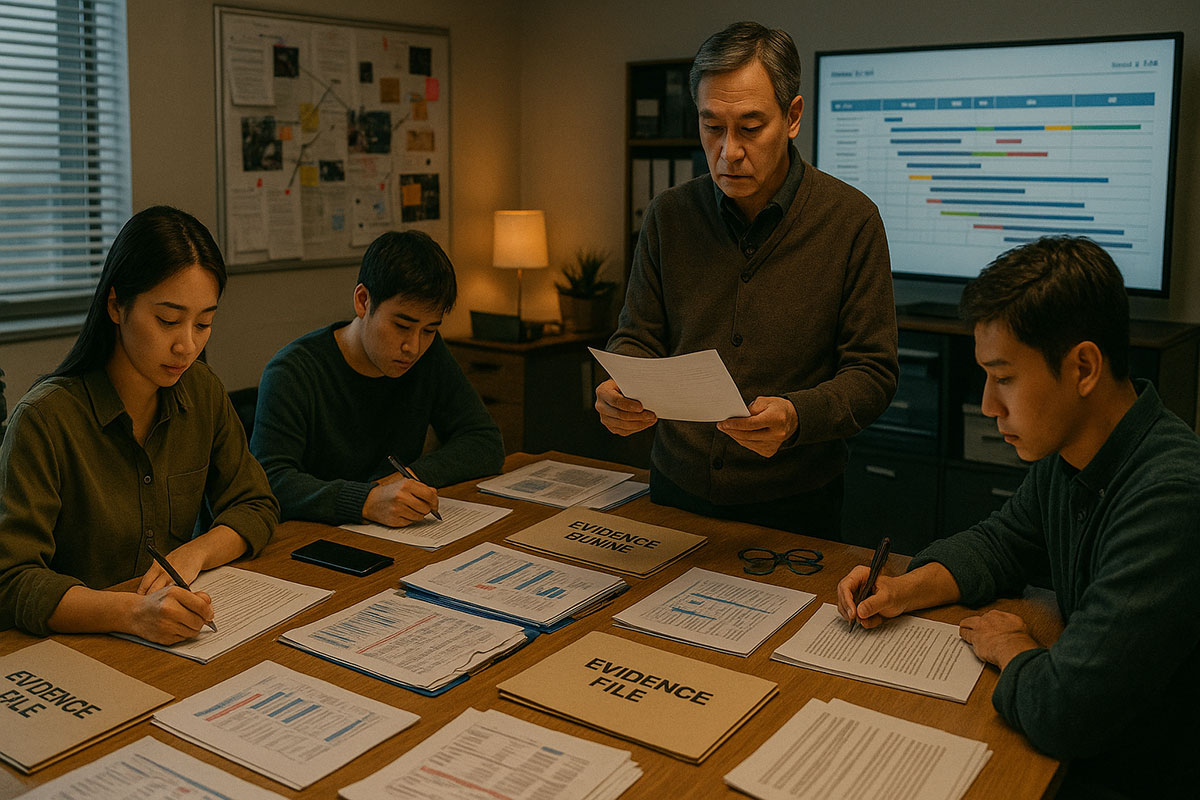
A realistic, structured day with strong personalities, strict standards, in-class writing, real assignments, grading tomorrow, and deep immersion in the world of investigative broadcasting.
MORNING — A DIFFERENT KIND OF SILENCE
When you step into Classroom 7, the atmosphere is completely different from the previous days.
No music.
No soft lighting.
No warmth.
Just:
bright white lights
metal desks
thick folders labeled “CASE FILE A, B, C”
timeline charts pinned to the walls
a digital clock counting seconds
This is the world of News & Current Affairs.
Your classmates enter one by one:
Minji holds her coffee like a shield.
Hana is calm but serious.
Taesung looks more energized than any other day — this environment suits him.
Jaeho puts away his phone immediately; even he senses the gravity.
At 9:01, the door opens.
A man in his early fifties walks in with the presence of someone who has spent half his life chasing truths people tried to bury.
Square shoulders.
Short hair.
A quiet but piercing gaze.
This is Writer Lee Changmun, veteran investigative writer for MBC’s current affairs programs.
He sets a folder on the desk with a heavy thud.
INTRODUCTION — THE BURDEN OF TRUTH
Lee Changmun:
“Good morning.
Drama works with wounds.
Radio works with hearts.
Documentaries work with truth.
But current affairs…”
He taps the folder.
Lee Changmun:
“…works with consequences.”
He looks at each of you, slowly.
Lee Changmun:
“If you write carelessly, an innocent person suffers.
If you write carelessly, a guilty person escapes.
If you write carelessly, the public stays blind.”
He pauses.
Lee Changmun:
“So today, I will not be gentle.”
Everyone straightens instinctively.
HOMEWORK RETURN FROM DAY 4
Even though he isn’t your radio teacher, he returns your segments.
Lee Changmun:
“Writer Park said:
‘They handled the hearts well. Now let them learn to handle fire.’”
He distributes grades.
Minji: B- (“Good heart, too many adjectives”)
Taesung: B+ (“Strong pacing, clear voice”)
Hana: A (“Tone control excellent”)
Jaeho: C (“Stop trying to be funny everywhere”)
Nick: A-
He nods at you once — that’s his way of saying “acceptable.”
LECTURE 1 — WHAT SEPARATES NEWS WRITING FROM EVERYTHING ELSE
He writes three words:
FACT — STRUCTURE — FAIRNESS
Lee Changmun:
“You don’t write to entertain.
You write to clarify.”
Then he adds:
Your enemy is confusion.
He turns around sharply.
Lee Changmun:
“In variety, confusion is funny.
In drama, confusion is emotional.
In documentaries, confusion is philosophical.
But in news…”
He lifts a finger.
Lee Changmun:
“…confusion is dangerous.”
LECTURE 2 — THE FIRST TOOL: QUESTIONS
He writes:
THE SIX INVESTIGATIVE QUESTIONS
What happened?
Why?
Who is affected?
Who benefits?
Who is responsible?
What now?
Lee Changmun:
“If your story can’t answer these six, it has no spine.”
He hands out a case file packet titled:
CASE FILE A — The Broken Playground
It contains:
a complaint letter from parents
an inspection report
a budget document
a statement from a district official
two conflicting witness accounts
three photos
Lee Changmun:
“You will build a story from contradictions.”
IN-CLASS ASSIGNMENT 1 — FIND THE THIN RED THREAD
Task:
From the messy 11-page packet, identify:
The central problem
The conflicting accounts
The one line of truth
The hidden angle
You begin reading carefully.
Minji whispers, “This is harder than it looks…”
Taesung is already marking lines with a highlighter.
Hana organizes documents by timestamp.
Jaeho mutters, “So many lies…”
After 20 minutes, you stand and give your findings.
Your conclusions:
Central problem:
A playground slide collapsed, injuring a child.
Conflicting accounts:
Parents say it had been cracking for months.
District official claims inspections were “passed and documented.”
One line of truth:
Inspection dates don’t match the digital timestamp of the photos.
Hidden angle:
Maintenance budget was approved but never used.
Lee listens carefully.
Lee Changmun (slow nod):
“You see the thread.
Good.”
Grade (quietly recorded): A
LECTURE 3 — BUILDING THE NEWS STRUCTURE
He draws a structure on the board:
1. Lead line
2. Fact block 1
3. Soundbite
4. Fact block 2
5. Tension point
6. Reveal
7. Closing line
Lee Changmun:
“You must deliver truth in the cleanest possible sequence.
Like a surgeon cutting away infection.”
He looks at Jaeho.
Lee Changmun:
“Write me a lead line for this story.”
Jaeho:
“Um… ‘A playground slide suddenly collapsed today—’”
Lee Changmun:
“No.”
He turns to Minji.
Minji:
“‘A child is recovering tonight after a slide collapse that parents say was long overdue.’”
Lee Changmun:
“Better.”
Then he points at you.
You:
“‘A collapse that should not have happened — and a paper trail that raises questions about why it did.’”
He stops.
Lee Changmun:
“That’s a news lead.”
He marks it down.
IN-CLASS ASSIGNMENT 2 — THE 3-MINUTE NEWS PACKAGE
Task:
Create a contained 3-minute news outline using the case file.
Must include:
2 factual blocks
1 interview soundbite
1 tension moment
1 reveal
1 closing line
You work in silence for 30 minutes.
Your outline:
Lead:
“A collapse that should not have happened — and a paper trail that raises questions.”
Fact Block 1:
What happened / injury / parents’ past warnings.
Soundbite:
Parent: “We emailed the office three times. Nothing changed.”
Fact Block 2:
District records + inspection dates mismatch.
Tension Point:
Budget approved but unspent for 6 months.
Reveal:
Inspector signature doesn’t match work logs.
Closing line:
“What remains unclear now is why warnings were ignored — and who will be held accountable.”
When you present it:
Lee Changmun:
“This is correct structure.
And more importantly…
It is fair.”
Grade: A-
AFTERNOON — THE ETHICS LAB
He passes out new sheets titled:
ETHICAL SCENARIOS FOR BROADCAST WRITERS
Scenario examples:
A victim cries on camera—do you use the clip?
An interviewee contradicts themselves—how do you write the narration?
A whistleblower wants anonymity—how do you phrase the reveal?
A fact is true but misleading without context—do you include it?
Task:
Discuss each scenario as a class.
This leads to intense debate.
Minji:
“We shouldn’t show tears without asking first.”
Taesung:
“But if they were already crying, isn't it public?”
Hana:
“Truth is not permission.”
You:
“If emotion overshadows clarity, we lose the purpose of the story.”
Lee Changmun:
“Excellent.
A writer must know where the ethical red line lies.”
FINAL IN-CLASS ASSIGNMENT — NARRATION WRITING
Task:
Write two versions of a closing narration for the playground story:
Neutral
With quiet moral clarity (but not emotional manipulation)
Your versions:
Neutral:
“Authorities say they will open a full investigation.
The child is recovering in stable condition.”
Moral clarity:
“The investigation will determine responsibility.
But tonight, one fact remains:
Warnings were given — and action was not.”
He reads both.
Lee Changmun:
“Correct.
You understand restraint.”
HOMEWORK FOR DAY 5
The final homework of the week.
Tonight, complete:
Full 3-minute script
narration
on-screen text
soundbite placement
transitions
Fact Verification Log
For every line, mark:source
confirmation method
doubt level
Ethical Statement
Write a 100-word justification explaining why your script is fair.Rewrite your closing line
Two improved versions.
Lee Changmun:
“I will judge this harshly.
If you cannot write fairness, you cannot write news.”
He bows briefly.
Class dismissed.
END OF DAY 5 — THE FINAL WALK OUT
The five of you walk outside into the evening air.
No one speaks at first.
Then:
Hana:
“I’ve never been so exhausted… and so proud.”
Minji:
“I learned more this week than in years of thinking about writing.”
Taesung:
“This training is no joke. But it’s honest.”
Jaeho:
“I’m… changed. I feel it.”
Then they look at you.
Hana:
“Nick… you did really well this week.”
You smile.
You all did.
This wasn’t just training.
It was transformation — across heart, truth, emotion, and responsibility.
Five days.
Five disciplines.
One writer emerging stronger.
Final Thoughts by Nick Sasaki
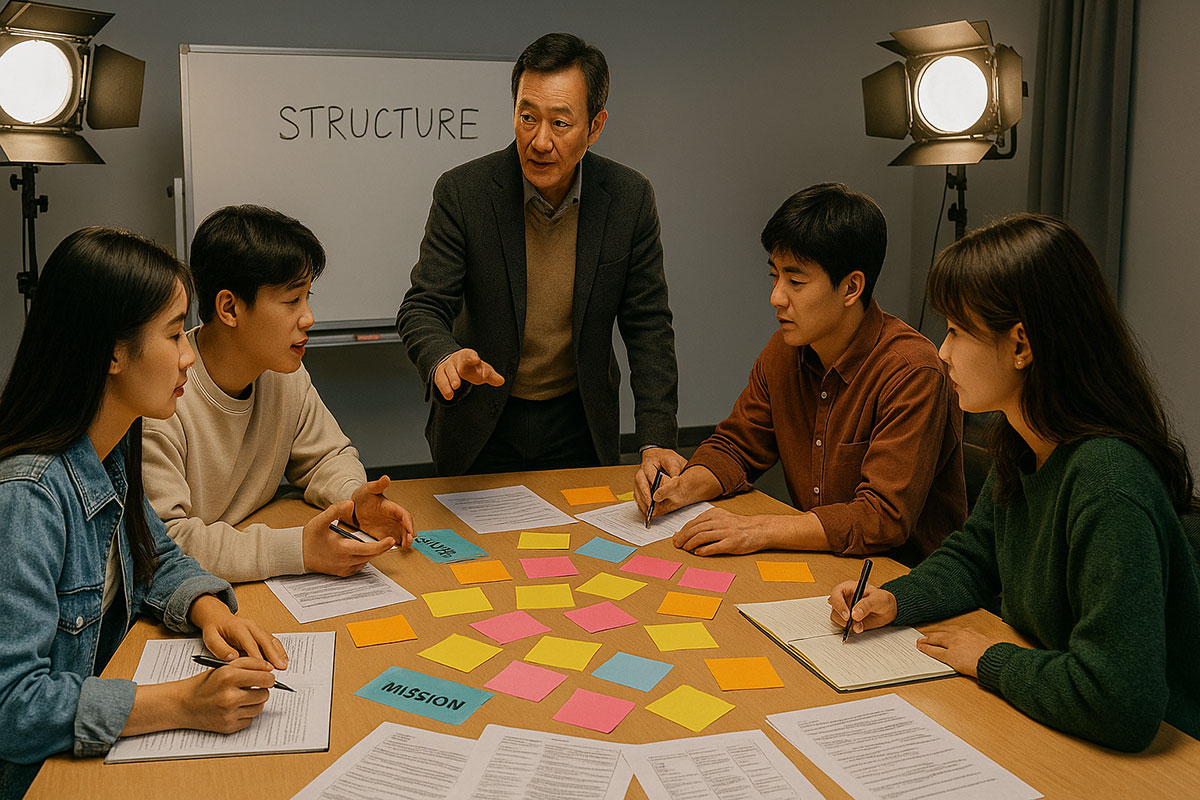
By the end of the five days, I realized something unexpected: this training wasn’t only about writing; it was about awakening disciplines inside me I didn’t know I had.
From variety writing, I learned structure — how to organize chaos into clear, engaging entertainment.
From documentary writing, I learned responsibility — how truth requires patience, curiosity, and restraint.
From drama writing, I learned courage — how to dig into emotional wounds without fear or judgment.
From radio writing, I learned gentleness — how words can be soft enough to heal a stranger’s midnight.
From news & current affairs, I learned fairness — that clarity, ethics, and accuracy must stand above everything.
Most of all, I learned that every Korean program we watch — every drama, documentary, variety show, or news report — is shaped by writers who carry immense care for story, emotion, and truth.
This five-day experience didn’t just show me how broadcasting is made.
It showed me what it takes to become the kind of writer who deserves to make it.
And now… I’m more inspired than ever to keep writing — and maybe, someday, to see my name in the end credits.
Short Bios:
Instructors
Seo Yewon
A respected Korean drama writer with extensive experience on JTBC weekend dramas. Known for her precise emotional architecture and insistence that character wounds drive every story. She teaches drama writing with a balance of empathy and strict structural discipline.
Jung Do-seon
A veteran documentary writer with more than 25 years in the industry, contributing to investigative programs for KBS and EBS. His teaching style is exacting and ethically uncompromising, emphasizing observation, meaning, and responsibility in every sentence.
Park Hyejin
A longtime SBS radio writer specializing in late-night healing broadcasts. Her work focuses on empathy-driven scripts and audience comfort. She teaches radio writing through gentle pacing, breath control, and emotionally supportive language.
Lee Changmun
A senior investigative writer known for his work on MBC current affairs programs. Direct, disciplined, and demanding, he trains students to handle facts with fairness, structure, and accountability. His classes emphasize the high stakes of public truth.
Kim Haru
A former variety show writer turned structural consultant for major Korean entertainment programs. Energetic, sharp, and humor-driven, she teaches students how to build cue sheets, missions, and segment flow for audience engagement.
Students
Nick Sasaki
A dedicated trainee exploring the full spectrum of Korean broadcasting writing. Strong in emotional timing and narrative clarity, he adapts quickly across genres and consistently receives high marks for balance, restraint, and insight.
Hana
A thoughtful and disciplined student with natural sensitivity toward tone and emotional nuance. Frequently praised for clarity and warmth in her writing, especially in documentary and radio assignments.
Minji
Energetic and imaginative, often the most expressive voice in the room. She brings creative flair to variety and drama writing but must work on controlling emotional excess in factual scripts.
Taesung
Precise, structured, and highly detail-oriented. Thrives in investigative and current affairs work, with a strong sense of fairness and logical progression in his writing.
Jaeho
A humorous, spontaneous thinker who adds levity to the classroom dynamic. While he struggles with tone control in serious genres, he has a natural voice for variety and character-driven moments.
Leave a Reply