

|
Getting your Trinity Audio player ready...
|
What if Shirley Jackson explained why no one stops the lottery?
Introduction by Shirley Jackson
People often remember The Lottery for its ending.
They talk about stones, shock, outrage—as though the story were a trick I played on them, something meant to startle and then release. But the ending was never the point. It was simply the moment when readers finally noticed what they had been calmly accepting all along.
I did not invent a cruel village. I described an ordinary one.
A place where people gather on time, follow procedure, speak politely, and trust that what has always been done must have a reason—even if no one can quite remember what that reason was. I wrote the story plainly because nothing about the ritual required exaggeration. Its power lay in how easily it fit into the day.
What interested me was not violence, but agreement.
How people participate in things they do not believe in, simply because participation is easier than refusal. How responsibility thins when it is shared. How traditions survive long after they have lost meaning, because questioning them would require standing alone.
This conversation does not explain The Lottery in order to make it safer.
It examines the moments when safety itself becomes the danger.
(Note: This is an imaginary conversation, a creative exploration of an idea, and not a real speech or event.)
Episode 1 — Tradition Without Memory
Why Do People Obey Rituals They No Longer Understand?
Participants:
Shirley Jackson
Ruth Franklin
Stanley Edgar Hyman
Alan Heimert
Richard Slotkin
Sacvan Bercovitch
Moderator:
Nick Sasaki
Opening Scene
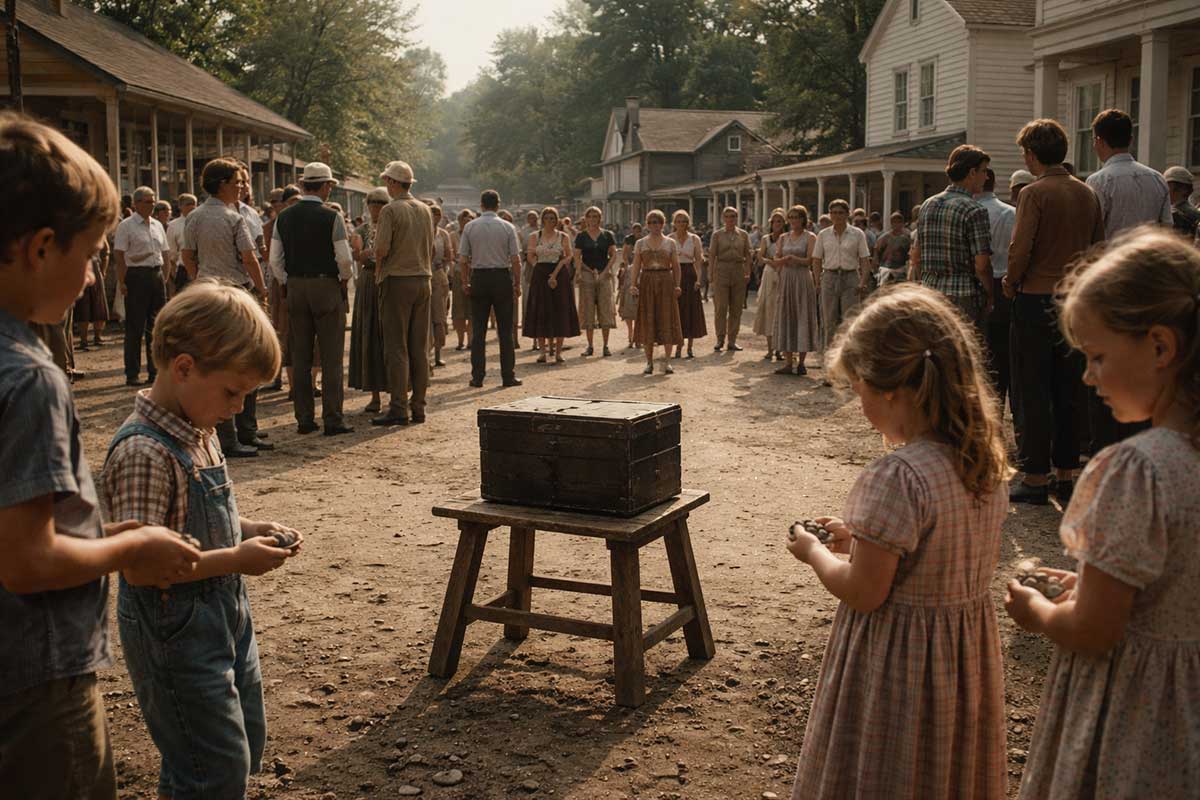
The square is already filling.
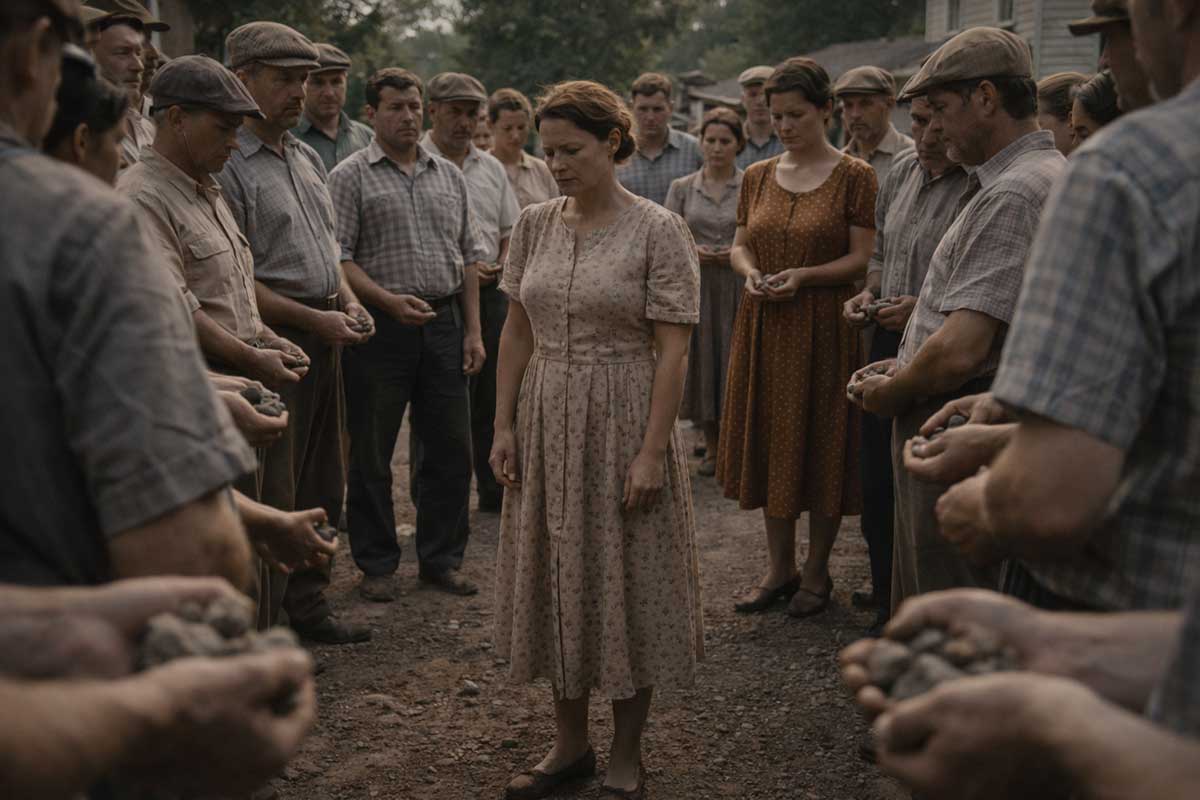
Children collect stones with no sense of secrecy. Adults arrive in loose clusters, talking about weather, work, and minor inconveniences. Someone jokes. Someone glances at the black box and looks away.
Nothing feels ceremonial. Nothing feels urgent.
Shirley Jackson sits quietly, hands folded, watching the scholars rather than the square—as if she’s more interested in how people talk about rituals than in the ritual itself.
Nick Sasaki breaks the calm.
First Question
Nick Sasaki
In The Lottery, the ritual continues even though no one can explain where it came from or what it achieves.
So let’s begin with the core question:
Why does a tradition survive after its meaning has disappeared?
Ruth, would you start?
Ruth Franklin
What Jackson exposes is that tradition doesn’t need belief to function.
It needs repetition.
The lottery survives not because people understand it, but because they’ve inherited it as something that is simply done. Meaning fades, but habit remains—and habit is often stronger than belief.
Shirley Jackson
(calm, precise)
People assume traditions survive because they’re meaningful.
I was interested in how often they survive because they’re familiar.
Stanley Edgar Hyman
That familiarity is key.
In older sacrificial systems, violence was justified by myth—gods, seasons, fertility. Jackson removes all of that.
What’s left is ritual without transcendence. Procedure without purpose.
And that makes it uniquely modern.
Alan Heimert
There’s also a distinctly American inheritance here.
Jackson draws from Puritan structures—collective obligation, moral conformity—but strips away the theology. What remains is obedience without faith.
The lottery feels old because it sounds inherited, even though no one remembers why.
Richard Slotkin
And violence becomes the stabilizer.
In American myth, violence often renews the community. In The Lottery, violence doesn’t renew anything—it merely preserves continuity.
The ritual doesn’t promise improvement. It promises that nothing will change.
Sacvan Bercovitch
That’s ideology at its most efficient.
The ritual no longer needs justification. Questioning it would require standing outside the community’s shared language.
So the tradition protects itself by eliminating the need to explain.
Nick Sasaki
Shirley, let me ask you directly—
If the ritual has lost its meaning, what exactly are the villagers protecting?
Second Question
Shirley Jackson
They’re protecting themselves from having to decide.
Once a ritual exists, responsibility is outsourced. No one chooses the outcome; they merely participate in it.
That’s comforting.
Nick Sasaki
So the ritual survives not because it makes sense—but because it removes the burden of choice?
Shirley Jackson
Yes.
Choice is lonely.
Ruth Franklin
That loneliness is crucial.
Jackson’s villagers aren’t stupid. They’re cautious. They sense—perhaps without articulating it—that stopping the lottery would require explaining themselves to themselves.
And explanations invite doubt.
Alan Heimert
Which is why tradition here is not memory—it’s discipline.
The ritual teaches obedience by continuing. It doesn’t persuade; it conditions.
Stanley Edgar Hyman
And notice how dissent is framed in the story.
Not as immoral. Not as wrong.
As “old-fashioned.” “Silly.” “Out of step.”
That rhetorical move neutralizes resistance without argument.
Sacvan Bercovitch
Once dissent is framed as impractical rather than unethical, tradition becomes untouchable.
You don’t argue with it. You adjust to it.
Nick Sasaki
Richard, let me bring you in here.
Is the violence itself doing any work anymore—or is it simply maintaining the structure?
Richard Slotkin
It’s maintaining the structure.
The lottery is no longer symbolic violence—it’s administrative violence.
Its purpose is not renewal, but continuity. And continuity, in this case, is valued above human cost.
Third Question
Nick Sasaki
Final question for this episode—and it’s one Jackson never answers outright:
Does tradition become more honest when its meaning disappears—or more dangerous?
Stanley?
Stanley Edgar Hyman
More dangerous.
Because meaning at least offers a point of contestation. Once meaning is gone, only procedure remains.
And procedures don’t argue.
Ruth Franklin
Jackson removes every excuse readers might lean on.
There’s no god. No harvest myth. No external justification.
If we’re horrified, it’s because there’s nothing left to blame but human inertia.
Alan Heimert
Tradition here is not wisdom passed down.
It’s fear passed sideways.
Sacvan Bercovitch
And ideology without belief is the hardest to dismantle.
Because it no longer needs to convince—it only needs to continue.
Nick Sasaki
Shirley, last word.
Shirley Jackson
(after a pause)
People kept asking me why the villagers didn’t stop the lottery.
I always thought the more interesting question was why they’d want to.
Closing Scene
The black box is placed at the center of the square.
It is splintered. It is outdated. It could be replaced.
No one suggests it.
Nick Sasaki closes the discussion.
Nick Sasaki
Then perhaps the most unsettling truth of The Lottery is not the violence at the end—
but the comfort at the beginning.
Tradition survives not because it is right, but because interrupting it would require someone to stand alone, refuse to participate, and accept whatever follows.
In the next episode, we’ll step fully into the crowd and ask:
How does shared violence erase individual guilt?
Fade out.
Episode 2 — Community as Violence
How Does Collective Participation Erase Individual Guilt?
Participants:
Shirley Jackson
Bernice M. Murphy
Darryl Hattenhauer
Joanne Bailey
Elaine Tyler May
Moderator:
Nick Sasaki
Opening Scene
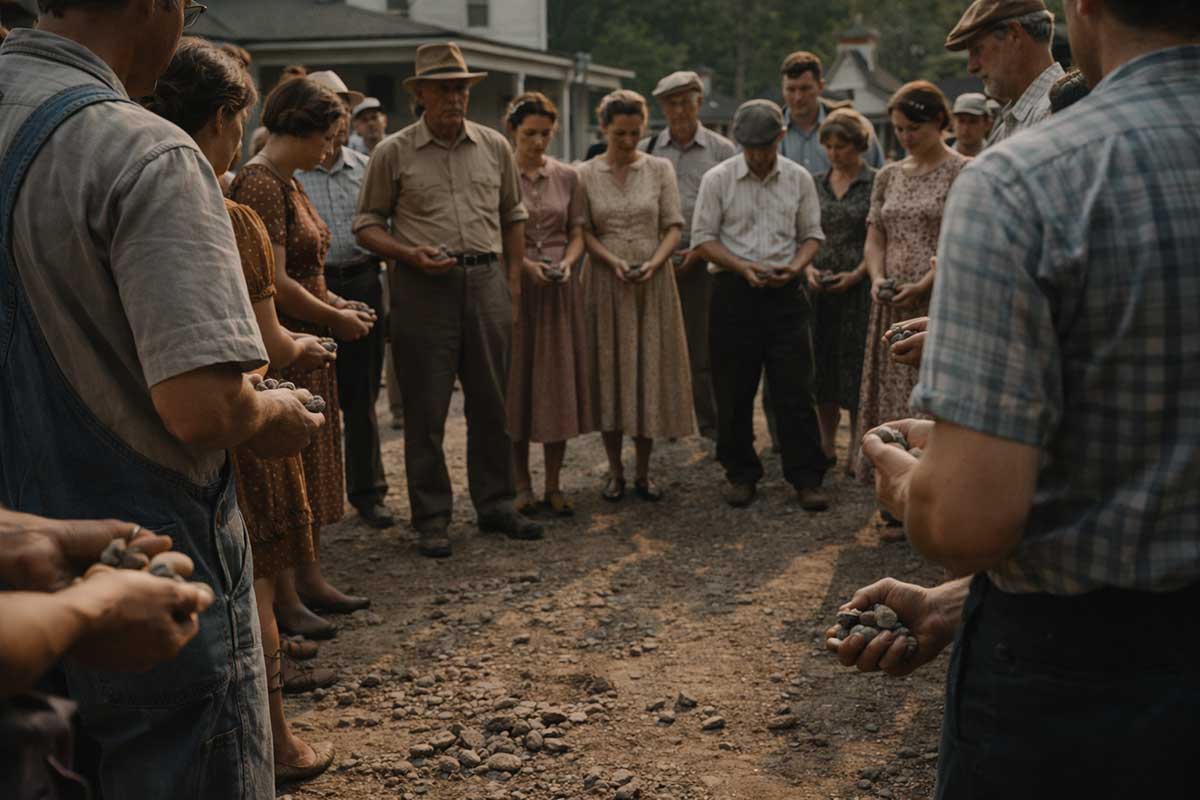
The square tightens.
What began as casual gathering now takes on shape. Families stand together. Children are called closer. Names are read aloud, not harshly, not gently—simply efficiently.
No one moves away.
Shirley Jackson watches the group, expression neutral, almost observational, as if the real story is not what they do—but how easily they do it together.
Nick Sasaki speaks.
First Question
Nick Sasaki
In The Lottery, no single person commits the violence alone. Everyone participates.
So let’s begin here:
How does communal participation transform violence into something morally bearable?
Bernice, would you start?
Bernice M. Murphy
Jackson exposes one of the most unsettling truths of social horror: violence feels lighter when it’s shared.
When everyone participates, responsibility dissolves. No one feels like the author of harm. The act becomes what the community does, not what any one person chooses.
That diffusion of guilt is the story’s real mechanism.
Shirley Jackson
(even, unsentimental)
People kept asking me who the villain was.
I never understood the question.
Darryl Hattenhauer
That’s because the community itself is the instrument.
Jackson doesn’t depict a mob whipped into frenzy. She depicts neighbors fulfilling roles. Violence becomes administrative—distributed across hands, voices, procedures.
Once harm is procedural, conscience loses its footing.
Joanne Bailey
What’s chilling is how domestic the violence feels.
Families stand together. Husbands hand stones to wives. Parents involve children.
Jackson shows how intimacy doesn’t prevent brutality—it often facilitates it.
Violence feels safer when it happens inside belonging.
Elaine Tyler May
And culturally, this reflects postwar American conformity.
Community cohesion was prized above moral dissent. To belong meant to participate—even when participation violated private ethics.
Jackson writes against the myth that communities are inherently protective.
Nick Sasaki
So violence becomes tolerable not because people are cruel—but because they’re together?
Bernice M. Murphy
Exactly.
Isolation terrifies people more than guilt.
Second Question
Nick Sasaki
Let’s sharpen this further.
Does collective violence actually erase guilt—or does it simply delay its recognition?
Joanne?
Joanne Bailey
Jackson suggests that guilt is never confronted because it’s never individualized.
No one reflects. No one processes. The ritual ends, and life resumes.
Guilt requires interiority. Community action bypasses interior life entirely.
Shirley Jackson
When everyone agrees, no one feels responsible.
That’s not innocence.
That’s convenience.
Darryl Hattenhauer
This is coercion without force.
No one is dragged into participation. They arrive willingly because refusal would mean social death.
Jackson makes refusal unthinkable—not forbidden.
Elaine Tyler May
And that’s key.
Social pressure replaces moral reasoning. The fear of exclusion outweighs the fear of doing harm.
In that environment, violence doesn’t feel like a violation—it feels like membership.
Bernice M. Murphy
Jackson’s restraint intensifies this.
There’s no buildup of rage. No ideological speech. Just names, slips of paper, and neighbors watching.
The absence of emotional excess makes the violence feel normal.
Nick Sasaki
Shirley, did you intend the ritual to feel routine rather than dramatic?
Shirley Jackson
Absolutely.
Drama lets people distance themselves.
Routine doesn’t.
Third Question
Nick Sasaki
Final question for this episode—and it’s the most uncomfortable.
If everyone participates, does that make the violence more just—or more dangerous?
Elaine?
Elaine Tyler May
More dangerous.
Because shared participation doesn’t correct injustice—it stabilizes it.
Once violence becomes communal, it becomes self-protecting. Anyone who objects threatens the group’s coherence.
Shirley Jackson
And coherence can feel more important than mercy.
Darryl Hattenhauer
Jackson dismantles the idea that morality improves with numbers.
Here, consensus is not ethical validation—it’s insulation.
The group protects itself from doubt by acting together.
Joanne Bailey
What’s most haunting is how affection coexists with harm.
People care for one another—and still proceed.
Jackson shows that love does not automatically generate moral resistance.
Bernice M. Murphy
This is why the ending devastates.
Not because of the act itself—but because no one breaks away.
Community absorbs the violence and moves on intact.
Nick Sasaki
So perhaps the most unsettling truth of The Lottery is this:
Violence doesn’t require hatred.
It only requires agreement.
Shirley Jackson
(after a pause)
I never believed people needed to be evil to do terrible things.
They just needed reassurance they weren’t alone.
Closing Scene
Stones are lifted.
Hands hesitate—briefly.
Then move.
The crowd closes in.
Nick Sasaki ends the session.
Nick Sasaki
In The Lottery, violence doesn’t erupt. It’s organized.
And because everyone participates, no one feels accountable.
In the next episode, we’ll look at how Shirley Jackson makes this horror feel almost invisible—and ask:
Why does the story sound so calm while doing something so brutal?
Fade out.
Episode 3 — The Banality of Horror
Why Does the Story Sound So Calm While Doing Something So Brutal?
Participants:
Shirley Jackson
S. T. Joshi
Terry Heller
James Phelan
Mieke Bal
Moderator:
Nick Sasaki
Opening Scene
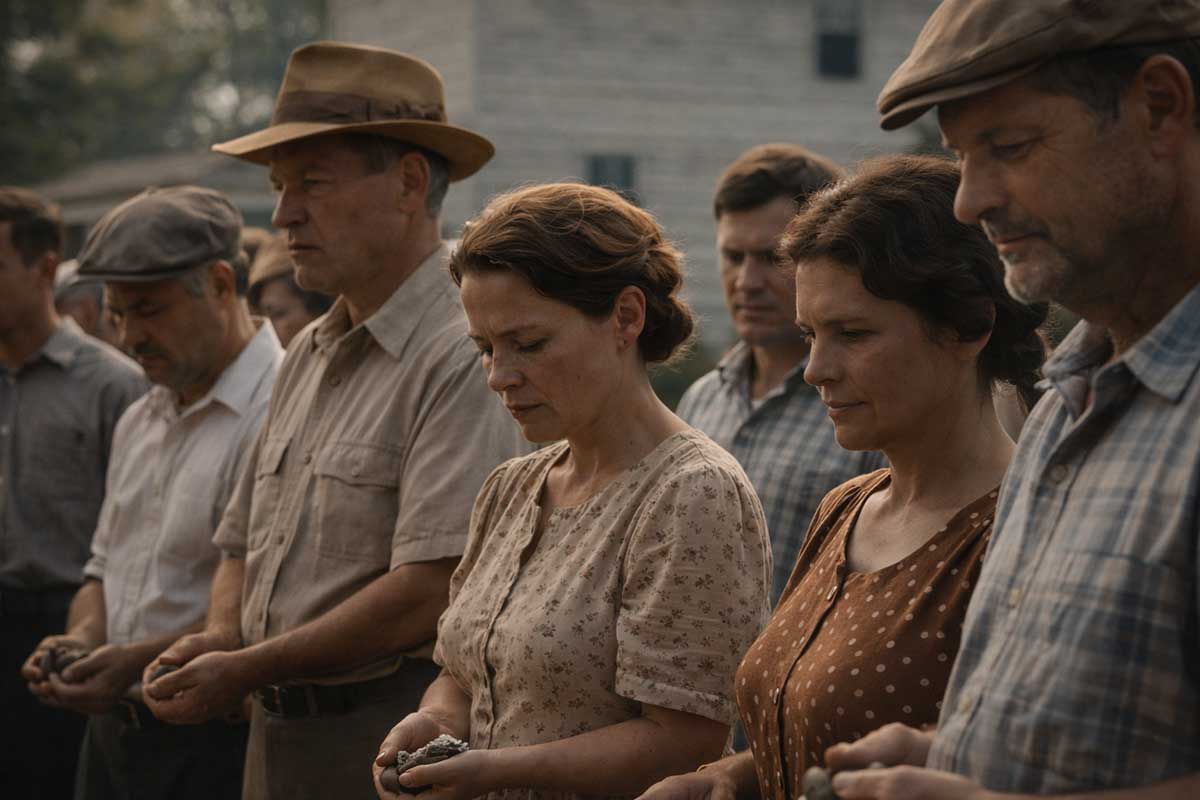
There is no music cue.
No ominous sky. No raised voices. The village square is described the way one might describe a grocery line or a schoolyard—efficiently, plainly, without emphasis.
The violence is approaching, but the language refuses to announce it.
Shirley Jackson sits with her hands folded, expression composed, as if the calm itself were the point.
Nick Sasaki begins.
First Question
Nick Sasaki
Readers often say The Lottery is terrifying—but when you look closely, the prose is remarkably restrained.
So let’s start here:
Why does Shirley Jackson tell a story of ritualized killing in such an ordinary, almost neutral voice?
S. T., would you begin?
S. T. Joshi
Jackson’s restraint is deliberate and structural.
She removes every conventional signal that tells a reader, this is horror. No heightened diction. No moral commentary. No dramatic pacing.
By doing so, she denies readers the emotional distance that genre normally provides.
The calm voice traps us inside the normality of the act.
Shirley Jackson
(dry, precise)
If I sounded alarmed, readers would feel warned.
I wasn’t interested in warning anyone.
Terry Heller
Exactly.
Jackson understood that excess emotion reassures readers. It says, this is not you. Calmness says the opposite.
The story sounds like a report because the violence is already normalized within the world of the story.
Mieke Bal
From a narratological perspective, the story’s focalization is crucial.
We are never allowed to inhabit deep interiority. The narration floats just above the village, observing rather than judging.
This absence of psychological depth prevents empathy from concentrating anywhere.
No single consciousness becomes a refuge.
James Phelan
Which makes the reader complicit.
Because without guidance, readers supply their own moral response—and often realize too late that they’ve been reading comfortably.
The shock is not the violence itself. It’s the realization that we weren’t resisting it.
Nick Sasaki
So the horror doesn’t arrive as an event—it arrives as a recognition?
James Phelan
Yes.
The story doesn’t scare us.
It catches us.
Second Question
Nick Sasaki
Let’s sharpen this.
How does ordinary language make extraordinary violence feel acceptable—or even invisible?
Mieke?
Mieke Bal
Language shapes perception.
Jackson’s vocabulary is domestic: lists, names, routines. These words belong to safety, not threat.
When violence enters through that vocabulary, it inherits its neutrality.
The act feels procedural, not transgressive.
Shirley Jackson
People trust familiar words.
That trust does a lot of work.
Terry Heller
Jackson also avoids metaphor.
There’s no symbolic fog to get lost in. Everything is literal. Stones are stones.
That literalness denies readers the comfort of interpretation-as-escape.
S. T. Joshi
And notice what’s missing: outrage.
No one in the story narrates fear or revulsion in language. Emotional vocabulary is withheld.
The absence of moral adjectives is not neutral—it’s accusatory.
James Phelan
It’s also an ethical strategy.
Jackson forces readers to ask: Why didn’t I feel more alarmed sooner?
The story trains us into complacency before revealing its cost.
Nick Sasaki
Shirley, did you worry readers might miss the danger entirely?
Shirley Jackson
I assumed they would.
That was the risk worth taking.
Third Question
Nick Sasaki
Final question for this episode.
Is the calm tone simply a stylistic choice—or is it the story’s central moral argument?
Terry?
Terry Heller
It’s the moral argument.
Jackson is saying: this is what violence looks like when it’s been accepted.
No screaming. No chaos. Just people doing what comes next.
Shirley Jackson
Horror doesn’t need volume.
It needs permission.
S. T. Joshi
The calmness implicates everyone—characters and readers alike.
It suggests that moral failure often announces itself quietly, through routine rather than rupture.
Mieke Bal
And because the tone never shifts, readers cannot locate a safe distance.
The story does not allow us to say, this is where it went wrong.
It was wrong all along—and sounded fine.
James Phelan
Which is why the ending feels less like a climax and more like a confirmation.
The violence doesn’t change the story’s tone.
It completes it.
Nick Sasaki
So perhaps The Lottery isn’t terrifying because of what happens—
but because of how easily we listen.
Shirley Jackson
(after a pause)
People are very good at listening calmly to things they’ve already decided not to stop.
Closing Scene
The stones fall.
There is no scream described—only motion.
And then the language stops.
Nick Sasaki closes the discussion.
Nick Sasaki
In The Lottery, horror does not announce itself.
It arrives disguised as normalcy, carried by familiar words, spoken in a voice that never raises itself.
In the next episode, we’ll examine how that calm masks something even more unsettling—and ask:
Did anyone in the village truly have a choice?
Fade out.
Episode 4 — The Illusion of Choice
Could Anyone in the Village Actually Refuse?
Participants:
Shirley Jackson
Michel Foucault
Hannah Arendt
Judith Butler
Philip Zimbardo
Moderator:
Nick Sasaki
Opening Scene
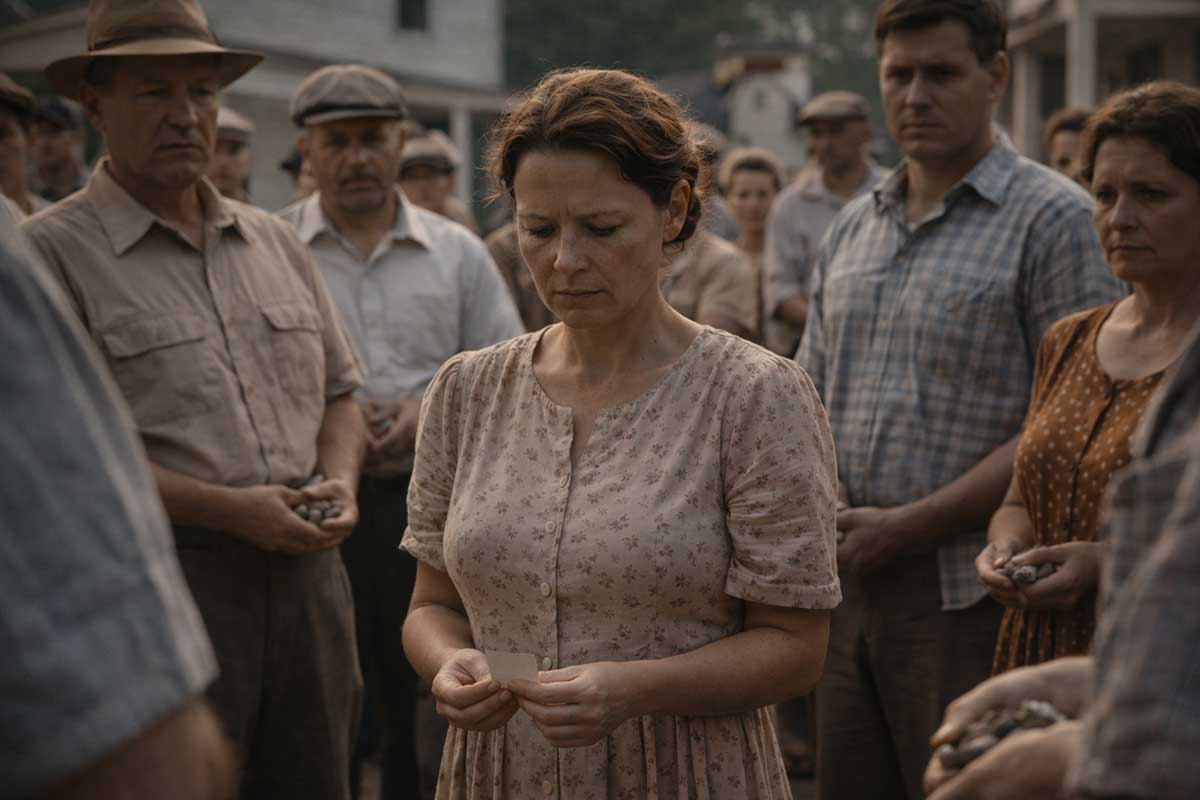
The names are read.
Not shouted. Not emphasized. Simply spoken, one after another, as though calling attendance in a classroom. People step forward when called. No one hesitates long enough to be noticed.
The crowd does not look threatening. It looks organized.
Shirley Jackson watches with the faintest trace of irony—as if the most important force in the square is not violence, but compliance.
Nick Sasaki begins.
First Question
Nick Sasaki
In The Lottery, no one is physically restrained. No one is dragged forward.
So let’s ask the uncomfortable question directly:
Did anyone in this village actually have a choice?
Michel, let’s start with you.
Michel Foucault
Choice is the wrong category.
What Jackson depicts is discipline—social, internalized, invisible.
No one needs to be forced because the rules have already been absorbed into the body. People arrive on time. They stand in the right place. They perform the correct gestures.
Power here does not operate through violence first. It operates through normalization.
Shirley Jackson
(cool, observational)
If someone had refused, people would have called it strange.
Not brave.
Hannah Arendt
That distinction is crucial.
The villagers are not coerced; they are embedded.
Responsibility dissolves because action is framed as participation in a system rather than a personal decision. When no one feels they are choosing, no one feels accountable.
This is how ordinary people commit extraordinary acts.
Philip Zimbardo
What struck me immediately is how little pressure is needed.
The environment does the work. Expectations are clear. Deviation is visible.
In such settings, refusal feels more dangerous than compliance. Not because of punishment—but because of exposure.
Judith Butler
And exposure threatens identity.
In this village, identity is relational. You exist because others recognize you as participating correctly.
Refusal would not just be an action—it would be a rejection of intelligibility.
To refuse would be to risk becoming unintelligible to the community.
Nick Sasaki
So the illusion of choice exists because refusal carries a cost that isn’t stated—but is fully understood?
Michel Foucault
Exactly.
The most effective power structures do not announce their penalties.
They let people imagine them.
Second Question
Nick Sasaki
Let’s take this further.
If refusal is possible only at the cost of social death, can we still call participation voluntary?
Hannah?
Hannah Arendt
No.
Voluntary action requires the ability to act otherwise without annihilation.
Here, refusal would mean exile—not necessarily formal, but existential. One would no longer belong.
When belonging is at stake, “choice” becomes a fiction.
Shirley Jackson
People assume courage looks loud.
Most of the time, it looks lonely.
Philip Zimbardo
And loneliness is a powerful deterrent.
Experiments show that people will endure significant moral discomfort to avoid isolation. The village exploits this instinct without needing to articulate it.
Everyone knows what’s expected—so no one asks.
Judith Butler
This is how norms enforce themselves.
No one has to threaten you if your sense of self depends on being recognized as “normal.”
The ritual doesn’t force participation. It defines what participation is.
Michel Foucault
And once norms are internalized, resistance appears irrational.
Refusal doesn’t look like moral clarity—it looks like madness.
Nick Sasaki
Shirley, did you imagine any character in the village capable of refusal?
Shirley Jackson
I imagined many people thinking about it.
That’s not the same thing.
Third Question
Nick Sasaki
Final question for this episode.
Is the most dangerous part of the lottery the violence—or the fact that no one believes refusal would matter?
Judith?
Judith Butler
The latter.
When people believe their actions are irrelevant, agency collapses. They stop imagining alternatives.
Violence becomes inevitable not because it must happen—but because no one believes interruption is possible.
Shirley Jackson
I wasn’t interested in whether someone could stop it.
I was interested in why they didn’t think stopping it would help.
Hannah Arendt
That resignation is the final victory of the system.
Once people stop believing their choices matter, responsibility disappears entirely.
Philip Zimbardo
And the environment rewards that resignation.
Those who comply remain safe, recognizable, included.
The cost of obedience is hidden. The cost of refusal is immediate.
Michel Foucault
Which is why modern power prefers rituals over commands.
Rituals don’t need enforcement.
They reproduce themselves.
Nick Sasaki
So perhaps The Lottery is not about people choosing violence—
but about a system that makes choice feel irrelevant.
Shirley Jackson
(after a long pause)
People rarely stop what they believe is unstoppable.
They just make sure they’re standing in the right place when it happens.
Closing Scene
The final slip is opened.
A name is spoken.
No one argues.
The crowd exhales—not in relief, but in synchronization.
Nick Sasaki closes the session.
Nick Sasaki
In The Lottery, no one is chained, threatened, or commanded.
And yet no one steps out of line.
The story’s most unsettling truth may be this:
violence does not require force—only the belief that resistance is pointless.
In the final episode, we’ll confront the oldest logic behind this ritual and ask:
Why must one person suffer so the community can continue?
Fade out.
Episode 5 — The Scapegoat Mechanism
Why Must One Person Suffer So the Community Can Continue?
Participants :
Shirley Jackson
René Girard
Mary Douglas
Walter Burkert
Bruce Lincoln
Moderator:
Nick Sasaki
Opening Scene
The stones are already in people’s hands.
No one rushes. No one panics. The circle closes with the efficiency of something practiced. The victim stands inside it—not separated by hatred, but by agreement.
Shirley Jackson watches closely, not with horror, but with attention—because this is the moment her story has been moving toward all along.
Nick Sasaki begins.
First Question
Nick Sasaki
Across cultures and centuries, societies have sacrificed one person to stabilize the many.
So let’s start at the foundation:
Why does a community so often require a single victim in order to feel whole?
René, would you begin?
René Girard
Because collective violence must be redirected.
When tensions accumulate—fear, rivalry, resentment—a society seeks release. The scapegoat concentrates that chaos onto one body.
Once the victim is chosen, violence no longer circulates. It converges.
Peace follows not because justice is achieved, but because conflict has been displaced.
Shirley Jackson
(quiet, unsentimental)
People like solutions that don’t require change.
Walter Burkert
Anthropologically, sacrifice predates morality.
Early rituals did not ask whether killing was right. They asked whether killing worked.
Sacrifice organizes fear. It transforms chaos into order.
In The Lottery, the ritual no longer explains itself—but it still performs that ancient function.
Mary Douglas
And the victim represents disorder.
In purity systems, danger comes from what doesn’t fit. The chosen individual becomes symbolically “out of place.”
Once marked, removing them restores a sense of cleanliness—even if the criteria are arbitrary.
Bruce Lincoln
This is where authority enters.
Ritual violence requires legitimacy. The community must believe the act is sanctioned—not by gods necessarily, but by tradition, history, or collective agreement.
Once sanctioned, violence feels necessary rather than chosen.
Nick Sasaki
So the victim isn’t selected because they’re guilty—
but because selecting someone resolves uncertainty?
René Girard
Exactly.
The identity of the victim matters less than the unanimity against them.
Second Question
Nick Sasaki
Let’s confront the moral center of the story.
Does the sacrifice actually stabilize the community—or does it merely postpone collapse?
Mary?
Mary Douglas
It stabilizes temporarily.
Ritual creates the illusion of purity and order. But because the underlying tensions are never addressed, the ritual must repeat.
That’s why the lottery is annual.
Order achieved through exclusion is fragile.
Shirley Jackson
And repetition feels reassuring.
That’s why people defend it.
Walter Burkert
Sacrifice creates continuity, not progress.
It preserves the structure at the cost of the individual. Nothing improves—nothing is meant to.
Jackson strips away the mythic language so we can see the machinery clearly.
Bruce Lincoln
And the machinery depends on silence.
Once the victim is named, discussion ends. Dissent would fracture the consensus required for the ritual to work.
That silence is power’s final seal.
René Girard
What makes The Lottery terrifying is that the victim is not later deified.
In ancient myths, the scapegoat often becomes sacred after death.
Here, there is no transformation.
Only removal.
Nick Sasaki
Shirley, was it important to you that the victim remain ordinary—neither heroic nor symbolic?
Shirley Jackson
Very.
If the victim were special, readers could distance themselves.
Ordinary victims don’t allow that.
Third Question
Nick Sasaki
Final question—for the story and for us.
What does The Lottery ask the reader to do once the scapegoat mechanism is exposed?
Bruce?
Bruce Lincoln
Exposure alone is destabilizing.
Once the mechanism is visible, it loses some of its power. Ritual depends on invisibility—on being felt, not examined.
Jackson forces examination.
Shirley Jackson
I didn’t want readers to feel smarter.
I wanted them to feel implicated.
René Girard
Recognition is the first interruption.
Once people see how unanimity produces victims, participation becomes harder to justify—even if refusal is costly.
Mary Douglas
But recognition does not guarantee change.
That’s Jackson’s final honesty.
Knowing the mechanism doesn’t dissolve it. It only removes innocence.
Walter Burkert
Which leaves responsibility.
After the story ends, readers must decide whether they will continue rituals simply because they persist—or question what they demand.
Nick Sasaki
So The Lottery doesn’t offer redemption.
It offers clarity.
Shirley Jackson
(after a long pause)
People kept asking me how to stop the lottery.
I thought the better question was whether they recognized where they were already holding stones.
Closing Scene
The stones fall.
There is no aftermath described. No grief ritualized. No lesson stated.
The circle opens. People return to their lives.
Nick Sasaki closes the final session.
Nick Sasaki
The Lottery endures because it refuses to comfort us.
It shows how communities preserve themselves—not through cruelty, but through agreement. Not through hatred, but through habit.
The story does not ask us to condemn the villagers.
It asks whether we recognize the ritual before it asks for a victim.
And whether, when the moment comes, we know what it would cost to step out of the circle.
Fade out.
Final Thoughts by Shirley Jackson

After the story was published, many people wrote to ask me why the villagers did not stop the lottery.
They assumed there must be a reason—fear, ignorance, cruelty, madness. They wanted an explanation that would place the violence somewhere distant from themselves. I never had a satisfying answer for them.
The villagers did not stop the lottery because nothing told them to.
There was no signal, no authority, no sudden realization that declared the ritual wrong. There was only the quiet certainty that this was what happened next, and the unspoken understanding that refusal would come at a cost no one wished to pay.
I did not write The Lottery to offer solutions. I wrote it to remove excuses.
Once the ritual is visible, innocence disappears. After that, the story no longer belongs to the village. It belongs to the reader—who must decide whether recognition changes anything, or whether familiarity will once again do its work.
Violence rarely announces itself as such. More often, it arrives wearing the language of order, tradition, and belonging.
The question is not whether the lottery should end.
The question is how often we recognize it only after we are already standing in the square.
Short Bios:
Shirley Jackson
American writer best known for The Lottery and The Haunting of Hill House. Her work explores conformity, domestic unease, and the quiet violence embedded in everyday life.
Nick Sasaki
Founder of ImaginaryTalks and moderator of the series. He guides literary conversations that examine moral tension, responsibility, and meaning through imagined dialogues.
Ruth Franklin
Literary critic and biographer of Shirley Jackson, author of A Rather Haunted Life. Her work situates Jackson within psychological, cultural, and biographical contexts.
Stanley Edgar Hyman
Literary critic and editor, closely associated with mid-20th-century American criticism. He wrote extensively on myth, ritual, and modern literature.
Alan Heimert
Scholar of American literature and Puritan ideology, known for analyzing inherited moral structures in American cultural narratives.
Richard Slotkin
Cultural historian specializing in American myth, violence, and national identity, particularly the role of ritualized violence in sustaining social order.
Sacvan Bercovitch
Influential American literary scholar known for his work on ideology, consensus, and the moral narratives underlying American culture.
Bernice M. Murphy
Scholar of American Gothic and horror literature, focusing on social anxiety, conformity, and everyday settings as sites of fear.
Darryl Hattenhauer
Literary critic whose work examines power, patriarchy, and conformity in Shirley Jackson’s fiction.
Joanne Bailey
Scholar focusing on domestic space, gender, and social violence in American literature, with particular attention to Jackson’s work.
Elaine Tyler May
Historian of American culture and postwar conformity, known for her analysis of community, belonging, and social pressure.
S. T. Joshi
Literary critic and editor specializing in horror and weird fiction. He has written extensively on narrative restraint and tone in modern literature.
Terry Heller
Scholar of American horror literature, focusing on subtle terror, narrative manipulation, and reader complicity.
James Phelan
Narrative theorist known for work on narrative ethics, reader response, and moral engagement in fiction.
Mieke Bal
Cultural theorist and narratologist specializing in focalization, narrative structure, and the ethics of storytelling.
Michel Foucault
Philosopher and social theorist whose work examines power, discipline, and how norms regulate behavior without overt force.
Hannah Arendt
Political theorist known for her analysis of responsibility, obedience, and the moral dangers of thoughtless conformity.
Judith Butler
Philosopher and theorist whose work explores norms, identity, and how social recognition governs behavior.
Philip Zimbardo
Psychologist known for research on social roles, conformity, and how environments shape moral action.
René Girard
Anthropologist and theorist of the scapegoat mechanism, examining how societies channel violence through collective sacrifice.
Mary Douglas
Anthropologist known for her work on purity, pollution, and how communities define order through exclusion.
Walter Burkert
Classicist and scholar of ancient ritual and sacrifice, studying how violence functions in the formation of social order.
Bruce Lincoln
Historian of religion specializing in myth, authority, and how ritual violence is legitimized through narrative.
Leave a Reply