
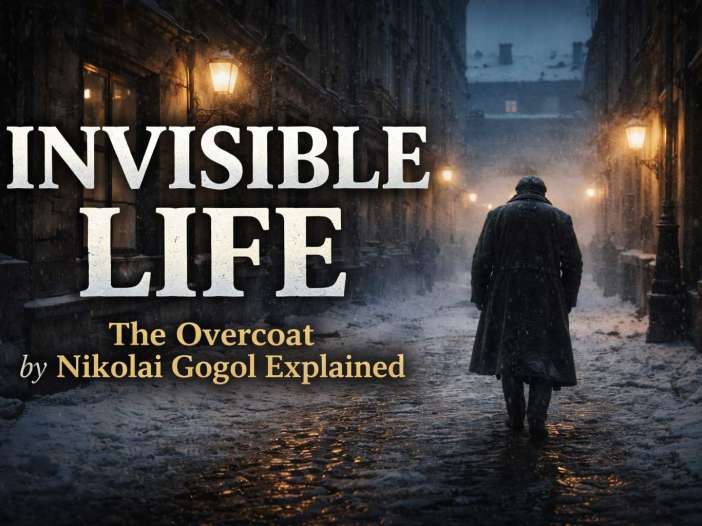
|
Getting your Trinity Audio player ready...
|
What if Nikolai Gogol believed society only sees you once you suffer?
Introduction by Nikolai Gogol
You may think this story is about a coat.
That is the first mistake.
I did not write The Overcoat to complain about poverty, nor to accuse clerks, nor even to expose bureaucracy—though all of those stand plainly before you. I wrote it because I saw something quieter and far more disturbing: a man who disappears without anyone needing to hate him.
Akaky Akakievich does not rebel. He does not dream. He does not demand meaning. He copies. He survives. He exists exactly as society prefers him to exist—useful, invisible, replaceable. And because of this obedience, no one feels responsible for him.
When readers laugh at Akaky, they believe they are laughing gently. When officials dismiss him, they believe they are only following procedure. When the city lets him die, it believes nothing has happened at all.
That is the danger.
This story is not a tragedy caused by cruelty. It is a tragedy caused by correctness. By routines performed so smoothly that conscience never interrupts them. The coat matters only because it briefly grants Akaky visibility—and visibility, without protection, is exposure.
So if you are searching here for heroes or villains, you will be disappointed. You will find only people doing what they are supposed to do. And a man who was never supposed to matter.
Read carefully.
Not to pity Akaky—but to notice when you stop noticing him.
(Note: This is an imaginary conversation, a creative exploration of an idea, and not a real speech or event.)
Topic 1 — When a Person Becomes a Function
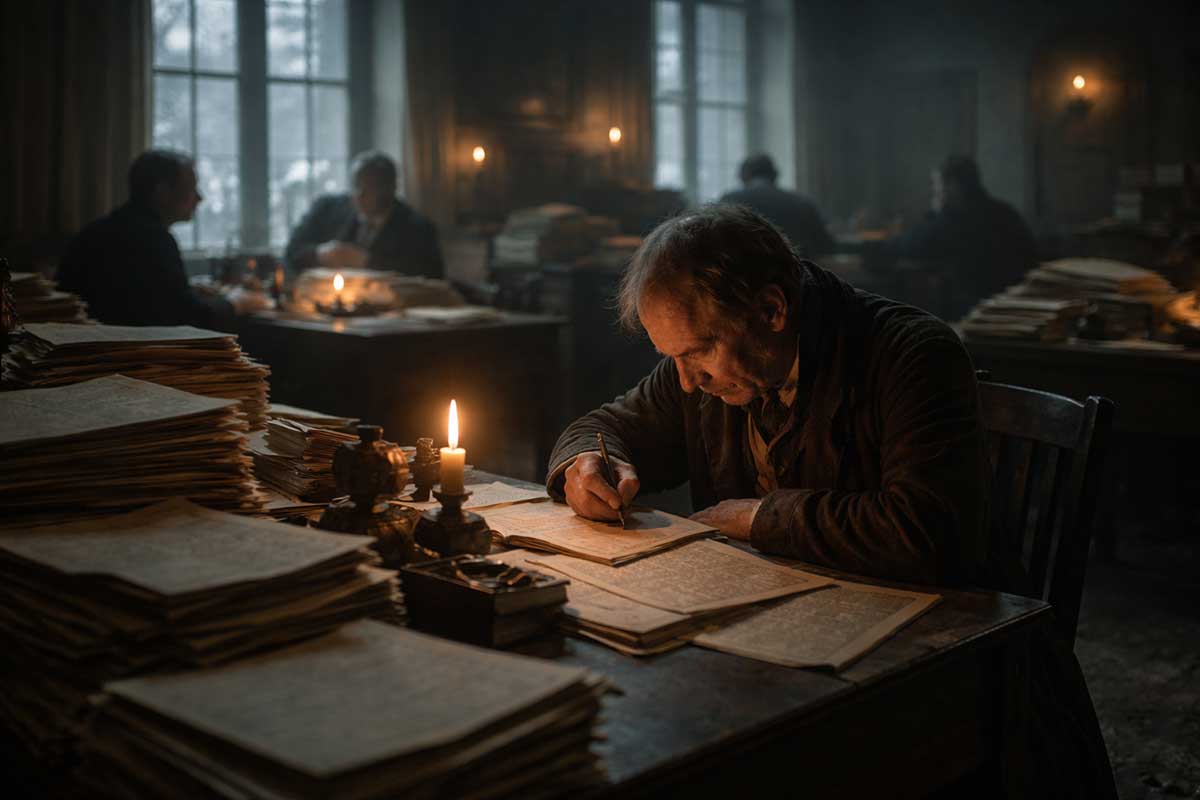
Setting:
A dim, narrow government office that seems to stretch endlessly, desks repeating into shadow. Papers are stacked with mechanical precision. Lamps glow weakly. Snow presses against tall windows. At the center sits Nikolai Gogol, observing with faint amusement. Five scholars are gathered, with a moderator guiding the discussion.
Moderator: Nick Sasaki
Participants:
Nikolai Gogol (author)
Vladimir Nabokov (novelist, Gogol critic)
Donald Fanger (Gogol scholar, The Creation of Nikolai Gogol)
Caryl Emerson (Russian literature scholar)
Boris Eikhenbaum (Russian Formalist)
Nick Sasaki leans forward, hands folded.
“Let’s begin where Gogol begins—with a man whose entire existence is reduced to copying words written by others. Akaky Akakievich Bashmachkin. My question is simple, but uncomfortable.”
He pauses.
“At what point does Akaky stop being treated as a person and start being treated as a function—and does the story suggest he ever existed as anything else?”
A quiet settles over the table.
Donald Fanger speaks first, carefully.
“From the opening paragraph, Gogol denies Akaky a conventional inner life. We’re told almost nothing about his desires beyond copying. The narration itself treats him as an object of bureaucratic description—rank, salary, habits. In that sense, Akaky is born already reduced. He doesn’t fall into dehumanization; he emerges from it.”
He gestures lightly toward Gogol.
“What’s radical is that the story refuses a ‘before.’ There is no lost self to recover.”
Vladimir Nabokov smiles thinly.
“Yes—but that does not mean Akaky lacks a soul. It means Gogol refuses to sentimentalize it. Akaky’s joy in copying is not nothing. It’s precise. It’s aesthetic. He takes pleasure in curves of letters, in repetition. That devotion is absurd, yes—but it is also sincere.”
He taps the table.
“The cruelty lies not in Akaky’s narrowness, but in how others deny even that narrow joy legitimacy.”
Gogol clears his throat softly.
“My dear Vladimir,” he says, voice gentle but sly, “you make him sound almost noble. I never intended him to be.”
A faint ripple of laughter.
“I wrote Akaky as someone who disappears not because others crush him—but because the world has no space for noticing such people. He is not tragic in the classical sense. He is… overlooked.”
Caryl Emerson leans in.
“That’s precisely the problem. Overlooked by whom? Akaky’s colleagues mock him, but the system itself does worse—it ignores him entirely. No one needs to be actively cruel when a structure quietly erases.”
She continues.
“What unsettles modern readers is how familiar this feels. Akaky’s function defines his worth. Outside of copying, he has no language to assert himself. The story suggests that personhood, in such a system, is not intrinsic—it is granted.”
Nick nods, then gently presses forward.
“Which leads to the harder question.”
He glances at Gogol.
“Is Akaky’s invisibility imposed—or chosen? Does his devotion to copying represent quiet resistance, or quiet surrender?”
Boris Eikhenbaum answers briskly.
“Formally speaking, Akaky’s surrender is structural. The repetition of copying mirrors the repetition of narrative description. Gogol writes him into mechanical rhythms. This is not psychology—it’s design.”
He raises a finger.
“But that does not absolve the system. It implicates it. The form itself enacts bureaucracy.”
Nabokov interjects.
“And yet—Akaky resists in the only way he knows how. He refuses ambition. He refuses rivalry. He refuses even resentment. That refusal irritates everyone around him because it exposes the emptiness of their own striving.”
Gogol chuckles softly.
“Yes. They cannot forgive him for being content with so little.”
Then, unexpectedly, his tone sharpens.
“But make no mistake—I did not write him as a saint. His contentment is dangerous. It allows the system to continue unchallenged.”
The room grows quieter.
Nick seizes the tension.
“So then—if society only recognizes people through usefulness, is Akaky a victim of cruelty… or the logical outcome of the system itself?”
Donald Fanger exhales.
“He is both. And that’s Gogol’s cruelty toward the reader. We want to rescue Akaky, but the story denies us that comfort. There is no villain to overthrow. Only procedures, habits, indifference.”
Caryl Emerson adds:
“The real horror is not that Akaky is crushed. It’s that no one notices the crushing. The violence is ambient.”
Nabokov tilts his head.
“And we, the readers, are complicit. We laugh. We skim. We accept Akaky as comic relief—until he dies.”
Gogol looks directly at the reader now, breaking the fourth wall.
“You see?” he says quietly. “You wanted him to matter. But you only wanted him to matter once he lost the coat.”
He smiles, sadly.
“Before that, you were content to let him copy.”
Nick lets the silence linger.
Then he speaks softly.
“This is where Topic 1 leaves us—with an uncomfortable mirror.”
He looks around the table.
“A man becomes a function. A function becomes invisible. And invisibility becomes normal.”
He turns to the reader.
“If Akaky had never needed the overcoat… would you have noticed him at all?”
Topic 2 — The Overcoat as False Salvation
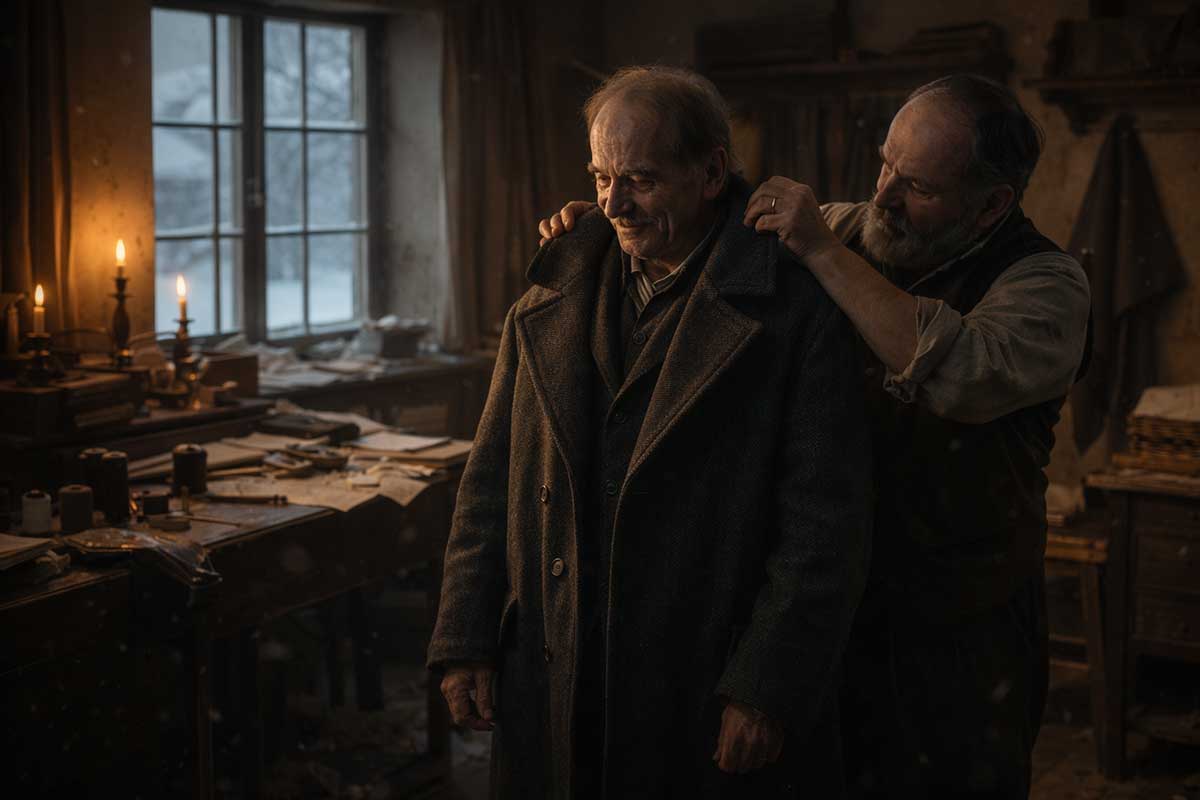
Setting:
Evening. Snow thickens outside the same government quarter, but now the room is warmer. A new overcoat hangs on a wooden stand near the door—dark, well-made, slightly oversized. It draws the eye more than any person in the room.
Moderator: Nick Sasaki
Participants:
Nikolai Gogol
Vladimir Nabokov
Donald Fanger
Caryl Emerson
Boris Eikhenbaum
Nick gestures subtly toward the coat.
“Akaky’s life changes the moment this object enters it. People notice him. Invite him. Smile at him.”
He pauses.
“So let’s begin here.”
“Does the overcoat restore Akaky’s humanity—or does it merely make him visible to a world that still doesn’t care?”
Caryl Emerson answers first.
“The overcoat doesn’t restore anything intrinsic. It acts like a passport. Akaky doesn’t become different—others behave differently. That distinction matters. The coat reveals that recognition in this society is transactional. You are seen not when you exist, but when you conform.”
She glances at the coat.
“It’s conditional dignity.”
Donald Fanger nods.
“And it’s temporary. Gogol structures the coat as a brief interruption in a narrative of erasure. Notice how quickly the social warmth appears—and how quickly it vanishes. The celebration is shallow, almost automatic. There is no curiosity about Akaky himself.”
He adds quietly:
“The coat is not love. It’s acknowledgment.”
Gogol shifts in his chair.
“Yes,” he says, “and acknowledgment is more dangerous than neglect.”
The scholars look up.
“When Akaky was ignored, he was safe. Once he is seen, he becomes vulnerable. The coat pulls him into a world he does not understand—and cannot survive.”
Nabokov raises an eyebrow.
“But surely, Nikolai Vasilievich, you are not denying him joy. That night matters. His walk through the streets, the cold held at bay—that happiness is real, even if fleeting.”
Gogol responds gently.
“I grant him joy. I do not grant him illusion.”
He taps the table.
“Joy built on external validation is a debt. And debts are always collected.”
Nick leans in.
“That raises the next question.”
He looks directly at the panel.
“Is Akaky’s desire for the coat truly his own—or has humiliation taught him what to want?”
Boris Eikhenbaum answers sharply.
“From a formal perspective, the desire is constructed. The coat emerges not from longing, but from necessity imposed by climate and ridicule. The cold initiates it. Mockery intensifies it. The narrative manufactures desire externally.”
He continues.
“This is crucial. Akaky does not imagine transformation. The system imagines it for him.”
Caryl Emerson adds:
“The coat is the minimum requirement for entry into humanity. That’s what’s devastating. Akaky doesn’t aspire upward—he merely wants not to be punished for existing.”
Nabokov interjects.
“And yet, the desire becomes intimate. Once imagined, it animates him. He dreams of the coat. He plans for it. The humiliation may teach him what to want, but the wanting becomes real.”
He pauses.
“That’s the tragedy. The desire outgrows the object.”
Nick lets that land, then asks the third question.
“If dignity must be purchased to be acknowledged—does the overcoat represent hope… or the final trap?”
Silence.
Then Gogol speaks, slowly.
“It is a trap disguised as hope.”
He looks at the coat again.
“The coat tells Akaky: You matter—so long as you wear this. That is not dignity. That is ransom.”
Donald Fanger supports this.
“The story punishes the belief that visibility equals safety. The coat invites Akaky into public space—but offers no protection there. Once stolen, everything collapses. The dignity was never his.”
Caryl Emerson adds softly:
“And the system learns nothing. Akaky’s brief ascent doesn’t challenge hierarchy—it confirms it. He is allowed to borrow humanity, not claim it.”
Nabokov exhales.
“And we, the readers, feel betrayed. Because we wanted the coat to save him.”
He looks toward Gogol.
“You make us complicit again.”
Gogol smiles faintly.
“Of course.”
Then he breaks the fourth wall.
“You believed in the coat because you wanted something simple to fix him.”
He pauses.
“But the story is not about fixing.”
Nick closes the topic carefully.
“So Topic 2 leaves us here.”
He gestures toward the empty chair where Akaky once sat.
“The overcoat gives warmth. It gives recognition. It gives one perfect evening.”
He lowers his voice.
“And then it proves how fragile dignity becomes when it depends on objects rather than justice.”
Topic 3 — Laughter as Cruelty

Setting:
The office appears lighter now—almost cheerful. A few clerks stand in the background, mid-laughter, their voices indistinct. Papers rustle. Someone chuckles. The sound feels harmless… until it doesn’t. The overcoat hangs empty.
Moderator: Nick Sasaki
Participants:
Nikolai Gogol
Vladimir Nabokov
Donald Fanger
Caryl Emerson
Boris Eikhenbaum
Nick begins quietly.
“Gogol makes Akaky funny. Not accidentally—deliberately.”
He looks around the table.
“So let’s confront that.”
“Why make Akaky ridiculous—and what kind of violence does that humor quietly perform?”
Boris Eikhenbaum answers first.
“From a formal standpoint, humor is Gogol’s primary instrument. The exaggeration, the repetition of Akaky’s name, the absurd seriousness with which trivial details are treated—this is comic stylization.”
He pauses.
“But stylization distances. And distance allows cruelty.”
Caryl Emerson nods.
“The laughter functions as insulation. It keeps the reader from responding with immediate sympathy. We are invited to observe Akaky as an object of amusement before we are asked to grieve him.”
She adds:
“That delay matters. It trains us to accept his suffering as normal.”
Gogol tilts his head.
“I never asked the reader to be kind,” he says calmly. “I asked them to look.”
He leans forward.
“And people look most comfortably when they are laughing.”
Nabokov smiles—uneasily.
“This is where Gogol is most dangerous. The comedy is exquisite. Akaky’s delight in copying, his terror of change—it’s funny because it’s precise. But precision sharpens the knife.”
He continues.
“We laugh not because Akaky deserves it, but because the narrative makes us fluent in contempt.”
Nick presses further.
“That raises the next question.”
He looks directly at the group.
“Are we laughing with Akaky, at him, or at the system that crushes him—and how does the story blur those distinctions?”
Donald Fanger responds thoughtfully.
“The ambiguity is intentional. Early laughter feels benign—almost affectionate. But as the story progresses, the laughter shifts. It becomes nervous. Then uncomfortable.”
He glances at Gogol.
“The brilliance is that we don’t know when the laughter becomes unethical. By the time we do, it’s too late.”
Caryl Emerson adds:
“And that confusion mirrors the bureaucracy itself. The system never announces its cruelty. It hides behind routine, jokes, tone.”
She gestures outward.
“The clerks tease Akaky not as villains, but as colleagues. That makes it worse.”
Nabokov interjects sharply.
“Let’s be honest. We laugh because Akaky violates our expectations of ambition. He is content. That offends modern sensibility. We punish him with humor.”
Gogol chuckles softly.
“Yes. You laugh because he refuses the drama you demand.”
Then his tone darkens.
“But what happens when laughter becomes permission?”
Nick nods and asks the third question.
“If laughter requires distance, what does our amusement say about our own position in the hierarchy Gogol depicts?”
Silence again.
Boris Eikhenbaum answers.
“It places us above Akaky. Temporarily. Comfortably.”
He continues.
“The reader is invited to occupy the same vantage point as Akaky’s colleagues—watching, commenting, never intervening.”
Donald Fanger adds:
“That’s the quiet cruelty. The story implicates the reader without accusing them outright. We laugh, then feel shame, but only after Akaky is gone.”
Nabokov exhales slowly.
“And that shame is Gogol’s true punchline. Not the jokes—but the realization that our laughter aligned us with power.”
Gogol looks directly at the reader again, breaking the fourth wall.
“You laughed,” he says gently.
“Not because you are cruel—but because laughter made you safe.”
He pauses.
“And safety is what allowed Akaky to disappear.”
Nick closes the discussion.
“So Topic 3 leaves us here.”
He looks around the room.
“Laughter softens cruelty. Humor disguises hierarchy. And comedy—when aimed downward—becomes a tool of erasure.”
He lowers his voice.
“In The Overcoat, the jokes don’t kill Akaky.”
He pauses.
“They just make his death easier to accept.”
Topic 4 — The Theft That Reveals the System
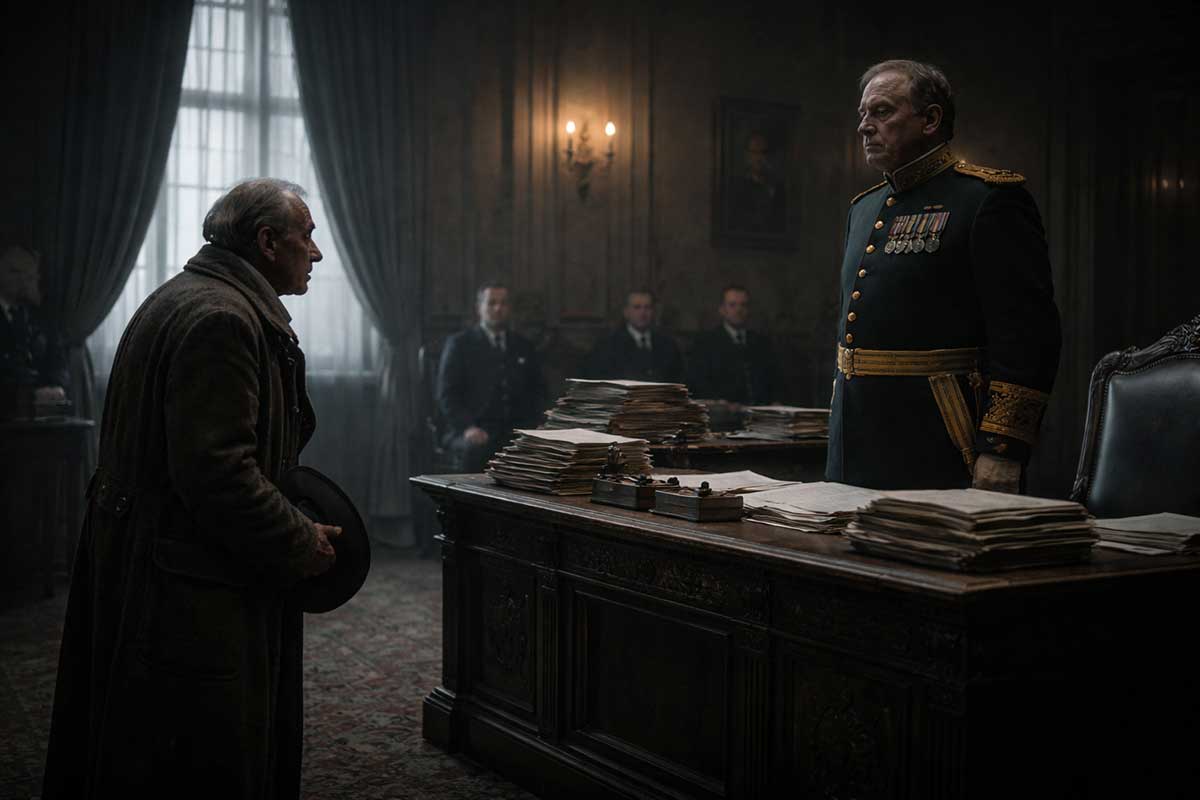
Setting:
Night. Snow drives sideways through narrow streets. The room feels colder now. The overcoat is gone. A police ledger lies open on the table—neatly ruled, perfectly useless. Somewhere beyond the walls, boots echo and fade.
Moderator: Nick Sasaki
Participants:
Nikolai Gogol
Vladimir Nabokov
Donald Fanger
Caryl Emerson
Boris Eikhenbaum
Nick begins without preamble.
“The coat is stolen. And with it, any remaining illusion that Akaky’s dignity was secure.”
He looks around the table.
“So let’s confront the moment that changes everything.”
“Is the theft of the overcoat a crime committed by thieves—or the inevitable consequence of a society built on indifference?”
Donald Fanger speaks first.
“The thieves are almost incidental. Gogol gives them no psychology, no motivation. They function like weather—cold, sudden, impersonal.”
He pauses.
“That’s deliberate. The real theft has already occurred long before the street assault. The coat was never protected by the system that pretended to value it.”
Caryl Emerson nods.
“The story refuses us a satisfying antagonist. Which forces us to look elsewhere. The thieves take the coat—but the system takes Akaky’s voice.”
She continues.
“When violence finally appears, it feels inevitable because nothing stood in its way.”
Gogol folds his hands.
“Yes,” he says quietly. “People always want villains. I offered them procedures instead.”
Nabokov interjects.
“And that’s the cruelty of the scene. The theft feels shocking, but not surprising. It confirms what we already knew: visibility without protection is exposure.”
He looks at Nick.
“Akaky steps into public space—and the public devours him.”
Nick presses forward.
“That brings us to the next question.”
“Why does every authority Akaky appeals to fail him—and what does that failure reveal about how power actually functions?”
Boris Eikhenbaum answers crisply.
“The failures are methodical. Each authority behaves exactly as designed. The police record the complaint. The clerks redirect him. The Important Person enforces protocol.”
He pauses.
“This is not dysfunction. It is precision.”
Caryl Emerson adds:
“The system offers form instead of care. Akaky is crushed not by chaos, but by order. Everyone follows rules—and that becomes the excuse.”
Gogol leans in slightly.
“I wanted the Important Person to be terrifying not because he is cruel—but because he is correct.”
A hush falls.
“He speaks the language of rank flawlessly. And in doing so, he annihilates Akaky without raising his voice.”
Nabokov grimaces.
“That scene is devastating. The Important Person doesn’t steal anything. He humiliates. And humiliation finishes what theft began.”
Nick asks the final question, slowly.
“When institutions respond correctly but cruelly, is injustice a malfunction—or a feature?”
Silence lingers longer this time.
Donald Fanger answers.
“It’s a feature. Gogol strips away the fantasy that institutions exist to protect the vulnerable. They exist to preserve hierarchy.”
Caryl Emerson continues:
“And that hierarchy does not need to hate Akaky. It only needs to ignore him efficiently.”
Nabokov adds softly.
“The most honest thing the system does is abandon him.”
Gogol looks directly at the reader, breaking the fourth wall once more.
“You see now,” he says, almost kindly,
“why I did not let him recover.”
He pauses.
“Recovery would have implied justice was possible.”
Nick closes the discussion.
“So Topic 4 leaves us with a cold realization.”
He gestures toward the empty coat stand.
“The theft exposes the truth: dignity was never protected, authority was never listening, and justice was never part of the design.”
He lowers his voice.
“Akaky did not lose his coat.”
He pauses.
“He discovered where he never belonged.”
Topic 5 — The Ghost Who Takes Coats

Setting:
Late night. St. Petersburg streets blur under falling snow. The room is almost empty now. The ledger is closed. The overcoat stand is gone. Only footprints remain—leading nowhere. Somewhere between rumor and reality, a presence lingers.
Moderator: Nick Sasaki
Participants:
Nikolai Gogol
Vladimir Nabokov
Donald Fanger
Caryl Emerson
Boris Eikhenbaum
Nick speaks softly.
“Akaky dies. Quietly. Almost administratively.”
He pauses.
“And then—something impossible happens.”
“Does Akaky’s ghost represent justice finally arriving… or humiliation returning in another form?”
Caryl Emerson answers first.
“The ghost is not justice in any ethical sense. It doesn’t restore balance or meaning. It merely repeats the logic of the living world—only inverted.”
She continues.
“Coats are still taken. Fear is still distributed unevenly. Power remains the axis.”
Donald Fanger nods.
“The supernatural doesn’t redeem the system—it exposes it. The ghost is bureaucratic revenge, not moral reckoning. It doesn’t ask why coats matter. It only enforces symmetry.”
Gogol smiles faintly.
“Yes. I gave them a ghost because they wanted closure.”
He leans forward.
“But closure is not the same as justice.”
Nabokov raises a finger.
“And yet—the ghost terrifies the Important Person. For the first time, power feels fear. That moment matters.”
He pauses.
“Even if it changes nothing structurally, it punctures the illusion of immunity.”
Nick moves to the second question.
“Is the supernatural ending meant to restore moral balance—or to expose how impossible justice has become in the living world?”
Boris Eikhenbaum answers briskly.
“Formally, the ghost breaks genre. We move from social realism into folklore. That rupture signals failure. When realism cannot deliver justice, the narrative abandons realism altogether.”
He adds:
“The ghost is an admission of defeat.”
Caryl Emerson agrees.
“The story cannot resolve itself ethically, so it resolves itself mythically. That should trouble us.”
Gogol speaks again, quietly.
“I did not believe justice could arrive politely.”
He looks at Nick.
“If justice came at all, it would be grotesque.”
Nick asks the final question.
“When the story ends with coats taken by force, has anything truly changed—or has the system simply found a darker equilibrium?”
A long silence.
Donald Fanger answers.
“Nothing changes. But something is revealed. The ghost does not reform society—it reveals its conscience was already dead.”
Nabokov adds:
“The ghost gives readers a thrill. That thrill is dangerous. It tempts us to believe revenge equals resolution.”
Gogol looks directly at the reader, breaking the fourth wall one last time.
“You wanted him to matter,” he says softly.
“So I made him haunt you.”
He pauses.
“But haunting is not healing.”
Nick closes the series.
“So The Overcoat ends not with justice, not with reform, but with repetition.”
He looks around the empty room.
“A man becomes a function.
A function becomes invisible.
Invisibility becomes violence.
Violence becomes folklore.”
He turns to the reader.
“And the system continues—warm, orderly, untouched.”
Final Thoughts by Nikolai Gogol

You may feel relieved when the ghost appears.
Many readers do.
At last, they think, something is corrected. Fear travels upward. Authority trembles. The world acknowledges what it ignored. But do not mistake disturbance for justice. The ghost does not repair the system. It only reveals what the system was always capable of producing.
The coats are taken again.
Only now, everyone is afraid.
Akaky does not return to reclaim his dignity. He returns because dignity was never available to him in life. And so it reemerges as folklore—unsettling, unresolved, and useless for reform.
That is where I leave you.
Not with hope.
Not with redemption.
But with a question that lingers longer than any ghost:
If a man can live correctly, suffer quietly, disappear politely—and still be erased…
What, then, is society actually designed to protect?
If you feel uneasy, good.
That discomfort is the only thing in this story that still has a chance to matter.
— Nikolai Gogol
Short Bios:
Nikolai Gogol
Russian novelist and short-story writer whose works combine realism, absurdity, and moral unease. The Overcoat helped define modern literature by exposing how bureaucracy and indifference quietly erase human dignity.
Vladimir Nabokov
Russian-American novelist and literary critic, author of Lolita. Nabokov famously lectured on Gogol, praising his artistic cruelty, linguistic precision, and refusal to sentimentalize suffering.
Donald Fanger
Literary scholar and author of The Creation of Nikolai Gogol. Fanger’s work focuses on Gogol’s narrative structure, irony, and the tension between social realism and grotesque imagination.
Caryl Emerson
Renowned scholar of Russian literature and intellectual history. Emerson’s research explores narrative voice, ethics, and how systems of power shape individuality in Russian fiction.
Boris Eikhenbaum
Foundational figure of Russian Formalism. Eikhenbaum analyzed Gogol’s techniques of tone, defamiliarization, and narrative mechanics, showing how form itself produces meaning and cruelty.
Nick Sasaki
Founder of ImaginaryTalks and moderator of the discussion. Sasaki guides literary conversations that bring authors and scholars into dialogue, focusing on moral tension, psychological insight, and modern relevance.
Leave a Reply