
|
Getting your Trinity Audio player ready...
|
Introduction by Dr. Jordan B. Peterson
We live in an age that confuses outrage for moral clarity and certainty for truth.
It’s easier now to dismiss our political opposites as caricatures than to sit across from them and speak honestly about what we both fear and hope for.
That is why this conversation matters.
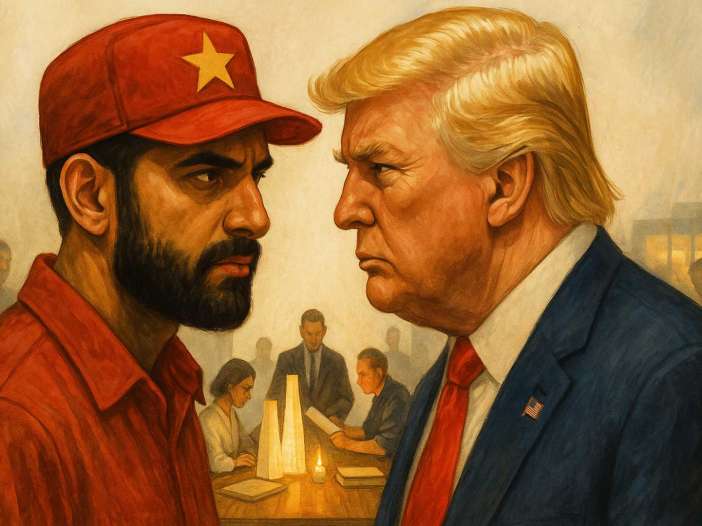
Donald Trump and Zohran Mamdani could not be more different — in temperament, in vision, in method. Yet both are animated by conviction, both believe they serve a moral purpose, and both are products of a culture that has forgotten how to speak across its fractures.
Power and belief are dangerous companions. Faith can inspire the noblest acts of leadership, but it can also sanctify cruelty. Justice can elevate the powerless, but it can also become tyranny in moral disguise.
And so the question before us is not who is right, but how can two men who see the world through opposite lenses find something approximating truth between them?
In this dialogue, I am not a referee but a witness — not to their arguments, but to their humanity.
For if civilization is to endure, we must remember that disagreement is not desecration. It is the friction by which ideas are sharpened and souls are tested.
When conviction meets humility, something miraculous happens: power turns into responsibility, and belief becomes service.
That, I think, is the path back to meaning — not through dominance or submission, but through dialogue conducted in good faith.
(Note: This is an imaginary conversation, a creative exploration of an idea, and not a real speech or event.)
Topic 1: Faith and the Moral Core of Leadership
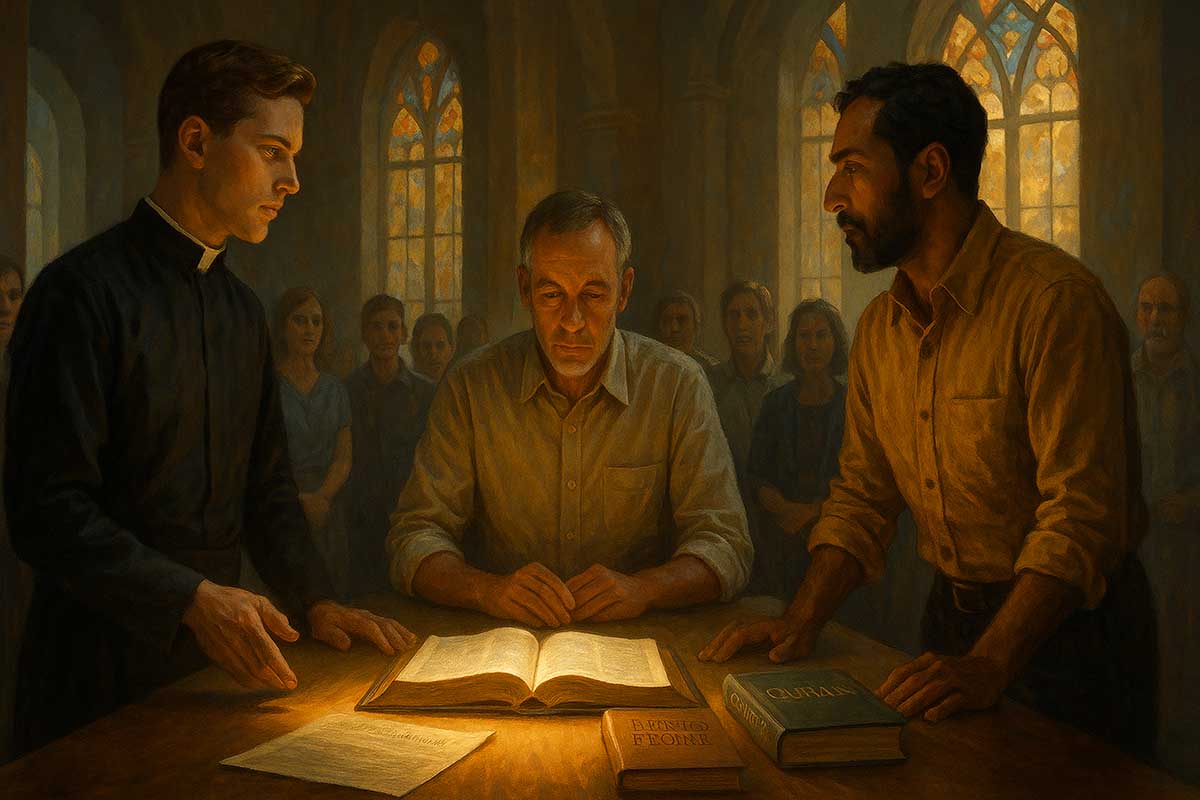
Setting:
A quiet conference room in New York’s City Hall. Late afternoon light filters through tall windows. The noise of the city hums faintly beyond the glass — sirens, laughter, traffic — the living sound of the people both men claim to serve.
At the table sit President Trump, confident yet watchful, and Mayor Mamdani, calm but intense. Dr. Jordan Peterson leans forward, hands folded, his voice deliberate, almost surgical in tone.
Question 1 – Faith and Power: How Do You Lead Morally Without Turning Morality Into Control?
Jordan Peterson:
“Gentlemen, both of you root your leadership in moral conviction — one in Christian faith, the other in social justice. Yet history shows that when belief fuses with power, it easily becomes tyranny. How do you lead morally without turning morality itself into control?”
Donald Trump:
“Well, Jordan, you’re right — faith and power, they can be dangerous together. But I think of it like business — you need strength, or people walk all over you. I’m a Christian, a strong one, and I believe God gives us responsibility, not just comfort.
But you can’t lead by lecturing people on morality. People want results. You show your faith by doing. By protecting your country, by defending life, by standing with Israel — because that’s right in God’s eyes.
When I led, I didn’t tell people how to pray. I made sure they could. That’s freedom — that’s moral leadership.”
Zohran Mamdani:
“I appreciate that, Mr. President, but for me, faith isn’t about protecting what we already have — it’s about expanding who gets to belong.
I’m a Muslim, but my politics aren’t about theology. They’re about the sacred idea that dignity isn’t negotiable. When I speak about justice, I’m not imposing morality — I’m inviting society to remember its conscience.
The danger isn’t faith in politics. It’s hypocrisy in power. When faith becomes a shield for greed or nationalism, it betrays both God and people.”
Jordan Peterson:
“So perhaps morality without humility becomes tyranny — and humility without courage becomes uselessness. You’re both circling the same paradox: how to be righteous without becoming self-righteous.”
Question 2 – The Moral Purpose of Success
Jordan Peterson:
“Mr. Trump, you’ve built a life on creating wealth and competition. Mr. Mamdani, you’ve built yours on redistributing opportunity. Both claim moral ground. So I ask — what is the moral purpose of success? Is it freedom, or is it service?”
Zohran Mamdani:
“Success, to me, is measured by the distance between our principles and our policies.
Freedom without fairness isn’t freedom — it’s privilege dressed up as merit.
I represent a city where millions work two jobs and still can’t afford rent. Success, in that context, means using power to close that distance — to make the moral imagination of equality something tangible.
Service isn’t charity. It’s justice in action. My moral duty isn’t to make everyone rich; it’s to make sure no one is disposable.”
Donald Trump:
“You know, that sounds good, but it’s not how the world works. Look — if everyone’s equal, no one’s excellent. You need winners, you need people who drive the engine.
Success is about building something — jobs, buildings, a country — and doing it bigger and better. That’s how you serve. You make people proud again.
When I became president, people had hope again. That’s moral. It’s not about handouts; it’s about belief. God blesses effort. And when people succeed, they give back naturally. That’s America. That’s freedom.”
Jordan Peterson:
“What I hear from both of you is a vision of meaning.
Mr. Mamdani, you speak of justice as service; Mr. Trump, of excellence as moral contribution.
Perhaps success, at its highest level, is responsibility — to something beyond the self.
The disagreement lies in whether responsibility is best expressed through solidarity or strength.”
Question 3 – Order vs. Compassion: The Paradox of Civilization
Jordan Peterson:
“Every civilization walks a tightrope between order and compassion. Too much order — tyranny. Too much compassion — chaos. Where, then, should a society like New York, or America itself, draw that line?”
Donald Trump:
“You need order. Period. That’s why people loved what we did — law and order. It’s in the Bible too. God is not a God of confusion.
You can’t have compassion if you don’t have stability. You start with law, safety, strength. Then you can be kind.
The problem today? We have too much weakness pretending to be kindness. You can’t run a city — or a country — on guilt.
People respect rules. And when you enforce them fairly, you protect everyone.”
Zohran Mamdani:
“Order without compassion becomes cruelty.
Yes, law matters, but justice isn’t static — it grows. The same laws that once protected power now must protect people.
If you look at the subway, the shelters, the working families — order to them means access, not punishment.
We need compassion not as softness, but as strategy — a way to prevent the desperation that breeds disorder in the first place.”
Jordan Peterson:
“So the question isn’t order or compassion — it’s which must come first.
Mr. Trump believes chaos ends where rules begin.
Mr. Mamdani believes chaos ends where despair ends.
Both are right — but neither can stand alone.
A society that enforces law without empathy breeds resentment. A society that grants empathy without discipline breeds decay.
And perhaps the art of leadership is knowing when to be merciful — and when to be immovable.”
[Silence falls briefly.]
The three men sit quietly as the sounds of New York drift in again — horns, laughter, the faint rhythm of construction. The city keeps moving, indifferent to the arguments above it.
Jordan Peterson (softly):
“In the end, moral leadership might be less about controlling others and more about governing one’s own soul — and seeing that struggle reflected in the millions we lead.”
Donald Trump (nodding):
“Strong point. You win from the inside first.”
Zohran Mamdani (smiling faintly):
“Or not at all.”
Topic 2: Wealth, Ambition, and the Meaning of Success

Setting:
The same City Hall conference room, but dusk has fallen. The skyline beyond the windows glows amber and steel-blue. The hum of the city has deepened — taxis, sirens, and the distant rumble of trains. The conversation has grown more intimate, less political, more human.
Question 1 – Is Wealth the Measure of a Life Well Lived, or Merely a Side Effect of Serving Others Effectively?
Jordan Peterson:
“Gentlemen, let’s start with something foundational. Both of you have built public lives around the idea of success — one through accumulation, the other through redistribution. But I wonder, is wealth itself the measure of a life well lived, or merely a side effect of serving others effectively?”
Donald Trump:
“I’ve always said — success isn’t about the money, it’s about the scoreboard. You build, you win, you prove something. Money is just how you keep track.
When I built towers, people got jobs. When I became president, people got hope. That’s service, even if it doesn’t sound humble.
But let’s not pretend money is evil. People want to provide for their families, they want to dream big. The Bible says the worker deserves his wages — not to apologize for them.
If you make wealth honestly and use it well — to create jobs, to keep America strong — then it’s a blessing, not a burden.”
Zohran Mamdani:
“I think the danger comes when wealth becomes an end instead of a tool.
In this city, I see billionaires who own ten apartments, and families who can’t afford one. That’s not blessing; that’s imbalance.
To me, wealth is meaningful only if it’s shared. Not because I resent success — but because I believe success, by definition, should expand dignity, not concentrate it.
If one person’s gain depends on another person’s poverty, that’s not a successful society. That’s a clever failure.”
Jordan Peterson:
“Interesting. Mr. Trump speaks of creation; Mr. Mamdani of correction.
Perhaps both are incomplete without the other — creation without conscience becomes greed; conscience without creation becomes impotence.
The question may not be how much wealth one has, but whether it multiplies meaning.”
Question 2 – When Does Ambition Transform from Virtuous Striving into Destructive Greed?
Jordan Peterson:
“Ambition can drive greatness — or it can devour it.
Mr. Trump, you’ve often been accused of hubris; Mr. Mamdani, of utopian idealism. So let me ask — when does ambition transform from virtuous striving into destructive greed?”
Zohran Mamdani:
“When ambition stops serving others and starts demanding applause, it’s already become greed.
For me, ambition is collective — to raise the standard of living, to make the city fairer.
But there’s a temptation even there — to believe that moral ambition can’t corrupt. It can. When you start thinking your vision is infallible, you stop listening.
So the discipline is humility. The goal isn’t to be right — it’s to be useful.”
Donald Trump:
“You know, Jordan, I hear that and I get it — but people need ego. You can’t build anything without believing you’re the best. That’s not arrogance; that’s confidence.
Greed? That’s when you take and don’t give back. I built things that gave people jobs, families, pride — that’s not greed.
And frankly, the country could use more ambition. The problem today isn’t too much ego — it’s too much apology. Nobody wants to win anymore. And if you don’t want to win, you can’t help anyone.”
Jordan Peterson:
“There’s truth in both views.
Ambition, in its highest form, is sacrificial — it demands order, focus, and restraint.
But at its worst, it’s narcissism disguised as mission.
The line between the two isn’t clear — and perhaps that’s why every great leader walks close to the edge.”
Question 3 – If Equality Requires Limiting Gain, and Freedom Allows Inequality to Grow, Which Is More Moral — the Fair System or the Free One?
Jordan Peterson:
“This is the paradox at the heart of your politics.
Mr. Trump, your philosophy prizes freedom — the right to rise as high as you can.
Mr. Mamdani, yours demands fairness — to lift those left behind.
But these values often conflict. If equality requires limiting gain, and freedom allows inequality to grow, which is more moral — the fair system or the free one?”
Donald Trump:
“Freedom, no question. Because once you start limiting success, you kill motivation. You tell people, ‘Don’t try too hard.’ That’s not moral, that’s misery.
The Bible says talents were given to be used, not buried. You don’t punish the man who multiplies his gift; you reward him.
That’s how America works — not by making everyone equal, but by giving everyone a chance.
And when people do succeed, you don’t take their reward; you take pride in it.”
Zohran Mamdani:
“I don’t think equality and freedom are enemies. I think inequality is the enemy of freedom.
When people can’t afford housing, can’t afford education, can’t afford healthcare — that’s not freedom, that’s survival.
A system that lets a few rise while the rest sink isn’t free — it’s rigged.
True fairness doesn’t limit ambition; it makes ambition accessible.
So the moral society is one where the dream of freedom is shared, not hoarded.”
Jordan Peterson:
“So, again, you define freedom differently.
Mr. Trump sees it as the right to rise without restraint.
Mr. Mamdani sees it as the ability to rise at all.
The truth, I suspect, is that a society dies when either principle triumphs alone.
If it becomes only free, it becomes unjust. If it becomes only fair, it becomes lifeless.
The moral civilization is one that keeps both principles in tension — freedom with mercy, fairness with fire.”
[A pause.]
The room is dim now. The city’s lights flicker like stars inverted onto glass. For a moment, none of them speak.
Zohran Mamdani (quietly):
“Maybe the goal isn’t to win, but to widen the circle of those who can.”
Donald Trump (half-smiling):
“And maybe the circle only gets bigger if someone’s willing to draw it first.”
Jordan Peterson (nodding slowly):
“Yes… perhaps success is not what we have, but what we sustain — in ourselves, and in others.”
Topic 3: Nationhood, Borders, and the Question of Belonging
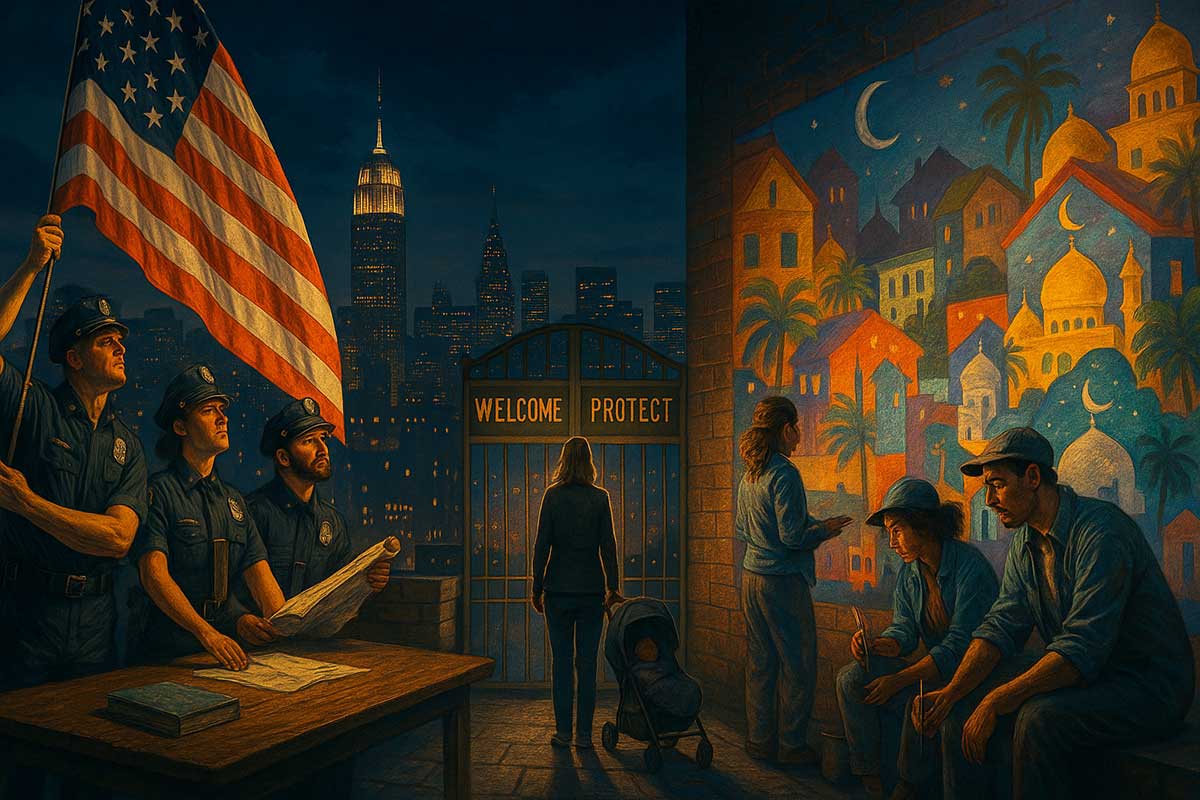
Setting:
Night has settled outside City Hall. Manhattan glows beneath a low, restless sky. The sound of distant traffic hums like a tide. Inside, the three men sit closer now — the earlier sparring softened into a kind of mutual curiosity. Coffee cups steam between them.
Question 1 – Patriotism Gives Identity, but Can Also Exclude. How Do We Love Our Own Without Hating the Other?
Jordan Peterson:
“Both of you speak of love — love of country, love of people, love of justice. Yet history shows that when we love narrowly, that love can curdle into hatred.
Patriotism can inspire greatness or division. How do we love our own without hating the other?”
Donald Trump:
“Well, first of all, loving your country doesn’t mean you hate anyone else. It means you take care of your own — that’s what leaders are supposed to do. You put America first because if America collapses, the world follows.
People call that nationalism; I call it responsibility. You can’t take care of others if your own house is burning.
The Bible says love your neighbor — but it doesn’t say bankrupt yourself doing it. You build strength first, then you help. That’s how real compassion works — from power, not guilt.”
Zohran Mamdani:
“Mr. President, I think love of one’s country is noble — but I also think it’s incomplete if it ignores who built that country.
New York was made by immigrants — workers, refugees, dreamers. To love this city means loving its diversity, not fearing it.
For me, patriotism isn’t about exclusion. It’s about care — making sure every person, regardless of where they’re from, feels seen, protected, and valued.
I don’t see America as a fortress. I see it as a covenant — a promise renewed every generation to keep the door open a little wider.”
Jordan Peterson:
“Both of you define love through responsibility.
Mr. Trump — to protect one’s own first.
Mr. Mamdani — to protect the vulnerable within that ‘own.’
The tension, it seems, lies in how large we allow that circle of belonging to become before it loses its coherence.”
Question 2 – Can a Society Function Without Boundaries — Moral, Cultural, or Physical?
Jordan Peterson:
“Let’s press deeper.
Mr. Trump defends borders; Mr. Mamdani defends openness. But all functioning systems — even the human body — require boundaries.
Can a society truly function without them, moral, cultural, or physical?”
Zohran Mamdani:
“Boundaries matter — but they must breathe.
A border that protects life is moral. A border that hoards privilege is not.
I don’t believe in chaos or open borders; I believe in compassionate structure.
We need rules, but we also need to remember that people cross borders not to invade, but to survive.
When a refugee knocks, a moral society answers.
Boundaries should define responsibility — not excuse indifference.”
Donald Trump:
“Look, that’s beautiful — but it doesn’t work in real life. You open the gates, and you lose the country.
We need borders. Without them, you don’t have a nation; you have a hotel. And someone always ends up paying the bill.
I built walls, yes — but I also built systems that protected jobs, safety, identity. People need to feel their home is theirs.
You can be kind — but you can’t be naive. Boundaries aren’t cruelty; they’re civilization.”
Jordan Peterson:
“So perhaps a border isn’t just a wall — it’s a mirror. It shows what a nation values and what it fears.
Mr. Mamdani sees fear as a failure of empathy; Mr. Trump sees empathy without fear as a failure of wisdom.
A moral border might be one that defends integrity without denying humanity.”
Question 3 – Is There Such a Thing as Too Much Compassion in National Policy?
Jordan Peterson:
“Here’s the paradox. Compassion sounds universally good — but too much of it, without discernment, can destroy the very order that sustains it.
Is there such a thing as too much compassion in national policy?”
Donald Trump:
“Yes, absolutely. Too much compassion is chaos.
You give everything away, and pretty soon you’ve got nothing left to give. That’s what’s happening in these cities — people saying yes to everything, no rules, no limits.
God wants us to love, but also to protect. Look at Jesus — he forgave, but he also flipped tables. There’s a balance.
Without strength, compassion becomes weakness. You can’t feed the world if your own table’s empty.”
Zohran Mamdani:
“I think compassion without structure is sentiment, not justice.
But I also think we underestimate how much order compassion creates.
When people feel seen and supported — when their basic needs are met — they contribute, they stabilize society.
It’s not softness; it’s sustainability.
The problem isn’t too much compassion; it’s too little imagination about how to apply it effectively.”
Jordan Peterson:
“So the excess of compassion is chaos, and the absence of it is cruelty.
One collapses the system through indulgence; the other corrodes it through indifference.
Civilization survives by negotiating between those two abysses — mercy that doesn’t weaken, and order that doesn’t harden.”
[A long pause follows.]
Outside, sirens wail faintly, blending with the rustle of wind through scaffolding. The city never stops testing its own limits.
Jordan Peterson (softly):
“Maybe the true border isn’t on the map.
It’s the line within us — between the fear that builds walls and the love that opens doors.”
Donald Trump (leaning back):
“Strong doors, Jordan. You can’t open them if they’ve already fallen down.”
Zohran Mamdani (with a small smile):
“And yet, if no one ever opens them, what’s the point of having them at all?”
Jordan Peterson (closing his notebook):
“Then perhaps the answer is paradox itself:
To love deeply enough to defend, and to defend wisely enough to still love.”
Topic 4: Israel, Palestine, and the Covenant of Justice
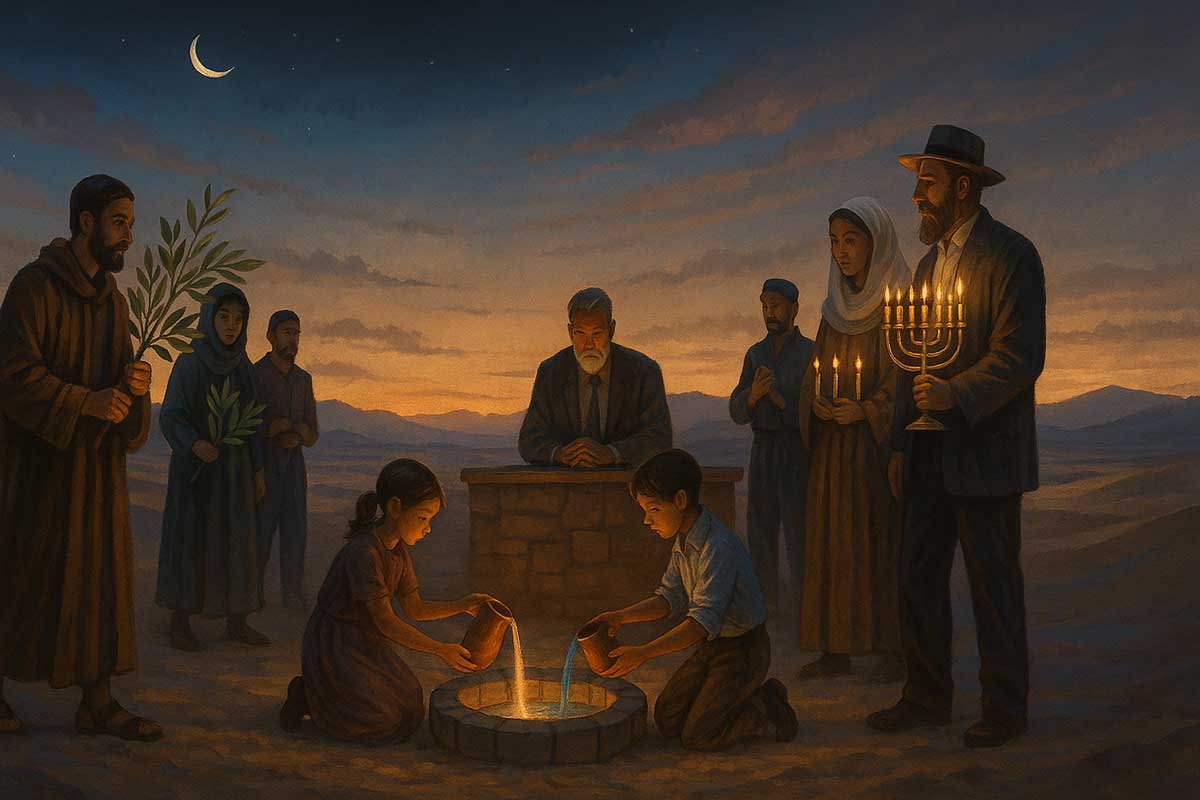
Setting:
The air in the City Hall chamber feels heavier now. The hum of the city outside has quieted into night. Through the windows, the distant skyline glitters like constellations over dark water — and somewhere within that vastness, history itself seems to listen.
Jordan Peterson leans forward, his voice measured, carrying both weight and gentleness.
Question 1 – Can Absolute Morality Exist on Both Sides of a War?
Jordan Peterson:
“This question reaches beyond politics into the heart of human tragedy.
Both of you see the Israeli–Palestinian conflict through moral conviction — one as defense of covenant and survival, the other as defense of dignity and justice.
But can absolute morality truly exist on both sides of a war?”
Donald Trump:
“Well, Jordan, war’s a terrible thing, but sometimes it’s necessary.
Israel has the right — no, the duty — to defend itself. Always has. I’ve been there; I’ve seen it. It’s surrounded by enemies, always attacked, always blamed.
God made a covenant with His people. That means something. You can’t just throw that out because the world’s uncomfortable with it.
Morality doesn’t change just because people get emotional. You protect your people, your land, your faith — that’s moral strength.
I made sure America stood with Israel, and I’m proud of that. It’s loyalty, and loyalty is sacred.”
Zohran Mamdani:
“Mr. President, I believe loyalty is sacred — but so is life.
When loyalty blinds us to suffering, it becomes idolatry.
I’ve walked in neighborhoods where Palestinian children watch their homes disappear. Their mothers bury them under rubble. Are they not also sacred?
I don’t question Israel’s right to exist. I question the world’s ability to see Palestinian humanity as equally divine.
The covenant, to me, isn’t about one people’s protection — it’s about everyone’s redemption. If God’s promise excludes the oppressed, it’s no longer holy.”
Jordan Peterson:
“So we face a terrible symmetry: one side sees covenant as divine obligation, the other as divine equality.
Both claim righteousness — and perhaps both are right, which is what makes this tragedy so enduring.”
Question 2 – If Peace Required Both Israel and Palestine to Give Up Parts of Their Sacred Identity, Would That Peace Still Be Just?
Jordan Peterson:
“Suppose peace required both sides to surrender a piece of their sacred self — their story, their territory, their pride.
Would that peace still be just, or would it simply be another wound disguised as compromise?”
Zohran Mamdani:
“Peace without justice isn’t peace; it’s sedation.
The oppressed are always asked to surrender more than the powerful — to forgive, to forget, to move on. But dignity isn’t negotiable.
Still, I believe compromise is holy if it brings life.
If Palestinians could live free and Israelis could live without fear — that would be justice enough to honor both faiths.
But it must be equality, not hierarchy disguised as harmony.”
Donald Trump:
“You know, I made peace deals — the Abraham Accords — because I believe you can get people to talk if you respect strength.
But peace doesn’t mean everybody gets what they want. It means everybody gets to live.
You don’t erase identity; you protect it.
Israel can’t give up what God gave it. And the Palestinians, they need leadership that loves peace more than power.
You don’t fix the Middle East by weakening Israel. You fix it by strengthening everyone’s respect for it. That’s how peace works — through power, not apology.”
Jordan Peterson:
“So you both equate peace with preservation — but preservation of what?
For Mr. Trump, it’s the preservation of divine promise.
For Mr. Mamdani, it’s the preservation of human equality.
The tension between them may be eternal — and yet, it’s precisely that tension that makes peace sacred.”
Question 3 – How Does One Honor God, or Humanity, in a Conflict Where Every Side Claims Divine Legitimacy?
Jordan Peterson:
“Perhaps the hardest question of all.
How does one honor God — or humanity — when every side claims divine legitimacy?
When every prayer is answered by another’s suffering?”
Donald Trump:
“You honor God by standing firm. Weakness offends Him.
If you believe in something, you fight for it. That’s how you honor faith — not by surrender, but by standing.
And you treat people fairly, you make peace through strength.
But you don’t let evil hide behind the word ‘justice.’ Some people use that word to excuse hate.
I think God blesses those who defend what’s right — not those who give it away for peace that never lasts.”
Zohran Mamdani:
“I honor God by refusing to accept that He plays favorites.
Faith, to me, is the radical belief that every child, Israeli or Palestinian, carries the same spark of the divine.
The idea that one side owns holiness — that’s not faith. That’s fear wearing scripture.
I don’t believe justice comes from vengeance or victory. It comes from compassion strong enough to stop the cycle.
That’s how we honor God — not by choosing sides, but by choosing humanity.”
Jordan Peterson:
“Both of you are wrestling with the same truth from opposite ends — that God demands justice, but justice without mercy becomes cruelty.
Perhaps the true faith is not claiming divine favor, but bearing divine responsibility — the courage to see one’s own side’s sins and still protect its soul.”
[The silence that follows is heavy, like the air before rain.]
Trump folds his hands. Mamdani looks down. Peterson closes his eyes briefly, as if in prayer.
Jordan Peterson (quietly):
“Maybe the holiest ground isn’t the land between them, but the space between certainty and compassion — where both sides kneel, not in defeat, but in recognition.”
Donald Trump (gruffly):
“Well, I still believe strength keeps peace. But I’ll say this — respect matters. Even when you disagree.”
Zohran Mamdani (softly):
“And sometimes, respect is the first miracle we forget to notice.”
Jordan Peterson:
“Then perhaps that’s where covenant begins again — in the smallest miracle: listening.”
Topic 5: Leadership, Ego, and the Burden of Power
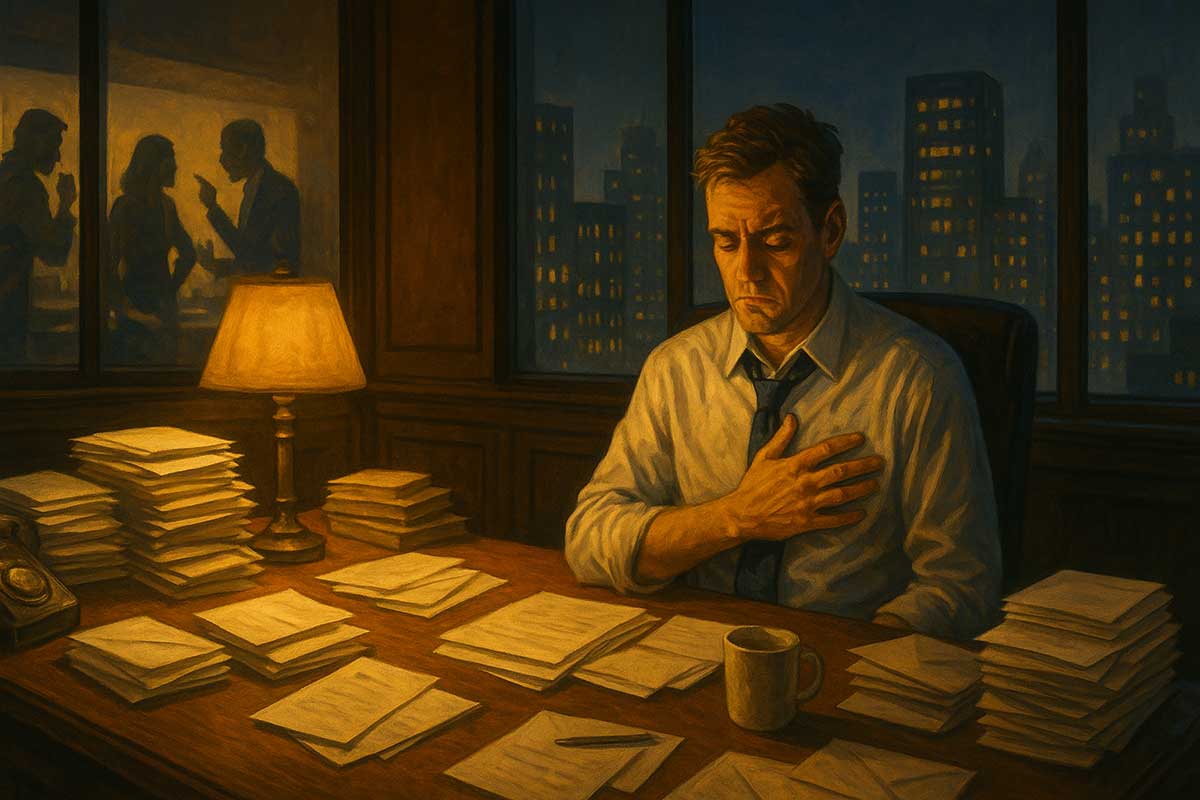
Setting:
It’s past midnight in City Hall. The lights are dimmed, the city outside reduced to a faint pulse of neon. The air feels quieter now — the kind of quiet that invites honesty.
Coffee has gone cold. None of them seem to notice.
Question 1 – How Do You Ensure Your Ego Serves the Office, Not the Other Way Around?
Jordan Peterson:
“Power magnifies the self. It can reveal the best in a person — or the worst.
Both of you have lived inside immense power structures. How do you ensure your ego serves the office — not the other way around?”
Donald Trump:
“Look, Jordan, ego isn’t bad. You need it. Without it, you don’t run for president — you don’t build anything.
The trick is control. You remind yourself it’s not about being loved — it’s about being respected.
When I made decisions, I asked, ‘Is this good for the country?’ Sometimes people hated it — but leadership isn’t therapy.
The office tests you every minute. The moment you start worrying about what people think, you stop winning.
So yes, my ego’s big. But so is my responsibility.”
Zohran Mamdani:
“I think ego is the most seductive lie power tells us — that you are the system, that you alone can fix it.
When I became mayor, I thought moral clarity would be enough. Then came the bureaucracy, the deals, the endless noise.
It’s humbling — or it should be.
Every day I remind myself: this chair isn’t mine. It belongs to the people.
If you forget that, you don’t lead anymore — you rule.”
Jordan Peterson:
“So perhaps ego is like fire. It can forge or destroy, depending on whether you keep it in the hearth or let it roam free.”
Question 2 – Every Great Leader Faces the Temptation of Self-Deification. What Internal Discipline Prevents That?
Jordan Peterson:
“Every leader hears that whisper — that they alone can save, that their vision is destiny.
That’s the temptation of self-deification.
What internal discipline keeps you from believing it?”
Zohran Mamdani:
“For me, it’s failure. Failure is holy.
It reminds you that no vision, however pure, survives reality unscarred.
I’ve learned to listen — to the protester who yells, to the worker who’s tired, to the citizen who just wants rent relief.
When you listen long enough, the illusion of being the savior disappears. You become a servant again.
Discipline isn’t about control. It’s about remembering who you’re accountable to.”
Donald Trump:
“Well, Jordan, I’ll tell you — the media said I thought I was a god. Totally false. I know who God is, and it’s not me.
But you can’t lead if you’re doubting every second. You’ve got to believe you’re chosen for the job.
I prayed. I asked for wisdom, not weakness. That’s discipline.
You trust God, you trust your gut, and you keep moving forward.
People call that ego; I call it faith in purpose.”
Jordan Peterson:
“Faith and humility — both are disciplines, though they work in opposite directions.
Perhaps true leadership is walking precisely between them — confidence without delusion, surrender without defeat.”
Question 3 – How Do You Measure Your Success: By What You Built, or By Who You Became While Building It?
Jordan Peterson:
“In the end, we all face the mirror.
Do you measure success by what you built — towers, policies, legacies — or by who you became while building them?”
Donald Trump:
“I built a lot. I’m proud of that — real things: hotels, jobs, a strong economy. Those don’t vanish.
But who I became? — that’s harder. You get hit from every side, betrayed by people you trusted.
It changes you.
I’d say success is surviving it without losing belief.
If I could do it again, maybe I’d listen more — but I wouldn’t apologize for being bold. You can’t lead the world by whispering.”
Zohran Mamdani:
“I think the legacy that matters isn’t what stands when you’re gone — it’s what continues without you.
I don’t want monuments; I want systems that outlast ego.
When a single mother sleeps safely, when a kid finds hope in public school — that’s the real architecture of leadership.
What I built matters less than what I became — and I hope I became less certain, more human.”
Jordan Peterson:
“Then perhaps success is not what endures in stone, but what endures in conscience.
Buildings crumble. Laws change.
But the person shaped by service — that, if anything, touches eternity.”
[Long silence.]
A clock ticks somewhere in the hall. The city outside exhales its endless rhythm.
Jordan Peterson (softly):
“The burden of power is not just the cost of decisions — it’s the weight of becoming what your choices make of you.”
Donald Trump (quietly):
“Power shows you who you really are.”
Zohran Mamdani:
“And if you’re lucky, it gives you time to change who that is.”
Jordan Peterson (closing his notes):
“Then maybe redemption, not perfection, is the true measure of leadership.”
The three men sit in silence, no longer adversaries, but fellow travelers on the narrow road between conviction and humility.
Final Thoughts by Dr. Jordan B. Peterson
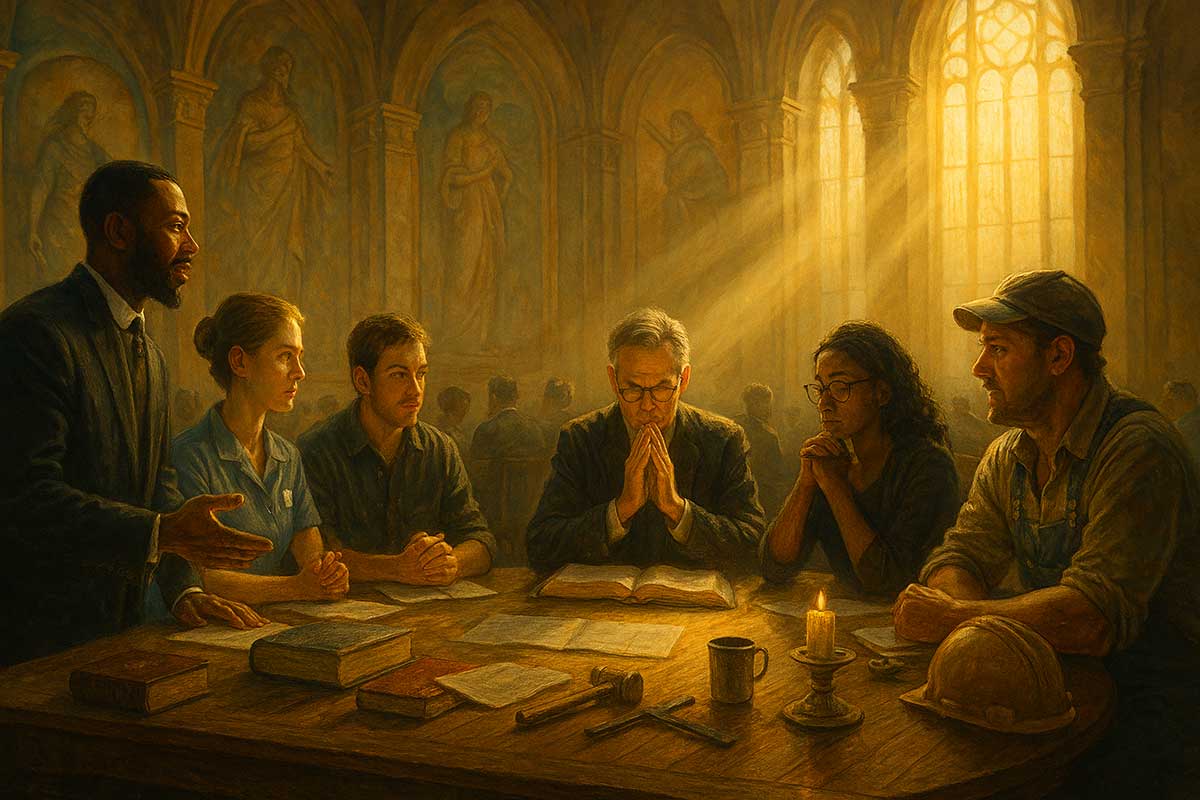
There’s an ancient idea that every great empire collapses first in spirit, not in stone.
When leaders forget that they are servants of something higher than themselves — when ideology replaces humility — the center cannot hold.
In these conversations, I saw something rare: two men arguing not merely for victory, but for meaning.
President Trump believes that strength and order preserve civilization.
Mayor Mamdani believes that compassion and justice redeem it.
Both are right — and both are wrong — for either without the other turns into its shadow.
Strength without mercy becomes tyranny. Mercy without structure becomes decay.
Every generation must relearn this balance, and every leader must rediscover it within himself.
The true burden of power is not the decisions you make, but the person you become while making them.
And the mark of a civilization worth saving is not the absence of conflict — but the presence of those willing to sit together, in honesty, despite it.
Perhaps that is what faith, rightly understood, demands of us: not blind certainty, but courageous conversation.
Not domination, but discernment.
Not the arrogance of the saved, but the humility of those still seeking salvation.
If even for a moment these two men — so divided in their visions — could find a shared truth in the space between their convictions, then perhaps there is hope for the rest of us.
And that, I suspect, is where the future begins.
Short Bios:
Dr. Jordan B. Peterson is a Canadian psychologist, author, and lecturer known worldwide for his work on meaning, responsibility, and the moral foundations of civilization. Formerly a professor of psychology at the University of Toronto, he rose to prominence through his lectures on the archetypal patterns of myth and the psychology of belief.
Peterson’s work bridges theology, philosophy, and science, urging individuals to confront chaos with courage and to find order without tyranny. In this dialogue, he serves as both mediator and mirror — challenging each leader to find truth not in dominance, but in discernment.
Donald J. Trump, the 45th and 47th President of the United States, is a businessman, author, and political leader whose populist movement reshaped the modern conservative landscape. Known for his unapologetic nationalism, outspoken defense of Christianity, and steadfast support of Israel, he remains a polarizing yet defining figure of American identity.
For Trump, power is stewardship, faith is strength, and success is proof of purpose. In this conversation, he represents the archetype of order — the belief that civilization survives through discipline, loyalty, and divine mission.
Zohran K. Mamdani is an Indian-Ugandan-born, Queens-based organizer and politician who rose from grassroots activism to the office of New York City Mayor. A democratic socialist and advocate for tenants’ rights, immigrant protection, and economic justice, he embodies a new wave of progressive leadership rooted in moral conviction and human equality.
For Mamdani, politics is faith in action — a constant attempt to reconcile compassion with pragmatism. In this dialogue, he stands as the archetype of renewal — the voice that believes justice is not preserved by order, but by empathy powerful enough to rebuild it.
Leave a Reply