
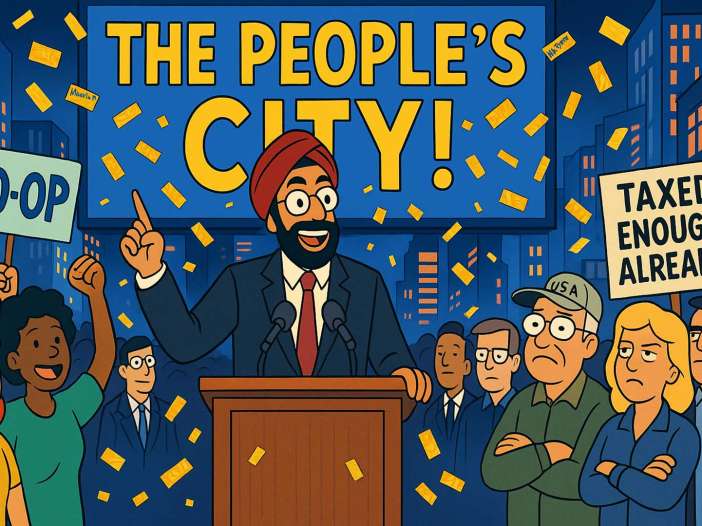
Introduction — by Nick Sasaki
(Spotlight fades in on Nick at a vintage SNL-style news desk. The skyline of New York glows behind him in exaggerated golds and yellows, like the city’s had one too many espresso shots.)
Nick Sasaki:
“Good evening, New York — or should I say, comrades of caffeine and co-ops.
Tonight, we enter a parallel universe where Zohran Mamdani, the Bronx-born democratic socialist with the swagger of a barista and the vocabulary of a poet, becomes mayor. For eight years, the city of ambition turns into the city of intention — where every latte is fair trade, every landlord must explain themselves in song, and public policy comes with a punchline.
We’ll follow this People’s City through its phases — from the first optimistic espresso shot of reform to the jittery hangover of governance. Along the way, we’ll meet the baristas-turned-legislators, the accountants-turned-activists, and the councilmembers-turned-therapists.
This isn’t dystopia or utopia. It’s New Yorktopia — a city where the potholes are patched with good intentions, and the subway delays are labeled “collective patience training.”
Welcome to the Mamdani era — where hope rides the A train and cynicism has to pay extra for peak hours.”
(Cue jazz sting, applause, and a camera zoom to the digital banner: “Live from New York — It’s the People’s City!”)
(Note: This is an imaginary conversation, a creative exploration of an idea, and not a real speech or event.)
Topic 1 — Public Safety: “Compassion vs. Control”

Setting:
A polished Manhattan studio, somewhere between Crossfire and Saturday Night Live. Behind the panelists glows a light-up skyline of New York City. Coffee mugs, microphones, and exhausted optimism line the desk.
Participants: Nick Sasaki (Moderator), Zohran Mamdani, Evelyn Grant, Rabbi David Klein, Dr. Lila Moreno, and Tom Bradley.
Scene Opens
Nick Sasaki (smiling):
Welcome back to The People’s City Roundtable. Tonight’s first topic: Public Safety — Compassion vs. Control.
Zohran Mamdani’s imagined mayorship has divided dinner tables from Queens to Staten Island. Can a city built on empathy still enforce order — or will it turn into a therapy session with sirens?
(The audience laughs; the camera pans to Zohran, who grins but looks ready for a fight.)
Question 1: Can empathy keep a city safe?
Evelyn Grant (leaning forward):
Let’s be real, Nick. Safety isn’t optional. You can’t substitute hugs for handcuffs. When progressive mayors defund or demoralize police, ordinary people pay the price — especially in working-class neighborhoods.
Zohran Mamdani:
Evelyn, nobody’s saying “no police.” We’re saying new purpose. Safety should mean you don’t just survive the night — you live with dignity the next day. That means jobs, housing, and mental health support. If your system relies on punishment, it’s already failing.
Tom Bradley:
That’s poetic, Zohran. But the guy stealing my catalytic converter isn’t looking for a therapy appointment. He’s looking for my muffler.
(Audience chuckles.)
Dr. Lila Moreno:
Actually, Tom, data shows crime correlates with poverty, not leniency. Give people stability, and you reduce desperation. Policing alone is like mopping the floor while the pipe’s still leaking.
Rabbi David Klein (nodding):
I agree that dignity matters — but so does deterrence. In Jewish tradition, justice requires balance. Mercy without structure becomes chaos. People in my community — especially seniors and synagogue-goers — worry that the pendulum is swinging too far. We’ve seen an increase in anti-Semitic incidents. They want empathy and enforcement.
Zohran Mamdani (softly):
And they deserve both. My approach doesn’t abandon the rule of law — it broadens what “law” means. Safety isn’t just about who’s arrested, it’s about who’s safe enough not to commit the crime in the first place.
Evelyn Grant:
That sounds lovely, but if you hesitate to prosecute offenders, crime doesn’t wait for philosophy. It grows.
Nick Sasaki:
So we’ve got Evelyn defending control, Zohran pushing compassion, and Rabbi Klein trying to keep the moral compass upright. If empathy and order are two rails — who keeps the train from derailing?
(Camera cuts to a wide shot. The skyline backdrop flickers like a heartbeat.)
Question 2: What happens when police lose authority — or trust?
Tom Bradley:
New York’s police force already feels vilified. Under a Mamdani administration, they’d need a support group just to write parking tickets.
Zohran Mamdani:
No, Tom. They’d need purpose. Police should be first responders, not last resorts. I’d rather they prevent harm than perpetuate it. That means de-escalation training, mental health units, and body cams that don’t mysteriously turn off when accountability starts.
Evelyn Grant:
So you’ll turn cops into social workers — and expect criminals to wait patiently for their counseling session?
Dr. Lila Moreno:
Evelyn, nobody’s suggesting turning precincts into yoga studios. But right now, we ask police to solve everything — addiction, homelessness, mental illness. They’re overwhelmed and underprepared. We can reduce that burden while strengthening public safety.
Rabbi David Klein:
Trust is fragile. When Jewish neighborhoods see police pull back after criticism, they feel abandoned. When others see officers act without restraint, they feel endangered. Both experiences are valid. We need presence without oppression.
Zohran Mamdani:
That’s exactly the goal. The NYPD shouldn’t feel like an occupying force or a ghost. They should be partners. Accountability builds trust — and trust saves lives.
Tom Bradley:
Until your “partners” hesitate in the field because they’re terrified of being the next viral video. There’s a reason crime spikes when enforcement drops — deterrence works because consequences exist.
Nick Sasaki:
So, trust versus authority — it’s like a see-saw where one side always feels heavier. Can New York really balance it?
(He glances toward the live audience, half of whom nod solemnly while the other half applauds Mamdani’s optimism.)
Question 3: What does “safe” mean for different communities?
Nick Sasaki:
Let’s talk perspective. Rabbi Klein, you mentioned anti-Semitic attacks. Many Black and Muslim New Yorkers feel similar vulnerability. How does a mayor build a city that feels safe for everyone?
Rabbi David Klein:
By acknowledging fear without hierarchy. When Jewish families see hate crimes rise, they fear invisibility. When others see systemic injustice, they fear profiling. The tragedy is — both are right.
Zohran Mamdani:
Exactly. Real safety isn’t uniform — it’s contextual. My administration would invest in community patrols, hate-crime hotlines, and cross-cultural dialogues. Not performative “unity,” but shared guardianship.
Evelyn Grant (skeptical):
Shared guardianship? Sounds like group project government — and we all know how those end. Someone does all the work while others take credit.
(Audience laughs.)
Dr. Lila Moreno:
Yet we’ve tried the opposite — command and control — and that didn’t make everyone safer either. Public safety must be localized. When communities help shape policing, they protect themselves better.
Tom Bradley:
Or they turn every incident into a debate club. You can’t crowdsource crime prevention. Sometimes, you just need the guy with the badge to say, “Stop.”
Zohran Mamdani:
And that guy should be trusted when he says it. That’s the point. Community engagement isn’t weakness — it’s legitimacy. When people co-own the system, they cooperate with it.
Rabbi David Klein (thoughtful):
There’s a Hebrew phrase — tikkun olam — repairing the world. It’s about responsibility through empathy. Maybe that’s what we’re really discussing. Not whether compassion weakens control, but whether it strengthens humanity.
(Silence falls for a moment. Even Tom Bradley looks contemplative.)
Closing Reflection
Nick Sasaki (leaning back):
So tonight, we didn’t solve crime — but we did identify the two emotions that fuel every New Yorker: fear and hope. Evelyn fears losing order. Zohran hopes compassion can replace coercion. Rabbi Klein reminds us both emotions are sacred — because they mean we still care enough to argue.
(The skyline behind them fades into soft amber light. The music cue swells faintly.)
Nick Sasaki (smiling to camera):
Coming up next — can you fund a socialist city without maxing out your moral credit card? Stay tuned for Topic 2: The Price of Fairness.
Cue theme music. Applause.
Topic 2 — Fiscal Reality: “The Price of Fairness”

Setting:
Same studio. Tonight’s prop: a glowing digital billboard behind the guests reads “MATH vs. MORALITY.” Piled high on the desk are color-coded budget binders, a stack of MetroCards, and one lonely calculator smoking faintly.
Cast: Nick Sasaki (moderator), Zohran Mamdani, Evelyn Grant, Rabbi David Klein, Dr. Lila Moreno, and Tom Bradley.
Question 1 – Can the city afford compassion?
Nick Sasaki:
Zohran, your vision sounds beautiful, but spreadsheets don’t run on dreams. How do you pay for it?
Zohran Mamdani:
By re-prioritizing what we already spend. New York’s richest 1 percent hold more wealth than forty U.S. states combined. A modest wealth duty, public bank lending, and smarter procurement could fund transit, childcare, and housing without cutting corners on dignity.
Evelyn Grant:
Or without any numbers that add up. Every progressive plan starts as “modest” until the bill arrives. Then you’re taxing middle-class teachers to keep your utopia caffeinated.
Tom Bradley:
Right — call it what it is: emotional accounting. You can’t pay for ideals with Instagram likes.
Dr. Lila Moreno:
Actually, moral investment yields economic returns. Cities that expand childcare see higher workforce participation. Public health cuts ER costs. Equality is fiscal policy in slow motion.
Rabbi David Klein:
Both of you are correct — and incomplete. Jewish charities survive on balanced ledgers and balanced hearts. When finances crumble, compassion collapses with it. Justice needs solvency.
Zohran Mamdani:
Which is why transparency’s key. Every dollar traceable, every contract public. Fairness isn’t free, but secrecy is what really bankrupts us.
Nick Sasaki:
So — we’ve confirmed that morality costs money, and cynicism costs souls. Excellent start.
(Audience laughter.)
Question 2 – Who should pay for equality?
Nick Sasaki:
The eternal question — who foots the bill?
Evelyn Grant:
Those who use the services. You ride the bus? Pay the fare. You rent the apartment? Honor the lease. Progressive taxation punishes productivity and drives it away.
Tom Bradley:
Exactly. Capital flight isn’t a metaphor; it’s a JetBlue boarding group.
Zohran Mamdani:
Funny, because that same capital hasn’t fled subsidies. Billion-dollar developers cash city checks with both hands. If we can afford corporate welfare, we can afford child welfare.
Dr. Lila Moreno:
And wealth concentration strangles innovation. Equality isn’t redistribution; it’s reinvestment. Healthy communities produce better consumers and safer streets — that’s ROI conservatives should love.
Rabbi David Klein:
But resentment is dangerous fuel. If the upper-middle class feels punished for staying, they leave; if the poor feel abandoned, they revolt. A just tax policy must preserve trust, not just collect revenue.
Evelyn Grant:
Amen — from your lips to City Hall’s spreadsheets.
Nick Sasaki:
So maybe “who pays” isn’t the right question. Maybe it’s “who stays.”
(Camera zooms on Zohran, who grins but doesn’t disagree.)
Question 3 – When budgets tighten, who gets protected?
Nick Sasaki:
Rabbi Klein, many faith-based schools and nonprofits rely on predictable funding. What happens to them when progressive spending peaks?
Rabbi David Klein:
Instability scares donors. If government help arrives like weather — unreliable and dramatic — we can’t plan long-term care for families, seniors, or the poor. Even charity needs consistency.
Zohran Mamdani:
I’d structure multi-year funding for essential nonprofits, especially those serving marginalized groups. Predictability is equity.
Evelyn Grant:
Until revenue drops. Then guess who gets cut first? The programs with the least political muscle. It’s the cycle of good intentions → debt → austerity → anger → Republican mayor.
(Audience laughter and a few cheers.)
Tom Bradley:
History repeats because math doesn’t lie. You can rename the deficit “solidarity,” but the bond market doesn’t speak poetry.
Dr. Lila Moreno:
True — but bond markets also crave stability. If progressive policy builds social cohesion, investors see reliability, not risk. Fiscal prudence and fairness aren’t opposites; they’re codependent.
Rabbi David Klein:
Exactly. In Hebrew we say chesed ve’emet — loving-kindness and truth. Compassion without truth is chaos; truth without compassion is cruelty. A city must honor both.
Zohran Mamdani:
Then let’s redefine solvency: not the absence of debt, but the presence of purpose.
(Soft applause. Tom rolls his eyes, but even he’s smiling.)
Closing Reflection
Nick Sasaki (leaning back):
So tonight we learned the hardest equation in politics — how to add empathy without subtracting sense.
Evelyn wants a calculator.
Zohran wants a conscience.
Rabbi Klein wants both balanced on the same line.
New York’s fiscal future might depend on whether we can price justice without discounting it.
*(The skyline backdrop fades from “MATH vs. MORALITY” to a single word glowing in blue neon: “BALANCE.”)
Nick Sasaki:
Up next — can capitalism survive compassion? Topic 3: Business & Innovation — Who Really Builds the City?
Cue music. Applause.
Topic 3 — Business & Innovation: “Who Really Builds the City?”

Setting:
Same studio, but tonight the digital backdrop glows with a moving skyline of construction cranes and stock tickers. A banner reads “ENTERPRISE OR EQUALITY?”. On the desk: coffee cups, a half-eaten bagel, and a tiny LEGO model of a skyscraper with a “Co-Op” flag taped to the top.
Cast: Nick Sasaki (moderator), Zohran Mamdani, Evelyn Grant, Rabbi David Klein, Dr. Lila Moreno, and Tom Bradley.
Question 1 – Can entrepreneurship survive in a socialist city?
Nick Sasaki:
Zohran, critics say your policies would suffocate small businesses under red tape and taxes. You call it fairness — they call it economic asphyxiation. Can entrepreneurship even breathe under socialism?
Zohran Mamdani (smiling):
Let’s get one thing straight, Nick. I’m not anti-business; I’m anti-exploitation. If your profit depends on underpaying workers or evading taxes, you’re not an entrepreneur — you’re a middleman for misery.
Evelyn Grant:
And that’s exactly why investors would run for the hills. You demonize success, then act surprised when it moves to Florida.
Tom Bradley:
Capitalism is like oxygen — you don’t notice it until you can’t breathe. When government micromanages, innovation flatlines.
Dr. Lila Moreno:
That’s a false binary. Regulation doesn’t kill creativity; it channels it. Worker co-ops, green startups, and community finance can unleash new forms of entrepreneurship — ones that serve society, not just shareholders.
Rabbi David Klein:
There’s a middle path. Jewish tradition honors both the merchant and the laborer. Wealth creation isn’t sinful; neglecting justice is. A city can encourage enterprise and still protect its soul.
Zohran Mamdani:
Exactly. My dream isn’t fewer businesses — it’s better ones. Imagine a city where success means shared prosperity, not private excess.
Evelyn Grant (dryly):
Sounds lovely. But you’ll be doing all that imagining from an empty office building.
(Audience laughter.)
Question 2 – How much government is too much government?
Nick Sasaki:
Tom, conservatives say progressives don’t know where to stop. What’s the tipping point between protection and interference?
Tom Bradley:
When government tries to manage human ambition like a thermostat. The city shouldn’t dictate how people dream — it should get out of their way.
Zohran Mamdani:
Except ambition without guardrails becomes greed. Government’s role isn’t to smother creativity — it’s to stop it from devouring everything in its path.
Evelyn Grant:
That’s a neat slogan. But bureaucracy breeds paralysis. By the time your co-op gets a building permit, their grandchildren will be doing the paperwork.
Dr. Lila Moreno:
Which is why smart regulation matters — not endless paperwork. Public banking, for example, can reduce dependency on big finance and accelerate local investment.
Rabbi David Klein:
Every system needs checks and balances. In Torah, even kings had limits. Power — corporate or governmental — needs humility. Without it, either tyranny or chaos wins.
Zohran Mamdani:
Exactly. This isn’t about growing government; it’s about shrinking inequality.
Tom Bradley:
And when the bureaucracy can’t shrink itself, it just creates another agency to monitor the last one.
(Audience laughs, and even Zohran can’t help but chuckle.)
Question 3 – What does “prosperity” look like in a fair city?
Nick Sasaki:
Let’s dream forward. What does prosperity actually mean in Zohran’s New York — and to the people watching this who own a deli, a startup, or a synagogue bakery?
Evelyn Grant:
Prosperity means freedom — the freedom to take risks, to build, to fail, and to start again without City Hall lecturing you on morality.
Tom Bradley:
Right. If success becomes suspicious, ambition dies. You can’t guilt-trip people into greatness.
Zohran Mamdani:
I’m not against success. I’m against success that requires someone else’s suffering. True prosperity is shared — stable wages, affordable housing, clean air, and cultural pride. That’s wealth you can’t offshore.
Dr. Lila Moreno:
And the data supports that. Inclusive economies grow more steadily. When people have a stake, they spend more, create more, and revolt less.
Rabbi David Klein:
Community wealth sustains moral wealth. In Jewish ethics, prosperity without compassion is incomplete — but compassion without productivity is unsustainable. A good city must bless both the worker and the work.
Evelyn Grant:
So your city will be one giant trust fall exercise?
Zohran Mamdani (grinning):
Only if we trust each other to catch one another — which, frankly, is the whole point of living in a city.
(Soft applause.)
Closing Reflection
Nick Sasaki (leaning back):
So tonight’s takeaway: capitalism and socialism aren’t mortal enemies — they’re roommates who argue over the thermostat.
Evelyn wants the heat of ambition.
Zohran wants the cool air of equality.
And Rabbi Klein reminds us that harmony, like profit, needs maintenance.
Maybe prosperity isn’t about who builds the tallest building — it’s about who can afford to live in its shadow.
(Lights dim as the backdrop shifts to a split screen: one half showing Wall Street, the other a community garden in the Bronx. Both glow under the same sunrise.)
Nick Sasaki:
When we come back — identity, ideology, and inclusion. Topic 4: Culture & Faith — When Justice Meets Belief.
Cue applause. Music plays.
Topic 4 — Culture & Identity: “Faith, Freedom, and Overreach”

Setting:
The studio lights are warmer tonight. The digital backdrop shows stained-glass mosaics fading into protest murals — a visual collision of belief and activism. The banner reads: “WHO OWNS MORALITY?”
At the table: coffee cups, a menorah, a Pride flag pin, and a half-open Torah beside a stack of policy memos. The mood: tense but thoughtful.
Cast: Nick Sasaki (moderator), Zohran Mamdani, Evelyn Grant, Rabbi David Klein, Dr. Lila Moreno, and Tom Bradley.
Question 1 – When does inclusion become overcorrection?
Nick Sasaki:
Let’s begin with the question every culture-war headline asks: when does inclusion stop healing and start dividing?
Evelyn Grant:
When it turns into a loyalty test. Progressives talk about tolerance, but disagree with them once and you’re canceled faster than a Midtown parking spot.
Tom Bradley:
Exactly. The new orthodoxy isn’t faith — it’s offense. One wrong pronoun and you’re excommunicated from polite society.
Zohran Mamdani:
That’s an exaggeration, Tom. Inclusion isn’t punishment — it’s repair. We’re trying to fix centuries of imbalance. Of course, it’s messy. Healing always is.
Dr. Lila Moreno:
Cultural change feels threatening because it moves faster than comfort. But the point isn’t to erase anyone — it’s to make room for everyone.
Rabbi David Klein:
The trouble begins when ideology forgets humility. My congregants want progress, but they also want reverence. If secular activism replaces spiritual ethics, we lose something ancient — the rhythm of responsibility that faith provides.
Zohran Mamdani:
Faith and justice aren’t rivals. They’re siblings. Both ask: “How do we treat each other?” The city I imagine welcomes prayer and protest in the same square.
Evelyn Grant:
Then make sure the prayer isn’t treated like the protest. That’s what scares people.
(Soft murmur from audience — divided but engaged.)
Question 2 – Can belief and progress share the same space?
Nick Sasaki:
Rabbi Klein, you mentioned reverence. In a secular city run by progressives, can faith still have a seat at the table?
Rabbi David Klein:
Faith will always find a seat — the question is whether it’s respected or merely tolerated. Jewish New Yorkers fear that public culture has turned allergic to tradition. We want inclusion that doesn’t flatten difference.
Tom Bradley:
Exactly. The left treats religion like an antique — to be admired, not applied.
Dr. Lila Moreno:
That’s unfair. Many progressives are people of faith — they just interpret faith as a call to equality. But yes, some activism has become so secular it forgets its own moral roots.
Zohran Mamdani:
And that’s something I’d correct. You can’t build solidarity by mocking belief. My administration’s cultural programs would include partnerships with churches, synagogues, and mosques — not as relics, but as allies in healing.
Evelyn Grant:
So you’ll fund everyone’s ideology equally? What about the pastor who disagrees with your social policy?
Zohran Mamdani:
We fund service, not sermons. Feed people, shelter people, heal people — that’s where public dollars meet divine duty.
Rabbi David Klein:
That, I can live with. Tikkun olam — repair of the world — is done through hands, not hashtags.
(Audience applause.)
Question 3 – Can shared values survive ideological division?
Nick Sasaki:
We’ve spent eight years watching politics split the city like subway lines that never meet. What’s left that still unites us?
Tom Bradley:
Sports and bagels. Beyond that, not much.
(Audience laughter.)
Evelyn Grant:
People crave belonging, Nick. But progressives replaced community with ideology. When everything’s political, nothing feels personal anymore.
Dr. Lila Moreno:
I’d say it differently — we’re learning new ways to belong. Faith once united us through belief; now we can be united by conscience. We just haven’t learned the language yet.
Zohran Mamdani:
That’s beautiful. New York’s strength has always been coexistence, not consensus. The day everyone agrees, the city dies of boredom. We thrive because we argue.
Rabbi David Klein:
And yet, we must argue with love. In Jewish debate, you never shame your opponent — you sharpen them. If we could bring that spirit into politics, we’d turn conflict into covenant.
Tom Bradley:
Covenant’s nice, Rabbi. But in politics, you don’t get commandments — you get comment sections.
(Laughter breaks the tension.)
Zohran Mamdani:
Then let’s rewrite the comments.
(Applause.)
Closing Reflection
Nick Sasaki (leaning forward):
Tonight we saw something rare — disagreement with grace.
Evelyn worries inclusion has become exclusion.
Rabbi Klein wants reverence without rigidity.
Zohran and Lila believe justice must make space for faith.
And Tom just wants a bagel that doesn’t come with a manifesto.
(Audience laughter.)
Maybe the real test of a city isn’t how diverse it is, but how gently it holds that diversity. The day New York stops arguing about who belongs is the day it’s no longer New York.
(The skyline backdrop glows with the words “FAITH + FREEDOM = FRAGILE BEAUTY.” A soft piano riff plays under applause.)
Nick Sasaki:
Coming up next — immigration, identity, and the politics of compassion. Topic 5: The City of Open Doors.
Cue applause and theme music.
Topic 5 — Immigration & Order: “The City of Open Doors”

Setting:
The backdrop tonight is half Ellis Island, half JFK Terminal 4 — one side historical sepia, the other buzzing neon. The banner reads: “WELCOME HOME — MAYBE.”
At the table: passports, a Statue of Liberty bobblehead, a toy bus labeled “Sanctuary Express,” and five cups of coffee that have clearly seen too many debates.
Cast: Nick Sasaki (moderator), Zohran Mamdani, Evelyn Grant, Rabbi David Klein, Dr. Lila Moreno, and Tom Bradley.
Question 1 – Can a city be both sanctuary and sustainable?
Nick Sasaki:
Zohran, under your imagined mayorship, New York becomes a full sanctuary city — open borders, no deportation cooperation, universal access to healthcare and education. Critics say it’s morally noble but fiscally reckless. Can compassion scale?
Zohran Mamdani:
Yes, if it’s structured. The right calls it chaos; I call it continuity. Immigrants built this city — they shouldn’t just clean it. Integrating newcomers isn’t charity; it’s an investment in our collective survival.
Evelyn Grant:
Except you’re spending other people’s money to prove your virtue. Hospitals are overwhelmed, shelters are bursting, and taxpayers are footing the bill for feel-good slogans.
Tom Bradley:
Exactly. You can’t run a city like a group hug. Borders exist for a reason — not to divide humanity, but to define responsibility.
Dr. Lila Moreno:
But when we deny refuge, we inherit despair. Studies show immigrants contribute more in taxes than they take in benefits over time. The short-term strain builds long-term strength.
Rabbi David Klein:
We must remember that compassion isn’t optional — it’s commanded. The Torah says, “Love the stranger, for you were strangers in Egypt.” But yes, even compassion needs coordination. A flood without channels becomes destruction.
Zohran Mamdani:
Exactly, Rabbi. We don’t need fewer people — we need better systems. Immigration isn’t breaking New York. Bureaucracy is.
Evelyn Grant:
Try telling that to the nurse pulling a double shift in a hospital that feels like the U.N. without translators.
(Audience murmurs — some clapping, some booing.)
Question 2 – Who gets priority in a crowded city?
Nick Sasaki:
Evelyn brings up a hard point. When resources are limited — housing, jobs, healthcare — who comes first? The citizens already here or those just arriving?
Evelyn Grant:
Citizens first. Always. That’s not cruelty — it’s order. A government that treats everyone equally ends up serving no one well.
Tom Bradley:
Exactly. Imagine your apartment floods and your landlord spends your rent money fixing someone else’s building. That’s what open-border budgeting feels like.
Zohran Mamdani:
And yet those “someone else’s” are often the hands rebuilding your building, the cooks feeding your family, the drivers delivering your medicine. They’re part of us. Prioritizing one group over another divides what’s already connected.
Dr. Lila Moreno:
It’s not a zero-sum equation. Studies show immigrant entrepreneurship revitalizes neighborhoods others have written off. Queens, for example, thrives precisely because it’s a living mosaic.
Rabbi David Klein:
Still, the fear is real. I hear from Jewish residents worried about cultural tension and safety. Compassion must never come at the cost of security — or identity.
Zohran Mamdani:
Which is why the goal isn’t borderlessness — it’s belonging. You can have security without cruelty. Sanctuary doesn’t mean surrender.
Evelyn Grant:
Try saying that after your subway car’s packed tighter than a campaign slogan.
(Laughter breaks the tension.)
Question 3 – What does belonging mean in a city that never stops changing?
Nick Sasaki:
Let’s go deeper. America’s always reinvented itself through immigration — but now, even shared identity feels negotiable. What does it mean to belong in this city?
Dr. Lila Moreno:
Belonging isn’t static — it’s a process. You earn it by contributing, and you’re welcomed by recognition. The future of citizenship may look less like paperwork and more like participation.
Evelyn Grant:
That sounds nice until you realize “participation” means voting blocs shaped by ideology, not loyalty.
Tom Bradley:
Exactly. If everyone belongs instantly, then belonging means nothing. It’s like giving everyone a gold medal before the race starts.
Zohran Mamdani:
Belonging isn’t a medal — it’s a responsibility. You care for your community because it’s yours, not because someone graded you. A shared city doesn’t dilute identity; it strengthens it through inclusion.
Rabbi David Klein:
There’s wisdom in that. The Hebrew word for peace, shalom, comes from shaleim — wholeness. You can’t have peace by excluding fragments. But we must also protect the conditions for that peace — language, law, mutual respect.
Evelyn Grant:
And yet we’re losing that respect. Disagree with the new orthodoxy, and you’re labeled intolerant. That’s not inclusion; that’s ideological colonization.
Zohran Mamdani:
Inclusion must include dissent. If everyone agrees, democracy’s already dead.
(Audience applauds. Even Evelyn nods slightly, despite herself.)
Closing Reflection
Nick Sasaki (leans back, smiling):
So — what happens when New York becomes “The City of Open Doors”?
Evelyn fears the house collapses.
Zohran believes the walls expand.
Lila sees the blueprint evolving.
Rabbi Klein just wants everyone to wipe their feet before entering.
And Tom’s checking if the rent still includes Wi-Fi.
(Audience laughter and applause.)
Maybe the truth lies somewhere in between — between Ellis Island and City Hall, between compassion and caution. The dream isn’t a city without borders — it’s a city whose borders breathe.
(The lights fade as the backdrop shifts to a glowing silhouette of the Statue of Liberty holding a MetroCard instead of a torch. The crowd cheers.)
Nick Sasaki (smiling to camera):
That’s all for tonight’s series — If Zohran Mamdani Became Mayor. From socialism to satire, from faith to finance, one truth remains: this city will argue its way to a better morning.
Cue music. Standing ovation.
Final Thoughts by Nick Sasaki

(Lights dim to a soft amber. Nick stands at the edge of the stage, Times Square glowing behind him like a fever dream of idealism and irony.)
Nick Sasaki:
“So… eight years later, how did it all turn out?
The People’s City survived — bruised, brilliant, occasionally broke, but still arguing with itself in five languages before lunch. The streets are cleaner, the rent’s higher, and somehow everyone owns half of something — even if it’s just the Wi-Fi.
Zohran Mamdani didn’t just govern; he improvised. He made socialism sound like stand-up, and civic duty feel like a block party. Sure, mistakes were made — a few too many committees, a few too few accountants — but the experiment left behind something more valuable than perfection: participation.
In a world that loves to scroll past problems, New York under Mamdani tried to talk about them — loudly, lovingly, and occasionally with choreography.
So here’s to the city that argues itself awake, that dreams between protests, that fails better every decade. Whether you call it socialism or satire, progress or pandemonium — it’s still the same New York underneath: proud, loud, and eternally unfinished.
Live from New York — it was The People’s City.”
(The lights fade as confetti of MetroCards and policy memos falls over the stage. Saxophone outro plays the faint echo of the city that never stops becoming.)
Short Bios:
Nick Sasaki — Writer, interviewer, and social commentator known for moderating imaginative roundtables blending humor, philosophy, and politics. His voice bridges satire and sincerity with a knack for turning complex civic ideas into entertaining narratives.
Zohran Mamdani — New York State Assemblymember from Queens and progressive organizer advocating for democratic socialism, housing justice, and economic equity. Known for his sharp wit, community-first politics, and bold urban reform ideas.
Evelyn Grant — Veteran conservative columnist and television commentator. Represents the skeptical, pragmatic voice of free markets and personal responsibility, often clashing with progressive ideals through sharp humor and logic.
Rabbi David Klein — Reform rabbi and ethics scholar. His calm wisdom and moral grounding bring spiritual and historical perspective to social and political debates, often emphasizing compassion balanced with tradition.
Dr. Lila Moreno — Urban policy expert and sociologist focused on equity, sustainable cities, and social innovation. Known for translating data into stories of human impact, bridging the gap between activism and evidence.
Tom Bradley — Blue-collar humorist and libertarian podcast host. Uses down-to-earth sarcasm to challenge bureaucracy, defend personal freedom, and speak for the working-class voice often missing in elite policy circles.
Leave a Reply