

|
Getting your Trinity Audio player ready...
|
What if James Clear, Viktor Frankl, and Marcus Aurelius sat down to explain why you quit every year?
Introduction by Nick Sasaki
Every January, millions of people make the same quiet promise to themselves.
This year will be different.
And every year, most of those promises fade—not because people are lazy or weak, but because they were never taught how change actually works.
We were told to try harder.
To want it more.
To summon discipline on demand.
But real life doesn’t bend to motivation.
Energy fluctuates. Circumstances interfere. February arrives.
So instead of asking, “What should I do this year?”
I want to ask a different question:
Who must I become so that follow-through feels natural instead of forced?
This series was born from that question.
Not as advice.
Not as motivation.
But as a conversation—imaginary, yes, but deeply practical—between some of the sharpest minds who understood how human beings actually change.
What they reveal, again and again, is surprisingly simple:
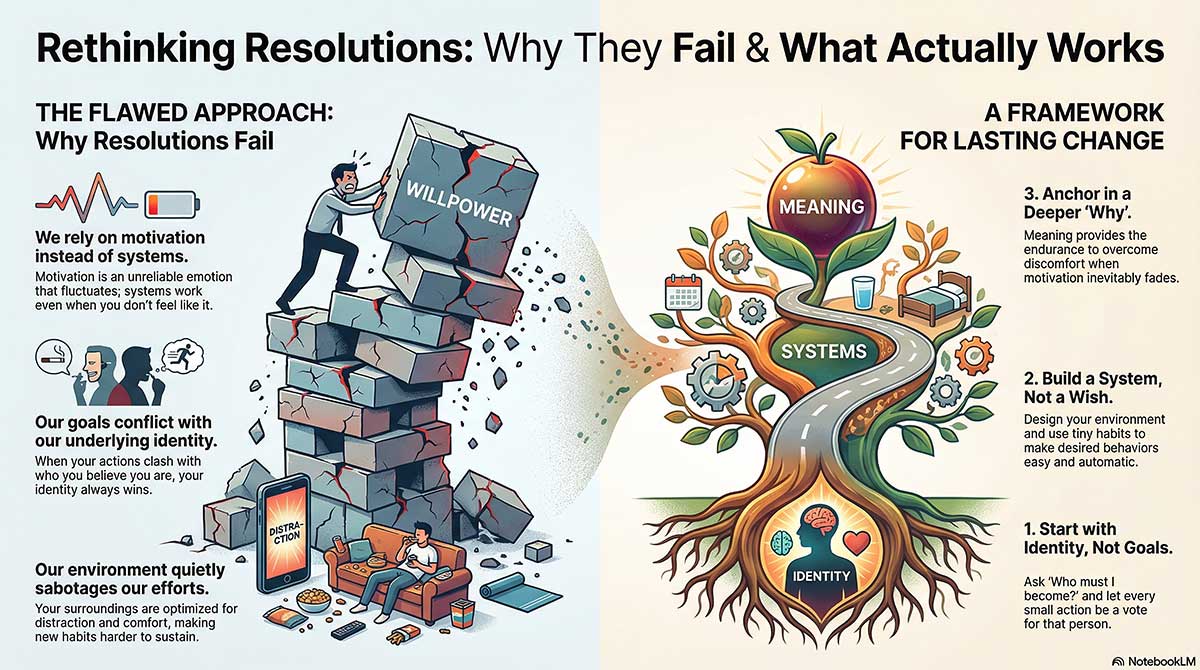
- Change doesn’t start with goals. It starts with identity.
- Motivation doesn’t sustain action. Systems do.
- Big transformations don’t begin big. They begin small.
- Discipline collapses without meaning.
- And no one changes alone—environment always has a vote.
If you’ve ever felt discouraged by broken resolutions, this is not a failure of character. It’s a failure of framing.
This conversation is an invitation to stop fighting yourself—and start designing a life that quietly supports who you’re becoming.
Not perfectly.
Not dramatically.
But honestly.
(Note: This is an imaginary conversation, a creative exploration of an idea, and not a real speech or event.)
Topic 1 — Identity Before Goals: Becoming the Person Who Follows Through

Moderator: Nick Sasaki
The room is quiet in the way only January 1 can be quiet—not empty, but expectant. Outside, the year has just begun. Inside, five minds sit around a simple table, not to talk about goals, but about something far more uncomfortable: why so many goals quietly disappear.
Nick Sasaki leans forward, not with a challenge, but with curiosity.
“Before we talk about habits, systems, or discipline, I want to start deeper. When no one is watching—no audience, no accountability—who do you believe yourself to be? And how does that silent identity override even your best intentions?”
James Clear
Most people think they’re failing at goals, but what’s really happening is identity conflict. Every action you take is a vote for the type of person you believe you are. If your resolution asks you to behave like someone you don’t yet see yourself as, friction is inevitable. The moment motivation fades, identity wins. That’s why lasting change starts with small proofs—tiny actions that let you say, “This is who I am now.”
William James
Long before neuroscience, we understood this intuitively. A person is not made by resolutions but by repeated acts. What you call your “will” is often just habit wearing a moral costume. When identity and action disagree, action eventually prevails—and identity follows. The tragedy is not lack of desire, but the unconscious loyalty to familiar patterns.
Epictetus
You speak of intentions as if they command the self. They do not. What commands the self is what you assent to daily. If you see yourself as a person who delays, excuses, or waits for better conditions, you will act accordingly—even while claiming otherwise. Freedom begins the moment you examine which self you are serving.
Seth Godin
We like to announce goals because they feel like progress. But identity is quieter. Identity is shown by what you do when the applause is gone. If you don’t decide who you’re becoming, the culture will do it for you. And culture is very good at rewarding inconsistency while pretending to admire discipline.
Benjamin Franklin
I did not trust inspiration. I trusted record-keeping. Each day, I asked not whether I felt virtuous, but whether I had acted in alignment with the man I wished to become. Identity is not discovered; it is practiced. Without a daily mirror, self-deception becomes effortless.
Nick lets that settle. Then he continues, softer now.
“Many people fail year after year and tell themselves it’s because they lack discipline. But I wonder—if a resolution keeps failing, what identity might actually be protected by that failure?”
Epictetus
Failure often preserves comfort. To succeed would require relinquishing excuses, victimhood, or the story that circumstances are to blame. Some identities are built on avoidance. They survive by never being tested fully.
Seth Godin
There’s safety in being the person who’s “trying.” Trying earns sympathy without demanding transformation. Finishing is dangerous—it changes how people relate to you. Some identities prefer the shelter of potential over the exposure of proof.
James Clear
This is why identity change must be incremental. If success threatens your social role, your brain will sabotage it. The solution isn’t force—it’s redefining success as “showing up” rather than “arriving.” That way, progress doesn’t feel like betrayal of who you were.
William James
The mind seeks coherence. If success contradicts your long-held self-image, failure restores internal harmony. Until identity evolves, relapse is not weakness—it is consistency.
Benjamin Franklin
I noticed this in myself. Certain virtues were easier to neglect because they challenged my self-concept. Tracking them exposed not laziness, but resistance. Failure was not accidental; it was instructive.
Nick nods, then asks the final question—one that feels less like inquiry and more like invitation.
“What would change if success this year were measured not by outcomes, but by the kind of person you repeatedly practice being each day?”
James Clear
Everything would slow down—and that’s the point. You’d stop asking, “Did I win?” and start asking, “Did I act in alignment?” Identity-based success compounds quietly. By the time results appear, they feel inevitable.
Benjamin Franklin
You would trade intensity for fidelity. A man faithful to daily practice surpasses the man of occasional brilliance. History remembers the former longer.
Epictetus
You would reclaim control. Outcomes are not yours. Character is. Measure what belongs to you.
William James
You would stop waiting for the future self and begin educating the present one. Habit is moral education in action.
Seth Godin
You would become hard to stop. Because no one can take away who you are becoming—unless you abandon the practice yourself.
The room grows still again. Outside, the year stretches forward—unwritten.
Nick Sasaki closes, not with instruction, but with a reflection:
“Maybe the real resolution isn’t what we promise to do—but who we quietly agree to become. And maybe this year doesn’t need more pressure… just more honesty.”
Topic 2 — Systems Over Motivation: Designing Life So Success Is Inevitable

The table feels more grounded now. Topic 1 stripped away illusions about identity; Topic 2 moves into structure—the invisible architecture that either carries a person forward or quietly collapses beneath them.
Nick Sasaki doesn’t open with urgency. He opens with realism.
“Most people start the year motivated. Then life happens. Energy dips. Mood shifts. Distraction creeps in. So let me ask something blunt: where are we relying on motivation to rescue us instead of building a system that works even when we don’t feel like it?”
Scott Adams
Motivation is unreliable because it’s emotional, and emotions fluctuate. Systems don’t care how you feel. When I stopped setting goals and started designing systems—daily routines that naturally produced progress—I stopped needing inspiration. If your plan requires you to be motivated every day, it’s not a plan. It’s a wish.
Peter Drucker
Execution is not an act of enthusiasm; it is a process. People fail not because they lack desire, but because they haven’t defined feedback loops. A system tells you quickly whether you’re off course. Motivation delays that clarity. Structure reveals it.
Taiichi Ohno
In industry, we learned long ago that blaming workers for inconsistency misses the point. Variation comes from the system. When a process is well designed, performance becomes predictable. When it is not, effort is wasted correcting the same failures repeatedly.
Cal Newport
Deep work taught me this lesson personally. If you depend on willpower to protect your focus, you will lose. I built rituals, time blocks, and constraints so that the default behavior aligned with my values. A system is simply a decision you don’t have to remake every day.
W. Edwards Deming
People often say, “I just need more discipline.” That is almost always incorrect. Improve the system, and performance improves automatically. Blame the system first—especially when failure is consistent.
Nick lets the weight of that sink in, then shifts the lens.
“If systems matter this much, then the next question becomes uncomfortable. Which parts of your daily environment are silently making your resolution harder than it needs to be?”
Taiichi Ohno
Look for friction. Waste hides in plain sight. If a task requires unnecessary steps, people will avoid it. Simplify access to what matters and remove obstacles to correct behavior. The environment teaches people what is truly expected.
Cal Newport
Most environments are optimized for distraction, not intention. Phones, notifications, open calendars—they all signal urgency over importance. If you don’t deliberately redesign your environment, you are outsourcing your attention to whoever designed it instead.
Scott Adams
People underestimate how much the environment decides outcomes. If junk food is visible, you eat it. If tools are hard to access, you don’t use them. This isn’t weakness—it’s biology. Design beats effort every time.
Peter Drucker
The environment answers questions before you consciously ask them. What gets measured gets managed. What gets scheduled gets done. What gets ignored disappears. Your surroundings reflect your true priorities, not your stated ones.
W. Edwards Deming
When failure is predictable, it is designed. Look at patterns, not intentions. Repeated breakdowns point directly to environmental causes.
Nick nods slowly. Then he asks the question that reframes everything.
“Let’s imagine willpower didn’t exist at all. If motivation were removed from the equation, what simple structure could still carry you forward this year?”
Cal Newport
Ritual. A fixed time, a fixed place, a defined action. When behavior becomes automatic, it no longer competes with decision fatigue. You stop asking, “Should I?” and simply begin.
Scott Adams
I’d choose one system that produces many benefits. For me, that was daily exercise—it improved energy, focus, and confidence. A good system compounds across areas of life. One input, multiple outputs.
Taiichi Ohno
Standardization is freedom. When the correct action is the easiest action, compliance follows naturally. Complexity creates excuses. Simplicity creates momentum.
Peter Drucker
Feedback is essential. Without measurement, there is no learning—only hope. A system without feedback drifts. A system with feedback corrects itself.
W. Edwards Deming
Stability first. Improvement comes second. You cannot optimize chaos. Create consistency, then refine.
The room grows quiet again—not heavy, but clear. Nick offers a closing reflection, almost conversational.
“What I’m hearing is this: motivation is a spark, but systems are gravity. They pull us forward even when we’re tired, distracted, or unsure. Maybe the question isn’t why we fail resolutions—but why we keep trusting emotions to do the work of design.”
Outside, the calendar still says January 1. But inside, something has shifted—from self-blame to self-engineering.
Topic 3 — Tiny Wins & Behavioral Momentum: Making Change Too Small to Fail

If Topic 2 exposed the machinery beneath success, Topic 3 turns toward scale—how small real change actually begins. The table feels lighter now. Less theory. More humility.
Nick Sasaki smiles slightly before speaking.
“Many resolutions fail not because they’re wrong—but because they’re too big to survive real life. So let me ask this: why do we keep designing goals that require a ‘new version of ourselves,’ instead of actions the current version can already sustain?”
BJ Fogg
Because we confuse aspiration with design. People think big dreams require big actions, but behavior doesn’t work that way. The brain resists overload. When you start tiny, you bypass resistance entirely. Tiny behaviors succeed because they respect reality, not ambition.
Charles Duhigg
Habits form through repetition, not heroism. If the routine is too demanding, it never loops long enough to become automatic. People fail because they interrupt the habit loop before it stabilizes.
Masaaki Imai
In continuous improvement, small steps are not a compromise—they are the method. Large changes invite fear. Small changes invite participation. When improvement feels safe, it becomes permanent.
Leo Babauta
Simplicity is kindness. When people demand transformation from themselves, they create internal conflict. Tiny habits remove that tension. They say, “Just show up.” Over time, showing up becomes identity.
Jerry Seinfeld
When I wrote every day, the rule wasn’t “write something great.” It was “don’t break the chain.” The chain mattered more than the content. Momentum comes from continuity, not intensity.
Nick pauses, then leans in again.
“So if small actions are the gateway, here’s the deeper question: what is the smallest behavior that, if done daily, would quietly rebuild your trust in yourself?”
Leo Babauta
Trust comes from keeping promises you know you can keep. One minute of mindfulness. One paragraph written. One walk around the block. Self-trust grows when the bar is low and consistency is high.
BJ Fogg
Celebrate immediately. The emotion of success wires the behavior. When people feel good about tiny actions, repetition becomes enjoyable instead of forced.
Charles Duhigg
Look for keystone habits—small behaviors that trigger larger shifts. Making your bed. Writing one sentence. Drinking water first thing. These signals tell the brain, “I’m someone who follows through.”
Jerry Seinfeld
It’s not about the act; it’s about the streak. The longer the streak, the harder it is to break—not because of discipline, but because of pride.
Masaaki Imai
Improvement is cumulative. One percent daily improvement compounds invisibly until it becomes undeniable. Trust grows when results arrive without drama.
Nick lets the energy build before asking the final question—the one that reframes ambition itself.
“At what point does consistency become more powerful than ambition—and how can we reach that point faster?”
Charles Duhigg
Consistency wins the moment behavior becomes automatic. Once a habit runs without conscious effort, ambition becomes optional. The habit carries you.
BJ Fogg
That point arrives when behavior feels easy. If it feels hard, it won’t last. Design for ease, and consistency follows naturally.
Jerry Seinfeld
Ambition is noisy. Consistency is quiet. But quiet things accumulate. One day, you look back and realize the work is done.
Leo Babauta
Let go of the fantasy of sudden change. Real transformation feels almost boring. That’s how you know it’s working.
Masaaki Imai
Consistency becomes power when improvement no longer requires courage. It becomes routine.
The room settles into a calm clarity. Nick closes gently.
“Maybe the most radical idea isn’t doing more—but doing less, more faithfully. Maybe the future doesn’t belong to the motivated—but to the consistent.”
Outside, the year continues its slow unfolding. Inside, the pressure to become someone else has quietly dissolved—replaced by permission to begin small.
Topic 4 — Meaning, Purpose, and the “Why” That Survives February

By now, the room feels different. Identity has been questioned. Systems have been redesigned. Habits have been made smaller. And yet—something remains unspoken.
Nick Sasaki doesn’t rush it.
“Even with the right identity, systems, and habits, many people still drift away from their resolutions. So I want to ask something more human. If this resolution actually succeeds—what deeper need inside you is being met?”
Viktor Frankl
Every sustained effort answers a question of meaning, whether consciously or not. When people fail to endure, it is rarely because the task is too hard. It is because the suffering feels pointless. When meaning is clear, endurance becomes possible—even inevitable.
Friedrich Nietzsche
Man does not collapse under difficulty; he collapses under emptiness. A goal without meaning becomes unbearable the moment resistance appears. But when a person knows why they are walking, even a difficult path feels chosen rather than imposed.
Simon Sinek
People often attach goals to surface rewards—status, approval, numbers. Those motivations evaporate quickly. When a goal is connected to identity and service, it lasts. Purpose doesn’t energize you once—it keeps calling you back.
Mahatma Gandhi
Discipline that is disconnected from conscience becomes oppression—of the self. But when action aligns with truth, restraint feels natural. One does not need force to live in accordance with one’s values.
Leo Tolstoy
I learned that achievement without meaning leads not to fulfillment, but despair. People do not need more ambition; they need clarity about what gives their effort dignity.
Nick lets the words breathe before continuing.
“So if meaning matters this much, what happens when a resolution is disconnected from values, service, or a sense of purpose?”
Nietzsche
The will weakens. Without meaning, effort feels humiliating. The soul resists being used for goals it does not respect.
Frankl
When purpose disappears, people seek distraction. They call it burnout, but it is existential fatigue. The task itself becomes intolerable because it no longer answers a meaningful question.
Tolstoy
One begins to resent the very goal one once desired. It feels imposed rather than chosen. This resentment quietly erodes commitment.
Gandhi
Action without moral grounding becomes mechanical. Such action cannot be sustained, because it does not nourish the spirit.
Sinek
People then chase motivation endlessly, not realizing motivation was never the solution. Purpose was.
Nick’s final question lands gently, but deeply.
“How does remembering why this matters change the way we endure discomfort, delay, or doubt?”
Frankl
Suffering changes shape. It becomes a teacher instead of an enemy. When hardship is meaningful, it strengthens rather than breaks a person.
Gandhi
Patience emerges naturally. One no longer asks, “Is this hard?” but “Is this right?” That question quiets fear.
Nietzsche
The pain does not disappear—but it loses its authority. Meaning places suffering in context.
Sinek
Purpose reframes effort. You stop asking for motivation and start showing up because it feels necessary.
Tolstoy
Endurance becomes devotion. One continues not because it is easy, but because it is honest.
The room grows still—not heavy, but reverent. Nick closes with a reflection rather than a conclusion.
“Perhaps the reason resolutions fade isn’t that we lack discipline—but that we never answered the deeper question: Why is this worth my life force?
When the answer is clear, the path doesn’t need to be easy. It only needs to be true.”
Outside, winter continues. Inside, something steadier than motivation has taken root.
Topic 5 — Environment, Accountability, and Social Gravity

The room feels settled now—not resolved, but aware. By the fifth conversation, a pattern has emerged: people rarely fail alone. They fail within contexts that quietly pull them back.
Nick Sasaki doesn’t soften the question.
“Even with the right identity, systems, habits, and meaning, people still slip. So let me ask directly: who—or what—are we unconsciously staying loyal to when we don’t fully follow through?”
Benjamin Hardy
People protect their past identity through their social environment. Growth threatens belonging. When success risks outgrowing familiar roles or relationships, the mind chooses loyalty over progress. This isn’t weakness—it’s attachment.
Naval Ravikant
Most behavior is downstream of environment. You think you’re choosing freely, but incentives choose for you. If your surroundings reward distraction, comfort, or approval, you will unconsciously obey them.
B.F. Skinner
Behavior follows reinforcement. People repeat what is rewarded and abandon what is punished. Social reactions—approval, ridicule, indifference—shape behavior far more reliably than intention.
Robert Cialdini
Commitment is social before it is personal. When people make commitments publicly or within trusted groups, follow-through increases dramatically. Identity becomes reinforced externally, not just internally.
Marcus Aurelius
We are shaped by the company we keep, even in solitude. One must ask: whose judgment do I fear more than my own?
Nick pauses, then shifts the angle.
“How does our environment quietly reward the very habits we claim we want to change?”
Skinner
Rewards don’t have to be obvious. Relief from discomfort, avoidance of effort, or social approval can reinforce destructive habits. The environment teaches through consequences, not lectures.
Naval Ravikant
Modern environments are optimized for short-term dopamine, not long-term fulfillment. If you don’t deliberately choose your inputs, they will choose your outputs.
Hardy
Your environment is an external memory. It reminds you who you used to be. Without changing it, you keep rehearsing the same identity daily.
Cialdini
Consistency pressure works both ways. Once you behave a certain way publicly, you feel compelled to repeat it—even if it contradicts your goals. Environment locks in patterns through expectation.
Marcus Aurelius
Do not blame the river for carrying you downstream if you never learned to swim against its current. Choose higher ground.
Nick’s final question arrives quietly—but it lands hardest.
“What kind of accountability actually supports change rather than shames it—and why does that difference matter?”
Cialdini
Supportive accountability emphasizes consistency and identity, not punishment. Shame creates avoidance; belonging creates adherence.
Hardy
Accountability works when it reinforces who you’re becoming—not who you failed to be. Growth thrives in safety, not fear.
Skinner
Positive reinforcement outperforms punishment in shaping lasting behavior. Encouragement strengthens repetition. Shame suppresses it.
Naval Ravikant
Choose environments that make the right behavior easier than the wrong one. The best accountability is structural, not emotional.
Marcus Aurelius
Hold yourself accountable not to perfection, but to alignment. The rest will follow.
The room grows quiet one last time. Nick doesn’t rush the ending.
“Maybe the question was never, ‘Why can’t I stick to my resolutions?’
Maybe the better question is, ‘What am I standing inside of that keeps pulling me back?’
Change doesn’t ask for more willpower. It asks for better surroundings—and kinder witnesses.”
The year stretches forward again—not as a test of strength, but as an invitation to choose one’s environment wisely.
Final Thoughts by Nick Sasaki
As we come to the end of this conversation, I want to say something clearly:
If you’ve struggled to keep your New Year’s resolutions, there is nothing wrong with you.
What failed wasn’t your willpower.
It was the story you were told about how change works.
You were taught to rely on motivation instead of identity.
Intensity instead of systems.
Pressure instead of meaning.
Isolation instead of environment.
No wonder it didn’t last.
What I hope this series leaves you with is not another promise—but a gentler, stronger orientation toward change.
You don’t need to reinvent yourself overnight.
You don’t need to force consistency through guilt.
You don’t need to wait for confidence before you begin.
You only need to practice becoming someone—one small action at a time—inside an environment that supports you, for reasons that truly matter to you.
If this year becomes different, it won’t be because you tried harder.
It will be because you became more honest about:
who you are,
how you live,
what you value,
and what you allow to shape you.
And if you stumble—and you will—let that be information, not indictment.
The goal was never perfection.
The goal was alignment.
So instead of asking, “Will I stick to my resolutions this year?”
Try asking:
“What kind of person am I quietly practicing being today?”
That question has a way of answering itself—one day at a time.
Short Bios:
James Clear — Author of Atomic Habits, known for reframing behavior change around identity, systems, and small daily actions that compound over time.
William James — Pioneer of modern psychology who emphasized habit as the foundation of character and personal destiny.
Epictetus — Stoic philosopher whose teachings focused on self-mastery, personal responsibility, and freedom through disciplined thought.
Seth Godin — Writer and thinker on identity, consistency, and long-term creative practice beyond short-term motivation.
Benjamin Franklin — Founding Father and polymath who practiced daily virtue tracking and systematic self-improvement.
Scott Adams — Creator of Dilbert and advocate of systems thinking over goal obsession in personal and professional success.
Peter Drucker — Influential management thinker who emphasized execution, feedback loops, and structured decision-making.
Taiichi Ohno — Architect of the Toyota Production System, demonstrating how well-designed systems outperform individual effort.
Cal Newport — Writer known for Deep Work, focusing on intentional structure, focus, and sustainable productivity.
W. Edwards Deming — Quality pioneer who taught that performance failures are usually system failures, not personal ones.
BJ Fogg — Stanford behavior scientist and creator of the Tiny Habits method for sustainable behavior change.
Charles Duhigg — Author of The Power of Habit, known for explaining habit loops and behavioral momentum.
Masaaki Imai — Founder of the Kaizen philosophy, emphasizing continuous improvement through small, steady changes.
Leo Babauta — Writer of Zen Habits, focusing on simplicity, mindfulness, and gentle consistency.
Jerry Seinfeld — Cultural icon whose “don’t break the chain” practice popularized consistency over intensity.
Viktor Frankl — Psychiatrist and Holocaust survivor who taught that meaning is the deepest source of endurance.
Friedrich Nietzsche — Philosopher who explored purpose, will, and the necessity of meaning to endure hardship.
Simon Sinek — Writer and speaker known for the “Start With Why” framework linking purpose to sustained action.
Mahatma Gandhi — Historical leader whose disciplined daily practice aligned moral purpose with action.
Leo Tolstoy — Writer and moral thinker who examined the relationship between meaning, discipline, and inner life.
B.F. Skinner — Behavioral psychologist who demonstrated how environment and reinforcement shape behavior.
Naval Ravikant — Entrepreneur-philosopher known for insights on leverage, environment design, and long-term thinking.
Robert Cialdini — Influence researcher who studied commitment, social proof, and behavioral consistency.
Benjamin Hardy — Writer and psychologist focused on identity, environment, and future-self alignment.
Marcus Aurelius — Roman emperor and Stoic philosopher whose Meditations model daily self-accountability and inner discipline.
Leave a Reply