

|
Getting your Trinity Audio player ready...
|

Jesus:
When I first said, “Love your enemy,” the world already knew war, oppression, and injustice. Rome ruled by the sword, and many believed strength came from crushing one’s foes. Yet I told them to bless those who cursed them, to pray for those who mistreated them, because love is the only force that can break the cycle of fear and vengeance.
Now, in 2025, your cities rise higher, your weapons reach farther, your voices travel instantly to every nation. But still, the same question lingers: will you meet your enemies with love or with more walls, more weapons, more wounds? This command was not given for safe days—it was meant for the days when hatred feels justified. In these times, love is not weakness; it is the most daring act of strength.
(Note: This is an imaginary conversation, a creative exploration of an idea, and not a real speech or event.)

Topic 1: When Love Costs Security: Is Peace Worth the Risk?
Moderator: Desmond Tutu (legacy voice)
Desmond Tutu:
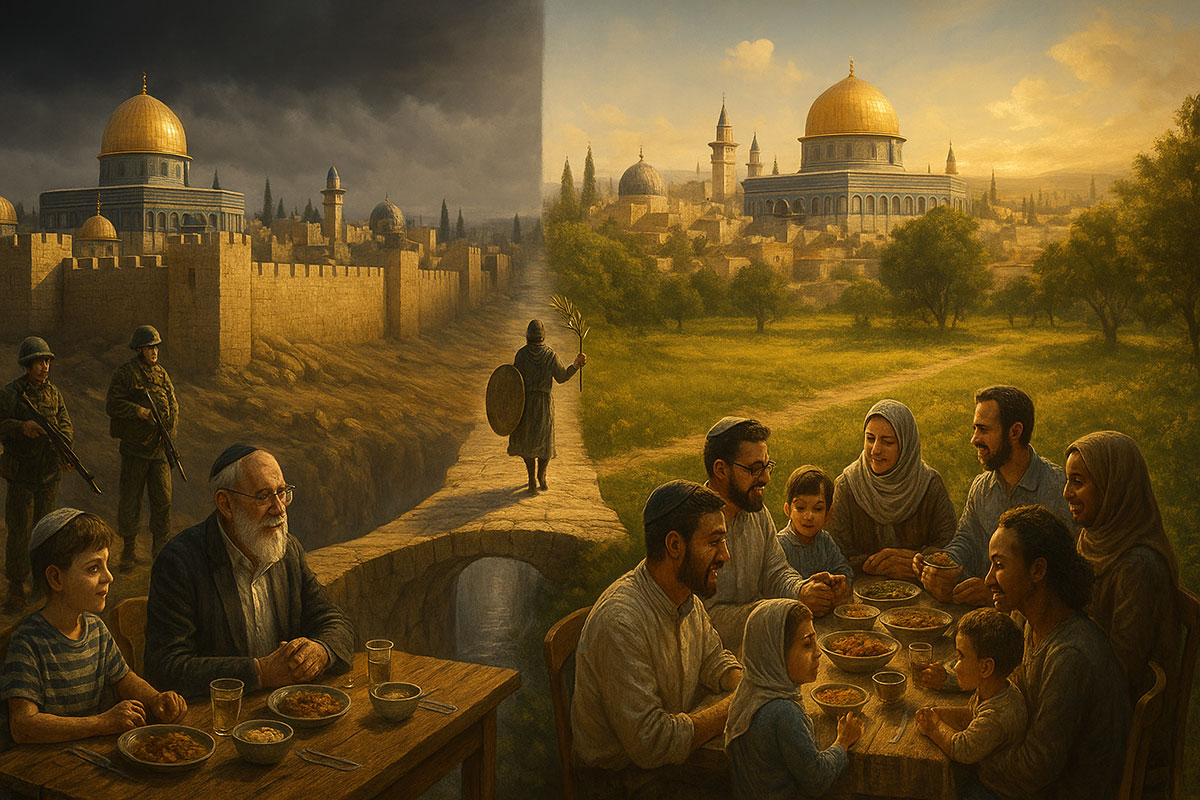
Friends, today we stand before one of the most uncomfortable crossroads in faith and politics: Can “love your enemy” be lived out when it may cost lives? In a place like Israel—where history, fear, and hope collide daily—what does it mean to love without abandoning security? I ask you all: What do you believe Jesus truly meant when He said to love your enemy, especially in a land where survival is always in question?
Benjamin Netanyahu:
When you lead a nation under constant threat, you learn quickly that the Bible’s poetry and the battlefield’s reality speak different languages. I respect the moral beauty of loving your enemy, but in Israel, our enemies are armed, organized, and often call for our destruction. Love here can’t mean laying down our guard. If we truly love our people, we must protect them—even from those who would see such love as weakness.
Rev. Munther Isaac:
Benjamin, I hear your concern for safety, but as a Palestinian Christian living under occupation, I’ve seen how security policies can also become walls around the heart. Jesus wasn’t naive about danger—He was speaking under Roman occupation, too. To love your enemy is to recognize their humanity even as you defend yourself. Without that, security becomes a prison for both sides.
Jesus:
When I said, “Love your enemy,” I did not mean “Trust your enemy’s intentions” or “Ignore evil.” I meant to refuse hatred’s poison, even when defending the innocent. Love is not the absence of protection—it is the refusal to let fear decide the limits of your mercy.
John Hagee:
From a pastoral perspective, I must stand with Israel as God’s covenant people. Loving your enemy does not mean sacrificing God’s promises. It means seeking peace, yes, but never at the expense of the divine mandate to protect what God has entrusted to you. Sometimes the most loving act is to draw a line that cannot be crossed.
Desmond Tutu:
And yet, if we are to take Jesus seriously, His command does not have an exception clause for “when it’s too dangerous.” So tell me: Is there a point where national security and Jesus’ teaching can meet—or are they destined to be in tension forever?
Rev. Munther Isaac:
They can meet if we are willing to redefine security. Security that is only about weapons and borders will always be temporary. True security comes when the other side has no reason to hate you—when they see you as a neighbor, not a target. That’s not utopia; it’s the fruit of justice and compassion.
Jesus:
The tension will always exist if nations build their safety on fear rather than trust in God’s justice. Even Rome fell, yet love remains. My command is not to abolish self-defense but to redeem it—so that it does not destroy the soul in the act of saving the body.
Benjamin Netanyahu:
I appreciate the idealism, but leaders must deal with what is, not only what should be. If our enemies disarm, peace is possible tomorrow. Until then, “love” without caution risks the very lives we are sworn to protect.
John Hagee:
Desmond, perhaps the meeting point is this: We uphold strong defense while maintaining a heart posture that seeks reconciliation whenever possible. We must pray for enemies, even as we prepare for their attacks.
Desmond Tutu:
That leads me to my final question: If we ignore “love your enemy” in national policy, what will faith look like in fifty years? Will it be stronger, or will it be hollowed out?
Jesus:
A faith that lives only within safe borders will shrink to the size of its own fear. Love is the only force that expands the soul beyond survival. Without it, faith becomes a flag, not a light.
Rev. Munther Isaac:
In fifty years, if love is absent from policy, we will have taught our children that faith is private decoration—not public courage. They will inherit walls, not bridges.
Benjamin Netanyahu:
Faith will still exist, but it will be a guarded faith, shaped by realism. Perhaps that is the price we pay for survival.
John Hagee:
I believe faith can remain strong if it’s rooted in God’s Word. Even if national policy cannot fully embody “love your enemy,” the Church can model it in communities, showing the world what’s possible.
Desmond Tutu (closing):
It is not easy to love an enemy when the threat is real. But if we reserve Jesus’ words only for safe moments, we will never see their power in dangerous ones. Perhaps the truest security is not the absence of enemies, but the presence of a love that refuses to become like them.
Topic 2: Prophecy vs. Compassion: Which Comes First?
Moderator: Mustafa Akyol
Mustafa Akyol:
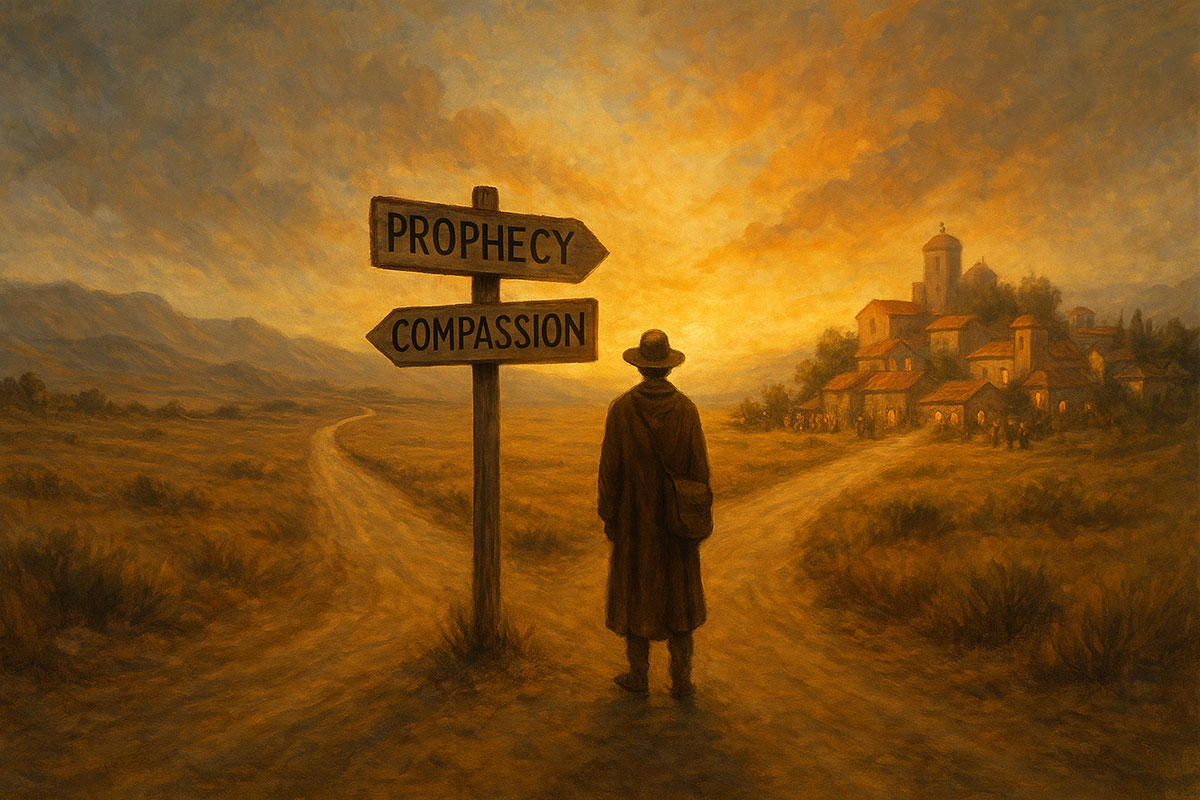
Friends, prophecy shapes the imagination of millions—sometimes giving hope, sometimes justifying harm. Today, we ask: When God’s promises and human compassion seem to collide, which should lead? Let’s begin: If you believe prophecy is real, how should it guide our actions toward those we might see as “the other side”?
David Jeremiah:
Prophecy is God’s timeline, not ours. We must interpret events in light of Scripture, especially regarding Israel’s place in God’s plan. Compassion is vital, but it must operate within the boundaries of God’s ultimate purposes. Sometimes prophecy will require standing firm, even when it brings tension.
Rabbi Jonathan Sacks (legacy voice):
In Judaism, prophecy is not only about foretelling; it is about forthtelling—the moral responsibility to act justly. If we ignore compassion in the name of prophecy, we betray the prophets themselves. God’s promises do not excuse cruelty; they demand greater kindness.
Jesus:
Prophecy without love is a clanging cymbal. Fulfillment means nothing if, along the way, we crush the ones the Father loves. Every promise of God points toward reconciliation, not domination.
Sami Awad:
I live in a land where prophecy is quoted to justify suffering. Compassion must be the first step, or prophecy becomes a weapon. If the fulfillment of God’s word leaves widows and orphans in despair, we have misunderstood His heart.
Mustafa Akyol:
Let me push further—if prophecy says a certain outcome is inevitable, why bother with compassion at all? Is it not just delaying what God has already planned?
Jesus:
Because compassion is the method by which prophecy is fulfilled. The kingdom of God grows like a seed—through mercy, patience, and service. To skip compassion is to change the nature of the kingdom itself.
Rabbi Jonathan Sacks:
We are not spectators to prophecy; we are participants. God calls us to help bring His vision to life through righteousness. If we rush toward an end without compassion, we may reach something—but it will not be the world God promised.
David Jeremiah:
I agree that compassion matters, but Scripture warns that the world will resist God’s plan. Standing with Israel is both obedience and love, even if the road is rough. Compassion cannot mean compromising what God has said will happen.
Sami Awad:
And yet, what if your reading of prophecy blinds you to the suffering you could stop now? What if clinging to the future blinds you to the neighbor at your gate?
Mustafa Akyol:
Final question—if future generations see us as people who chose prophecy over compassion, what will they conclude about our faith?
Sami Awad:
They will think our God was small and cruel, when in truth it was our hearts that were small.
Jesus:
They will know us by our love—or by the absence of it. The world will judge whether prophecy made us merciful or made us hard.
David Jeremiah:
I would hope they see us as faithful to God’s Word, even when the cost was high. If they misunderstand, God will vindicate His truth in time.
Rabbi Jonathan Sacks:
I pray they see us as people who made God’s promises visible through acts of healing. That is the only way prophecy can bear fruit worth tasting.
Mustafa Akyol (closing):
Perhaps prophecy and compassion are not rivals at all—but prophecy without compassion is counterfeit, and compassion without hope is fragile. The challenge is to live in such a way that the future God promises is foreshadowed in the present we create.
Topic 3: Can Love Your Enemy Be Policy, or Only Personal?
Moderator: Stanley Hauerwas
Stanley Hauerwas:
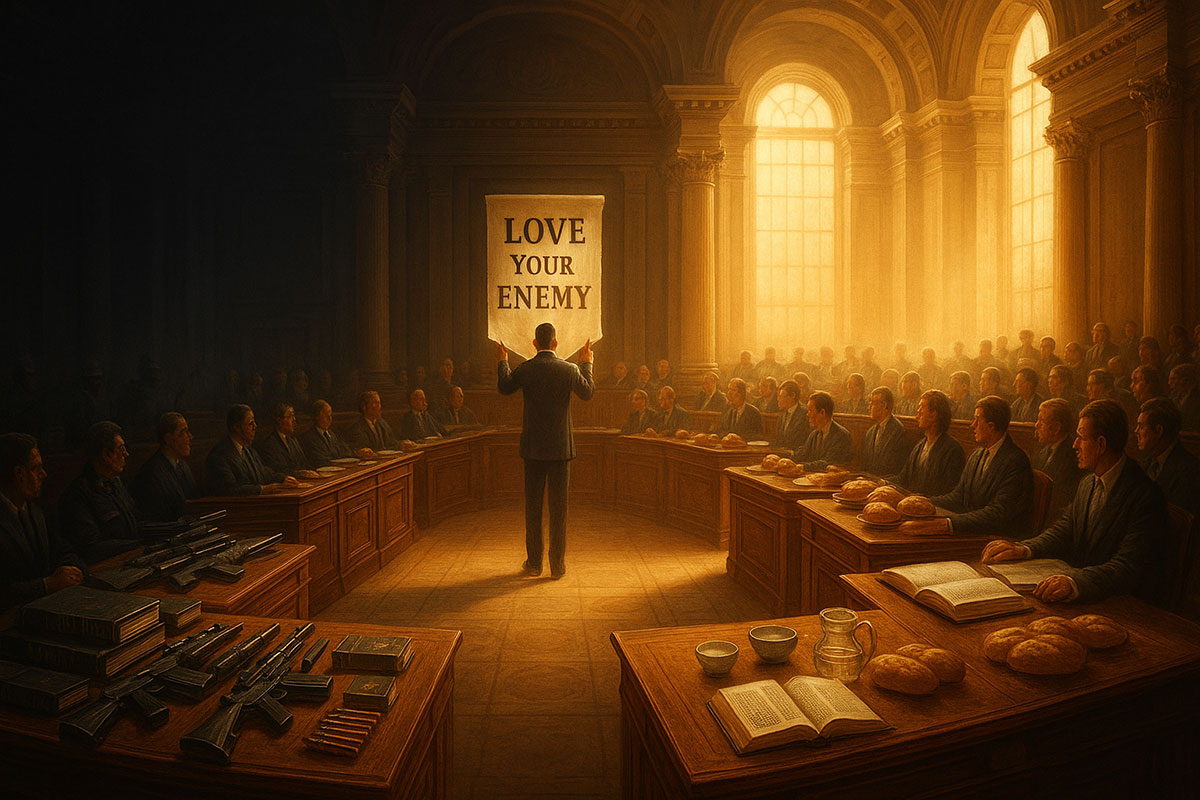
We’ve all heard Jesus’ command to love your enemy. But here’s my question: Was that meant for individuals only, or should governments and armies live by it too? Let’s begin—how do you interpret Jesus’ words when applied beyond personal life?
Jesus:
The command is not limited by scale. Whether a man forgives his neighbor or a nation forgives its rival, the call is the same: refuse hatred, even while protecting what is good. Love of enemy is not a suggestion for private life only; it is a vision for the whole creation.
U.S. President (fictional composite):
With all respect, governing requires more than ideals. My oath is to protect my citizens. While personal mercy is admirable, national policy must deter aggression and defend against real threats. If love for enemies were our military policy, our enemies might take it as permission to attack.
Amos Yadlin:
As a former Israeli military leader, I can tell you: survival requires strength. Love may guide how we treat prisoners or civilians, but it cannot dictate our overall defense posture. In war, hesitation can cost lives.
Palestinian mother (fictional composite):
And yet, every time “security” is put first, more mothers bury their children. If love for enemies is only for the home and not the state, then our leaders will never model it—and the cycle will never end.
Stanley Hauerwas:
But if we say, “This is only for private life,” are we not creating a two-tiered morality—one for Sunday, another for Monday? Can a faith survive that split?
Amos Yadlin:
Faith can survive with boundaries. Soldiers can act with honor, minimize harm, and still fight effectively. The state’s job is not to practice unconditional love—it’s to keep its citizens alive.
Jesus:
If your survival depends on abandoning my words, then what have you truly preserved? Fear will always make the command seem impossible, yet I gave it for the very moments when fear is strongest.
U.S. President:
But there’s a difference between individuals who can choose martyrdom and governments that must avoid mass casualties. Governments cannot “turn the other cheek” when an entire population’s safety is at stake.
Palestinian mother:
And yet, leaders could choose policies that humanize the enemy—economic cooperation, shared education—ways to prevent conflict before it becomes war. That would be loving your enemy in policy form.
Stanley Hauerwas:
So here’s the last question: If nations never adopt “love your enemy” as policy, will it always remain an impossible dream—or can the Church still make it real?
U.S. President:
It may never be national policy, but faith communities can embody it locally and influence leaders over time.
Jesus:
The kingdom of God is not built by the sword, yet it can grow in the shadow of one. My Church is meant to be a nation without borders—showing governments another way is possible.
Amos Yadlin:
If the Church can model it without compromising safety, perhaps over generations it could influence how nations act. But in our current world, the gap between faith and policy is wide.
Palestinian mother:
If the Church lives it and teaches it to children, they will grow up questioning why their nations do not. Change will not come quickly, but it will come.
Stanley Hauerwas (closing):
Maybe the real tragedy is not that nations don’t follow “love your enemy,” but that Christians accept that without protest. If the Church is to be salt and light, it must live a morality that makes the world wonder—not just nod in agreement.
Topic 4: Selective Morality: Why We Apply Jesus Differently at Home and Abroad
Moderator: Miroslav Volf
Miroslav Volf:
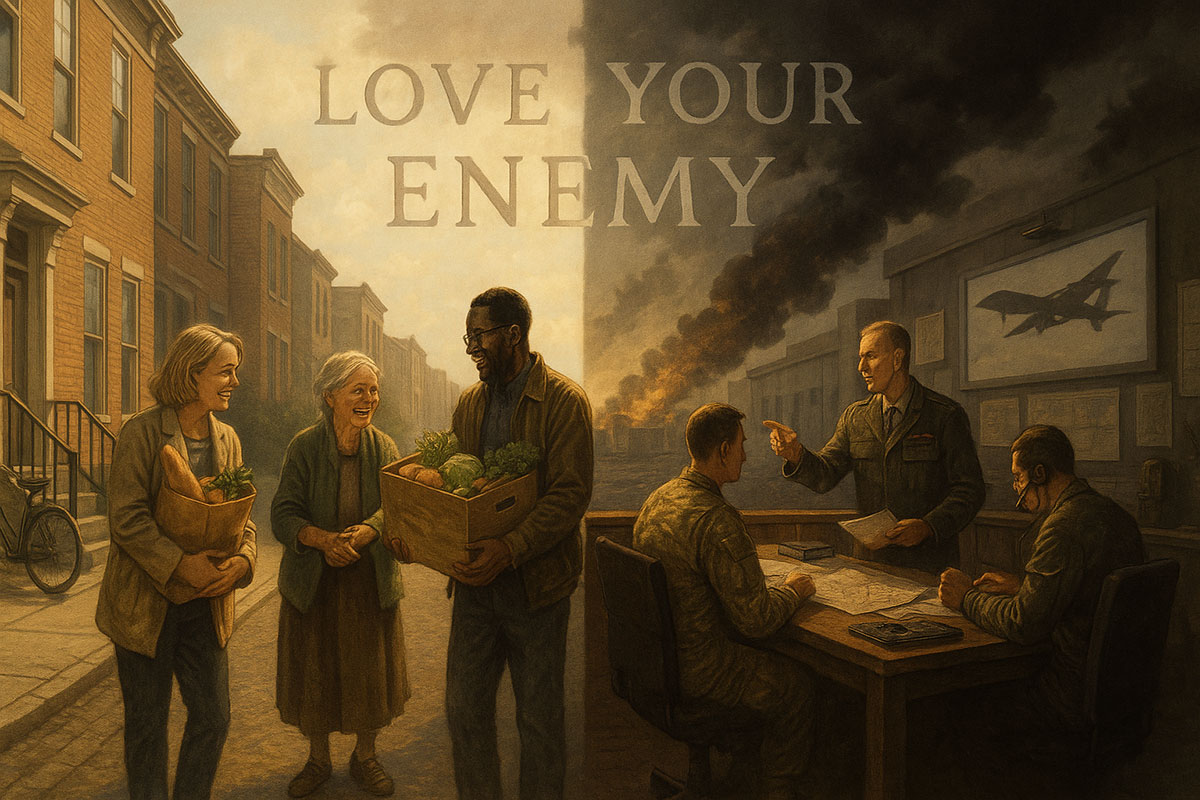
We often forgive our neighbor across the street but support harsh measures against nations or peoples far away. My first question is simple: Why do you think Christians so easily separate personal morality from political morality?
Charlie Kirk:
Because they’re two different arenas. In personal life, you can choose to be generous or forgiving without risking your community’s safety. But in politics, you carry responsibility for millions. National leaders can’t gamble on mercy the way individuals can.
Jesus:
The arenas may differ, but the heart that governs them is the same. If we permit hatred and vengeance at the national level, it will seep back into the personal level. The Kingdom does not divide life into “faith here” and “practicality there.”
Gershon Baskin:
I’ve seen Israelis and Palestinians show deep personal kindness to each other—sharing coffee, helping in emergencies—yet in the political space, those same people support policies that harm the other side. The separation is psychological protection; it allows people to live with contradictions.
American Evangelical layperson (fictional composite):
Honestly, it’s easier to love someone you know than someone you’ve only heard about through the news. Media often paints “the other side” as faceless or dangerous. That makes political love harder to imagine.
Miroslav Volf:
So if that’s true, my second question is: What would it take for Christians to apply the same forgiveness they extend personally to the realm of international conflict?
Gershon Baskin:
Contact. Stories. Shared projects. When you know someone personally from “the other side,” political categories start to crumble. Relationships build a bridge that policy can eventually walk across.
Charlie Kirk:
It would take a radical cultural shift in how we understand risk. Right now, policy is driven by fear of vulnerability. To extend forgiveness as policy, leaders would need a safety net strong enough to take that risk without endangering lives.
American Evangelical layperson:
Churches could model it first—inviting people from opposing sides to speak, pray, and serve together. If believers lived this way locally, politicians would have less room to claim it’s impossible.
Jesus:
The bridge from personal to political begins when the personal is so compelling it cannot be ignored. If the Church lives forgiveness visibly, it will unsettle the world’s logic of self-protection.
Miroslav Volf:
Then let me ask my last question: If we never close this gap—if personal morality remains generous but public morality remains hard—what will be the cost to our witness as Christians?
Jesus:
The world will see faith as a private hobby, not a public truth. Salt that never leaves the kitchen does not preserve anything.
Gershon Baskin:
The cost will be endless cycles of mistrust. Without moral consistency, reconciliation will always be postponed to “someday” that never arrives.
Charlie Kirk:
I think the witness can still survive if personal faith remains strong, but yes—the perception will be that Christianity has little to offer on the world stage.
American Evangelical layperson:
People will stop believing we mean what we say. If we preach love but vote for hate, our words will feel empty.
Miroslav Volf (closing):
Perhaps the most dangerous division is not between nations but between the faith we practice in our hearts and the faith we practice with our hands. Only when the two are one will the world see what Jesus meant.
Topic 5: What Happens to Faith if We Sidestep the Hardest Teachings?

Moderator: Philip Yancey
Philip Yancey:
When Jesus said, “Love your enemy,” He gave us one of His most radical commands. But what happens when believers quietly set it aside in practice? My first question: If we consistently avoid His hardest teachings, what does that do to the soul of our faith?
Jesus:
Faith loses its saltiness when its hardest truths are softened. You may keep the name of faith, but not its power. My commands are not decorative—they are the marrow of the kingdom.
Tom Segev:
History shows that religions often survive while ignoring their prophets’ most difficult words. But when they do, they become cultural badges rather than moral forces.
Jimmy Carter:
In my peacemaking work, I’ve seen how sidestepping the hard path erodes credibility. People sense when our actions don’t match our stated beliefs, and trust is hard to rebuild.
Young believer from Gaza (fictional composite):
If I see Christians support violence while quoting Jesus, I start to think faith is just politics with a cross on it. That pushes young people like me away.
Philip Yancey:
So my second question: Why do you think Christians are tempted to treat these teachings as optional ideals instead of binding commands?
Tom Segev:
Because the hardest teachings often clash with national, cultural, or personal self-interest. It’s easier to reframe them as “aspirations” than to face the cost of living them out.
Jesus:
You call them ideals when you want to postpone them. But the kingdom does not come later—it comes when you live it now, however costly.
Jimmy Carter:
There’s also fear—fear of being seen as weak, fear of losing security, fear of standing alone. Fear can make even the faithful justify setting aside their deepest convictions.
Young believer from Gaza:
Sometimes leaders teach the easy parts and leave out the hard parts. We grow up thinking it’s normal to pick and choose, so we stop expecting more from ourselves.
Philip Yancey:
Final question: If we keep ignoring the hardest commands of Jesus, what will Christianity look like fifty years from now?
Jesus:
It will be a shell—familiar in shape, hollow in substance. The world will keep the word “Christian” but forget what it means.
Jimmy Carter:
It may remain large in numbers but small in influence, especially in places where its moral authority has been compromised by compromise itself.
Tom Segev:
Future historians will write about a faith that once changed empires but eventually settled for blessing the status quo.
Young believer from Gaza:
It will lose us—the next generation. If we don’t see courage and love lived out in dangerous times, we won’t believe the faith is worth following.
Philip Yancey (closing):
Perhaps the greatest danger to faith is not outside opposition but inside accommodation—when we quietly file away the very words meant to transform us. If the Church has a future worth living into, it will be because we chose to live the hardest truths, not avoid them.
Final Thoughts By Jesus
If you love only those who agree with you, follow your faith, or share your homeland, what new thing have you done? The world will not be healed by loving those who are easy to love. It will be healed when you choose mercy where revenge is expected, kindness where cruelty is common, and peace where fear demands war.
Do not wait for your leaders to make “love your enemy” national policy before you live it. The Kingdom of God begins in the heart of each person willing to cross the divide. When you love in the face of hatred, you are not only keeping my words—you are bringing the Kingdom into this world. And the Kingdom, once it takes root, will not be uprooted.
Short Bios:
Jesus – Central figure of Christianity, regarded by believers as the Son of God and the Messiah, whose teachings on love, forgiveness, and reconciliation remain among the most radical in history.
Benjamin Netanyahu – Israeli politician and current Prime Minister, known for his strong national security stance and influential role in shaping Israel’s domestic and foreign policy.
Rev. Munther Isaac – Palestinian Christian pastor and theologian based in Bethlehem, advocating for justice, reconciliation, and a lived expression of the gospel in the context of the Israeli–Palestinian conflict.
John Hagee – American pastor and founder of Christians United for Israel (CUFI), a leading voice in Christian Zionism and prophecy-oriented support for Israel.
Desmond Tutu (legacy voice) – South African Anglican archbishop and Nobel Peace Prize laureate, remembered for his leadership in the anti-apartheid movement and commitment to reconciliation and forgiveness.
David Jeremiah – American pastor, author, and broadcaster, widely recognized for his Bible prophecy teaching and evangelical preaching.
Rabbi Jonathan Sacks (legacy voice) – Former Chief Rabbi of the United Kingdom, influential Jewish philosopher and theologian known for promoting ethics, interfaith dialogue, and moral leadership.
Sami Awad – Palestinian Christian activist and founder of the Holy Land Trust, working toward nonviolent transformation and reconciliation between Israelis and Palestinians.
Mustafa Akyol – Turkish writer and public intellectual, focusing on Islam, politics, and interfaith dialogue, advocating for freedom of conscience and compassion in public life.
U.S. President (fictional composite) – Represents the perspective of a contemporary American head of state balancing national security concerns with moral and ethical considerations.
Amos Yadlin – Retired Israeli Air Force general and former head of Israel’s military intelligence, offering pragmatic perspectives on defense and security policy.
Palestinian mother (fictional composite) – Symbolizes the lived experience of civilians enduring loss and hardship in the midst of political conflict.
Stanley Hauerwas – American theologian and ethicist, known for his critiques of nationalism and emphasis on Christian nonviolence and community ethics.
Charlie Kirk – American conservative political commentator, founder of Turning Point USA, known for advocating strong national security and traditional values.
Gershon Baskin – Israeli peace activist, mediator, and co-founder of the Israel/Palestine Center for Research and Information, involved in direct negotiations with opposing sides.
American Evangelical layperson (fictional composite) – Represents everyday church members wrestling with the gap between personal faith and political realities.
Miroslav Volf – Croatian Protestant theologian and author, noted for his work on reconciliation, forgiveness, and the theology of embracing the “other.”
Tom Segev – Israeli historian and journalist, chronicler of Israel’s political and cultural history, and commentator on Jewish–Christian relations.
Jimmy Carter – Former U.S. President and Nobel Peace Prize laureate, recognized for his work in international diplomacy, peacebuilding, and humanitarian efforts.
Young believer from Gaza (fictional composite) – Represents the next generation living amid the realities of conflict, questioning the integrity and relevance of faith.
Philip Yancey – American Christian author, known for exploring grace, suffering, and the authenticity of Christian witness in contemporary society.
Leave a Reply