
|
Getting your Trinity Audio player ready...
|
Introduction by Nick Sasaki
Who controls the narrative controls reality.
This idea shows up everywhere—religion, politics, history, media, even in the private stories we tell ourselves late at night. We rarely question it because stories feel natural to us. They help us belong. They help us understand pain. They help us decide who is right, who is wrong, and who we are supposed to be.
But stories don’t just explain the world. Over time, they shape it.
In this five-part imaginary conversation, I wanted to step back before certainty hardens into belief, before belief becomes identity, and before identity turns into power. Not to tear stories down—but to look at how they are chosen, preserved, enforced, and sometimes weaponized. These conversations are not about replacing one narrative with another. They are about learning to see the frame we’ve been living inside.
Because once you can see the narrative, you’re no longer completely owned by it.
(Note: This is an imaginary conversation, a creative exploration of an idea, and not a real speech or event.)
Topic 1 — Before Truth: How Stories Become Reality
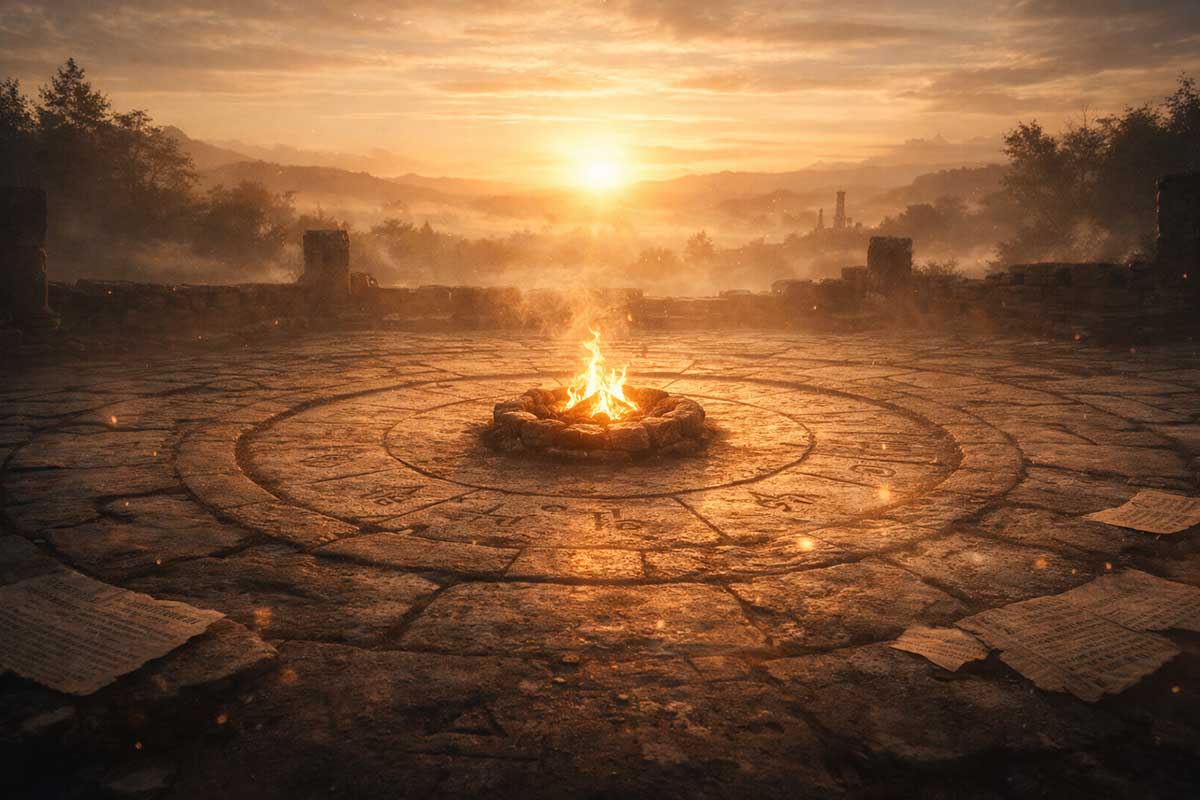
Setting:
A circular stone courtyard at dawn. No banners, no symbols. Only a low fire in the center. The sky is pale, undecided. The kind of light that exists before conclusions.
Participants:
Yuval Noah Harari · Karen Armstrong · Carl Jung · Hannah Arendt · Joseph Campbell
Opening — Karen Armstrong
Karen Armstrong sits quietly for a moment, letting the silence do some of the work.
“Long before doctrines, before governments, before even written language,” she begins, “human beings told stories. Not to entertain—but to survive. Tonight, I want to begin before truth hardens into certainty. Before facts become weapons. Before belief becomes law.”
She looks around the circle.
“My question is simple, but not comfortable. Do stories describe reality… or do they create it?”
She turns first not to the oldest voice—but to the most contemporary one.
Yuval Noah Harari
“Reality has layers,” Harari says calmly. “Some are objective—gravity, biology, death. But most of what governs human life exists only because we agree it does. Nations. Money. Human rights. Even the idea of ‘self.’ These are not lies. They are shared stories.”
He pauses.
“When enough people believe the same story, it becomes real in its consequences. A border exists because we die for it. A corporation exists because we trust it. Truth, at the human level, is often a function of coordination.”
Carl Jung
Jung nods slightly, but his expression is wary.
“Yes,” he says, “but stories do not begin as agreements. They begin as images rising from the unconscious. Archetypes. Symbols. Dreams. When a story resonates deeply, it is because it touches something older than reason.”
He leans forward.
“The danger begins when a society mistakes a symbol for a fact. When metaphor is enforced as literal truth. That is when myth turns pathological.”
Hannah Arendt
Arendt speaks next, precise and restrained.
“Totalitarian systems,” she says, “do not rely on lies alone. They rely on the destruction of the distinction between fact and fiction. When people no longer trust their own experience, they become dependent on narrative authority.”
She looks at Harari directly.
“Stories may organize reality. But when narrative replaces factual truth entirely, freedom collapses. The danger is not myth—it is monopoly.”
Joseph Campbell
Campbell smiles faintly.
“Myth was never meant to be obeyed,” he says. “It was meant to be lived through. A good story opens the individual to mystery. A bad one closes it.”
He gestures toward the fire.
“The problem is not that humans live by stories. The problem is that we forget they are stories.”
Karen Armstrong lets the circle settle. Then she speaks again—softly, but with intent.
The Second Question — Karen Armstrong
“If stories shape reality, then power belongs to those who choose which stories survive. Who decides which narratives become sacred, and which are discarded?”
Hannah Arendt
“Power,” Arendt replies, “always seeks narrative stability. Uncertainty is intolerable to authority. This is why inconvenient stories are erased—not because they are false, but because they disrupt coherence.”
She pauses.
“The most dangerous moment is when people begin to prefer a story that explains everything over a reality that explains nothing fully.”
Yuval Noah Harari
“Selection happens through institutions,” Harari adds. “Education systems. Religious canons. Media platforms. Algorithms. Stories that help large groups cooperate are preserved. Stories that fragment cooperation are eliminated.”
He looks thoughtful.
“This does not mean the chosen stories are morally superior—only more useful to power.”
Carl Jung
Jung frowns.
“When power suppresses alternative myths,” he says, “they do not disappear. They descend. Into neurosis. Into extremism. Into shadow.”
He taps the stone lightly.
“A society that allows only one story creates monsters it does not understand.”
Joseph Campbell
“Every civilization,” Campbell says, “has a dominant myth. When it stops serving the soul, it becomes propaganda. That is when people feel spiritually homeless—yet cannot articulate why.”
Karen Armstrong breathes in, then asks the final question.
The Third Question — Karen Armstrong
“If narrative is unavoidable, and control is dangerous, what responsibility do we have as individuals? Can we live inside stories without being owned by them?”
Yuval Noah Harari
“We must develop narrative literacy,” Harari answers. “The ability to say: this is a story that helps me cooperate—but it is not the universe. Without that awareness, we become programmable.”
Hannah Arendt
“Judgment,” Arendt says firmly. “The quiet, internal act of thinking without banisters. When individuals stop examining narratives for themselves, evil becomes banal—not because people are cruel, but because they are unreflective.”
Carl Jung
“You must confront your personal myth,” Jung adds. “Not rewrite it. Confront it. Especially the parts that make you uncomfortable. Otherwise, the collective story will possess you completely.”
Joseph Campbell
“And remember,” Campbell says gently, “a healthy story leaves room for mystery. The moment your narrative answers every question, it has stopped being wisdom.”
Closing — Karen Armstrong
Karen Armstrong looks at the fire as it begins to dim.
“Perhaps,” she says, “the task is not to escape narrative—but to hold it lightly. To refuse the comfort of absolute stories. To remain compassionate toward those living inside different ones.”
She lifts her eyes.
“Before truth becomes law… may we remember that every story is a doorway—not a prison.”
The light shifts. The courtyard grows quiet.
Topic 2 — Holy Words & Chosen Truths: Narrative in Religion

Setting:
An ancient library hall where scrolls and manuscripts rest side by side—Hebrew, Greek, Latin, Syriac. Light filters through high windows, illuminating dust in the air. Nothing here feels finished. Truth feels provisional.
Participants:
Elaine Pagels · Rabbi Jonathan Sacks · Augustine of Hippo · Origen of Alexandria · Ibn ʿArabi
Opening — Rabbi Jonathan Sacks
Rabbi Sacks stands, hands gently folded.
“Religion,” he begins, “is born from revelation—but sustained by interpretation. Every faith claims sacred origin, yet history shows that what survives is not merely what is revealed, but what is chosen.”
He lets the words settle.
“My first question is this: if divine truth is eternal, why do religious narratives change so dramatically across time?”
He turns to Elaine Pagels.
Elaine Pagels
“Because what survives is rarely neutral,” Pagels says. “Early Christianity was not one voice—it was many. Gnostic texts, mystical interpretations, radically inclusive visions existed alongside what later became orthodoxy.”
She gestures toward the shelves.
“These texts were not rejected because they lacked spiritual depth, but because they threatened centralized authority. Narrative selection was not only theological—it was political.”
Augustine of Hippo
Augustine’s voice is measured, but firm.
“Truth is not threatened by authority,” he says. “It is protected by it. Without a canon, faith dissolves into private opinion. Unity requires boundaries.”
He looks toward Pagels.
“The Church did not silence voices arbitrarily. It discerned which teachings aligned with apostolic truth and which led souls astray.”
Origen of Alexandria
Origen inclines his head slightly.
“And yet,” he replies, “even Scripture itself speaks in layers. Literal, moral, allegorical, mystical. To freeze revelation into a single authorized meaning is to impoverish it.”
He smiles faintly.
“God is not offended by complexity. Only institutions are.”
Ibn ʿArabi
Ibn ʿArabi speaks last, softly.
“Every revelation,” he says, “is shaped by the heart that receives it. The divine is infinite; language is not. When one interpretation claims exclusivity, it mistakes the cup for the ocean.”
Rabbi Sacks listens carefully. Then he asks the second question.
The Second Question — Rabbi Jonathan Sacks
“If interpretation is unavoidable, where does authority belong? Who has the right to define orthodoxy—and at what cost?”
Augustine of Hippo
“Authority must guard the community,” Augustine responds. “Without doctrinal clarity, faith fragments into chaos. Heresy is not simply difference—it is danger.”
He pauses.
“A shepherd who allows wolves in the name of openness fails his flock.”
Elaine Pagels
“But what if,” Pagels counters, “the ‘wolves’ were simply voices that refused hierarchy? When authority defines truth exclusively, it often preserves itself rather than God.”
She looks directly at Augustine.
“Silencing alternative narratives does not protect faith—it limits its imagination.”
Origen of Alexandria
Origen interjects gently.
“Authority should guide, not imprison. The soul matures through wrestling with meaning. When answers are enforced prematurely, spiritual growth is arrested.”
Ibn ʿArabi
“In my tradition,” Ibn ʿArabi says, “we say: the color of the water is the color of the cup. Authority that forgets this becomes idolatrous—not of God, but of its own certainty.”
Rabbi Sacks folds his hands again before asking the final question.
The Third Question — Rabbi Jonathan Sacks
“If controlling religious narrative risks oppression, but abandoning it risks chaos—how do faith traditions survive without betraying their deepest truth?”
Elaine Pagels
“By humility,” Pagels answers. “By admitting that canon is history, not heaven. Faith deepens when believers are trusted with complexity rather than shielded from it.”
Augustine of Hippo
“By fidelity,” Augustine insists. “Truth is not negotiated by popularity. Compassion without structure dissolves into sentiment.”
Yet his tone softens slightly.
“Still, authority must remember it serves mystery, not replaces it.”
Origen of Alexandria
“By allowing questions to be acts of devotion,” Origen says. “Doubt is not betrayal—it is engagement.”
Ibn ʿArabi
“And by remembering,” Ibn ʿArabi concludes, “that God is larger than any story told about Him. The moment a narrative claims finality, it ceases to point toward the divine.”
Closing — Rabbi Jonathan Sacks
Rabbi Sacks looks around the hall, at texts that once divided communities—and still do.
“Perhaps,” he says quietly, “faith is strongest not when it controls the narrative completely, but when it refuses to confuse certainty with holiness.”
He pauses.
“A sacred story should bind people to God—and to one another. When it binds them instead to power, it may survive… but it no longer saves.”
The light fades across the manuscripts.
Topic 3 — History Is Written by the Victors (But Lived by the Silent)

Setting:
A long wooden table inside a partially ruined archive. Some shelves are intact; others are empty, their labels still visible. Maps hang with corners torn away. Outside, distant sounds of rebuilding and forgetting happen at the same time.
Participants:
Howard Zinn · Timothy Snyder · George Orwell · W.E.B. Du Bois · Svetlana Alexievich
Opening — Timothy Snyder
Timothy Snyder stands near a map whose borders no longer match the present.
“History,” he begins, “is often described as a record of what happened. But in practice, it is a decision about what counts as happening.”
He looks around the table.
“My opening question is this: when power determines which stories are preserved, does history become truth—or justification?”
Howard Zinn
“Justification,” Zinn answers without hesitation. “The official story almost always serves those who won. Not because historians are evil, but because archives, education, and legitimacy belong to the powerful.”
He gestures toward the empty shelves.
“The suffering of ordinary people rarely disappears—it’s simply never invited into the narrative.”
George Orwell
Orwell’s voice is calm, almost restrained.
“The danger,” he says, “is not merely omission, but revision. When the past is constantly rewritten to suit the present, people lose their ability to judge reality at all.”
He pauses.
“Control the past, and you control the frame through which people understand the present.”
W.E.B. Du Bois
Du Bois leans forward.
“And whose past is being rewritten?” he asks. “In America, the stories of Black lives were not just excluded—they were deliberately distorted to justify domination.”
He taps the table.
“History is not neutral terrain. It is a battlefield where dignity is either affirmed or erased.”
Svetlana Alexievich
Alexievich speaks quietly, but with weight.
“I write not about events,” she says, “but about voices. War looks different when told by mothers, children, nurses—those who did not author policy but paid its price.”
She looks at Zinn.
“Without these voices, history becomes clean. Too clean.”
Snyder nods, then asks the second question.
The Second Question — Timothy Snyder
“When historians attempt to ‘correct’ dominant narratives, do they restore truth—or simply replace one ideology with another?”
George Orwell
“That depends,” Orwell replies, “on whether correction preserves facts or merely inverts loyalties. Propaganda can wear the mask of justice.”
He looks toward Zinn.
“A counter-narrative that refuses complexity risks becoming propaganda of a different flag.”
Howard Zinn
“I never claimed neutrality,” Zinn responds. “Neutrality in an unequal system sides with power. Choosing to center the oppressed is not ideology—it is moral clarity.”
He pauses.
“But yes, any narrative, including mine, must remain open to challenge.”
W.E.B. Du Bois
“Correction is necessary,” Du Bois says, “because silence was never neutral. Yet we must resist replacing one simplification with another.”
He nods slightly.
“Truth demands expansion, not substitution.”
Svetlana Alexievich
“I don’t correct history,” Alexievich says softly. “I complicate it. When many voices speak, ideology loses its grip.”
Snyder reflects briefly before asking the final question.
The Third Question — Timothy Snyder
“If history is always incomplete and contested, how do societies remember responsibly—without weaponizing memory?”
Howard Zinn
“By admitting history is unfinished,” Zinn replies. “The past is not a monument—it’s a conversation. The moment it becomes sacred and untouchable, it becomes dangerous.”
George Orwell
“By protecting factual truth,” Orwell adds. “Memory collapses when facts become optional. Without shared reality, there is only power.”
W.E.B. Du Bois
“By restoring humanity to those erased,” Du Bois says. “Not as symbols, but as full people. Memory becomes ethical when it restores dignity.”
Svetlana Alexievich
“And by listening,” Alexievich concludes. “Not just to heroes, but to the wounded. History that listens resists domination.”
Closing — Timothy Snyder
Timothy Snyder looks once more at the broken archive.
“History does not belong to the past,” he says. “It belongs to the future. Whoever controls its narrative does not merely explain what was—but shapes what becomes possible.”
He pauses.
“To remember responsibly is to resist the comfort of a single story—and accept the burden of many.”
The sound of pages turning echoes softly, even where shelves are empty.
Topic 4 — Media, Money, and Manufactured Consent

Setting:
A dark, minimalist room lined with floating screens. Headlines dissolve into graphs, graphs into faces, faces into data points. There is no single source of light—only glow. The atmosphere feels efficient, frictionless, unsettling.
Participants:
Noam Chomsky · Shoshana Zuboff · Marshall McLuhan · Neil Postman · Jaron Lanier
Opening — Shoshana Zuboff
Shoshana Zuboff stands at the center as data streams pulse faintly behind her.
“In earlier eras,” she begins, “power needed propaganda. Today, it needs prediction. We are no longer merely persuaded—we are anticipated.”
She looks at the group.
“My first question is this: when narratives are filtered, ranked, and personalized by systems we don’t see, who is actually shaping reality?”
Noam Chomsky
“The system always mattered,” Chomsky replies evenly. “Ownership, funding, access—these determine what becomes visible. Algorithms didn’t invent narrative control; they automated it.”
He gestures toward the screens.
“What’s new is speed and scale. Consent is no longer manufactured slowly—it’s nudged continuously.”
Marshall McLuhan
McLuhan smiles faintly.
“The medium,” he says, “is not neutral. It reshapes the nervous system. A society shaped by television thinks differently than one shaped by print. A society shaped by algorithms no longer thinks—it reacts.”
He pauses.
“We are not drowning in information. We are drowning in formats.”
Neil Postman
Postman nods grimly.
“When information becomes entertainment,” he says, “truth loses its seriousness. The problem is not censorship—it’s trivialization.”
He looks around.
“A culture amused to death does not notice it is being guided.”
Jaron Lanier
Lanier speaks last, his tone reflective.
“When engagement becomes the metric,” he says, “human behavior becomes the product. Narratives evolve not toward truth, but toward what keeps us clicking.”
He sighs.
“We didn’t lose control accidentally. We traded it for convenience.”
Zuboff listens, then asks the second question.
The Second Question — Shoshana Zuboff
“In a world where everyone believes they are choosing freely, but choices are subtly engineered—does manipulation still count as coercion?”
Noam Chomsky
“Of course it does,” Chomsky answers. “The most effective power hides itself. When people believe they are autonomous, resistance evaporates.”
He adds quietly.
“Freedom that cannot be noticed being taken is the most complete form of control.”
Marshall McLuhan
“Coercion no longer feels external,” McLuhan says. “It becomes environmental. Like water to a fish.”
He gestures vaguely.
“You don’t argue with the medium—you inhabit it.”
Neil Postman
“The danger,” Postman says, “is not that people are lied to, but that they stop caring whether something is true.”
He pauses.
“When narrative becomes performance, meaning collapses into spectacle.”
Jaron Lanier
“We must stop pretending personalization is benign,” Lanier says. “A personalized reality fragments shared truth. Democracy requires common ground—and algorithms profit from its erosion.”
Zuboff exhales slowly before asking the final question.
The Third Question — Shoshana Zuboff
“If narrative control is now structural rather than ideological, what agency—if any—remains for individuals and societies?”
Noam Chomsky
“Agency requires awareness,” Chomsky replies. “Understanding how power works does not guarantee freedom—but ignorance guarantees submission.”
Neil Postman
“Limits,” Postman says. “Not everything that can be shared should be. A culture without restraint cannot sustain meaning.”
Marshall McLuhan
“We must redesign environments,” McLuhan adds. “Moral appeals fail when structures remain unchanged.”
Jaron Lanier
“And we must remember,” Lanier concludes, “that technology reflects values. If we do not encode human dignity, systems will encode profit instead.”
Closing — Shoshana Zuboff
Shoshana Zuboff looks at the flickering screens as they begin to dim.
“The greatest illusion of our age,” she says quietly, “is that no one is in control. In reality, control has simply become invisible—embedded in architecture rather than ideology.”
She pauses.
“When narrative becomes infrastructure, resisting it is no longer a matter of opinion—but of design.”
The screens fade to black. The room is silent.
Topic 5 — The Final Battlefield: The Story You Tell Yourself

Setting:
A quiet room with no walls—only depth. Five chairs arranged in a loose circle. Above them, faint shifting images appear and dissolve: childhood memories, imagined futures, fragments of dreams. Nothing is labeled. Nothing stays.
Participants:
Carl Jung · James Hillman · Viktor Frankl · Brené Brown · Friedrich Nietzsche
Opening — James Hillman
James Hillman does not begin immediately. He lets the images drift.
“We’ve spoken of myths that build nations, scriptures that bind communities, histories that justify power, and media that shapes consent,” he says at last. “But all of those narratives must pass through a final gate.”
He taps the arm of his chair lightly.
“The psyche.”
He looks around the circle.
“My opening question is this: if whoever controls the narrative controls reality, then who controls the story inside a human being?”
Carl Jung
Jung speaks first, slowly.
“No one controls it completely,” he says. “That is the illusion modern people suffer from. The psyche speaks in symbols, not commands. When we believe we author our own story entirely, we are already possessed by it.”
He gestures upward.
“The unconscious writes most of the script. Consciousness edits very little.”
Viktor Frankl
Frankl nods, but adds quietly.
“And yet,” he says, “even within constraint, humans retain a final freedom—the freedom to choose meaning. We may not choose our suffering, but we choose the narrative we assign to it.”
He pauses.
“This choice does not erase pain. It redeems it.”
Brené Brown
Brown leans forward.
“Most people don’t realize they’re telling themselves a story at all,” she says. “They call it truth. Shame thrives in silence because it narrates without witnesses.”
She looks around.
“The most destructive inner narratives are the ones we never question.”
Friedrich Nietzsche
Nietzsche smiles thinly.
“Meaning,” he says, “is not discovered—it is forged. The danger is not false narratives, but inherited ones. Stories that weaken the will are the true poison.”
He lifts his chin slightly.
“One must become the author—or remain a character written by others.”
Hillman listens carefully, then asks the second question.
The Second Question — James Hillman
“Modern culture encourages people to ‘rewrite their story.’ But is mastery of narrative healing—or another form of control?”
Carl Jung
“Rewriting implies censorship,” Jung replies. “Healing requires integration, not editing. The shadow does not disappear because you prefer a brighter story.”
He adds quietly.
“What you refuse to narrate will narrate you.”
Brené Brown
“I agree,” Brown says. “Healing isn’t about polishing your story. It’s about telling it truthfully—especially the parts you’d rather hide.”
She pauses.
“Shame loses power when the story is spoken aloud.”
Viktor Frankl
“Rewriting can become avoidance,” Frankl adds. “But reframing is not denial. Meaning is not a lie—it is a response.”
He looks toward Nietzsche.
“One must be careful not to confuse strength with hardness.”
Friedrich Nietzsche
Nietzsche responds sharply.
“Endless confession can become another cage,” he says. “Some stories should be overcome, not endlessly revisited.”
He leans back.
“To live is to outgrow earlier versions of oneself.”
Hillman nods, then asks the final question.
The Third Question — James Hillman
“If the inner narrative is never neutral, how does one live without being dominated—either by imposed stories or by self-created illusions?”
Carl Jung
“By cultivating dialogue with the psyche,” Jung answers. “Dreams, symbols, reflection. Not domination—relationship.”
Viktor Frankl
“By choosing responsibility,” Frankl says. “Meaning anchored beyond the ego prevents collapse into narcissism.”
Brené Brown
“By staying curious,” Brown adds. “The moment certainty replaces curiosity, the story hardens into identity—and growth stops.”
Friedrich Nietzsche
“By affirming life,” Nietzsche says. “Not as it should be—but as it is. Including suffering. Especially suffering.”
Closing — James Hillman
Hillman looks upward as the images slow.
“The greatest danger,” he says softly, “is not that others tell our story—but that we believe our story is the truth rather than a truth.”
He stands.
“When inner narratives become rigid, the soul suffocates. When they remain alive, symbolic, and unfinished, the psyche breathes.”
The images dissolve completely.
What remains is silence—and the unsettling freedom to choose what story to live next.
Final Thoughts by Nick Sasaki
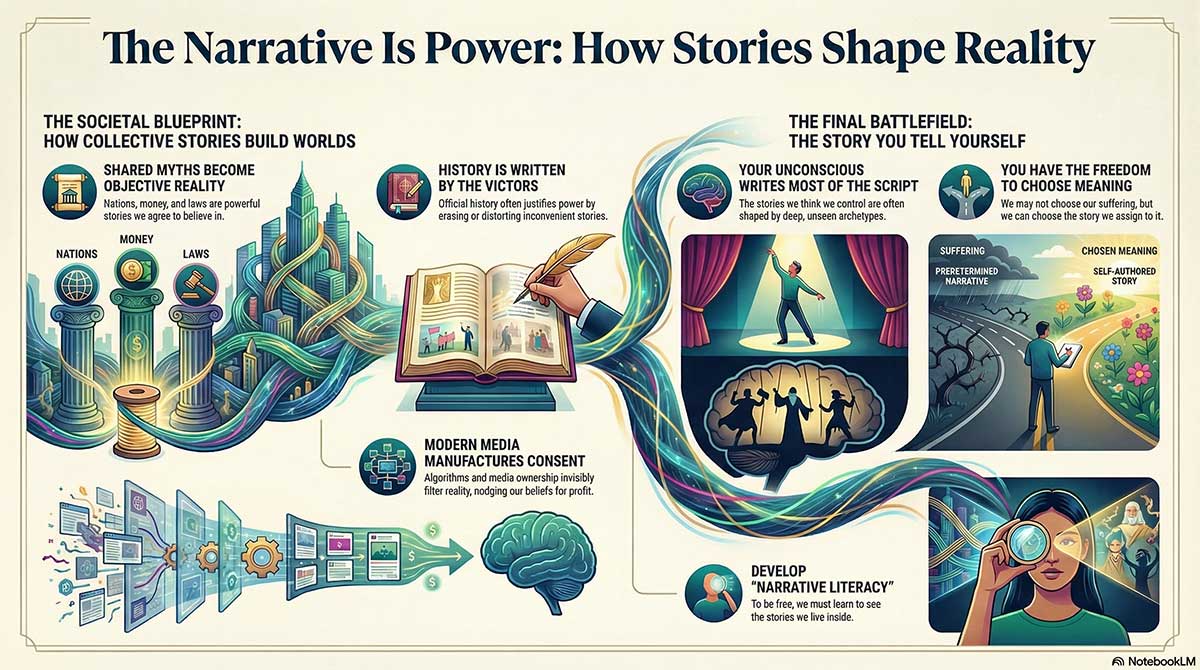
What stayed with me through these conversations is not the danger of stories—but their responsibility. Stories are unavoidable. Even silence becomes a narrative. The question is not whether we live by stories, but whether we remember they are partial, human, and unfinished.
When narratives are held too tightly, they stop guiding us and start governing us. They become tools of exclusion instead of bridges of meaning. History turns rigid. Faith turns defensive. Media turns manipulative. And the inner voice turns cruel.
But when narratives are held lightly—with humility, curiosity, and compassion—they remain alive. They invite dialogue instead of obedience. They leave room for doubt, growth, and shared humanity.
Perhaps the real task is not to control the narrative, but to stay conscious of it. To recognize when a story is helping us see more clearly—and when it is quietly deciding reality on our behalf.
That awareness alone may be the first step back toward freedom.
Short Bios:
Topic 1 — Before Truth: How Stories Become Reality
Karen Armstrong
Former nun and renowned scholar of religion and mythology, exploring how sacred stories shape compassion, conflict, and human meaning across cultures.
Yuval Noah Harari
Historian and author focused on how shared myths—money, nations, human rights—enable large-scale human cooperation and shape perceived reality.
Carl Jung
Psychiatrist and founder of analytical psychology, known for exploring archetypes, the collective unconscious, and the symbolic roots of human experience.
Hannah Arendt
Political philosopher who examined power, totalitarianism, and the fragile boundary between truth, narrative, and authority.
Joseph Campbell
Mythologist who studied universal story patterns and how myth guides individuals through meaning, transformation, and identity.
Topic 2 — Holy Words & Chosen Truths: Narrative in Religion
Rabbi Jonathan Sacks
Rabbi, philosopher, and moral voice known for bridging tradition and modernity while emphasizing ethical responsibility and pluralism.
Elaine Pagels
Historian of early Christianity who revealed how alternative Christian narratives were excluded in the formation of religious orthodoxy.
Augustine of Hippo
Early Christian theologian whose writings shaped Western doctrines of truth, authority, sin, and salvation.
Origen of Alexandria
Early Christian thinker who emphasized symbolic and multi-layered interpretations of scripture over rigid literalism.
Ibn ʿArabi
Islamic mystic and philosopher who taught that divine truth is infinite and perceived differently through each human heart.
Topic 3 — History Is Written by the Victors
Timothy Snyder
Historian of Europe and authoritarianism, examining how distorted history enables political violence and erosion of truth.
Howard Zinn
Historian who centered ordinary people and marginalized voices in historical narratives often dominated by power.
George Orwell
Writer and critic who warned how language, propaganda, and historical revision undermine freedom and reality.
W.E.B. Du Bois
Sociologist and historian who exposed how racial injustice and erased histories shaped modern power structures.
Svetlana Alexievich
Nobel Prize–winning writer who documented history through firsthand human voices rather than official accounts.
Topic 4 — Media, Money, and Manufactured Consent
Shoshana Zuboff
Scholar of surveillance capitalism, analyzing how digital systems shape behavior, attention, and autonomy.
Noam Chomsky
Linguist and political critic known for exposing how media and institutions manufacture public consent.
Marshall McLuhan
Media theorist who argued that communication technologies reshape human perception and society itself.
Neil Postman
Cultural critic who warned that entertainment-driven media erodes seriousness, truth, and public discourse.
Jaron Lanier
Technologist and philosopher advocating for human dignity and ethical responsibility in digital systems.
Topic 5 — The Final Battlefield: The Story You Tell Yourself
James Hillman
Psychologist and founder of archetypal psychology, emphasizing myth, soul, and symbolic imagination over self-optimization.
Carl Jung
Psychiatrist who explored how unconscious narratives shape identity, meaning, and psychological wholeness.
Viktor Frankl
Psychiatrist and Holocaust survivor who taught that meaning—not pleasure or power—is the deepest human motivation.
Brené Brown
Researcher and author focused on vulnerability, shame, courage, and the stories people tell about belonging.
Friedrich Nietzsche
Philosopher who challenged inherited moral narratives and urged individuals to create meaning through life affirmation.
Leave a Reply