

|
Getting your Trinity Audio player ready...
|
What if Daniel Gilbert debated Stumbling on Happiness with Kahneman and Tversky—then showed you exactly why your forecasts fail?
Stumbling on Happiness Explained is my invitation to do something most of us hate doing: doubt our own “sure thing” feelings about the future. We walk around with a private simulator in our heads—an imagination engine that can conjure a promotion, a breakup, a move to a new city, a “finally I made it” moment—and then it whispers, Here’s exactly how you’ll feel. The problem is that the simulator isn’t neutral. It’s a spotlight. It overemphasizes one feature of the future and leaves out the hundreds of ordinary details that actually shape well-being. It edits out boredom. It edits out adaptation. It edits out the fact that you will still be you—on Tuesday morning—after the big event.
That’s why I wrote this book, and that’s why I’m excited about this imaginary discussion. I want to sit with the people whose work I’ve leaned on—researchers who have mapped the hidden machinery of judgment, memory, and prediction—and ask a question that’s more practical than it sounds: If we’re so bad at forecasting happiness, how can we make better life decisions anyway? Not perfect decisions. Just better ones—ones that rely less on fantasy and more on evidence, patterns, and what real human lives tend to feel like once the novelty fades.
Because if there’s one promise in these pages, it’s not that you can avoid pain or guarantee joy. It’s that you can stop being so surprised by yourself.
(Note: This is an imaginary conversation, a creative exploration of an idea, and not a real speech or event.)
Topic 1 — The Forecasting Illusion

Why we’re predictably wrong about what will make us happy.
The room isn’t dramatic—no stage, no spotlight—just a long table, a few notebooks, and that quietly dangerous idea that your mind can lie to you while sounding completely reasonable. Daniel Gilbert leans back, half-smiling like a man about to confess a shared human weakness.
Daniel Gilbert: Before we go anywhere, I want to put a pin in the problem I keep returning to: when people imagine a future that will “finally make them happy,” the mind produces something that feels like a faithful preview… but it’s a sketch. A biased sketch. So let me ask you all this as bluntly as possible: when we simulate the future, what shortcut hijacks the simulation first?
George Loewenstein: Projection. People assume future emotions will resemble present emotions. If you’re lonely now, you imagine the future through loneliness. If you’re hungry now, you think you’ll want the same thing later. The “hot” states and “cold” states don’t translate. That gap is the first crack in the forecasting engine.
Daniel Kahneman: I’d say focalism—attention zooms in on one feature and treats it like the whole experience. A raise, a move, a breakup, a diagnosis. The mind builds a story around the highlight and forgets that life will still be… life. You’ll still wake up, commute, get tired, have small annoyances. The simulation is not the day-to-day.
Timothy D. Wilson: I’m with Danny on focalism, but I’ll add something: people don’t understand how much the brain “fills in” missing details. We create a coherent picture from very little information, and coherence feels like accuracy. You’re not forecasting reality—you’re forecasting a narrative that your mind can easily run.
Amos Tversky: And the narrative is driven by availability. Whatever comes to mind easily becomes “representative” of what will happen. A vivid example, a recent memory, a friend’s dramatic story—these become the building blocks. Ease of recall masquerades as probability.
Daniel Gilbert: Right. And when you add those up—projection, focalism, availability—you can see why the future feels so persuasive: it’s built from whatever is loudest in the present.
Gilbert sits forward now, tapping his pen once, like a judge about to ask the question that makes everyone uncomfortable.
Daniel Gilbert: Here’s the next problem. If forecasting errors are so reliable—if we’re wrong in the same ways again and again—why don’t we learn faster? Why do smart people keep stepping into the same emotional potholes?
Timothy D. Wilson: Because feedback is messy. You make a choice, then the world changes, you change, your standards change. People don’t get clean data. Instead, they get stories: “It worked because I deserved it,” or “It failed because of bad luck.” We explain outcomes in ways that protect identity, not in ways that improve prediction.
Daniel Kahneman: Also, memory is not a neutral archive. If you ask people how an experience was, you’re asking the remembering self to summarize. That summary is heavily influenced by peaks and endings, not duration. So the “lesson” people think they learned is often not about what they truly experienced.
Amos Tversky: And because the mind prefers certainty, it underweights ambiguity in hindsight. Once the choice is made, people feel they always knew. That illusion of foresight blocks real learning. If you believe you predicted it accurately, why would you update?
George Loewenstein: There’s another angle: some forecasting errors are motivational. If people accurately predicted how quickly they’d adapt to a new car, a new job title, a new luxury, they might not pursue it. Certain mispredictions keep the engine of striving running. The system is “wrong,” but it’s useful for movement.
Daniel Gilbert: That’s the maddening part: the mind’s errors can be functional. It’s like realizing your compass is tilted on purpose because it keeps you walking.
He pauses, then makes the question smaller, more practical—like he’s offering a tool, not just a diagnosis.
Daniel Gilbert: So let’s get concrete. If imagination is a biased simulator, what’s the most practical replacement? How does a person swap the “inside view” for something better—without turning life into a sterile optimization exercise?
Daniel Kahneman: The outside view. Use base rates and comparison classes. Ask: “How do people like me feel after making this kind of choice?” Not the exceptional cases, not the dramatic anecdotes—the typical outcome. It’s not romantic, but it’s reliable.
Amos Tversky: And don’t trust the single story. Aggregate. When you rely on one vivid example, you’re doing the availability dance again. The outside view works best when it’s many cases—patterns, not portraits.
Timothy D. Wilson: I’d add: people need permission to copy the boring wisdom. There’s a strange resistance to learning from others because it feels unoriginal. But if your goal is happiness rather than a heroic self-narrative, other people’s data is priceless.
George Loewenstein: Also: forecast your states, not your slogans. People say, “I want meaning,” but meaning is too abstract to predict. Instead, ask, “What will my Tuesday feel like?” Energy, stress, loneliness, time pressure, autonomy. Those are more forecastable than grand concepts.
Daniel Gilbert: Yes—Tuesday. Not the highlight reel. Not the “new identity.” Tuesday.
He looks around the table, as if the real takeaway is almost embarrassingly simple.
Daniel Gilbert: Let me try to fuse what you all said into one rule that doesn’t insult the reader: if you want to predict your happiness, don’t ask your imagination for a movie. Ask reality for a statistic. Ask other people for Tuesdays. And then—this is the hard part—believe them more than your vivid fantasy.
He smiles again, but this time there’s a gentler edge to it.
Daniel Gilbert: Because the future our minds show us is not a lie exactly. It’s worse. It’s a beautifully edited truth. And our job, if we want fewer regrets and more durable well-being, is to stop confusing editing for accuracy.
Topic 2 — Two Selves, Two Truths

Experiencing self vs. remembering self—and why memory edits happiness.
The room feels a little quieter now, like everyone has agreed to talk about something tender: the way we tell ourselves the truth, and how often that truth is a story we wrote after the fact.
Daniel Gilbert doesn’t open with a big claim. He opens with a confession.
Daniel Gilbert: I’ve come to think the biggest conflict in happiness isn’t between pleasure and pain. It’s between two versions of you. The one who lives life and the one who tells the story. So let me throw the first question into the middle of the table: if the experiencing self and the remembering self want different things, who should get to vote when we make big choices—career, marriage, where we live?
Daniel Kahneman: The remembering self has the vote by default because it’s the one that keeps score. It writes the résumé of your life. It will tell you whether your marriage was “good” or your career was “worth it.” But the experiencing self is the one who pays the daily cost. If you ignore it, you can build a life that looks impressive in memory and feels unpleasant in reality.
Daniel L. Schacter: I’d put it this way: the remembering self is not merely biased—it’s constructive. Memory and imagination use overlapping systems. That means the story you tell about your past becomes the raw material you use to imagine your future. If you let the remembering self dominate, you’re choosing based on an edited archive that then edits the next decision.
Elizabeth Loftus: And we should be careful with the idea that the remembering self is even “you” in a stable sense. Memory is malleable. People absorb suggestions, social narratives, and emotional needs, and those can rewrite what felt certain. So if the remembering self is shaping major decisions, we should admit the jury has been tampered with—often by perfectly innocent influences.
Antonio Damasio: The experiencing self is not just about pleasure. It’s about regulation—stress, calm, safety, threat. Those are bodily signals. When people make decisions that satisfy the remembering self—status, pride, a neat narrative—but the body remains chronically activated, you get a mismatch: the story says “success,” the organism says “danger.” The vote should include physiology.
Daniel Gilbert: So the uncomfortable truth is: if you make decisions purely for the story, you may win the biography and lose the day. And if you make decisions purely for the day, you may later feel your life lacked shape. Great.
He tilts his head like he’s about to ask a question that causes fights at dinner parties.
Daniel Gilbert: Memory doesn’t just record happiness—it edits it. What edits are the most dangerous? The peak-end effect? The meaning overlay? Or the stories we tell to protect identity?
Elizabeth Loftus: The most dangerous edits are the ones you don’t know are edits. People feel their memories are like recordings. They’re not. We reconstruct. We borrow details. We compress timelines. And the more emotional the event, the more people assume accuracy. That false confidence is a hazard. If your memory is wrong but certain, you won’t question it—and you’ll build the future on it.
Daniel Kahneman: Peak and end are powerful because they’re simple. The remembering self is lazy in a specific way: it wants summaries. So it uses the most intense moment and the ending, and it discards duration. That’s why a vacation with one terrible day can be remembered as “ruined,” or a difficult project that ends triumphantly becomes “worth it,” even if the middle was misery.
Daniel L. Schacter: The meaning overlay is tricky because it feels like wisdom. People turn experience into lessons. Sometimes that helps. But it can also distort. If you decide an event “made me who I am,” you may inflate its role. Identity-driven memory is sticky—it resists correction because the correction feels like self-erasure.
Antonio Damasio: And the body adds its own editing. Emotional tags—somatic markers—can attach to certain memories. You may “remember” something as bad not because it was, but because your body learned a threat association. That’s not moral failure; it’s biology. But it can produce very confident avoidance of experiences that might actually be good now.
Daniel Gilbert: So the edits can be cognitive, social, and bodily. Lovely. We are edited by our brains, by other people, and by our nervous systems.
He looks down at his notes, then back up—so the third question lands like a practical dare.
Daniel Gilbert: Is it possible to design a life that satisfies both selves? Or do we have to accept a permanent tradeoff—either living well or telling a good story?
Antonio Damasio: It’s possible, but the design must respect rhythms. The experiencing self needs recovery, autonomy, connection, and manageable stress. If those basics are absent, no story will compensate for long. The remembering self can be satisfied through meaning, purpose, and coherence—but those should be layered onto a nervous system that isn’t in constant alarm.
Daniel Kahneman: The tradeoff can be reduced by measuring the right things. People track the story metrics—salary, titles, milestones—but they don’t track the daily metrics—time pressure, mood, energy, social connection. If you keep a modest record of daily experience, you can give the experiencing self a voice in planning.
Daniel L. Schacter: You can also design “future memories” deliberately. Not in a fake way, but by choosing experiences that are likely to be remembered well and lived well. For example: time with close others often scores highly for both selves. So does work that produces visible progress without chronic overload.
Elizabeth Loftus: And humility helps. If you accept that memory is fallible, you become less enslaved to the narrative. You can revise the story without feeling like you’re lying. That flexibility is protective. Rigid stories trap people.
Daniel Gilbert: So maybe the solution isn’t picking a winner. Maybe it’s building a system: give the experiencing self a microphone during the week, and give the remembering self a microphone when you’re shaping long arcs—without letting either one hijack the whole government.
He smiles again—less like a professor, more like a man trying to rescue people from their own mental bureaucracy.
Daniel Gilbert: Because if there’s one thing I’m learning, it’s that happiness isn’t a single feeling. It’s a negotiation between selves… and the most unhappy people are the ones who let only one side of themselves speak.
Topic 3 — Adaptation Is the Great Magician

Why joy and pain fade faster than we expect—and what that means for life choices.
The tone shifts in the room. Topic 1 felt like diagnosing a machine. Topic 2 felt like negotiating with two selves. Topic 3 feels like admitting a trick has been played on all of us—by something inside us that’s both merciful and maddening.
Daniel Gilbert doesn’t start with optimism. He starts with the sentence people hate hearing when they’re chasing something.
Daniel Gilbert: Let me put the “magic trick” on the table. Most of us believe that if we finally get the thing—love, money, status, the body, the city—our happiness will rise and stay there. And we believe that if the bad thing happens—loss, rejection, failure—it will hurt and stay there. But adaptation keeps moving the goalposts. So here’s my first question: why do we systematically overestimate how long joy or pain will last? What do we misunderstand about adaptation in real time?
Sonja Lyubomirsky: We underestimate how quickly “new” becomes “normal.” The mind is an extraordinary meaning-making machine—it calibrates fast. The first weeks of a new relationship or new job have novelty, attention, salience. Then attention drifts. The baseline returns. People aren’t broken for adapting—adaptation is efficient. But our predictions ignore that efficiency.
Ed Diener: And part of the misunderstanding is measurement. People imagine happiness as a single steady state, like a thermostat setting. But well-being is multi-dimensional and dynamic—mood, satisfaction, meaning, stress, connection. When something big happens, one dimension spikes or dips, but the others keep tugging you back toward typical patterns. You have the same habits, the same relationships, the same biology.
Martin Seligman: I’d add a hopeful twist: adaptation isn’t just the enemy of lasting happiness—it can be a feature. It’s what allows people to survive tragedy. But where we go wrong is thinking that a change in circumstances automatically changes our character and practices. If you don’t build new routines—gratitude, connection, purpose—the circumstances will fade and you’ll be right back where you started.
Roy Baumeister: Also, negative events often have a different “stickiness” because of meaning. Pain isn’t just sensation; it’s interpretation. The mind asks, “What does this say about me? About my future? About my worth?” We overestimate duration because we imagine the meaning will remain fixed. But meanings shift. People reinterpret. They rebuild identity.
Daniel Gilbert: So in a way, we’re forecasting the headline—“I’ll be happy forever,” “I’ll be devastated forever”—and forgetting that the brain is a relentless editor. It updates the story even when you’re not trying.
He pauses, then pushes into the sharp edge of the topic—where adaptation stops looking like a gift and starts looking like a problem.
Daniel Gilbert: Here’s the second question, and it’s the one that makes people uneasy: where does adaptation fail? What kinds of losses or gains don’t fade the way we expect, and what does that reveal about what people truly value?
Ed Diener: Social connection is a major one. People can adapt to many material changes more than they expect, but chronic loneliness or unstable relationships tend to keep showing up in well-being measures. We don’t fully adapt to persistent social pain the way we adapt to a nicer car.
Roy Baumeister: I’d frame it as: we don’t adapt well to threats to belonging, identity, and dignity. Losses that imply rejection or humiliation can linger because they threaten the self. Likewise, certain gains don’t fade when they change your agency—if you gain real autonomy, or escape chronic stress, the improvement can be durable because you’re not just adding pleasure; you’re removing ongoing constraint.
Martin Seligman: There’s also the meaning layer. If a gain increases your sense of purpose, contribution, or mastery, it can resist hedonic adaptation more than simple pleasure does. Pleasure adapts. Engagement and meaning can compound—especially if you keep setting new challenges and building skill.
Sonja Lyubomirsky: And many “failures to adapt” come down to repetition and rumination. Some people keep reliving the event, rehearsing it, comparing their present to an alternative reality. That blocks adaptation. On the positive side, people can also block adaptation to good things by deliberately renewing attention—gratitude practices, savoring, variety. Not in a forced way, but as a habit of noticing.
Daniel Gilbert: So adaptation isn’t a fixed law. It’s shaped by attention, meaning, and what repeats.
He leans forward now with the question that turns the whole book into a practical dilemma.
Daniel Gilbert: If our minds will adapt anyway—if the brain will pull the rug out from under both misery and euphoria—how do we choose goals that stay rewarding? How do we avoid chasing new highs and new identities like we’re on a treadmill made of our own expectations?
Martin Seligman: You choose goals that change who you are and what you do daily. Not the trophy goal—the practice goal. Skills, relationships, service, health, mastery. If your goal produces a new pattern of living, it can keep paying dividends. If your goal is mostly a badge, you’ll adapt quickly and then need a bigger badge.
Sonja Lyubomirsky: I’d say: choose goals that create repeated positive experiences rather than one-time peaks. Happiness is less like fireworks and more like a campfire. You need fuel. Relationships, kindness, movement, creativity, learning. And build strategies that slow adaptation: introduce variety, savoring, gratitude—not as self-help slogans, but as attention training.
Ed Diener: Also, be cautious about “comparison goals.” Many people chase happiness by chasing rank—who has more, who looks better, who’s more admired. Those goals are particularly unstable because the comparison target keeps moving. Goals anchored in values and community tend to be more stable.
Roy Baumeister: And accept that a meaningful life includes discomfort. If you require constant comfort to feel happy, you’ll be brittle. Some of the most enduring satisfaction comes from responsibility, commitment, and contribution—things that aren’t always pleasant in the moment. People confuse “I’m stressed” with “I’m unhappy,” when sometimes stress is the cost of building a life that matters.
Daniel Gilbert: So the durable path is less “get the thing” and more “become the kind of person who lives differently.”
He sits back, like he’s letting the message land in the reader’s gut instead of their head.
Daniel Gilbert: The strange mercy of adaptation is that it will rescue you from heartbreak you can’t imagine surviving. The strange cruelty of adaptation is that it will also dull the triumph you swore would complete you. Which means the question isn’t “How do I secure permanent happiness?” The question is “What kind of life keeps producing reasons to be glad I’m here?”
He looks around the table, then gives the kind of closing line that sounds almost too simple—until you realize it’s the whole book.
Daniel Gilbert: If you want to beat the magician, don’t demand a permanent emotional peak. Build a life with repeatable sources of meaning, connection, and growth—because adaptation can fade a feeling, but it can’t easily fade a way of living.
Topic 4 — Choice, Regret, and the Tyranny of Options

Why more freedom can produce less satisfaction (and more second-guessing).
The room feels different now—less like a lab, more like a courtroom. Topic 4 isn’t about what we feel. It’s about what we argue with ourselves after we choose.
Daniel Gilbert starts with a grin that signals he’s about to accuse everyone of the same crime.
Daniel Gilbert: We tend to treat choice like oxygen: if we don’t have enough of it, we suffocate. But in practice, more choice often makes people anxious, indecisive, and regretful. So let me ask the first question as plainly as I can: when does “more choice” stop being freedom and start becoming a regret machine? What are the early warning signs?
Barry Schwartz: The warning signs show up fast: you delay, you compare obsessively, you fear missing out, and when you finally choose you keep checking the unchosen doors. People think more options guarantee a better outcome, but they forget the psychological cost of evaluating them. Maximizers—people who feel they must choose the best—suffer the most. They often get objectively better results but feel worse.
Richard Thaler: And the environment matters. If the choice architecture is messy—too many options, unclear tradeoffs, no good defaults—people freeze or make random choices and then blame themselves. A lot of “choice stress” isn’t personal weakness; it’s bad design. Humans aren’t built to compare twenty near-identical alternatives.
Cass Sunstein: There’s also the moral framing: modern culture tells people that if they’re unhappy, it’s because they chose wrong. That creates a kind of choice shame. The more options you have, the more responsibility you feel, and the more self-blame you experience when reality is imperfect—which it always is.
Dan Ariely: And we adapt quickly. So people think, “If I choose perfectly, I’ll lock in lasting happiness,” but adaptation undermines that. Then the mind goes hunting: “Maybe the other option would have kept me happier.” The choice becomes a counterfactual factory. Regret isn’t just emotion—it’s imagination applied to the paths not taken.
Daniel Gilbert: So freedom becomes a trap when it turns your life into a constant audit. The mind stops living the choice and starts litigating it.
He makes the second question feel like a knife made of kindness—because it’s about constraints, and people have complicated feelings about constraints.
Daniel Gilbert: That leads to the next question: what’s the most humane way to use constraints—defaults, commitments, rules—without crossing into manipulation or self-deception? How do we narrow the menu without making people feel controlled?
Cass Sunstein: The ethical line is transparency and easy exit. Defaults can help people—most people want to save for retirement, get vaccines, choose healthy food—but the system should be visible and reversible. “We picked a default because it helps most people. Here’s how to opt out.” That protects autonomy.
Richard Thaler: And there’s a difference between forcing and guiding. Good nudges reduce friction for choices people already endorse. They don’t sneak people into outcomes they’d reject if they were paying attention. The best choice architecture makes the good choice easy, not the alternative impossible.
Barry Schwartz: At the personal level, constraints can be chosen rather than imposed. People can adopt satisficing—“good enough”—as a value. They can limit options deliberately. But society often shames that as settling. It’s not settling; it’s protecting your attention and your peace.
Dan Ariely: Commitment devices matter too. If you know you’ll procrastinate or drift, you can pre-commit in ways that preserve dignity: public goals, scheduled routines, penalties that you voluntarily choose. It’s not self-deception; it’s self-knowledge.
Daniel Gilbert: So a good constraint is one you can explain without embarrassment. “I’m doing this because my brain works this way, and this structure helps me live better.” That’s not weakness—that’s competence.
Then he asks the third question, the one that’s meant to produce a tool you can actually use after watching the video.
Daniel Gilbert: If you could teach one decision habit that reliably reduces regret—one habit people can practice without becoming robots—what would it be? Satisficing? Pre-commitment? Reframing? Something else?
Barry Schwartz: Satisficing, clearly. Decide what matters most—two or three criteria—choose an option that meets them, and stop shopping. Regret thrives on endless comparison. You kill it by ending the comparison game.
Richard Thaler: I’d say: set a default for yourself. If you repeatedly face similar decisions, create a policy. Policies reduce decision fatigue and prevent you from treating every choice like it’s life-or-death. “I always choose the simplest plan.” “I don’t read reviews after I buy.” Those rules protect satisfaction.
Cass Sunstein: Mine is: separate outcome from process. People judge themselves by results, but results have luck. If you choose well given what you knew, you should respect the decision—even if the outcome disappoints. That mindset reduces moralized regret.
Dan Ariely: I’ll add: don’t let your memory rewrite the alternative. After you choose, you idealize the unchosen path. It becomes a fantasy. So build a habit of reality-checking your counterfactuals: “What problems did the other option have that I’m now forgetting?” That alone lowers regret.
Daniel Gilbert: So the antidote isn’t “choose perfectly.” It’s “choose sanely”—then stop rerunning the universe like you’re editing the director’s cut of your life.
He sits back and offers the kind of closing that feels like relief.
Daniel Gilbert: The mind’s great lie about choice is that the perfect decision will prevent pain. It won’t. Life contains pain. The best decision habits don’t eliminate discomfort—they eliminate the extra suffering we generate by second-guessing, self-blaming, and worshiping the road not taken.
He glances around the table, almost amused.
Daniel Gilbert: And if happiness has an enemy in the modern world, it might not be tragedy. It might be the endless menu.
Topic 5 — The “Outside View” Cure

Why listening to other people often beats imagination—and when it doesn’t.
Topic 5 feels like the final test. After all the talk about forecasting errors, memory edits, adaptation, and regret… what do you do Monday morning when you have a real decision?
Daniel Gilbert sets the mood with a small confession that sounds like a warning label.
Daniel Gilbert: If the inside view is a beautifully edited hallucination, then the obvious cure is the outside view—other people’s experience. But here’s the irony: we resist it. We’d rather trust our imagination than the data of human lives. So let me ask the first question: why is the outside view often more accurate than imagination, and why do we resist it even when we know it’s better?
Philip E. Tetlock: The outside view is boring in the best way. It’s base rates. It says, “People like you, making choices like this, usually end up here.” That’s humbling because it reduces your sense of uniqueness. We resist because we want to believe we’re the exception—especially when we’re emotionally invested.
Gerd Gigerenzer: Also, the outside view often works through simple heuristics. “Follow the crowd” isn’t always stupid—it’s an efficient rule when you lack information. But people think using heuristics means being irrational. They want to feel like their choices are special, deeply reasoned. Yet in uncertain environments, simple rules often outperform complex analysis.
Mihaly Csikszentmihalyi: There’s another resistance: people don’t want to borrow someone else’s life. They want authorship. They want the sense that their happiness is self-made, not socially transmitted. But the outside view isn’t about copying—it’s about learning the conditions under which people tend to thrive.
Paul Slovic: And we distrust other people’s experience because emotions are contagious and biased. We know stories can manipulate us. So we swing the other way: “I’ll just trust myself.” The problem is, the self doing the trusting is the same self that mispredicts.
Daniel Gilbert: Right—the skeptic and the fool share the same skull. That’s the situation.
He pauses, then makes the second question sharper, because the outside view can go wrong in a way that looks like wisdom.
Daniel Gilbert: That brings me to the second question: when does social information mislead us? How do we tell the difference between true guidance and contagious cultural narratives that hijack our goals?
Paul Slovic: The danger is affect. People follow what feels vivid, dramatic, morally charged—because feelings substitute for analysis. Cultural narratives often come packaged with strong emotion: fear, status, outrage, belonging. If you feel swept up, you may be absorbing affect rather than evidence.
Philip E. Tetlock: I’d add: watch for “one story tyranny.” The outside view isn’t “what one charismatic person said.” It’s aggregated reality. Cultural narratives often pick a single prototype—“the entrepreneur,” “the perfect marriage,” “the glamorous city”—and treat it like a base rate. That’s not outside view. That’s mythology.
Gerd Gigerenzer: And sometimes the outside view is misused by pretending the world is stable when it isn’t. Heuristics work when they match the environment. If the environment changes—new technology, new norms—old base rates can mislead. You need ecological rationality: the right rule for the right context.
Mihaly Csikszentmihalyi: Cultural narratives also mislead by confusing applause with fulfillment. They reward visible success, not lived quality. Flow, for example, is not glamorous. It’s absorption, skill, challenge, feedback. Society doesn’t always praise the things that actually nourish the human mind.
Daniel Gilbert: So the outside view isn’t “let the crowd program you.” It’s “listen to patterns in human experience—then interrogate whether the pattern fits your environment and values.”
He leans forward with the third question—because this one must produce a one-sentence rule people can carry out of the room.
Daniel Gilbert: Last one: if you had to give viewers one simple rule for better forecasting—one sentence they can remember—what would it be?
Mihaly Csikszentmihalyi: “Choose what you can repeatedly lose yourself in.” If an activity reliably generates flow, it’s a strong predictor of sustained well-being.
Gerd Gigerenzer: “Use one good cue, not ten noisy ones.” In uncertainty, a simple heuristic anchored to a meaningful signal often beats complicated forecasting.
Paul Slovic: “If it makes you feel urgent, slow down.” Strong emotion—fear, excitement, outrage—often signals that your judgment is being steered.
Philip E. Tetlock: “Ask for base rates before you ask for advice.” Don’t start with stories. Start with typical outcomes, then adjust carefully.
Daniel Gilbert: Let me stitch those into my own final rule—the one I wish people would tattoo on the inside of their eyelids:
Daniel Gilbert: When predicting your happiness, replace imagination with evidence: start with base rates, watch for emotional hijacks, and choose what produces good Tuesdays—not grand fantasies.
He sits back, satisfied—not because the problem is solved, but because the cure is finally practical.
Daniel Gilbert: The real tragedy isn’t that we stumble on happiness. It’s that we stumble in the dark while insisting we can see. The outside view doesn’t make you less original—it makes you less fooled. And that’s the only kind of prediction skill that actually matters.
Final Thoughts by Daniel Gilbert
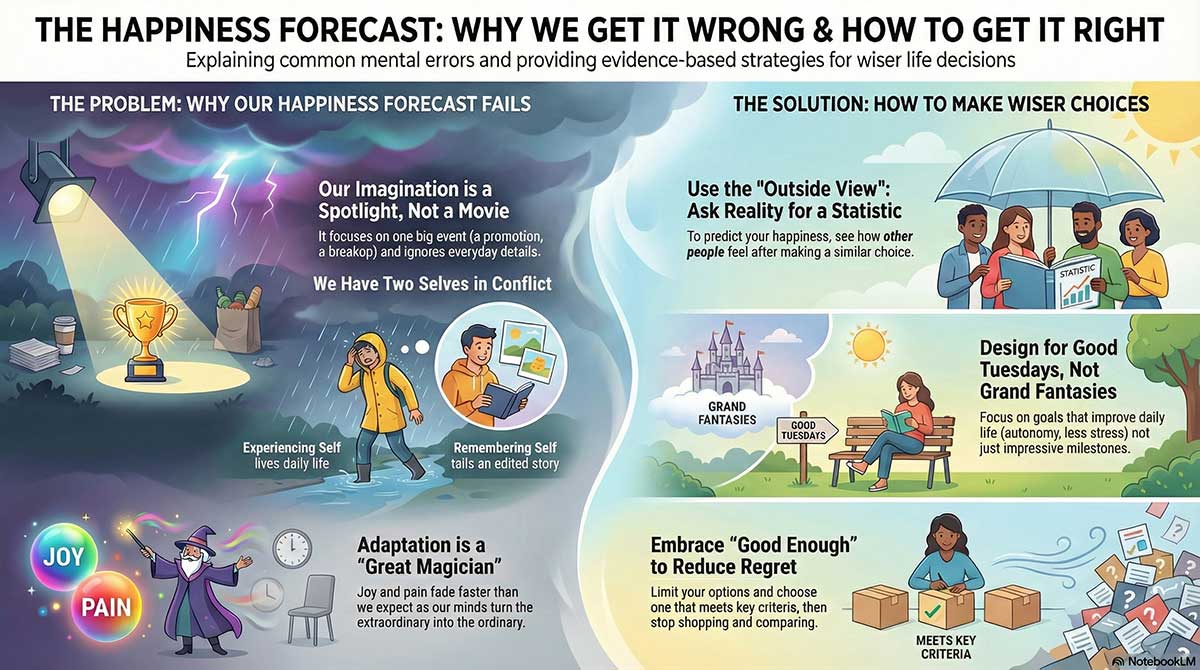
If I learned anything fresh from this conversation, it’s that our errors aren’t random—they’re coordinated. We don’t merely “get it wrong.” We get it wrong in ways that make emotional sense: we focus too tightly, we fill in gaps with stories, we confuse intensity with importance, and we let the remembering self run the show as if it were an honest historian. Then adaptation arrives, quietly and efficiently, and turns both triumph and tragedy into something livable—sometimes to our relief, sometimes to our disappointment.
What struck me most is how often the solution is not more introspection but better inputs. The inside view feels personal, and that’s why it’s seductive. But the outside view—base rates, other people’s Tuesdays, the unglamorous patterns of human experience—keeps beating our confident predictions. And the goal isn’t to become cynical or mechanical. The goal is to become less fooled by the brain’s most persuasive stories.
So here’s what I’m taking with me: happiness is rarely a single event you win. It’s more often a life you construct—through relationships that hold, work that fits, choices you can live with on ordinary days, and habits of attention that keep the present from being bulldozed by imagined futures. If you want to stumble less, don’t demand certainty from a mind built for storytelling. Build guardrails. Ask for base rates. Design your choices so that when the spotlight fades, what remains is still a life you’re glad to wake up to.
Short Bios:
Daniel Gilbert — Harvard psychologist and bestselling author of Stumbling on Happiness, known for making “why we mispredict our future feelings” both scientifically sharp and wildly readable.
Daniel Kahneman — Nobel Prize–winning psychologist who mapped the mind’s decision shortcuts and biases (Thinking, Fast and Slow) and helped popularize the “experiencing self vs. remembering self” split.
Daniel L. Schacter — Harvard memory researcher who showed how memory is constructive (and tied to imagination), explaining why our “past” is often an edited draft, not a recording.
Elizabeth Loftus — Pioneering psychologist famous for research on false and malleable memories, demonstrating how easily recollection can be shaped by suggestion and context.
Antonio Damasio — Neuroscientist who revealed how emotion and bodily signals guide decision-making, helping explain why “feels right” can be biological guidance—or biological noise.
Barry Schwartz — Psychologist behind The Paradox of Choice, showing how too many options can increase anxiety, regret, and dissatisfaction.
Richard Thaler — Nobel Prize–winning behavioral economist who developed “nudge” thinking and choice architecture, explaining how defaults and design shape real-world decisions.
Cass Sunstein — Legal scholar and coauthor of Nudge, focused on ethical choice design and how small structural changes can improve decisions without coercion.
Dan Ariely — Behavioral economist known for vivid experiments on irrational behavior, especially how emotion, framing, and social influence distort our choices.
Philip E. Tetlock — Political psychologist who studied forecasting accuracy and “superforecasters,” emphasizing base rates, humility, and probabilistic thinking.
Gerd Gigerenzer — Decision scientist who champions “fast and frugal” heuristics, showing how simple rules can outperform complex reasoning in uncertain environments.
Mihaly Csikszentmihalyi — Psychologist who introduced “flow,” the state of deep absorption that often predicts sustained well-being better than pleasure peaks.
Paul Slovic — Psychologist who studied risk perception and how feelings drive judgment, explaining why vivid stories can overpower statistics and sober reasoning.
Leave a Reply