
|
Getting your Trinity Audio player ready...
|
What if the biggest risk of war today isn’t weapons—but stories?
Lex Fridman:
Today I want to explore something that’s difficult to talk about clearly—because it lives at the intersection of hard power and human meaning.
We often describe global conflict in terms of strategy: alliances, deterrence, weapons, geography, economics. Those things matter. They matter a lot.
But if you zoom out far enough, you start to see a deeper pattern: wars don’t happen only because of resources or territory. They happen because human beings organize themselves around stories—stories about identity, destiny, fear, honor, humiliation, and sometimes sacred purpose.
And right now, multiple forces are colliding.
First, there’s the possibility that we’re moving from a world dominated by one superpower to a world with multiple centers of gravity—a multipolar world. If that’s true, then the old assumptions about who sets the rules, and how conflicts get contained, may no longer apply.
Second, we have proxy warfare—where major powers avoid direct confrontation, but compete through other nations and regions. Proxy wars can feel limited. But history shows they often grow. They escalate slowly, then suddenly.
Third, there’s sacred geography—places that carry profound spiritual weight for billions of people. These places are not just strategic locations. They are psychological and religious anchors. When a sacred place becomes part of a conflict, normal political logic can break down.
Fourth, there are apocalyptic narratives—end-times thinking, prophetic interpretation, the belief that history is moving toward an inevitable climax. Sometimes those beliefs are sincere. Sometimes they are used as rhetoric. Either way, they can shape the decisions people make—especially in moments of chaos.
And finally, we live in an age of information war—where truth competes with propaganda, censorship, and AI-generated media. In such a world, what matters is not only what is true, but what is believable—and what spreads fastest. And that can influence decisions at the highest levels of power.
So the purpose of this conversation is not to sensationalize fear.
It’s to try to understand the machinery that turns friction into conflict.
Because if we can understand that machinery—the incentives, the myths, the blind spots, the escalation ladders—then maybe we can also understand what restraint looks like.
And what an off-ramp might look like.
(Note: This is an imaginary conversation, a creative exploration of an idea, and not a real speech or event.)
Topic 1 — Multipolar Reality vs Unipolar Habit
Joe Rogan:
Alright—so the big claim here is simple but wild: we’re acting like we still run the world the way we did after 1991, but we don’t. And if we keep pretending, we’re going to get forced into “reality” the hard way.
So let’s start basic: are we actually in a multipolar world now—and if we are, what does “accepting it” even mean?
Graham Allison:
We are in a different era. But the more important question is whether leaders behave like they understand that. When two major powers see themselves as entitled to set the rules, you get friction everywhere—trade, tech, shipping lanes, finance, military presence. The pattern is old: rising power meets ruling power, and the risk is miscalculation more than intention.
Peter Zeihan:
We’re not just in a different era—we’re in a different math problem. People keep debating prestige and values while ignoring production and geography. The U.S. has a lot going for it—oceans, food, energy, demographics relative to peers. But the assumption that we can do “global management” forever? That’s expensive. And it requires industrial depth we’ve been hollowing out.
Maryam Jamshidi:
And there’s another layer: legitimacy. “Running the world” isn’t just aircraft carriers and GDP. It’s whether others accept your rules as lawful or tolerable. If your actions look like unilateral force without a clear legal framework or consistent standards, you lose credibility—and then even allies hedge.
Reza Aslan:
Also, “multipolar” isn’t only states. It’s identities. It’s religious networks, diaspora communities, and narratives that travel faster than policy. Leaders keep thinking in Cold War blocks, but mass publics are mobilized by meaning: humiliation, sacred duty, historical grievance. A world order that ignores that is blind.
Yuval Noah Harari:
Empires collapse when their stories collapse. The “unipolar moment” was not only a power balance; it was a narrative: liberal democracy is the end point, global integration is inevitable, and the U.S. is the guarantor. When people stop believing that story—inside the U.S. and outside—institutions weaken quickly.
And into that vacuum step new stories: civilizational conflict, religious destiny, national revival.
Joe Rogan:
Okay but here’s the question everyone asks in real life: so what’s the alternative?
Because “accept multipolarity” sounds like… what? Let China do whatever it wants? Let regional powers do whatever they want? People hear that as surrender.
Graham Allison:
Accepting reality doesn’t mean surrender. It means prioritization. You decide what you will fight for, what you will negotiate, and what you will tolerate. The most dangerous position is promising everything everywhere—because eventually you prove you can’t deliver.
Maryam Jamshidi:
And it means aligning actions with principles. If you claim a rules-based order, then rules need to apply even when it’s inconvenient. Otherwise, “rules-based” becomes a branding slogan—useful until the moment credibility matters.
Peter Zeihan:
You also stop confusing capability with desire. The U.S. can project power. But should it? And at what cost? You can’t keep supply chains global, energy flows secure, and defense commitments everywhere while your industrial base is geared for a peacetime economy that assumes someone else makes the stuff.
Reza Aslan:
And you stop treating other societies like they’re just chess squares. If you don’t understand what “face,” “honor,” “martyrdom,” or “holy place” means to people, you create conflict even when you “win” tactically. Because you just recruited the next generation against you.
Yuval Noah Harari:
A multipolar world can be stable, but only if major powers agree on at least minimal shared myths: borders matter, sacred sites are protected, and escalation is taboo. When there is no shared myth, every crisis becomes existential.
Joe Rogan:
So let me pin this down into something measurable.
If we’re living in a multipolar world but acting like it’s unipolar, what does that look like in real decisions? What are the tells?
Peter Zeihan:
A tell is when policy assumes infinite resources—like we can fund, arm, and manage multiple theaters while also reshoring industry and keeping inflation down. That’s not strategy; that’s wishcasting.
Maryam Jamshidi:
Another tell: the public justification changes every week. When the reason for action keeps shifting—security, then democracy, then deterrence, then “credibility”—it often means there was never a coherent legal or strategic foundation.
Graham Allison:
A third tell is when leaders keep drawing red lines they don’t enforce—or enforce inconsistently. That trains rivals to test you, and it trains allies to doubt you.
Reza Aslan:
A fourth tell: ignoring symbols. Treating sacred geography like normal real estate. That’s a profound misread of what triggers mass violence.
Yuval Noah Harari:
And the biggest tell is narrative breakdown at home. When citizens don’t believe their institutions, they won’t sustain long commitments abroad. A multipolar world punishes internal fragmentation.
Joe Rogan:
So is the real danger here that we’re losing power—or that we’re losing the ability to admit limits without panicking?
Graham Allison:
The second. Great powers can adjust. They fail when pride blocks adaptation.
Maryam Jamshidi:
And when the public is asked to sacrifice without honest explanations.
Peter Zeihan:
And when the industrial base can’t back up the promises.
Reza Aslan:
And when leaders ignore the meaning people assign to conflict.
Yuval Noah Harari:
Empires die twice: first in imagination, then in reality.
Topic 2 — Proxy Wars and the “Slip” Into Something Bigger
Joe Rogan:
Alright, Topic 2. The idea is: big powers don’t want to fight each other directly—especially with nukes on the table—so they fight through other places.
But then it feels like these proxy wars… don’t stay proxies. They widen, they harden, and suddenly everybody’s involved.
So here’s the question: why do proxy wars keep slipping into bigger wars even when nobody wants that?
Maryam Jamshidi:
Because proxies create a moral loophole. When you’re not formally “at war,” governments behave like normal accountability rules don’t apply. You get covert actions, blurred chains of command, deniable strikes—then something happens, civilians die, or a red line is crossed, and suddenly you have escalation with no legal or diplomatic architecture to contain it.
Graham Allison:
Proxy wars are not designed to “win.” They’re designed to avoid losing face. The trap is credibility. Each side thinks, “If I don’t respond, I’ll look weak.” And the response becomes the new baseline. You climb an escalation ladder one rung at a time, and no one notices until you’re too high to climb down without falling.
Peter Zeihan:
Also: logistics. A proxy war eats inventory. It consumes missiles, spare parts, airframes, trained crews. People talk about “sending aid” like it’s infinite. It isn’t. And once you’ve committed your supply chain, you’ve committed your future options. Then the war starts dictating your behavior—because you can’t afford to look like you’re backing away after you’ve spent the material.
Reza Aslan:
And you’re missing the social side: proxy wars create martyrs and myths. The proxy becomes the story. It becomes identity. You can “negotiate” with a government, but you can’t negotiate with a narrative that says, “We were humiliated—now we must avenge.” That’s how conflicts metastasize across borders, especially when religion or sacred sites are involved.
Yuval Noah Harari:
Proxies also outsource consequences. Leaders imagine the war’s suffering will stay “over there.” But in an interconnected world, it comes back—energy shocks, migration, online radicalization, polarization. The proxy war returns home as domestic instability. That feedback loop pushes leaders into more coercion, more censorship, more fear—then society becomes less capable of diplomacy.
Joe Rogan:
Okay—so you’re all describing different versions of the same thing: proxy wars reduce the immediate cost for leaders, but they increase the long-term risk.
What’s the simplest mechanism? Like, what’s the moment where it stops being “contained”?
Graham Allison:
Usually it’s a misread signal. You interpret a strike as intentional when it was accidental—or you interpret a warning as bluff. Proxy wars are full of ambiguous signals. And ambiguity is gasoline. It’s not the planned escalation that gets you; it’s the unplanned escalation.
Maryam Jamshidi:
And ambiguity is weaponized. When there’s no transparency, actors can claim anything. “They attacked first.” “That was a false flag.” “That was a mistake.” Even if the truth is knowable later, the immediate effect is rage and mobilization.
Peter Zeihan:
There’s also a material tipping point: when standoff warfare runs out. If you run low on safer tools—long-range missiles, interceptors, spare parts—your options narrow. You start taking riskier actions: closer air sorties, more exposed ships, more advisors on the ground. That’s how you drift into direct involvement.
Reza Aslan:
And the cultural tipping point is when a proxy war becomes framed as a holy war or civilizational war. Once that frame is widely believed, compromise becomes betrayal. Moderates get crushed. The extremists gain status. That’s a predictable pattern.
Yuval Noah Harari:
Proxy wars also create “audience capture” for leaders. They make promises, their media repeats those promises, and then leaders become prisoners of their own rhetoric. Backing down becomes politically impossible—even if strategically rational.
Joe Rogan:
So in plain English: miscommunication + politics + running out of tools.
Let’s make this real. What are the “classic moves” that turn a proxy war into a broader one?
Peter Zeihan:
Move one: you start “advising.” Advisors become operators. Operators become “limited deployments.” Limited deployments become permanent.
Maryam Jamshidi:
Move two: you normalize exceptional measures—surveillance, censorship, criminalizing dissent. Once you do that, backing down feels dangerous because you’ve created internal enemies.
Graham Allison:
Move three: you pull allies in by making it about shared credibility—“If you don’t join, the alliance is meaningless.” That turns a regional conflict into a coalition conflict.
Reza Aslan:
Move four: you strike symbols. Not just military targets—symbols. A religious site, a cultural landmark, a massacre that goes viral. That changes the emotional temperature instantly.
Yuval Noah Harari:
Move five: information collapse. When people don’t believe official narratives, they believe the narratives that fit their fear. That makes restraint politically impossible.
Joe Rogan:
That’s the scariest part—because it means the war becomes self-driving.
So let me ask the uncomfortable question: do proxy wars sometimes continue because they’re useful? Not to citizens—to systems.
Graham Allison:
Some actors benefit. War can unify domestic politics temporarily, distract from failures, justify budgets. But it’s like playing with a tiger because it keeps away the wolves. Eventually the tiger eats you.
Maryam Jamshidi:
Legally and politically, wars expand state power. That’s not a conspiracy; it’s institutional momentum. Emergency becomes normal.
Peter Zeihan:
Certain industries benefit in the short term, but strategically it can be catastrophic if it exposes your depletion and inability to replenish. The real winners are often your rivals, watching you drain yourself.
Reza Aslan:
Extremists benefit. Nothing recruits like war—especially war framed as existential or sacred.
Yuval Noah Harari:
And platforms benefit from outrage. Societies become addicted to conflict narratives. That addiction is itself a national security problem.
Joe Rogan:
Okay—so what’s the antidote?
If proxy wars are so prone to drift, what actually stops them from turning into a bigger war?
Maryam Jamshidi:
Transparent goals and lawful constraints. If you can’t state objectives in plain language and justify them in a consistent framework, you’re already drifting.
Graham Allison:
Back channels. You need quiet communication with adversaries even during conflict. Otherwise every move is interpreted in the worst way.
Peter Zeihan:
Industrial honesty. If you can’t sustain the war materially, you should not begin it—or you need a short timeline with a real exit before depletion forces escalation.
Reza Aslan:
Protect symbols. Build explicit taboo zones. And don’t pretend sacred sites are negotiable like normal territory.
Yuval Noah Harari:
And rebuild trust at home. A society that hates itself cannot manage a disciplined foreign policy. It will oscillate between crusade and collapse.
Joe Rogan:
So the whole point here is: proxy wars look safer than direct war, but they can be more psychologically and politically contagious.
Alright. Next topic gets even darker: when sacred geography becomes a tripwire—when one strike on a holy site can ignite global violence.
Topic 3 — Sacred Geography as a Global Tripwire

Joe Rogan:
Alright, Topic 3. This one gets intense.
There are places on Earth where politics stops being normal politics—because the place itself is sacred. Jerusalem is probably the most obvious example.
So here’s the question: why do certain places become global tripwires?
Like, why can a single incident in one square mile trigger outrage across continents?
Reza Aslan:
Because sacred geography isn’t about land. It’s about meaning. A sacred site is a physical anchor for identity, memory, and divine narrative. When people say a place is holy, they’re not talking about territory—they’re talking about the story of their people and their relationship with God.
Yuval Noah Harari:
Yes. Humans organize large societies through shared myths. A sacred site is where myth becomes geography. It turns an abstract story into a location you can point to. That makes it powerful—and extremely volatile—because attacking the site feels like attacking the entire story.
Maryam Jamshidi:
And international law struggles with that. Law is built to regulate territory, sovereignty, and borders. But sacred places operate outside that logic. If multiple communities claim a site as non-negotiable, legal frameworks become fragile very quickly.
Peter Zeihan:
From a strategic perspective, sacred geography creates asymmetric stakes. For one actor it might be symbolic, but for another it’s existential. That imbalance makes deterrence hard, because you’re calculating risk in material terms while the other side is calculating in spiritual terms.
Graham Allison:
And that’s exactly when miscalculation becomes likely. If one side underestimates how deeply the other side values a sacred place, actions that seem minor tactically can trigger massive reactions.
Joe Rogan:
So basically you’ve got a situation where a square mile of land carries two thousand years of emotional investment.
That seems like a nightmare for diplomacy.
Reza Aslan:
It’s worse than a nightmare—it’s a multiplier. Sacred places activate collective memory. Historical trauma, past conquests, destruction, exile—everything gets folded into the present moment.
Yuval Noah Harari:
Exactly. Humans remember symbolic injuries longer than material ones. Empires fall, economies recover, but sacred humiliation can echo for centuries.
Maryam Jamshidi:
Which is why attacks on cultural or religious sites are often treated as crimes against humanity. They’re not just property destruction—they’re perceived as attempts to erase identity.
Peter Zeihan:
And that’s when conflicts expand. Because suddenly millions of people who were not involved in the original dispute feel personally threatened.
Graham Allison:
Strategists call that “stake inflation.” What started as a local conflict suddenly acquires global stakeholders.
Joe Rogan:
Right—because people halfway across the planet start saying, “That’s my holy place too.”
Joe Rogan:
Here’s something I’ve always wondered. If two groups both believe a site is sacred, why is compromise so difficult? Why not share it?
Reza Aslan:
Because sacred space often carries exclusivity narratives. One group’s theology may say the site validates their covenant with God. Sharing it can feel like undermining that divine claim.
Maryam Jamshidi:
And politically, leaders are punished for compromise. If a sacred site becomes negotiable, opponents accuse them of betraying the faith or the nation.
Peter Zeihan:
Which means the incentives push toward hard positions. Nobody wants to be the leader who “gave away” something sacred.
Yuval Noah Harari:
And myths evolve. If a leader compromises, the myth adjusts to portray them as weak or illegitimate. That reshapes political legitimacy.
Graham Allison:
So rational bargaining breaks down. When stakes are existential or sacred, normal cost-benefit analysis doesn’t work.
Joe Rogan:
So if sacred places are this explosive, what happens when they intersect with modern weapons and global media?
Peter Zeihan:
You get instant global reaction. A strike that might have once been a local incident becomes worldwide outrage within minutes.
Maryam Jamshidi:
And verification becomes difficult. In the early hours of any incident, rumors spread faster than facts.
Reza Aslan:
Which allows actors to frame events immediately. Whoever controls the narrative first often controls the emotional response.
Yuval Noah Harari:
The digital age amplifies myth formation. Images become symbols almost instantly.
Graham Allison:
And once public opinion hardens, leaders lose room to de-escalate.
Joe Rogan:
So basically: one event at a sacred site could force governments into positions they didn’t plan for.
Joe Rogan:
Is there any realistic way to protect sacred places from becoming military flashpoints?
Maryam Jamshidi:
In theory, yes. International agreements can designate protected cultural and religious zones. But those protections depend entirely on the willingness of powerful actors to respect them.
Graham Allison:
Which requires mutual restraint—and trust that the other side will also restrain itself.
Peter Zeihan:
And in high-intensity conflicts, that trust often disappears.
Reza Aslan:
The deeper solution is cultural understanding. Leaders must grasp what these places mean to people.
Yuval Noah Harari:
Because when leaders ignore the symbolic dimension of geography, they accidentally trigger forces they cannot control.
Joe Rogan:
So what we’re really saying is this: sacred geography turns a local conflict into a global emotional event.
Graham Allison:
Yes. It multiplies stakes.
Maryam Jamshidi:
And it complicates diplomacy.
Peter Zeihan:
And it destabilizes strategy.
Reza Aslan:
Because faith and identity cannot be bombed into submission.
Yuval Noah Harari:
Sacred places remind us that humans do not live only in the physical world—we live in the worlds of meaning we create.
Joe Rogan:
Alright. That leads right into the next topic.
Because if sacred narratives are powerful enough to shape wars…
what happens when apocalyptic or end-times beliefs start influencing political decisions?
Topic 4 — When Apocalyptic Narratives Enter Statecraft
Joe Rogan:
Alright—Topic 4. This is the part that makes people uncomfortable because it’s not just “strategy” anymore.
It’s: what if some leaders or influential factions genuinely believe war is part of prophecy—or they talk that way to mobilize people?
So the question is simple: what happens to decision-making when catastrophe is seen as meaningful—or even desirable?
Yuval Noah Harari:
The first thing that happens is that politics stops being about compromise. If you believe history is moving toward an inevitable final act, negotiation becomes a distraction or even a betrayal. The future is not something to be built—it is something to be fulfilled.
Maryam Jamshidi:
And it breaks basic safeguards. In normal policy, we have constraints: proportionality, necessity, civilian protections, oversight. But if a faction believes it is doing “God’s work” or fighting absolute evil, then legal limits become irrelevant—because the moral story overrides the rulebook.
Reza Aslan:
Also, apocalyptic thinking spreads easily because it gives suffering a purpose. People living through fear, humiliation, or uncertainty are vulnerable to narratives that say, “This chaos proves we’re right. This is the sign.” It turns instability into proof.
Graham Allison:
From a strategic standpoint, it’s destabilizing because it changes what deterrence means. Deterrence assumes actors prefer survival and stability. If an actor believes martyrdom or collapse is sacred—or if they believe escalation triggers salvation—then classic deterrence models fail.
Peter Zeihan:
And you can’t ignore the incentives. Even if leaders don’t believe it, they may find the rhetoric useful. Apocalyptic framing is a mobilization tool. It hardens the base, simplifies the enemy, and makes endless sacrifice politically sustainable—until the material system breaks.
Joe Rogan:
So there’s two versions:
- they believe it, or
- they use it.
Either way, it’s dangerous.
Reza Aslan:
Exactly. And they can blend. A leader might not fully believe the theology but still internalize the emotional logic: chosen people, sacred mission, cosmic enemy. That’s how political identity becomes religious identity.
Yuval Noah Harari:
Humans are very good at believing stories that benefit them. The line between sincere faith and convenient faith is often invisible even to the believer.
Maryam Jamshidi:
Which is why institutions matter. Democracies should not require theological tests, but they do need safeguards: transparency, civilian oversight, independent courts, free press. Apocalyptic policy thrives where accountability collapses.
Graham Allison:
And where dissent is treated as treason. In moments like this, leaders redefine critics as enemies—because questioning the mission threatens the sacred narrative.
Peter Zeihan:
And because war creates a supply-demand chain for meaning. The more the war costs, the more meaning you need to justify it. That’s how rhetoric escalates even if the original motive was mundane.
Joe Rogan:
That’s a crazy point: the more you spend, the more religious you get—even if you didn’t start religious.
Joe Rogan:
So what makes apocalyptic thinking different from normal ideology? Lots of ideologies are intense.
Graham Allison:
Because normal ideology still allows bargaining. Apocalyptic thinking often turns the conflict into a final test. It treats restraint as weakness and escalation as faithfulness.
Reza Aslan:
And it sacralizes violence. Violence becomes cleansing, purifying, or necessary for redemption.
Maryam Jamshidi:
Which is exactly what humanitarian law was designed to resist: the idea that civilian harm is acceptable if the cause is “holy” or “ultimate.”
Yuval Noah Harari:
It also introduces “signs and wonders” logic. Events are interpreted as omens rather than consequences. That leads to very poor decision-making.
Peter Zeihan:
And you get strategic blindness. Because if the outcome is guaranteed by destiny, you stop checking the inventory, the logistics, the alliances, the costs. You stop doing math.
Joe Rogan:
So it’s basically: when destiny enters, reality leaves.
Joe Rogan:
Okay, but here’s the American dilemma. People have freedom of religion. You can’t tell someone, “You’re not allowed to believe that.”
So what do you do if someone’s belief system pushes policy toward catastrophe?
Maryam Jamshidi:
You don’t police belief—you police conduct and process.
Questions like:
- Are decisions justified with evidence and lawful authority?
- Are there checks against unilateral action?
- Are intelligence claims transparent enough for oversight?
Graham Allison:
You also keep back channels open with adversaries. Apocalyptic framing thrives in isolation. Communication forces reality back into the picture.
Reza Aslan:
And you invest in religious literacy. A secular elite often can’t even recognize the language of sacred escalation until it’s too late.
Yuval Noah Harari:
And you protect pluralism at home. Once domestic life becomes “us vs them,” apocalyptic narratives gain traction.
Peter Zeihan:
But none of this works if leaders are rewarded politically for pushing the most extreme story. If the electorate prefers emotional certainty, you’ll get leaders who sell emotional certainty.
Joe Rogan:
That’s the scary part. It’s not just “leaders.” It’s the whole feedback loop.
Joe Rogan:
Give people listening a gut-check list. What are the warning signs that apocalyptic logic is driving policy?
Maryam Jamshidi:
- Dissent is treated as blasphemy or treason
- The legal rationale is vague or constantly shifting
- Civilian harm is justified as “necessary purification”
- Oversight mechanisms are bypassed
Graham Allison:
- Red lines become moral absolutes
- Leaders refuse off-ramps that preserve core interests
- Escalation is described as “inevitable”
Reza Aslan:
- Sacred symbols dominate the messaging
- The enemy becomes “cosmic evil,” not a political adversary
- Martyrdom is glorified
Yuval Noah Harari:
- Omens replace analysis
- Destiny replaces contingency
- History is described as a script
Peter Zeihan:
- Material constraints are ignored
- Industrial reality is treated as irrelevant
- Timelines are fantasy
Joe Rogan:
That last one—timelines—always gets me. “This will be over in a week.” That’s like the curse phrase.
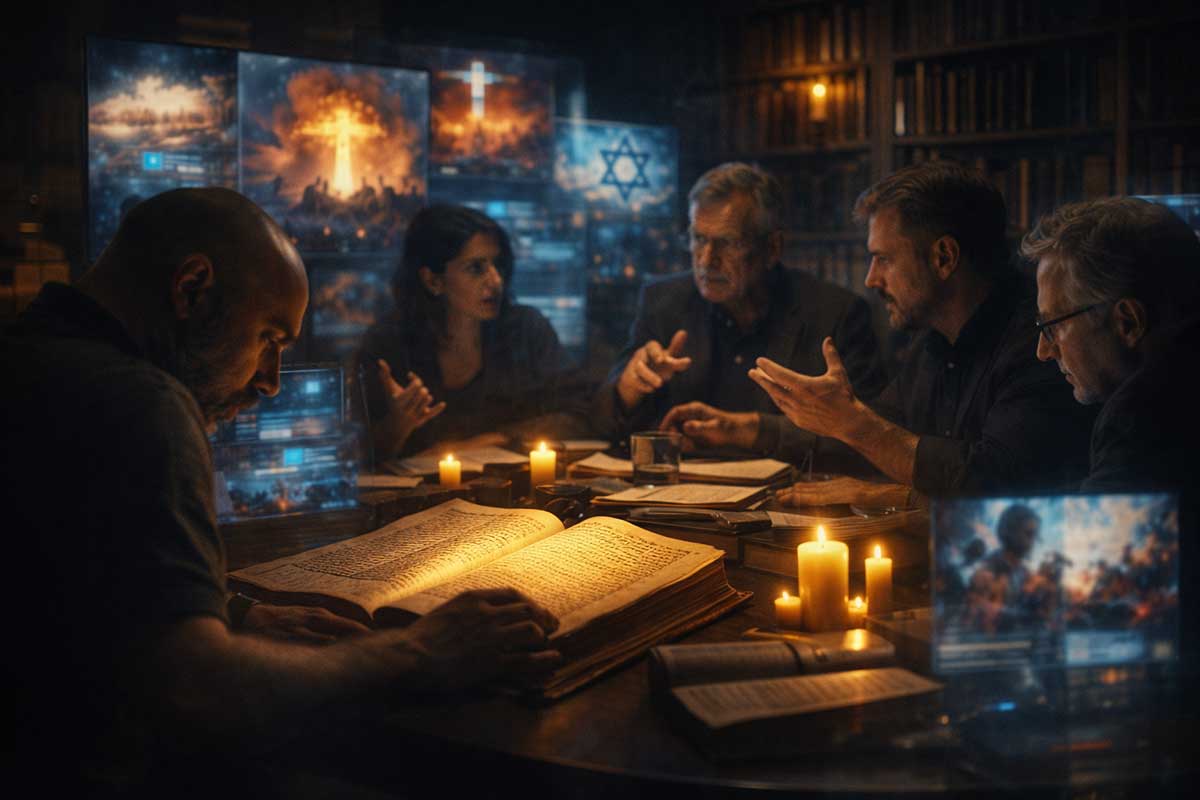
Topic 5 — Information Fog: Censorship, AI Media, and “Plausible” False Narratives
Joe Rogan:
Alright, last topic. And honestly this one might be the most important, because it affects everything else.
We’re in a world where:
- wartime censorship is normal,
- propaganda is constant,
- and AI can generate convincing “evidence.”
So here’s the question: when nobody can agree on what’s real, how do wars get contained?
Or do they just… spiral?
Peter Zeihan:
Information fog isn’t new. What’s new is speed and volume. In past wars, governments controlled information by controlling newspapers. Now it’s about flooding the zone. If you can’t prevent footage, you drown people in footage—real, fake, mislabeled, out of context—until the public gives up.
Maryam Jamshidi:
And that undermines accountability. If you can’t establish facts, you can’t enforce laws. Investigations stall. Public oversight collapses. That creates an environment where violations are easier—not necessarily because everyone is evil, but because truth becomes too costly to prove.
Reza Aslan:
And in that vacuum, people default to identity-based truth: “I believe what my side believes.” That makes sacred and civilizational narratives even more powerful, because they don’t rely on evidence—they rely on belonging.
Yuval Noah Harari:
We are moving from an information age into a narrative age, where reality is less important than coherence. People choose the story that makes them feel safe, righteous, and part of a tribe. AI accelerates this by making persuasive content infinite.
Graham Allison:
And strategically, this is dangerous because escalation depends on perceived intent. If you can’t distinguish an accident from an attack, leaders assume worst-case. That raises the probability of overreaction.
Joe Rogan:
That’s the scary thing: even if a “false flag” isn’t real, people acting like it’s real can still start a chain reaction.
Joe Rogan:
Let’s drill into that. How does a modern war blow up because of information?
Maryam Jamshidi:
Because in the first 24 hours, the public forms a belief. And leaders react to the public belief. Later corrections don’t matter. So a single claim—true or false—can force policy decisions.
Peter Zeihan:
And it’s amplified by markets too. Energy prices spike, panic spreads, governments react to shortages, supply chains re-route. Even if the original story was wrong, the material consequences become real.
Reza Aslan:
And emotionally, the most powerful stories are the ones involving children, sacred places, or atrocities. Those are not “arguments.” They’re triggers. They bypass rational debate.
Yuval Noah Harari:
Exactly. Images become icons. Icons become myths. Myths become marching orders.
Graham Allison:
Which means you can escalate without firing a shot—by provoking a reaction. In this environment, information operations are not peripheral to war. They are central.
Joe Rogan:
So if you wanted to inflame a conflict, you don’t need perfect lies. You just need lies that are believable enough long enough.
Joe Rogan:
Here’s the problem though. People hear “misinformation” and it turns into: “Censor everything.”
Is there a way to fight this without becoming authoritarian?
Maryam Jamshidi:
Yes, but it’s hard. You focus on transparency and process rather than suppression.
- publish standards for takedowns
- require independent auditing
- create protected lanes for journalists, investigators, and watchdogs
The danger is when censorship is vague and discretionary—that becomes political persecution.
Yuval Noah Harari:
In principle, a society can build information hygiene the way it built public health: norms, institutions, education. But we are doing the opposite. We’re building addiction engines.
Peter Zeihan:
And wars are the perfect excuse to expand control. “Security” becomes the justification for everything.
Reza Aslan:
Also: if people feel censored, they don’t stop believing—they just go underground. Then the most extreme interpretations dominate those spaces.
Graham Allison:
Strategically, you want your population resilient, not silenced. A silenced population becomes fragile and reactive. Resilience comes from trust—trust comes from credible institutions.
Joe Rogan:
So you’re saying the goal isn’t “control the narrative”—it’s “make the public harder to hack.”
Joe Rogan:
Give people something concrete. If you’re just a normal person watching this unfold, what do you do so you’re not being manipulated?
Maryam Jamshidi:
- Separate claims from evidence
- Look for primary sources and timelines
- Be cautious with “anonymous officials” during war
- Don’t share outrage content until it’s verified
Peter Zeihan:
- Track what is physically verifiable: fuel flows, shipping disruptions, refinery impacts
- If the “story” implies a major physical event, there will be physical footprints
Reza Aslan:
- Notice language that turns complex people into a single evil category
- If you hear “they’re all animals,” you’re being primed for atrocity acceptance
Yuval Noah Harari:
- Be suspicious of stories that make you feel instantly righteous
- That emotional reward is often the hook
Graham Allison:
- And pay attention to incentives: who benefits from you being furious, afraid, or certain?
Joe Rogan:
That’s such a good point. The feeling of certainty is like a drug.
Joe Rogan:
So put it together: war creates censorship and propaganda, propaganda creates outrage, outrage forces leaders to escalate, escalation creates more war, and the whole thing loops.
Yuval Noah Harari:
Yes. And AI makes it cheaper to feed the loop forever.
Maryam Jamshidi:
And without shared facts, you can’t negotiate. Negotiation requires a common reality.
Graham Allison:
Which raises the risk of catastrophic miscalculation.
Peter Zeihan:
And it accelerates depletion, panic, and economic shock—making leaders more desperate.
Reza Aslan:
And it radicalizes identities, turning political disputes into sacred fights.
Joe Rogan:
So the modern battlefield is… not just missiles. It’s minds.
Final Thoughts by Lex Fridman
When you look at history, you realize something unsettling.
Human beings are brilliant at building systems—economies, technologies, institutions, alliances.
But we are also vulnerable to the oldest forces inside us: fear, pride, tribalism, and the need to turn complex reality into a simple moral story.
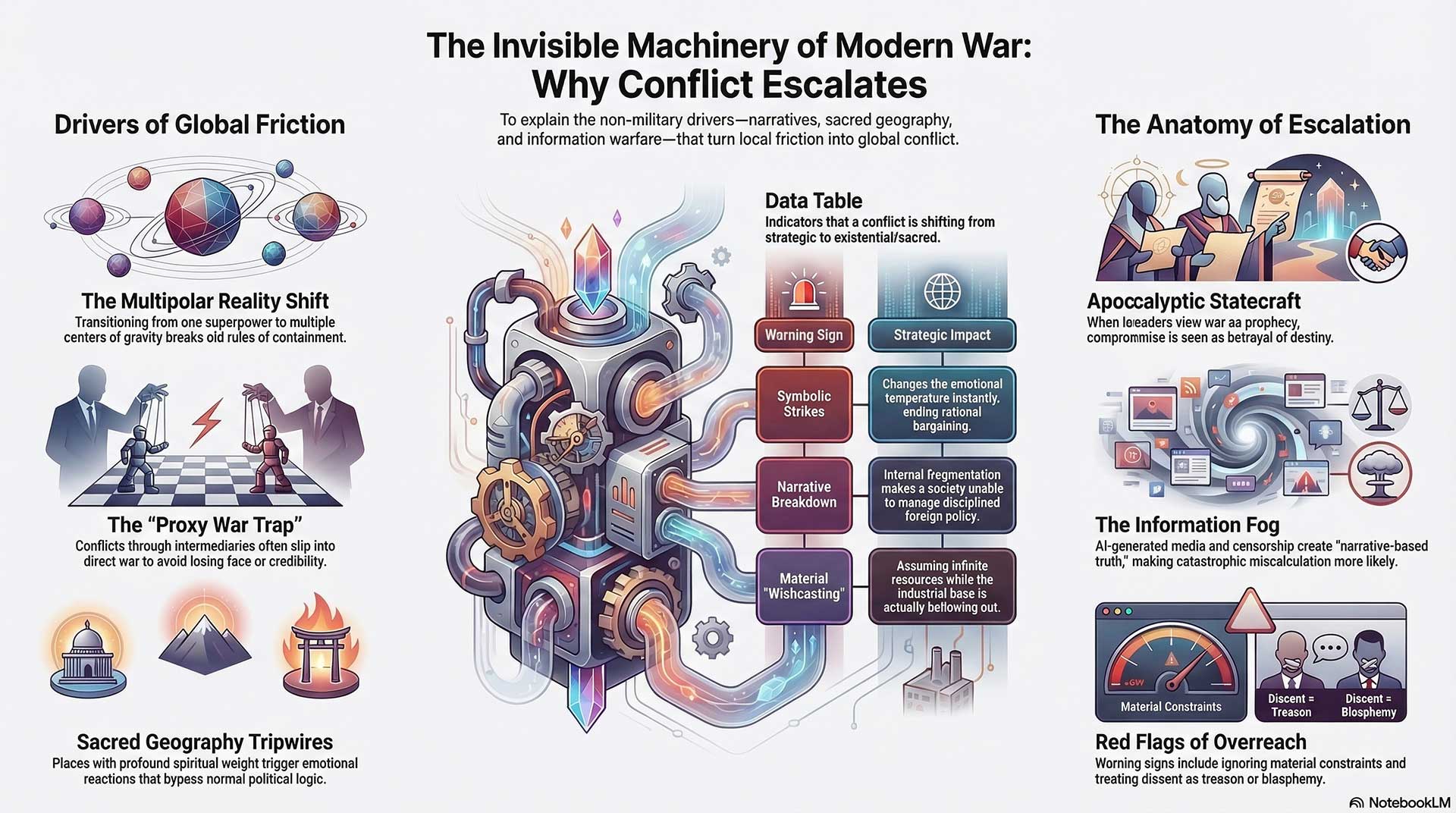
One of the themes that keeps appearing in this discussion is that modern conflict is not just about weapons. It’s about feedback loops.
A shift in world order creates insecurity.
Insecurity creates proxy conflict.
Proxy conflict creates stories of grievance and revenge.
Those stories attach themselves to sacred symbols and sacred places.
And then information systems amplify them—often faster than wisdom can catch up.
That’s the loop.
And the question is: how do we interrupt it?
The answer is probably not just diplomatic. Not just military. Not just economic.
It might be cultural.
It might require a kind of humility that great powers struggle to practice—an honest recognition of limits, and a respect for what other people consider sacred and non-negotiable.
It might require institutions strong enough to tell the truth during war, even when the truth is inconvenient.
It might require citizens willing to resist being emotionally hijacked by propaganda—regardless of which side it comes from.
And it might require leaders who can take an off-ramp without framing it as defeat.
Because sometimes the most courageous act in geopolitics is not escalation.
It’s restraint.
I don’t think this conversation gives easy answers.
But I do think it clarifies what’s at stake: not only in the region where the conflict is happening, but in the structure of the world that our children will inherit.
And if we care about that future, we have to think clearly—especially when clarity is hardest.
Short Bios:
Joe Rogan
Joe Rogan is a podcast host, comedian, and commentator known for long-form conversations exploring science, politics, philosophy, and culture. His discussions often bring together experts from diverse fields to examine complex issues in an accessible and curiosity-driven way.
Graham Allison
Graham Allison is a political scientist and professor at Harvard University specializing in international relations, nuclear security, and great-power rivalry. He is the author of Destined for War, which analyzes the historical risks that arise when rising powers challenge established ones.
Reza Aslan
Reza Aslan is a scholar of religion and author whose work focuses on how faith, identity, and sacred narratives shape societies and political movements. He is known for exploring the role of religion in global conflict and cultural transformation.
Peter Zeihan
Peter Zeihan is a geopolitical strategist and author who studies how geography, demographics, energy, and supply chains influence global power structures. His analysis often focuses on the changing balance of power in the international system.
Maryam Jamshidi
Maryam Jamshidi is a legal scholar specializing in international law, human rights, and national security. Her work examines how modern conflicts challenge legal accountability and how global institutions respond to the use of force.
Yuval Noah Harari
Yuval Noah Harari is a historian and bestselling author of Sapiens, Homo Deus, and 21 Lessons for the 21st Century. His work explores how shared narratives, technological change, and information systems shape the trajectory of human civilization.
Lex Fridman
Lex Fridman is an artificial intelligence researcher and podcast host known for thoughtful conversations with scientists, philosophers, and public figures about technology, ethics, and the future of humanity. His work often bridges scientific inquiry with philosophical reflection.
Leave a Reply