
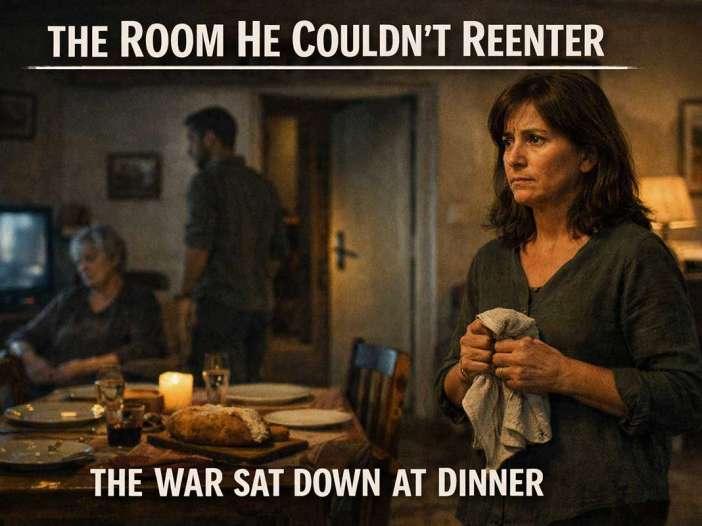
Introduction by Nick Sasaki
This story does not begin before the wound.
It begins after someone has already come home changed.
That choice matters.
The Room He Couldn’t Reenter is not built around a peaceful family before history breaks in. It is built around a family already living inside alertness, memory, duty, and the long effort to call that condition normal. The war is not approaching from a distance. It is already in the room, though no one yet knows how to speak to it honestly.
That is the center of the story.
I wanted the Israeli side of this project to feel different from the earlier stories. Not another quiet morning, not another ordinary family before rupture, but a house already shaped by fear and survival. A grandmother carries old historical terror and the belief that softness invites catastrophe. A father has built his adulthood around seriousness, protection, and the refusal of complacency. A mother listens for truth in appetite, tone, and silence. A daughter hears contradiction before anyone is ready to admit it. And a son comes back from war not destroyed in an obvious way, but altered enough that ordinary dinner can no longer remain ordinary around him.
That is where the story begins.
What interested me most here was the damage done not only to people, but to language.
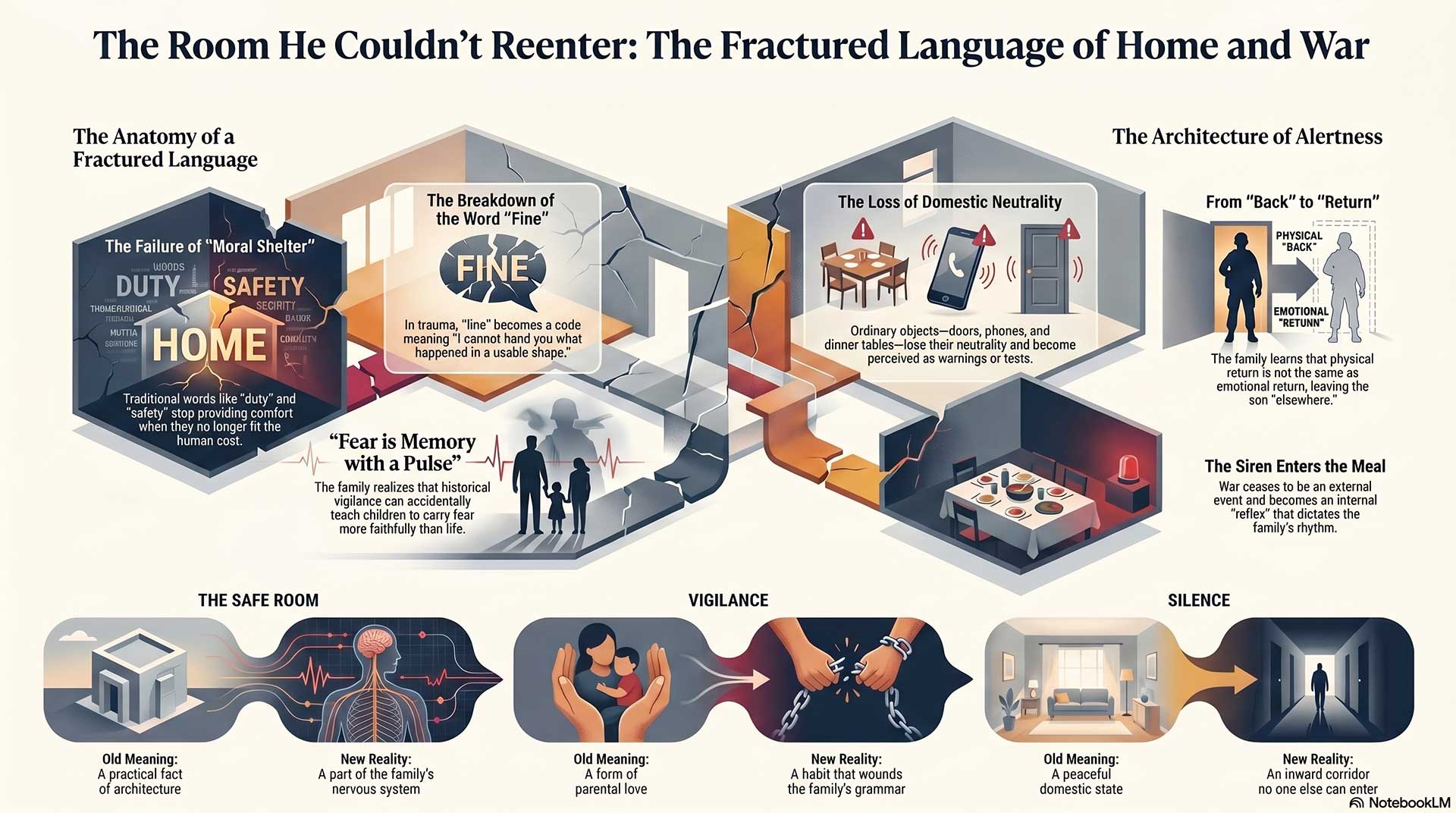
In this apartment, words such as safety, duty, protection, necessity, and history have lived for years as moral shelter. They are not fake words to this family. They are tied to real Jewish fear, real inherited memory, real national fragility, and the emotional truth that for many Israelis, safety has never felt natural or guaranteed. I wanted to respect that fully.
But I also wanted to follow the harder question:
What happens when those same words return through someone you love already changed by them?
That is when the room begins to fail.
Not because anyone stops loving one another.
Because the old language no longer fits the human cost.
The family in this story is not simple, and that mattered to me very much.
Leah is not there just to represent historical fear. She is a woman formed by consequence, by the knowledge that danger ignored can become disaster. David is not simply rigid or patriotic. He is a father who believes readiness is part of love. Miriam is not just “the caring mother.” She is the one who understands first that physical return and emotional return are not the same thing. Noa is not merely the questioning younger generation. She is the one who can hear that the room’s speech has become too careful, too prepared, too narrow. And Yonatan is not meant to stand for a nation. He is one son whose altered silence changes the whole architecture of home.
That is why the title matters.
He does not fail to reenter the room because he does not love his family. He cannot reenter because the room itself has been built, over years, out of habits of fear, protection, vigilance, and interrupted safety. Those habits once kept the house standing. Now they no longer know how to receive him without also exposing what they have done to him.
For me, this story is about what happens when survival remains necessary, but the language of survival stops feeling morally whole.
Chapter 1 — The Dinner He Couldn’t Finish
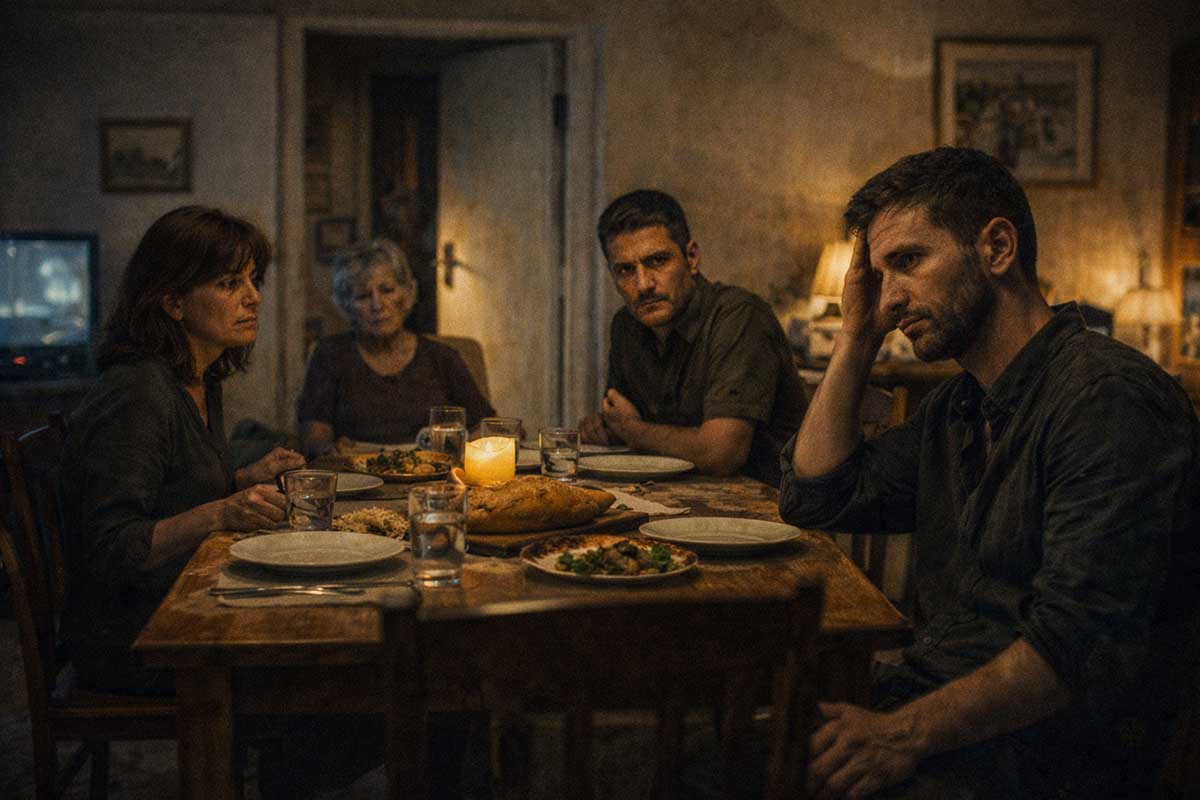
By evening, the apartment looked too carefully arranged.
That was the first thing Noa noticed.
Not clean, exactly. Her mother was not the kind of woman who believed anxiety could be solved by making everything neat. The tablecloth had a crease running down one side. One fork had been replaced by a spoon and then replaced again. A glass sat near the sink because someone had forgotten it there and then decided not to move it. Nothing was perfect.
Still, the room had the feeling of something prepared for inspection.
The plates were already out before anyone was hungry.
The soup had been reheated twice.
The safe room door stood half open, though no one mentioned it.
The television was on mute.
And her mother kept glancing toward the hallway every few minutes, as though the apartment itself might say the wrong thing if she stopped listening.
Noa stood in the doorway with her phone in one hand and watched the room try to become ordinary.
Her father, David, was setting bread on a plate with more concentration than bread required. Her grandmother Leah sat near the far end of the table, straight-backed, hands folded, looking like someone who had come to dinner and to judgment in the same dress. The overhead light was too white. It made everyone look slightly unreal.
In the kitchen, her mother Miriam stirred the soup once more, then set the spoon down, then picked it up again without actually needing it.
“Stop staring,” Miriam said without turning around.
“I’m not staring.”
“You are.”
“I’m observing.”
“That’s just a younger word for the same bad habit.”
Noa almost smiled, but not fully. The apartment did not seem built for full smiles tonight.
From the sitting room came the muted flicker of the television. Images moved across the screen: a road, a correspondent, a map, a face, another face, red lines, captions, the kind of repeated visual language that had become part of Israeli evenings long before this one. On mute, it looked almost peaceful.
That was the lie of mute television. It made fear look like furniture.
“Set the glasses,” David said.
“They’re already there.”
“Then check them.”
Noa moved to the table and straightened one glass that had barely shifted at all. Her father was not really talking about glasses. He was trying to keep his hands useful.
That was his way.
When things could still be managed, he became more precise. Shoes aligned by the door. Phone charged. Window checked. News checked. Lock checked. Water bottles counted. Calm arranged like a shelf that might hold a collapsing wall in place if one stacked it carefully enough.
Noa had loved that about him when she was little.
It had made the world feel held.
Now she wasn’t sure.
“Is Uncle Eitan coming?” she asked.
Leah answered before anyone else.
“He said he would.”
Her tone suggested that if Eitan did not appear, the failure would belong to the century rather than the man.
Noa adjusted the spoon beside her own plate and then moved it back to where it had been before. Across the table sat Yonatan’s place.
Not empty.
Not yet.
That was the second thing wrong with the room.
Everything had been prepared for his return, but nothing in the apartment believed in return cleanly.
He had been back for three days.
Three evenings.
Three attempts at dinner.
Three times sitting in the chair nearest the wall as if he needed one surface at his back.
Three times saying he was tired.
Three times finishing less food than he used to.
Three times answering questions in sentences that stopped just before real meaning.
He was home.
That was true.
He was also somewhere else.
That was true too.
The front door opened.
No one in the room jumped. That was another habit this country taught well: not leaping every time the threshold spoke. Still, the whole apartment turned inward at once, like a body hearing one of its own joints move.
Yonatan stepped in, then paused in the hall as if the distance between the door and the table needed thought.
He was still in civilian clothes, though the clothes themselves no longer made much difference. The change was not in fabric. It was in pace. He moved as if every room required a second reading. His face looked thinner than it had a month ago. Not dramatically. Just enough that Miriam had begun putting extra bread on the table without asking if he wanted it.
“You’re late,” David said.
It came out too quickly and too lightly at the same time.
Yonatan took off his jacket.
“There was traffic.”
“There’s always traffic.”
“Yes.”
That could have been the end of it on another night. Tonight it sat in the room like a dropped nail.
Miriam came out of the kitchen wiping her hands on a towel that did not need wiping.
“Sit down,” she said. “The soup is hot now.”
Now.
As if hotness were a military operation she had timed carefully against failure.
Yonatan looked at her for a second too long before nodding. Then he took his seat.
Noa watched the chair receive him.
That was how it felt. Not that he sat. That the chair accepted his weight with difficulty, as though the room had expected his body but not the silence he brought with it.
Leah studied him openly.
Not rudely. Not gently either. She belonged to a generation that did not believe love required pretending not to see.
“You’re eating with us tonight,” she said.
Yonatan gave the faintest suggestion of a smile.
“That’s usually how dinner works.”
For one blessed half-second the room almost became itself.
Then it didn’t.
Miriam served the soup. Bread passed. Chairs adjusted. Spoons touched bowls. All the noises of a family meal occurred in proper order. Yet every sound seemed too clear, as though the apartment had begun listening to its own acoustics.
Noa lifted her spoon and burned her tongue because she had not actually registered what she was doing.
David said, “How was the drive?”
Yonatan tore bread before answering.
“Fine.”
Leah’s eyes did not leave his face.
Noa looked down at her bowl.
There it was again. Fine.
Every word in this apartment had started breaking in two.
Fine meant:
I arrived.
I’m speaking.
Do not ask for more.
I am not fine.
I cannot hand you what happened in a usable shape.
Miriam asked, “Did you sleep at all before coming?”
“A little.”
“When?”
“Earlier.”
David drank water. Put the glass down. Picked it up again.
Noa wanted to say, Earlier where? Earlier when? Earlier with whom? Instead she said nothing, because everyone else’s silence had already arranged itself around his.
That was what frightened her most — how quickly a family learns the perimeter of someone’s wound without ever having it named.
The television flashed in the next room.
Still on mute.
Still present.
From outside, faint through the closed windows, came the sound of a motorcycle passing and then some distant shout from the street. Life continuing elsewhere with the rude confidence of life that does not know it has entered the wrong scene.
Eitan arrived halfway through the soup.
He did not knock properly. He entered with the half-apologetic, half-proprietary rhythm of someone who had been part of the family long enough to stop respecting doorframes but not long enough to stop making a little performance of it.
“I’m late,” he said.
“You’re always late,” Miriam answered.
“Then I’m consistent.”
He kissed Leah on the forehead, squeezed David’s shoulder once, nodded at Noa, and stopped when he saw Yonatan at the table.
Something passed over his face.
Not surprise. Recognition.
“There you are,” he said.
Yonatan looked up.
“There I am.”
Noa hated how the men in this family could place entire conversations inside three words and call that adulthood.
Miriam got up for another bowl. Eitan tried to refuse. She ignored him. He sat.
The table adjusted itself to his presence at once. Not with ease. With familiarity. He carried with him the older security language of the family — not her father’s burdened version, but something harder, more settled. He had been through earlier waves, earlier deployments, earlier alarms. He spoke about danger as if danger respected clear speech.
That had once been reassuring to Noa when she was younger.
Now it made the room feel smaller.
“You look tired,” Eitan said to Yonatan.
“Thanks.”
“That wasn’t an insult.”
“I didn’t take it as one.”
Leah said, “Then don’t answer like a lawyer.”
Eitan smiled into his bowl. David didn’t.
Miriam broke bread and passed it again though no one had asked. Noa watched her mother’s hands. That was where truth lived first in this apartment. Not in speeches. In hands. Her mother’s hands had become too careful. They set things down as if sudden noises might tear something thin.
“How long are you staying?” David asked.
Yonatan looked at him, then at the table.
“I don’t know.”
That answer changed the room more than the others had.
Not because it was new. Because it was honest enough to hurt.
Eitan leaned back slightly.
“You should rest while you can.”
Noa looked at him.
While you can.
Every sentence in this country seemed to carry a second staircase downward.
Miriam asked, “Do you want more soup?”
Yonatan shook his head.
“You barely touched it.”
“I’m not hungry.”
Leah said, “That’s foolish.”
Noa almost laughed. Her grandmother had a way of treating trauma, bad manners, low blood sugar, and poor posture as neighboring failures.
Yonatan rubbed one hand over his face.
“I said I’m not hungry.”
No one moved.
The sentence itself was not loud. But something in it had edges.
Miriam set down the ladle.
“All right,” she said.
That was what mothers did when there were no good moves left. They took one square inch of peace and put it gently on the table as if it might hold.
The room stayed still around it.
Noa looked from one face to another.
Leah: alert, unsoftened, carrying old fear like iron in the bones.
David: trying to keep shape, even now, especially now.
Miriam: listening harder than anyone.
Eitan: watching Yonatan not with comfort but with professional concern he probably thought he was hiding.
Yonatan: present in the chair, absent in some inward corridor no one else could enter.
And herself, sitting among them with the unbearable modern skill of seeing too much and being able to fix none of it.
At last she said the wrong thing.
“What happened?”
The silence after was so immediate it almost sounded rehearsed.
David turned to her sharply.
“Noa.”
But she kept looking at her brother.
Not because she wanted to force him. Because everyone had already been asking the question without words, and she could not bear another minute of pretending the room was built on anything else.
Yonatan did not answer at once.
He looked at her for so long that she thought perhaps he had not heard.
Then he said, very quietly, “Nothing that fits at dinner.”
Noa looked down at her bowl.
There it was.
The whole family in one sentence.
Nothing that fits at dinner.
Miriam sat back slowly. David closed his eyes for one brief second. Leah’s face did not move, but something in her hand tightened on the tablecloth. Eitan looked away first.
The television flickered in the next room, still mute, still translating the world into shapes no one had asked it to simplify.
Noa understood then that the apartment had crossed into a new kind of evening.
Not one where war was somewhere outside and the family was somewhere inside.
Not one where history belonged to memory, or policy, or the arguments of men on television.
This was a room in which public language had already reached the body of someone they loved and come back damaged.
Noa set down her spoon.
Miriam stood, gathered the untouched bread, then stopped and left it where it was.
No one finished dinner properly.
Later, when the bowls had been cleared and the apartment had gone quieter than quiet, Noa stood in the darkened kitchen alone and looked at the safe room door down the hall.
It had once seemed to her like a practical fact of architecture.
Now it looked like part of the family’s nervous system.
Behind her, in the other room, she could hear low voices. Her mother’s, too soft to make out. Her father’s, lower still. Leah clearing her throat. Eitan saying something brief. Yonatan saying almost nothing.
The apartment still stood.
The table still stood.
The family still sat inside the same walls.
But the room he had entered was not the room he could reenter.
And everyone in it knew, already, that this was not a story that would begin with innocence.
It had begun with return.
And return, she was starting to understand, was not the same thing as coming back.
Chapter 2 — A House That Learned to Listen for Sirens
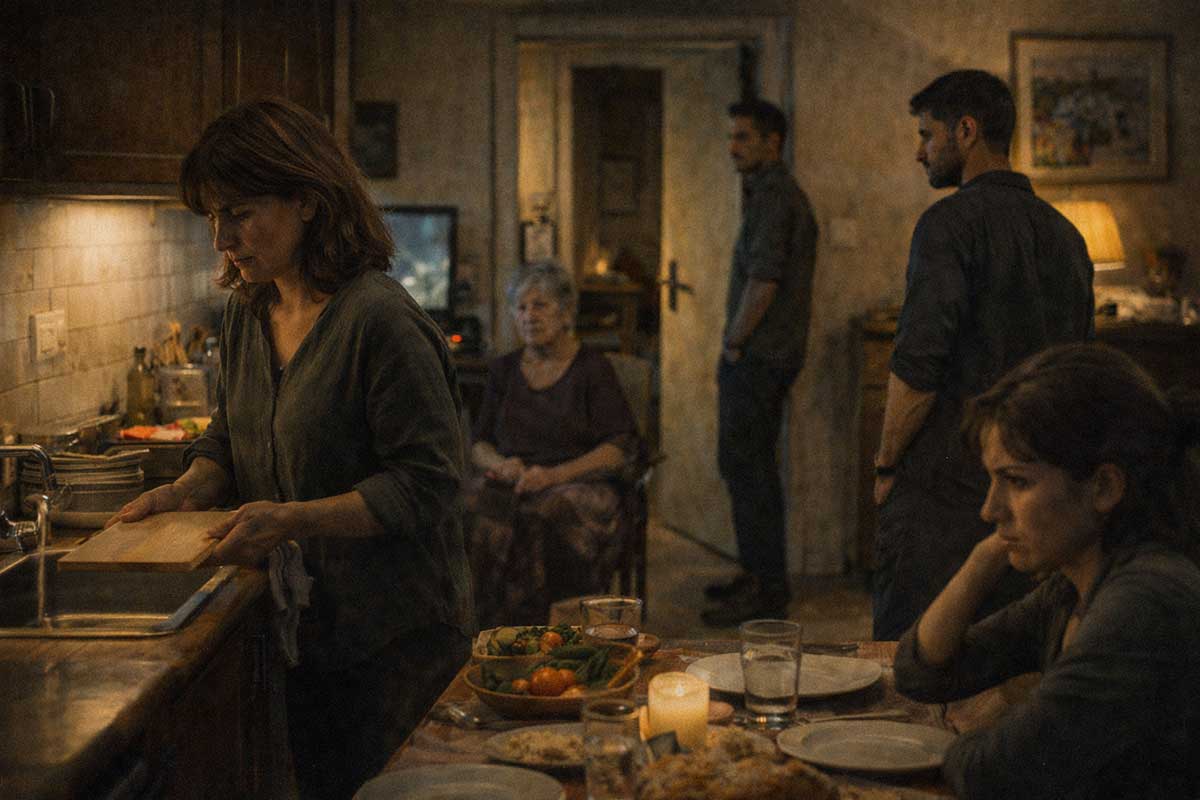
After that dinner, the apartment began listening to itself.
Not only to the news.
Not only to phones.
Not only to the sky.
To itself.
The sound of a chair pushed back too quickly.
A fork set down before the plate was finished.
A bathroom tap running longer than usual.
The safe room door not fully closed.
The television left on mute in the next room, as if silence made images less invasive.
Noa noticed all of it.
That had become her role in the family without anyone saying so. She was the first to hear when a room had changed temperature, the first to notice when speech became performance, the first to feel when everyone was using ordinary words to avoid one real one.
Yonatan stayed three more nights.
On the first morning after his return, Miriam tried to behave as though the apartment still obeyed domestic logic. She cut fruit. She warmed bread. She asked whether anyone wanted eggs. She moved lightly between kitchen and table, not in denial, but in resistance. She was trying to keep the room connected to ordinary appetite.
Yonatan sat with coffee in front of him and did not touch it.
David read headlines he had already seen on his phone, then folded the paper without seeming to absorb a word. Leah kept the television volume low but never turned it off. The hosts spoke of operations, deterrence, losses, pressure, international reaction, strategic necessity. They spoke in a tone so smooth that Noa felt embarrassed for them.
At last Miriam said, “Drink it before it goes cold.”
Yonatan looked at the coffee as though it belonged to another life.
“It’s fine.”
There was that word again.
Miriam put down the knife.
“No,” she said quietly. “It’s coffee.”
Yonatan looked up.
For a moment Noa thought he might smile. Instead he gave the smallest exhale, not laughter, not irritation. Something more tired than either.
He lifted the cup and drank.
That was what the family had become: a place where even one sip felt like proof of continued membership in ordinary life.
Later that day, while David was out buying batteries they did not yet need and Leah was arguing softly with the television, Noa found Yonatan standing in the small room near the safe room door.
He was not doing anything.
Just standing there.
The window in that room faced another building, so close that no real view existed, only pale concrete and one balcony hung with shirts that had stopped moving in the still air.
Noa leaned against the doorway.
“You know that’s the worst room in the apartment.”
Yonatan did not turn right away.
“It’s quiet.”
“No,” she said. “It’s the room where the walls gave up.”
That got a real smile, brief but visible.
“It used to be your homework room.”
“It used to be where I pretended to do homework.”
He nodded, still looking at the window.
The light from outside made his face flatter than usual. Not emptier. Flattened, as though expression itself had become something he now spent carefully.
Noa asked, “Are you going back?”
The question came out more gently than she intended.
Yonatan’s hand rested against the window frame.
“Yes.”
She waited.
He did not add anything.
“When?”
“Soon.”
“That’s not a time.”
“No.”
She folded her arms.
“You answer like every sentence is a corridor with a guard at the end.”
That made him turn.
“You think I’m trying to be difficult?”
“No. I think you’re trying not to bring something into the room.”
His face changed then, only slightly, but enough for her to know she had touched the right place.
For a second she thought he might tell her.
Instead he said, “Maybe the room doesn’t need it.”
She looked past him into the gray window.
“Maybe the room already has it.”
Neither spoke after that.
From the kitchen came the sound of her mother putting away dishes with too much care. From the sitting room, a commentator’s low voice rose and fell. The whole apartment seemed built around the effort of not forcing truth into a shape it could not yet survive.
That evening Eitan came again.
Noa had begun to resent the ease with which he entered the apartment, as though the room still belonged to the old grammar. He never arrived chaotically. He arrived with jackets folded correctly, boots placed near the wall without sloppiness, voice even, shoulders square. He was a man who believed that if danger had structure, then people should too.
When he stepped in, he kissed Miriam on the cheek, squeezed David’s shoulder, nodded to Leah, and said to Yonatan, “You look better.”
Yonatan replied, “You should have seen me before.”
Eitan paused for half a second.
That was the trouble with Yonatan now. He did not say much, but when he did, his sentences left a mark.
Dinner that night lasted longer than the first one, though not more easily.
Miriam had made rice, lentils, roasted vegetables, and chicken that no one praised though it was excellent. The family sat in the same arrangement, and the apartment tried again to become a place where meal and war could remain separate.
It failed more slowly this time.
Leah began it.
“Do you remember,” she said to no one in particular, “when children once asked where to go in a fire and not where to go when the siren starts?”
Noa looked up.
“Were children calmer then?”
“No,” Leah said. “Only less educated.”
David gave her a tired glance.
“Mother.”
“What?”
“You say things like that as if fear is an accomplishment.”
Leah lifted her glass.
“Fear is memory with a pulse.”
Eitan nodded once, as if something in the sentence satisfied him.
Noa saw it and felt the old irritation rise.
“That’s exactly the problem,” she said.
Everyone looked at her.
“You all say these things as if they explain the whole world. Fear, memory, survival, history. Every sentence sounds deep enough to stop people from asking what it’s doing to us now.”
Eitan answered first.
“And what is it doing to us now?”
She looked at him.
“It’s making us live as if alertness is the same thing as life.”
David leaned back in his chair.
“That’s easy to say when others are doing the alertness for you.”
The sentence came out too hard. He knew it at once.
So did she.
Noa lowered her eyes to the table.
“That’s not fair.”
“No,” Miriam said softly. “It isn’t.”
David rubbed his forehead.
“I didn’t mean—”
“Yes, you did,” Noa said, but without anger. “That’s what makes it worse.”
Yonatan had not spoken through any of this. He sat with one hand on his glass, not drinking, listening in the way people listen when they are no longer sure where conversation ends and damage begins.
Eitan turned toward him.
“What do you think?”
Miriam’s head lifted at once. She hated when people did that — brought him in like a witness expected to settle everyone else’s moral weather.
Yonatan looked at Eitan, then at the table.
“I think,” he said slowly, “that the house learned to listen for sirens a long time ago.”
The room fell still.
Noa felt something cold move through her, because this was the first time since his return that he had spoken in a sentence larger than immediate refusal.
No one interrupted.
Yonatan went on.
“And maybe that was necessary.”
Eitan nodded slightly.
“But,” Yonatan said, and the word itself changed the room, “if a house listens long enough, it starts hearing danger before anything happens. Then after a while, it hears danger inside things that used to be neutral.”
Noa watched her mother’s face.
Miriam did not move, but her whole attention had become visible.
David said quietly, “What things?”
Yonatan looked up.
“Doors.”
A pause.
“Phones.”
Another pause.
“Silence.”
Then, almost after the thought had already left him:
“Dinner.”
Noa looked down at her plate.
That was it. That was the truth none of them had managed to say with all their prepared language. The apartment had not only learned readiness. It had lost neutrality. Objects had become warnings. Rooms had become routes. Meals had become tests.
Leah spoke next, but more gently than usual.
“That is the price.”
Yonatan looked at her.
“For what?”
No one answered right away.
On the television in the next room, the muted images shifted again — map, correspondent, flashing line of text, studio panel. The world outside kept making itself legible in the old way, but the apartment no longer trusted legibility.
David finally said, “For staying alive.”
Yonatan did not look convinced.
Neither did Noa.
Miriam rose to clear the plates before anyone was finished. She did that only when she could no longer bear the room as it was.
Noa stood to help her.
In the kitchen, with water running and dishes between them, Miriam said, “He said more tonight.”
“Yes.”
“Too much?”
Noa thought about it.
“No. Just enough that no one can pretend now.”
Miriam dried one bowl and set it aside.
“That doesn’t always help.”
Noa looked at her mother’s hands.
“Do you wish he’d say nothing?”
Miriam’s answer took time.
“No,” she said at last. “I wish speaking didn’t cost him so much.”
That stayed with Noa long after the dishes were done.
Later that night, when the others had drifted into their separate corners of the apartment, she found David standing inside the safe room.
Not using it. Just standing there, as if measuring it with his body.
She stayed at the threshold.
“What are you doing?”
He did not turn.
“Nothing.”
“That’s becoming the family religion.”
He gave the faintest sigh.
“I was checking the window seal.”
She almost said, No, you weren’t. But let it pass.
After a moment he said, “When you were little, you used to bring books in here during drills.”
Noa leaned against the frame.
“I remember.”
“You said if you had to be in here, you wanted to at least finish the chapter.”
A small smile touched her mouth.
“That sounds like me.”
“It does.”
He finally turned then.
In the dim light of the safe room, her father looked older than he had a month before. Not because of war alone. Because of what war had begun asking of his language. He had spent years believing that seriousness, readiness, and vigilance were part of love. Now his son had come back carrying the cost of those beliefs in a form no father could bear cleanly.
He looked at her for a long second.
“You think I don’t hear it,” he said.
“Hear what?”
“That the words sound different now.”
Noa stayed very still.
“The old words,” he said. “Safety. Duty. Necessary. All of them.”
She did not answer.
“I still believe the danger is real,” he said.
“I know.”
“But belief doesn’t protect words from being damaged.”
That was the first truly honest thing he had said to her in days.
Maybe longer.
Noa asked, “What do you do when the words don’t work?”
He looked around the small reinforced room.
“You keep the door working,” he said. Then, after a pause: “And you try not to make your children live entirely inside the door.”
Noa felt tears rise then, not because the sentence was beautiful, but because it was insufficient and true at the same time.
That was the shape of love in this apartment now. Not answers. Effort against narrowing.
When she went back to her room, Yonatan’s door was closed. Light still showed under it.
She stood there a moment, not knocking.
The apartment was quiet enough to hear the refrigerator hum, the low voice of the television still on in Leah’s room, the movement of Miriam folding laundry no one urgently needed, the plumbing of other apartments stacked around theirs like strangers breathing in parallel.
A house had learned to listen for sirens.
A father had learned that readiness can wound language.
A mother had learned that speech costs more than silence.
A daughter had learned that contradiction is now a form of inheritance.
And a son had come home carrying a version of danger the family could hear but not yet translate.
Noa looked at the line of light beneath Yonatan’s door and understood something she had not understood during the first dinner.
The problem was not only that he could not reenter the room.
It was that the room itself had changed so much in order to survive, no one any longer knew what “back” was supposed to mean.
Chapter 3 — The Language That Kept the House Standing
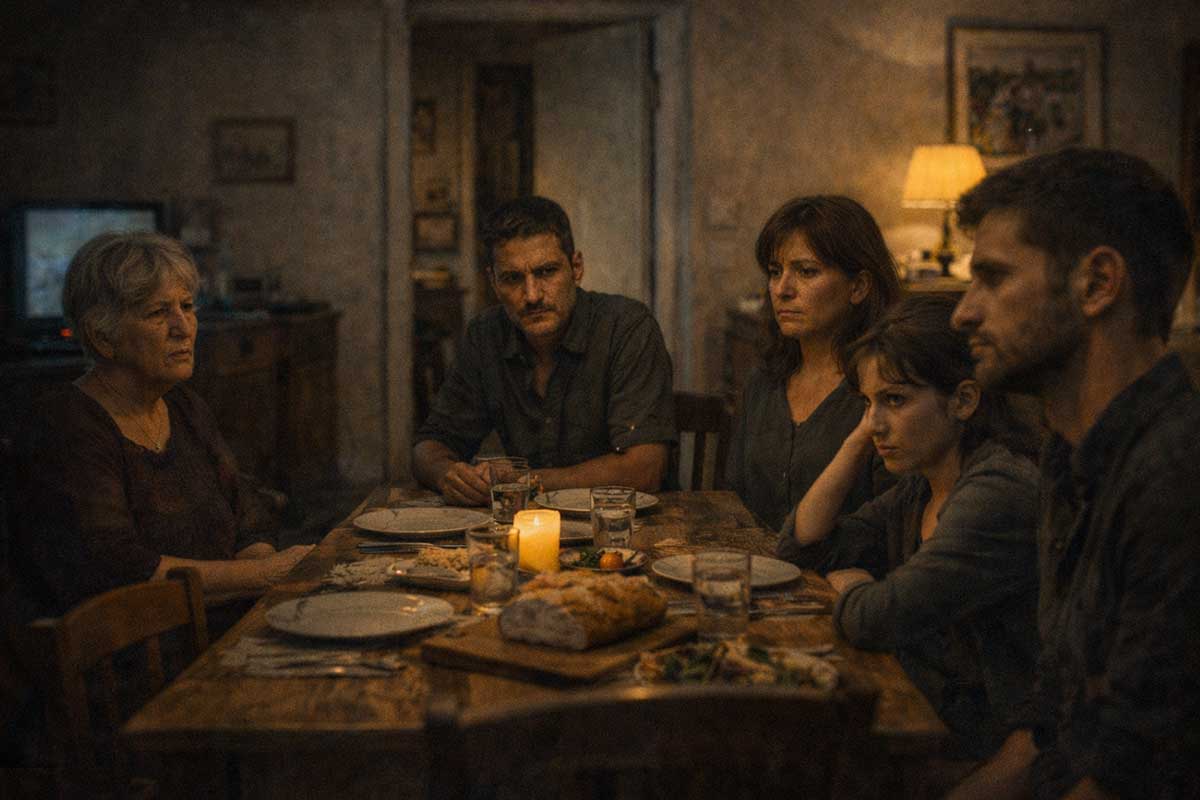
After Yonatan left again, the apartment became strangely polite.
Not peaceful.
Not calm.
Polite.
Doors closed more softly. Chairs were pulled back with more care. No one raised the television too high unless Leah was alone in the room. Miriam stopped asking direct questions at dinner, as if questions themselves had begun to bruise. David checked his phone less openly, which meant he was checking it more often. Noa learned the new rhythm almost at once: the family had entered the stage where fear tried to dress itself as discipline.
It did not fool her.
For a few days, there were still messages from Yonatan.
Short ones.
Dry ones.
Messages that looked intact until you held them too long.
All right.
Busy.
Will call later.
Don’t wait up.
Everything okay there?
That last one made Miriam angriest.
Not outwardly. She did not slam anything. She did not cry in front of them. She only stood at the counter reading the screen with one thumb pressed hard against the edge of the phone, as if holding it differently might force more truth out of it.
“He asks us if everything is okay here,” she said once, not looking at anyone.
David, at the table with a cold cup of tea in front of him, answered without lifting his eyes.
“He wants to know he still belongs somewhere normal.”
Miriam turned then.
“This is not normal.”
David looked up.
“No,” he said. “But it is still home.”
That should have comforted her. It did not.
Noa watched the exchange from the doorway and thought how strange it was that every word in the apartment now seemed to arrive carrying another word inside it.
Home meant shelter.
Home meant witness.
Home meant burden.
Home meant the place a person might return to if he still knew how.
In the evenings, the apartment settled around television light again, but now even Leah watched differently. Her old certainty had not vanished. It had only stopped sounding complete. She still distrusted softness. She still believed that Jews who forgot history invited disaster. She still spoke about danger in a voice that seemed to come from farther back than everyone else’s.
Yet even she had begun lowering the volume at the wrong moments.
That was how Noa knew the room had changed most deeply. Not when anyone admitted anything. When habit shifted.
One night, just after dark, Eitan came over again with oranges, batteries, and two bags of coffee no one had asked for. He always brought something useful when he had no useful words. Miriam took the bags without comment and put them on the counter.
“You’re turning this place into a warehouse,” Noa said.
“A warehouse is better than regret,” Eitan replied.
“That sounds like one of your posters.”
“I don’t make posters.”
“You make poster sentences.”
Leah almost smiled.
David, who had been reading messages on his phone in the sitting room, said, “Enough.”
But the word had weakened in this apartment. It no longer ended things. It only marked the point where the room had started hurting.
Dinner that night was late. The rice had gone dry once and been revived with more water. The salad sat on the table too long before anyone touched it. Miriam moved through the kitchen with the contained speed of someone trying to outrun thought through sequence. Wash. Chop. Stir. Plate. Carry. Return. Repeat.
Noa stood beside her drying dishes that did not need drying yet.
“You don’t have to do all this,” Noa said.
Miriam did not stop moving.
“Yes, I do.”
“For whom?”
Miriam set down the knife.
“For the room.”
Noa looked at her.
“The room?”
Miriam finally turned.
“If no one can say what they need, then at least the room must not collapse.”
That stayed with Noa. It felt like something older than the war and newer than the day.
At the table, Eitan was telling David about some logistical change, some route, some update about reserve schedules, some familiar machinery of national life that had once sounded reassuring in its competence. Noa heard only pieces.
Rotations.
Availability.
Uncertainty.
Be ready.
Hard to know.
Depends where.
Years ago, those half-sentences would have bored her. Now she heard in them the whole architecture of the country — a place where full information rarely arrived at the table, only enough to rearrange breathing.
Leah sat at her usual place, cardigan buttoned wrong by one hole, staring at the television on mute as though the faces there still owed her a century of honesty.
“Turn it off,” Miriam said.
No one moved.
“I said turn it off.”
This time David reached for the remote and did it.
The room at once became more real and more fragile.
That was the strange power of television in the apartment. When it was on, everyone could pretend that the main conversation was happening elsewhere. Once it was off, the family had to hear itself.
Eitan lifted his glass.
“How long since you heard from him?”
The question was aimed at David, but Miriam answered first.
“This afternoon.”
“What did he say?”
The silence after that question was familiar now. Not dramatic. Worn.
David said, “Enough.”
“No,” Miriam said. “He said enough.”
Eitan nodded once, though what that nod meant Noa could not tell. Agreement? Recognition? Approval of distance? In this family, men often nodded at one another in ways that seemed to save whole pages of speech and destroy them at the same time.
Noa said, “Maybe we should stop pretending short messages are reassuring.”
Everyone looked at her.
Leah spoke first.
“You think long messages are better?”
“I think honest ones are.”
“And what makes you think honesty survives those conditions?”
Noa opened her mouth, then stopped.
Leah did that to her sometimes — not winning the argument, but narrowing it to a shape she hated.
Eitan said, “Sometimes you tell family less so they can keep functioning.”
Miriam turned to him sharply.
“No. Sometimes people tell family less so they can keep functioning themselves.”
That hit harder than anything else said so far.
David leaned back in his chair.
“She’s right.”
All eyes turned toward him.
Noa could not remember the last time he had said something that sounded like surrender and insight in the same breath.
Eitan studied him.
“You’ve changed your tone.”
David gave a tired half-smile.
“I’ve changed my son.”
The room froze.
Noa looked at her father and felt, in one violent instant, how much of the family’s old language had lived in him without either of them naming it: seriousness, readiness, not panicking, not being weak, not sounding soft, doing what had to be done, staying useful, keeping the room from collapse, keeping the country from collapse, not asking for tenderness in the middle of necessity.
All of it had once sounded like adulthood.
Now it sat at the table like a broken tool.
Miriam lowered her eyes first. Not in disagreement. In pain.
Leah said, more quietly than usual, “Do not speak as if you made the whole century.”
David gave a short breath.
“I didn’t say that.”
“You meant more than you said.”
“Yes.”
Noa sat very still.
That was what made the apartment unbearable now: the new honesty was never large enough to free anyone. Only large enough to wound them more precisely.
After dinner, Eitan stayed for tea. Miriam almost objected, then let him remain. Perhaps she understood that even the wrong kind of company was still company.
Noa went to the small hallway near the safe room and stood there with her phone in her hand, scrolling without reading. From the kitchen came the sound of cups. From the sitting room came low male voices. From Leah’s room, the faint scrape of drawer wood opening and closing.
The apartment was full of effort.
Everyone was trying, in their own manner, to keep the family inside language. Eitan through hardness. David through partial admissions. Miriam through domestic continuity. Leah through historical scale. Noa through questions. Yonatan, far away, through messages that denied nothing and explained nothing.
And still the room kept slipping.
She found Leah a few minutes later in her bedroom, sitting on the edge of the bed with an old tin box open beside her.
Inside were photographs, folded papers, a train ticket stub so faded it looked almost blank, a child’s school certificate, two letters tied with string, a prayer book whose cover had nearly rubbed away.
“You only open that box when you’re thinking about old things,” Noa said.
Leah did not look surprised to see her.
“At my age, everything is an old thing.”
Noa sat in the chair by the wardrobe.
Leah lifted one photograph. A woman Noa did not know looked back from it, hat tilted, face too serious for the shape of the mouth.
“Who is that?”
“My aunt.”
“You never talk about her.”
Leah set the picture in her lap.
“That is not true. I talk around her.”
Noa waited.
After a moment Leah said, “She used to think the world could be read correctly if one stayed decent enough.”
Noa looked at the photograph again.
“What happened to her?”
Leah looked down.
“The world was read incorrectly for her.”
That answer was so like Leah that Noa almost rolled her eyes. Then she saw the old woman’s hand resting on the corner of the photograph and understood that this was not evasion. It was the furthest edge of what Leah could say without opening some older sealed room.
Noa asked, “Is that why you always talk the way you do? About fear and vigilance and all of it?”
Leah lifted her head.
“No.”
Noa blinked.
“No?”
“No,” Leah repeated. “That is only what you hear.”
“Then what is it?”
Leah took time before answering.
“It is not fear I worship. It is consequence.”
Noa looked at her grandmother’s face, at the lines that did not soften even in lamplight.
“What’s the difference?”
Leah closed the box halfway, then left it like that.
“Fear can be foolish. Consequence is never foolish.”
Noa thought about that.
Leah went on.
“You think the apartment is built from fear. It isn’t. It is built from what happens when people once discover they were not afraid enough soon enough.”
That sentence followed Noa back into the hall and stayed with her long after she returned to her room.
She did not fully agree with it.
That was not the point.
The point was that the house she lived in had not been shaped by one kind of memory. It had been shaped by memory interpreted into rule. Rule interpreted into language. Language interpreted into family habit. And now habit itself was breaking under the strain of what had returned through Yonatan’s voice and silence.
Late that night, after Eitan left and Miriam finished the last dishes, David knocked once on Noa’s door and entered before she answered.
He never used to do that.
He stood with one hand on the frame.
“I was hard on you.”
“Which time?”
The faintest smile crossed his face, then disappeared.
“At dinner.”
She looked at him over the edge of the blanket.
“Yes.”
He nodded.
No apology yet. That too was family style.
After a moment he said, “You were right that the messages don’t reassure anyone.”
Noa sat up a little.
“Do you want me to be pleased?”
“No.”
“What do you want?”
He looked toward the hallway, toward nothing visible.
“I want…” He stopped. Started again. “I want there to still be a way to talk in this house that doesn’t make everybody choose sides against one another.”
Noa listened.
“That sounds nice,” she said. “Do you think there is?”
He was quiet.
“No,” he said. Then, more honestly than she expected, “Not in the old way.”
He left a minute later, and she lay awake long after.
That was the lesson of those days. Not only that war damaged bodies. It damaged speech hierarchies. It stripped old phrases of their confidence. It exposed how much a family had been standing on words that worked only as long as the worst cost remained theoretical.
Now the cost had a voice.
A thinning one.
A flattening one.
A son’s one.
The next morning a siren sounded before sunrise.
The apartment moved at once, no discussion needed. Shoes, door, safe room, count, silence. Noa stood in the narrow reinforced space beside Miriam, David, and Leah and listened to the outer world become mechanical.
For a brief second she thought, absurdly, of how ordinary they had all begun to look inside emergency. Pajamas. Slippers. Sleep-heavy faces. An old cardigan. A phone clutched too tightly. Her father’s jaw set in the half-light. Her mother’s hand still damp from the sink. Leah upright as ever, as though apocalypse required posture.
Then the sound ended.
No one moved for three seconds after.
That was the truest measure of the house now: not how fast it ran, but how slowly it believed in stopping.
When they came out, the apartment looked unchanged.
The table.
The cups.
The folded towel.
The muted television.
The chair Yonatan had used.
Noa looked at the room and understood something with terrible clarity.
The house had not only learned to listen for sirens.
It had learned to build itself around the possibility that the next one was already on its way.
And that, she thought, might be the language no one in the family yet knew how to stop speaking.
Chapter 4 — The Day the Siren Entered the Meal
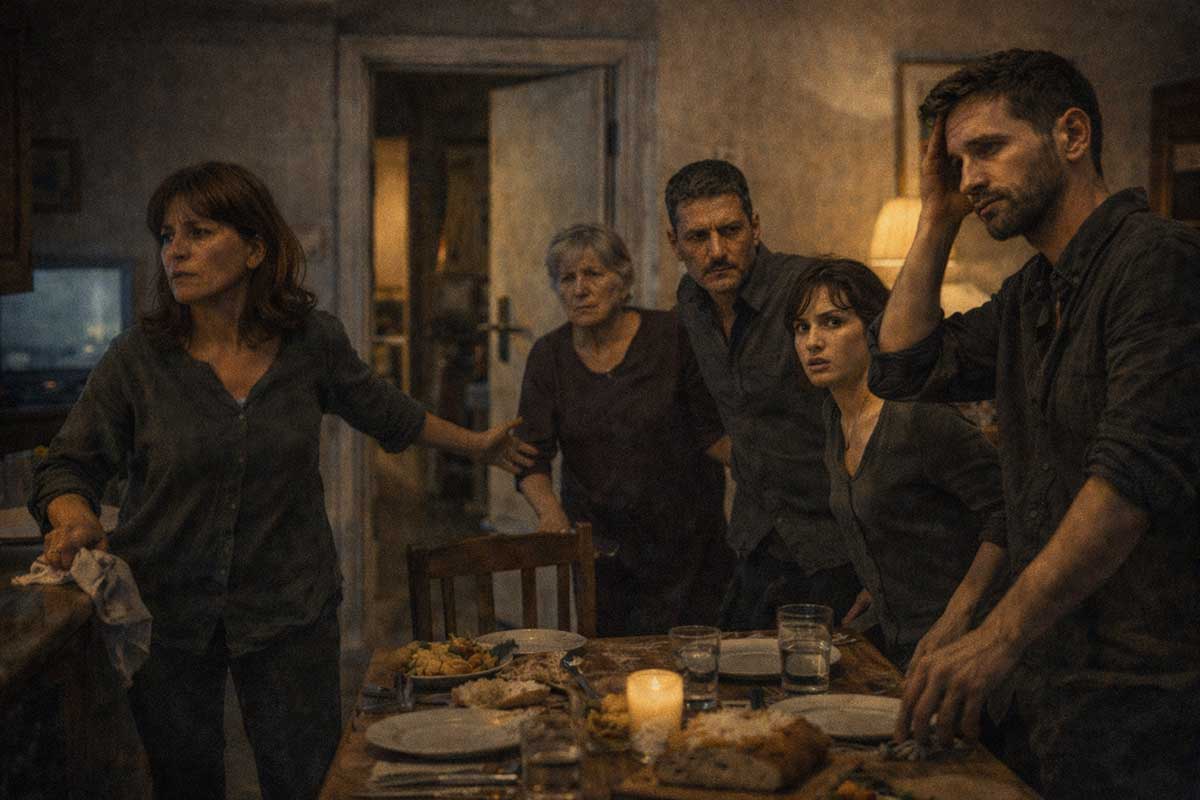
The next time Yonatan came home, no one said welcome back.
It was not deliberate.
The sentence simply no longer fit through the doorway.
Miriam opened the door before he knocked a second time. She had been standing too near it already, drying the same plate for longer than one plate required. When she saw him, she stepped aside at once, not from coldness, but from a kind of frightened respect, as though his body now carried weather the apartment had to make room for before anyone could touch it.
“You’re wet,” she said.
It was raining, not hard but steadily, and dark had already settled over the building. Water shone on his coat shoulders and in his hair. He looked less exhausted than the last time and somehow more altered. The difference was not in visible damage. It was in his speed. He no longer crossed a threshold the way people do when they belong entirely to the room they are entering. He paused, assessed, resumed.
“Take that off,” Miriam said.
He did, though too slowly.
From the sitting room, David called, “Is he here?”
The question made Noa, listening from the hallway, feel a flash of anger she knew was unfair. Of course he was here. That was the whole problem. He was here and not here, present and withheld, returned and still travelling some inward road they could not see.
“Yes,” Miriam answered. “He’s here.”
Leah was already watching from her chair, television low, sound still on this time. Maps moved across the screen behind a presenter’s calm face. There were always maps now. The country had become a set of glowing outlines narrated by people whose voices sounded trained to survive contradiction.
Eitan, unexpectedly, was there too.
Noa almost groaned when she saw him.
“What are you doing here?”
Eitan did not look offended.
“Your mother invited me.”
“I invited him because there was food,” Miriam said.
“That’s not why,” Noa muttered.
Eitan gave a small shrug. “It doesn’t matter why. I’m here.”
Everything in the apartment felt crowded at once.
The table had been set for six.
Rice, eggplant, chicken, salad, bread.
A bowl of olives no one would finish.
The overhead light too bright again.
The television too present.
The safe room door visible from the end of the hall like an uninvited relative who had started appearing at every family gathering.
Yonatan sat down in his usual chair.
That, more than anything else, made the whole scene unbearable to Noa. The habit of it. The way trauma was already arranging itself into seating.
Miriam served food. David poured water. Eitan asked whether traffic had been bad, a stupid question dressed as consideration. Leah watched Yonatan with the same difficult steadiness as always. Noa sat opposite him and tried not to study the way his left hand never rested fully flat on the table anymore.
They had barely begun eating when the first siren started.
No one shouted.
That was not how it worked in a family like this.
The body reacted before emotion organized itself.
David stood.
Miriam was already reaching for the hallway light.
Leah put down her fork with annoying composure.
Noa’s chair scraped hard against the floor.
Eitan said, “Now,” in the voice he used when trying to make urgency sound useful.
And Yonatan—
Yonatan did not move at first.
That was what froze the room.
Not long. One breath. Maybe less. But enough.
He sat with his hand still around the glass, eyes unfocused in a way Noa had never seen before, as though the siren had not begun outside the apartment but somewhere behind his face.
“Yonatan,” Miriam said.
He looked up sharply then, almost startled by the sound of his name.
David had already crossed half the room.
“Come on.”
The siren went on.
Noa hated that sound. Not only because it was frightening. Because it made every movement feel pre-written. The same route, the same bodies, the same reordering of domestic life into emergency.
Leah was on her feet now, slower than the others but straighter. “Don’t hover,” she told David as he reached toward her arm.
“No one is hovering.”
“You are.”
Eitan grabbed the edge of the table to steady himself as he turned.
Miriam was already in the hall, calling back, “Phones. Bring your phones.”
Noa had hers. David had his. Eitan had two, because men like Eitan always seemed to have two. Yonatan stood at last, too quickly now, knocking the chair backward hard enough to hit the wall.
The sound of it made everyone flinch.
No one commented.
In the safe room, the air was always wrong.
Too still.
Too aware of itself.
Too full of the fact that walls had been designed to matter.
They crowded in: David nearest the door, Miriam still holding the dish towel without realizing it, Leah settling onto the folding chair with terrible dignity, Eitan by the far corner, Noa beside the water shelf, and Yonatan against the wall opposite the door, breathing through his mouth as if the room had less oxygen than the rest of the apartment.
The siren carried on.
Noa watched him before she could stop herself.
This was different from the last time. Not more dramatic. More revealing. The safe room had stripped away the performative part of homecoming. Here there was no table to sit at, no bread to tear, no useful half-conversation. Only the body and whatever it had learned to do with sound.
Miriam saw it too.
Mothers always saw it first.
“Sit down,” she said quietly.
“I’m fine.”
There it was.
That ruined phrase.
Noa almost laughed from the pressure of hearing it again here, in a room built for the opposite of fine.
“No, you’re not,” she said.
David shot her a look.
But Yonatan did not.
He closed his eyes once, then opened them again.
“I said I’m fine.”
Eitan spoke into the silence.
“Let him be.”
Noa turned toward him at once.
“That’s what everyone says right before they stop seeing someone.”
“Enough,” David said.
“No,” Noa answered, more sharply than she meant to. “Not enough. Never enough. That’s the whole structure here.”
Leah’s voice cut through them all.
“Stop talking like children.”
The authority of it made them actually fall silent.
The siren ended.
No one moved.
That was another thing about these moments. The sound stopping did not mean the fear obeyed. Fear had become cleverer than that. It stayed behind like static in the body, making everyone wait one second too long before trusting movement.
Miriam looked at Yonatan.
“Do you want water?”
He shook his head.
“Sit, then.”
He did this time.
That small obedience hurt Noa more than if he had refused.
It made him look younger. Younger and farther away.
When they returned to the dining room, the meal had changed species.
Steam had thinned from the food.
The bread had dried a little at the edges.
The television still flickered.
The fallen chair had been lifted, but not by anyone in the family — Eitan, of course, had done it during the shift back into ordinary space, as if efficiency could glue the scene together.
No one sat immediately.
David muted the television.
Then, finally, they took their places again.
For a few seconds the apartment held the grotesque image of itself: six people around a table pretending that meals and sirens belonged to separate categories of life.
Leah broke first.
“This,” she said, looking not at anyone but at the bowls and plates before them, “is why people speak the way they do in this country.”
Noa looked up.
“What way?”
“The way you dislike.”
That answer was aimed directly at her.
Noa set down her fork.
“You mean fear as vocabulary.”
Leah met her eyes.
“I mean alertness as inheritance.”
“That sounds prettier.”
“It is not prettier. It is more exact.”
David rubbed both hands over his face.
“Not now.”
But the room had already crossed that line.
Miriam said, almost to herself, “The meal doesn’t know what it is anymore.”
Everyone heard her.
That sentence struck the table with more force than anything else. Because it was ridiculous. Because it was true. The family had become so used to interruption that even food no longer trusted its own place in the evening.
Eitan tried to restore shape.
“People adapt.”
Noa turned to him.
“That’s not always the comfort you think it is.”
He looked tired suddenly.
“I didn’t say it was comfort.”
“Then what is it?”
He answered after a pause.
“Structure.”
Yonatan laughed.
Just once.
No humor in it.
It was the first laugh he had given them that did not resemble home.
All heads turned toward him.
He looked at the table, not at them.
“You really think structure is what’s left,” he said.
No one interrupted.
He continued, more quietly.
“You know what it becomes after a while?”
Noa could feel the room leaning toward him without physically moving.
“A reflex,” he said. “Then a room. Then a language. Then…” He stopped.
“Then what?” Miriam asked.
He looked at her, and for one second Noa thought he might withdraw again.
Instead he said, “Then you stop knowing whether you are protecting life or only protecting the system that taught you how to be afraid.”
Noa felt the whole apartment go cold.
Even Leah did not answer.
David stared at his son as if something long suspected had finally crossed into speech and now could not be put back.
Eitan was the first to respond.
“That’s not fair.”
Yonatan turned toward him at once.
“No,” he said. “It isn’t.”
There was no anger in the answer.
That made it much worse.
Because everyone in the room understood that he was not making an argument. He was speaking from the place where argument had stopped helping him.
Miriam reached for the breadbasket, then stopped before touching it. Her hand rested in midair for a second and dropped back into her lap. Noa would remember that movement later more vividly than any sentence from the evening.
David said quietly, “You think there’s another way?”
Yonatan looked at him.
It was not a hostile look. It was worse than hostility. It was the look of someone who loved the person asking and no longer trusted the question.
“I think,” he said, “that the old way no longer knows what it’s making of us.”
No one spoke after that.
Even the television, muted, seemed for once unable to complete the room.
The meal ended without being declared over.
Miriam cleared plates too early.
Eitan stood and offered to help; she refused.
Leah returned the sound to the television but kept it very low.
David stayed seated longer than anyone else, staring at the place where Yonatan’s glass had left a ring of water on the table.
And Yonatan went to wash his hands though no one could remember him touching much food.
Noa remained where she was until the room had mostly emptied.
She looked at the table.
At the bread no one wanted.
At the bowls gone half-cold.
At the chair legs slightly out of line from the rush to the safe room.
At the overhead light still too harsh for evening.
At the whole domestic theater of continuity.
And she understood something she had not fully understood before.
The war did not only interrupt the meal.
It entered it.
Not as noise alone.
As inheritance.
As reflex.
As language.
As a son who could no longer sit at the table without exposing what that language had done to him.
Later that night, when the apartment had gone dim and everyone withdrew into separate rooms, Noa stood in the hallway and looked at the safe room door.
Closed now.
Ordinary-looking.
Part of the apartment again.
That was the worst thing about it.
How quickly the exceptional became architecture.
From her parents’ room came low voices. Not fighting. Not exactly. More like the sound two people make when trying to decide whether honesty will help or only rearrange pain. In Leah’s room, the television still murmured. Eitan had gone. Yonatan’s door was shut.
Noa rested her hand against the wall.
The apartment had once been a place that listened for sirens.
Now it was a place that had begun bringing the siren back to the table, inside the people who lived there.
And she could not decide which was more frightening:
that danger might enter from the sky,
or that it had already learned how to eat with them.
Chapter 5 — The Night the House Stopped Pretending
After that dinner, the apartment gave up its last performance of normality.
Not openly.
Not all at once.
No one stood in the middle of the room and said, We cannot live like this anymore.
Families almost never change that cleanly.
It happened in smaller ways.
The television stayed off longer.
The safe room door remained slightly open even on calm nights.
Miriam stopped setting the table for more than whoever was physically there.
David stopped using words like necessary unless he was alone.
Leah no longer raised the volume when officials spoke in the old, hard tone.
And Noa began hearing the whole apartment as one long unfinished sentence.
Yonatan left again two mornings later.
He left before full light, which somehow made it worse. The hallway bulb was still on. His bag was by the door. Miriam had wrapped food he would probably not eat. David stood with one hand in his coat pocket, as if holding onto his own fingers were a substitute for saying something useful. Leah remained in her room but was clearly awake; her cough traveled once through the wall. Noa stood in the kitchen doorway and watched everyone avoid the obvious shape of departure.
There had been a time in this family when goodbye still sounded like goodbye.
Now it sounded like logistics.
“Take this.”
“Call when you can.”
“Charge your phone.”
“Is the battery pack full?”
“Do you have the keys?”
“Text when you arrive.”
Miriam held out the wrapped food.
Yonatan took it.
“Thanks.”
That was all.
David said, “Drive carefully.”
It was such a small, ridiculous sentence against the scale of everything else that Noa almost cried from hearing it. The country could mobilize hundreds of thousands of words for war, security, defense, necessity, history, survival. And fathers, in the end, still reached for drive carefully.
Yonatan nodded once.
Then he was gone.
The door shut.
And the silence after it felt less like absence than like the apartment had been asked to hold its own breath.
Miriam stood still for a second too long.
Then she turned, took two steps into the kitchen, and began washing a clean plate.
Noa watched her.
“It’s already clean.”
Miriam did not stop.
“I know.”
“Then why are you washing it?”
This time she did stop. Her hands stayed in the sink.
“Because it’s there,” she said.
Noa looked away.
That was the house now: full of actions done because something had to receive motion.
David left for work an hour later and came back before noon.
No one asked why.
His coat stayed on longer than usual. He walked into the sitting room, saw the television dark, and did not turn it on. He sat in the chair opposite Leah’s and leaned forward with his elbows on his knees, looking not at anything, only downward, at the carpet pattern they had all long ago stopped seeing.
Leah entered a few minutes later, cardigan buttoned wrong again.
“You’re home early.”
“Yes.”
“Why?”
He looked up at her. The question itself had become strange in the apartment. Why was now a hard word. Too many real answers had no safe shape.
“I couldn’t stay there.”
Leah studied him.
“At work?”
He nodded once.
She sat down without speaking.
The room stayed quiet.
Then David said, “I kept hearing him at the table.”
Leah did not answer right away.
“What he said?” she asked.
“No.”
David rubbed one hand over his mouth.
“The way he said it.”
Now Leah understood.
That was the terrible part. Words can be argued with. Tone cannot. Tone goes straight under the argument and begins loosening the floorboards.
Leah folded her hands in her lap.
“You think the boy has seen too much.”
David gave a short breath that was almost anger and almost grief.
“I think he has become the proof of something I kept trying not to know.”
Leah looked at him steadily.
“And what is that?”
He leaned back then, as if the room needed more distance for the sentence.
“That we may have taught our children to carry fear more faithfully than life.”
The words remained between them like a light switched on in the wrong room.
Leah’s face changed very little. That was her strength and her cruelty both. But her eyes lost their old quickness for a moment.
“No,” she said quietly. “You taught them to live in the world as it is.”
David turned toward her.
“And if the world as it is has already moved into them too deeply?”
She did not answer.
For the first time in Noa’s life, her grandmother looked not defeated, not corrected, but cornered by intimacy. History still stood behind Leah like iron. But iron was no match for the altered voice of a grandson at dinner.
That evening Eitan called and said he would not come by.
The relief in the apartment was immediate and shameful.
Noa hated herself for feeling it. She knew he cared. She knew he was trying to be useful. She knew the security language he carried had once sounded like adult competence and not imprisonment. Still, his absence gave the rooms a little more air.
Miriam made a smaller meal.
That mattered too.
Soup, bread, cheese, sliced tomatoes, olives. Nothing ceremonial. Nothing that required praise. No attempt to gather too much family into one arrangement. She cooked for who was there, not for who ought to have been there. The honesty of that nearly broke Noa more than any larger grief could have.
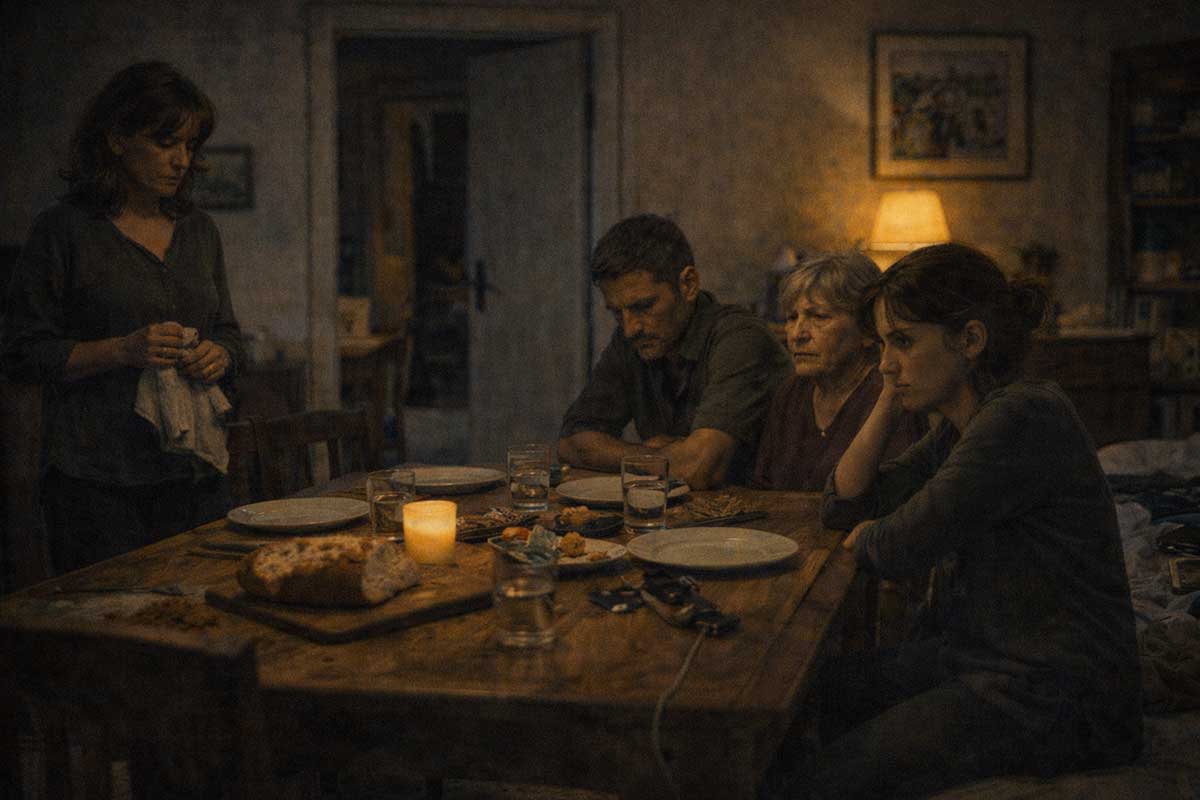
At the table it was only four of them: Leah, David, Miriam, Noa.
No television.
No guest.
No performance of a full household.
Only the people who remained physically inside the walls.
For the first few minutes, they spoke almost normally.
About the rain.
About the neighbor upstairs whose washing machine shook the building.
About whether Miriam should buy more candles or stop behaving like every week was the first week of emergency.
About a cousin who had called from Haifa and spoken too cheerfully to be believed.
Then Leah said, without warning, “When I was young, I thought the worst thing a people could become was careless.”
No one moved.
She went on.
“Then later I thought the worst thing was weak.”
A pause.
“Now I’m no longer sure.”
Noa looked up sharply.
Miriam set down her spoon.
David stared at the table.
Leah’s voice did not soften. It only became slower, which in her meant much more.
“A people can survive fear,” she said. “It can survive vigilance. It can survive hardness for a long time.” She looked toward the empty place where Yonatan usually sat. “I do not know how long it survives once it can no longer recognize the cost in its own children.”
No one answered.
There was nothing to argue with there. That was the strange mercy of pain carried honestly: it leaves less room for posture.
Noa felt tears rise before she had decided whether she wanted them. She hated crying at the table, hated giving family grief the shape of a ritual, hated the way tears can simplify what should remain morally jagged.
Miriam saw it and said, almost firmly, “Don’t.”
Noa laughed once through the tears anyway.
“That’s helpful.”
“I know,” Miriam said. “That’s why I said it.”
The laugh, small as it was, saved the room for a moment.
That was another thing the apartment had not entirely lost: the ability to keep love from turning theatrical.
Later, after dinner, David asked Noa to walk with him to the corner shop.
It was raining again, lightly. The street looked washed and tired. Cars moved too fast for the wet. The air smelled of stone, metal, and bread from the bakery half a block away. They walked in silence for several minutes, hands in pockets, not because silence was empty, but because both knew they were already walking inside the conversation.
At last David said, “You think we built this.”
Noa looked at him.
“Not all of it.”
“But some of it.”
“Yes.”
He nodded, as if this answer had been expected.
“When you were small,” he said, “I thought my job was simple. Keep the family safe. Keep the house prepared. Don’t let danger arrive before you’ve named it.” He looked ahead as they crossed the street. “I didn’t understand how easily the naming becomes its own world.”
Noa watched his face in profile. He looked older in the streetlight than he had at home. Not because the light was cruel. Because outside there was less furniture to share the burden.
“You were trying to protect us,” she said.
“Yes.”
“And?”
He gave a tired smile that vanished almost at once.
“And protection can become a habit that keeps asking for more of the soul than you notice while you’re giving it.”
That was the cleanest thing he had said yet.
They reached the shop, bought bread and batteries they did not urgently need, and walked back through the wet street carrying the kind of ordinary objects that had started to feel almost sacred. Bread. Batteries. Proof that a life still existed around the edges of catastrophe.
When they came back, Miriam had folded the dish towel twice and set it by the sink. Leah was already in her room. The apartment was dim and almost peaceful, though no one trusted that word anymore.
Noa went down the hall and stopped at Yonatan’s door.
It was closed.
He was not there.
She knew that. Still, for one second, the closed door carried him more strongly than his presence had during the dinners.
That was the final cruelty of the house. It had learned to contain absence too well.
She opened the door and stepped inside.
The room smelled faintly of detergent, damp wool, and the stale edge of male exhaustion. On the desk lay a charger, two coins, a folded receipt, and the book he had stopped reading months ago with a paper scrap still marking the page. Nothing dramatic. Nothing cinematic. Just the ordinary debris of one person’s life waiting in place while the person himself moved through a history too large to fit home cleanly anymore.
She sat on the bed.
For a long time she did nothing.
Then she understood what had changed most deeply.
The apartment no longer believed in the old bargain.
Not the bargain that said:
Be vigilant, and you will be safe.
Be strong, and you will stay whole.
Be serious, and language will remain trustworthy.
Prepare enough, and danger will remain outside.
That bargain was over.
The house had stopped pretending.
It still locked the doors.
Still kept the safe room ready.
Still charged phones.
Still bought batteries.
Still listened for sirens.
Still loved fiercely in all the clumsy domestic ways families do.
But it no longer believed that fear, by itself, knew how to protect what mattered most.
That was what Yonatan had brought back with him.
Not an argument.
Not a confession.
Not a clean political position.
A wound to the family’s grammar.
He had returned not with the truth of the war, because no one returns with that whole. He had returned with something smaller and more devastating:
proof that the old language could no longer carry the full weight of what it demanded.
Noa lay back on the bed and stared at the ceiling.
Somewhere in the building a child was laughing.
A pipe knocked once.
Rain moved down the glass.
Her mother closed a cupboard in the kitchen.
Her father coughed softly in the sitting room.
The television remained off.
The apartment still stood.
That was not nothing.
But now it stood in a different way. Not as a fortress of certainty. Not as a home preserved from history. As a place where love had outlived explanation, but not yet learned what language might come after it.
And perhaps, Noa thought as the rain kept falling, that was the beginning of something more honest.
Not peace.
Not healing.
Not innocence.
Only this:
a house that could no longer lie to itself as cleanly as before.
And for now, that would have to be enough.
Final Thoughts by Nick Sasaki
What remains with me at the end of this story is not a single event.
It is a changed room.
That is what I wanted The Room He Couldn’t Reenter to leave behind. Not a solved argument. Not a clean moral verdict. Not a simple statement about who was right. What remains is the feeling of a house that can no longer pretend its old speech still works the way it once did.
That is the real break in the story.
At first, this family still lives inside a familiar inheritance. Fear has meaning. Vigilance has meaning. Security has meaning. Preparedness has meaning. These things do not arrive as empty slogans. They arrive through history, through Jewish memory, through statehood, through military life, through parents trying to protect children in a place where danger has always felt close enough to become domestic.
Then Yonatan comes home changed.
And from that moment on, the old words are no longer stable.
They do not vanish.
They do not become fake overnight.
But they stop standing cleanly.
That is the tragedy I cared about most.
A family can remain loving and still lose confidence in the language that once held it together. A father can still believe in duty and begin hearing its cost differently. A grandmother can still believe in historical fear and find that intimacy has weakened the completeness of her certainty. A mother can still keep the house running and know that the house no longer heals the way it once did. A daughter can still question everything and discover that questioning hurts more once someone beloved has become the evidence.
I think that is why the story grows quieter rather than louder.
The later chapters do not need larger speeches. They need smaller sounds:
a cup set down too carefully,
a siren changing the meaning of dinner,
a message that says too little,
a door half open,
a safe room that looks ordinary until you remember why it exists.
That quietness matters because this story is not about spectacle. It is about moral atmosphere. It is about what happens when fear has shaped a family for so long that nobody knows where vigilance ends and life begins.
Miriam is one of the deepest centers of that truth. She understands that the body knows before politics does. She hears it in Yonatan’s voice, in the weight of untouched food, in the way people stop finishing sentences. David carries another pain: the realization that what he taught as seriousness and protection may also have prepared his son for a form of obedience and injury he can no longer defend in the same old tone. Leah matters because she shows that historical fear is not simple superstition. It is rooted in real consequence. Yet even consequence cannot shield a family from the shock of seeing what its own necessary language has become in someone it loves.
And Noa, to me, is the witness who makes the story breathe. She hears the crack. She sees that alertness has become architecture. She feels that the apartment no longer knows how to separate safety from narrowing. Through her, the story can hold both love and moral unease without collapsing into a lecture.
This is why the ending belongs where it does.
Not in peace.
Not in closure.
Not in a full confession.
But in a house that has stopped pretending.
The television can still turn on.
The safe room can still stand ready.
The doors can still lock.
The family can still eat together, or try to.
But the old bargain is gone.
The bargain that said fear, by itself, would know how to protect what mattered most.
What remains instead is something quieter and harder:
love after certainty,
family after rhetoric,
home after the language of home has been damaged.
That is the emotional truth I wanted this story to carry.
Short Bios:
Leah Ben-Ami
Leah is the grandmother of the family and the carrier of deep historical fear. She holds Holocaust shadow, exile memory, and the belief that danger ignored becomes catastrophe. She gives the apartment its oldest seriousness.
David Ben-Ami
David is the father, shaped by statehood, security thinking, and the belief that readiness is a form of love. His tragedy is that the language of protection he passed down no longer sounds innocent once it returns through his son.
Miriam Ben-Ami
Miriam is the mother and the emotional center of the story. She hears truth first in silence, appetite, tone, and gesture. She understands that someone can be physically home and still not fully back.
Yonatan Ben-Ami
Yonatan is the older son, the one who returns changed. He carries the war into the room without fully speaking it. Through him, the family begins to understand that the old language of duty and safety no longer carries its cost cleanly.
Noa Ben-Ami
Noa is the younger daughter and the clearest witness inside the apartment. She notices contradiction first, hears the cracks in prepared speech, and understands that fear has become part of the family’s native grammar.
Eitan Harari
Eitan is the older security-minded relative or family friend who represents the harder language of survival, vigilance, and realism. His presence sharpens the room and keeps the family from escaping into comfort or easy innocence.
Nick Sasaki
Nick Sasaki is a writer and curator of emotionally serious historical fiction, imagined dialogues, and morally layered stories about war, family, identity, memory, and the long afterlife of public events inside private rooms.
Leave a Reply