
|
Getting your Trinity Audio player ready...
|
What if “creating your reality” is about identity + action—not blame?
Introduction by Neale Donald Walsch
When I began writing what later became Conversations with God, I was not trying to create a new religion or even propose a new philosophy. I was trying to understand my life.
Like many people, I had grown up with certain ideas about God—ideas that were often mixed with fear, judgment, and the sense that somehow I was always falling short. Yet something inside me kept asking a deeper question: What if the relationship between humanity and the divine is not based on fear, but on love?
That question opened a door. And behind that door came a series of insights that reshaped how I understood life itself.
These five conversations explore some of the most important ideas that emerged from that journey:
- that God may not be a punishing authority but a loving presence,
- that human beings participate in shaping their own experience,
- that the divine may not be separate from us at all,
- that life might be less like a test and more like a process of discovery,
- and that the future of civilization may depend on our collective movement from fear to love.
None of these ideas asks you to abandon your beliefs. They ask something much simpler—and perhaps more difficult.
They ask you to consider the possibility that reality is more compassionate, more creative, and more interconnected than we were taught to believe.
And if that possibility is true, then the question is no longer What does God expect from us?
The question becomes:
Who do we choose to be in response to life?
That is the journey we begin here.
(Note: This is an imaginary conversation, a creative exploration of an idea, and not a real speech or event.)
Topic 1: God Is Not Judgmental or Punishing

The room is quiet, the kind of quiet that makes people honest. A circle of chairs in a community space. Morning light pours through high windows. No pulpit. No altar. Just faces—listening. If God is love, why have so many people spent their lives afraid of God?
Stakes Line:
If the divine is not punitive, then fear can no longer be the engine of spirituality—and something deeper must replace it.
Krista Tippett:
If God is pure love, why did fear, guilt, and punishment become so central in religion?
Don Miguel Ruiz:
We are domesticated early: reward when we obey, punishment when we don’t. Then we make an agreement—“If I am good, I will be loved.” Later we project that agreement onto God.
Neale Donald Walsch:
Fear is easier to market than freedom. Fear creates dependence—on gatekeepers, approval, institutions. Love invites direct relationship, and that threatens systems built on control.
Marianne Williamson:
Fear makes people small, and small people are easier to manage. Love asks more of us: responsibility without humiliation, accountability without shame as a motivator.
Rob Bell:
A lot of religion became an anxiety-management system. If the world feels dangerous, we want a God who punishes “them” and rewards “us.” But love doesn’t operate like tribal membership. Love restores.
Byron Katie:
It often starts with a thought: “I’m bad.” When you believe that, you expect punishment. Then you project the inner judge outward and call it “God.”
Perspective Shift:
The conversation begins sounding less like theology and more like psychology. The question isn’t only what God is like—it’s what fear does to human beings when it’s placed at the center of their spiritual life.
Krista Tippett:
Can moral responsibility exist without the threat of divine punishment?
Rob Bell:
Yes. If people behave only because they’re afraid, that’s compliance, not virtue. Real morality is who you become when no one is watching.
Byron Katie:
Punishment creates hiding. People confess what’s safe, not what’s true. When fear relaxes, honesty becomes possible—and honesty is where change begins.
Neale Donald Walsch:
We confuse punishment with consequence. Consequence is natural—what you put out returns. Punishment is someone deciding you should suffer. Life teaches without condemning.
Don Miguel Ruiz:
Responsibility is the ability to respond with awareness. Fear makes you react. Love gives you choice. When you see others as yourself, harming them becomes unthinkable.
Marianne Williamson:
Love is not permissive. Love includes boundaries and accountability. But it doesn’t include humiliation. When “justice” secretly enjoys crushing people, it’s vengeance wearing religious clothing.
“Punishment creates performance. Love makes truth possible.”
— Byron Katie
Turning Point Line:
Now the discussion leaves the private realm and enters the hardest arena: when harm is real and society demands justice, what does love actually do?
Krista Tippett:
What does justice look like if it’s restorative rather than retributive?
Marianne Williamson:
Restoration begins with a radical claim: no one is disposable. Retribution asks, “How do we make them pay?” Restoration asks, “How do we make this right?”
Rob Bell:
Retribution is obsessed with the past—settling a score. Restoration is committed to the future—repairing what was broken. It requires truth, confession, and consequences, but the aim is healing, not humiliation.
Don Miguel Ruiz:
Punishment reproduces the energy it claims to defeat—shame, domination, violence. Restoration breaks the old agreement: we don’t answer pain with more pain.
Neale Donald Walsch:
If God is love, justice is love in action: the victim’s healing matters, the community’s safety matters, and the offender’s awakening matters—not to excuse harm, but to refuse multiplying it.
Byron Katie:
Start with the inner courtroom. People punish others because they punish themselves. When the inner judge softens, you can see what repair actually requires—without revenge.
Transition:
No one in the circle argues for “no accountability.” They argue for accountability without hatred—repair without humiliation. The fear-based courtroom begins to look less inevitable, and the workshop begins to look possible.
Takeaway Line:
Accountability remains, but hatred is no longer treated as sacred.
Topic 2: Humans Are Co-Creators of Reality

Dawn breaks over a quiet intersection of paths. A person stands at the crossroads: one route is cluttered—sticky notes, half-finished plans, glowing screens, frantic motion. The other route is simple—one clean board, one clear list, one calm next step. The phrase floating in the air is both hopeful and dangerous: “You create your reality.” It can wake someone up—or crush them with blame if misused.
Stakes Line:
If we misunderstand co-creation, we either lose agency entirely—or we turn empowerment into victim-blaming.
Malcolm Gladwell:
Where’s the line between co-creating your life and blaming people for suffering?
Neale Donald Walsch:
The line is compassion. Co-creation is not a verdict about the past—it’s an invitation about the next moment. If the idea produces shame, it’s being applied wrong.
Joe Dispenza:
Trauma and systems are real. The compassionate version is: “Let’s reclaim agency where it exists.” The harmful version is: “You attracted your tragedy.” That doesn’t heal anyone.
Rhonda Byrne:
Many people meet this idea when they feel powerless. But yes—if it becomes blame, it becomes cruelty. The message should lift, not accuse.
Deepak Chopra:
Reality has layers—physical conditions, social structures, psychological patterns, and consciousness. Co-creation doesn’t deny the outer world; it includes the inner dimension of meaning and awareness.
Wayne Dyer:
You may not control what happened, but you can choose your response. That choice shapes what you become—and what you attract in a practical sense: opportunities you notice, risks you take, help you accept.
Perspective Shift:
What begins as a spiritual slogan starts turning into a practical question. The real issue isn’t whether thoughts are magical—it’s how attention, identity, and emotional state steer choices over time.
Malcolm Gladwell:
Do thoughts create outcomes… or do they mainly shape perception, state, and behavior?
Joe Dispenza:
Repeated thoughts create emotional states. States drive behaviors. Behaviors change outcomes. If you rehearse fear daily, your decisions will match that rehearsal.
Wayne Dyer:
Identity is the thermostat. If you see yourself as incapable, you won’t attempt much. If you see yourself as guided and resilient, you keep moving—especially when results come slowly.
Rhonda Byrne:
For many people, it’s attention: what you focus on expands in awareness. You begin to see chances you used to miss—and you stop feeding stories that keep you stuck.
Neale Donald Walsch:
And the deepest creation is identity. People ask, “Did I create this circumstance?” A more useful question is, “Who am I choosing to be in relationship to this?”
Deepak Chopra:
Perception itself is participatory. The brain interprets reality; it doesn’t merely record it. Meaning shapes experience, and experience shapes the next choice.
“Agency is forward. Blame is backward.”
— Neale Donald Walsch
Turning Point Line:
Now the conversation faces its hardest test: co-creation sounds inspiring in private life—but what happens when the world is structurally unfair?
Malcolm Gladwell:
How do we balance personal intention with systems like poverty, war, and injustice?
Deepak Chopra:
We need inner transformation and outer reform. Systems change through policy and culture, but those systems reflect the consciousness of the people designing them.
Joe Dispenza:
Systems affect biology—stress, health, cognition. Teaching self-regulation builds capacity. Capacity makes clear thinking possible. Clear thinking makes effective action possible.
Wayne Dyer:
Inner work isn’t the finish line—it’s the generator. A less fear-driven person serves more effectively: they build, organize, mentor, vote, create solutions.
Rhonda Byrne:
Spirituality can’t become denial. Intention should be fuel, not escape. If your beliefs make you passive, something is off.
Neale Donald Walsch:
Intention without action is fantasy. Action without intention becomes rage. The responsible path is alignment—then movement, even if it’s one honest step at a time.
Transition:
The crossroads remains, but it looks different now. Co-creation isn’t a promise that life will be painless. It’s a practice of attention, identity, emotional state, and responsible action—held inside compassion.
Takeaway Line:
Co-creation becomes safest when it’s taught as agency-forward, not blame-backward.
Topic 3: No Separation Between God and Humans

Morning again, but this time the scene is deliberately plain: a quiet kitchen, soft light, water running. Someone washes dishes without rushing. In the background, another person crosses the room, slightly out of focus—ordinary life continuing. The simplicity is the point, because the claim on the table is anything but simple: that the feeling of being a separate self may be a perceptual error, and that what many people call “God” might be another name for awareness itself.
Stakes Line:
If non-separation is true, then loneliness isn’t proof of abandonment—it’s a signal of forgetting, and remembering becomes a practical skill.
Sam Harris:
When you say “there’s no separation,” are you making a claim about reality—or describing a mental state people can experience?
Michael A. Singer:
Start with what’s verifiable: you are aware. Thoughts appear, emotions appear, but the awareness noticing them is constant. That’s not philosophy. It’s immediate experience.
Eckhart Tolle:
Yes. The experience is presence—stillness beneath thought. The mind wants a concept, but the invitation is to return to direct awareness, now. In presence, separation weakens.
Neale Donald Walsch:
I’m making a claim about reality: the divine is not outside life. God is life. If God is everywhere, God cannot be “somewhere else.” Separation is the story we learn.
Alan Watts:
The separate ego is a kind of trance. You are something the universe is doing—like a wave is something the ocean is doing. The “you” you defend so intensely is mostly a social convention.
Ram Dass:
And then comes the practice: can you live from that understanding when you’re irritated, tired, afraid—when it’s not poetic but inconvenient?
Perspective Shift:
The conversation begins to split into two lanes: one lane asks what can be experienced directly (awareness), and the other asks what we should call it (God, consciousness, reality). But most readers aren’t stuck on labels—they’re stuck on the ache of feeling alone.
Sam Harris:
If separation is an illusion, why does loneliness feel so real—and what do you say to someone who hears “oneness” and feels dismissed?
Ram Dass:
You don’t dismiss loneliness. We’re embodied; we need belonging. This insight should reduce shame, not shame people for needing connection.
Michael A. Singer:
Loneliness becomes unbearable when it fuses with identity: “I am lonely.” Witnessing allows: “Loneliness is here.” That small space changes the entire experience.
Neale Donald Walsch:
Loneliness is forgetting, not failure. The reminder isn’t “You shouldn’t feel this.” The reminder is “You are not abandoned,” even when you feel separate.
Eckhart Tolle:
Loneliness often comes from resistance to the present moment—wanting something else to be happening. Presence doesn’t erase human needs, but it dissolves the extra suffering created by fighting what is.
Alan Watts:
And if someone feels dismissed, the teaching was delivered without compassion. Truth isn’t a weapon. You don’t heal loneliness by telling someone they’re wrong for feeling it.
“Truth isn’t a weapon. You don’t heal loneliness by telling someone they’re wrong for feeling it.”
— Alan Watts
Turning Point Line:
Now the real risk appears: the same idea that can free a person can also become a costume—spiritual language used to avoid emotions, ethics, and responsibility.
Sam Harris:
How do we prevent “non-separation” from turning into spiritual ego or emotional bypassing?
Michael A. Singer:
By knowing the difference between witnessing and suppressing. Witnessing is openness—allowing emotion without building identity around it. Suppression is avoidance. They’re opposites.
Eckhart Tolle:
Spiritual ego is the ego claiming spiritual concepts: “I’m awake.” The antidote is presence. In presence, there is no need to be special.
Neale Donald Walsch:
If God is in everyone, superiority collapses. The measure becomes: does this belief make you kinder, more honest, more responsible—especially in ordinary life?
Ram Dass:
Kindness is the test. If your spirituality makes you less patient, less gentle, less human, it hasn’t reached the heart.
Alan Watts:
The ego’s favorite disguise is holiness. Humor punctures it. If you can’t laugh at your own spiritual seriousness, you’re probably trapped inside it.
Transition:
The water turns off. The last plate is dried. Nothing supernatural happened—and that’s the quiet point. If non-separation is real, it should show up here, in the unremarkable moments, as a little more presence and a little more kindness.
Takeaway Line:
Oneness isn’t a slogan; it’s a practice of awareness that becomes compassion in daily life.
Topic 4: Life Is Self-Discovery, Not a Test
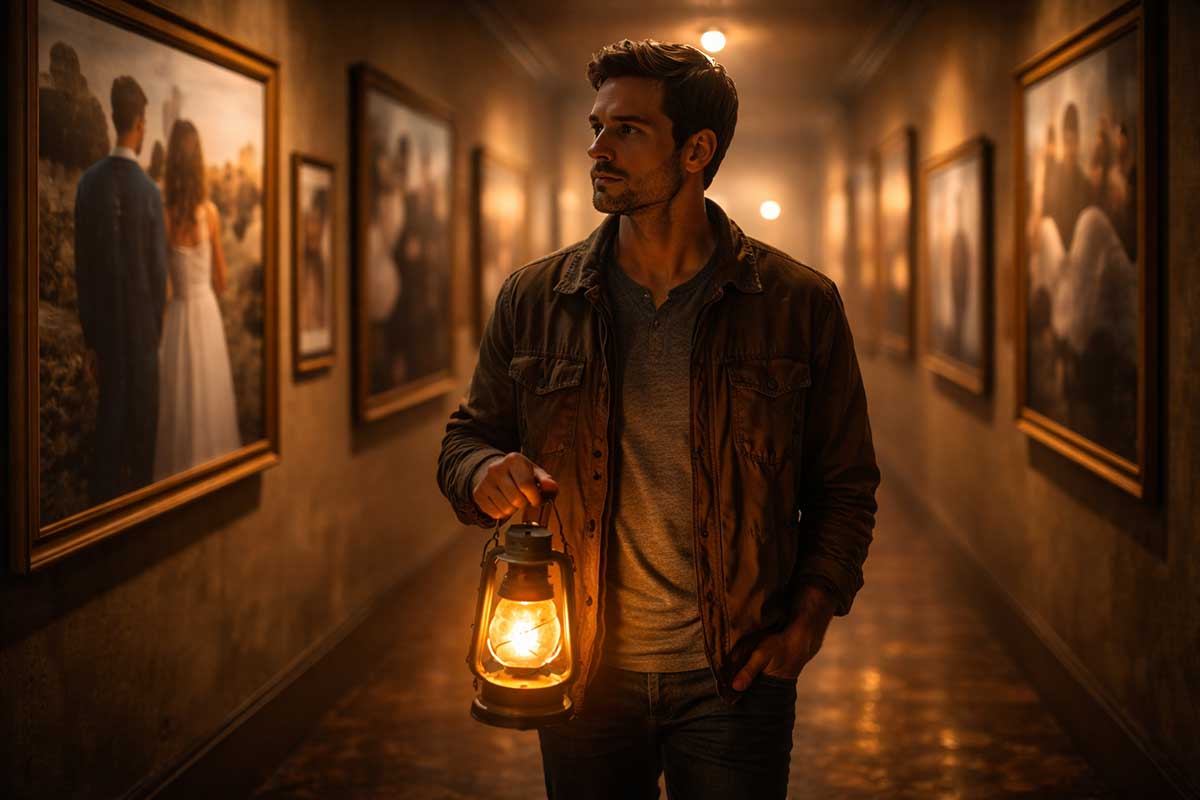
A long hallway stretches forward like a quiet museum of life. On the walls hang framed moments—graduation, a hospital bed, a wedding dance, a long drive at night, a job offer, a goodbye at an airport. The images are blurred just enough to belong to anyone. A person walks slowly down the corridor holding a small lantern, not trying to pass an exam, but simply trying to see clearly.
Stakes Line:
If life is not a test, then failure loses its power to define us—and experience becomes the real teacher.
Terry Gross:
Many people grow up believing life is a kind of moral exam—be good, pass the test, earn approval. If life isn’t a test, what replaces that framework?
Neale Donald Walsch:
Replace earning with expressing. You are not here to prove worthiness—you are here to express who you choose to be. Life offers situations so we can decide that again and again.
Brené Brown:
Pass-fail thinking fuels shame. People start believing they must be perfect to belong. A healthier approach asks: “Am I living according to my values?” That’s not grading yourself—that’s practicing integrity.
Viktor Frankl:
Even if life is not an exam, responsibility remains. Life asks something of us in each moment. The question becomes: what is the most meaningful response available now?
Pema Chödrön:
When we stop trying to perform goodness, we can meet life honestly. Ethics then comes from tenderness, not fear. You become curious instead of defensive.
Paulo Coelho:
A test makes mistakes terrifying. A journey makes mistakes instructive. The heart does not hand out grades—it offers direction.
Perspective Shift:
The hallway of life suddenly looks different. Instead of rows of successes and failures, the frames begin to look like lessons—moments that shaped character rather than scores that judged it.
Terry Gross:
People often say suffering is a teacher. But that can sound insensitive to someone in real pain. How should we think about hardship?
Viktor Frankl:
Suffering is not automatically meaningful. But meaning can arise from how we respond to suffering. Even in difficult circumstances, we retain the freedom to choose our attitude.
Pema Chödrön:
Sometimes phrases like “everything happens for a reason” bypass the rawness of pain. First we allow the feeling. Only later does wisdom emerge.
Brené Brown:
When people rush straight to the lesson, they often skip the truth: this hurts. Healing begins with honesty and connection, not quick explanations.
Neale Donald Walsch:
Life does not need to send pain as punishment. Life presents experiences. Experience reveals. The question becomes: what will you create from this moment?
Paulo Coelho:
A wound becomes wisdom only when it is faced. You cannot rush that process. Pain must be acknowledged before it can transform.
“Meaning can arise from suffering—but it begins with honesty about the pain.”
— Viktor Frankl
Turning Point Line:
Now the focus shifts from what life brings to us… to what we choose to do with what life brings.
Terry Gross:
What practices help people discover who they truly are, without fooling themselves?
Pema Chödrön:
Sit quietly with your mind. Notice how quickly it tries to escape discomfort. Self-discovery begins when we stay present instead of running.
Brené Brown:
Tell the truth to safe people. Shame thrives in secrecy. Authenticity grows where honesty is welcomed.
Viktor Frankl:
Commit to something larger than yourself—service, love, a meaningful task. Through responsibility, the self becomes clearer.
Neale Donald Walsch:
Ask one simple question often: “What would love do now?” Then act on the answer. Identity is formed through repeated choices.
Paulo Coelho:
Listen to the quiet longing within you. Then take one brave step. Destiny reveals itself through movement, not endless thinking.
Transition:
The lantern moves further down the hallway. Each frame remains part of the journey, but none of them carries a grade. Instead they reveal something else: a person slowly discovering who they are.
Takeaway Line:
Life becomes less about passing tests and more about consciously choosing who we are becoming.
Topic 5: Humanity Must Move Toward a More Loving Civilization

A city council chamber in bright daylight. Microphones, folders, serious faces. A poster board on an easel shows diagrams—blurred enough to be universal. Through tall windows, another world runs in parallel: a community garden, volunteers distributing food, hands pressing seedlings into soil. One scene is policy. The other is compassion in action. The question is no longer private—it’s civilizational.
Stakes Line:
If fear remains the organizing principle of society, we may gain control but lose humanity—and the cost will compound across generations.
Fareed Zakaria:
Are humans actually becoming more moral—or just getting better at rationalizing harm?
Yuval Noah Harari:
We’ve reduced some forms of violence through institutions, but we’ve also created new forms—bureaucratic, technological, distant. Humans are story-driven. With the right narrative, we can justify almost anything.
Rutger Bregman:
And we’re addicted to cynical stories about human nature. The belief that people are selfish becomes self-fulfilling—policies built on distrust create behaviors that confirm distrust. We underestimate cooperation.
Jane Goodall:
Morality isn’t a straight line upward. It depends on empathy. When people lose connection to consequences—especially consequences they can’t see—cruelty becomes easier.
Dalai Lama:
Compassion must be trained like a skill. Modern life stimulates fear and anger constantly. Without inner education, outer progress becomes unstable.
Neale Donald Walsch:
Civilization keeps choosing fear as a strategy—then wonders why fear multiplies. We are instructed by the results. If our systems create suffering, the strategy is failing.
Perspective Shift:
The discussion begins to feel less like a moral lecture and more like a design problem. If society rewards fear, fear grows. If society rewards care, care grows. The question becomes: what actually changes the incentives?
Fareed Zakaria:
What realistically moves societies from fear to love—policy, culture, spirituality, or technology?
Rutger Bregman:
Trust-based systems. Reduce humiliation, increase dignity. When desperation decreases, people can think long-term. Compassion becomes easier when survival isn’t constantly threatened.
Yuval Noah Harari:
Culture defines what’s normal and admirable. Technology amplifies what culture feeds it. Without governance, tech can industrialize fear—misinformation, surveillance, outrage incentives.
Dalai Lama:
Education of the heart is essential: compassion, self-control, responsibility. Ethics without inner training is fragile, and inner training without ethics is empty.
Jane Goodall:
Hope must be practical—local projects, youth leadership, communities repairing what they can touch. Big shifts often begin with small, consistent acts.
Neale Donald Walsch:
All four must align. Policy without consciousness becomes cold. Spirituality without policy becomes private comfort. Culture is the bridge. Technology is the amplifier. Choose the value first—then design accordingly.
“Technology amplifies what culture feeds it.”
— Yuval Noah Harari
Turning Point Line:
Now the ideal meets the real: compassion sounds beautiful—until power enters the room and exploitation becomes a possibility.
Fareed Zakaria:
Can love scale politically without becoming weak or exploitable?
Dalai Lama:
Compassion is not weakness. It is courage without hatred. You can oppose harmful actions firmly while still respecting the humanity of the person.
Yuval Noah Harari:
Large systems require verification—checks, audits, enforcement. Without structure, good intentions become vulnerabilities. Love needs boundaries to scale.
Rutger Bregman:
Naivete is not love. Love can be designed into institutions: transparency, accountability, fair rules, safety nets. Trust isn’t blind—it’s structured.
Jane Goodall:
A loving civilization must include the natural world. Without responsibility toward the planet, collapse comes regardless of ideology. Compassion must extend forward in time.
Neale Donald Walsch:
Love with no backbone is sentimentality. Love with backbone is integrity: clear boundaries, truthful speech, protecting the vulnerable—without becoming what you fight.
Transition:
Inside the chamber, policies are debated. Outside, seedlings are planted. The two scenes don’t contradict each other—they complete each other. Love becomes real when it is both a value and a design.
Takeaway Line:
Compassion scales when it becomes structure—built into culture, policy, and daily practice.
Final Thoughts by Neale Donald Walsch
When I began writing what later became Conversations with God, I wasn’t trying to start a movement or argue theology. I was trying to understand my life.
Like many people, I grew up with an image of God mixed with fear—fear of judgment, fear of punishment, fear of not measuring up. Yet something in me kept asking a quieter, deeper question: What if the relationship between humanity and the divine is not built on fear… but on love?
That question opened a door. And behind that door came a handful of ideas that kept returning, no matter what topic I brought to the page.
They can be said simply:
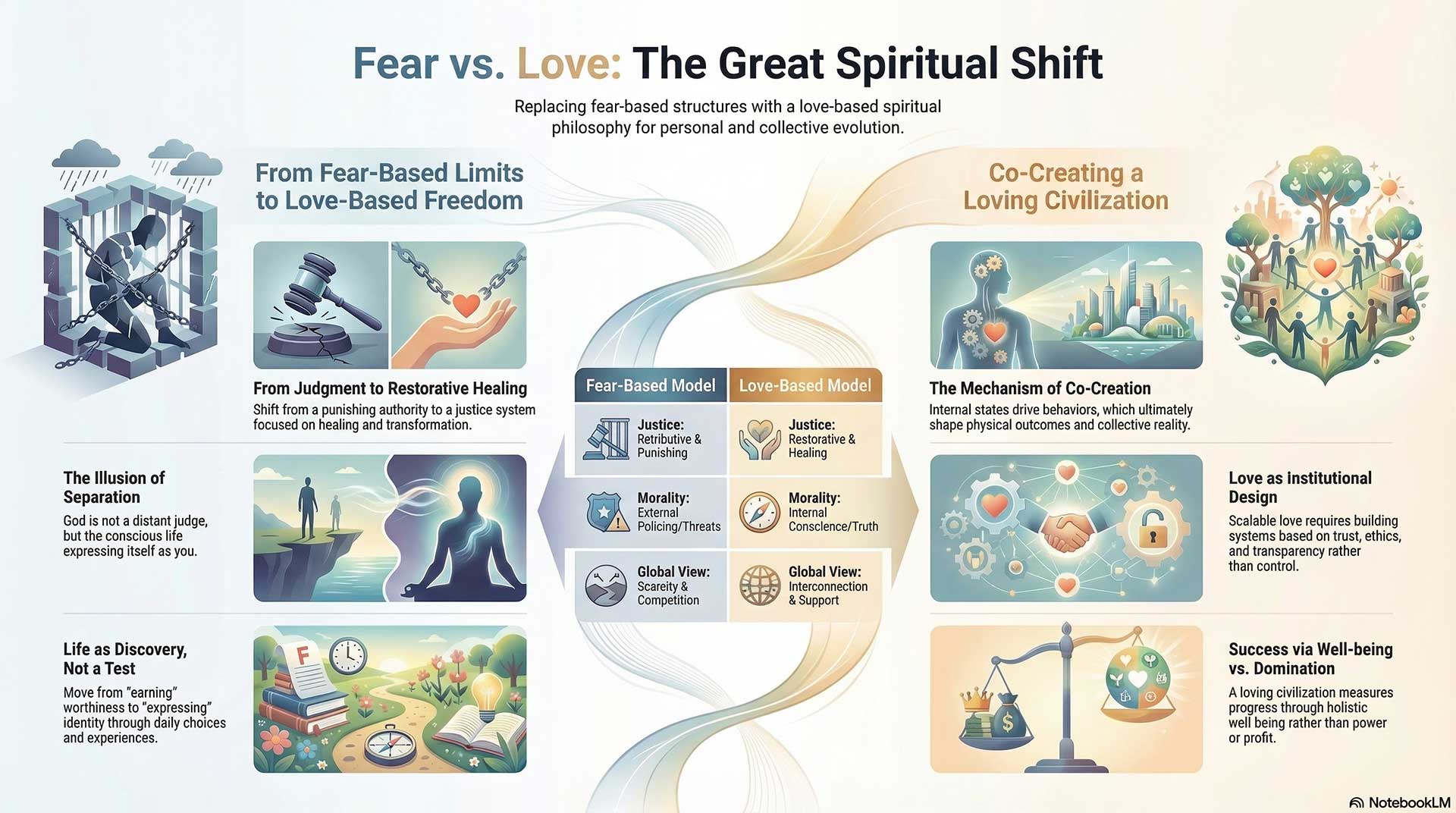
- God may not be a punishing authority, but a loving presence.
- Human beings participate in shaping their experience of life.
- The divine may not be separate from us at all.
- Life might be less like a test and more like a journey of discovery.
- The future of civilization may depend on a collective movement from fear to love.
None of these ideas requires you to abandon your faith. They ask for something both simpler and more demanding:
Consider the possibility that reality is more compassionate, more creative, and more connected than you were taught.
And if that possibility is true, then the most important question is not, “What does God expect from me?”
It’s this:
Who do I choose to be—right now—in response to life?
Short Bios:
Speakers
Neale Donald Walsch
American spiritual author best known for Conversations with God, a bestselling series presenting a dialogue with the divine that emphasizes love, personal responsibility, and humanity’s role in shaping its future.
Rob Bell
Writer and former pastor known for rethinking traditional Christian ideas about heaven, hell, and faith in books like Love Wins and What We Talk About When We Talk About God.
Marianne Williamson
Author of A Return to Love and long-time advocate of spiritual transformation through compassion, forgiveness, and the shift from fear-based thinking to love-based living.
Byron Katie
Spiritual teacher known for developing “The Work,” a method of questioning stressful thoughts to reduce suffering and increase clarity and compassion.
Don Miguel Ruiz
Author of The Four Agreements, drawing on Toltec wisdom to help people break limiting beliefs and live with greater freedom and authenticity.
Deepak Chopra
Physician and bestselling author who integrates science, consciousness, and spirituality in books such as The Seven Spiritual Laws of Success.
Wayne Dyer
Motivational author whose work emphasized intention, self-identity, and personal transformation through books like Wishes Fulfilled and Your Erroneous Zones.
Joe Dispenza
Chiropractor and researcher exploring how meditation, neuroscience, and behavior change can transform habits and emotional patterns.
Rhonda Byrne
Creator of The Secret, which popularized the “law of attraction” concept and the idea that thoughts and beliefs influence life outcomes.
Eckhart Tolle
Author of The Power of Now, teaching the practice of presence and the dissolution of ego through awareness.
Michael A. Singer
Author of The Untethered Soul, known for explaining the “inner witness” and the practice of observing thoughts without attachment.
Ram Dass
Former Harvard psychologist Richard Alpert, widely known for Be Here Now and teachings blending Eastern spirituality with Western psychology.
Alan Watts
Philosopher who introduced many Western audiences to Zen Buddhism, Taoism, and non-dual philosophy through lectures and books.
Viktor Frankl
Founder of logotherapy and author of Man’s Search for Meaning, exploring how humans can find purpose even in extreme suffering.
Pema Chödrön
Buddhist teacher known for compassionate teachings about uncertainty, fear, and resilience in books like When Things Fall Apart.
Brené Brown
Research professor studying vulnerability, shame, and courage, widely known for books like Daring Greatly and her TED talks.
Paulo Coelho
Author of The Alchemist, a globally influential novel about following one’s destiny and listening to the call of the heart.
Dalai Lama
Spiritual leader of Tibetan Buddhism and global advocate for compassion, nonviolence, and universal human ethics.
Rutger Bregman
Author of Humankind, arguing that humans are more cooperative and compassionate than cynical narratives suggest.
Yuval Noah Harari
Historian known for Sapiens and Homo Deus, exploring how shared stories, institutions, and technology shape human civilization.
Jane Goodall
World-renowned scientist and environmental activist whose work emphasizes empathy, stewardship, and hope for the planet.
Moderators
Krista Tippett
Host of On Being, known for thoughtful conversations on spirituality, ethics, and the human condition.
Malcolm Gladwell
Writer and podcast host famous for exploring social behavior, psychology, and hidden patterns in everyday life.
Sam Harris
Neuroscientist, philosopher, and author known for exploring consciousness, ethics, and the nature of the self. His work bridges science and contemplative traditions, arguing that spiritual insight can be studied through reason and direct experience.
Terry Gross
Host of NPR’s Fresh Air, widely respected for in-depth, human-centered interviews with cultural and intellectual figures.
Fareed Zakaria
Host of Fareed Zakaria GPS and analyst of global politics, economics, and international affairs.
Leave a Reply