
|
Getting your Trinity Audio player ready...
|
Introduction by Nick Sasaki
This story does not begin before pressure.
It begins inside it.
That matters.
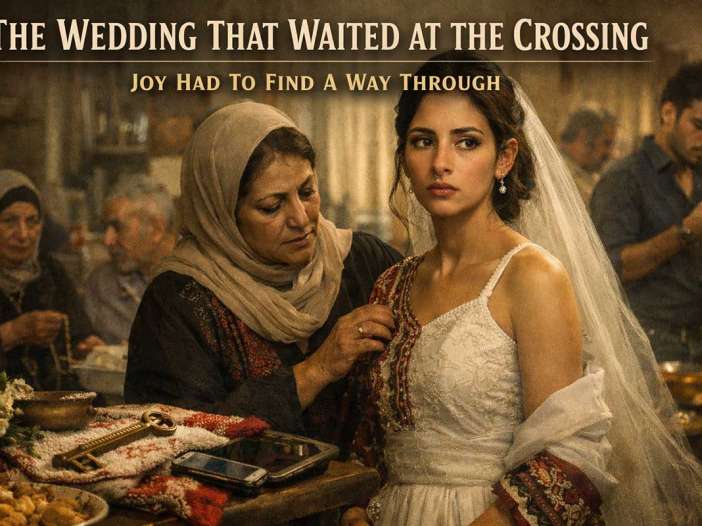
The Wedding That Waited at the Crossing is not a story about a peaceful family before tragedy suddenly arrives. It is a story about a family already living inside interruption, already shaped by roads, permits, crossings, exile, memory, and the exhausting labor of trying to make one day feel whole. The wedding does not create the pressure. It reveals how deeply the pressure already lives inside the family.
That is the center of the story.
I wanted the Palestinian side of this project to feel different from the other war stories. Not another quiet morning before the break, but a house already preparing joy under conditions that keep refusing to let joy arrive cleanly. A grandmother carries 1948 in the body of her speech. A father has learned to think in routes, waiting times, and backup plans because occupation has made logistics part of love. A mother tries to hold beauty, dignity, and timing together so the day does not collapse into bitterness. A bride wants one ordinary human day and keeps discovering that even joy has become conditional. A younger brother uses humor to survive how absurd the whole structure has become. And a relative delayed by the crossing turns the family itself into a map of fragmentation.
What mattered most to me here was continuity.
The Palestinian side is often described through loss, and loss is real. But if the story stops there, it becomes too flat. The deeper truth is that this family is not only losing. It is also carrying, adapting, preserving, joining, cooking, dressing, waiting, blessing, calling, remembering, and trying again. In other words, it is trying to remain a family under conditions that repeatedly break continuity into sections.
That is why the wedding is the right engine.
A wedding naturally gathers everything:
the old village,
the camp,
the city,
the diaspora,
the absent uncle,
the late cousin,
the inherited dress,
the old key,
the future everyone wants to celebrate,
and the roads that refuse to let family become one room without permission.
This gives the story both beauty and pressure at once.
I also wanted the historical background to be more visible here than in some of the earlier stories. Not through lectures, but through objects, speech, and family roles. The brass key is not just a symbol. It is a way of carrying the old house into the present. The grandmother’s memory is not there to make the room sentimental. It is there to remind the family that joy does not begin from empty land or empty time. The father’s route-planning is not merely practical. It is a whole history of occupation translated into daily behavior. The relative waiting at the crossing is not just a late guest. He is the living shape of what fragmentation does to kinship.
That is what I wanted readers to feel:
that Palestinian history is not only a matter of past dispossession or present restriction, but a long struggle to keep family continuity from being broken beyond recognition.
Mariam stands near the center of that struggle. She is a bride, but she is also a daughter asked to carry more than a bride should carry. She wants a wedding, not a metaphor. She wants joy, not only symbolic survival. She wants the future to arrive as life, not just endurance. That desire is one of the most human and painful things in the story.
For me, The Wedding That Waited at the Crossing is about what happens when a people must build beauty under conditions that keep delaying wholeness. It is about memory, yes. But it is equally about the future’s right to exist without always asking permission from the road.
(Note: This is an imaginary conversation, a creative exploration of an idea, and not a real speech or event.)
Chapter 1 — The Day Began in Fragments
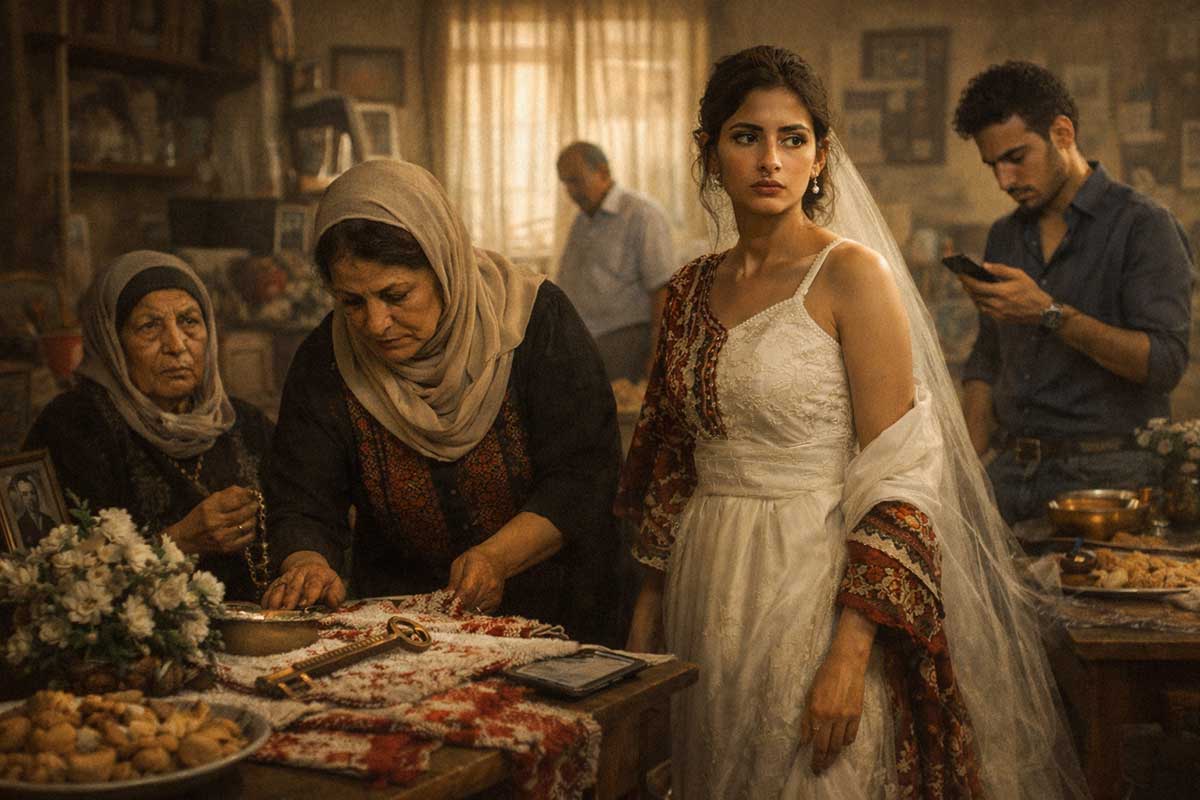
By late afternoon, the house had already grown too full for its walls.
Not with guests.
Not yet.
With preparation.
Trays covered in cloth.
Shoes lined by the door and then moved again.
A dress hanging from the wardrobe with one sleeve turned inward, as if it had been interrupted while becoming beautiful.
A pot on the stove not quite ready.
A second pot already finished.
A phone charging on the floor because every plug in the house was already in use.
And in the middle of all of it, Nadia moving from room to room with the fast, contained energy of a woman trying to hold one day together before the day had decided whether it wished to cooperate.
“Not there,” she said, lifting a stack of plates from the table where Yousef had just set them. “If your uncle comes through, we’ll need the larger tray here.”
“If my uncle comes through,” Yousef repeated. “You say it like weather.”
Nadia did not answer at once. She carried the plates into the kitchen, set them down, then came back with folded napkins.
“In this family,” she said, “weather would be easier.”
Yousef leaned against the doorway and watched her. He was old enough to be useful, young enough to still make usefulness sound like complaint.
“So what are we waiting for exactly?” he asked. “The uncle, the permit, the cousin, the dressmaker, the man with the chairs, or the miracle?”
“The chairs already came.”
“Then the miracle.”
From the far room, Um Salim said, “If you speak foolishly enough, God may decide not to attend.”
Yousef looked toward the voice and grinned despite himself.
His grandmother sat on the low cushioned chair by the window as if she had lived there longer than the wall behind her. A black dress, a heavy cardigan despite the warmth in the room, hands resting one over the other in the lap. She was not doing nothing. In a house like this, elders never did nothing. They watched what was being forgotten.
On the bed beside her lay a folded embroidered thobe wrapped in thin tissue, a small velvet box, and an old brass key no one had moved all day.
Mariam stood in the center of the room while Nadia adjusted the dress against her shoulders for the third time.
“Don’t pull,” Mariam said.
“I’m not pulling.”
“You are.”
“If I were pulling, you would know.”
Mariam gave a short, tired laugh.
That laugh had been with her all week. Not joyless. Not joyful either. The sound of someone trying to protect a day from becoming too heavy before it had even begun.
Noa did not exist here. This was not Noa’s country, Noa’s apartment, or Noa’s silence. Mariam was not trying to survive a dinner table that had turned strange. She was trying to become a bride in a house where every beautiful thing had to pass through logistics first.
Nadia stepped back and looked at her.
“Turn.”
Mariam turned.
The dress caught the light from the window and held it for a second. Cream fabric, stitched red work at the sleeves and chest, the kind of embroidery that looked decorative to strangers and ancestral to family. Um Salim stared at it with a face that gave nothing away quickly.
“It sits well,” she said.
That was her highest form of blessing.
Mariam touched the edge of one sleeve.
“Do you think it’s too much?”
Um Salim did not hesitate.
“For whom?”
“For today.”
“There is no such thing as too much dignity.”
Yousef muttered, “There is such a thing as too much fabric.”
“Then you should not wear it,” Um Salim said.
Nadia almost smiled.
That was how the house survived pressure: someone always answered sharply enough to keep sorrow from growing theatrical.
The phone rang.
Not the landline. The mobile on the floor.
Everyone stopped.
Nadia got there first, lifted it, looked at the screen, and answered at once.
“Hassan?”
Mariam went still.
Yousef pushed away from the doorway. Even Um Salim’s face changed, though only around the eyes.
Nadia listened.
“Yes.”
“How long?”
“No, don’t say ‘soon.’ Tell me where.”
A pause.
“All right.”
Another pause.
“Yes, we know.”
Then, softer: “Just keep the line alive if you can.”
She ended the call and stood holding the phone as if it might continue by itself.
“Well?” Mariam asked.
Nadia looked at her daughter.
“He’s waiting.”
“For what?”
Nadia did not answer quickly enough.
Yousef did it for her.
“For people to decide whether family counts as urgent.”
“Yousef,” Nadia said.
But it was too late. The sentence was already in the room.
Mariam looked away.
The air changed around her, and Nadia hated that most of all — the way one message could make a bride look less like a bride and more like a daughter of this place again, measured against roads and permissions and whether one man would be allowed to arrive in time to stand in the family photograph.
Um Salim spoke from her chair.
“Waiting is also a kind of arrival here.”
No one answered.
That was the thing about her sentences. They often sounded like wisdom and defeat at once, and the family never knew which part to resent.
Nadia put the phone down carefully.
“We continue,” she said.
It was not a declaration. It was labor.
The kitchen grew warmer as the evening leaned closer. Steam gathered at the window. Oil hissed. Someone knocked downstairs and Yousef went to open the building door for the women bringing sweets. Their voices rose up through the stairwell ahead of them — one sharp, one laughing, one already complaining about the climb.
This, too, was the shape of the day: joy arriving in pieces.
Mariam sat on the edge of the bed for a moment while Nadia pinned the back of the dress.
“You should eat something.”
“I can’t.”
“You will faint beautifully and annoy me.”
Mariam smiled despite herself.
“You always say things like that on serious days.”
“That is why serious days are survivable.”
From the hall, Yousef called, “Where do these go?”
“Not there,” Nadia answered immediately.
“Then where?”
“Near the window.”
“Which window?”
“There are only two!”
“In this house there are six moods and no windows,” he called back.
Um Salim clicked her tongue.
“You joke because you have not yet learned what the day costs.”
Yousef appeared in the doorway carrying two metal trays heavy with sweets.
“No,” he said, “I joke because otherwise we’d all start speaking like official announcements.”
That made Mariam laugh properly for the first time that day, and the sound went through Nadia like relief and grief together.
A girl should laugh on her wedding day.
A girl should not have to earn the right to laugh through route updates.
Nadia took one of the trays from Yousef.
“Put it down and wash your hands.”
“I already washed them.”
“Then wash them again. Today I trust no one.”
He rolled his eyes and obeyed.
The room settled for a few minutes into work again. Tissue paper folded. Cups counted. Jewelry box opened. One earring missing, then found. Headscarf chosen, rejected, chosen again. A cousin calling to say traffic had stopped. Another relative sending a voice message instead of coming in person because no one wanted to promise arrival anymore.
Mariam sat before the mirror while Nadia fixed her hair.
For a moment, the room might have been only what it claimed to be. A bride, a mother, a grandmother, a younger brother pretending not to be emotional. Women in the kitchen. Sugar on trays. Evening approaching. One family preparing to welcome another.
Then Um Salim picked up the brass key from the bed.
She held it in her palm the way some people hold prayer beads.
Mariam saw her in the mirror.
“Why did you take it out today?”
Um Salim looked at the key, not at anyone else.
“Because your mother forgot.”
Nadia kept working at the hairpins.
“I didn’t forget.”
“You wrapped the dress. You opened the box. You set the table twice. You forgot the key.”
Yousef came back into the room drying his hands.
“I still don’t know why we bring that out every time.”
No one answered him at once.
The key sat in Um Salim’s hand, dark and heavy and too old for the lock it once knew.
At last she said, “Because a family should not celebrate as if it began in the room it is standing in.”
Yousef looked down.
That was one of the first real historical sentences of the day, and it entered the house without any change in volume. No lecture. No ceremony. Only an object older than the evening itself.
Mariam turned slightly in her chair.
“You think I don’t remember?”
Um Salim’s face softened, though only a little.
“I think you remember differently.”
“That’s not the same as forgetting.”
“No,” Um Salim said. “It isn’t.”
Nadia put the last pin in place and stepped back.
“Done.”
Mariam lifted her hand toward her hair, then stopped before touching it.
The mirror held all of them at once.
The bride.
The mother.
The grandmother with the key.
The brother lingering in the doorway.
The room full of beauty and interruption.
Nadia looked at her daughter’s reflection and thought, not for the first time, that Palestinians were asked to do too many things at once. Remember, but keep moving. Mourn, but celebrate. Endure, but do not become only endurance. Build a future, but do not insult the dead by behaving as if the past has loosened its hold.
The phone rang again.
No one moved.
Then everyone moved.
This time Mariam picked it up.
“Hassan?”
Her voice changed at once.
Not into panic. Into concentration.
“Are you through?”
A pause.
“What does that mean?”
Another pause.
“No, don’t say maybe.”
She closed her eyes. “Just tell me if you’re moving.”
Nadia stood with both hands pressed against the back of the chair.
Yousef looked away toward the window, because he could not bear the shape of hope on his sister’s face while it was still being negotiated by strangers and barriers.
Um Salim kept the key in her hand.
At last Mariam said, quietly, “All right.” Then, after listening longer: “Then come if you can. We’ll begin if we must.”
She ended the call.
No one asked at once.
Mariam set the phone down on the table beside the jewelry box.
“He’s still waiting.”
The house did not react dramatically.
That was what made it Palestinian.
No one cried.
No one shouted.
No one said this was impossible, though it was.
Everyone simply absorbed one more fracture into the architecture of the day.
Nadia picked up the veil and shook it out once before folding it over her arm.
“Then we go on,” she said.
This time her voice sounded harder.
Not because she felt less. Because there were only so many times a woman could hold a celebration together before holding it together became its own form of anger.
Mariam stood.
Yousef reached for the tray of sweets.
Um Salim closed her hand around the key and slipped it into her pocket.
Outside, evening had fully arrived. The call to prayer drifted between buildings, mingling with car horns, footsteps, and the ordinary noise of a place where life never stopped trying to continue no matter how often it was broken into sections.
Nadia looked once around the room — dress, trays, cups, folded cloth, half-packed joy, waiting phone, old key, living daughter — and understood the truth of the day more clearly than she wanted to.
This was a wedding.
It was also a map.
Of what had been lost.
Of what remained divided.
Of what still insisted on being joined.
And the day had only just begun.
Chapter 2 — The House That Still Carried Another House
They did not leave for the hall right away.
That was the first secret of the day.
A wedding, in stories, moves forward. People dress, gather, travel, arrive, bless, eat, dance. Even when something goes wrong, it still feels like one event carrying itself toward another.
But in Nadia’s house, this wedding kept pausing to remember that movement was never simple.
The women from downstairs had settled in the front room with trays and opinions. One cousin was still sending voice messages instead of appearing in person. Another had promised to come “if the road opened,” a phrase so familiar it no longer sounded absurd until a stranger heard it. In the kitchen, tea had already been poured twice and forgotten twice. Somewhere in the building, a child was practicing ululations too early and being corrected by an aunt who believed celebration had proper timing even when the world did not.
Mariam stood near the window with the veil over one arm, not wearing it yet.
“Sit,” Nadia said.
“If I sit, the dress will crease.”
“If you stand, you’ll fall.”
“I’m not going to fall.”
“You say that like a curse against me.”
Mariam smiled faintly, but she sat.
The room breathed around her. It smelled of starch, perfume, coffee, sweet pastry, steam from the kitchen, and the faint dryness of old wool from Um Salim’s cardigan. The air itself felt layered with generations.
Yousef came in carrying the brass tray with the small coffee cups.
“Where?”
“Not on the bed,” Nadia said.
“That narrows the world beautifully.”
“Good. Put it by the mirror.”
He set it down and looked at Mariam.
“You still look calm.”
“That’s because I’m using all my energy not to kill you.”
He grinned.
Um Salim, from her chair, said, “A bride should not threaten blood before sunset.”
“A brother should not speak before being useful,” Mariam replied.
That got a low sound from Um Salim that, in another woman, might have been laughter.
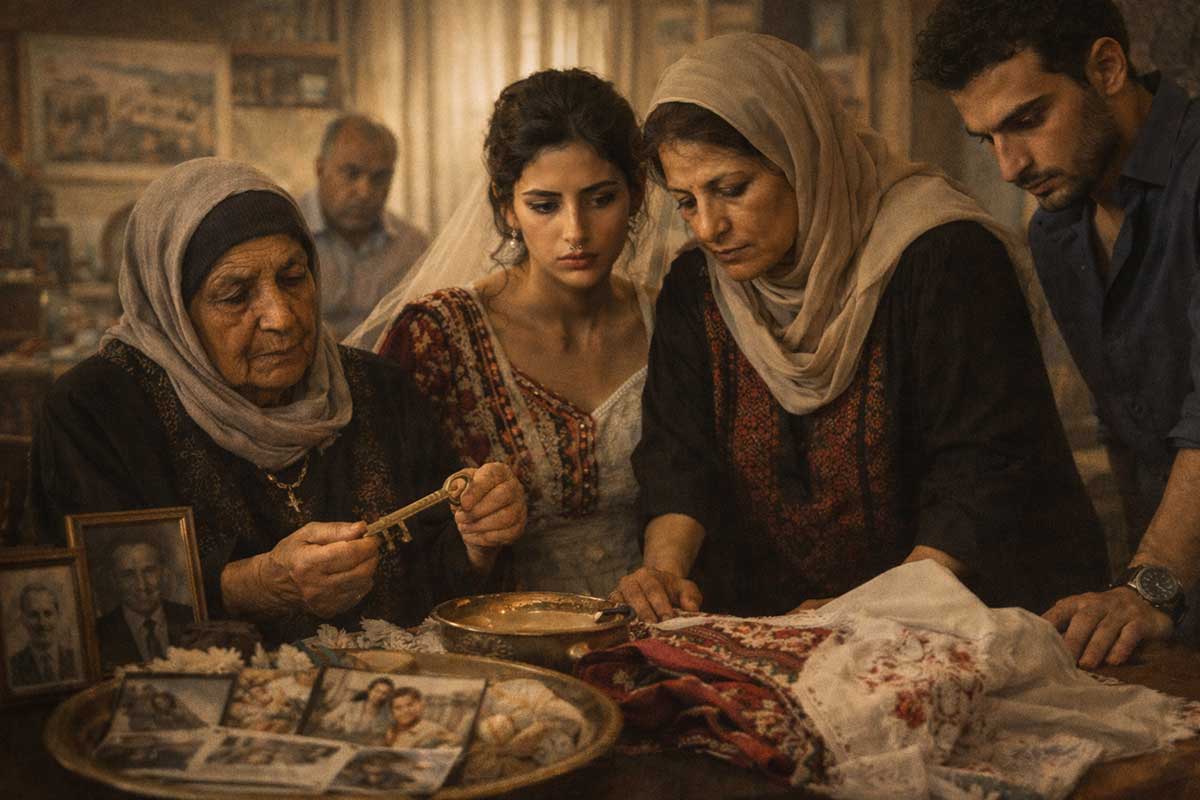
The key was back in her hand.
It had not returned to the pocket. It lay across her palm the way a fact lies across a table — not aggressive, only impossible to ignore for long.
Nadia saw Mariam looking at it.
“Mother,” she said, not sharply. “At least put it away until later.”
Um Salim did not move.
“Later for what?”
“For when the old story is needed.”
“The old story is needed now.”
Yousef leaned against the wall.
“It is always needed now with you.”
Um Salim turned her head and fixed him with the look that had once disciplined sons, daughters, goats, and perhaps weather.
“Yes,” she said. “That is because you are all trying to live as if today began today.”
No one answered immediately.
The front room had gone quieter. Even the women from downstairs, hearing the change in tone without hearing every word, had begun speaking lower. That was another feature of family houses like this: silence traveled through walls almost as fast as gossip.
Mariam said at last, “Tell it, then.”
Nadia looked up.
“Not now.”
“Yes, now,” Mariam said, still looking at Um Salim. “If she is going to sit there holding it like that, then tell it properly.”
Yousef folded his arms.
“We all know the story.”
“No,” Um Salim said. “You know the outline.”
That sentence settled in the room with old authority.
She lifted the key slightly.
“This was for the front door,” she said. “Not this door. The other one.”
No one moved.
Nadia’s hands, which had been smoothing a cloth on the table, stopped.
“The house had three steps,” Um Salim went on. “A fig tree to one side. Your grandfather kept tools near the wall even when there was no work to do. Your aunt used to sweep the doorway twice because she said dust was how the day announced itself.”
Mariam listened without lowering her eyes.
Yousef did not interrupt this time.
“There was a room where the women sat when guests came,” Um Salim said. “And a small place in the back where your great-grandmother kept jars. Not because jars were important. Because order was important. She believed if you kept food, oil, cloth, and sugar in the right places, then the house itself would stay reasonable.”
Her thumb moved once over the key’s worn head.
“When we left, no one said we were leaving forever.”
The room stayed still.
That was always the line that cut deepest in stories like these — not the loss by itself, but the ordinary misunderstanding at the center of catastrophe. The belief that one would return by evening, next week, after the shooting, after the shouting, after the road reopened, after the adults stopped looking frightened.
Mariam asked softly, “Who carried it?”
“The key?”
“Yes.”
“My mother.”
Um Salim looked toward the window, though not at the street below it.
“She had tied it into the corner of her scarf. Later she took it out and kept it in a box. Then in a drawer. Then in another country. Then in another room. Then in my hand.”
Yousef said quietly, “And now on my sister’s wedding day.”
“Yes,” Um Salim said. “Because a family should know what it is asking of joy.”
Nadia looked at her daughter and felt the old division open again inside herself.
One part of her wanted to protect the day from this weight. Let the girl wear the dress, pin the veil, drink the coffee, laugh when the cousins laugh, complain about the photographer, be a bride before she becomes a symbol again.
Another part knew Um Salim was right.
Palestinian joy did not begin in innocence. It began in continuity fought for.
Mariam stood up.
The dress rustled softly.
“What did you think when you left?” she asked.
Um Salim lifted her head.
“That we would return.”
“No,” Mariam said. “Not what did you think happened. What did you think in your body?”
For the first time, Um Salim looked old in a way that had nothing to do with weakness.
She answered slowly.
“I thought not to lose the children.”
A pause.
“Then not to lose the direction.”
Another pause.
“Then not to lose the names.”
No one in the room breathed deeply after that.
Nadia sat down without meaning to.
Yousef looked at the floor.
And Mariam, still in her dress, still not yet veiled, stood in the center of the room like someone who had just understood that marriage in this family was never only about entering a new house. It was also about carrying the old one correctly.
From the front room, a cousin called out, “Should we bring the sweets now or later?”
The ordinary voice of it almost hurt.
“Later,” Nadia answered.
Her own voice sounded different to her. Not broken. Reweighted.
Hassan called then.
This time Nadia put the phone on speaker without asking first.
The line crackled. For a second they heard nothing but road noise and a breath too close to the microphone.
“Hassan?”
“I’m here.”
“Where is here?” Yousef asked at once.
A short laugh came through the line, tired and uneven.
“Today, that’s the national question.”
No one smiled fully, but the joke gave the room one inch of air.
“Still waiting?” Nadia asked.
“Yes.”
“For what?”
“You want the official answer or the true one?”
“Today I want the true one.”
Hassan was quiet for a beat.
“For someone to decide whether one family crossing one road is a risk, an inconvenience, a number, or nothing.”
Yousef shut his eyes briefly.
Mariam came closer to the phone.
“Don’t say maybe again.”
“I won’t.”
“Can you come?”
“I don’t know.”
There it was again. The phrase that had become the national anthem of fractured families.
I don’t know.
Not because people had no will.
Because the road had become another relative with moods.
Um Salim said into the phone, “If you cannot come, you still call when it begins.”
Hassan’s voice softened.
“I will.”
“You don’t say I will if you’re speaking to be kind.”
“I’m not speaking to be kind.”
That answer pleased her. One could tell because she did not answer again.
Nadia took the phone back.
“Keep it charged.”
“I know.”
“Eat something.”
“Nadia—”
“Eat.”
That got the faintest sound of laughter from the line.
“All right.”
The call ended.
The room returned to itself, though not to the version of itself it had been ten minutes earlier.
That was the trouble with memory told properly. It did not pass like weather. It changed the moral weight of objects.
Now the dress was not only a dress.
The tray not only a tray.
The key not only a relic.
The wedding not only a celebration.
Everything had become linked again.
Nadia rose.
“Enough sitting,” she said, though she herself had only just sat. “If we wait for the road to grow a conscience, your children will be married in old age.”
Yousef laughed.
“There’s the wedding spirit.”
“That is the wedding spirit,” she said. “Movement.”
The women in the front room began calling for the bride. Someone had found the missing earring properly this time. A girl from downstairs ran in with flowers and then froze in awe at seeing Mariam dressed. Another aunt arrived carrying pins she claimed were better than every other pin in the district. The room filled once more with instructions, cloth, perfume, heat, and the familiar female energy by which celebrations in pressured places are forced into being.
As Nadia draped the veil at last, Mariam caught her mother’s hand.
“For one minute,” she said.
Nadia paused.
Mariam looked at her through the mirror.
“Did you have a day like this?”
Nadia smiled, but it was a smile with history in it.
“No.”
“Why?”
“Because mine was smaller.”
“Smaller how?”
“Less dress.”
A beat.
“Less family.”
Another beat.
“Less pretending the road was not in the room.”
Mariam’s expression changed.
“Did you mind?”
Nadia adjusted the fabric at her daughter’s shoulder.
“Yes,” she said. “And no.”
That was the only true answer available.
From the window, the last light was leaving the buildings.
Outside, men were carrying chairs down the street. Somewhere below, a car door slammed. Someone laughed too loudly. A call to hurry floated up the stairwell and dissolved before reaching the top.
The day was moving whether it wished to or not.
Nadia stepped back and looked at her daughter fully dressed at last.
Beautiful, yes.
But more than that — precise.
Like a sentence the family had been trying to keep alive for generations.
Um Salim rose from her chair.
That made them all turn.
She walked more slowly now than she had once walked, but no one mistook slowness for uncertainty in her. She came to Mariam, stood before her, and placed the key in Nadia’s hand instead of the bride’s.
“Not on her,” she said.
Nadia nodded.
“I know.”
Mariam looked between them.
“Why not on me?”
Um Salim answered with perfect calm.
“Because a bride should carry the future with both hands.”
For a moment, no one spoke.
Then Yousef said, softly this time, “That’s actually good.”
No one scolded him for speaking.
Because it was.
And because, in that instant, the house understood something it had been trying all day to hold without naming:
the old house still lived here,
but today’s bride was not meant to become its museum.
She was meant to pass through it, carrying memory without being buried under it.
Nadia closed her fingers around the key.
The room filled again. Voices, perfume, instructions, trays, cousins, shoes, shawls, pins, laughter trying to win against timing.
And still the day remained incomplete.
Hassan was not through.
The road was still deciding.
The family could not yet become one room.
But now, at least, the history inside the house had spoken clearly enough that the wedding could move forward without pretending it had begun in an empty place.
That, too, was a kind of dignity.
And outside, evening was waiting.
Chapter 3 — The Road Had Become Part of the Family
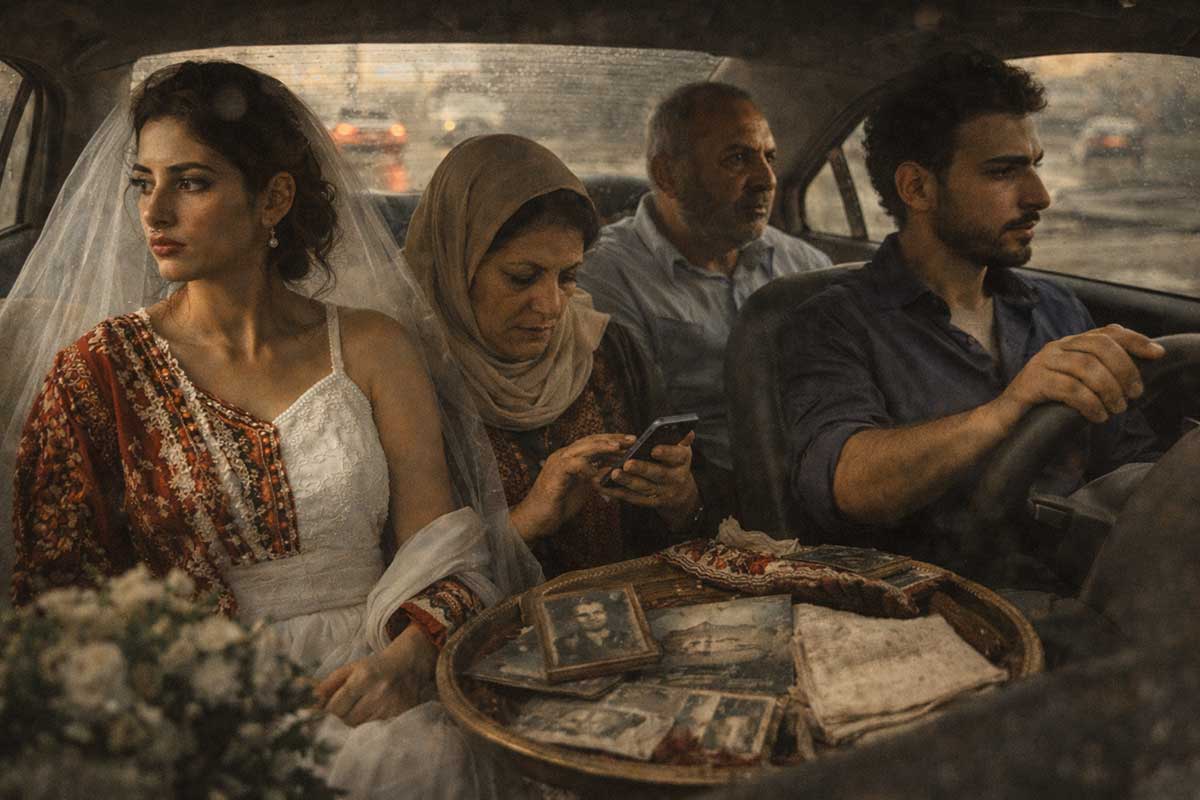
By the time they finally left the apartment, the wedding had already learned how to wait.
That was the trouble with the day.
No one said it aloud, but everyone had begun adjusting their joy in advance, trimming it, folding it, preparing it for delay. Even the women who sang on the stairwell sang as though leaving room between verses for a phone call, a new instruction, a change in route, a cousin saying he was close when he was not close, or not allowed through when everyone had already dressed as if he were.
The building smelled of rain-damp concrete, cardamom coffee, perfume, and the sharp sweetness of syrup from the trays below. The stairwell had become its own little procession: women carrying fabric, men carrying chairs, children trying to run too fast, older relatives correcting everyone’s timing as if proper order might shame history into behaving.
Mariam descended slowly in the dress, one hand lifting the hem just enough to keep it clean.
Nadia was beside her.
Yousef went ahead with the trays.
Um Salim came last, not because she was weakest, but because she was the one who still measured departures.
Outside, the air was cooler than it had been upstairs. The street was alive in the half-chaotic way streets become when family events spill into them — doors opening, car lights flashing, neighbors looking out, someone calling a name from too far away, another person insisting the flowers should have gone in the second car and not the first. Yet beneath all of that was the real organizer of the evening.
The road.
Not the festive road.
Not the symbolic one.
The actual road.
The one that decided whether a family became whole for a few hours or remained split into phone calls and apologies.
Salim stood near the first car with his phone in one hand and the old forward-leaning posture of a man already calculating three backup plans and trusting none of them. His jacket was buttoned wrong at the top, which meant the evening had outrun his patience.
“Well?” Nadia asked.
He glanced up.
“The road from the north is moving.”
“That is not an answer.”
“It’s the only one I have.”
“And Hassan?”
Salim looked at Mariam before replying, which was answer enough already.
“Still waiting.”
No one reacted dramatically.
That was one of the things outsiders never understood. Dramatic reactions belonged to events that still felt unusual. For this family, waiting on the road had become intimate. It had entered tone, posture, seating arrangements, who got called first, who spoke optimistically out of habit, and who had stopped doing so out of self-respect.
Yousef loaded the trays into the back seat and muttered, “If roads had mothers, someone would have taught them manners.”
Um Salim, who had reached the pavement by then, said, “Roads have rulers. That is worse.”
One of the younger cousins laughed, not because the sentence was funny, but because weddings demand that someone keep sound moving.
They drove in fragments.
That, too, was part of the family condition.
One car with the bride and her mother.
Another with trays and aunties.
Another carrying chairs, flowers, and one uncle who complained so much that everyone trusted him to survive anything.
Children redistributed at the last minute.
One cousin dropped because there was no room.
One uncle already at the hall.
One relative still on the phone from elsewhere, saying he might make it, which no longer meant anything stable.
The city outside the window moved the way Palestinian roads always seemed to move in family memory: quickly, then slowly, then not at all, then in a sudden little burst that felt almost generous and therefore suspicious.
Mariam sat in the back seat with the veil gathered beside her.
Nadia, in the front passenger seat, kept turning halfway around to check whether the dress had caught in the door, whether the hem was folded cleanly, whether Mariam was breathing too high in the chest.
“Stop watching me,” Mariam said gently.
“I’m not watching you.”
“You’ve turned around four times.”
“That’s not watching. That’s motherhood.”
Salim kept one hand on the wheel and one eye on the brake lights ahead.
“Call him again,” he said.
Nadia already had the phone in hand.
Hassan answered on the third ring.
The car went quiet at once.
“Where?” Nadia asked.
A pause.
Then: “Still there.”
Salim tightened his jaw.
“For how long?”
Hassan gave a sound that was almost laughter and almost surrender.
“You ask time like it belongs to us.”
Mariam looked down at her hands.
Her fingers were pressing together too hard. Nadia noticed and reached back without turning, finding her daughter’s wrist by feel alone.
“Are you alone?” Salim asked.
“No. A wedding from Hebron is here too. And a man carrying a box of medicine. And two students pretending they are calm. And one old woman who keeps saying she has grandchildren waiting, as though grandchildren are a legal category.”
Yousef would have answered that with a cruel joke. Salim did not.
“Will they let you through?”
“I don’t know.”
There it was again.
The family’s most honest sentence.
When the call ended, no one in the car spoke for a while.
Outside, men were unloading plastic chairs from a truck in front of a pharmacy. A boy on a bicycle rode too close to traffic and was shouted at by three different adults at once. Laundry still hung from one balcony even though evening damp had already begun to settle into the cloth. Life continued in ways both ordinary and insulting.
Mariam looked out the window and said, very softly, “I hate that this feels normal.”
Nadia turned.
“What does?”
“All of it. Dressing like this. Calling like this. Waiting like this. Acting like maybe is part of the ceremony.”
Nadia looked toward Salim, then back at her daughter.
“It is not part of the ceremony.”
“Yes, it is.”
The answer was quick, and tired, and so true that no one in the car tried to soften it.
At the hall, the family arrived in uneven waves.
That was how the evening would continue: not as one event carrying itself smoothly forward, but as reunions happening in pieces.
First the women from downstairs.
Then the cousin with the flowers.
Then the uncle with the keys to the side room.
Then two relatives from Ramallah, wet from the rain but smiling too brightly.
Then a call from a relative in Jordan who would join only by video.
Then one of the groom’s relatives asking, with forced casualness, whether Hassan had made it through yet.
Mariam stood in the bridal room while Nadia adjusted her veil for the fifth time.
The mirror in this room was too big and the light too flattering, which made everything feel more false, not less. Through the half-open door came the sounds of preparation: chairs scraping, women greeting one another, trays being set down, an aunt beginning a song too early, someone shushing children, someone else saying let them run, it is a wedding.
Nadia pinned one last edge near the shoulder and stepped back.
“There.”
Mariam stared at herself in the mirror.
Not admiringly. Not critically. Like someone checking whether the face in the glass still belonged to the plan she had made for the day.
In the reflection, Nadia saw something she had been trying all week not to name.
Her daughter was beautiful.
And furious.
Not raging. Not dramatic. Furious in the way people become furious when life keeps insisting on becoming conditional at the exact point where it should have been allowed to become whole.
“Don’t let it ruin this,” Nadia said quietly.
Mariam kept looking at the mirror.
“I’m trying to decide what ‘it’ is.”
Nadia knew exactly what she meant.
The checkpoint.
The waiting.
The absent uncle.
The years of maps and permits and divided routes.
The larger history entering through one evening.
The fact that a bride should not need political stamina to become a bride.
Nadia put both hands lightly on her daughter’s shoulders.
“It is not the whole day.”
“No,” Mariam said. “But it is in the whole day.”
That was the hardest truth in the room.
The older generation often hoped history could be honored and set aside at the correct moments. The younger generation knew better. History did not wait politely outside the bridal room. It came in through missed arrivals, split guest lists, live calls from roads, old keys in handbags, and relatives who had to be spoken of in countries rather than neighborhoods.
In the main hall, Yousef was helping arrange chairs and failing to hide his irritation.
The groom’s cousin, trying to sound cheerful, said, “At least the weather held.”
Yousef replied, “We don’t live in a place where weather gets the final word.”
The man laughed uncertainly.
Yousef almost apologized, then did not. Weddings made him meaner and more tender at the same time. He could not stand the way everyone kept trying to smooth the evening into something innocent. Yet he was also the one carrying trays, checking cables, making sure the old women had seats, and bringing water to the children who had run themselves into sweat.
That was the Palestinian family condition too: bitterness and service living in the same body.
Salim stood near the entrance with his phone, no longer pretending the device was incidental. It had become the sixth major member of the family tonight. It told them whether the family was complete, whether the map had allowed temporary mercy, whether one old man’s joke or one aunt’s complaint would remain only a voice and not a body in the room.
He saw Nadia coming toward him and lifted the phone before she asked.
“Nothing yet.”
“How long since the last call?”
“Seventeen minutes.”
“You counted?”
“I’m the father.”
That meant yes.
Um Salim sat in the corner of the hall where older women are placed when everyone knows they must be comfortable and visible at once. She watched the room fill around its own incompleteness. The wedding hall itself was not impressive: bright lights, patterned carpet, artificial flowers trying too hard, speakers too large for the room, the usual mixture of beauty and exhaustion common to family spaces built for celebration under financial realism.
But she did not see the hall only as a hall.
She saw the absences.
The missing chair that was not missing because a chair was absent, but because a person was.
The families who came from separate geographies now linked only by ceremony.
The young women taking pictures for relatives abroad.
The old men who had stopped promising arrival until they were actually inside the door.
A younger woman approached her with coffee.
“Do you need anything?”
Um Salim took the cup.
“Yes,” she said. “A country.”
The girl blinked, then smiled awkwardly, not sure whether she had heard correctly.
Um Salim waved her away with kindness before embarrassment could fully land.
That was the thing about old women who had lived too long with dispossession. Sometimes truth came out dressed like mischief.
The call finally came just before the bride was to be led into the main room.
This time Hassan did not speak first.
They heard only movement, then his breathing, then a burst of traffic noise and a voice in the background speaking too fast to understand.
Nadia gripped the phone with both hands.
“Hassan?”
“I’m through.”
Every person nearest enough to hear went still.
“Through where?”
“The crossing.”
Salim closed his eyes for one second. Not gratitude exactly. More like a brief internal lowering of the body after holding too much tension upright for too long.
“How long?” Nadia asked.
“Not long.”
That phrase meant something different now. It meant hope had finally risked specificity.
“Come straight,” Salim said. “Don’t stop.”
Hassan laughed properly this time.
“You say that like I’m on my way to surgery.”
“In this family, weddings require similar endurance.”
The line crackled. Then Hassan said, more softly, “Start if you must. I’m coming.”
When the call ended, the room changed.
Not into peace.
Into motion with air in it.
That was enough.
Nadia found Mariam in the bridal room and told her.
Mariam shut her eyes.
The relief in her face was so sharp it bordered on pain.
“Good,” she said.
Only that.
Because what else was there to say? Thank God? Finally? Of course? Good was large enough. It contained joy, fury, fatigue, vindication, and the humiliation of having needed permission from the road for something that should have belonged only to family.
Nadia kissed her forehead.
“Ready?”
Mariam looked at herself one last time in the mirror.
“No,” she said.
Then, after a beat: “Yes.”
That, too, was the truth of the night.
No one was ready.
They would proceed anyway.
As the music began and the first ululations rose through the hall, Yousef stepped back from the doorway and watched his sister move toward the room where everyone had gathered.
Light, fabric, hands, faces, old women blessing, children weaving between chairs, cousins lifting phones, a groom trying to look composed, mothers watching everything, men pretending not to cry yet.
And underneath it, the knowledge that one late arrival had changed the emotional weather of the whole evening.
The road had become part of the family so long ago that everyone had stopped speaking of it as if it were an intruder.
It was kin now.
Demanding. Unpredictable.
Always consulted. Never invited.
And still the family had made the night happen.
Not freely.
But truly.
That counted for something.
As Mariam entered the hall, Um Salim touched the pocket where the key lay hidden in Nadia’s bag and thought, not for the first time, that Palestinians had been forced into a strange art.
They had learned how to make beauty appear in full dress while history still stood in the doorway refusing to leave.
And perhaps, for one night, that was its own kind of victory.
Chapter 4 — The Wedding Became a Map of Everything Unfinished
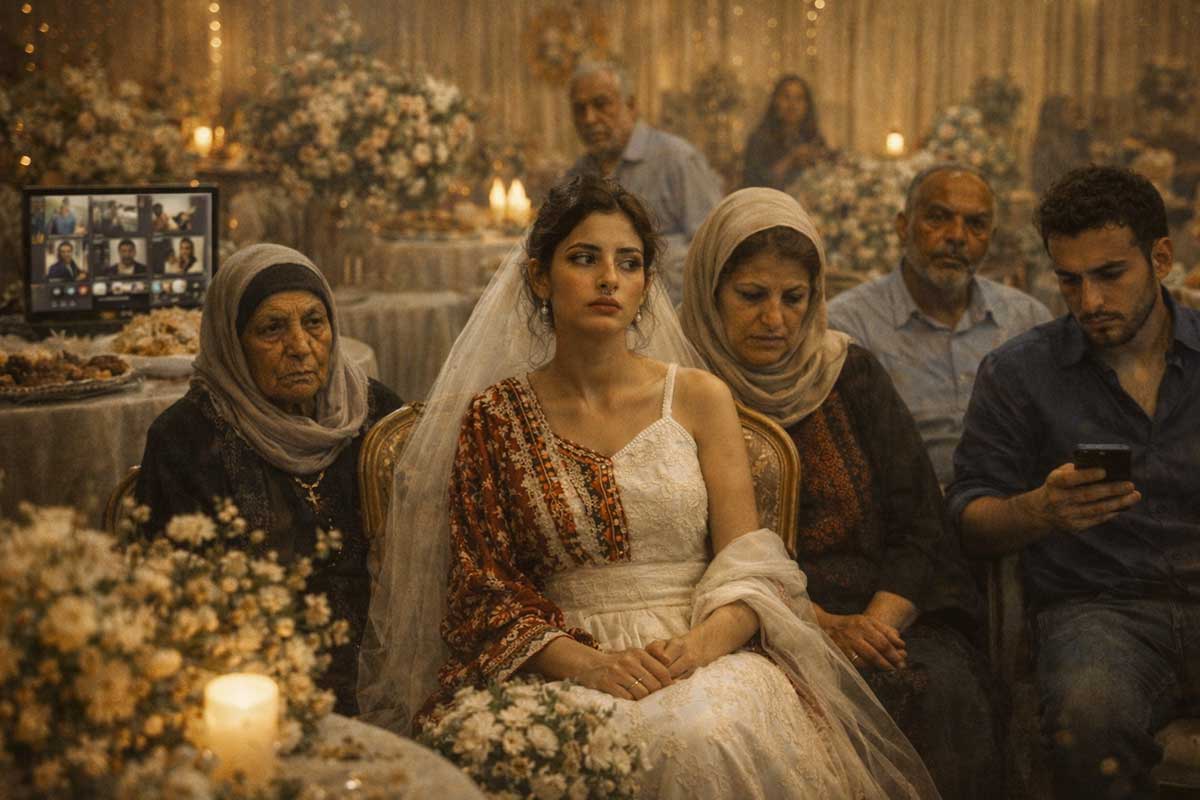
By the time Hassan arrived, the wedding had already split into two versions.
One version lived in the hall.
Music.
Lights.
Hands clapping in rhythm.
A groom standing straighter than he felt.
Women rising to greet the bride as if joy had finally won one clean hour.
Children slipping between chairs with sugared mouths and no respect for solemn timing.
Old women lifting blessings into the air as if blessing itself could thicken the walls against history.
The other version lived beneath it.
The missed calls.
The route updates.
The chair held open too long.
The relatives on screens.
The names spoken with countries attached to them.
The fact that one late arrival had altered the emotional weather of the entire room.
Both versions were real.
That was the hardest part.
Mariam sat beside the groom under the bright lights that made everyone look slightly ceremonial and slightly false. Her veil had settled properly at last. Her hands rested in her lap with more stillness than she actually felt. From far away, she may have looked calm. Nearer, anyone who loved her could see the strain at the mouth, the set of the shoulders, the effort of keeping the evening from collapsing into symbolism.
Nadia watched from three rows back and thought, not for the first time, that weddings in this family asked too much of women.
Smile.
Receive.
Endure.
Remember.
Look radiant.
Do not let the room feel what it cost to get here.
Yousef moved along the side wall carrying glasses, shifting chairs, speaking to caterers, checking the entrance every few minutes even though Hassan had already called. He could not seem to stop looking. Once a family learns to count itself through arrivals, the body keeps doing it long after information is settled.
Salim stood near the hall doors with a face worn down by vigilance. He had spent the whole day in the posture of a man negotiating with time. Now the time had come, the bride was seated, the guests had mostly arrived, the trays were open, the music had begun — and still he did not know how to sit.
That, too, was part of Palestinian fatherhood in a day like this.
The event could begin.
The mind would remain on the road.
Um Salim sat exactly where she had been placed, which was also exactly where she wished to be: visible, central enough to bless, peripheral enough to watch. She had already measured the room once and found all its absences.
The cousin in Amman on a screen.
The uncle in Ramallah who never came after dark anymore.
The aunt in Lebanon who sent voice notes instead of gifts, not from coldness but from distance hardened into habit.
The grandchildren who knew village names better than village roads.
The young men who spoke of permits the way old men once spoke of harvest.
She watched Mariam and thought: the girl is beautiful, yes. Yet what struck her more deeply was that the girl was carrying many Palestines at once.
The lost village in the embroidery.
The camp in the grandmother’s speech.
The occupation in the route planning.
The diaspora in the screens lifted above the crowd.
The future in the white of her hands resting together, still asking for ordinary life as though ordinary life were not already a form of courage.
When Hassan finally entered, no one announced him.
The room did not need announcing. It changed by itself.
People nearest the door turned first.
Then others, following faces rather than sound.
Then Nadia, who knew from the shift in the hall’s breathing before she actually saw him.
He looked rain-marked, late, apologetic, relieved, and old in the way men become old after one day of waiting under authority. Not permanently old. Temporarily, but truly. His coat was damp at the shoulders. His face carried road dust, fluorescent light, and the small humiliation of having arrived only after his own family had begun learning how to celebrate without trusting his presence.
He smiled anyway.
That was what scattered families do when they finally cross into one another’s rooms.
They arrive smiling through exhaustion, not from lightness, but from refusal.
Nadia reached him first.
“You came.”
The sentence came out too simple for all it held.
Hassan kissed her forehead.
“I said I would.”
“Yes,” she answered. “You also said maybe three times.”
That made him laugh, and the laugh broke the edge of the moment just enough for the room to absorb him instead of collapsing into it.
Yousef took his coat.
Salim gripped his shoulder once, harder than greeting required.
Um Salim lifted one hand and motioned him over. He bent toward her, and for a second she placed her palm against his cheek with almost no movement at all. No theatrical gratitude. No long speech. Just touch used correctly.
“Late,” she said.
“Alive,” he answered.
She nodded once.
That was enough.
Then Hassan looked toward Mariam.
The bride had seen him the whole time.
He did not wave. She did not call out. Yet relief passed between them so visibly that even people who knew none of the day’s details understood what had entered the room.
A wedding reveals the map of a people very quickly.
Who is here.
Who is not.
Who is present only on a screen.
Who crossed.
Who could not.
Who married nearby on purpose.
Who lives ten minutes away and may as well live in another century.
Who keeps the old stories.
Who keeps the papers.
Who keeps the jokes alive.
Who stops promising arrival until they are actually inside the door.
This was not only a family celebration now.
It had become a diagram of Palestinian continuity under damage.
Later, after the formal blessing and before the music lifted fully again, one of the younger cousins held up a phone so relatives abroad could see the room.
People leaned in.
Voices from a speaker crackled.
A child shouted the wrong name.
Someone in another country cried immediately.
Someone else laughed too loudly to cover it.
Mariam looked at the screen and then away.
That was the second split of the night.
One family gathered in plastic chairs under too-bright lights.
Another gathered in pockets of signal and glass.
Nadia saw it and felt a pressure behind the ribs she had been holding down all day.
This was what no one outside understood enough.
The deepest wound was not only the loss of land.
It was the long damage done to continuity itself.
A wedding should gather people.
A funeral should gather people.
A birth should gather people.
A feast should gather people.
A house should gather people.
Here, gathering had to fight for itself every time.
And still, astonishingly, people kept trying.
The music rose again.
Women stood.
Hands lifted.
The circle opened and closed around Mariam.
Even Yousef, sulking by instinct against all emotional exposure, found himself pulled into carrying chairs, passing sweets, steadying cables, taking calls, bringing water, translating one side of the room to another.
That was the other part of the Palestinian inheritance.
Bitterness and service.
Fury and hospitality.
Memory and movement.
A people offended by interruption and still skilled at feeding everyone inside it.
At one point Hassan stood beside Salim near the back wall, both men holding tiny coffee cups gone cold in their hands.
Salim said, “How bad was it?”
Hassan looked toward the stage before answering.
“Bad enough that I knew not to tell Nadia properly.”
Salim gave a tired half-smile.
“She knows anyway.”
“Yes.”
They stood in silence for a moment.
Then Hassan said, “Do you realize what it took to get one wedding night to look almost ordinary?”
Salim did not smile this time.
“I realize it every time anything in this family looks ordinary.”
That was the truth of it.
Ordinary here was not natural.
It was engineered.
Through calls.
Through routes.
Through patience.
Through contingency.
Through women preparing for joy with one ear turned toward the road.
Through fathers measuring time against checkpoints.
Through young people mocking the whole structure and serving it anyway.
Through old people refusing to let memory become decorative.
In the women’s room, later, Mariam sat for a moment alone.
Not truly alone; no bride is ever alone on such a night. But alone enough to hear her own breathing and the muffled pulse of music through the wall. The dress felt heavier now. Not from fabric. From hours.
Nadia found her there.
“You disappeared.”
“I came to sit.”
“Your aunt is looking for you.”
“She can keep looking for two minutes.”
Nadia sat beside her.
The mirror reflected both of them. Bride and mother. White and dark cloth. Youth and fatigue. Beauty and management. Love and the work that makes love possible.
Mariam looked at her hands.
“Did it happen?”
Nadia almost laughed.
“We are in the middle of it.”
“No,” Mariam said. “I mean really. Did I get a wedding, or did I get a Palestinian version of one?”
Nadia listened to the music through the wall before answering.
“You got both.”
Mariam nodded.
“That’s what I thought.”
Neither spoke for a while.
Then Mariam said, “I was happy when Hassan came.”
“You should be.”
“And then I got angrier.”
Nadia turned toward her.
“At what?”
“At everything.” Mariam looked up at the mirror. “At having to feel grateful for what should have been ordinary. At everybody acting relieved that the family became family for one night. At knowing half the room is here and half the room always isn’t. At feeling beautiful and furious at the same time.”
Nadia reached over and smoothed one wrinkle from the dress that did not need smoothing.
“That means you are awake.”
“I don’t want to be awake tonight.”
“No,” Nadia said. “But I am glad you are.”
That was the mother’s lesson, and the daughter’s burden.
Do not sleep through your own history.
Do not let history steal the whole night either.
Outside the small room, the ululations rose again. Someone was calling for the bride. Another aunt was insisting the photographer had missed a proper picture with the grandmother. A child had dropped a pastry and was crying as though all tragedy began in syrup.
The world, even broken, still knew how to become specific.
Mariam stood.
When she stepped back into the hall, she saw the room differently.
Not as a wedding fighting history.
As a family carrying history into a wedding and refusing to let either disappear.
There was Um Salim, small and unbent in her chair, one hand resting over Nadia’s bag where the key still lay hidden.
There was Hassan, late and present, carrying the road on his coat.
There was Salim, still watching the entrance even though everyone who would come had likely come.
There was Yousef, laughing at something harsh, handing sweets to children, already turning tomorrow’s exhaustion into tonight’s usefulness.
There were the screens, the absences, the doubled geographies.
There was the groom, trying to stand in the moment without pretending the moment was unbroken.
There was Nadia, who had held the day together through sheer maternal refusal to let it collapse into bitterness.
And there was herself.
A bride.
A daughter.
A Palestinian woman at the beginning of something new and already unfinished.
That was the true shape of the night.
Not ruined.
Not whole.
Not defeated.
Not free.
Only this:
life insisting on itself under conditions that had long ago stopped being reasonable.
As the music swelled and the family gathered again for the photograph everyone had nearly given up on making, Mariam stood between them and understood what the wedding had become.
Not only a celebration.
Not only a ritual.
Not only a future.
A map.
Of who could come.
Who had to call.
Who carried the village.
Who carried the camp.
Who carried the key.
Who carried the route.
Who carried the anger.
Who carried the hope.
And no one in the photograph would look at it later without seeing all the unfinished history standing just outside the frame.
Chapter 5 — After the Guests Left, the Family Was Still Divided by History
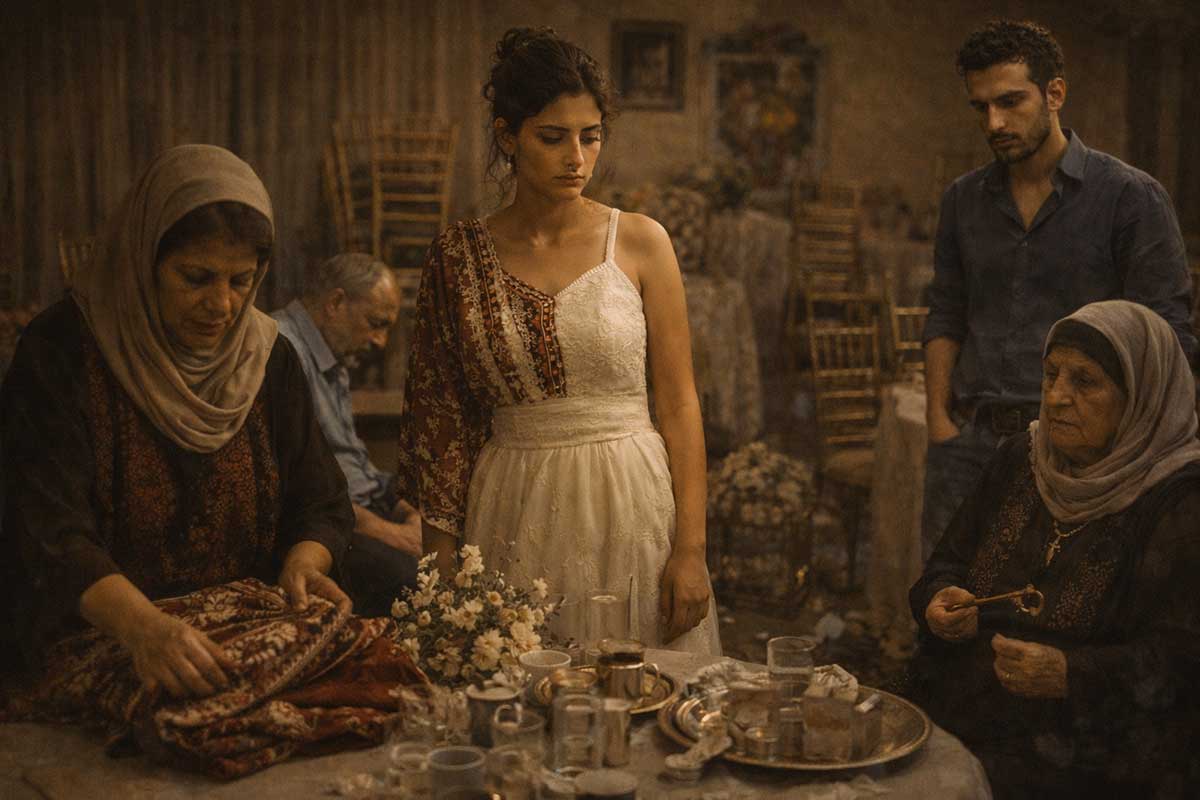
After midnight, the hall began to empty in layers.
Not all at once.
Not cleanly.
First the children, carried out asleep across shoulders or led away sugar-drunk and defiant. Then the older women who had given their blessings, their corrections, their judgments on food, dresses, timing, and the spiritual quality of the evening. Then the men who left with chairs, trays, folded jackets, and tired jokes that had lasted just long enough to keep the night from collapsing under its own meaning.
The music softened.
The floor cleared.
The lights, too bright all evening, suddenly looked tired.
That was when weddings became truthful.
Not during the first entrance.
Not during the ululations.
Not while the trays were still full and the photographs still being staged.
Truth arrived after.
When the room could no longer perform celebration without showing the labor underneath it.
Nadia stood by the side table folding napkins no one would use again. She had done enough for two mothers and still looked as if the night had another list hidden inside it. That was one of the laws of family women in places like this: when the event ended, the real work became visible.
Yousef was stacking cups into plastic crates with more force than necessary.
“Not like that,” Nadia said.
“They’re plastic.”
“Still, not like that.”
He slowed down without looking at her.
Across the room, Salim was helping one uncle count chairs as though the counting itself mattered morally. Perhaps it did. Counting is a strange comfort in damaged societies. If one can still count chairs, trays, children, cousins, cars, and borrowed tablecloths, then something in the world still submits to measure.
Hassan had loosened his collar and sat near the wall with the weariness of a man who had spent the whole evening arriving. Even after he got there, some part of him had remained on the road, still waiting at the crossing under fluorescent light and other people’s permission.
Mariam had finally taken off the veil.
That changed her face more than anyone expected.
Not because she became less beautiful, but because she became more herself again. The bride remained; the symbolic brightness of the bride receded. What stayed was the daughter, the woman, the person who had carried the whole day like a vessel and now sat quietly at the edge of the room, one hand resting over the embroidery on her dress as if trying to feel what part of the evening was actually hers.
Um Salim watched all of this from her chair with the alert stillness of someone who had seen enough departures to know that what remains after a gathering is often more important than the gathering itself.
A younger cousin came to kiss her hand before leaving.
“It was beautiful,” the girl said.
Um Salim nodded.
“Yes,” she said. “And difficult.”
The girl smiled politely, not fully understanding, and went on.
That, too, was part of history. The young often inherited the room first as atmosphere and only later as meaning.
By one o’clock, the hall belonged mostly to family and labor.
Someone swept pastry flakes from the floor.
Someone wrapped leftover bread in foil.
Someone searched for a missing earring that no one would actually care about by morning.
Someone unplugged the speaker, and the sudden absence of sound made the whole room seem larger and less forgiving.
Mariam rose at last and crossed to where Nadia was standing.
“Sit down,” Nadia said.
“You’ve been saying that to everyone all day.”
“Then perhaps you should listen.”
Mariam gave the smallest smile and sat in the nearest chair.
For a few moments neither spoke.
That silence between mother and daughter no longer felt like strain. It felt earned.
At last Mariam said, “Did it work?”
Nadia folded another napkin and set it aside.
“What?”
“The day.”
Nadia looked at her carefully.
“Work for what?”
Mariam laughed once, tiredly.
“That’s not fair.”
“No,” Nadia said. “It’s precise.”
Mariam looked across the room. At Hassan seated with one shoe half unlaced. At Salim still counting chairs. At Yousef carrying crates as if annoyance were fuel. At Um Salim, who seemed to sit inside history as easily as other people sat inside furniture.
“I mean,” Mariam said slowly, “did we actually have a wedding? Or did we just manage one?”
Nadia’s hands stopped.
There it was.
The wound of the whole story.
Because in families like this, management had become so intimate that celebration itself sometimes felt like an administrative victory.
Nadia pulled out the chair beside her daughter and sat down.
“You had a wedding,” she said. Then, after a pause: “And we managed one.”
Mariam lowered her eyes.
“That sounds terrible.”
“It sounds true.”
Across the hall, Hassan lifted his hand once to catch Salim’s attention. Salim crossed over and the two men stood together in the tired way men stand when a long day is finally admitting what it cost them.
“I nearly turned back,” Hassan said.
Salim’s face did not show surprise.
“I know.”
“No,” Hassan said. “I mean I nearly let the road tell me I was no longer part of the evening.”
Salim looked at him for a long time.
“The road has been trying to tell us that for years.”
Hassan smiled without joy.
“Yes. Tonight I almost believed it.”
That sentence stayed between them like the last uncollected object in a nearly empty room.
It was not only about a crossing.
It was about exile, camp life, permits, family distance, split geographies, the slow wearing away of entitlement to presence.
Palestinians did not only lose homes.
They lost the assumption that family could gather without negotiation.
Yousef, passing near them with the crates, heard enough to say, “We should print invitations with route alternatives and emotional warnings.”
“Carry those more carefully,” Nadia called from across the room.
He lifted the crate slightly in acknowledgment but did not apologize.
That was his gift to the family. Even in exhaustion, he refused to let sorrow become elegant. He kept it awkward, local, impossible to sentimentalize.
Um Salim asked for coffee.
That brought them all briefly back into orbit around her.
Hassan brought the cup.
Nadia adjusted the shawl on her shoulders.
Yousef moved a chair from the draft without being asked.
Salim stood near enough to hear if she wanted something else.
Mariam came and sat on the arm of the chair like a girl again for one second before remembering she had crossed into another role tonight.
Um Salim took the coffee and looked at them all.
“Stop standing as if someone died.”
Yousef laughed aloud.
“Finally.”
Nadia shook her head. “You choose your moments strangely.”
“No,” Um Salim said. “I choose them exactly.”
She drank once, then set the cup down.
“This family is still too impressed by sadness.”
No one answered.
Because again, she was right in a way that made argument sound immature.
After a moment she added, “The day was wounded. It still happened.”
Mariam looked at her grandmother.
“That’s enough for you?”
Um Salim met her gaze.
“No. But it is not nothing.”
The older woman then did something no one expected.
She asked Nadia for the key.
The room shifted.
Nadia opened the bag and placed it in her mother’s hand. The brass looked darker now under the artificial light, less symbolic and more like what it had always been: metal worn by human use, then by memory, then by repetition.
Um Salim turned it once between her fingers.
“When I was young,” she said, “I used to think return meant going back exactly.” She looked at Mariam. “That was a child’s thought.”
No one moved.
She continued.
“Then I thought return meant keeping the house alive in the mouth.”
A pause.
“Then I thought it meant not letting the children become strangers to what was taken.”
Another pause.
“Tonight I think perhaps it also means refusing to let interruption become the only inheritance.”
The hall had gone almost fully quiet around them now.
Even the uncle counting chairs stopped counting.
Mariam looked at the key, then at her grandmother.
“What does that mean?”
Um Salim closed her hand around it.
“It means you were right to want one day that was yours.”
Mariam’s face changed in a way Nadia knew she would remember later more clearly than the veil, the music, the lights, or the photographs.
Not because the sentence solved anything.
Because it was the first time all day that the oldest generation had directly released the youngest from carrying memory only as burden.
Nadia looked away then, because mothers know when not to intrude on a daughter receiving something essential.
Hassan said softly, “That may be the wisest thing I’ve heard tonight.”
Yousef, surprisingly, did not add a joke.
He only leaned the crate down against the wall and stood still.
Outside, rain had started again.
It tapped against the high windows in the soft, repetitive way rain does when it wants to remind a room that weather continues whether or not history behaves. The hall, nearly empty now, smelled of extinguished celebration: wilted flowers, coffee, sugar, damp coats, tired perfume, warm wires from the speakers, and the human heat left behind when many bodies have insisted on joy in one place for as long as they could.
This was the true afterlife of the wedding.
Not the posed photograph.
Not the formal congratulations.
Not the moment of entrance.
This:
chairs being folded,
history still in the room,
family no longer fully performing,
truth speaking more plainly because the guests had gone.
Salim came and sat beside Nadia.
He looked older than he had at noon.
“You should be happy,” she said.
“I am.”
“You don’t look it.”
“That is because I also have a daughter.”
She almost smiled.
“There’s no cure for that.”
“No.”
Across the room, Mariam stood and at last took the key from Um Salim — not to keep, not yet, but to hold for one moment.
She turned it over in her hand and said, almost to herself, “It’s heavier than it looks.”
“Yes,” Um Salim said. “So is everything worth carrying.”
That might have been sentimental in another house. Here it was not. Here it was a plain sentence about metal, family, land, and the cost of continuance.
Mariam returned the key to Nadia, who placed it back in the bag.
Then she looked around the hall one last time.
At Hassan, who had made it through.
At Yousef, who had mocked everything and carried everything.
At Salim, who had managed the roads as if roads were another member of the family.
At Nadia, who had refused to let the day collapse into bitterness.
At Um Salim, who had brought the lost house into the room without letting it take the bride hostage.
At the scattered crumbs, the stacked chairs, the cooling cups, the fallen flower petals, the nearly empty hall.
This was what remained.
Not a perfect wedding.
Not a free one.
Not an untouched one.
But a real one.
And perhaps that was the final Palestinian lesson of the night:
not that beauty survives history unchanged,
but that people keep building beauty anyway, even when history has made every joining partial.
As the last of the lights were turned off and the family began carrying what was left back down to the cars, Mariam understood that the wedding had not resolved anything.
The village was still gone.
The camp was still real.
The crossings still decided too much.
The diaspora was still looking in through screens.
The future was still conditional in ways no one should have to call normal.
But something had happened.
Not only a marriage.
A line had been spoken clearly inside the family:
the past must be carried,
but it must not be allowed to become the only shape of the future.
For a people who had lived so long under interruption, that was not a small thing.
And when they finally stepped back out into the rain-swept night, carrying flowers, trays, leftovers, dresses, shoes, children, fatigue, and one old key tucked safely away, the family was still divided by history.
But it was still a family.
And for now, that was how survival looked.
Final Thoughts by Nick Sasaki
What remains with me at the end of this story is not the ceremony itself.
It is what the ceremony exposed.
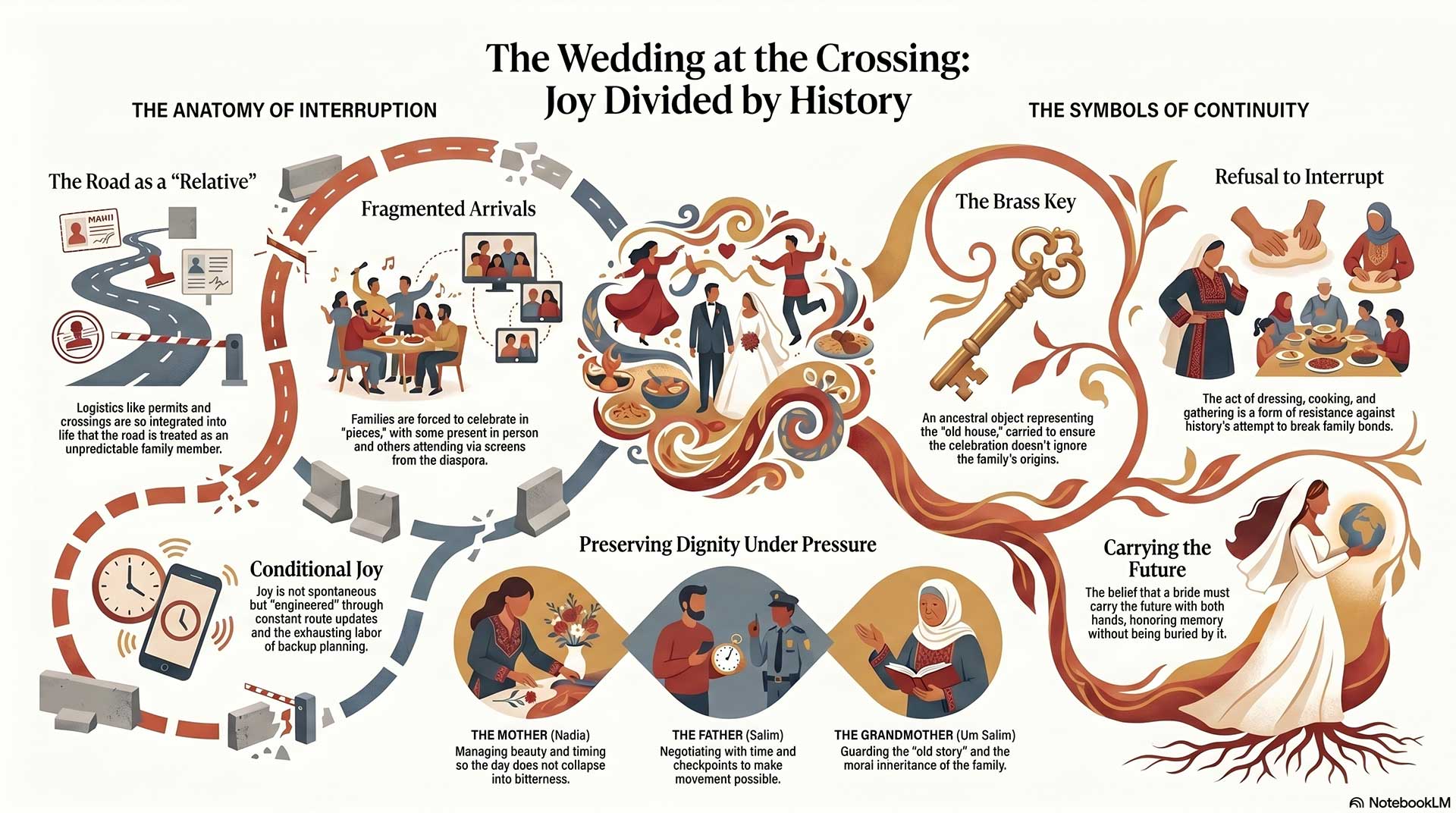
That is what I wanted The Wedding That Waited at the Crossing to leave behind. Not a single emotional climax, not a clean lesson, and not a simple image of either hope or despair. What remains is the feeling that one wedding day became a map of Palestinian life: memory, loss, roadblocks, family continuity, diaspora, anger, tenderness, beauty, and the painful labor of making one day hold together under conditions that were never built for wholeness.
This is one of the deepest truths in the story:
the family does not only suffer history. It organizes around it.
That matters.
The father organizes around roads.
The mother organizes around timing and dignity.
The grandmother organizes around memory.
The younger generation organizes around interruption so thoroughly that sarcasm becomes a form of realism.
The bride organizes around the impossible wish that this day might be allowed to belong to her fully.
And yet the story does not end in defeat.
That is important too.
The wedding is not free, not untouched, not simple, not complete in the way a wedding should be complete. But it still happens. That does not erase the wound. It reveals something else alongside it: a people can be repeatedly interrupted and still keep making the future appear in human form.
To me, Nadia is one of the deepest centers of this truth. She knows that joy is not self-executing. It needs food, cloth, chairs, order, timing, emotional force, and refusal. She does not speak like a political theorist. She speaks like a mother trying to protect one day from dissolving into the thousand other days that were broken before it. That is a profound form of dignity.
Salim matters because he shows what occupation does to fatherhood. He has become a man of permits, route changes, waiting times, and contingency plans. But that practicality is not emotional emptiness. It is a form of love under pressure. He is trying to keep the family moving inside a world built to make movement uncertain.
Um Salim matters because she keeps the old house alive without allowing it to become decorative. She reminds the family that memory is not a costume. It is a moral inheritance. Yet one of the most important turns in the whole story comes when she allows that the bride should carry the future with both hands. That moment matters because it protects memory without letting memory devour the living.
Mariam matters because she refuses the false choice between remembering and living. She does not want to betray the past, but she also does not want to become only a vessel for inherited sorrow. Her anger is one of the clearest truths in the story. She wants one wedding day that is simply a wedding day, and the fact that this desire feels almost radical reveals how damaged continuity has become.
Yousef matters because he protects the story from becoming too solemn in the wrong way. His humor is not lightness. It is a younger generation’s refusal to pretend absurdity is normal just because it is repetitive. Through him, the story remembers that anger and service often live side by side.
I think the final emotional truth of the story is this:
the deepest wound is not only what was taken once.
It is how often life is prevented from becoming fully continuous afterward.
That is what the wedding shows so clearly. Not only loss, but interruption as atmosphere. And still, the family gathers. Still, they cook. Still, they dress the bride. Still, they wait. Still, they bless. Still, they argue. Still, they insist on the future.
For me, that is where the story’s force lives.
Not in triumph.
Not in ruin.
But in the stubborn, wounded insistence that life is still allowed to become meaningful even under fragmentation.
That is what this wedding protected for one night.
Short Bios:
Um Salim
Um Salim is the grandmother of the family and the keeper of Nakba memory. She carries the old village, the lost house, and the inherited conviction that what was taken does not become unreal. She gives the family its deepest continuity.
Salim
Salim is the father, shaped by checkpoints, road systems, permits, occupation, and the daily labor of making family movement possible. His practicality is not surrender. It is care translated into logistics.
Nadia
Nadia is the mother and the emotional center of the story. She holds beauty, labor, dignity, and timing together so that the wedding does not collapse under interruption. She understands that joy also needs protection.
Mariam
Mariam is the bride and the story’s emotional hinge. She belongs to the generation trying to build a future without pretending history is gone. She wants not only symbolic survival, but ordinary human wholeness.
Yousef
Yousef is the younger brother, quick with humor, impatience, and hard truth. He belongs to the generation that has grown up with interruption so normalized that sarcasm becomes one of the few honest languages left.
Hassan
Hassan is the delayed relative whose journey turns the wedding into a map of Palestinian fragmentation. He carries exile, distance, and the ache of a family that remains loyal across separation but rarely arrives whole.
Nick Sasaki
Nick Sasaki is a writer and curator of emotionally serious historical fiction, imagined dialogues, and morally layered stories about war, memory, family, identity, and the long afterlife of public history inside private lives.
Leave a Reply