
|
Getting your Trinity Audio player ready...
|
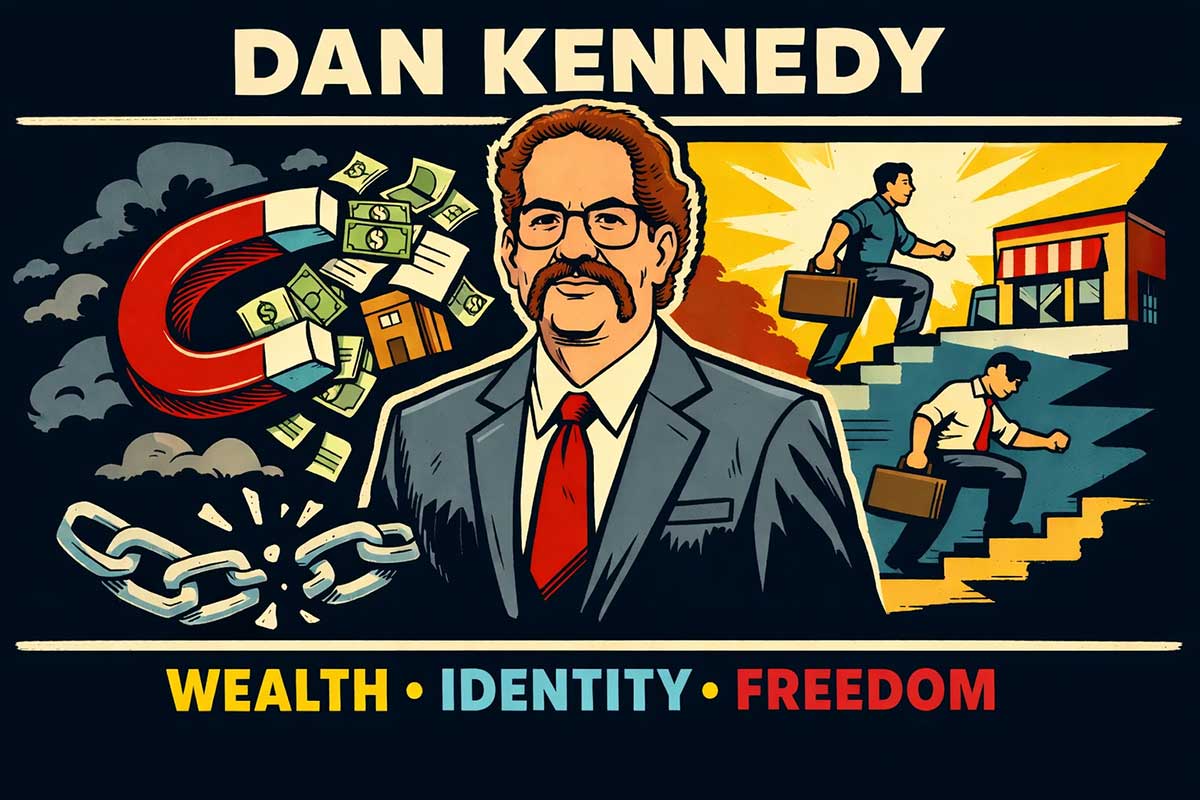
What if Dan S. Kennedy and top thinkers discussed why entrepreneurs secretly repel wealth?
Introduction Nick Sasaki
Welcome, everyone. Today’s conversation centers on a book that speaks with unusual bluntness: No B.S. Wealth Attraction for Entrepreneurs by Dan S. Kennedy. At first glance, the title may sound like a book about money mindset alone. But as we moved through these five topics, it became clear that the deeper issue is much tougher and much more personal. This is really a conversation about whether an entrepreneur can become the kind of person who is able to create wealth, hold wealth, and grow wealth without shrinking, drifting, or sabotaging the result.
We began with the hidden resistance many people carry toward money itself. A person may say they want success, freedom, and abundance, yet still feel guilt around wealth, suspicion toward rich people, fear of judgment, or discomfort with becoming more visible and more responsible. That inner split quietly shapes pricing, action, confidence, risk tolerance, and even the ability to receive opportunity when it arrives.
From there, we moved into the daily reality of “attraction.” The panel challenged the fantasy that wealth comes from wishing, hoping, or waiting for the universe to reward good intentions. Instead, the discussion pointed again and again to behavior, standards, identity, repetition, and self-respect. What kind of person are you becoming every day? What does your calendar reveal? What actions do you repeat when nobody is praising you?
Then we looked at one of the biggest practical distinctions in the whole discussion: the difference between income and wealth. Many entrepreneurs get good at earning but never build freedom. They create high-effort cash flow, yet own very little that can keep growing without them. That led us into equity, leverage, assets, systems, and the larger question of how a business can become a real store of value rather than a demanding job in disguise.
After that, the conversation got sharper. We confronted the tension between personal responsibility and excuse culture. Real obstacles exist. Pain is real. Setbacks are real. Yet there comes a point where explanation becomes a shield, and that shield can quietly tax the future. The panel pushed hard on that issue: when does self-compassion help recovery, and when does it become permission to remain unchanged?
In the final topic, we asked the question every serious entrepreneur wants answered: what actually creates a true wealth surge? The answers were not mystical. Better offers. Better buyers. Better use of time. Better pricing. Better follow-up. Better discipline. Better stewardship of what comes in. The recurring message was simple: wealth grows when a person becomes more exact, more honest, more useful, more disciplined, and more capable of owning rather than merely earning.
So this conversation is not just about money. It is about self-command. It is about whether ambition is matched by character, whether effort is matched by structure, and whether success is being converted into freedom. With that, let’s move into the final reflections.
(Note: This is an imaginary conversation, a creative exploration of an idea, and not a real speech or event.)
Topic 1 — Why many entrepreneurs secretly repel wealth
Opening
Nick Sasaki:
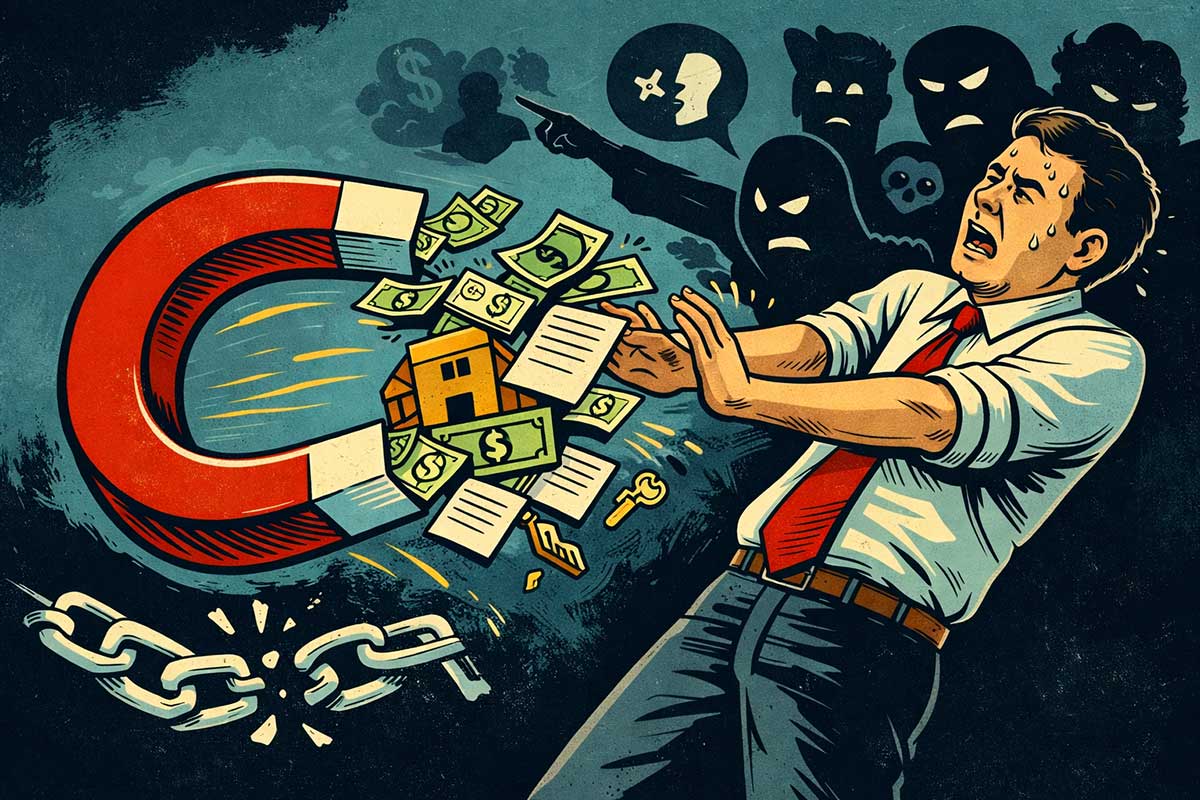
Welcome to Topic 1. This one goes straight to the hidden wall inside many entrepreneurs. A lot of people say they want wealth, freedom, scale, and success. Yet when money starts coming closer, something strange happens. They hesitate. They undercharge. They hide. They delay the offer. They stay too small. They make themselves busy instead of profitable. So today I want to ask a hard question: do many entrepreneurs fail to attract wealth because of bad tactics, or because some part of them still feels unsafe becoming rich?
Dan S. Kennedy:
Most people never face that question honestly. They talk about market conditions, lack of time, lack of capital, bad luck, bad timing, bad platforms, bad clients. Fine. Some of that is real. But a lot of entrepreneurs are doing something much more destructive. They are rejecting wealth emotionally while claiming to pursue it intellectually. That conflict wrecks everything. If your conscious mind says, “I want money,” but your deeper conditioning says, “Rich people are selfish, greedy, arrogant, corrupt, or hated,” then you will sabotage yourself before you ever break through.
T. Harv Eker:
Yes. People carry a money blueprint, and that blueprint often gets built in childhood. They may have heard things like “money changes people,” “rich people are crooks,” “we’re not the kind of family that gets wealthy,” or “wanting too much is selfish.” So later they become adults who work hard, read good books, and set big goals, but the old script is still running underneath. They want wealth and fear it at the same time.
Gay Hendricks:
I’d say many people hit what I call an upper limit. Life starts getting better, income rises, opportunities expand, and then the person feels inner tension. They may not call it fear. They may call it stress, confusion, exhaustion, distraction, or bad timing. But the real issue is that they are leaving the zone where they feel familiar. Wealth asks them to receive more, hold more, and become more visible. That is deeply uncomfortable for many people.
Napoleon Hill:
Desire alone is never enough. Desire must be joined with faith, self-possession, and a mind that can hold the image of success without contradiction. A divided mind cannot produce a whole result. A man may speak of riches all day long and still be inwardly loyal to poverty through fear, guilt, and inherited opinion.
Thomas J. Stanley:
And most people misunderstand wealth from the beginning. They picture status, luxury, applause, and outward display. Real wealth is often quieter than that. It is restraint. It is control. It is margin. It is assets. It is not noise. So some entrepreneurs repel wealth because they confuse wealth with a caricature they dislike. They reject the stereotype and accidentally reject the reality too.
Question 1 — Why do so many hardworking entrepreneurs still feel uneasy about becoming truly wealthy?
Nick Sasaki:
Let’s start there. Why do hardworking entrepreneurs still feel uneasy about becoming truly wealthy?
Dan S. Kennedy:
Because wealth is not just more money. Wealth is a change in identity. It changes your choices, your associations, your standards, your obligations, your visibility, and often your relationships. Some people can tolerate hard work more easily than they can tolerate power. Hard work feels moral. Wealth feels exposed. Once you become wealthy, you lose many excuses. You can no longer tell yourself that you are noble because you are struggling. Now you must manage, decide, invest, protect, say no, and live with the consequences of larger choices. Many people are far less comfortable with that than they admit.
T. Harv Eker:
I agree. A lot of people have a hidden loyalty to the emotional world they came from. If their parents struggled, if their family lived with financial tension, if sacrifice was treated as goodness, then becoming wealthy can feel like betrayal. Not betrayal in logic, but in emotion. Their nervous system says, “If I go too far, I leave my tribe.” So they stay near familiar pain.
Gay Hendricks:
There is also the issue of receiving. Many entrepreneurs are better at effort than at receiving results. They know how to grind. They know how to chase. They know how to prove themselves. But they do not know how to let in expansion without guilt. So when a bigger result comes, they tighten up. They create problems. They pick fights. They miss deadlines. They get sick. They unconsciously restore themselves to the level they can emotionally tolerate.
Napoleon Hill:
Fear of criticism is a mighty force here. A person imagines what others will say if he succeeds too greatly. Old friends may resent him. Family may judge him. Competitors may mock him. Society often praises ambition in speech, yet resents it in practice. Weak minds bend under that pressure.
Thomas J. Stanley:
And many people secretly think wealth means becoming socially obnoxious. They have seen too many flashy examples. So they conclude, “I do not want to become one of those people.” But that is a false choice. Real wealth, in many cases, looks like quiet freedom, paid-off obligations, patient investing, a stable business, and lower drama. You do not have to become cartoonishly rich in personality to become financially strong in reality.
Dan S. Kennedy:
That’s right. The entrepreneur must stop confusing wealth with performance. Wealth is not a costume. It is not a leased car, a louder voice, or a bigger social media identity. Wealth is stored choice. Once you understand that, much of the moral confusion starts falling apart.
Question 2 — What inner beliefs make a person sabotage income right after a breakthrough?
Nick Sasaki:
Now let’s go one level deeper. What inner beliefs cause people to sabotage income right after things start going well?
Gay Hendricks:
One common belief is: “I can only feel safe when things are familiar.” Breakthroughs are unfamiliar. More income can mean more responsibility, more attention, more expectation, more change. So the person creates a problem that returns them to the emotional climate they know how to handle. Another belief is: “I am fundamentally flawed, so I cannot hold a great life for long.” That belief creates self-punishment.
T. Harv Eker:
I’d list a few common ones. “Rich people are greedy.” “Making more money means becoming less spiritual.” “If I succeed too much, people will use me.” “If I charge more, I’m taking advantage.” “I have to work twice as hard as everyone else to deserve the same reward.” “If money comes too easily, something must be wrong.” These beliefs crush receiving and distort behavior.
Dan S. Kennedy:
And then there’s the entrepreneur’s favorite excuse: complexity. They overcomplicate what should be simple. Why? Because simplicity creates exposure. If the path is clear and they still fail to act, then they must face themselves. So they build elaborate systems, endless planning cycles, brand revisions, funnel revisions, research loops, and learning loops. All of it can serve one dark purpose: avoiding the direct act that gets paid.
Napoleon Hill:
Indecision is another symptom. The person stands at the edge of action and retreats into delay. Delay gives temporary relief, but it feeds fear. Fear then appears justified, and the man mistakes the effect for the cause. The disease deepens.
Thomas J. Stanley:
I’d add lifestyle inflation in a psychological sense. Some people sabotage income by spending emotionally the moment they earn more. They do not yet see themselves as stewards of capital. So the breakthrough becomes consumption, not wealth. They feel richer for a moment, but become no stronger. The money came in, but no durable structure was built.
Dan S. Kennedy:
Exactly. The breakthrough must be converted. Into assets, reserves, capability, control, systems, better clients, better offers, better positioning. If your first instinct is relief spending, vanity spending, or reward spending, you are still treating money like an event, not a tool.
Gay Hendricks:
There is a subtle form of sabotage too: conflict creation. Somebody starts doing well, then suddenly they get entangled in unnecessary drama. Team problems, personal chaos, distractions, resentment, emotional storms. Those things can become a way to prove, “See? I was never meant to rise that high.”
T. Harv Eker:
Yes, and that is why changing outer strategy without changing inner coding often fails. The person learns what to do, but still cannot hold the outcome.
Question 3 — Is wealth mainly a strategy problem, or is it first a permission problem?
Nick Sasaki:
So which comes first? Is wealth mainly about strategy, or is it first about permission?
Dan S. Kennedy:
First permission, then strategy, then execution. A person who has not given themselves permission to become wealthy will misuse or avoid strategy. They will sit in seminars, buy programs, fill notebooks, ask clever questions, and still remain financially unchanged. Why? Because they are looking for a tactic that will bypass an identity issue. It won’t. First they must decide that wealth is appropriate, desirable, and their responsibility to pursue.
Napoleon Hill:
The inner state precedes the outer result. Thought mixed with emotion becomes force. A man who inwardly rejects his own stated aim cannot sustain organized effort toward it. Permission is the opening of the gate.
T. Harv Eker:
Yes. Permission is the first inner move. It says: “I am allowed to be wealthy. I am allowed to receive. I am allowed to outgrow old limits. I am allowed to have money without apology.” Once that starts changing, strategy begins to work differently. You stop twisting every offer with shame. You stop shrinking your prices. You stop hesitating at the point of asking.
Thomas J. Stanley:
But after permission, people need realism. We should not turn this into pure psychology. Plenty of people give themselves permission and still behave foolishly. They overspend, chase status, neglect saving, avoid investing, or build weak businesses. So yes, permission comes first, but wealth still demands adult habits.
Gay Hendricks:
I’d put it this way: permission opens the door, but capacity keeps you in the room. You must build the emotional and behavioral capacity to live at a higher level without creating suffering to escape it.
Dan S. Kennedy:
That’s well said. Entrepreneurs love romance. They want one insight, one idea, one mentor, one ad, one launch, one deal to fix everything. But wealth is a relationship. It asks, “Can I trust you? Will you manage me well? Will you grow me? Will you protect me? Or will you turn me into chaos?” Many people want wealth to arrive before they become the type who can carry it.
Nick Sasaki:
So permission is the first gate, but then standards, behavior, stewardship, and capacity must follow.
Dan S. Kennedy:
Exactly. Wealth is attracted to clarity, confidence, value, decisiveness, and self-command. It is repelled by guilt, confusion, apology, drift, and self-betrayal.
Closing
Nick Sasaki:
This first topic exposed something uncomfortable but important: many entrepreneurs are not poor in ambition. They are divided in identity. One part wants wealth. Another part fears what wealth means. That split shows up in prices, offers, visibility, discipline, spending, and the strange habit of stepping back right when life starts opening.
Thomas J. Stanley:
And it helps to clean up the picture of wealth itself. Wealth does not have to mean vanity. It can mean freedom, margin, patience, and fewer forced choices.
Napoleon Hill:
The inner image must be made consistent with the outer aim. No person can travel far with a divided allegiance.
Gay Hendricks:
And no breakthrough lasts unless the person learns to receive more good without creating pain to balance it out.
T. Harv Eker:
That means rewriting the money blueprint, spotting inherited beliefs, and giving yourself full permission to grow.
Dan S. Kennedy:
Yes. Stop saying you want wealth if you are still morally suspicious of it, emotionally afraid of it, or behaviorally unprepared for it. Clean that up first. Then your tactics start working with far less friction.
Nick Sasaki:
That sets up Topic 2 perfectly: if attraction is real, what does it actually look like in daily behavior, standards, and identity?
Topic 2 — Attraction is not magic: it is behavior, standards, and identity

Opening
Nick Sasaki:
In Topic 1, we looked at the hidden beliefs that make entrepreneurs pull away from wealth. Now I want to move into something more concrete. A lot of people hear the phrase “wealth attraction” and think of positive thinking, vision boards, or hoping money shows up. But serious entrepreneurs know that cannot be the whole story. So today I want to ask: if wealth attraction is real, what does it actually look like in everyday life? What habits, standards, and identity shifts make a person more financially magnetic?
Dan S. Kennedy:
The first thing to clean up is fantasy. Money does not move toward wishful people. It moves toward people who become useful, visible, persuasive, disciplined, and dependable. If you want wealth, you must stop acting like attraction is mystical. Attraction is practical. The market is attracted to value, confidence, clarity, trustworthiness, and results. If your life is disorganized, your offers are weak, your follow-up is sloppy, and your standards are low, then you are not attracting wealth. You are repelling it.
James Clear:
That is where habits matter. People talk about big financial outcomes, but those outcomes usually sit on top of repeated actions. Identity shapes habits, and habits reinforce identity. So a person who says, “I want wealth,” but lives daily as someone careless, reactive, and inconsistent is strengthening the wrong identity. The real question is not just what you want, but what type of person your daily actions prove you are becoming.
Brendon Burchard:
Standards are huge here. People do not drift into wealth. They rise or fall to the standards they tolerate in their focus, energy, execution, and relationships. A lot of struggling entrepreneurs are not short on dreams. They are short on disciplined self-management. They let distraction, doubt, scattered priorities, and emotional fatigue run the day. That creates a weak signal in the marketplace.
BJ Fogg:
And people often fail because they make behavior change too dramatic. They think identity shifts have to begin with giant acts. Usually they begin with small, repeatable actions that are easy enough to sustain. A person becomes more financially effective by making better behaviors simpler and more automatic. If the actions that support wealth are too hard to start, they won’t last.
Robin Sharma:
A wealthy life is built from self-respect in motion. How you begin the morning, how you protect your attention, how you speak to people, how you finish what you start, how you carry yourself when nobody is watching — these things shape destiny more than bursts of motivation. Fortune often follows the person who has already become inwardly ordered.
Question 1 — What does “wealth attraction” really mean for a serious entrepreneur?
Nick Sasaki:
Let’s begin with the foundation. What does “wealth attraction” really mean for a serious entrepreneur?
Dan S. Kennedy:
It means becoming the kind of person and business the marketplace wants to reward. That includes solving painful problems, communicating value clearly, asking for money without apology, following up relentlessly, and making yourself hard to ignore. Attraction is not about waiting. It is about putting the right signals into the world. Good offers attract buyers. Good marketing attracts attention. Good discipline attracts opportunity. Good stewardship attracts more capital. All of that is concrete.
James Clear:
I’d say attraction is what happens when identity and action line up. A person who sees themselves as a professional operator behaves differently from someone who is still mentally dabbling. They prepare more carefully, they recover faster, they track performance, and they repeat what works. Those behaviors compound. Over time, other people start trusting them more, recommending them more, buying from them more. It can look like attraction from the outside, but it is really consistent identity expressed through behavior.
Brendon Burchard:
For me, wealth attraction means generating a certain level of presence and performance. When you show up with clarity, energy, confidence, and service, people feel it. They trust you more. They listen more. They engage more. A lot of entrepreneurs underperform because they show up in a half-committed state. Their body is there, but their conviction is weak. That is not attractive in business.
BJ Fogg:
I’d reduce it to systems of repeated success. If your workflows help you publish consistently, follow up consistently, make offers consistently, and improve consistently, you become more effective without needing heroic willpower every day. Good systems make strong behavior easier. That is a practical version of attraction.
Robin Sharma:
And there is a moral side to it. Wealth often moves toward people who treat their craft with reverence. Not perfection, but reverence. They respect the day. They respect the customer. They respect their word. They are not chaotic with their gifts. That kind of inward order has outward consequences.
Dan S. Kennedy:
Yes. The marketplace can sense chaos. It can sense vagueness. It can sense hesitation. It can also sense confidence, specificity, and authority. If you want to attract more money, become more exact, more useful, more deliberate, and more visible.
Question 2 — Which daily behaviors make a person more financially magnetic?
Nick Sasaki:
Let’s get very practical. Which daily behaviors actually make a person more financially magnetic?
James Clear:
One is repetition of the highest-value actions. Many people fill their day with activity but avoid the few actions that produce results. So I would look at daily writing, selling, outreach, follow-up, offer refinement, and reviewing performance. Those small repeated actions build evidence. That evidence then strengthens identity. The person starts trusting themselves because their behavior is no longer random.
Dan S. Kennedy:
I’d put direct response behavior near the top. Make offers. Track responses. Test messaging. Follow up. Improve conversion. Stay close to what gets paid. Too many entrepreneurs live in abstraction. They stay busy with design, planning, meetings, and opinions. Fine. But where is the money-making behavior? The entrepreneur who does something revenue-producing every day is operating on a different level from the one who mostly rearranges things.
Brendon Burchard:
Protecting focus is huge. Many people cannot attract wealth because their attention is shattered. They wake up reactive, stay reactive, and go to sleep depleted. A serious entrepreneur needs blocks of focused output, intentional transitions, and strong energy habits. You cannot build a premium business from a fragmented mind.
BJ Fogg:
I would make the behaviors as easy to start as possible. For example: one outreach before checking social media, one follow-up before lunch, one metric review at the end of the workday, one short planning ritual for tomorrow. Tiny actions done consistently can reshape a whole business. People often fail because they treat discipline like an emotional event instead of a design problem.
Robin Sharma:
I’d include private excellence. Read daily. Think daily. Reflect daily. Guard your mornings. Guard your standards. Finish what you begin. Speak with care. Keep promises to yourself. External wealth is helped by internal dignity. When a person keeps self-betrayal low, their presence grows stronger.
Dan S. Kennedy:
And let’s not leave pricing out of this. One daily wealth behavior is refusing to think and speak like a discount person. If you continually apologize for your price, weaken your offer, or attract bargain hunters, you are training your business to stay thin. Financial magnetism includes the courage to ask for proper value.
James Clear:
That fits identity perfectly. Every repeated underpricing decision is a vote for a smaller self-concept. Every repeated act of clarity and proper valuation is a vote for a stronger one.
Brendon Burchard:
Yes. Wealth grows faster when your behavior says, “I respect what I bring, and I am prepared to serve at a high level.”
Question 3 — Why do some people learn money ideas for years and still never change their financial reality?
Nick Sasaki:
This may be the hardest question in the topic. Why do some people study money and business for years, yet their financial life barely changes?
Dan S. Kennedy:
Because learning is often used as a hiding place. Information can become a socially acceptable form of avoidance. The person feels productive because they are reading, watching, organizing, and discussing. But they are not confronting the marketplace. They are not asking for the sale. They are not testing. They are not risking rejection. They are not doing the uncomfortable things that force growth.
James Clear:
I’d say they confuse knowledge with embodiment. Knowing a principle is not the same as installing it in daily life. Reading about discipline does not mean you are disciplined. Reading about wealth does not mean your calendar, habits, or environment support wealth. Real change shows up in systems, not inspiration.
BJ Fogg:
Many people also fail at the design level. They rely on motivation that comes and goes. They do not redesign their environment to make the right actions easier. If the useful behavior is always harder than the distracting behavior, the old pattern will keep winning. Good intentions lose to bad design every day.
Brendon Burchard:
There is also fear of full commitment. Once you really commit, you can no longer hide behind potential. You must live in measurement. You must face whether the message works, whether the offer works, whether you are leading well, whether people trust you. Many people prefer the emotional safety of “someday I could” over the exposure of “today I am fully in.”
Robin Sharma:
And many have weak reverence for their own life. They treat their goals casually. They let their days leak away. They speak grandly, but live loosely. A great financial life asks for seriousness. Not heaviness, but seriousness. It asks a person to honor the day as if it matters, because it does.
Dan S. Kennedy:
Right. The market pays for implementation. It rewards tested offers, disciplined communication, valuable positioning, and steady action. It does not hand out money for being interested. A lot of entrepreneurs are amateurs with expensive vocabularies. That sounds harsh, but it is true.
James Clear:
The encouraging part is that change often begins smaller than people think. A person does not need to transform everything at once. They need a few repeated actions tied to a stronger identity.
BJ Fogg:
Yes. Make the good actions easier. Shrink them until they happen. Celebrate progress. Build from there. Financial change often starts with reliable motion, not dramatic reinvention.
Brendon Burchard:
Then momentum grows. Confidence grows. Standards rise. The person begins to trust themselves. That changes what they attempt and what they can hold.
Closing
Nick Sasaki:
This topic helped clear away a big misunderstanding. Wealth attraction is not passive. It is not about hoping hard enough. It is about becoming someone whose behavior, standards, and identity make trust, value, and opportunity more likely.
Robin Sharma:
The outer result often follows inner order.
BJ Fogg:
And inner order becomes much easier when the right actions are small enough and simple enough to repeat.
Brendon Burchard:
Then those repeated actions build energy, self-respect, and real performance.
James Clear:
And each repeated action becomes a vote for the identity that can create and keep wealth.
Dan S. Kennedy:
Exactly. Stop romanticizing attraction. Build offers. Make decisions. Follow up. Improve your message. Raise your standards. Protect your time. Charge properly. Behave like a serious entrepreneur, and money starts finding more reasons to come your way.
Nick Sasaki:
That leads naturally into Topic 3: if hard work creates income, what creates actual freedom — and why is equity so different from cash flow?
Topic 3 — Income is fragile, equity is freedom
Opening
Nick Sasaki:
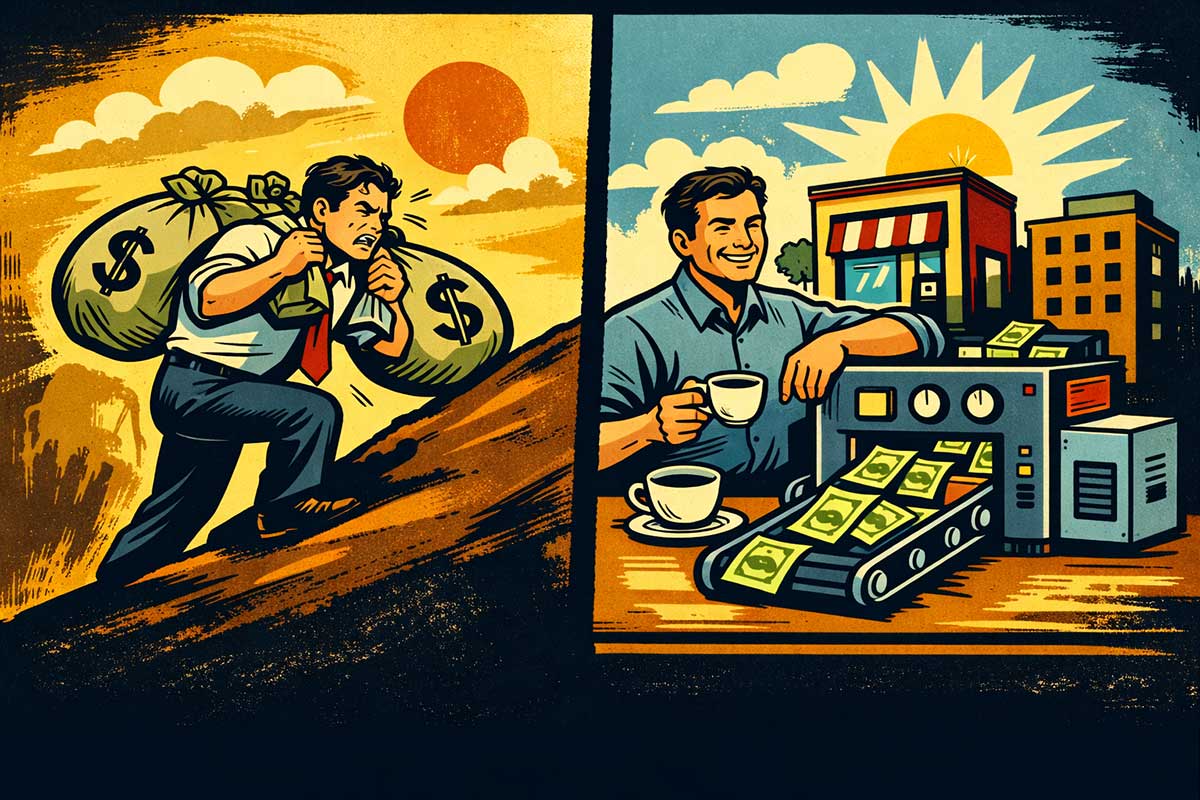
In the first two topics, we looked at inner resistance, behavior, standards, and identity. Now I want to move into the part that may change an entrepreneur’s life most in practical terms. Many people get better at making money, yet still do not become free. They earn, spend, repeat, and stay dependent on the next month, the next client, the next launch, the next burst of effort. So today I want to ask a deeper question: what is the real difference between income and wealth, and why do so many entrepreneurs work hard for years without building anything that can carry them?
Dan S. Kennedy:
Because they confuse cash flow with wealth. Cash flow matters, of course. You need it. But cash flow alone can still leave you trapped. If the machine stops when you stop, you are not wealthy. You may be talented, productive, and well-paid, but you are still carrying the whole load on your back. Wealth starts showing up when income gets converted into assets, equity, control, and durable value. Many entrepreneurs never make that shift. They keep milking effort instead of building ownership.
Naval Ravikant:
That is the key distinction. Income is usually tied to labor, time, or direct performance. Equity is ownership in something that can grow beyond your immediate input. A salary, a fee, or a project payment can be useful, but ownership gives you leverage. The person who owns a piece of the upside lives in a different reality from the person who only gets paid for participation.
Robert Kiyosaki:
A lot of people think they are doing well because money is coming in, but they do not stop and ask the right question: is this money building an asset, or is it just funding a lifestyle? That question changes everything. If income goes straight into consumption, then the person may look successful and still be financially weak. Wealth comes from acquiring and growing assets that put money back in your pocket over time.
Codie Sanchez:
Yes, and many entrepreneurs miss simple ownership paths right in front of them. They think wealth has to come from some huge flashy company, a giant exit, or a glamorous startup story. But ownership can be very unsexy. A boring small business, a strong cash-flowing asset, a company with loyal customers and clean operations — these can create real wealth. The problem is that many people stay addicted to hustle because it feels active and exciting, whereas ownership asks for patience, structure, and a longer horizon.
Warren Buffett:
The essence is simple. If you consume what you earn, you remain dependent. If you invest in productive assets, those assets can begin carrying part of the burden. Then the compounding begins. It may start slowly, but its character is entirely different from earned income. One requires repeated exertion. The other, if chosen well, grows in value and produces returns over time.
Question 1 — What is the difference between making money and building wealth?
Nick Sasaki:
Let’s begin at the center. What is the real difference between making money and building wealth?
Dan S. Kennedy:
Making money is an activity. Building wealth is a system. Making money can happen in bursts. Building wealth requires intention about what happens after the money arrives. The entrepreneur who gets paid and then just lives better has improved lifestyle, not wealth. The entrepreneur who gets paid and then converts part of that into assets, reserves, better business infrastructure, recurring revenue, intellectual property, or equity starts building strength.
Naval Ravikant:
Making money can be linear. You do work, you get paid. Building wealth becomes non-linear when ownership enters the picture. If you own a business, software, media, investments, or other assets with leverage, then your upside can expand without matching your effort hour for hour. That is where freedom starts. Freedom rarely comes from getting slightly more efficient at selling your time.
Robert Kiyosaki:
Yes. Many people are chasing income and calling it wealth. They are proud of revenue, proud of gross numbers, proud of sales months, proud of visible success. But wealth is what you own. Wealth is the base beneath the performance. If you stopped working for six months, what would still keep producing? That answer tells you far more than your latest income statement.
Warren Buffett:
Building wealth usually includes a habit of deferred gratification. You choose not to consume everything now. You let capital accumulate and then place it into assets that can compound. This is emotionally difficult for many people because spending creates immediate pleasure, yet compounding asks for patience. Many people understand compounding mathematically and still fail to live by it behaviorally.
Codie Sanchez:
And there is a business version of that. Entrepreneurs often pull too much out of the business too early. They want the reward now. New house, bigger car, status upgrades, lifestyle signals. Meanwhile the business still needs stronger systems, stronger people, stronger customer retention, and more durable cash flow. Sometimes wealth means leaving money inside the machine long enough for it to become stronger than you.
Dan S. Kennedy:
Exactly. The entrepreneur must stop treating every gain as permission to celebrate through spending. Some gains should be celebrated through strengthening the asset. Better list. Better marketing. Better team. Better process. Better client quality. Better ownership position. Better reserves. Those are far less glamorous in the moment, but they make future freedom more real.
Question 2 — Why do entrepreneurs get trapped in high-effort cash flow with nothing durable to show for it?
Nick Sasaki:
Why do so many entrepreneurs get stuck in high-effort cash flow? They work hard, money comes in, yet after years there is little durability beneath it.
Codie Sanchez:
A big reason is that they build themselves into the center of everything. The clients want them. The sales depend on them. The delivery depends on them. The relationships depend on them. The decisions depend on them. So the business is really a demanding job wearing a business costume. That can pay well, but it does not scale cleanly, and it does not create much transferable value.
Dan S. Kennedy:
That is very common. Entrepreneurs often build for control or ego instead of build for value. They want to be needed everywhere. They enjoy being the hero. They like being the rainmaker, the closer, the genius, the indispensable figure. Fine. But do not confuse indispensability with wealth. Very often it is a prison.
Naval Ravikant:
Another reason is low-leverage thinking. People stay inside work that is one-to-one, time-bound, and hard to multiply. They never ask: what can I build once and use many times? What can I own? What can I automate? What can I delegate? What can I package? What can I distribute at scale? That is where leverage begins entering the picture.
Robert Kiyosaki:
And many do not learn financial literacy. They know sales, product, or service delivery, but not balance sheets, assets, liabilities, tax efficiency, or capital allocation. So money passes through their hands without being organized intelligently. A person can be very smart in one area and dangerously weak in another.
Warren Buffett:
Temperament matters too. Many people do not like the slow early stage of durable wealth building. They want dramatic visible gains. So they keep cycling through effort and reward instead of committing to the quieter process of compounding. In the beginning, compounding can look unimpressive. That discourages the impatient.
Dan S. Kennedy:
And there is one more issue: entrepreneurs often confuse revenue growth with business quality. More revenue is nice, but what is the margin? What is the predictability? What is the client concentration risk? What is the dependence on the founder? What is the recurring component? What is the transferability? If you cannot answer those questions well, then you may have motion without value.
Codie Sanchez:
Yes. Plenty of businesses are loud but fragile. A real asset is one another owner would want. If the whole thing collapses without you, or if it is messy, personality-dependent, and chaotic, then it is hard to sell, hard to scale, and hard to call wealth.
Question 3 — What kinds of assets, systems, or business structures turn work into lasting wealth?
Nick Sasaki:
Now let’s move to solutions. What kinds of assets, systems, or business structures start turning work into lasting wealth?
Naval Ravikant:
Anything with ownership and leverage deserves attention. Equity in a business, software, media, intellectual property, brand assets, networks, financial investments, real estate, and scalable digital products can all serve this purpose. The common thread is that the value can grow beyond the immediate hour of labor. That is what matters.
Dan S. Kennedy:
For entrepreneurs, I’d start with the business itself. Can you make it more valuable as an asset? Can you create recurring revenue? Can you build a strong customer list? Can you improve retention? Can you document processes? Can you create intellectual property? Can you improve positioning so the business earns more from better clients? Can you reduce founder dependence? Those moves increase equity value.
Codie Sanchez:
I’d make the case for small business ownership too. People overlook simple businesses with reliable cash flow. Service companies, local businesses, overlooked niche operators, practical businesses that are not glamorous — those can be wonderful wealth vehicles if bought well and operated well. You do not always need the next huge idea. Sometimes you need one asset with real economics and clean operations.
Robert Kiyosaki:
Cash-flowing assets matter. The entrepreneur should get serious about asking: what puts money into my pocket whether I am there or not? The answer may be a business, a rental property, a dividend-producing investment, a license, or a royalty stream. The form can vary. The principle stays the same.
Warren Buffett:
I would add that quality matters more than excitement. A mediocre asset bought from impatience can create trouble for years. A strong asset, understood well and held with patience, can be life-changing. The discipline to choose carefully is part of wealth building.
Dan S. Kennedy:
And systems are a hidden asset too. Good systems make revenue more predictable and the business less exhausting. A strong sales process, strong follow-up, strong marketing engine, clear metrics, good documentation, and disciplined delegation all increase value. People talk about assets as if they are only external things. A better business operating system is itself part of the asset.
Naval Ravikant:
This is where specific knowledge matters. Build in areas where you have insight, judgment, and an edge. Ownership works best when it sits on top of real competence.
Codie Sanchez:
Yes. Do not buy or build from fantasy. Buy or build from clarity. Understand the economics. Understand the risks. Understand where value can be improved. Then let patience do its work.
Closing
Nick Sasaki:
This topic may be one of the biggest turning points in the whole conversation. Income can feel powerful, but it is often fragile. Equity can feel slower, but it changes the structure of a life.
Robert Kiyosaki:
Income pays bills. Assets build freedom.
Warren Buffett:
And freedom grows when capital is allowed to compound rather than being consumed too early.
Codie Sanchez:
Entrepreneurs need to ask whether they are building a real asset or just creating a tiring job for themselves.
Naval Ravikant:
Ownership and leverage are the bridge from effort to freedom.
Dan S. Kennedy:
Exactly. Hard work matters, but hard work alone is overrated. If your income dies the moment your effort stops, then you still have more building to do. Wealth begins when what you own starts carrying more of your future than what you personally grind out every day.
Nick Sasaki:
That brings us to Topic 4: if wealth demands ownership, discipline, and self-command, then what role does personal responsibility play — and how much of entrepreneurial failure comes from excuse culture rather than strategy?
Topic 4 — Personal responsibility versus excuse culture

Opening
Nick Sasaki:
In the last topic, we talked about the difference between cash flow and lasting wealth. Now we come to a harder and more uncomfortable subject. Many entrepreneurs know a lot. They read, plan, watch, study, compare, and talk. Yet their business remains weak, their finances stay unstable, and their momentum keeps collapsing. At some point, the question is no longer, “Do they need more information?” It becomes, “Are they refusing responsibility?” So today I want to explore the line between real obstacles and excuse culture. When does explanation become avoidance?
Dan S. Kennedy:
That line gets crossed very quickly. Entrepreneurs love reasons. The economy. The algorithm. the niche. The customers. The ad costs. The competition. Their team. Their childhood. Their burnout. Their lack of support. Some of these are real factors. But most people use real factors as hiding places. Responsibility means starting with the brutal question: “Given reality as it is, what am I still responsible for?” The unwillingness to live inside that question keeps many people poor.
Jocko Willink:
Ownership is the beginning. Not partial ownership. Full ownership. You may not be at fault for every condition, but you are still responsible for your response, your standards, your preparation, your discipline, and your decisions. The person who waits for ideal conditions stays weak. The person who takes ownership becomes dangerous in a good way, because excuses stop controlling them.
David Goggins:
A lot of people are way too soft with themselves. They want growth, but they protect comfort. They want money, but they do not want to confront their laziness, inconsistency, fear, or weakness. So they build stories. Fancy stories. Intelligent stories. Emotional stories. But a story can still be a hiding place. The truth is simple: many people are underperforming because they are lying to themselves every day.
Jim Rohn:
Responsibility is not punishment. It is power. The day a person accepts, “My life is largely shaped by what I do with what I have,” that person becomes teachable again. As long as blame dominates the mind, progress stays small. A blaming mind is a powerless mind.
Jordan Peterson:
And excuse culture has moral consequences. A person can become attached to innocence. They would rather appear misunderstood than face their own disorder. They defend self-image by externalizing failure. That gives short-term relief, but it weakens character. A person becomes less able to act, less able to endure, and less able to transform chaos into order.
Question 1 — What excuses sound intelligent but keep entrepreneurs broke?
Nick Sasaki:
Let’s start with that. What excuses sound reasonable, maybe even intelligent, yet keep entrepreneurs broke or stuck?
Dan S. Kennedy:
One of the most common is, “I’m still learning.” Learning is useful. Endless preparation is not. At some point, “I’m still learning” means, “I’m avoiding the marketplace.” Another one is, “I just need more clarity.” Usually that means they want emotional certainty before acting. But clarity often comes after action, not before it. Another favorite is, “I don’t want to be pushy.” That often translates to fear of selling, fear of asking, fear of hearing no.
Jocko Willink:
A big one is, “I don’t have enough time.” Usually the real problem is poor prioritization. People make time for what matters by cutting what does not. Another is, “My team is the problem.” Maybe the team has issues. Fine. But who hired them? Who trained them? Who tolerated weak standards? Ownership starts at the top.
David Goggins:
I hear people say, “I’m overwhelmed.” Sometimes that’s true. A lot of the time it means they lack toughness and structure. They let too much noise into their head, then they use that feeling as permission to do nothing. Another excuse is, “I’m waiting for the right moment.” No, you’re scared. Just say you’re scared. At least then you’re telling the truth.
Jim Rohn:
Another polished excuse is, “I’m a perfectionist.” Perfectionism often looks respectable from the outside, but in practice it can be procrastination wearing a nice suit. The person delays action, delays completion, delays exposure, delays judgment. They protect pride by postponing the test.
Jordan Peterson:
Then there is the appeal to wounded history. A person says, “You do not understand what I have been through.” That may be true. Their suffering may be real. Yet suffering does not remove the necessity of responsibility. In some cases, it increases it. If life has injured you, then your refusal to take responsibility compounds the injury. It does not heal it.
Dan S. Kennedy:
And let’s add this one: “I need a better strategy.” Maybe. But many people do not have a strategy problem. They have a compliance problem. They do not execute the strategy they already have. They do not publish consistently. They do not follow up. They do not ask for the sale. They do not track the numbers. They want a more exciting plan because they are bored by the basic work that actually pays.
Question 2 — How does radical self-responsibility change decision-making?
Nick Sasaki:
What changes when a person really adopts radical self-responsibility? How does it reshape decisions?
Jocko Willink:
Decision-making gets cleaner. Faster. Less emotional. When you own everything you can own, you stop spending energy on blame and start spending it on solutions. You ask, “What can I do right now to improve this?” That question creates movement. Ownership creates movement. Blame creates stagnation.
Dan S. Kennedy:
It also eliminates self-pity as a business model. Many entrepreneurs are running a private emotional economy built on being misunderstood, unlucky, or unfairly burdened. Responsibility ends that. It forces a person to think in terms of leverage, options, priorities, and consequences. It turns complaint into calculation.
Jim Rohn:
Yes. A responsible person starts measuring life differently. They no longer ask, “Whose fault is this?” first. They ask, “What is mine to do?” That one shift changes finances, health, relationships, and work. You start building rather than explaining.
Jordan Peterson:
It also transforms the person’s relationship to chaos. Instead of seeing difficulty as proof that life is against them, they begin seeing difficulty as material to be worked on. That is psychologically stabilizing. The person regains agency. That is a great antidote to resentment.
David Goggins:
It makes you harder in the right way. You stop negotiating with weakness. You stop needing a perfect mood. You stop asking whether you feel like it. You do the work anyway. That changes everything. Most people wait for motivation. Responsible people build identity through action.
Dan S. Kennedy:
And the entrepreneur who embraces responsibility becomes much easier to help. Advice works better on them. Coaching works better on them. Strategy works better on them. Why? Because they are not filtering everything through an excuse machine. They take a principle, apply it, and adjust from results.
Jocko Willink:
Exactly. Ownership creates adaptability. If something fails, the responsible person does not collapse into drama. They assess, correct, and move. That speed matters.
Question 3 — At what point does sympathy for your circumstances become a tax on your future?
Nick Sasaki:
This may be the sharpest question of the topic. At what point does sympathy for your circumstances become a tax on your future?
Jordan Peterson:
It becomes a tax when it turns into identity. There is a difference between compassion and fusion. Compassion says, “Yes, this is painful.” Identity says, “This pain is now who I am, and it exempts me from transformation.” Once that happens, sympathy becomes corrosive. It rewards stasis.
Jim Rohn:
Sympathy is helpful when it offers comfort for a season. It becomes harmful when it gives permission for a lifetime. If people comfort you in ways that weaken your ambition, discipline, or accountability, you are paying too high a price for that comfort.
David Goggins:
Most people want their suffering witnessed more than they want their life changed. That’s the truth. They collect understanding, validation, and explanations, but they do not build proof. At some point, all that sympathy becomes a drug. It calms the pain without improving the person.
Dan S. Kennedy:
And in business, the market does not pay you for how valid your struggle is. It pays for value, outcomes, trust, problem-solving, and useful offers. That may sound cold, but it is liberating. Once you accept that the market is not your therapist, you stop expecting emotional reward for hardship and start building commercial reward for usefulness.
Jocko Willink:
There is a place for compassion. There is no place for surrender. The question is simple: is sympathy helping you recover and get stronger, or is it helping you stay where you are? If it keeps you static, it is a liability.
Jordan Peterson:
That is well put. Healing and responsibility are not enemies. They are often allies. A person can acknowledge pain truthfully and still refuse to worship it.
Dan S. Kennedy:
Yes. The entrepreneur must stop turning hardship into identity capital. Hardship can teach. It can deepen. It can sharpen. But if it becomes the reason you expect lower standards from yourself, then it is stealing from your future.
Closing
Nick Sasaki:
This topic stripped away a lot of comforting language. Real obstacles exist. Pain is real. Bad luck is real. Weak markets are real. Yet there is a dangerous point where explanation becomes self-protection and self-protection becomes stagnation.
Jim Rohn:
Responsibility restores power.
Jocko Willink:
Ownership creates action.
David Goggins:
Truth kills excuses.
Jordan Peterson:
And responsibility gives a person back their agency in the face of suffering and disorder.
Dan S. Kennedy:
Exactly. Stop asking life to be fair before you become effective. Stop demanding emotional certainty before you act. Stop romanticizing your struggle. Look at the facts. Take responsibility. Make decisions. Raise standards. Do useful work. That is the path out.
Nick Sasaki:
That brings us to Topic 5: if an entrepreneur really takes responsibility, raises standards, and starts thinking like an owner, what are the few changes that can create a real wealth surge over the next year?
Topic 5 — The entrepreneur’s path to a real wealth surge
Opening
Nick Sasaki:
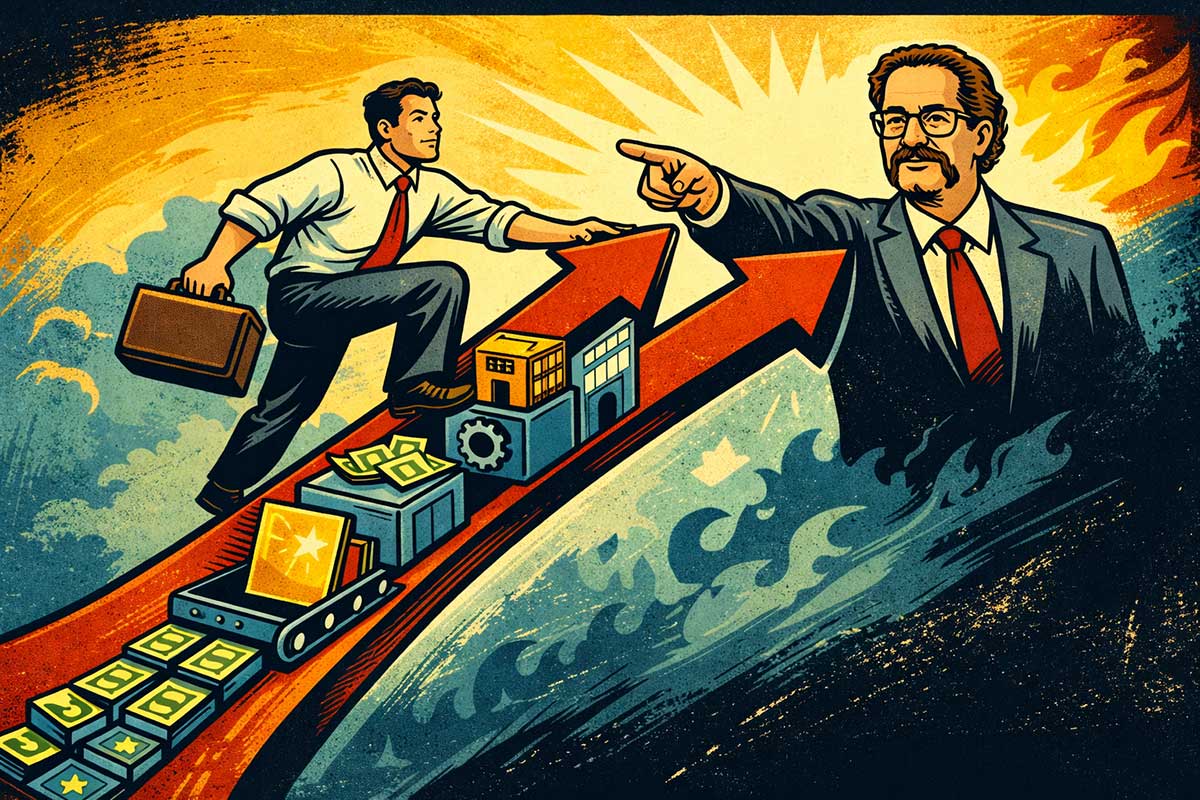
We’ve gone through resistance, identity, behavior, equity, and responsibility. Now we come to the question most entrepreneurs secretly carry through all of it: what actually changes the game? Not in theory, but in real life. Not someday, but over the next year. If a serious entrepreneur wanted to create what Dan Kennedy would call a true surge in wealth, what few shifts would matter most? What needs to stop, what needs to begin, and what has the highest leverage?
Dan S. Kennedy:
Most people are too scattered to create a surge. They do too many things, tolerate too much waste, spend too much time with weak prospects, and keep too many mediocre activities alive. A real wealth surge usually comes from fewer things done with far more force. Better offers. Better clients. Better positioning. Better conversion. Better follow-up. Better pricing. Stronger use of time. The surge is not magic. It is concentrated correction.
Tony Robbins:
Yes, and a surge usually starts with a decision that changes identity. The person stops dabbling, stops hoping, stops negotiating with their old self. They decide that the next year will not be casual. Then state, strategy, and execution line up. A lot of people are not missing opportunity. They are missing emotional certainty and full commitment.
Alex Hormozi:
I’d frame it simply. Wealth surges come from solving bigger problems, for better customers, with better offers, at better margins, with repeatable systems. That’s it. Many entrepreneurs stay stuck because they keep trying to squeeze more money out of weak offers or weak audiences. Fix the economics first. Then scale what works.
Grant Cardone:
And most people are playing way too small. They’re trying to protect energy, protect comfort, protect reputation, protect certainty. But the market pays people who take space, make noise, ask often, follow up hard, and refuse invisibility. If you want a surge, you need more volume, more outreach, more promotion, more action. Most people do not have an opportunity problem. They have an obscurity problem.
Morgan Housel:
I’d add one caution. A surge that creates short-term income but weakens long-term behavior is not a real win. Some people mistake intensity for durability. A true financial surge should strengthen the future, not just create a dramatic month. So I would want any surge plan to include preservation, reserves, discipline, and protection from self-damage.
Question 1 — Which few shifts create the biggest jump in wealth for an entrepreneur?
Nick Sasaki:
Let’s start with the highest-leverage changes. Which few shifts create the biggest jump in wealth?
Alex Hormozi:
The first is improving the offer. Most businesses do not have a traffic problem first. They have an offer problem. If the offer is weak, unclear, too common, badly priced, or not outcome-driven, nothing scales well. A better offer improves conversions, margins, referrals, and customer quality all at once. That’s massive leverage.
Dan S. Kennedy:
Second is moving upstream to better buyers. One of the fastest ways to increase wealth is to stop marketing to people who are hard to persuade, hard to please, and hard to collect from. Better clients buy faster, complain less, stay longer, and refer more. Many entrepreneurs stay poor because they keep selling into the wrong crowd.
Tony Robbins:
Third is raising internal standards. Your income usually follows the quality of what you tolerate. What do you tolerate in your schedule, your body, your focus, your staff, your messaging, your habits, your fear? A surge happens when standards rise so sharply that old patterns can no longer survive.
Grant Cardone:
Fourth is multiplying exposure. More people need to know you exist. More people need to hear your message. More people need to be asked. More follow-up needs to happen. A lot of entrepreneurs are way too passive. They hope the right buyers show up. Go get them. Hit them again. Stay in front of them. Urgency creates opportunity.
Morgan Housel:
Fifth is keeping more of what you make. A surprising number of people increase income without increasing wealth because spending rises with it. A surge that all leaks out into lifestyle is mostly theater. A real surge includes retention of capital, so the new level can turn into lasting strength.
Dan S. Kennedy:
That last point is huge. Many entrepreneurs get a breakthrough and immediately spend as if the breakthrough will now repeat forever. That is naïve and dangerous. A surge should first build cushion, capability, and control.
Question 2 — What should a business owner stop doing immediately if they want financial momentum?
Nick Sasaki:
Now the harder half. What should a business owner stop doing right away if they want momentum?
Dan S. Kennedy:
Stop spending time on low-value tasks that make you feel busy but do not make you money. Stop indulging weak prospects. Stop over-customizing for difficult buyers. Stop endless redesigns, endless brand tinkering, endless learning loops that avoid direct selling. Stop apologizing for the price. Stop talking like a hobbyist.
Grant Cardone:
Stop hiding. Stop waiting for perfect. Stop making one post and acting like you did marketing. Stop assuming one follow-up is enough. Stop thinking “people know what I do.” They don’t. Hit the market harder. Be seen more. Ask more. Close more.
Alex Hormozi:
Stop trying to serve everyone. Narrow the market. Sharpen the problem. Tighten the message. Make the value obvious. Broad weak messaging kills momentum. Strong specific messaging creates it. Stop adding complexity where simplicity would sell better.
Tony Robbins:
Stop letting emotional state dictate execution. If you only work well when inspired, you will never create sustained momentum. The owner has to become bigger than their moods. A business cannot be built on emotional convenience.
Morgan Housel:
Stop treating every good month like proof that the future is secure. That mindset leads to overconfidence, overspending, and fragile decisions. Some restraint is intelligent. Financial momentum is helped by realism.
Dan S. Kennedy:
And stop being too available. Accessibility is often mistaken for service. In reality, it can signal low status, poor structure, and lack of boundaries. Wealth usually rises when value rises, and value often rises when access is structured.
Alex Hormozi:
Yes. Owners should ask, “What is the smallest set of actions that drives most of the money?” Then cut hard around that.
Question 3 — What would a 12-month “wealth attraction” plan actually look like in practice?
Nick Sasaki:
Let’s finish with something concrete. What would a 12-month wealth attraction plan look like for a serious entrepreneur?
Dan S. Kennedy:
Months 1 to 3 should be diagnosis and correction. Fix the offer. Fix the message. Fix the pricing. Identify the best customer. Remove waste. Tighten the calendar. Track the numbers that matter. Create stronger follow-up. Get direct about where the money really comes from.
Alex Hormozi:
I’d make Quarter 1 about economics. Better offer, better margin, better sales process, better customer qualification. Quarter 2 should be about volume and consistency. More outreach, more content, more traffic, more sales opportunities, more tested messaging. Quarter 3 should be about systems and people. Document what works, delegate what can be delegated, build repeatability. Quarter 4 should be about retention of gains: keeping profit, building reserves, reinvesting in the best channels, and preparing the asset for another level.
Grant Cardone:
I’d want daily targets all year. Number of contacts. Number of follow-ups. Number of offers. Number of closes. Number of promotions. Most people are too vague. A surge needs a scoreboard. No scoreboard, no surge.
Tony Robbins:
And the entrepreneur needs rituals that protect state. Morning priming. Physical care. Review time. Recommitment. Weekly truth sessions. Monthly resets. If your psychology falls apart, the plan falls apart. Energy management is not optional.
Morgan Housel:
I’d add rules for money after it comes in. A percentage to reserves. A percentage to reinvestment. A percentage perhaps to asset accumulation outside the business. The point is to avoid success turning into emotional leakage. New income should strengthen the future first.
Dan S. Kennedy:
Exactly. And there must be one strategic question asked repeatedly all year: “What would make this business more valuable as an asset, not just more profitable this month?” That question shifts the owner from operator thinking to wealth thinking.
Alex Hormozi:
That is the big difference. Many owners optimize for cash this week. Smarter ones optimize for lifetime value, margin, systems, retention, brand strength, and transferability.
Grant Cardone:
I still want aggression in it, though. Too many people hear “long-term” and become sleepy. Push hard. Promote hard. Sell hard. Long-term thinking should not become low-energy thinking.
Morgan Housel:
Agreed. Restraint does not mean passivity. It means keeping gains and avoiding self-inflicted fragility.
Tony Robbins:
So the plan becomes inner and outer at the same time: stronger identity, stronger state, stronger standards, stronger offer, stronger execution, stronger stewardship.
Dan S. Kennedy:
Yes. That is what people miss. The wealth surge is not one trick. It is a cluster of corrections that start working together.
Closing
Nick Sasaki:
This final topic answered the question many entrepreneurs care about most. A wealth surge does not usually come from one secret tactic. It comes from concentrated improvement in the few places that matter most.
Morgan Housel:
And from keeping what is gained, so progress becomes durable.
Grant Cardone:
From more action, more visibility, more promotion, and more asks.
Alex Hormozi:
From better economics: better offer, better buyer, better margin, better systems.
Tony Robbins:
From full commitment, raised standards, and the identity shift that says, “This year will be different.”
Dan S. Kennedy:
Exactly. Cut waste. Raise standards. Sell better. Ask more. Price properly. Keep more. Build assets. Strengthen the business as an asset, not just a job. That is how an entrepreneur creates real momentum and turns it into wealth.
Nick Sasaki:
That completes the five-topic arc: hidden resistance, daily behavior, equity, responsibility, and the path to a wealth surge. Together they show that wealth attraction is never passive. It is built through self-command, clarity, usefulness, ownership, and disciplined action.
Final Thoughts by Nick Sasaki:
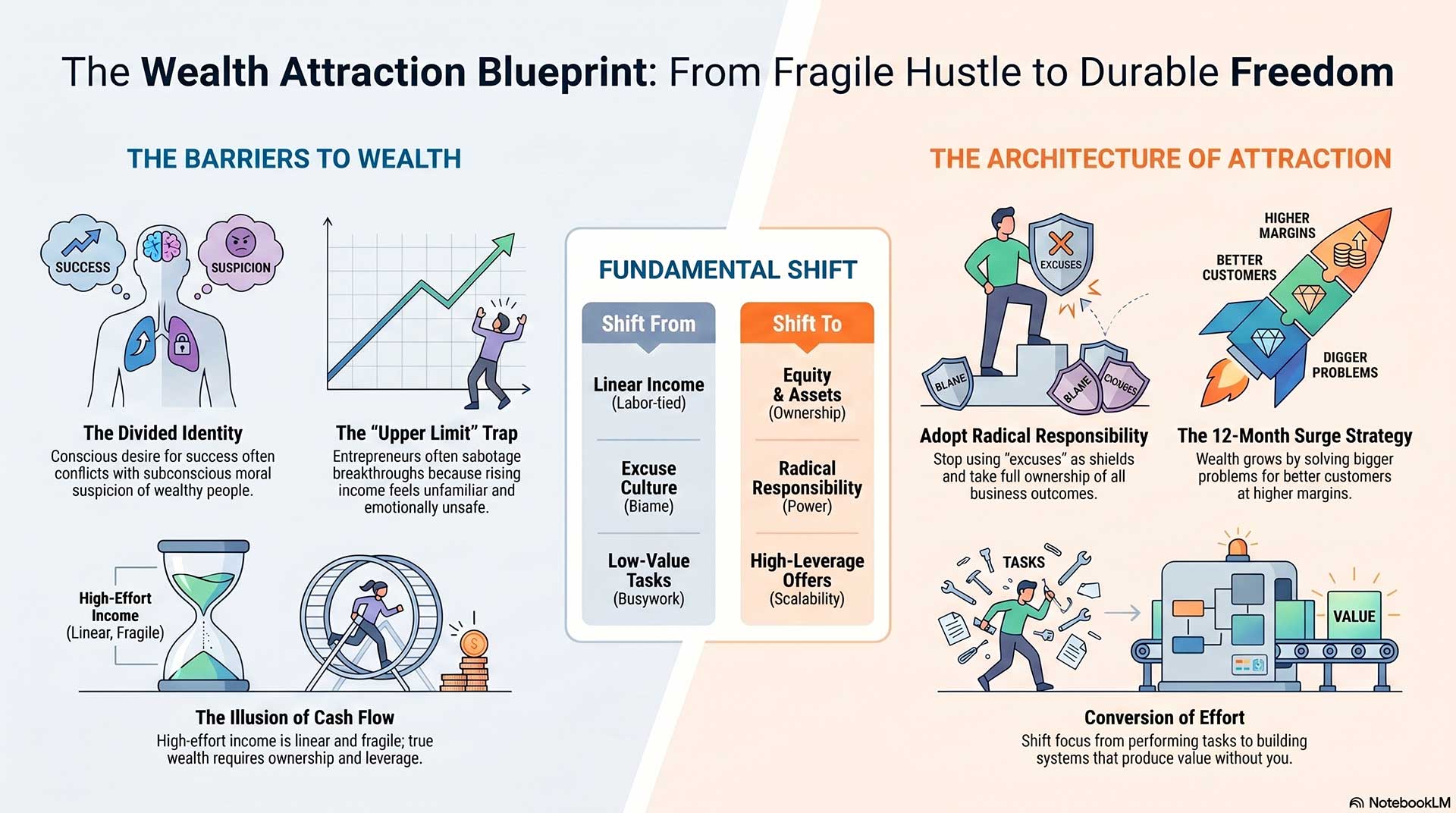
What stayed with me most from this conversation is that wealth is never just a financial outcome. It is a mirror. It reflects beliefs, habits, standards, emotional tolerance, discipline, and the ability to tell the truth about one’s own life. That is what made this discussion feel bigger than business advice.
One major lesson was that many entrepreneurs do not merely lack tactics. They are divided inside. One part wants success, and another part fears what success will expose. That conflict shows up in hesitation, underpricing, distraction, overcomplication, and the strange habit of stepping back just when progress begins. Until that split is faced honestly, even good strategy can be weakened by inner resistance.
Another lesson was that attraction, in serious entrepreneurial life, is tied to conduct. The market responds to value, trust, clarity, conviction, consistency, and problem-solving. It does not reward vague desire for very long. A person becomes more financially magnetic when their behavior becomes stronger, cleaner, and more repeatable. In that sense, wealth attraction is far less mysterious than people often think. It is deeply human, deeply behavioral, and deeply tied to identity.
I was also struck by the repeated contrast between making money and building wealth. That difference may be one of the great dividing lines in entrepreneurial life. Income can create relief. Wealth can create freedom. Income may depend on ongoing effort. Wealth begins to grow through ownership, systems, assets, leverage, and the patient strengthening of what one controls. Many people who look successful from the outside are still far more fragile than they realize.
The conversation on responsibility was probably the hardest, but maybe the most necessary. There is pain in life that no one chooses. There are unfair conditions. There are real burdens. Yet the panel kept returning to one liberating truth: responsibility is not mainly a burden; it is a source of power. The moment a person asks, “What is mine to do now?” the future opens again.
And then there was the final practical point: a true wealth surge does not usually come from one magical insight. It comes from concentrated correction. Raise standards. Sharpen the offer. Move toward better buyers. Stop leaking energy. Stop leaking money. Track what matters. Keep more of what you earn. Build what can outlast your daily effort. Those are not flashy ideas, but they are serious ones.
So perhaps the deepest message from today is this: wealth tends to grow around people who become trustworthy stewards of value, time, opportunity, and responsibility. It is not just about wanting more. It is about becoming more capable of carrying more.
Thank you to Dan S. Kennedy and to all of our guests for helping turn a business book into a much deeper reflection on identity, discipline, freedom, and the architecture of a strong life.
Short Bios:
Dan S. Kennedy
Dan S. Kennedy is a direct-response marketing strategist, business writer, and entrepreneur known for blunt, practical teaching on sales, wealth, positioning, and business growth. His work often pushes entrepreneurs to think with more discipline, more ownership, and less illusion.
T. Harv Eker
T. Harv Eker is a business speaker and author best known for his work on money beliefs, financial conditioning, and the internal “blueprint” people carry about wealth and success.
Gay Hendricks
Gay Hendricks is an author and teacher known for his work on upper-limit problems, self-sabotage, receiving, and human potential. His ideas often focus on why people pull back from greater success, love, or freedom.
Napoleon Hill
Napoleon Hill was an early success thinker and author of Think and Grow Rich. His work focused on desire, belief, organized effort, and the mental patterns that shape achievement.
Thomas J. Stanley
Thomas J. Stanley was a researcher and author best known for The Millionaire Next Door. His work highlighted how real wealth is often built through restraint, discipline, and quiet long-term habits rather than visible status.
James Clear
James Clear is an author and writer known for his work on habits, identity, and steady behavior change. He is best known for showing how small repeated actions can shape long-term results.
Brendon Burchard
Brendon Burchard is an author and performance coach whose work centers on energy, productivity, intention, and high personal standards in work and life.
BJ Fogg
BJ Fogg is a behavior scientist known for research on tiny habits, behavior design, and the role of simplicity in lasting change. His work helps turn large goals into practical daily action.
Robin Sharma
Robin Sharma is a writer and leadership thinker known for themes of self-mastery, discipline, daily excellence, and purposeful living.
Naval Ravikant
Naval Ravikant is an entrepreneur and investor known for clear thinking on leverage, ownership, wealth creation, judgment, and freedom through equity rather than labor alone.
Robert Kiyosaki
Robert Kiyosaki is an entrepreneur and author known for popularizing the contrast between assets and liabilities, earned income and ownership, and the importance of financial literacy.
Codie Sanchez
Codie Sanchez is an investor and business educator known for her focus on ownership, small business acquisition, cash-flowing businesses, and practical wealth building through overlooked assets.
Warren Buffett
Warren Buffett is an investor and business leader widely known for long-term capital allocation, patience, value investing, and the discipline of compounding.
Jocko Willink
Jocko Willink is a leadership teacher, author, and former Navy SEAL officer known for stressing discipline, ownership, and decisive action under pressure.
David Goggins
David Goggins is a former Navy SEAL, endurance athlete, and motivational writer known for his fierce emphasis on self-honesty, toughness, and pushing past self-imposed limits.
Jim Rohn
Jim Rohn was a business philosopher and speaker known for practical wisdom on personal development, responsibility, discipline, and the shaping force of daily habits.
Jordan Peterson
Jordan Peterson is a psychologist and public intellectual known for his focus on responsibility, order, meaning, self-confrontation, and the moral dimension of personal development.
Tony Robbins
Tony Robbins is a business and life strategist known for work on personal change, emotional state, decision-making, and high-performance action.
Alex Hormozi
Alex Hormozi is an entrepreneur, investor, and business educator known for teaching offer creation, value growth, margins, sales, and straightforward business economics.
Grant Cardone
Grant Cardone is a sales trainer, entrepreneur, and real estate investor known for his aggressive views on selling, promotion, visibility, and expansion.
Morgan Housel
Morgan Housel is a financial writer known for his work on behavior, risk, patience, money psychology, and the human side of financial decision-making.
Leave a Reply