

|
Getting your Trinity Audio player ready...
|
Introduction by Nick Sasaki
I grew up not far from Mount Osore—Japan’s famed “Mountain of the Dead.”
To many, it is a remote, desolate place.
To me, it was part of the landscape of my childhood.
The wind that descended from the crater did not sound like ordinary wind.
Sometimes it wailed.
Sometimes it whispered.
And as a child, I often found myself answering it softly, as if the voices it carried were simply trying to be heard.
Years later, I discovered the writings of Lafcadio Hearn, the man who became Koizumi Yakumo.
Through him, I learned that ghost stories are not truly stories about ghosts.
They are stories about human longing—
about love that crosses impossible boundaries,
about sorrow that refuses to fade,
about the thin, trembling line between this world and the next.
Even though Hearn was born far from Japan,
he understood the heart of this land with breathtaking clarity.
And strangely, the emotions woven into his ghost tales felt identical to what I had sensed in the winds of Osorezan since childhood.
This story, “Aoi of the Wind-Hollow Valley,” is my attempt to bring these two worlds together:
the spiritual atmosphere of Osorezan,
and the gentle, uncanny insight Hearn brought to every tale he touched.
Osorezan is a place where beauty and terror coexist.
Where the living speak to the dead,
and the dead sometimes answer.
I invite you to read this story slowly,
and to allow the wind of the mountain—and perhaps Hearn’s spirit—to brush gently against your imagination.
Aoi of the Wind-Hollow Valley
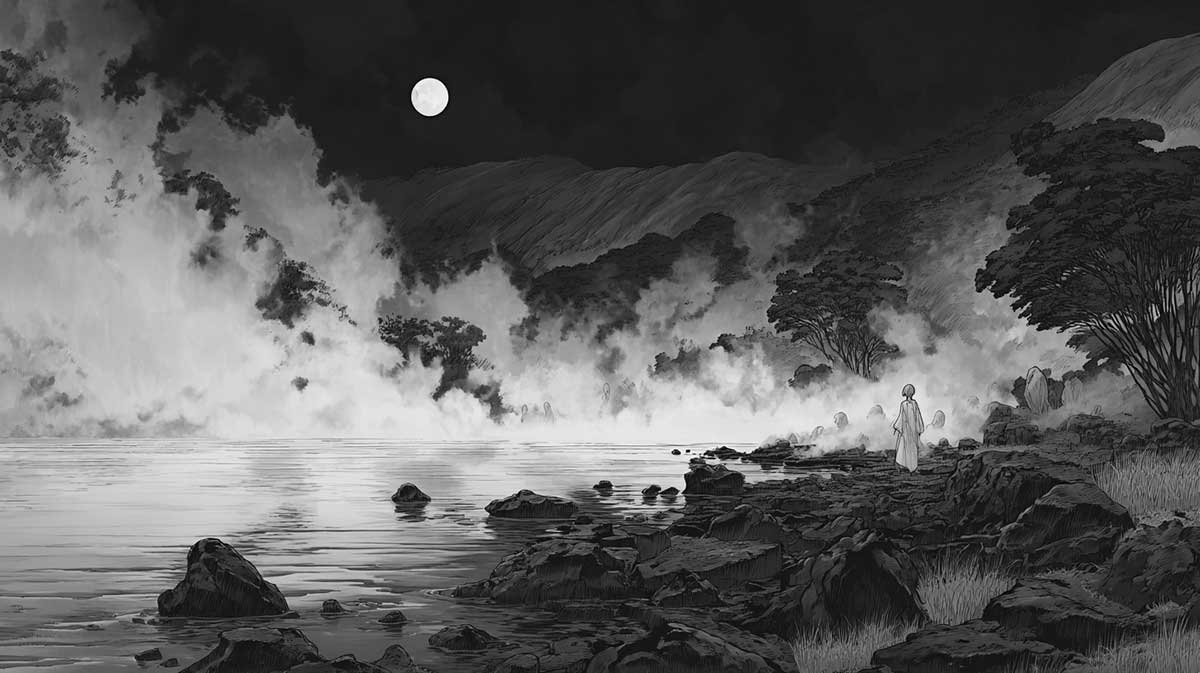
On the pilgrimage road leading toward Mount Osore—Japan’s famed “Mountain of the Dead”—there lies a small hamlet known as Wind-Hollow Valley.
The valley is surrounded by barren volcanic hills, the air thick with sulfur drifting down from Osorezan’s hell-like crater. When winter comes, the wind whistles like crying spirits. Locals call it “the voices of those who failed to cross to the afterlife.”
Tetsuro, a woodcutter living in the valley, encountered the woman on such a night.
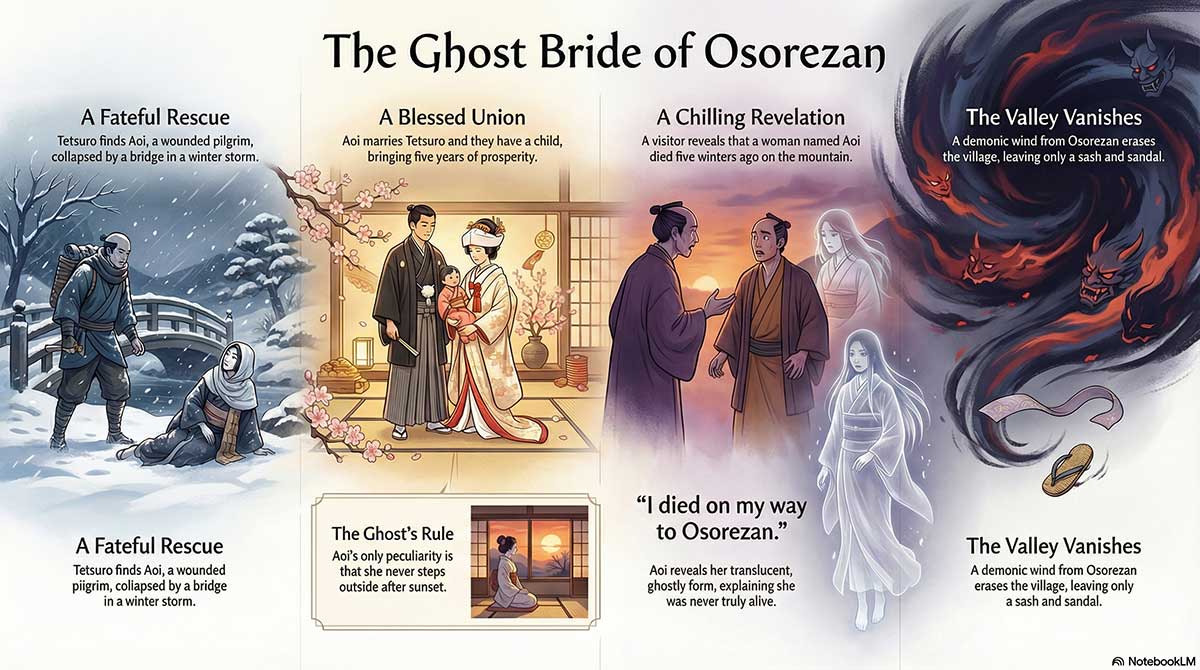
It was five winters ago, during a storm blowing down from Osorezan’s blasted slopes. As Tetsuro made his way home along the frozen path, a faint cry rose from the wind—a cry too human to ignore. Following the sound, he found a collapsed bridge and, beside it, a young woman in a white pilgrim’s robe.
White robes are worn by those making the traditional pilgrimage to Osorezan, a place believed to be the boundary between the living and the dead. For centuries, villagers had feared rejecting a pilgrim, believing it invited “the wind’s curse,” a disaster said to drag entire households into ruin.
The woman’s feet bled from a deep wound, and she drifted in and out of consciousness.
Her only coherent words were fragments:
“…my mother… I must… reach the mountain…”
That alone was enough for Tetsuro. He carried her to his home through the storm.
The doctor who examined her warned that she could not be moved for days.
The roads were buried in snow.
And the valley’s old chief spoke firmly:
“Never turn away a pilgrim bound for Osorezan.
To do so is to anger the mountain.
Its winds do not forgive.”
There were stories—whispered, half-believed—of homes that vanished overnight after refusing shelter to the dying. Whether myth or truth, no one in Wind-Hollow Valley risked testing it.
And so the woman was accepted, naturally, seamlessly, as though fate had pulled her into the village.
For two days she could barely speak. On the third night, sitting by the hearth, she finally responded when Tetsuro gently asked her name. She hesitated, then offered a soft, almost reluctant answer:
“…Aoi.”
In the firelight, she was unearthly beautiful—pale as the mist drifting over Osorezan’s Lake Usoriko, hair as black and fluid as water running over volcanic rock. Her eyes flickered with a strange inner glow, like the faintest reflection of souls said to gather on the mountain.
As she healed, Aoi moved through the household with quiet grace.
She worked, helped, listened, smiled.
The villagers adored her.
Within months, Tetsuro fell deeply in love with her.
And soon enough, Aoi became his wife.
The following year, she bore him a child.
For five years the valley prospered: crops flourished, livestock grew healthy, and even the sick began to recover. The villagers whispered that perhaps a blessing from Osorezan was upon them.
Yet one peculiarity shadowed Aoi:
She never stepped outside after sunset.
When asked why, she would only say, with a strained smile,
“The night wind frightens me.”
The villagers understood.
In this region, the wind after dusk was called “the welcoming wind.”
It was believed to carry the voices of the dead returning to claim what was theirs.
Tetsuro dismissed his unease. Happiness can blind a man to the threads pulling at its seams.
——Everything unraveled in the fifth winter.
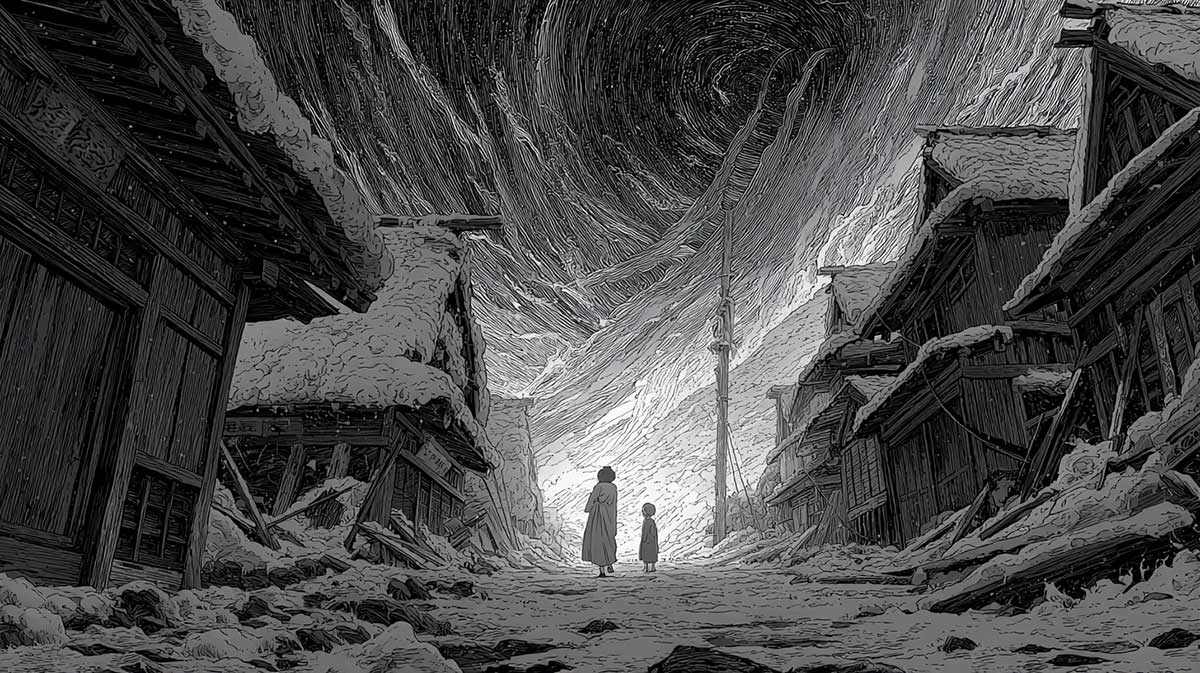
On the morning of Osorezan’s annual opening ritual, a group of pilgrims visited the valley. Among them was an elderly man who asked Tetsuro quietly:
“Tell me… have you heard of a family near here whose daughter died five winters ago?
Her name was Aoi.
In her final moments, through the spirit medium at Osorezan, she cried again and again that she wished she had lived long enough… to bear a child.”
Tetsuro’s heart froze.
That evening, an ominous wind descended from Osorezan’s crater—stronger and more violent than anything the valley had known. Children screamed. Animals thrashed in their stalls. The lamps inside homes flickered and died one by one.
Tetsuro ran home.
Through the window, he saw Aoi holding their child.
Behind her, a towering black shadow leaned over them—shifting, indistinct, with no feet touching the ground.
He burst into the house, but the shadow vanished instantly.
Aoi turned to him, her face softly illuminated by the dying light.
“…So,” she whispered, “you have finally seen what walks behind me.”
Her voice was no longer warm.
She lifted her sleeve.
Her arm shimmered—translucent, wavering—and beneath the skin, pale bones glowed like moonlit coral. Her form seemed held together by will alone.
“I died on my way to Osorezan.
I fell into the river when the wind called my name.
When you carried me home, I was no longer human.”
Tetsuro trembled violently.
“I wanted only one thing,” Aoi continued.
“To live as a woman… beside you.
To hold a child in my arms.
For five borrowed years, I defied the mountain and the winds that guard the boundary.”
She looked past him, toward the door, where the wind shrieked like a hundred voices.
“But Osorezan does not allow its dead to remain.
And those who join the dead—
those who share breath, bed, and blood—
draw the whole valley across the boundary with them.”
The moment she finished speaking, the wind roared with demonic force.
It tore through homes, extinguishing every life in its path.
The villagers’ screams fused with the storm until silence swallowed everything.
By dawn, Wind-Hollow Valley was empty.
Pilgrims passing through found the villagers lying in the snow, faces not twisted in terror but strangely peaceful—as if they had fallen asleep while someone tenderly watched over them.
Outside Tetsuro’s house lay a single white sash and a child’s tiny sandal.
Since that winter, the valley has disappeared from maps.
Travelers approaching Osorezan on stormy nights sometimes report seeing a figure in white wandering the lakeside, cradling a child made of wind and light.
And in the howling air, a woman’s voice murmurs:
“I only wished… to live one more day as a human…”
Final Thoughts by Nick Sasaki
There is something unforgettable about Osorezan.
The cold wind,
the cracked volcanic earth,
the still, unreachable depths of Lake Usoriko—
standing there, you feel both incredibly small and strangely connected to something ancient.
Yet amid all that bleakness, there is also tenderness.
A quiet sense that the living and the dead are not as far apart as we think.
That sorrow and love linger in the same air.
This is the feeling Lafcadio Hearn understood better than anyone:
that ghost stories are not simply meant to frighten us,
but to remind us of the emotions that remain long after a life ends.
In “Aoi of the Wind-Hollow Valley,”
fear, love, grief, and devotion intertwine until they become inseparable—
just as they so often are in real life.
If, after reading this tale,
you feel a faint echo inside your chest,
a quiet lingering note of sadness or beauty,
then perhaps you have heard the same wind I heard growing up—
the same wind Hearn once listened to
as he wrote about the fragile ties between worlds.
Osorezan is not merely a mountain of the dead.
It is a mountain of memory.
A mountain of yearning.
A mountain where stories never quite end.
And if one day the wind there brushes your cheek a little too gently,
know that perhaps…
a story is asking you to remember it.
Short Bios:
Aoi(葵) — The Enigmatic Woman in White
A mysteriously beautiful woman who appears during a blizzard near Mount Osore.
Soft-spoken and gentle, she lives in the village for five years as a devoted wife and mother.
Only later is it revealed that she died as a pilgrim on her way to Osorezan and has been borrowing time from the boundary between life and death.
Her presence brings prosperity, but also an inevitable tragedy tied to the mountain’s spiritual laws.
Tetsuro — The Woodcutter of the Valley
A hardworking, kind-hearted villager who discovers Aoi in the storm and cares for her.
He represents compassion, devotion, and the human desire to protect those we love.
His marriage to Aoi brings five years of happiness, only to end in heartbreaking revelation.
Tetsuro is the emotional anchor of the story—an ordinary man drawn into an extraordinary fate.
The Village Elder — Guardian of Tradition
An old leader who understands the customs, fears, and spiritual boundaries of the region.
He warns that a pilgrim to Osorezan must never be turned away, for it invites the wind’s curse.
His knowledge preserves the cultural memory of the valley and foreshadows the story’s tragedy.
The Pilgrim Elder — Bearer of the Hidden Truth
A wandering pilgrim who arrives five years later and unintentionally reveals Aoi’s true identity.
His words bridge the world of the living with the rituals of Osorezan, bringing clarity—and dread.
He represents the inevitability of truth in stories about spirits and unfinished lives.
The Mountain Wind — The Invisible Enforcer
Not a person, yet a presence.
The wind descending from Osorezan is believed to carry voices of the dead and to enforce the boundary between worlds.
It is the story’s silent antagonist, a force of nature that cannot be reasoned with, only respected.
In the final night, it comes to reclaim what belongs to the mountain.
The Village of Wind-Hollow Valley — A Character in Itself
A remote settlement shaped by superstition, devotion, and fear of the sacred mountain.
Its customs—such as caring for pilgrims—reflect centuries of living at the edge of the spirit world.
The valley embodies fragile coexistence between humans and the unseen.
Nick Sasaki — The Narrator from Osorezan’s Shadow
Born in the same Tohoku region as Osorezan, Nick Sasaki carries within him the winds, silences, and folklore of the North. Influenced by Lafcadio Hearn, he explores the delicate boundary where the living and the unseen briefly touch.
Leave a Reply