
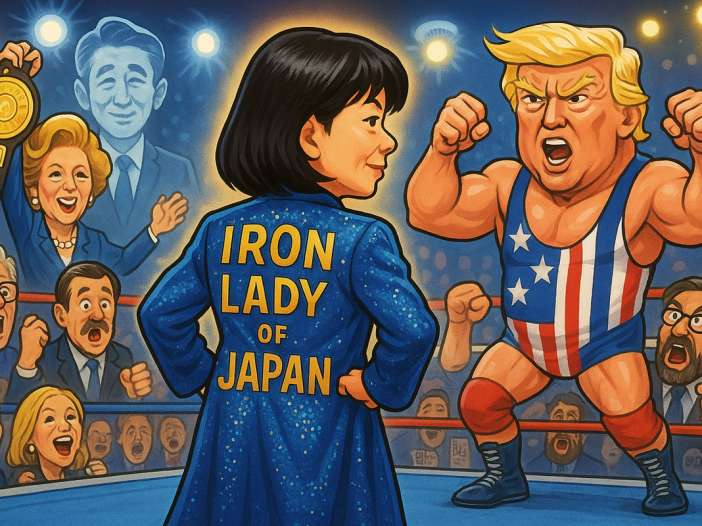

Introduction by Shinzo Abe
When I dedicated my life to public service, my mission was clear: to protect Japan, to restore pride in our identity, and to ensure that our children would grow up in a nation that stands with dignity among the world’s powers. Much was accomplished—strengthening our alliance with the United States, shaping the vision of a Free and Open Indo-Pacific, and reviving our economy through Abenomics.
Yet much remains unfinished. Japan still lives under the constraints of Article 9, our economy still struggles to translate growth into everyday prosperity, and our people still question the meaning of our national identity in a turbulent age.
In this work, Prime Minister Sanae Takaichi now carries forward the torch. She has the courage to confront difficult truths, the resolve to protect our sovereignty, and the conviction to lead with principle. Some compare her to Margaret Thatcher, but I believe she will chart a path that is distinctly her own—firmly rooted in Japan’s traditions, yet boldly engaged with the world.
(Note: This is an imaginary conversation, a creative exploration of an idea, and not a real speech or event)

Topic 1: Carrying Forward Abe’s Legacy — National Security & Constitutional Reform

Moderator: Karen Armstrong
Opening
Karen Armstrong:
Prime Minister Abe often spoke of Japan as a “beautiful country” that must stand strong and proud in the world. His tragic passing left behind not just grief, but unfinished work, particularly in the areas of national security and constitutional reform. Today, I’d like to begin by asking each of you: what does it truly mean to carry forward Abe’s legacy in these areas?
Question 1: What aspects of Abe’s national security vision remain most urgent for Japan today?
Sanae Takaichi:
Abe-sensei believed Japan must never again be defenseless. His greatest unfinished mission was amending Article 9 of the Constitution so our Self-Defense Forces could be recognized for what they are: a legitimate military protecting the nation. The world has grown far more dangerous since his time—Ukraine, Taiwan Strait, the rise of North Korea’s missiles. For me, carrying on his vision means not only reform but investing in deterrence—cyber, space, and advanced technologies.
Shinzo Abe (legacy voice):
If I may, my intent was never to discard pacifism, but to ensure pacifism was credible. A pacifism without strength invites aggression. I urged Japan to move from “client state” dependency on America toward a more equal alliance. Sanae’s determination to recognize the SDF constitutionally honors that intent.
John Bolton:
From Washington’s perspective, Abe was the most strategic Japanese leader since the war. He pushed for the Quad, a framework now indispensable against Chinese aggression. What remains urgent? Missile defense integration, closer U.S.–Japan operational planning, and yes, constitutional reform so that Japan is not shackled by outdated legal fictions.
Tomomi Inada:
As a younger member of the LDP during Abe’s leadership, I admired how he fused conservatism with a vision of national dignity. What remains urgent now is not just legal change, but cultural change. Our people must shed the fear that asserting ourselves means repeating past mistakes. Abe wanted us to move from apology to responsibility.
Shigeru Ishiba:
I respect Abe’s contributions, but I must emphasize balance. National security isn’t only about weapons or constitutions—it’s also about diplomacy and trust. We must ensure reforms do not alienate our neighbors unnecessarily. If carrying forward Abe’s legacy means strength, then it must also mean prudence.
Question 2: Constitutional reform has been attempted for decades. What will it take, finally, to succeed?
Shinzo Abe (legacy voice):
I struggled to gain public consensus, not for lack of conviction but because of fear and misunderstanding. Success requires leadership that can persuade the people this is not a march toward militarism, but a safeguard for peace.
Sanae Takaichi:
That is precisely my mission. It will take honesty with the Japanese people. We must show them Article 9 is not protecting peace; it is denying reality. Our SDF already act as a military—flying, sailing, defending. To succeed, we need three things: coalition unity, public education, and a clear timeline. I am prepared to pursue all three.
Tomomi Inada:
And we must not underestimate the symbolic power of women in this debate. When a conservative woman advocates reform, it disarms critics who claim this is simply macho nationalism. Abe paved the road; Sanae has the chance to walk it further.
John Bolton:
From the U.S. view, it will also take regional crises to shift public opinion. Unfortunately, history shows that peace is rarely defended without some wake-up call. If North Korea launches another nuclear test, or if China pressures Taiwan further, Japan will recognize the urgency. Leaders must be ready when that moment comes.
Shigeru Ishiba:
But we must be careful: forcing reform could fracture the nation. Success must be achieved by consensus, not by ramming through legislation. It requires building trust—between parties, with the public, even with civil society groups deeply skeptical of change. That is the only way reform will endure.
Question 3: If Abe’s legacy was about “a beautiful, strong Japan,” what does that look like in practice under today’s challenges?
Tomomi Inada:
For me, it is a Japan where young people are proud of their flag, their anthem, their defense forces. A Japan that stands shoulder-to-shoulder with allies in defending democracy, without shame or hesitation. Beauty comes from confidence.
John Bolton:
I would put it more bluntly: a strong Japan is one that carries its fair share. America cannot and should not bear the Indo-Pacific burden alone. Abe understood this, Trump understood this, and I hope Prime Minister Takaichi does as well.
Sanae Takaichi:
A beautiful Japan is one that is safe for families, innovative in science, respected abroad, and unafraid of responsibility. Strength is not for war, but for protection—of our sovereignty, our way of life, and our partnerships. Abe’s dream will guide me, but my generation must adapt it to new realities.
Shigeru Ishiba:
I would add: a strong Japan is not merely a fortress. It must also be a bridge. Security is not only military—it is also diplomacy, energy, food. We must secure ourselves without isolating ourselves. Abe sought balance; we must do the same.
Shinzo Abe (legacy voice):
My hope was always that Japan would walk with dignity into the future. A nation at peace with its past, yet resolute in its defense of freedom. If Sanae and her generation can achieve this, then my work will have meaning.
Closing Reflection
Karen Armstrong:
What I hear from each of you is that Abe’s legacy is not a single policy, but a vision—of strength that sustains peace, of reform that faces reality, of dignity restored to a nation long hesitant about its own identity. The challenge now is whether Japan can move from memory into action.
Topic 2: The Thatcher Parallel — Female Conservative Leadership

Moderator: Karen Armstrong
Opening
Karen Armstrong:
Prime Minister Takaichi, much has been made of your admiration for Margaret Thatcher. Japan has never had a long-serving conservative woman at the helm, and many wonder how your leadership might echo or diverge from hers. I’d like to begin with a simple but profound question: what does Thatcher represent to you, and how might her example resonate in Japan’s political climate today?
Question 1: What lessons from Margaret Thatcher are most relevant for Japan’s first female conservative prime minister?
Margaret Thatcher (legacy voice):
Leadership requires conviction. When I was called the “Iron Lady,” I wore it as armor. A nation adrift must be given firm direction, not endless compromise. Japan’s politics, like Britain’s in my day, risks drowning in hesitation. The lesson is simple: lead with clarity, and never apologize for strength.
Sanae Takaichi:
I have studied Thatcher closely. What I admire most is her courage to make unpopular decisions for the sake of the nation’s long-term health. In Japan, people expect consensus and harmony. Yet sometimes harmony delays solutions. To honor her, I must balance our culture’s preference for consensus with the courage to act decisively.
Condoleezza Rice:
From my perspective, Thatcher’s legacy is also about legitimacy as a woman in power. She didn’t lean on her gender; she leaned on results. For Takaichi-san, the challenge is similar. She will not succeed because she is Japan’s first conservative woman prime minister. She will succeed if she delivers security, prosperity, and trust.
Seiko Noda:
I must voice caution. Thatcher was transformational but also divisive. Japan is not Britain. Here, our society values social cohesion far more than confrontation. If Prime Minister Takaichi imitates Thatcher too literally, she risks fracturing the very harmony she seeks to protect.
Nikki Haley:
I’d say Thatcher showed that conservative women can redefine the battlefield. In America, I’ve often had to prove I could be tough without losing compassion. Thatcher excelled at that balance. Takaichi-san has the opportunity to show Japan that a woman can be both principled and patriotic, firm yet maternal.
Question 2: In such a male-dominated political culture, how can a woman lead without being either dismissed as weak or demonized as too harsh?
Sanae Takaichi:
This is the paradox. If we show softness, we are dismissed. If we show firmness, we are feared. My approach is to ground decisions in principle, not personality. I am not trying to be “the female Abe” or “Japan’s Thatcher.” I am Sanae Takaichi. But yes, I will wield conviction, even if some call me severe.
Seiko Noda:
Yet you must remember: Japanese voters still measure women by different standards. I know this from my own career. To survive, you must humanize yourself constantly—through family, through community, through small gestures that remind people you are not distant. Thatcher had her teacup; perhaps you must find your own cultural symbol of accessibility.
Nikki Haley:
Exactly. I learned early that voters want both strength and connection. When I visited military families or small businesses, I made sure they saw me not just as a politician, but as a mother and daughter of immigrants. For you, Prime Minister, your story—your struggles—can bridge that gap. Don’t hide them.
Condoleezza Rice:
In the U.S., I found that expertise was my shield. No one could dismiss me if I was the most prepared person in the room. For Takaichi-san, mastering security policy, economics, and diplomacy at the highest level is essential. A woman leader in a male-dominated system cannot rely on charm. She must outmatch in competence.
Margaret Thatcher (legacy voice):
Do not bend to their expectations. If they call you shrill, it is because they fear your clarity. If they call you cold, it is because they cannot ignore your firmness. Lead, and let the names fall away. History will vindicate you, as it did me.
Question 3: If Thatcher’s Britain was about breaking decline, what might Takaichi’s Japan symbolize in today’s global order?
Condoleezza Rice:
I believe Takaichi’s Japan could symbolize resilience. Japan has endured economic stagnation, demographic decline, and geopolitical pressure. To rise now under female conservative leadership would show that democracies can reinvent themselves even in adversity. That is a message the world desperately needs.
Sanae Takaichi:
My hope is that Japan can symbolize dignity restored. For too long, we have apologized for our past and hesitated in the present. I want our people to feel pride—not arrogance, but pride. Pride in our culture, our families, our defense, and our contribution to world peace.
Nikki Haley:
And Japan could be a model of conservative female leadership in Asia. In many parts of the world, women still face skepticism when they lead with firmness. Your example could inspire beyond Japan—showing that tradition and progress can coexist.
Seiko Noda:
I see another possibility: Japan as a bridge-builder. In a divided world, perhaps what distinguishes Takaichi’s leadership is not confrontation, but reconciliation. Thatcher revived Britain through conflict; maybe Takaichi revives Japan through balance. That could be her unique legacy.
Margaret Thatcher (legacy voice):
Do not underestimate the weight of precedent. When I stood against decline, I did not merely save Britain—I redefined what was possible. If you succeed, Takaichi, you will not only reshape Japan, you will expand the horizon of women in politics everywhere.
Closing Reflection
Karen Armstrong:
What I hear is both inspiration and caution. Thatcher’s shadow looms large: her courage, her steel, her divisiveness. But perhaps the true lesson is not imitation, but adaptation. Prime Minister Takaichi, your leadership may prove that Japan can honor tradition while embracing transformation, that strength can wear many faces—even, at long last, a woman’s.
Topic 3: Japan–U.S. Conservative Axis with Trump’s America

Moderator: Karen Armstrong
Opening
Karen Armstrong:
Prime Minister Takaichi has expressed her desire to strengthen ties with the United States, particularly under President Trump’s leadership. With the Indo-Pacific at the center of global tensions, the idea of a Japan–U.S. conservative axis raises both excitement and concern. Let’s begin by asking: what is the true potential of this partnership, and what dangers does it hold?
Question 1: What would a deeper U.S.–Japan conservative alliance look like in practice?
Donald J. Trump (47th President of the United States):
Well, let me tell you, Prime Minister Takaichi is a fantastic woman, very strong, very smart. The alliance has to be about fairness—Japan paying more for its defense, absolutely—but also about strength. Together, we can show China, North Korea, and anyone else that freedom-loving nations won’t be pushed around. It’s about power, not weakness.
Sanae Takaichi:
For me, deepening our alliance means coordination at every level—diplomatic, military, and technological. But it also means equality. We cannot remain forever the junior partner. If I work closely with President Trump, it will be as allies who share responsibilities, not as dependent and protector.
Mike Pompeo:
From my time as Secretary of State, I can tell you that the key is shared strategy. A conservative axis isn’t just symbolism—it’s alignment. Japan must be ready to act decisively in defense of Taiwan, freedom of navigation, and the rules-based order. If Trump returns to office, Takaichi will have the chance to make Japan indispensable.
Yoshihide Suga:
I appreciate the vision of strength, but as prime minister I learned that alliances must also be trusted by the Japanese people. If we appear too dependent on a single American leader, public skepticism will grow. A deeper alliance must be institutional, not just personal.
Steve Bannon:
Let’s not kid ourselves. This is about a civilizational struggle. Globalists want to weaken sovereign nations. A conservative axis between Trump’s America and Takaichi’s Japan could be a model for national revival. This isn’t just about missiles—it’s about culture, family, and sovereignty. That’s the real alliance.
Question 2: What risks could come from tying Japan’s future so closely to Trump’s America?
Yoshihide Suga:
The risk is volatility. American politics swings sharply. If Japan ties itself too closely to one leader, we risk instability when leadership changes. Our alliance must be strong regardless of who occupies the White House. Otherwise, Japan will look shortsighted.
Sanae Takaichi:
I understand the concern. Yet, President Trump represents a movement, not just a man. His policies on China, North Korea, and fairness in trade resonate with Japan’s interests. My task is to safeguard continuity—ensuring that no matter who governs America, our shared goals endure.
Donald J. Trump:
Look, people say I’m unpredictable. But I was tough, I was fair, and I kept the world safe. Under Biden, the world is a mess. Japan knows I’ll always be strong against China. That’s not risk—that’s reliability.
Mike Pompeo:
Still, the risk is real. If American leadership pulls back from global commitments, Japan may find itself carrying more burden than expected. That’s why Japan must prepare to defend itself fully, not simply rely on U.S. guarantees.
Steve Bannon:
The greatest risk isn’t Trump—it’s the globalist establishment that fears this alliance. They will smear, undermine, and attack it. Japan must decide: Will it be part of a sovereign renaissance, or will it cling to a failing liberal order? That is the true danger.
Question 3: If a Japan–U.S. conservative axis emerges, how might it reshape the Indo-Pacific and the world?
Mike Pompeo:
Such an axis could anchor the free world in Asia. Imagine: Japan rearmed and confident, America committed and decisive. Together, they would deter China, strengthen Taiwan, and create a bulwark for liberty in the Indo-Pacific. This would reshape the balance of power for decades.
Sanae Takaichi:
I see it not just as military, but as moral leadership. Japan and America could champion family values, economic freedom, and the dignity of nations. If we succeed, the Indo-Pacific would not be ruled by fear of Beijing, but by cooperation rooted in sovereignty.
Steve Bannon:
And let’s not stop at Asia. A Japan–U.S. axis could inspire Europe’s conservatives, Africa’s nationalists, and Latin America’s patriots. This is about a global revolt against decline. If Tokyo and Washington stand together, it could be the tipping point.
Donald J. Trump:
Exactly right. People forget—I brought North Korea to the table. I stood up to China. With Prime Minister Takaichi, we could do even more. Japan is a tremendous ally, and together we’ll keep the world safe. Tremendous things will happen.
Yoshihide Suga:
I must stress balance. An axis can bring strength, but it must not lead to escalation. Japan’s future lies not only in deterrence but in diplomacy. The world will judge us not only by how strong we are, but by how wisely we use that strength.
Closing Reflection
Karen Armstrong:
What emerges from this discussion is both promise and peril. A Japan–U.S. conservative axis could become a pillar of global order—or a lightning rod for division. For Prime Minister Takaichi, the challenge is not only to walk in Abe’s and Trump’s footsteps, but to ensure that the alliance serves Japan’s sovereignty and the world’s stability.
Topic 4: “Sanaenomics” vs. Abenomics — Conservatism & Economy

Moderator: Karen Armstrong
Opening
Karen Armstrong:
Abenomics reshaped Japan’s economy through monetary easing, fiscal stimulus, and structural reforms, but it left behind mixed results—rising asset prices but stagnant wages. Prime Minister Takaichi now faces the challenge of defining her own path, sometimes called “Sanaenomics.” Let’s begin by asking: what should differentiate Sanaenomics from Abe’s vision?
Question 1: How should Sanaenomics improve upon the strengths and weaknesses of Abenomics?
Shinzo Abe (legacy voice):
My program was designed to break deflation. We succeeded in weakening the yen, boosting exports, and reviving corporate profits. Yet, I acknowledge wages lagged behind. For Sanae, the task is not to dismantle what worked, but to ensure that prosperity reaches the household table.
Sanae Takaichi:
Exactly. Abenomics was bold, but incomplete. My focus is to shift from financial markets to families. That means supporting wage growth through tax incentives, investing in childcare, and ensuring that small businesses—not only corporations—can thrive. Where Abe-sensei laid the foundation, I must build a home where every citizen feels secure.
Heizo Takenaka:
From my reformist perspective, Abenomics leaned too heavily on monetary policy and neglected structural change. Sanaenomics should be about deregulation, labor mobility, and digital transformation. Without tough reforms, Japan risks repeating its cycle of stagnation.
Arthur Laffer:
As an economist, I’ll be blunt: cutting taxes works. Abe kept the consumption tax too high. Sanaenomics should reduce taxes, particularly on consumption and corporate investment. Growth comes when people keep more of what they earn. Japan must trust in incentives, not bureaucracy.
Taro Kono:
But cutting taxes alone is not a panacea. We need innovation. Abe launched “Society 5.0” but never fully realized it. Sanaenomics should prioritize renewable energy, AI, and biotech. Japan’s challenge is not just fiscal—it’s whether we can lead in the technologies of the future.
Question 2: What concrete policies could make Sanaenomics unique and credible in the eyes of the Japanese people?
Arthur Laffer:
Start with a bold signal: slash the consumption tax, even temporarily. Let ordinary citizens feel relief instantly. Nothing builds credibility faster than money back in people’s wallets.
Sanae Takaichi:
While tax relief is vital, credibility also comes from stability. I would channel subsidies into fuel, food, and healthcare costs. At the same time, I propose a “Family First Policy Package”—child allowances, support for elderly caregivers, and wage subsidies for SMEs. People will know that Sanaenomics means daily security, not just abstract growth.
Heizo Takenaka:
Credibility also requires discipline. Japan’s debt is massive. Sanaenomics must introduce fiscal rules tied to growth—commitments that debt only rises if GDP does too. Without such a framework, markets will doubt her seriousness.
Shinzo Abe (legacy voice):
Credibility rests on vision. My slogan was “Japan is Back.” Sanae must craft her own. If she presents Sanaenomics as a shield for households, a ladder for youth, and a promise for aging parents, she will inspire confidence beyond numbers.
Taro Kono:
And let’s not forget transparency. In an age of distrust, Sanaenomics must publish clear, real-time data: how subsidies are spent, how wages are rising, how debt is evolving. If people can see results on their smartphones, they will believe.
Question 3: If Sanaenomics succeeds, how will Japan’s economic identity change in the global order?
Sanae Takaichi:
It will mean that Japan is not simply the land of deflation and decline, but a model of balanced conservatism—strong in innovation, firm in family values, secure in finances. We will show the world that tradition and modernity can thrive together.
Heizo Takenaka:
Success would also mean Japan finally escaping the “lost decades.” If we become the test case for combining tech innovation with fiscal responsibility, Japan could inspire Europe’s stagnant economies and even influence U.S. debates.
Arthur Laffer:
And globally, it would prove that growth comes from freedom, not from state micromanagement. Sanaenomics could be remembered as Japan’s Reaganomics moment—proof that incentives and lower taxes can revive a mature economy.
Shinzo Abe (legacy voice):
For me, success would mean continuity. That Japan did not abandon my vision, but carried it into a new chapter. If Sanae builds a society where growth reaches every family, then the story of Abenomics and Sanaenomics will be one story of national renewal.
Taro Kono:
But let us be honest: success will also redefine Japan’s diplomacy. A prosperous, innovative Japan can lead the Indo-Pacific alongside America. Sanaenomics is not only about GDP—it is about strategic influence. Economic identity is foreign policy.
Closing Reflection
Karen Armstrong:
From this conversation, Sanaenomics emerges not as a rejection of Abenomics but as its evolution—from markets to families, from stimulus to security, from vision to credibility. The question now is whether Japan is ready to embrace bold change while holding fast to responsibility.
Topic 5: Japan’s Identity in a Fragmenting World Order

Moderator: Karen Armstrong
Opening
Karen Armstrong:
The world today is marked by fragmentation—China’s rise, Russia’s aggression, America’s divisions, Europe’s uncertainty. In this environment, Japan under Prime Minister Takaichi faces a profound question: what identity should the nation embrace? Let us explore how Japan defines itself, not just for its people, but for the world.
Question 1: What is Japan’s role in a world where alliances and values are fracturing?
Henry Kissinger (legacy voice):
Japan’s destiny has always been to balance power in Asia. In a fragmenting order, Japan must serve as both ally of the United States and stabilizer of the region. It should not define itself merely as a junior partner, but as a strategic pivot whose diplomacy maintains equilibrium between confrontation and peace.
Sanae Takaichi:
I believe Japan must embrace sovereignty and leadership. No longer can we hide behind pacifism or rely solely on others. Our role is to defend freedom in the Indo-Pacific and to stand as a cultural model of resilience—rooted in tradition, yet forward-looking in technology and democracy.
Yuval Noah Harari:
From a historian’s view, Japan is fascinating. It is both ancient and modern, isolated yet global. In a fragmenting world, its role may be to show how identity can be plural—how a nation can honor tradition without being consumed by nationalism. That example could help prevent further global disintegration.
Marine Le Pen:
I would add that Japan’s role is also to resist globalism. Nations must not dissolve into bureaucratic empires. Just as France must defend sovereignty, Japan must do the same. By asserting cultural and political independence, Japan strengthens not only itself but also the principle of the nation-state worldwide.
Fumio Kishida:
I take a more cautious view. Japan’s role is to be a bridge. Fragmentation is dangerous, and nationalism alone cannot resolve it. Our diplomacy must emphasize dialogue, aid, and shared prosperity. Japan should not only defend itself but also mediate between divided powers.
Question 2: How should Japan reconcile nationalism with its need for international cooperation?
Yuval Noah Harari:
Nationalism can be both a shield and a prison. Japan must be careful not to trap itself in myths of the past. The only sustainable nationalism today is one that is open—where pride in identity coexists with cooperation on climate, technology, and health. Otherwise, nationalism becomes isolation.
Sanae Takaichi:
I understand this balance well. I do not seek nationalism as exclusion, but as dignity. Cooperation is vital—we must work with America, Europe, and Asia—but cooperation without self-respect is weakness. My nationalism is not hostility, but pride that enables equal partnerships.
Marine Le Pen:
But let us be honest: international cooperation has too often meant surrendering sovereignty to unelected bodies. Japan must defend its own interests first. Yes, cooperate—but only on terms that respect national identity. That is true independence.
Fumio Kishida:
Cooperation and nationalism can coexist, but only through trust. Japan must show that its leadership is not merely self-serving. We gain legitimacy when we invest in development, disaster relief, and peacebuilding. Our neighbors will accept a proud Japan if it is also a generous Japan.
Henry Kissinger (legacy voice):
History teaches us that identity is sharpened by challenge. Japan must embrace its nationalism quietly, with restraint, and project cooperation as strategy. National pride without diplomatic tact leads to conflict. National pride with cooperation leads to leadership.
Question 3: If Japan defines its identity now, what should the world see in it ten years from today?
Marine Le Pen:
The world should see Japan as a sovereign nation that refuses to be absorbed into global uniformity. A Japan proud of its culture, protective of its borders, and fearless in defending its people.
Fumio Kishida:
I hope the world sees a Japan that is trusted—a nation that combines strength with compassion, technology with humanity. In ten years, our identity should be as a reliable partner that brings stability wherever it engages.
Yuval Noah Harari:
I would like the world to see Japan as a paradox resolved. A society that has blended tradition and modernity without collapse, that has shown humanity can live with roots and wings at once. That would inspire others facing similar identity crises.
Sanae Takaichi:
I want the world to see Japan as dignified, resilient, and indispensable. A nation that overcame decades of hesitation, that found pride in its history and purpose in its future. A Japan that leads by example: strong in defense, generous in peace, confident in itself.
Henry Kissinger (legacy voice):
If Japan achieves this, it will no longer be defined by its past wars or its postwar weakness, but by its role in sustaining the fragile balance of our century. That is the highest calling: to transform identity into stability for the world.
Closing Reflection
Karen Armstrong:
What we discover here is that Japan’s identity cannot be one-dimensional. It must be sovereign, but not isolated; proud, yet cooperative; strong, but restrained. For Prime Minister Takaichi, the task is not only to inherit Abe’s vision but to shape Japan into a model of dignity in a fractured age. The world will watch to see if Japan becomes fortress, bridge, or paradox—but perhaps, in time, it will become all three.
Final Thoughts by Shinzo Abe
History will not remember us for the challenges we faced, but for how we responded to them. Japan’s path has never been easy—our geography, our neighbors, our past, and our responsibilities all demand vigilance and vision. But I believe that with courage, Japan can rise to meet every test.
Sanae Takaichi stands at a turning point. She must not simply inherit what I began, but build upon it—transforming Japan into a nation that is secure in its defense, prosperous in its economy, and confident in its identity.
If she succeeds, Japan will no longer be seen only as a follower or a former great power, but as a leader—indispensable to the stability of Asia and to the hope of the world. That is the Japan I dreamed of. That is the Japan I entrust to her generation.
Short Bios:
Sanae Takaichi
Japan’s Prime Minister in 2025, long-time conservative lawmaker in the Liberal Democratic Party. Protégé of Shinzo Abe, she is known for her firm stance on national security, constitutional reform, and economic conservatism, earning comparisons to Margaret Thatcher as Japan’s “Iron Lady.”
Shinzo Abe
Japan’s longest-serving Prime Minister (2006–2007, 2012–2020). Architect of “Abenomics” and proponent of a Free and Open Indo-Pacific strategy. Remembered for his push toward constitutional reform and strengthening Japan–U.S. ties, he remains a mentor figure to Takaichi.
Margaret Thatcher
Prime Minister of the United Kingdom (1979–1990). Nicknamed the “Iron Lady,” she championed free-market reforms, strong national defense, and conservative values, inspiring generations of female leaders worldwide, including Takaichi.
Donald J. Trump
47th President of the United States, noted for his nationalist “America First” policies, unconventional diplomacy, and tough stance on China. Maintains close symbolic ties with conservative leaders like Abe and Takaichi.
Mike Pompeo
U.S. Secretary of State under Trump (2018–2021), previously CIA Director. Advocated for a strong Indo-Pacific strategy and was key in countering Chinese influence.
Steve Bannon
Former White House Chief Strategist under Trump. Known for his populist and nationalist worldview, he promotes sovereign identity politics and opposes globalist institutions.
Yoshihide Suga
Prime Minister of Japan (2020–2021), successor to Abe. Focused on domestic reform and pandemic response, representing a pragmatic and centrist conservative approach.
Tomomi Inada
Japanese LDP politician and former Defense Minister. A strong nationalist voice, she supports constitutional reform and has often stood alongside Abe and Takaichi.
Shigeru Ishiba
Veteran LDP politician and former Defense Minister. Known for his expertise in security issues and his occasional rivalry with Abe’s faction.
Condoleezza Rice
U.S. Secretary of State (2005–2009) under President George W. Bush. A pioneering African-American woman in foreign policy, she emphasized democracy promotion and strong alliances.
Nikki Haley
Former U.S. Ambassador to the United Nations (2017–2018) under Trump, and former Governor of South Carolina. Seen as a rising conservative leader with foreign policy expertise.
Seiko Noda
Japanese LDP politician and advocate for women’s rights within the party. Often contrasts with Takaichi in style and emphasis, representing a softer conservative image.
Heizo Takenaka
Japanese economist and Cabinet minister under Prime Minister Junichiro Koizumi. Prominent advocate for structural reforms and deregulation.
Arthur Laffer
American economist, famous for the “Laffer Curve” theory linking lower tax rates to higher revenue. Influential in Reagan-era economics.
Taro Kono
Japanese LDP politician, known for his reformist and sometimes maverick positions. Has served as Foreign and Defense Minister, advocating modernization and innovation.
Henry Kissinger
U.S. Secretary of State (1973–1977). Architect of realpolitik diplomacy, noted for opening U.S.–China relations and balancing Cold War power politics.
Yuval Noah Harari
Israeli historian and author of Sapiens and Homo Deus. Offers global philosophical perspectives on nationalism, identity, and the future of humanity.
Fumio Kishida
Prime Minister of Japan (2021–2025). Known for his moderate diplomacy and “New Capitalism” economic vision, providing contrast to Takaichi’s conservatism.
Marine Le Pen
Leader of France’s National Rally party. Advocate for nationalism, sovereignty, and resistance to EU centralization, she symbolizes the rise of right-wing populism in Europe.
Karen Armstrong
British author and former nun, renowned for her works on comparative religion, history, and spirituality. Known for books such as A History of God and The Battle for God, she advocates for compassion as a central principle across faith traditions. In this series, she serves as a thoughtful moderator, guiding complex political and philosophical discussions with balance and depth.
Leave a Reply